

Crypto World
talent exodus sparks fresh debate over foundation leadership



The departures also come as the foundation has unveiled a new strategic framework known as “CROPS,” an acronym standing for cypherpunk values, resilience, open-source development, permissionlessness and security. Foundation leaders presented the framework as a way to clarify the EF’s mission and reinforce Ethereum’s core values as the ecosystem becomes increasingly decentralized. Supporters viewed it as a reaffirmation of Ethereum’s founding principles, while critics argued it did little to address concerns about execution, organizational effectiveness and the network’s competitive position.
Among the most vocal critics was former Ethereum researcher Dankrad Feist, who suggested the recent spate of executive departures reflected deeper management issues rather than disagreements over strategy.
“The people who are leaving the Ethereum Foundation are CROPS believers,” Feist wrote on X. “The problem isn’t with the strategy, it’s with management.”
Feist’s comments were notable because they challenged the prevailing idea that recent departures stemmed from dissatisfaction with the foundation’s new direction. Instead, he argued that many of those leaving supported the CROPS vision itself, making the loss of talent a reflection of leadership shortcomings rather than ideological disagreements. “The exodus of talent is truly bearish for Ethereum, sadly,” he added.
Other community members echoed concerns about the Foundation’s internal dynamics. “It makes me sad to see the dysfunction at the Ethereum Foundation,” head of engineering at Coinbase Yuga Cohler wrote on X.

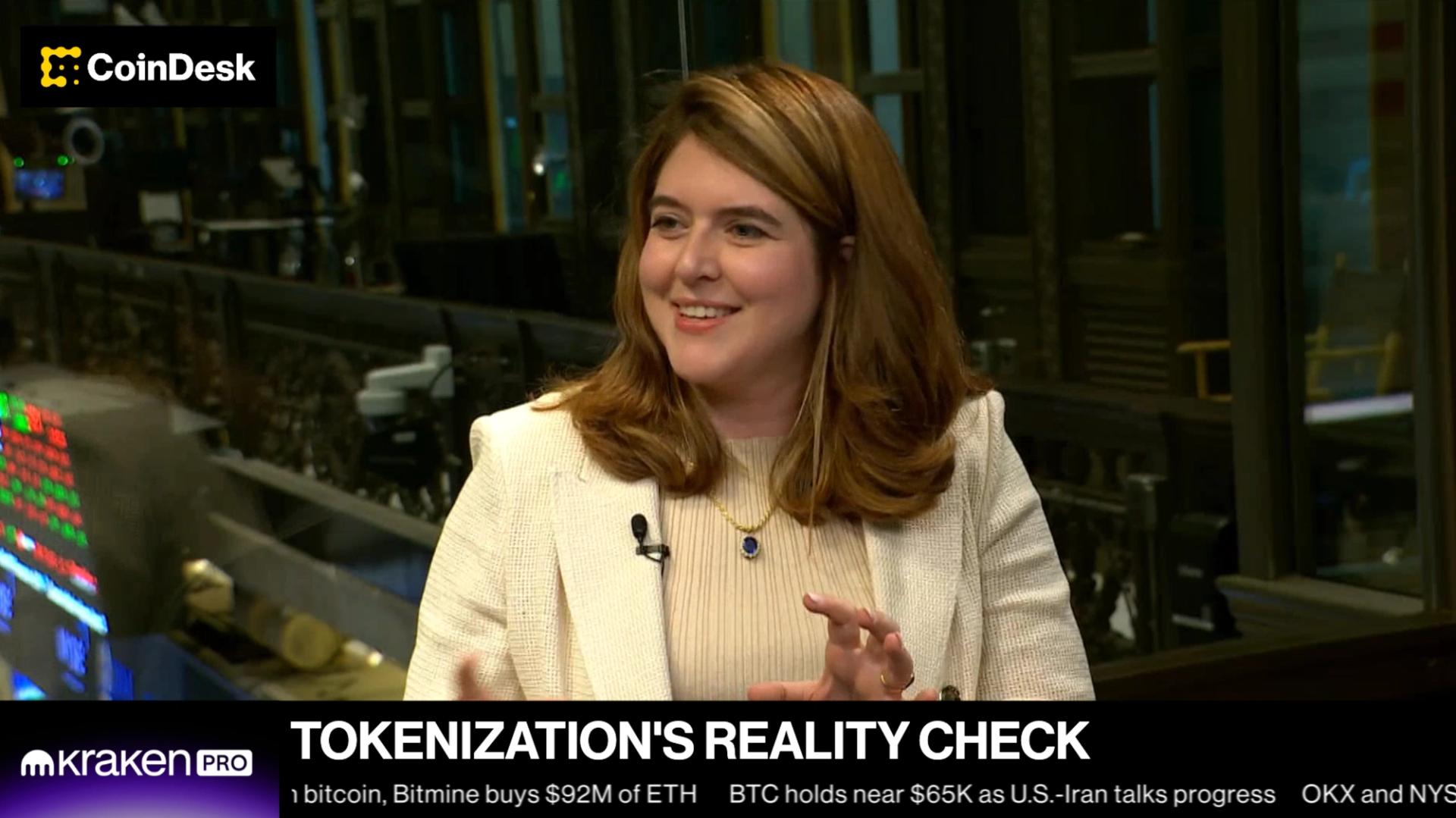
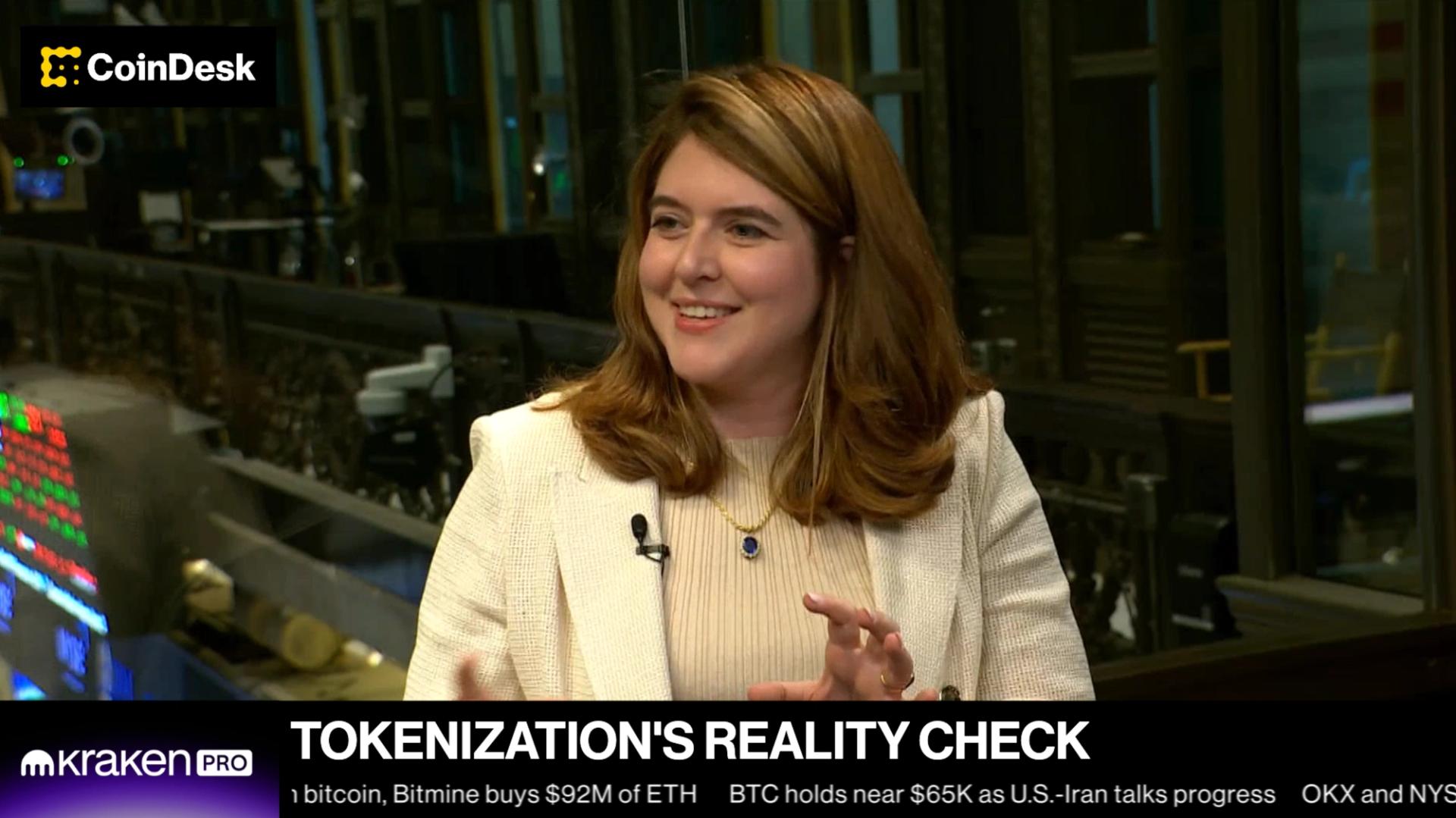
What she’s saying: Former 21Shares co-founder Ophelia Snyder argues that crypto and traditional finance are talking past each other when it comes to tokenization.
- Tokenization solves real problems around settlement rails and moving assets, Snyder said.
- The larger challenge is integrating blockchain-based assets with the systems banks, brokerages and asset managers already use.
- Existing discussions often overlook the operational processes that occur after a trade is executed and before assets are fully settled.
- Snyder joined CoinDesk’s Jennifer Sanasie on Public Keys.
The gap: Snyder said blockchain firms have largely addressed transaction throughput but not the broader operational requirements of financial institutions.
- Questions remain about how tokenized assets fit into books and records systems, compliance workflows and regulatory reporting.
- Financial institutions also must rethink risk management frameworks if tokenized assets can trade around the clock.
- Many firms rely on third-party software providers that have not yet adapted their systems for blockchain-native transactions.
Why it matters: Snyder believes the industry’s biggest challenge is scale, not functionality.
- A tokenization project can work at a limited scale and still struggle to support the volume of U.S. capital markets.
- “A billion dollars is nothing when it comes to traditional financial flows,” Snyder said.
- Moving large amounts of digital bearer assets on behalf of clients requires significantly more oversight and controls than existing book-entry systems.
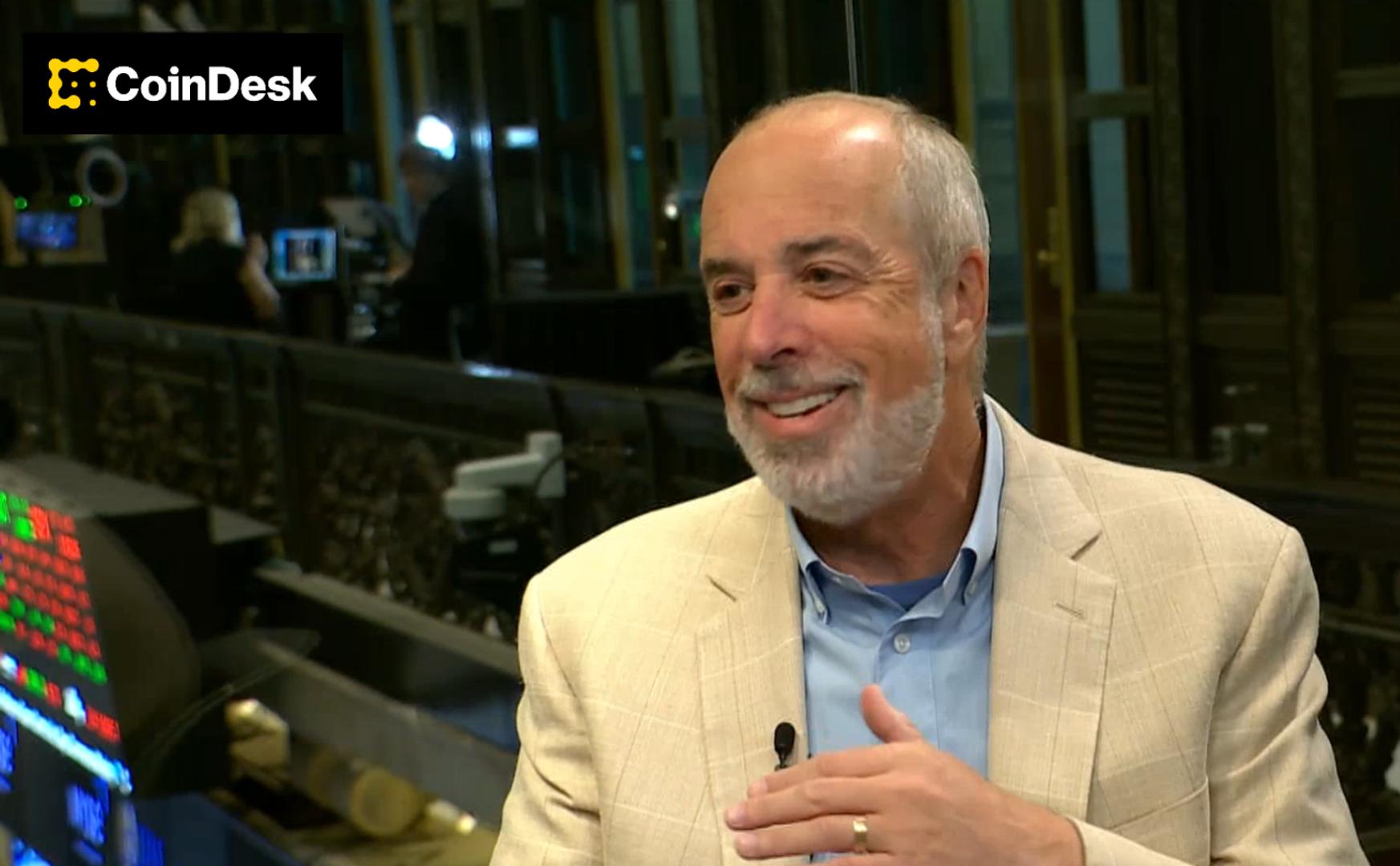
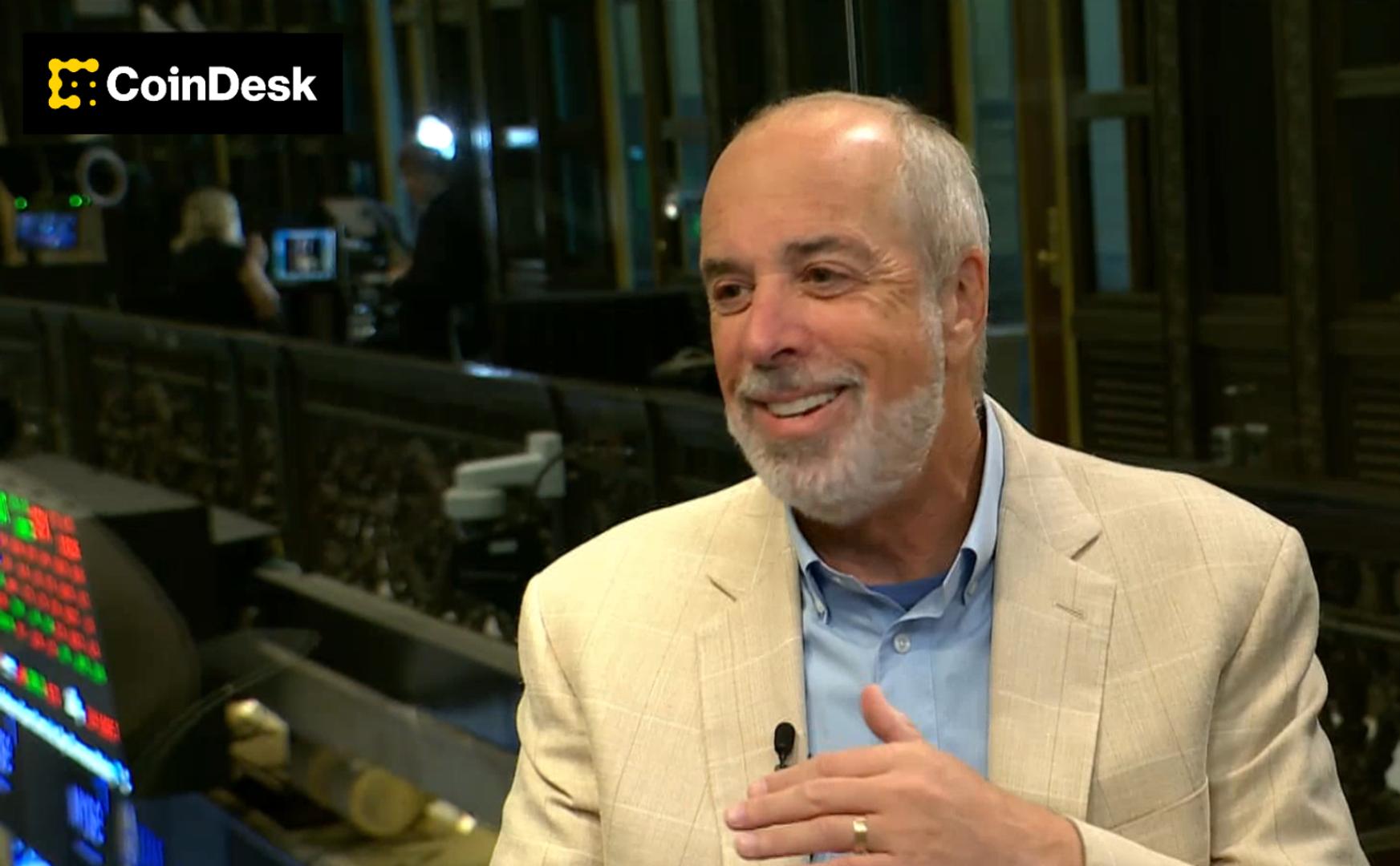
Latest developments: Edelman argues investor sentiment and industry fundamentals are moving in opposite directions.
- Bitcoin ETF investors have pulled billions from funds in recent days, while market fears have risen amid concerns about Mt. Gox wallet movements and regulatory uncertainty, Edelman said.
- Debate around the CLARITY Act has added to uncertainty, with lawmakers including Sen. Bernie Sanders and Sen. Elizabeth Warren pushing for additional provisions related to crypto oversight, according to Edelman.
- The result is a market focused on negative headlines even as major financial institutions continue expanding crypto-related initiatives.
- Edelman joined CoinDesk’s Jennifer Sanasie on Public Keys.
The contrast: Wall Street firms are increasing their involvement despite weak market sentiment.
- BlackRock, JPMorgan, Morgan Stanley, Franklin Templeton, Fidelity, State Street and Invesco are all advancing tokenization efforts, Edelman said.
- Tokenization is expanding beyond crypto assets into equities, cash and ETFs, according to Edelman.
- Institutional investors are showing growing interest in crypto exposure, with many firms planning first-time allocations or increasing existing positions, he said.
Worth watching: The fate of the CLARITY Act could shape crypto markets in the months ahead.
Crypto World
Ethereum Price Analysis: ETH Technical Aspects Quietly Improve, but These Hurdles Remain
Ethereum has staged a notable recovery after its sharp selloff toward the $1.5K region earlier this month. While the broader market structure remains bearish on the higher timeframe, buyers have managed to defend a major demand zone and are now attempting to build a short-term recovery. At the same time, derivatives data shows improving buying pressure, which could support further upside if key resistance levels are reclaimed.
Ethereum Price Analysis: The Daily Chart
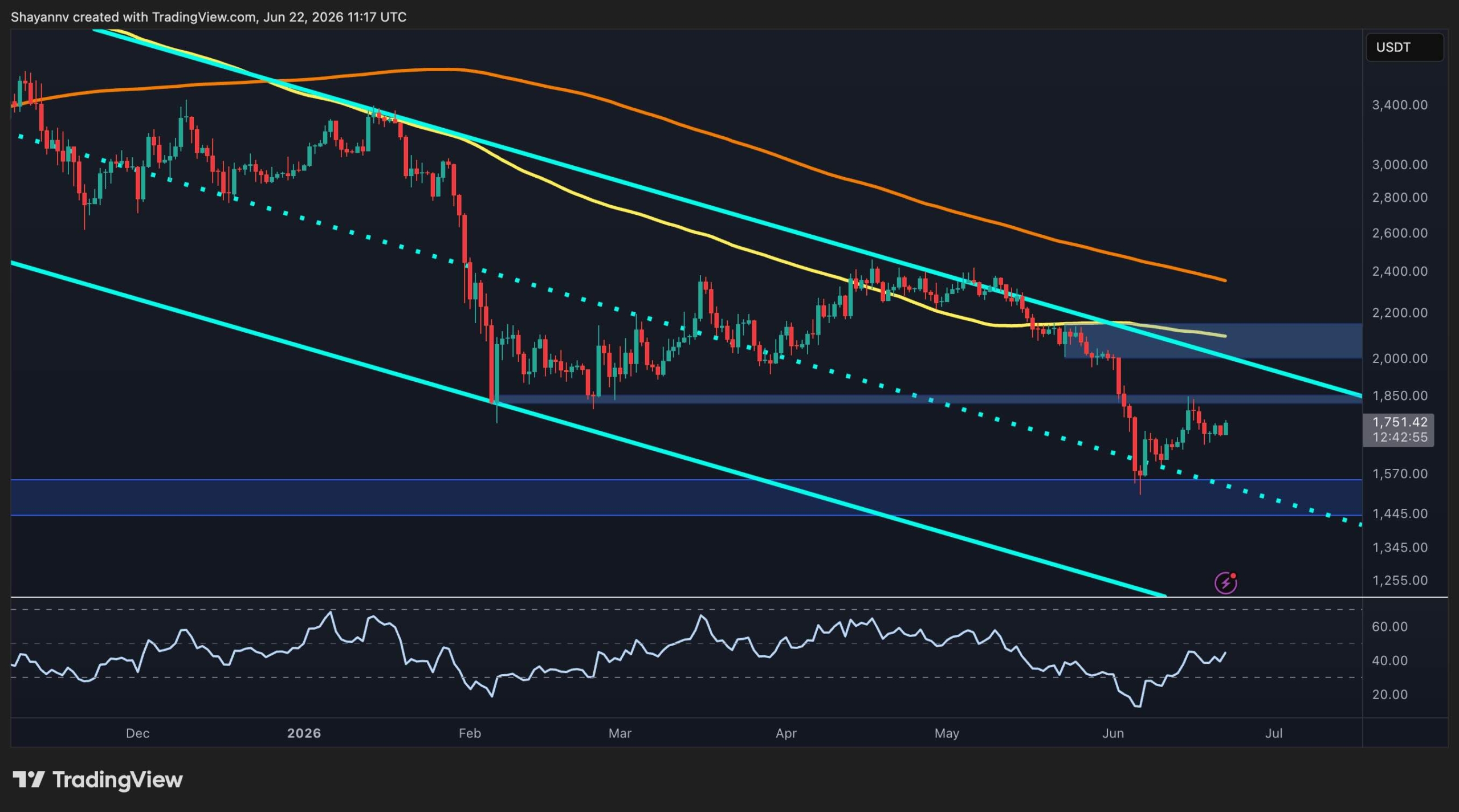
On the daily timeframe, ETH remains trapped within a well-defined descending channel that has governed price action for several months. The recent decline pushed the asset into the major support zone at $1.5K, where buyers stepped in aggressively, triggering a rebound.
Following the bounce, Ethereum recovered toward the $1.85K resistance area, which coincides with a former horizontal support-turned-resistance level. Yet, the price was rejected from this area and is currently trading around $1.75K, just beneath it.
Despite the recovery, the broader structure still favors sellers. Price remains well inside the descending channel, while also being below the major 100-day and 200-day moving averages, located around $2.1k and $2.3k levels, respectively. The next major resistance zone is located at $2.1k, where horizontal resistance aligns closely with the descending trend structure and moving averages.
A breakout above $1.85K would likely open the path toward this region. Conversely, rejection from current levels could send ETH back toward the $1.5K support zone, with a breakdown there exposing the lower boundary of the channel.
ETH/USDT 4-Hour Chart
The 4-hour timeframe presents a more constructive picture. After forming a local bottom near $1.5K, ETH developed an ascending channel and advanced toward the $1.85K resistance area. The rally tested the resistance zone but failed to secure a breakout. Since then, the price has dropped and broken the lower boundary of the channel.
Yet, the key support area remains at $1.50K, which served as the origin of the current recovery. As long as this level holds, buyers can still maintain control of the short-term structure.
On the upside, the first major hurdle remains at $1.85K. A decisive breakout above this resistance could accelerate bullish momentum toward the larger supply zone at $2.1K. However, continued failure beneath $1.85K may keep Ethereum locked in a consolidation phase before another attempt higher.

Sentiment Analysis
The Ethereum Taker Buy Sell Ratio from all exchanges provides an important view into aggressive market participation. Values above 1 indicate that market buy orders dominate, while readings below 1 suggest stronger selling pressure.
The chart shows that the 30-day moving average of the ratio has remained below the neutral 1.0 threshold for an extended period, reflecting the broader weakness that accompanied Ethereum’s decline from above $4K toward the recent lows near $1.5K. However, a notable shift has emerged in recent sessions.
After reaching one of its lowest readings of the cycle near 0.96, the indicator has begun to recover sharply and is now just above the neutral 1.0 level. This rebound suggests that aggressive buyers are gradually returning to the market after months of seller dominance.
While the metric has not yet confirmed a sustained bullish regime by moving decisively above 1, the recent improvement aligns with Ethereum’s defense of the $1.5K support area and strengthens the case for a continued relief rally. A continued rise in the Taker Buy Sell Ratio above 1 would provide additional confirmation that demand is returning and could support a move toward and even beyond the $1.85K and $2.1K resistance zones.

The post Ethereum Price Analysis: ETH Technical Aspects Quietly Improve, but These Hurdles Remain appeared first on CryptoPotato.


Franklin Templeton has completed its acquisition of crypto asset manager 250 Digital, adding new cryptocurrency investment strategies to its platform as the firm manages $1.78 trillion in assets worldwide.
Summary
- Franklin Templeton has completed its acquisition of 250 Digital and launched a new crypto-focused division called Franklin Crypto.
- The asset manager continues expanding across crypto markets through Bitcoin-linked ETF filings and tokenized fund partnerships.
- RWA.xyz data shows Franklin Templeton’s tokenized assets have grown from $768 million to over $2.5 billion in a year.
According to Franklin Templeton, the deal has resulted in the creation of a new division called Franklin Crypto, which combines the investment team and crypto strategies previously operated by 250 Digital with Franklin Templeton’s existing digital asset capabilities.
Former 250 Digital executives Christopher Perkins and Seth Ginns will lead the unit alongside Franklin Templeton digital assets executive Tony Pecore. The financial terms of the transaction were not disclosed.
The acquisition closes a transaction first announced in April and comes after CoinFund spun out its liquid strategies business into 250 Digital earlier this year as the investment firm concentrated on venture-focused activities.
Franklin Crypto expands institutional investment offerings
Within the newly established division, Franklin Templeton said institutional investors will gain access to actively managed cryptocurrency strategies supported by the former 250 Digital team and the asset manager’s global distribution network.
Alongside the acquisition, Franklin Templeton continues to add crypto-related products across several parts of its business.
Earlier this month, the company integrated its BENJI tokenized money market fund with MoonPay Trade, allowing institutional clients to exchange stablecoins such as USDC and USDT for BENJI through MoonPay’s on-chain trading infrastructure.
Days later, Franklin Templeton filed to launch two exchange-traded funds that would automatically direct stock dividend income into Bitcoin-linked investments, according to previous crypto.news reporting.
Those developments follow several initiatives announced this year. In February, Franklin Templeton unveiled a partnership with Binance that enables institutional investors to use tokenized money market fund shares as collateral for cryptocurrency trading while maintaining regulated custody of the underlying assets.
Soon after, the company partnered with Ondo Finance to make tokenized exchange-traded funds available on blockchain networks, extending access to selected investment products beyond traditional brokerage platforms.
Tokenized asset growth accelerates across the market
Growth in Franklin Templeton’s tokenization business has accompanied its expansion into crypto investing.
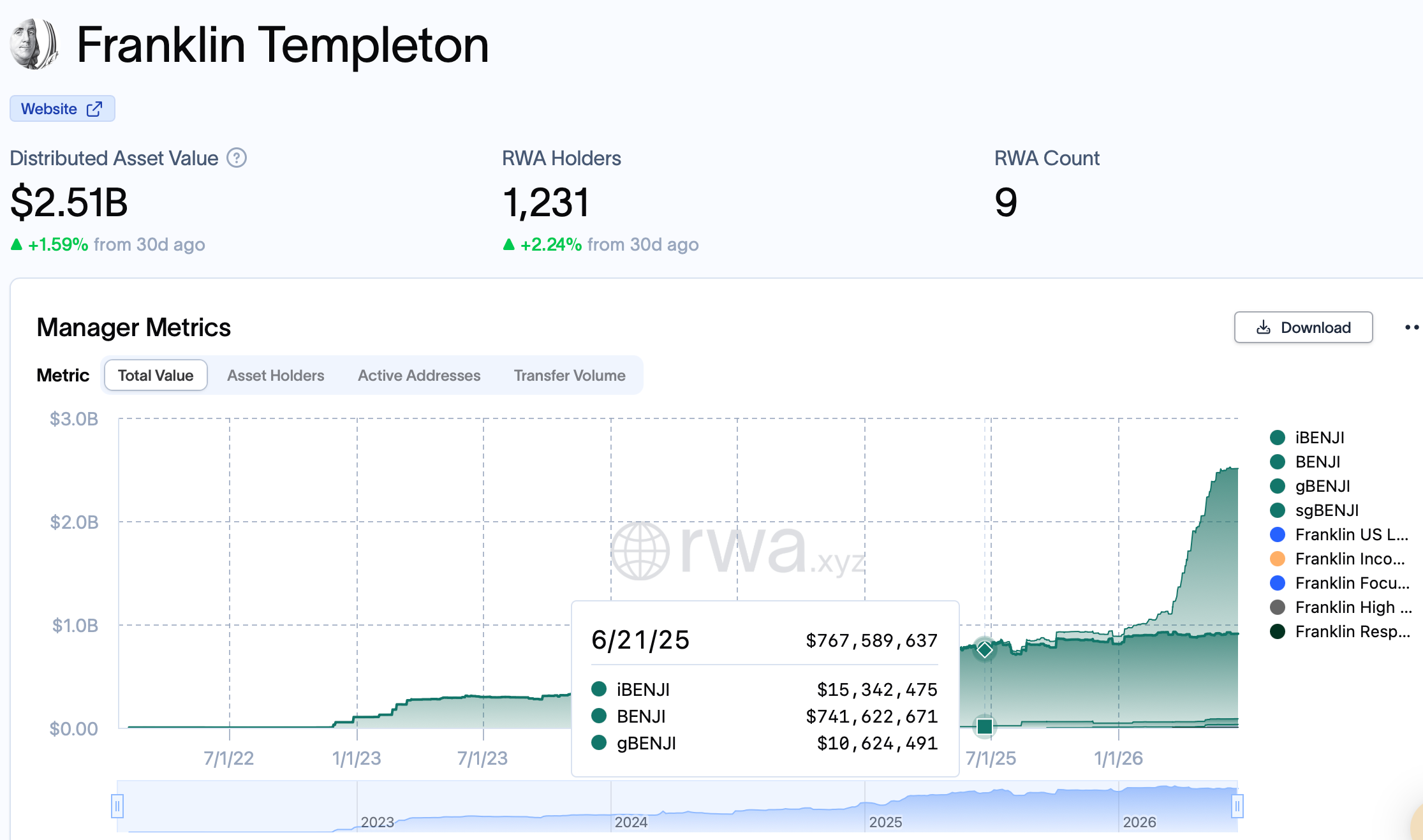
According to data from RWA.xyz, the firm’s tokenized assets have increased from roughly $768 million in June 2025 to more than $2.5 billion today, more than tripling over the past year.
Industry-wide figures reported by RWA.xyz show similar momentum. The value of on-chain real-world assets has climbed from approximately $11.8 billion a year ago to $32.2 billion, highlighting continued adoption of tokenized financial products across blockchain networks.
Existing digital asset operations remain an important part of Franklin Templeton’s strategy. Beyond launching investment products, the company maintains a dedicated digital assets unit focused on research, portfolio construction, and institutional risk management.
Operating in more than 35 countries, Franklin Templeton said the addition of 250 Digital strengthens its ability to serve institutional clients seeking cryptocurrency exposure while expanding the range of digital asset products available through its platform.
Crypto World
Tokenization pioneers Securitize and tZERO clash over patents as Wall Street moves onchain

Market forecasts have ballooned in recent years. Citi has estimated tokenized assets could reach a $5 trillion market capitalization by 2030, while a report from Boston Consulting Group and Ripple projected a market worth $18.9 trillion by 2033.
Patent battle over tokenization infrastructure
At the center of the dispute are patents covering compliance systems for tokenized securities, digital asset issuance and redemption technology and blockchain-based trading infrastructure.
tZERO said its investigation concluded that products including Securitize’s DS Protocol and Vault Registrar infringe patents covering self-enforcing compliance controls for security tokens and crypto integration systems.
The company said it is also investigating potential infringement by at least six other firms across tokenization, institutional crypto infrastructure and decentralized finance.
Securitize rejected the claims.
“tZERO’s allegations are without merit and run counter to the spirit of fair play that defines our industry at its best,” the company said in a statement posted on X.
Early pioneers clash amid growing stakes
The dispute pits two pioneers of tokenization against each other.
tZERO launched in 2014 and has spent more than a decade building technology for regulated digital asset markets and says it holds 105 patents globally across 23 patent families related to tokenized capital markets. NYSE parent Intercontinental Exchange made a strategic investment in the company in 2022, and tZERO unveiled plans last year to go public.
Solana (SOL) captured 95% of all tokenized equity trading activity across blockchains last week, setting a new record with $1.29 billion in trading volume. The surge comes as SOL trades more than 75% below its all-time high near $295, leaving SOL traders divided on whether the asset is nearing a cycle bottom.
SOL onchain activity continues to expand across several metrics, even as a SOL price reversal remains the central focus for market traders.
Tokenized equities on Solana hit record activity
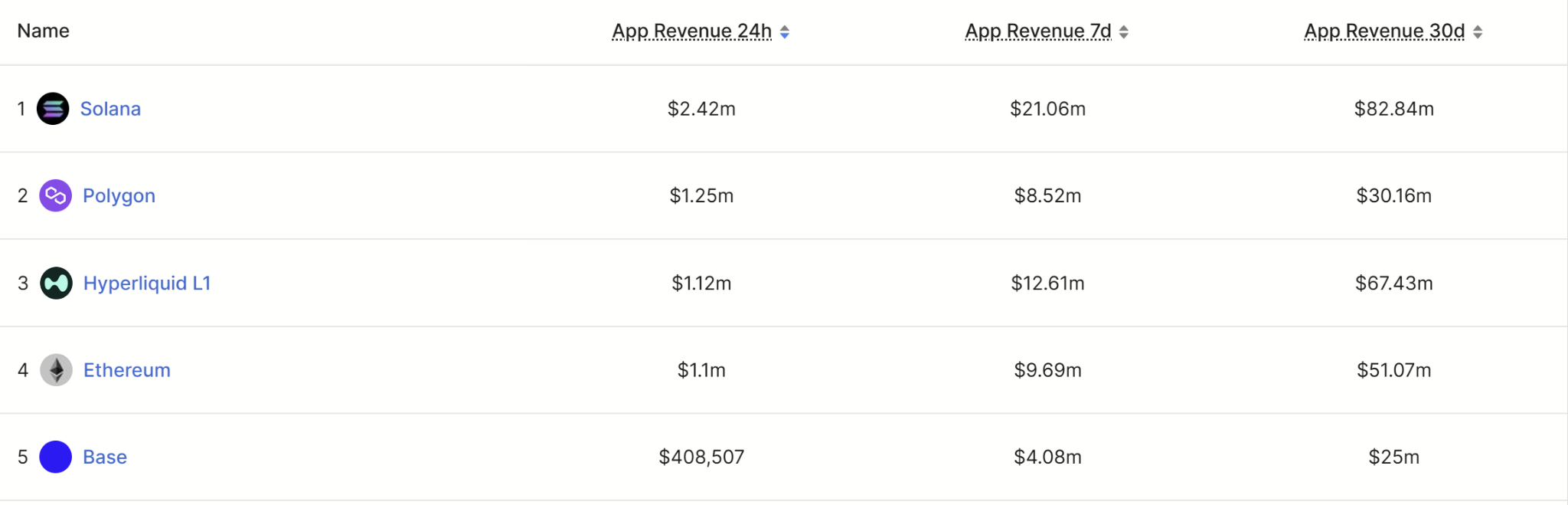
Data shows Solana generated $21 million in weekly app revenue, ahead of Ethereum, Hyperliquid, and Base. Over the past month, Solana applications produced $82.84 million in revenue, compared with $67.43 million on Hyperliquid and roughly $51 million on Ethereum.
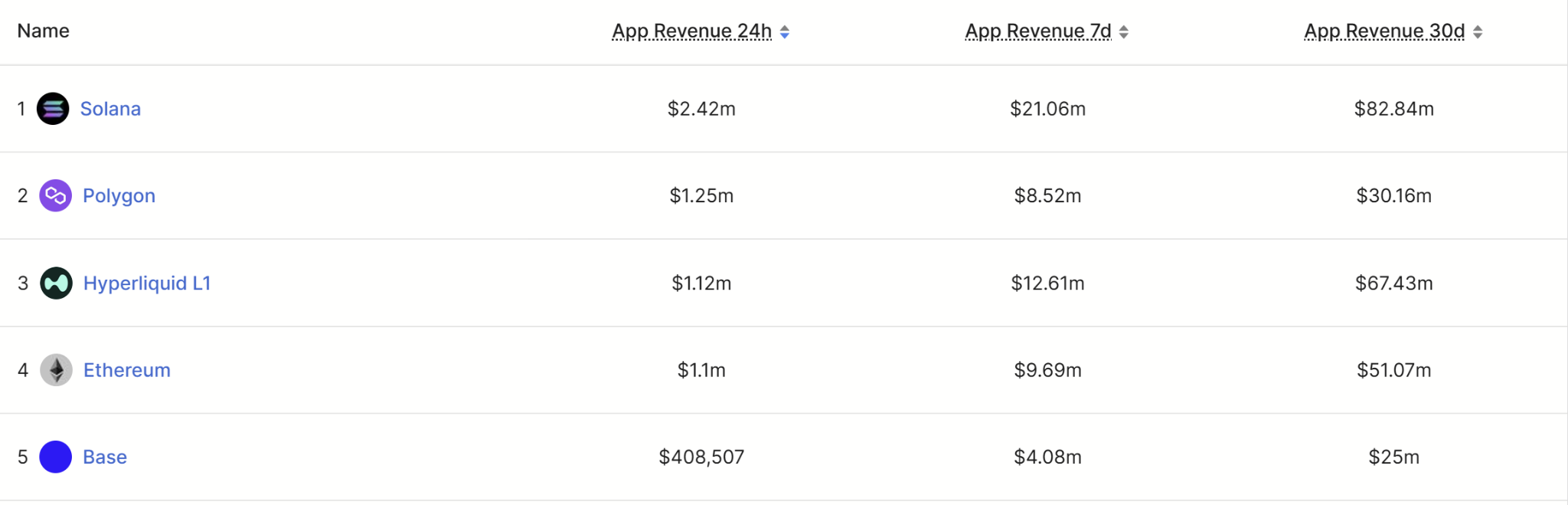
App revenue generated by chains. Source: DefiLlama
Solana has also led the charge for tokenized equity trading on its chain. Independent reporting from Solana Floor noted that the network recorded its largest week on record for tokenized stock trading, with $1.29 billion in volume, accounting for 95% of activity across all chains.
According to Solana Floor, last week’s volume exceeded the total for the entire previous month, driven largely by the release of SpaceX’s IPO token, SPCX.
At the same time, the total value locked (TVL) on Solana stands near $5.7 billion. TVL measures the value of assets deposited across decentralized finance applications and serves as a gauge of onchain capital participation.
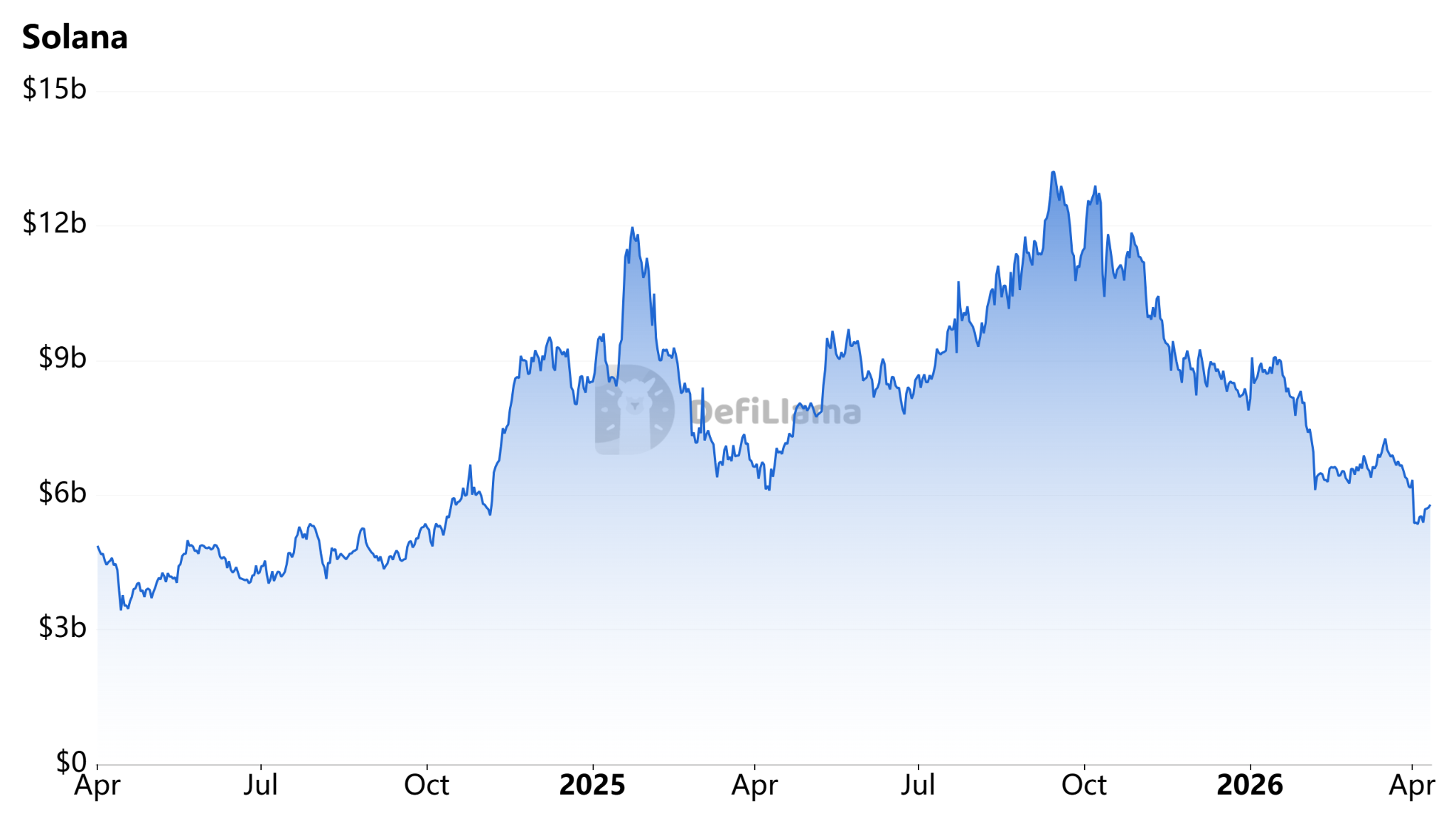
Solana’s TVL chart. Source: DefiLlama
That figure sits well below Solana’s all-time high TVL of roughly $13 billion from September 2025, showing that capital committed to DeFi applications has not returned to peak-cycle levels despite strong transaction activity and revenue generation.
Related: These XRP price charts hint at potential 25% relief rally in July
SOL traders remain split on accumulation timing
Market analysts and traders remain divided on whether SOL has already entered a durable bottoming phase.
Crypto trader Ardi said Solana is approaching the area that attracts the trader’s attention for the next bull cycle. Ardi noted that SOL has already fallen about 77% to $60, from its cycle peak near $295.
Drawing on historical drawdown compression seen in Bitcoin and Ether, Ardi said an 80%–85% decline would place SOL in the $45-$60 range, the most attractive accumulation zone.
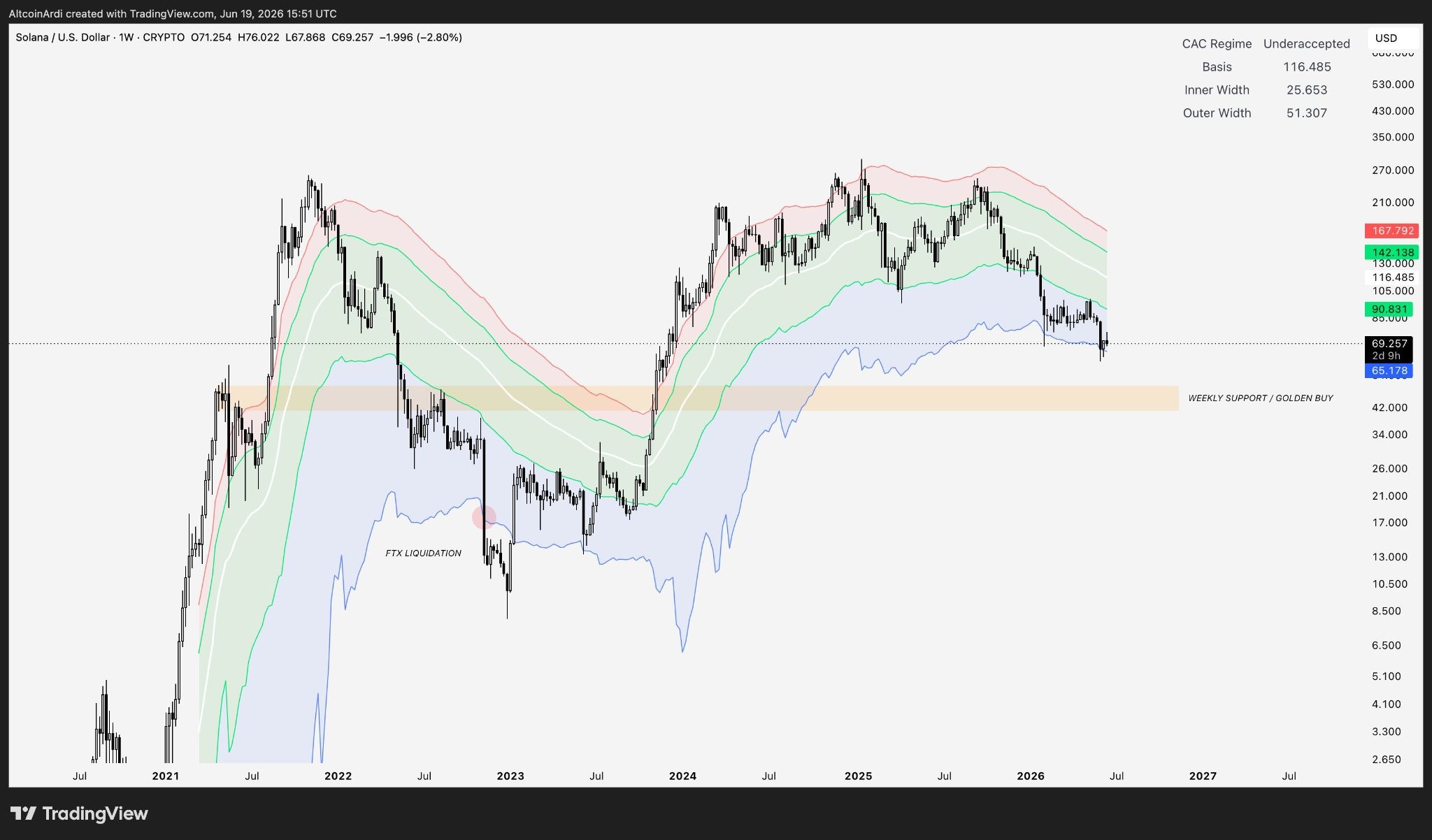
SOL/USD, one-week analysis by Ardi. Source: X
Crypto trader Bluntz took a more constructive view, arguing that the price forming a weekly bullish divergence with respect to the relative strength index (RSI) following an 80% drawdown often appears near the market lows. The trader implied that SOL could trend higher sooner rather than later based on this setup.
Meanwhile, crypto trader Dyme urged caution, noting that Solana spent roughly 500 days from May 2022 to October 2023, building a base before its last major recovery. The comparison suggests that SOL may require a longer period of sideways trading before a durable bottom forms.
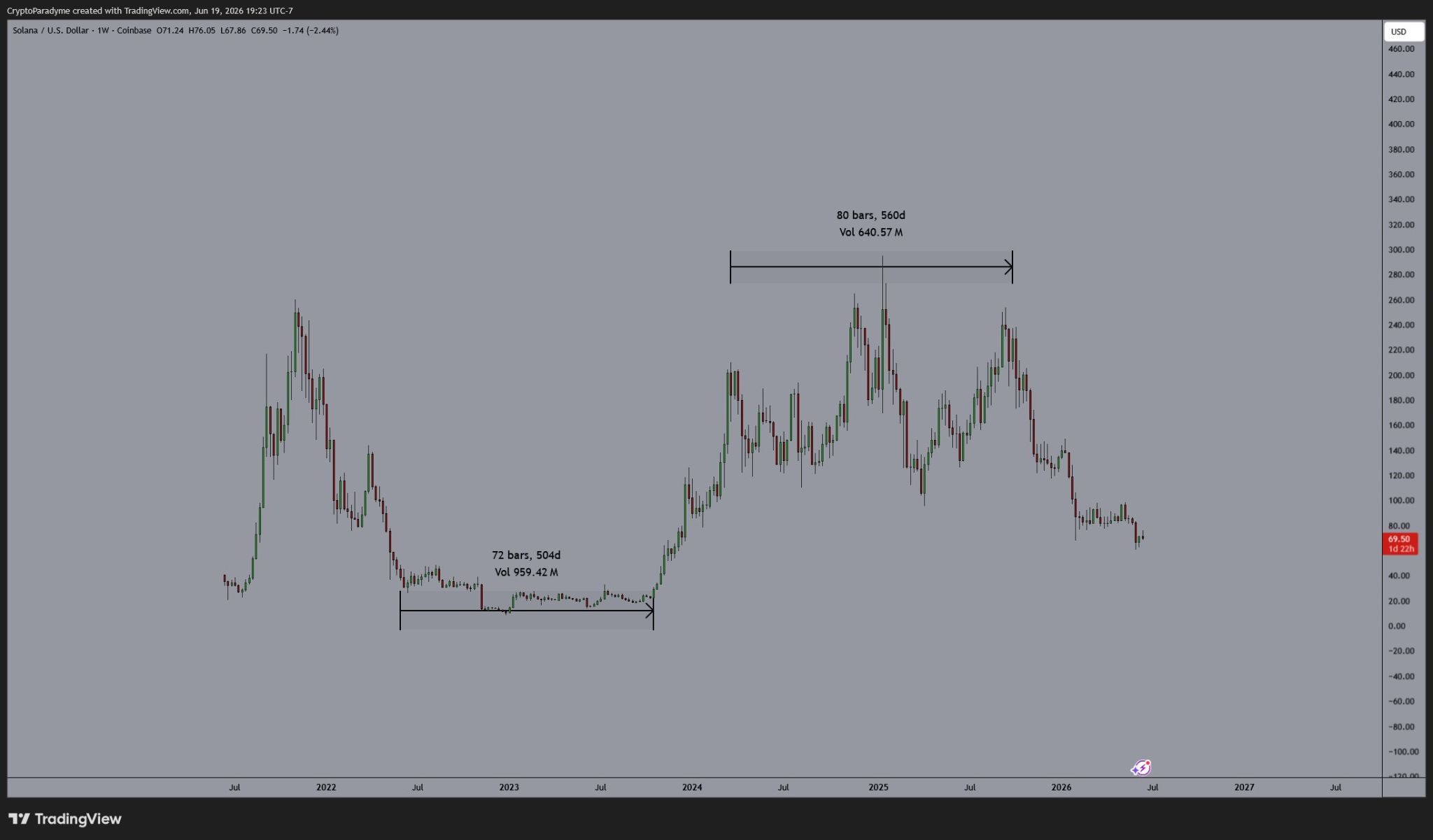
SOL/USD, one-week chart analysis by Dyme. Source: X
Trading Stable founder Ryan Clark also questioned the recent optimism, noting that SOL continues to trade below the key weekly 50-period and 200-period simple moving averages. The analyst, popularly known as HORSE, said that a move back above the $90 region would provide a stronger technical signal.
For now, the debate centers on whether demand SOL can build higher before the price reaches the $45-$60.
Related: Altcoin selling tops $266B as capital rotates out of crypto: Is altseason extinct?
Crypto World
New York, Maryland and Utah to Hold Primaries with Crypto PAC Money Hanging over Voters
Political action committees (PACs) backed by cryptocurrency companies and aligned interest groups have bet more than $8 million to support candidates in Tuesday’s primaries across three US states, which could impact the makeup of the country’s Congress in 2027.
As of Monday, the Protect Progress PAC, an affiliate of Fairshake that supports Democratic candidates, reported spending more than $516,000 on media for April McClain Delaney, running in Maryland’s 6th congressional district. However, much of the PAC’s attention has been focused on two races in Maryland and New York, where it reported combined expenditures of more than $5.5 million and $1.4 million, respectively, for primary races in the states’ 5th and 15th congressional districts, for Adrian Boafo and Ritchie Torres.
Filings with the Federal Election Commission (FEC) showed that Protect Progress had spent about $24,000 on ads to oppose Quincy Bareebe and $74,000 for media opposing Harry Dunn, both running against Boafo in Maryland’s 5th district. Dunn and Bareebe, along with Rushern Baker, who is running in the same primary, issued a statement on June 15 against what they called the “influence of dark money and special interests” in the race:
“We are calling on Governor Moore, Senator Alsobrooks, and Congressman Hoyer to answer directly: Do you support nearly $8 million in outside spending from crypto billionaires and AIPAC in a Maryland Democratic primary? If not, they should say so publicly and call on Adrian Boafo to reject it.”
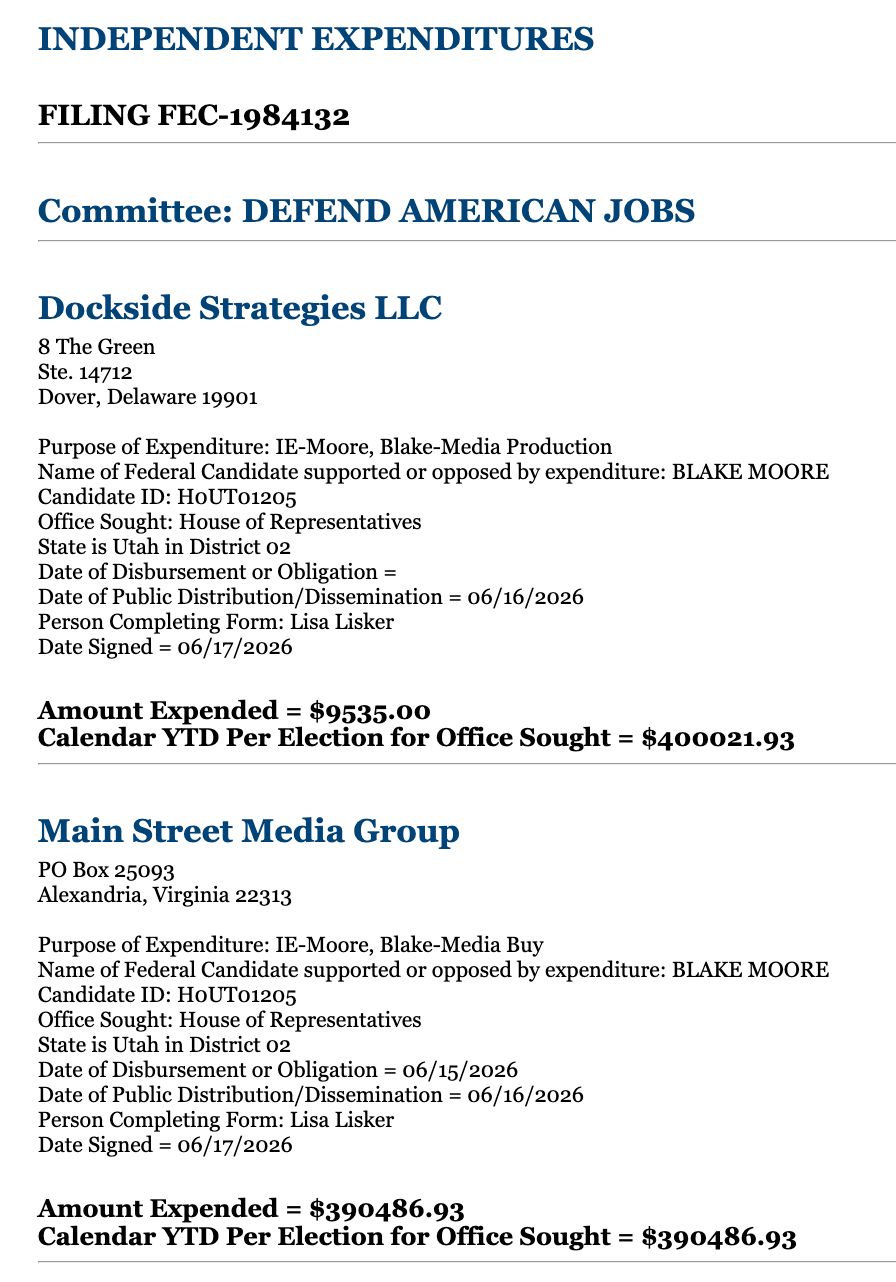
Defend American Jobs, another Fairshake affiliate, reported spending more than $400,000 on Republican Blake Moore’s primary in Utah’s 2nd congressional district. All expenditures followed what a Fairshake spokesperson called the “biggest spend of the cycle” in last week’s Alabama primary runoff, resulting in a win for Republican Barry Moore after the PAC spent more than $12 million on ads.
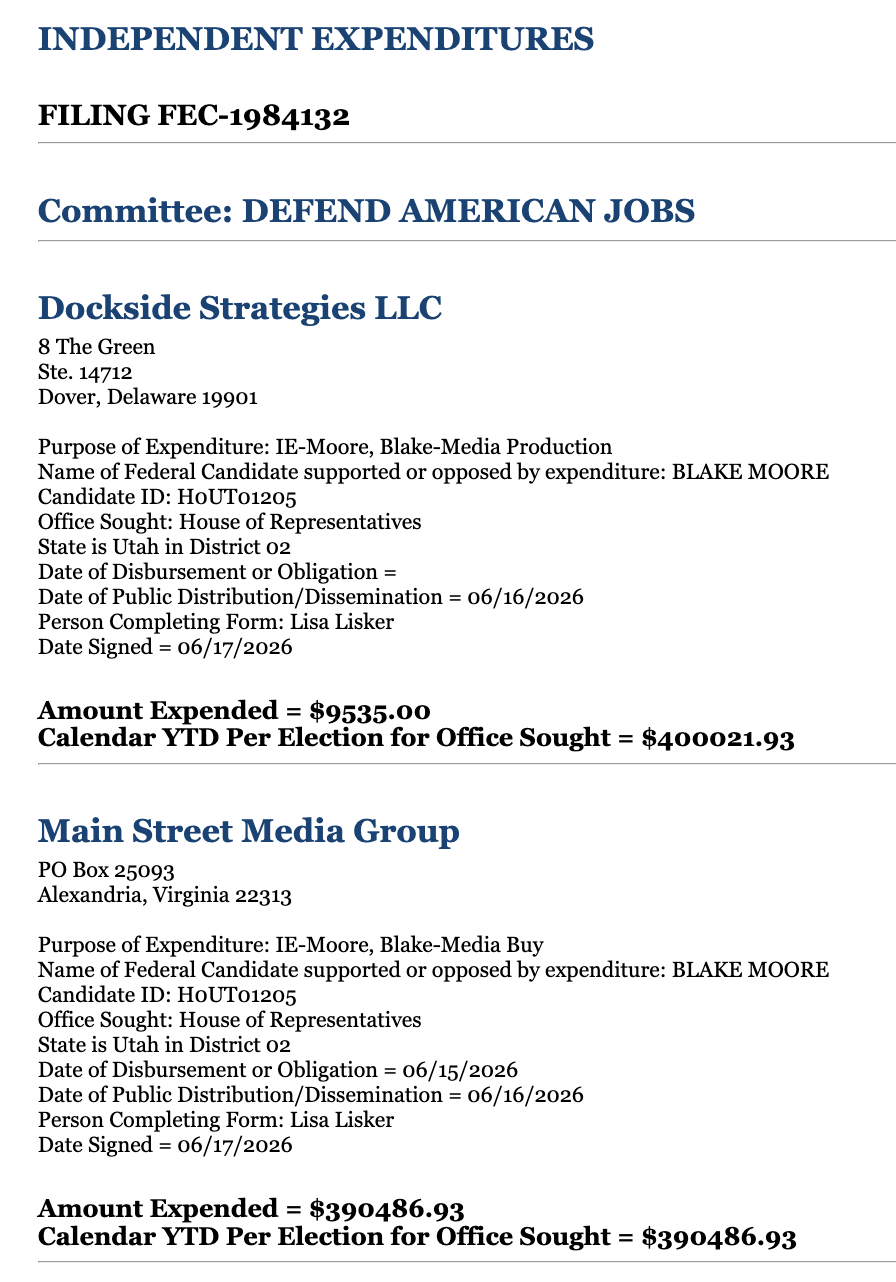
Source: FEC
Related: NYSE owner ICE to launch oil-linked futures with OKX
The Fellowship PAC, another committee backed by $11 million from Cantor Fitzgerald and Anchorage, disclosed $300,000 in spending to support Torres’ New York run.
Are Colorado and Arizona next?
With the three US state primaries to be decided on Tuesday, many expect Fairshake and other crypto-aligned PACs to turn their attention to Colorado and Arizona, which are scheduled to hold primaries on June 30 and July 21, respectively.
As of Monday, none of the PACs had disclosed significant spending in any congressional races in the two US states. However, in 2024, Fairshake and its affiliates poured more than $10 million into media to support Ruben Gallego’s Senate race in Arizona and $2.1 million for Democratic Representative Yadira Caraveo in Colorado’s 8th district.
Magazine: Bitcoin decouples from tech stocks, Ether eyes ‘selling wave’: Market Moves


Crypto-backed political action committees have spent more than $8 million supporting candidates in congressional primary races across three U.S. states ahead of Tuesday’s elections.
Summary
- Crypto-backed PACs linked to Fairshake have spent more than $8 million ahead of key congressional primaries in Maryland, New York, and Utah.
- Protect Progress directed most of its spending toward Adrian Boafo and Ritchie Torres, while opponents criticized the role of outside money in the races.
- With Colorado and Arizona primaries approaching, Fairshake’s past spending patterns suggest those states could attract future crypto PAC funding.
According to filings with the U.S. Federal Election Commission, much of the spending has come from political groups linked to Fairshake, the crypto industry-backed PAC that has emerged as one of the most active players in the 2026 election cycle.
Protect Progress, a Fairshake affiliate that supports Democratic candidates, has directed the largest share of its spending toward races in Maryland and New York.
FEC records show the PAC spent more than $5.5 million backing Maryland state Delegate Adrian Boafo in the Democratic primary for the state’s 5th Congressional District. In New York’s 15th District, the group reported more than $1.4 million in expenditures supporting incumbent Representative Ritchie Torres.
Additional spending has targeted other contests. Protect Progress reported more than $516,000 in media expenditures supporting April McClain Delaney, who is seeking the Democratic nomination in Maryland’s 6th Congressional District.
Fairshake affiliates concentrate resources on key races
While much of the money has been directed toward boosting preferred candidates, FEC filings also show spending against rivals. Protect Progress disclosed roughly $24,000 in advertising opposing Quincy Bareebe and another $74,000 in media spending targeting Harry Dunn, both of whom are competing against Boafo in Maryland.
Political opposition to the spending has surfaced during the final stretch of the campaign. In a June 15 joint statement, Democratic candidates Harry Dunn, Quincy Bareebe, and Rushern Baker criticized what they described as the growing role of outside money in the race.
The candidates called on Maryland Governor Wes Moore, Senator Angela Alsobrooks, and Representative Steny Hoyer to publicly address whether they supported millions of dollars in spending from crypto industry donors and other outside groups backing Boafo’s campaign.
Elsewhere, Defend American Jobs, another Fairshake-affiliated PAC, reported spending more than $400,000 in support of Republican Representative Blake Moore as he seeks renomination in Utah’s 2nd Congressional District.
The latest expenditures follow what a Fairshake spokesperson previously described as the “biggest spend of the cycle” during Alabama’s Republican primary runoff. According to campaign finance disclosures, Fairshake-backed groups spent more than $12 million on advertising in that contest before Republican Barry Moore secured victory.
Colorado and Arizona emerge as the next battlegrounds
Attention is already turning to upcoming primaries in other states as Tuesday’s contests conclude.
Campaign finance records reviewed on Monday showed no major spending by Fairshake-linked groups in Colorado or Arizona, where congressional primaries are scheduled for June 30 and July 21, respectively. Even so, previous election cycles suggest both states could become targets for future investment.
During the 2024 election cycle, Fairshake and affiliated committees spent more than $10 million supporting Ruben Gallego’s successful Senate campaign in Arizona. The organization also invested approximately $2.1 million in backing Democratic Representative Yadira Caraveo in Colorado’s 8th Congressional District.
Separate disclosures also highlight activity from other crypto-aligned political organizations. Fellowship PAC, a committee backed by roughly $11 million in funding from Cantor Fitzgerald and Anchorage Digital, reported spending $300,000 to support Torres in New York’s primary race.
With several competitive congressional contests still ahead on the election calendar, spending by crypto-backed political groups remains concentrated on races where outside money could influence closely fought primaries.

Recent findings by The Wall Street Journal (WSJ) have revealed shocking details about the promotional content of the prediction platform, Polymarket. As reported, the majority of the winning bets that drove the platform’s viral growth were staged on copycat versions of its website.
According to a report from WSJ, Polymarket paid college-age creators to stage up to $1.9 million in fake bets. The investigation team assembled by WSJ reviewed at least 1,105 videos posted by these creators and found none of them to be real; they had no blockchain trace and could not be verified by any digital ledger.
Fake Bets, Fake Winnings
At the core of the Polymarket business campaign is the claim that all trades are settled in USD Coin (USDC) on the Polygon blockchain. These trades are public and can be verified by anyone. While the prediction platform has led its campaigns with this claim, the company’s promotional content suggests otherwise.
Polymarket has been paying creators $2,000 to $3,000 a month to post videos of bets seemingly placed and won on its website. However, in reality, those trades were placed on dummy sites like poiymarket.com, created to mirror the real platform.
Out of more than 1,000 betting videos from 10 creators promoted between December 2025 and mid-May 2026, none were real. While marketing firms pushed the videos to get more views, the creators were told to refrain from disclosing that they received payments for the clips. As part of the scheme, the creators often altered headlines and used outdated footage to imply they won the bets, even when the winnings were fake.
Polymarket Back in the U.S.
Interestingly, the same bets that won millions in the promotional clips incurred losses for traders in reality. About 118 clips reviewed by WSJ showed creators celebrating roughly $900,000 in wins; however, in reality, the same bets would have incurred over $166,000 in losses.
Furthermore, a creator claimed they won $100,000 after U.S. President Donald Trump said the word “McDonald’s” in January. As discovered during the investigation, Trump never said the word publicly that month, and the clip used to justify the winning was older. Unfortunately, at least 50 accounts that actually placed that bet on Polymarket all lost.
As concerns about the promotional content arise and investigations intensify, many of those creators have removed the fake bet-winning videos from their social media accounts. Additionally, Polymarket has taken down the dummy website, poiymarket.com.
These accusations come as Polymarket re-enters the United States after securing a greenlight from regulators. The platform intends to audit its promotional content following the revelations.
The post How Polymarket Reportedly Used Fake Winning Bets to Drive Viral Growth appeared first on CryptoPotato.
Global asset manager Franklin Templeton has completed its acquisition of crypto asset manager 250 Digital, closing a deal first announced in April and expanding its digital asset business with a new division focused on cryptocurrency investing.
As part of the transaction, Franklin Templeton absorbed 250 Digital’s investment team and cryptocurrency strategies into a newly created division called Franklin Crypto. The unit will be led by former 250 Digital executives Christopher Perkins and Seth Ginns alongside Franklin Templeton digital assets executive Tony Pecore.
The acquisition follows CoinFund’s decision earlier this year to spin out its liquid strategies business into 250 Digital as the crypto investment firm sharpened its focus on venture investing.
Franklin Templeton said Franklin Crypto will offer institutional investors actively managed cryptocurrency strategies, combining the investment capabilities of the former 250 Digital team with the asset manager’s global distribution network. The company did not disclose the financial terms of the acquisition.
The new division builds on the asset manager’s existing digital asset business, which includes a dedicated unit focused on digital asset research, portfolio construction and institutional risk management. Franklin Templeton manages approximately $1.78 trillion in assets and operates in more than 35 countries, according to the company.
Related: Blockworks acquires Messari in crypto data consolidation push
Franklin Templeton broadens crypto and tokenization efforts
The acquisition is the latest in a series of moves by Franklin Templeton to expand its digital asset business across cryptocurrency investing and tokenized financial products.
In February, the company announced a partnership with Binance that lets institutional investors use tokenized money market fund shares as collateral for cryptocurrency trading. Under the framework, the tokenized fund shares remained in regulated custody while their collateral value is reflected within Binance’s trading system.
In March, Franklin Templeton partnered with Ondo Finance to offer tokenized exchange-traded funds (ETFs) on blockchain networks, expanding access to its investment products beyond traditional brokerage accounts. Last week, the firm also proposed two ETFs that would reinvest stock dividends into Bitcoin-linked investments, creating a hybrid strategy spanning equities and digital assets.
RWA.xyz data shows Franklin Templeton’s tokenized assets have more than tripled over the past year, rising from about $768 million in June 2025 to more than $2.5 billion today.
The broader tokenized asset market has also expanded rapidly, with onchain RWA value rising from about $11.8 billion to $32.2 billion over the past year.
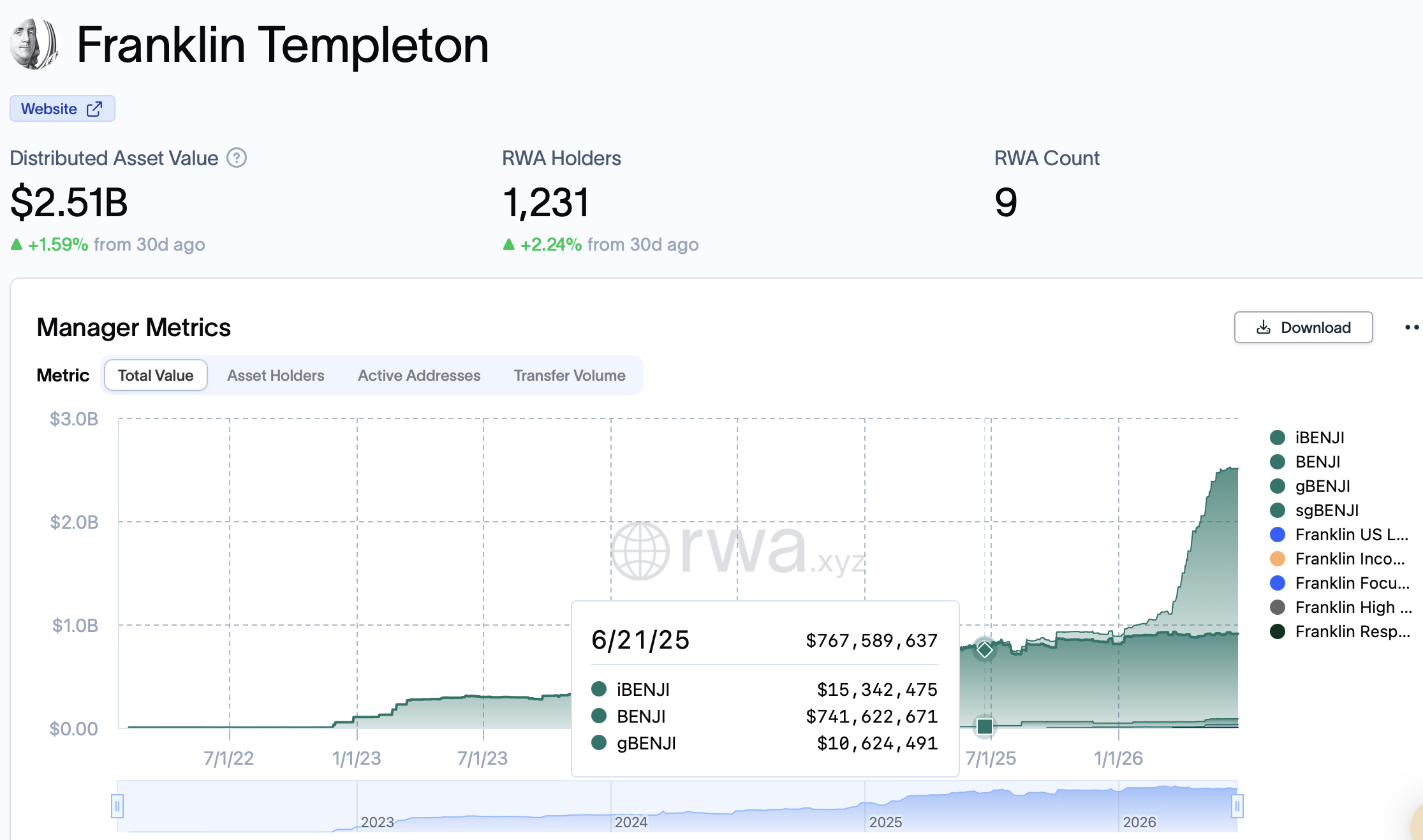
The value of Franklin Templeton’s tokenized assets. Source: RWA.xyz
Magazine: Bitcoin, the ‘canary in the coal mine,’ XRP transaction demand falls 91.5%: Market Moves

Ashley Cain responds after BBC axing over ‘unacceptable’ sexist language

Nike Q4 Preview: The Better-Than-Feared Value Opportunity

21Shares co-founder warns tokenization hype is outrunning Wall Street reality

No Jackpot Winner as $257 Million Prize Rolls Over to $269 Million Monday Draw

Blockchain.com files with SEC for U.S. IPO

Israel says it has killed new Hamas military leader in Gaza City airstrikes

Top Economist: A Once in a Lifetime Financial Crisis Is Coming

$1000 XRP BY 2028? – WILL BLACKROCK AQUIRE RIPPLE? – YOU DON’T TRADE XRP! – DID MICA CRUSH BINANCE?

Humanity still exists.. @johnmalek3 #humanity #dream #success #giveaway #lifestyle #money #shorts
-

 Fashion3 days ago
Weekend Open Thread: Miami – Corporette.com
-
 Tech6 days ago
The Adder At The Heart Of Intel’s 8087 FPU
-

 Entertainment2 days ago
Renter of Home in Anne Heche Crash Denies Settlement With Son
-

 Tech9 hours ago
Microsoft accidentally kills epic Outlook email threads
-

 Business2 days ago
Soccer-U.S. defends Iran World Cup travel restrictions, says discussions ongoing
-
 Business3 days ago
Wall Street Week Ahead: Investors see Micron earnings as pulse check of AI rally momentum
-

 Politics4 days ago
BBC Reporter Discusses Cross Party Criticism Of Trumps Iran Deal
-

 Tech4 days ago
AWS enters the context layer race with a graph that learns from agents, not manual curation
-

 Crypto World3 days ago
HIVE shares jump as $220M AI deal speeds Bitcoin mining pivot
-

 Crypto World2 days ago
Jake Chervinsky accuses CME of protecting derivatives monopoly
-
 Crypto World2 days ago
Can Charles Hoskinson Really Rescue Cardano?
-

 Tech2 hours ago
Nearly 7,000 fake Amazon domains registered ahead of Prime Day 2026, researchers warn
-

 Sports4 days ago
FIFA World Cup 2026: Canada beat 9-men Qatar 6-0 to register first ever win | FIFA World Cup 2026
-

 Business2 days ago
MHP SE 2026 Q1 – Results – Earnings Call Presentation (OTCMKTS:MHPSY) 2026-06-20
-

 Business4 days ago
Brexit cost 6% of UK economy, Bank of England company data suggests
-

 Politics3 days ago
Andy Burnham and the meaning of Makerfield
-

 Crypto World5 days ago
Anthropic’s Dario Amodei Urged AI Unity at G7, Even as US Banned His Models
-
 Tech1 day ago
Signal’s Meredith Whittaker says AI chatbots ‘are not your friends’ and calls Copilot agents a backdoor
-

 Crypto World7 days ago
Robinhood opens AI-powered trading to all users, sending HOOD stock past $100
-

 Tech5 days ago
Weeks Of In-The-Field Testing And A Verdict
You must be logged in to post a comment Login