

Crypto World
TeraWulf (WULF) Stock: Q1 2026 Results Show AI Revenue Surge Despite $427M Loss


Key Highlights
- Q1 2026 net loss reached $427M for TeraWulf, significantly higher than the $61.4M loss recorded in Q1 2025.
- High-performance computing lease income surged 117% sequentially to $21M, representing approximately 60% of quarterly revenue.
- Bitcoin mining income declined by half to approximately $13M.
- Cash and restricted cash reserves totaled around $3.1B at quarter end.
- WULF shares declined 2.6% Friday but remain up more than 105% for the year.
TeraWulf’s first quarter 2026 financial results revealed a net loss of $427 million, representing a significant increase from the $61.4 million loss the company reported during the corresponding period in 2025.
Quarterly revenue totaled $34 million. The company’s high-performance computing lease segment generated $21 million — comprising roughly 60% of overall revenue — following a remarkable 117% sequential increase.
Revenue from Bitcoin mining operations, in contrast, plummeted 50% to approximately $13 million amid challenging conditions affecting the broader mining industry.
Shares of WULF declined 2.6% Friday in response to the quarterly report. Nevertheless, the stock has climbed more than 105% since the beginning of the year and has risen over 30% during the past 30 days.
HPC Business Emerges as Primary Revenue Driver
The high-performance computing revenue stemmed from 60 megawatts of active critical IT capacity at the Lake Mariner facility — recognized as among North America’s largest HPC installations — currently under lease to Core42.
TeraWulf is simultaneously managing infrastructure deployment with partners including Fluidstack and Google. Multiple computing facilities, specifically CB-3, CB-4, and CB-5, are scheduled to become operational during the latter half of 2026.
CEO Paul Prager noted that the organization began 2026 equipped with essential contracts, infrastructure assets, and capital arrangements already secured, with leadership now concentrating on transforming these resources into sustainable recurring revenue streams.
During October 2025, TeraWulf finalized a 25-year lease agreement with Fluidstack — supported financially by Google — valued at approximately $9.5 billion in committed revenues. This arrangement built upon a previously announced 10-year commitment.
The Abernathy joint venture, encompassing a 168 MW HPC facility under a 25-year lease structure, continues progressing toward its anticipated Q4 2026 launch.
CFO Patrick Fleury explained that the company’s capital framework is structured to synchronize extended-term financing with contractual cash flows. He noted that predictable AI infrastructure income could mitigate the volatile earnings patterns traditionally associated with Bitcoin mining activities.
TeraWulf concluded the first quarter holding approximately $3.1 billion in combined cash and restricted cash.
Strategic Power Sites Drive Growth Strategy
Beyond the Lake Mariner installation, TeraWulf is developing a nationwide portfolio of power-advantaged locations.
This expansion includes a recently acquired 480 MW facility in Hawesville, Kentucky, a 300 MW development in Lansing, New York, and a 210 MW location in Morgantown, Maryland — with expansion potential reaching 1 gigawatt.
Prager characterized the company’s approach as constructing “a power-advantaged platform” that is becoming increasingly distinct in an industry constrained by electrical capacity access.
TeraWulf’s strategic shift reflects a wider transformation across the sector. Riot Platforms disclosed $167.2 million in total Q1 2026 revenue, with its data center operations generating $33.2 million, partially offsetting declining Bitcoin mining income.
Core Scientific has announced intentions to liquidate over 2,500 Bitcoin to finance AI infrastructure expansion and strengthen cash reserves.
MARA Holdings, Hive, Hut 8, and Iren have each begun transitioning mining capacity into high-performance computing infrastructure designed for AI workload deployment.
For TeraWulf, the completion of CB-3, CB-4, and CB-5 computing facilities represents the company’s primary operational objectives for the remainder of 2026.




MicroStrategy CEO Phong Le confirmed the Bitcoin (BTC) treasury firm will sell BTC only under specific conditions.
The remarks followed Executive Chairman Michael Saylor’s earlier suggestion that Strategy might sell Bitcoin to cover dividends. The comment triggered a 4% drop in MSTR shares and rattled the market.
Stretch (STRC) Reshapes MicroStrategy’s Bitcoin Playbook
The first condition relates to Strategy’s Series A Perpetual Stretch Preferred Stock, also known as Stretch (STRC). The instrument carries an 11.5% dividend.
Stretch shifted the calculus, according to Le. The CEO said in a CNBC interview that the product opened strategic optionality.
“We have raised $8.5 billion in 10 months, and with that, we look at optionality, we look at our strategy, and we say now let’s look at Bitcoin and see if it can provide us value from time to time to sell it,” Le mentioned.
This lets Strategy weigh Bitcoin sales against equity issuance for dividends. He emphasized that the firm would only sell BTC to fund yield payments if the move is accretive to shareholders.
“That’s defined as accretive to Bitcoin per share, and the times it’s accretive are when the book value of our company is trading below the price, or the price is trading below the book value, or mNAV is below right now 1.22,” he said.
Follow us on X to get the latest news as it happens
The second condition covers tax management, with the firm prepared to sell to capture deferred gains or tax losses. Meanwhile, Le also defended the company’s financial position, stating that Strategy’s leverage remains manageable.
“Right now, our leverage is right around 10-15%, amplification is about 35% and if you compare that to typical companies, we would be rated just based on those KPIs as an investment-grade stock, so I don’t see that being an issue right now, and we manage it closely…we manage our leverage and amplification level very thoughtfully,” he added.
The pivot reverses Saylor’s “never sell” stance. Strategy first signaled the change during its Q1 2026 earnings call. It disclosed a net loss of $12.54 billion. Le framed the shift as a pragmatic calculation rather than an ideological retreat.
“Ultimately, I believe in math over ideology,” Le remarked.
MicroStrategy Downplays Market Impact of Potential Bitcoin Divestments
Strategy is the largest publicly traded corporate holder of Bitcoin. The firm currently holds 818,334 BTC acquired at an average purchase price of around $75,537 per coin.
Addressing concerns about liquidity and the market impact of potential Bitcoin sales, Le argued that Strategy’s dividend obligations are relatively small compared to Bitcoin’s daily trading volume.
“Bitcoin trades north of $60 billion a day,” he noted. “If our entire annual dividend is $1.5 billion that we have to pay on a daily basis, we are talking about percentage points or basis points of Bitcoin liquidity.”
Le added that despite Strategy owning nearly 4% of Bitcoin’s circulating supply, the company does not believe its trading activity significantly moves the market in either direction.
“For the last couple of weeks, we didn’t buy any Bitcoin and Bitcoin price still went up,” the executive stated. “Liquidity isn’t an issue for us.”
Subscribe to our YouTube channel to watch leaders and journalists provide expert insights
The post MicroStrategy Reveals It Will Sell Bitcoin Under These Conditions appeared first on BeInCrypto.
The value of cryptocurrency held by South Korean investors more than halved over the past year, falling from 121.8 trillion won ($83.3 billion) at the end of January 2025 to 60.6 trillion won ($41.4 billion) by the end of February 2026.
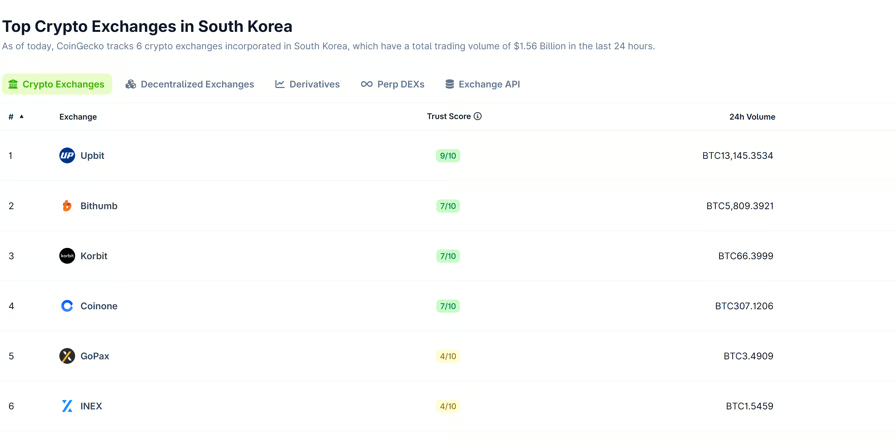
Daily trading volumes across the country’s five major exchanges, including Upbit, Bithumb, Korbit, Coinone and Gopax, also took a hit, collapsing to $3 billion by February compared to $11.6 billion in December 2024, Korean outlet The Chosun Daily reported, citing data the Bank of Korea submitted to Rep. Cha Gyu-geun of the Rebuilding Korea Party.
Won deposits held at exchanges, a proxy for investor dry powder, also fell from 10.7 trillion won at end-2024 to 7.8 trillion won. The drop is attributed to a combination of falling crypto prices and capital flowing into the stock market.
Stablecoins bucked the trend. Holdings climbed from $60 million in July 2024 to a peak of $597 million in December before easing to $41 million in February, a far smaller decline than the broader crypto market.
Related: South Korea seeks 20-year sentence for Delio CEO over $169M crypto fraud
Tighter AML rules threaten to push investors away
The market contraction comes as regulators prepare to tighten oversight. Financial authorities plan to implement revised AML rules in August that would require crypto transactions above 10 million won involving overseas exchanges or private wallets to be automatically flagged as suspicious.

Top Korean exchanges by volume. Source: CoinGecko
Industry body DAXA has pushed back, arguing the rule is disproportionate and could drive users to offshore platforms like Binance. The industry body said the proposal could increase suspicious transaction reports from South Korea’s five largest exchanges by 85 times, from about 63,000 cases last year to over 5.4 million, making compliance difficult in practice.
Debate over the government’s planned 22% crypto tax, set for 2027, is also intensifying. On Thursday, South Korea’s Finance Ministry confirmed for the first time that a 22% tax on crypto gains will take effect as scheduled on January 1, 2027.
Related: Bithumb wins temporary court stay on South Korea suspension: Report
Samsung SDS to build South Korea’s blockchain securities platform
As Cointelegraph reported, Samsung SDS has won a contract to build and operate a blockchain-based securities platform for South Korea’s Korea Securities Depository (KSD), with the project expected to be completed by February 2027.
The move comes ahead of South Korea’s broader push to build market infrastructure for tokenized assets ahead of a new legal framework taking effect in early 2027.
Magazine: AI-driven hacks could kill DeFi — unless projects act now
Crypto World
Penguin Solutions (PENG) Stock Rockets 13% on AMD Partnership and Upgraded Revenue Forecast

Key Highlights
- Shares of Penguin Solutions (PENG) climbed approximately 13.47% following news of a strategic collaboration with AMD and Shell targeting AI data center optimization.
- Management doubled its fiscal year 2026 revenue growth projection from 6% to 12%, citing robust memory segment performance.
- Second quarter FY2026 revenues reached $343M, marginally exceeding analyst expectations of $340.2M.
- Technical indicators showed a bullish “golden cross” pattern while trading volumes spiked significantly.
- Senior Vice President Clark Joseph Gates offloaded $173,750 in shares on May 5 through a predetermined trading arrangement.
Shares of Penguin Solutions (PENG) advanced 13.47% on May 10, closing at $44.23, after the technology firm unveiled a collaborative venture with AMD and Shell designed to enhance AI-powered data center efficiency. After-hours activity pushed the stock to $46.50.
The surge followed a respectable second quarter fiscal 2026 earnings release. Revenues totaled $343.0 million, narrowly surpassing Wall Street’s $340.2 million projection.
While revenues declined 6% compared to the prior year period, investors appeared unfazed. The company’s decision to double its annual revenue growth forecast from 6% to 12% captured market attention.
This upgraded outlook stems primarily from robust performance in PENG’s memory division. Management is positioning the enterprise as a critical infrastructure provider for what executives describe as “AI factory” deployments and inference-oriented artificial intelligence applications.
Stifel affirmed its Buy recommendation following the earnings announcement, while reducing its target price to $24 from $27, citing supply chain limitations as a short-term obstacle.
Citizens maintained its Market Outperform stance and elevated its price objective to $35 after discussions with Penguin’s executive leadership. The firm views the company’s strategic emphasis on enterprise AI capabilities as a catalyst for sustained expansion.
However, sentiment wasn’t uniformly positive. Barclays shifted its rating to Equalweight from Overweight, despite increasing its target to $27 from $23. Analysts there expressed concern about slower-than-anticipated momentum in the Advanced Computing division, attributed to shifting AI investment patterns from enterprise to cloud environments.
Chart Patterns Attract Technical Traders
Beyond the operational developments, technical analysis revealed compelling signals. PENG formed a “golden cross” configuration — occurring when the 50-day moving average surpasses the 200-day — a pattern that typically attracts momentum-oriented investors.
Trading volume substantially exceeded typical levels, indicating this wasn’t merely a routine price fluctuation. Year-to-date, the stock has appreciated 126% and was already approaching its 52-week peak of $39.66 before today’s advancement.
The rally also raises valuation questions. Prior to the jump, shares commanded a P/E multiple of 55, with InvestingPro characterizing the stock as expensive compared to its Fair Value assessment.
Executive Stock Transaction Precedes Rally
On May 5 — mere days before the substantial price increase — Senior Vice President Clark Joseph Gates divested 5,000 shares at $34.75 each, generating proceeds of $173,750. The transaction was documented through an SEC Form 4 submission.
The divestiture occurred pursuant to a Rule 10b5-1 trading arrangement established in November 2025, indicating it was predetermined rather than responsive to material developments.
Following this transaction, Gates maintains ownership of 81,776 shares.
The stock has now appreciated approximately 122% over the trailing twelve months. Notably, Citizens’ upgraded $35 price target already sits below PENG’s current trading level following today’s movement.

Trump Media & Technology Group (TMTG), the parent company behind Truth Social, posted a net loss of $405.9 million for the first quarter of 2026, a steep rise from $31.7 million in the year-ago period. The surge in red ink was largely driven by unrealized markdowns on its crypto holdings and other digital-asset investments, according to an SEC filing.
The filing shows unrealized losses of $244 million on Bitcoin and $108.2 million in investment losses tied mainly to equity securities. In total, nearly $370 million of the quarter’s losses came from markdowns in digital assets and equities, underscoring how a crypto-heavy treasury can swing earnings even when the business itself remains operational.
The losses trace back to Bitcoin purchases made at last summer’s market peak. TMTG bought roughly 9,500 BTC at an average cost of about $108,519 per coin. As of March 31, the company held 9,542 Bitcoin with a cost basis of $1.13 billion, but a fair value of just $647 million — a gap of about $500 million. The position has since recovered somewhat, with the balance around $770 million as Bitcoin traded above $80,000.
Beyond Bitcoin, Trump Media also holds 756 million Cronos (CRO) tokens acquired for $113.9 million as part of a Crypto.com deal last year, which were worth only about $53 million at quarter-end. Of the Bitcoin holdings, 4,260 BTC were pledged as collateral for convertible notes and another 2,000 BTC were held against covered call options to hedge price swings.
Key takeaways
- Net loss for Q1 2026: $405.9 million, up from $31.7 million a year earlier, driven largely by unrealized losses on Bitcoin and other investments.
- Bitcoin exposure: ~9,500 BTC purchased at an average cost of ~$108,519; March 31 position 9,542 BTC with a cost basis of $1.13 billion and fair value around $647 million, later rebounding to roughly $770 million as BTC stayed above $80,000.
- Collateral and hedges: 4,260 BTC pledged as collateral for convertible notes and 2,000 BTC used to hedge via covered calls.
- Cronos exposure: 756 million CRO tokens bought for $113.9 million; quarter-end value around $53 million.
- Cash flow and assets: Operating cash flow of $17.9 million in the quarter; total financial assets at $2.1 billion, about triple the level from a year prior.
- Operational metrics: Revenue of $871,200, up 6% year over year, with media revenue of $810,100 and $61,100 in management fees from Truth.Fi ETF offerings.
- Leadership and market context: CEO Devin Nunes stepped down on April 22; the stock has shed more than 90% from its peak, trading near the low single digits to mid-teens range earlier in the decade and around $8.93 at the time of reporting.
Bitcoin, cash flow and the broader risk picture
The quarterly results illuminate a broader tension for crypto-focused corporate treasuries: sizable upside when markets rally, but outsized risk when prices move against holdings. TMTG’s Bitcoin strategy appears to be a mix of long exposure, pledged collateral, and hedges, a structure that can dampen volatility in some respects while amplifying it in others. The rapid revaluation between cost basis and fair market value underscores how much discretion a corporate treasury has when marking assets to market and using crypto as both an investment and a balance-sheet tool.
Despite the sizable markdowns, the company managed to generate positive operating cash flow of $17.9 million during the quarter, aided in part by selling options tied to its pledged Bitcoin. Total financial assets stood at $2.1 billion, three times higher than a year earlier, suggesting that the firm still maintains a substantial asset base even as crypto positions swing in value.
Revenue remained modest overall, with Q1 revenue totaling $871,200 — broken down into $810,100 from media and $61,100 in management fees from Truth.Fi ETF offerings. The earnings backdrop for the quarter reflects a broader narrative around Trump-linked crypto ventures, which have drawn attention for both their ambitious scale and the governance questions they raise for investors and partners alike.
Beyond TMTG, the crypto ventures tied to Trump remain a topic of scrutiny and speculation. American Bitcoin, the mining operation co-founded by Eric Trump and backed by Donald Trump Jr., reported an $81.7 million net loss in Q1 2026, narrowing from a $100.6 million loss a year earlier. The company achieved $62.1 million in revenue, up sharply from the prior year, driven by a record mining output of 817 BTC in the quarter, but still reported an earnings miss relative to expectations. The earnings per share stood at a loss of eight cents, versus a consensus for a one-cent loss.
Taken together, the quarter highlights how a crypto-forward corporate strategy intersects with public markets and regulatory expectations. The volatility of Bitcoin and other digital assets can amplify risk to earnings when prices swing, even as they offer potential upside if assets rally and hedges or collateral configurations perform as intended. For investors and observers, the key questions going forward include how management adjusts its exposure, whether the hedging framework proves robust under adverse conditions, and how market dynamics affect the value of associated collateral and revenue streams.
As the first half of 2026 unfolds, readers should watch for the next results update to see whether unrealized markdowns begin to reverse with BTC strength, how leadership changes impact strategic direction, and what regulatory or investor scrutiny may accompany Trump-linked crypto ventures as they evolve.

Binance has released a report outlining how cryptocurrencies and digital asset infrastructure are improving financial access in underserved regions and emerging markets. Titled “Finance Without Frontiers,” the paper explains how the unbanked and underbanked population is turning to crypto for cross-border payments and financial inclusion as a whole.
According to the report, crypto adoption has grown beyond speculation into real-world utility because of the financial inclusion it offers. Besides trading on digital asset platforms, users now have access to global systems through tokenization, artificial intelligence (AI) agents, and mobile-native services.
A Huge Financial Inclusion Gap
Researchers at the world’s largest crypto exchange found that the scale of unmet financial need is structural and concentrated in certain regions. There is a huge global financial inclusion gap.
Data from the World Bank revealed that roughly 21% of the global adult population (1.3 billion adults) remains unbanked. Approximately 73% of these adults are found in low- and middle-income countries (LMICs), with more than 50% concentrated in eight countries.
For the purpose of the report, researchers tagged adults with access to deposit accounts but limited access to credit, digital payments, yield-bearing savings, or cross-border services as the underbanked. About 4.7 billion adults lack access to credit or loans, and 3.6 billion in LMICs do not use digital payments or cards. Roughly 40% of adults in LMICs save formally, with at least 77% receiving no interest on their deposits.
Interestingly, five of the eight countries with the highest concentration of unbanked people rank among the top 20 in Chainalysis’s Global Crypto Adoption Index. This pattern shows that digital networks have provided an alternative entry point for financial inclusion.
How Crypto Helps
Diving deeper, Binance researchers highlighted areas where crypto has driven financial inclusion. Some of them include payments and remittances, access to capital markets, private-market democratization via tokenization, and programmable finance for non-human participants (AI agents). There is also the area of device penetration for people with mobile phones versus those with smartphones.
Amid the rise in financial inclusion, the growth of the share of crypto users from emerging markets has outpaced that of developed markets. Users from emerging markets have increased from 49% in 2020 to 77% in 2026 amid active demand for a broader range of financial services.
Additionally, user engagement has extended well beyond trading: an internal study on Binance showed that 14% of total active users engage with multiple products, including savings, payments, and investments. The majority of these users are concentrated in emerging markets.
The observed adoption trend highlights how on-chain networks have become a major component of the global financial-inclusion conversation.
The post Beyond Speculation: Binance Reveals How Crypto Is Transforming Emerging Markets appeared first on CryptoPotato.


Bitmine chairman Tom Lee has issued another Ethereum (ETH) price prediction. The executive sees the asset ending the year between $9,000 and $12,000.
The forecast arrives as on-chain data from early May highlights fragile holder conviction across the Ethereum market.
Tom Lee Bets On Crypto Spring
Lee delivered the targets at Consensus Miami, pairing the Ethereum range with a Bitcoin (BTC) projection of $150,000 to $200,000. He framed the crypto winter as already over.
Recently, the executive said that the crypto spring has commenced. He also highlighted tokenization and agentic AI as dual tailwinds for the second-largest cryptocurrency.
Analyst Crypto Patel pushed further, projecting $10,000 to $15,000 this cycle in a post on X.
Follow us on X to get the latest news as it happens
Notably, Lee’s Ethereum target requires a gain of roughly 415% from the current price near $2,323. However, such a sharp rally could still face resistance from broader macroeconomic uncertainty and geopolitical tensions.
Lee has made bullish Ethereum calls before. He projected ETH at $10,000 to $12,000 by the end of 2025. The asset peaked near $4,946 that August, then plunged sharply from October.
Exchange Inflows Reveal Strain Among Ethereum Holders
Meanwhile, analyst Darkfost observed that “some degree of short-term instability remains among large ETH holders.” The analyst noted that Binance has logged several hourly inflow spikes through early May.
Darkfost counted 216,152 ETH inflow worth $511 million on May 6. Another 98,552 ETH ($224 million) followed on May 8, with 125,146 ETH ($288 million) on May 9.
Binance’s reserves have also grown. The exchange now holds about 3.62 million ETH, or about 24.6% of all Ethereum held on centralized platforms.
“What is particularly interesting about these transfers is that they all occurred while price was entering corrective phases, whether shallow or more significant. This behavior appears to reflect emotional reactions from investors rather than calculated profit taking,” the analyst said. “It may also help explain why Ethereum has been stuck in a consolidation phase for several weeks now,”
The data highlights a split between bullish institutional positioning and weakening short-term holder conviction. Whether that dynamic shifts and Ethereum reaches Lee’s target remains an open question.
Subscribe to our YouTube channel to watch leaders and journalists provide expert insights
The post Bitmine’s Tom Lee Bets Big On Ethereum With New 2026 Prediction appeared first on BeInCrypto.

TLDR:
- Kevin Warsh is expected to become Fed Chair on May 15, 2026, replacing Jerome Powell as head of the Fed.
- Warsh’s Senate comment on rate cuts triggered a sharp Bitcoin selloff, reflecting BTC’s growing Fed sensitivity.
- Warsh has called Bitcoin “digital gold” for younger investors, separating BTC from speculative altcoins publicly.
- His opposition to aggressive CBDC expansion may strengthen long-term institutional
Kevin Warsh, the leading candidate for the next Federal Reserve Chair, is set to take office around May 15, 2026. His expected appointment has already moved Bitcoin markets.
Warsh told the Senate that President Trump never asked him to promise rate cuts. That statement alone triggered a sharp BTC selloff.
Investors are now watching closely as a hawkish Fed era may be taking shape, with real consequences for digital asset markets.
Warsh’s Policy Stance Puts Pressure on Bitcoin Near-Term
Kevin Warsh has a long record as a hawk on monetary policy. He previously served as a Fed Governor and advised President George W. Bush on economic matters. His focus has consistently been on controlling inflation, even at the cost of slowing growth.
Bitcoin is now deeply tied to Fed policy decisions. During the 2020–2021 era of near-zero rates and quantitative easing, BTC reached historic highs. When the Fed shifted to aggressive tightening in 2022, Bitcoin fell sharply along with other risk assets.
The market’s sensitivity to Fed signals has grown over time. In March 2023, Bitcoin climbed 8.2% after the Fed paused rate hikes. Then in November 2024, a hawkish Fed statement sent BTC down 5.3% within days.
Warsh’s Senate comments reinforced the higher-for-longer rate narrative. That narrative tends to reduce liquidity across all risk assets.
In the short term, Bitcoin may continue facing headwinds if Warsh maintains a tight monetary stance after taking office.
Warsh’s Bitcoin Views May Support Institutional Confidence Long-Term
Despite his hawkish reputation, Warsh has spoken favorably about Bitcoin specifically. He has referred to BTC as a form of “digital gold” that resonates with younger generations of investors. He also described Bitcoin as a “policeman” capable of exposing central bank policy errors.
At the same time, Warsh remains skeptical of many altcoins. He has called some of them “software pretending to be money.” That distinction matters, because it aligns with how institutions currently approach the crypto market.
Today’s digital asset market is increasingly Bitcoin-focused. Institutional flows are running through Bitcoin ETFs, corporate treasury allocations, and large-scale portfolio strategies. Speculative altcoins are largely excluded from those institutional channels.
Warsh has also expressed opposition to aggressive central bank digital currency expansion. That position could, over time, strengthen the case for Bitcoin as a neutral, non-sovereign store of value.
For institutional investors, a Fed Chair who understands Bitcoin’s role may prove constructive for long-term BTC market structure.
Crypto World
XRP Investment Analysis: Evaluating Ripple’s Token After SEC Victory and Network Growth
Key Takeaways
- On March 15, 2026, the XRP Ledger recorded 3 million daily transactions, demonstrating genuine network utilization
- Ripple’s legal battle with the SEC concluded in August 2025 with a $125 million settlement
- Approximately 33 billion XRP remains locked in escrow accounts, representing a significant supply consideration
- Ripple’s RLUSD stablecoin introduces potential internal competition for value capture within the payment ecosystem
- XRP represents a hybrid investment case — more established than speculative altcoins but facing legitimate economic questions
For years, XRP has sparked intense discussion within cryptocurrency circles. Advocates highlight its genuine application in cross-border payments. Skeptics question the centralization around Ripple Labs and whether token economics truly reward holders. Following significant legal clarity and expanding network metrics, investors now have a more transparent view — though complexity remains.
As the native digital asset of the XRP Ledger, XRP operates on a public blockchain that launched in 2012. Transactions finalize within three to five seconds with minimal fees. Recent XRPSCAN data captured over 1.2 million daily transactions, while Ripple confirmed the network processed 3 million transactions on March 15, 2026. These figures represent verifiable, on-chain usage.
The regulatory cloud that hung over XRP for an extended period has now dissipated. According to Reuters reporting from August 2025, the Securities and Exchange Commission case against Ripple reached its conclusion. Ripple agreed to pay $125 million to settle. Importantly, the judicial finding that XRP trading on secondary markets did not constitute securities transactions remained undisturbed, although specific institutional offerings were deemed violations. This resolution eliminated a primary risk factor for token holders.
Token Distribution Dynamics Matter
Current CoinGecko figures indicate approximately 62 billion XRP tokens circulating, producing a market capitalization near $88 billion. XRPSCAN data reveals roughly 33 billion XRP still secured in escrow arrangements. While Ripple maintains transparency in its escrow operations and typically re-locks unused tokens, this controlled inventory is substantial and market participants remain conscious of it.
This reality doesn’t undermine XRP’s legitimacy as a digital asset. However, it clarifies that limited supply isn’t central to the value proposition in the manner it is for Bitcoin.
Examining How Value Accrues
Ripple’s payment solutions currently provide clients with options: execute settlements using XRP or leverage stablecoins such as RLUSD. This optionality strengthens Ripple’s competitive position when acquiring customers. Yet it simultaneously presents a valid concern — if Ripple’s ecosystem expands primarily through stablecoins and tokenized instruments without substantial XRP dependency, where does token value appreciation originate?
Additionally, XRP confronts competition from traditional bank settlement infrastructure, alternative blockchain payment networks, and the broader stablecoin sector. Notably, some competitive tension emerges from Ripple’s own diversified product offerings.
The March 15, 2026 milestone of 3 million daily transactions on the XRP Ledger represents the most recent validated network activity benchmark available.
Concluding Assessment
XRP occupies a fundamentally improved position compared to two years prior. Regulatory uncertainty has been resolved, network activity demonstrates utility, and Ripple continues product development. The outstanding considerations regarding token supply and value accrual mechanisms are legitimate, yet they’re transparent and well-documented. For those evaluating XRP as an investment, uncertainty has diminished — it functions as a major cryptocurrency asset with identifiable advantages and recognizable constraints.
TLDR:
- Bitcoin per share (BPS) replaces EPS focus as Saylor links capital allocation to BTC per share growth.
- Phong Le ties dividend funding and BTC sales to mNAV below 1.0 for per-share accretion logic.
- Strategy posts $12.54B loss driven by $14.46B unrealized Bitcoin losses amid price volatility cycle.
- BTC treasury model evolves as Strategy balances credit, dividends, and Bitcoin holdings above $60B.
Strategy’s Michael Saylor and Phong Le recalibrate dividend funding, Bitcoin sales, and balance sheet actions. The two linked shareholder value directly to BTC holdings, market conditions, and volatility pressures.
Saylor Reframes Strategy Around Bitcoin Per Share (BPS)
Michael Saylor redefined Bitcoin per share (BPS) as an EPS equivalent under the Bitcoin standard for capital allocation decisions. This framing links balance sheet strength directly to Bitcoin exposure per share across reporting cycles.
Phong Le reinforced Bitcoin per share (BPS) as the firm’s True North guiding equity and credit decisions. This approach now influences issuance timing and capital deployment choices across market conditions.
Strategy integrates Bitcoin per share (BPS) into preferred stock funding and digital credit structures to enhance BTC yield stability. It also reflects increasing integration between tax strategy, liquidity planning, and digital asset treasury management.
Additionally, leverage management aligns with Bitcoin accumulation goals while balancing liquidity needs across volatile market cycles continuously.
Capital structure flexibility remains key under fluctuating crypto market conditions. Capital discipline now emphasizes per-share Bitcoin growth over conventional earnings metrics.
mNAV Threshold and Dividend Strategy in Focus
mNAV threshold guides Strategy decisions where Bitcoin sales become viable only when per-share accretion improves under the BPS model. This framework ties Bitcoin balance sheet movements directly to shareholder value per share outcomes across cycles.
CEO Phong Le stated Bitcoin may be sold to fund dividends if it strengthens Bitcoin per share (BPS). This approach reduces reliance on traditional earnings metrics while prioritizing Bitcoin exposure across funding decisions.
He added that tax credits and credit facilities influence liquidity planning alongside Bitcoin holdings valued at nearly sixty billion dollars. It also reflects increasing integration between tax strategy, liquidity planning, and digital asset treasury management. Capital structure flexibility remains key under fluctuating crypto market conditions.
Strategy reported a twelve point five four billion dollar loss driven by unrealized Bitcoin depreciation in Q1 2026. Volatility in Bitcoin prices continues to amplify unrealized gains and losses across reporting periods. Unrealized losses continue to affect quarterly earnings volatility and investor sentiment.
Despite losses, Bitcoin per share (BPS) remains central to evaluating shareholder performance across volatile crypto market conditions.
Investors now track Bitcoin per share (BPS) as a proxy for underlying treasury efficiency and exposure. BPS adoption signals a shift toward a Bitcoin-native financial reporting framework structure.
Market sentiment improved slightly as Bitcoin traded above eighty thousand dollars. However, Strategy stock remains significantly below prior highs as volatility and capital structure concerns weigh on valuation.
Debt servicing costs and preferred dividend obligations continue influencing market perception of the Strategy’s risk profile. Overall, the long-term strategy focuses on aligning shareholder value with Bitcoin accumulation.
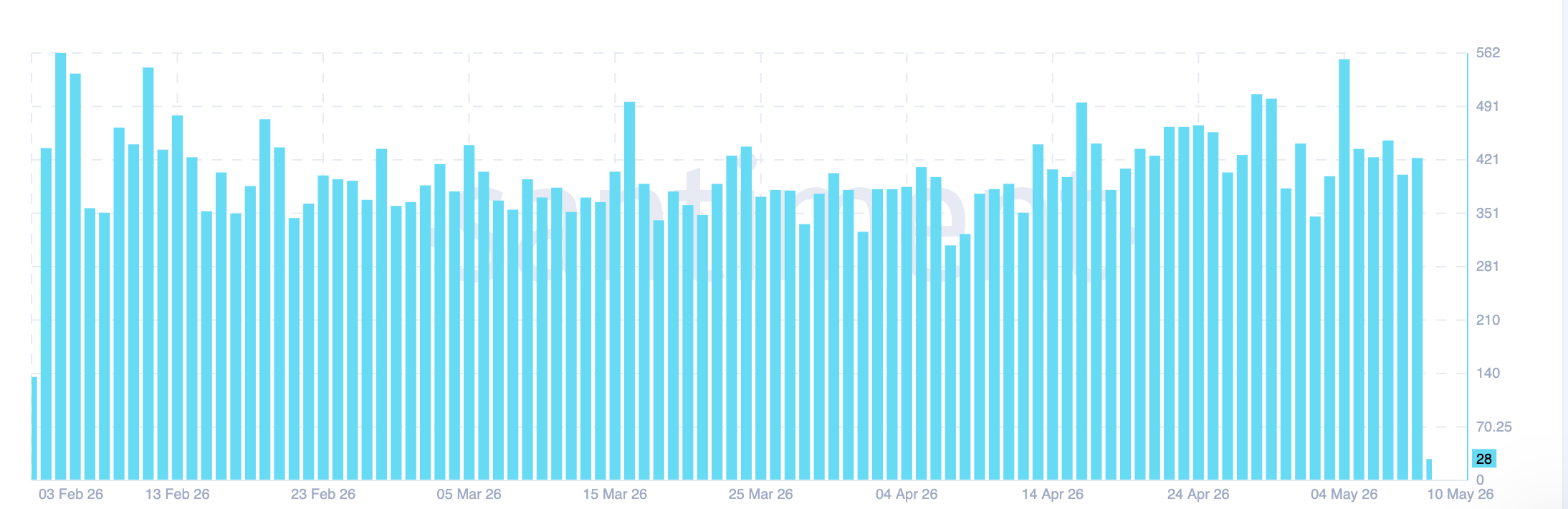
Altcoin season chatter has surged to a 3-month high across social media, but one chart is flashing a clear warning that the rotation may not be as healthy as recent token rallies suggest.
Santiment data shows mentions of “altcoinseason” and “altseason” climbing in early May, while Altcoin Vector argues weak Ethereum (ETH) leadership could undermine the move.
Altcoin Social Volume Hits Multi-Month High
On-chain analytics platform Santiment recorded social volume for “altcoinseason” surging to 544 on May 4, the strongest reading since February 5.
Follow us on X to get the latest news as it happens

Mentions of “altseason” on May 5 also hit their highest level since March 18, signaling renewed retail interest. The buzz follows fresh price action, with several altcoins staging notable rallies that have lifted hopes of a broader rotation away from Bitcoin (BTC).
Together, the data points suggest sentiment is warming up after a stretch of muted retail engagement.
Why the ETH/BTC Chart Is Flashing a Warning
Despite the optimism, Altcoin Vector flagged a structural problem in how the rally is unfolding. The OTHERS/BTC ratio, which tracks the total altcoin market cap excluding the top 10 coins relative to Bitcoin, has started to recover.
However, the ETH/BTC ratio remains weak. This breaks the standard rotation playbook, in which Ethereum (ETH) typically leads altcoins higher before capital flows down the risk curve into smaller tokens.
“That divergence tells us alts may be front-running a potential rotation, skipping the usual ETH leadership phase. A healthy rotation usually starts with ETH,” the post read.

Whether the current altcoin push converts into a sustained rotation now hinges on Ethereum reclaiming relative strength against Bitcoin.
If ETH/BTC stays compressed, Vector’s warning suggests the gains across smaller altcoins could unwind quickly on any Bitcoin weakness.
Subscribe to our YouTube channel to watch leaders and journalists provide expert insights
The post Is Crypto Entering an Altcoin Season? Social Buzz Hits a 3-Month High appeared first on BeInCrypto.

Verizon: The Buy Case Still Holds After Q1 (NYSE:VZ)

MicroStrategy Reveals It Will Sell Bitcoin Under These Conditions

HP EliteBoard G1a puts a PC inside a keyboard

Manchester United reach agreement with Casemiro over contract clause amid transfer speculation

US brings back mandatory military draft registration

Steven Gerrard disagrees with Gary Neville over ‘shock’ Chelsea and Arsenal claim | Football


-
 Crypto World2 days ago
HarrisX Poll Found 52% of Registered Voters Support the CLARITY Act
-

 NewsBeat7 days ago
Channel 5 – All Creatures Great and Small series 7 new post
-

 Crypto World3 days ago
Upbit adds B3 Korean won pair as Base token gains Korea access
-

 Fashion2 days ago
Weekend Open Thread: Marianne Dress
-

 Tech6 days ago
Image AI models now drive app growth, beating chatbot upgrades
-
 NewsBeat3 days ago
NCP car park operator enters administration putting 340 UK sites at risk of closure
-
 Business23 hours ago
Ignore market noise, India’s long-term story intact, say D-Street bulls Ramesh Damani and Sunil Singhania
-

 Business7 days ago
Winning Numbers Drawn as Jackpot Resets to $20 Million
-

 Politics1 day ago
Politics Home Article | Starmer Enters The Danger Zone
-

 Entertainment6 days ago
Olivia Wilde Reacts To Viral ‘Corpse’ Comparison
-

 Crypto World7 days ago
BlackRock Buys $284M In Bitcoin On May 1 As The Best Crypto To Invest In For 2026 Sits Below A Pending Binance Listing
-

 Sports6 days ago
Inter Milan Win Serie A Title After Victory Over Parma
-
 Sports7 days ago
IPL 2026: Gujarat Titans opt to bowl vs Punjab Kings; Nishant Sindhu handed debut | Cricket News
-

 Sports7 days ago
Kofi Kingston and Xavier Woods reportedly released by WWE along with others
-

 Business7 days ago
Can LeBron James Lead LA Past OKC Without Injured Luka Doncic?
-

 Crypto World5 days ago
UAE Free Zone Deploys Blockchain IDs to Verify Registered Firms
-

 Entertainment7 days ago
Other Bennet Sister Love Triangle Cast: Ella Bruccoleri, Donal Finn
-
 Sports6 days ago
Every word of Arne Slot’s heated rant after Manchester United win vs Liverpool
-

 Sports7 days ago
Joel Embiid urges Sixers fans not to sell playoff tickets to Knicks fans
-
Entertainment7 days ago
Jennifer Lawrence’s Mary Jane Sneakers Are Spring’s It-Girl Shoe
You must be logged in to post a comment Login