
Crypto World
Tesla drops 6% as Cybercab faces federal audit

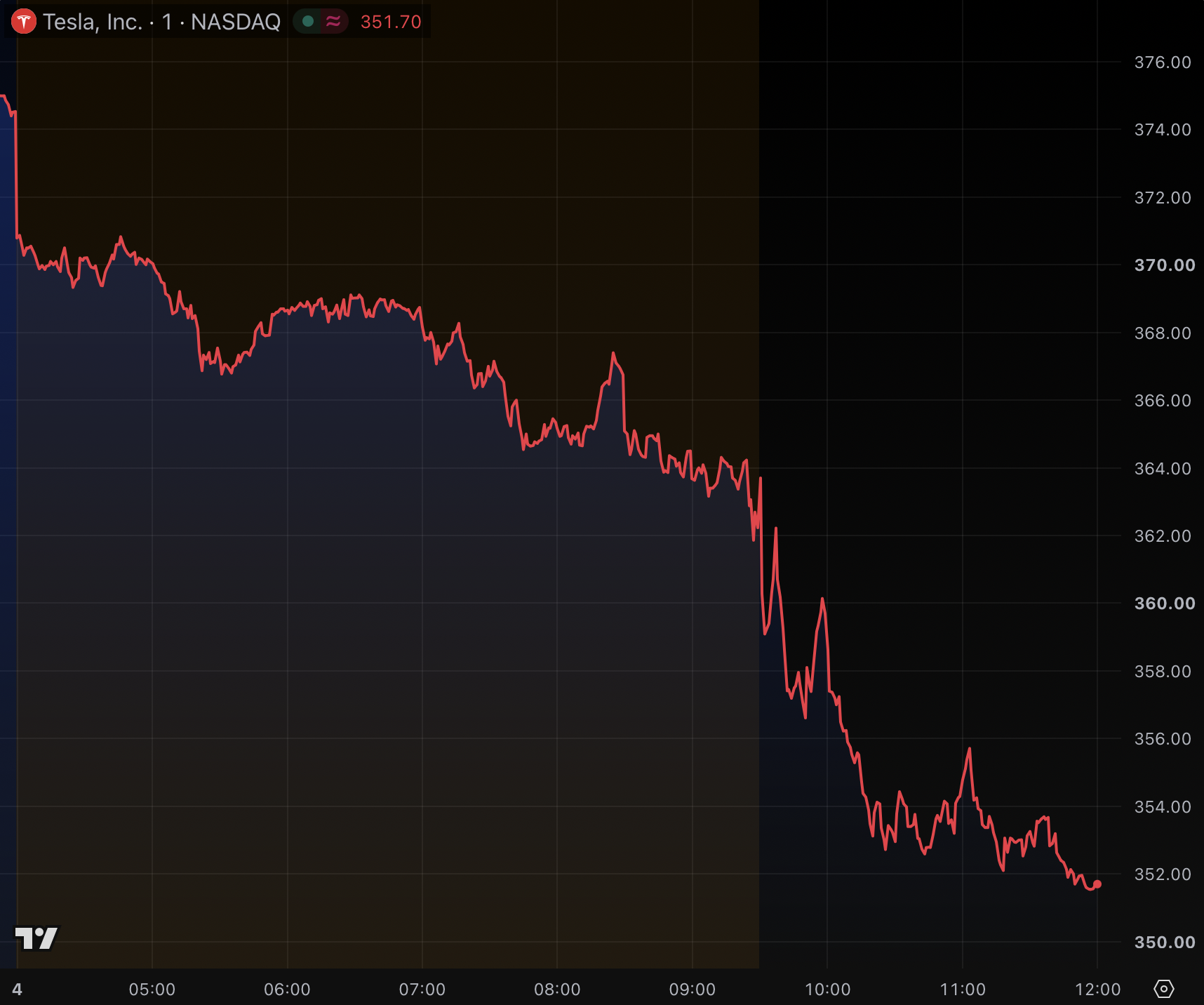
Tesla Cybercabs stock crashed 6% in an hour this morning following news of a compliance audit.
Yesterday, Tesla commercially deployed Cybercabs onto public streets in Austin, Texas. By the end of the day, the National Highway Traffic Safety Administration (NHTSA) quietly opened a new probe, Audit Query AQ26002, of up to 1,000 Tesla vehicles, which would more than cover the company’s Cybercab fleet of only a few dozen vehicles.
Tesla stood behind its claim that “Cybercab is engineered to be the safest car on the road.”
The NHTSA doesn’t typically pre-approve vehicles for compliance with Federal Motor Vehicle Safety Standards (FMVSS).
Manufacturers self-certify compliance with FMVSS standards, or request a limited exemption in advance.
Whenever the NHTSA suspects non-compliance with FMVSS standards, the agency may probe conduct and pursue remedies. In Tesla’s case, the NHTSA said it “is opening this AQ to examine the process and technical data on which Tesla relied when certifying the Cybercab and related issues.”
Cybercab has no permanently attached steering wheel, brake pedal, accelerator pedal, or rearview mirrors. In Tesla’s view, these omissions make the car look futuristic and are safe.
An Audit Query is not an allegation of misconduct. The NHTSA’s Cybercab notice doesn’t announce a recall or any current determination of noncompliance.
Read more: CHART: Value of Tesla’s BTC holdings have fallen by two-thirds
Tesla self-certifies Cybercab, sought no exemption
Last year, the NHTSA announced three proposed rules for automated vehicles without manual controls.
Its existing route allows manufacturers to sell up to 2,500 vehicles per year that don’t fully comply with traditional FMVSS.
Zoox is a recent example of an NHTSA audit ending unremarkably. In its case, the NHTSA closed its self-certification inquiry in August 2025, delivering a list of requests to Zoox that the company fulfilled. Zoox then received a formal, temporary FMVSS exemption for its commercial deployment that began July 2026.
Zoox may legally operate cars on public roads under this exemption.
Tesla chose the bolder route. It began commercial deployment with a self-certification, rather than proactively applying for a special exemption.
Tesla didn’t immediately respond to Reuters’ request for comment on yesterday’s NHTSA audit.
By noon in Nasdaq’s trading session today, shares of Tesla were trading 6.5% below yesterday’s closing price despite a relatively sideways Nasdaq 100 index at -0.5%.
Got a tip? Send us an email securely via Protos Leaks. For more informed news and investigations, follow us on X, Bluesky, and Google News, or subscribe to our YouTube channel.


This kind of change isn’t unique to real estate. It’s happening in education, finance, manufacturing, and virtually every other industry. No matter your profession, you may spend tremendous amounts of time on administrative work: writing spreadsheet formulas, analyzing documents, sending email, producing marketing content, organizing information, preparing presentations, and tackling repetitive tasks that add little strategic value.
What AI can’t replace
But whether you’re an attorney, consultant, plumber, financial advisor, or sales executive, your greatest value doesn’t come from routine administrative work. It comes from solving problems and building relationships.
Tools like ChatGPT, Claude, and Gemini can analyze contracts, create reports, summarize research, review documents, and automate a plethora of other tedious tasks. They allow professionals to spend less time on administration and more time serving their clients and building meaningful relationships. But AI isn’t replacing the qualities that matter most.

It doesn’t always look the way people expect, either. Sometimes, the moms who are suffering the most appear to have everything under control, says Jayme Scarfo, a licensed professional counselor in Surprise, Ariz., who specializes in working with pregnant and postpartum women. They’re showering, cooking, going to the gym, and insisting: “It’s hard, but don’t worry. I’ve got it.”
You don’t need to decide whether someone meets the diagnostic criteria before checking in. Describe what you’ve noticed without labeling her, Scarfo suggests: “I know this is a huge adjustment, and you haven’t seemed like yourself lately. How are you really doing?” Or: “You seem much more anxious than usual, and I’m worried about you. Can we talk about it?”
Consider who should initiate that conversation, too. “The best person to ask those hard questions is often going to be whoever she feels the least pressure to perform for,” Scarfo says. That might be a sister, best friend, therapist, or fellow mom—not necessarily her partner or mother.


The National Sheriffs’ Association (NSA) has dropped its opposition to a cryptocurrency market structure bill scheduled for a vote later this month when the US Senate returns to session.
In a Thursday letter to Senate Majority Leader John Thune and Minority Leader Chuck Schumer, the US law enforcement group said that it was changing its position on the Digital Asset Market Clarity (CLARITY) Act to “neutral.” The NSA cited the “significant work undertaken by Congress, the Administration, and stakeholders to navigate the many legal, regulatory, and enforcement considerations involved” in addressing the bill.
“At this time, we believe the most appropriate course is to step back and allow the legislative process to proceed to establish a clear, effective, and much needed regulatory framework,” said NSA president Troy Wellman and CEO and executive director Justin Smith.
The NSA previously expressed opposition to provisions in the CLARITY Act, saying it had “significant concerns” about amendments to exempt crypto mixers from many registration requirements. According to the group, the provision could “[impair] law enforcement’s ability to trace transactions and digital assets, and recover victims’ money.”
“The CLARITY Act protects the crypto industry, not the public,” said Sheriff Jim Skinner in a July video from the NSA.
Related: Rushed CLARITY Act vote could set legislation back, Gallego warns
Passed by the US House of Representatives in July 2025, the CLARITY Act has faced several hurdles since it was sent to the Senate for consideration. Although the Senate agriculture and banking committees passed their versions of the bill in 2026, many interest groups and lawmakers continue to raise concerns about aspects of the legislation, including stablecoin rewards, tokenized equities and potential conflicts of interest from President Donald Trump and his family.
Before breaking in August, Thune filed a motion to hold a cloture vote on the bill on Sept. 15 after senators return from state work periods.
US regulators to move forward without CLARITY?
In August, Trump stood alongside the heads of the US Securities and Exchange Commission (SEC), Commodity Futures Trading Commission (CFTC) and several digital asset companies to push for passage of CLARITY. SEC Chair Paul Atkins and CFTC Chair Michael Selig — both nominated by Trump — have signaled that their agencies would address crypto regulation if Congress were unable to pass the market structure bill.
Magazine: Token buybacks are booming. But are they good for crypto projects?
Post-quantum infrastructure company QuFi Network has launched a verification platform designed to protect digital assets against future quantum computing threats without requiring changes to existing blockchain settlement networks.
The platform separates verification from settlement, using a decentralized network of nodes to validate transactions with post-quantum cryptography before they are settled on existing blockchain networks.
QuFi also launched uBTC, a proof-of-concept that applies the verification system to Bitcoin (BTC) and is currently operating on Bitcoin Testnet4. The uBTC system verifies BTC collateral and generates cryptographic proofs governing how value moves between settlement environments, while redemptions ultimately settle as standard Bitcoin transactions.
The platform uses three post-quantum cryptographic standards — ML-DSA-65, SLH-DSA and ML-KEM-1024 — for digital signatures and secure key exchange.
QuFi said the external verification layer is intended to avoid the added storage, bandwidth and computing demands that can come with adopting larger post-quantum signatures directly on individual blockchains.
Related: Crypto’s first quantum attack will look like unexplained breach: Quantus founder
Crypto ramps up quantum defenses
The platform arrives amid a series of recent efforts to prepare blockchain networks for potential quantum computing threats.
In August, StarkWare tested a quantum-resistant Bitcoin transaction on mainnet without requiring a fork. However, the transaction took hours of computation and cost roughly $150 to $200, and its nonstandard format required direct submission to a miner.
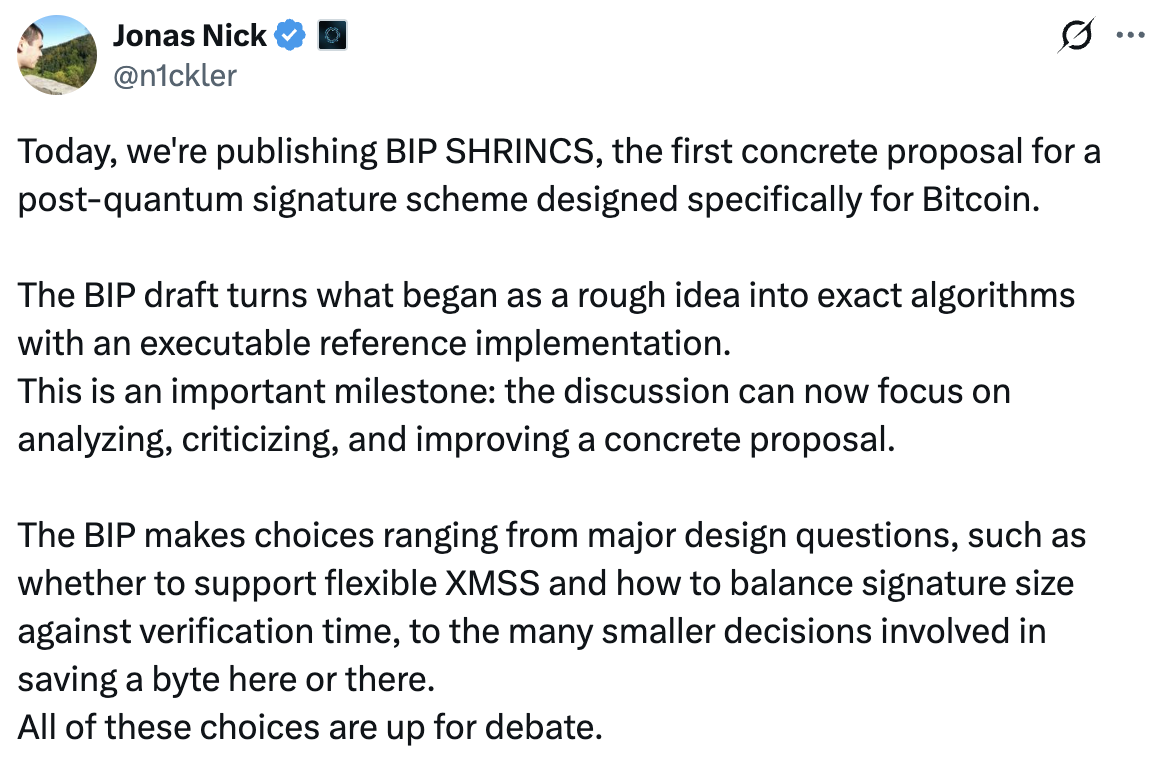
Jonas Nick announces the BIP SHRINCS proposal on Aug. 26. Source: Jonas Nick
The same month, banks and regulators across Europe, the Middle East and Asia joined a pilot testing post-quantum wallets and onchain transfers using ML-DSA-65, one of the same cryptographic standards incorporated into QuFi’s platform. Meanwhile, the Ethereum Foundation dropped the Poseidon hash function from its planned post-quantum architecture in favor of established alternatives such as SHA or BLAKE.
Bitcoin developers are also exploring protocol-level defenses. In August, Blockstream researchers published a Bitcoin Improvement Proposal for SHRINCS, an experimental post-quantum signature scheme designed to reduce the size and performance costs associated with quantum-resistant signatures.
The approach comes with trade-offs. SHRINCS uses stateful signatures to reduce their size, requiring wallets to track previously used signing keys. The scheme remains in an early stage without a completed security proof, and its design adds complexity and potential user failure modes.
Magazine: Bitcoin’s new quantum defenses, 18.9M SOL cancelled: Hodler’s Digest
Crypto World
Recent Pi Network (PI) Price Forecasts, Ethereum’s (ETH) Potential, and More: Bits Recap September 4

Pi Network’s native token has soared by 11% over the past month and has recently drawn mixed price predictions.
Ethereum seems ready to post substantial gains in September, while Shiba Inu may not fare so well this month.
PI’s Next Targets
The token has rebounded by roughly 35% from its July historic bottom and currently trades at around $0.095 (per CoinGecko). It remains among the most discussed cryptocurrencies, and, as expected, many industry participants have paid attention to its recent price performance and made interesting predictions.
X user OxNeena noted that PI is holding a key support zone around $0.09-$0.10 after a long consolidation, envisioning a massive uptrend above $0.30 if bulls reclaim $0.20.
Nakamoto Files argued that “something is moving behind the scenes” at Pi Network, while CT News believes that if the next altcoin rotation reaches PI, the coin could climb much faster than most think.
“The sleeping giant may not stay asleep forever,” they added.
Meanwhile, there has been growing speculation that the team behind Pi Network intends to implement a burning mechanism that could positively impact the price. However, the X account BSCN and other users rejected the development.
ETH in September?
The second-largest cryptocurrency jumped by nearly 5% over the past 24 hours, once again exceeding the psychological $2,500 mark. Some important factors, including strong demand from institutional investors, suggest that the coming weeks may deliver further gains.
SoSoValue’s data shows that spot ETH ETFs posted 12 consecutive green days before the run paused on September 2. The momentum quickly returned, with the following 24 hours adding another strong inflow.
The amount of ETH stored on cryptocurrency exchanges is another bullish element. Several days ago, the figure plunged to roughly 14.9 million coins, the lowest since the summer of 2016. Later on, there was a slight move north, yet the total remains below 15 million. Such a development signals that many investors prefer to avoid centralized platforms, thereby reducing immediate selling pressure.
At the same time, Ethereum’s seasonal performance serves as a warning. The asset has ended 7 of the past 11 Septembers in the red, and there hasn’t been a year in which both August and September closed with gains. Recall that last month delivered a 32% price increase for ETH.
SHIB’s Perspective
Unlike ETH, the self-proclaimed Dogecoin killer appears more likely to underperform in September than to post a major rally. The worrying signals include Shibarium’s stalled activity, the declining burn rate, and others.
Moreover, September has been a predominantly poor month for SHIB, with its valuation finishing the timeframe in the red three out of five times.
There is still a glimmer of optimism. Back in 2021, both August and September closed in the green, giving the SHIB Army hope that history could repeat itself, especially since the meme coin pumped by 7.5% last month.
The post Recent Pi Network (PI) Price Forecasts, Ethereum’s (ETH) Potential, and More: Bits Recap September 4 appeared first on CryptoPotato.

The most consequential device in cryptography does not exist yet. Quantum memory, an Oxford lecturer argues, will decide whether Bitcoin (BTC) breaks or gets replaced by something better.
Stefano Gogioso published that argument on Tuesday. He says the promise of quantum cryptography now rests on building a single piece of hardware.
“The development of portable long-term quantum memory will be one of the most consequential milestones of quantum technology. These devices will power an entirely new class of applications, such as quantum money, the ultimate incarnation of a digital store of value.”
Gogioso, a quantum computing lecturer at the University of Oxford and co-founder of quantum security firm Spooqy, told BeInCrypto.
The Bottleneck Quantum Money Never Cleared
An earlier report from the BeInCrypto Experts Council ended on an unsolved problem. Quantum money cannot be forged, because quantum states cannot be copied.
Nobody, however, can hold those states for long. The best laboratory systems keep one alive for seconds, which is why the case for quantum money has stayed theoretical.
Gogioso’s post sets out what a usable device would actually need. Stability measured in months, or ideally forever. Portability, first inside a shipping crate and later inside a pocket. Capacity running to billions of separate states.
He also rules out the more familiar idea of quantum RAM. Nothing in his design needs random access or in-place editing. States are drawn in order and spent once.
The distance between seconds and months is the entire problem.
Why Gogioso Calls Quantum Memory Inevitable
His answer arrives in two steps, and the first one is categorical.
A fault-tolerant quantum computer must keep fragile states alive at scale, against noise, for as long as a calculation runs. That requirement is what fault tolerance means.
Remove the computing, Gogioso argues, and a quantum memory device is what remains. Denying one therefore means denying the other.
The reframing matters commercially. Billions of dollars are already committed to fault-tolerant machines. The memory sits inside those roadmaps as an unavoidable step.
His second step concerns portability. Machines running at cryogenic temperatures will keep their states at the bottom of a refrigerator for years to come.
Atom-based designs are different. They store information in properties that nature already keeps isolated. That turns the problem into hard engineering rather than physics.
Gogioso also lowers the bar in a way the debate has mostly ignored. A memory does not have to survive decades. A sealed single-use cartridge, filled at a facility and spent state by state, would serve every application he describes.
The Same Machine Breaks Bitcoin and Builds Its Replacement
Follow that argument into crypto and it produces an awkward symmetry.
In March, Google Quantum AI worked with the Ethereum Foundation and Stanford on the cost of attacking Bitcoin. The team put the requirement at fewer than 500,000 physical qubits.
Such a machine only works if it is fault tolerant. And fault tolerance, by Gogioso’s own definition, is quantum memory.
The conclusion is uncomfortable for both camps. The hardware that would expose Bitcoin’s signatures would also fuel quantum money.
Every dollar chasing fault tolerance therefore funds both futures at once. No version of this story exists where quantum computers break Bitcoin and the alternative stays impossible.
Gogioso and Daniela Herrmann, chief executive of quantum firm Dynex, made the wider case on the panel above.
Why a Stolen Shipment Would Not Matter
The security model behind all of this inverts an old assumption.
Classical key material is dangerous in transit. Whoever copies it owns it, and leaves no trace of having done so.
An entangled pair carries no information at all while it sits in storage. The randomness that becomes a key appears only at the moment of measurement.
A hijacked crate would therefore cost a supplier its stock rather than its secrets. Gogioso writes that the worst a corrupt supplier can deliver is a tank of useless gas.
A second consequence is stranger. These resources burn. A key consumes entangled pairs, and a banknote gets spent across its own verifications.
Gogioso calls the effect cryptography by combustion. Money built this way would arrive with a fuel gauge.
Q-Day Has a Calendar. Quantum Money Does Not.
The two halves of this story move at very different speeds.
The attack side is full of dates. IBM expects quantum computing to move its earnings by 2028 or 2029. Hong Kong has set its banks a quantum readiness deadline of 2030.
The National Institute of Standards and Technology plans to retire current elliptic-curve signatures by 2030. It would disallow them outright by 2035.
The replacement side has no calendar whatsoever. Gogioso declines to supply one. His post argues for the inevitability of the resource, not the imminence of a product.
He was more forward-looking on the panel, suggesting provably impossible applications within five to seven years. That estimate covered quantum resources broadly, not a memory small enough for a wallet.
Herrmann drew the same boundary during the discussion.
“Quantum money is the vision, once this all plays out. Right now, quantum money as such isn’t available yet. But as soon as the chips advance, these things have to be handled with real responsibility.”
What the Argument Leaves Open
Two questions survive it.
Somebody still has to fill the memories. That leaves an issuer inside a system advertised as having no custodian.
A bearer instrument with no ledger also has no recovery. A note that is lost, stolen, or simply left to decay takes its value with it.
The industry is building the machine regardless. It has not yet decided which of the two things it wants.
The post Quantum Memory: The Device That Breaks Bitcoin and Replaces It appeared first on BeInCrypto.

US spot Bitcoin ETFs ended August on an impressive note and appear to have continued to build momentum, recording $731 million in net inflows on September 3rd, their strongest single-day performance since January.
Now, a pattern has sparked speculation over whether Bitcoin could see another short-term top following the latest surge in ETF demand.
ETF Buying Explodes
Analyst Ted Pillows said that on the previous two occasions when Bitcoin ETFs recorded daily inflows above $700 million, first in October 2025 and then in January 2026, BTC went on to form a local peak shortly afterward.
Despite a minor hiccup on September 1st, which saw outflows of over $236 million, US-based spot Bitcoin ETFs have bounced back strongly. Total net assets reached $103.34 billion, representing just over 6% of Bitcoin’s market capitalization. Cumulative net inflows since the ETFs launched in January 2024 stood at $55.44 billion.
Data shared by SoSoValue revealed that BlackRock’s IBIT led the gains with around $454 million. Next up was Ark and 21Shares’ ARKB at $137.7 million, followed by Fidelity’s FBTC at $74.4 million. Grayscale’s two products attracted a total of $57 million in capital.
On the other hand, VanEck’s HODL and WisdomTree’s BTCW were the only funds to have posted outflows of $20 million and $5 million, respectively.
Over the past month, Bitcoin saw around 105,000 BTC equivalent in net capital inflows, and the US spot Bitcoin ETFs accounted for approximately 42,800 of that total. According to Axel Adler Jr., the fund inflows accounted for about 41% of the overall capital entering the market during the period.
Bear Market Debate Continues
Alongside these inflows, Bitcoin surged by over 4% to trade near $81,130. Open interest on Binance and Bybit reached levels not seen since May 5, which suggested that derivatives activity is rebuilding alongside the latest price advance. These developments have prompted some experts to believe that the crypto bear market may be coming to an end.
However, Fidelity believes that the recent recovery does not yet prove the bear market is over. The firm noted that BTC’s historical four-year cycle could leave room for another market low around November 2026, although the pattern is not guaranteed.
The latest technical setup, however, looks more bullish. Bitcoin moved back above the weekly EMA ribbon after recently falling below it, a level that previously signaled the start of a sell-off. Dami-Defi explained that the EMA ribbon currently sits between about $71,000 and $78,000. The reclaim is seen as a positive shift, but the crypto asset still needs to hold above the ribbon on weekly closes. If it does, the next major resistance level to watch is around $95,000-$96,000. A drop below the ribbon, however, could invalidate the recovery.
The post Bitcoin ETF Inflows Exceed $700M as Historical Pattern Points to BTC Local Top appeared first on CryptoPotato.
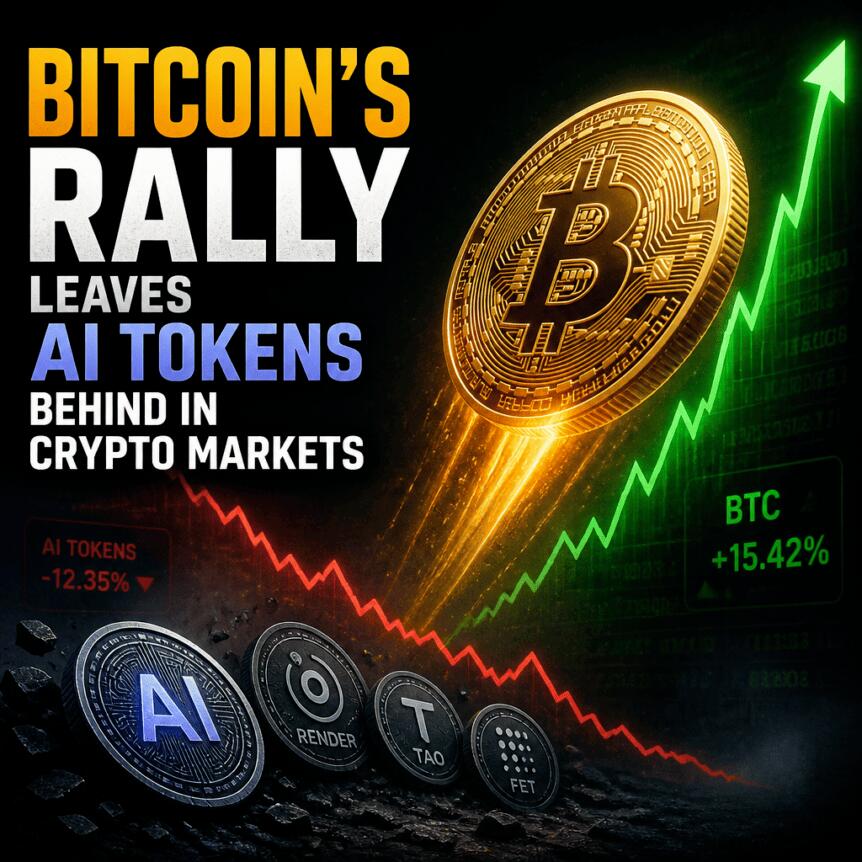
August’s rebound in crypto did more than lift prices—it reshuffled attention toward the companies most exposed to Bitcoin and Ether beta. Bitcoin miners are again trading like a levered play on BTC, while corporate treasuries continue to add to their holdings during the same recovery window.
At the same time, traditional finance is moving closer to stablecoins for settlement and payments. And in Ethereum’s market, Bitmine’s persistent spot buying has pushed it close to a major share-of-supply milestone.
Key takeaways
- Bitcoin miner stocks surged in August after a stretch where investors favored AI- and HPC-oriented infrastructure plays.
- Strive and Strategy added thousands of BTC in late August, extending a corporate “buy the dip” pattern as digital-asset risk appetite returned.
- A consortium of 21 major financial institutions is planning a G7 stablecoin initiative with a targeted launch in the first half of 2027.
- Bitmine’s 65-week ETH buying streak has lifted its holdings to about 4.9% of Ethereum’s circulating supply, nearing its 5% goal.
Miners regain leverage as BTC rallies
Bitcoin’s rally in late August helped reverse a prior trend that had benefited some miners less than others. According to BlocksBridge Consulting, Bitcoin-linked mining equities rose sharply—up as much as 67%—at a time when the market had been more focused on miners pivoting toward AI-driven demand.
BlocksBridge reported that Bitcoin’s roughly 23% jump in late August outperformed much of the AI-linked infrastructure space. It cited gains ranging from about 41% to 67% for Canaan, American Bitcoin, and Cango, compared with around 21% for CoreWeave, 17% for Nebius, and 15% for IREN. Other miners with greater exposure to AI and high-performance computing were flat or declined.
The newsletter pointed to several drivers behind the miner rebound: expanding US Treasury-related buybacks that support liquidity, renewed regulatory optimism following a White House meeting on crypto, and a short squeeze that BlocksBridge said liquidated more than $1.6 billion in positions.
For investors, the message is straightforward: when BTC momentum returns, the market appears willing to reward direct exposure and operational leverage again. Still, BlocksBridge also flagged a lingering risk for the sector—high costs tied to scaling AI data-center capacity. That tension helps explain why AI-forward strategies may not always capture the same upside during pure BTC-driven rallies.
Strive and Strategy extend BTC treasury buying
Corporate treasuries were another focal point during the recovery. In the final week of August, Strive and Strategy both made additional Bitcoin purchases that pushed their holdings higher and reinforced the idea that balance-sheet conviction is still alive.
Strive bought 1,800 BTC for approximately $143 million, per earlier reporting, lifting its holdings to 23,156 BTC. The company paid an average of $79,431 per BTC (including fees and expenses) after purchasing 1,110 BTC the prior week at an average price of $73,409.
Strategy, meanwhile, acquired 4,603 BTC at an average price of $80,318. Those purchases lifted its holdings above 845,000 BTC after four sales since May, according to the same coverage. Together, the two companies illustrate how the late-August bounce translated into concrete treasury actions rather than purely speculative positioning.
BlocksBridge-linked commentary also tied the timing to a broader digital-asset recovery that began Aug. 19 after the US Treasury announced plans to double certain long-term bond buybacks. While that doesn’t “explain” every corporate decision, it provides context for the return of risk appetite across markets—including crypto.
Stablecoins move toward a G7 push for 2027
Beyond BTC and ETH, stablecoin development is drawing renewed momentum from traditional financial institutions. A consortium of 21 major firms—including Bank of America, Goldman Sachs, and Citi—plans to establish a new company to develop and issue stablecoins, representing another step in the long-running effort to build “digital dollars” for real-world payment rails.
The group intends to launch a US dollar-denominated stablecoin in the first half of 2027, with plans to expand to other G7 currencies afterward—starting with a euro offering. The stated objective is to support wholesale, institutional, and retail use cases, including cross-border payments and digital-asset settlement.
The stablecoin initiative builds on an earlier announcement from last October, when 10 banks explored a 1:1 reserve-backed form of digital money on public blockchains. The consortium now spans regions including North America, Europe, East Asia, the Middle East, and Africa, and aims to comply with both the US GENIUS Act and the EU’s MiCA framework.
For market participants, this matters because stablecoin issuance and distribution directly affect on-chain settlement liquidity, off-ramp/on-ramp rails, and how quickly traditional counterparties can connect to tokenized assets. The 2027 target also provides a concrete timeline for builders and compliance teams watching regulatory clarity in major jurisdictions.
Bitmine nears 5% of ETH circulating supply
In the Ethereum segment, Bitmine’s accumulation pace remains unusually persistent. The company extended its ETH buying streak to 65 consecutive weeks, adding 53,501 ETH in the latest reported period as broader crypto prices recovered.
As a result, Bitmine’s holdings rose to more than 5.9 million ETH, valued at roughly $14.8 billion based on an ETH price of $2,511 as of Sunday, in line with the figures reported in the earlier coverage. That put Bitmine’s stake at approximately 4.9% of Ethereum’s 120.7 million circulating supply—leaving it close to its stated 5% goal.
Bitmine chairman Tom Lee said Ether, Bitcoin, and Solana were the three best-performing major assets since June 30, with ETH leading gains. He also argued that the relative performance against other macro assets should encourage institutions to add to their crypto holdings.
Still, the accumulation has not erased the accounting reality of a drawdown recovery story. According to DropsTab data referenced in the report, Bitmine is sitting on about $5.1 billion in unrealized losses on its Ether holdings—reflecting sustained buying through a downturn that began in late 2022. The company’s willingness to keep absorbing that gap while the market rebounds is central to why its supply share has climbed despite volatility.
What to watch next
With miners responding sharply to BTC momentum, treasuries continuing to add during recovery phases, and major institutions pushing stablecoin plans toward 2027, the next signal will be whether these themes hold as volatility returns—particularly whether AI-linked infrastructure continues to lag (or catch up) when Bitcoin’s direction changes.

Hargreaves Lansdown now sells Bitcoin (BTC) to about 2 million clients. However, it arrives five months too late, given that the tax break its savers wanted was closed in April.
Buy Bitcoin through a rival last winter, and the profit is tax-free for life. Buy the same thing at HL today and the taxman takes a cut.
Hargreaves Lansdown’s Bitcoin is for £100,000 Earners
According to a report in the Financial Times, nine products went live, delivering notes that track the Bitcoin price, and run by firms like BlackRock, Invesco, and CoinShares. Fees range from 0% to 0.35% per year.
HL was the last big British platform to say yes, waiting 330 days after the rules changed. However, on closer inspection, you notice that it only changed its shelf, not its mind, since they still label these products as high risk.
Most clients cannot buy them anyway, as HL requires £100,000 in yearly income or £250,000 in savings. Buyers also sit a short test and wait a day.
There is a catch in the product too. You never own any Bitcoin. Instead, you own a promise from the firm behind the note.
That makes 2 million the client list, not the buyer list, and anyone who qualifies must use a taxed account, or a pension they cannot touch until 55.
“After an appropriateness test and a 24-hour wait, a SIPP or Fund and Share account on HL can take listed Bitcoin exposure, even though you still do not hold the coins and a standard Stocks and Shares ISA remains closed to new buys,” one user noted.
Follow us on X to get the latest news as it happens
Britain’s Tax-Free Window Lasted 180 Days
That taxed account is the whole problem because savers once had a better option, and now it has gone. Britain barred ordinary savers from these products for years. The Financial Conduct Authority lifted that ban on 8 October 2025.
For a while, savers could hold Bitcoin inside an ISA. That is the tax-free account millions of Britons already use. Money made inside one is never taxed.
The tax office shut that door on 6 April 2026. The window had been open for 180 days. HL now turns up 150 days after it closed.
Savers who moved in time keep the tax break for good. The tax office left their holdings in place. HL’s clients get nothing.
Here is what that is worth. Put £20,000 in an ISA, double it, and you owe zero. Double it in a normal account, and the tax bill is about £4,080.
BeInCrypto called the reopening a symbolic step when Bitcoin ETNs returned to Britain. That reading holds up. The firm that said Bitcoin was no asset class now sells it. Just to the rich and in the wrong account.
Ministers say ordinary ISAs may get these notes back later.
The post Biggest UK Investment Platform Lists Bitcoin For 2 Million Users appeared first on BeInCrypto.


The U.S. is investigating a strike on a wedding in southern Iran, Vice President J.D. Vance said Thursday, as reports suggest American weapons killed at least five people and injured dozens of others.
“We’re investigating it because obviously we care,” Vance told reporters. “We want to know.”
The strike represents the U.S.’s latest controversial action in its war with Iran, raising questions about its conduct and civilian harm. Washington and Tehran have escalated their attacks this week, ending a lull in hostilities since July.
But Vance said he was “extremely skeptical” about reports coming from Iranian state media, arguing they have “not been a very good scribe about what’s happened in the conflict thus far.”
Iranian state media reported that a residential building in Kuhestak was attacked on Tuesday evening, where a wedding was being celebrated. Among the casualties was a 4-year-old kid. Reuters and the New York Times independently verified footage from the scene and found that a wedding was taking place when the building was struck.
Iran’s Ministry of Foreign Affairs said that it “will respond to these savage crimes with firmness”—and responded to a broader barrage of American attacks by launching missiles and drones at sites used by the U.S. in Middle East states. The Iranian Red Crescent Society, a humanitarian group, also urged a probe from the International Criminal Court to assess potential violations of international law.
The U.S. Central Command said Wednesday it was already looking into reports of the incident but argued that the “U.S. military never targets civilians, unlike the [Islamic Revolutionary Guard Corps],” referring to Iran’s armed forces branch.
Vance also defended U.S. military action, telling reporters: “If we do make mistakes, again, this is a big difference between us and Iran: when our military makes mistakes, they learn from them to try to get better from them.”
What we know about the strike
On the evening of Sept. 1, CENTCOM reported strikes on military targets, including “air defense sites, radar systems, maritime assets and facilities, mine laying capabilities, and communications sites.”
Iranian media later reported four deaths and at least 68 injured in Kuhestak, a coastal town on the Strait of Hormuz, where trade has been bottlenecked since the start of the U.S.-Iran war in late February. The strikes happened at around 9:30 p.m. local time, per the Red Crescent.
Analyses of footage from the incident conducted by Reuters and the New York Times reveal that wedding guests were gathered in a Kuhestak building. Amid the celebration, what was likely a U.S. munition hit the building and, as the Times put it, “brought down the roof.”
Experts told Reuters and the Times that weapon fragments seen in Iranian media were consistent with what Americans have used.
The attacks on Kuhestak also hit a communications tower roughly 100 m away from the building. A human rights group told the Associated Press that one of the four people initially reported killed—a 16-year-old—was struck by shrapnel near the tower rather than at the wedding. Iranian state television said Thursday that a 22-year-old woman had since died in hospital following the strike, bringing the reported death toll to five.
Axios reported that CENTCOM Commander Adm. Brad Cooper ordered an internal review of the strike.
Civilian casualties raise concern
The Red Crescent sent a letter to the International Criminal Court Wednesday calling for “an independent, impartial, thorough, and effective investigation,” citing the “civilian character” of the strike’s location.
The organization also argued that under the Rome Statute, intentionally directing attacks on civilians and knowingly launching a clearly excessive attack may constitute “war crimes.” However, both Iran and the U.S. are nonparties to the Rome Statute, so the ICC does not have automatic jurisdiction over them.
Still, “the laws of war state that civilians are protected from military attacks,” Melanie O’Brien, a professor of international law at the University of Western Australia, tells TIME. “A wedding is not a military objective, particularly in a civilian residential building. It is clear that there was a direct missile hit to the home. This would render the attack unlawful.”
It’s also not the U.S.’s first involvement in strikes that hit civilian structures without obvious military use and that endangered or killed civilians. On the first day of the war with Iran on Feb. 28, a U.S. Tomahawk missile hit a primary school in Minab—just 30 km (18 mi) away from Kuhestak—where more than 100 children were killed.
O’Brien, however, says she is skeptical about any result from the U.S.-led investigation of the wedding strike: “The U.S. track record is to only investigate when allegations gain significant public traction, and even when any convictions occur, the penalties are minor or pardons are given.”

2.5 Hours of Unhinged Financial Hot Takes (Do You Agree?)

Police say Whittlesey road will stay closed for ‘number of hours’ after woman seriously injured in crash

inTEC Group sells commercial businesses to Tela to ‘simplify’ its operations





-

 Tech7 hours ago
The Birds Outside, Drawn For You Automatically
-
 Crypto World6 hours ago
Bitcoin price stalls near $82K as key resistance holds
-

 Politics6 hours ago
Best Gaming Laptops, CPUs, TVs, And Keyboards To Upgrade Your Set Up For GTA VI
-

 Crypto World10 hours ago
IMF Says El Salvador’s Post-Review Bitcoin Purchases Used No Public Funds
-
 Crypto World6 hours ago
U.S. added stronger than expected 162,000 jobs in August as labor market bounced back
-

 Sports10 hours ago
Alexandre Pato consortium’s Northampton Town investment approved
-

 Sports11 hours ago
Commanders’ Chig Okonkwo is a top breakout fantasy football candidate
-

 Sports5 hours ago
Golden Eaglets Drawn in Group B for 2026 WAFU B U17 Championship
-

 Politics12 hours ago
A new European chapter for Gibraltar
-
 Crypto World5 hours ago
XRP price breaks falling channel as bulls target $1.53
-

 Politics8 hours ago
The House | Bin the lectures, bring gossip and be ready to banter: how the new PM should prepare for his Trump encounter
-

 Politics5 hours ago
How To Avoid Winter Colds: 4 Everyday Habits That Spread Germs, Says Pharmacist
-

 Crypto World5 hours ago
From warning to listing: UK’s largest retail investment platform opens access to crypto ETNs
-

 Crypto World6 hours ago
FinCEN flags $12.7B tied to Southeast Asia crypto investment scams
-

 Tech7 hours ago
A Worthy Android Ereader, With Some Tradeoffs
-

 Crypto World5 hours ago
Trezor Data Breach Impacts 67,000 More US Customers
-

 Politics10 hours ago
33 Cosy Autumn Home Decor Ideas: Blankets, Pumpkin Decorations, And Candles
-

 Tech5 hours ago
beyerdynamic AVENTHO Y Debuts at IFA 2026 and Makes Wireless Headphones Less Disposable
-

 Sports11 hours ago
Seven wickets in 21 balls: Sri Lanka’s Chamari Athapaththu scripts history with record-breaking spell
-

 Tech6 hours ago
How To Edit Claude’s Memory
You must be logged in to post a comment Login