
Crypto World
Tether posts $1.04 billion in first-quarter profit, reaches $8.23 billion reserve buffer



Tether, issuer of the largest stablecoin by market capitalization, said first-quarter net profit was $1.04 billion and excess reserves increased to a record $8.23 billion.
The company did not provide year-earlier or fourth-quarter figures. It reported a net profit of more than $10 billion for all of 2025.
The amount of the dollar-pegged USDT in circulation remained stable, with total token-related liabilities of about $183 billion as of March 31, the firm said in its quarterly report. The company’s total assets are just under $192 billion, it said.
The report was released at a time of increasing global demand for stablecoins as they find uses outside crypto trading as a mechanism for international payments. Just this week, Visa announced expansion of its stablecoin settlement pilot to nine blockchains, adding Base, Polygon, Canton Network, Arc and Tempo to existing support for Ethereum, Solana, Avalanche and Stellar.
Excess reserves, up from $6.3 billion at end-2025, were supported by “continued profitability and a reserve base concentrated in short-duration, high-quality liquid instruments,” the company said.
USDT is the third-largest cryptocurrency, behind bitcoin and ether (ETH), with a market capitalization of just under $190 billion.
The majority of Tether’s reserves are held in U.S. government-backed instruments and short-term liquidity facilities, the firm said, adding that it is the 17th-largest holder of U.S. Treasuries globally. Tether has become a top 10 buyer of U.S. Treasuries over the past two years, surpassing Taiwan, Israel and the UAE.
Its physical gold holdings are roughly $20 billion and its bitcoin reserve is approximately $7 billion, it said.

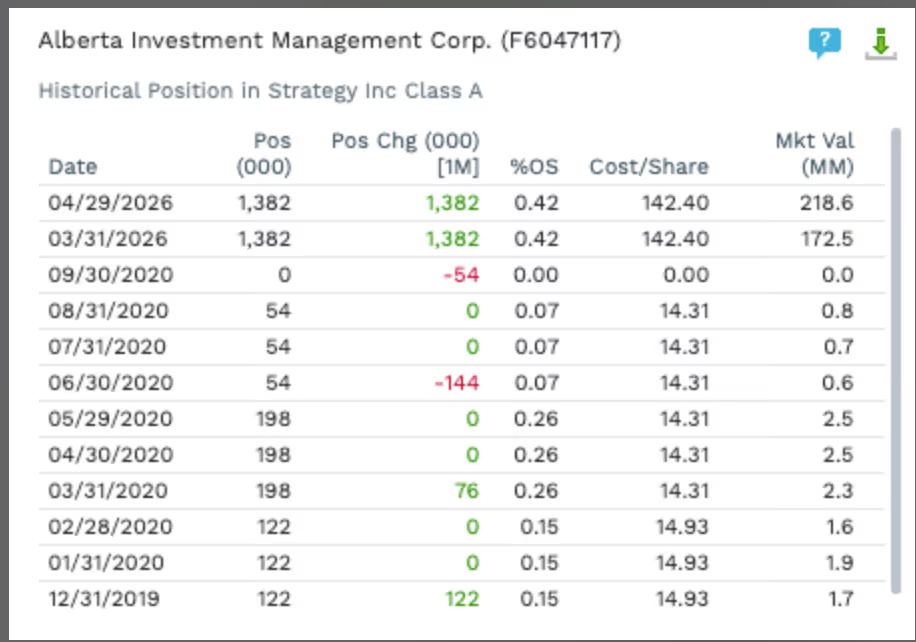
Alberta Investment Management Corporation (AIMCo), according to its first quarter 13F filing, purchased 1,382,000 shares of Strategy (MSTR) for $172,473,600.
This implies an average cost of about $125 per share. With MSTR having rallied to about $175, that position would now be valued at roughly $241 million, representing an unrealized gain of about $69 million.
As of December 2025, AIMCo managed more than $140 billion on behalf of Alberta’s public sector pension plans, making it one of Canada’s largest institutional investors.
A 13F is a quarterly filing required by the SEC for institutional investment managers with over $100 million in U.S. equity holdings, disclosing their positions at the end of each quarter.
According to FactSet, AIMCo previously held a small position in MSTR between late 2019 and mid 2020, around 198,000 shares. The fund exited the position entirely in September 2020, shortly after CEO Michael Saylor pivoted the company toward Bitcoin as a corporate treasury asset in August 2020.

In certain jurisdictions, institutional investors may face restrictions on directly holding Bitcoin, leading them to seek alternative exposure through instruments such as Strategy or BlackRock’s IBIT.
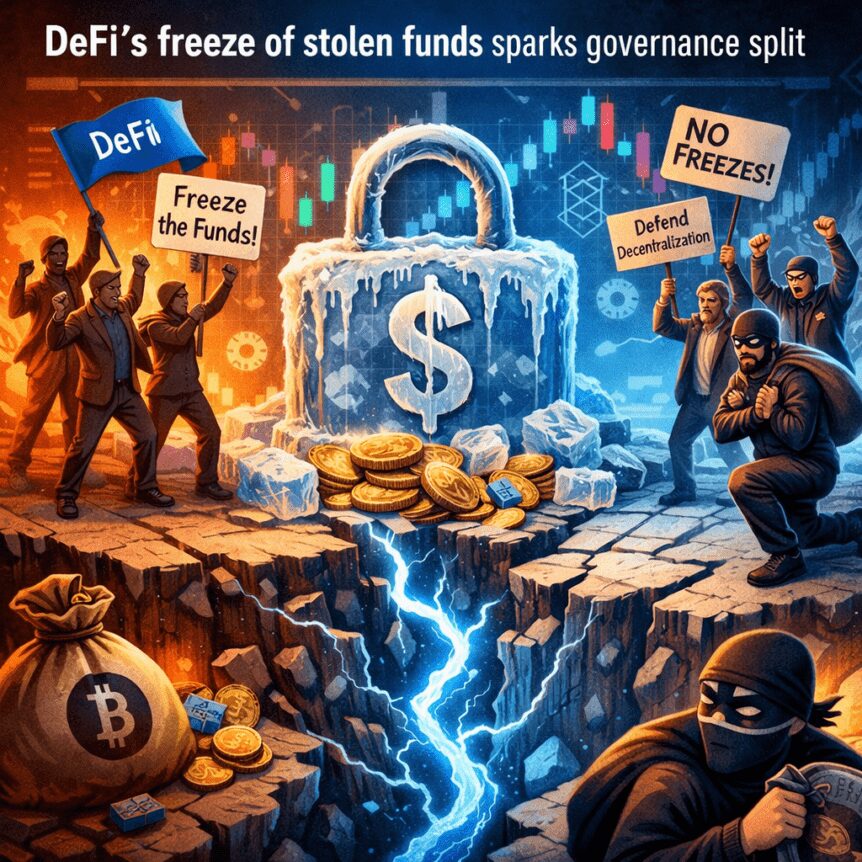
The debate over DeFi’s supposed “trustless” nature has been foregrounded again as a high-profile exploit tests the boundaries of on-chain governance and emergency intervention. After Arbitrum’s response to a major hack linked to the Kelp exploit, questions intensified about who gets to pause, seize, or redirect funds—and under what rules those powers should operate in a system that markets itself as decentralised.
The Arbitrum incident highlighted a practical tension: while protocol developers and decentralisation evangelists argue that permissionless, transparent governance should govern all action, emergency interventions by a security council or a group of trusted insiders can stop further damage at the cost of a purer reading of decentralisation. The core of the debate is not simply “decentralised vs centralised,” but over who holds the keys, how those keys are governed, and how quickly decisions can be made when funds are at risk.
Key takeaways
- Arbitrum relies on a 12-member security council that can enact changes in emergencies; nine signatures are required to authorize actions within a multisignature framework.
- During the Kelp DAO-related incident, Arbitrum froze some stolen funds linked to suspected North Korean actors, prompting renewed scrutiny of protocol-controlled intervention power.
- Centralised stablecoins like USDC and USDT can freeze funds under legally compelled processes, highlighting a governance gap between DeFi’s ethos and regulated fiat-backed issuers.
- THORChain Design: some DeFi projects insist they cannot freeze funds by design, a stance that contrasts with cases where intervention has occurred, raising questions about what “decentralised” really means in practice.
- Experts urge codifying pre-defined, transparent thresholds for intervention to avoid ad hoc governance decisions, balancing user protection with principled decentralisation.
Interventions in DeFi and the Arbitrum episode
The recent Arbitrum security gesture centered on freezing assets tied to an attack linked to the Kelp DAO incident. Arbitrum’s architecture allows a 12-person security council to oversee protocol changes, with emergency actions achievable through a nine-of-12 quorum in its multisig framework. This mechanism, voted on by the network’s decentralized autonomous organization, is designed to provide a rapid-response option when on-chain evidence signals malicious activity.
Connor Howe, CEO and co-founder of the cross-chain infrastructure project Enso, framed the tension plainly: “crypto protocols are not that different from centralized platforms or banks if a small group of people can freeze funds.” He stressed the need for transparency around who holds keys and the safeguards designed to prevent abuse. “There should be transparency in every protocol around who holds the keys, and the safeguards in place to prevent them from going rogue. If there’s no clear distinction, then it’s a vague claim of decentralization,” Howe said.
In discussing Arbitrum’s move, observers highlighted that the decision to intervene—especially in cases tied to North Korean-linked hackers—has become a focal point for broader questions about governance and responsibility in DeFi. The incident also revived scrutiny around the scope and limits of “emergency” powers in privacy-preserving, permissionless networks.
Who intervenes and what counts as “extreme” action?
On one side of the ledger are projects that argue for a hard line against any form of post-hoc intervention. THORChain, for example, has stated it cannot freeze funds by design, arguing that such action would undermine the very premise of non-custodial, cross-chain liquidity. Yet security researchers have pointed to past instances where interventions did occur, challenging the claim that decentralisation automatically prevents any form of takedown or fund seizure.
Bernardo Bilotta, CEO of stablecoin infrastructure platform Stables, argued that intervention can be appropriate but must be tightly scoped. “Freeze capabilities need to be narrowly scoped, time-limited and governed by transparent criteria that existed before the breach occurred,” he told Cointelegraph. “A protocol shouldn’t be making up the rules while the house is on fire.” His stance frames the problem as one of responsible governance, not a philosophical struggle over decentralisation in the abstract.
The debate resurfaced amid the wider discourse triggered by the Drift protocol exploit, which involved a substantial loss and prompted questions about how best to respond when a protocol’s funds are compromised. The broader worry is that a few hands with “keys” can decide to intervene pre-emptively, potentially diverting funds away from legitimate user plans or liquidity strategies.
Wish Wu, CEO of institution-focused layer-1 Pharos, emphasized the need for pre-defined, codified conditions for intervention. “In practice, ‘extreme’ is too often defined after the fact by whoever holds the keys, which is exactly the failure mode decentralization was meant to avoid,” Wu said. He advocated for governance frameworks that set objective triggers—accepting that some edge cases may fall outside those rules—and insisted that a credible governance model must make it possible to distinguish between custodial and non-custodial operation in practice.
Centralised issuers and the mechanics of control
The debate cannot ignore the central role played by big centralized issuers in the crypto ecosystem. Centralised stablecoins such as Tether’s USDt and Circle’s USDC dominate the liquidity landscape, with a combined market cap well over $266 billion. The ability to freeze funds is a feature these issuers claim to exercise within the bounds of legal process rather than unilateral decision-making.
Circle’s position has been explicit: freezes occur as a compliance obligation, not as unilateral acts of asset seizure. Dante Disparte, Circle’s head of global policy, described the stance in a recent blog post: “When Circle freezes USDC, it is not because we have decided, unilaterally or arbitrarily, that someone’s assets should be taken from them. Our ability to freeze funds is a compliance obligation — exercised only when we are legally compelled by an appropriate authority, through lawful process.”
The drift toward centralized control has been sharpened by incidents such as the Solana-based Drift exploit, which reinforced concerns about regulatory and jurisdictional leverage over crypto assets in crisis moments. Critics argue that Circle’s approach—while more cautious—undermines the broader DeFi narrative by showcasing a different form of control, anchored in legal processes rather than on-chain governance alone.
Defining the edge: what counts as extreme intervention?
As the industry weighs the tradeoffs between speed, protection, and decentralisation, the question of who defines “extreme” intervention remains pivotal. Some proponents argue that protocols must embed decision rules into governance so that emergency actions occur within pre-agreed boundaries, preserving user trust while acknowledging the harsh realities of security incidents.
“That’s the key distinction between DeFi and traditional finance: there should be a transparent framework for intervention that’s pre-defined, not improvised,” Howe noted. “If the system can’t clearly articulate who holds the keys and under what circumstances they’ll act, it loses credibility as a genuine decentralised platform.”
Wu echoed the concern, warning that vague or discretionary powers could erode the very essence of decentralisation. “If there’s no clear distinction, then it’s a vague claim of decentralization,” he said, urging projects to articulate governance boundaries and escape hasty, ad hoc moves in crisis moments.
What’s at stake for users, investors, and builders
For users and investors, these debates shape risk profiles across DeFi and the broader crypto market. Quick, decisive interventions may curb losses in the near term but could also raise questions about future guarantees of fund accessibility and market integrity. For builders, the episode underscores the importance of designing governance that is both transparent and auditable, with clear criteria for emergency actions that preserve user protections without eroding the decentralised ethos.
Industry observers also note that the Arbitrum episode comes at a time when cross-chain infrastructure and Layer-2 security governance are increasingly in focus. If the industry can codify robust, pre-agreed governance thresholds, it may reconcile the imperative to stop damage quickly with the imperative to uphold a decentralized, user-centric ethos.
As markets digest these developments, the next phase will hinge on how governance structures evolve to balance action, transparency, and the protection of user funds. The essential question remains: can a DeFi ecosystem maintain its non-custodial promise while still defending users from sophisticated exploits through timely and accountable intervention?
Readers should watch forthcoming governance proposals, potential regulatory guidance, and any formal disclosures from major protocols about how they define and implement emergency intervention—especially when the stakes involve hundreds of millions of dollars in on-chain value.


Those looking for fresh narratives around bitcoin are getting so desperate that they’re bordering on lunacy. One popular crypto account on X recently suggested that gold will be displaced by bitcoin because we are going to build data centers on the moon, which will then enable us to, I guess, mine gold on asteroids, or something like that.
Sarcastic or not (and I’m not convinced the post was), if this is what market pundits are propagating, Jamie Dimon’s comparison of bitcoin to “pet rocks” might actually prove true. But perhaps ironically, Mr. Dimon is helping to create bitcoin’s new, lasting narrative by integrating it into the plumbing of traditional finance. Bitcoin is not digital gold. It is a digital collateral asset. The question is how much of the global financial system it will ultimately collateralize.
We’re seeing new examples spring up every day: JPMorgan has begun allowing clients to use bitcoin-linked assets, and potentially bitcoin itself, as collateral for loans. Morgan Stanley, BlackRock and more are also incorporating bitcoin exposure into lending frameworks, structured products and portfolio margin systems. New, cheaper ETFs and retail accounts, like one just announced by Charles Schwab, are pushing bitcoin further into the mainstream. Other Wall Street firms are sure to follow.
But bitcoin’s role in that system is changing. Over the past decade, bitcoin has been assigned a rotating cast of identities. It has been described as an inflation hedge, a proxy for global liquidity, a form of digital gold, a geopolitical safe haven, and, most recently, the centerpiece of institutional adoption. Each of these narratives has, at various points, appeared convincing. Yet in the current cycle, they have all broken down.
In this cycle, rather than acting as a hedge during periods of market stress, bitcoin is increasingly behaving like a collateral asset under pressure, amplifying liquidity contractions through forced deleveraging. In this context, institutional adoption is not dampening volatility — it may actually be increasing it.
This transition offers a compelling explanation for bitcoin’s sad price action as of late.
When an asset becomes collateral, its price behavior fundamentally shifts. It is no longer simply held; it is borrowed against, levered, rehypothecated, and, critically, liquidated. This introduces a reflexive dynamic that is well understood in traditional markets but underappreciated in bitcoin. When prices fall, collateral values decline. When collateral values decline, margin calls are triggered. When margin calls are triggered, forced selling occurs. That selling drives prices lower still, creating a feedback loop.
This is precisely how collateralized systems behave in equities, real estate and commodities. Bitcoin is now entering that same regime.
Thus, the real narrative for bitcoin is that it is emerging as the world’s first globally traded, neutral, programmable collateral asset. It is the canary in the coal mine; a high-duration, zero-cash-flow asset that is acutely sensitive to liquidity conditions.
In practical terms, this new narrative means that bitcoin behaves like a leveraged barometer for global risk appetite. When liquidity expands meaningfully, bitcoin can outperform dramatically. But when liquidity tightens — even marginally — it tends to break first. In multiple recent drawdowns, bitcoin has led equities lower by days or even weeks, functioning less as protection and more as a forward indicator of stress.
Bitcoin’s massive drawdown over the past five months has occurred against a macroeconomic backdrop that should have supported it: inflation has remained elevated, global liquidity has stabilized and begun to expand, geopolitical tensions persist, and traditional markets — from the S&P 500 to gold — have performed strongly until very recently. If bitcoin were meaningfully tied to any of these forces, it should have responded accordingly. It did not.
A few weeks ago, as equities fell from their highs, people pointed to bitcoin’s stable price behavior as proof of its hedging capability. It’s down 50% in five months; it’s not a hedge for anything, it just front-ran the wipeout.
Other popular narratives don’t work either. Consider the widely cited relationship between bitcoin and global M2 money supply. While there have been periods when bitcoin appeared to track the money supply, the relationship has proven highly unstable, shifting from strongly positive to strongly negative within the same cycle.
The same inconsistency appears when comparing bitcoin to traditional assets. Long-term data show that bitcoin’s correlation with both gold and equities tends to cluster near zero over extended periods, despite temporary spikes during specific market regimes. More recent data reinforces this instability. Bitcoin’s correlation with gold has at times turned sharply negative, falling as low as -0.9, indicating not just independence, but outright divergence. Meanwhile, its correlation with equities has ranged from negligible to as high as 0.8 during periods of institutionally driven risk-on behavior.
Similarly, the digital gold narrative has struggled to hold up in practice. Gold has materially outperformed bitcoin during recent periods of macro uncertainty, while bitcoin has continued to exhibit large, equity-like drawdowns. Even as an inflation hedge, bitcoin has disappointed. Since the inflation surge began in 2021, it has failed to deliver consistent, real returns.
What remains is an uncomfortable conclusion: bitcoin does not reliably rise with equities or any other asset class, it does not track gold and it does not hedge inflation. What it does do (consistently) is fall earlier and more aggressively when financial conditions tighten.
What all of that boils down to is that bitcoin is a high-volatility, reflexive, globally traded collateral asset. It is leverage on liquidity cycles, not protection.
This may be a less romantic narrative than asteroid mining and lunar data centers, but in order to be integrated into the traditional leveraged financial system in earnest, bitcoin must be understood for what it is, not what we wish it were.


The Trump sons, Donald Trump Jr. and Eric Trump, quietly took roughly 20% of a Kazakh tungsten miner now backed by up to $1.6 billion in US federal financing, the Financial Times reported Friday.
Three forces converge in their favor, each set in motion by their father’s administration. Federal financing builds the mine, a US ban removes the dominant supplier, and the Pentagon needs an alternative now.
Why the Deal Raises Red Flags
The brothers entered through Skyline Builders, a Nasdaq-listed shell, in August 2025 with no public disclosure. They added shares in a $24 million private placement in late October, days after deal terms leaked.
In November, President Trump and Kazakh President Kassym-Jomart Tokayev unveiled the project at a White House summit.
The Export-Import Bank pledged up to $900 million, and the Development Finance Corporation pledged $700 million more.
“This could be the biggest corruption scandal in recent US history,” analyst Bull Theory noted.
Their broader crypto ventures already faced Senate probes over conflict-of-interest concerns. Reportedly, the brothers are passive investors with no government role.
The Financial Times found no evidence they knew about pending US support when they first bought in.
Three Angles of Government Help
US miners have not produced tungsten commercially since 2015. A 2026 law also bars Chinese tungsten from American military gear, leaving the Pentagon without a domestic alternative.
China still controls about 80% of global tungsten and tightened export rules in early 2025. Prices reached a decade high in 2024, fueling Washington’s push for an allied source.
The Northern Katpar and Upper Kairakty deposits could supply roughly 15% of global tungsten output.
- Government cash builds the mine.
- Government policy banishes the dominant rival.
- Government contracts will fill the gap that policy created.
Whether KAZR triggers the congressional policy scrutiny already targeting family crypto holdings will define the coming weeks.
The post Trump Sons Profit From Every Angle of $1.6 Billion US-Backed Tungsten Deal appeared first on BeInCrypto.


Coinbase activated Trade at Settlement for XRP futures on May 1, making XRP TAS the first altcoin to receive the same institutional block-trade execution mechanism already available for Bitcoin, Ethereum, gold, and crude oil futures, following a CFTC filing on April 21.
Summary
- XRP TAS allows institutional investors to execute large block orders for both nano XRP and full-sized XRP futures at the official 4 PM settlement price, removing intraday price exposure that increases execution costs at volume.
- The tool places XRP on the same operational footing as traditional commodity futures, directly following the SEC and CFTC’s March 2026 joint classification of XRP as a digital commodity.
- A Coinbase and EY-Parthenon survey found that 25% of institutional investors plan to add XRP to their portfolios in 2026, with 65% citing regulatory clarity as the primary condition holding them back.
Coinbase XRP TAS went live on May 1, as Coinbase Derivatives activated Trade at Settlement functionality for XRP futures on both nano and standard contracts. As crypto.news reported, Coinbase filed documentation with the CFTC on April 21 confirming the activation, with the filing outlining how TAS will support block trades under the Commodity Exchange Act, with Coinbase’s Market Regulation team overseeing activity to ensure fair and transparent execution. TAS lets large institutional participants lock in the official 4 PM settlement price rather than trading against live, fluctuating intraday markets — a standard mechanism in traditional commodity futures that reduces execution cost and position-sizing uncertainty at volume. Previously, Bitcoin, Ethereum, gold, and crude oil held TAS eligibility on Coinbase. XRP is the first altcoin to receive it.
The TAS activation lands within a broader institutional build-out for XRP that has accelerated since the SEC and CFTC jointly classified XRP as a digital commodity in March 2026. As crypto.news documented, Goldman Sachs has disclosed a $153.8 million position across four XRP ETFs, and total XRP ETF assets under management have reached $1.53 billion. A Coinbase and EY-Parthenon survey found that institutional investors plan to increase XRP exposure from 18% to 25% of portfolios in 2026, with 65% citing regulatory clarity as their threshold condition. The TAS launch is arriving at the same time as a Coinbase market maker program that also activates May 1 and is designed to improve order book depth for XRP and other crypto futures on the exchange. As crypto.news tracked, XRP ETFs logged their best inflow month of 2026 in April at $81.63 million, with the nine-day positive streak ending just days before the TAS activation adds another institutional access layer to the asset.
The 247 Wall St. analysis notes that TAS is one of four concrete XRP catalysts in May alone: GraniteShares launches 3x leveraged XRP ETFs on May 7, Powell exits as Fed chair on May 15, and the CLARITY Act faces its hard May 21 markup deadline. If block trade flows through TAS materialise at scale, they will be the clearest signal yet that institutional XRP demand is converting from stated intent into actual capital deployment.
MegaETH liquidity providers (LPs) are furious following yesterday’s MEGA launch after Kumbaya, the network’s flagship decentralized exchange (DEX), reportedly took half of their trading fees, undisclosed.
In total, the DEX took over $375,000 in protocol revenue between April 30 and May 1, according to DeFiLlama data.
Responding to the outcry, Kumbaya said that “updated documentation along with more details on Kumbaya’s fee structure is coming tomorrow.”
Hours later, the team advised that the DEX is “safe to use” following a security alert on its site which had been “flagged by a wave of malicious manual reports,” seemingly from embittered users.
Read more: Crypto hackers snatch over $1B in 68 incidents this year
Unhappy LPs took to X to voice their anger over discovering the fee split via on-chain data, after the info was reportedly lacking on the exchange’s website.
Another user claimed that Kumbaya “implied for months” that LPs in certain pools would earn points or tokens once MEGA launched via a logo in the UI, which was later quietly removed.
Yet another felt betrayed by Kumbaya’s close links to the MegaETH Foundation, and recommended LPs migrate to competitor Prism. The official MegaETH X account has repeatedly endorsed Kumbaya, even calling it “ecosystem critical” upon deployment in January.
Compared with Uniswap’s share of LP fees, which are significantly lower, or even Prism’s 25%, Kumbaya’s undisclosed 50% split is seen as predatory, capitalizing on the flurry of trading around MEGA’s launch.
On the other hand, contrarian crypto lawyer Gabriel Shapiro argued that “the code *is* the disclosure.” He later added that “the whole merit of defi is that the code is available.”
The MEGA token is down approximately 25% since launch, with a fully diluted valuation of approximately $1.5 billion.
Read more: MegaETH pre-deposit event derailed by congestion and multisig mayhem
Not MegaETH’s first rodeo
The network previously faced embarrassment during a hotly-anticipated “pre-deposit event” in November.
Despite claiming to be “the first real-time blockchain,” with ultra-fast >100,000 transactions per second (TPS) and sub-10 ms block times, the event was beset by a congested KYC process.
This led to many would-be depositors missing their chance as the initial $250 million cap was filled within three minutes.
In an attempt to make things right, the team decided to quadruple the initial cap, queuing a pre-signed transaction in the projects multisig wallet.
However, the transaction was then discovered and executed well ahead of schedule by user chud.eth with an “oops,” before eventually being walked back to $500 million by the team.
“Unfortunately, the party responsible for executing the raise tx was unfamiliar with the specific Safe feature,” the team later admitted.
Got a tip? Send us an email securely via Protos Leaks. For more informed news and investigations, follow us on X, Bluesky, and Google News, or subscribe to our YouTube channel.
Crypto World
Investors Rush As 2nd May Approaches Making DOGEBALL The Top Crypto to Invest This Week

Momentum is building fast around the top crypto to invest this week, and early-stage opportunities are becoming harder to find at low entry points. DOGEBALL crypto presale 2026 is one of the few projects still offering a sub-$0.001 price while already attracting strong investor participation. With over $245K+ raised and 890+ participants onboarded, the demand is clearly accelerating.
The presale went live on 2nd January 2026 and is now approaching its final deadline on 2nd May 2026. This short 4-month window creates a rare setup where investors can position early and aim for significant upside in a limited time. As 2nd May gets closer, the urgency to secure early pricing is increasing.
DOGEBALL Crypto Presale 2026 Gains Traction As A Top Crypto To Invest This Week
DOGEBALL crypto presale 2026 is being recognized as a top crypto to invest this week because it delivers real infrastructure, not speculation. Built on DOGECHAIN, a custom Ethereum Layer 2, the project integrates GameFi and PayFi into a single ecosystem designed for real-world use.
DOGEBALL enables users to send crypto while receivers get fiat directly into their bank accounts across 30+ currencies. Transactions are near-instant, with zero FX fees and no intermediaries involved. This direct system removes delays and costs that typically affect global payments, giving DOGEBALL a clear functional advantage.
Real Utility And High Demand Mechanics Drive Investor Confidence
DOGEBALL introduces measurable value through its payment and gaming infrastructure, creating continuous demand for its native token. $DOGEBALL is used to pay transaction fees, which naturally drives buy pressure as adoption increases. Combined with staking rewards, the token offers both utility and earning potential.
The gaming ecosystem further strengthens its position by offering up to $1M in rewards, with top prizes reaching $500K. Players can instantly convert winnings into fiat without losing a percentage to intermediaries. This creates a direct and efficient system for gamers, developers, and content creators globally.
Presale Pricing Gap Creates Strong ROI Potential
At the current presale price of $0.0004, DOGEBALL is expected to launch at $0.015. This pricing difference represents a potential ROI exceeding 3600% within the 4-month presale period. Investors entering now are positioned to benefit from this gap as the launch approaches.
Using bonus code PAY35 adds another advantage by providing 35% extra $DOGEBALL tokens. On top of that, the Buyer of the Week incentive offers a 100% token bonus on total weekly spend, making top buyers feel like VIP participants while encouraging competitive accumulation.
Buyer Of The Week Competition Creates Urgency And High Engagement
The Buyer of the Week program has become a major driver of activity within the DOGEBALL ecosystem. Participants are competing aggressively for the top spot, knowing that the 100% token bonus can significantly boost their holdings. This structure directly rewards commitment and timing.
In the past 7 days, the competition reached peak intensity with a $2131 purchase at 23:58 UTC taking first place, only to be overtaken by a $2320 buy at 23:59 UTC. This last-minute shift highlights how serious investors are about maximizing their allocation before each weekly cycle ends.
How To Buy DOGEBALL Before The Presale Ends On 2nd May
Joining the DOGEBALL presale is simple and designed for quick access. Investors can visit the official website, connect their wallet, and choose their preferred investment amount. The process is streamlined to ensure fast participation without unnecessary steps.
Before completing the purchase, entering the bonus code PAY35 unlocks an additional 35% in tokens. With the presale ending on 2nd May 2026 approaching quickly, acting now ensures access to the lowest price tier and available incentives before they close.

Final Take: DOGEBALL Presale Positioned As Top Crypto To Invest This Week
DOGEBALL continues to stand out as the top crypto to invest this week due to its strong combination of utility, demand mechanics, and early-stage pricing. The DOGEBALL presale has already crossed $200K+ in funding within a short period, confirming growing investor confidence.
With real-world payment solutions, a functional gaming ecosystem, and a clear pricing advantage, DOGEBALL offers more than speculation. As 2nd May approaches, this presale is entering its final phase, making immediate action critical for those targeting early-stage gains.

Find Out More Information Here
Website: https://dogeballtoken.com/
X: https://x.com/dogeballtoken
Telegram Chat: https://t.me/dogeballtoken
FAQs For Top Crypto To Invest This Week
1. Which crypto is best for this week?
The top crypto to invest this week is DOGEBALL due to its active presale, strong utility in payments and gaming, and high ROI potential from $0.0004 to $0.015, making it attractive for early investors.
2. What crypto is best to invest in right now?
DOGEBALL is a strong option right now with $245K+ raised and 890+ participants. Its ecosystem supports instant payments and gaming rewards, giving it real-world value beyond typical crypto presale projects.
3. Which crypto is increasing fast?
DOGEBALL is gaining traction quickly during its presale phase. Strong participation, weekly incentives, and bonus rewards are driving rapid growth and increasing investor interest ahead of its upcoming launch.
Disclaimer: This is a Press Release provided by a third party who is responsible for the content. Please conduct your own research before taking any action based on the content.

April’s exploits were driven less by smart contract bugs and more by social engineering, bridge spoofing, and AI-assisted reconnaissance.

Key Highlights
-
DVLT shares advance following CyberCatch acquisition announcement
-
Stock climbs 3.05% on news of all-stock transaction with CyberCatch Holdings
-
Acquisition brings AI-powered compliance and security capabilities to Datavault
-
Deal broadens company’s cybersecurity portfolio amid rising industry demand
-
DVLT strengthens position in AI cybersecurity sector through strategic buyout
Shares of Datavault AI (DVLT) climbed following the company’s announcement of a binding agreement to purchase CyberCatch Holdings through an all-stock deal. The stock reached $0.7479, representing a 3.05% increase, though it retreated from an earlier peak above $0.79. This acquisition positions Datavault AI to capitalize on expanding cybersecurity needs across sectors including defense, healthcare, financial services, and data management.
Strategic Acquisition Agreement Outlined
The company entered into a binding letter of intent for a complete acquisition of CyberCatch through an all-stock arrangement. Following completion, CyberCatch will operate as a fully owned subsidiary. The transaction is structured to proceed via a court-sanctioned plan of arrangement in accordance with British Columbia corporate regulations.
The agreement stipulates that Datavault AI will purchase approximately 26.8 million outstanding CyberCatch common shares. In return, CyberCatch’s existing shareholders will receive roughly 49.9 million newly created Datavault AI shares. This exchange assigns a valuation of approximately CAD $136.84 million to CyberCatch’s equity.
Following transaction completion, existing Datavault AI shareholders will retain approximately 92.48% ownership of the merged entity. Former CyberCatch shareholders will control around 7.52% on a non-diluted basis. The San Diego-based CyberCatch operation will remain under the leadership of its founder and chief executive, Sai Huda.
Platform Capabilities and Market Opportunity
CyberCatch operates an AI-driven platform designed for continuous cybersecurity compliance verification and cyber risk reduction. The system performs automated control assessments, evaluates security posture, and executes persistent penetration testing. Results are aligned with prominent regulatory frameworks such as CMMC, NIST, ISO 27001, HIPAA, and PCI DSS.
This transaction positions Datavault AI within a substantial and growing market segment. According to Gartner forecasts, global information security expenditures are anticipated to hit $240 billion by 2026. Furthermore, the research firm predicts the AI-enhanced security market will expand to $160 billion by 2029.
CyberCatch’s offerings address increasing regulatory pressure on organizations, particularly in defense contracting. The U.S. Cybersecurity Maturity Model Certification (CMMC) program launched its initial phase in November 2025. Required third-party compliance assessments for Level 2 contracts take effect in November 2026.
Integration Strategy and Technology Synergies
Datavault AI intends to integrate CyberCatch’s capabilities as a foundational security component throughout its existing technology infrastructure. This encompasses the company’s DataValue, DataScore, and Information Data Exchange solutions. Management anticipates the platform will enable secure processing of workloads subject to regulatory oversight.
The acquisition aligns with Datavault AI’s quantum-resistant edge computing initiatives. CyberCatch has been advancing MARS-MABE encryption technology designed to enhance access management and credential revocation capabilities. This innovation could facilitate secure data operations across healthcare institutions, defense contractors, financial firms, manufacturing operations, and energy providers.
Several conditions remain before transaction completion, including execution of definitive documentation, completion of due diligence reviews, board authorization from both entities, CyberCatch shareholder consent, and judicial approval. Regulatory clearance from both Nasdaq and the TSX Venture Exchange is also required. The parties have committed to a 45-day exclusive negotiation window to finalize binding terms.


Major US banking trade groups have asked the Treasury Department and the FDIC to pause three GENIUS Act rulemaking comment periods until the OCC finalises its primary stablecoin framework, while stablecoin startup Agora simultaneously filed for a national trust bank charter on April 24 to establish a federal presence before the rules harden.
Summary
- The American Bankers Association and the Bank Policy Institute asked Treasury and the FDIC to wait 60 days after the OCC finishes its framework before running parallel comment periods, arguing the proposals are structurally interdependent.
- Agora CEO Nick van Eck called the banks’ stance “not much of a surprise,” adding that their real concern is deposit flight and the loss of yield spread between near-zero deposit rates and Fed reserves.
- Van Eck said Agora’s charter, if approved by year-end, would allow the company to issue stablecoins directly under federal oversight and eliminate what he called “egregious fees” in fiat-to-crypto on/off ramps.
The GENIUS Act banking groups officially pushed back on April 22 when the American Bankers Association, the Bank Policy Institute, and two other trade associations wrote to the Treasury Department and the FDIC requesting extended comment periods on three proposed implementation rules. As crypto.news reported, the groups argued that the Treasury’s equivalency rule, the FDIC’s issuer standards rule, and the FinCEN-OFAC anti-money-laundering directive are all “substantively tethered” to the OCC’s pending framework and cannot be meaningfully assessed until the OCC publishes its final rule. The GENIUS Act, signed into law in July 2025, is scheduled to take effect no later than January 18, 2027.
“This is not much of a surprise,” van Eck said of the banking sector’s response, calling the law “one of the most significant pieces of banking legislation in our generation.” He said banks’ deeper concern is the prospect of users moving deposits to stablecoin platforms that can pass through higher yields, eroding the spread between near-zero deposit rates and returns banks earn at the Federal Reserve. Agora’s counter-move was to file for a national trust bank charter with the OCC on April 24, positioning the firm to issue stablecoins directly under federal oversight rather than waiting for the broader rulemaking to settle. Van Eck said a federal charter would eliminate “egregious fees” in fiat-to-crypto conversion infrastructure and allow Agora to expand into custody, compliance, and payments.
As crypto.news documented, the OCC released its proposed stablecoin rulebook in February 2026, covering issuance, reserves, supervision, and redemption requirements for permitted payment stablecoin issuers. That proposal opened a 60-day comment window that closed May 1. As crypto.news tracked, the Treasury separately proposed its own rules covering state-level oversight for issuers under $10 billion, with a June 2 comment deadline. Banks are effectively seeking to collapse the three separate timelines into a single coordinated process, which analysts say could delay the GENIUS Act’s activation by several months and give traditional lenders more time to assess the competitive threat from nonbank stablecoin issuers before the rules are locked.

Labour Zionist disgrace Ellman attacks Polanski for condemning police brutality
AIMCo scores $69 million paper gain on Strategy bet
Bleacher Report Delivers Brutal Take on Vikings Draft Pick

Manchester United reach agreement with Casemiro over contract clause amid transfer speculation

US brings back mandatory military draft registration

Steven Gerrard disagrees with Gary Neville over ‘shock’ Chelsea and Arsenal claim | Football


-

 Tech4 days ago
Register Renaming | Hackaday
-

 Fashion7 days ago
Weekend Open Thread – Corporette.com
-
Crypto World6 days ago
Hyperliquid $HYPE Rally Builds Momentum as AI Sector Enters Prove-It Phase
-

 Tech4 days ago
Images of Samsung’s rumored smart glasses have leaked
-

 Politics4 days ago
Drax board avoid their own AGM, accused of greenwashing & environmental racism
-

 Tech4 days ago
Why Blue Badges Disappeared From Toyota Hybrids
-
 Sports5 days ago
IPL 2026: Ruturaj Gaikwad registers slowest fifty of the season, enters all-time unwanted list | Cricket News
-

 NewsBeat5 days ago
LK Bennett closes all stores after entering administration
-

 Fashion3 days ago
Kylie Jenner’s KHY Enters a New Era with ‘Born in LA’
-
 Entertainment6 days ago
Mariah Carey Slams Deposition Claims In Brother’s Lawsuit
-

 Business3 days ago
Most Commercial Energy Audits Miss the Real Losses
-

 Business4 days ago
(VIDEO) Charlize Theron Climbs Times Square Billboard to Promote New Netflix Thriller ‘Apex’
-

 Crypto World3 days ago
CFTC’s AI will review U.S. crypto registration applications, chairman tells CoinDesk
-
 Crypto World7 days ago
Nvidia (NVDA) Stock Jumps 5% as Intel Earnings Ignite Semiconductor Rally
-

 Tech6 days ago
Microsoft to roll out Entra passkeys on Windows in late April
-

 Business2 days ago
Barclay Brothers Avoid Bankruptcy: HSBC Drops High Court Petitions After IVA Deal
-

 Tech5 days ago
OpenAI’s Sam Altman apologizes for not reporting ChatGPT account of Tumbler Ridge suspect to police
-

 Tech6 days ago
OpenAI CEO apologizes to Tumbler Ridge community
-
 Business2 days ago
Tesla Officially Registers Elon Musk’s Stock: What Investors Need to Know
-

 Tech3 days ago
Get Ready for More Brain-Scanning Consumer Gadgets
You must be logged in to post a comment Login