
Crypto World
The 100 Most Influential People in AI 2026


Since the release of the 2000 Oscar-winning movie about her, the name Erin Brockovich has been synonymous with grassroots activism against powerful institutions. This year, Brockovich has turned her attention to a new target: AI data centers. When Brockovich asked people online how they felt about the issue, she received a “flood” of impassioned responses, she wrote in May.
So Brockovich launched a tool to map data centers across the country, allowing community members to submit their own information about nearby data centers. That map has since received more than 9,000 reports and has become a repository for information, including about data centers’ energy usage, physical size, and economic impact. The site also tracks local legislative and community efforts to push back. (Similar efforts include the Data Center Proposal Tracker and Data Center Watch.)
While Brockovich has elevated all kinds of concerns, she herself is particularly concerned about data centers’ lack of transparency and public participation. “Transparency means notifying residents before decisions are made, not after,” she wrote on her blog in May. “It means elected officials who answer to their constituents first, not to the corporations seeking tax breaks and zoning variances.”




New York Times-bestselling thriller author Andrea Bartz struggled for years to hone her writing style and gain success in the literary world. So when she found out in 2023 that pirated versions of her books were being fed into AI systems, allowing them to spit out dozens of pages in her prose style in a matter of seconds, “it was like a gut punch,” she says.
The New York-based writer fought back by becoming one of the three main plaintiffs (alongside Charles Graeber and Kirk Wallace Johnson) in a class-action lawsuit against Anthropic that accused the company of using stolen works to train its chatbot Claude. Bartz being alphabetically first of the trio, she “got the privilege and the tax of having my name become shorthand” for the legal precedent. After a judge ruled that Anthropic’s downloading of pirated books was not protected as fair use, the company agreed to pay $1.5 billion, the largest known copyright settlement in history. Authors whose work was stolen would receive $3,000 for each book.
Critics charge that the case didn’t settle larger questions about AI and copyright—only that Anthropic violated the law because the company trained its models on pirated books. Bartz hopes other lawsuits set stronger precedents, but nonetheless views her case as “a crucial victory.”
The author—whose next novel, which she calls a “tech thriller,” is due to be released in May 2027—also hopes the settlement serves as a morale boost for writers and a symbol of defiance. “This makes it clear that it is illegal for big tech companies to download troves of pirated e-books to use however they see fit,” she says. “It is theft, and it sounds pretty obvious, but that had not been established before.”
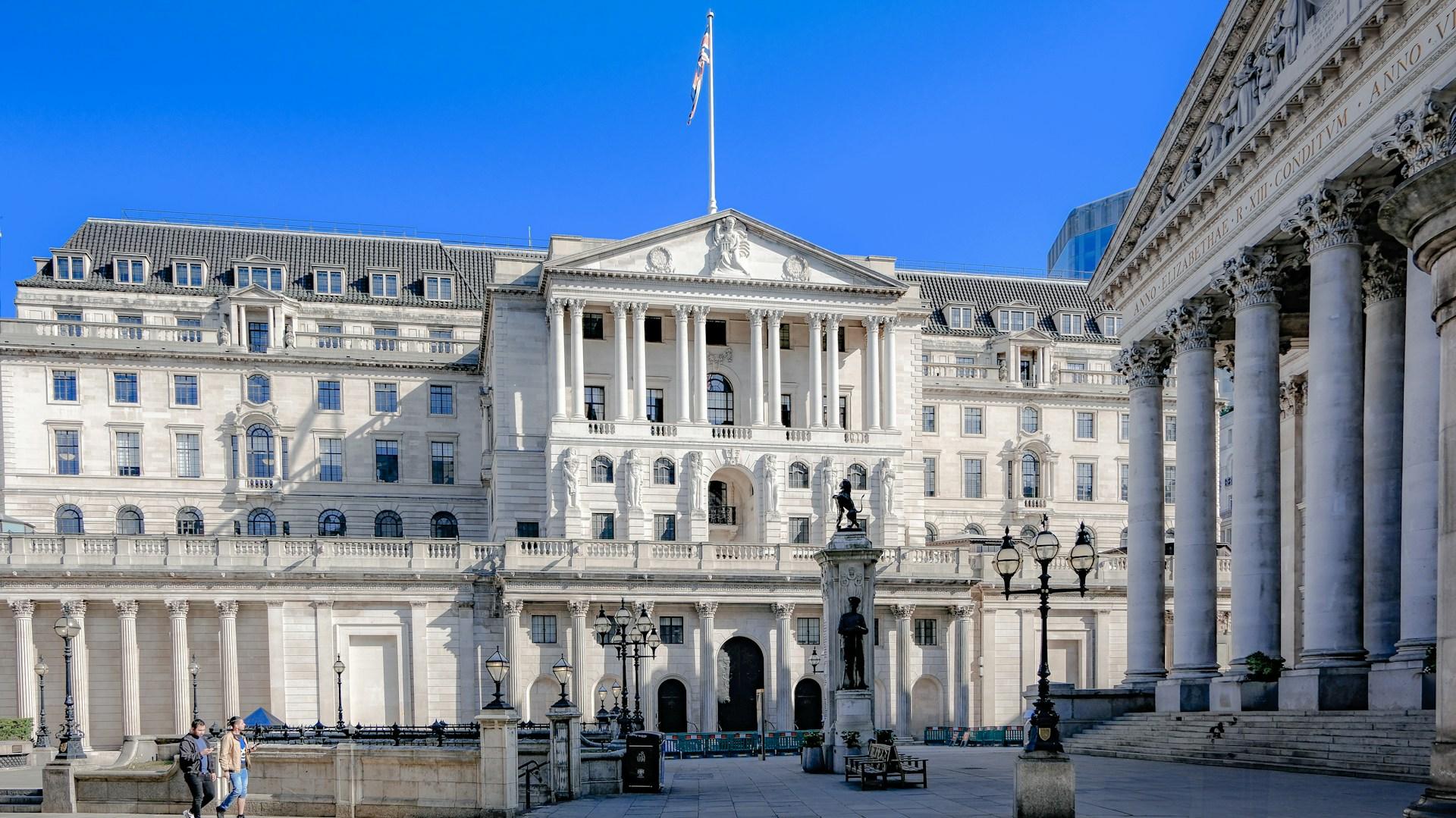
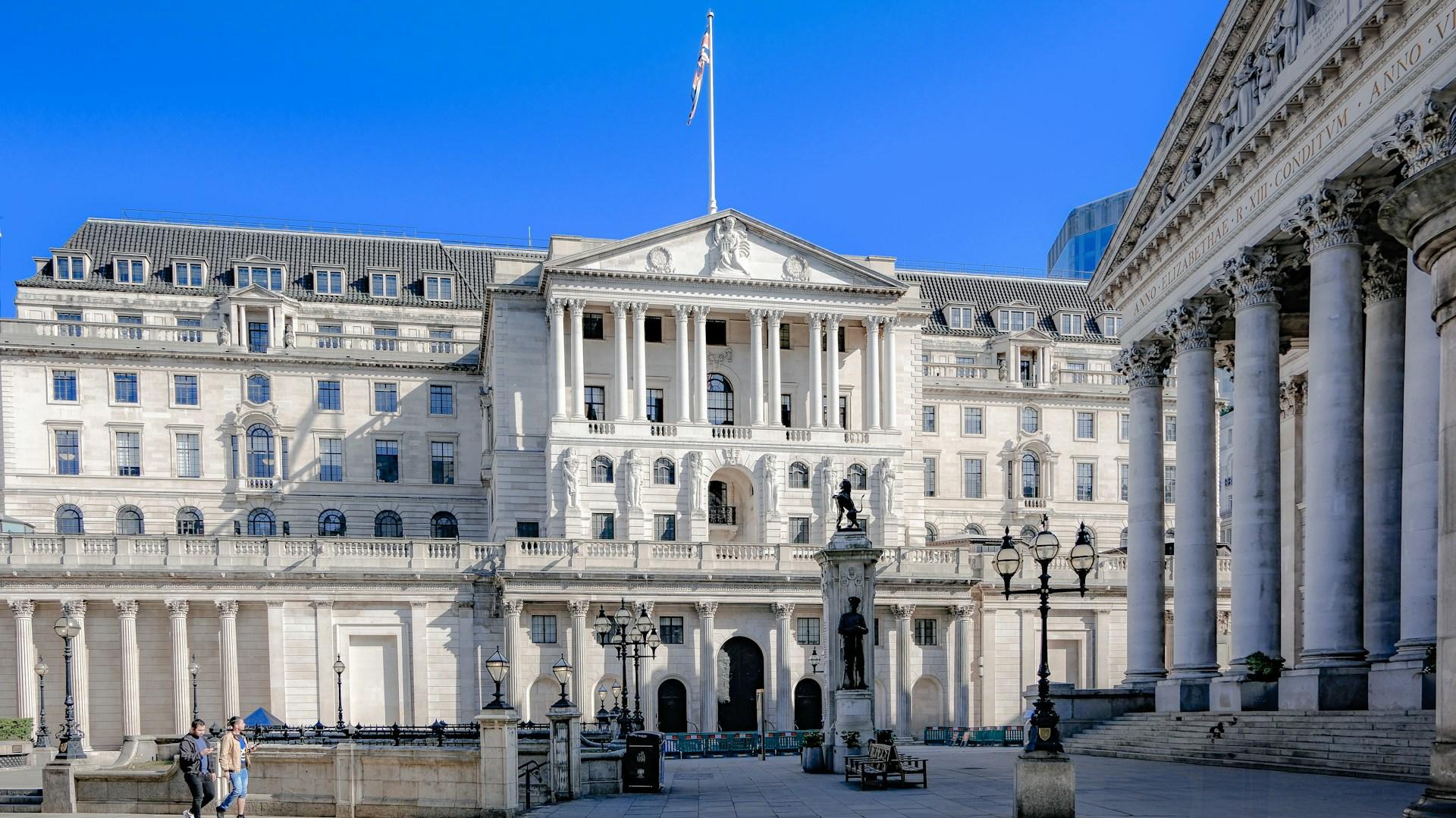
Financial stability would remain its primary duty, with annual reports to Parliament on the new objective being planned.



Mirae Asset is looking to turn its control of South Korean crypto exchange Digital X into a large-scale digital asset platform, targeting 150 trillion won (about $109 billion) in business value, according to The Korea Times.
The plan builds on Mirae Asset Consulting’s acquisition of a controlling 97.15% stake in Korbit last July—an effort the report describes as the first time a South Korean financial group affiliate has taken control of a domestic crypto exchange. After the takeover, Korbit was rebranded as Digital X.
Key takeaways
- Mirae Asset aims to grow Digital X into a broad digital asset business worth 150 trillion won, focused on crypto, stablecoins, real-world assets, and security tokens.
- The strategy follows Mirae Asset Consulting’s July acquisition of a 97.15% stake in Korbit for a total 141.4 billion won, with the exchange later renamed Digital X.
- Digital X has started waiving trading fees for won-denominated assets, with the zero-fee period planned through Aug. 24, 2027.
- The initiative comes despite Korbit—Digital X’s predecessor—having only about 0.5% of South Korea’s crypto trading market in 2025, per the country’s Fair Trade Commission.
From Korbit control to Digital X’s expansion blueprint
Digital X’s projected growth is anchored in what The Korea Times says will be a multi-pronged digital asset lineup. The report states Digital X will focus on cryptocurrencies, stablecoins, real-world assets (RWAs), and security token offerings (STOs).
Beyond tokenized financial products, the outlet also reports that the exchange is considering tokenizing physical assets such as gold, silver, and—more unusually—electricity. If pursued, that would position Digital X at the intersection of tokenization narratives and tangible-asset markets, where product design, custody, and regulatory treatment tend to be complex.
Why Mirae Asset’s stake matters for South Korea’s exchange landscape
According to The Korea Times, Mirae Asset Consulting completed its purchase of the 97.15% stake in Korbit in July for a cumulative 141.4 billion won. The deal effectively gave a major financial group affiliate control of a domestic exchange—something the report highlights as a first in South Korea.
That matters because it suggests the market may be shifting from niche crypto venues to exchange models backed by large financial institutions. Such a transition typically brings new priorities—risk management frameworks, institutional-grade product standards, and distribution through broader financial services—though the exact implementation details were not provided in the report.
For context, Korbit’s scale was modest before the rebrand. The Korea Times notes that despite being founded in 2013, Korbit represented just 0.5% of South Korea’s crypto trading market in 2025, citing the country’s Fair Trade Commission. That creates an immediate tension for the new strategy: Mirae Asset’s large target implies a substantial expansion in both users and product depth beyond the exchange’s prior market share.
Fee waivers and the push to widen won-denominated activity
Digital X has already begun changing its trading economics. As reported in the original coverage, on Monday the exchange started waiving trading fees across all won-denominated assets, with the policy scheduled to last through Aug. 24, 2027.
On its face, fee reduction is a competitive lever: it can lower trading costs for active users and improve liquidity during periods when exchanges often compete on price. However, investors and traders typically watch for follow-on effects—such as whether volumes rise enough to offset reduced revenue per trade, and whether the firm’s broader tokenization and stablecoin roadmap receives a corresponding ramp-up in product availability.
Digital X’s stated fee change is tied to its won-denominated markets, and readers can review the exchange’s trading fee information via its own site: https://korbit.co.kr/info/fee/?tab=trade.
Leadership messaging: “Mirae Asset 3.0” and a platform approach
In the lead-up to its expansion, Mirae Asset founder and chairman Park Hyeon-joo reportedly discussed the initiative at an employee event in Seoul on Wednesday. The Korea Times says Park positioned Digital X as a core component of “Mirae Asset 3.0.”
That framing is significant because it indicates the project is not being treated solely as an operational acquisition; it is being pitched as part of a wider corporate evolution. Still, the report does not spell out how Digital X will integrate with other Mirae Asset businesses or what governance and risk controls will be applied as the platform adds stablecoins, RWAs, and security tokens.
Next, market participants should watch how Digital X converts its long-term ambition—tokenizing assets and supporting STOs—into concrete regulatory and product milestones, while also tracking whether the multi-year fee waiver meaningfully boosts trading activity in won-denominated markets. The scale of the 150 trillion won target sets a high bar, and the critical question will be whether the exchange can grow beyond its earlier market share while sustaining a viable revenue model.


Genius Group has proposed raising capital through perpetual preferred securities to build an $827 million Bitcoin treasury and an $800 million AI portfolio within a $2 billion total-asset target for fiscal 2031.
Summary
- An initial preferred securities offering would seek $12.5 million from income-focused investors.
- Proceeds would be divided among Bitcoin, AI investments, and an 18-month dividend reserve.
- Genius Group plans to restart Bitcoin purchases after liquidating its holdings to repay $8.5 million.
- Final offering terms remain subject to board approval, securities rules, and market conditions.
Genius Group turns to preferred capital
Genius Group said on Aug. 27 that it intends to use its $1.2 billion shelf registration to issue publicly registered perpetual preferred securities, placing the financing method at the center of its five-year treasury plan.
The Securities and Exchange Commission declared the shelf registration effective on July 18, 2025. Such a registration allows the NYSE American-listed company to offer securities over time, but it does not represent SEC approval of the securities or their investment merits.
Under the preliminary proposal, Genius Group would seek $12.5 million in its first preferred securities offering. The company expects the instruments to be non-convertible and to carry a variable dividend paid monthly.
Funds from the sale would be allocated among the Bitcoin treasury, the AI treasury, and a U.S. dollar reserve equal to approximately 18 months of preferred dividend payments. Genius Group did not disclose how much of the initial proceeds each party would receive.
Discussions have begun with investment banks that have experience in preferred securities and digital asset treasury financing. However, the final issue price, dividend rate, offering size, exchange listing, and sale date have not been decided.
Any offering would require separate materials filed with or furnished to the SEC. The structure will also depend on board approval, applicable securities laws, regulatory requirements, and market conditions, according to the announcement.
Shareholders provided some of the required corporate authority at Genius Group’s annual meeting in July. About 97.58% of votes supported giving the board authority to issue preferred shares, while 99.54% approved a mandate allowing the company to repurchase up to 20% of its ordinary shares.
The $2B target covers total assets
Rather than placing $2 billion entirely into Bitcoin and AI investments, Genius Group has set separate fiscal 2031 targets of $827 million for its Bitcoin treasury and $800 million for its AI portfolio.
Operating businesses, cash, and other holdings would account for the remaining assets under the $2 billion plan. The company currently reports net assets of $106.6 million, following a 57% year-over-year increase announced on Aug. 13.
Genius Group calculated its net asset value at $0.62 per ordinary share. With GNS closing at $0.18 on Aug. 26, the company said its stock was trading at approximately 0.29 times book value, compared with what it described as a 2.60-times average for the U.S. education sector.
Management has forecast that net asset value could reach between $2 and $4 per share over five years if the company executes its financing, asset-purchase, and share-buyback plans. The projection also depends on market conditions and the performance of Bitcoin and its AI investments.
Chief executive Roger James Hamilton described perpetual preferred capital as a way to fund treasury purchases without issuing more ordinary shares.
“Every dollar of preferred capital deployed into our Bitcoin and AI Treasury that generates returns above the preferred dividend rate flows directly to our ordinary shareholders’ net asset value.”
Returns above the dividend cost could add to the assets attributable to ordinary investors. If the acquired assets lose value or earn less than the dividend rate, however, the preferred payment obligations would remain senior to ordinary shareholder distributions.
Genius Group identified Bitcoin price volatility, changes in private technology company valuations, financing costs, and capital availability among the factors that could cause actual results to differ from its forecasts.
Strategy provides the financing model
For its proposed securities, Genius Group has taken Strategy’s Bitcoin financing program as its main reference. The company said Strategy has raised more than $16 billion through four perpetual preferred stock series since introducing STRK in January 2025.
The preferred securities have no fixed maturity and do not require repayment on a set date. Their dividends and senior claims still create costs that treasury assets must cover before any excess return reaches ordinary shareholders.
Investor demand has emerged for some of the products. In May, Strategy’s STRC security recorded $1.53 billion in daily trading volume, crypto.news reported, drawing attention to the use of dividend-paying stock to fund corporate Bitcoin holdings.
Market prices can also depart from the issue or liquidation value. STRC fell to an intraday low of $82.50 on June 18 before closing near $88.59, well below the approximately $100 level around which the security was designed to trade.
Strategy later used Bitcoin sales to support the preferred program. An Aug. 10 SEC filing showed that the company sold 1,690 BTC for $108.6 million between Aug. 3 and Aug. 9, using the proceeds to repurchase about 1.15 million STRC shares.
A subsequent filing showed Strategy spent $132.2 million on additional STRC repurchases and $52.4 million on related dividends during the following week. It also placed $149.1 million into its U.S. dollar reserve, bringing the cash pool to $4.8 billion.
For U.S. investors, Genius Group’s final prospectus will determine the economic and legal terms of the proposed security. Until those documents are available, its dividend rate, liquidation preference, call provisions, exchange access, and possible tax treatment remain unconfirmed.
Bitcoin purchases are scheduled to restart
Before developing the dual-treasury plan, Genius Group pursued a Bitcoin-first policy under which it intended to hold at least 90% of its reserves in BTC.
The company adopted the policy in November 2024 and planned an initial $120 million purchase program. By January 2025, it held 420 BTC after buying another $5 million at an average price of $95,912 per coin. Holdings later reached a peak of 440 BTC.
A U.S. court order disrupted the program in early 2025 by restricting the company from selling shares, raising funds or buying Bitcoin during a legal dispute tied to its asset purchase agreement with Fatbrain AI. Genius Group reduced its Bitcoin holdings while seeking relief from the restrictions.
After the order was lifted, the company resumed purchases in June 2025 and increased its balance to 100 BTC. Management also restored a target of accumulating 1,000 BTC.
Liquidity needs later forced another change. Genius Group sold its remaining Bitcoin during the first quarter of 2026 and used the funds as part of the repayment of $8.5 million in debt.
Before the final sale, the company reported holding 84 BTC valued at approximately $5.7 million in March. Its April 1 operating update said it would rebuild the treasury when management considered market conditions more favorable.
Under the latest timetable, Bitcoin purchases are expected to restart in the fourth quarter of 2026. The company has not disclosed the size or price of its first planned acquisition.
Genius Group established the second part of its treasury in May 2026, when the board authorized an AI portfolio with an initial investment plan of up to $100 million. The company made its first allocation in June through funds providing exposure to private companies, including OpenAI, Anthropic, Anduril, and Databricks.
SpaceX held the largest look-through weighting at 13.5% of the AI portfolio, according to the company. Genius Group said its portfolio also contained exposure to xAI, Figure AI, Replit, and other companies involved in AI models, robotics, and infrastructure.
Zcash could emerge as a meaningful challenger to Bitcoin’s dominance among digital assets as the rapid adoption of artificial intelligence puts a premium on financial privacy and fuels concerns over AI-powered surveillance, according to Grayscale.
In a new research report, Grayscale head of research Zach Pandl said Zcash (ZEC) has “second mover advantages” that could help it challenge Bitcoin’s (BTC) entrenched network effects, something previous alternatives such as Litecoin (LTC) have failed to achieve.
Central to Pandl’s argument is financial privacy. Zcash can shield transaction information, which Grayscale argues could become increasingly valuable as AI systems become better at analyzing financial activity at scale.
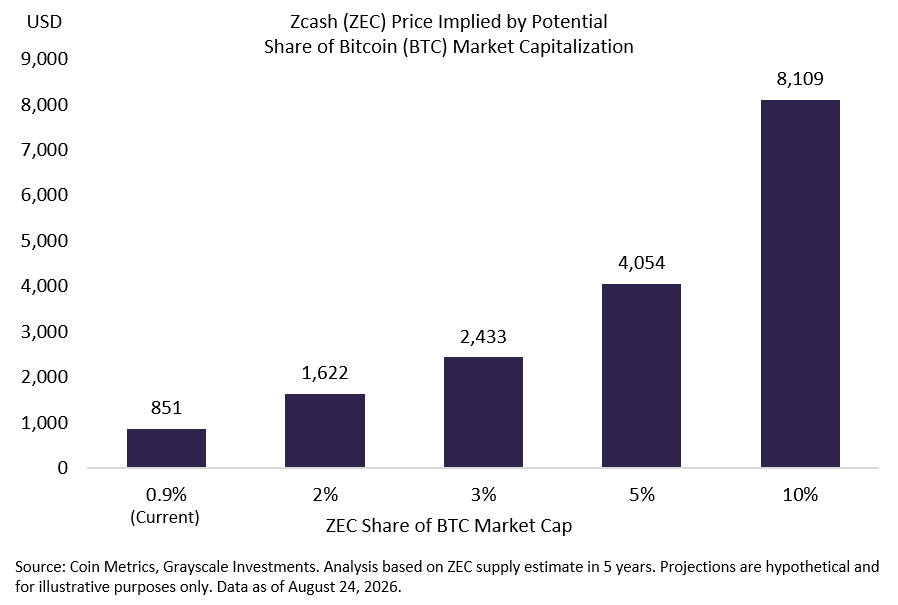
The report comes after ZEC’s roughly 19-fold increase over the past year. Despite those gains, Zcash remains valued at less than 1% of Bitcoin’s market capitalization, a disparity Grayscale sees as evidence of further upside if Zcash can capture market share.
Pandl acknowledged that Bitcoin’s liquidity and entrenched network remain powerful defenses of its dominant position. Grayscale also warned that Zcash remains a high-risk investment and that any further gains could be volatile and uneven.
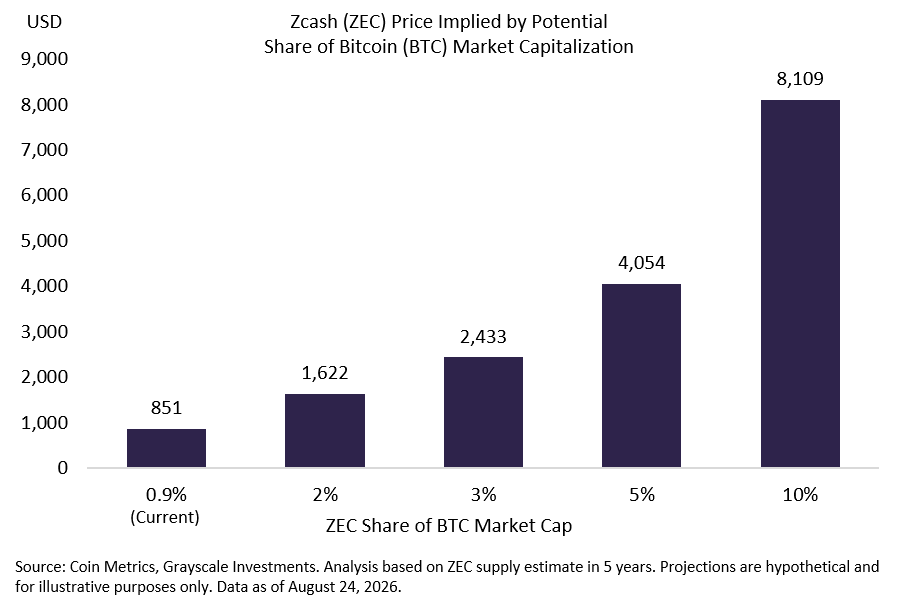
Zcash could be valued at more than $4,000 if its market capitalization reached 5% of Bitcoin’s. Source: Grayscale
Related: Zcash’s Ironwood upgrade faces possible delay over infrastructure readiness
Zcash ecosystem attracts institutional capital
Interest in the Zcash ecosystem is broadening alongside ZEC’s strong price performance. As Cointelegraph recently reported, Nasdaq-listed privacy technology company Cypherpunk Technologies expanded its Zcash exposure by acquiring a mining fleet from Winklevoss Capital in a $33.33 million equity-based transaction.
The operation is already online across US facilities, producing about 4.2 GSol/s of Equihash hashrate, or roughly 18% of the Zcash network’s total computing power. Cypherpunk said the deal made its mining arm the network’s largest active fleet.
Related: Strategy’s $66B Bitcoin machine hinges on capital markets, not BTC price: Report


Nvidia’s earnings beat and strong outlook lifted technology stocks, bitcoin and AI infrastructure companies.


Anthropic plans to let early investors and staff sell stock in its upcoming market debut, according to a recent report by The Information. SpaceX gave its own backers no such option in June.
The prospectus should land soon after Labor Day on September 7. That document sets out the risks and the finances before anyone can buy.
Anthropic IPO Departs From Musk’s SpaceX Structure
Big listings can sell two kinds of stock:
- New shares raise money for the company.
- Existing shares pay early backers instead.
SpaceX sold only the first kind. Its pricing release covered 555,555,555 new shares at $135 each. Not one came from an existing holder.
Underwriters then took another 83,333,333. That brought the total to 638.9 million shares and roughly $86 billion, still the largest listing ever.
Every dollar went to the company, with the filing estimating that Musk kept about 82.4% of the voting power once trading began.
Anthropic has copied part of that design, as indicated in a recent report. As BeInCrypto reported, it described supervoting shares for founders, the same tool Musk used to hold control.
Letting insiders sell changes the other half:
- Backers get cash at the offer price.
- Buyers absorb more stock on day one.
Follow us on X to get the latest news as it happens
Longer Lockups Could Offset the Early Selling
A lockup bars insiders from selling for a set period after a debut. It shields a young stock from a flood of supply. SpaceX shows what the delay looks like, because on August 6, about 911.5 million insider shares became sellable at once. That topped the 638.9 million sold in June.
The tradable pool more than doubled overnight, rising from 4.9% of the company to 11.8%. The stock still closed up 6.1% that day.
Anthropic appears to want the smoother path. A sale inside the deal is priced and placed with buyers in advance. A lockup expiry is neither.
The company is weighing lockups longer than the norm. Insiders would take cash early, then wait longer for a second window.
The backers in line are also large, given Anthropic raised $65 billion in May at a $965 billion valuation, according to its own announcement. Altimeter, Dragoneer, Greenoaks and Sequoia led that round.
Sovereign money joined too, with Singapore’s state fund GIC co-leading alongside Capital Group and Coatue. Those are the names that would be selling.
They would sell at a far higher price, as Anthropic last reported revenue in May, when it said its run rate had exceeded $47 billion. It has not updated that number since.
The prospectus would answer some of these questions. It is also expected to name public backlash against AI as a formal risk.
Crypto traders already price the same stake. Anthropic exposure trades through pre-IPO token markets on Solana, where PreStocks handles 78% of OpenAI and Anthropic volume.
The filing will probably name who sells and for how much, with the list likely to reveal more about Anthropicis valuation.
The post Anthropic IPO Could Come in September, But It Has a Massive Risk Factor appeared first on BeInCrypto.
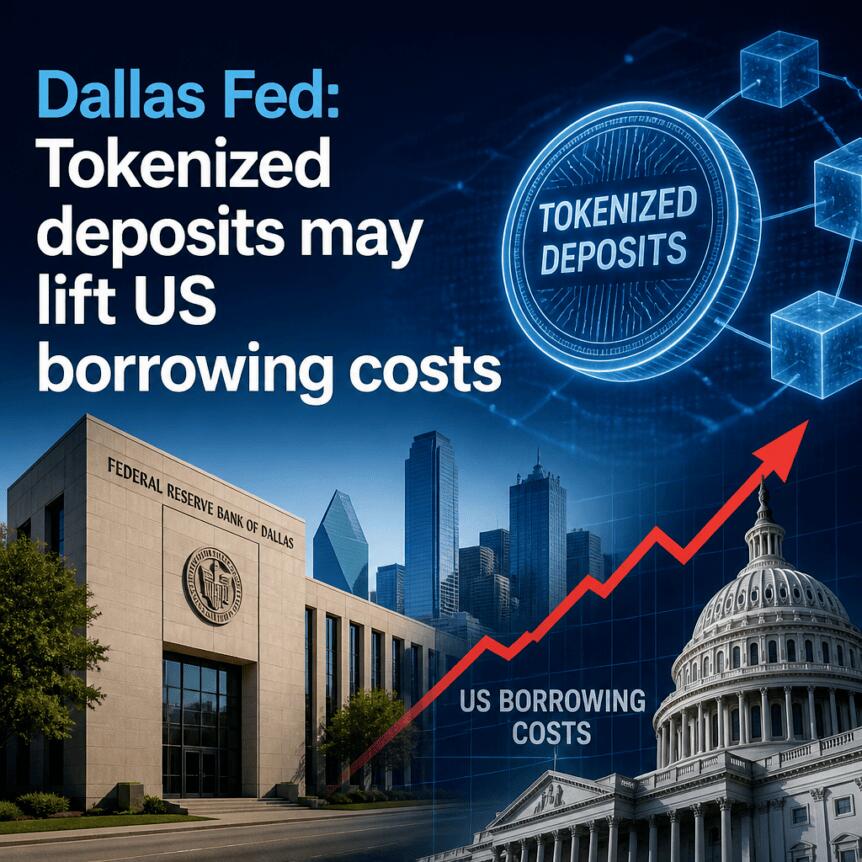
Tokenized deposits could make bank funding less “sticky,” potentially increasing borrowing costs for US households and businesses, according to an analysis by economists at the Federal Reserve Bank of Dallas. The concern is not about immediate, one-for-one changes to lending, but about how faster deposit movement—enabled by instant settlement and automated transfers—could reshape how banks manage liquidity and credit risk.
In a research note, economists Rosie Levy and Srini Ramaswamy argue that programmable deposit tokens combined with automated transfer mechanisms could allow customers seeking higher yields to switch banks more quickly. They estimate that if deposits became 10% more responsive to interest rates, banks’ capacity to hold long-term loans and other assets could decline by roughly $700 billion on a 10-year-equivalent basis. A separate scenario where deposits stayed at banks 10% less time implies a reduction of about $580 billion, expressed in the same 10-year-equivalent terms. These are scenario outcomes, not forecasts.
Key takeaways
- Tokenized deposits may increase deposit “rate sensitivity,” making funding more mobile when higher yields appear elsewhere.
- Instant settlement and automated transfers could shorten how long deposits remain at a given bank, reducing stability.
- Dallas Fed researchers estimate large liquidity and balance-sheet capacity effects under two 10% sensitivity/time scenarios, though they are not direct lending cuts.
- Banks are already building shared blockchain-style networks intended to move tokenized deposits within the regulated banking system.
Why instant settlement could destabilize funding
Levy and Ramaswamy’s central mechanism is straightforward: when settlement happens instantly, customers can react to rate differences faster. In traditional banking, moving deposits can take time, which can blunt how quickly funds shift across institutions. With programmable deposit tokens, deposits can be designed to integrate with automated processes—potentially powered by agentic artificial intelligence—that coordinate transfers with less manual friction.
The economists describe this as a shift in deposit behavior: deposits become more sensitive to interest rates and potentially less time-bound at a single bank. That matters because bank lending relies on relatively stable funding to support longer-duration assets.
Importantly, the authors stress that their numerical estimates are scenario-based. The changes are framed in terms of banks’ capacity to hold long-term loans and other assets, not as a direct “dollar-for-dollar” reduction in lending.
What the Dallas Fed scenarios imply for banks and borrowers
Under one scenario, the researchers assume deposits become 10% more sensitive to interest rates. Under another, deposits remain at banks for 10% less time. In both cases, they estimate reductions in banks’ capacity to hold long-term assets—about $700 billion and $580 billion, respectively, using 10-year-equivalent measures.
The analysis points to trade-offs banks could face when deposit stability declines. One response could be holding larger portfolios of highly liquid assets, such as reserves and US Treasurys, to better withstand faster outflows. Another could be leaning more on term debt to maintain the lending book.
But both adjustments can come with costs. Increasing reliance on wholesale funding or term debt typically raises funding expenses, and those higher costs can propagate into credit terms for borrowers—precisely the outcome Levy and Ramaswamy say could increase credit costs for US households and businesses.
From research to rollout: bank networks for tokenized deposits
The Dallas Fed concerns arrive as US banks accelerate plans for tokenized-deposit infrastructure. On Tuesday, 39 US state banking associations formed the BankChain Alliance, aiming to develop a nationwide network designed to support tokenized deposits, stablecoins, and automated settlement. Separately, The Clearing House is developing another network backed by major institutions including JPMorgan Chase, Bank of America, Citi, BNY, and Wells Fargo.
Banks have also begun connecting tokenized-deposit systems across organizations. On Aug. 20, Standard Chartered and HSBC completed a live cross-border transaction through Swift’s blockchain ledger. The reported design linked the two banks’ separate systems and recorded obligations on the ledger, with settlement still occurring via existing payment infrastructure.
Taken together, these efforts suggest that the industry is moving beyond pilots toward interoperable systems. From a policy perspective, that raises a key question Levy and Ramaswamy implicitly put on the table: if the plumbing makes movement faster and more programmable, will regulators and banks anticipate and manage the resulting funding dynamics?
Liquidity lessons from instant payments—what’s comparable and what isn’t
Levy and Ramaswamy cite Brazil’s Pix instant-payment system as a comparison point, while emphasizing it is not identical to tokenized deposits. Their reasoning is that instant-payment rails can change how quickly funds can move, which can alter deposit behavior and, in turn, banks’ balance-sheet choices.
A 2025 study by Brazil’s central bank found that heavier Pix use increased banks’ holdings of liquid assets and reduced credit intermediation. While that evidence does not prove the same outcome will occur with tokenized deposits, it offers a relevant reference for how faster payment flows can influence bank liquidity decisions.
For investors and lenders, the policy takeaway is less about whether tokenization will “help or hurt” lending in the abstract and more about how institutions will adapt their asset-liability management. If deposit mobility rises, market participants should watch for shifts in liquidity buffers, reliance on wholesale funding, and credit pricing—channels the Dallas Fed analysis highlights.
Going forward, the key uncertainty is how quickly tokenized deposit networks translate into real consumer and business deposit switching behavior. Readers should watch for regulatory guidance around tokenized deposit frameworks and for measurable changes in banks’ funding structures—especially whether liquidity reserves and term-debt reliance rise as these systems expand.

You have 7 days left for the Bitcoin and XRP move

Men arrested after high-speed chase towards Irish border

10 Things You Need to Know About This New Phone Today





-

 Fashion6 days ago
Weekend Open Thread: Madewell – Corporette.com
-

 Crypto World2 days ago
SpaceX stock could rise 75% to $240, JPMorgan says
-

 Business5 days ago
Musk’s Tesla, SpaceX Confirm $16.8 Billion ‘Terafab’ Chip Plant as World’s Largest Building in Texas
-

 Crypto World6 days ago
anatomy of crypto’s biggest liquidation event since 2021
-

 Crypto World3 days ago
A $30 Billion AI Fund Implodes, Now the SEC Is Investigating Wall Street’s Role
-

 Politics5 days ago
6 months on, Irish renters crushed by effects of government housing bill
-

 Crypto World2 days ago
Did Trump Just Move SpaceX Stock With One Truth Social Post?
-

 Business5 days ago
Mystery AI Model ‘Ox Alpha’ Draws Developers With Free Access as Chinese Lab Origins Remain Debated
-
 NewsBeat6 days ago
The ‘Lucky Dip Gang’ causing carnage for clicks: After five thugs were killed speeding in the wrong direction on a motorway, GUY ADAMS investigates a sick new trend… and why police aren’t even allowed to pursue them
-
 Crypto World6 days ago
Nvidia Stock Suffers Longest Losing Streak Since 2022: Will Q2 Earnings End It?
-

 Business3 days ago
Moderna CEO warns China is pouring state money into mRNA technology
-

 Business3 days ago
NVIDIA Stock Drops Nearly 2 Percent to $210 on Seventh Losing Day Ahead of Critical AI Earnings
-

 Tech6 days ago
Unitree’s New Superman Robot Claims to Outjump and Outrun Every Human, Usain Bolt Included
-

 Business6 days ago
UK firms in critical financial distress rise 9% to 53,756
-

 Sports5 days ago
Deshaun Watson fires back at Browns fans after being booed: ‘It’s a disrespectful thing’
-
 Crypto World5 days ago
Google Gemini AI Predicts Ethereum Could Become the Trade Retail Misses in 2026
-

 Tech6 days ago
Faster chip in a familiar form factor
-

 Business6 days ago
Will Tesla Stock Be Higher or Lower a Year From Now? Here’s What Wall Street Analysts Are Saying
-

 Business4 days ago
Tesla Recalls Nearly 3 Million Cars in China Over Hidden Door Handles Linked to Multiple Deaths Amid New Ban
-

 Crypto World7 days ago
SEC Regulation Crypto vs CLARITY Act: which framework wins
You must be logged in to post a comment Login