
Crypto World
The 15 Lawyers and Firms Fighting Crypto’s Biggest Legal Battles

Every major regulatory victory, landmark court ruling, and every piece of legislation that shaped the crypto industry has a lawyer behind it. They’re a big driver behind the mainstream acceptance of digital assets. But 15 firms and individual lawyers have carved out their place in modern financial history.
They wrote briefs, argued cases, testified before Congress, and built the legal frameworks that enabled institutional capital to enter crypto with confidence.
From the landmark Ripple Vs SEC case, the regulatory victory of Coinbase, to policy papers that now appear in Senate testimony, here are the 15 biggest lawyers fighting crypto’s legal battles.
Rank
Nominee
Type
Base
Landmark Case
Credentials & Track Record
Why on the List
1
Sullivan & Cromwell
Firm
New York, USA
FTX bankruptcy lead counsel
Major SEC defense;
$180M+ approved FTX fees;
Chambers Band 2 Crypto-Asset DisputesLed the largest crypto bankruptcy to date.
The FTX restructuring stands as the most complex legal mandate the industry has seen.
2
Davis Polk & Wardwell
Firm
New York, USA
Block.one EOS securities settlement
Chambers Band 1 in Crypto-Asset Disputes and FinTech Blockchain;
Robert Cohen (ex-SEC Crypto Unit head)The only firm ranked Band 1 across both core crypto legal categories.
Deep regulatory ties and top-tier institutional mandates.
3
Latham & Watkins
Firm
Los Angeles, USA
Global DeFi, DAO, and NFT defense
Chambers Band 1;
Multi-agency matters (SEC, CFTC, FinCEN, OFAC)Handles more DeFi and DAO mandates than any peer.
Strong cross-border execution across US, EU, and Asia.
4
Debevoise & Plimpton
Firm
New York, USA
Ripple SEC defense
Chambers Band 1;
Andrew Ceresney (ex-SEC enforcement director)Played a central role in the Ripple case that reshaped how courts treat secondary-market token sales.
5
Cleary Gottlieb
Firm
New York, USA
Garlinghouse & Larsen SEC defense
Chambers Band 2;
Matthew Solomon (ex-SEC litigation chief)Led the personal defense of Ripple’s executives, a parallel case with major legal implications.
6
Fenwick & West
Firm
Mountain View, USA
Crypto SEC investigations and M&A
Chambers 2026 ranked in 4 FinTech categories;
Partner Michael Dicke individually ranked for Crypto-Asset DisputesCore legal partner to Silicon Valley crypto builders. Broadest bench across crypto, fintech, and securities law.
7
Cooley LLP
Firm
Palo Alto, USA
Early Bitcoin company advisory
Chambers FinTech ranked;
Brian Klein (Band 1) joined 2025Involved since the earliest Bitcoin corporate formations.
Continues to advise founders and funds shaping the sector.
8
Brown Rudnick (Digital Commerce)
Firm
Boston / DC, USA
FTX Bahamas counsel; BlockFi recovery
Stephen Palley (Chair);
Chambers & Legal 500 rankedBuilt a leading crypto practice through strategic hires.
Delivered landmark DAO rulings and full BlockFi creditor recovery.
9
Paul Grewal
Individual
San Francisco, USA
Coinbase SEC case dismissal (2025)
Coinbase CLO;
Former US Magistrate JudgeLed Coinbase’s legal defense to a major win against the SEC.
Influential voice in policy and regulatory debates.
10
Stuart Alderoty
Individual
San Francisco, USA
Ripple summary judgment & 2025 settlement
Ripple CLO;
President of National Cryptocurrency AssociationDelivered a defining court outcome for crypto markets.
Now leading industry-wide public education efforts.
11
Lewis Rinaudo Cohen
Individual
New York, USA
US Senate Banking testimony (2025)
Co-Chair, CahillNXT;
Chambers Band 1Key legal thinker shaping US crypto legislation.
His “ancillary asset” framework influenced policy design.
12
Miles Jennings
Individual
United States
SEC Task Force decentralization framework
CLO, Castle Island Ventures;
Former a16z policy headDeveloped one of the most cited frameworks on decentralization in regulatory discussions.
13
Jake Chervinsky
Individual
Washington DC, USA
Hyperliquid Policy Center CEO
Founder & CEO;
Former Blockchain Association policy headNow leading a DeFi-focused policy group with strong funding. Active in shaping US regulatory direction.
14
Amanda Tuminelli
Individual
New York, USA
DeFi patent challenges
Executive Director & CLO, DeFi Education Fund
Led successful legal challenges against patents affecting core DeFi protocols.
Key figure in pre-enforcement strategy.
15
Marisa Tashman Coppel
Individual
United States
SEC Dealer Rule lawsuit
Senior Product Counsel, Phantom;
Former Blockchain Association legal headLed a major industry challenge against SEC rulemaking.
Helped frame constitutional arguments for crypto firms.
About This List
This list is compiled by the BeInCrypto Research Division as part of the BIC 100 Institutional Awards 2026.
Nominees are selected based on the impact, influence, and industry-shaping significance of their legal work in digital assets. Regulators and government officials are evaluated separately in Category 5.5 (Regulatory Framework).
Methodology
Rankings draw on Chambers FinTech 2026 tier assignments, landmark case outcomes, regulatory engagement (including Senate testimony, SEC filings, and amicus briefs), and the strategic significance of signature matters.
Individual roles and affiliations reflect public information as of April 2026, sourced from firm profiles, Bloomberg Markets, and official announcements.
To submit a nomination or share feedback, contact awards@beincrypto.com.
The post The 15 Lawyers and Firms Fighting Crypto’s Biggest Legal Battles appeared first on BeInCrypto.



Two Tether-related entities, German former crypto miner Northern Data and US-based video streaming service Rumble, are set to begin the merger process, with Rumble offering equity for shares of Northern Data.
The merger, which was announced in November of last year, will end with Rumble taking over data center sites and receiving thousands of GPU servers. Tether owns a majority of Northern Data and 30% of Rumble.
Shareholders in Northern Data will receive 2.0281 shares of Rumble stock for each share they hold. Northern Data is currently trading at $13 a share and Rumble is trading at $6.41 a share.
A strange merger that’s good for Tether
From an outside perspective, a defunct mining company and a video streaming service merging doesn’t make a lot of sense. However, in November Christ Pavlovski, the CEO of Rumble, said, “Northern Data. Tether. Rumble. This is how we build the AI ecosystem for the future, from the ground up.”
It’s unclear what Tether or Rumble have to do with AI.
What’s more clear is that the merger will ultimately benefit Tether, which has already committed to purchasing $150 million in compute from Rumble over the next two years and will have a $610 million unsecured debt financing facility provided to Northern Data now reassessed and altered.
Financial Shenanigans
The merger of the two Tether-related companies required little agreement from minority shareholders due to Tether’s strong influence, Rumble’s executive equity structure, and Northern Data’s financial struggles over the past several years.
Both Northern Data and Rumble have seen the price of their stocks slide post-Tether investment, with Rumble trading near all-time lows as of recent.
Since the merger has begun the stock has rallied 20%.
The financial shenanigans involved in the Tether-related deal is nothing new for the company, which has been dogged by a long list of controversies around audits, hacks, and scams.
Read more: Tether-owned Northern Data considers ditching bitcoin mining
Since the collapse of FTX and the election of Donald Trump, Tether has attempted to present itself as transparent and safe, and has made a massive push into the US market. This includes lobbying efforts that saw CEO Paulo Ardoino visit the White House multiple times.
US Secretary of Commerce, Howard Lutnick, used to run Cantor Fitzgerald, which purchased US treasury notes for the company and previously said he was “a big fan of the company.”
Got a tip? Send us an email securely via Protos Leaks. For more informed news and investigations, follow us on X, Bluesky, and Google News, or subscribe to our YouTube channel.
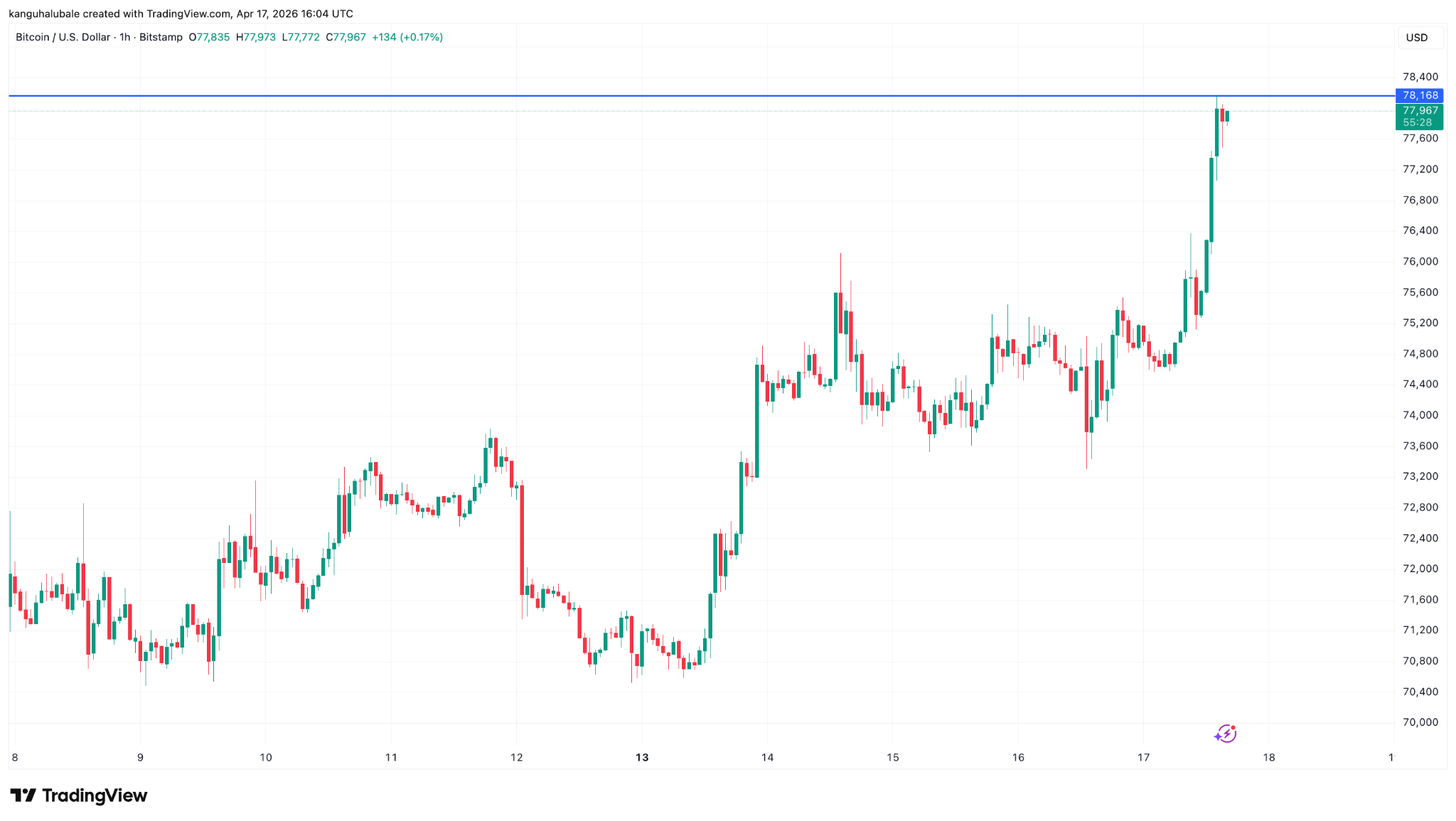
Bitcoin (BTC) rallied above $78,000 to hit another 10-week high on Friday as crypto and equity markets reacted to cooling tensions in the US and Israel war in Iran. The rally above range highs also resulted in a large liquidation of leveraged Bitcoin positions.

More than $660 million in short positions were liquidated, with Bitcoin accounting for $353 million of that total. Ether (ETH) followed with $160 million in short liquidations.
Related: Three things Bitcoin must do to hold highs above $76K: Analysts
Across the board, $826 million was wiped from the futures market over the last 24 hours.

The single biggest liquidation occurred on Hyperliquid, where a $15.75 million BTC-USDT short position was closed.
Large clusters of short liquidations typically amplify the reach of asset rallies and data from CoinGlass showed a 13% rise in Bitcoin’s aggregate futures open interest (OI) over the last 24 hours.

Even though futures longs (buyers) and shorts (sellers) are always matched, rising OI suggests greater leverage and market participation, which, in this case, appears to be on the side of bulls.
Hyblock data showed ask liquidity sitting between $77,500 and $78,000 being absorbed as BTC rallied to its intra-day highs on Friday.

Bitcoin MACD forecasts a “big move“
Bitcoin’s moving average convergence divergence (MACD) indicator has signaled a buy on its weekly chart, a pattern that has historically preceded sharp price rallies.
The MACD is a popular momentum indicator used in technical analysis that helps traders identify the strength, direction and duration of a trend of an asset’s price.
The indicator reached its lowest level in history and has formed a bullish cross on the weekly chart, as shown in the figure below.
“Not only do we have a 1W MACD bullish cross and break of trend, we have it from the lowest point the MACD has ever dropped to,” analyst Sykodelic said in a recent post on X, adding:
“We are at a very important level here, and the weekly close will be very important.“
Previous instances show that Bitcoin tends to rise sharply when the MACD line (blue) crosses above the signal line (orange). The last time this happened was at the bottom of the 2022 bear market, which preceded a 376% increase in BTC price.

“A big move usually follows whenever this weekly MACD bullish cross happens,” analyst Mikybull Crypto said in a recent post on X.
Fellow analyst The Chart Report told their followers that previous crossovers have “historically produced a 93% win rate with a median 12-month return of +195%.”

Other Bitcoin analysts suggest that the altcoin could continue its recovery to retest higher resistance levels, with BTC price targets set at $90,000 and above.
This article is produced in accordance with Cointelegraph’s Editorial Policy and is intended for informational purposes only. It does not constitute investment advice or recommendations. All investments and trades carry risk; readers are encouraged to conduct independent research before making any decisions. Cointelegraph makes no guarantees regarding the accuracy or completeness of the information presented, including forward-looking statements, and will not be liable for any loss or damage arising from reliance on this content.

Pi Mainnet is moving toward Protocol 22, with April 27 set as the deadline tied to node readiness. The update puts fresh attention on Pi Node, which supports network security and transaction flow on desktop devices.
The move also renews focus on Pi’s long-running node plan. Pi’s own notice says parts of its early node document may not be up to date, yet the role of nodes remains clear.
Pi Node Remains Central to the Network Design
Pi Node is the fourth role in the Pi ecosystem.
It runs on laptops and desktops, while mobile users keep using the Pi app.
The system does not use proof of work like Bitcoin. Instead, Pi says it uses a model based on the Stellar Consensus Protocol.
Under that design, nodes form trusted groups called quorum slices. They agree on transactions only when trusted nodes reach agreement.
Pi says this trust model connects with security circles from mobile miners. Those circles help form a wider trust graph for validation.
Protocol 22 Deadline Brings Node Readiness Into Focus
With the April 27 deadline now in focus, node reliability becomes a key part of the discussion. Pi has said nodes help validate transactions and submit them to the blockchain.
SuperNodes carry a larger role in the network. They reach consensus, write transactions to the ledger, and keep other nodes updated.
Pi also says selected node operators must meet technical and account checks. These include uptime, internet stability, hardware capacity, and KYC after invitation.
The project has also said one account should run only one node. That rule links node participation to the same account used on the mobile app.
Pi Keeps a Phased Path for Node Development
Pi’s node plan has followed a staged testnet path. It began with a selection stage, then moved into revision work, and then live testnet activity.
In the selection stage, Pi assessed devices, connection quality, and software setup. The aim was to learn what was needed for a stable and secure network.
During the revision stage, Pi used a centralized layer for faster testing. The company said this helped it simulate many network conditions and stress the consensus model.
Pi has also said that this layer would be removed for mainnet after testing. That point matters as the network now moves around the Protocol 22 deadline.
Pi’s notice also says mainnet nodes are under a firewall during the Enclosed Network period. It adds that broader community access is planned for the Open Network period.
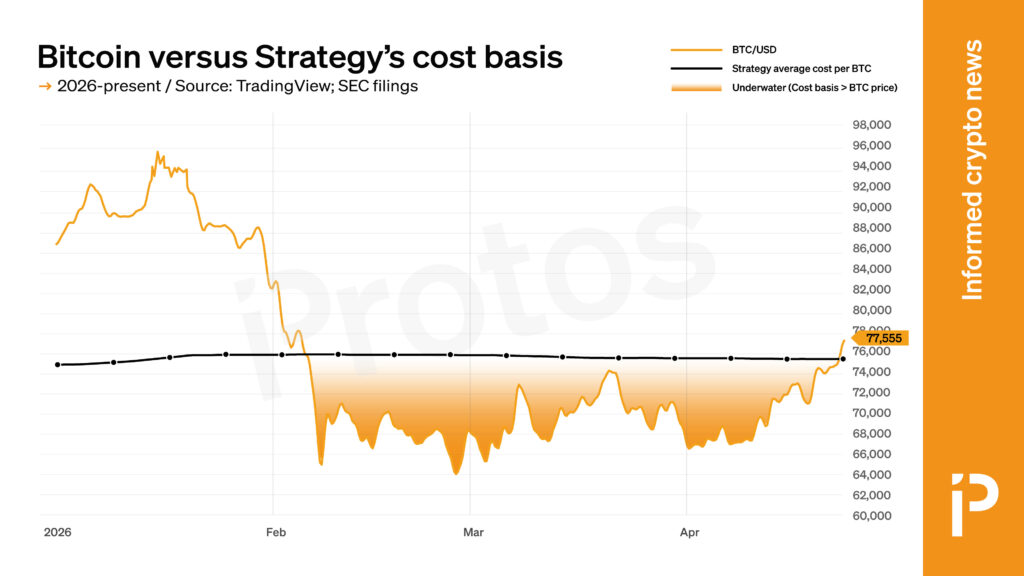
Michael Saylor’s bitcoin (BTC) treasury at Strategy is back in the green this morning — but only barely, and only because BTC gave him a lucky break after the US and Iran announced the reopening of the Strait of Hormuz.
Strategy (formerly MicroStrategy) now holds 780,897 BTC at a blended average cost basis of $75,577 per coin, according to its own disclosure page.
The company’s total expenditures to amass that hoard cost cost $59 billion. BTC traded above $77,870 this morning, making the stack worth roughly $60.8 billion. The unrealized gain works out to $1.8 billion, or a 3% gain.
After nearly six years of leveraged buying, debt issuances, perpetual preferred sales, and common stock dilution, the company has staged a multi-billion dollar comeback this morning.
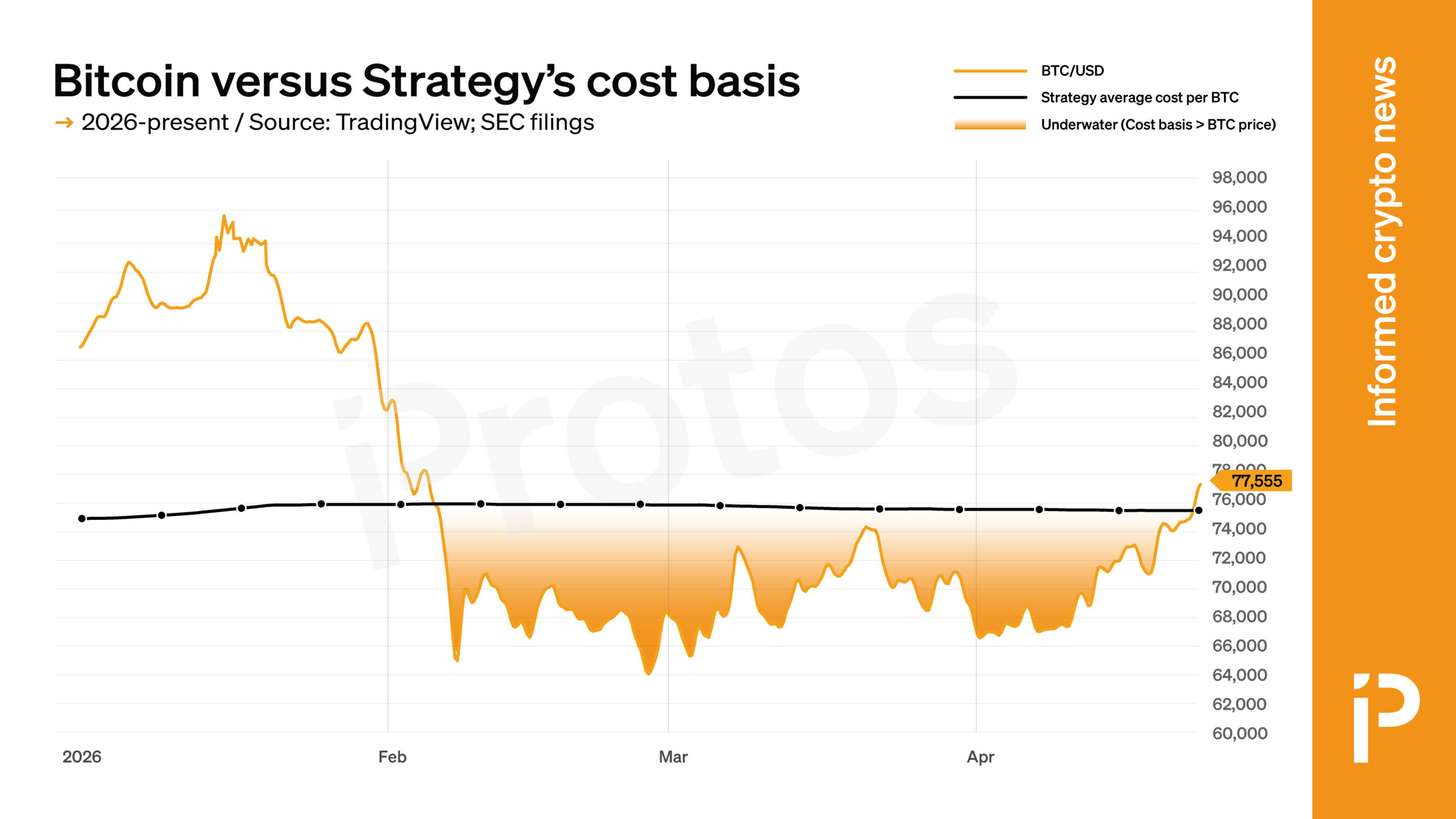
Strategy’s $11B unrealized loss to green again
Protos previously reported that Strategy owned 640,031 BTC on October 6, 2025 at an average cost of $73,983. BTC traded near $125,000 per coin that day.
The company’s paper profit at that time was an impressive $32 billion.
Saylor, who pledges never to liquidate BTC, proceeded to hold every coin through a gut-wrenching downturn.
Four months later, on February 6, BTC dropped to an intraday low of $59,930. Strategy by then held 713,502 BTC acquired for $54.26 billion at an average of $76,052 per coin. Worse, Saylor had kept buying through the decline, at prices far above the low.
At the February 6 low, the position was worth just $42.7 billion.
The unrealized loss had reached negative $11.50 billion, or a negative 21.2% unrealized loss.
Besides seeing more red on his screen, nothing much else about the corporation changed over that time period.
The company’s board of directors kept declaring preferred share dividends on-time. Common stockholders kept suffering dilution, as usual.
Saylor kept posting orange dots, a visual representation of the company’s BTC purchases.
The primary thing that changed was the whipsawing price of the one asset that he had repeatedly promised never to sell.
Read more: Buying the dip? Strategy prefers the top of the range
Saved by a Strait of Hormuz rally
Fortunately, BTC has since rallied roughly 30% off that February low. Strategy’s holdings, now up to 780,897 BTC, sit in positive territory as of a few hours ago.
The chart tells the story of Strategy’s intraday success. The asset, not the company’s management, rescued their leveraged position.
Saylor’s buying through the drawdown arguably made the recovery thinner. Q1 2026 buys carried a volume-weighted cost near $80,929 per coin, and his weekly purchases overwhelmingly landed in the upper half of each week’s available trading range.
Those overpriced buys are what pushed the company’s blended cost basis up. The same company that once sat on a $32.6 billion gain in October now has a $1.8 billion gain, and was more than $11 billion underwater in the interim.
Got a tip? Send us an email securely via Protos Leaks. For more informed news, follow us on X, Bluesky, and Google News, or subscribe to our YouTube channel.

Bitcoin bulls charge back into the spotlight as the largest cryptocurrency retook a key barrier near $76,000, a move traders say could open the door to a more sustained rally. The backdrop includes a rare on-chain signal: whales have been accumulating at scale, with CryptoQuant data indicating roughly 270,000 BTC added to wallets holding more than 1,000 BTC in the past 30 days—the strongest spree since 2013. That buildup, together with a geopolitical backdrop that included Iran’s comment on keeping the Strait of Hormuz open during a U.S.-Israel-Iran ceasefire, has contributed to a cautious, albeit constructive, mood among market participants.
Analysts warn that while the trajectory looks positive, a clean breakout needs to be confirmed by sustained price action above critical levels and a continued on-chain bid. In particular, observers look to whether the market can sustain momentum beyond a nearby pivot and avoid a quick pullback that would trap late buyers. Still, a handful of onboard signals suggest the current move could have more legs, even if the path remains bumpy.
Key takeaways
-
Bitcoin clear of the $76,000 hurdle has traders eyeing an ascent toward $84,000 and ultimately the $92,000 zone if the price closes above resistance and sustains the breakout.
-
Whales have piled into BTC at the fastest pace seen in a decade, with about 270,000 coins added to large holders in the last 30 days, according to CryptoQuant data.
-
Analysts flag potential near-term hurdles: a close above the pivotal level could form an ascending triangle pattern, but a break below the moving averages may nod to renewed bear pressure.
-
Altcoins are broadly performing, with Ethereum and several other top assets testing key short- and mid-term resistance levels that could reshape the near-term trend if broken.
-
Market watchers urge caution: a bull-market confirmation would require price action to clear several hurdles including a sustained close above important moving averages and a weekly RSI signal above critical thresholds.
Bitcoin price outlook: a rising odds scenario
Bitcoin rose decisively past a recent resistance around $76,000, signaling renewed demand from bulls after a period of consolidation. The chart setup points to an ascending-triangle formation that could unlock a path to higher targets if bid interest remains firm. A close above $76,000 would complete that pattern, opening the door toward $84,000 and, on a continued impulse, toward the $92,000 region.
On the technical side, the 20-day exponential moving average sits at about $72,100, providing a rising support buffer for the short term. The RSI hugging the upper end of its range indicates momentum is skewed toward buyers, though traders watch for any signs of exhaustion that could precede a pullback. If prices dip back below the moving averages, the bulls would lose traction and a trip toward the triangle’s lower boundary could unfold, potentially reintroducing a more defensive tone to the market.
Ether and the broader altcoin sleeve
Ethereum’s bid to extend its recovery remained intact as buyers defended the $2,415 level against a test from sellers. A daily close above that resistance could push ETH toward $2,800, and then $3,050, spotlighting a potential bottoming process that began near the $1,748 area earlier in the cycle.
Beyond ETH, traders are watching XRP’s pattern: after closing above the 50-day simple moving average, the chart shows the 20-day EMA turning upward and the RSI in a constructive zone. A breakout past the nearby downtrend line could catalyze a move toward the next resistance cluster, but a break below moving averages would reopen risk of a deeper retracement toward the $1.27 floor.
BNB, meanwhile, confirmed a shift in near-term momentum by closing above the 50-day SMA. If this uptrend sustains, the next upside milestones sit near $687, with potential extensions to $730 and $790 should buyers maintain control.
Solana, Dogecoin and other micro-movers
Solana’s price action has also shifted in bullish fashion, with the close above moving averages suggesting a test of the $98 resistance. A breakout above that level would remove some near-term overhead supply and could pave the way toward the $117 mark, while a rejection at $98 may elongate the consolidation phase.
Dogecoin is echoing a similar sentiment, bouncing off the moving averages and approaching the $0.10 area. If buyers sustain the headline momentum, a climb to $0.11 and possibly $0.12 could unfold, though the bears remain keen to defend key supports that could snap the rally if breached decisively.
Hyperliquid (HYPE) traders remain focused on breakout levels, with the price needing to hold above the $43.76 breakout point to keep the run intact. A push through $46 could clear the way toward the $50–$51.43 zone, whereas a reversion below the 20-day EMA and the 50-day SMA could re-open risk of a deeper pullback toward the lower bound.
Smaller caps and the Chainlink view
Cardano is quietly reasserting strength, moving toward the upper boundary of its current channel and eyeing a potential break past the downtrend line. A decisive move higher could target the $0.32–$0.37 range, signaling a possible early trend change for ADA.
Bitcoin Cash is perched around the 20-day EMA and wrestling with immediate resistance at the 50-day SMA. If bulls manage to clear that barrier, BCH could accelerate toward $486 followed by a test of $520; failure to hold the near-term supports could invite a retest of lower levels near $419.
Chainlink faces a battle around the $8–$10 zone, where sellers have historically stepped in. A lasting close above $10 would likely reawaken the bullish case and could propel LINK toward $11.61, contingent on continued demand and a break past residual overhead supply.
What this means for risk and opportunity now
The current setup paints a blend of cautious optimism and on-chain caution. The rapid accumulation among large BTC holders signals that the market’s biggest players are bracing for higher prices, a factor that can provide a more durable bid if sustained. Yet the bear case remains open if prices fail to cling to the moving averages or if macro or geopolitical headlines inject volatility into the mix. In that sense, traders should watch the interplay between spot price action and on-chain signals—especially the resilience of key moving averages and the ability to close decisively above them on a weekly timeframe.
For investors, the story hinges on whether the market can defend the breakout in Bitcoin and maintain leadership across leading altcoins. If BTC can sustain a move above mid-range targets, other assets with favorable chart structures may follow suit, lending credence to a broader risk-on cycle. Conversely, if risk controls tighten or selling pressure reasserts near the moving averages, the rally could stall and reintroduce a longer consolidation phase.
Looking ahead, market watchers will be paying close attention to hold levels around $78,100—identified by analysts as a critical line for validating a structural shift toward a bull market—and to the evolving on-chain backdrop that has shown strong large-holder demand in recent weeks. The next few sessions could reveal whether this rally is a sustained unwind or a relief move within a larger, uncertain regime.
Readers should keep an eye on how price action evolves around the moving averages and the key resistance zones outlined for each asset. As always, developments in macro risk, regulatory hints, and geopolitical headlines will influence the tempo and magnitude of any upcoming moves.

TLDR:
- Singapore Gulf Bank enables 1:1 USD to USDC conversion with round-the-clock settlement on the Solana network
- The service removes fees for a limited time, allowing institutions to test seamless crypto-fiat transactions
- Wu Blockchain reported that the platform supports instant minting and redemption without time restrictions
- The bank plans to extend access to retail users by the end of Q2 after the initial institutional rollout phase
Singapore Gulf Bank has introduced a new stablecoin service that enables direct conversion between USD and USDC on Solana.
The offering provides continuous settlement and removes fees for a limited period, targeting institutional participants at launch.
Institutional Access to 24/7 Stablecoin Conversion
Singapore Gulf Bank has rolled out a mint and redeem service for USDC, allowing direct conversion between USD and USDC. The service supports a one-to-one exchange ratio and operates without fees during the initial phase.
A post shared by Wu Blockchain on X reported the launch and confirmed key features of the service. The tweet noted that the platform enables 24/7 settlement on Solana while maintaining a fixed USD–USDC conversion rate.
The service operates on the Solana network, which is known for fast transaction speeds and low fees. As a result, clients can complete transactions at any time, including weekends and holidays. This continuous availability supports institutions that require round-the-clock liquidity.
In addition, the fee waiver lowers entry barriers for early users. Institutions can test the service without incurring extra costs. This approach may support early adoption while giving the bank time to scale operations.
The focus on institutional users reflects current demand patterns in digital asset markets. Large entities often require efficient fiat-to-crypto rails for treasury and trading operations. Therefore, the service is positioned to meet those operational needs.
Expansion Plans Toward Retail Users
Singapore Gulf Bank has stated that the service will extend to individual users by the end of the second quarter. This planned rollout suggests a phased approach to onboarding. The bank appears to be testing the infrastructure with institutional flows before opening wider access.
The tweet referenced the official announcement, which confirms that retail availability remains part of the near-term roadmap. As a result, individual users may soon gain direct access to minting and redeeming USDC through the platform.
Moreover, the use of Solana may appeal to users seeking faster settlement compared to other networks. The blockchain’s design supports high throughput, which aligns with payment and conversion use cases. This setup could support broader participation once retail access begins.
At the same time, the bank’s move reflects growing interest in stablecoin services tied to traditional finance. Institutions and individuals continue to look for reliable on-ramps and off-ramps. Therefore, offerings that combine fiat access with blockchain settlement are gaining attention.
The current rollout remains limited to selected clients. However, the upcoming expansion indicates a wider strategy. By gradually opening access, the bank can monitor performance and user activity while refining the service.

Crypto World
Kraken’s parent company Payward to acquire derivatives exchange Bitnomial for $550 million in cash and stock.


Crypto exchange Kraken’s parent company has agreed to acquire digital asset derivatives platform Bitnomial for up to $550 million, in a cash-and-stock transaction that values the firm at $20 billion, Payward said in a press release exclusively shared with CoinDesk.
Bitnomial, founded over a decade ago, is the first crypto-native platform to secure all three licenses required to operate a full-stack derivatives business in the U.S. It has approvals to operate a designated contract market, a derivatives clearing organization and a futures commission merchant. The acquisition effectively shortcuts years of regulatory buildout for Payward as it expands its U.S. footprint.
While Kraken trails platforms like OKX, Bybit and Coinbase (COIN) in spot trading volumes, it remains a major player in the crypto derivatives market.
Kraken is a U.S.-based cryptocurrency exchange where users can buy, sell, and trade digital assets like bitcoin and ether (ETH) using fiat or crypto. It has expanded into services such as derivatives, staking, and custody, positioning itself as a more full-service trading platform beyond a basic retail app.
“The shape of a market is determined by its clearing infrastructure, not its front end,” said Payward Co-CEO Arjun Sethi, pointing to Bitnomial’s crypto-native settlement, collateral and 24/7 trading capabilities as core to the strategy.
Deal activity in the crypto sector has begun to pick up after a prolonged downturn, as firms look to consolidate capabilities and shore up infrastructure following years of market volatility and regulatory scrutiny.
Larger, better-capitalized players are increasingly targeting acquisitions that fill strategic gaps such as custody, derivatives or compliance, rather than pursuing growth at any cost. At the same time, depressed valuations have created opportunities for buyers, while smaller startups facing funding constraints are more open to being acquired, setting the stage for a more pragmatic phase of industry consolidation.
Scaling up
Kraken has been scaling up ahead of its planned initial public offering (IPO). Payward said it confidentially submitted a draft S-1 to the U.S. Securities and Exchange Commission on November 19 last year.
However, CoinDesk reported last month that the firm had put its IPO plans on hold due to difficult market conditions. According to sources, the company is still considering an initial public offering, but probably not until market conditions improve.
In recent years, Kraken has pursued a relatively targeted but increasingly strategic M&A strategy focused on expanding beyond pure crypto trading into multi-asset and derivatives infrastructure.
The most significant transaction was its $1.5 billion acquisition of NinjaTrader in 2025, a U.S.-based retail futures platform and CFTC-registered FCM, marking the largest-ever deal between traditional finance and crypto and giving Kraken a direct foothold in U.S. derivatives markets and a large base of futures traders.
Prior to that, Kraken executed smaller tuck-in acquisitions such as BCM in 2023 and other platform or exchange purchases, including the later acquisition of Small Exchange, aimed at building out its derivatives and institutional capabilities.
Overall, Kraken’s deal activity signals a clear strategy. Using M&A to acquire regulatory licenses, trading infrastructure, and user bases that help it evolve into a broader, institutional-grade, multi-asset trading platform spanning crypto and traditional markets.
Derivatives business
The combined platform will integrate Bitnomial’s regulated infrastructure with Payward’s global distribution and liquidity across brands including Kraken and NinjaTrader. Initial offerings are expected to include spot margin, perpetual futures and options for U.S. clients under Commodity Futures Trading Commission oversight.
Payward has been building out its derivatives business globally, acquiring a U.K. crypto futures platform in 2019 and launching an EU offering in 2025. With Bitnomial, it now adds a fully regulated U.S. stack.
The deal also expands Payward Services, the firm’s B2B infrastructure arm, allowing banks, fintechs and brokerages to access regulated U.S. derivatives through a single API integration.
The transaction, which covers 100% of Bitnomial’s equity, is expected to close in the first half of 2026, pending customary conditions and regulatory filings.
“We are not acquiring a company. We are adding the infrastructure layer that makes the next generation of US derivatives possible,” Sethi said in emailed comments.
UPDATE (April 17, 12.40 pm UTC): Updates story with CEO quote in the final paragraph.
XRP (XRP) holders now have direct access to Solana’s (SOL) DeFi ecosystem through wrapped XRP (wXRP), a 1:1 backed token that lets them earn yield, swap, and lend without selling their native position.
The wrapped token, live through Hex Trust custody and LayerZero’s cross-chain bridge, is already supported in Phantom wallet, Jupiter Exchange, Meteora, Titan Exchange, and byreal_io.
New DeFi Options Without Leaving XRP
For holders who kept XRP primarily for payments and cross-border settlement, wXRP opens a new layer of utility. By depositing native XRP through Hex Trust’s authorized channels, users receive wXRP on Solana and can deploy it across liquidity pools, lending protocols, and decentralized exchanges.
Each wXRP corresponds to one native XRP locked in a segregated custody account.
The token is minted on deposit and burned on redemption, keeping supply fully matched. Holders can redeem back to the XRP Ledger at any time.
This also means wXRP can trade against Ripple’s RLUSD stablecoin on supported chains, giving holders more pairing options for managing their positions.
Risks XRP Holders Should Weigh
Despite regulated custody, wXRP introduces counterparty exposure to Hex Trust as the third-party custodian.
Cross-chain bridges, including LayerZero’s OFT standard, have historically faced exploits, though LayerZero’s architecture avoids unregulated intermediaries.
Minting, bridging, and DeFi participation also carry fees and potential slippage. Larger deposits may require KYC and AML verification through Hex Trust’s compliance process.
wXRP does not replace holding native XRP on the XRP Ledger for settlement use cases.
However, it gives holders a compliant path into one of the most active DeFi ecosystems without abandoning their core XRP exposure.
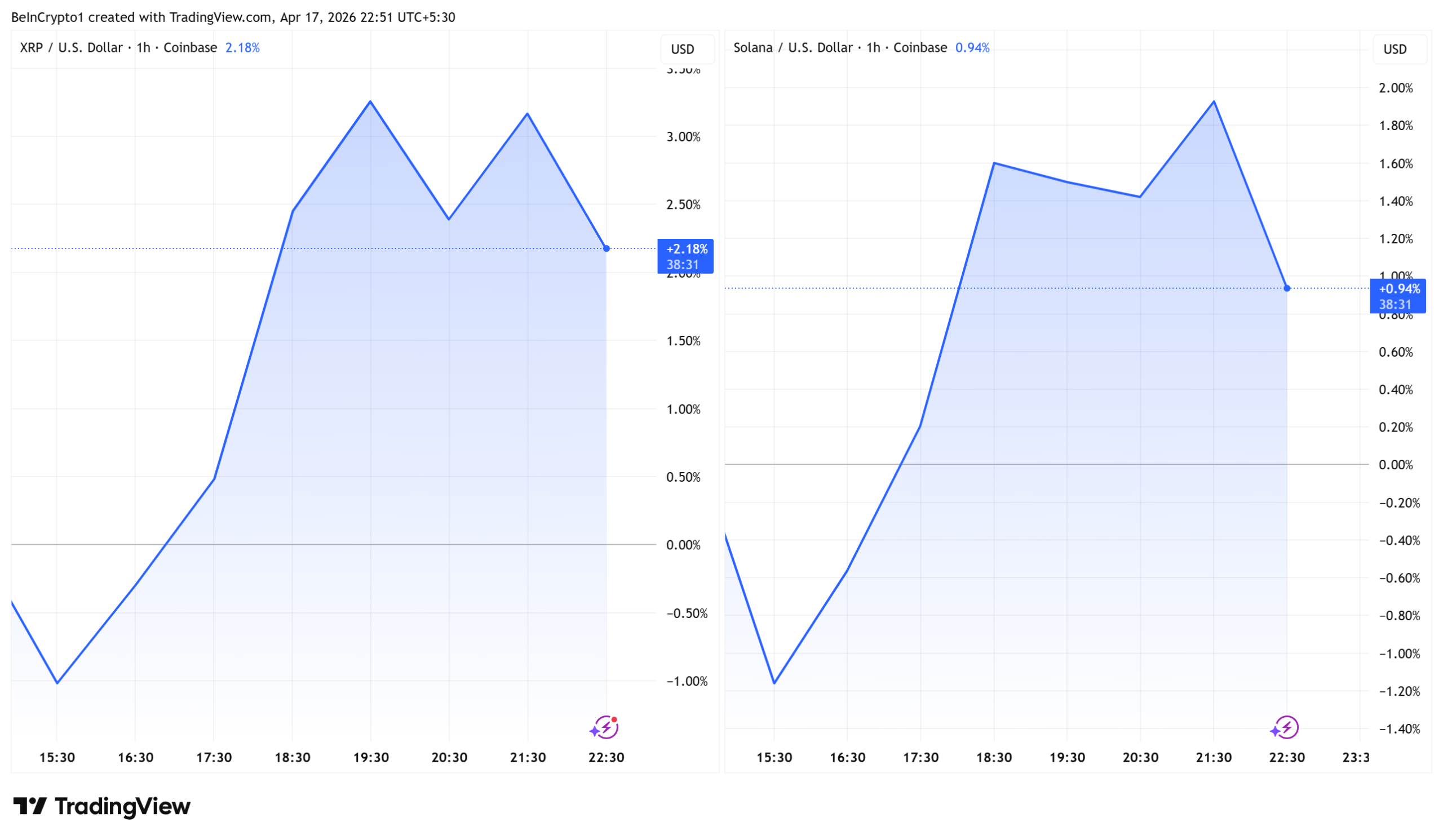
Despite the news, both XRP and Solana prices only recorded modest surges, rising 2% and 0.9%, respectively. As of this writing, XRP traded for $1.49 while SOL exchanged hands for $89.72.
The post XRP Holders Now Have Direct Access to Solana DeFi Ecosystem appeared first on BeInCrypto.
Crypto World
Truist Financial (TFC) Stock Climbs on Strong Q1 Performance with EPS Jump and Loan Portfolio Expansion
Key Highlights
-
TFC shares rally 3.7% following robust Q1 performance with earnings growth and expanding loan book
-
First quarter delivers elevated EPS, consistent revenue generation, and enhanced capital position
-
Truist achieves positive momentum with rising profitability and continued balance sheet expansion
-
Financial institution demonstrates enhanced operational efficiency alongside stable deposit base
-
Quarterly performance showcases EPS advancement while maintaining consistent credit metrics
Truist Financial (TFC) advanced to $51.26, posting a 3.70% increase following the release of first-quarter financial results that demonstrated profitability improvements and ongoing lending growth. The banking institution generated $5.15 billion in total revenue, marking a 5.2% year-over-year increase, while earnings per share climbed to $1.09 compared with $0.87 in the prior-year period. The quarterly report underscored operational consistency, expense management discipline, and maintained financial strength.
Truist Financial Corporation, TFC
Profitability Advancement and Revenue Performance
Truist delivered net income attributable to common shareholders totaling $1.38 billion, demonstrating ongoing profitability momentum. Diluted earnings per share advanced to $1.09, driven by enhanced operational productivity and diversified income generation. The institution achieved a 13.8% return on tangible common equity, showcasing productive capital deployment.
Total revenue experienced a marginal sequential decline while maintaining year-over-year growth momentum. Net interest income totaled $3.60 billion, reflecting moderate sequential headwinds associated with shifts in deposit composition. Noninterest income remained stable at $1.55 billion, benefiting from heightened trading volumes and investment banking contributions.
The efficiency ratio declined to 57.9%, demonstrating enhanced cost management throughout the period. Expense reductions across staffing and professional service categories drove the overall cost decrease. Consequently, pre-provision net revenue exhibited strength, validating the bank’s operational execution.
Lending Portfolio Growth and Financial Position Enhancement
Truist grew its lending operations, with average loans and leases climbing to $327 billion throughout the quarter. Commercial lending segments drove the majority of growth, while consumer portfolios experienced modest contraction. Period-end loans totaled $329.2 billion, demonstrating sustained yet measured expansion.
The deposit base exhibited consistent growth, with average deposits ascending to $399 billion. Period-end deposits reached $404.1 billion, illustrating stable funding dynamics. Declining deposit costs also enhanced margins, with the average deposit cost decreasing to 1.55%.
Average earning assets expanded to $486.35 billion, reflecting incremental balance sheet progression. The loan yield compressed to 5.71%, influenced by repricing trends within the prevailing interest rate landscape. Reduced borrowing expenses and an optimized funding composition helped mitigate margin compression.
Credit Metrics and Financial Strength Remain Resilient
Truist preserved consistent credit quality, with net charge-offs registering 0.61% during the period. Nonperforming assets decreased to $1.79 billion, signaling managed credit exposure. Nonaccrual loans similarly declined to $1.72 billion, reinforcing overall portfolio consistency.
The allowance for loan losses maintained stability, with the ALLL ratio holding steady at 1.53%. Loans delinquent beyond 90 days remained flat, confirming consistent credit performance. These indicators reflected prudent risk oversight across lending operations.
Capital metrics remained robust, with the CET1 ratio maintaining a 10.8% level. The Tier 1 capital ratio achieved 11.9%, while the Tier 1 leverage ratio registered 9.9%. The company executed $1.1 billion in share repurchases, reinforcing shareholder returns and financial position strength.
Truist produced a well-rounded quarterly performance, merging profitability growth, expense discipline, and consistent lending expansion. Despite modest margin headwinds, the stable deposit base and solid capital foundation underpinned continued operational durability.


Europe needs more euro-issued stablecoins and banks across the European Union (EU) countries must explore tokenized deposits, French Finance Minister Roland Lescure said Friday, according to Reuters.
The statements signal a potential shift in stance within the French government and its central bank.
Lescure expressed support for Qivalis, a group of 12 European banks, including BBVA, ING, UniCredit and BNP Paribas, that are set to launch a euro-pegged stablecoin in the second half of 2026, in a move they hope will counter U.S. dominance in digital payments.
“That is what we need and that is what we want.” Lescure said. “I also strongly encourage banks to further explore the launch of tokenised deposits.”
He also said that the relatively small volume of euro-pegged stablecoins compared to dollar-pegged ones was “not satisfactory”.
Former Finance Minister Bruno Le Maire spearheaded a strict regulatory stance against privately-issued fiat-pegged cryptocurrencies, saying they “had no place on European soil” and were a threat to “the sovereignty of nations.” And in 2023, La Maire was linked to a EU document revealing the European Commission’s plan to halt stablecoins from becoming widely used in place of fiat currency.
More recently, during a live confrontation with Coinbase CEO Brian Armstrong over stablecoins and yields, Bank of France Governor Francois Villeroy de Galhau warned that stablecoins and tokenized private money could accelerate what he framed as a political threat. “The first threat is privatization of money, and loss of monetary sovereignty,” he added.
Zentalis presents preclinical data on cancer drug azenosertib

Rumble begins merging with Northern Data

The international press asks: is Real Madrid’s European dominance over?


-

 Business7 days ago
Tesla Model Y Tops China Auto Sales in March 2026 With 39,827 Registrations, Beating Cheaper EVs and Gas Cars
-

 Politics5 days ago
World Cup exit makes Italy enter crisis mode
-
 NewsBeat5 days ago
Pep Guardiola and Gary Neville agree over Arsenal title problem that benefits Man City
-

 Crypto World4 days ago
The SEC Conditionalises DeFi Platforms to Be Avoided for Broker Registration
-

 Crypto World4 days ago
SEC Signals Exemption for Crypto Interfaces From Broker Registration
-

 News Videos2 days ago
Secure crypto trading starts with an FIU-registered
-

 Sports10 hours ago
NWFL Suspends Two Players Over Post-Match Clash in Ado-Ekiti
-

 Crypto World4 days ago
SEC Proposes Certain Crypto Interfaces Don’t Need to Register as Brokers
-

 Business6 days ago
Ireland Fuel Protests Enter Day 5 as Blockades Spark Shortages and Government Prepares Support Package
-

 NewsBeat3 days ago
Trump and Pope Leo: Behind their disagreement over Iran war
-

 Crypto World7 days ago
Federal judge blocks Arizona from bringing criminal charges against Kalshi
-
 NewsBeat6 days ago
JD Vance announces ‘no agreement’ with Iran over nuclear weapons fear
-

 Business7 days ago
IMF retains floor for precautionary balances at SDR 20 billion
-
Sports6 days ago
Dexter Lawrence, Stefon Diggs, Trading for De’Von Achane
-

 Business7 days ago
Former Liverpool CEO eviscerates FIFA for World Cup ticket pricing
-
Crypto World5 days ago
Sei Network Enters Quiet Reset Phase as On-Chain Metrics Signal a Slowdown in 2026
-

 Crypto World4 days ago
Trump whales load up ahead of Mar-a-Lago luncheon.
-
Business7 days ago
Coreweave CSO Venturo sells $5.5m in class a common stock
-
Sports7 days ago
1st-Round WR Enters Vikings Mock Draft Orbit
-
Business4 days ago
Kering slides after Morgan Stanley downgrade, Gucci woes loom
You must be logged in to post a comment Login