

Crypto World
The 8-Week Bitcoin Demand Drought Points to Where the Money Went

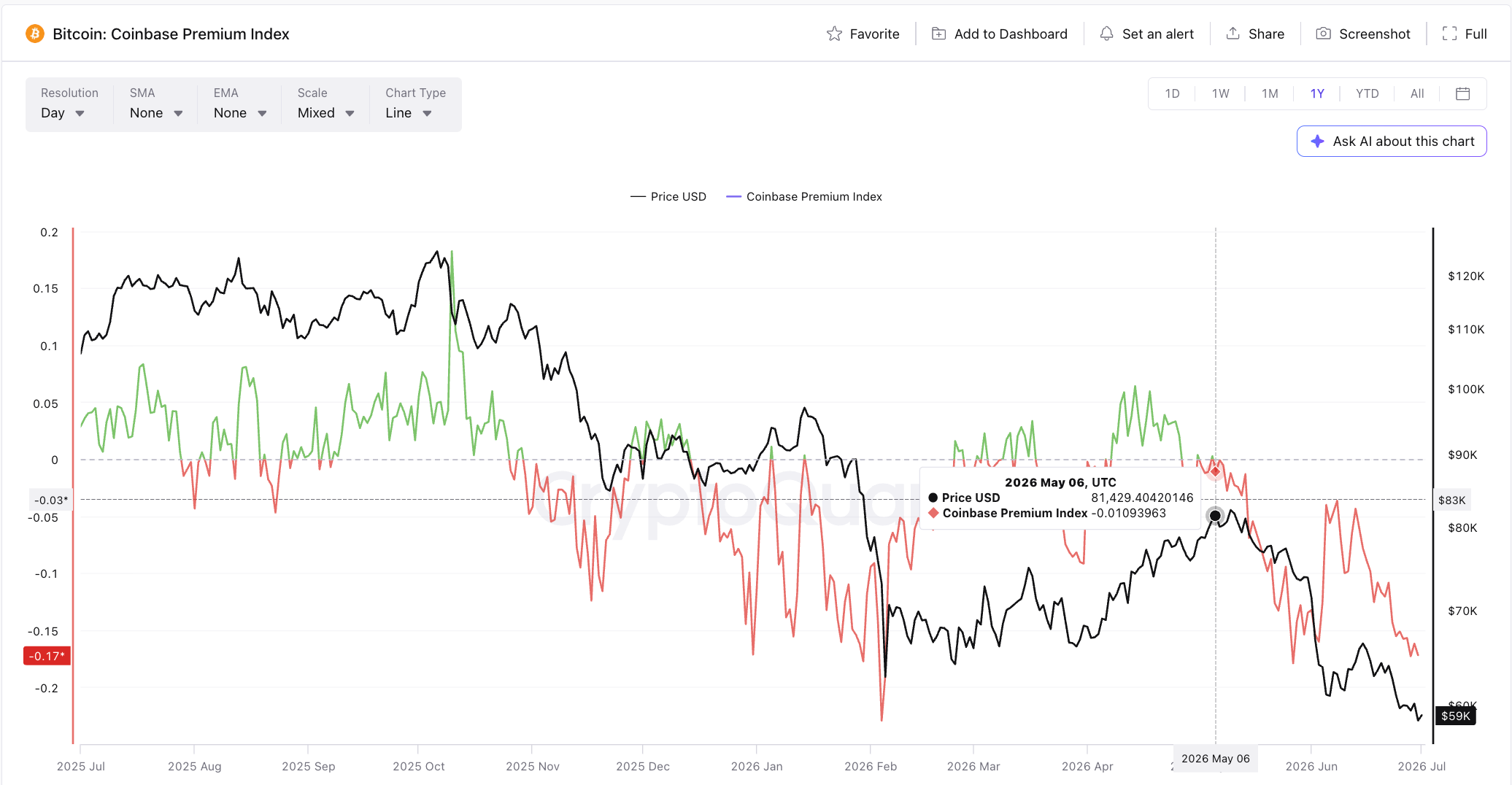
Bitcoin (BTC) buyers in the United States have gone quiet. The Coinbase Premium Index, a gauge of US Bitcoin demand, has stayed negative since May 6, its longest weak stretch in more than a year.
The signal matters because it shows who is stepping back. A negative premium means American investors are paying less for BTC than the rest of the market. That helps answer why is Bitcoin going down.
What the Coinbase Premium Is Showing
The index tracks the price gap between US-based Coinbase and offshore exchanges. When it turns negative, US Bitcoin demand is fading. When it climbs, American buyers are leading.

Right now it is stuck below zero. The current negative premium streak began on May 6, with Bitcoin near $81,429, and has held for roughly eight weeks. That is the longest such run since early 2025.
Want more token insights like this? Sign up for Editor Harsh Notariya’s Daily Crypto Newsletter here.
Since then, the Bitcoin spot price has slid toward $59,500, down about 27% and still falling.
Where Is Bitcoin Money Going
The weak US Bitcoin demand lines up with a historic move in stocks. American money is not sitting idle. It is chasing chips.
The semiconductor index has beaten the S&P 500 by about 85 percentage points this year, its widest first-half lead on record, according to Kobeissi. That tops the dot-com peak of 2000.
Chips now dominate the market. Semiconductors make up roughly 18% of the S&P 500 and have driven close to 70% of its 2026 gains, data shows. Micron has jumped about 300% and SanDisk more than 760%.
The rotation is visible in fund flows. Since April, US gold and Bitcoin ETFs have lost about $12 billion, while chip ETFs pulled in around $20 billion.
BlackRock’s iShares Bitcoin Trust (IBIT), the largest bitcoin fund, led June’s record ETF outflows, the worst month since spot ETFs launched.
The January Warning
This is not the first time US Bitcoin demand vanished this year. The pattern already played out once.
Bitcoin’s premium turned negative around January 15, when BTC traded near $95,583. By the time that streak ended on February 24, Bitcoin had crashed to about $64,100.

That was a drop of roughly 33% in six weeks. The current slump is longer and shows the same fading US demand.
One Caveat Before the Panic
There is a catch to the rotation story. Bitcoin and the Nasdaq usually move together, with a six-month correlation near 0.46. That link normally means both rise and fall on the same macro forces.

This year, though, the two have split but the correlation stays intact. Bitcoin is down about 33% in 2026, while the tech sector has gained more than 20% in the first half.

The reason for the gap points straight back to chips. Semiconductors drove close to 70% of the market’s 2026 gains, so this tech rally is really a chip rally. In other words, the asset class Bitcoin usually tracks is being lifted by the exact sector US buyers are moving into.
That is why the split matters. When a normally correlated pair breaks apart this far, capital moving from one into the other is the simplest explanation.
What Happens Next
Bitcoin’s next move may hinge on US buyers. If the premium stays negative and chip inflows continue, the path of least resistance points lower for BTC. The January-February price slump of 33% shows that BTC can still correct further.
Yet, a flip back to positive would be the first real sign that domestic BTC demand is returning. Until then, the January script remains the one to watch.
The post The 8-Week Bitcoin Demand Drought Points to Where the Money Went appeared first on BeInCrypto.



World, the mysterious Solana project that garnered millions of views on X with little more than a glowing globe, cryptic posts and the tagline “Trade Everything,” is now live as a fully onchain prediction market inside Phantom.
The platform is online at world.xyz and in the Phantom wallet on iOS, Android and desktop, with Chainlink serving as its primary oracle infrastructure for its data.
Users can trade event contracts tied to crypto prices and the 2026 FIFA World Cup, with additional markets on sports, geopolitics, and macroeconomics planned for the near future, according to an announcement shared with CoinDesk.
World’s world_xyz account has built attention throughsocial media posts offering scant product details, fueling speculation that the project could be a meme coin, trading app or broader Solana infrastructure play. Copycat WORLD-themed tokens have appeared on token launchpads, though those tokens are not official World assets.
The platform’s identity stayed hidden until late June, when a legal disclosure on Phantom’s site surfaced on X.
World is instead a non-custodial prediction market, with users being able to trade directly from their Solana wallets and funds moving only when they enter a market. Positions, settlement and redemptions happen onchain.
Circle CEO Jeremy Allaire argued that USDC’s decade-long network of integrations, liquidity and regulatory infrastructure gives it a structural advantage over new stablecoin entrants, while challenging key elements of Open USD’s proposed business model.
In a Wednesday X post, Allaire described stablecoin networks as platform businesses driven by network effects, saying sustained investment in integrations, liquidity, regulatory approvals, banking relationships and reserve management creates competitive advantages that are difficult to replicate.
He also questioned whether permanently offering free, unlimited minting and redemption would remain sustainable at scale and said returning nearly all reserve income to partners risks “starving an infrastructure.”
The comments highlight intensifying competition among stablecoin issuers as new entrants seek to challenge USDC and USDT by offering businesses a greater share of reserve income and influence over governance.
Open Standard announced Open USD (OUSD) on Tuesday, with support from over 140 payments, banking, technology and crypto companies, including Visa, Mastercard, Stripe, Coinbase, BlackRock and Google. The stablecoin is expected to go live later in 2026.
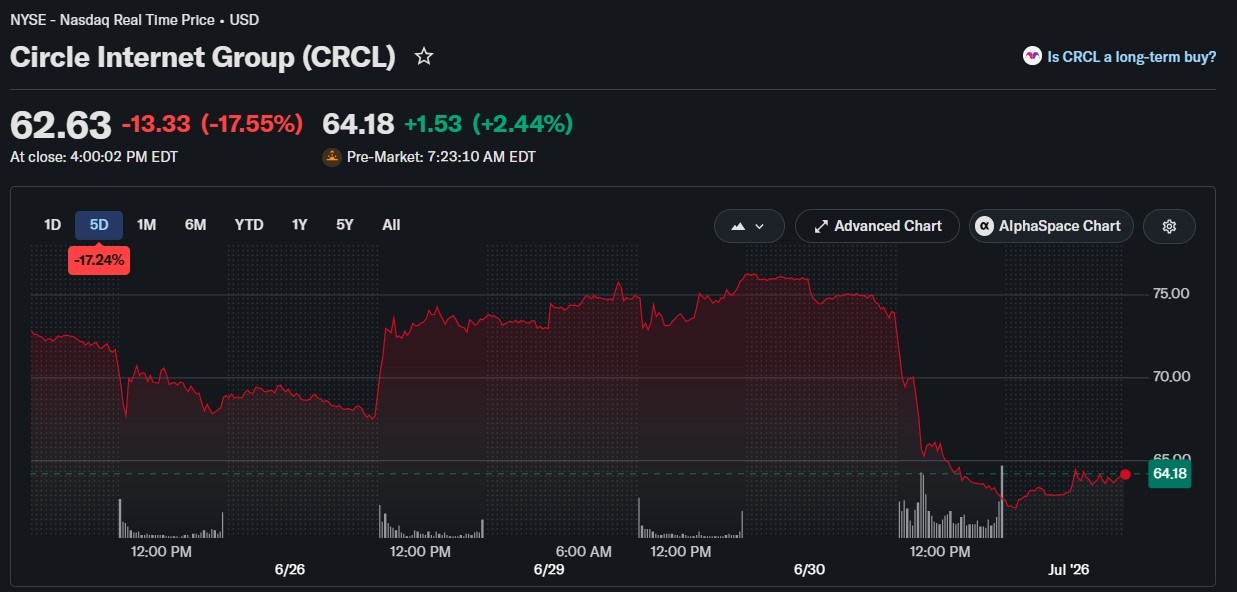
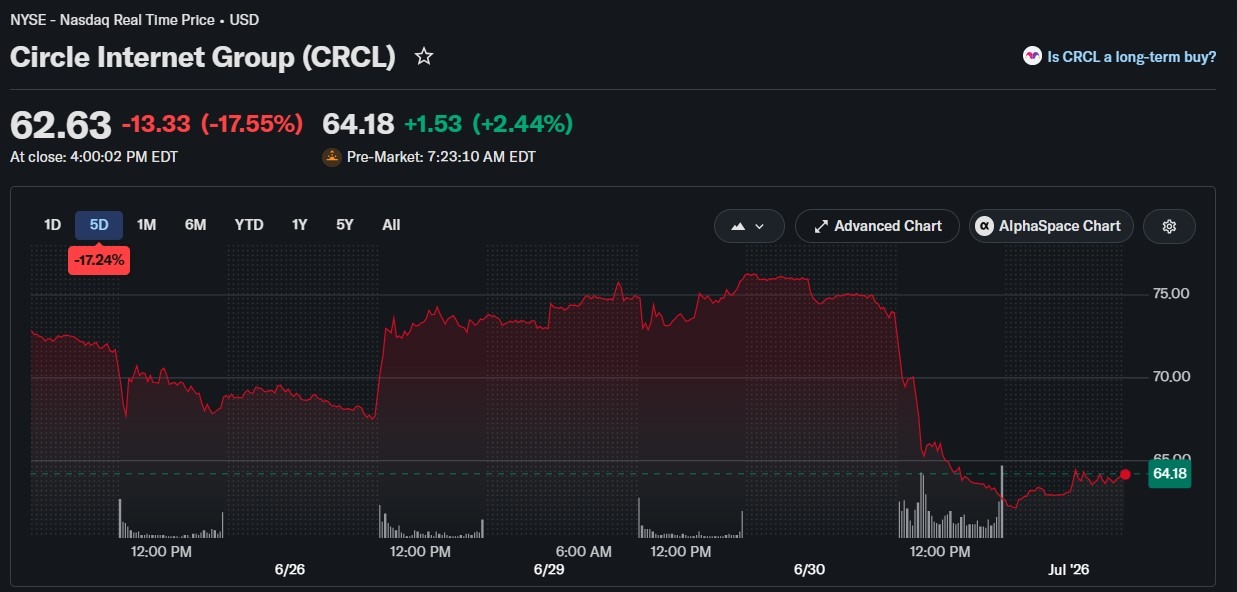
Circle’s stock performance in the last five days. Source: Yahoo Finance
Circle shares closed Tuesday at $62.63, down 17.55% from the previous session, before rising 2.44% to $64.18 in premarket trading as of 11 am UTC on Wednesday, according to Yahoo Finance data.
OUSD could challenge the Circle-Tether duopoly: Bernstein
In a research note, analysts at Bernstein said OUSD could become the “strongest and first new entrant to challenge the duopoly of Circle and Tether,” citing its reach across payments, banking, technology and commerce.
However, Bernstein said governance, operational architecture and the revenue-sharing formula remain open questions, as coordinating more than 140 partners will require substantial work. Bernstein said Circle spends close to $500 million on marketing, infrastructure, technology and compliance, highlighting the amount of resources needed to scale a stablecoin network.
Related: MetaMask launches stablecoin yield account with card spending
Lorenzo Valente, director of research at ARK Invest, took a more skeptical view. In a post on X, Valente said that OUSD still faces the cold-start problem created by USDC and USDT’s entrenched liquidity across the crypto ecosystem. He called the announcement a “giant” letter of intent and said that many participants also support competing stablecoins or operate their own infrastructure.
“The partners are backing rivals: Stripe owns Bridge and has its own stack, Coinbase is wedded to USDC, banks are building their own deposit tokens and the card networks support every token out there,” Valente wrote.
Magazine: Japanese pension fund tips 1% in crypto, G7 urges action on NK hackers: Asia Express

Remittix has moved into a busier launch window, and one update is now taking priority across the community: airdrop registration.
The registration page is live through the official Remittix site, giving RTX holders a clear step to complete before token distribution moves closer. For presale buyers, the focus is shifting from simply watching updates to taking action, registering wallets and preparing for the next stage of the Remittix rollout.
The timing is important. Remittix is currently building toward several major updates, including the RTX launch price reveal expected in 3 days, the extended 350% RTX bonus, the approaching public platform launch and the $32 million milestone expected to unlock the official launch date reveal.
Why Airdrop Registration Is Now In Focus
The Remittix airdrop is connected to the distribution of RTX tokens purchased during the presale. It is not being presented as a separate free-token campaign. Instead, it is part of the process for helping holders prepare for token distribution.
To register, holders need to visit the official Remittix site, connect their wallet, submit their wallet address and complete the registration page. Users can also add optional notification details so they can receive future updates linked to the airdrop, distribution and launch process.
Once the process is complete, the page confirms that the holder has successfully registered.
This has made registration one of the most practical updates for the community. While launch headlines continue to build, wallet submission is the step holders can complete now.
Launch Updates Are Starting To Stack Up
The next few updates could be important for Remittix. The RTX launch price reveal is expected in 3 days, giving holders a clearer view of how the token will be positioned heading into launch.
At the same time, the project is closing in on the $32 million milestone, which is expected to unlock the official launch date reveal. This has added more attention around the current registration period, especially as holders wait for clearer launch timing.
The extended 350% RTX bonus is also still active, adding another incentive for users watching the final stretch before launch activity increases.
Platform Launch Adds A Utility Angle
Beyond token distribution, Remittix is still building its wider crypto-to-fiat payments story.
The platform is designed to let users send crypto while recipients receive fiat directly into bank accounts. Multiple community members have reportedly received fiat payments through the Remittix system, giving the project practical proof as public platform access moves closer.
That is why the airdrop registration update matters beyond wallet submission alone. It arrives at the same time as launch price news, platform momentum, the 350% bonus extension and the $32 million milestone.
For RTX holders, the next step is straightforward. Register through the official Remittix site, submit wallet details and stay ready as the next Remittix launch updates approach.
Discover the future of PayFi with Remittix by checking out their project here:
Website: https://remittixpresale.io
Airdrop Registration: https://airdrop.remittixpresale.io
FAQ
Why is airdrop registration important for Remittix holders?
Airdrop registration allows RTX holders to submit their wallet address and prepare for the upcoming token distribution process.
What major Remittix updates are approaching?
The main updates include the RTX launch price reveal in 3 days, the $32 million milestone for the launch date reveal and the approaching public platform launch.
What is the Remittix platform designed to do?
The Remittix platform is designed to let users send crypto while recipients receive fiat directly into bank accounts.
Disclaimer: This is a Press Release provided by a third party who is responsible for the content. Please conduct your own research before taking any action based on the content.

Key Points
- Christopher Delgado admits guilt in $400M cryptocurrency fraud operation
- Federal prosecutors reveal Ponzi-style structure using new investor funds
- At least $250M in verified losses connected to the fraudulent scheme
- Agreement includes forfeiture of luxury properties, vehicles, and high-end goods
- Federal sentencing scheduled for October 8 in ongoing fraud prosecution
Christopher Alexander Delgado, former chief executive of Goliath Ventures, has entered a guilty plea in connection with a massive $400 million cryptocurrency fraud operation in Florida. Federal authorities allege that Goliath collected investor capital by promising substantial returns through digital asset liquidity pool investments. Instead, investigators claim the funds financed payouts to earlier investors, extravagant personal purchases, and corporate entertainment expenses.
Executive Acknowledges Involvement in Fraudulent Operation
According to the U.S. Attorney’s Office, Delgado entered guilty pleas on charges including conspiracy, wire fraud, and money laundering. Each wire fraud charge carries a potential sentence of up to 20 years behind bars. The money laundering charge adds an additional maximum penalty of 10 years in federal prison.
Delgado assumed leadership of Goliath Ventures following its earlier incarnation as Gen-Z Venture Firm. Federal prosecutors indicate that the Crypto Fraud scheme operated continuously from January 2023 until January 2026. Throughout this timeframe, the company marketed consistent monthly profits supposedly generated from cryptocurrency liquidity pool operations.
Federal authorities state that Delgado has acknowledged responsibility for investor losses totaling at least $250 million. Prosecutors further assert that Goliath collected approximately $400 million from defrauded victims. The executive now awaits his sentencing hearing scheduled for October 8.
Federal Investigation Reveals Luxury Asset Trail
Government prosecutors detail how Goliath employed incoming investor capital to satisfy withdrawal requests from previous participants. The organization simultaneously processed payouts and maintained outward appearances of legitimate investment activities. According to prosecutors, merely $1 million actually reached genuine cryptocurrency assets.
The Crypto Fraud investigation uncovered substantial luxury expenditures, based on federal court documents. Prosecutors documented purchases by Delgado including multiple residential properties, exotic automobiles, premium timepieces, designer handbags, upscale wallets, and fine jewelry. The spending spree encompassed Lamborghini and Rolls-Royce vehicles, Rolex watches, and custom-designed Tiffany & Co. jewelry pieces.
The plea arrangement mandates that Delgado surrender eight real estate properties and eleven luxury vehicles. Additional forfeitures include 30 high-end watches and over 50 designer bags and wallets. Delgado has also consented to relinquish no fewer than 29 pieces of jewelry.
Fraud Investigation Raises Questions About Financial Oversight
The investigation attracted significant attention even before Delgado’s guilty plea. Affected investors initiated a proposed class-action complaint against JPMorgan Chase in March. The legal action accused the banking institution of permitting questionable Goliath transactions through its banking infrastructure.
The civil complaint asserted that approximately $253 million flowed through a JPMorgan business account. Plaintiffs additionally claimed that roughly $123 million subsequently transferred to Goliath-controlled wallets at Coinbase. Independent federal filings documented additional transaction flows involving Bank of America accounts and Coinbase wallet addresses.
The Crypto Fraud prosecution underscores the disconnect between promotional representations and verifiable blockchain transactions. While liquidity pools function as legitimate DeFi mechanisms, companies must demonstrate transparent on-chain evidence. In this instance, federal prosecutors contend that Goliath exploited the liquidity pool concept to facilitate an extensive Crypto Fraud enterprise.


The seasonal pattern normally runs the other way. Across bitcoin’s full record, the fourth quarter has been its strongest by a wide margin, averaging a 77% gain with a median near 48%, the stretch that has repeatedly salvaged mediocre years.
The third quarter is the opposite, the weakest quarter on average and often flat. The calendar, in other words, would normally argue for a quiet third quarter and a strong fourth-quarter finish. In 2018 and 2022, that seasonal strength failed. The bear market overrode the calendar, and the fourth quarter, usually the best, became one of the worst.
A sample of two may tell little on its own and both of those years turned on specific collapses that have no exact equivalent today. The comparison does not mean 2026 must follow 2018 or 2022, but it does mean the only other times bitcoin started a year this weakly, the weakness was a symptom of something structural rather than a passing dip.
Whether 2026 belongs in that category depends on what is driving the selling, and the drivers look more like a grind than a panic.
U.S. spot bitcoin exchange-traded funds (ETFs) have seen record outflows over the past month, the number of active users onchain has stayed near the low end of its range, and capital has rotated steadily into AI stocks, which just posted their best quarter in years while crypto fell.

Global mergers and acquisitions (M&A) reached a record $2.8 trillion in the first half of 2026, up 48% from a year earlier. This marked the strongest opening six months since LSEG began tracking deals in 1980.
Large takeovers carried the market. Fewer companies changed hands, yet the deals that closed were far bigger, lifting total value to a record.
Global M&A Surges to Record $2.8 Trillion
Transactions above $10 billion set the pace. Roughly 47 such deals, worth more than $1.3 trillion combined, drove close to half of all value in the period, according to LSEG data.
Meanwhile, the total number of deals fell 9% to about 24,000, the lowest first-half count in six years. Buyers favored fewer, bigger bets over broad activity.
Ivan Farman, co-head of Global M&A at Bank of America, said the stronger pace of large-scale deals compared with smaller transactions “reflects a growing view that a $1 billion to $3 billion deal takes just as much time as a larger one, so when an opportunity for a big transaction arises, companies see this as the moment to act.”
“So when an opportunity for a big transaction arises, companies see this as the moment to act,” Farman added.
Follow us on X to get the latest news as it happens
Ample financing made that ambition possible. Global investment-grade corporate debt issuance reached $3.4 trillion in the first half, up 10% from last year, Reuters reported.
Technology continued to dominate global merger and acquisition activity. Announced deals totaled $649 billion in the first six months of the year.
Meanwhile, cross-border M&A surged to $893 billion during the first half of 2026, marking a 62% increase from the same period last year. It also represented the strongest start to a year since 2018. The US drew the most interest, at 25% of cross-border transactions. Britain ranked a close second.
While the first half has been notable, full-year momentum points higher. Global M&A is projected to reach $4 trillion in 2026, which would mark the strongest year since 2021, according to PwC.
Subscribe to our YouTube channel to watch leaders and journalists provide expert insights
The post Mega-Deals Drive Global M&A to $2.8 Trillion in First Half of 2026 appeared first on BeInCrypto.
Crypto World
707 Cayman Holdings (JEM) Stock Explodes 267% on New Director Appointment and Blockchain Strategy

Key Highlights
- Shares of JEM closed 267.59% higher during Tuesday’s regular session at $3.97, followed by an additional 154.41% gain after-hours to $10.10
- The explosive move followed news that Robin Hoksnes Karlsen was appointed as executive director, revealed before markets opened
- Volume exploded to 122.24 million shares — approximately 130 times the typical daily average of 940,600
- Directors greenlit exploration of an AI-powered blockchain supply chain system with a preliminary budget of $10–12 million across three years
- No funds have been allocated yet; any cryptocurrency payment trials require regulatory clearance in Hong Kong, the EU and compliance with FATF standards
707 Cayman Holdings (JEM) delivered one of Tuesday’s most dramatic market performances. Shares finished regular trading up 267.59% at $3.97, before climbing an additional 154.41% in extended hours to $10.10.
707 Cayman Holdings Limited Ordinary Shares, JEM
The dramatic rally was sparked by news that Robin Hoksnes Karlsen had been named executive director. The announcement arrived ahead of market open.
Karlsen is the founder of AMIHAN Innovations Ltd., a Web3 and technology firm, and brings over ten years of expertise spanning real estate investing, capital structuring and institutional Real World Asset (RWA) tokenization within decentralized finance ecosystems. His educational credentials include a master’s degree from the University of Hong Kong and an undergraduate degree from University College London.
Trading activity underscored the intensity of investor interest. The session saw 122.24 million units change hands — roughly 130 times JEM’s standard daily volume of 940,600.
With a market capitalization around $7.15 million, the company remains firmly within small-cap boundaries. JEM’s 52-week trading range spans $1.02 to $135, while its RSI currently registers at 67.99 after the dramatic price movement.
Company Unveils AI and Blockchain Supply Chain Strategy
Also on July 1, the board revealed approval to investigate a cutting-edge digital infrastructure merging AI capabilities, blockchain-based traceability and a cryptocurrency payment pilot designed to digitalize its worldwide apparel supply network.
The initiative responds to growing demand from European and North American customers for enhanced supply chain visibility, accelerated restocking cycles and authenticated ESG documentation.
Leadership presented a preliminary three-year funding framework of $10 million to $12 million for staged implementation. The roadmap encompasses AI-enhanced supply chain efficiency, AI design tools, blockchain-powered origin verification and a crypto transaction pilot program.
The board emphasized that no capital commitments have been finalized. The schedule and extent of any cryptocurrency payment operations hinge on securing regulatory permissions in Hong Kong, the EU and meeting FATF compliance requirements.
Karlsen’s expertise in blockchain tokenization and real estate finance is being highlighted as strategically aligned with this expansion trajectory.
Short Position Data and Historical Performance
Some broader perspective deserves attention here. While Tuesday brought explosive gains, JEM remains down 96.17% across the trailing twelve months. The six-month performance shows a gain of 12.15%.
Short interest currently represents 36.2% of available float. Such elevated short positioning can magnify price swings in either direction when traders rush to close positions.
Technical analysis signals from TipRanks currently indicate a sell rating for the stock.
JEM’s market capitalization stays modest at $5.6–7.15 million based on different measuring points. This means even moderate purchase activity can generate disproportionate price reactions.
The company’s typical daily trading activity before Tuesday stood at merely 940,600 units, contrasting sharply with the 122.24 million shares that traded during the session.
Ethereum has remained pinned near the $1,500 support zone after quarter-end selling, whale distribution, and weak institutional flows kept the second-largest cryptocurrency under pressure despite continued corporate treasury accumulation.
Summary
- Ethereum has logged its first-ever third straight quarterly loss as quarter-end selling keeps ETH near $1,500 support.
- SharpLink and Bitmine expanded their ETH treasuries, but whale selling and ETF outflows continue to weigh on price.
- Analysts say reclaiming $1,700 is key, while losing $1,500 could expose ETH to another leg lower.
According to data from crypto.news, Ethereum (ETH) traded around $1,580 at the time of writing, down roughly 5.3% over the past seven days and about 25% for the quarter. The decline completed Ethereum’s first-ever streak of three consecutive quarterly losses.
Selling pressure also intensified after the Ethereum Foundation announced a restructuring on June 23 that included a 20% workforce reduction and a 40% budget cut, raising fresh concerns about development spending while large holders continued reducing exposure.
Corporate buyers, however, have continued to accumulate into the weakness. SharpLink disclosed another purchase of 10,000 ETH at an average price of $1,611, spending about $16.1 million to expand its treasury. Separately, Bitmine added 27,084 ETH during the past week, lifting its holdings above 5.7 million ETH. Those purchases have so far failed to offset persistent selling from whales and institutional investors.
Bitmine, however, framed the quarter-end weakness as partly technical rather than purely fundamental. In a June 30 post on X, the company said “window dressing is taking place,” adding that institutions often sell underperforming assets toward the end of a quarter. Bitmine noted that Bitcoin was down 13% and Ethereum was down 25% for the quarter, saying crypto was “being sold” into the reporting period.
On-chain activity has remained mixed. According to Ali Martinez, Ethereum whales sold roughly 550,000 ETH over the past week, adding substantial supply to the market. Lookonchain separately reported that one whale exited a 2,468 ETH position after holding it for more than five months, realizing a loss of about $4.33 million after selling near $1,572.
FG Nexus has also struggled with its Ethereum treasury strategy. According to Lookonchain, the company has realized about $86.6 million in losses after buying ETH near the 2025 highs and later selling at much lower prices.
Meanwhile, institutional demand has yet to recover. Spot Ether ETFs have recorded approximately $274 million in cumulative net outflows across consecutive sessions without posting a single day of positive inflows. At the same time, capital has continued flowing into U.S. artificial intelligence stocks and the recently launched SpaceX IPO, leaving fewer buyers available to absorb Ethereum’s selling pressure.
Technical structure leaves Ethereum trapped between $1,500 and $1,650
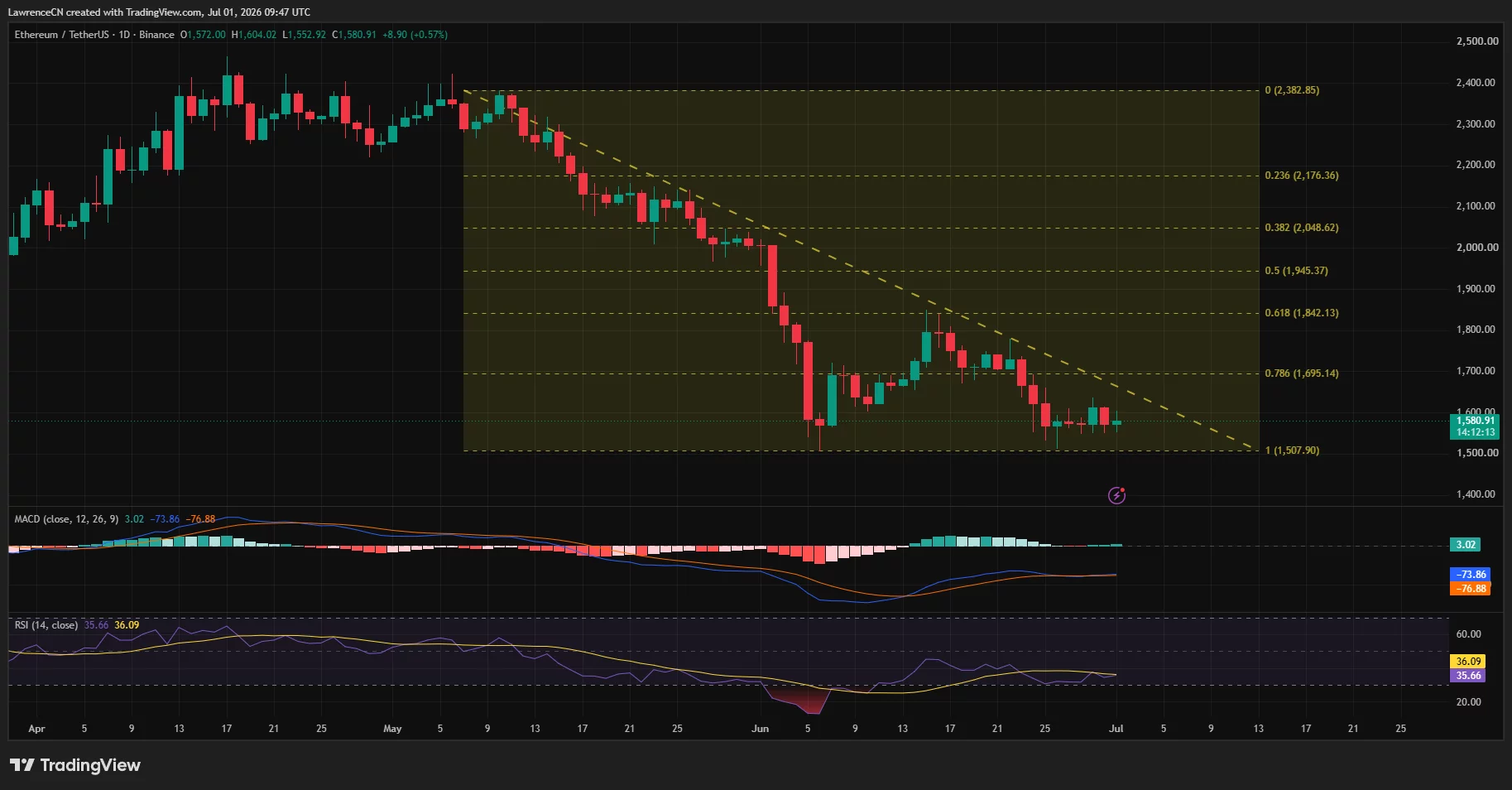
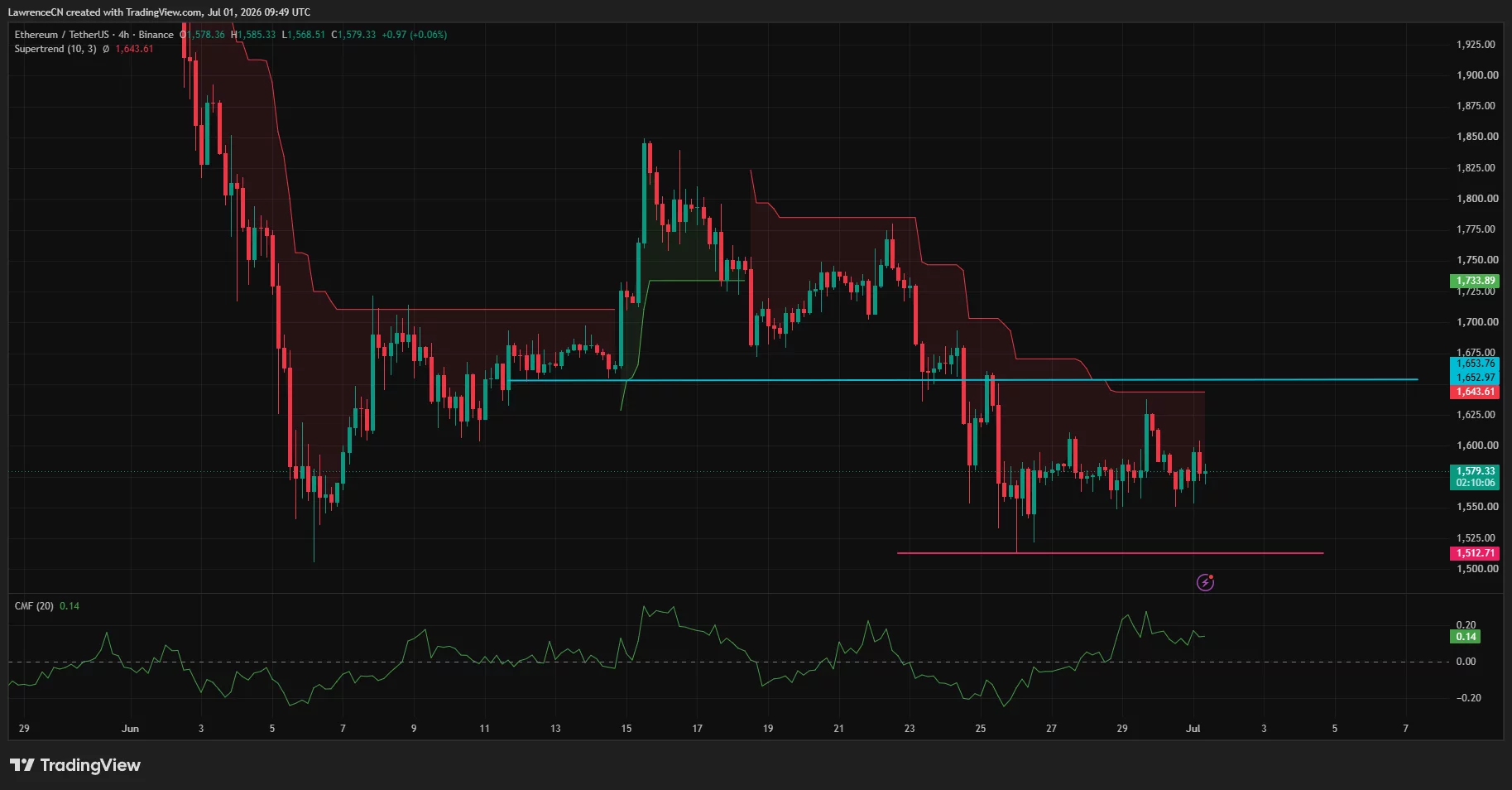
Ethereum’s daily chart continues to trade below a descending trendline that has capped every recovery attempt since May. The asset also remains below the daily Supertrend resistance near $1,644, while the 78.6% Fibonacci retracement around $1,695 forms the next major resistance level should buyers regain control.
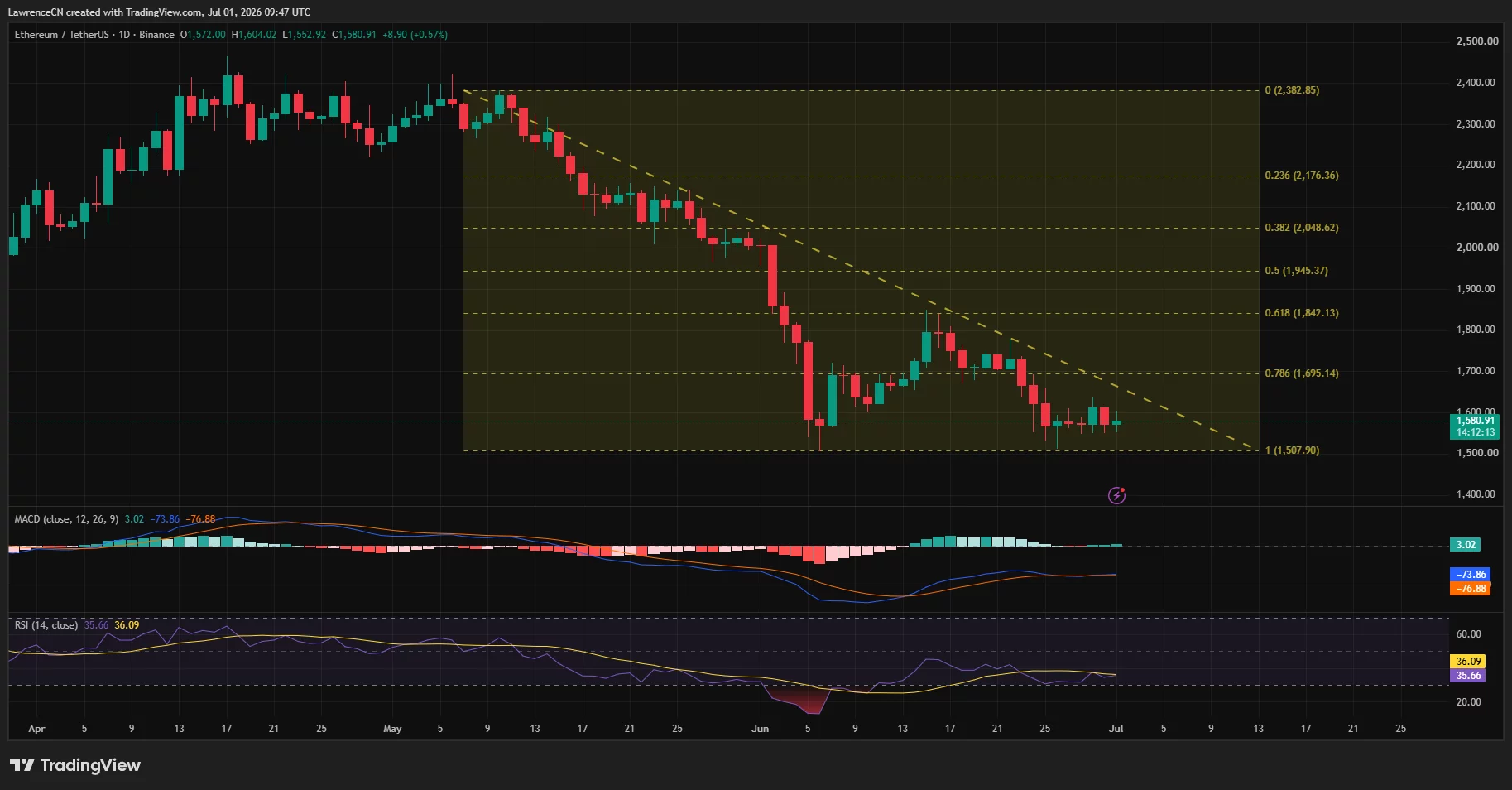
Momentum indicators have yet to confirm a reversal. The daily RSI remains near 36, keeping Ethereum in bearish territory despite stabilizing above recent lows. MACD has begun flattening after weeks of decline but has not produced a decisive bullish crossover. On the 4-hour chart, Chaikin Money Flow has climbed back above zero, suggesting buyers have started returning, although the recovery remains limited while price stays below key resistance.
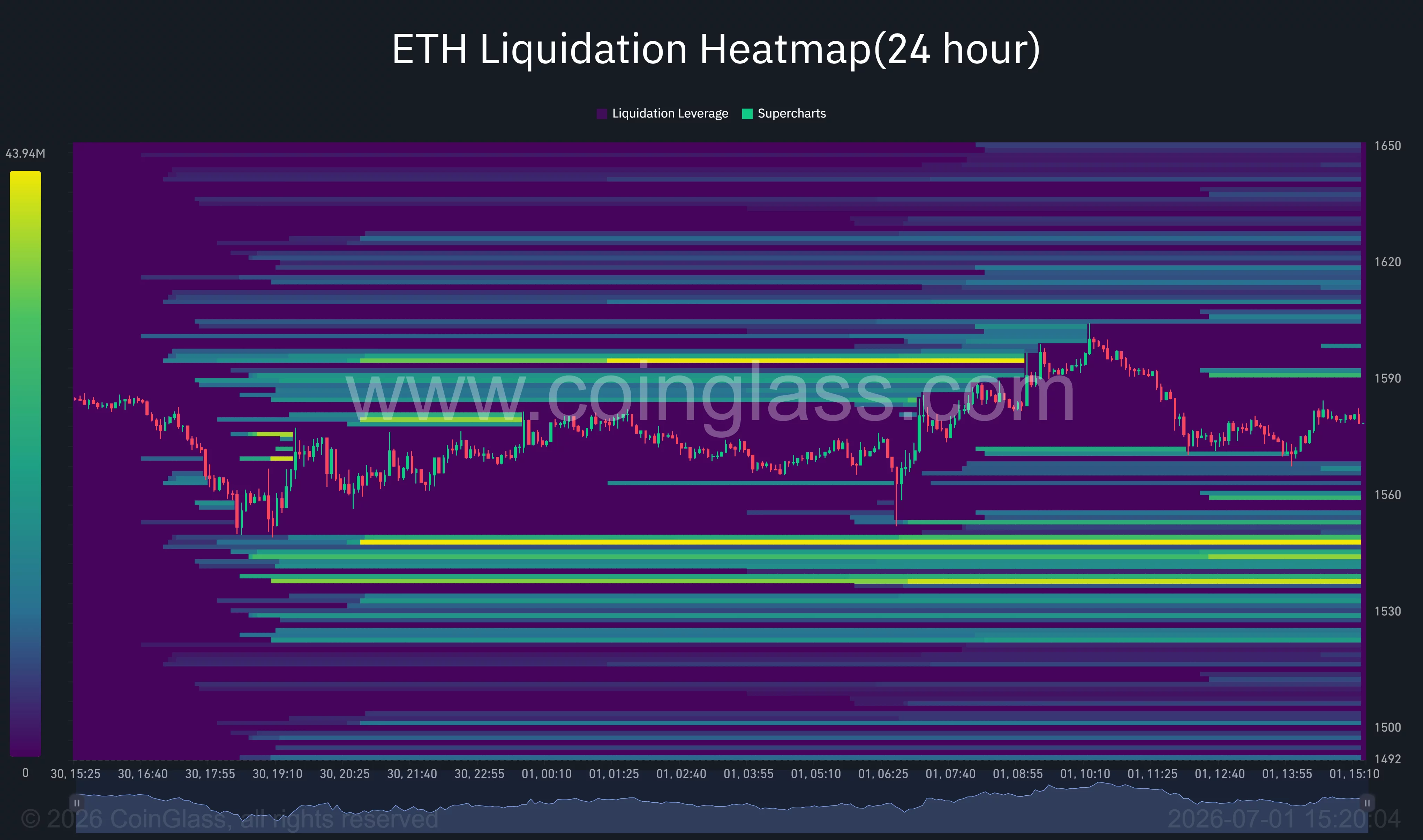
Derivatives positioning also presents a mixed picture. CoinGlass liquidation data shows the largest short liquidation cluster sitting around $1,590-$1,600, while a much larger concentration of long liquidations has built between roughly $1,530 and $1,545. A break above the upper cluster could trigger a short squeeze toward the $1,640-$1,700 region, whereas losing the lower liquidity pocket could accelerate selling into the psychological $1,500 support.
Commenting on the market structure, crypto analyst Ted Pillows wrote:
“ETH is holding better than BTC now… Until Ethereum reclaims the $1,700 level, the chances of a new low will go up.”
His view aligns with the current technical picture, where reclaiming $1,700 would invalidate the series of lower highs that has controlled price action for nearly two months.
Loss of $1,500 support could expose another leg lower
The bearish case strengthens if Ethereum fails to defend the $1,500-$1,510 support band, which also aligns with the recent swing low on the daily chart. A breakdown below that region would invalidate the current consolidation and expose the next downside targets near $1,400 before attention shifts toward the $1,200 area discussed by several market participants.
Macro conditions continue to add uncertainty. Sticky U.S. inflation, expectations for higher interest rates, geopolitical tensions in the Middle East, and weaker decentralized finance activity have reduced risk appetite across digital assets.
Unless ETF flows stabilize, whale selling eases, and Ethereum reclaims resistance above $1,640 and eventually $1,700, quarter-end weakness may continue to weigh on price even as corporate treasuries keep accumulating ETH.
Disclosure: This article does not represent investment advice. The content and materials featured on this page are for educational purposes only.


Against the backdrop of a weak UK economy and inflation above target, the Bank of England paused on 18 June, leaving the base rate unchanged at 3.75% for a fourth consecutive meeting, despite internal disagreements among committee members over the need for a rate hike. The contrast with the European Central Bank’s actions was notable: on 11 June, the ECB raised interest rates in response to a surge in eurozone inflation driven by higher energy prices amid the Middle East conflict. As a result, the monetary policy paths of London and Frankfurt temporarily diverged, with market attention now shifting to two upcoming meetings: the ECB on 23 July and the Bank of England on 30 July.
Technical Outlook
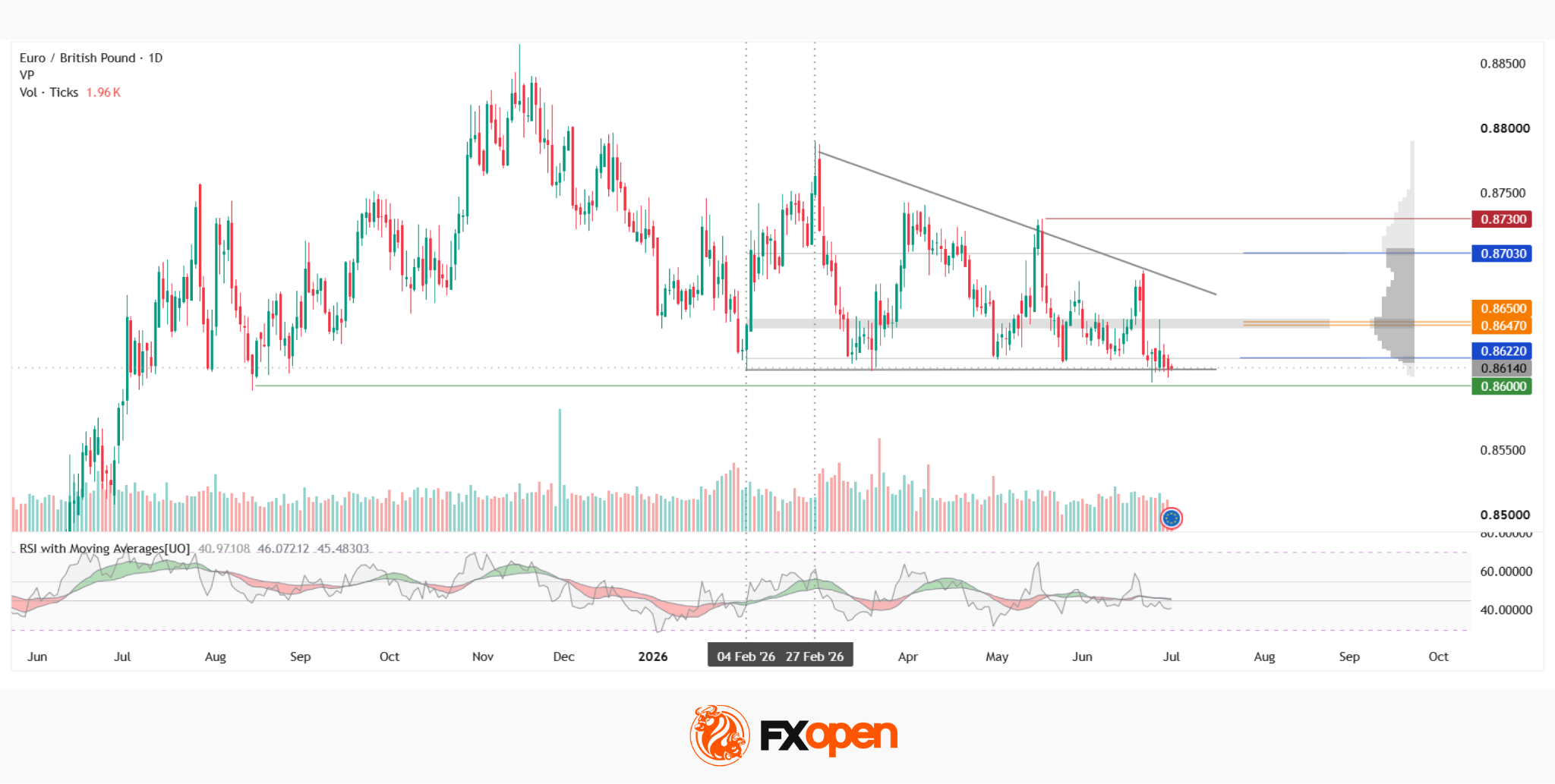
On the daily chart, EUR/GBP has been forming a bearish structure since November last year. After peaking around 0.8860, the pair moved into a broad trading range, and in February a descending triangle began to take shape. The price is currently testing the triangle's lower boundary.
Immediately below the triangle's lower boundary lies support at 0.8600, while slightly above it is the lower boundary of the current volume profile at 0.8622. This cluster of three technical levels could help keep the pair within the triangle, whereas a downside break may trigger increased market activity.
Above this area is the Point of Control (POC) zone at 0.8647–0.8650, where the bulk of trading volume for the first half of the year is concentrated. If the price breaks above this zone, it could move on to test the triangle's upper boundary. Should buying pressure overcome the descending resistance line, the upper boundary of the volume profile at 0.8703 and the resistance level at 0.8730 may act as the next barriers.
The RSI and MAs indicators currently stand at 41, 46 and 45, respectively. The RSI remains below the neutral 50 level, while the MAs, although approaching the lower boundary of the neutral zone, remain positively aligned.
Summary
The combination of the Bank of England keeping interest rates unchanged and the ECB's recent rate hike creates a backdrop in which the technical reaction around 0.8600 or the POC zone could become a key factor in determining the next directional move for EUR/GBP.


The MiCA transition period and final deadline have ended, marking a decisive shift for the European crypto market. Only providers holding a valid license under the EU Markets in Crypto-Assets Regulation (MiCA) can now legally offer services across the European Economic Area.
The grace period that allowed unlicensed crypto service providers to keep operating is now gone. In the weeks leading up to the deadline, the European Securities and Markets Authority (ESMA) issued a final warning to unauthorized firms, telling them to wind down EEA operations before the cutoff.
A Single EU Rulebook Replaces 27 Markets
For the first time, a harmonized regulatory framework covers crypto-asset service providers across Europe. MiCA’s passporting principle means a single license obtained in one member state is valid throughout the entire EU.
This eliminates the patchwork of national regimes that previously required separate compliance efforts in each country.
For institutional investors, that clarity is critical. Regulatory uncertainty has kept many banks and asset managers on the sidelines of the digital asset space.
MiCA now sets explicit standards for custody, governance, and capital requirements, a framework that traditional financial institutions can actually plan around.
Simon Schneider, CEO of Sygnum Europe, describes the end of the transition period as a defining moment for the competitive landscape:
“The end of the transition period is a sorting moment: the market will increasingly consolidate around regulated players who can both operate at scale in terms of operational experience and regulatory compliance as much as innovative products and service. Bank-grade trust becomes a competitive moat under MiCAR.”
Market Consolidation Already Underway
The shakeout is well underway. Bybit restricted its platform for EEA users as Binance also scaled back its European presence.
On the other side, Coinbase opened a MiCA hub in Luxembourg covering all 27 EU states, and Ripple secured a preliminary CASP license in Luxembourg. Euro stablecoins hit record highs under MiCA, suggesting that regulatory clarity does attract capital.
For regulated providers already holding licenses and operational infrastructure, the new environment opens significant growth opportunities.
More than 5,000 banks across Europe have not yet offered digital asset services, largely due to the cost and complexity of building the required infrastructure safely.
MiCA’s clarity changes the calculus. For many, the realistic path may be through established regulated partners rather than building from scratch.
Schneider sees this as a structural shift in how trust and market access relate:
“As traditional and digital finance increasingly converge, trust will remain Europe’s most valuable currency. Direct access to the European market, powered by our global banking platform, will help us bring Sygnum’s trusted, secure services to more clients across Europe,” said the CEO of Sygnum Europe.
Whether MiCA delivers the expected acceleration in institutional crypto adoption will become clearer over the coming months. This is particularly true as MiCA-compliant stocks attract investor attention and banks decide whether to build, partner, or stay out entirely.
The post MiCA Transition Period Ends: Who Wins the EU Crypto Market? appeared first on BeInCrypto.

NIH unveils world’s largest genomics-health database

Taylor Frankie Paul Checked Into Rehab for Voluntary Stay

PM 30 Jun 26: Financial year draws to a close





-

 Fashion5 days ago
Weekend Open Thread: Staud – Corporette.com
-

 Politics5 days ago
The House | Manchesterism won’t survive the painful trade-offs unless it gets citizens on board
-

 Crypto World1 day ago
Strategy authorizes up to $1.25B in Bitcoin sales under new capital plan
-

 Politics5 days ago
Potential 2028er World Cup attendee leaderboard
-

 Business5 days ago
Asia stock markets slide as tech shares slump
-

 News Videos3 days ago
MAJOR BITCOIN & MARKET UPDATE!!!! (MUST WATCH ASAP!!!)
-

 Tech6 days ago
A Look At A Gaggle Of Transputer Boards
-
 Crypto World6 days ago
Dell (DELL) Shares Tumble Over 5% Following Analyst Downgrade to Hold
-

 Crypto World4 days ago
Coinbase, Circle Deepen Crypto Stock Losses Despite Resilient S&P 500
-

 Business1 day ago
Australia treasurer says alleged access of prime minister’s bank data ’incredibly concerning’
-

 Crypto World4 days ago
Kraken's xStocks Opens Bending Spoons IPO Registration to EEA Retail
-

 Sports5 days ago
FIH Pro League: India defeat Pakistan 7-1, register biggest win of campaign | Other Sports News
-

 Crypto World5 days ago
Bitcoin Sparks $600M Hourly Liquidations With $65,000 Set To Become Resistance
-

 Tech4 days ago
Bluekit phishing kit adopts browser-in-the-middle for login theft
-

 Tech4 days ago
Russian hackers now target Signal backup recovery keys
-
Crypto World5 days ago
Hyperliquid Named on Singapore MAS Investor Alert Register
-
 Crypto World6 days ago
Ripple and SBI launch RLUSD in Japan after JFSA approval
-

 Crypto World5 days ago
RTX holders must register wallets before token distribution begins
-

 Tech1 day ago
Anonymous researcher drops 0-day ‘exploitarium’ repo
-
 Business2 days ago
The AI boom won’t burst all at once. It will pop in ‘rolling bubbles’: Macquarie
You must be logged in to post a comment Login