

Crypto World
The banks hired lawyers to stop Ripple’s bank



The lobby representing JPMorgan, Goldman Sachs, and Citigroup has retained counsel to challenge the regulator that approved crypto’s bank charters. No suit has been filed. The threat is doing the work, and the fight underneath it decides who gets to be a bank in America.
Summary
- The Bank Policy Institute, whose board includes the CEOs of JPMorgan, Goldman Sachs, and Citigroup, has retained outside counsel and is weighing a lawsuit against the OCC over national trust bank charters granted to crypto firms.
- The trigger was December’s batch of conditional approvals, Ripple, Circle, Paxos, BitGo, and Fidelity Digital Assets in a single wave, followed by February conditionals for Crypto.com, Bridge, and Stripe: eleven applicants in roughly 83 days.
- The banks’ argument is that a limited-purpose trust charter now delivers bank-like national powers under a lighter rulebook, after the OCC reinterpreted what a trust company may do, a change finalized in an April 1 rule.
- The subtext is competitive: the same charters let stablecoin issuers and custodians operate nationwide without deposit insurance obligations, state-by-state licensing, or the capital regime full-service banks carry.
- No lawsuit exists yet, and that is the strategy. The threat hangs over every pending application, over Ripple’s unfinished conditions, and over the one firm, Anchorage, that has ever completed the journey.
The most consequential legal document in crypto right now has not been filed, may never be filed, and is shaping behavior anyway. Since March, the Bank Policy Institute, the Washington lobby whose membership rolls read as a list of everyone crypto was built to route around, JPMorgan, Goldman Sachs, Citigroup, roughly forty of America’s largest lenders, has had outside counsel engaged and litigation options under active review against the Office of the Comptroller of the Currency.
The offense being contemplated is not against any crypto company. It is against the regulator that has spent eight months converting crypto companies into federally chartered trust banks, the charter at the center of the fight, Ripple and Circle and Paxos among them, through what the banks describe as a quiet reinterpretation of what the word bank means. The industry celebrated those charters as its arrival inside the perimeter. The incumbents read them as the perimeter being moved, and their response, a retained-counsel threat that never quite becomes a case, is a more sophisticated weapon than a lawsuit. It is worth understanding precisely, because whichever way it resolves determines whether the charter wave that Ripple is riding reaches shore.
What the OCC actually did
The fight is about a specific licensing artifact, and the details are where both sides’ arguments live.
A national trust bank charter is a federal license from the OCC that lets a company operate as a trust bank: fiduciary services, custody, asset safekeeping, without taking deposits or making loans. It is a limited-purpose vehicle, historically used by trust companies doing exactly what the name says, and it comes with a decisive feature: national preemption. A firm holding one operates in all fifty states under a single federal supervisor, escaping the state-by-state money-transmitter licensing maze that costs crypto firms years and tens of millions to assemble.
For most of crypto’s history, this path was nearly shut; Anchorage Digital, chartered in 2021, remains to this day the only crypto-native firm to have completed the full journey from conditional approval to an operating national trust bank. Then came the current OCC, under Comptroller Jonathan Gould, and the door swung open on a schedule that startled everyone. On December 12, the agency issued conditional approvals in a batch, Ripple, Circle, Paxos, BitGo, and Fidelity Digital Assets at once, the first mass grant of federal charters to crypto firms in history. February brought conditionals for Crypto.com, Bridge, and Stripe. By early March, eleven companies had either received conditional approval or filed applications within roughly 83 days, and more, including Zerohash, were queuing.
Alongside the approvals came the reinterpretation the banks consider the real offense. In February the OCC finalized a rule, effective April 1, revising the description of what a chartered trust bank may do, from language centered on fiduciary activities to trust company operations and related activities, wording critics argue blesses substantial non-fiduciary business, custody of stablecoin reserves, payments-adjacent services, inside a limited-purpose charter. The agency insists the rule neither expands nor contracts its authority. The banks’ lawyers read it as the load-bearing sentence of the entire crypto-charter project, and there is a biographical detail they will not need to invent for a complaint: the interpretive groundwork was laid in OCC letters authored when Gould was the agency’s chief counsel, and it is now administered by the same man as Comptroller. The author of the theory runs the agency enforcing it.
The banks’ case, on its merits
Strip away the self-interest for a moment, because the BPI’s legal argument is not frivolous, and pretending it is would misread the risk.
The core claim is statutory: a national trust bank charter exists for companies in the business of exercising fiduciary powers, and the new wave of applicants, the argument runs, are not meaningfully trust companies at all. A stablecoin issuer chartering its reserve-custody function, a payments firm housing its settlement stack, an exchange federalizing its custody arm, each is using the trust wrapper to obtain the valuable parts of bankhood, federal preemption, the word bank, proximity to the payment system, without the burdens that define it: deposit insurance and its assessments, the Bank Holding Company Act’s supervision of affiliates, community reinvestment obligations, and the capital and liquidity regime built for institutions whose failure hurts depositors. In the BPI’s October letters urging rejection of the Ripple and Circle applications, and in parallel objections from the Conference of State Bank Supervisors and community banking groups, the through-line is charter arbitrage: if the cheapest federal charter confers national banking powers, the expensive ones become optional, and the two-tier structure of American banking law collapses from the bottom.
There is also a safety argument the banks deploy with practiced solemnity: trust banks sit outside deposit insurance, their customers may not grasp the difference, and a failure inside a federally chartered, bank-labeled crypto custodian would land on public confidence in the charter itself. Skeptics note the sincerity gradient here, the same institutions rarely worried about consumer confusion when the confused were crypto customers, but the doctrinal point stands independent of motive. And procedurally, the banks hold a genuine card: administrative law. An agency that changes the effective meaning of a charter category through interpretive letters and a lightly noticed rule, without what challengers would call adequate statutory grounding, is exposed to exactly the kind of Administrative Procedure Act challenge that has felled ambitious regulators of every ideological stripe in the past decade. The BPI has sued a banking regulator before, joining the litigation against the Federal Reserve’s stress-testing framework in late 2024, and won concessions. This is not a lobby that bluffs from weakness.
Why there is still no lawsuit
Which raises the question the crypto industry should sit with: if the case is strong, why has it spent four months as a threat?
Because the threat may be worth more than the verdict. Consider what the retained-counsel posture accomplishes without a single filing. Every pending application is now processed by an agency that knows its next approval could be Exhibit A. Every conditionally approved firm, and conditional is the operative word, Ripple’s charter still carries unmet pre-opening conditions, faces the possibility that the ground rules will be relitigated mid-construction. Banks that might partner with newly chartered crypto firms price in headline and legal risk. And the OCC itself is invited to slow down, attach heavier conditions, and narrow the April rule in application, all of which the BPI would count as victory, none of which requires persuading a judge. The banking lobby’s earlier letters asked the OCC to pause charters until the GENIUS Act’s rules were finalized; with the unwritten rules the war is fought over now late past their statutory deadline, the pause argument renews itself monthly for free.
Litigation, by contrast, carries risks the lobby’s members feel acutely. A loss would ratify the charter pathway with precedent, converting today’s reversible policy into settled law. Discovery cuts both ways in a fight where JPMorgan operates its own digital-asset platform and half the plaintiffs’ members are building what the incumbents are building instead on the same technological ground they would be calling dangerous. And suing the Trump administration’s OCC, run by a Comptroller aligned with the White House’s explicit crypto agenda, is a political expenditure the banks may prefer to save for a fight they cannot win by leaning. The likeliest reading of the last four months is that the lawsuit is being held, not drafted toward a deadline: a live round chambered where the agency can see it.
What it means for Ripple and the charter class
For the chartered firms, the standoff defines the next year more than any product roadmap.
Ripple’s position is emblematic. Its conditional approval, December’s headline, remains exactly that, conditional, with pre-opening requirements to satisfy before its trust bank operates, while the April rule that defines what the bank could do is precisely the rule under legal threat. Circle crossed to final approval on July 10, the second crypto firm ever to finish, which sharpens rather than settles the question: a BPI suit filed tomorrow would seek to unwind the pathway under firms already standing on it, and administrative litigation has unwound completed approvals before. The strategic consequence is a quiet race, chartered firms hurrying to convert conditional status into operating reality and operating reality into reliance interests a court would hesitate to disturb, while the lobby decides whether hurrying itself is the provocation that finally files the complaint.
The deeper stakes belong to the whole industry, and they connect to every regulatory story this year. The trust charter is the load-bearing structure of crypto’s institutional strategy: it is how stablecoin issuers will hold GENIUS-regime reserves, how custodians serve ETFs, how firms like Ripple bolt a federal entity onto global operations. The banks understand this, which is why the fight is here and not somewhere symbolic. It is also the other government bet Ripple holders carry. And both sides are arguing in the shadow of the same missed deadline: the GENIUS rules that would define what reserve custodians actually are remain unfinished, meaning the charter war is being fought over territory whose map the agencies have not drawn. A court asked to decide what a trust bank may custody, before the rules defining custodial obligations exist, would be legislating twice over, which is one more reason everyone involved may prefer the current arrangement: the banks holding their fire, the OCC holding its pace, and eleven applications holding their breath.
The Anchorage precedent
One firm has walked the entire road the December cohort is now on, and its five years as the only finisher are the most underused evidence in the debate.
Anchorage Digital received its conditional national trust charter in January 2021, under a different administration and before the current controversy had a name, and converted it into a fully operational national trust bank, a journey no other crypto-native firm completed until Circle this month. What the intervening years looked like is the part both sides of the current fight selectively quote. Anchorage operated under close, sometimes bruising supervision: it absorbed a public consent order over Bank Secrecy Act compliance shortfalls, spent years and substantial sums remediating, and built the examination relationship, reporting cadence, and compliance headcount that full federal supervision actually demands. The charter delivered exactly what the applicants now queuing want, federal legitimacy, national operation, custody mandates from institutions that require a chartered counterparty, and it extracted exactly the price the OCC’s defenders say the framework imposes: continuous supervision with teeth.
Both litigating narratives have to contend with that record. The banks’ claim that trust charters confer bank-like powers under a lighter rulebook must explain why the one operating example spent years under enforcement-grade scrutiny for compliance failures a state money-transmitter regime might never have surfaced; light-touch is not how Anchorage would describe its decade. The industry’s claim that the charter wave is routine must explain the inverse: if converting conditional approval into an operating bank took the best-resourced early mover four-plus years and a consent order, then the December cohort’s eleven applicants are not weeks from operation, they are at the start of a supervisory gauntlet the OCC can lengthen or shorten at will, which is precisely the discretion the BPI’s pressure campaign is designed to influence.
The precedent also frames the fight’s genuine open question: whether the OCC of 2026 intends Anchorage-grade supervision at eleven-firm scale, or something faster. The agency’s staffing, examination capacity, and the conditions attached to each approval are the observable variables, and the answer determines which caricature is true. A slow, conditions-heavy pipeline vindicates the framework and starves the lawsuit of its best facts. A rapid wave of final approvals with thin supervision behind them hands the banks their complaint’s opening paragraph, and puts the first crypto trust bank failure, whenever it comes, at the center of a charter-legitimacy crisis the whole industry would share.
Anchorage proved the road exists. What nobody has proved is that it can carry this much traffic at this speed, and that, beneath the doctrine, is what the retained counsel are actually waiting to see.
What to watch
The first filing, or the first final approval wave. Either breaks the equilibrium. A BPI complaint converts the threat into years of litigation with the whole charter class as hostages; a rapid OCC push moving Ripple, Paxos, and the December cohort to final approval builds the reliance wall higher and dares the lobby to sue over facts on the ground. Watch which side blinks at the other’s calendar.
The GENIUS rulemaking’s custody provisions. Final rules defining reserve custody would either legitimize the trust-charter model, custodians regulated as the OCC envisions, or hand the banks statutory language to litigate with. The late rulebook is the war’s missing map, and whoever it favors when it lands inherits the high ground.
Whether Congress notices. Charter-arbitrage fights historically end legislatively, and both CLARITY’s drafts and the bank lobby’s Senate letters already gesture at the question of who may hold what charter. A single provision in a moving bill could moot the entire threatened lawsuit in either direction, which is why the same institutions threatening the OCC in March were writing to Senate leadership in June.
The banks did not hire lawyers because Ripple got a charter. They hired lawyers because the definition of a bank, the regulatory moat their entire industry sits behind, was rewritten in an interpretive letter, and the companies walking through the gap are the ones built to replace them. No complaint has been filed, and none may ever be, and the fight is fully underway regardless, conducted in comment letters, conditions, and calendars. Crypto spent fifteen years asking to be let inside the banking system. The incumbents’ answer, delivered through retained counsel, is that the doorway itself is now in dispute. It is also a reminder of the backstop the chartered firms will not get: a federal charter changes supervision, not the politics of rescue.
Frequently asked questions
Who is threatening to sue whom?
The Bank Policy Institute, a trade group representing roughly 40 major US lenders including JPMorgan, Goldman Sachs, Citigroup, and American Express, has retained outside counsel and is weighing a lawsuit against the Office of the Comptroller of the Currency. The target is the OCC’s practice of granting national trust bank charters to crypto and fintech firms, not any crypto company directly. As of late July 2026, no suit has been filed.
What charters triggered the fight?
A December 12 batch of conditional approvals for Ripple, Circle, Paxos, BitGo, and Fidelity Digital Assets, the first mass grant of federal trust charters to crypto firms, followed by February conditionals for Crypto.com, Bridge, and Stripe. Roughly eleven firms received approvals or filed applications within about 83 days. Anchorage Digital remains the only crypto-native firm to have fully completed the journey to an operating national trust bank, with Circle reaching final approval on July 10.
What is the banks’ legal argument?
That the OCC exceeded its authority by reinterpreting the limited-purpose trust charter, historically for genuine fiduciary businesses, to accommodate firms whose real activities are custody, payments, and stablecoin reserves. An April 1 rule change describing permissible activities as trust company operations and related activities is central. The banks argue this creates charter arbitrage: national bank-like powers without deposit insurance, holding-company supervision, or full-service capital requirements.
Why does a trust charter matter so much to crypto firms?
Federal preemption. One OCC charter replaces the state-by-state money-transmitter licensing maze, provides a single federal supervisor, and confers institutional legitimacy that ETF custody mandates and banking partnerships increasingly require. For stablecoin issuers, it is also the expected vehicle for holding reserves under the GENIUS Act regime, making the charter the structural foundation of the industry’s institutional strategy.
Why has no lawsuit been filed yet?
Plausibly because the threat outperforms the case. The retained-counsel posture pressures the OCC to slow approvals and heighten conditions, clouds every pending application, and costs nothing, while actual litigation risks creating pro-charter precedent, invites uncomfortable discovery given that BPI members run their own digital-asset businesses, and spends political capital against an administration-aligned regulator. The BPI has litigated against regulators before, joining the 2024 stress-test suit against the Federal Reserve.
Where does this leave Ripple specifically?
Exposed but moving. Ripple’s charter remains conditional, with pre-opening requirements outstanding, and the April rule defining its future bank’s powers is exactly what the banks contest. Its incentive is to reach final, operating status quickly, building reliance interests courts hesitate to unwind, while the pending Fed master account application adds a second, separate regulatory bet. A filed lawsuit would cloud the pathway even without immediately stopping it.
Could the GENIUS Act rules resolve the fight?
They are the missing map. Final rules defining stablecoin reserve custody would clarify whether trust-chartered firms are the intended custodians, legitimizing the OCC’s approach, or give challengers statutory text to litigate against. All the relevant agencies missed the law’s July 18 rulemaking deadline, so the charter war is currently being fought over territory whose governing rules remain unwritten.
What are the possible endgames?
Four broad paths: the BPI sues and courts decide the charter’s scope over years, with the December cohort in limbo; the OCC completes final approvals quickly and the threat fades against facts on the ground; the agency quietly narrows conditions and slows the pipeline, a negotiated de-escalation; or Congress settles the definition legislatively inside a market-structure bill. Each path assigns different values to the charters crypto firms are counting on. This is not legal or investment advice.
Disclaimer: This article is for information and educational purposes only and does not constitute financial, investment, or legal advice. It describes a contemplated legal challenge and regulatory processes that can change quickly, and no outcome discussed is guaranteed. Always do your own research. Information is accurate as of July 21, 2026.



- Whale bought about 200 million DOGE near the $0.07 support.
- Dogecoin has stayed below its 20-day EMA for a record 65 days.
- Bulls must reclaim $0.075-$0.08 to improve momentum.
Dogecoin has struggled to keep pace with the broader cryptocurrency market, even as Bitcoin and several large-cap digital assets have posted stronger performances in recent weeks.
The popular memecoin is trading at $0.07267, down 0.7% over the past 24 hours, with its price confined to a narrow $0.07207–$0.07381 trading range.
While the subdued price action reflects weaker momentum, on-chain activity and technical indicators suggest a cautious outlook.
Whale buying contrasts with weak price action
One of the notable developments in recent days has been renewed whale activity.
Reports indicate that a large investor acquired roughly 200 million DOGE, a purchase valued at about $14 million, while the token traded near the $0.07 level.
Large purchases of this size often attract attention because they can signal confidence from investors with significant capital.
However, the buying has not yet translated into a broader recovery in price.
Dogecoin remains nearly 90.1% below its all-time high of $0.7316, reached in May 2021, although it is still more than 83,000% above its all-time low recorded in 2015.
The muted reaction reflects the broader slowdown in the memecoin market, where trading enthusiasm has eased compared with earlier phases of the crypto cycle.
Technical indicators show key support facing an important test
Price action continues to revolve around the $0.07-$0.071 support zone, an area identified by several market analysts as a key technical level.
Holding above this range would preserve the possibility of a recovery, while a decisive move below it could expose Dogecoin to additional downside toward the $0.060-$0.058 region.
On the upside, resistance begins around $0.07394, which aligns with the 20-day exponential moving average.
Additional resistance sits near $0.075, followed by the 50-day EMA around $0.07950.
Beyond that, traders are watching the $0.08 level, with $0.08736 near the 100-day EMA and the 200-day EMA around $0.10368 representing higher resistance levels.
The technical picture remains challenging because Dogecoin has now spent 65 consecutive trading sessions below its 20-day moving average, the longest streak on record.
Investor Jordi Visser said this prolonged weakness suggests retail participation has yet to return to the market, raising questions about whether the broader crypto rally has fully expanded beyond Bitcoin and other leading assets.
Despite the bearish trend, momentum indicators are beginning to show signs of exhaustion.
The monthly Stochastic RSI has moved into oversold territory, a condition that technical analyst Trader Tardigrade compared with previous market cycles that were later followed by strong recoveries.
$Doge/monthly#Dogecoin bounces every single time it touches this support trendline — and the pump after each touch is accelerating.
2017: Touch → Pump
2020: Touch → Bigger pump
2026: Touch → ?This is a long-term support that has held for nearly a decade. Every bounce gets… pic.twitter.com/4paJozoI6j
— Trader Tardigrade 🧬 (@TATrader_Alan) July 22, 2026
Oversold readings alone do not guarantee a reversal, but they indicate that selling pressure may be weakening.
DOGE’s recovery depends on reclaiming key resistance levels
Dogecoin’s technical outlook now depends on whether Dogecoin can maintain support above $0.07.
A sustained move above $0.075 would represent an early improvement in momentum, while reclaiming $0.08 would strengthen the short-term outlook.
Some technical models point to $0.105 as a potential upside target if support continues to hold and buying momentum builds.
Other longer-term projections have suggested that Dogecoin could revisit the $0.15-$0.22 range under favourable market conditions.
Those projections, however, depend on stronger participation across the cryptocurrency market and a broader recovery in memecoin sentiment rather than current price action alone.
For now, Dogecoin remains in a consolidation phase, and whether it can defend the $0.07 support zone and reclaim nearby resistance levels is likely to determine the next significant move for the memecoin.
An entity deeply affiliated with Ripple was shortlisted for several recognitions at one of the industry’s most respected hedge fund award ceremonies.
XRP has entered green territory over the past week, while the recent behavior of the whales and renewed interest from institutional investors signal that the bears may lose even more ground in the short-term.
The Prestigious Nominations
The Hedgeweek US Awards – annual industry honors recognizing top-performing hedge funds and leading service providers across the United States – will take place on October 8 in New York.
The nominated companies have been announced, and interestingly, Ripple Prime was included in four of the categories: Prime Broker of the Year: Client Service, Prime Broker of the Year: Technology, Prime Broker of the Year: Specialist Markets, and Prime Broker of the Year: Start-up & Emerging Managers. Competition for the entity will include well-known brokerage firms such as Mirae Asset Securities and Interactive Brokers.
Speaking on the matter was Ripple Prime’s CEO Mike Higgins, who thanked all clients and partners for their “continued trust” in the platform, its solution, and services. He also noted that voting for winners is open.
Whales Are Back
Another recent Ripple-related development is the evident return of big XRP investors. As CryptoPotato reported, whales and sharks holding between 100,000 and 100 million tokens each have added almost 3% more coins to their bags in the past five weeks. At the same time, smaller players (those owning less than 0.01 XRP) have reduced their exposure.
“Historically, XRP price has tended to move more with key stakeholders and against the smallest retail wallets, so this split supports the bullish case behind the bounce,” the analytics platform Santiment explained.
The ETF Front
Institutional investors have also shown renewed appetite toward XRP. SoSoValue’s data shows that lately spot XRP ETFs have attracted millions of dollars of capital, with the last red day being July 8. The past trading week was also in the green, with roughly $7 million in net inflows. However, four out of the five trading days saw no reportable action, which raised some eyebrows.

The launch of these products was highly anticipated across the community, and the first one (which has 100% exposure to the asset) saw the light of day in November 2025. Its issuer is Canary Capital, while prominent companies like Franklin Templeton, 21Shares, Grayscale, and Bitwise followed shortly after. Since day 1, these investment vehicles have generated a cumulative total net inflow of almost $1.5 billion.
XRP Price Outlook
The asset is currently worth around $1.14, representing a 3% increase on a weekly scale. Whale activity and interest in spot ETFs only reinforce the scenario shared by many analysts that XRP is poised for more substantial gains in the short term.
Earlier this week, Ali Martinez labeled $1.13 a level of huge importance, claiming a decisive breakout above could open the door for further upside to as high as $1.30. He later confirmed the setup, saying that XRP has cleared resistance, but the token remains sideways around that line as of press time.
Cryptollica also chipped in. A few days ago, the analyst argued that “there is no better opportunity” than XRP right now, stating that it has reached an all-time low oversold level.
The post Ripple News Today and XRP Price Update: July 22 appeared first on CryptoPotato.
Bitcoin price has fallen more than 1% below $66,000 as renewed U.S.-Iran threats have lifted oil prices and increased expectations for another Federal Reserve rate hike this year.
Summary
- Bitcoin price slipped below $66,000 as Trump’s latest Iran threat pressured risk assets.
- Rising oil prices pushed traders to increase bets on another Fed rate hike.
- BTC faces resistance near $67,300, while support sits between $64,500 and $65,500.
According to data from crypto.news, Bitcoin (BTC) price was trading near $65,700 on July 22 after reaching an intraday high of roughly $66,886, leaving the cryptocurrency under pressure as traders weighed another escalation around the Strait of Hormuz.
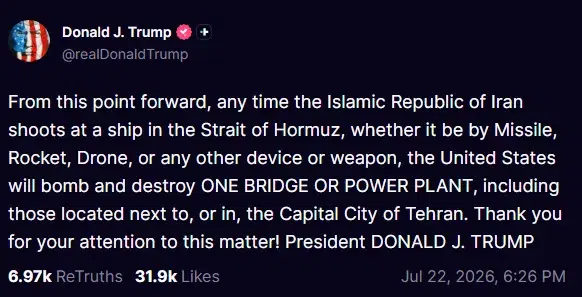
President Donald Trump warned in a Truth Social post that the United States would destroy one Iranian bridge or power plant each time Iran attacks a ship in the waterway. Trump added that the targets could include infrastructure located in or close to Tehran.
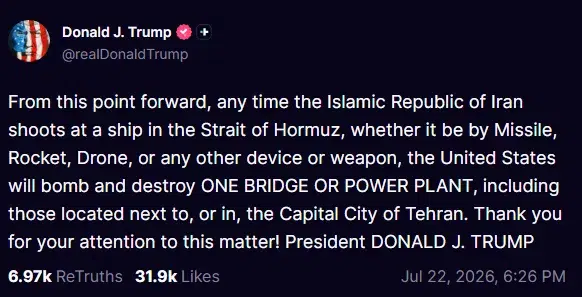
The warning followed the collapse of the interim ceasefire terms agreed under the Islamabad Memorandum of Understanding. The agreement, signed in June, called for the restoration of commercial traffic through Hormuz and the gradual removal of the U.S. naval blockade.
Iranian authorities have threatened to respond against regional infrastructure if Washington attacks the country’s bridges or electricity network, according to Iran’s Tasnim News Agency. Tasnim also reported that Iran’s Islamic Revolutionary Guard Corps had targeted Amazon data infrastructure in Bahrain during an earlier missile operation.
Shipping risks have increased further after Iran-backed Houthi forces threatened to block the Bab el-Mandeb Strait. Seven tankers had already changed course following the threat, which placed another key energy route under pressure while traffic through Hormuz remained disrupted.
Rising oil prices have revived inflation concerns
Brent crude climbed above $95 per barrel on July 22, reaching its highest point in six weeks as traders priced in risks to Gulf exports. Brent touched $95.24 before easing to about $94.40, representing a daily gain of more than 3%.
Around 20% of global petroleum consumption passes through the Strait of Hormuz, according to the U.S. Energy Information Administration. Continued disruption can therefore raise transport and fuel costs for countries that depend on Gulf oil, particularly if the Bab el-Mandeb route also faces restrictions.
Those energy risks have changed interest-rate expectations days before the Federal Open Market Committee meets on July 28–29. CME FedWatch data cited by MarketWatch placed the probability of a July increase at 33.7%, up from 25.7% one day earlier.
Polymarket traders, meanwhile, assigned a 65% probability to at least one Fed rate hike during 2026. The contract covers the rest of the year rather than only the July meeting, where futures traders continued to favor unchanged rates.
Before the latest oil increase, softer U.S. inflation data had reduced expectations for immediate tightening. A July 14 Reuters report showed that traders then assigned only a 10% chance to a July hike after annual headline inflation slowed to 3.5% in June from 4.2% in May.
The Federal Reserve’s June meeting minutes showed that policymakers were already watching energy-driven price pressure. Fed staff estimated that headline personal consumption expenditure inflation reached 4.1% in May, while core PCE inflation stood at 3.4%, according to the central bank.
Bitcoin price faces resistance between $67,000 and $69,340
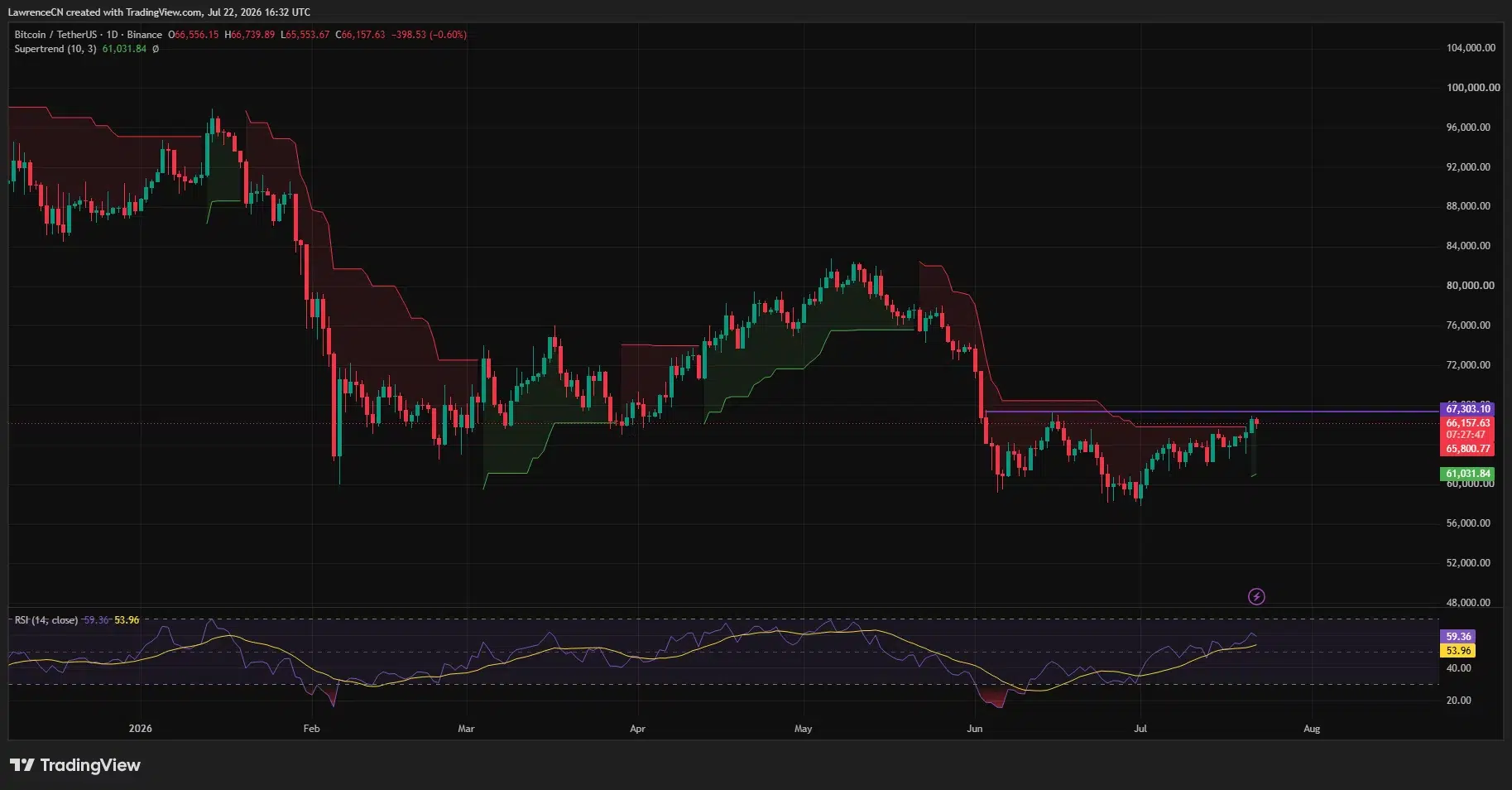
Bitcoin’s daily chart shows that price has remained below Supertrend resistance at $67,303 despite recovering from its late-June low near $58,000. The daily Relative Strength Index has risen to 59.36, above its signal average of 53.96, indicating improving momentum without reaching overbought territory.
On the 4-hour chart, BTC has traded inside an ascending channel since early July. Price recently tested the channel’s upper boundary near $66,986 before retreating, while the 78.6% Fibonacci retracement at $65,021 now forms the first visible support.
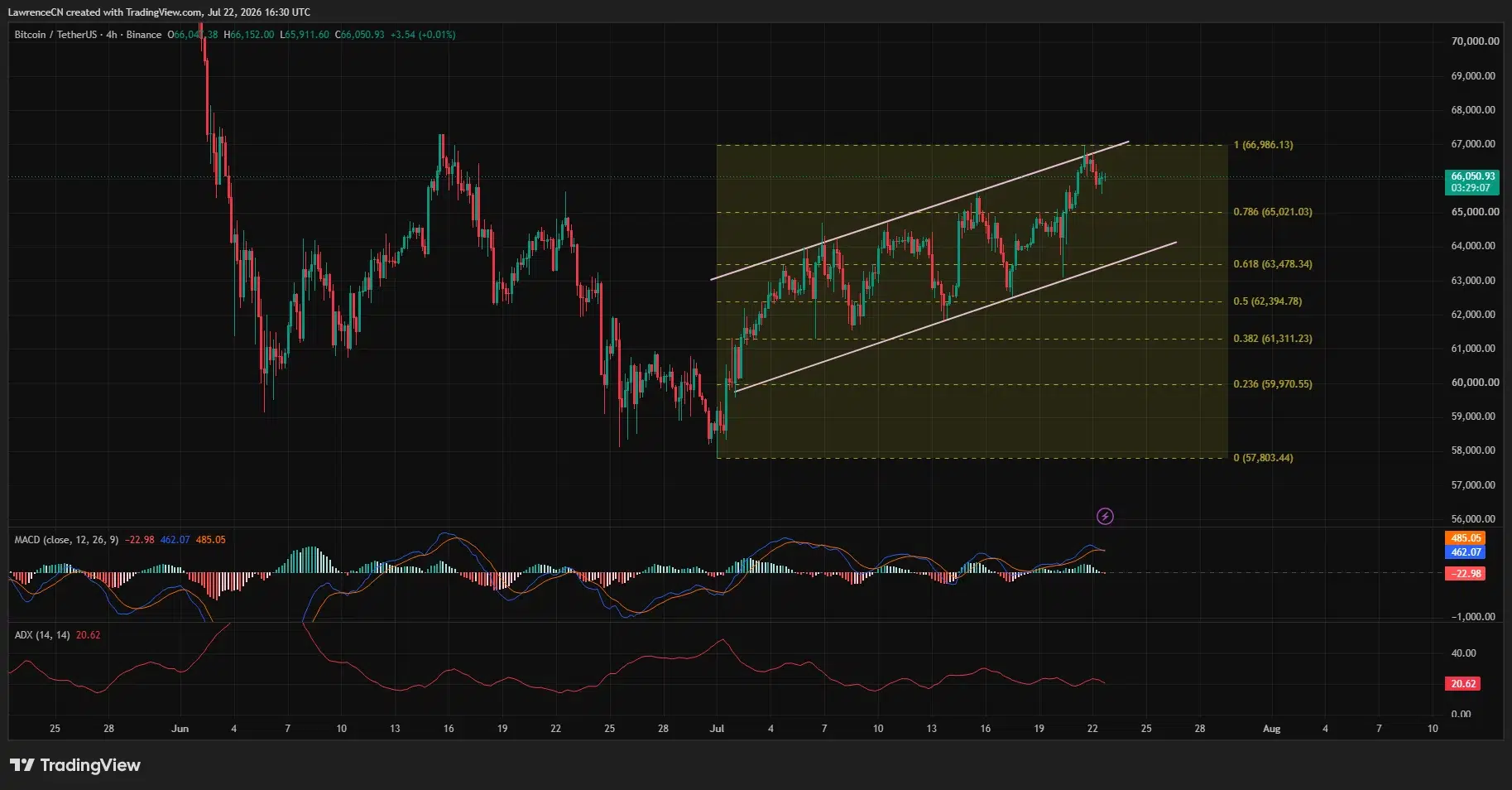
A deeper pullback would place the 61.8% retracement at $63,478 in focus, followed by the channel floor near $64,000. The 4-hour MACD histogram has moved slightly negative, and the MACD line has slipped below its signal line, showing that momentum weakened after the rejection near $67,000.
ADX has remained at 20.62, indicating that the current trend lacks strong directional force. A confirmed move above $66,986 and daily Supertrend resistance at $67,303 would be needed to improve the chart structure, while a break below $65,021 could expose the lower channel support.
Order-book data shared by crypto analyst Ted Pillows showed buy orders concentrated between $64,500 and $65,500, with sell orders stacked from $67,000 to $68,000. Commenting on the setup, Pillows wrote:
“If Bitcoin breaks above it, a rally to $70,000 will happen quick.”
Another barrier sits at $69,340, which crypto analyst Ali Charts identified as the short-term holder realized price. According to Ali, every Bitcoin rebound since November has been rejected around this on-chain cost basis, making the level an important test if buyers clear the immediate sell wall.
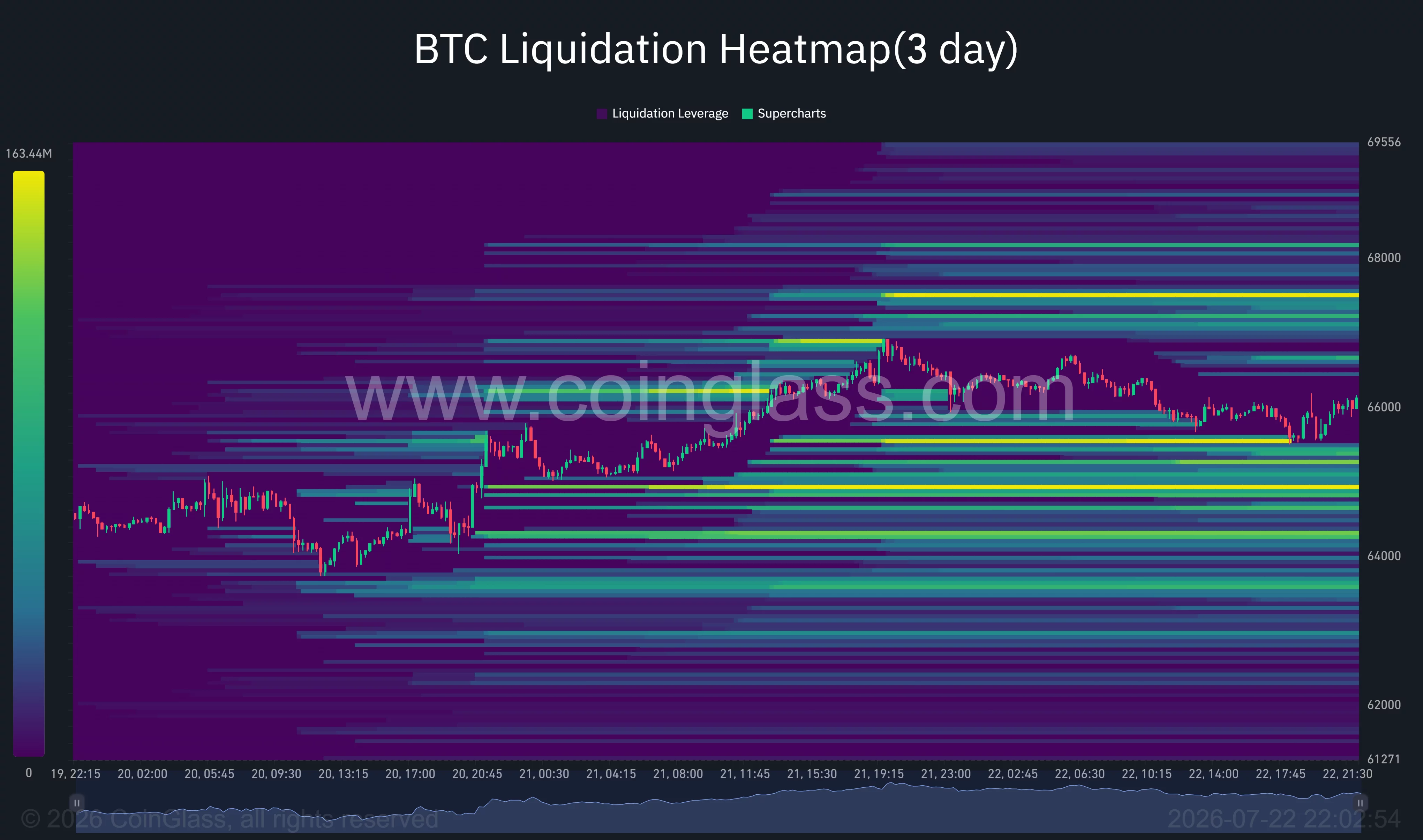
CoinGlass’s three-day liquidation heatmap supports the same resistance picture, showing the largest overhead liquidity cluster near $67,300, followed by dense positions around $68,000. Below the market, notable liquidation pools appear near $65,000, $64,400 and $63,500, leaving Bitcoin exposed to sharp moves in either direction as traders respond to oil prices, military developments and the July Fed decision.
Disclosure: This article does not represent investment advice. The content and materials featured on this page are for educational purposes only.


A self-proclaimed crypto rugpuller claims he was robbed of $14,000 worth of SOL by a group of drunk Australian girls while partying in Bali.
Ronnie Magrehbi, who has previously admitted to using the stories of cancer-afflicted babies to pump and dump crypto, shared footage of himself drinking shots with a group of female strangers he’d met at a beach club in Bali.
According to Magrehbi, he gave his unlocked phone to one of the girls so that she could look up and follow her Instagram account for him.
When she returned his phone, he noted that the vibe shifted and the girls disappeared after going to the bathroom.
Read more: FC Barcelona Instagram hacker made $26K in Pump Fun rewards
Upon checking his phone, he realised that $14,000 worth of SOL had been transferred from his Phantom mobile wallet to a wallet he’d never interacted with before.
Footage appears to show him confronting the girls and accusing them of stealing his funds. One girl panics, while another stands silent as he films.
Magrehbi subsequently called the police, leading to 12 undercover officers tracking the girls down and arresting them.
He then continued to film the girls in a police station, where he’s heard saying, “They wanna steal and not follow the law of the land, they can deal with the consequences. All of them. How about that.”
Bali crypto robbery karma for Magrehbi’s crimes
Magrehbi, who goes by the name “29” on X, was 19-years-old when he was charged in January 2020 with armed robbery and burglary after police caught him and three accomplices robbing a man at gunpoint and stealing his jacket and bag.
Later that year, Magrehbi was charged with conspiracy to commit wire fraud after allegedly taking over the social media account of a National Football League (NFL) player and holding it ransom.
Magrehbi allegedly took a ransom payment from the athlete, but never relinquished access to the account. Authorities claim his accomplice, Trevontae Washington, targeted both NFL and National Basketball Association players.
In 2025, Magrehbi was branded a “scumbag crypto scammer” after he rug-pulled investors with Pump Fun memecoins that appeared to exploit children with cancer.
Afterwards, he was recorded apparently mocking the children and “thanking” them for helping him make thousands of dollars.
Read more: UK gang who posed as cops to steal $5.4M in crypto jailed
In an interview with YouTuber THURL DES, Magrehbi also admitted to “draining” crypto wallets with malware.
He’s also linked to the alias “Ronny Fargo,” and he has repeatedly claimed to have hacked the Twitter and Pinterest accounts of Mark Zuckerberg back in 2017.
Another YouTuber, Atozy, doubted these claims, noting that there’s no reported connection between hacking group OurMine, which hacked Zuckerberg, and Magrehbi’s other alleged NFL social media takeovers.
Got a tip? Send us an email securely via Protos Leaks. For more informed news and investigations, follow us on X, Bluesky, and Google News, or subscribe to our YouTube channel.


Cointelegraph is committed to providing independent, high-quality journalism across the crypto, blockchain, AI, and fintech industries.
All news, reviews, and analyses are produced with full journalistic independence and integrity. For more details on our standards and processes, please read our Editorial Policy.


Blockchain intelligence firm TRM Labs has claimed in a new analysis that Justin Sun-owned HTX has been “rotating its wallet infrastructure on a rapid cycle” following sanctions issued by the UK Foreign, Commonwealth, and Development Office (FCDO) against Huobi Global S.A.
The FCDO sanctions, which landed in May, claimed that Huobi Global S.A. was being used by the A7 Network in Russia to bypass sanctions meant to target Russia.
HTX quickly claimed that “the listed entity Huobi Global S. A. is distinct from the online HTX exchange.”
Read more: UK sanctions HTX for alleged Russian sanctions violations
However, this wasn’t the whole story, as Huobi Global S.A. owned the United States trademark for HTX, and Huobi Global S.A. had filed documents in court that claimed that it “owns and operates HTX.”
Following this, HTX took its already problematic reserves and hid them in a new category on its proof-of-reserves called “ThirdParty.”
HTX has been unwilling to disclose to Protos what custodian is behind this new arrangement, despite claiming on its proof-of-reserves page that users should “directly contact the third-party custodians” to verify the reserves.
Ari Redbord, global head of policy at TRM Labs, has described the behavior as “HTX changing its wallets every few hours to stay a step ahead of screening built on static lists.”
HTX has claimed to The Block that these practices “reflect routine, security-driven platform operations common across the industry.” Further, it adds that it “categorically rejects any characterization implying otherwise.”
TRM Labs works with Sun-related entities in other partnerships.
It’s a part of the so-called “T3 Financial Crime Unit,” a partnership between TRM Labs, Sun-founded TRON, and Tether which was formed “to combat illicit activity associated with the use of USDT on TRON blockchain.”
Got a tip? Send us an email securely via Protos Leaks. For more informed news and investigations, follow us on X, Bluesky, and Google News, or subscribe to our YouTube channel.


Senate Republicans released the long-awaited Clarity Act text on Wednesday, adding strict new ethics rules that bar public officials—including the President—from issuing or sponsoring digital assets during their time in office.
The 616-page amendment in the nature of a substitute to H.R. 3633 delivers the first comprehensive federal framework for digital asset markets while addressing Democratic demands for conflict-of-interest protections.
The post Clarity Act Text Is Out: What Does It Say? appeared first on BeInCrypto.

The U.S. Department of Justice has filed five civil forfeiture complaints seeking more than $25 million in cryptocurrency it alleges is linked to international romance and investment frauds that targeted victims in both Canada and the United States. According to the U.S. Attorney’s Office for the District of Columbia and the U.S. Secret Service, the case stems from separate investigations conducted by the Cyber Fraud Task Force.
Prosecutors say victims were persuaded into believing they were making legitimate digital asset investments, only for their funds to be routed through laundering networks designed to obscure the origin and movement of stolen crypto. The DOJ describes tactics that frequently blend social engineering, fraudulent trading platforms, and layered wallet transfers to make recovery difficult.
Key takeaways
- The DOJ is pursuing five civil forfeiture actions targeting more than $25 million in crypto tied to romance and investment scams.
- One complaint seeks about $12.1 million connected to romance schemes affecting more than 200 victims.
- Another action seeks $10.4 million tied to suspected victim transactions involving more than 270 people.
- Authorities allege the launderers were largely based in Southeast Asia, with related IP activity associated with China, Malaysia, and Cambodia.
- International enforcement has recently intensified against similar social engineering–to-crypto laundering pipelines, including Interpol’s Operation First Light 2026.
DOJ targets crypto tied to romance and fake investment platforms
In a statement, the U.S. Attorney’s Office for the District of Columbia and the U.S. Secret Service said the assets were recovered as part of investigations associated with the Cyber Fraud Task Force. DOJ officials allege that scammers identified thousands of victims worldwide and misled them into believing they were investing in digital assets.
The largest complaint seeks approximately $12.1 million and is tied to romance-based frauds that reportedly defrauded more than 200 victims. Prosecutors say proceeds were routed through intermediary addresses and commingled with funds from other victims—an approach that can complicate attribution and recovery efforts.
A second complaint seeks $10.4 million and involves more than 270 suspected victim transactions. DOJ also filed three smaller complaints, which prosecutors describe as involving fake investment accounts and an additional “recovery” scheme—an escalation pattern seen in many fraud ecosystems, where initial victims are later targeted again with offers to help them get their money back for a new fee or deposit.
Where laundering allegedly operated—and how identities were masked
The DOJ said the alleged laundering infrastructure was predominantly located in Southeast Asia, while related IP addresses were associated with China, Malaysia, and Cambodia. While the filing describes these characteristics at a high level, the enforcement theory is consistent: criminals sought to break the on-chain connection between victim payments and the addresses that ultimately benefited.
Prosecutors frame the problem as more than a direct “investment” fraud. They argue that crypto-enabled romance scams typically rely on social engineering to build trust, then steer victims toward fraudulent trading or investment platforms. After funds are placed, investigators say the money is moved through multiple wallet layers and networks that help conceal the stolen funds’ trail.
Interpol operation highlights the scale of social engineering to crypto laundering
This DOJ filing follows broader international enforcement activity focused on social engineering scams and the financial networks used to launder their proceeds. According to earlier reporting from Cointelegraph, Interpol-coordinated Operation First Light 2026 involved 97 countries and territories. Interpol said the operation led to 5,811 arrests and the interception of $283 million in illicit assets.
Interpol also reported that the operation identified more than 142,000 victims and blocked more than 31,000 bank accounts. Within the operation, Thai authorities reportedly uncovered a network that allegedly converted romance-scam proceeds into crypto. Investigators also described the use of cross-chain token swaps to further obscure the movement of funds.
Cointelegraph reported that a wallet associated with a suspected money launderer processed more than $122.5 million in crypto over a period of 10 months. While that figure comes from Interpol-linked reporting rather than the DOJ civil forfeiture filings themselves, the overlap underscores the same operational playbook: trust-building scams, movement of funds into crypto, then multi-step transfers and trading-like activity to frustrate tracing.
Earlier U.S. actions show stablecoin laundering patterns
The DOJ’s move also fits into a wider pattern of U.S. enforcement against crypto used in romance and investment frauds. Cointelegraph previously noted that, in February, federal agents seized over $61 million in USDT stablecoin from addresses allegedly associated with laundering proceeds tied to fraudulent investment platforms.
In that earlier account, investigators described a workflow similar to the one now reflected in the forfeiture complaints: scammers build trust through romantic relationships, steer victims to fake trading platforms, and then move funds across multiple wallets. The DOJ complaint language adds further detail about how schemes can evolve into “recovery” scams and about how funds can be commingled among victims—both of which affect how law enforcement attempts to dismantle networks and how victims may later attempt to locate assets.
For readers, the key point is practical: these cases show that the fraud often shifts from social manipulation to financial plumbing. Even when victims send funds into what appears to be a legitimate digital asset transaction, the traceable parts can be deliberately fragmented through intermediaries, layered transfers, and cross-network activity.
As the forfeiture cases proceed, the next watchpoints are straightforward: whether courts allow the government to establish ownership and tracing theories at the complaint stage, and whether additional actions follow targeting other wallets or infrastructure tied to the same alleged laundering clusters.
Ethereum has staged a notable recovery from its June lows. It has reclaimed some important support levels and is now pushing toward a major technical barrier. While short-term momentum continues to favor buyers, the broader trend remains challenged by overhead resistance and a still-negative Coinbase Premium Index, suggesting institutional demand from U.S. investors has yet to fully return.
Ethereum Price Analysis: The Daily Chart
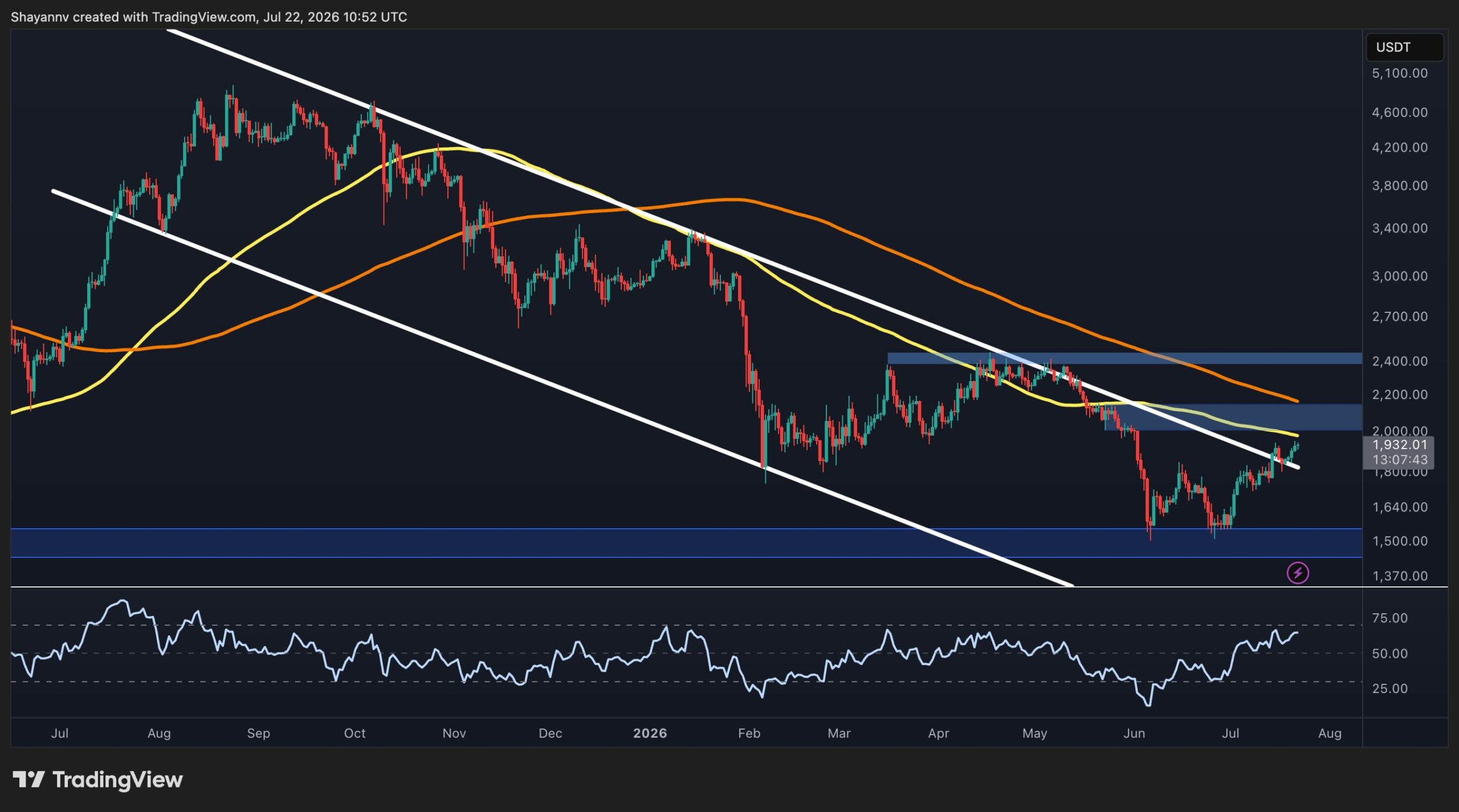
On the daily timeframe, ETH has rebounded sharply after defending the $1.5K demand zone, where buyers repeatedly stepped in to halt the broader downtrend. The recovery has carried price back above the descending channel’s higher boundary.
The price is also approaching an important confluence of resistance. The descending trendline aligns closely with the 100-day moving average, while the 200-day moving average remains higher around the $2.2K region. These dynamic resistance levels reinforce the nearby horizontal supply zones at $2K and $2.4K. This confluence makes this area the primary obstacle before any larger bullish reversal can develop.
Momentum has also improved considerably, with the RSI climbing toward the upper half of its range, reflecting strengthening buying pressure without yet reaching overbought territory. As things stand, the path toward the $2K to $2.2K resistance area is open. Yet, a rejection from this zone would keep the broader bearish structure intact and increase the likelihood of another retracement back inside the channel and toward the $1.5K support zone.
ETH/USDT 4-Hour Chart
The lower timeframe shows a much more constructive market structure. ETH has been producing higher highs and higher lows while respecting an ascending channel that has supported the advance throughout June and July.
After rebounding from the $1.7K short-term demand zone, the price accelerated toward the upper boundary of the large channel, where it is currently consolidating around $1.9K. This places ETH directly beneath a key resistance trendline that has capped rallies over the past several weeks.
The immediate support lies around $1.76K, where a previous resistance zone has flipped into support. Holding above this region and the short-term rising trendline would preserve the current bullish structure and keep the focus on another attempt to break above the channel resistance near $1.95K.
A successful breakout could trigger a continuation toward the psychological $2K level, while a loss of the ascending trendline would likely shift momentum back in favor of sellers and expose the $1.7K support area once again.

Sentiment Analysis
The Coinbase Premium Index continues to paint a more cautious picture despite ETH’s recent price recovery. Although the metric has rebounded from its deeply negative readings seen earlier this summer, it remains below zero, indicating that Ethereum continues to trade at a discount on Coinbase relative to offshore exchanges.
Historically, sustained positive readings have reflected stronger buying activity from U.S.-based institutional participants. The current negative premium suggests that this segment of the market has not yet returned aggressively, even as price attempts to establish a short-term uptrend.
This divergence implies that the ongoing recovery is being driven primarily by broader market demand rather than strong institutional accumulation. A move back into positive territory would strengthen the bullish case and increase confidence that the current advance has sufficient underlying support to challenge the major resistance levels overhead.
Until then, traders should monitor the current breakout attempt with some caution, as weakening demand at resistance could still lead to another corrective move.

The post Ethereum Price Analysis: ETH Holds Crucial Support as $2K Comes Into View appeared first on CryptoPotato.
In Bitcoin news today, shareholders of Satsuma Technology voted by more than 90% on Monday to sell the company’s remaining 668 BTC, worth roughly $43.5M at current prices, and to cancel its LSE delisting, overruling four of six board members and formally ending a Bitcoin treasury experiment that lasted less than 12 months.
The decision crystallizes one of the sharper destructions of investor capital in the UK crypto space: against the £163.6M raised in August 2025, shareholders now expect to recover between £26.8M and £30M after wind-down costs, less than 20 pence on the pound.
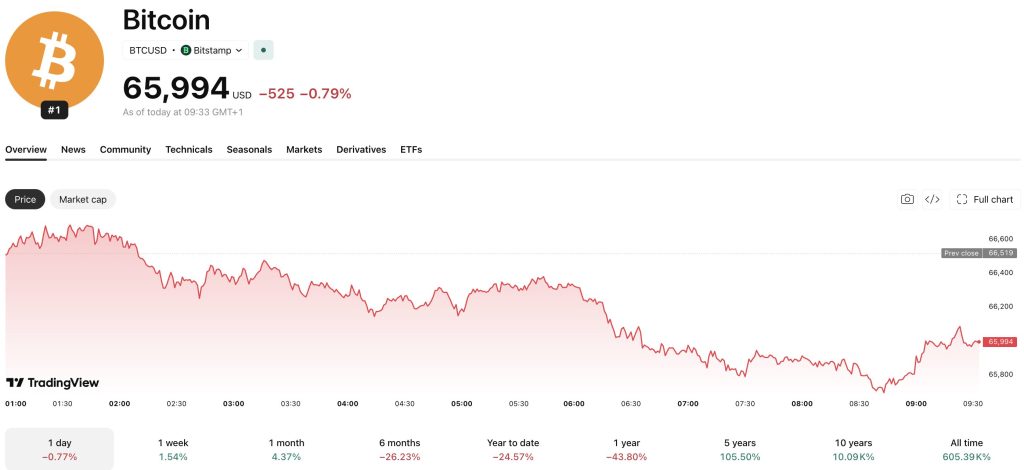
This latest Bitcoin Treasury firm news dropped as BTC climbed a modest +0.4% overnight, dropping under $66,000 since yesterday but still trading at $65,700, with a daily trading volume of $31.8Bn.
Bitcoin News Today: From £163M Raise to Fractional Recovery
Satsuma started life as TAO Alpha, a small AI firm, before rebranding and pivoting to a Bitcoin treasury accumulation strategy. In August 2025, it hired Mark Moss, an American Bitcoin commentator with over 700,000 YouTube subscribers, as Chief Bitcoin Strategist.
The firm then raised £163.6M through convertible notes led by ParaFi Capital, with Pantera Capital, Digital Currency Group, and Kraken participating. Some investors contributed 1,097 BTC directly in place of roughly $97M in cash.
The stock peaked around £14 per share in June 2025. Bitcoin reached its $126,000 all-time high in October before sliding into the current crypto winter, dragging Satsuma’s share price with it.
By December 2025, the company was already liquidating assets to stay solvent, selling 579 BTC for £40M to repay noteholders who declined to convert their debt into equity.
The CFO departed in February 2026; the CEO followed in March. By April, shares had lost more than 99% of their June 2025 peak value, trading at fractions of a penny. At that point, Pantera Capital, holding approximately 6.7% of Satsuma’s stock, began publicly calling for a full liquidation, with a straightforward rationale.
The company’s market cap had fallen well below the value of the Bitcoin on its balance sheet, making the equity position strictly worse than owning the underlying coin. A shareholder group representing more than 20% of issued capital formally put the resolution to a vote.
The board split hard. Four of the six directors opposed liquidation, arguing that Satsuma remained a viable, publicly listed corporate vehicle for Bitcoin. Two sided with shareholders. The 90%-plus vote to wind down left the board majority’s position moot.
Discover: The Best Crypto to Diversify Your Portfolio
The DAT Model Under Scrutiny
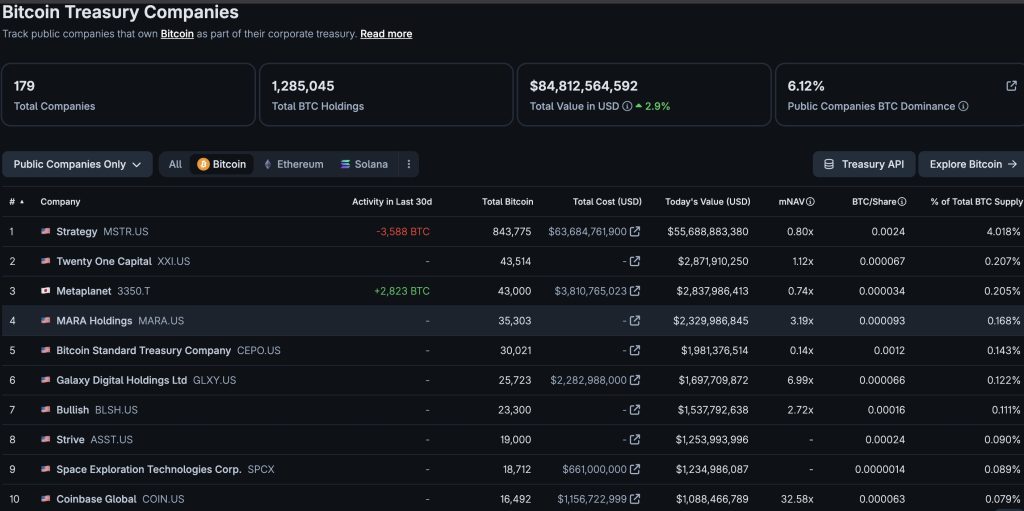
Satsuma’s collapse is the most visible failure yet of the DAT, a digital asset treasury structure that proliferated across UK small-caps in 2025.
These companies, modeled loosely on MicroStrategy’s approach, give equity investors indirect exposure to Bitcoin while bolting on a thin operating business to satisfy UK listing rules on alternative investment fund classification.
The structure works when Bitcoin price momentum and equity premiums reinforce each other; it unravels quickly when both reverse simultaneously, as the convertible note obligations create a sell-to-survive dynamic at exactly the wrong point in the cycle.
The broader regulatory environment for UK crypto companies adds another layer of structural pressure that pure-play listed treasuries are poorly positioned to absorb.
The wind-down proceeds through a “B Share Scheme,” a UK legal mechanism for distributing cash assets back to shareholders. Estimated termination costs run to £2.7M: legal fees, severance, delisting charges, and run-off insurance.
Combined with the £40M recovered from December’s BTC sale, the total capital returned is roughly £66–70M, against the £163.6M raised.
Critically, convertible noteholders rank above common equity in the payout waterfall, so ordinary shareholders may receive considerably less than even those aggregated figures suggest.
Satsuma was the second-largest UK-listed Bitcoin treasury company by holdings at the time of the vote. The Smarter Web Company, holding 2,878 BTC, currently sits at the top of that ranking and has not indicated any plans to wind down, though Satsuma’s outcome will sharpen investor focus on the NAV-to-market-cap gap across all remaining UK crypto treasury vehicles.
The contrast with Michael Saylor’s approach, maintaining Bitcoin conviction through drawdowns rather than liquidating under shareholder pressure, is a live debate in the corporate Bitcoin treasury space right now.
Trade Bitcoin on Bybit and Get a Chance to Win Our $1,000 USDT Airdrop
Bitcoin News: Court Approval and Satsuma Delisting Timeline
UK High Court hearings to approve the capital return scheme are scheduled for August and September 2026. The LSE delisting is expected in mid-September, with shareholder payments due by late September.
High Court hearings to approve the capital return are set for August and September 2026, before distributions begin. For traders still holding Satsuma shares, the key variable is whether the 668 BTC sale executes above or below current spot.
With the Bitcoin price trajectory remaining contested at current levels, even a modest move in either direction will shift the final distribution range away from the £26.8–30M estimate. Noteholders’ priority claim means ordinary equity holders are effectively last in line for whatever remains after costs are settled.
Discover: The Best Token Presales
The post Bitcoin News: BTC Treasury Strategy Casualty as Satsuma Technology Votes to Wind Down appeared first on Cryptonews.

Yahoo Finance Live: Daily Market Coverage – July 22, 2026 9AM-11AM (ET)

New UK prime minister faces the same economic issues that sank his predecessor

Asustek Computer Shares Jump Nearly 3% as AI Server and AI PC Demand Fuels Ongoing Taiwan Tech Rally

Renter of Home in Anne Heche Crash Denies Settlement With Son

No Jackpot Winner as $257 Million Prize Rolls Over to $269 Million Monday Draw

Weekend Open Thread: Staud – Corporette.com
Yahoo Finance Live: Daily Market Coverage – July 22, 2026 9AM-11AM (ET)

Bitcoin Has NEVER Done This Before. | Crypto Whales Are Accumulating Like They Know

House price growth outpacing wages despite market slowdown | Finance Report | ABC NEWS
-
 NewsBeat6 days ago
London Mayor Sadiq Khan handed a peerage by Keir Starmer alongside 15 other Labour figures… just days before the PM leaves No10
-

 Fashion5 days ago
Weekend Open Thread – Corporette.com
-

 Politics4 days ago
The House | The City of London can help the new chancellor deliver growth in every postcode
-
 Crypto World5 days ago
Two July Windows Left: The CLARITY Act’s Senate Fight and What Failure Means
-

 Crypto World7 days ago
CFTC blocks Kalshi from unwinding Michigan trades after court order
-

 Crypto World4 days ago
Ripple Payments Joins MiCA With 14 Firms, Does It Mean Anything For XRP?
-

 Business7 days ago
Nvidia Stock Slips After Big Tuesday Rally as Huang Confirms Vera Rubin Chip Is Now in Production Today
-

 Politics3 days ago
Democrats look to World Cup watch parties to register thousands of voters
-

 Crypto World5 days ago
Ripple wins EU-wide access as ESMA adds it to MiCA register
-

 Crypto World1 day ago
Grayscale Files For Worldcoin ETF, WLD Registers Sharp Rise
-

 Crypto World6 days ago
Injective Submits SEC Transfer-Agent Registration to Onchain Ownership Records
-

 NewsBeat2 days ago
Unregistered fitter used Gas Safe logo on business flyers
-

 Business7 days ago
Palantir Shares Rise After Expanded Nvidia Partnership and Fresh Analyst Upgrades Ahead of Earnings Day
-

 Tech2 days ago
Sail Virtually Aboard The “Itanic” With IA-64 Emulator
-
 Tech2 days ago
Turtle Beach Command Series KB7 review: a nifty screen-equipped gaming keyboard
-

 NewsBeat5 days ago
Registration is now open for March for Men with Kev 2026
-
 Sports7 days ago
New Cornerback Enters Vikings Trade Rumor Mill
-
 Business13 hours ago
New Jersey voter registration controversy explained: How 6,600 noncitizens got on the rolls, and what happens next
-

 News Videos5 days ago
Money | Class 12 Economics | CBSE Board Exam 2026-27
-
 Crypto World6 days ago
Claude Fable 5 Slips to Second in AI Coding Leaderboard
You must be logged in to post a comment Login