

Crypto World
The CFTC is in talks with every major pro sports league to crack down on insider trading



Chairman Mike Selig of the U.S. Commodity Futures Trading Commission (CFTC) said his agency is in talks with all major U.S. professional sports leagues as federal regulators deepen oversight of sports-related prediction markets.
The regulator is seeking broader cooperation with leagues to monitor insider trading and market manipulation tied to event contracts, Selig said Tuesday at the annual FINRA conference in Washington D.C. on Tuesday, following an earlier CFTC announcement of a data-sharing agreement with Major League Baseball in March.
“We’ve entered into a memorandum of understanding with Major League Baseball, and we’re in talks with all the professional sports leagues,” Selig said at the event, hosted by the brokerage industry’s self-regulatory organization.
The CFTC agreement with baseball was its first formal information-sharing deal with a professional sports organization. The arrangement comes as federally regulated prediction markets such as Kalshi and Polymarket move deeper into sports contracts, triggering disputes with state gaming regulators over who controls the sector.
Selig took an aggressive stance on that legal fight. He said the CFTC has already sued “about five or six states” over attempts to block federally regulated event contracts and pledged the agency would continue bringing cases against states that challenge the commission’s authority. Under U.S. law, derivatives listed on CFTC-regulated exchanges fall under federal oversight rather than state gaming laws, he’s repeatedly argued.
“Different products, parallel regimes,” he said, comparing sports prediction contracts with traditional casino betting.
The chairman also outlined how the agency is approaching insider trading in prediction markets, an area regulators have only recently begun confronting.
Selig cited a case policed by the platform Kalshi involving YouTube creator MrBeast in which an employee allegedly traded ahead of market-moving information tied to online content releases. He also described hypothetical sports-related scenarios, including trainers or team staff trading on nonpublic injury information before games.
The exchanges themselves remain the “first line of defense,” Selig said, because they conduct know-your-customer and anti-money laundering checks that can help identify suspicious activity.
The CFTC also expects prediction markets to spread into mainstream investment products.
Selig said regulators are reviewing exchange-traded products and funds linked to prediction-market strategies and are coordinating oversight with the Securities and Exchange Commission (SEC). SEC chair Paul Atkins is scheduled to speak at the conference later this afternoon.
Selig’s remarks signal a broader shift at the CFTC under the Trump administration, which has embraced prediction markets and crypto-linked financial products after years of regulatory resistance toward the sector.



Tata Consultancy Services expects to operate as many AI agents as human employees over the next three years, Chairman N Chandrasekaran said. The company will not cut staff but will slow hiring as AI absorbs more work.
The shift extends beyond technology services. Companies are deploying AI agents to do work once handled by humans, slowing hiring and reshaping how entire industries staff their operations.
AI Agents Reshape India’s IT Workforce
Chandrasekaran made the remarks at the company’s annual general meeting on Tuesday. He said that wider adoption of AI agents will reduce hiring at TCS and across the industry as automated systems take over human tasks.
“I predict that over the next 3 years, TCS will have as many AI agents as human employees. What we build in this next chapter – for our clients, for India, and for you – will be the most consequential work this company has ever done,” he said.
The company does not plan to cut staff but will hire fewer. Even so, Chandrasekaran said new roles and openings will emerge as firms reshape how they work with AI.
“Some of the work being done will go to AI agents. That will be the nature of the transition that we have to go through not only as a company, as an industry, and as a country,” he added.
Notably, India’s $315 billion IT sector built its success on sprawling, people-heavy teams. As one of the country’s biggest private employers, the industry has already pared back hiring, with geopolitical turbulence further weakening client demand.
TCS is India’s largest IT firm by market value and headcount. The company cut more than 12,000 jobs last July. Net headcount fell by over 23,000 in the fiscal year ended March 2026.
Follow us on X to get the latest news as it happens
Hedge Funds Follow the Same Playbook
Meanwhile, finance is moving in parallel. According to Bloomberg, Magnetar, the $18 billion hedge fund, will deploy AI bots to scour markets for ideas, analyze stocks, make recommendations, and forecast trends in its newest vehicle. Humans will retain final say on trades.
The workforce shift is also surfacing in employment figures. AI has been cited as a reason for 87,714 job losses this year, accounting for 22% of all layoffs in 2026. That figure already tops the 54,836 roles the technology displaced throughout 2025.
Layoffs.fyi, which tracks tech job cuts, has logged 117,571 tech employees laid off across 175 companies so far in 2026. Whether AI-staffed funds can beat the market remains an open test. Meanwhile, TCS’s agent buildout will show how far the hybrid model scales across industries.
Subscribe to our YouTube channel to watch leaders and journalists provide expert insights
The post India’s IT Sector Braces for Slower Hiring in AI Era appeared first on BeInCrypto.

The Hashgraph Group and Merck have integrated the German tech maker’s product authentication technology with TrackTrace, a Hedera-based digital product passport platform introduced in February, as businesses seek to comply with new European Union supply-chain transparency and traceability requirements.
Under the arrangement, Merck’s M-Trust technology embeds security markers into products and packaging that can be verified with a handheld scanner. Authentication data is then recorded on The Hashgraph Group’s TrackTrace platform, creating a digital record linked to a product’s Digital Product Passport.
The companies said the integration combines physical product authentication with blockchain-based traceability, allowing businesses to verify both the authenticity of a product and the records associated with it.

Source: The Hashgraph Group on X.com
The platform targets two emerging EU compliance frameworks: Digital Product Passports under the Ecodesign for Sustainable Products Regulation and traceability requirements under the EU Deforestation Regulation.
Merck is a science and technology company focused on healthcare, life sciences and electronics, while Swiss-based Hashgraph develops enterprise blockchain and AI applications within the Hedera ecosystem.
According to the companies, the technology has already been demonstrated in an undisclosed supply-chain pilot. Potential use cases include food, pharmaceutical, luxury goods and electronics supply chains, where businesses face increasing scrutiny over sourcing and product authenticity.
Related: ECB pushes back on euro stablecoin proposals, citing financial stability risks
EU sustainability rules create market for product traceability
The collaboration comes as companies prepare for forthcoming Digital Product Passport requirements under the European Union’s Ecodesign for Sustainable Products Regulation (ESPR), which entered into force in July 2024.
The regulation applies to most physical goods sold in the EU and forms part of the European Green Deal, a broader effort to improve resource efficiency, expand the circular economy and increase transparency around product environmental impacts.
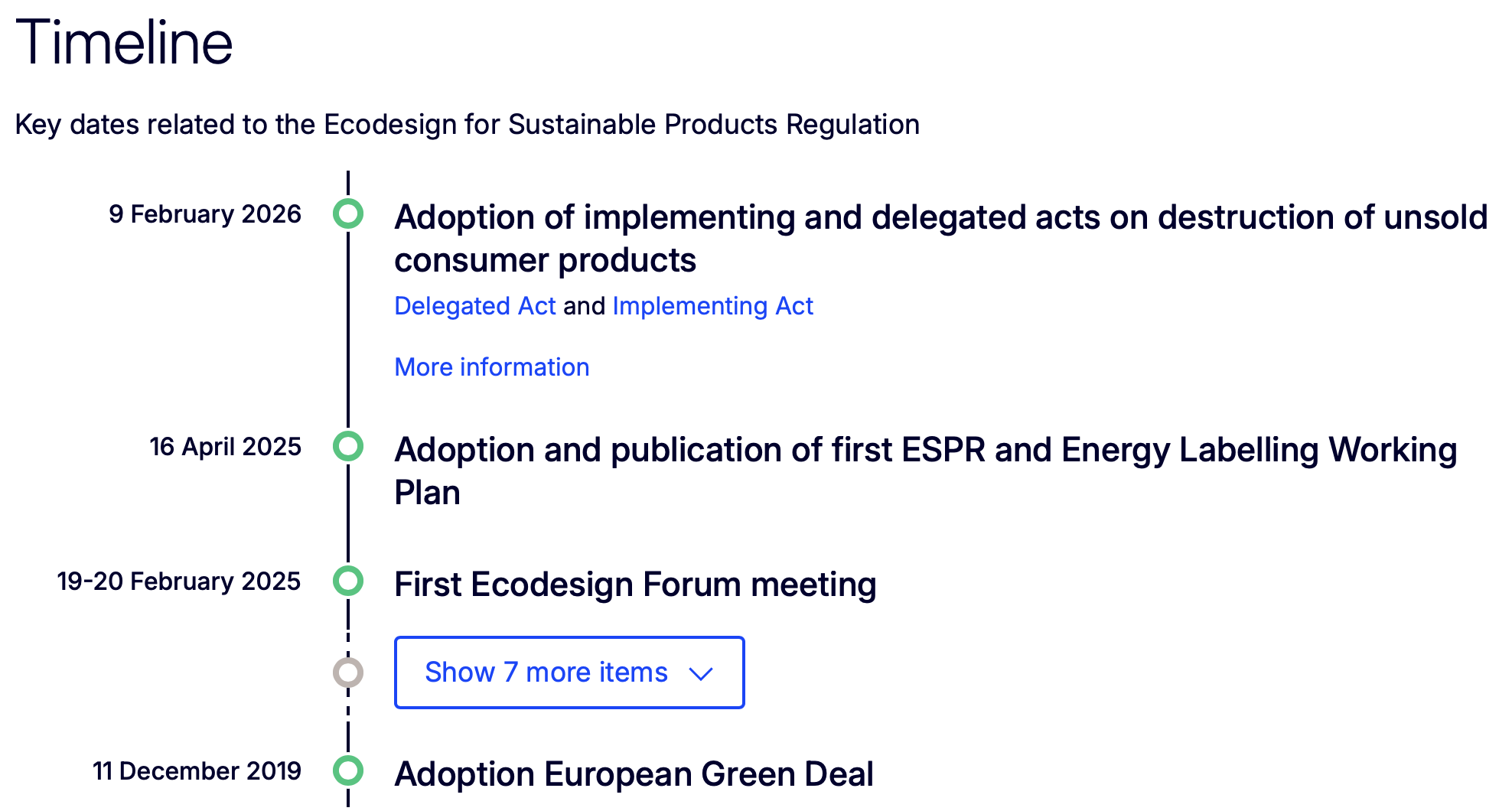
Source: European Commission
Interest in blockchain-based trade and supply-chain infrastructure extends beyond the EU. In March, authorities in Hong Kong and Shanghai agreed to study a blockchain-based cross-border platform under the Hong Kong Monetary Authority’s Project Ensemble initiative, which explores tokenized market infrastructure and digital financial rails.
The project will examine how trade documentation and commercial data can be integrated into trade finance applications, with the goal of streamlining cross-border commerce and related financial services.
Magazine: Vietnam preps crypto pilot, HK pushes tokenization: Asia Express


StarkWare has launched a new privacy framework for Starknet tokens that allows users to conceal balances and transaction details while preserving tools for compliance reviews and regulatory disclosures.
Summary
- StarkWare launched STRK20, a Starknet privacy standard that hides balances and transaction data while allowing disclosures for compliance reviews.
- Sui opened public testing for confidential transfers that conceal balances and transfer amounts but keep key transaction metadata visible.
- Recent developments at Zama and Zcash have increased attention on privacy systems that combine confidentiality with auditability.
According to StarkWare, the newly released STRK20 standard brings privacy features to ERC-20 tokens on Starknet by enabling users to shield balances and transaction information on-chain.
The framework was announced on Tuesday as developers across the crypto industry continue looking for ways to offer transaction privacy without removing oversight mechanisms relied upon by institutions, exchanges, and regulators.
STRK20s is officially live.
Practical privacy for all assets, accessible in one click, with deep DeFi integration.
We’re fixing onchain privacy for good, and for everyone. https://t.co/5eEG011zBz
— StarkWare 🥷 (@StarkWareLtd) June 9, 2026
Providing details on how the system works, StarkWare co-founder and CEO Eli Ben-Sasson notes that STRK20 should not be viewed as a guarantee of regulatory approval or legal compliance. Instead, he said the framework follows a risk-based approach where privacy remains conditional.
Ben-Sasson explained that screening occurs before assets enter shielded pools and that viewing-key technology can be used to disclose information when lawful requests require access.
Unlike traditional privacy-focused cryptocurrencies that seek to obscure most transaction data, STRK20 introduces disclosure tools designed to balance confidentiality with accountability.
Under the model described by StarkWare, transaction details remain hidden from the public while authorized disclosure remains possible under specific circumstances.
Privacy tools are adding disclosure mechanisms
Elsewhere in the sector, developers are adopting similar approaches to encrypted transactions. According to an announcement published on June 8, Sui opened public testing for confidential transfers on its Devnet. The feature encrypts token balances and transfer amounts while leaving sender and recipient addresses, token types, and transaction timestamps visible on-chain.
As reported by crypto.news, Sui stated that authorized parties can access relevant data when required for auditing or compliance purposes. A Testnet rollout is scheduled for later this year.
Rather than removing transparency entirely, the Sui design keeps selected transaction information visible while concealing financial details. The network described the system as a way to support privacy requirements without limiting access for compliance teams and auditors.
Taken together, the launches from StarkWare and Sui highlight how blockchain developers are increasingly incorporating controlled disclosure features into privacy products instead of relying on complete anonymity.
Recent events have increased focus on oversight
At the same time, several privacy-focused projects have recently faced scrutiny over compliance and operational safeguards.
Earlier this month, blockchain privacy company Zama said it would speed up work on its compliance roadmap after approximately $12.5 million in USDC held within its confidential USDC wrapper was frozen under a court order. According to Zama, the restriction was later removed once the underlying legal request was resolved.
Following the incident, the company highlighted disclosure tools and regulatory coordination procedures available for encrypted transactions.
Meanwhile, developers behind Zcash recently disclosed a vulnerability that raised concerns about the possible creation of counterfeit tokens. According to the project, an emergency network upgrade completed in early June addressed the issue, and no evidence of exploitation has been found.
Zcash developers noted that reconstructing historical activity inside shielded pools can be difficult after vulnerabilities are disclosed, a limitation that has renewed discussion around how privacy systems can provide confidentiality while still supporting verification and oversight when needed.
On-chain analytics firm Glassnode has reported a sharp deterioration in key XRP network metrics, pointing to weakening activity and mounting pressure on holders. Recent data shows both transaction demand and realized profitability have fallen significantly despite the token trading well above its 2024 levels.
The decline in holder profitability is particularly evident in Glassnode’s latest realized profit-and-loss data. According to the firm, the 90-day simple moving average of XRP’s Realized Profit-to-Loss Ratio has dropped to 0.38. This indicates that market participants are realizing only 38 cents in profits for every dollar of losses recorded on-chain.
Profitability Ratio Signals Deep Stress
The profitability metric remains well below the breakeven level of 1.0, a threshold that separates net profit-taking from net loss realization. During strong bull market phases, the ratio often rises far above 20 or even 50 as profitable selling dominates network activity.
The latest reading suggests a very different market environment, with loss-taking outweighing profit-taking by a wide margin. The analytics firm noted that such low levels are commonly associated with capitulation periods. In these phases, a large share of transacted coins belong to holders exiting positions at a loss.
Signs of weakness are also emerging in broader network activity. Glassnode reported that the 90-day simple moving average of total transaction fees on the XRP Ledger has fallen significantly. It dropped from 5,900 XRP in February 2025 to approximately 500 XRP today, a decline of more than 91% over the period.
Ecosystem Under Persistent Pressure
The recent figures reinforce concerns highlighted by Glassnode in late 2025 regarding the condition of XRP holders. In November of that year, the firm reported that only 58.5% of the circulating supply remained in profit.
Those concerns were reflected in earlier market conditions. That figure marked the lowest percentage recorded since November 2024, when XRP traded near $0.53. At the time, roughly 41.5% of the supply, equivalent to about 26.5 billion XRP, was held at a loss despite the token trading around $2.15.
Together, the declining profitability metrics and reduced network activity suggest continued stress across the XRP ecosystem. The data indicates that a significant portion of holders remain under pressure while transaction demand stays well below previous cycle highs.
The post XRP Activity and Investor Capitulation Hit Extremes: What It Means for Ripple appeared first on CryptoPotato.


Morpho Association has raised $175 million in a funding round co-led by Paradigm, a16z Crypto, and Ribbit Capital, the protocol announced on X Tuesday morning. The financing comes at a $2 billion valuation and ranks among the largest fundraises in decentralized finance to date, according to… Read the full story at The Defiant

TLDR
- Paradigm and Hyperliquid Policy Center urged the U.S. Treasury to revise the proposed AML rule for stablecoin issuers.
- The groups argued that secondary market liability would impose obligations issuers cannot control.
- They supported FinCEN’s focus on primary market compliance where issuers know their customers.
- The letter asked regulators to narrow the definition of stablecoin payment-related activity.
- Hyperliquid Foundation funded the advocacy group with about $29 million worth of HYPE tokens.
Paradigm and Hyperliquid Policy Center urged the U.S. Treasury to revise a proposed anti-money laundering rule. The groups said the draft would impose strict liability on stablecoin issuers for transactions they cannot control. They asked regulators to narrow certain provisions before finalizing implementation under the GENIUS Act.
Hyperliquid and Paradigm Outline Concerns Over Secondary Market Liability
Paradigm and Hyperliquid Policy Center submitted a joint letter to the Treasury on Tuesday. The letter addressed a proposal issued in April by FinCEN and OFAC. The agencies seek to implement GENIUS Act provisions under the Bank Secrecy Act.
The proposal would treat stablecoin issuers as financial institutions for compliance purposes. However, the groups said some obligations extend beyond primary market activity. They argued that secondary market rules would create strict liability for actions issuers cannot police.
The letter stated, “We broadly support the proposed rule,” and endorsed FinCEN’s focus on primary market compliance. The groups supported tailoring obligations where issuers know their customers. They urged agencies to clarify or narrow secondary market requirements.
They said issuers only see wallet addresses and transaction amounts in public blockchain environments. Therefore, they argued that agencies should align AML and sanctions requirements with that reality. They warned that smart contract liability would exceed issuer control.
They wrote, “An issuer facing obligations it cannot meet on the secondary market has a strong incentive to deploy only to permissioned environments.”
They added that such an outcome would remove U.S.-regulated stablecoins from DeFi platforms. They stated that offshore alternatives could fill any resulting gap.
Groups Propose Specific Revisions Under GENIUS Act Framework
The joint letter recommended narrowing the definition of “payment stablecoin-related activity.” The groups also asked regulators to reconsider OFAC’s treatment of smart contract interactions. They said the current draft extends liability beyond issuer capacity.
The GENIUS Act passed last year with support from President Donald Trump’s administration. Lawmakers advanced the legislation to provide clearer rules for digital assets. Regulators now work through the rulemaking phase before full implementation.
Hyperliquid Foundation established the Hyperliquid Policy Center in February. The foundation funded the group with roughly $29 million worth of HYPE tokens. Jake Chervinsky serves as the center’s chief executive officer.
Paradigm backed Hyperliquid and supported the center’s advocacy efforts. The venture firm co-signed the letter addressed to Treasury officials. The document forms part of the public comment process.
FinCEN and OFAC will review submitted comments before issuing a final rule. The agencies proposed the draft in April under existing statutory authority. The implementation phase continues as regulators evaluate industry feedback.



Sam Bankman-Fried, the convicted founder of the collapsed crypto exchange FTX, has formally filed a petition for a presidential pardon with the Trump White House, his attorney confirmed to CNBC and Fox Business on Monday. The petition was filed with the Office of the Pardon Attorney, a division of… Read the full story at The Defiant
Crypto World
US Bitcoin Reserve Bill Text Locks Holdings for 20 Years and Mandates Quarterly Proof-of-Reserve Reports


The full legislative text of a bill to codify a US Strategic Bitcoin Reserve is now public on Congress.gov, revealing a mandatory 20-year prohibition on selling any acquired BTC and a requirement for quarterly, publicly audited proof-of-reserve reports. Rep. Nick Begich (R-AK) introduced H.R. 8957,… Read the full story at The Defiant
Crypto World
Janus Henderson Takes ENA Stake, Deploys Into USDe, Explores ETP Distribution in Four-Part Ethena Deal


Janus Henderson Investors has announced a multi-part partnership with Ethena, the synthetic dollar protocol behind USDe. The announcement, made via Ethena's official X account this morning, covers a strategic ENA investment from Janus Henderson's blockchain venture ANTIK, the integration of a Janus… Read the full story at The Defiant


Michael Saylor has pushed back against dilution concerns after Strategy sold approximately $181 million worth of MSTR shares and used part of the proceeds to expand both its Bitcoin holdings and cash reserves.
Summary
- Michael Saylor rejected dilution claims tied to Strategy’s $181M MSTR share sale.
- Strategy added 1,550 BTC and increased cash reserves by $100 million.
- Fortune warned about rising obligations and risks if Bitcoin falls further.
According to comments posted by Strategy Executive Chairman Michael Saylor on X, criticism surrounding the company’s latest capital raise misunderstands how shareholder value should be measured.
Saylor’s response came after Bitcoin analyst Matthew R. Kratter argued that recent share issuance diluted existing shareholders and pointed to a decline in Strategy’s BTC Yield metric between June 1 and June 8.
Data published by Strategy showed the company held 843,706 BTC while its assumed diluted shares outstanding increased to 384,180 during the period. Referring to those figures, Kratter said on X that the increase in shares outweighed the short-term benefit of additional Bitcoin per share.
Fresh scrutiny followed Strategy’s June 8 filing, which disclosed the sale of more than 1.4 million MSTR shares for roughly $181 million. Market participants also noted that company executives sold around $15 million worth of MSTR stock for tax-related purposes, while sentiment had already been pressured by Strategy’s disclosure of its first Bitcoin sale in more than four years at the end of May.
Saylor disputed the dilution argument by stating that BTC Yield measures growth in Bitcoin per share rather than total shareholder accretion. In his response, he said Strategy added both Bitcoin and cash during the transaction, making the outcome positive for shareholders when both assets are considered.
“Last week Strategy added ₿1,550 of BTC and $100 million of USD Reserve. When both assets are included, the transaction was accretive to MSTR shareholders.”
Strategy points to cash reserves alongside Bitcoin growth
Figures released by the company show Strategy acquired 1,550 BTC for approximately $101.3 million between June 1 and June 7. The purchase was completed at an average price of $65,332 per Bitcoin during a period of heavy market volatility.
Company disclosures indicate Strategy now holds 845,256 BTC, which Saylor said are valued at roughly $51.9 billion based on current market prices. The company also reported a year-to-date BTC Yield of 12.8% and a BTC Gain of 86,328 BTC.
At the same time, the latest fundraising increased Strategy’s dollar reserves by $100 million, lifting total cash reserves to about $1 billion. Those reserves have attracted additional attention following shareholder approval of a proposal to change STRC preferred stock dividend payments from a monthly schedule to semi-monthly distributions beginning this month.
Rising obligations remain a focus for analysts
A separate analysis published by Fortune has highlighted concerns about Strategy’s growing use of preferred stock and Bitcoin-backed financing. According to the publication, the company’s combined debt and preferred stock obligations have increased from approximately $6.9 billion in early 2025 to around $21.8 billion, with preferred stock issuances accounting for much of the increase.
Fortune also estimated that Strategy’s stock continues to trade roughly 31% above its net asset value and warned that the premium could come under pressure if Bitcoin prices fall or investor concerns about the company’s capital structure intensify.
Under a scenario modeled by Fortune in which Bitcoin (BTC) declines to $50,000, the company’s net asset value could fall to about $23 billion while liabilities remain unchanged.
Attention has also remained on Strategy’s funding flexibility after the company disclosed the sale of 32 BTC for about $2.5 million in late May, its first reported Bitcoin sale since December 2022.
In a previous research covered by crypto.news, JPMorgan described the transaction as largely symbolic and said it appeared intended to demonstrate flexibility toward preferred shareholders, while cautioning that future dividend commitments could raise questions if cash reserves are eventually depleted.

T20 Blast round-up: Wins for Lancashire, Essex & Northamptonshire

Salesforce acquires m3ter to add consumption-based billing to Agentforce

East London man jailed for stabbing partner 31 times before blowing up home



-

 Fashion4 days ago
Weekend Open Thread: Evereve – Corporette.com
-
 Crypto World5 days ago
Jensen Huang Approves Samsung, SK Hynix, and Micron for NVIDIA (NVDA) HBM4 Memory Supply
-

 Crypto World2 days ago
Anatomy of the June crypto crash: Fed, Iran, Saylor
-
Crypto World3 days ago
Senator Cynthia Lummis Calls CLARITY Act the Most Consequential Financial Legislation of This Generation
-

 NewsBeat2 days ago
Alexander Zverev wins the French Open to finally earn a 1st Grand Slam title
-

 Tech5 days ago
Microsoft launches MXC, an OS-level sandbox for AI agents, with OpenAI and Nvidia already on board
-
 Entertainment3 days ago
The Best Mystery Series of All Time Is Surging on Streaming 30 Years After It Ended
-
 Business3 days ago
The Pain Points Taking a Fragile Tech Rally Down a Notch
-

 Tech3 days ago
Microsoft unveils seven homegrown AI models in new bid for ‘long term self-sufficiency’
-

 Tech4 days ago
Suspicious Polyfill login prompts pop up on Toshiba, Muji websites
-
Crypto World5 days ago
LBank Surpasses 25 Million Users Worldwide as AFA Partnership Continues to Drive Global Growth
-

 Crypto World3 days ago
Trump’s AI Ownership Plan Could Benefit Anthropic at OpenAI’s Expense
-

 Business5 days ago
(VIDEO) Justin Bieber Delivers Surprise Happy Birthday Serenade to Diners at Los Angeles Mexican Restaurant
-
 Sports12 hours ago
Bangladesh beat Australia after 20 years in ODIs, register only their second win over six-time world champions | Cricket News
-

 Tech5 days ago
RCS Messages Between iPhone and Android Get End-to-End Encryption With iOS 26.5
-

 Tech5 days ago
Meta steals a tactic from Tesla and builds data centers in tents
-
 Crypto World2 days ago
Eli Lilly (LLY) Stock Surges 4% Following Breakthrough Sleep Apnea Trial Results
-

 Tech4 days ago
Hackers now exploit SolarWinds Serv-U flaw to crash servers
-
 Tech4 days ago
Von der Leyen’s AI envoy pick draws conflict-of-interest fire
-

 Business2 days ago
Wall Street ends sharply lower as chips stocks slide
You must be logged in to post a comment Login