

Crypto World
The Clarity Act is the most important consumer protection effort in years



As a former financial regulator, I understand that no law can prevent every market failure or stop every bad actor. Fraud exists in every market, at every scale, but strong rules can mitigate the worst outcomes. They give regulators visibility, set obligations for companies before consumers engage with their products, and require firms to operate with basic and enforceable accountability. The bill is often described as crypto market structure legislation. That description is accurate, but it doesn’t capture the full scale. Market structure is the legal architecture that determines who must register with which agency, who supervises the market, what firms owe their customers, how assets are protected, what disclosures must be made, and what happens when something goes wrong.
Today, millions of Americans already use digital asset exchanges, brokers, dealers, and custodians. They open accounts, buy and sell assets, rely on platforms to execute transactions, and often trust intermediaries to hold their property. If those businesses are going to serve American consumers, they should operate under clear federal rules.
The Clarity Act would create those rules. Digital asset intermediaries would have to register, meet capital and risk-management standards, keep records, disclose material information to retail customers, monitor markets, address conflicts of interest, and follow conduct rules covering fraud, manipulation, marketing, supervision, and fair pricing. Those are basic safeguards in mature financial markets. They should apply here too.



Anthropic has proposed leasing up to $10 billion of computing power from Meta Platforms over two years as the AI developer prepares for a possible October IPO.
Summary
- Anthropic has proposed leasing up to $10 billion of computing power from Meta over two years.
- Meta is reviewing the deal, which could create a new revenue stream from its AI infrastructure.
- Bloomberg reports Anthropic is preparing for a possible IPO as early as October.
According to Reuters, which cited The New York Times, Meta is reviewing the proposal after Anthropic presented the terms in June. The planned agreement would require Anthropic to make monthly payments for access to Meta’s computing capacity.
Both companies could end the contract before the two-year period expires, the report added. Meta and Anthropic have not finalized the arrangement, leaving its value and duration subject to the outcome of their talks.
For Anthropic, the lease would provide access to the processing capacity needed to train and operate advanced artificial intelligence models. AI developers depend on large numbers of specialized chips and data centers, making reliable computing access a central part of their expansion plans.
Meta, in turn, could earn revenue from infrastructure built primarily for its own AI products and services. According to the report, the proposed lease would give the social media company another way to generate returns from its computing investments beyond its advertising business.
Meta could enter the AI infrastructure market
A completed agreement would place Meta in competition with CoreWeave and Nebius, two companies that supply computing infrastructure for AI workloads. Reuters reported that the Anthropic proposal could turn Meta into a provider of capacity to an external AI developer while it continues building models and products of its own.
The talks have emerged as technology companies compete for chips, electricity and data center space. Under the reported structure, Anthropic would secure capacity from a company that has spent heavily on AI infrastructure, while Meta would add a potential customer for resources within its computing network.
Anthropic has also pursued separate long-term infrastructure arrangements. Earlier this month, the company signed a 20-year data center lease with Bitcoin miner TeraWulf. The agreement is expected to supply additional computing resources for Anthropic’s future AI development.
Taken together, the Meta discussions and TeraWulf lease show how Anthropic is assembling the infrastructure required to support its models. Any assessment of the scale or financial effect of those agreements, however, depends on their final terms and the amount of capacity Anthropic ultimately uses.
Anthropic could reach public markets in October
Bloomberg reported that Anthropic is moving forward with preparations for a possible stock market listing. Banks working on the offering have begun arranging meetings between company executives and prospective investors, according to the report.
Those meetings could support an IPO as early as October, although Bloomberg’s timeline remains subject to market conditions and the company’s final decision. An October debut would put Anthropic in the public market before OpenAI, which Bloomberg reported is considering a listing in 2027.
Chinese AI developer DeepSeek is also preparing for an eventual public offering, according to the original report. Anthropic could therefore become one of the first major companies from the latest generation of AI model developers to list its shares.
Before the IPO report emerged, Anthropic had received approval from the US government to restore access to its Mythos 5 model for selected companies and federal agencies last month. Combined with its infrastructure agreements and investor meetings, the decision adds another development for banks and potential shareholders to examine as preparations continue.
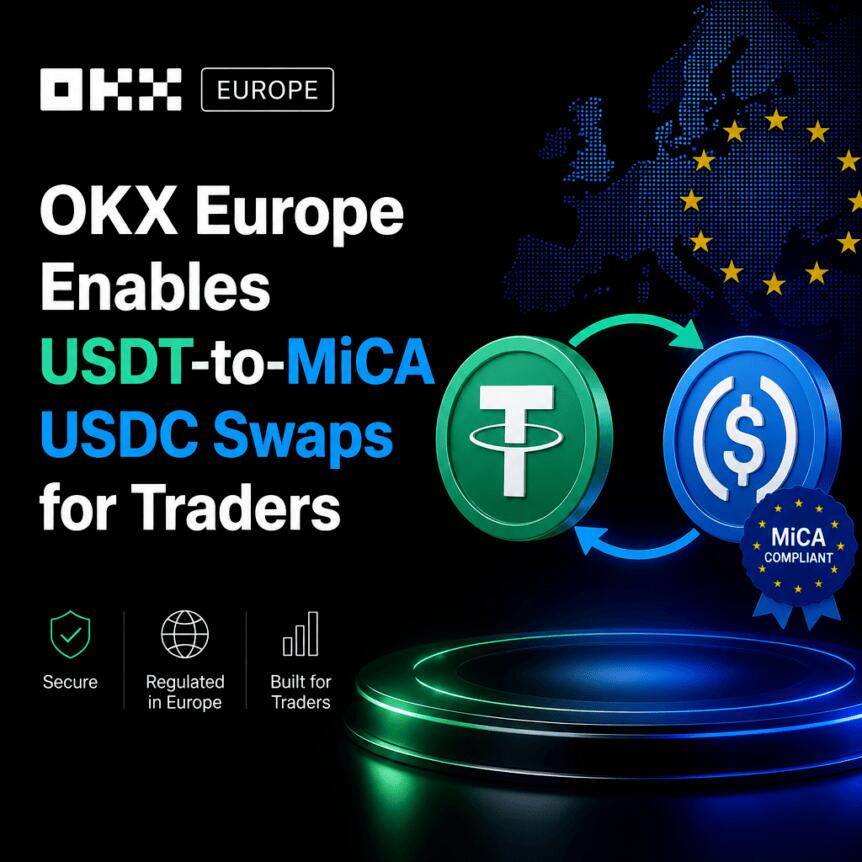
OKX Europe has introduced a “one-way conversion” tool that lets customers deposit Tether’s USDT and convert it into Circle’s MiCA-compliant USDC. The feature is aimed at clients who can no longer keep USDT supported on their accounts as European Union stablecoin rules tighten.
In an announcement shared with Cointelegraph, OKX Europe said the process is customer-controlled: users can deposit USDT into their OKX Europe account and convert it into USDC at their discretion, rather than being forced through a platform-imposed deadline. The exchange said the tool is meant to support customers whose existing venues no longer accept USDT or who plan to move balances automatically to compliant alternatives.
Key takeaways
- OKX Europe now supports conversion from USDT into MiCA-compliant USDC, without requiring a two-way transfer option.
- The feature targets customers affected by MiCA implementation, when many EU-facing platforms reduced USDT availability.
- OKX Europe positions the update as a migration path for users who want to preserve value continuity while shifting to USDC.
- Tether has not pursued MiCA authorization for USDT, which is central to why some platforms restrict or delist USDT in the EU.
- USDT remains the largest stablecoin by market share, according to DefiLlama, even as compliance-driven changes accelerate in Europe.
How OKX Europe’s one-way migration works
According to OKX Europe’s announcement, the new conversion feature allows customers to deposit USDT—Tether’s USDt—into their OKX Europe account and convert those tokens into USDC. USDC is described as one of the major stablecoins that fits the EU’s Markets in Crypto-Assets (MiCA) framework.
The “one-way” aspect matters: the workflow is designed to move balances toward a MiCA-aligned stablecoin rather than enabling conversion in both directions. OKX Europe also emphasized that conversions can be completed at the customer’s discretion instead of via a strict cutoff determined by the exchange.
OKX Europe operates under its MiCA license across 30 EU and European Economic Area countries, positioning the feature as a practical bridge for users navigating where USDT is no longer supported.
MiCA rollout forces stablecoin support to change
The timing aligns with the EU’s stablecoin regulatory rollout. Tether has not obtained authorization to issue USDT under MiCA, a status that has led many European platforms to restrict deposits, remove trading pairs, or convert client balances into compliant alternatives as MiCA rules took full effect on July 1.
That regulatory friction is not marginal. DefiLlama data cited in the report shows Tether accounts for about 59% of the roughly $310 billion stablecoin market, with USDT market capitalization around $184 billion. Circle’s USDC is much smaller by comparison, at about $73 billion, but still one of the largest compliant options for EU-based platforms.
For investors and traders, these shifts can change liquidity and execution. When a major venue restricts deposits or delists pairs, users who depend on a stablecoin—whether for trading, hedging, or moving between exchanges—can face friction even if the underlying stablecoin remains available elsewhere outside the EU.
Tether’s stance on MiCA authorization
Tether has defended its decision not to pursue MiCA authorization for USDT, and the approach has shaped the behavior of European market operators. Cointelegraph previously reported that Tether CEO Paolo Ardoino has criticized MiCA, arguing that reserve requirements could introduce unnecessary risk by requiring part of reserves to be held with European credit institutions.
Ardoino has also suggested that the regulatory tradeoffs are not favorable for stablecoin issuers. In a May 2025 interview with Cointelegraph, he characterized MiCA’s approach as “very dangerous when it comes to stablecoins,” noting Tether’s choice not to seek authorization despite expectations that USDT could lose support on European exchanges.
More recently, in a July 2025 post on X, Ardoino said Tether would reconsider pursuing MiCA authorization only “when MiCA becomes safer for consumers and stablecoin issuers.” The messaging indicates Tether sees no near-term reason to change course—an implication reinforced by the continuing migration efforts from EU-facing exchanges and other service providers.
Broader industry response: from exchanges to retail apps
OKX Europe’s conversion tool reflects a wider trend across Europe: when MiCA restricts USDT access, platforms often re-route customers toward compliant stablecoins or withdrawal pathways.
One example highlighted in the same material is Revolut, a digital banking platform that said it will stop supporting USDT for customers in the European Economic Area and Switzerland. Revolut reportedly gave users until Aug. 31 to sell or withdraw their holdings, with any remaining balances expected to be automatically converted into the base currency.
These actions underscore a key asymmetry for USDT holders in Europe. While USDT remains globally dominant, users in MiCA-regulated jurisdictions may experience forced transitions—either by changing what can be deposited and traded on exchanges or by shifting stablecoin exposure within retail financial interfaces.
For traders, this can affect strategy execution. Stablecoin pairs tied to USDT liquidity may shrink, and conversion paths could introduce operational steps or timing variability. For users focused on custody or settlement, the migration choice also becomes a matter of which compliant stablecoin is supported on the platform they use day to day.
What to watch next for EU stablecoin migration
As MiCA compliance keeps reshaping which stablecoins are usable on EU-facing platforms, customers should watch whether more exchanges adopt similar “migration” features and whether USDT support continues to narrow to withdrawals and conversions rather than active trading. The next turning point will likely be how quickly the market’s liquidity consolidates around MiCA-approved alternatives like USDC—and whether Tether’s position evolves if regulatory conditions change.

Artificial intelligence remains the dominant investment theme of 2026, but investors are increasingly questioning whether AI stock valuations are keeping pace with reality.
💰 Big Tech continues to invest at an unprecedented scale, with hyperscaler AI spending projected to exceed $800 billion in 2026.
📈 TSMC’s latest earnings showed a 77.4% year-on-year increase in quarterly profit, highlighting that demand for AI chips remains exceptionally strong.
⚖️ At the same time, the Bank of England has warned that elevated valuations and rapidly rising investment expectations could leave markets vulnerable if earnings fail to justify current prices.
The debate is becoming increasingly clear.
📈 Bullish case: AI leaders continue to deliver strong earnings growth, record investment and genuine commercial demand.
📉 Bearish case: Valuations may already reflect years of future growth, leaving little room for disappointment if AI adoption or earnings slows.
The key question for investors is whether technology companies can continue turning record AI spending into sustainable earnings growth—or whether expectations have simply moved too far ahead of fundamentals.
Gain insights to strengthen your trading knowledge.
Watch it now and stay updated with FXOpen.
💬 Don’t forget to like, comment, and subscribe for more professional market insights every week.
This article represents the opinion of the Companies operating under the FXOpen brand only. It is not to be construed as an offer, solicitation, or recommendation with respect to products and services provided by the Companies operating under the FXOpen brand, nor is it to be considered financial advice.


FTX has scheduled its fifth creditor distribution for July 31, preparing to return nearly $900 million as founder Sam Bankman-Fried’s efforts to secure clemency face political resistance.
Summary
- FTX will begin its fifth creditor distribution, worth nearly $900 million, on July 31.
- Preferred shareholders will receive another $18 million, lifting total trust payments to $95 million.
- SBF’s pardon campaign faces resistance as criminal cases linked to FTX continue.
According to an FTX press release, the bankrupt exchange will distribute funds to creditors with approved claims in the Convenience and Non-Convenience Classes under its Chapter 11 reorganization plan. Claimants must have completed all pre-distribution requirements by the June 16 record date to qualify.
Eligible creditors will receive their payments through one of FTX’s approved distribution providers. The company has named Kraken, Payoneer, and crypto custodian BitGo among the services handling the transfers.
FTX described the July payment as its fifth distribution since the repayment process began. The company said the round will return almost $900 million to creditors, though it did not provide a breakdown of how much each claim class will receive.
Future record and payment dates will be announced later, according to the exchange. The bankruptcy proceedings also remain active, with the court scheduled to hold omnibus hearings on July 23 and Aug. 16.
Preferred shareholders will receive another $18 million
Alongside the creditor distribution, FTX will issue a second payment to eligible Preferred Equity Holders on July 31. The company said eligibility for this group was also determined using the June 16 record date.
Funds will come from the Preferred Shareholder Remission Fund Trust, which was established to compensate qualifying shareholders. FTX said the upcoming payment will distribute $18 million and raise total payments from the trust to $95 million.
Individual shareholders will receive their funds through Kraken, while BitGo will process payments for institutional recipients, according to the exchange. FTX added that it began contacting eligible Preferred Equity Holders in January to help them complete the required steps.
The dual distribution continues the financial unwind of FTX, which filed for bankruptcy in 2022 after a liquidity crisis exposed a multibillion-dollar shortfall. Under the court-approved plan, distributions depend on claim approval, record-date eligibility and completion of verification requirements.
SBF’s clemency campaign faces political resistance
While creditors await the latest payment, Bankman-Fried has continued seeking a presidential pardon for his criminal conviction. The former FTX chief is serving a 25-year prison sentence after a federal jury found him guilty of fraud and conspiracy charges connected to the exchange’s collapse.
Notably, the U.S. Senate recently rejected a clemency effort involving Bankman-Fried. President Donald Trump has also indicated that he does not plan to pardon the former executive, weakening the prospects of an early release through presidential action.
Criminal cases tied to FTX have continued even as the bankruptcy estate returns money to creditors. Last month, crypto.news reported that a federal judge rejected Michelle Bond’s attempt to dismiss four campaign finance-related charges and scheduled her trial for Nov. 9.
In an order filed in the U.S. District Court for the Southern District of New York, Judge George Daniels rejected Bond’s argument that prosecutors had promised not to charge her if her husband, former FTX executive Ryan Salame, pleaded guilty. Bond’s prosecution was one of the final criminal cases linked to FTX after several former executives faced charges following the exchange’s failure.
Earlier in July, the cat-themed meme coin defied the ongoing bear market by posting a whopping 2,000% weekly increase. Its ascent was primarily driven by the token’s affiliation with the official Robinhood platform, which recently introduced its own blockchain, as well as backing from Binance.
However, the uptrend came to an abrupt end, and over the past seven days, CASHCAT has crashed by more than 65%, raising the question of whether the hype is over.
The Traders’ Experience
CASHCAT, which exploded to $0.22 on July 12, is now worth roughly $0.05 (per CoinGecko), and some market observers have started speculating that it will hardly reclaim its previous peaks and instead collapse even lower.

Meanwhile, savvy traders have taken advantage of the meme coin’s decline. According to the analytics platform Lookonchain, one individual began shorting CASHCAT two days ago and is now sitting on over $500,000 in unrealized profits. Of course, this has prompted allegations of insider information that the rest of the market participants were unaware of.
However, not all benefited from the token’s wild trajectory. One trader made a paper loss of $460,000 due to CASHCAT’s meltdown, while another sold prematurely, turning a $69 position into $711. This is indeed 10x, but Lookonchain pointed out that if they had waited a bit more, they could have retired.
Is It Really Game Over?
Certain X users have been baffled by CASHCAT’s sudden move south, trying to figure out what triggered it. Fluffy asked their 125,000 followers for an explanation, and most of the responses weren’t exactly flattering to the meme coin.
Many of the people commenting on the post described the cat-themed token as a scam, claiming that “anybody that bought at these high valuations got played.”
It is true that CASHCAT resembles many other meme coins whose explosive rallies relied entirely on hype and speculation rather than fundamentals or real utility. Examples include Siren (SIREN) and MemeCore (M). The former was at the forefront of gains in June, yet it crashed by 96% in a single day after its controller supposedly sold roughly 94% of the supply.
Comebacks are not out of the question, and a renewed influx of speculative traders could help lift CASHCAT and similar tokens. Nonetheless, one should remain mindful of the risks and severe volatility, conduct proper due diligence before entering the ecosystem, and invest only what they can afford to lose.
The post CASHCAT Plummets 65% in a Week: The Doom of Another Meme Coin or New Pump Loading? appeared first on CryptoPotato.

Bitcoin recovered most of the losses seen during the day after dipping to $62,400 and is now back above $64,000. What’s intriguing about this rebound is that it came after some unfavorable reports for risk-on assets.
The first one focused on more threatening developments on the US/Israel-Iran war front, while the second was on the continuously growing US margin debt.
Two Major Signals
The tension in the Middle East skyrocketed a couple of weeks ago when the US and Iran broke the ceasefire with new attacks. There’s been little to no reporting on potential peace talks since then. In contrast, Trump’s new attack plan was recently leaked, while a new report from Axios outlined the next possible steps.
The Trump Administration has reportedly conveyed to Israel that it will send ‘dozens more’ refueling planes ahead of a potential ‘massive offense’ against Iran. Some of the more threatening details include possible bombing against key Iranian infrastructure like power plants and nuclear sites.
The report added that the POTUS is expected to order the escalation ‘in the coming days.’ As expected, oil prices reacted with an immediate increase, as USOIL is up by over 20% since the war restarted.
Separately, the Kobeissi Letter noted that the US margin debt has risen by over $86 billion in June to a new record of $1.5 trillion. This marked the third monthly increase in a row. Moreover, the margin debt has skyrocketed by nearly $500 billion in the past year.
The analysts concluded that “US investors have never been more leveraged,” as the broader measure of such positions is up to approximately 1.4% of the S&P’s total market cap. This is close to the 2018 peak and far exceeds the 2000 Dot-Com bubble of 1.1%.
BTC Rebounds
The primary cryptocurrency tends to slip following similar reports, especially escalations in the Middle East. However, the past few hours have shown a very different reaction. The asset had fallen to a multi-day low of $62,400 before the bulls took charge and helped it recover nearly $2,000.
Nevertheless, bitcoin remains below the recent local peak of $65,600 reached after the US CPI numbers for June came out on Tuesday. The market is still in a fragile place, and it’s unlikely that new attacks between the US and Iran will have a longer-term beneficial effect.
The post Bitcoin’s Surprising Reaction to Trump’s Iran Threats and Rising US Margin Debt appeared first on CryptoPotato.
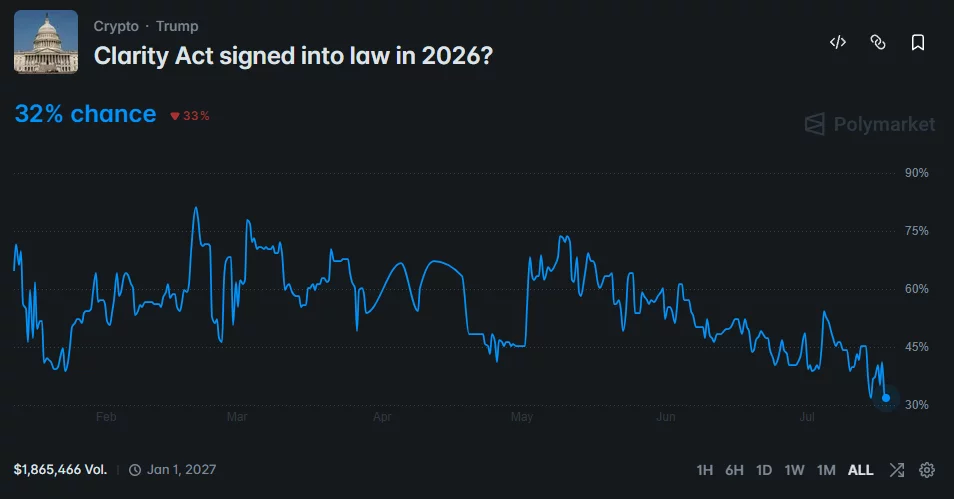
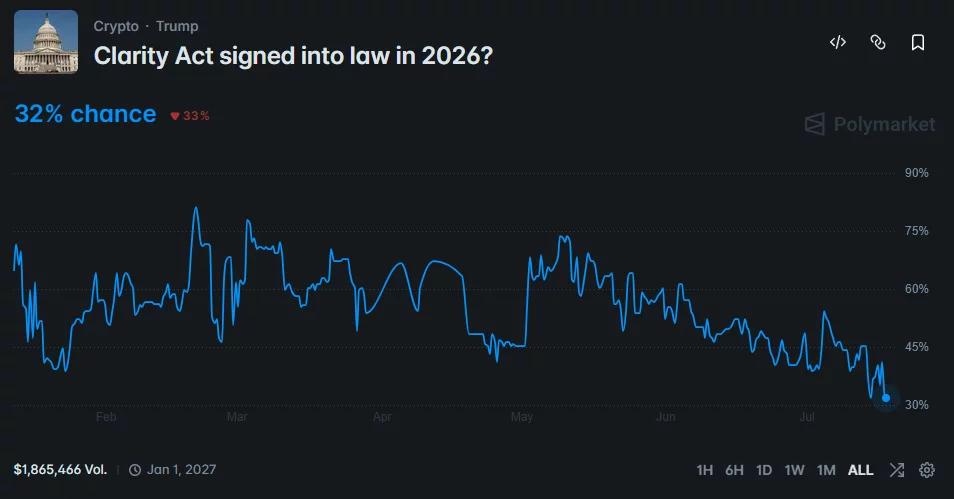
President Donald Trump has failed to unlock the stalled CLARITY Act after meeting Senate Republicans, with no revised text released and Polymarket traders cutting its 2026 passage odds to 32%.
Summary
- Trump’s meeting with Senate Republicans produced no revised CLARITY Act text.
- Polymarket traders cut the bill’s 2026 passage odds to 32%.
- Democratic opposition remains focused on ethics rules and consumer protections.
Journalist Eleanor Terrett reported on X that the updated bill remained unavailable after Thursday’s White House meeting, where Trump and Republican senators discussed ethics rules tied to the legislation. Industry leaders now expect the text to arrive next week, according to Terrett, extending a delay around one of Washington’s most closely watched crypto bills.
“Updated legislative text remains elusive following yesterday’s meeting between President Trump and Senate Republicans on ethics,” Terrett wrote.
Before the meeting, Republican senators had suggested the draft could emerge shortly after their talks with Trump. Sen. Bernie Moreno told reporters that lawmakers would release the plan once the president received a briefing, adding that journalists would have “a lot of reading to do.”
Moreno is still seeking a Senate vote before the August recess, according to Terrett. Sen. Cynthia Lummis also expressed hope that the language would become public after the White House discussion, although she did not offer a firm timetable.
Passage odds have fallen to 32%
Polymarket traders have lowered the probability of the CLARITY Act becoming law in 2026 to 32% as Republicans and Democrats remain divided over the bill’s ethics provisions. The prediction-market decline has followed growing doubt over whether senators can secure enough bipartisan support to advance the measure.
In New York, the House Financial Services Committee’s Republican members are scheduled to hold a hearing at 10 a.m. ET on the legislation’s potential role in digital-asset development, according to Terrett. She noted that the event is informational and will not influence the Senate’s review of the bill.
The House passed its version of the CLARITY Act in 2025, but Senate negotiators have been working on separate language covering crypto market rules. Any final measure would need enough support to clear the Senate before lawmakers could reconcile it with the House bill.
Democratic ethics demands remain the main barrier
Sen. Ruben Gallego, one of the leading Democratic negotiators, told POLITICO that Republicans had presented ethics language his party could not support. Gallego linked the dispute to Trump’s business interests in the crypto sector and warned that the proposal would not attract the Democratic votes needed for passage.
“At the end of the day, we don’t have strong ethics,” Gallego said. “I don’t care what the president says. You’re not going to have the Democratic votes.”
After reviewing the Republican proposal, Gallego described it as “very weak,” arguing that it gave the president considerable freedom while offering limited consumer protections. A Democratic Senate aide also told POLITICO that the plan taken to the White House fell short of what Democrats would accept.
According to the same aide, Democratic lawmakers had neither reviewed nor approved the draft discussed during Thursday’s talks. The lack of agreement has left Republicans unable to present the delayed text as a bipartisan proposal.
Sen. Cory Booker has maintained that negotiations remain active, telling reporters that bipartisan cooperation is the only route to completing the legislation. Booker also indicated that negotiators should finish those discussions before releasing a new draft, leaving the publication date and Senate vote schedule unresolved.

Join Blockchain Life in Dubai on December 1–2, 2026!
On December 1–2, 2026, Blockchain Life 2026 returns to Dubai for one of the world’s largest gatherings focused on Web3, cryptocurrency, mining, and AI.
The event will bring together 15,000+ attendees from 130+ countries, 200+ world-class speakers, 200+ booths at expo, 3 dedicated stages, and the debut of AI Future – a brand-new track exploring the next generation of AI.
Why attend Blockchain Life?
🔹 A full week of high-impact networking with the industry’s biggest names: 2 days of the Blockchain Life Forum, hundreds of side events, exclusive business & private meetups, and the Formula 1 Grand Prix Finale.
🔹 200+ industry-leading speakers, including crypto whales, founders and C-level executives from top exchanges and leading Web3 projects, prominent investors, Tier 1 funds, AI innovators, and legendary traders.
🔹 200+ leading companies at one of the largest industry’s expo – from major crypto exchanges and mining firms to Web3 pioneers, AI developers, and cutting-edge startups.
🔹 The Debut of AI Future, a dedicated Forum exploring the future of AI, emerging trends, breakthrough robotics, and the convergence of AI, blockchain, and business.
🔹 The legendary Blockchain Life Afterparty at one of the world’s premier nightclubs, featuring a globally recognized headlining artist.
🔹 Startup Pitch & Blockchain Life Awards, where promising startups gain exposure and the industry’s leading companies are recognized for their achievements.
🎟 Book now at early bird price! Save 10% on your ticket with promo code: CRYPTOBREAKING
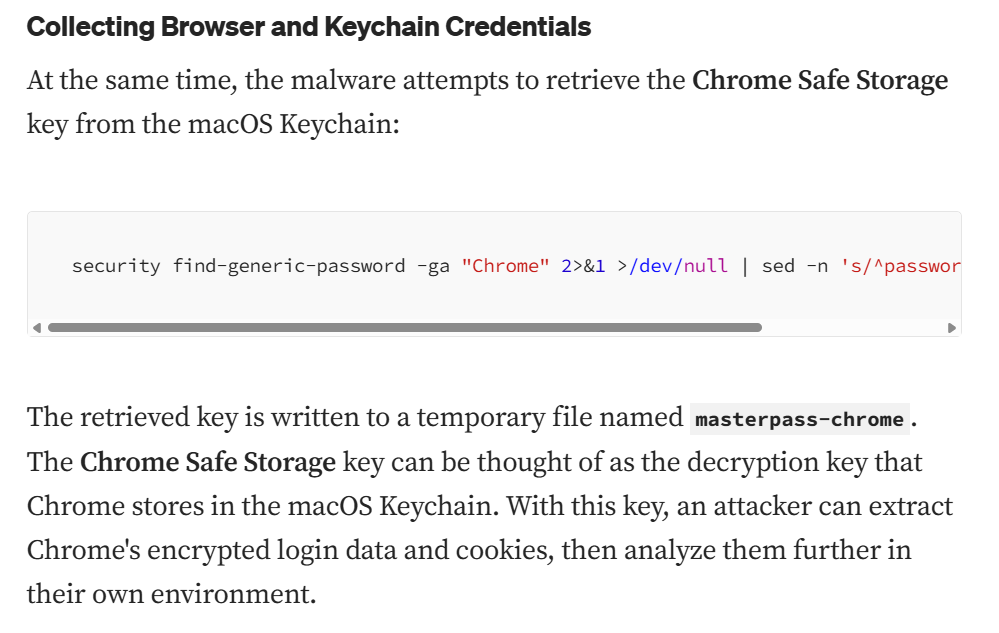
A macOS information-stealing malware can hijack Telegram Desktop sessions and compromise cryptocurrency wallets, according to blockchain security firm SlowMist.
The malware harvests data from the macOS Keychain, Safari cookies, Apple Notes, Telegram Desktop and databases associated with more than a dozen cryptocurrency wallets.
After collecting passwords and authenticated sessions, the malware copies users’ authenticated Telegram Desktop session data, wallet databases and browser wallet extension data.
SlowMist said attackers can then attempt to decrypt the stolen wallet databases offline using passwords harvested from the infected device or replace legitimate Ledger and Trezor applications with fake versions that trick users into entering their recovery phrases. The security firm reproduced the attack chain in an isolated environment.
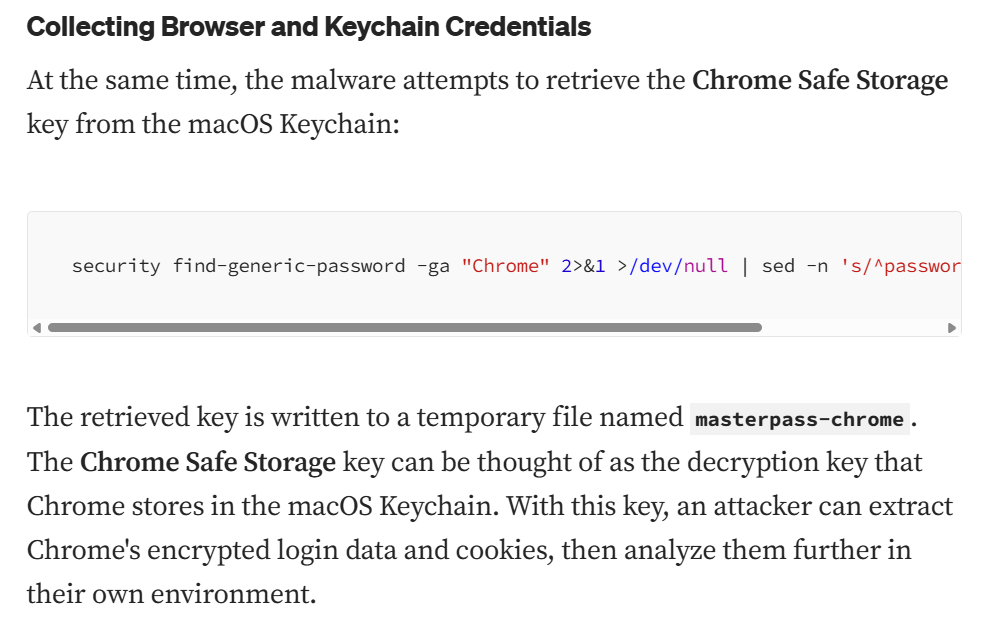
MacOS malware code used to steal keys and passwords. Source: SlowMist
Related: AI has not triggered DeFi ‘hackpocalypse,’ Dragonfly partner says
MacOS malware targets popular crypto wallets
According to SlowMist, the malware combines multiple techniques into a coordinated attack chain, allowing attackers to pursue different methods of compromising cryptocurrency accounts and wallets.
The malware targets software wallets including Exodus, Atomic, Electrum, Wasabi and Monero, as well as hardware wallet applications such as Ledger Live and Trezor Suite, according to SlowMist. It also searches for wallet data stored by full-node clients including Bitcoin Core, Litecoin Core, Dash Core and Dogecoin Core.
Telegram two-step verification does not prevent the attack because the malware reuses an authenticated local session instead of creating a new login, according to SlowMist. In tests, researchers restored stolen Telegram Desktop session data on another Mac without entering a phone number, verification code or two-step verification password.
SlowMist urged users who suspect their devices have been compromised to immediately terminate existing Telegram sessions, establish a new trusted login and change both their Telegram two-step verification password and Telegram Desktop Passcode. The company also recommended generating a new recovery phrase on a clean device and transferring all assets to new addresses.
Magazine: Does Botanix’s failure prove Bitcoiners don’t care about DeFi?


DeFi platform Spreadefi has reported that the total volume of funds users placed in liquidity pools topped $25 million in the second quarter. For a relatively young project, that’s a significant milestone, especially with interest in the decentralized finance sector only gradually picking back up after a long stretch of subdued activity.
Growth in total value locked (TVL) is traditionally seen as one of the key health indicators for a DeFi platform. The more capital users are willing to trust a protocol with, the deeper the liquidity, the more stable the service runs, and the wider the opportunities for further ecosystem development.
What drove the growth?
According to market participants, several factors fed into the increase.
Over the past year, the Spreadefi team has been actively building out the platform’s infrastructure, regularly rolling out technical updates and improving the user experience. A lot of focus went into optimizing liquidity pool management, making smart contracts more efficient, and sharpening the internal algorithms that handle capital allocation.
Beyond the technical side, the project significantly dialed up its public presence. Over the past year, the team has regularly published product development reports, maintained an official blog, shown up at industry conferences, and expanded its footprint inside the crypto community.
For users, that kind of openness is a major trust factor, especially against the backdrop of the countless anonymous projects popping up across the DeFi landscape.
The platform’s growth in 2025
Last year was a period of active scaling for Spreadefi. The team broadened the platform’s functionality, kept pushing liquidity pool staking solutions forward, and put a premium on infrastructure stability.
One of the standout moments was the formal establishment of the company in the United States, coming after more than two years of project development. That step made it possible to boost business transparency and strengthen trust from both users and potential partners.
At the same time, the platform’s community kept growing. The user base expanded, the audience across official channels widened, and the product gradually became more visible alongside other DeFi projects.
Why TVL is considered an important metric
For most decentralized financial platforms, the amount of funds sitting in liquidity pools is one of the primary development indicators.
TVL growth typically signals that users are willing to entrust their assets to a protocol over the long haul. Larger pools also have a positive knock-on effect on platform efficiency, cutting slippage, making trading operations more resilient, and opening up more ways to deploy capital.
That’s why a lot of analysts look at TVL dynamics as one of the most objective measures of a DeFi project’s health.
What’s next?
Spreadefi representatives note that the increase in liquidity pool volume is just one stage of the platform’s development. The team’s immediate plans include further infrastructure expansion, the rollout of new investment instruments, a growing number of supported networks, and ongoing work to sharpen the user experience.
If the current pace holds, Spreadefi will be in a position to strengthen its standing among emerging DeFi platforms and pull in even more users interested in staking and earning through liquidity pools.
In the second quarter, the project has already shown it can attract significant capital. Where things go from here will depend on how well the team keeps the community’s trust, advances its technology base, and adapts to a decentralized finance market that never stands still.
The post Spreadefi Users Deploy Over $25 Million in Liquidity Pools in the Second Quarter appeared first on BeInCrypto.

Dovestone moorland fires battle enters second week as police arrest more suspected arsonists

Trevi Therapeutics Shares Surge 13% as Biopharma Investors Cheer Cough Drug Data at London Conference

Anthropic turns to Meta for $10B in computing power before IPO


-

 Fashion7 days ago
Weekend Open Thread: Nutriplenish Leave-In Conditioner
-
 NewsBeat1 day ago
London Mayor Sadiq Khan handed a peerage by Keir Starmer alongside 15 other Labour figures… just days before the PM leaves No10
-

 Crypto World2 days ago
CFTC blocks Kalshi from unwinding Michigan trades after court order
-

 Politics2 days ago
Young campaigners urge incoming PM to act on outdoor junk food ads
-

 Business2 days ago
Nvidia Stock Slips After Big Tuesday Rally as Huang Confirms Vera Rubin Chip Is Now in Production Today
-

 Fashion2 hours ago
Weekend Open Thread – Corporette.com
-
 Entertainment2 days ago
Disney’s Most Ambitious Failed Star Wars Attraction Is Coming to SDCC
-

 News Videos3 days ago
XRP BOMBSHELL… XRP OMBOARDED FOR TRANSACTIONS!!!
-

 Tech4 days ago
Get Your ESP32 Sunny Side Up With This Solar Dev Board
-

 Crypto World23 hours ago
Injective Submits SEC Transfer-Agent Registration to Onchain Ownership Records
-

 NewsBeat8 hours ago
Registration is now open for March for Men with Kev 2026
-

 Tech3 days ago
Dark Secrets Emerge When Jailbreaking LLMs
-

 Business2 days ago
Palantir Shares Rise After Expanded Nvidia Partnership and Fresh Analyst Upgrades Ahead of Earnings Day
-

 News Videos13 hours ago
Money | Class 12 Economics | CBSE Board Exam 2026-27
-
 Sports2 days ago
New Cornerback Enters Vikings Trade Rumor Mill
-

 Business19 hours ago
Banco Bilbao Vizcaya Argentaria, S.A. (BBVA) Discusses Global Macro Environment and Economic Outlook for Core Markets Transcript
-
 Tech4 days ago
Cloudflare Precursor Watches Your Mouse and Keyboard To Decide If You Are Human
-

 News Videos4 days ago
how to make coin bank box with cardboard #scienceproject #money #diy #shorts
-
 Entertainment2 days ago
Vicki Gunvalson Defends Discussing Heather Dubrow’s Money
-

 Business1 hour ago
Airlines warn Sunshine Protection Act could disrupt flight scheduling
You must be logged in to post a comment Login