
Crypto World
The Cryptocurrency Industry Pushes Clarity Act Amendments Ahead of the Senate Draft


Coin’s Resistance Brings About Reaction
Firms such as Coinbase have opposed the stablecoin yield model. According to them, the rules inhibit user reward systems and expansion of the platforms. Therefore, the leaders of the industry currently organise the work to appear with a single offer to the legislators. The proposal offered in the current version prohibits access to rewards on idle balances and the incentives in activity-related programs. Such rewards should, however, not resemble the interest on bank deposits. Besides, companies assert that these restrictions might dilute consumer interaction on crypto sites.
Senator Thom Tillis will issue the text of the reward rules and regulatory measures as the draft. In the meantime, discussions about stakeholders are ongoing with lawmakers narrowing down on key provisions. In addition, the White House’s recent consent is intended to lessen tensions between banks and crypto companies. Both sides of the legislature are working in collaboration to perfect the language of the bill. Senator Tim Scott claimed that there are talks between Republicans, Democrats, and administration officials. Therefore, the leaders want to create the framework that favours innovation and keeps the financial control.
Senator Cynthia Lummis also mentioned the issues of the protection of developers of decentralized finance. According to her, amendments to the bill enhanced protection of Title 3. Moreover, she encouraged the actors in the market to help in continuous bipartisan work to amend the legislation. Also, they emphasise that there is a need to maintain rewards systems that appeal to users. This interest is indicative of increased pressure in the industry as the bill advances to consideration. The chances of passing the bill have decreased as differences still exist. Latest data indicate that there is less confidence in approval this year. As a result, the unaddressed problems may postpone the markup process that was planned to take place in April.

Crypto World
Will XRP price drop to $1.12 as it remains capped under a descending trendline resistance?
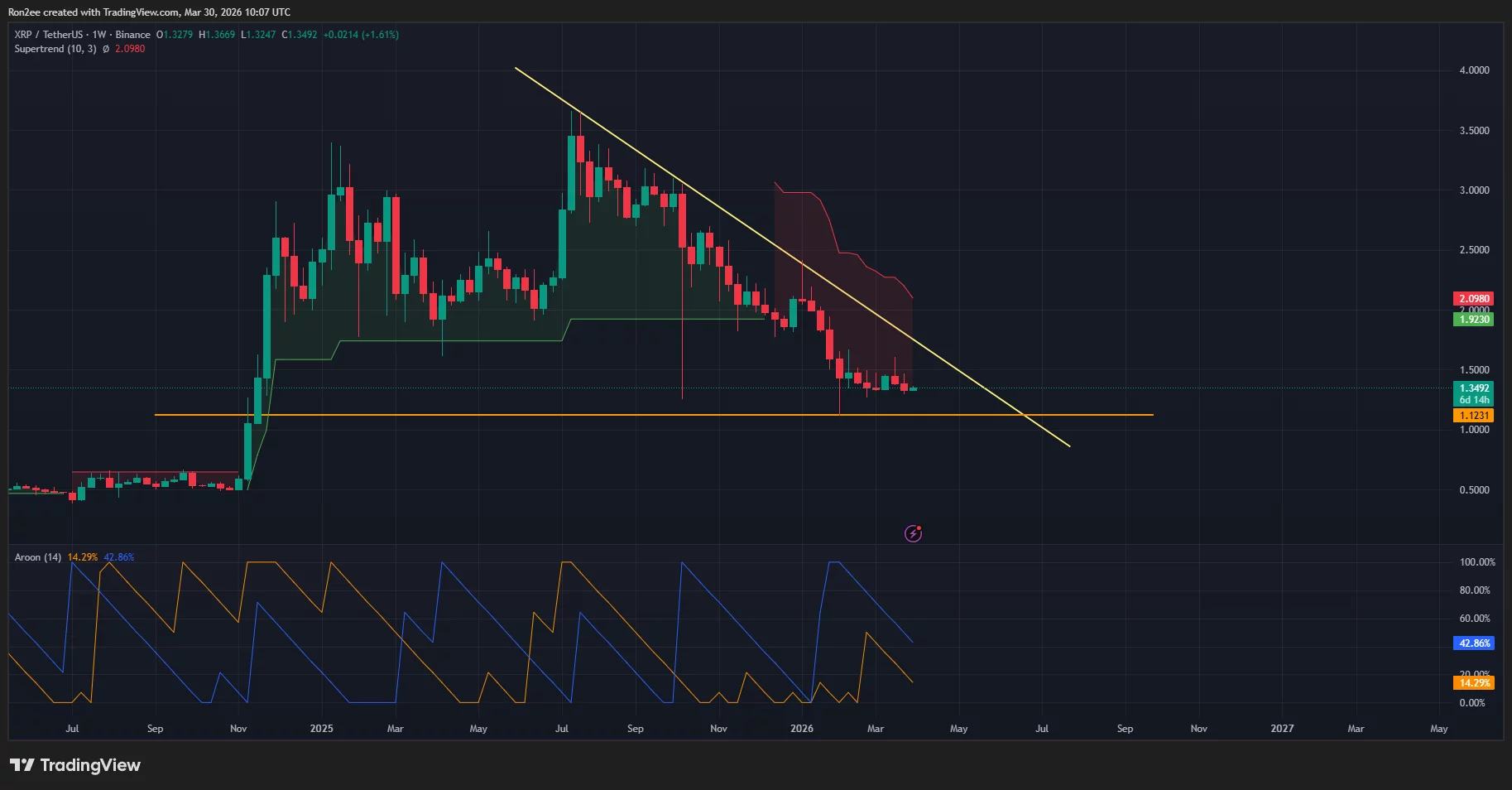
XRP price fell 15% over the past two weeks as its price action remained below a descending trendline that has been acting as key dynamic resistance.
Summary
- XRP price has dropped over 15% in two weeks and remains capped below a long-term descending trendline acting as key resistance.
- Macro pressures, including geopolitical tensions and reduced rate-cut expectations, have weighed on sentiment, contributing to over 40% decline from yearly highs.
- Bearish indicators signal further downside risk toward $1.12 and potentially $1.00, while a breakout above $1.40 could trigger a short-term recovery.
According to data from crypto.news, XRP (XRP) price has fallen 15.6% from its monthly high of $1.60 reached on March 17 to $1.35 at press time. Zooming out the charts, the losses mount up to over 40% from its year-to-date high of $2.39.
XRP price fell amid geopolitical and macroeconomic concerns that have plagued the entire crypto market since the beginning of this year. These include U.S. tariff hikes on the EU and Canada and the subsequent war between the U.S. and Iran in the Middle East that has led crude oil prices to soar to multi-year highs, sparking concerns of rising inflation and driving investors away from risk assets.
Lower expectations of any interest rate cuts from the Federal Reserve have also dampened the mood for speculative assets.
Now, XRP price stands at risk of more downside, especially as the broader crypto market remains under pressure.
On the weekly chart, XRP price has respected a descending trendline that had been acting as a key dynamic resistance since mid July 2025. Every time the bulls managed to push XRP price towards the resistance level, it experienced a sharp drop as bears regained control of the market.
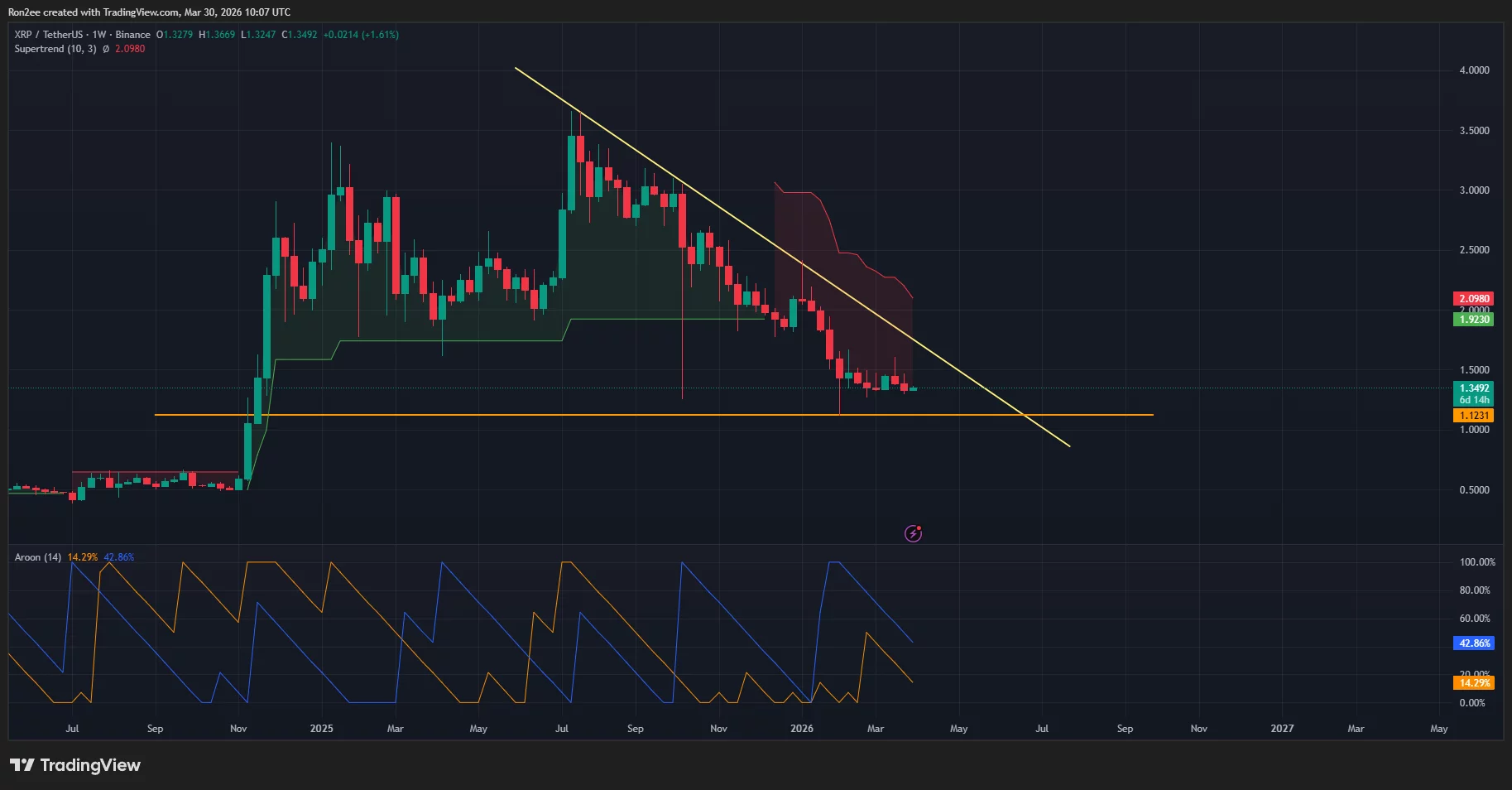
A look at technical indicators also seems to suggest a similar bearish outlook for its price. Notably, the Supertrend has flipped red while the Aroon Down at 42.86% remains far above the Aroon Up at 14.29%. Both indicators point toward a continuation of the current downward trend.
Hence, XRP price may visit the February 2 low of $1.12, a sharp drop below which could extend losses to the $1 mark. On the contrary, if XRP price manages a breakout above $1.40, it could pave the way for a recovery toward $1.50.
Disclosure: This article does not represent investment advice. The content and materials featured on this page are for educational purposes only.
Crypto World
Bitcoin price outlook as Bernstein signals potential bottom for crypto stocks this quarter
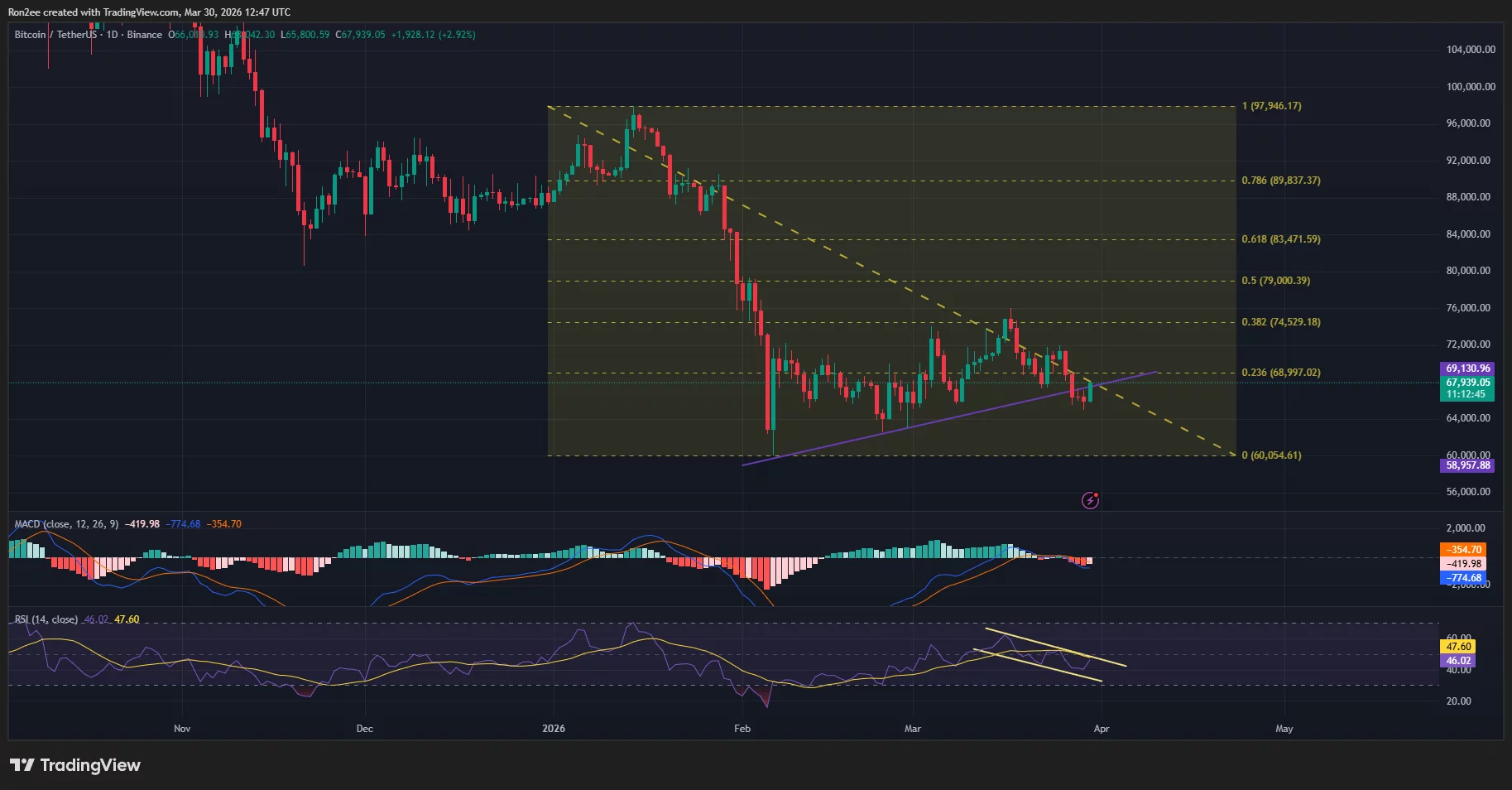
Bitcoin price has fallen over 30% from its yearly high, largely impacted by geopolitical and economic concerns that deteriorated investor appetite for risk assets.
Summary
- Bitcoin price has dropped over 30% from its yearly high amid geopolitical tensions and persistent macroeconomic pressure weighing on risk assets.
- Bernstein analysts expect market weakness to persist until Q1 earnings, with crypto-linked stocks down sharply but potentially nearing a bottom.
- Bearish technical indicators point to further downside risk toward $60,000, while a move above $69,000 could signal a shift in momentum.
After rallying nearly 12% to a yearly high of $97,538 on Jan. 15, the bellwether crypto has fallen by nearly 31% to $67,525 at the time of writing. This came amid several geopolitical and macroeconomic concerns that have largely risen due to U.S. President Donald Trump’s tariff drama that has extended into the beginning of this year, followed by the start of a war in the Middle East against Iran that has led to repercussions in energy and financial markets across the globe.
The hawkish stance the Federal Reserve has maintained as a result has also not helped the situation.
According to analysts at Bernstein, the resulting volatility has left stocks tied to crypto markets, including exchanges, brokerages, and tokenization platforms such as Coinbase, Robinhood, and Figure, down nearly 60% from their recent highs. This represents a big discount considering that these businesses have continued to expand their operations despite the turbulence.
In their Monday note to clients, they predicted that the current market weakness will extend until the release of first-quarter earnings reports, at which point a market bottom could potentially form. Such a prediction suggests that Bitcoin could likely continue to see more downside at least until April ends.
On the daily chart, Bitcoin (BTC) price has lost the support of a key descending trendline where bulls have often previously found footing.
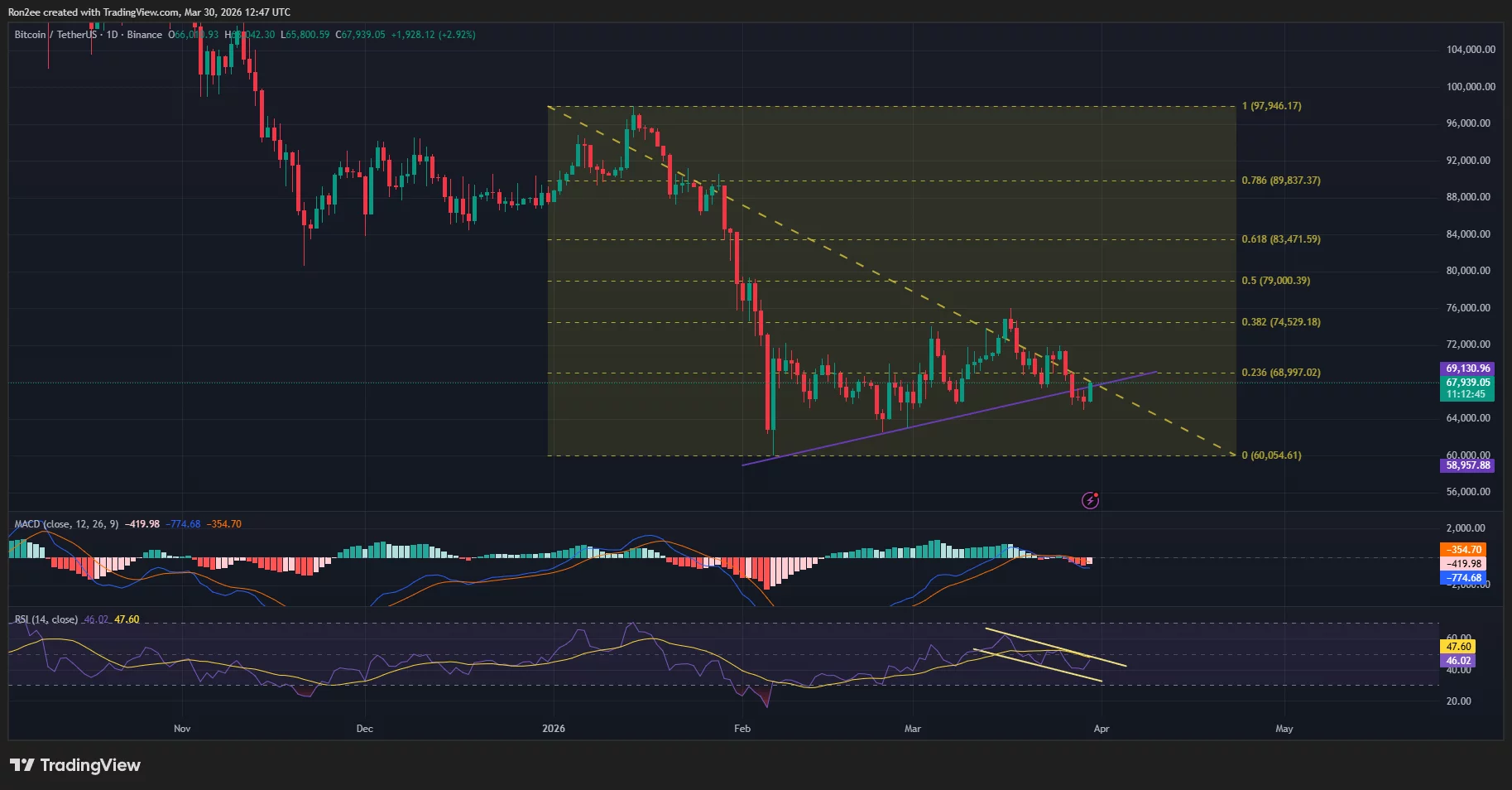
Technical indicators such as the MACD and RSI show that bears still have the advantage in the current setup. The MACD lines have formed a bearish crossover and were trending downwards while the RSI line was moving within a descending channel, both signs that selling pressure remains dominant.
For now, $65,000 could serve as the key psychological support which bulls would seek to defend. If Bitcoin falls sharply below this key level, bears could aim to drag it all the way down to its yearly low around $60,000 once again.
On the contrary, if BTC price rebounds above $69,000, which aligns with the 23.6% Fibonacci retracement level, it could signal a shift in momentum.
Bullish outlook on crypto-linked stocks despite downturn
While the recent report projected trimmed price targets for crypto-linked stocks, Bernstein analysts maintained “outperform” ratings for Coinbase, Robinhood, and Figure as they attributed the recent weakness to macro pressure and deteriorating market sentiment rather than fundamental business failures.
This means that following the expected weak quarter, they expect these companies to come out stronger in the long term, likely as Bitcoin retraces back to its former highs once all the drama from the ongoing U.S.-Iran war settles down.
Disclosure: This article does not represent investment advice. The content and materials featured on this page are for educational purposes only.
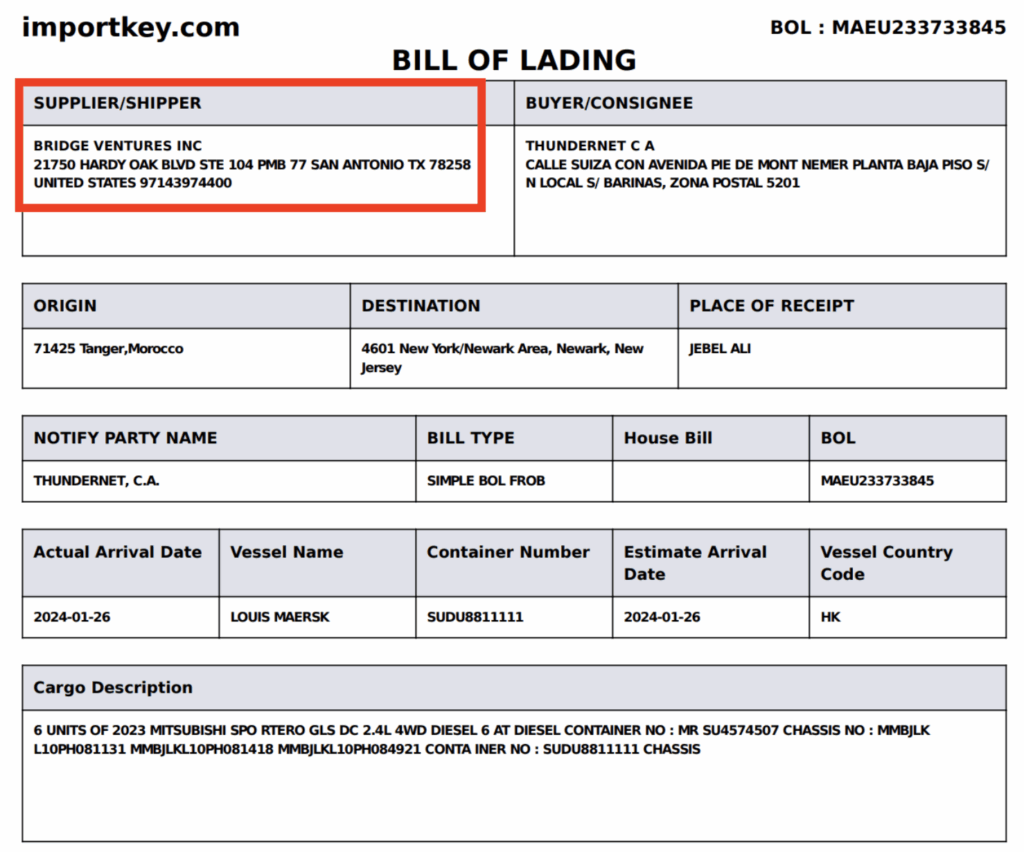
Stripe’s billion-dollar stablecoin subsidiary Bridge Ventures Inc. has apparently been listed on documents as having sold 12 Mitsubishi trucks to a company in Venezuela with ties to the family of former president Hugo Chávez.
The stablecoin company, which Stripe acquired for $1.1 billion, appears, along with its exact street address, suite number, city, state, and zip code, on a shipment slip that sent trucks through a New Jersey port to a company in Venezuela.
At the time of the shipment, Venezuela was under broad US sanctions that covered many companies connected to the Chávez regime’s state-owned oil company PdVSA, and entities acting on its behalf.
Bridge categorically denies any involvement with the shipment. “Whatever this is about, it has nothing to do with us: Bridge had no involvement in this shipment or any associated payment activity,” a spokesperson told reporter Jason Mikula.
“The only explanation we can think of is some clerical error or confusion around a common name like Bridge.”
However, the platform’s character-by-character name isn’t particularly common, while the address on both bills of lading match US Patent and Trademark Office filings and third-party business registries like Bloomberg.
Mikula tweeted and published an article about his skepticism that a third party used Bridge’s name without its authorization.
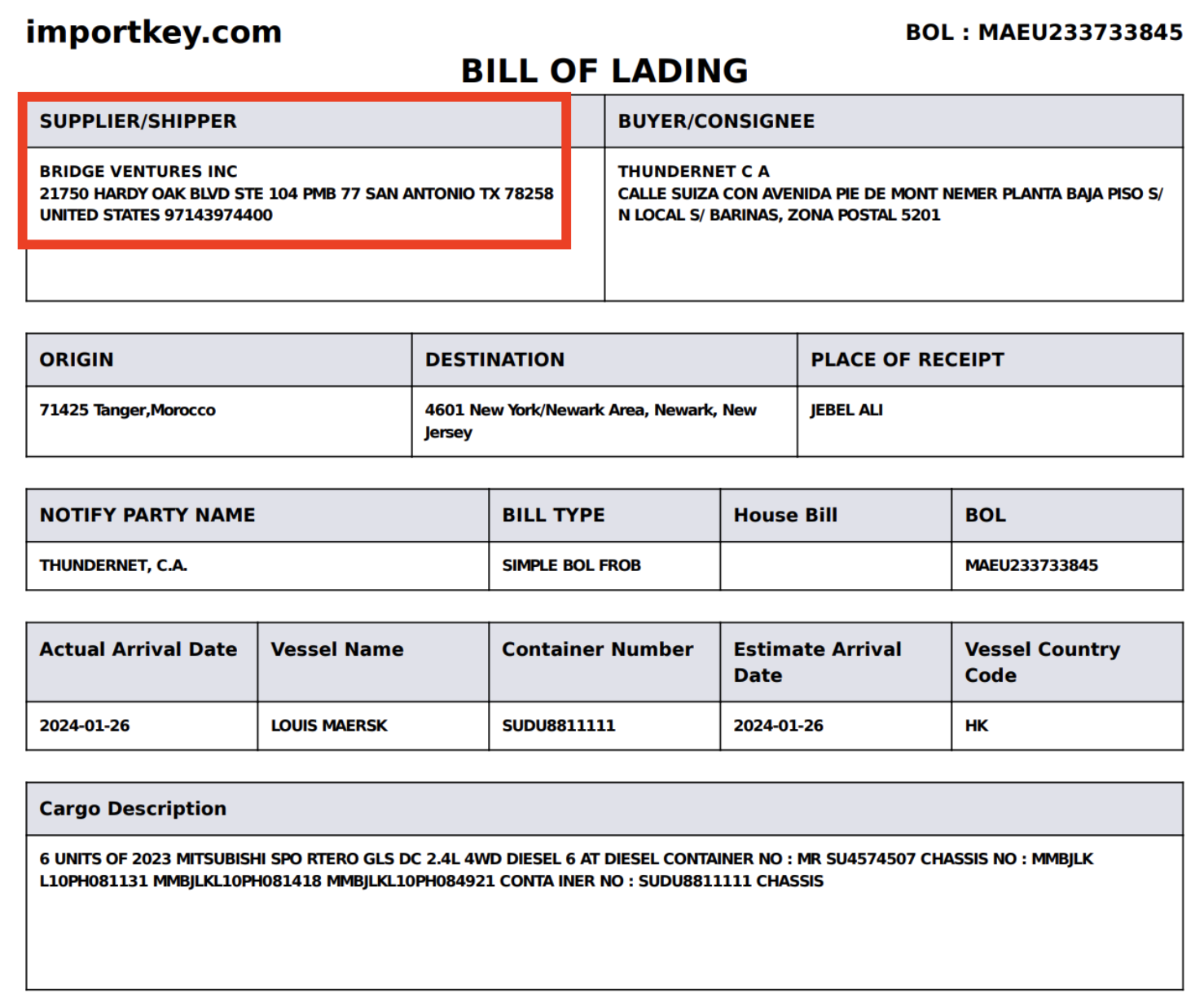
Thundernet, a Hugo Chávez family connection
The buyer on both truck shipments from “Bridge Ventures Inc.” was Thundernet, C.A., an internet provider based in Barinas, Venezuela.
Thundernet belongs to Grupo Nemer, a conglomerate of dozens of companies across Venezuela, Panama, and the US with close ties to Chávez’s regime.
For example, Hugo Chávez’s youngest brother, Adelis, previously owned the Barinas-based Zamora Futbol Club. The club is now run by Omar Jose Nemer Irched, the eldest son of Grupo Nemer head, Syrian-born Atef Salami Nemer Hirchedd.
That soccer club’s sponsor switched from PdVSA to Thundernet.
In addition, investigative outlet Armando.info reported in 2021 that Nemer Hirchedd maintained a close relationship with another Chávez sibling, Adan Chávez Frías.
Adan served as governor of Barinas and Venezuela’s ambassador to Cuba, a relationship that allegedly helped Grupo Nemer take over operations of a bankrupt state agriculture company.
An exact name match and a denial from Bridge
According to Mikula, the shipping documents compound an already dubious compliance record.
In January 2026, he revealed Stripe’s connection via the Bridge stablecoin platform to Venezuelan crypto exchange Kontigo, rumored to have links to ousted President Nicolas Maduro’s son.
Maduro served as president of Venezuela since 2013, succeeding Chávez.
Moreover, as recently as November 2025, Bridge and Stripe executives were praising Venezuela as a stablecoin showcase.
Bridge subsequently reclassified Venezuela from “controlled” to “prohibited” in its sanctions compliance document.
The timing aligned neatly with the Kontigo fallout and Bridge’s pursuit of a national trust bank charter from the US Office of the Comptroller of the Currency, which conditionally approved its application, after Bridge’s downward revision of Venezuela, in February 2026.
Read more: Venezuela had crypto for buying jet fuel, now its president has lost his plane
The entities on the bills of lading don’t appear on OFAC’s Specially Designated Nationals list. However, Venezuela’s broad program-level sanctions arguably cover persons acting on behalf of the government.
Grupo Nemer’s opaque, multi-jurisdictional corporate structure makes verifying beneficial ownership extraordinarily difficult.
Both shipments originated from Jebel Ali port in Dubai, transited Morocco, and passed through Newark, New Jersey. The same Gmail address appeared for both seller/shipper and buyer/consignee on the documents.
Got a tip? Send us an email securely via Protos Leaks. For more informed news, follow us on X, Bluesky, and Google News, or subscribe to our YouTube channel.
Crypto World
Lido DAO proposes $20 million LDO buyback as token trades at 70% discount to two-year median


Lido DAO proposed spending up to 10,000 stETH to buy its own governance token at what it calls a historically depressed valuation. That works out to roughly $20 million at current ether prices near $2,000.
The problem is where to spend it.
Onchain LDO liquidity sits at about $90,000 of depth at plus-or-minus 2%, according to the proposal posted by the Lido Ecosystem Operations team over the weekend. The market depth measure means a transaction of that value could move the token’s price by as much as 2%.
A single 1,000 stETH batch executed onchain would blow through available liquidity multiple times over, meaning Ethereum’s largest liquid staking protocol has to go offchain to buy its own token at scale.
The proposal authorizes the Lido Growth Committee to route trades through centralized exchanges including Binance, OKX, Bybit, Gate and Bitget, each of which currently offers more than $100,000 in depth. It also permits the committee to engage market-maker partners on behalf of the Lido Ecosystem Foundation to facilitate execution.
Valuing governance
LDO hit an all-time low of $0.27 on March 7 and currently trades near $0.30, according to CoinGecko data, with a market capitalization of roughly $258 million.
The token is down more than 95% from its 2021 peak of $7.30. At current prices, the proposed buyback could use up roughly 65 million tokens, or about 8% of the circulating supply.
The DAO’s case rests on a gap between token performance and protocol fundamentals. The LDO-to-ETH ratio sits at approximately 0.00016, a 70% discount to levels that held for most of the past two years.
Net protocol rewards, in contrast, have dropped only about 20% over the same period, while costs improved 13% year-over-year and the protocol’s effective take rate rose to 6.11% from 5%. Lido still holds the largest share of staked ether at around 23%, per DefiLlama.
“This is not a routine fluctuation,” the proposal states. “It represents one of the most significant dislocations between LDO’s market price and its underlying protocol fundamentals in the token’s history.”
Execution would proceed in 1,000 stETH batches, each requiring a separate Easy Track motion — a governance mechanism for routine or approved operations — with a three-day objection period. The Growth Committee retains discretion over timing and pace to avoid signaling exact moves to the market, a necessary precaution given that the proposal is public. Slippage is capped at 3% below the reference price.
The deeper question the proposal surfaces is one facing DeFi governance tokens broadly. LDO’s 95% drawdown from peak is extreme, but it is not an outlier in the category. A protocol that dominates its sector, generates consistent fees, and holds billions in TVL is trading at a $258 million market cap because the market has broadly repriced what a governance token is worth when it controls a fee switch but distributes nothing.
Lido’s answer is to treat the dislocation as a buying opportunity. Whether that works depends on whether the market ever decides governance tokens deserve to trade on fundamentals at all.


Opinion by: Ashna Vaghela, chief customer officer at Mercuryo, and Vi Powils, CEO at World of Women.
For decades, the financial industry has treated creativity as a high-risk hobby. If you’re a woman building a global brand from a laptop, there is a risk that your bank doesn’t see a CEO. Rather, it sees someone with a non-standard income stream, without collateral, who might have to stop or pause working, to have children. Our global economy champions the middleman while the actual source of value can be treated as an afterthought.
For many women, particularly in emerging markets, creating online is not supplemental income; it is primary income and often the most borderless economic opportunity available to them.
That barrier runs deeper in emerging markets. A creator in Lagos can build a following of millions, only to find that the banking systems turn cross-border payments into a months-long exercise in fees and delays. When you control the flow of capital, you control who gets to stay in business. Women have spent years asking for a seat at the table where the legs were already broken.
The intersection of the creator economy and crypto payment infrastructure offers the first genuine path to financial freedom that doesn’t require anyone’s permission. As we move toward a world where code does the work that banks used to gatekeep, and that shift matters more for women than almost anyone else.
The invisible tax on identity
Legacy finance has failed women and creators in tandem. Venture capital still directs a tiny fraction of its capital to female founders with only 2.3% of venture capital funding having gone to female-founded companies in 2024. Credit scoring still penalizes uneven income, which is the reality for most independent artists. These systems were designed for a 9-to-5 world that is no longer the default way of being.
Layered on top of that is the platform toll. Some take up to 50 percent of earnings before a single cent reaches a creator’s wallet. You’re renting your audience from a landlord who can evict you whenever the terms do not suit them.
Programmable revenue and the end of Net-90
In the old world, a creator sells their work and can wait months to get paid. Smart contracts change this entirely. Revenue splits happen at the point of sale. If an artist collaborates with a developer, the payment doesn’t pool in a corporate account, it moves directly to their respective wallets the moment a transaction clears.
Related: Blockchain restores women’s power in AI
The code becomes the escrow. There’s no chasing invoices, no waiting on platforms to release what you’ve already earned. Hardcoded royalties mean creators benefit from the long-term value of their work regardless of where it’s resold.
While an imperfect system, the structure of onchain royalties is intended to help artists capture value over time, rather than relying solely on single transactions. OpenSea made royalty enforcement optional, which most marketplaces have now followed. This is what we mean by participatory capitalism: a model where the growth of the whole, lifts the people who actually built it. For many artists, especially women building global audiences, this shift is more than technical, it enables consistent revenue without depending on a platform’s schedule or policies.
Infrastructure as the foundation of family
Infrastructure sounds dry until you realise it’s the difference between asking for permission and having power. Community is a multiplier, but infrastructure is the engine. For the millions of women entering the creator economy, crypto rails offer a global passport that doesn’t check for borders or bias.
The community talks a lot about community in Web3, but what is really being described is something closer to family. A community is a group you associate with. A family shows up when things get hard. Stablecoins have become that bridge for creators in regions with volatile currencies, letting them hold the value of their work without needing a bank’s approval.
When you lower friction at both ends of a transaction, the creativity in the middle takes off. There is already seeing a generation of entrepreneurs who don’t need an invitation to the boardroom because they own the system it sits on. Reliable payment rails make the difference between being able to monetize globally and being restricted to local, slow, or costly banking systems, a gap that disproportionately affects women creators in emerging markets.
Moving toward ownership
Inclusion is not a gift. Ownership is holding the deed, not being handed a seat. The shift to Web3 payment infrastructure moves us toward that deed. This moment is about refusing to let legacy systems set the value of creative communities. The infrastructure is ready. The only thing left is for the creators to lead.
Let us stop waiting for the system to change. Let us continue to the payment rails that replace it.
Opinion by: Ashna Vaghela, chief customer officer at Mercuryo, and Vi Powils, CEO of World of Women.
This opinion article presents the author’s expert view, and it may not reflect the views of Cointelegraph.com. This content has undergone editorial review to ensure clarity and relevance. Cointelegraph remains committed to transparent reporting and upholding the highest standards of journalism. Readers are encouraged to conduct their own research before taking any actions related to the company.


Dozens of Kash Patel-themed tokens appeared on memecoin launchpad Pump Fun this weekend, after Iranian hackers leaked his personal email along with a burner username that some believe has been used to comment on pornographic videos.
The Iranian government-linked collective published over 300 emails, personal photos, and a resume from Patel’s Gmail account on Friday.
Among the leaked details was an alias, “spiderkash,” that Patel used with a burner email. Researchers searched for exact matches for that handle across the internet and found a profile on XVideos, a pornography website.
Spiderkash created its porn account on January 5, 2020 to review and leave comments on adult videos.
While it’s not been confirmed that the account actually belongs to Patel, crypto promoters believed they had enough evidence with the exact character match.
No official statement has confirmed or denied the connection, and there’s little reason for Patel to clarify.
Nevertheless, screenshots spread across X within hours, racking up millions of views and the profile soon became restricted.
Read more: Research finds less than 0.002% of Pump.fun memecoins succeed
Dozens of Kash Patel porn memecoins, one outcome
Within hours of Patel’s email leak, dozens of promoters created memecoins bearing the Spiderkash username appeared on Pump Fun.
One token named after Patel’s actual leaked email address, [email protected], peaked within one minute of launch before crashing 87% five minutes later and never recovering.
The largest by market cap spiked to a $104,000 value within hours of launch. However, one hour after its peak, it had collapsed 70%.
Within 12 hours it was 87% off its peak and by Saturday night, peak-to-trough losses exceeded 90%.
A third Spiderkash-inspired memecoin called Mayhem reached $5,500 before falling 85% to just $818 within seconds. it never recovered.
One Pump Fun wallet deployed four Spiderkash tokens in the same hour. Each remained at Pump Fun’s starting market cap and, despite illiquid wicks to high prices, never attracted any meaningful trading.
Dozens were trading 90% below their momentary all-time highs.
Iranian hackers previously targeted Patel in December 2024, before his confirmation as FBI director, claiming that the breach was retaliation for the DOJ seizing several of its websites on March 19.
Got a tip? Send us an email securely via Protos Leaks. For more informed news, follow us on X, Bluesky, and Google News, or subscribe to our YouTube channel.
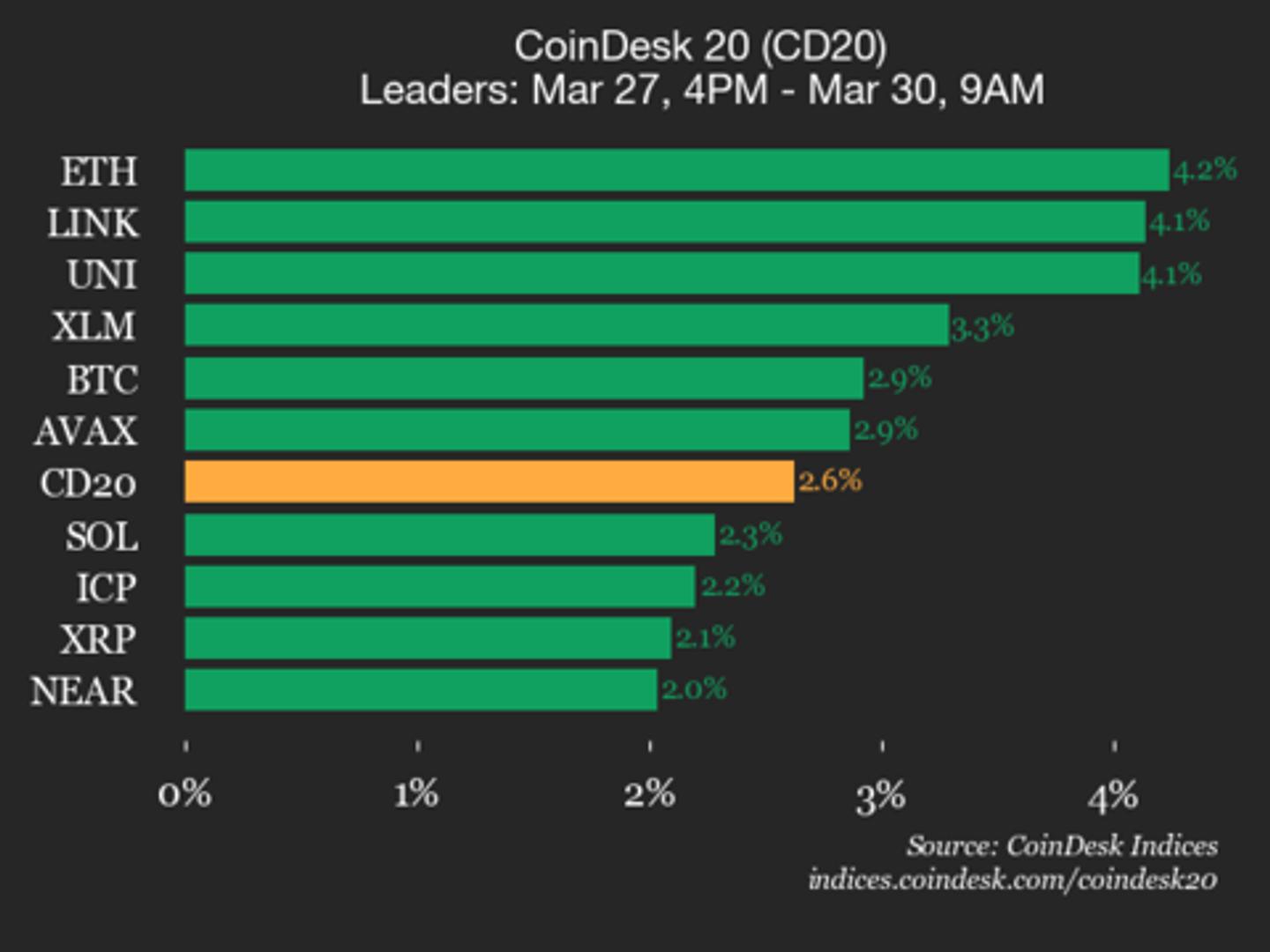
Chainlink (LINK) joined Ethereum (ETH) as a top performer, up 4.1% since Friday.


Aave, one of the largest decentralized lending platforms, debuted its long-awaited v4 upgrade on Ethereum, aiming to push DeFi beyond crypto trading and into broader financial markets.
The upgrade has been in development for about two years and is designed to make it easier to use Aave for a wider range of lending and borrowing activities, including those tied to real-world assets.
The introduction follows months of internal debate over governance and value flow through the protocol. Disputes over interface fees, contributor roles and proposals to redirect product revenue to the decentralized autonomous organization (DAO) have highlighted tensions between decentralization and coordination, even as the work progressed.
At a basic level, v4 changes how Aave organizes its markets. Instead of grouping everything together, the new system allows different types of lending markets to operate separately while still sharing the same pool of funds.
That means users could eventually borrow and lend against more than just crypto tokens.
For Aave Labs founder Stani Kulechov, the shift reflects a broader change in how decentralized finance is evolving. “Lending is based on trust… you need lending conditions that reflect market conditions,” he said in an interview with CoinDesk.
The upgrade is designed to better handle that complexity. By separating different market types while sharing liquidity, Aave aims to support everything from traditional crypto lending to more complex situations like institutional borrowing and real-world assets.
It also opens the door for others to build on top of the protocol more easily.
“It also means that other teams can come and build and expand that infrastructure,” Kulechov said.
Another goal is to make better use of the capital already in the system.
“There’s some technical improvements where the float … can be reinvested,” Kulechov said, referring to idle funds that can now be deployed more efficiently.
The new version went live with a limited set of markets and conservative settings. More features are likely to be added following governance decisions.
“DeFi is stronger than ever,” Kulechov said. “A lot of these opportunities will come from value outside of DeFi.
Read more: Aave labs proposes ‘Aave Will Win’ plan to send 100% of product revenue to DAO

A government app released this week has ignited a debate over location-tracking, data collection and security, with researchers and privacy advocates urging closer scrutiny of the permissions it requests. The White House rolled out the app on Friday, framing it as a direct line to the administration for breaking news, livestreams and policy updates.
Critics say the app’s permission model raises questions about privacy, especially since store listings on Google Play and Apple’s App Store do not display explicit warnings about the requested access. The White House privacy policy describes data handling that appears broader than the app’s stated use, noting it automatically stores information such as the originating IP address and other basic data, and that it may retain subscriber names and email addresses—even though providing that information is not required to use the app.
On its face, the app is marketed as a transparent communications channel, but independent analyses have flagged unusual data-collection aspects, particularly the inclusion of location services in a tool that shows no obvious location-based features such as maps, geofenced content or weather. A software developer who uses the X handle Thereallo, together with Adam, a security engineer and infrastructure architect, identified code that could enable GPS access on the device. They argue that GPS usage in this context is atypical and merits closer examination. For context, their observations have not been independently verified.
Adam noted that the mere presence of location capabilities could introduce risk, particularly if such functionality can be activated by an update or is exploited by a malicious actor. “There is no map, no local news, no geofencing, no events near you, no weather. Nothing in the app that requires location,” he said, underscoring the mismatch between expected use and the permissions being requested.
Security assessment and risk vectors
Thereallo published a deeper analysis suggesting the app could contain code that would allow tracking a device every 4.5 minutes when foregrounded and every 9.5 minutes in the background, though this claim has not been independently validated. The researchers emphasized that while the app still requires permissions, the underlying tracking infrastructure could be activated with a minimal trigger in the right conditions. In addition to GPS data, they flagged the collection of notification interactions, in-app message clicks and phone numbers.
“No servers were probed. No network traffic was intercepted. No DRM was bypassed. No tools were used that require jailbreaking. Everything described here is observable by anyone who downloads the app from the App Store and has a terminal.”
The discussions have also touched on broader security concerns. Adam warned that the app’s security may be vulnerable to interception or manipulation by skilled actors on the same Wi‑Fi network, such as in public spaces, or by users with jailbroken devices capable of runtime modification. He cautioned that the combination of permissive data access and weak defenses could open doors to data leakage or altered behavior if an attacker gains foothold in the device’s communications stack.
Researchers have cited external posts and analyses to support their findings. For example, a detailed security write-up by Thereallo references a decompilation of the app and points to potential telemetry and data-access pathways. Additional context has circulated around accompanying discussions on social media, including posts that surfaced on X.
Policy gaps and broader implications for users and markets
Within the crypto and broader digital-privacy communities, the episode underscores a recurring theme: the trust users place in digital tools—whether a government app or a crypto wallet interface—depends on clear, auditable data practices and minimal, justified permissions. While the White House app is not a crypto product, the situation matters to builders and users who rely on public-facing platforms for custody, identity verification and timely communications. It highlights how privacy-by-design considerations—especially around location data and telemetry—are increasingly front and center for any digital service that touches sensitive information.
From a regulatory perspective, the divergence between what is stated in privacy policies and what is visible in store listings can become fertile ground for scrutiny. Google Play indicates that personal data may be collected during download and use, while Apple’s App Store directs users to the White House privacy policy for further details. The absence of visible, explicit warnings about location permission on the storefronts could be interpreted as a disclosure gap, prompting calls for clearer consent and more transparent user notifications in government apps and similar public-interest deployments.
As policymakers and technologists digest the incident, several questions loom: Why is location access required at all for a news-and-updates app with no geolocation features? Will the administration publish an independent security assessment or a clearer privacy-by-design pledge? And how might these disclosures influence future digital-government projects and the adoption of privacy-enhancing technologies in more sensitive domains?
Industry watchers may also consider the broader market implications. The episode touches on a tension that resonates across the crypto ecosystem: the need for robust, transparent security postures in any platform that handles user data or communications. For users, the key takeaway is to monitor disclosures around permissions and to expect clearer explanations about why location data is being requested, especially for government-run software that arrives with high public visibility.
In the near term, observers should watch how the White House and its contractors respond. Clarifications on the necessity of location permissions, any forthcoming security audits, and possible revisions to privacy disclosures will be important signals about how seriously authorities intend to uphold privacy as public digital services scale.
For readers and market participants, the episode reinforces a practical takeaway: privacy and security commitments in public-facing tech—whether for government apps or crypto services—are only as credible as the transparency and accountability that accompany them. Continued scrutiny and independent testing will likely shape how such apps evolve and how users balance convenience with data safety in an increasingly digital world.
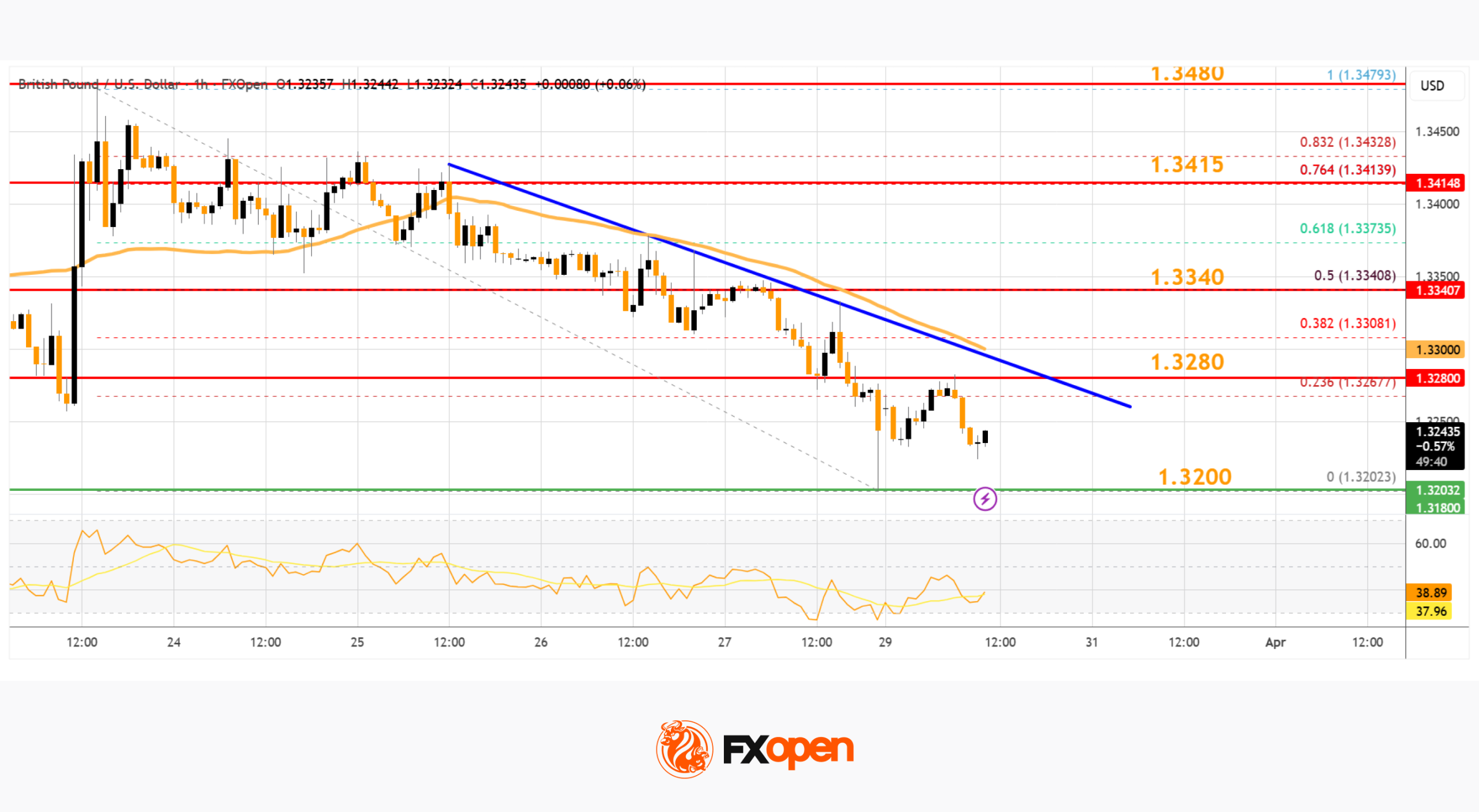
GBP/USD failed to climb above 1.3500 and corrected some gains. EUR/GBP started a decent increase and might aim for more gains above 0.8700.
Important Takeaways for GBP/USD and EUR/GBP Analysis Today
· The British Pound is showing bearish signs below the 1.3400 support.
· There is a key bearish trend line forming with resistance near 1.3280 on the hourly chart of GBP/USD at FXOpen.
· EUR/GBP is gaining pace and trading above the 0.8660 pivot level.
· There is a connecting bullish trend line forming with support at 0.8670 on the hourly chart at FXOpen.
GBP/USD Technical Analysis
On the hourly chart of GBP/USD at FXOpen, the pair failed to stay above the 1.3450 pivot level. As a result, the British Pound started a fresh decline below 1.3400 against the US Dollar.
There was a clear move below 1.3340 and the 50-hour simple moving average. The bears pushed the pair below 1.3250. Finally, there was a spike toward the 1.3200 handle. A low was formed near 1.3202, and the pair is now consolidating losses.
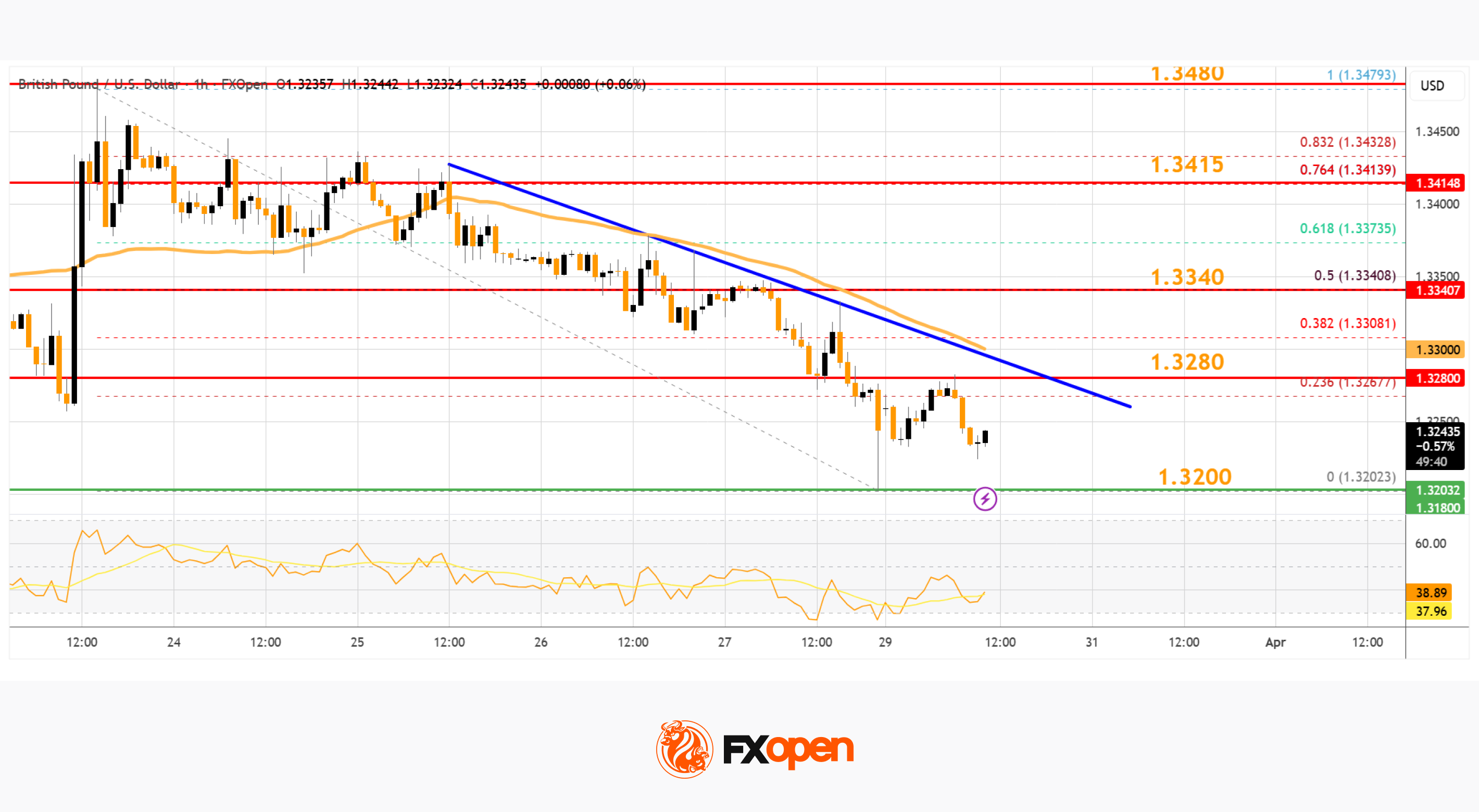
There was a minor move above 1.3240 and the 23.6% Fib retracement level of the downward move from the 1.3479 swing high to the 1.3202 low. On the upside, the GBP/USD chart indicates that the pair is facing resistance near a key bearish trend line at 1.3280.
A close above the trend line might send the pair toward the 50% Fib retracement at 1.3340. If the bulls remain in action, they could aim for more gains.
In the stated case, the pair might rise toward 1.3415. The next major hurdle for GBP/USD sits at 1.3480. On the downside, there is a key support forming near 1.3200. If there is a downside break below 1.3200, the pair could accelerate lower. The next key interest area might be 1.3160, below which the pair could test 1.3120. Any more downside could lead the pair toward 1.3050.
EUR/GBP Technical Analysis
On the hourly chart of EUR/GBP at FXOpen, the pair started a decent increase from 0.8635. The Euro traded above 0.8650 to enter a positive zone against the British Pound.
The pair settled above the 50-hour simple moving average and 0.8660. The pair traded as high as 0.8687 before there was a minor pullback, but the pair stayed above the 23.6% Fib retracement level of the upward move from the 0.8636 swing low to the 0.8687 high.
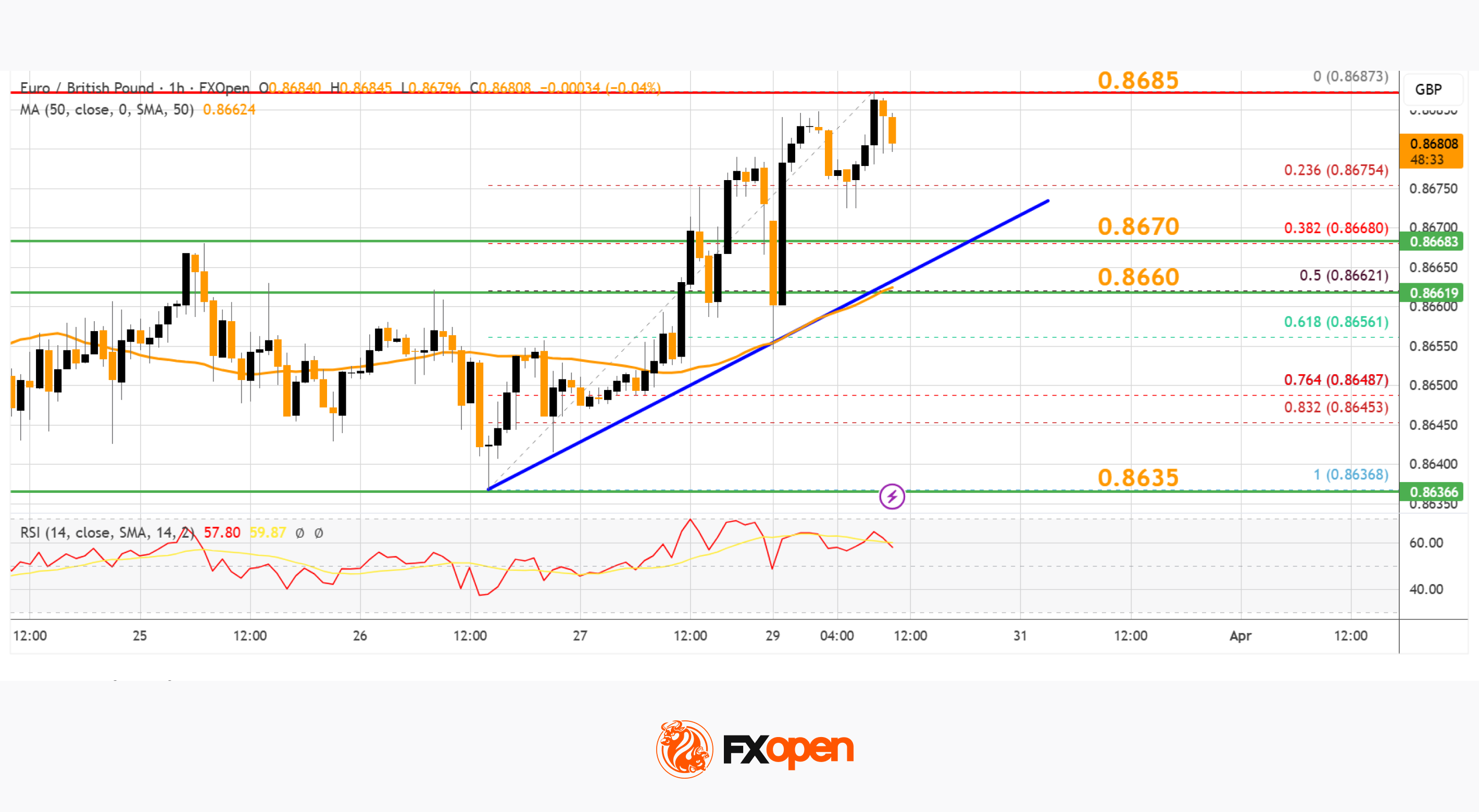
However, the pair is stable above 0.8670. Besides, there is a connecting bullish trend line forming with support at 0.8670.
A downside break below 0.8670 might call for more downsides. In the stated case, the pair could drop toward the 50% Fib retracement level at 0.8660. Any more losses might call for an extended drop toward the 0.8635 pivot zone.
If there is another increase, the EUR/GBP chart suggests that the pair is facing hurdles near 0.8685. A close above 0.8685 might accelerate gains. In the stated case, the bulls may perhaps aim for a test of 0.8700. Any more gains might send the pair to 0.8740.
This article represents the opinion of the Companies operating under the FXOpen brand only. It is not to be construed as an offer, solicitation, or recommendation with respect to products and services provided by the Companies operating under the FXOpen brand, nor is it to be considered financial advice.

Gloria Estefan’s Timely New Documentary Is Officially on Digital [Exclusive]

#bankcharges #banktruth #atmfees #money #finance
Piper Sandler cuts JPMorgan stock price target on lower earnings


-
 NewsBeat5 days ago
Manchester United reach agreement with Casemiro over contract clause amid transfer speculation
-

 News Videos5 days ago
Parliament publishes latest register of MPs’ financial interests
-

 NewsBeat3 days ago
The Story hosts event on Durham’s historic registers
-

 Business4 days ago
Instagram, YouTube Found Responsible for Teen’s Mental Health Struggle in Historic Ruling
-
 NewsBeat5 days ago
Tesco is selling new Cadbury Dairy Milk bar and people can’t wait to try it
-

 Tech7 days ago
Samsung will soon let you control smart home devices from your car’s dashboard
-
 Entertainment2 days ago
Lana Del Rey Celebrates Her Husband’s 51st Birthday In New Post
-

 Fashion6 days ago
Does It Matter What You Wear When You’re Laid Off and Looking?
-

 Business6 days ago
More women enter wealth management, but few in advisory roles: study
-
 NewsBeat7 days ago
Colombian military plane with 110 soldiers onboard crashes following takeoff
-

 Politics7 days ago
How Media Platforms Balance Performance and Accessibility in Image Delivery
-

 NewsBeat6 days ago
Entrepreneurs Forum survey reveals optimism in North East
-
 NewsBeat6 days ago
NASA Artemis II Astronauts enter 14-Day quarantine as moon rocket reaches launchpad
-

 Business6 days ago
Late-paying firms face multimillion-pound fines under new crackdown
-
 Crypto World6 days ago
BTC gives up $70,000 level as markets mull higher interest rates
-

 Sports5 days ago
Fantasy Baseball Week 1 Preview: Top sleeper hitters for both five- and 12-day period led by Munetaka Murakami
-
 Tech4 days ago
Intercom’s new post-trained Fin Apex 1.0 beats GPT-5.4 and Claude Sonnet 4.6 at customer service resolutions
-

 Fashion6 days ago
Coffee Break: Korean Skincare Set
-

 Tech5 days ago
US FCC Prohibits Approval Of New Foreign-Made Consumer Routers
-

 Fashion6 days ago
Althea Mink: Patrice Taylor’s Atlanta Couture Brand Built on Legacy, Resilience, and Architectural Glamour
You must be logged in to post a comment Login