

Crypto World
White House app sparks privacy worries over location data for crypto


A government app released this week has ignited a debate over location-tracking, data collection and security, with researchers and privacy advocates urging closer scrutiny of the permissions it requests. The White House rolled out the app on Friday, framing it as a direct line to the administration for breaking news, livestreams and policy updates.
Critics say the app’s permission model raises questions about privacy, especially since store listings on Google Play and Apple’s App Store do not display explicit warnings about the requested access. The White House privacy policy describes data handling that appears broader than the app’s stated use, noting it automatically stores information such as the originating IP address and other basic data, and that it may retain subscriber names and email addresses—even though providing that information is not required to use the app.
On its face, the app is marketed as a transparent communications channel, but independent analyses have flagged unusual data-collection aspects, particularly the inclusion of location services in a tool that shows no obvious location-based features such as maps, geofenced content or weather. A software developer who uses the X handle Thereallo, together with Adam, a security engineer and infrastructure architect, identified code that could enable GPS access on the device. They argue that GPS usage in this context is atypical and merits closer examination. For context, their observations have not been independently verified.
Adam noted that the mere presence of location capabilities could introduce risk, particularly if such functionality can be activated by an update or is exploited by a malicious actor. “There is no map, no local news, no geofencing, no events near you, no weather. Nothing in the app that requires location,” he said, underscoring the mismatch between expected use and the permissions being requested.
Security assessment and risk vectors
Thereallo published a deeper analysis suggesting the app could contain code that would allow tracking a device every 4.5 minutes when foregrounded and every 9.5 minutes in the background, though this claim has not been independently validated. The researchers emphasized that while the app still requires permissions, the underlying tracking infrastructure could be activated with a minimal trigger in the right conditions. In addition to GPS data, they flagged the collection of notification interactions, in-app message clicks and phone numbers.
“No servers were probed. No network traffic was intercepted. No DRM was bypassed. No tools were used that require jailbreaking. Everything described here is observable by anyone who downloads the app from the App Store and has a terminal.”
The discussions have also touched on broader security concerns. Adam warned that the app’s security may be vulnerable to interception or manipulation by skilled actors on the same Wi‑Fi network, such as in public spaces, or by users with jailbroken devices capable of runtime modification. He cautioned that the combination of permissive data access and weak defenses could open doors to data leakage or altered behavior if an attacker gains foothold in the device’s communications stack.
Researchers have cited external posts and analyses to support their findings. For example, a detailed security write-up by Thereallo references a decompilation of the app and points to potential telemetry and data-access pathways. Additional context has circulated around accompanying discussions on social media, including posts that surfaced on X.
Policy gaps and broader implications for users and markets
Within the crypto and broader digital-privacy communities, the episode underscores a recurring theme: the trust users place in digital tools—whether a government app or a crypto wallet interface—depends on clear, auditable data practices and minimal, justified permissions. While the White House app is not a crypto product, the situation matters to builders and users who rely on public-facing platforms for custody, identity verification and timely communications. It highlights how privacy-by-design considerations—especially around location data and telemetry—are increasingly front and center for any digital service that touches sensitive information.
From a regulatory perspective, the divergence between what is stated in privacy policies and what is visible in store listings can become fertile ground for scrutiny. Google Play indicates that personal data may be collected during download and use, while Apple’s App Store directs users to the White House privacy policy for further details. The absence of visible, explicit warnings about location permission on the storefronts could be interpreted as a disclosure gap, prompting calls for clearer consent and more transparent user notifications in government apps and similar public-interest deployments.
As policymakers and technologists digest the incident, several questions loom: Why is location access required at all for a news-and-updates app with no geolocation features? Will the administration publish an independent security assessment or a clearer privacy-by-design pledge? And how might these disclosures influence future digital-government projects and the adoption of privacy-enhancing technologies in more sensitive domains?
Industry watchers may also consider the broader market implications. The episode touches on a tension that resonates across the crypto ecosystem: the need for robust, transparent security postures in any platform that handles user data or communications. For users, the key takeaway is to monitor disclosures around permissions and to expect clearer explanations about why location data is being requested, especially for government-run software that arrives with high public visibility.
In the near term, observers should watch how the White House and its contractors respond. Clarifications on the necessity of location permissions, any forthcoming security audits, and possible revisions to privacy disclosures will be important signals about how seriously authorities intend to uphold privacy as public digital services scale.
For readers and market participants, the episode reinforces a practical takeaway: privacy and security commitments in public-facing tech—whether for government apps or crypto services—are only as credible as the transparency and accountability that accompany them. Continued scrutiny and independent testing will likely shape how such apps evolve and how users balance convenience with data safety in an increasingly digital world.



Bitmine Immersion (BMNR), the largest publicly-traded Ethereum treasury firm, bought 26,497 ether (ETH) last week, sharply reducing the pace of accumulation after making its largest purchase of 2026 just a week earlier.
The latest acquisition, worth roughly $53 million at current ETH prices, lifted Bitmine’s holdings to nearly 5.42 million tokens, or approximately 4.49% of ether’s circulating supply, according to a Monday company update.
The purchase was down more than 75% from the prior week’s 120,000 ETH haul.
The slowdown comes after Thomas “Tom” Lee, chairman of Bitmine, said in May at Consensus 2026 that the company planned to moderate accumulation as it was rapidly approaching its long-term goal of owning 5% of ETH’s supply.
Despite the slower pace, Bitmine remains one of the few large digital asset treasury firms still actively adding to its crypto holdings. Even Michael Saylor’s bitcoin juggernaut Strategy (MSTR) sold $2.5 million bitcoin last week. Bitmine has acquired more than 1 million ETH since the start of the year and now sits about 90% of the way toward its stated goal of controlling 5% of the network’s supply.
“ETH prices are not reflecting the strengthening of Ethereum fundamentals,” Lee said in Monday’s statement. “But then again, this is not surprising given we are in the early stages of crypto spring.”
Bitmine’s total crypto and cash holdings stood at $11.6 billion as of May 31. In addition to its ETH treasury, the company held 203 bitcoin, $446 million in cash, and stakes in Beast Industries and Eightco Holdings.
The firm has increasingly focused on generating income from its holdings through staking. The company estimates its staking operations generate roughly $258 million in annualized revenue, with projected rewards approaching $300 million annually through its MAVAN staking platform.

Coinbase has activated direct rupee bank rails in India, enabling local users to move money between bank accounts and crypto markets on a single platform. The feature integrates deposits and withdrawals in Indian rupees via the Immediate Payment Service (IMPS) network and unlocks access to spot trading, perpetual futures, and Coinbase’s Advanced Trade interface from one unified interface.
In a blog post published this week, Coinbase outlined that Indian users can now deposit and withdraw INR directly through IMPS while trading across multiple product layers. The move is part of a broader push to deepen Coinbase’s footprint in India, following the company’s regulatory progress and a prior foray into the market that included a brief period of UPI-based rupee deposits in 2022.
The company says the development is anchored by Coinbase’s registration with India’s Financial Intelligence Unit (FIU) earlier in 2025, a step it describes as providing a formal regulatory footing under the country’s anti‑money laundering framework. The registration comes after a tumultuous debut in 2022, when UPI-based rupee deposits were briefly supported before payments authorities distanced themselves from crypto use of the network and partners pulled back.
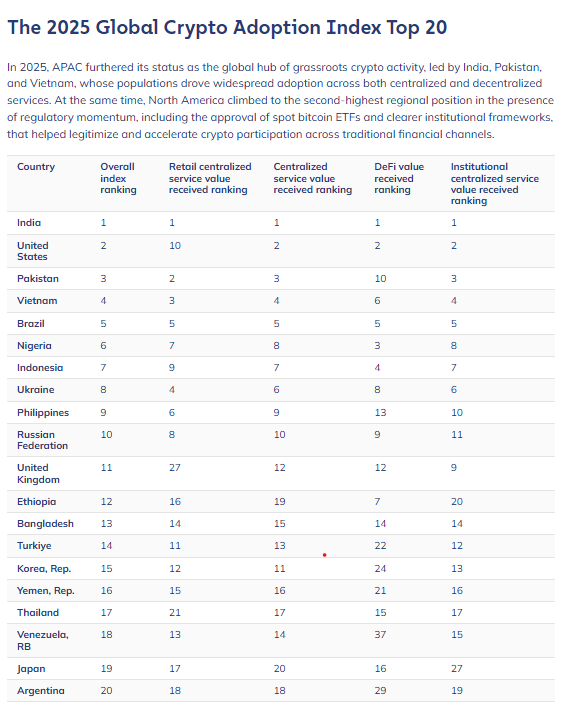
India’s position in global crypto adoption has been a focal point for exchanges seeking to balance regulatory risk with fast-growing user demand. Chainalysis ranked India first in its 2025 Global Crypto Adoption Index, citing strong on‑chain retail activity, centralized exchange use, and a broad array of on-ramp activity—indicators that Coinbase is keen to capitalize on as it expands access to INR rails. The country remains a competitive battlefield, with domestic platforms such as CoinDCX, CoinSwitch, ZebPay and WazirX, alongside global players like Binance and KuCoin, which have historically leveraged fiat-onramps and peer-to-peer channels rather than direct bank rails.
With rupee deposits and withdrawals now live, Coinbase is positioning itself as a bridge between domestic liquidity and its global exchange ecosystem. The firm says the INR order books have been built to support concentrated local liquidity, while users also gain access to Coinbase’s spot markets, perpetual contracts, and the Advanced Trade interface on a single platform. In practice, that means Indian traders can navigate from bank-to-crypto transfers straight into trading without switching apps or networks, a streamlined flow that could shift how retail participants interact with digital assets.
Key takeaways
- Coinbase launches direct INR rails via IMPS in India, enabling bank-to-crypto transfers on a single platform for spot, futures, and Advanced Trade.
- The move follows Coinbase’s FIU registration in March 2025, signaling a formal regulatory foothold for crypto activity in India.
- India tops Chainalysis’s 2025 Global Crypto Adoption Index, underscoring strong domestic activity and potential for continued on‑ramps and liquidity provision.
- Despite regulatory headwinds and tax considerations, India remains a key growth market, with multiple local and international exchanges competing for retail users.
Direct INR rails and what changes for Indian traders
By linking IMPS-enabled INR deposits and withdrawals to its trading rails, Coinbase provides Indian users with a direct bank-to-crypto transfer channel. This reduces friction that previously required converting rupees through third-party gateways or relying on peer-to-peer mechanisms. The platform now supports access to spot markets, perpetual futures, and its Advanced Trade interface, all in a single experience.
Industry observers note that the move could broaden participation among new entrants who are attracted to the convenience of direct rupee onramps, especially in a market where mobile payments and self-directed trading have become widely adopted. While domestic exchanges have long dominated the landscape, the availability of direct INR rails to a global exchange like Coinbase could raise the stakes for liquidity competition and pricing efficiency across Indian crypto markets.
That said, investors should monitor how the INR rails interact with broader regulatory requirements in India, including AML steps and tax rules that shape user behavior. Coinbase’s own disclosures emphasize compliance alignment with local authorities, a necessary condition for sustaining a broad retail onboarding pump in a highly regulated environment.
Regulatory momentum and market context
The March 2025 FIU registration marks a notable milestone in Coinbase’s attempt to formalize its presence in India. The company stated that the registration enables it to offer crypto trading services in the Indian market under the country’s AML framework, a prerequisite that was missing during earlier, more speculative phases of its Indian operation.
India’s policy landscape remains nuanced, with taxes and reporting requirements shaping user incentives. A 30% tax on many digital asset gains and a 1% tax deducted at source on certain transactions have created a complex environment for both retailers and platforms. Despite these constraints, India’s large and digitally engaged population has drawn sustained investment and competition from global and domestic players alike, as reflected in Chainalysis’ 2025 ranking.
Chainalysis highlighted India as the top country in its adoption index, a signal that on-chain activity, exchange usage, and onshore liquidity are formidable forces shaping the trajectory of crypto in the world’s second-most populous nation. For Coinbase and similar platforms, that combination of size and activity creates a compelling case for expanding on‑ramps, liquidity, and product breadth.
Market dynamics: competition, liquidity, and user choice
India’s crypto exchange ecosystem is crowded, with homegrown platforms like CoinDCX, CoinSwitch, ZebPay, and WazirX serving domestic traders, alongside major global players that have sought access via local or cross-border channels. The shift toward direct INR rails could intensify competition for user deposits and trading activity, particularly if Coinbase’s INR liquidity pools and global order books offer improved pricing and deeper liquidity compared with other onramps.
Beyond domestic players, the broader crypto landscape has included P2P rupee access via major exchanges such as Binance and KuCoin. However, the direct IMPS route via Coinbase represents a more traditional banking rail, potentially improving reliability and speed for on- and off-ramps and reducing reliance on quasi-fiat bridges. For users, that could translate into more predictable settlement times and better liquidity visibility across the exchange’s global ecosystem.
What readers should watch next
As Coinbase builds out INR liquidity and expands product access, investors and traders should watch how the Indian market adapts to direct INR rails and evolving regulatory scrutiny. Key questions include: Will direct bank rails attract a broader base of retail participants, and how will Indian regulators respond to expanding on-chain activity linked to global platforms? How will the interplay between tax policy and on‑ramp options shape user behavior and platform competition in the months ahead?
For now, Coinbase’s direct INR rails represent a meaningful step in normalizing bank-to-crypto flows in India, reinforcing the country’s standing as a premier growth hub for crypto adoption and on‑ramp innovation. The next phase will likely hinge on how efficiently the system can scale liquidity, maintain compliance, and navigate the complex regulatory terrain that has already influenced several high-profile market moves in recent years.
As the market watches, Indian users can expect more clarity on how foreign and domestic platforms balance accessibility with compliance, and how this balance will influence the long-term trajectory of crypto usage in one of the world’s most dynamic digital ecosystems. For now, the availability of direct INR rails marks a practical, headline-grabbing improvement in user experience, with potential ripple effects across liquidity, competition, and investor confidence in India’s crypto markets.
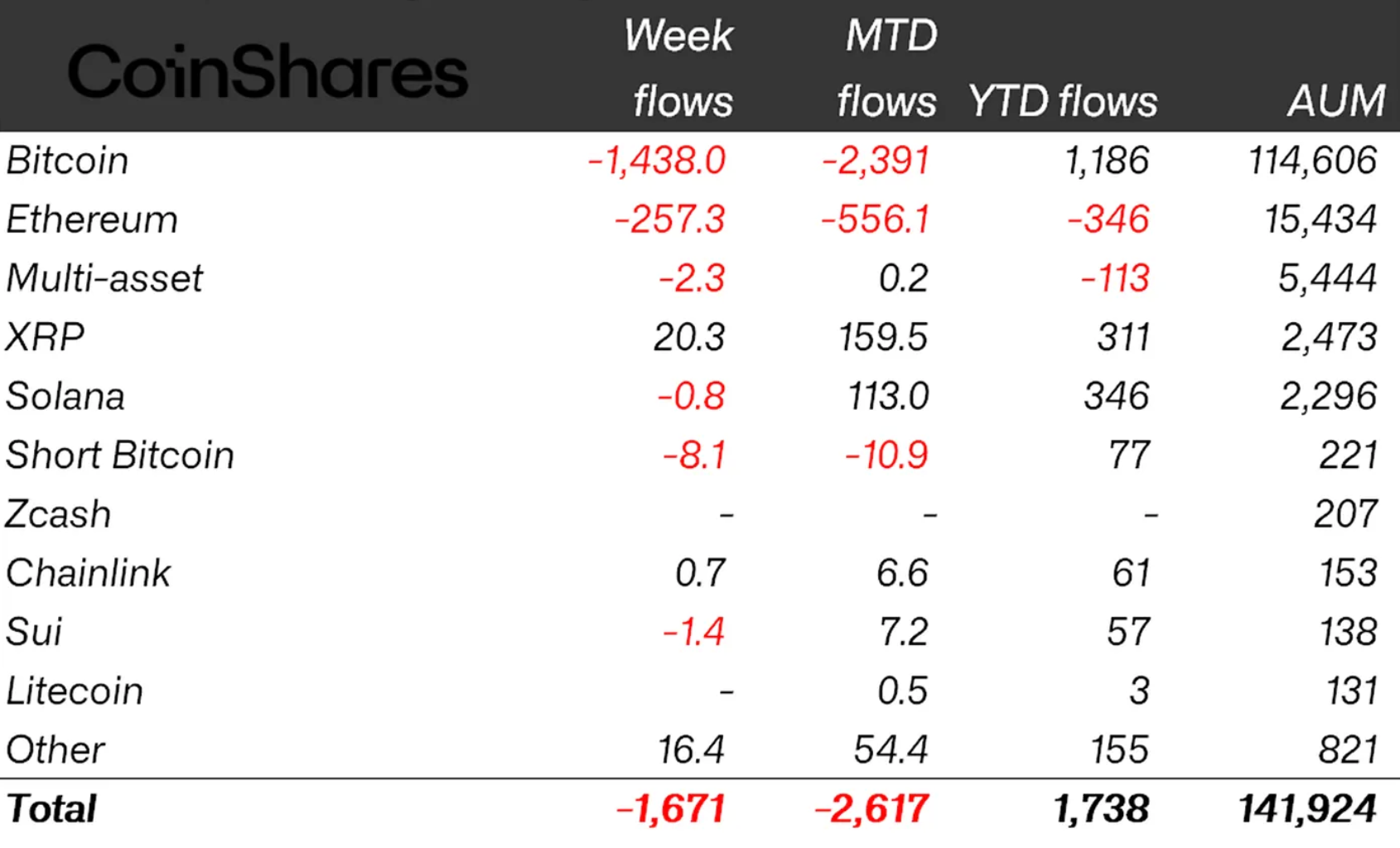
Crypto investment products extended losses to three straight weeks last week amid ongoing selling pressure in markets and limited institutional demand.
Crypto exchange-traded products (ETPs) recorded $1.67 billion in outflows last week, the second-largest weekly withdrawal of 2026, CoinShares reported on Monday.
The fresh outflows bring three-week losses to $4.21 billion, with total assets under management dropping to $141 billion, the lowest level since early April.
CoinShares head of research James Butterfill attributed surging outflows to an Iran-related risk-off move that has now overwhelmed any cushioning effect from CLARITY Act progress. “The pattern is reminiscent of the January-February episode that delivered five consecutive negative weeks,” he said.
Bitcoin sees the largest weekly outflow of 2026
Bitcoin (BTC) ETPs led weekly outflows by a wide margin, with $1.44 billion leaving the funds, marking the largest weekly outflow so far this year.
The funds were $2.4 billion down month-to-date but still had about $1.2 billion in inflows year-to-date, while assets under management fell to $114.6 billion.
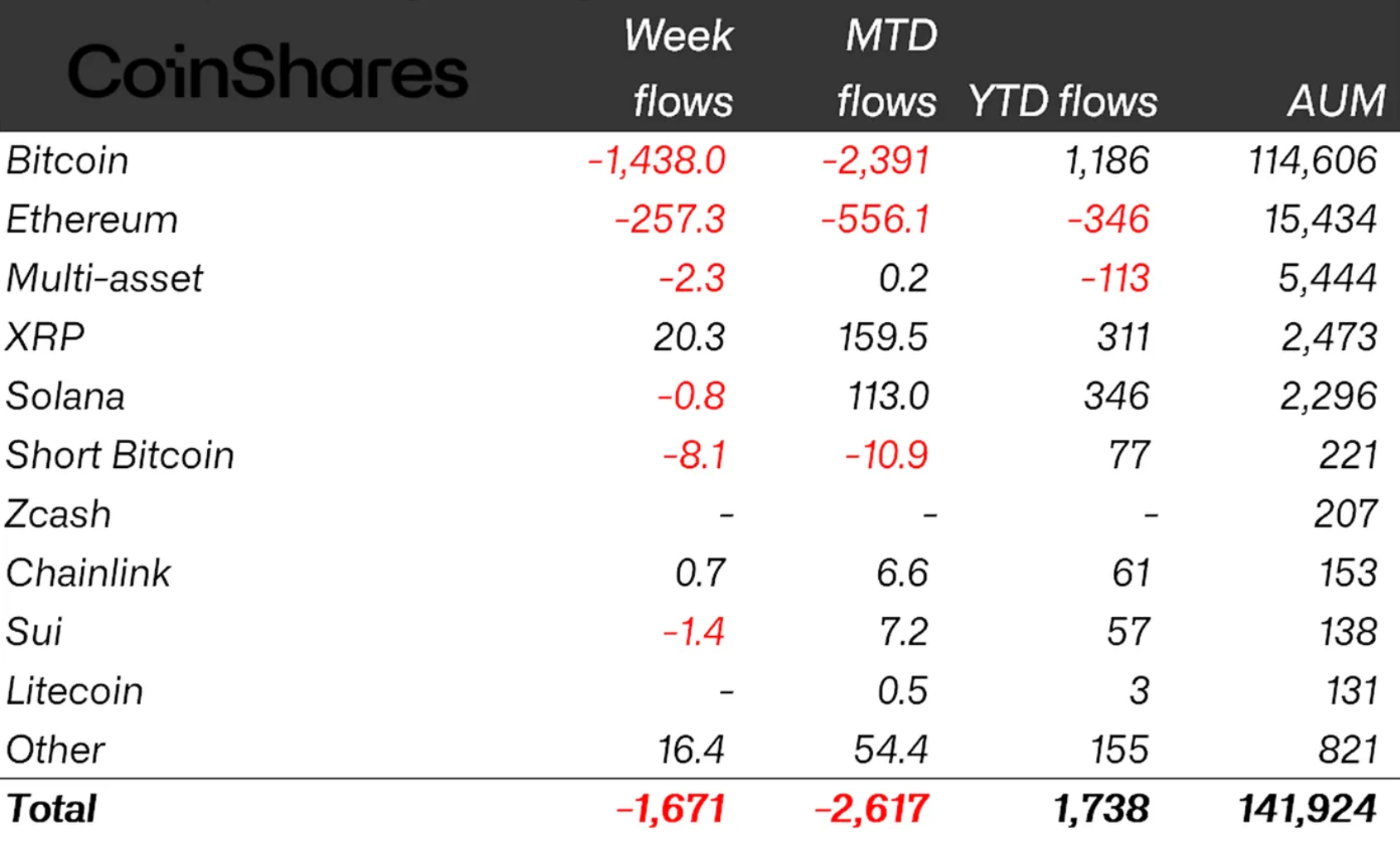
Crypto ETP flows by asset (in millions of US dollars). Source: CoinShares
Ether (ETH) funds continued to see selling pressure with $257.3 million in outflows, bringing year-to-date losses to $346 million.
Altcoin participation also collapsed, CoinShares’ Butterfill said, referring to only five assets recording substantial inflows above $1 million, down from nine a week prior.
XRP (XRP) again led positive momentum with $20.3 million in inflows, while Hyperliquid (HYPE) and Near (NEAR) followed with $10.8 million and $7.6 million, respectively.
US drives losses with $1.63 billion of outflows
Regionally, the United States drove the global outflow story with $1.63 billion of outflows, aligning with $1.42 billion in outflows from US-listed spot Bitcoin exchange-traded funds (ETFs), according to SoSoValue data.
Germany joined the risk-off sentiment with $25.7 million of outflows, while Sweden and Hong Kong saw $6.6 million and $4.5 million in outflows, respectively. The Netherlands again was the only country to see inflows above $1 million, with $1.3 million in inflows, down from $6.6 million a week prior.
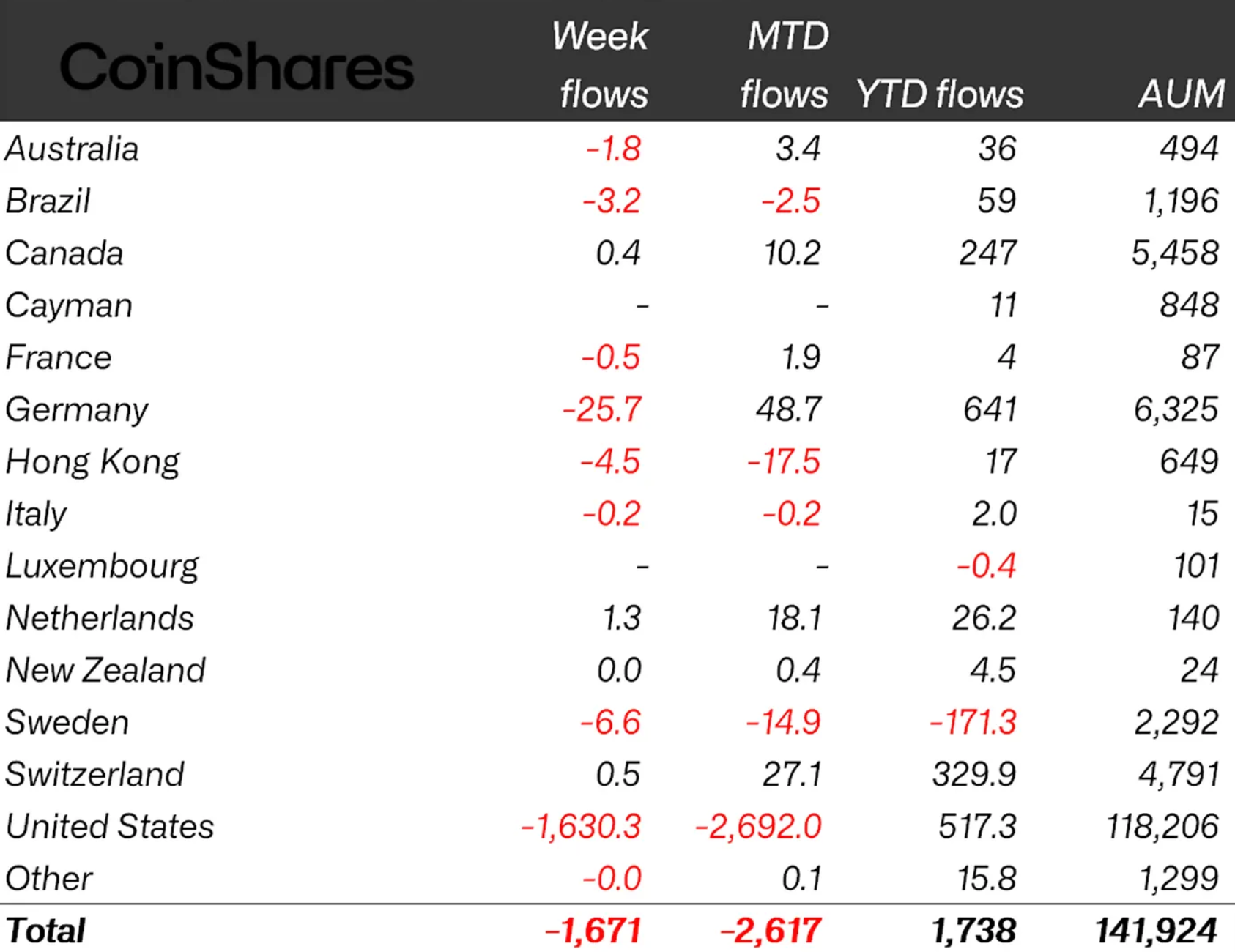
Crypto ETP flows by country (in millions of US dollars). Source: CoinShares
According to the derivatives trading desk at Laser Digital, the crypto sell-off last week came without a clear catalyst and was affected by underperforming equities.
Related: Strategy’s Michael Saylor teases BTC buy with ‘working better’ tweet
The unit cited a lack of demand, including Michael Saylor’s Strategy announcing that it did not purchase any BTC between May 18 and May 24.
“With STRC still trading below par and the continued lack of interest from retail buyers, BTC is expected to remain weak for the time being,” it said in a statement seen by Cointelegraph.
Magazine: HYPE chases $100 target, ETH could dump below $1800: Market Moves


Michael Saylor weeks ago teased that it was coming, but the news for the moment is shocking already depressed crypto markets even further.
Strategy (MSTR) in a Monday morning filing disclosed the sale of 32 bitcoin for $2.5 million. The amount is a rounding error compared to the 840,000-plus BTC held by the company, but it’s nevertheless significant, suggesting even larger sales down the road as Strategy looks to fund dividend payments on its high-yielding preferred stock STRC.
Bitcoin has slipped just below $72,000 on the news, down nearly 3% over the past 24 hours. MSTR shares are lower by 5.15% premarket. U.S. stocks, meanwhile. are set to add to record highs hit last week, with futures on all three major indices in the green.
Importantly, it’s not the first time Saylor and team have sold some of their stack. The company near the bottom of the 2022 bear market sold 704 bitcoin at about $18,000 each.
Bitcoin bulls can only hope the current sales again might be marking a significant bottoming in prices.

Key Highlights
- Kentucky Retirement Systems dramatically expanded its ServiceNow holdings by 400% during Q4, acquiring an additional 51,904 shares valued at approximately $9.94 million.
- Multiple institutional players made substantial position increases, pushing total institutional ownership to 87.18% of outstanding shares.
- Shares began Monday trading at $124.56, trading above the 200-day moving average of $123.39 despite remaining below the 52-week peak of $211.48.
- First quarter revenue surpassed expectations at $3.77 billion compared to the projected $3.75 billion, marking a 22.1% year-over-year increase.
- Analysts maintain a “Moderate Buy” rating with a collective price target of $141.85.
ServiceNow (NOW) shares are capturing significant institutional investor interest, as fourth-quarter 2025 filings reveal a substantial wave of position building and expansion among professional money managers.
Leading the charge, Kentucky Retirement Systems quadrupled its ServiceNow stake to 64,880 shares, representing approximately $9.94 million in value at filing time. This dramatic move signals strong conviction rather than a minor portfolio adjustment.
This bullish sentiment extended across multiple institutions. Peapack Gladstone Financial Corp expanded its holdings by an impressive 505.5%, Florida Financial Advisors increased exposure by 552.9%, and Waterloo Capital grew its position by 384.1%. Meanwhile, Rothschild Wealth initiated a fresh stake valued near $310,000.
Cumulatively, institutional stakeholders now control 87.18% of ServiceNow’s total shares outstanding.
NOW kicked off Monday’s session at $124.56 per share. The stock maintains a position above its 200-day moving average of $123.39, though it continues trading significantly below its 52-week high of $211.48. With a 52-week low of $81.24, the stock has achieved a meaningful rebound from its bottom levels.
The enterprise software giant carries a market capitalization of $128.42 billion alongside a price-to-earnings ratio of 74.23.
First Quarter Results Exceed Expectations
ServiceNow unveiled its Q1 performance on April 22nd, delivering revenue of $3.77 billion that topped the Street’s $3.75 billion estimate. This figure reflects a robust 22.1% year-over-year expansion.
Earnings per share reached $0.97, aligning precisely with analyst projections. The comparable quarter in the prior year produced EPS of $0.81. Looking ahead to the complete fiscal year, the analyst community currently projects earnings of $2.36 per share.
The company achieved a net margin of 12.59% coupled with an 18.16% return on equity.
Street Ratings and Executive Trading
Wall Street maintains a generally optimistic stance on ServiceNow shares. Citigroup elevated its price objective from $154 to $158 while maintaining a “Buy” rating. Evercore increased its target from $140 to $150 with an “Outperform” designation. BTIG reaffirmed its “Buy” recommendation with a $150 target. DA Davidson sustained its “Buy” rating with the most aggressive target at $190. Cantor Fitzgerald adjusted its target downward to $122 but preserved an “Overweight” rating.
Among 43 monitored analysts, the distribution stands at: two Strong Buy ratings, 35 Buy ratings, five Hold ratings, and one Sell rating. The average price target comes to $141.85.
Regarding insider transactions, Director Paul Edward Chamberlain divested 1,500 shares on May 14th at $87.23 each, trimming his stake by 3.23%. Insider Paul Fipps sold 1,048 shares on May 18th at $98.51 apiece, representing a 7.99% reduction. Both transactions occurred through predetermined Rule 10b5-1 trading plans. Fipps executed his sale specifically to satisfy tax liabilities associated with vesting equity compensation.
Collectively, company insiders disposed of 28,071 shares totaling roughly $2.53 million over the past quarter. Executive and board ownership represents merely 0.34% of the company.



Strategy (MSTR) sold 32 bitcoin between May 26 and May 31 at an average net price of $77,135 a coin, totaling $2.5 million, the company disclosed in an 8-K filing on Monday.
Bitcoin briefly dropped under the $72,000, per CoinDesk data, with over $90 million in BTC-tracked futures positions liquidated shortly on the move.
The disposal is Strategy’s first disclosed bitcoin sale and the proceeds are earmarked to fund distributions on its preferred stock, according to a footnote in the filing.
In addition, for the week, Strategy raised $128.3 million through its at-the-market (ATM) common stock program and allocated a small portion of the proceeds to increase its U.S. dollar cash reserve from $871 million to $900 million. After depleting a substantial portion of its cash holdings $1.5 billion of its 2029 convertible notes.
The company held 843,706 bitcoin at an average purchase price of $75,699 as of May 31, putting the sale price above its blended cost basis but also above where bitcoin was trading on Monday below $72,000 per CoinDesk data.


Seemingly every company is obsessed with artificial intelligence these days, whether it’s how the technology is transforming their industry or the effects it’s having on employees and customers.
But the degree to which companies are utilizing AI tools internally and adapting to a rapidly changing reality varies dramatically. A new study from AI-Driven Enterprise Institute (AIDE) breaks down how well S&P 500 companies — and their leaders — are adopting AI compared to their peers.
The top performers, unsurprisingly, are centered in the tech industry, according to the data, which was shared with CNBC. In looking at four areas — literacy, advocacy, orientation and implementation — AIDE gave each company a score of up to 100 in the four categories and then provided an overall index score.
In technology, the highest company score (the average of the orientation and implementation pillars) and the only 100, went to chipmaker Nvidia, which has become the world’s largest company by selling the chips and systems that have powered the development of AI models and services. Meta and Amazon also scored 100, but in the S&P 500, those companies are considered communication services and consumer discretionary names, respectively.
The only other 100 company score went to energy producer SLB, formerly Schlumberger. The next highest scorer was retailer Walmart, followed by AES and NextEra Energy, which are both classified as utilities.
The new open-source index draws from publicly available data like earnings call transcripts, job openings and patent applications to measure how much executives know and say about AI, as well as how much their companies are prioritizing the technology and bringing it into daily operations.
The data doesn’t measure whether AI is driving financial returns, but it’s meant to give leaders an objective way to compare their strategy to their peers without relying on self-reported surveys, said Paul Cheek, AIDE’s CEO and a senior lecturer at Massachusetts Institute of Technology.
“When a board asks a CEO — ‘How are we doing compared to our peer group?’ — I don’t want it to be speculative,” Cheek said in an interview. “I want there to be some data that they can use to back up what they have to share.”
Cheek said there’s “significant room for improvement” for board members and executives to increase their own AI literacy, adding that boards need to better understand AI “as it relates to the ability to manage risk and strategic investments in the organizations that create value for all of us.”
Here are the the 20 companies with the top company scores, based on their “orientation” and “implementation” scores:
- Nvidia (100)
- Schlumberger (100)
- Amazon (100)
- Meta (100)
- Walmart (95.84)
- AES (95.46)
- NextEra Energy (95.44)
- Ecolab (95)
- Digital Realty (94.74)
- Chevron (94.74)
- Alphabet (94.72)
- Equinix (94.59)
- IQVIA (93.75)
- Dow (93.34)
- Halliburton (92.83)
- Broadridge Financial Solutions (91.66)
- Microsoft (91.37)
- Block (90.91)
- Duke Energy (90.91)
- PepsiCo (90.62)
These companies were at the top of their sector based on the “AIDE Index”:
WATCH: Meta reshapes workforce as AI disrupts entry level hiring

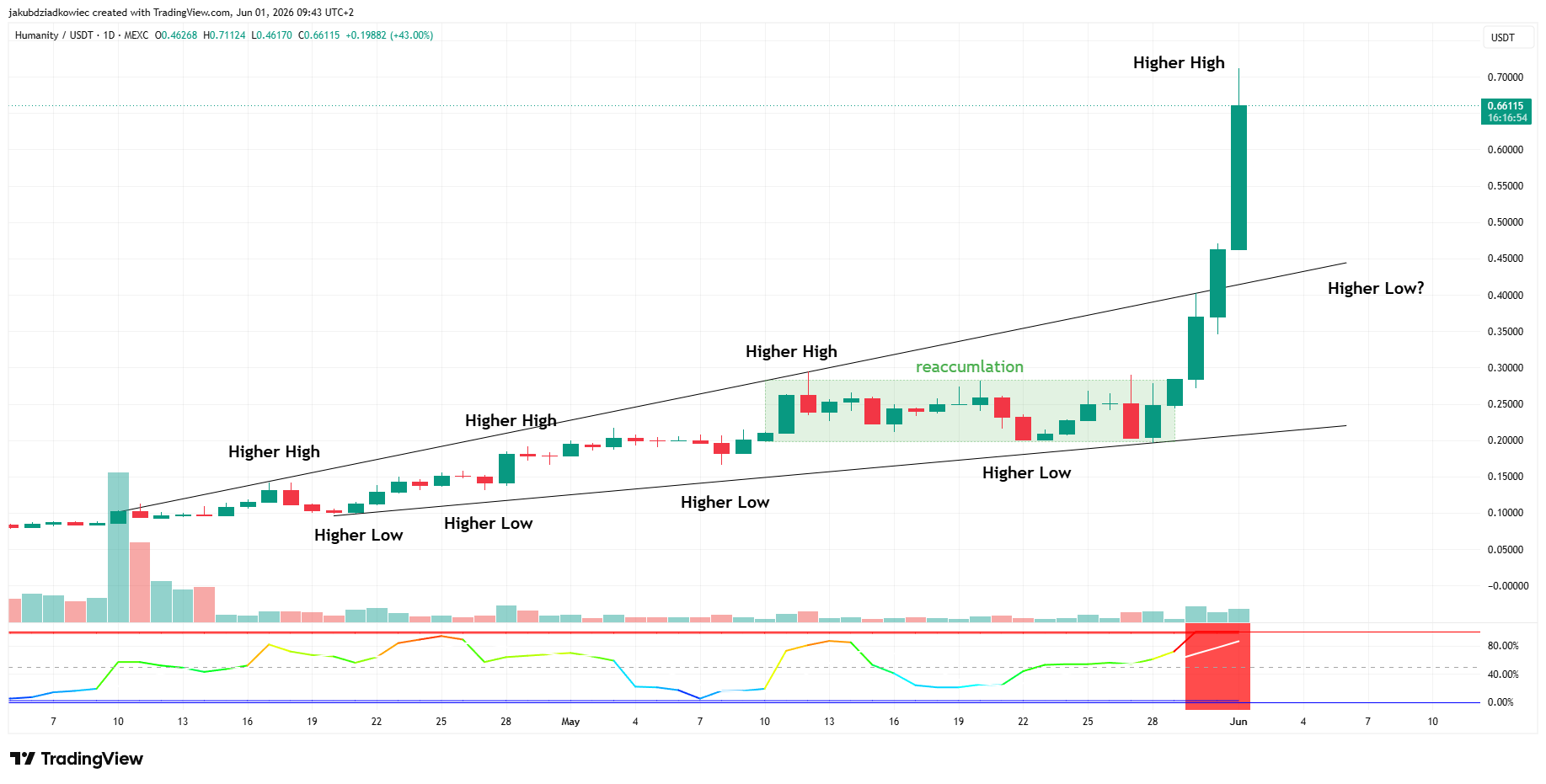
Humanity (H) price jumped more than 65% over the past 24 hours, pushing past $0.65 and setting a new all-time high above $0.68. The move added the token to a wider AI-themed rally sweeping crypto markets on June 1.
H now trades around $0.65 with a market cap of $1.18 billion, ranking 65th by capitalization. The token has gained 172% over the past week and roughly 237% over the past 30 days, based on current market data.
AI Sector Rally Lifts H Alongside Worldcoin and FET
The H rally fits inside a broader AI token move that pushed Humanity, Worldcoin (WLD), Fetch.ai (FET), and Venice Token (VVV) into the day’s top gainers list. Funds rotated into AI-linked tokens as risk appetite improved across equities.
Falling bond yields, softer oil prices, and renewed enthusiasm around upcoming AI-related tech IPOs added fuel to the speculative bid. The sector has tracked the strength of large-cap AI equities over the past 24 hours.
No project-specific catalyst surfaced from Humanity Protocol’s official channels. The move looks driven by sector rotation rather than a discrete announcement such as a listing or protocol upgrade.
Weekly Chart Shifts Into Price Discovery
H has broken cleanly above its October 2025 record high and now trades in price discovery on the weekly timeframe. The weekly Relative Strength Index (RSI) sits at 84, deep inside overbought-bullish territory.
The first two Fibonacci extension targets at 1.272 and 1.618 have already been printed. Price reached both during the current weekly candle, leaving the next upside zones open.

The 2.0 Fibonacci extension sits at $0.75, with the 2.618 target near $0.97. Both align with measured-move logic from the breakout structure.
On the downside, the 0.786 Fibonacci retracement at $0.32 marks the strongest visible support if the rally cools.
Daily Broadening Pattern Drives Volatility Expansion
The daily chart shows H trading inside a broadening formation that has produced higher highs and higher lows since mid-April 2026. The structure widens as price advances, a classic late-stage trend signature.
A roughly three-week reaccumulation phase from May 10 to the end of May built the platform for the current expansion. Price traded inside a tight range before the breakout fired.

Bollinger Band Width Percentile (BBWP) has flashed red over the past three sessions. The reading marks an extreme volatility regime and historically precedes either continuation spikes or sharp mean-reversion candles.
If sellers force a pullback, the next higher low projection sits near $0.43. That level would preserve the broadening structure on the daily timeframe.
Social Volume Spikes as Attention Floods H
Santiment data shows Humanity’s Social Volume and Social Dominance both climbing into the rally. The H/USD line accelerated steeply while social mentions hit their highest readings of the past three months.
Social Dominance reached 0.071, signaling that H captured an outsized share of crypto conversations relative to its market cap. Sentiment-tracking accounts on X assigned the token a 9 of 10 bullish confidence score.

Larger commentators have framed H as a top performer across the majors and highlighted its move past the $1 billion market cap line. That kind of attention tends to pull in short-term momentum traders and breakout chasers, much like the recent move in Worldcoin.
Humanity (H) Price Prediction Levels to Watch
The bullish path keeps H pointed at the 2.0 Fibonacci extension at $0.75 and the 2.618 extension near $0.97. Both targets sit within the current price discovery zone.
A failure to hold the daily structure shifts focus to the $0.43 higher-low projection. A deeper retracement would test the 0.786 Fibonacci support at $0.32, where buyers defended the prior breakout base.
The rally still lacks a discrete fundamental catalyst, which leaves the trade dependent on AI sector flows and chart-driven demand. Traders looking further out can weigh longer-term Humanity forecast scenarios alongside the live structure.
Whether H sustains its breakout depends on whether sector momentum and social attention hold firm through the next few daily candles.
The post Humanity (H) Surges 65% to Record High on AI Token Rally appeared first on BeInCrypto.
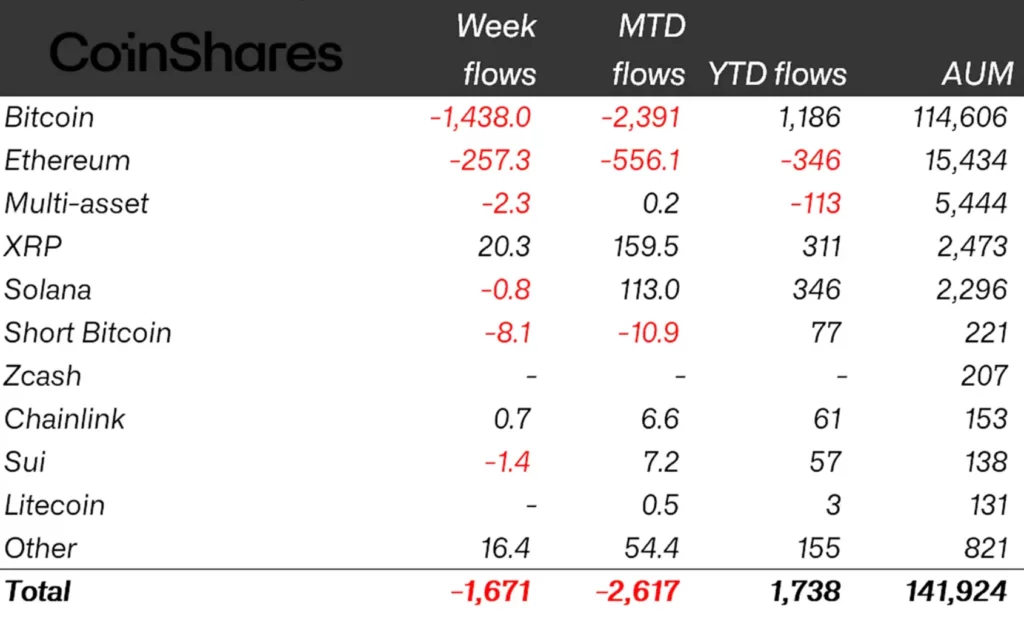
Crypto investment products recorded $1.67 billion in outflows last week, extending their losing streak to three weeks as Bitcoin funds saw their largest exit of 2026.
Summary
- Crypto ETPs recorded $1.67 billion in outflows, extending losses to three straight weeks globally now.
- Bitcoin funds led the selling with $1.44 billion withdrawn, their largest weekly outflow of 2026.
- XRP, Hyperliquid and Near attracted inflows, but altcoin participation narrowed sharply across markets last week.
Digital asset exchange-traded products posted their second-largest weekly withdrawal of 2026, according to CoinShares. The latest pullback took three-week outflows to $4.21 billion.
Total assets under management fell to $141 billion, the lowest level since early April. The data shows weaker demand from institutional investors after several weeks of pressure across crypto markets.
“The pattern is reminiscent of the January-February episode that delivered five consecutive negative weeks,” CoinShares head of research James Butterfill said.
Butterfill linked the selling to an Iran-related risk-off move that outweighed any support from progress around the CLARITY Act. The report said the pullback remained concentrated in major crypto investment products.
Bitcoin leads weekly selling
Bitcoin ETPs recorded $1.44 billion in outflows, the largest weekly Bitcoin withdrawal so far in 2026. Bitcoin products were down $2.4 billion month-to-date.
The asset still had about $1.2 billion in year-to-date inflows. Bitcoin fund assets under management fell to $114.6 billion after the latest withdrawals.
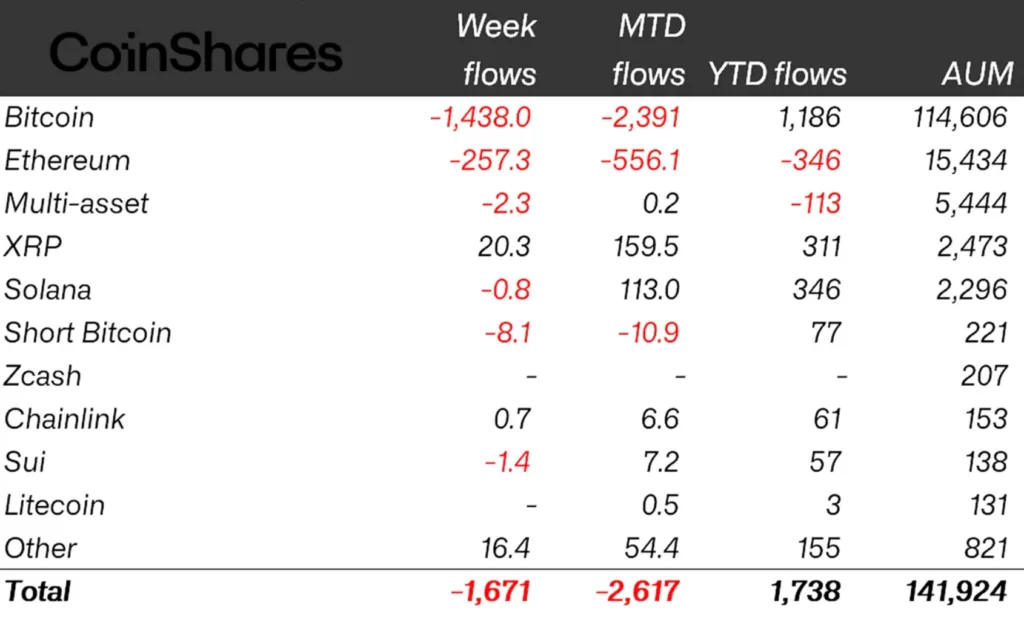
Ether products also stayed under pressure. ETH funds lost $257.3 million during the week, taking year-to-date outflows to $346 million.
Altcoin demand narrowed sharply. CoinShares said only five assets posted inflows above $1 million, down from nine assets a week earlier.
U.S. products drive global exits
The United States accounted for most of the selling, with $1.63 billion in outflows. That matched heavy withdrawals from U.S.-listed spot Bitcoin ETFs during the same period.
Germany recorded $25.7 million in outflows. Sweden and Hong Kong also saw withdrawals, while the Netherlands was the only market with inflows above $1 million.
XRP led the few positive assets with $20.3 million in inflows. Hyperliquid followed with $10.8 million, while Near added $7.6 million.
This showed that some investors still targeted selected altcoin products. However, the broader market remained tilted toward exits.
Earlier inflows give wider context
As previously reported by crypto.news, crypto ETFs saw strong inflows in April, with Bitcoin, Ethereum, and XRP products attracting fresh capital. That earlier rebound has now weakened.
Separate earlier coverage also showed crypto investment products drawing more than $1 billion in weekly inflows in March, when Bitcoin and Ethereum led demand.
The latest CoinShares data marks a clear change from that earlier buying. Bitcoin now accounts for most of the pressure, while Ether funds and several regional markets also remain weak.
The next weekly fund flow report will show whether the outflow streak extends toward the five-week pattern seen earlier this year or whether demand returns after the latest sell-off.
Coinbase has enabled direct rupee bank rails in India, making it easier for local customers to move money between bank accounts and crypto markets on the exchange as the company deepens its push into one of the world’s fastest-growing digital asset markets.
Indian users can now deposit and withdraw Indian rupees via the Immediate Payment Service (IMPS) instant payments network and access spot markets, perpetual futures and the company’s Advanced Trade interface through a single platform, according to a company blog post published Sunday.
The move marks Coinbase’s latest push to expand its presence in India since a troubled 2022 debut and follows the company’s registration with India’s Financial Intelligence Unit, giving it a formal regulatory footing in the market.
In 2022, Coinbase briefly supported Unified Payments Interface (UPI)-based rupee deposits before halting them days after launch, after payments authorities distanced themselves from crypto use of the network and partners stopped enabling UPI for the exchange.
Related: Coinbase brings global crypto derivatives markets to US institutional clients
Coinbase registered with India’s Financial Intelligence Unit in March 2025, a step the company said enables it to offer crypto trading services in India under the country’s Anti-Money-Laundering (AML) framework.
India first in global crypto adoption index
Coinbase is wading into a crowded but strategically important arena, where domestic platforms such as CoinDCX, CoinSwitch, ZebPay and WazirX already serve Indian traders.
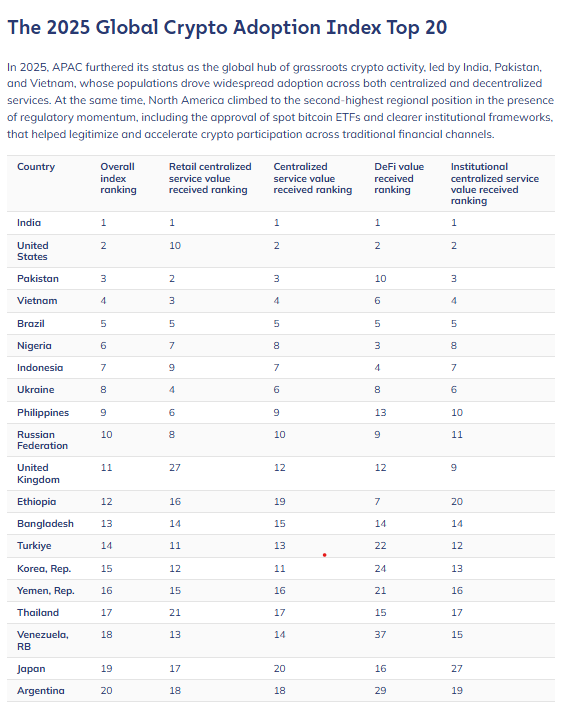
Chainalysis Global Crypto Adoption Index, 2025. Source: Chainalysis
Global exchanges such as Binance and KuCoin are also widely used, but have largely relied on crypto-only or peer-to-peer rupee access, rather than the kind of direct, IMPS-based bank rails Coinbase is now offering.
With rupee deposits and withdrawals now live, Coinbase is providing Indian users direct bank-to-crypto transfers in addition to spot trading, perpetual futures and its Advanced Trade platform, and says it has built local INR order books for concentrated domestic liquidity alongside access to its global exchange.
India has emerged as a key prize for global exchanges despite policy headwinds, including a 30% tax on many digital asset gains and a 1% tax deducted at source on certain transactions.
Chainalysis ranked India first in its 2025 Global Crypto Adoption Index, ahead of 150 other countries, based on factors such as retail onchain activity, use of centralized exchanges and decentralized finance protocols, and transaction volumes, illustrating the scale of grassroots usage that platforms like Coinbase are trying to tap.
Magazine: Guide to the top and emerging global crypto hubs — Mid-2026

Bitmine (BMNR) slows ether (ETH) purchase pace, buying $53 million in tokens

9 Years Later, A24’s 113-Minute Masterpiece Seeks Redemption on Streaming

Gradfest 2026 – Celebrating Emerging Talent at The Lir Academy


-

 NewsBeat5 days ago
Israel says it has killed new Hamas military leader in Gaza City airstrikes
-

 Tech5 days ago
NASA taps Blue Origin to deliver lunar rovers for Moon Base initiative
-

 Politics7 days ago
Bridgerton Season 5: Cast, Release Date And Everything We Know So Far
-

 Sports6 days ago
2026 NBA Finals schedule, odds: Knicks await Thunder or Spurs after winning East
-

 News Videos5 days ago
XRP *JUST* SUCCEEDED!!!! CLARITY ACT EXPOSED!!! (SHE EXPOSED IT)
-

 News Videos3 days ago
This is BROKEN! INSANE 5x MONEY CAR WASH WEEK! The NEW GTA Online UPDATE Today! (GTA5 New Update)
-
 Crypto World6 days ago
Micron Crosses $1 Trillion Market Cap as AI Demand Reshapes Memory Sector
-
 NewsBeat7 days ago
Hottest May day ever as London hits 34.8C in 2C leap from previous records
-

 Business5 days ago
Selena Gomez Reportedly Upset Over Benny Blanco’s Comments on Her ‘Terrible’ Diet
-
 Tech6 days ago
China assigns ID codes to 28,000+ humanoid robots
-

 Business7 days ago
Nikkei 225 Surges Past 65,000 for First Time as Iran Peace Hopes Fuel Record Rally
-

 Tech7 days ago
Microsoft’s quiet Claude Code retreat and the real cost of enterprise AI
-

 Tech3 days ago
Waymo dominates autonomous vehicle registrations as Tesla trails behind
-
 Entertainment7 days ago
‘Breaking Bad’ Star’s Easy-to-Binge 6-Part Crime Series Spin-Off Is Finally Heading to Free Streaming
-

 NewsBeat7 days ago
Crowds find riverside shade in York as temperatures soar
-
Tech5 days ago
The Samsung pay deal is the moment Korean unions changed register
-
 Tech2 days ago
SpaceX just won a second Golden Dome contract. This one is $4.16 billion.
-

 Entertainment6 days ago
Days of our Lives 2-Week Spoilers May 25-June 5: Gwen Rages, Abe Confesses & 2 Tragic Anniversaries!
-

 Tech7 days ago
Westone Audio and Etymotic Acquired by Fidelity Collective in Major IEM Market Move
-
 Entertainment6 days ago
Taylor Swift Fans Label Travis Kelce’s Beer-Chugging A ‘Red Flag
You must be logged in to post a comment Login