
Crypto World
The Iran War Revealed Bitcoin’s Second Use Case: Why Price Targets Need Revising

Bitwise Chief Investment Officer Matt Hougan says Bitcoin’s (BTC) rally since the Iran war began is not a fluke. It reflects a structural repricing of BTC as both digital gold and a currency.
The argument centers on a framework Hougan calls “two bets in one.” For five years, the market has priced Bitcoin almost exclusively as a store of value. Iran’s decision to collect crypto tolls at one of the world’s busiest shipping lanes suggests a second, far larger use case is now in play.
Bitcoin Isn’t Just Digital Gold Anymore, And the Price Targets Haven’t Caught Up
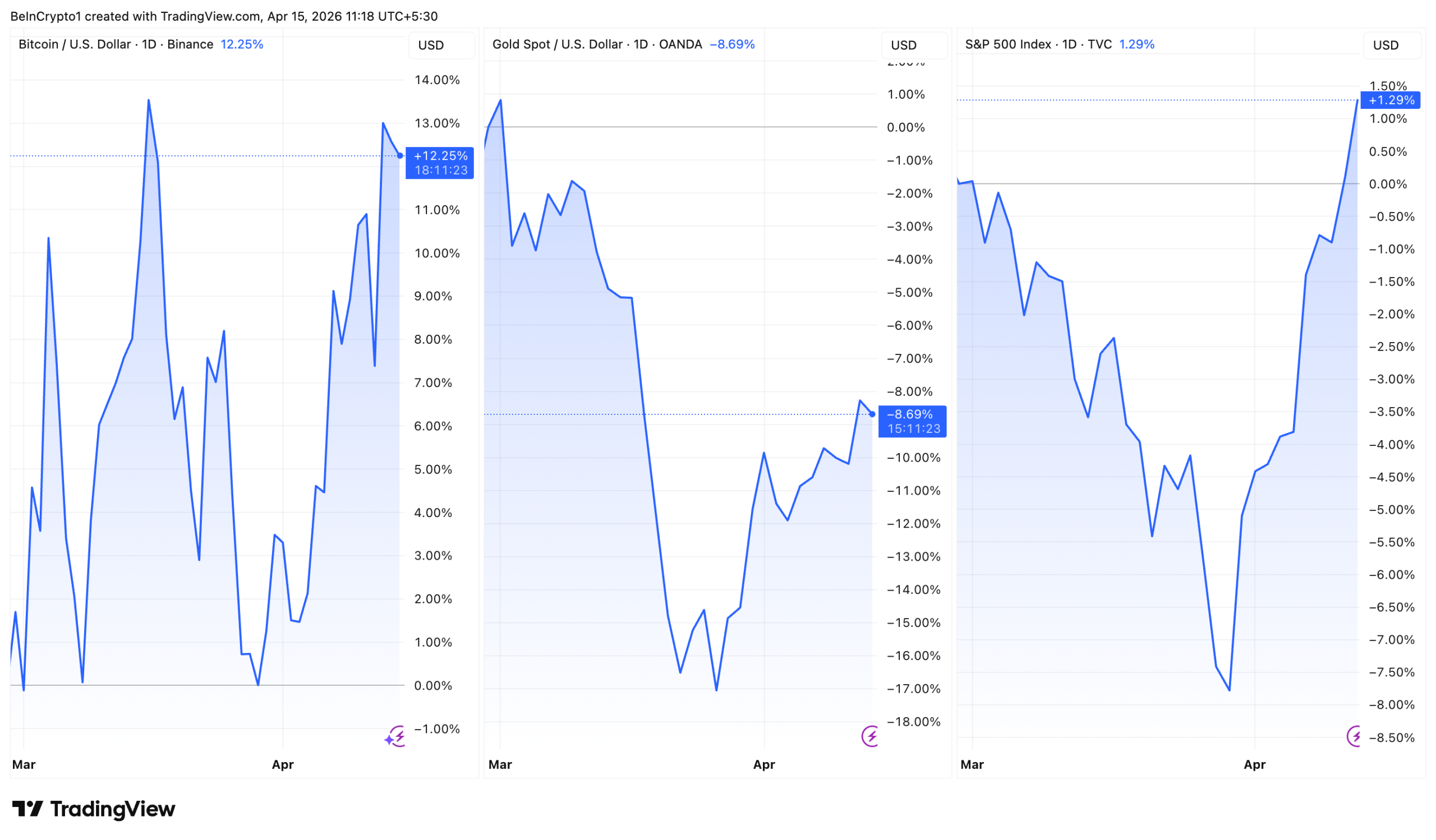
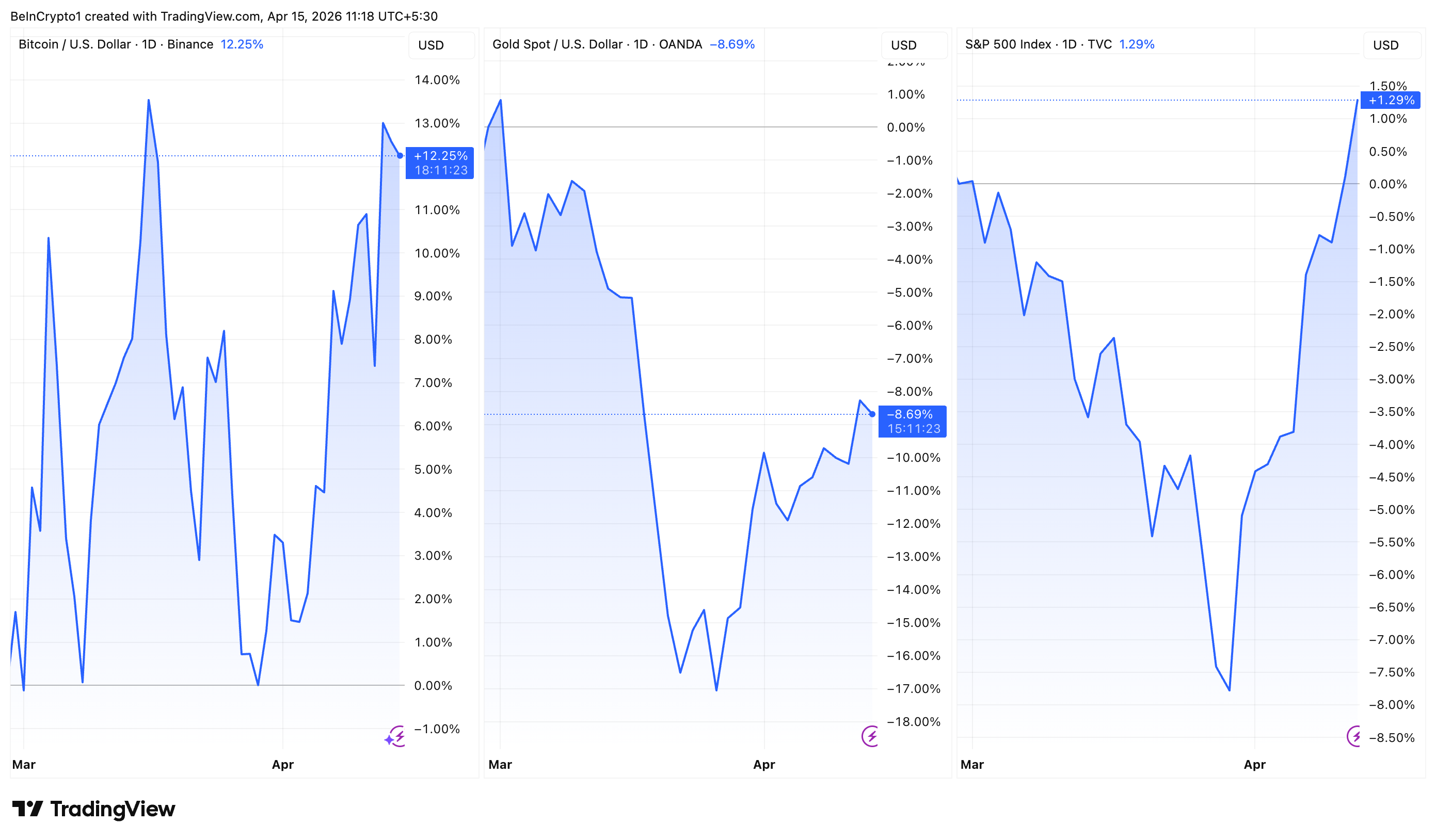
In a recent post this week, Hougan pointed to BTC’s strength amid the war. Bitcoin has rallied 12.25% since the US and Israeli airstrikes on Iran began on February 28.
The cryptocurrency has vastly outperformed gold (down 8.69%) and the S&P 500 (up just 1.29%), defying expectations that BTC would sell off as a risk asset during geopolitical turmoil.
“Some have argued that geopolitics is irrelevant for bitcoin, while others have pointed out that war often leads to money printing, which tends to boost bitcoin in the long term. Both arguments are wrong. Bitcoin’s strength during this crisis stems directly from the conflict itself,” he said.
Hougan argued that every Bitcoin buyer is making two simultaneous wagers. The first is the familiar digital gold thesis.
“You’re betting that bitcoin will become ‘digital gold’ and compete with physical gold in the $38 trillion ‘store of value’ market. That’s bitcoin’s current use case, and I consider it a very attractive bet. As I’ve explained here in the past, bitcoin can reach $1 million by capturing just 17% of this market over the next decade,” he added.
But the second bet is where things get interesting. It hinges on the possibility that Bitcoin “might act like a traditional currency.”
“I’ve historically thought of this second bet as an out-of-the-money call option: a speculative bet on an unlikely future,” Hougan remarked.
Until recently, that idea seemed remote. However, Hougan pointed to the 2022 decision by the US, the European Commission, France, Germany, Italy, the UK, and Canada to remove selected Russian banks from SWIFT.
In response, countries like China developed alternative financial systems, with Russia shifting nearly all its transactions to these networks.
“I mused at the time that the weaponization of SWIFT might one day open up space for bitcoin: If countries grew reluctant to deal in dollars, it stood to reason that they might prefer an apolitical alternative at some point. And indeed, during the Iran conflict, we saw one of the earliest (and more uncomfortable) examples of this happening,” Hougan explained.
Subscribe to our YouTube channel to watch leaders and journalists provide expert insights
Iran’s Bitcoin Toll Activated the Currency Thesis
BeInCrypto reported that Iran planned to collect a $1-per-barrel toll on ships transiting the Strait of Hormuz, payable in Bitcoin. The move raises sanctions compliance concerns. However, according to Hougan,
“At the same time, it points to a reality that transcends the current conflict: In a world where countries have weaponized their financial rails, bitcoin is emerging as an apolitical alternative.”
Hougan framed BTC’s potential as a currency through options pricing theory. An out-of-the-money call option gains value when two things happen: the probability of hitting the strike price improves, or volatility in the underlying market increases.
The Iran conflict delivered both. The probability of Bitcoin functioning as a currency jumped with Iran’s toll system. In addition, the volatility of the global monetary order spiked.
Hougan argued that this perspective highlights two key implications for Bitcoin’s trajectory. For one, it suggests the asset could gain during periods of geopolitical tension, especially in regions caught between the US and Chinese spheres. It also indicates that Bitcoin’s potential market extends well beyond gold’s $38 trillion valuation.
“We’ve spent the past five years talking about bitcoin exclusively as a ‘store of value.’ If bitcoin starts to take on a dual role as both a store of value (like gold) and an actual currency (like the dollar), we may need to revise our targets higher,” Hougan stated.
Thus, the five-year “store of value” narrative served Bitcoin well. What comes next could dwarf it.
Follow us on X to get the latest news as it happens
The post The Iran War Revealed Bitcoin’s Second Use Case: Why Price Targets Need Revising appeared first on BeInCrypto.

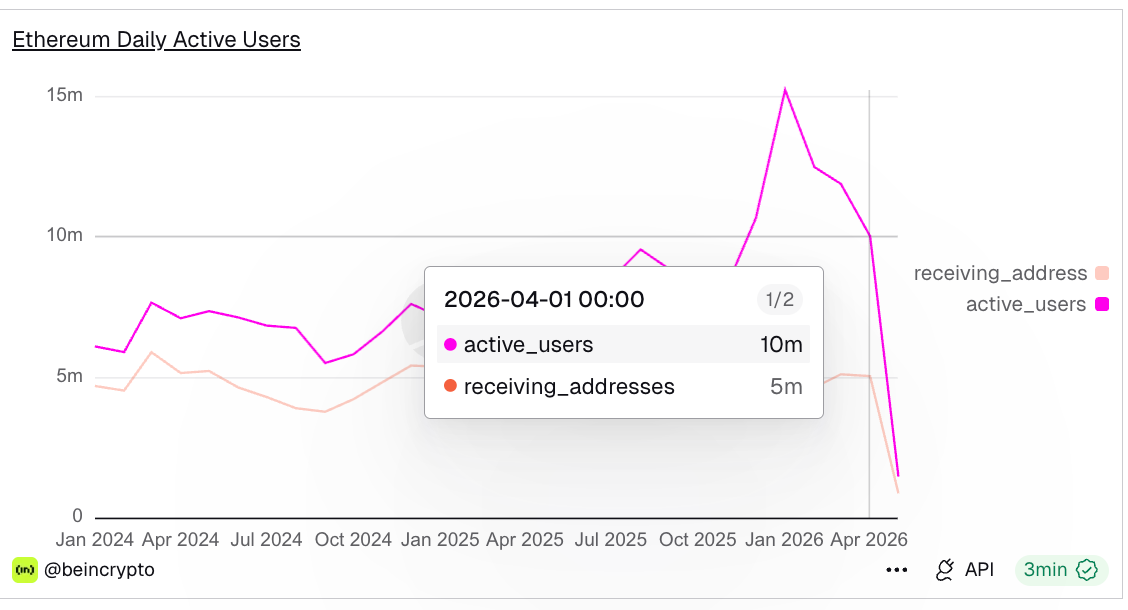
The Ethereum price has rallied 15% over the past month, but the on-chain story has quietly turned bearish. Active users dropped 33% from the January peak. Average gas sits at the lowest sustained reading in two years.
Volume has trended lower even as price climbed. And on May 1, exchange net position change pivoted from accumulation to distribution. The rally is showing up on price. The network is signaling something different.
Ethereum’s Network Demand Has Quietly Collapsed?
Three structural data points frame the network picture heading into May.
Want more token insights like this? Sign up for Editor Harsh Notariya’s Daily Crypto Newsletter here.
Daily active users on Ethereum peaked at 15 million in January 2026, per BeInCrypto’s exclusive Dune dashboard. By April, that figure had fallen to 10 million. The 33% three-month drop matters because of its velocity, not its resting point. The 10 million reading is still higher than the 6 to 7 million baseline that held during the July 2024 spot ETF launch. The momentum reversal is the signal.

The second data point is gas. Average gas prices on Ethereum sit at roughly 1 gwei, the lowest sustained reading since early 2024 when the metric peaked at 49 gwei. Low gas is not always user-friendly feature. It is a measure of demand for block space, and it directly weakens the EIP-1559 burn mechanism that creates supply pressure on ETH. Less activity means less ETH burned, which means less deflationary support for the Ethereum price.

The third data point comes from the price chart itself. Since February 6, Ethereum has traded inside a parallel rising channel. Price has steadily climbed. Volume over the same window has trended lower. That bearish volume divergence means the rally is being carried by progressively less buying conviction, even as price extends. Moreover, the ascending channel forms after a near 50% dip from the mid-January highs. This makes the pattern way less bullish than usual.

The pieces add up to one observation. The Ethereum price is rising. The network supporting that price is not.
Exchange Flows Just Confirmed What the Network Was Already Signaling
The clearest validation that the network weakness is now bleeding into price action sits in Glassnode’s Exchange Net Position Change data, a metric that tracks net flow of ETH into and out of exchange wallets.
For most of April, the metric was deeply negative. ETH was leaving exchanges at a steady pace. Each red bar represented withdrawals from exchange wallets into self-custody, a classic accumulation signal. Through April 28, daily outflows averaged roughly 300,000 ETH.
Then it flipped.
On May 1, exchange net position change turned positive. By May 4, 60,449 ETH had moved into exchanges. The pivot from sustained accumulation to fresh distribution is the kind of pattern shift that historically precedes price weakness. Holders who were absorbing supply through April have started to send tokens back to exchanges, which is where they get sold.

The historical precedent reinforces the read. The last time Ethereum rallied with a similar fundamental setup, July 2024, ETH dropped 40% within days of the spot ETF launch. The cause then was the same as now. Institutional flows lifted price without organic network demand to support it. Active users were flat at 6 to 7 million, as shown by the image shared earlier. Gas was low. The rally fizzled within weeks.

The April 2026 setup matches that template. Active users have collapsed from January’s peak. Gas is at multi-year lows. Volume on the price chart has thinned. And exchange flows have just confirmed that holders are starting to take chips off the table.
The network gave the warning. The exchanges are now the confirmation.
Ethereum Price Levels Show Where the Rally Has to Prove Itself
Ethereum (ETH) trades at $2,383 inside a parallel rising channel that has guided price higher since February 6. That channel followed a 48.81% drop from the January peak of $3,407 to the February low of $1,747. The current rally is a recovery attempt, not a continuation.
The first test sits at $2,466. A daily close above this level brings ETH closer to the channel’s upper trendline and gives the rally room to validate itself with the volume the chart has been missing. Without that close, the structure stays compressed and the bearish on-chain signals from active users, gas, and exchange flows get the chance to translate into price weakness.

The downside levels are stacked tightly. Holding $2,074.57, the 0.236 Fibonacci level, keeps Ethereum inside the channel. A break of $2,074 cracks the channel and exposes $1,831, the 0.382 Fibonacci level. Below $1,831, the path opens to $1,747, the February low, and $1,635, the 0.5 Fibonacci level.
The level math is asymmetric. Upside requires reclaiming $2,466 with volume the chart has not delivered. Downside, if the channel cracks, opens a path back to the February lows. A daily close above $2,466 weakens the bearish on-chain thesis. A close below $2,074 confirms it.
The post The 15% Ethereum Rally Hides a Network Problem That Just Reached Exchanges appeared first on BeInCrypto.
Figure Technology Solutions is advancing its strategic pivot from being a pure home equity line of credit (HELOC) originator to a broader platform that integrates blockchain infrastructure and AI-powered credit markets. Bernstein Securities reaffirmed an Outperform rating on Figure (FIGR) with a $67 price target, implying roughly 67% upside from current levels and signaling confidence in the company’s transition beyond traditional lending.
In the brokerage note published Tuesday, Bernstein highlighted a momentum shift under way, underscored by April loan volumes totaling $1.34 billion—up 108% year over year and marking the second consecutive month above $1 billion. The firm argues that tokenization—converting loans into on-chain, tradable assets that can settle in real time—could unlock a much larger addressable market than standard HELOC lending, aligning Figure with broader trends in tokenized credit and real-world assets.
Key takeaways
- Bernstein reiterates an Outperform rating on FIGR with a $67 target, signaling potential upside of about two-thirds from current levels.
- The research argues that Figure’s shift toward tokenized credit and AI-driven markets could access a much larger market than its legacy HELOC business.
- April loan volumes reached $1.34 billion, up 108% year over year, the second straight month above $1 billion, with growth expected to continue.
- Bernstein projects total loan volumes could climb to $16.5 billion by 2027 from $8.4 billion in 2025, reflecting a multi-year growth trajectory.
- Tokenized credit remains a small slice of the real-world asset (RWA) market today, but several players are building toward broader adoption, including Figure’s Hastra ecosystem and peers like Centrifuge.
Figure’s pivot: from HELOC originator to a tokenized credit and DeFi-enabled platform
The note frames Figure’s evolution as a deliberate expansion beyond traditional HELOC lending into a platform designed to support a broader spectrum of credit markets. Central to this shift is the tokenization of loans—turning consumer and business debts into on-chain instruments that can be traded and settled in real time. Bernstein views tokenized credit as a way to unlock liquidity, improve risk transfer, and accelerate settlement cycles for lenders and investors alike.
Figure’s Hastra ecosystem embodies this broader vision, integrating tokenized credit products—such as auto loans—into decentralized finance (DeFi) and related capital markets. By embedding tokenized credit inside a blockchain-enabled framework, Figure aims to connect traditional lending with on-chain liquidity, potentially boosting fund flows and diversification for both retail and institutional participants.
Tokenized credit: a nascent, multi-trillion opportunity amid early adoption
Bernstein’s analysis points to a sizable addressable market for tokenized credit, estimated at around $4 trillion in annual origination across multiple loan categories, including mortgages, auto loans, HELOCs, and small-business lending. That figure underscores a long runway for platforms like Figure to broaden activity beyond the company’s core HELOC heritage.
In parallel, the broader real-world asset (RWA) space remains relatively small today. Industry data cited by Bernstein puts the tokenized credit market at about $5.5 billion, highlighting the gap between current adoption and the longer-term growth trajectory forecast by the firm. The potential, however, is clear: as more asset classes are tokenized and brought onto-chain, Figure could play a significant role in linking traditional credit with DeFi liquidity channels.
The broader ecosystem has begun to test these connections. For instance, Centrifuge has expanded its DeFi platform to include tokenized credit and U.S. Treasury products on new blockchain networks, signaling a broader industry push toward institutional-grade assets within DeFi. Such developments provide a proof point that the tokenized-credit thesis—while still in early days—has a credible pathway to scale.
Within Figure’s strategy, the Hastra program is cited as a concrete avenue for expanding tokenized credit products, particularly auto loans, into on-chain markets. This direction aligns with a growing trend of using tokenized consumer and commercial debt to improve liquidity and risk sharing across decentralized platforms.
What this means for investors and builders in crypto finance
The trajectory outlined by Bernstein suggests that investors should watch two key dimensions: the pace of loan-portfolio growth and the rate at which tokenized credit assets gain on-chain liquidity and price discovery. If the April momentum—$1.34 billion in loan originations, up 108% YoY—continues and scales toward Bernstein’s 2027 target, Figure could demonstrate tangible progress from a traditional lender toward a versatile credit-platform model.
Beyond Figure, the broader tokenized-credit story remains a work in progress. The current market size indicates substantial headroom if on-chain settlement, liquidity, and compliance frameworks mature. Observers will be watching how regulatory developments, custody solutions, and institutional participation influence the speed and breadth of adoption in tokenized credit markets.
For builders, the example set by Centrifuge and Figure’s Hastra initiative highlights a path for tokenized credit products to bridge real-world assets with DeFi ecosystems. The ongoing experimentation across mortgages, auto loans, and other indebtedness points to a future where on-chain credit could become a standard liquidity layer for non-traditional borrowers and asset classes.
As Figure navigates this transition, investors will need to monitor not only headline loan volumes but also the quality of onboarding, risk controls, and the ability to convert on-chain liquidity into meaningful, tradable instruments. The open question remains how quickly tokenized credit will reach mainstream liquidity, how regulators will respond to expanded on-chain securitization, and whether the current growth trajectory can withstand macro headwinds.
In the near term, the key data point to watch is loan origination velocity and the trajectory of Hastra-enabled products. If the pace of originations sustains its current speed and tokenized offerings gain broader market acceptance, Figure could move closer to Bernstein’s optimistic outlook. However, given the nascent stage of tokenized credit, investors should balance potential upside with the uncertainties inherent in early-stage on-chain asset markets.
Readers should keep an eye on further disclosures from Figure and its partners as the company scales tokenized credit offerings, alongside independent assessments of market adoption and risk management frameworks in tokenized lending.
Figure Technology Solutions remains at a crossroads of traditional lending and on-chain finance, a junction where near-term momentum and long-term strategic clarity will determine whether tokenized credit becomes a core driver of value for Figure and its ecosystem.

Key Takeaways
- Q1 2026 revenue reached $1.63B, surging 85% annually and exceeding analyst projections
- Adjusted earnings per share landed at $0.33; annual guidance upgraded to $7.65–$7.66B range
- Government segment delivered $687M, surpassing forecasts; U.S. commercial segment at $595M fell short
- Shares declined approximately 7%, hovering around $136, marking a 23% year-to-date retreat
- Extreme valuation metrics persist with 232x trailing P/E and 78x price-to-sales multiple
Shares of Palantir (PLTR) tumbled roughly 7% Tuesday following the company’s otherwise impressive Q1 2026 financial results, as Wall Street zeroed in on underwhelming commercial segment performance and eye-watering valuation metrics.
Palantir Technologies Inc., PLTR
The data analytics giant traded around $136 during midday sessions, slipping beneath both its 50-day moving average of $145.40 and its 200-day moving average of $164.26. Year-to-date losses now stand at 23%, representing a significant pullback from the 52-week peak of $207.52.
First-quarter revenue totaled $1.63 billion, reflecting an 85% year-over-year expansion that exceeded Wall Street’s consensus. Adjusted earnings per share registered at $0.33. The company simultaneously boosted its full-year revenue outlook to a range of $7.65–$7.66 billion.
This marks the eighth consecutive quarter where the company has surpassed both earnings and revenue projections—a remarkable achievement few enterprises can claim.
Government Segment Shines While Commercial Underdelivers
The government division emerged as the clear winner, generating $687 million in revenue and handily exceeding the $610.5 million analyst consensus.
The challenge emerged from the commercial business. U.S. commercial revenue totaling $595 million landed below expectations, proving sufficient to trigger negative sentiment immediately following the release.
Palantir had previously projected U.S. commercial revenue growth of at least 115% throughout fiscal 2026. The Q4 2025 period saw this segment expand 137% year-over-year to $507 million, establishing elevated expectations heading into this quarter.
CEO Alex Karp previously characterized Palantir’s Rule of 40 metric as “an incredible 127%,” positioning the enterprise as “an n of 1.” Tuesday’s earnings release maintained this positioning without reservation.
Valuation Multiples Remain Stratospheric
Despite exceptional growth metrics, the stock commands a trailing price-to-earnings ratio of 232x, a forward P/E of 112x, and a price-to-sales multiple reaching 78x.
Industry competitors including Snowflake, ServiceNow, and Microsoft also trade at elevated valuations—yet none approach Palantir’s price-to-sales premium.
This valuation disconnect became the focal point for skeptical investors Tuesday, even as broader technology sector sentiment remained generally supportive.
Rosenblatt Securities reaffirmed its optimistic $225 price objective, highlighting Palantir’s ontology platform as critical enterprise AI infrastructure. The Street’s consensus price target currently stands at $180.68.
Analyst coverage remains divided: 19 Buy recommendations, 10 Hold ratings, and 2 Sell calls. Recent insider transaction activity has skewed heavily toward selling, with 72 net sell transactions recorded.
Interestingly, Polymarket participants had assigned a 99% probability to PLTR declining on May 5, even prior to the earnings announcement—an unusual instance where prediction markets anticipated the negative reaction.
Reddit community sentiment shifted from neutral toward bullish territory following the earnings beat, registering a score of 60. However, the broader composite sentiment indicator measured 57.01, reflecting a 5.54-point decline over the trailing seven-day period.
Technical analysts are monitoring the $130 price level as critical support heading into the week’s conclusion.

Crypto World
Dogecoin Whales Just Accumulated $18 Million in 96 Hours: Is the $0.13 Breakout Finally Coming?
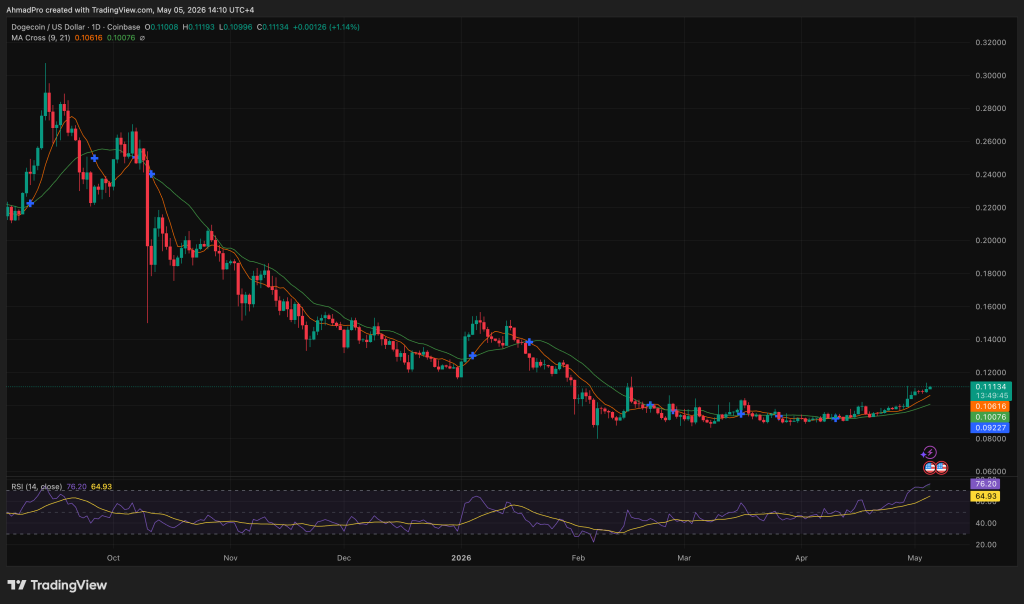
Dogecoin whales just moved with conviction. Over a 96-hour window ending May 4, large holders accumulated roughly 160 million DOGE, approximately $18 million worth, pushing the memecoin above the $0.11 resistance level that had capped its price for months.
The accumulation was first flagged by analyst Ali Martinez on X and subsequently confirmed by on-chain data from Santiment.
Large-holder balances rose from 17.82 billion to 18.15 billion DOGE across that 96-hour stretch, whales now control roughly 11% of circulating supply.
Price responded sharply: DOGE surged from $0.1075 to $0.1119 in a single high-volume burst. Open interest in DOGE futures climbed nearly 30% to $1.77 billion over the past week, with the long/short ratio hitting 1.8, meaning the derivatives market is decisively leaning bullish.
Bitcoin reclaiming $80,000 provided macro tailwinds, but the DOGE move looks self-propelled. Both the MACD and Stochastic RSI flashed buy signals on TradingView simultaneously, a confluence that traders rarely ignore.
Can Dogecoin Price Hit $0.13 This Week?
DOGE is in a strong short-term structure right now, holding above multiple key EMAs, which is a bullish signal. The volume spike to around $2B adds weight, that is, real participation, not just noise.
The missing piece is the 200-day EMA. Until DOGE reclaims that, the trend is improving but not fully flipped.
$0.109 is the key support. As long as that holds, the structure stays bullish and keeps the path open higher.

On the upside, $0.12 is the next major level, and clearing it opens the move toward $0.13.
The risk is momentum overheating. RSI is already elevated, so a pullback toward $0.10 is possible before continuation.
Most likely, DOGE either consolidates between $0.109 and $0.12 or pulls back slightly before pushing higher.
So this is a bullish setup with strong volume, but it needs either a cooldown or a clean break above resistance to keep expanding.
Maxi Doge Could Skyrocket if DOGE Sustains This Pump
DOGE at $0.11 is still a solid trade, but the reality is the asymmetry is gone. At a ~$16B market cap, even strong moves tend to be measured rather than explosive.
That is why some traders rotate earlier, looking for setups where the move has not happened yet.

Maxi Doge is getting attention in that lane. It is a meme token built around trading culture, featuring staking, competitions, and a treasury designed to support liquidity and growth. The presale is around $0.0002816 with roughly $4.76M raised, showing steady traction.
The appeal is clear; it is early, narrative-driven, and positioned where traders look for higher upside.
But it is still a presale. Liquidity is not guaranteed, execution matters, and volatility can be extreme once it launches.
So the trade-off is simple: DOGE offers a more established but limited upside at this stage, while something like Maxi Doge offers earlier positioning with higher potential, but significantly higher risk.
The post Dogecoin Whales Just Accumulated $18 Million in 96 Hours: Is the $0.13 Breakout Finally Coming? appeared first on Cryptonews.


Solana co-founder Anatoly Yakovenko said a major upgrade to the network, dubbed Alpenglow, is expected to arrive as soon as this year, potentially within the next quarter, marking what he described as a pivotal step in the blockchain’s technical evolution.
“So the Alpenglow release is basically due sometime this year, I think next quarter,” Yakovenko said during a fireside panel at Consensus Miami 2026. “That, to me, is this exciting step in the evolution of the protocol.”
In simple terms, Alpenglow is about making Solana faster, more predictable and more secure at its core. Blockchains like Solana rely on a network of computers to agree on the order of transactions. Today, that process can introduce delays or uncertainty depending on network conditions.
Alpenglow aims to tighten those guarantees. Yakovenko described a system where transaction confirmations approach the physical limits of how fast information can travel, essentially, near the “speed of light” around the globe. For users and developers, that means quicker finality (knowing a transaction is permanently settled) and a more reliable foundation for building applications.
He framed the release of Alpenglow as a transition from Solana’s early innovations to a more mature phase focused on guarantees around performance and reliability.
The upgrade builds on Solana’s original design, which emphasized high throughput, like the ability to handle large volumes of transactions, but shifts focus toward consistency and timing precision. That matters for financial applications, where milliseconds can affect trading, payments or other time-sensitive activity.
If successful, Alpenglow could strengthen Solana’s pitch as infrastructure for global-scale financial systems, where both speed and certainty are critical.
“That, to me, is this exciting step in the evolution of the protocol,” Yakovenko said.
Read more: Solana Set for Major Overhaul After 98% Votes to Approve Historic ‘Alpenglow’ Upgrade

Lionel Bonaventure | Afp | Getty Images
Coinbase became the latest tech company to announce a round of layoffs Tuesday morning, blaming artificial intelligence for altering the company’s operations. Prediction markets traders think the fintech company is yet another sign of what’s to come among technology providers.
Traders on Kalshi give a 92% chance to more tech layoffs in 2026 than in 2025, when they job losses totaled 447,000.
Already in 2026, the Bureau of Labor Statistics has reported 178,000 layoffs in the information sector through March, according to data from the Job Openings and Labor Turnover Survey.
For its part, Coinbase is cutting 14% of its workforce. In addition to AI, the company added the downturn in cryptocurrency prices in the last six months weighed on the decision too.
In February, Block cited AI as the reason for laying off almost half of its workers. In April, Instagram and WhatsApp owner Meta Platforms cut 10% of its workforce, or about 8,000 workers, as it ramps up AI investment. Amazon laid off 16,000 corporate workers in January, saying it was part of an anti-bureaucracy push.
Total employment in the information sector has declined dramatically since its post-pandemic peak of more than 3.1 million.
In March, the total was just under 2.8 million workers.
Traders on Polymarket have a similarly grim outlook for tech layoffs, giving 87% odds to more cuts in 2026 than in 2025.
Disclosure: CNBC and Kalshi have a commercial relationship that includes customer acquisition and a minority investment.
Markets shift and headlines fade, but the core principles of building long-term wealth remain constant. Join us for our third CNBC Pro LIVE, where investors of all backgrounds – from financial professionals to everyday individuals – come together to cut through the noise and gain actionable strategies for smarter, more disciplined investing. No matter where you’re starting from, you’ll leave with clearer thinking, stronger strategies. Enter your email here to get a discount code

Republic has joined XDC Network as an institutional validator, adding another established financial technology institution to the blockchain’s validator group as it expands its role in trade finance and real-world asset tokenization.
Under the partnership , Republic will operate masternodes responsible for helping secure XDC Network and validate on-chain transactions. The announcement links Republic more directly to the technical systems behind blockchain-based financial applications, particularly those designed for institutional markets.
XDC Network is an enterprise-grade layer-one blockchain built for global trade and finance. Its architecture supports real-world asset tokenization, cross-border settlement, trade finance applications, stablecoins, and institutional decentralized applications.
For Republic, the validator role deepens its exposure to blockchain systems beyond marketplace services, tokenization, asset management, advisory, and staking operations.
“XDC is one of the few blockchain networks where the use cases are not theoretical, they are live, scaled, and institutionally backed. The trade finance track record, the validator set, the real-world asset pipeline. For Republic, joining at the infrastructure level is a statement about where we see the digital asset economy heading, and the kind of infrastructure we want backing that conviction,” said Jeffrey Vier, Head of Tokenization at Republic.
Republic Brings Institutional Backing to XDC’s Validator Set
Validators play a core role in proof-of-stake and masternode-based blockchain networks. They help confirm transactions, support network uptime, and contribute to the trust model behind on-chain activity.
Republic’s participation comes as XDC Network continues to add institutional validators to its ecosystem. Recent validator additions include HashKey Cloud and UOB Venture Management.
Shanlong James Chen, Head of Strategic Investments at XVC Tech, the venture capital arm of XDC Network, said Republic’s participation supports the network’s institutional growth.
“Each additional institutional validator improves the robustness of our layer 1 protocol as well as correspondingly increases credibility and confidence in the network. This announcement at Consensus Miami is well timed. We will be unveiling more US validators in the coming weeks as XDC increases its North American footprint,” Chen said.
The timing also points to XDC Network’s growing focus on the US market. More institutional validators could help the network strengthen its presence among financial firms, asset managers, and blockchain companies exploring tokenized finance.
Trade Finance and RWAs Remain XDC’s Main Focus
XDC Network has built its market identity around trade finance, tokenized assets, and enterprise blockchain applications. These areas have become a major part of institutional crypto adoption as firms search for more efficient settlement systems and digital representations of financial assets.
Trade finance remains one of blockchain’s most discussed enterprise use cases due to its reliance on documentation, intermediaries, and cross-border coordination. Tokenization offers a way to represent assets and related financial rights on-chain, while blockchain settlement can reduce operational friction across markets.
Republic has facilitated more than $2.6 billion in investments, supported over 2,500 ventures, and built a community of more than 3 million users across 150 countries. Its business spans private market investment services, community financing, accredited investment opportunities, tokenization, staking, digital asset management, blockchain advisory, and private investment advisory services.
By joining XDC Network at the validator level, Republic is supporting the base systems used for transaction validation and network resilience. The move also gives XDC another institutional participant as it grows its validator network around real-world financial use cases.
For XDC Network, the announcement adds momentum to its institutional validator program. For Republic, it extends the company’s role in digital assets into the operational foundation of a network focused on trade finance and real-world assets.
The post Republic Joins XDC Network Validator Set, Signaling Institutional Momentum appeared first on BeInCrypto.


DeFi lending platform Aave has filed an emergency motion to vacate a request to seize $71 million worth of ether rescued by Arbitrum’s Security Council following April’s $290 million Kelp DAO hack.
It claims the restraining notice “is causing immediate harm, right this very moment, to blameless third parties,” i.e. Aave users affected by the hack’s fallout.
Law firm Gerstein Harrow filed the restraining notice on May 1, claiming that the stolen funds seized by “potential garnishee” Artbitrum are, in fact, North Korean property.
The firm requested funds be turned over to “collect unpaid judgements” owed to their clients who had previously been awarded damages, which North Korea hasn’t paid.
Gerstein Harrow has previously taken action against a range of crypto projects, often seeking to stake a claim to North Korea-linked funds.
Read more: DeFi sector in $14B meltdown as $290M rsETH hack fallout burns Aave
Kelp DAO hack’s effects on Aave
April 18’s Kelp DAO hack exploited Layer Zero’s bridging infrastructure to fraudulently release $290 million rsETH tokens.
The hackers, suspected to be North Korea’s notorious Lazarus Group (due to on-chain connections to ByBit and BTC Turk hacks), borrowed $236 million of WETH against the stolen rsETH on Aave.
With outstanding loans made against partially unbacked collateral, Aave faced between $124 million and $230 million worth of bad debt.
Arbitrum Security Council’s rescue was the first step in a week-long effort to secure funding from across the DeFi ecosystem.
Read more: DeFi plays the blame game
DeFi United planned to use the funds to re-back rsETH, before force-liquidating the hackers’ positions via manual oracle adjustment.
That was until Gerstein Harrow threw a spanner in the works on Friday.
Aave has come out strongly against Gerstein Harrow’s theory that “momentary theft triggers possession rights.” It says the reasoning “defies logic, common sense, and the law.”
Comparing the argument to “the kindergarten adage ‘finders’ keepers’,” Aave points out that, even in that case, “the Arbitrum blockchain community has title, not North Korea.”
Judge Margaret Garnett has scheduled a remote court hearing for Wednesday, May 6 to discuss the developments.
Firm’s history of crypto lawsuits
Gerstein Harrow isn’t popular in the crypto community, to say the least.
Crypto security expert Taylor Monahan called the firm “worse than fucking ambulance chasers,” accusing it of attempting to secure a payday off other people’s work.
She points to a similar case involving $2.5 million of frozen USDC traced by fellow blockchain investigator ZachXBT.
ZachXBT also criticized the “predatory” firm for using his work to go after funds for a “victim from 26 years ago that has zero relation to crypto or exploits/hacks.”
Gerstein Harrow has previously brought legal action against DeFi and crypto projects related to PoolTogether, Railgun, Huobi and Nomad Bridge.
Got a tip? Send us an email securely via Protos Leaks. For more informed news and investigations, follow us on X, Bluesky, and Google News, or subscribe to our YouTube channel.


Major US banking associations rejected the Clarity Act’s stablecoin yield compromise, splitting publicly from Coinbase and Circle
Summary
- US banking associations pushed back against the stablecoin yield provisions in the Tillis-Alsobrooks Clarity Act compromise.
- Coinbase and Circle immediately backed the deal, with Coinbase CEO Brian Armstrong posting “Mark it up” after the text dropped.
- The split between traditional finance and crypto trade groups is now the central obstacle standing between the Clarity Act and a Senate committee markup.
Major US banking associations publicly rejected the stablecoin yield compromise brokered by Senators Tillis and Alsobrooks in the Clarity Act. The banking groups argued the deal introduces systemic risk to traditional financial institutions, warning that yield-bearing stablecoins could drain trillions from the deposit base.
Standard Chartered analysts estimated the risk at up to $500 billion in deposit flight by 2028 if an open-ended yield provision were allowed.
Coinbase and Circle both backed the compromise immediately after it was announced, urging the Senate Banking Committee to proceed. Coinbase CEO Brian Armstrong posted “Mark it up” after the text dropped, and Chief Legal Officer Paul Grewal said the language preserves activity-based rewards tied to real platform participation.
The split between banking associations and crypto trade groups now sits at the centre of the committee’s deliberations.
What the compromise actually says
The Tillis-Alsobrooks text draws a firm line: platforms cannot offer yield for simply holding a stablecoin. Rewards remain permissible only when tied to user activity, not passive balances. The framework gives the SEC, CFTC, and Treasury twelve months to define exactly what reward programs are permissible under the new language.
Banking associations, including the North Carolina Bankers Association, urged members to contact Senator Tillis’s office and demand changes, reopening a compromise they had helped negotiate just weeks earlier.
Ripple CEO Brad Garlinghouse, speaking at Consensus 2026 in Miami on May 5, said he still believes the bill will pass, describing the past week as a “big positive shift” even as the committee vote remains unscheduled. The Memorial Day recess begins May 21, leaving a narrow window for either side to claim a win before the legislative clock runs out.
Burwick Law filed a federal class action lawsuit against rapper Iggy Azalea this week. The suit alleges she misled buyers of her Mother Iggy (MOTHER) meme coin with promises of real-world utility that never fully materialized.
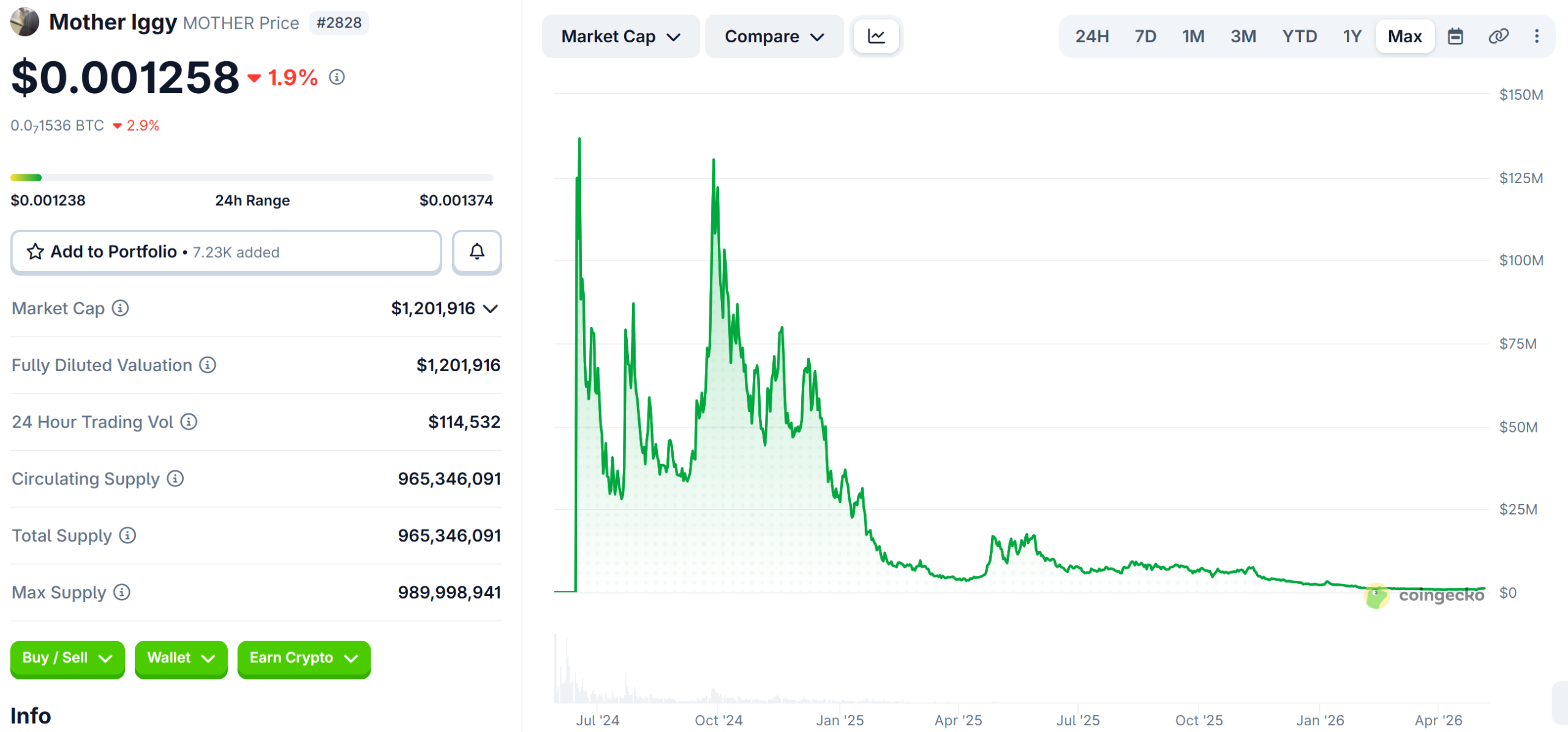
The complaint was filed in the Southern District of New York. It accuses Azalea of violating New York consumer protection laws after MOTHER lost roughly 99.5% of its peak value.
Inside the Iggy Azalea MOTHER lawsuit
The suit, filed on Monday, brought by Burwick on behalf of MOTHER buyers, cites New York General Business Law sections 349 and 350.
Both statutes target deceptive acts and false advertising. Plaintiffs also add claims of negligent misrepresentation and unjust enrichment.
The filing argues Azalea framed MOTHER as the native currency of an ecosystem she controlled. That ecosystem allegedly included Motherland, an online casino, and Unreal Mobile, a telecommunications business co-founded by the rapper.
Azalea told followers they would need MOTHER to enter Motherland. She also said Unreal Mobile customers could buy handsets and monthly plans with the token, claiming savings of up to $600 a year.
According to the filing, neither integration delivered durable, on-chain utility for holders. Plaintiffs argue buyers received no equity, no governance rights, and no revenue share in any of Azalea’s businesses.
“Holders of MOTHER received no equity in Azalea’s businesses. They received no revenue-sharing rights, no voting power, no contractual claims, and no legal interest in any underlying enterprise,” read an excerpt in the filing.
How MOTHER Collapsed From a $200 Million Peak
Azalea launched MOTHER on Solana on May 28, 2024. She positioned it as a meme coin with embedded utility, distinct from the typical celebrity launch.
Within weeks, the token reached an all-time high near $0.23 and a peak market capitalization of about $194 million. Azalea also disclosed partnerships with market makers Wintermute Trading and DWF Labs to lend institutional credibility.
The token now trades around $0.001258, with a market capitalization of about $1.2 million, according to Coingecko data. That puts MOTHER more than 99% below its peak.

The token’s debut also drew controversy. On-chain analysts previously flagged $2 million in insider trading activity around the launch, claims Azalea denied at the time.
“Don’t disappoint your mother. Also don’t believe the bullsh*t, fake screenshots, and all the rest. I know you all are smarter than that. No one is working with me. I can’t say it enough. Not true. Sahil, baby, take your L and go already,” Azalea stated at the time.
Burwick Law’s Expanding Crypto Litigation Playbook
Burwick has emerged as one of the most active plaintiff-side firms in crypto consumer protection. The firm has previously filed similar suits over the LIBRA token, the HAWK meme coin, and the Believe launchpad. It has also taken aim at Pump.fun.
The MOTHER case continues that pattern, focusing on consumer protection rather than securities registration.
By framing the action under deceptive practices statutes, Burwick avoids the harder question of whether meme coins qualify as securities.
Iggy Azalea has not publicly responded to the complaint.
The suit is in its earliest stages, and motions to dismiss are common in cases of this kind.
Notwithstanding, the filing puts another celebrity-backed meme coin on a growing list of class actions tied to alleged marketing failures.
The post Iggy Azalea Faces Class Action Lawsuit Over MOTHER Token appeared first on BeInCrypto.

India’s Favorite Smartphones Awards 2026, Powered by Flipkart: Full Winners & What They Mean For Consumers

New Financial Control Grid Explained | Edwin Vieira Jr, PhD, JD

All the London High Street chains closing stores in 2026

Manchester United reach agreement with Casemiro over contract clause amid transfer speculation

US brings back mandatory military draft registration

Steven Gerrard disagrees with Gary Neville over ‘shock’ Chelsea and Arsenal claim | Football
New Financial Control Grid Explained | Edwin Vieira Jr, PhD, JD

Ripple XRP IT HAPPENS IN 9 MINUTES! New QUANTUM Computer Will BREAK Bitcoin! (WATCH ASAP)

SOURCE OF FUND CLASS 12 ll Class 12 Finance Unit 4 ll Class 12 Finance Source Of Funds
-

 Business7 days ago
Most Commercial Energy Audits Miss the Real Losses
-

 NewsBeat2 days ago
Channel 5 – All Creatures Great and Small series 7 new post
-

 Fashion7 days ago
Kylie Jenner’s KHY Enters a New Era with ‘Born in LA’
-
 Tech4 days ago
Trump’s 25% EU auto tariff breaches Turnberry Agreement that also covers semiconductors and digital trade
-
 Sports4 days ago
Paul Scholes issues Marcus Rashford reality check as agreement emerges over Man United star
-

 Business6 days ago
Barclay Brothers Avoid Bankruptcy: HSBC Drops High Court Petitions After IVA Deal
-
 Business6 days ago
Tesla Officially Registers Elon Musk’s Stock: What Investors Need to Know
-

 Tech6 days ago
Texas Instruments made a new flagship graphing calculator: the TI-84 Evo
-

 Entertainment6 days ago
Celebrities Who Are Attending the 2026 Met Gala Event
-

 Business5 days ago
Two Powerball Tickets Split $143 Million Jackpot in Indiana and Kansas
-

 Entertainment4 days ago
Met Gala 2026 Rumored Guest List Is Turning Heads
-

 Entertainment6 days ago
Insider Claims Reason Behind Key & Peele Split
-
Business2 days ago
Winning Numbers Drawn as Jackpot Resets to $20 Million
-
 Crypto World5 days ago
CoreWeave (CRWV) Stock Climbs 8% Despite $45M Insider Share Dump
-
 Crypto World6 days ago
Securitize and Computershare Enable Tokenized Equity Issuance for Over 25,000 U.S.-Listed Stocks
-

 Crypto World6 days ago
Meta (META) starts stablecoin payout to creators in Circle’s USDC on Polygon, Solana via Stripe
-

 Business6 days ago
Strait of Hormuz Remains Heavily Restricted on April 29 Amid Iran Conflict
-

 Entertainment4 days ago
Kylie Jenner Hit With Second Lawsuit From Ex-Housekeeper
-

 Crypto World6 days ago
Gibraltar Proposes Tokenized Funds Regulation to Bolster Compliance
-

 Business7 days ago
Alexandria Real Estate Equities, Inc. (ARE) Q1 2026 Earnings Call Transcript
You must be logged in to post a comment Login