

Crypto World
The SEC wants to let newly public companies raise cash instantly in its biggest rule change in decades

The agency is proposing its largest overhaul of public listing rules in over 20 years, cutting compliance costs and giving crypto firms a much easier path to raise cash on Wall Street.



The Ethereum Foundation has revealed that the biggest challenge in AI-assisted security research has become proving which reported vulnerabilities are genuine rather than finding potential bugs.
Summary
- Ethereum Foundation says verifying AI bug reports is harder than generating them.
- AI agents found a real libp2p vulnerability, later disclosed as CVE-2026-34219.
- The Foundation says human validation and reproducible proof remain essential for protocol security.
According to the Ethereum Foundation’s Protocol Security team, recent experiments with coordinated AI agents uncovered real software flaws across systems that Ethereum depends on, but the organization said the majority of the effort now goes into separating valid findings from convincing false positives.
The team described the results in a technical post explaining how it has been testing AI agents against systems software, cryptographic libraries, and high-assurance smart contracts.
One confirmed discovery involved a remotely triggerable panic in the gossipsub component of libp2p, which forms part of the peer-to-peer networking layer used by Ethereum consensus clients. The Ethereum Foundation said the vulnerability was fixed and later disclosed as CVE-2026-34219.
Instead of treating AI agents as decision-makers, the Foundation said they should be viewed as tools that generate hypotheses requiring independent verification. While agents can inspect source code, trace execution paths, and prepare proof-of-concept material, the Foundation said they also produce reports based on unreachable code, duplicate known issues, debug-only crashes, or weak formal proofs that fail to demonstrate a real security problem.
The team said the unexpected finding was not that AI could identify bugs, but that validating those reports consumed far more time than generating them.
Multi-agent workflow filters unreliable reports
To reduce unreliable findings, the Ethereum Foundation said it deploys multiple AI agents against the same software repository, with each agent handling a different stage of the review process. Instead of relying on a central coordinator, the agents exchange information through the repository itself by sharing state in version control.
According to the Foundation, the workflow begins with reconnaissance, where broad attack surfaces are narrowed into specific testable ideas. Hunting agents then follow each hypothesis through the code and attempt to build a working reproducer. Gap-filling agents track accepted and rejected reports to avoid repeating earlier work, while validation agents independently examine every candidate, remove duplicates, and determine whether a report qualifies as a legitimate vulnerability.
The Foundation said every accepted report must identify a reachable target, define a clear security invariant, explain the failure mechanism, provide observable evidence, include a self-contained reproducer, and carry a deduplication key. These requirements are intended to ensure that every claim can be tested directly against production code.
Human validation remains the deciding factor
At the center of the process, the Ethereum Foundation said one principle overrides everything else: a vulnerability does not count unless someone other than the reporting agent can reproduce it against the real codebase. According to the Foundation, this requirement removes reports built around impossible attack paths, debug-only failures, or formal verification results that appear mathematically correct without proving a meaningful security property.
Beyond technical validation, the Foundation said surviving candidates are also evaluated for practical exploitability. A flaw that any network participant can trigger carries different security implications than one requiring privileged access or unrealistic computing resources.
The Foundation added that AI agents remain inconsistent when judging exploit reachability, attack severity, or vulnerabilities that emerge only through long sequences of valid interactions. In those situations, it said the agents perform better as assistants for stateful testing frameworks than as replacements for experienced security researchers.
The latest security update comes only weeks after the Ethereum Foundation completed a major internal restructuring. In a June 23 announcement, the organization said it had reduced its workforce by about 20%, with 54 employees leaving following a months-long review under its Mandate and Treasury Management Policy.
According to the Foundation, the restructuring was intended to focus staff and resources on responsibilities that only the organization can perform while continuing long-term Ethereum development.

Solana’s recovery appears to have lost momentum after it shed over 6% in the past week. As it currently trades near $77, it is facing its most negative market sentiment of 2026.
In fact, SOL’s trading volume has dropped to its lowest point in 2026, while negative commentary surrounding the asset has surged to its highest daily level this year, according to Santiment.
Rebound Setup Emerges
Much of the disappointment stems from expectations that strong narratives around tokenized stocks and real-world asset (RWA) activity would translate into stronger price performance, something traders have yet to see.
Santiment noted that this combination of elevated fear, uncertainty, and doubt (FUD) alongside weak trading volume has historically created conditions that can favor a rebound. With retail participation low and sentiment deeply negative, there may be less resistance if large stakeholders decide to drive Solana’s prices higher, which could potentially set the stage for a sharp move that catches traders off guard.
The Solana network added 1.60 million new addresses over the past two weeks. Additionally, the SuperTrend indicator on SOL’s three-day chart also flashed a new buy signal for the first time since October 10, 2025, when the Average True Range (ATR) trailing stop moved below the price. According to analyst Ali Martinez, the previous SuperTrend sell signal was followed by a 74% price correction. He said the latest signal points to a bullish trend and could send SOL toward $100.
Michaël van de Poppe also observed that the crypto asset has re-entered its trading range and may briefly pull back before continuing its upward move. He added that holding the $75-$77 range as support could open the door to gains toward $100 and potentially $120 in the coming weeks or months.
$78 Holds the Key
Another crypto analyst, Dami-Defi, also pointed to a potential breakout as SOL currently tests the upper boundary of a descending channel that has been in place since September 2025. According to the analyst, a three-day close above $78 would confirm the breakout and open the door to an initial move toward $105, followed by $125 and $155 if momentum continues.
However, the setup would be invalidated by a three-day close below $72, and stronger trading volume would be needed to confirm the breakout.
The post Solana (SOL) FUD Hits 2026 High: Why It Could Be a Bullish Twist appeared first on CryptoPotato.

Bitcoin rebounded after the Wall Street open as US stocks turned higher on fresh optimism around Iran. The shift in risk sentiment helped BTC/USD reclaim the $63,000 area, while traders reported short liquidations nearing $100 million over the past 24 hours, according to CoinGlass data.
The market’s relief rally followed remarks from US President Donald Trump suggesting there may still be room for a new Iran “deal” after the ceasefire situation deteriorated. With crypto effectively tracking broader risk assets, traders are now focusing on whether BTC can hold key intraday levels into the daily close.
Key takeaways
- BTC/USD rose back above $63,000, gaining nearly 1.5% on the day, per TradingView.
- CoinGlass shows short liquidations approaching $100 million over 24 hours, reflecting heavy leverage unwinds.
- Several traders are watching whether BTC can secure a daily close above $64,700 to sustain the rebound.
- Market participants continue to disagree on whether a bear-market bottom is forming, with competing cycle interpretations.
Risk appetite returns as Iran “deal” hopes resurface
According to TradingView, BTC/USD moved higher after Thursday’s Wall Street open, climbing back above $63,000. The move came as US equities rebounded across the board, helping to partially offset the downside seen earlier in the week.
That timing aligned with comments from Trump, who indicated that Iran “wants to make a deal” after the ceasefire breakdown. As reported via posts quoting trading resource The Kobeissi Letter and others, Trump said that calls had been made and that the sides “want to make a deal so badly.” Earlier coverage from Cointelegraph also linked the broader market mood to developments around the Iran ceasefire and regional tensions.
In crypto, the improved sentiment appears to have been immediate: CoinGlass data cited by the market coverage showed short liquidations running close to $100 million in the last 24 hours. For traders, that kind of flush can reduce immediate downside pressure while also encouraging fresh momentum trades—though it doesn’t automatically confirm a sustained trend reversal.
Liquidations highlight leverage stress—and quick sentiment reversals
Short liquidations are often a sign that price moves are accelerating due to leveraged positioning. CoinGlass data referenced in the reporting showed liquidity targets being hit fast enough to push near-$100 million in liquidations over a day, consistent with the broader “risk-on” bounce in stocks.
While such spikes can fuel further upside in the short term, they also tend to make markets more reactive to headlines. That matters now because the drivers cited here—geopolitical developments and policy signals—can change quickly, and crypto has been trading as a high-beta asset relative to traditional markets.
Traders taking part in the price discussion suggested the rebound does not necessarily indicate an immediate trend shift. One market participant, writing on X under the handle Killa, said the setup was “not bearish at all,” adding that he expects “a few more months of choppy PA.” In that view, BTC could still fluctuate within a broader band rather than transition cleanly into a new directional phase.
Traders narrow focus to BTC’s key daily close
As price action stabilized after the bounce, attention turned toward specific technical levels. Trader Killa highlighted $68,000 as a potential area for a short entry, consistent with the idea that rallies may encounter selling pressure before any larger breakout.
Another participant, Jelle (CryptoJelleNL), also emphasized that bulls may still be trying to reclaim key ground. In an X update, Jelle suggested that if BTC can move back above a level of importance, the market could push again toward the $65,000–$70,000 area. But if BTC rejects and loses support, Jelle indicated that the market could revisit levels below $60,000.
The most concrete “decision point” referenced in the reporting came from Daan Crypto Trades, who argued that a daily close above $64,700 would “flip the story” toward a larger relief rally. Daan’s X analysis placed BTC in a $61.3K–$64.7K range and described the latest move as a climb back after a prior risk-off flush. In that same framework, a daily close under $61.3K would open the door to retesting lows and potentially invalidate the rebound momentum.
Bear-market bottom debate continues despite the rebound
Even with the bounce above $63,000, participants are not aligned on what the move means for the larger cycle. The coverage pointed to ongoing divergence in views about whether the bear-market bottom is already in.
Earlier reporting referenced in the article highlighted two contrasting interpretations: one analysis described a “textbook” bottom formation as underway, while another cycle comparison argued for a deeper macro floor. In practice, this split matters because it changes how traders interpret near-term rallies—whether they’re seen as early confirmation of a bottom, or as relief moves inside a still-volatile consolidation.
That is why the market’s next few sessions may be less about whether BTC can rise, and more about whether it can hold above critical thresholds on a closing basis. Given the leverage effects seen in liquidations and the headline sensitivity tied to geopolitics, follow-through will likely be closely watched.
Heading into the next daily close, traders will likely treat levels such as $64,700 as a litmus test for whether this rebound is merely another range extension or the start of a broader relief phase—especially as opinions on a longer-term bottom continue to differ.

Bitcoin miner MARA Holdings shares rose about 15% in early trading Thursday after the company announced plans to acquire a Texas powered-land site with access to up to 2 gigawatts of electricity for AI computing and Bitcoin mining.
The 1,200-acre site in Matagorda county, about 90 miles southwest of Houston, is expected to provide access to an initial 1 GW of grid capacity by October 2027 and up to 2 GW by April 2028. MARA said it plans to develop the site as a digital infrastructure campus supporting both high-performance computing and Bitcoin mining.
Upon full energization, the site is expected to more than double the Bitcoin (BTC) miner’s potential power capacity to about 4.8 GW. HIF USA will retain a minority ownership stake in the project if MARA signs a lease with a high-performance computing tenant, according to the companies. The companies did not disclose financial terms of the transaction.
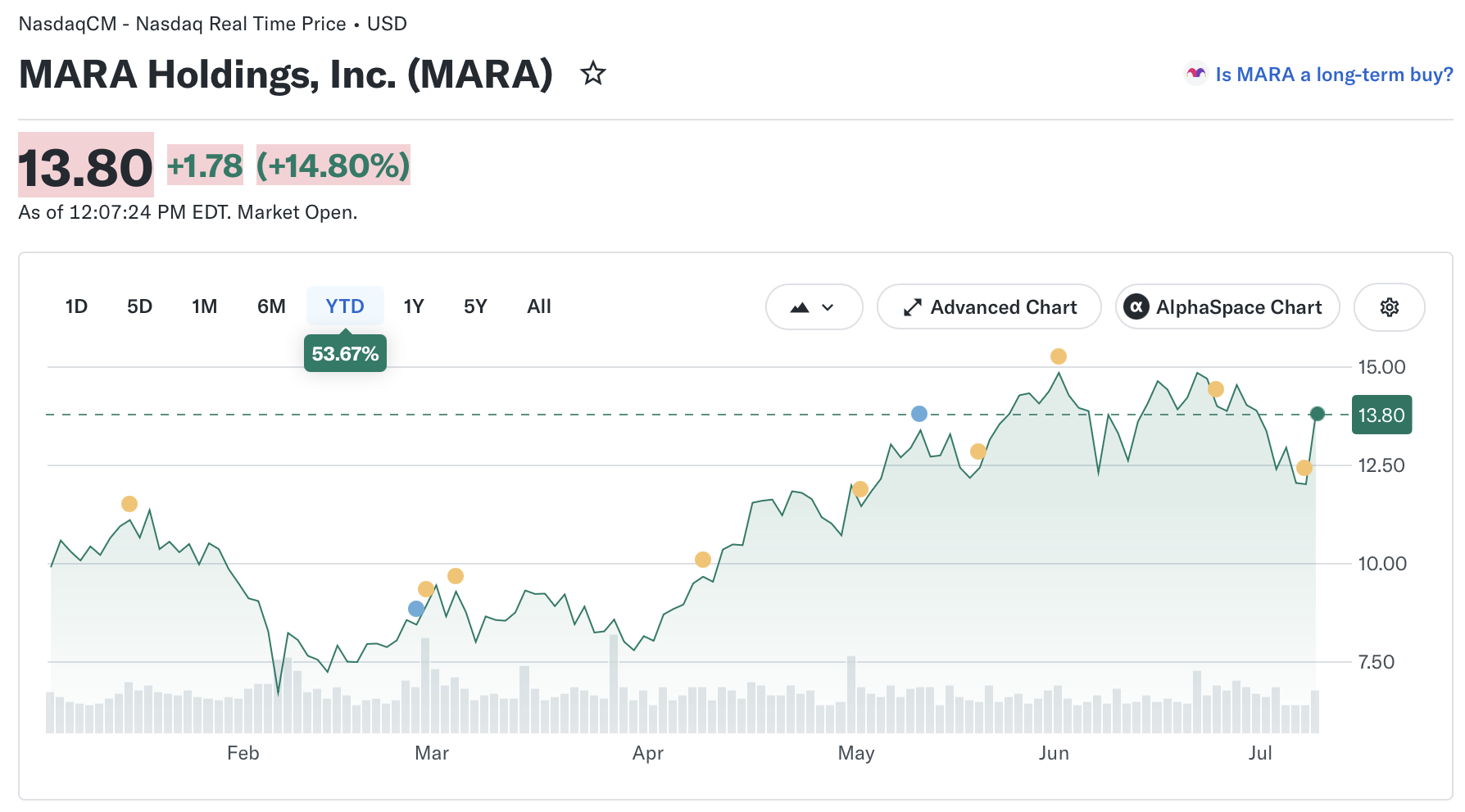
Source: Yahoo Finance
In a post on X, MARA said the project remains in the early stages of development and is subject to regulatory approvals, adding that construction will be phased over several years.
In April, MARA announced it would acquire Long Ridge Energy & Power, adding a 505-megawatt gas-fired power plant and a co-located data center in Ohio, in a roughly $1.5 billion transaction. Earlier this year, the company acquired a 64% stake in French computing infrastructure operator Exaion.
MARA is the fourth-largest publicly traded corporate holder of Bitcoin (BTC), with 36,303 BTC, according to data from BitcoinTreasuries.NET.
Related: Crypto Biz: Is AI the exit strategy for miners?
BTC miners bet big on AI data centers
Bitcoin miners have increasingly expanded into AI and high-performance computing as demand for data center capacity has grown. Rather than repurposing mining hardware, companies are leveraging existing power infrastructure built to support BTC mining, including grid connections, substations and energized sites.
However, converting mining sites into AI-ready data centers requires significant investment. CoinShares estimates mining infrastructure typically costs $700,000 to $1 million/MW, compared with $8 million to $15 million/MW for liquid-cooled AI infrastructure, while hyperscale customers require higher power density and uptime than many mining facilities were designed to provide.
Even so, several publicly traded miners have announced multibillion-dollar AI infrastructure agreements in recent months. Core Scientific expanded its hosting agreement with CoreWeave to more than $10 billion, while Hut 8 signed a 15-year, $7 billion data center lease with Fluidstack. TeraWulf has reported billions of dollars in contracted HPC revenue.
Investors have broadly rewarded the strategy. Hut 8 shares jumped about 20% after announcing its Fluidstack agreement, while companies with AI and HPC contracts have traded at higher valuation multiples than miners focused solely on Bitcoin production, according to a report from CoinShares.
Last week, TeraWulf shares rose about 12% after the Bitcoin miner announced a 20-year AI data center lease with Anthropic, expected to generate roughly $19 billion in contract revenue.
MARA is the sixth-largest holding in the sector exchange-traded fund CoinShares Bitcoin Mining ETF, as 4.76% of assets, according to Yahoo Finance data. WGMI shares were up more than 5% in early afternoon trading on Thursday.
Magazine: Bitcoin’s quantum dilemma: Bigger blocks or STARK proofs?
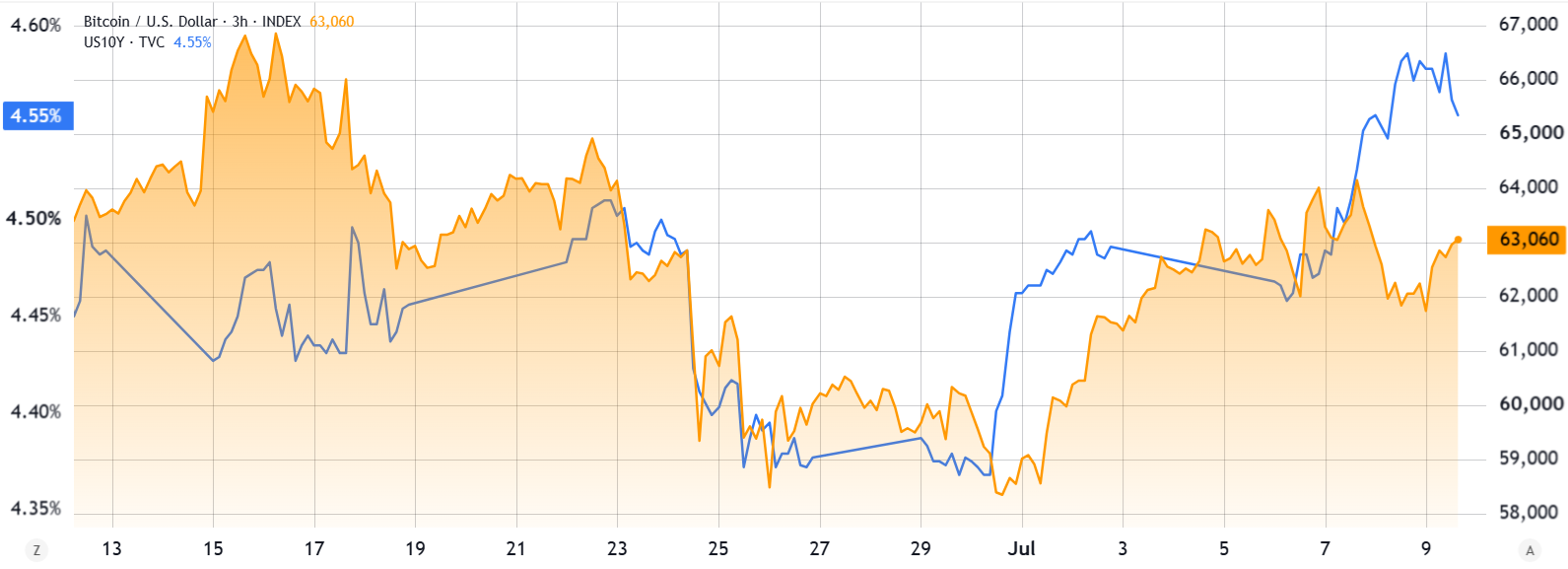
Bitcoin (BTC) reclaimed the $63,000 mark on Thursday, but traders fear a correction ahead of Friday’s $1.4 billion options expiry on Deribit. The concerns stem from the US government bond yield climbing toward a level that many view as a warning sign. Is the $62,000 support level at risk?
Key takeaways:
- Rising US Treasury yields signal debt concerns, negatively pressuring risk assets.
- Balanced Bitcoin options put-to-call volumes suggest limited downside from the $62,000 level.
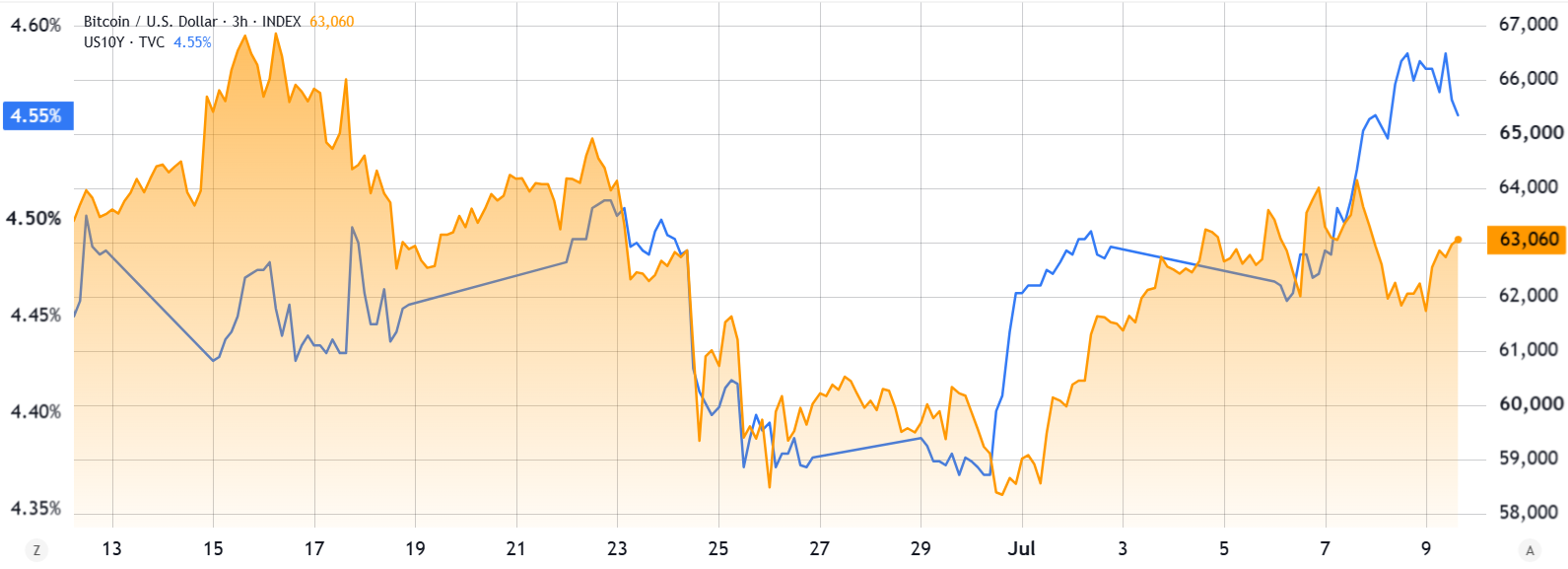
US 10-year Treasury yield (left) vs. Bitcoin/USD (right). Source: TradingView
Bitcoin ETF outflows are not a concern ahead of the Bitcoin options expiry
The 10-year Treasury yield’s approach to 4.6% signals investor anxiety over the expansion of US government debt and prospects for further monetary policy expansion to avert an economic recession. Bitcoin has felt the impact, trading sideways while the Nasdaq-100 Index sits merely 4% below its all-time high.
The AI sector’s bullish momentum keeps pulling capital toward equities. Asian chipmaker SK Hynix oversubscribed IPO in the US helped push the sector higher on Thursday, led by Arm Holdings (ARM) 10% gains, Advanced Micro Devices (AMD) 7% rally and Micron’s 7% intraday gains.
Wednesday brought $85 million in net outflows from spot Bitcoin ETFs, ending a short three-day inflow run. Still, the figure does not confirm a reversal in institutional flows. More importantly, demand for Bitcoin options has stayed balanced between calls (buy) and puts (sell).
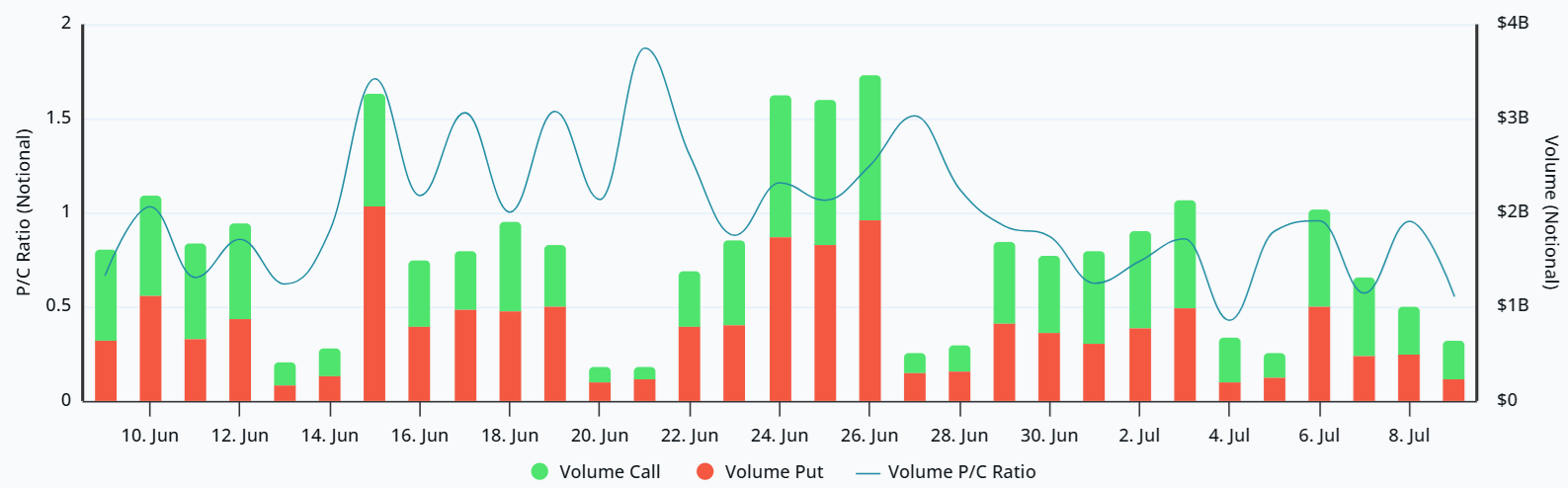
Bitcoin options put-to-call volumes ratio at Deribit. Source: Laevitas
Call options volume has outpaced put instruments over the past four days, reflecting reduced demand for downside movements. However, the upcoming weekly options expiry features an interesting setup as calls up to $62,500 total $137 million, while puts above $61,000 are at $121 million.
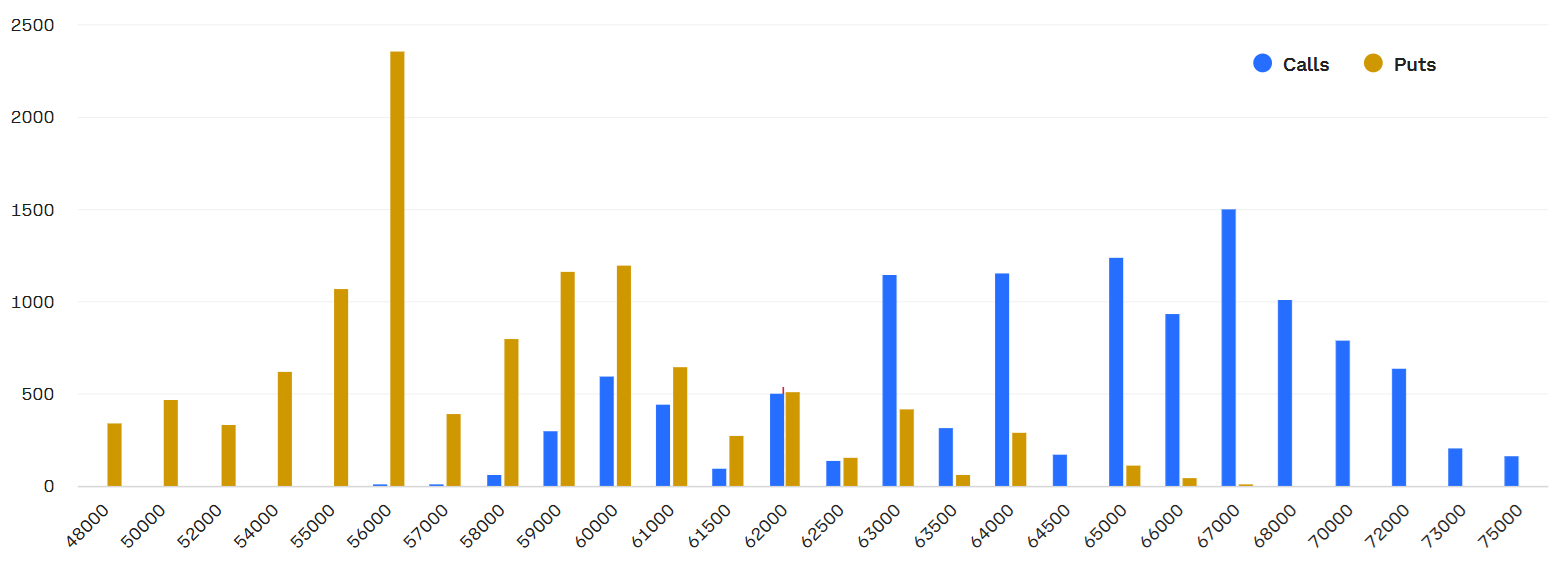
Deribit BTC options open interest for July 10, BTC. Source: Deribit
Bitcoin bulls would gain significant ground with a move above $63,500 by the 8:00 AM UTC expiry on Friday, boosting their advantage to $190 million. Bears hold a smaller $100 million edge below $61,000, limiting their incentive without additional catalysts.
Oil price decline could strengthen the demand for risk-on assets
A temporary truce in the Middle East could ease recession fears and shift money from fixed income into risk markets, likely pushing Bitcoin price higher. In contrast, continued strength in the AI sector drains capital from other investments while traders fear large Treasury issuance to cover growing debt.
Related: Bitcoin peels back to $62K as Fed-wary futures traders cut risk: Is the BTC rally over?
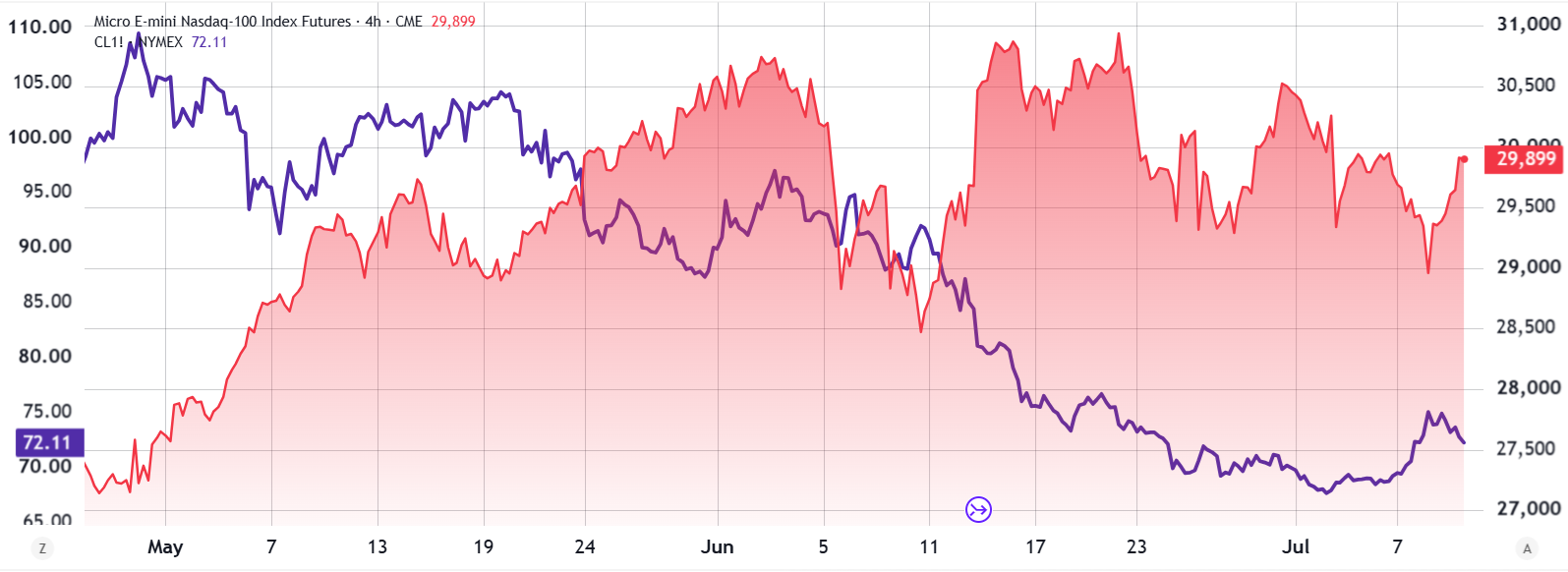
Crude WTI oil futures (left) vs. Nasdaq 100 Index futures (right). Source: TradingView
Traders should closely monitor whether Treasury yields will subside over the next week and if an aggravated war in Iran pushes oil prices higher. But with Bitcoin put options buying remaining restrained in recent sessions, the market appears positioned to strengthen the $62,000 support level.
Bitcoin sits in a delicate spot where a successful expiry resolution above $63,500 could provide short-term relief, but sustained upward momentum would require a boost from the macro side. As long as these dynamics persist, the odds favor limited bullish momentum for Bitcoin in the near term.
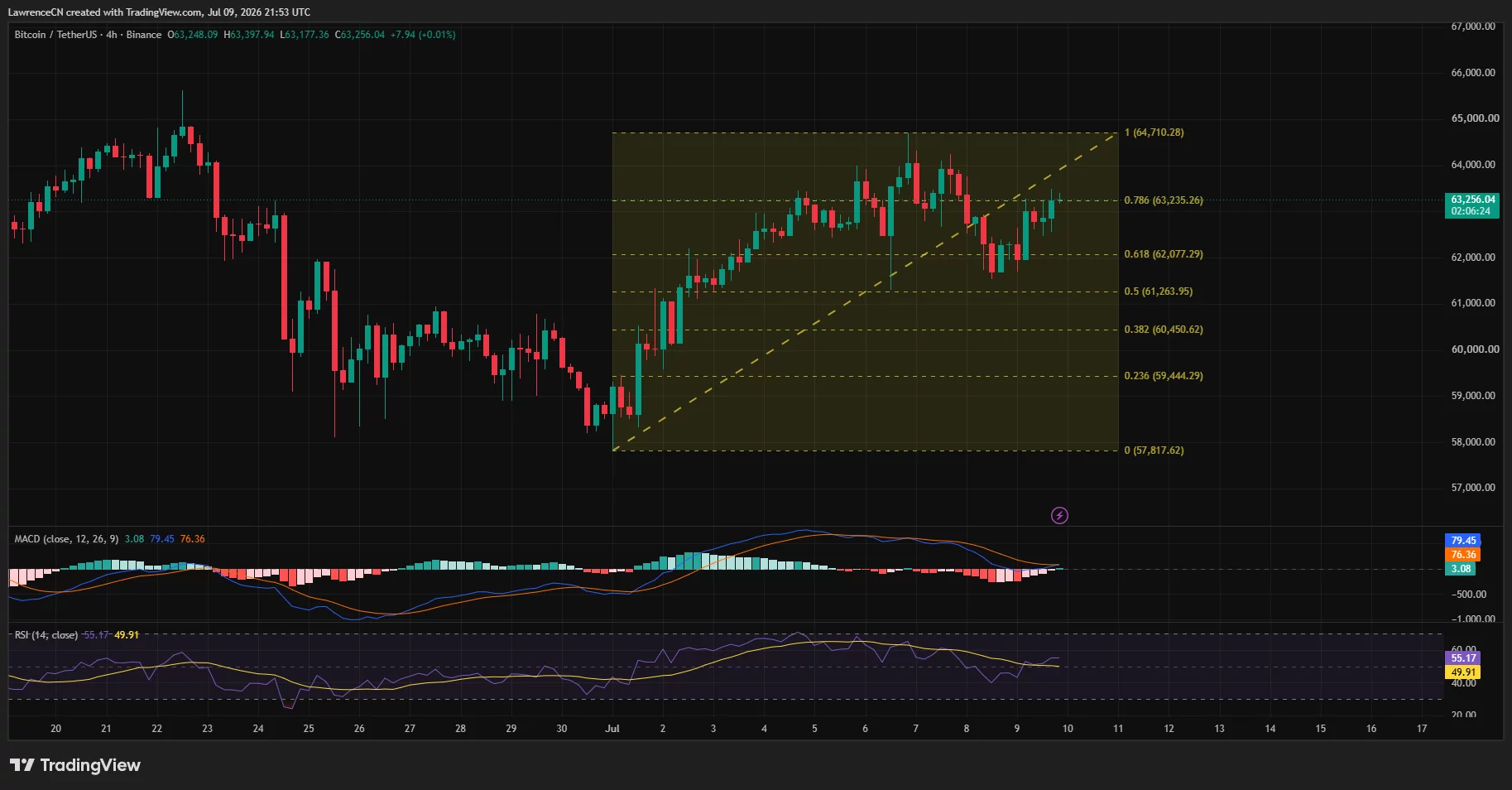
Bitcoin has climbed back above $63,000, gaining about 2% over the past 24 hours, as lower oil prices and softer U.S. bond yields have improved sentiment toward risk assets despite the crypto market remaining in extreme fear.
Summary
- Bitcoin has climbed above $63,000 as easing oil prices and lower Treasury yields lifted risk appetite.
- The Crypto Fear & Greed Index remains in Extreme Fear, showing investor confidence is still weak.
- Technical indicators suggest improving momentum, with Bitcoin testing key resistance near $63,235.
According to data from crypto.news, Bitcoin (BTC) traded around $63,250 on Thursday after recovering alongside other major cryptocurrencies as geopolitical concerns tied to Iran eased. The move followed a retreat in crude oil prices from recent highs and lower Treasury yields, conditions that often encourage investors to move back into higher-risk assets.
Although the recovery has pushed Bitcoin higher, investor confidence remains fragile. The Crypto Fear & Greed Index stayed in the Extreme Fear zone at 22, improving only slightly from 19 a week earlier. The reading suggests traders remain cautious even as prices stabilize.
Technical signals point to improving momentum
Beyond the macro backdrop, Bitcoin’s recent price action has started to show signs of technical recovery. On the 4-hour chart, BTC has reclaimed the 61.8% Fibonacci retracement level near $62,077 and is testing resistance around the 78.6% retracement at roughly $63,235.
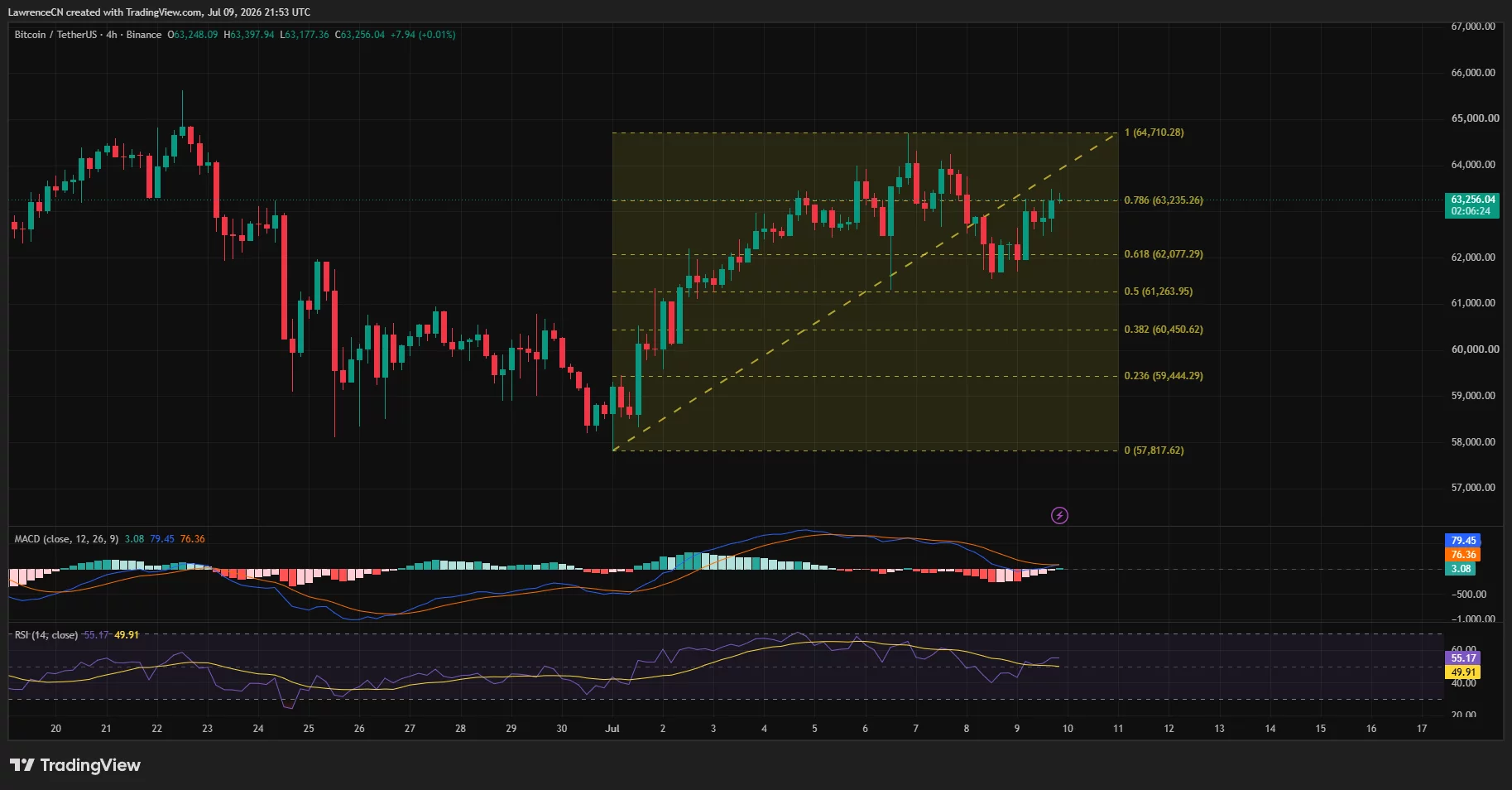
The chart also shows Bitcoin continuing to trade above a rising trendline formed after its early July rebound. Momentum indicators have improved alongside the price move. The Relative Strength Index has recovered to around 55, moving back above the neutral 50 level, while the MACD histogram has turned positive and the MACD lines are approaching a bullish crossover.
Together, these indicators suggest buying pressure has strengthened, although confirmation of a sustained breakout has yet to emerge.
A successful move above the current resistance zone could expose the recent swing high near $64,700. On the downside, the $62,100 area remains the first notable support should buyers lose momentum.
Elsewhere across the market, Ethereum added about 1.1% over the past day to trade just below $2,000. Solana rose roughly 1.5% to around $78, while XRP held above the $1 level as large-cap cryptocurrencies tracked Bitcoin’s recovery.
Lower oil and bond yields have supported crypto
The improvement in crypto prices has coincided with a shift in broader financial markets. Oil prices, which had surged earlier on concerns that the Iran conflict could disrupt global supplies, pulled back as fears of further escalation eased. At the same time, U.S. government bond yields also declined.
Lower oil prices can reduce inflation expectations, while falling Treasury yields make fixed-income investments relatively less attractive. Under those conditions, investors often become more willing to allocate capital to assets with higher return potential, including cryptocurrencies.
Bitcoin’s 2.4% gain over the past seven days indicates the latest advance is part of a gradual recovery rather than a one-session spike. Even so, the persistent Extreme Fear reading suggests many market participants are waiting for stronger confirmation before turning decisively bullish.
Adding another development to the sector, institutional digital asset custodian BitGo has quietly introduced a new toolkit focused on long-term crypto infrastructure. While the release has not affected current market prices, it highlights continued institutional investment in blockchain services even as short-term market sentiment remains cautious.
Disclosure: This article does not represent investment advice. The content and materials featured on this page are for educational purposes only.

Several publicly traded Bitcoin miners have enjoyed sharp stock re-ratings after pivoting toward AI infrastructure, but investors are increasingly questioning whether insiders and major shareholders capitalized on the rally before the sector cooled, raising fresh governance concerns, according to Blocksbridge Consulting.
In its latest Miner Weekly newsletter, Blocksbridge said the AI narrative helped lift valuations for several Bitcoin mining companies as they repositioned operations around data centers, power infrastructure and hyperscaler partnerships. However, sentiment has since weakened, with AI and chip stocks pulling back. The TEM AI Infrastructure Growth Index, which tracks Bitcoin miners, artificial intelligence cloud providers, power suppliers and other AI infrastructure companies, has decline 16% over the past month.
That shift has brought insider transactions into sharper focus. Executives at TeraWulf, Cipher Digital, Riot Platforms and Core Scientific have disclosed stock sales, many of them executed under prearranged Rule 10b5-1 trading plans. While such plans are common and designed to avoid conflicts around nonpublic information, the sales have attracted greater scrutiny as AI-related stocks have retreated, Blocksbridge said.
The trend extends beyond company executives. Strategic investors have also reduced their exposure, including stablecoin issuer Tether, which trimmed its stake in Bitdeer after the company’s AI-driven rebound.
According to Blocksbridge, investors are increasingly shifting their attention from the AI growth narrative to questions around governance and whether the benefits of the tech transition will ultimately accrue to public shareholders.
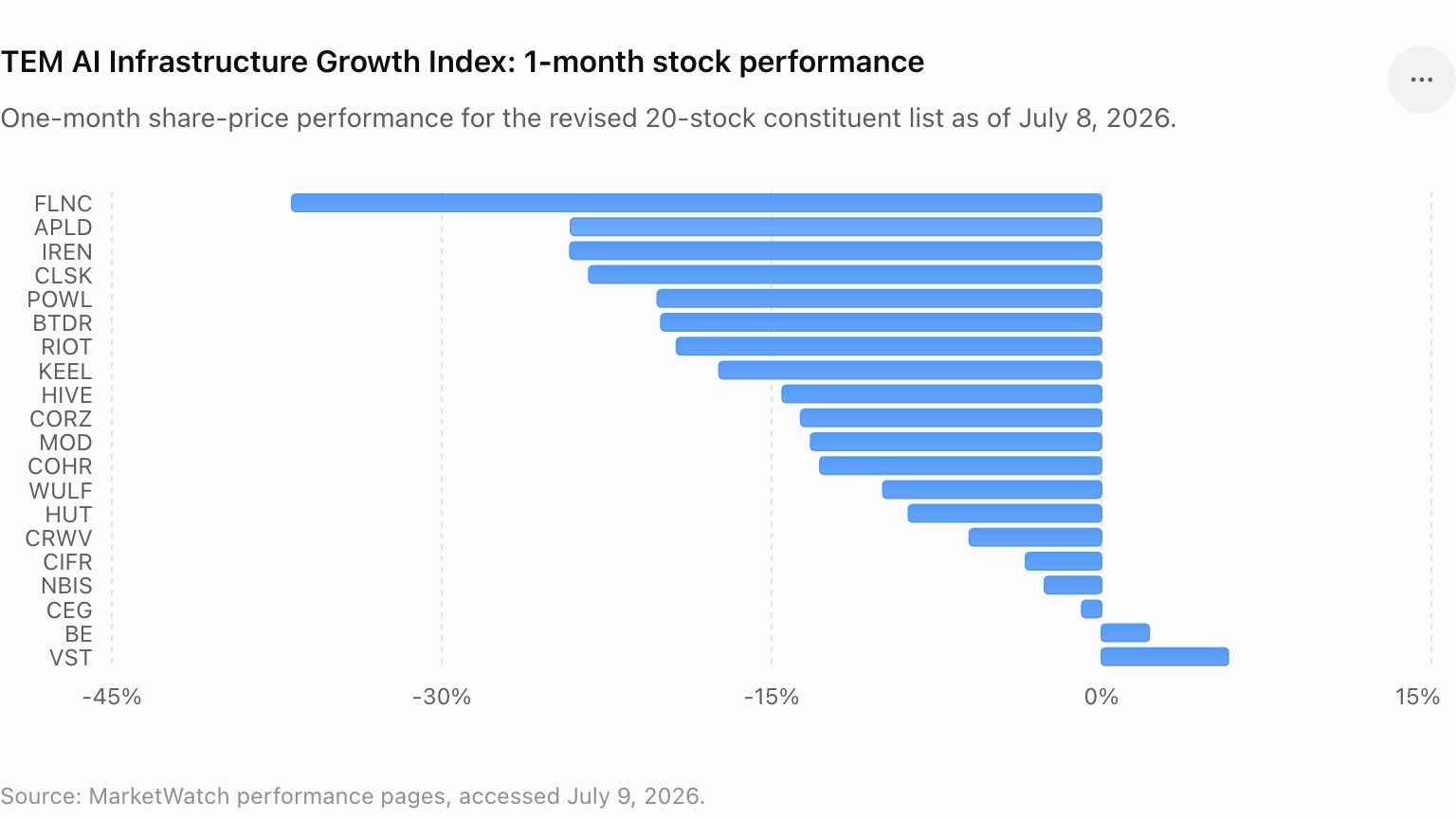
Most stocks in the TEM AI Infrastructure Growth Index have declined sharply over the past month. Source: Miner Weekly
Blocksbridge said TeraWulf offers the clearest example because the company remains one of the biggest beneficiaries of the AI infrastructure transition. CEO Paul Prager and Beowulf E&D Holdings, an entity he manages, sold roughly 1.59 million WULF shares before the company on Monday announced a 20-year AI infrastructure lease with AI developer Anthropic, a deal widely viewed as a major validation of its AI strategy.
Related: SBI Crypto shuts Bitcoin mining pool after 5-year run
AI spending raises questions about long-term returns
Many Bitcoin miners have pivoted toward AI data centers as mining economics have become increasingly challenging, particularly after Bitcoin’s 2024 halving squeezed industry margins. However, the artificial intelligence trade has also become more crowded, with companies facing growing pressure from investors to justify heavy infrastructure spending amid uncertain returns.
A report published by Deloitte in October described AI as a “paradox of rising investment and elusive returns,” noting that many organizations expect AI investments to take longer than anticipated to generate meaningful value.
Separate research by Teneo, based on a survey of more than 350 public company CEOs, found that fewer than half of artificial intelligence initiatives have delivered returns exceeding their costs.

Corporate AI spending is expected to increase significantly despite modest returns on investment. Source: Deloitte
Despite those challenges, companies continue to invest aggressively in AI infrastructure, betting that long-term demand for compute capacity will outweigh near-term concerns over profitability.
Bitcoin miners, with access to large-scale power and existing data center infrastructure, are positioning themselves to capture that opportunity.
Related: Trumps’ American Bitcoin sinks 8.4% ahead of reverse stock split to stay listed
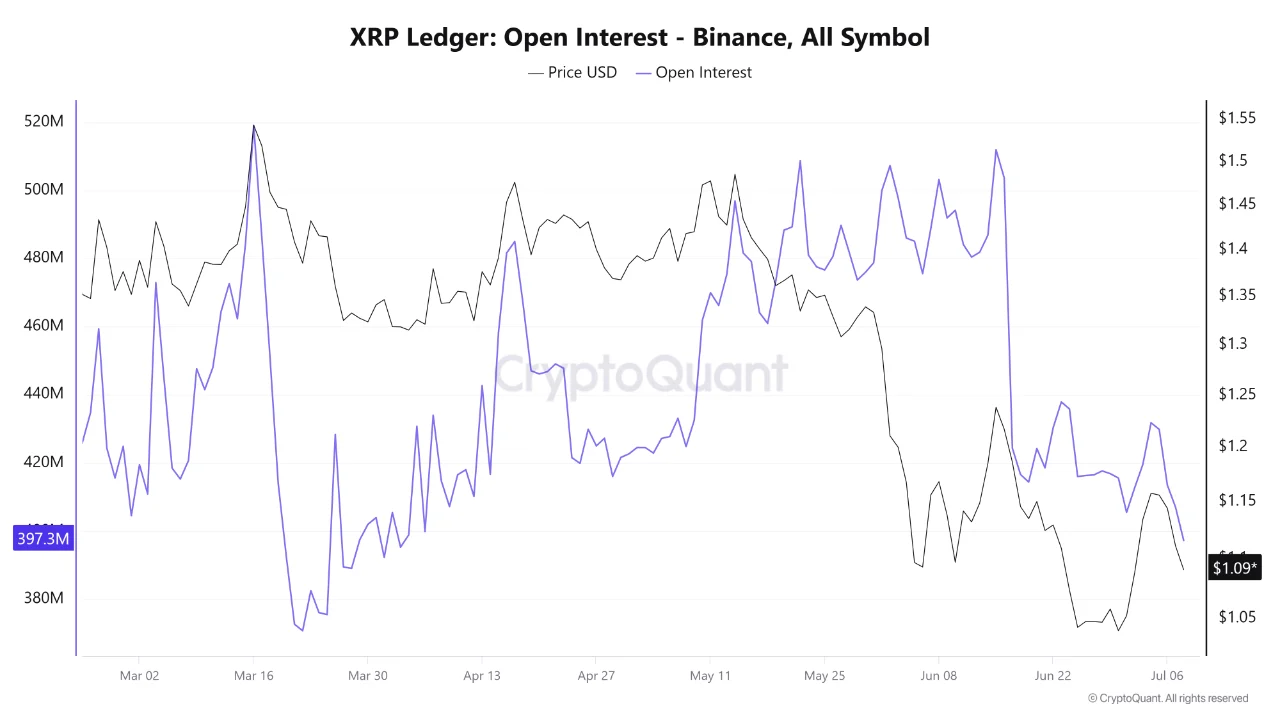
XRP futures open interest on Binance has fallen to roughly 397 million XRP, its lowest level in over three months. The decline arrives as the token trades at $1.09.
Here is what the drop means, how spot data contrasts, and what could come next for the price.
What the XRP Open Interest Decline Actually Means
Open interest measures the total number of outstanding derivative contracts in a market. A decline in this metric, especially alongside price weakness, often reflects deleveraging as traders reduce or close their existing positions.
On Binance, the drop signals lower speculative activity in XRP futures compared to previous periods. Furthermore, the metric is now at its weakest level in over three months, suggesting a cooling appetite for leveraged exposure.
CryptoQuant analyst Arab Chain clearly framed the trend. The analyst wrote that the decline points to “a slowdown in activity within the derivatives market.”
The analyst also noted that falling open interest alongside soft prices often signals weaker risk appetite and an outflow of liquidity from futures.
“Although a decline in open interest is not necessarily a definitive bearish signal, it does point to reduced trader participation in the derivatives market. In many cases, this phase represents a period of repositioning as investors await a clearer market direction,” CryptoQuant analyst Arab Chain said.
Follow us on X to get the latest news as it happens.

The spot side, however, tells a contrasting story. The XRP Binance Scarcity Index has risen to 0.77, its highest reading in over two years. As a result, the available supply for immediate selling on the exchange appears notably reduced.
Exchange reserves reinforce that trend. Binance XRP reserves have dropped roughly 650 million coins, or about 20%, since November 2024. Moreover, they fell from 2.8 billion in May to around 2.6 billion more recently.
Such withdrawals can signal investors moving tokens into self-custody. However, they do not automatically translate into upward price pressure without corresponding demand from fresh buyers entering the market.
What Does This Mean for the XRP Price
Reduced open interest may lead to lower leverage-driven volatility in the short term. As a result, the XRP price action could become more influenced by spot flows than by derivatives positioning across the market.
Technical observations remain mixed, though. Some charts show a hidden bearish divergence on the daily timeframe: price is forming lower highs while the RSI is forming higher highs. Holding above $1.15 is seen as important.
In derivatives, short positions faced pressure near the $1.00 to $1.04 area, contributing to a recent rebound. However, elevated unliquidated long positions across major cryptocurrencies increase the potential for volatility if key levels break.
A failure to hold $1.00 could open the path toward lower supports near $0.87. Meanwhile, XRP’s trajectory will likely continue to correlate with broader market conditions, particularly Bitcoin’s performance and overall risk sentiment.
“While many have been calling bottoms throughout this entire correction on every green candle, I’ve consistently argued that XRP would likely need a test of $1.09 or $0.87 before a true macro pivot could occur… here we are. We’re no longer talking about hypothetical levels. We’re sitting on them,” analyst CasiTrades noted.

Trading volume during the latest recovery has stayed relatively modest. Consequently, spot buyer conviction remains unconfirmed at current levels. Resistance sits near $1.19, with further upside toward $1.38 possible on a sustained break.
Subscribe to our YouTube channel to watch leaders and journalists provide expert insights.
The post XRP Open Interest on Binance Hits a Three-Month Low: What It Means for Price appeared first on BeInCrypto.


Bitdeer Technologies has unveiled a $36 million manufacturing facility in Nevada, bringing production of its SEALMINER Bitcoin mining machines to the United States.
Summary
- Bitdeer will invest $36 million in a Nevada factory to produce SEALMINER Bitcoin mining machines.
- The new Sparks facility is expected to begin commercial production by the end of 2026.
- Bitdeer shares jumped 14.1% as the company reported stronger U.S. manufacturing and 921 BTC mined in May.
According to Bitdeer, the new plant in Sparks, Nevada, will manufacture key components for the company’s SEALMINER mining rigs, with commercial production scheduled to begin before the end of 2026. The company said the facility will strengthen its manufacturing capacity inside the United States while reducing its dependence on outside suppliers for critical mining equipment.
Shares of Bitdeer responded positively to the announcement, climbing 14.1% on Thursday to $14.33. Even after the rally, the stock remains about 27% below its June peak, although it has gained roughly 26% since the beginning of the year.
Nevada incentives support local manufacturing expansion
Details released by Bitdeer show the Singapore-based company worked with Nevada Governor Joe Lombardo’s administration and local officials before selecting Sparks for the project. According to comments made by Bitdeer CEO Catherine Guo to local media, the state approved tax incentives, including reduced qualifying sales taxes, as part of the investment package supporting the facility.
Commercial production is expected to begin by year-end, allowing Bitdeer to manufacture more of its mining hardware domestically instead of relying as heavily on third-party suppliers. The company said the plant will focus specifically on Bitcoin mining equipment rather than artificial intelligence hardware.
Although the new factory centers on mining machines, Bitdeer has also expanded into AI cloud computing and high-performance computing services in recent years. According to the company, those businesses will continue separately from the Nevada manufacturing operation.
Bitcoin miners continue adding AI businesses
Across the industry, publicly traded Bitcoin miners are investing beyond cryptocurrency mining as they seek additional revenue from power-intensive computing businesses.
MARA Holdings announced on Thursday that it plans to acquire a Texas site capable of supporting up to 2 gigawatts of capacity for AI and digital infrastructure projects. The company said the expansion will increase its ability to serve artificial intelligence workloads alongside its existing mining operations.
Earlier in the week, TeraWulf announced a 20-year data center lease agreement with AI startup Anthropic. According to TeraWulf, the contract could generate about $19 billion in revenue over its lifetime, highlighting the growing interest among mining companies in long-term AI infrastructure deals.
While several competitors are directing more resources toward AI data centers, Bitdeer continues expanding both its mining operations and supporting infrastructure. The Nevada facility adds manufacturing to that strategy by giving the company greater control over the production of its own mining hardware.
Separately, Bitdeer’s latest production update showed the company mined 921 Bitcoin during May. According to Bitdeer, the figure represents a 370% increase compared with the same month a year earlier, underscoring the rapid growth of its mining business as it adds new infrastructure and equipment.
The combination of higher Bitcoin production and domestic manufacturing comes as mining companies continue adjusting their business models after the latest Bitcoin halving. While many firms are pursuing AI-related contracts to diversify earnings, Bitdeer’s latest investment keeps its manufacturing expansion closely tied to its core Bitcoin mining business while increasing its presence in the United States.
Crypto wallet provider Phantom and the Hyperliquid Policy Center have urged the US Commodity Futures Trading Commission (CFTC) to exempt blockchain protocol developers and non-custodial wallet providers from regulations designed for traditional financial intermediaries.
In response to a CFTC request for information on regulations affecting fintech firms, the companies asked the agency to confirm that blockchain protocol developers do not have to register solely for creating onchain software, issue guidance allowing regulated derivatives firms to use blockchain infrastructure, and codify exemptions preventing non-custodial wallet providers from being treated as introducing brokers.
The companies argued that existing CFTC regulations were designed for custodial financial intermediaries that hold customer assets and process trades, while onchain protocols allow users to transact directly without intermediaries controlling funds or executing orders.
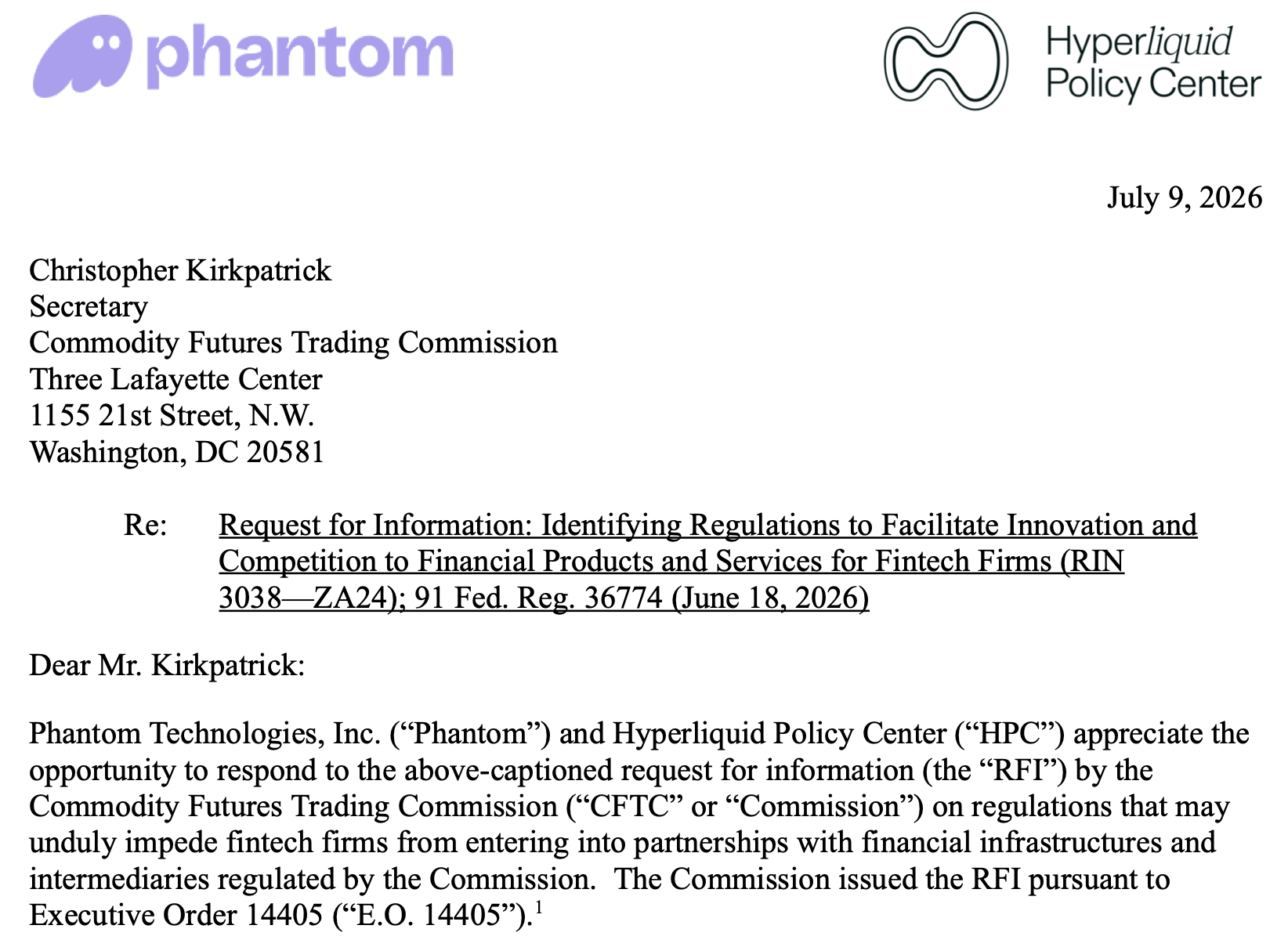
Letter to the CFTC. Source: Hyperliquidpolicy.org
They said registration requirements should apply to entities that handle customer funds or execute trades, rather than to developers who create blockchain software or contribute to open-source protocols without controlling how the software is used.
The groups also asked the CFTC to clarify that registered derivatives exchanges, clearinghouses and intermediaries can use onchain infrastructure for functions including trade execution, clearing, settlement, margining and recordkeeping, provided they continue to comply with existing regulations.
The groups said the alternative to adopting the recommendations is the status quo, in which “American users continue to be walled off from onchain derivatives markets,” while innovation continues to take place offshore.
Related: Can AI drain DeFi? Separating Claude Mythos hype from reality
Regulatory debate over onchain derivatives intensifies
The letter comes as crypto companies and traditional exchanges press US regulators over how blockchain-based derivatives should be regulated, with both sides seeking greater clarity on the agency’s approach.
In May, Intercontinental Exchange and CME Group reportedly urged regulators to scrutinize Hyperliquid’s expansion into commodity-linked perpetual futures, arguing that the decentralized platform’s energy derivatives posed market integrity and manipulation risks.
Two weeks later, ICE CEO Jeffrey Sprecher called for a “level playing field” that would allow regulated exchanges to offer 24/7 onchain perpetual futures, saying existing regulations were preventing traditional exchanges from competing with platforms such as Hyperliquid. Sprecher also said ICE had held exploratory discussions with Hyperliquid to better understand onchain derivatives markets.
CME, meanwhile, has continued expanding its own regulated crypto derivatives business. This year, the exchange announced futures tied to Avalanche and Sui, launched CFTC-regulated Bitcoin volatility futures and introduced the Nasdaq CME Crypto Index futures, a market-cap weighted contract tracking seven digital assets.
Despite that expansion, CME sued the CFTC in June over the agency’s approval of crypto perpetual futures, arguing the regulator exceeded its authority under the Commodity Exchange Act.
Magazine: The 5 types of real world assets being tokenized fastest onchain

NYT Strands hints and answers for Friday, July 10 (game #859)

Iran accuses Trump of striking nuclear plant with active working reactor LIVE

Costco sued over Orgain protein powder heavy metal allegations


-

 Fashion6 days ago
Weekend Open Thread: High Hopes
-
 NewsBeat5 days ago
Taylor Swift and Travis Kelce wedding staffer hilariously struggles to keep her cool while checking in megastars
-

 Crypto World6 days ago
Standard Chartered Secures MiCA License as ESMA Adds 37 New Crypto Firms
-

 Fashion3 days ago
Open Thread: What Great Books Have You Read Recently?
-

 Politics7 days ago
The House | “Reframing the debate from a binary discussion of winners and losers”: Yuan Yang reviews ‘We Are Not Machines’
-

 Fashion15 hours ago
Loro Piana Fall 2026 Enters Houston’s Art Scene
-

 News Videos3 days ago
Whats Hidden Inside This Cash Register? #treasure #reselling #money
-
 Tech3 days ago
Anthropic’s new “J-lens” reveals a silent workspace inside Claude that mirrors a leading theory of consciousness
-
 Crypto World6 days ago
ESMA Expands Crypto Register by 37 Firms Following MiCA Transition Period
-

 Business3 days ago
AXT Shares Jump Nearly 14% as Semiconductor Materials Maker Rebounds on AI-Linked Indium Phosphide Demand
-

 Sports2 days ago
Joshua Pacio ‘more complete’ ahead of ONE rematch vs Malachiev
-
Crypto World3 days ago
SK hynix (000660.KS) Stock Dips as $28B Nasdaq ADR Offering Drives AI Memory Expansion
-

 Crypto World4 days ago
South Africa proposes crypto tax guidance under existing rules
-

 News Videos3 days ago
Best Time to Enter Small Caps Right Now? Another Bull Run? | Financially Free
-

 Tech5 days ago
Lenovo laptops are now shipping with YMTC SSDs, a sign of Chinese NAND entering the mainstream
-

 Business7 days ago
What a 10 Percent Drop Means for Buyers, Sellers and Renters
-
Sports2 days ago
We have punished the disrespect
-

 News Videos4 days ago
Avoid entering in FOMO #bitcoin #cryptocurrency #trading #scalping
-

 Crypto World7 days ago
Alibaba bans Claude Code over alleged backdoor security concerns
-

 Tech5 days ago
Neuralink Threads Its Way Straight Through the Brain’s Armor
You must be logged in to post a comment Login