

Crypto World
The Short Window Ahead of Bullski’s 5pm UTC Launch


The list of meme coins to buy usually comes with an open clock. This week it doesn’t. Bullski ($BULLSKI) opens stage one of its presale at 5pm UTC on Friday, July 10, and the run-up is short.
Until then, the one move that matters is free: claim a spot on the priority list through Bullski’s site so you enter stage one ahead of the public rush. Here’s what the window really is, what to do before Friday, and where the listed memes fit around the event.
What the Before-Friday Window Really Is
The window is short and specific. Bullski’s presale opens to the public at 5pm UTC this Friday, and the days before it are a reservation phase. Joining the free priority list holds your place so stage one starts with you already through the door.
That’s the entire trick to a launch with a hard date: the people who did the two-minute step early are the ones who buy at the opening price.
Myth: Buying before a launch means finding somewhere to buy the token early. Reality: there is nowhere to buy $BULLSKI before Friday, and any page that says otherwise is not Bullski. The move before Friday is the free reservation; the buying happens at stage one, once the presale is live.
The One With the Deadline
Bullski is the reason the deadline exists, and its numbers hold up under a clock. It’s an ERC-20 token on Ethereum with a fixed 120 billion supply, sold through a 16-stage presale where each stage prices higher than the last on the way to a $0.0025 listing reference. Stage one is the lowest rung on that ladder, and stage one is what opens Friday, July 10.
The checks are already in place, which matters more when a date is pushing you. The contract is verified on Etherscan, an audit is in process, and liquidity locks at launch. Staking starts with the first purchase, and a referral program pays holders for bringing people in.
A deadline with a paper trail behind it is a very different thing from a deadline alone.
The Listed Memes Around the Event
The big listed memes are context here, not competition. Dogecoin has traded through every cycle since 2013 and is still the category benchmark, though its supply keeps growing and its early window closed more than a decade ago. Shiba Inu built one of the largest holder communities in crypto.
Pepe proved in 2023 that a fresh meme coin can still run hard. All three are listed, which means you can buy them any day you like. None of them has a Friday.
The short window belongs to the coin that does.
Side by side, the split looks like this.
|
Move |
Before Friday |
After 5pm UTC |
|
Priority list |
Free to claim, holds your place |
Priority holders enter stage one first |
|
Buying $BULLSKI |
Not possible anywhere yet |
Live at stage one with ETH or USDT |
|
Wallet prep |
Set up MetaMask, add ETH or USDT |
Connect and buy in minutes |
|
Staking |
Not open before launch |
Available right after a stage-one buy |
That leaves a short list between now and Friday.
-
Set up an Ethereum wallet such as MetaMask and fund it with ETH or USDT for fees.
-
Claim your priority spot now instead of at five minutes to five on Friday.
-
Save the official Bullski links so launch day involves zero searching.
Watch Out: A ticking window is exactly when people skip their checks. The Friday date is real, but so are the fake pages that cluster around any launch drawing attention. Verify every link through Bullski’s official channels before you connect a wallet, however close to the deadline you get.
Beating the Window: Your Before-Friday Move
If the countdown has your attention, spend it in the right order. The reservation is the whole game between now and launch: it costs nothing, takes about two minutes, and decides whether you enter at the lowest stage price or wait behind the crowd that reserved earlier. Fund your wallet, then reserve your stage-one entry on the official site.
When the presale opens Friday evening UTC, priority holders step into stage one first, buy with ETH or USDT, and can stake their $BULLSKI straight away.
$250 USDT Giveaway: There’s one more free move before the window closes. Bullski’s Bullish by Default draw pays $250 USDT to one winner, picked at random, with no purchase needed. You can join the Bullski giveaway draw through the Telegram and X, and bringing a friend adds entries. Winners are announced only on the official channels, and the team will never ask for your wallet keys.
Meme Coins to Buy Before Friday FAQ
What meme coins should I buy before Friday?
Bullski is the one with an actual deadline attached: stage one of its 16-stage presale opens Friday, July 10 at 5pm UTC, and the free priority list is how you enter it first. DOGE, SHIB, and PEPE are the listed names around it, buyable any day. Do your own research before committing to any of them.
What can I actually do before the launch?
Three things. Claim your priority list spot, set up an Ethereum wallet with a little ETH or USDT, and save the official links so you’re not searching in a hurry on the day. There’s nothing to pay before launch; the buying starts at stage one.
What happens at 5pm UTC Friday?
Stage one of Bullski’s presale opens. Priority list holders enter first, buy $BULLSKI with ETH or USDT at the lowest price of the sixteen stages, and can stake right away. From there the presale climbs stage by stage toward its $0.0025 listing reference.
How do I reserve a stage-one entry?
Go to the official Bullski site and add yourself to the priority list; it takes moments. Then fund an Ethereum wallet and wait for July 10. When stage one opens, your reservation puts you ahead of the public queue.
For More Information
Website: Visit the official Bullski website at bullski.io
Telegram: Join the Bullski Telegram channel at t.me/BullskiCoinOfficial
X (Twitter): Follow Bullski on X at x.com/bullskicoin
Disclaimer: This is a Press Release provided by a third party who is responsible for the content. Please conduct your own research before taking any action based on the content.




PayPal USD (PYUSD) has become natively available on Polygon through the Polygon Open Money Stack, giving businesses direct access to the regulated stablecoin across payment, compliance and fiat conversion services.
Summary
- PayPal USD is now issued natively on Polygon through the Open Money Stack, giving businesses direct access to regulated stablecoin payments and settlements.
- The integration combines wallets, fiat ramps and compliance tools into a single system to simplify cross border payments and local currency payouts.
- The launch extends PayPal’s PYUSD expansion after February’s PYUSDx platform and follows Mastercard’s decision to support PYUSD for stablecoin settlements across multiple blockchains.
According to a press release shared with crypto.news, Paxos-issued PYUSD is now issued natively on Polygon and integrated into the Polygon Open Money Stack, allowing businesses already processing payments on the network to access the stablecoin through the wallets, fiat ramps and compliance tools they already use.
Native PYUSD arrives on Polygon
According to Polygon Labs, the integration removes the need for businesses to connect separate providers for stablecoin issuance, fiat on and off ramps, compliance, and payment infrastructure. Instead, companies can accept payments from cards, bank accounts or exchange balances, settle in PYUSD across borders and convert funds back into local currencies through a single integration.
The company said the simplified setup reduces engineering work, lowers operating costs and speeds up settlement by combining regulated fiat access and compliance services within the same payments infrastructure.
Polygon Labs noted that its network has settled more than $2.6 trillion in stablecoin transactions to date and is already used by companies including Revolut and Stripe. Businesses already running payments on Polygon can now access PYUSD without changing their existing infrastructure, the company added.
Businesses target cross-border payments
According to Polygon Labs, businesses such as payroll providers, online marketplaces and remittance platforms could use PYUSD to pay contractors, settle with international sellers and move money into overseas markets without building their own banking and compliance systems. The company said end users could benefit from quicker payouts, fewer failed transactions and faster conversion into local currencies.
PYUSD is issued by Paxos under a national trust charter supervised by the Office of the Comptroller of the Currency, making it one of the largest U.S. dollar stablecoins issued by a federally regulated entity. Polygon Labs said pairing the regulated stablecoin with its licensed fiat ramps provides businesses with a compliant path between traditional financial systems and on-chain settlement.
“A stablecoin is only as useful as the places it can go and what it can do when it gets there,” Polygon Labs CEO Marc Boiron said, adding that bringing PYUSD into the Open Money Stack allows businesses to receive payments, move funds across borders and cash out through a single integration with compliance built in.
“PYUSD is issued under a national Trust charter supervised by the OCC, and bringing it natively to Polygon puts a federally regulated, dollar-backed stablecoin on one of the most active networks for stablecoin payments. Businesses running on the Open Money Stack can now settle in PYUSD with confidence in the compliance and regulatory oversight that serious money requires,” Peter Jonas, chief revenue officer at Paxos, added.
The rollout adds another expansion for PYUSD after PayPal and MoonPay introduced the PYUSDx platform in February, allowing developers to launch application-specific stablecoins backed by PYUSD without building payment infrastructure from scratch. At the time, the companies said growing stablecoin adoption had increased demand for faster deployment of custom digital currencies.
The launch also follows Mastercard’s June decision to add PYUSD alongside five other regulated dollar-backed stablecoins to its settlement network across multiple blockchains, including Polygon. Mastercard said the service would allow participating financial institutions to settle card transactions outside traditional banking hours while maintaining its existing security and compliance standards.

Charles Hoskinson has denied rumors that he is retiring from Cardano. He called the claims a complete fabrication in a video posted this week.
The Cardano founder blamed out-of-context clips and reaction videos for the story. He said they falsely claimed he called Cardano a failing project.
Hoskinson Pushes Back on the Rumor
Hoskinson said the story reached far. A London taxi driver told visiting Cardano supporters he had heard the founder was retiring.
He added that contacts at a partner firm relayed the same claim to their own chief executive.
“It is categorically untrue. It’s a complete lie. It’s a complete fabrication.”
Hoskinson asked supporters to share the video with anyone repeating the rumor. He said it proves he remains involved in the ecosystem.
A Rough Stretch for Cardano
The denial lands during a difficult period for Cardano. ADA’s price action has struggled near multi-year lows. The token trades around $0.16, roughly 94% below its 2021 all-time high of $3.09.

The network has also faced recent governance turmoil after EMURGO exited Cardano’s Pentad body following a wallet exploit. Investor Justin Bons separately made a call for Hoskinson’s exit, drawing heavy community backlash.
Not every signal has been negative. Cardano saw wallet growth this month even as ADA struggled to hold gains. Hoskinson has also floated a proposed governance overhaul aimed at restoring confidence.
The Broader Altcoin Backdrop
Cardano’s struggles mirror a wider altcoin market that has yet to break Bitcoin’s grip. Bitcoin dominance sits near 58%, testing support that has held since August 2025.
The Altcoin Season Index reads 45, still short of the 75 mark that defines a true rotation. The Crypto Fear and Greed Index remains in Extreme Fear territory.
Capital has stayed concentrated in Bitcoin and Ethereum through much of 2026. Analysts say a confirmed altcoin season likely needs Bitcoin dominance to break below 55.5%.
The post Charles Hoskinson Addresses Rumors He Is Quitting Cardano appeared first on BeInCrypto.
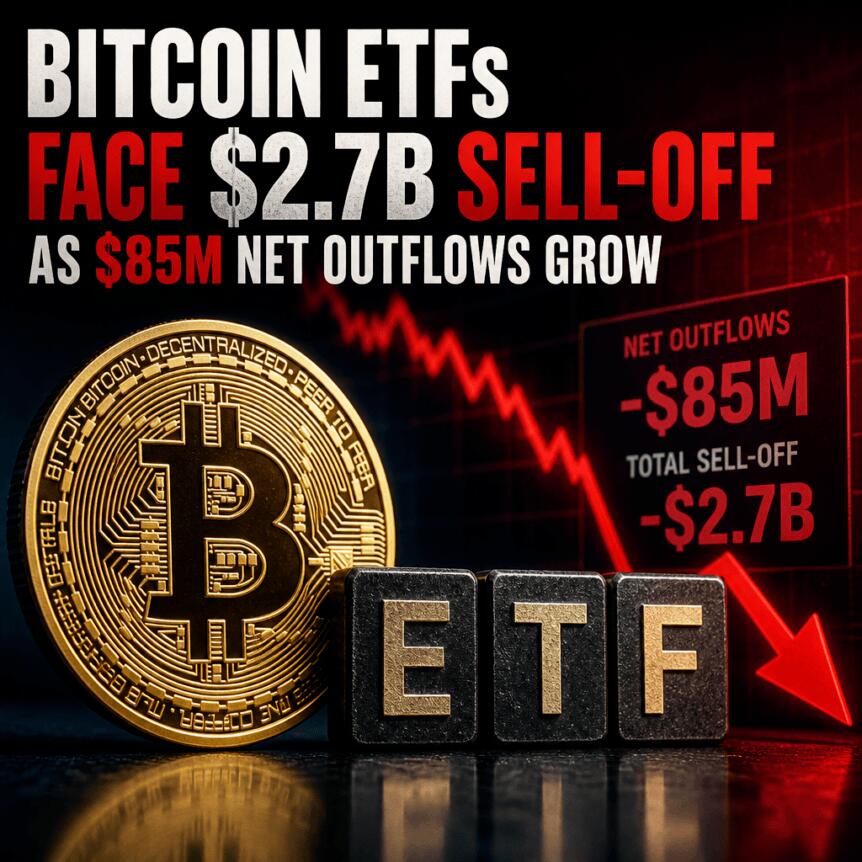
Bitcoin’s institutional story is turning, but not decisively—according to Swissblock, the most intense US spot Bitcoin ETF sell-off in the current bear market appears to be over, even as it cautions that institutional demand is still “not yet strong.”
While flows into US spot Bitcoin ETFs swung from ten straight days of outflows totaling $2.7 billion to a brief rebound, on-chain and derivatives-focused research continues to show a split: futures demand has improved faster than spot buying. That divergence matters because it often signals whether a recovery is durable or merely technical.
Key takeaways
- US spot Bitcoin ETFs reversed a ten-day outflow streak beginning June 17, after net outflows summed to $2.7 billion, per Farside Investors.
- Swissblock says the “most overwhelming” distribution wave has ended, but warns accumulation is still “positive, but not yet strong.”
- ETF flows show early stabilization—over $500 million net inflows across three trading days—yet remain fragile after a later net outflow.
- CryptoQuant analysis highlights a demand gap: derivatives demand moved toward neutral while spot demand stayed negative.
Swissblock: the ETF “storm” looks to have passed
In an X post on Thursday, Swissblock framed the recent ETF movement as the end of an unusually heavy sell-pressure phase. The firm described the episode as “the most overwhelming ETF distribution wave of this bear market,” adding, “The storm has passed.”
Swissblock also tied the change to improving risk conditions, stating that “Bitcoin Risk continues easing from Capitulation Risk” and that spot ETF flows have “turned slightly positive again.” The underlying flow numbers referenced in the article come from Farside Investors, a UK-based investment data provider that tracks ETF movement.
According to Farside Investors data, starting June 17 the US spot Bitcoin ETF complex recorded ten consecutive sessions of net outflows totaling $2.7 billion. After that stretch, the trend began to reverse, with more than $500 million in net inflows across three trading days—before the most recent session mentioned in the article closed with a net outflow of $84.9 million for Wednesday.
Swissblock characterized the rebound as a signal worth noting, but not one to overread. It called the development a “caveat” to the recovery narrative—an acknowledgement that ETF accumulation has improved, yet “institutional conviction is not returning with full force.”
“Has the storm passed? Or is Bitcoin simply in the eye of the storm?”
Why ETF flows matter—even when they turn
Spot Bitcoin ETFs have become a key channel for traditional and institutional access to BTC exposure. When flows consistently run negative for long stretches, it often reflects sustained risk-off positioning by allocators who use these vehicles as a regulated wrapper.
The shift from prolonged outflows to net inflows, even if modest or intermittent, can therefore represent more than a short-term trading reaction. It may indicate that some capital is returning after de-risking pressures eased.
Still, Swissblock’s framing is instructive for investors: “positive, but not yet strong” implies stabilization rather than a full recommitment of institutional capital. The specific pattern highlighted—three days of meaningful inflows followed by a smaller outflow—suggests demand may be improving unevenly rather than trending cleanly upward.
Spot versus futures: CryptoQuant sees a widening mismatch
Beyond ETF flow headlines, the broader picture of Bitcoin demand across market venues remains mixed. Earlier coverage referenced in the article pointed to demand as a recurring hurdle for a sustained bullish market recovery.
In fresh research shared this week through CryptoQuant, contributor IT Tech described conditions as partially improving while emphasizing a “clear divide between spot and derivatives markets.” In that view, total 30-day cumulative demand moved from close to -500K BTC to roughly -75K BTC.
More importantly, IT Tech said futures demand recovered faster than spot demand. Over the same period, futures demand shifted from -295,000 BTC to a “slightly positive” figure, while spot demand continued to register negative levels.
“This tells us something important. The latest bounce has been driven primarily by derivatives traders, while spot buyers are still relatively cautious,” IT Tech commented.
CryptoQuant’s framing aligns with a common market dynamic: derivatives can reflect expectations and hedging activity that change quickly, while spot buying—especially from longer-horizon participants—often requires stronger conviction. The article includes an additional historical observation attributed to IT Tech: the most reliable rallies tend to begin when both futures and spot demand rise together.
What to watch next: whether the spot bid returns
At this stage, the key uncertainty is whether the ETF improvement will translate into stronger, more persistent spot demand. The Swissblock takeaway—accumulation is improving but institutional conviction is not fully back—paired with CryptoQuant’s spot/derivatives divergence suggests investors should watch for confirmation across multiple indicators rather than relying on a single flow reversal.
In the coming sessions, readers should look for sustained net inflows in US spot Bitcoin ETFs beyond short bursts, alongside evidence that spot demand meaningfully turns positive rather than merely stabilizing while derivatives activity leads the rebound.


Robinhood Chain has recorded $500 million in daily Uniswap trading volume within just eight days of launch, lifting total value locked above $106 million and pushing the Arbitrum-powered network into the top ranks of decentralized finance activity.
Summary
- Robinhood Chain reached $500 million in daily Uniswap trading volume within eight days of launch.
- Ethena’s $50 million deposit helped push the network’s TVL above $106 million.
- Pump.fun integration, tokenized stocks, and gas fee waivers have accelerated early ecosystem growth.
DeFiLlama data shows the network’s total value locked climbed to more than $106 million after surging 159% in 24 hours, while cumulative addresses approached 200,000. The same data places Robinhood Chain behind only Ethereum mainnet in 24-hour Uniswap trading volume, an unusually rapid rise for a newly launched Layer 2 network.
Uniswap activity on the chain reached $500 million on July 8 after cumulative trading volume had already crossed $250 million during its first week.
Institutional liquidity has fueled the TVL jump
Most of the recent capital increase has come from institutional DeFi flows rather than retail participation.
According to DeFiLlama, nearly $90 million of Robinhood Chain’s locked value is held on the Morpho lending protocol, which powers the roughly 7% annual percentage yield available through Robinhood Earn on USDG deposits.
The largest catalyst came from Ethena, which deposited $50 million into a Steakhouse Financial-managed USDG vault on Morpho in a single transaction. That transfer accounted for much of the network’s sharp one-day TVL increase and highlighted how concentrated institutional liquidity can rapidly reshape early DeFi metrics.
Robinhood Chain also launched with full support for Uniswap’s v2, v3, v4 and UniswapX infrastructure from day one. Trading activity has centered on Wrapped Ether (WETH), memecoins and tokenized equity assets including NVDA, AAPL and GOOG, giving the network exposure to both crypto-native and tokenized real-world asset markets.
Ecosystem expansion has drawn fresh market attention
Robinhood chief executive Vlad Tenev has continued to position the network around tokenized real-world assets while acknowledging growing meme coin demand. In a July 8 post on X, Tenev wrote that as Robinhood develops Robinhood Chain into “the best chain for RWA,” it is “a great chain for memes, too.”
Support from Pump.fun arrived the same day, allowing users to trade Robinhood Chain tokens directly using SOL without bridging assets. The integration quickly boosted activity around the memecoin CASHCAT, adding another source of transaction volume shortly after the chain’s launch.
A separate filing with the U.S. Securities and Exchange Commission disclosed that Tenev sold 375,000 Class B HOOD shares under a prearranged Rule 10b5-1 trading plan.
According to the filing, the shares were sold between $112.22 and $118.13, generating roughly $43.6 million after HOOD stock had already gained more than 40% over the previous month, supported in part by enthusiasm surrounding Robinhood Chain.
Activity on the network has also lifted related crypto assets. UNI, Uniswap’s governance token, rose as much as 14% alongside the surge in trading volume. Robinhood Chain processes blocks every 100 milliseconds compared with Ethereum’s roughly 12-second block time, while Chainlink supplies oracle infrastructure for tokenized equities. Robinhood is also waiving gas fees for the network’s first 90 days, reducing transaction costs during its early growth phase.
Institutional interest in tokenized finance had already been building before the launch. Earlier this week, ARK Invest increased exposure to crypto-related stocks, adding to expectations that companies connected to tokenized assets could continue attracting investor attention.
At the same time, regulatory risks remain. SEC guidance published in January 2026 identified tokenized debt securities as an area for increased scrutiny, while Robinhood Chain’s current TVL remains heavily concentrated in Morpho, meaning large liquidity withdrawals could materially affect the network’s headline metrics.

Decentralized finance tokens have outperformed Bitcoin over the past month, a divergence Bitwise says may reflect a “quiet re-rating” of the sector rather than a short-lived bounce. In its latest crypto market review, the firm pointed to a steep change in relative performance during June: Bitcoin fell about 22%, while Bitwise’s index of tokens tracking major DeFi protocols declined roughly 4% over the same period.
Bitwise described the relative stability as unusual because DeFi tokens are typically among the first assets traders trim when risk appetite drops. The report argues that the sector’s volatility profile may be shifting as more traditional institutions use DeFi infrastructure—support that, in Bitwise’s view, has helped stabilize the broader ecosystem.
Key takeaways
- Bitwise’s DeFi token index fell about 4% in June versus Bitcoin’s ~22% drop, suggesting DeFi held up unusually well.
- Bitwise links the resilience to improving token economics and a narrowing gap between DeFi usage and token value.
- Institutional participation is cited as a stabilizing force as firms build on major DeFi names such as Morpho and Jupiter, with Aave highlighted for generating roughly $900 million in the past year.
- Despite token strength, total DeFi value locked has fallen—CryptoRank reported a decline to just over $70 billion from around $115 billion in January.
- Bitwise expects stablecoin-focused announcements to intensify before the GENIUS Act takes effect in January 2027, and it flags the CLARITY Act as a near-term volatility catalyst.
Why Bitwise thinks DeFi is being re-priced
Bitwise’s core observation is that DeFi’s traditional pattern—bigger swings than Bitcoin during downturns—has not played out in the most recent month. The firm said the relative performance difference is both “unusual” and largely absent from mainstream discussion, implying that market positioning may be lagging what token-level pricing is already signaling.
The report also frames this as more than a simple momentum story. Bitwise argues that DeFi token economics have been improving and that the historical disconnect between how much the platforms are used and how valuable their tokens become is narrowing. In that framing, outperformance is less about speculation and more about demand for DeFi services translating into token relevance.
Bitwise further points to real-world institutional usage as a stabilizer. It specifically names Morpho and Jupiter as examples of areas where institutions have started building, and it cites Aave’s activity—stating that Aave generated approximately $900 million in the past year—as evidence that core DeFi markets remain economically active even when the broader crypto market cools.
What’s inside Bitwise’s DeFi index
Bitwise’s DeFi index fund is market-cap weighted, and its current composition sheds light on why the basket has been resilient. The index allocates about 61% of weight to Hyperliquid’s native token (HYPE), which is tied to the perpetuals exchange ecosystem. Bitwise noted that HYPE has gained more than 160% so far this year.
The index also includes other prominent DeFi exposure, including Uniswap (UNI), Ondo (ONDO), and Aave (AAVE), among others. Despite being major constituents, these names have generally declined over the year-to-date period, with Bitwise stating that several of them are down double digits. That matters for investors because it suggests the overall index performance is being supported by a concentrated outlier (HYPE) while other widely followed protocols face their own drawdowns.
Value locked is down—resilience may not mean growth
Token performance does not automatically translate into increased capital deployment. While Bitwise’s index held up better than Bitcoin in June, CryptoRank reported that total value locked (TVL) in DeFi declined sharply throughout 2026.
According to CryptoRank data cited on June 24, DeFi TVL dropped nearly 40% so far this year, falling to just over $70 billion from roughly $115 billion in January. The data provider attributed much of the decline to a major correction in early October that followed a prior peak in the broader crypto market—when Bitcoin reached a high of more than $126,000.
CryptoRank also suggested the current drawdown is smaller than what occurred during the 2022 bear market, implying relative durability. Taken together, the token-vs-TVL split points to an important nuance for readers: DeFi can experience weaker liquidity and still see token pricing stabilize or improve—especially if parts of the ecosystem (like derivatives venues or specific liquidity markets) remain relatively favored by traders and institutions.
Policy catalysts: stablecoins and the CLARITY Act
Bitwise’s report extends beyond performance comparisons by highlighting regulatory and legislative developments it expects to influence market conditions. One major focus is stablecoins ahead of the GENIUS Act, a stablecoin-regulating bill that was made law in the US last year and is set to take effect in January 2027.
Bitwise said it expects “a steady run of large firms” to announce stablecoin projects ahead of GENIUS implementation. The firm also noted that stablecoin supply has remained supported through the recent downturn. In Bitwise’s view, continued supply growth should benefit major settlement rails such as Ethereum and Solana during the current quarter as regulators finalize rulemaking around the GENIUS Act.
On market structure, Bitwise said the next three months could be “make-or-break” for the CLARITY Act, currently under review and negotiation in the Senate. Bitwise said it believes the bill has an unlikely chance of passing before the November elections.
The report outlines a two-path scenario. If CLARITY passes, Bitwise argues it could signal the bottom of the current bear market. If it fails, Bitwise expects volatility at first, followed by a period of “clearing of uncertainty” as the industry continues building under a regulatory environment it characterizes as more pro-SEC and CFTC focused.
For investors, the practical takeaway is that the market may be balancing near-term uncertainty on structure policy with longer-term momentum from stablecoin-related deployment. With DeFi tokens holding up comparatively well against Bitcoin even as TVL falls, traders may increasingly look at whether liquidity breadth returns—or whether token strength continues to concentrate in specific segments.
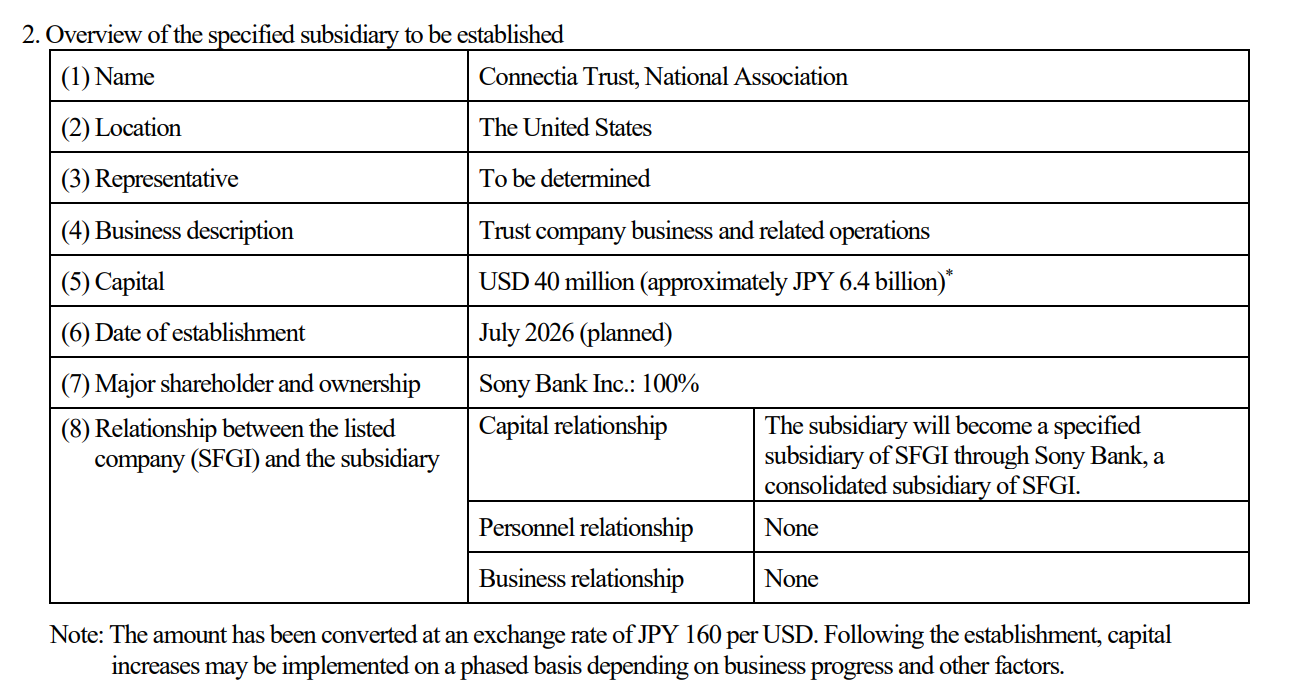
Sony Bank, a subsidiary of Sony Financial Group, said it’s received preliminary approval to establish a new US national trust bank subsidiary that will issue US dollar-denominated stablecoins.
The new unit, Connectia Trust, National Association, gained preliminary approval from the Office of the Comptroller of the Currency (OCC) on July 2.
It will be fully owned by Sony Bank and will support the issuance and management of US dollar-denominated stablecoins, according to a Monday announcement by Sony Financial Group.
The approval signals Sony’s entry into regulated US stablecoin issuance, part of a long-term digital asset business foundation, which it is backing with $40 million in starting capital.
Sony Bank said that no business activities or stablecoin issuance will be conducted until all approvals and authorizations are received, including the final approval from the OCC. The conglomerate plans to launch the stablecoin subsidiary this month.
Cointelegraph has approached Sony Bank for more details about the business and whether it would include the launch of a proprietary stablecoin, but did not receive a reply by time of publication.
Earlier in March, Sony Bank signed a memorandum of understanding with stablecoin issuer JPYC Inc. to study whether the Japanese yen-pegged stablecoin can be connected more directly to the bank’s deposit rails.
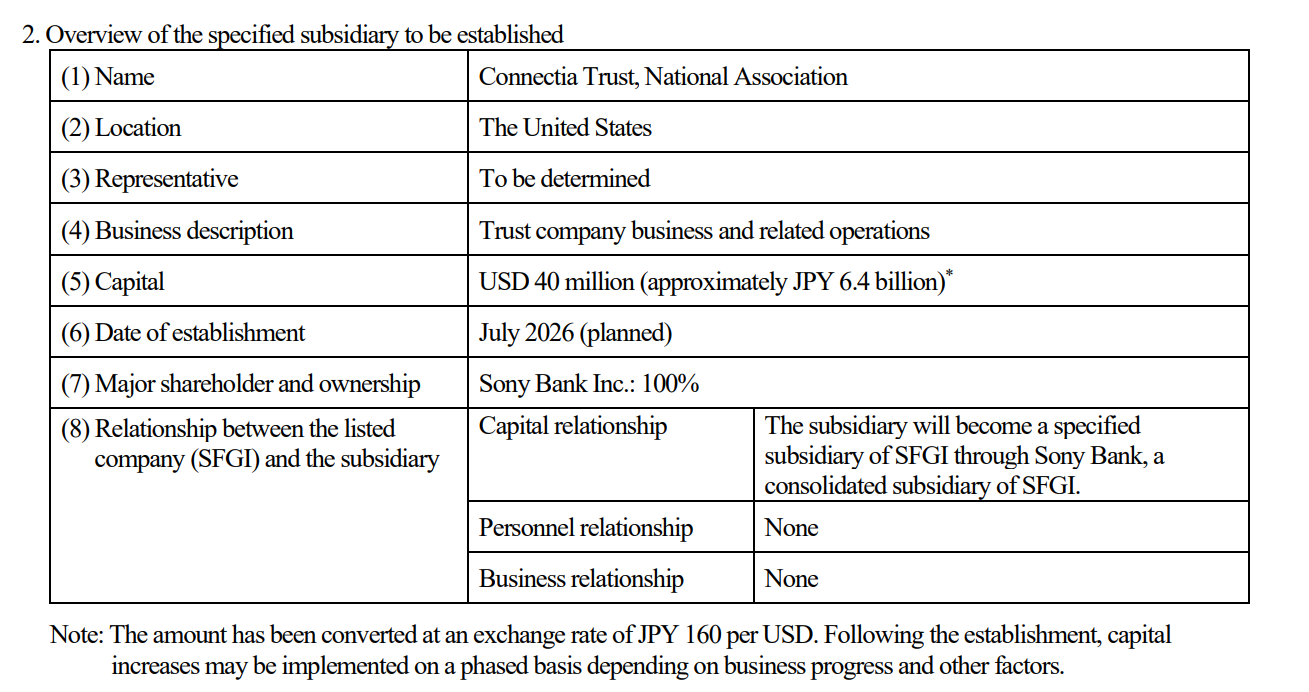
Overview of the specified Sony Bank subsidiary to be established in the US. Source: Sony Bank
Banks seek stablecoin integrations despite regulatory headwinds
More of the world’s biggest banks are seeking to integrate stablecoin infrastructure into traditional systems, despite regulatory headwinds in the US.
Last Thursday, British multinational bank Standard Chartered and USDC issuer Circle said they developed a system that lets institutions mint and redeem the USDC stablecoin through a bank-led onboarding process. Clients will be able to mint and redeem the US dollar-backed stablecoin directly through StanChart’s platform instead of opening separate accounts with Circle.
Related: SWIFT launches blockchain ledger with 17-bank tokenized deposit pilot
Meanwhile, Congressional progress on the first regulatory framework for digital assets in the US, the CLARITY Act, remains stalled, prompting Galaxy Digital to cut its odds of the bill becoming law in 2026 to 50%.
While the legislation is set for a House of Representatives hearing on July 17, Galaxy’s head of research, Alex Thorn, warned that the bill may not have enough floor time before the Senate is scheduled to leave for its traditional four-week recess on Aug. 8
The bill cleared the Senate Banking Committee in May, but faced pushback from most Democrats and the banking industry over concerns it would allow crypto firms to offer yields on stablecoins without facing the same requirements as traditional financial institutions.
At the beginning of June, more than 200 crypto companies and related organizations urged the Senate to pass the CLARITY Act, in a letter shared by crypto lobby group Stand With Crypto.
In May, JPMorgan CEO Jamie Dimon told Fox Business that banks will continue to “fight” against the current version of the CLARITY Act and said that crypto companies wanting to offer yield-bearing products “should apply for banking charters.”
Magazine: Wall Street’s tokenization boom has a liquidity problem: Axis CEO
PI is down 12% this week and is quickly approaching $0.10. Will buyers return there?
PI Network (PI) Price Predictions: Analysis
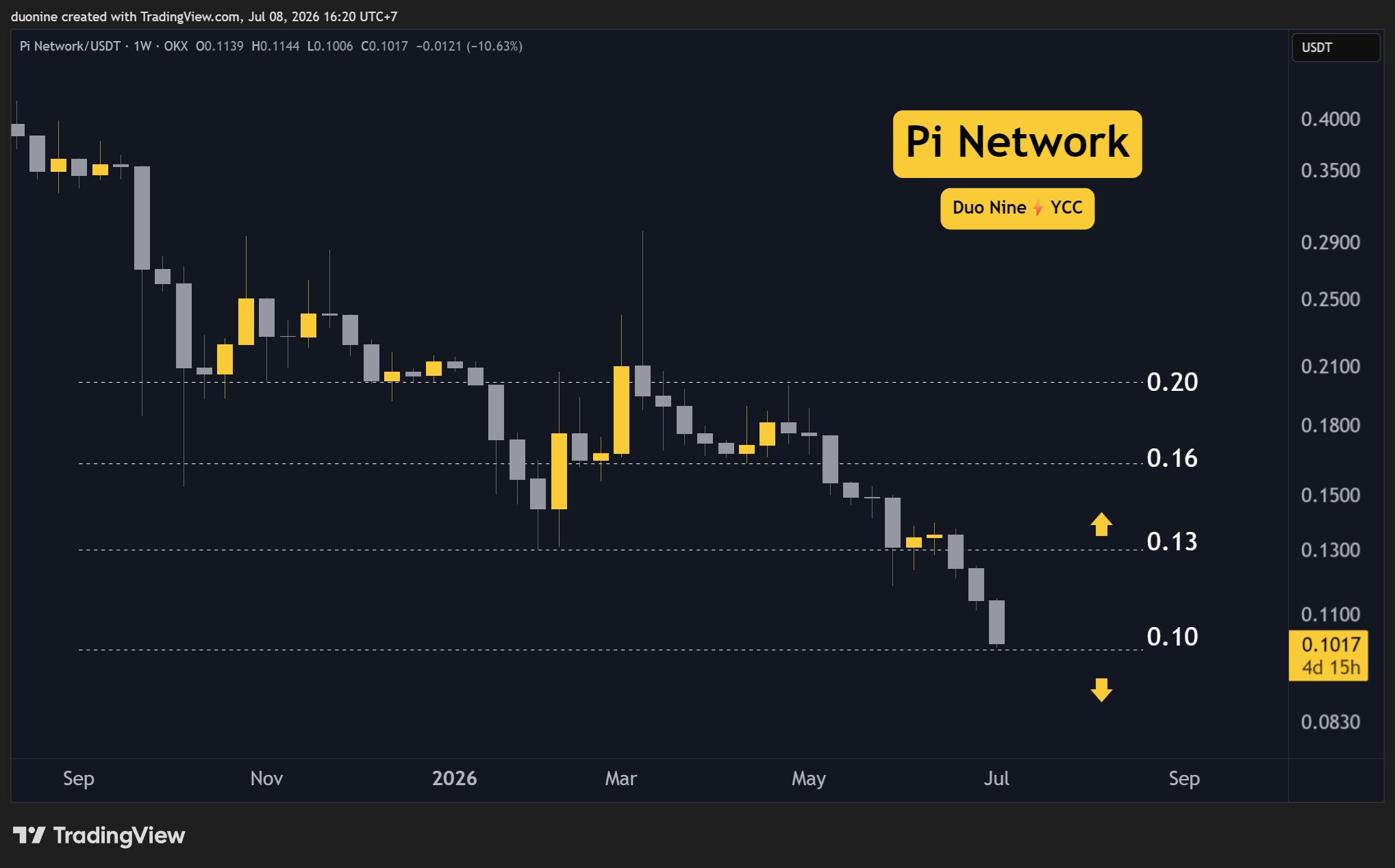
Key support levels: $0.10, $0.085
Key resistance levels: $0.13, $0.16
PI Arrives at $0.10
As expected, the price of PI has reached the 10-cent support, a key psychological level. So far, sellers appear to have total control, considering that the price has crashed 12% since last week.
If buyers plan to return, then this is a key moment for them to take back control. Ideally, they defend the $0.10 level and send PI into a bounce. The current resistance is found at $0.13, and only if this level breaks can we hope for a sustained rally.
Decisive Moment Ahead
With the $0.10 key support under pressure, PI is found at a crossroads. Bounce here, and buyers have a chance to recover some of the most recent losses. Fail to defend this level, and PI may crash even more and into single digits.
A look at the momentum indicators does not give much confidence that buyers stand a chance. The daily RSI is below 30, and the MACD has been making lower lows since a bearish cross in late June.

Sell Volume Explodes
Since mid-June, the sell volume has been making higher highs. That’s a clear bearish signal, and there is little hope this can reverse any time soon. Best to wait for a reaction at the 10 cents support, if it comes.
If the current momentum doesn’t change, expect sellers to continue to have the upper hand as they push PI to new record lows, with $0.085 as the next key target.

The post Why Is the Pi Network (PI) Price Down This Week? appeared first on CryptoPotato.

Hackers compromised a widely used Injective software package in a supply chain attack with malware designed to steal crypto wallet private keys, adding to a growing attack vector involving attackers using legitimate platforms to deliver malicious payloads.
Security firm Socket discovered on Thursday that a popular npm (node package manager) package with around 50,000 weekly downloads used for building on the Injective blockchain was maliciously modified to steal wallet private keys and seed phrases.
The large number of downloads makes the incident “significant for developers and applications that handle Injective wallet workflows,” Socket researchers said. The malicious code has since been removed.
The software supply chain attack is a relatively new attack vector in which hackers don’t target a blockchain’s cryptography or smart contracts directly, but instead compromise trusted developer tools used to build wallets, exchanges and apps.
Injective is an interoperable layer 1 designed for DeFi applications. Its usage has dwindled over the past two years, with total value locked shrinking by 88% to current levels of $8.2 million from its $71 million peak in mid-2024, according to DefiLlama.
Secretly copying private keys and phrases
Version 1.20.21 of the @injectivelabs/sdk-ts npm package was modified through a compromised developer GitHub account, with suspicious commits beginning June 8. It was also pinned across 17 other packages in the Injective Labs npm scope, “exposing users who may not have installed the SDK [software development kit] directly,” Socket said.
“The malicious release hooks wallet key-derivation functions, records private keys and mnemonics, and exfiltrates them through fake telemetry,” Socket explained.
The malicious code hooked into normal functions used to generate wallet keys, and whenever a developer’s app used these functions, it secretly copied the seed phrase or private key. The compromised data was then encoded and sent to a web address that looked like a legitimate Injective network server.
“Any keys or mnemonics passed through affected packages should be treated as compromised,” Socket added.
Related: ‘TrapDoor’ malware targets crypto dev tools in supply chain attack
Socket reported that the developer whose account was infiltrated quickly detected the compromise, but the malware had been downloaded more than 300 times, and “the campaign itself isn’t yet fully contained.”
Injective CEO Eric Chen said, “it’s already fixed, and the affected versions on npm are already deprecated.” No funds on the network are at risk, he added, and Socket did not specify whether any funds were stolen in the incident.
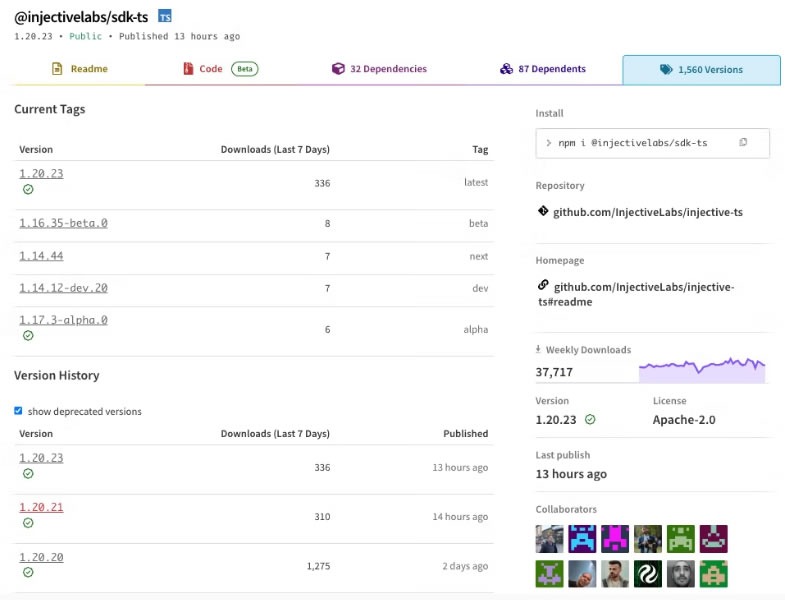
The compromised npm package was downloaded 310 times. Source: Socket
Wallet compromises most costly this year
The Security Alliance (SEAL) said in its second-quarter threat report that attackers are increasingly using legitimate platforms like GitHub, npm and Google to deliver payloads.
“In some cases, compromised systems are being used to push malicious code directly into a company’s own GitHub repositories, turning a single compromise into a distribution channel for the next one.”
SEAL added that the malware itself has also gotten more comprehensive, “with cross-platform payloads, including a rise in macOS-specific campaigns, that combine infostealers, RATs (remote access trojans) and backdoor capabilities in a single package.”
A similar supply chain attack hit Axios npm releases in March, while a malware campaign called TrapDoor was discovered in May targeting crypto, DeFi, AI and security developers.
GitHub itself was exploited on May 20 when it reported unauthorized access to its internal repositories following the compromise of an employee’s device.
Wallet compromises were the most costly attack vector in the first half of 2026, with $444 million stolen across 33 incidents, CertiK reported Monday.
Features: Bitcoin’s quantum dilemma: Bigger blocks or STARK proofs?

WD-40 Company shares traded as much as 14.5% higher in Thursday overnight trading via Blue Ocean ATS. The household lubricant maker beat Wall Street’s revenue and profit estimates by wide margins.
WD-40 also raised its full year guidance. The company pointed to stronger than expected demand for its core spray lubricant business.
Revenue and Profit Both Clear Estimates
WD-40 reported $195.1 million in sales, a 24.3% jump from a year ago. That easily beat the $173 million Wall Street expected. Profit per share also beat expectations. WD-40 earned $2.24 for every share, well above the $1.57 analysts had penciled in.

Two other numbers show how efficiently WD-40 turned sales into profit. Operating margin, the share of revenue left after covering core costs, rose to 20.7% from 17.4% a year ago. That means the company kept more of every dollar it made.
Free cash flow margin, the actual cash left over after running the business, dipped to 15% from 21.6%. Even with that dip, it still beat WD-40’s average over the past two years.
Zooming out, WD-40 has grown sales by 8.6% a year on average over the past three years. Analysts now expect growth to slow to just 3% over the next 12 months, a sign that this quarter’s strength may be hard to repeat.
While Chips Dominate, WD-40 Delivers
Wall Street’s biggest gains this year have mostly gone to one theme: AI chips and the infrastructure behind them. Nvidia, Micron, and their peers have swung by double digits on a single earnings report, driven by massive bets on data centers and computing power. WD-40 makes none of that, but still found a way to beat expectations and reward shareholders.
The company raised its full-year revenue guidance to $682.5 million at the midpoint, a 6.2% increase from its prior $642.5 million target. Full-year profit guidance also climbed, with earnings per share now expected to reach $6.20 at the midpoint, above what analysts had projected.
Shares closed at $272.00 after the report, pushing WD-40’s market capitalization to $3.02 billion. That’s a fraction of a single AI chipmaker’s daily swing in market value, but it’s a reminder that steady, unglamorous businesses can still deliver when they execute well.
The post WD-40 Greases Wall Street’s Expectations With Blowout Q2 Beat appeared first on BeInCrypto.


Spot Bitcoin and crypto ETFs have become the largest force in the market, absorbing and releasing billions of dollars of coins through a mechanism most of their own investors have never seen. This guide opens the machine: authorized participants, the creation and redemption loop, in-kind versus cash models, why a dollar of flow becomes a dollar of real buying or selling, how the arbitrage keeps ETF prices honest, and how to read the daily flow numbers everyone quotes.
Summary
- Spot crypto ETFs create and redeem shares through authorized participants, making ETF inflows and outflows translate into real buying and selling of cryptocurrencies.
- The creation and redemption process keeps ETF prices closely aligned with the value of the underlying coins through continuous arbitrage.
- Daily ETF flow data reflects actual spot market demand rather than investor sentiment alone, making it one of the market’s most closely watched indicators.
The most important trading desk in crypto does not trade on a crypto exchange. It sits inside a handful of Wall Street firms called authorized participants, and its job is to keep the price of spot crypto exchange-traded funds glued to the price of the coins they hold, by creating and destroying ETF shares in industrial quantities. When headlines report that Bitcoin funds bled $4.51 billion in a month, or took in $221.7 million in a day, they are reporting this machine’s output, and the machine’s mechanics, not sentiment, are why those flows translate directly into buying and selling of actual coins.
The spot ETF era has made these funds the marginal force in crypto’s market structure: they hold coins worth more than most national reserves, their daily flows are the most watched data series in the asset class, and their behavior in stress, as the recent record outflow month showed, can dominate price for quarters at a time. Yet the mechanism underneath, creation units, authorized participants, in-kind transfers, net asset value arbitrage, remains folk knowledge at best among the traders who quote its outputs daily.
This guide is the missing manual. It covers what a spot crypto ETF actually is and how it differs from the futures products and trusts that preceded it, the creation and redemption loop that is the entire engine, the in-kind versus cash distinction and why it matters for taxes and mechanics, the arbitrage that keeps the share price tracking the coins, why flows equal real spot demand and supply, what the daily flow numbers do and do not mean, and the honest list of what can go wrong.
What a spot ETF is, and what it replaced
A spot crypto ETF is a fund that holds the actual asset, real Bitcoin or Ether in institutional custody, and issues shares that trade on a stock exchange, each share representing a claim on a sliver of the coin pile. The design goal is simple to state and hard to engineer: make the share price track the coin price, continuously, within basis points, so that buying the ETF is economically equivalent to buying the coin, inside a brokerage account, with no wallets, keys, or crypto exchanges involved.
Everything distinctive about the structure exists to serve that tracking, and the point is sharpest against what came before. Futures-based ETFs held derivative contracts rather than coins and bled value to the cost of rolling those contracts month after month. Closed-end trusts held real coins but issued a fixed number of shares with no redemption mechanism, so their prices drifted to enormous premiums and discounts against their holdings, famously reaching double-digit discounts, because nothing forced the share price and the coin value together. The spot ETF’s innovation is precisely the forcing mechanism: an open-ended share supply that expands and contracts through arbitrage, executed by authorized participants. That mechanism is also, not incidentally, what separates an ETF from the treasury companies whose share prices float freely above and below their coin holdings: a treasury stock has no redemption loop, so its premium is a sentiment gauge; an ETF has one, so its premium is an arbitrage error measured in hundredths of a percent.
The engine: creation and redemption
The heart of every ETF is a wholesale market invisible to retail holders. ETF shares are not created when an investor clicks buy; they are created in bulk blocks called creation units, typically tens of thousands of shares at a time, by authorized participants, large trading firms and banks that hold agreements with the fund’s issuer.
The creation loop runs like this. When investor demand pushes the ETF’s market price even slightly above the value of the coins backing each share, its net asset value, an authorized participant sees free money: it buys the equivalent amount of actual coin on crypto markets, delivers it to the fund (or delivers cash the fund uses to buy the coin, a distinction the next section unpacks), receives newly minted ETF shares at NAV in exchange, and sells those shares into the stock market at the premium price. The AP pockets the spread; the share supply expands; the premium collapses back toward zero. Redemption is the mirror: when the ETF trades below NAV, an AP buys cheap shares on the stock market, returns them to the fund, receives coin (or cash from coin sales) worth full NAV, and sells the coin, pocketing the discount and shrinking the share supply until the price snaps back.
Read the loop again and notice what it implies, because it is the single most important fact in this guide: every net creation is real coin purchased on the market, and every net redemption is real coin sold. The flows are not sentiment surveys or paper reallocations; they are the visible exhaust of actual spot transactions, executed by the APs against crypto exchanges and OTC desks. A $500 million inflow day means roughly $500 million of coins were bought and moved into custody; a $4.51 billion outflow month means that much was sold out of it. This is why ETF flow data moves markets and why it deserves the obsessive attention it gets: it is the rare series that measures demand in the units that matter, coins actually changing hands, disclosed daily, to the dollar.
In-kind versus cash: the plumbing distinction
Creations and redemptions come in two flavors, and the difference, invisible to holders, shapes everything behind the scenes. In an in-kind model, the AP delivers and receives the actual asset: coins go in for shares, shares come back for coins, and the fund itself never trades. In a cash model, the AP delivers and receives dollars, and the fund’s own trading desk executes the coin purchases and sales. US spot crypto ETFs launched under a cash-creation regime, a regulatory choice that kept broker-dealers at arm’s length from handling coins, and the industry has since moved toward permitting in-kind, the structure ETFs use for every other asset class.
The distinction matters three ways. Mechanically, in-kind is cleaner: the fund holds coins and swaps them for shares, full stop, while cash models interpose a trading step where execution costs and timing slippage live. Tax-wise, in-kind is the quiet superpower of the ETF wrapper, letting funds shed appreciated assets through redemptions without realizing taxable gains, an efficiency cash models partially forfeit. And market-structure-wise, the cash model makes the fund itself a large, scheduled trader in the underlying market, whose execution patterns around creations and redemptions are studied, and sometimes anticipated, by everyone else. Either way, the coins end up in institutional custody, segregated wallets at qualified custodians, whose addresses on-chain observers track as a real-time audit of the funds’ holdings, one of the few places where traditional finance’s opacity meets crypto’s radical transparency and transparency wins.
The decade-long fight to exist
The mechanics above were nearly a decade in the courts and dockets before they were allowed to run, and the history explains several of the structure’s present quirks. The first spot Bitcoin ETF application was filed in 2013; the following ten years produced an unbroken record of rejections, with regulators citing manipulation risk in underlying crypto markets and the absence of surveillance agreements. The industry routed around the wall with inferior vehicles, the futures ETFs with their roll costs, the closed-end trusts with their wild premiums and discounts, and each inferior vehicle’s flaws became, ironically, evidence in the eventual case: the trust’s persistent discount showed concretely that investors were being harmed by the absence of a redemption mechanism, and a federal court’s 2023 ruling that rejecting spot products while approving futures ones was arbitrary broke the dam. The January 2024 approvals arrived as a batch, launching a dozen funds into simultaneous competition, which is why the market’s structure is a fee war among near-identical products rather than one dominant fund, and why issuer competition drove management fees to levels that undercut most of the world’s equity index funds within weeks of launch.
The cash-only creation requirement was the approvals’ regulatory fingerprint, imposed so that broker-dealers never touched coins directly, and its gradual relaxation toward in-kind is the quiet second act of the products’ regulatory story, unlocking the tax efficiency and mechanical cleanliness the wrapper was always meant to have. Ether funds followed Bitcoin’s, staking-enabled versions followed those, and the approval architecture built for two assets is now the template every other crypto asset’s ETF hopes, conditional on the classification framework Congress is deciding, to pass through. Ten years of rejection, in hindsight, built the most consequential piece of the structure: by the time the machine was switched on, the custody, benchmark, and surveillance infrastructure had been argued into institutional grade, which is a large part of why it has run through record inflows, record outflows, and a full market cycle without a single structural incident.
What holding the ETF actually costs
The wrapper’s convenience has a price list worth itemizing, because it is subtracted silently. The management fee, deducted daily from the fund’s assets, compounds into the tracking: a fund charging a quarter of a percent will lag its coin by exactly that much per year, before anything else. The NAV-timing gap adds a subtler cost for traders: the official NAV is struck once daily against an index snapshot, so orders executed at market prices far from the snapshot inherit tracking noise, trivial for holders, real for anyone trading the products tactically. Spreads and premiums cost basis points on entry and exit, tightest in the giant funds and wider in the small ones, and the arbitrage that minimizes them is weakest at the open and around crypto’s violent hours. And the structural exclusions, no staking yield in most products, no on-chain utility, no self-custody, are opportunity costs rather than fees, the value surrendered for the brokerage account’s convenience. Summed, the wrapper costs a diversified long-term holder a fraction of a percent annually against holding coins directly, which is, by the standards of what the access is worth to the capital that uses it, among the better bargains in finance, and knowing the itemization is what separates choosing the bargain from defaulting into it.
Why the tracking holds, and when it slips
The arbitrage loop keeps spot ETF prices within a whisker of NAV in normal conditions, but the whisker is worth understanding, because its width is a live diagnostic of market health.
The ETF trades during stock-market hours; the coins trade around the clock. Overnight and on weekends, the share price is frozen while the asset moves, so every open begins with a gap the APs arbitrage away in minutes, and the fund’s official NAV, struck once daily against a benchmark index of crypto exchange prices, is itself a snapshot of a moving target. Small premiums and discounts, hundredths to tenths of a percent, are therefore constant and meaningless. What matters is persistence: a discount that survives arbitrage signals that APs cannot or will not close it, because coin markets are too volatile to hedge, because borrowing shares is hard, or because redemption plumbing is stressed, and persistent dislocations in ETF land have historically been the smoke that precedes fire in the underlying market. The same logic runs through every wrapped-asset structure in finance, tokenized stocks keep their pegs by the identical mint-and-redeem loop, and the universal rule holds here: the wrapper is only as good as the arbitrage that binds it, and the arbitrage is only as good as the least reliable step in its loop.
One more participant deserves a paragraph: the basis trader. Because ETF shares can be held long against short futures positions, a meaningful fraction of ETF holdings at any time belongs not to investors who want crypto exposure but to arbitrageurs harvesting the spread between spot and futures prices. When that spread compresses, these holders redeem, mechanically, with no view on the asset, which means headline outflows always mix conviction selling with carry-trade unwinding in proportions no outside observer can fully separate. It is the single most important caveat when reading the flow numbers, and it cuts both ways: some of the most alarming outflow streaks in the products’ history were substantially plumbing, and some of the most celebrated inflow runs were substantially leverage.
A worked example ties the machinery together. Suppose strong demand lifts a Bitcoin ETF’s market price 0.2% above its NAV during a rally. An authorized participant simultaneously buys, say, $50 million of Bitcoin across exchanges and OTC desks and shorts the equivalent in ETF shares at the rich price, locking the 0.2% spread, about $100,000, minus costs. It delivers the coins (or cash) to the fund, receives creation units at NAV, and uses the new shares to close its short. Net result: the AP earned a riskless spread, the fund grew by $50 million of coins in custody, the day’s flow report shows a $50 million inflow, and the ETF’s premium collapsed back to a basis point or two. Reverse every step for a redemption into a discount. Multiply by every AP, every fund, and every trading day, and the aggregate is the flow series the market watches: not a survey, but the arithmetic residue of thousands of such loops, each one a real spot transaction with a paper trail. When the loops run large in one direction for weeks, as they did through June’s record redemptions, the ETF complex is not reflecting the market’s direction; at the margin, it is the market’s direction.
One design detail rounds out the picture: creation units keep the wholesale and retail layers honest simultaneously. Retail investors trade shares among themselves on the exchange all day without touching the fund at all, and only the net imbalance, the demand the secondary market cannot internally match, flows through the APs into creations or redemptions. The fund’s coin pile therefore moves only when the market’s aggregate position actually changes, which is why the flow series is such a clean demand signal: it nets out all the churn and reports only the residual conviction.
Reading the flows like a professional
The daily numbers reward a few disciplined habits. Read trends, not days: single sessions are noise, dominated by one fund’s creation calendar or one AP’s book, while multi-week runs, like the ten-day outflow streak that marked June’s low, are regime information. Distinguish flows from assets: net asset values fall when prices fall even while money flows in, and rise in rallies even during redemptions, so AUM headlines are mostly price echoes; the flow line is the demand signal. Watch the spread of participation: inflows concentrated in one fund are a product story, inflows across all issuers are an allocation story, and the custody balances that flows build are a structural supply force in their own right. Note the interaction with market hours: flows print against a US trading day, so they lag and compress around-the-clock crypto moves, and Monday’s number carries the weekend. And always carry the basis-trade caveat: the flow series measures shares created and destroyed perfectly, and measures investor belief only through that imperfect proxy.
Held together, the mechanics justify a conclusion stronger than the usual disclaimers: the spot ETF is the most consequential piece of market structure crypto has ever imported, precisely because its plumbing converts distant, regulated, advised capital into spot demand and supply with industrial efficiency and daily disclosure. It made the asset class legible to the largest pools of money on earth, and it made those pools’ behavior legible to everyone else, a two-way window that did not exist before 2024. The machine is neutral; June proved it pumps out as efficiently as it pumps in. Understanding the loop, APs, units, NAV, in-kind, basis, is what separates reading the window from being read through it.
One forward note completes the manual: the machine described here is still being extended. In-kind creation is arriving, staking-enabled funds have begun passing yield through the wrapper, options markets on the ETFs have layered a derivatives complex on top of the flow machine, and the same creation-redemption architecture is being fitted to additional assets as the regulatory perimeter settles. Each extension changes the reading of the flow data slightly, staking funds attract different holders than pure price trackers, options hedging generates mechanical creations and redemptions of its own, and the professional habit is to re-learn the machine’s output as its parts change. What does not change is the core: an arbitrage loop, run by profit-seeking intermediaries, converting the world’s brokerage demand into spot transactions, in public, every day. Crypto spent a decade fighting for that machine, and understanding it is the closest thing the asset class offers to reading its own pulse.
The reader’s bookmark list, finally, is short: each issuer’s daily holdings and flow disclosures, the aggregated flow dashboards the market quotes, the funds’ premium-discount trackers, and the custodian wallet monitors that let anyone verify the coins on-chain. Fifteen minutes a week across those four sources reproduces everything in this guide with live numbers, and turns the most quoted data series in crypto from a headline you consume into a machine you can actually read.
A last piece of perspective for scale: the creation-redemption machine described here is not a crypto invention but a thirty-year-old piece of market technology, refined across equity and bond ETFs holding trillions, and its arrival in crypto was less an experiment than a transplant of proven plumbing into a new asset. That pedigree is why it worked immediately at record scale, and it is also the quiet reassurance inside the daily drama of the flow numbers: whatever the coins do, the machine that wraps them has been stress-tested by every market crisis since the 1990s, and it has never been the thing that broke.
Disclaimer: This article is for educational purposes only and does not constitute investment advice. Digital asset markets are volatile and you can lose your entire investment. Structural details are current as of July 9, 2026, and may change. Always do your own research.
Frequently asked questions
How does a spot crypto ETF work in simple terms?
The fund holds real coins in institutional custody and issues shares that trade on a stock exchange, with each share representing a fraction of the coin pile. Large trading firms called authorized participants create new shares by delivering coins or cash to the fund, and destroy shares by redeeming them for coins or cash, an arbitrage loop that keeps the share price tracking the coin price within tiny margins.
What is an authorized participant?
An authorized participant, or AP, is a large financial firm with an agreement to create and redeem ETF shares in bulk blocks called creation units. APs arbitrage gaps between the ETF’s market price and the value of its holdings: buying coins and minting shares when the ETF trades rich, redeeming shares for coins when it trades cheap. Their profit motive is the mechanism that keeps the ETF honest.
Why do ETF flows move the crypto market?
Because flows are real spot transactions. A net inflow means authorized participants bought actual coins to create new shares; a net outflow means coins were sold to fund redemptions. Unlike sentiment indicators, the flow data measures coins genuinely changing hands, which is why sustained flow trends have become one of the most powerful forces in crypto price formation.
What is the difference between in-kind and cash creation?
In-kind creation swaps coins directly for shares, with the fund never trading; cash creation has the AP deliver dollars, which the fund’s own desk uses to buy coins. In-kind is mechanically cleaner and more tax-efficient, and it is the standard across ETFs generally; US spot crypto funds launched cash-only for regulatory reasons, with the industry since moving toward in-kind.
Can a spot ETF trade at a premium or discount?
Briefly and slightly, yes, especially at market opens after the coins moved overnight, but arbitrage closes gaps within minutes in normal conditions. Persistent premiums or discounts are rare and diagnostic: they signal that the creation-redemption loop is stressed, which historically has been a warning sign worth taking seriously. This tight tracking is the key difference from closed-end trusts and treasury stocks, which can drift far from their holdings’ value.
Do ETF outflows always mean investors are bearish?
No. A significant share of ETF positions belongs to basis traders holding shares against short futures to harvest the spread, and when that spread compresses, they redeem mechanically with no market view. Headline outflows therefore mix genuine de-risking with carry-trade plumbing, which is why flow trends matter more than single prints and why context from funding and futures data helps.
Where are the ETF’s coins actually kept?
With qualified institutional custodians, in segregated cold-storage wallets whose addresses on-chain analysts track publicly. The holdings are disclosed daily by the funds and independently observable on the blockchain, making spot crypto ETFs among the most transparent pooled investment vehicles in existence.
Is buying the ETF the same as buying the coin?
Economically it is very close: the tracking is tight and the convenience is real. The differences are structural: ETF investors hold shares, not coins, cannot self-custody or use the assets on-chain, trade only during market hours, pay an annual management fee, and rely on the fund’s custody arrangements. For brokerage-account exposure those trade-offs are usually acceptable; for crypto-native uses they are disqualifying.

Fidji Simo steps down from OpenAI’s no. 2 role

PayPal brings PYUSD stablecoin to Polygon’s Open Money Stack

Former U.S. Ski Team Member TJ Lanning Dead at Age 41


-

 Fashion6 days ago
Weekend Open Thread: High Hopes
-
 NewsBeat5 days ago
Taylor Swift and Travis Kelce wedding staffer hilariously struggles to keep her cool while checking in megastars
-

 Crypto World6 days ago
Standard Chartered Secures MiCA License as ESMA Adds 37 New Crypto Firms
-

 Fashion3 days ago
Open Thread: What Great Books Have You Read Recently?
-

 Politics7 days ago
The House | “Reframing the debate from a binary discussion of winners and losers”: Yuan Yang reviews ‘We Are Not Machines’
-

 Fashion17 hours ago
Loro Piana Fall 2026 Enters Houston’s Art Scene
-

 News Videos3 days ago
Whats Hidden Inside This Cash Register? #treasure #reselling #money
-
 Tech3 days ago
Anthropic’s new “J-lens” reveals a silent workspace inside Claude that mirrors a leading theory of consciousness
-
 Crypto World6 days ago
ESMA Expands Crypto Register by 37 Firms Following MiCA Transition Period
-

 Business3 days ago
AXT Shares Jump Nearly 14% as Semiconductor Materials Maker Rebounds on AI-Linked Indium Phosphide Demand
-

 Sports2 days ago
Joshua Pacio ‘more complete’ ahead of ONE rematch vs Malachiev
-
Crypto World3 days ago
SK hynix (000660.KS) Stock Dips as $28B Nasdaq ADR Offering Drives AI Memory Expansion
-

 Crypto World5 days ago
South Africa proposes crypto tax guidance under existing rules
-

 News Videos4 days ago
Best Time to Enter Small Caps Right Now? Another Bull Run? | Financially Free
-

 Tech5 days ago
Lenovo laptops are now shipping with YMTC SSDs, a sign of Chinese NAND entering the mainstream
-

 Business7 days ago
What a 10 Percent Drop Means for Buyers, Sellers and Renters
-
Sports3 days ago
We have punished the disrespect
-

 News Videos4 days ago
Avoid entering in FOMO #bitcoin #cryptocurrency #trading #scalping
-

 Crypto World7 days ago
Alibaba bans Claude Code over alleged backdoor security concerns
-

 Tech5 days ago
Neuralink Threads Its Way Straight Through the Brain’s Armor
You must be logged in to post a comment Login