Crypto World
The Top 5 for Developers

Every crypto app needs data. Very few need the same data.
A portfolio tracker asks what an address holds. A DeFi dashboard asks what a protocol holds. A trading terminal asks what a token trades at right now. Those are three different products.
Picking by brand name is how teams end up paying twice. Picking by question is how they stop.
This guide covers five crypto data APIs. Each one answers a different question well. CoinStats Crypto API leads on wallet, market and DeFi data. DefiLlama covers protocol economics. Codex handles real-time DEX and prediction market data. Glassnode measures the network. Blockscout returns the raw record, decoded.
Our guide to choosing the right crypto API also covers swaps and nodes. This one stays in the data lane.
Not All Crypto Data Is the Same Data
Five kinds of question sit behind the word “data”. Each has its own providers.
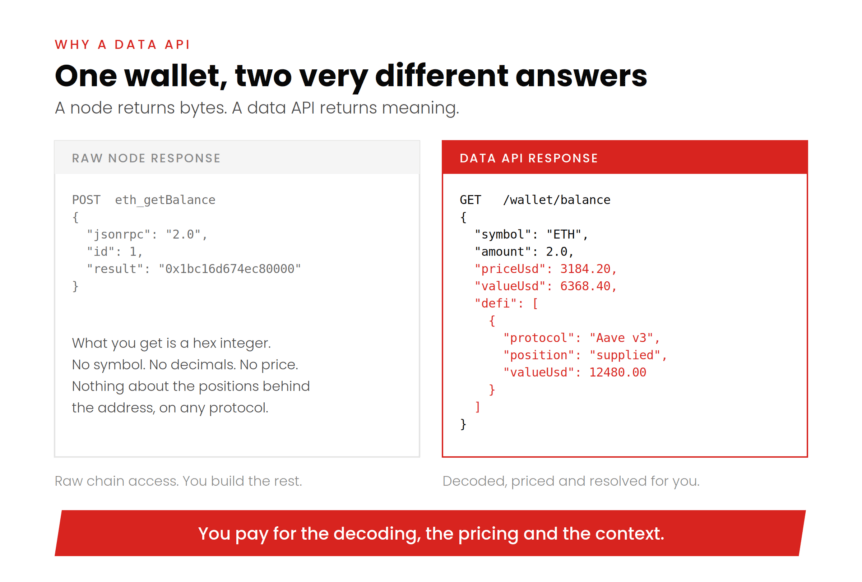
Portfolio data answers questions about an address. Balances, positions and value, already priced.
Protocol data answers questions about a protocol. Total value locked, fees, revenue and yields.
Market data answers what something trades at. Prices, candles, liquidity and holder flows.
Network data answers what participants are doing together. Supply distribution, cost basis and exchange flows.
Record data answers what actually happened. Decoded transactions, event logs and verified contract code.
A node gives you none of this. It gives you bytes. This primer on how a blockchain API works explains the gap.

1. CoinStats API (Best Overall)
One API for Markets, Wallets, DeFi and Portfolio Data
CoinStats Crypto API is a unified data layer for developers. It combines market data, wallet data, DeFi positions and portfolio analytics. Token security screening sits in the same schema. Coverage spans 100,000+ coins, 200+ exchanges and 120+ blockchains.
Wallet endpoints return balances and transactions across Ethereum, Solana, EVM chains and Bitcoin. Bitcoin support includes extended public keys (xpub, ypub, zpub). DeFi positions resolve per wallet across 10,000+ protocols. That covers staking, lending and liquidity tied to one address.
Token risk checks flag honeypots, hidden fees, blacklists and unrenounced ownership. Those checks run on EVM chains.
CoinStats API also ships an MCP Server for AI agents. It exposes wallet, DeFi and portfolio data to LLMs. Agents in Claude, Cursor and VS Code query it directly. That portfolio layer is the real differentiator. This best crypto API guide breaks down the endpoints.
Pros
- Market, wallet, DeFi, portfolio and token security in one API
- 120+ blockchains and 100,000+ coins under one key
- Per-wallet DeFi resolution across 10,000+ protocols
- Bitcoin xpub, ypub and zpub support
- Native MCP Server for AI and LLM workflows
- Free tier with credit-based pricing
Cons
- Read-only data layer, so no transaction submission
- REST-first, with no streaming for live event data
Best Use Cases
- Multi-chain portfolio trackers
- DeFi dashboards across staking, lending and LP
- Crypto tax and accounting tools
- AI agents that query data through MCP
- Wallet explorers and embedded widgets
Pricing
Pricing is credit-based with a free tier at signup. Paid plans start at $49 per month. Credits scale with endpoint complexity.
Best suited for: most data-driven builds, from portfolio trackers to AI agents.
Limitation: CoinStats API is a data layer, not a node provider. To broadcast transactions, pair it with RPC infrastructure.
2. DefiLlama
Free Protocol Economics Across Thousands of Protocols
DefiLlama tracks the economics of DeFi itself. It publishes total value locked, fees, revenue, yields and stablecoin supply. Coverage runs across hundreds of chains and thousands of protocols. The methodology is open source, so anyone can audit a number.
The open plan is genuinely free and needs no key. It returns TVL, revenue and fee data plus token prices. Most TVL figures quoted elsewhere trace back to it.
A developer API plan runs $300 per month. It allows 1,000 requests per minute and 1 million calls monthly. Extra calls cost $0.60 per thousand after that. A separate $49 Pro plan covers dashboards rather than API access.
DefiLlama also ships an MCP server plus installable agent skills. Each agent query costs one credit from the same API pool.
Best suited for: yield tools, DeFi dashboards and protocol research.
Limitation: DefiLlama works at protocol level, not wallet level. For per-address positions, pair it with CoinStats API.
3. Codex
Real-Time DEX Data and Prediction Markets in One Schema
Codex is an enriched blockchain data API with two pillars. Do not confuse it with the coding tool of the same name. The first pillar is tokens: real-time prices, OHLCV charts, holder analytics and balances. The second is prediction markets across Polymarket and Kalshi, now at record volume.
Odds, volume, trending events and order books share a single schema. Coverage reaches 70M+ tokens, 700M+ wallets and 80+ networks.
Access runs on GraphQL with WebSocket subscriptions and webhooks. Data freshness sits near one second. TradingView, Coinbase, Uniswap and pump.fun all build on it. A TypeScript SDK, an MCP server and agentic payments cover AI workflows.
The free tier allows 10,000 requests per month with full query access. Growth plans start at $350 per month.
Best suited for: trading terminals, token discovery and prediction market apps.
Limitation: Codex reads onchain markets, not exchange balances or DeFi positions. Pair it with a portfolio layer.
4. Glassnode
Network-Level Metrics for Research Teams
Glassnode measures what a whole network is doing. Its catalogue covers supply distribution, cost basis, profitability and exchange flows. Entity-adjusted metrics strip out transfers between wallets with one owner. That single correction changes most raw onchain numbers.
Coverage spans 1,500+ assets and onchain data from 11 blockchains. The Advanced plan costs $49 per month. It includes 300+ metrics at daily resolution plus API Light access. Professional adds longer history, 10-minute resolution and a credit-based API add-on.
Glassnode ships an MCP server, a CLI and an Excel add-in. Agents can also pay per call in USDC on Base. Metric calls cost five cents with no account required.
Point-in-time metrics never get revised, which keeps backtests honest. That pay-per-call route is new, and it suits research agents well.
Best suited for: research desks, market dashboards and macro-style analysis.
Limitation: Glassnode has no free plan and reads networks, not wallets.
5. Blockscout
Open-Source Explorer Data With a Real Free Tier
Blockscout is the open-source block explorer, exposed as an API. It returns decoded transactions, balances, event logs and verified contract ABIs. One key covers 120+ chains on every plan, free included. Endpoints follow the Etherscan V2 shape, so migrating is mostly a URL swap.
The free plan gives 100,000 credits per day at five requests per second. Builder costs $49 per month for 100 million credits. Pro costs $199 per month at 30 requests per second. Most standard calls spend 20 credits each. Keys come from the developer portal with no card required.
An MCP server runs on the same backend, alongside installable agent skills. The explorer stays open source, so any chain can self-host it. Teams debugging contracts get the same data their users see. Response headers return remaining credits on every call.
Best suited for: wallets, debugging tools and contract-level analytics.
Limitation: Blockscout returns chain records, not aggregated market data.
Side-by-Side Comparison

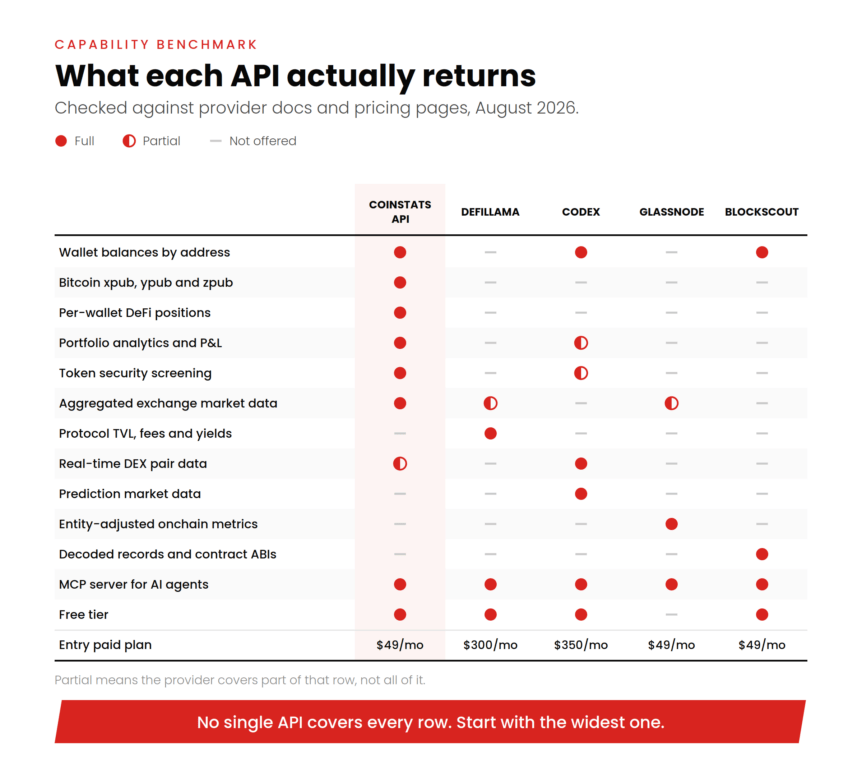
| CoinStats API | DefiLlama | Codex | Glassnode | Blockscout | |
| Primary layer | Market, wallet, DeFi and portfolio | Protocol economics | Real-time DEX and prediction markets | Network metrics | Explorer records |
| Core question | What does this wallet hold? | What is locked in this protocol? | What is this token worth now? | What is the network doing? | What happened in this transaction? |
| Coverage | 100,000+ coins, 120+ chains | Hundreds of chains | 70M+ tokens, 80+ networks | 1,500+ assets, 11 chains | 120+ chains |
| Wallet data | Yes, with DeFi and P&L | No | Balances only | No | Balances and history |
| AI / MCP | Native MCP Server | MCP server and skills | MCP and agent payments | MCP, CLI and pay-per-call | MCP and agent skills |
| Free tier | Yes, credit-based | Yes, open API | Yes, 10,000 calls | No | Yes, 100,000 credits daily |
| Entry paid plan | $49/mo | $300/mo | $350/mo | $49/mo | $49/mo |
| Best for | Most data-driven builds | DeFi research | Trading and discovery | Market research | Contract-level work |
What You Can Build
Portfolio trackers and wallet apps. CoinStats API returns holdings, prices and DeFi positions in one call.
Yield and treasury dashboards. DefiLlama supplies pool APYs, protocol fees and stablecoin supply.
Trading terminals and token screeners. Codex streams live pair data across 80+ networks.
Prediction market products. Codex normalises Polymarket and Kalshi into one schema.
Research and market reports. Glassnode supplies cost basis, supply and flow metrics.
Contract debuggers and audit tools. Blockscout decodes transactions and serves verified ABIs.
AI financial assistants. Every provider here now ships an MCP server for agents.

One Provider or Several?
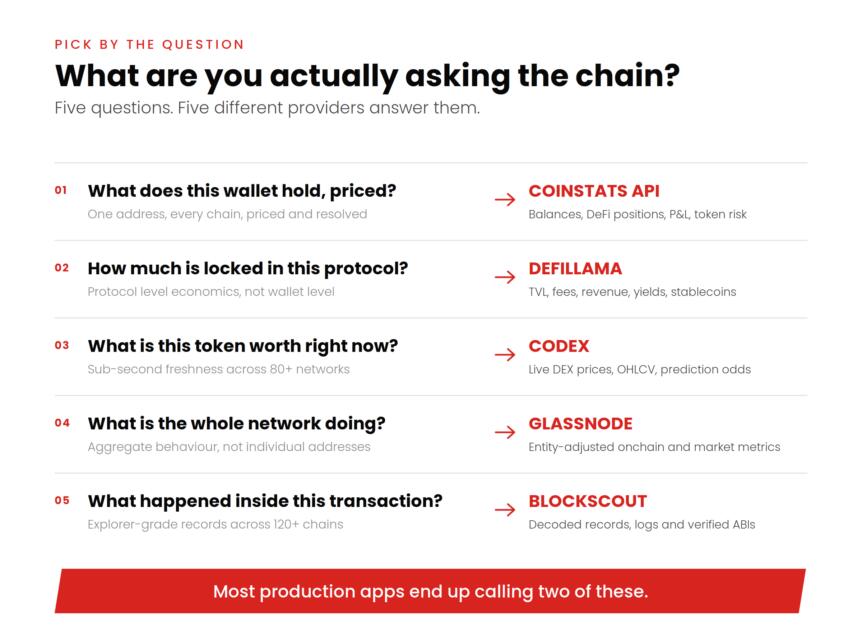
Most production teams do not run on a single API. They layer by question.
Start with CoinStats API for wallet, market, DeFi and portfolio data. Add DefiLlama when you need protocol economics behind those positions. Add Codex when live DEX pricing or prediction markets matter. Layer in Glassnode when the question turns to whole-network behaviour. Reach for Blockscout when you need the decoded record itself.
Two providers cover most products. Three is common at scale. Developers publish their own comparisons too. This hands-on developer comparison is worth a read.
Wrapping Up
There is no single best crypto data API. There is only the right answer to your question.
CoinStats API is the broadest starting point for application data. It suits most crypto use cases, from trackers to AI agents. DefiLlama owns protocol economics and stays free. Codex owns real-time DEX and prediction market data. Glassnode owns network-level research. Blockscout owns the decoded record.
Four of the five start free. Test the free tiers with real calls before you commit.
You must be logged in to post a comment Login