

Crypto World
The world cup turned Polymarket into a $5B market



The biggest sporting event on Earth has become the biggest liquidity event in prediction market history. Billions in tournament volume, a $45 billion June across the sector, one very expensive longshot trap, and a CFTC probe arriving right on schedule.
Summary
- Polymarket processed about $5 billion in World Cup trading as the tournament drove prediction market volumes to record highs across the sector.
- The expanded World Cup format and deeper liquidity pushed crypto based event markets into mainstream scale while attracting a large wave of first time users.
- The surge in activity also brought regulatory scrutiny and raised questions over whether the new liquidity will remain after the tournament concludes.
Four years ago, during the Qatar World Cup, Polymarket processed a grand total of $138,000 in tournament bets. That is not a typo missing some zeros. One hundred thirty-eight thousand dollars, roughly the price of a nice car, across the entire biggest sporting event on the planet.
This summer, the same platform blew through $5 billion in World Cup trading before the knockout rounds finished forming, with tournament totals now estimated around $6.4 billion and climbing. The flagship winner market alone has turned over more volume than many mid-cap tokens see in a month. Across the whole prediction market sector, June closed at $44.8 billion in combined monthly volume, a 75% jump from May, and Bernstein analysts project World Cup wagering could top $10 billion by the July 19 final at MetLife Stadium. Measured against its own 2022 self, Polymarket’s World Cup business grew by a factor of more than forty thousand.
Something changed between Qatar and now, and it was not football. The 2026 tournament has become the moment crypto-native prediction markets stopped being a curiosity and started operating at the scale of the industries they intend to eat. It has also, in the same six weeks, exposed exactly where the model creaks: a longshot problem hiding $1.6 billion of dubious positioning, a regulatory net closing from two directions, and an open question about what happens to all this liquidity on July 20.
The numbers, and why they are absurd
The tournament kicked off on June 11 with a format built for market makers: 48 teams instead of 32, 104 matches instead of 64, three host countries, and a brand-new Round of 32 that added an extra layer of binary, elimination-stakes events. Every match is a market. Every market is several: winner, draw, total goals, advancement. The expanded format nearly doubled the tradeable surface area of the world’s most-watched event.
The results by the numbers:
- Polymarket’s World Cup-linked contracts passed $2 billion in the group stage, $3.3 billion days later, and roughly $6.4 billion at the latest count, against $138,000 for the entire 2022 tournament.
- Kalshi, the CFTC-regulated rival, processed about $7.4 billion in World Cup trades, more than its entire March Madness, with its flagship winner market alone drawing over $832 million.
- Combined June volume across Kalshi, Polymarket, and Polymarket’s new US-regulated exchange hit $44.8 billion, up 75% from May’s $25.66 billion. Kalshi grew 87% month over month to $31.5 billion; Polymarket did $14 billion across both venues, including $3.04 billion on the US platform.
- Weekly sector volume peaked at a record $14.5 billion, with open interest holding at a record $1.6 billion for three consecutive weeks. Kalshi’s open interest alone crossed $1.16 billion.
- Reports put Polymarket’s revenue run-rate at $1 billion annualized on World Cup flow.
Individual matches show how deep the liquidity runs. A group-stage fixture between Algeria and Austria, two mid-tier footballing nations, drew $2.82 million. England versus Panama drew $1.76 million even though Panama arrived as the weakest side in the field and left without scoring a goal. Even Paraguay versus Australia, a match with all the global glamour of a Tuesday, cleared $329,000. When dead rubbers between minnows clear six figures, the order book is no longer a novelty. It is a market with depth at every rung of the attention ladder, which is exactly what market makers need before committing balance sheet.
Pricing on the big question has stayed remarkably stable through the chaos. France leads the winner market at roughly 23% to 24% implied probability, with Argentina at 20% to 21%, a rematch scenario the finalist markets take seriously: France at 39% and Argentina at 38% to reach the July 19 final. Argentina has drawn about $81 million in winner-market volume, France $77 million, Portugal $76 million, Spain $68 million, and England $61 million.
How the machine works, for the newcomers it just onboarded
Given how many of this tournament’s traders are first-timers, the mechanics deserve a plain-language pass, because they explain both the volume numbers and the regulatory fight.
A prediction market contract is a share that pays $1 if an outcome happens and nothing if it does not. France to win the World Cup trading at 24 cents means the market assigns France a 24% implied probability; buy at 24 cents and a French title returns $1 per share. Prices move with news, form, and money flow exactly like any order book, and because every share is a token settling on-chain, positions trade continuously until resolution. Polymarket runs on Polygon with markets denominated in USDC, and outcomes resolve through an oracle process, with the UMA optimistic oracle as the traditional backstop where disputes over real-world results get adjudicated by token-holder vote. Kalshi runs the same economic structure through a CFTC-regulated exchange with dollars instead of stablecoins.
The tradability is the entire difference from a sportsbook, and it is why volume comparisons flatter prediction markets. A bettor who backs France at a book locks the position until the final; a Polymarket trader might turn the same conviction over dozens of times, buying strength, selling wobbles, rotating into match markets and back. High turnover on stable open interest, precisely Polymarket’s tournament signature, is the fingerprint of trading behavior layered on top of betting behavior. It also means the platforms earn their status as information machines honestly in one respect: continuous two-sided pricing on live global events, updating in seconds, visible to anyone. During the group stage, Polymarket priced a draw as the most likely single outcome in Paraguay versus Australia at 42.5% while traditional books had Paraguay clearly favored, the kind of public disagreement between market structures that quants notice and harvest.
From election-night stunt to billion-dollar business
The tournament did not create Polymarket’s scale from nothing. It compounded an arc three cycles in the making.
The platform’s first mainstream moment came with the 2024 US election, when its presidential market became a media fixture and its pricing beat several polling aggregates to the result. That visibility arrived with a compliance hangover: Polymarket had operated outside US jurisdiction since a 2022 CFTC settlement barred it from serving American users, and the election spotlight brought raids, investigations, and a long regulatory negotiation. The resolution came in 2025, when the platform acquired a regulated derivatives venue and resumed limited US operations through a compliant exchange, the entity now posting $3.04 billion monthly volumes as Polymarket US.
Kalshi ran the mirror-image path: US-regulated from birth, it fought the CFTC in court for the right to list election contracts, won, and then leveraged the precedent into sports-adjacent event contracts that state gaming regulators now contest. Its reported $1 billion funding round earlier in 2026 and its $31.5 billion June say the strategy found product-market fit at scale.
The World Cup is the first event both platforms entered at full institutional strength, regulated venues live, market-maker relationships mature, mobile products polished, and the $45 billion June is what that maturity looks like when the biggest audience on Earth shows up. For perspective on how completely the sector has outgrown its origins: the entire prediction market industry’s 2022 World Cup handle would not cover thirty seconds of this tournament’s average volume.
The longshot trap: $1.6 billion of hope
Underneath the headline volume sits the tournament’s strangest statistic, and the one that says the most about who is actually trading. Roughly $1.6 billion, a quarter or more of Polymarket’s World Cup total, has been wagered on teams priced at 1% implied probability or less.
Think about what that means. Traders have committed nine figures to the proposition that sides the market gives essentially no chance will lift the trophy. Some of that is rational lottery-ticket buying, one-cent shares that pay a hundredfold if the miracle lands. Some is liquidity provision and hedging that looks stranger in aggregate than it is in detail. But a large share is the oldest pattern in betting: retail money chasing the thrill of the impossible payout, in a venue where the thrill is dressed up as trading.
Prediction market advocates have spent years arguing these venues are information machines, truth engines that price reality better than pundits. The longshot trap complicates the pitch. Markets in which a quarter of the money sits on near-impossible outcomes are not purely information machines. They are also entertainment products, and entertainment money behaves differently: it arrives for the event, it does not shop for edge, and it leaves when the confetti drops. Both things can be true at once, the sharp pricing at the top of the book and the lottery counter at the bottom, but the ratio between them decides what these platforms are when the World Cup is not on.
The user data leans the same direction. A Bitget Wallet study of 857,000 active Polymarket users found 60% had no prior on-chain trading history of any kind. Prediction markets are onboarding people crypto never reached, an achievement by any adoption metric, and those people are arriving to bet on football, not to discover decentralized finance.
What the tournament proved about the rails
Strip out the froth and the infrastructure story is the strongest one here. Positions on Polymarket are tokens settling on-chain via Polygon, which means the tournament has doubled as a live stress test of whether blockchain rails can host institutional-scale event trading. The answer, six weeks in, is yes. You can buy France at 24% today, watch a shaky quarterfinal drop the price, and sell before the next whistle. Positions are tradeable instruments with a live order book, not slips waiting for settlement, and the distinction is precisely why turnover figures dwarf what a sportsbook handle would show for the same interest.
The flow data show the two market leaders running different races. Polymarket’s open interest has held roughly flat while volume spiked, the signature of heavy turnover, traders rotating in and out around every match. Kalshi’s open interest has climbed steadily, pointing to stickier positioning from a user base that skews more institutional and holds through events. Kalshi also entered the tournament with a war chest, having closed a reported $1 billion funding round earlier in 2026, and its $31.5 billion June says the money is being put to work against sportsbooks as much as against Polymarket.
Competition is arriving from inside crypto too. World, a Solana-based prediction market, went live inside the Phantom wallet during the tournament, using Chainlink oracles and taking direct aim at the duopoly, while ADI Predictstreet operates as FIFA’s own first official prediction market partner. The sector that spent 2024 as an election-night curiosity now has a governing-body partnership, a regulated US exchange, and venue competition on three chains. That maturation is happening alongside the industry’s broader mainstream moment at this tournament, with Kraken serving as FIFA’s first official crypto exchange partner across the same six weeks, a deal we examine in full in a companion feature.
Six weeks of price discovery, match by match
The aggregate numbers hide the part traders actually enjoyed: watching the market metabolize a football tournament in real time.
The favorites’ pricing barely moved through six weeks of chaos, France oscillating between 23% and 24% and Argentina between 20% and 21%, a stability that says the market treated group-stage drama as noise around strong priors. The action was in the tails and the match markets. Cape Verde drawing with both Spain and Uruguay to escape Group H repriced an entire bracket path in minutes. DR Congo reaching their first knockout stage since 1974 sent their sub-1% title shares on the kind of hundredfold percentage ride that longshot buyers live for, right up until Harry Kane ended it with two goals in the final fifteen minutes. Panama, priced as the group’s doormat, performed exactly to market: three losses, zero goals, and $1.76 million traded on the England fixture anyway, proof that liquidity follows attention rather than quality.
The draw markets produced the tournament’s most interesting structural signal. Prediction market traders repeatedly priced draws as the most likely single outcome in tight fixtures, 42.5% in Paraguay versus Australia, 46.5% in Algeria versus Austria, while traditional books held moneyline favorites. Two market structures, two different opinions about the same ninety minutes, and a standing arbitrage question for anyone with accounts on both. Group-stage match markets settled into a reliable $500,000 to $2 million volume band regardless of the teams involved, which is the statistic that best captures what changed: four years ago, the entire tournament did $138,000; now that is a slow first half.
The quiet winners underneath the order book
Every trade in this boom runs on infrastructure that predates it, and the tournament has been a revenue and relevance event for the stack beneath the platforms.
Polygon carries Polymarket’s settlement, which means tens of millions of tournament transactions and billions in USDC transfer volume ran through a network that spent two years searching for a flagship consumer use case and found one wearing football boots. Circle benefits wherever the collateral pool grows, since every open position is USDC sitting on-chain. Chainlink’s oracle infrastructure gained a governing-body endorsement through ADI Predictstreet, FIFA’s own first official prediction market partner, and powers World, the Solana prediction market that launched inside Phantom mid-tournament to contest the duopoly on faster rails, one more front in the widening execution-layer contest between Solana and Ethereum. Even the losers of the platform war stand to inherit something: liquidity programs, market-making firms, and resolution tooling built for this tournament become sector infrastructure that any new entrant can rent.
That is the pattern worth filing away. Prediction markets have become the rare crypto vertical whose growth mechanically feeds the base layers underneath it, stablecoin float, L2 throughput, oracle demand, without requiring anyone to believe a new narrative. The World Cup did not just make Polymarket bigger. It made the case that event markets are a durable consumer category for the chains that host them, which is why Solana wants in and why the next cycle of this fight will be fought partly on infrastructure costs.
The real opponent is DraftKings, not each other
Frame the tournament as Polymarket versus Kalshi and you miss the actual contest. The $2 billion-plus that crypto prediction markets processed in World Cup contracts is being measured in real time against sportsbook scale, and the next four weeks decide whether the platforms keep that capital or hand it back to DraftKings and FanDuel when the novelty fades.
The traditional books still dwarf the challengers on absolute handle; US regulated sportsbooks process tens of billions per year on football alone, with decades of brand, state licenses, and parlay products engineered for maximum hold. What prediction markets attack is the margin structure. A sportsbook builds roughly 4% to 6% vig into a standard two-way line and far more into parlays; a prediction market charges the spread plus small fees, with two-sided order flow compressing costs toward exchange levels. For a sharp bettor, the difference between negative-5% expected value at a book and near-zero at an exchange is the difference between a hobby and a career, which is why professional money migrated first.
The Mexico versus England Round of 16 fixture made a clean case study: a high-attention knockout tie where Polymarket’s pricing stayed tight under both retail flood and institutional size, the market-maker backbone absorbing volume without spreads blowing out. Passing liquidity tests like that, repeatedly, on the sport’s biggest stage, is how an exchange steals a customer segment that never comes back to paying vig. The books know it; their lobbying against event-contract sports markets in state legislatures is the sincerest compliment the sector has received.
The structural irony is that prediction markets may win the comparison while losing the framing. The more their World Cup product resembles a better-priced sportsbook, the stronger the state regulators’ argument that it is one.
The regulators arrive at the party
A $5 billion-plus event was always going to draw the state’s attention, and it has, from two directions at once.
The federal track came first: the Wall Street Journal reported the CFTC has opened an investigation into Polymarket, landing just as the platform’s volumes peaked and barely a year after it resumed limited US operations through its regulated exchange. The probe’s scope remains unclear, which in practice means everything from market manipulation surveillance to the perimeter question of which event contracts count as legitimate derivatives.
The state track is broader. More than a dozen state-level authorities have taken legal action against Kalshi and Polymarket, accusing them of offering unlicensed sports betting to residents. The legal theory war here is existential for the sector: if a World Cup winner contract is a financial derivative, the CFTC owns it and federal preemption shields the platforms; if it is a sports bet, thirty-plus state gaming commissions get a vote, and the compliance map fragments overnight. Consumer protection advocates have pushed the second reading hard, and the tournament’s own success is their best exhibit. It is difficult to argue that $1.6 billion of one-percent longshots is hedging activity.
The jurisdictional map adds a third layer of mess, because this World Cup spans three host countries with three different rulebooks. American users navigate the federal-versus-state fight described above. Canadian provinces run their own gaming monopolies with their own views on event contracts. Mexican users face a framework that barely contemplates the product category at all. A tournament marketed as borderless is being traded through one of the most fragmented compliance environments in consumer finance, and every platform’s growth team is effectively running fifty different products wearing one interface.
The platforms are betting that regulated structure wins the argument, and the irony is thick enough to trade: prediction markets are now the subject of the kind of binary, high-stakes, externally resolved event they would normally list. Traders being traders, they occasionally do list it. The outcome will land on an industry already conditioned by this cycle’s macro whiplash, where risk assets have traded like leveraged tech exposure and volume booms have repeatedly decoupled from underlying token prices.
The question that matters: July 20
Every liquidity boom tied to a calendar event carries the same asterisk, and this one expires at full time on July 19.
The bear case writes itself. Fan-adjacent crypto products have a documented post-tournament decay pattern; volumes tied to the Qatar cycle collapsed within weeks of the final. If June’s $44.8 billion was mostly football, July’s number tells us so immediately, and the sector’s valuation narratives, including that billion-dollar Polymarket run-rate, deflate with it. Sixty percent of those 857,000 users have no other on-chain footprint to return to. They came for the World Cup. The World Cup ends.
The bull case is quieter but has data behind it. The June figures functioned as a stress test, and the infrastructure passed: record open interest held for three straight weeks, spreads on marquee matches stayed tight under institutional size, and non-sports volume across Kalshi and Polymarket reached $3.6 billion during the same window, meaning roughly a third of the boom had nothing to do with football at all. Elections, Fed decisions, crypto prices, and cultural events all inherited liquidity and market-making muscle built for the tournament. If even a modest fraction of the new cohort stays, the World Cup becomes the sector’s customer-acquisition event of the decade, acquired at zero marketing cost.
The honest position is that nobody knows the retention number, and the retention number is the entire question. What the tournament has already settled is capacity: prediction markets can absorb global-event liquidity at sportsbook scale on crypto rails without breaking. Whether they can keep it is the trade still open on the board.
Full time approaches
The 2026 World Cup will crown a champion at MetLife Stadium on July 19, and the winner market says it will probably be France or Argentina, though a combined $1.6 billion in longshot money is praying otherwise. For the prediction market industry, the trophy has arguably been lifted already: a forty-thousand-fold improvement on its 2022 self, a June that redefined the sector’s ceiling, and proof that on-chain event trading can operate at the scale of the businesses it wants to replace. The costs of that visibility, a federal probe, a state-by-state legal siege, and a user base of unknown loyalty, all come due in the quiet weeks after the final whistle. The tournament turned Polymarket into a $5 billion market. The off-season decides whether it stays one.
Disclaimer: This article is for informational purposes only and does not constitute investment or betting advice. Prediction markets carry significant financial and regulatory risk, and availability varies by jurisdiction. Always do your own research. Information current as of July 3, 2026.

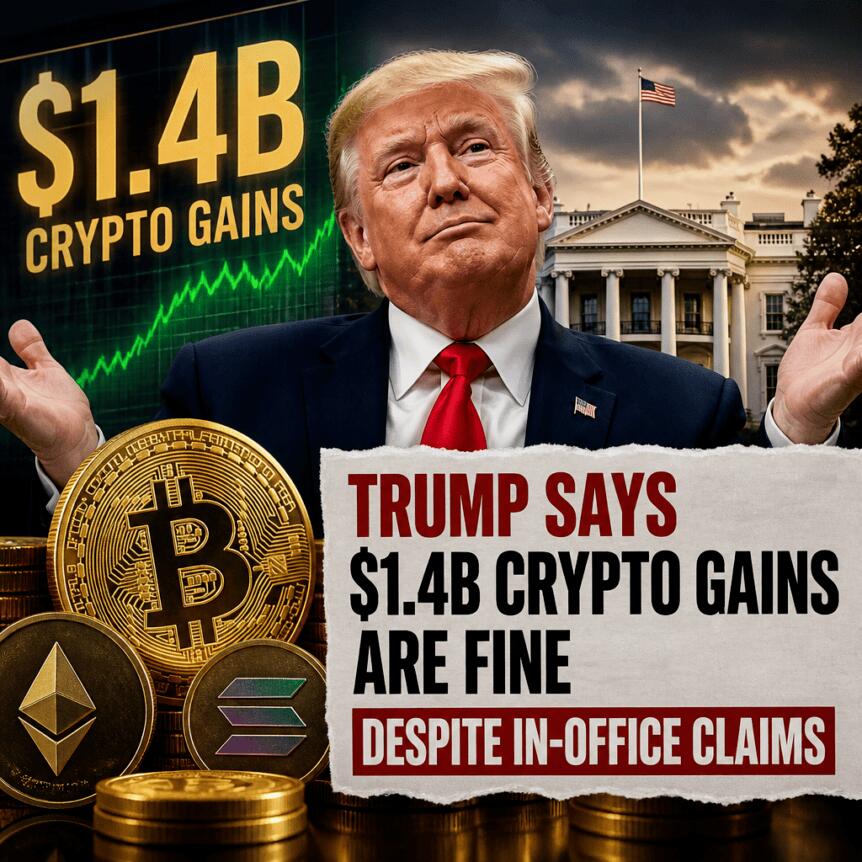
U.S. President Donald Trump has pushed back against criticism over his 2025 financial disclosures, telling CNBC that there was “nothing illegal” and “nothing wrong” with profiting from crypto-related investments while in office. In the interview, Trump also suggested that other parties were responsible for certain investment activity, adding that he did not “even know who they are,” an answer that did not directly address conflict-of-interest concerns.
The comments came after the U.S. Office of Government Ethics released Trump’s 2025 financial disclosure report, which shows he received more than $2 billion from business and investment holdings during the year, with roughly $1.4 billion tied to crypto ventures. Advocacy groups have argued that such earnings create incentives to shape policy in ways that benefit related projects.
Key takeaways
- Trump told CNBC he saw “nothing illegal” in profiting from crypto investments while president, even as critics highlighted potential conflicts.
- The 2025 disclosure report from the U.S. Office of Government Ethics ties about $1.4 billion of Trump’s income to crypto-related activity.
- Disclosure breakdown cited in the report includes $636 million from a memecoin, $588 million from World Liberty, and $197 million connected to equity in a stablecoin venture.
- Public Citizen says crypto-linked contributors have put $189 million into the 2026 U.S. election cycle as of June.
What Trump said after the disclosure release
During a Thursday appearance on CNBC with Joe Kernen, Trump responded to questions surrounding the 2025 financial disclosures. He maintained that profiting from crypto investments as president was not improper, framing the controversy as baseless.
When pressed on the issue of who managed or executed the investments, Trump did not provide a straightforward explanation of how he handled potential conflicts. Instead, he argued that others were responsible for the investments and said he did not know the people involved, leaving open key questions that critics say are central to public trust.
Trump’s remarks followed the release of his 2025 disclosure report by the U.S. Office of Government Ethics, an agency responsible for collecting and publishing high-level financial information from top federal officials.
How the 2025 figures connect to crypto projects
According to coverage of the filing, Trump reported more than $2 billion in income from his businesses and investments in 2025, with about $1.4 billion connected to crypto-related activities. Among the crypto-linked components cited were his memecoin, the family platform World Liberty Financial, and an equity stake associated with a stablecoin venture.
Specifically, the crypto-related totals described include approximately $636 million generated by his memecoin, about $588 million from World Liberty sales, and roughly $197 million from equity in a stablecoin venture. Together, these figures form the bulk of the reported $1.4 billion crypto-related income highlighted by critics.
Advocacy organizations have characterized these investments as a form of “grift,” arguing that political influence—whether direct or indirect—could advantage projects tied to Trump and his family. One such critique referenced in the reporting linked the donations and leverage question to proposed legislative efforts, including the Digital Asset Market Clarity (CLARITY) Act.
Earlier reporting on the disclosure emphasized the scale of the crypto-linked earnings and the overlap with areas where U.S. policy could affect digital asset markets.
From skepticism to industry alignment
Trump’s evolving posture toward crypto has been a defining theme of the past several years. In the wake of his first term, he had referred to Bitcoin as a “scam.” However, in the period leading up to the 2024 election, he increasingly associated himself with high-profile crypto figures and industry executives.
As described in the reporting, the shift included engagement with Gemini co-founders Cameron and Tyler Winklevoss, alongside relationships with executives from mining companies and crypto exchanges. During that same broader period, Trump launched a memecoin known as Official Trump (TRUMP), while his family’s involvement with World Liberty and American Bitcoin placed additional attention on crypto-native business activity.
The contrast between earlier skepticism and later engagement is central to why the disclosure controversy has attracted significant attention: critics argue the president’s financial exposure to crypto projects makes it harder to separate policy decisions from personal or business incentives.
Election spending: crypto money looks set to stay active in 2026
The controversy over Trump’s disclosures arrives amid evidence that crypto-related money is becoming a fixture of U.S. electoral spending. After digital asset firms and figures reportedly spent $170 million to support “pro-crypto” candidates to Congress in 2024, political action committees and aligned organizations appear to be applying a similar approach for 2026.
According to Public Citizen, companies and individuals tied to the crypto industry contributed $189 million to this year’s election cycle as of June. Public Citizen also reported that the $189 million figure makes up most of $294 million spent so far by crypto, AI, Big Tech, and online betting companies to support or oppose politicians.
With Trump’s term ending in January 2029, the current political landscape matters for more than symbolic scrutiny: all 435 seats in the U.S. House of Representatives and 35 seats in the Senate are up for election in 2026. For digital asset firms, stablecoins, exchanges, miners, and token issuers, legislative outcomes in the next cycle could shape compliance rules, market structure, and the pace of regulatory clarity.
Related coverage pointed to how these spending patterns reflect a sustained effort to influence policy direction during election years.
Pressure and counterpressure from within Trump’s orbit
Criticism is not limited to advocacy groups outside Trump’s circle. In comments relayed from a Friday interview with CNN’s Anderson Cooper, Mary Trump—his niece—accused him of pushing boundaries and argued that people could evade consequences due to the president’s use of the presidential pardon power.
While her remarks were not directly focused on the legal interpretation of financial disclosure rules, they underscore the broader narrative opponents are advancing: that public officials with substantial financial exposure to crypto-related enterprises face intensified scrutiny over potential conflicts of interest and the consequences for those who invest based on political proximity.
What to watch next
As scrutiny continues, the next signals to monitor are how regulators and watchdogs interpret the disclosure details in the context of federal ethics rules, and whether the 2026 election cycle brings additional policy movement on digital assets—especially in areas that intersect with stablecoins, token issuance, and broader market structure.
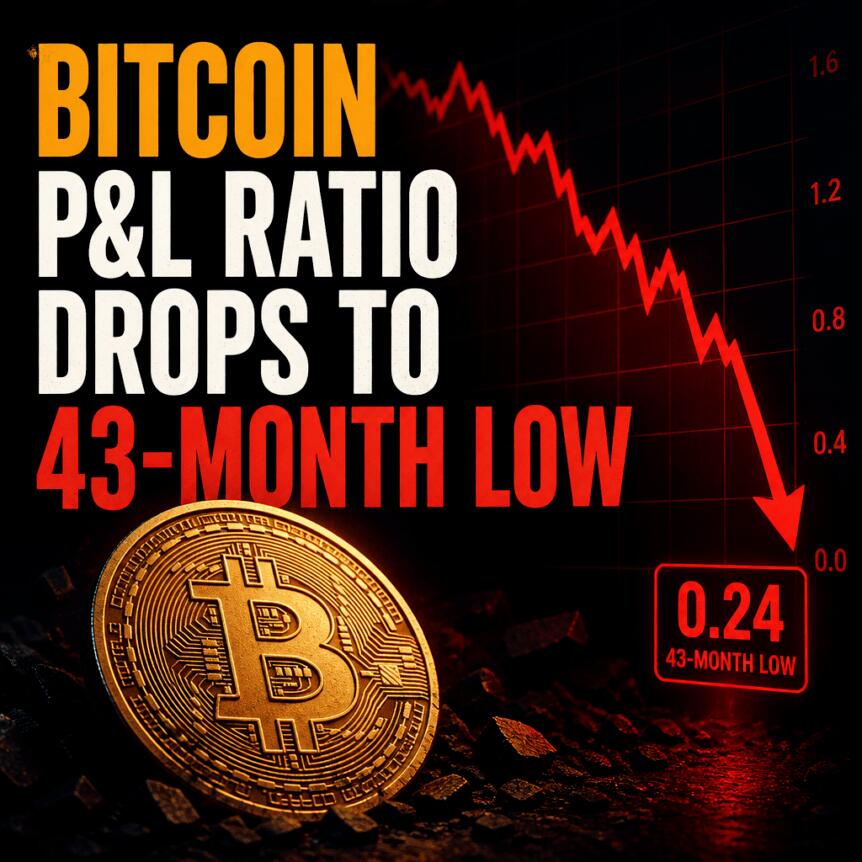
Bitcoin is flashing a highly unusual on-chain signal: its realized profit-and-loss ratio has fallen to a 43-month low of -0.35, an indicator CryptoQuant says reflects “extreme” loss conditions across the market. Historically, CryptoQuant adds, that type of reading has tended to appear close to major price bottoms.
The metric has not been this low since shortly after the FTX collapse, when Bitcoin traded below $16,000 in late 2022. With BTC still recovering from a steep drawdown that began after a peak near $126,080 in October, the new data is adding fuel to a broader debate among analysts over whether the market is past its worst stress—or merely approaching it.
Key takeaways
- CryptoQuant reports Bitcoin’s realized P&L ratio hit -0.35, the lowest reading in 43 months, last seen around late 2022.
- CryptoQuant says past occurrences of readings below -0.35 in 2015 and 2019 preceded subsequent rallies.
- CryptoQuant’s on-chain stress signal is arriving as “Fear and Greed” sentiment has moved off near-record lows and Bitcoin has bounced more than 7% from a June 25 trough near $58,190.
- Some analysts link the current drawdown to Strategy’s Stretch (STRC) preferred-stock offering and related concerns about dividend coverage.
- Other commentators argue investors should not wait for a “bottom” to be obvious because historical discount zones have been associated with strong 6- and 12-month forward returns.
Realized P&L reaches a historically rare loss zone
According to CryptoQuant, the Bitcoin realized profit-and-loss (P&L) ratio has dropped to -0.35. The realized P&L ratio measures the net percentage of Bitcoin currently in profit or loss relative to total supply, using on-chain cost basis information. In practical terms, a more negative reading indicates that a larger share of holders are underwater on their realized entry prices.
CryptoQuant emphasized that the -0.35 threshold has shown a strong historical relationship with major bottoming behavior. In its analysis published Thursday, the firm said that realized P&L has “marked BTC bottoms with extreme precision,” citing earlier periods where the ratio slipped below -0.35 before later rebounds.
The indicator’s last comparable level came around December 2022, shortly after the FTX collapse exposed fragile market liquidity. Back then, Bitcoin fell to levels under $16,000—an episode that many market participants still reference as a stress test for crypto’s risk assets.
What the signal may mean for sentiment and timing
CryptoQuant’s indicator arrives during a sharp correction cycle that began from a high set in October near $126,080, after which Bitcoin experienced a roughly 50% drawdown. While past realized P&L readings can be informative, timing remains the key question for investors: a bottom signal can appear before prices fully recover, and it does not rule out additional volatility.
Still, broader sentiment gauges show signs of stabilization. The “Fear and Greed” index has risen cautiously over the past 10 days, according to the index page on Alternative.me. During the same window, Bitcoin has climbed more than 7% after falling to a near two-year low of about $58,190 on June 25, as reflected in prior reporting by Cointelegraph.
In other words, the on-chain data and the sentiment recovery are moving in the same direction, even if they don’t provide a precise “day of the bottom” forecast.
Strategy’s STRC episode and the leverage unwind narrative
A significant part of the discussion around the latest selloff centers on corporate Bitcoin exposure. Cointelegraph previously reported that analysts attributed much of the recent weakness to Strategy—the largest corporate Bitcoin holder—after its top perpetual preferred stock offering, Stretch (STRC), deviated from its $100 par value. The move reportedly pushed STRC below $75, raising concerns that Strategy’s dividend model may have been strained.
On Thursday, Cointelegraph noted that Bitwise chief investment officer Matt Hougan said the STRC incident likely helped “squeeze out excess leverage” and could be pushing the market closer to a bottom as participants work through the fallout.
For traders and long-term holders alike, this matters because leveraged positioning can magnify moves on the way down. If leverage is truly being unwound—whether through forced deleveraging, hedging adjustments, or repricing of capital-market products—then the market may become less mechanically vulnerable to sudden liquidations. What remains unclear is how much of that unwind is complete and whether new risk reappears as prices rise.
Why some analysts say buying before the “bottom” may be rational
Not all commentary is framed around waiting for confirmation. Swan Bitcoin analyst Adam Livingston pointed to how close Bitcoin is currently trading relative to its realized price—the network’s aggregate cost basis, which often acts as a reference point in on-chain analysis.
According to Livingston, Bitcoin is trading about 16% above the realized price. He argued that this historically aligns with strong forward returns, citing research showing 41% gains over six months and 81% gains over 12 months following similar discount conditions.
Livingston acknowledged that buying at this stage “feels awful,” but he argued the psychological discomfort is part of why the opportunity can appear. In his view, waiting for a “bottom” is flawed because bottoms rarely announce themselves in a way that’s reliable enough to time entries perfectly.
While that argument is not a guarantee, it reframes the debate: rather than trying to predict the exact turn, investors may focus on whether market-wide indicators—on-chain loss concentration, realized valuation levels, and sentiment—suggest that downside pressure is fading.
What to watch next
For the near term, traders and investors will likely keep comparing this realized P&L trough with subsequent price action: if Bitcoin continues to stabilize while sentiment improves and leverage unwinds, the market may be shifting from capitulation toward consolidation. The key uncertainty is whether the current signals mark a decisive bottoming phase—or simply another stage in a volatile transition.
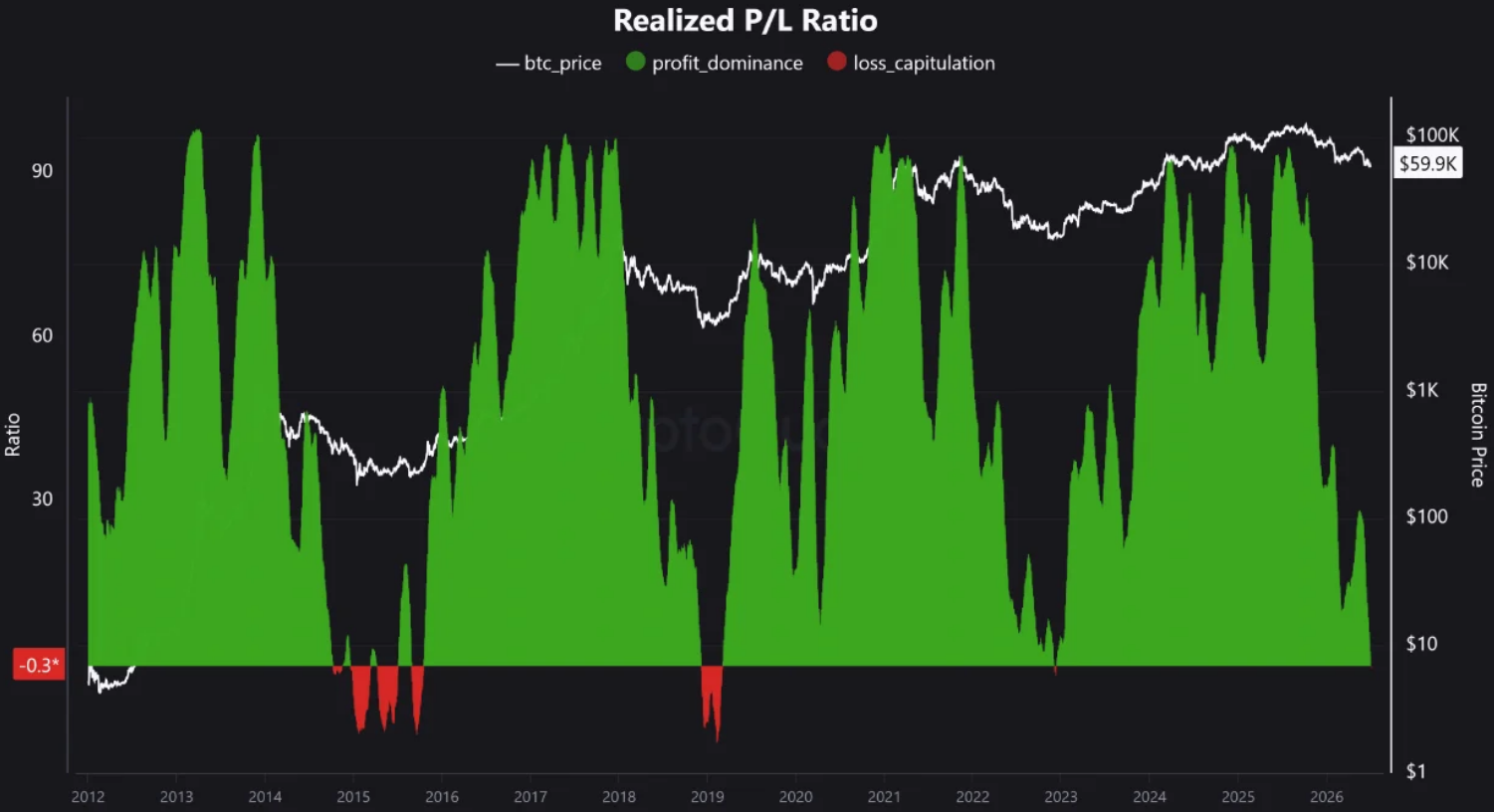
Bitcoin’s realized profit and loss ratio has fallen to a 43-month low of -0.35, a figure that signals extreme market-wide loss conditions but has historically coincided with market bottoms, blockchain analytics platform CryptoQuant said.
The Bitcoin realized P&L ratio — which measures the net percentage of Bitcoin (BTC) in profit or loss relative to total supply — hasn’t fallen this low since December 2022, shortly after FTX shockingly collapsed and sent Bitcoin below $16,000.
“Historically the indicator has marked BTC bottoms with extreme precision,” CryptoQuant said on Thursday. In 2015 and 2019 the Bitcoin realized P&L ratio also fell below -0.35 before price rallies followed.
Change in Bitcoin’s P/L ratio since 2012. The data was taken when Bitcoin was trading at $59,000. Source: CryptoQuant
The data could lift market sentiment, which has repeatedly fallen to near-record lows during the course of Bitcoin’s latest 50% drawdown from $126,080, set in October. Market sentiment has risen cautiously over the last 10 days, with Bitcoin up more than 7% since tanking to a near two-year low of $58,190 on June 25.
Many analysts blamed that drop on Strategy — the largest corporate Bitcoin holder — after its top perpetual preferred stock offering, Stretch (STRC), broke from its $100 par value to below $75, raising fears that its dividend model was unsustainable.
Related: Crypto Biz: Bitcoin maximalism meets the realities of capital markets
On Thursday, Bitwise chief investment officer Matt Hougan said the STRC incident squeezed out excess leverage and likely moved the market one step closer to a bottom.
“As the market continues to sort things out, I’m convinced the bottom is closer than ever — and that we will enter a new bull market in the fall.”
Don’t wait for the bottom, analyst says
Swan Bitcoin analyst Adam Livingston noted that Bitcoin is currently trading only 16% above the realized price — the network’s aggregate on-chain cost basis — a level that has historically coincided with strong forward returns of 41% at six months and 81% at 12 months.
Livingston acknowledged that buying Bitcoin right now “feels awful,” but that’s precisely why it’s trading at a discount, he argued.
“Waiting for ‘the bottom’ is a wonderful plan with one flaw. The bottom never announces itself,” Livingston said, recommending investors buy now rather than overpay at the top.
Magazine: Bitcoin slides to $58K, XRP hits $1 but onchain data promising: Market Moves

Senator Kirsten Gillibrand, a leading US lawmaker involved in negotiations on digital-asset market regulation, has proposed a new ethics rule aimed at preventing elected officials—and the president and their spouse—from issuing or backing their own tokens. The push comes as renewed scrutiny continues around conflicts of interest in the crypto space.
In a notice released on Friday, Gillibrand said Congress should consider legislation that would bar elected officials and their spouses from “issuing or sponsoring their own digital assets.” Her proposal specifically covers the US president and their spouse, while not clarifying whether the restriction would also apply to other family members or, for example, the vice president’s office.
Key takeaways
- Senator Kirsten Gillibrand is calling for a ban on elected officials and their spouses issuing or sponsoring their own digital assets.
- The draft she outlined would cover the president and the president’s spouse, according to her Friday statement.
- The proposal targets concerns about self-dealing and insider influence in crypto-related policy.
- Gillibrand’s ethics push ties into broader legislative negotiations around the Digital Asset Market Clarity (CLARITY) Act, where ethics issues have contributed to delays.
- The new restriction does not explicitly extend to other relatives, even as other criticisms have focused on family involvement in crypto-linked activities.
A targeted ethics rule aimed at token issuance
Gillibrand framed her proposal as a practical safeguard for a sector still working toward consistent federal rules. In her comments, she argued that officials and their spouses should not be able to issue memecoins, emphasizing the risk that personal financial incentives could undermine consumer protections and efforts to combat illicit activity.
Her statement links the ethics concern directly to conflicts of interest: she said “self-dealing” should not be allowed to weaken the policy work required to strengthen safeguards and expand financial access. Gillibrand also pointed to the broader public interest in ensuring enforcement and rulemaking are not distorted by insider advantages.
The senator’s notice also suggested that any workable solution must be broad enough to address the integrity of the legislative process, particularly when lawmakers have influence over market structure and consumer-facing rules.
How this connects to the CLARITY Act negotiations
Gillibrand is not introducing the idea in isolation. She is also among the lawmakers negotiating the Digital Asset Market Clarity (CLARITY) Act in the Senate—a bill that has reportedly faced delays linked to ethics concerns, tokenization questions, and how stablecoin incentives would be handled.
According to earlier reporting, Gillibrand expected the chamber to vote on the CLARITY Act by the Senate’s August state work period, but said no one would support the bill without addressing ethics concerns. Her reasoning centered on the possibility that elected officials could “get rich” from crypto markets due to their insider status.
That legislative backdrop helps explain why a narrower proposal about memecoin issuance by officials and spouses could still be politically important: it would target a concrete scenario—token sponsorship or issuance by those with rulemaking power—rather than leaving ethics questions as a vague debate.
Earlier coverage from Cointelegraph noted that lawmakers were wrestling with ethical and structural concerns in the broader package, including issues related to tokenization and stablecoin-linked rewards.
GENIUS Act history and memecoin conflict concerns
Gillibrand’s latest proposal also aligns with a moment in the development of stablecoin regulation. During consideration of the Guiding and Establishing National Innovation for US Stablecoins Act (GENIUS Act) in 2025, she said that senators had removed provisions specifically targeting Trump’s connections to the crypto industry, including the president’s memecoin Official Trump.
At the time, Gillibrand said the memecoin was likely “illegal based on current law,” but she acknowledged that fully addressing Trump’s ethics problems would require a “very long and detailed bill.” Trump later signed the GENIUS Act into law in July 2025.
That history highlights a recurring tension in Washington’s approach to crypto ethics: even when lawmakers see potential conflicts, crafting a solution that both clears legal scrutiny and achieves political consensus can be difficult. Gillibrand’s new initiative appears designed to shorten that distance by creating a rule that directly restricts token issuance or sponsorship by officials and their spouses.
Trump’s response and the wider conflict-of-interest debate
The proposal arrives amid continued debate over whether crypto profits by political figures create improper influence. This week, Cointelegraph reported that Trump said he earned about $1.4 billion from crypto ventures in 2025, the same year he took office.
According to Cointelegraph’s earlier reporting, Trump also asserted there was “nothing illegal” and “nothing wrong” with profiting from investments as president, while not directly answering questions about perceived conflicts of interest. The underlying concern for critics is not only whether transactions are legally permissible, but whether they erode trust in policymaking when an official’s financial exposure is tied to the regulatory outcomes.
Gillibrand’s proposal also stops short of explicitly extending the ban to all relatives. While she focused on elected officials and spouses, other criticisms have targeted the role of Trump’s sons in crypto-adjacent ventures, including World Liberty Financial and American Bitcoin, as reported in the article’s discussion of prior controversy.
That gap may matter for supporters of stricter rules: if spouses and officials are barred, critics may still ask how regulators should treat token sponsorship that is effectively enabled through broader family involvement, especially where family-linked businesses or holdings can influence perception—even if not always statutory ethics triggers.
As the CLARITY and stablecoin-related policy agendas continue to evolve, the key question for investors, builders, and market participants is whether ethics restrictions become part of a final legislative package—or remain a recurring obstacle that slows major crypto bills. Watch closely for whether Gillibrand’s proposal gains bipartisan traction, and whether negotiators are willing to translate ethics objections into enforceable rules rather than leaving them to case-by-case scrutiny.


Irish authorities have recovered another 500 BTC from wallets tied to convicted drug trafficker Clifton Collins.
Summary
- Irish authorities recovered another 500 BTC, raising total seized funds from Collins wallets to 1,500 BTC.
- Arkham data shows roughly 4,500 BTC still tied to dormant wallets linked to the case.
- Europol’s cybercrime unit helped investigators access wallets once believed unreachable due to lost private keys.
The Criminal Assets Bureau said in a Facebook statement that the latest seizure was made with support from Europol’s European Cybercrime Centre.
The latest recovery brings CAB’s total in the Collins case to 1,500 BTC. The bureau said the Bitcoin was identified as proceeds of crime. It marks the third 500 BTC recovery from the same wider wallet cluster this year, after earlier seizures in March and May.
Case traces back to lost private keys
The Collins case became known because the Bitcoin was long believed to be out of reach. The Irish Times reported in 2020 that Collins bought most of the coins in late 2011 and early 2012 using proceeds from cannabis sales. He later split more than 6,000 BTC across 12 wallets, with 500 BTC in each wallet.
According to that report, Collins printed the private keys on paper and hid them in the aluminum cap of a fishing rod case at a rented home in County Galway. The property was later cleared after his arrest, and the fishing gear was believed to have been taken to a dump. The keys were then viewed as lost.
Europol support remains central
Europol has helped Irish investigators in the wallet recovery work. The Irish Times reported in March that CAB accessed the first 500 BTC wallet with support from Europol’s European Cybercrime Centre. Garda Headquarters said at the time that Europol provided “highly complex technical expertise and decryption resources” for the operation.
As previously reported, Irish authorities first accessed a lost Bitcoin wallet tied to Collins in March. That wallet held 500 BTC and was part of the same 6,000 BTC stash. The recovery was notable because the funds had been viewed as locked for years.
Dormant wallets still hold large value
As crypto.news reported in May, the seizure later reached 1,000 BTC after CAB and Europol secured a second 500 BTC wallet. At the time, Arkham said another 500 BTC had moved from the Collins-linked entity after years of inactivity.
The latest move raises the total known recovery to 1,500 BTC. Onchain data from Arkham still tags wallets linked to Collins and shows remaining activity tied to the entity. Lookonchain also said in a July 2 post on X that another 500 BTC had been deposited to Coinbase Prime, while about 4,500 BTC remained in wallets linked to the case.
Recovery keeps case under scrutiny
The Collins case remains one of Ireland’s best-known crypto crime recoveries because the funds were tied to old private-key storage and years of inactivity. Each wallet recovery reduces the amount still considered dormant, but a large balance remains under watch by onchain analysts.
The case also shows how law enforcement agencies are using technical support and blockchain tracking in asset recovery. CAB has not fully explained how investigators gained access to the latest wallet. For now, the confirmed recoveries show that Bitcoin once viewed as lost may still be reachable when agencies combine legal seizures, cybercrime support, and onchain tracing.


The U.S. Securities and Exchange Commission (SEC) is studying a more orderly process for ETF approvals as the agency faces a sharp rise in new product filings.
Summary
- SEC officials want a clearer ETF process as crypto and prediction market filings increase sharply.
- Confidential filings could protect ETF issuers from copycats before new products become public.
- Prediction market ETFs remain under review while regulators seek feedback on novel fund structures.
Bloomberg ETF analyst Eric Balchunas said in a post on X that SEC Investment Management Division official Brian Daly said the agency receives about 200 ETF applications each month.
Daly made the comments during a Trillions interview with Balchunas and Joel Weber. According to Balchunas, Daly said the SEC “did a bad job with crypto” and wants to rebuild trust through an “orderly process” for novel products, including prediction market ETFs.
Confidential filings under review
Balchunas said in a second post on X that the SEC is also considering confidential ETF filings. The idea would allow some issuers to file products privately before their applications become public. That could protect early ideas and reduce copycat filings.
The SEC raised a similar issue in its public review of novel ETFs. As crypto.news reported, the agency asked whether ETF filings should stay confidential for part of the 75-day review period before becoming public. The agency said this could give applicants more room to develop products without rushing incomplete filings into the market.
Prediction market ETFs remain paused
The review comes while prediction market ETFs remain under SEC scrutiny. As crypto.news reported, the SEC delayed several prediction market ETF proposals while seeking public input on how event-based funds should be regulated. Bitwise, Roundhill Investments, and GraniteShares had filed products tied to elections and other event contracts.
The SEC’s official June 30 request asks for feedback on ETFs that invest in innovative assets or use novel strategies. SEC Chair Paul Atkins said ETF innovation depends on a “consistent, transparent, and efficient regulatory framework.” Daly also said ETF assets grew from $4 trillion in 2019 to more than $12 trillion at the end of 2025.
Crypto ETFs add to the filing wave
The agency’s review also matters for crypto funds. As previously reported, the SEC approved the T. Rowe Price Active Crypto ETF, a multi-asset product that may hold Bitcoin, Ethereum, XRP, Solana, Dogecoin, Shiba Inu, and other assets. That approval showed how crypto products are moving beyond single-asset funds.
Other issuers are also testing the new ETF path. Bitwise filed an S-1 for a spot SUI ETF, while the SEC’s generic listing standards have shortened parts of the approval process for qualifying products. The rising number of applications has made process questions more urgent.
The SEC is also reviewing wider digital asset rules. Previously, crypto.news reported that Atkins backed a limited innovation exemption for tokenized securities. That work sits beside the ETF review as the agency tries to support new products while keeping investor disclosures clear.
For ETF issuers, confidential filings could change how new products reach the market. For investors, the main question is whether the SEC can speed up reviews without weakening oversight. The current review shows the agency is trying to avoid another uneven approval cycle as crypto, tokenization, and prediction markets enter the ETF market.


CACEIS, the custody banking arm of Crédit Agricole, is in exclusive talks to acquire French crypto investment platform Meria, according to a BlockStories report.
Summary
- CACEIS is reportedly targeting Meria to expand beyond crypto custody into brokerage and staking services.
- Meria’s MiCA license gives the French platform stronger regulatory access across Europe’s crypto market.
- The talks show banks are buying crypto-native firms as MiCA raises compliance pressure across Europe.
The deal has not been formally announced by either company.
Meria, formerly known as Just Mining, was co-founded by Owen Simonin, known online as Hasheur. The company serves about 150,000 users and manages roughly €350 million in assets under management, according to the report. Its main services include crypto brokerage and staking products.
A bank push into crypto services
CACEIS already has a digital asset business line focused on custody. The company says its crypto services target asset managers, institutional investors, and other clients seeking regulated access to digital assets. Its parent group, Crédit Agricole, is one of France’s largest banking groups.
CACEIS also holds French and European crypto permissions. The AMF’s public record says CACEIS Bank has been authorized to provide crypto-asset services under MiCA through the Article 60 notification route. That allows the group to offer services such as custody, order reception, and transfer of crypto-assets.
Meria adds retail reach and staking
A Meria deal would give CACEIS access to a crypto-native platform with a retail user base and staking expertise. BlockStories reported that staking is one of the activities of interest to CACEIS, as Meria serves both retail and institutional clients in that area.
The reported talks come shortly after Meria received MiCA CASP authorization in France. A market intelligence listing shows Meria SAS as a France-based MiCA Crypto-Asset Service Provider authorized by the AMF on June 22. That timing gives the platform added value as Europe’s new licensing regime takes full effect.
MiCA changes the deal market
The talks reflect a wider shift in Europe’s crypto market. The MiCA transition period ended on July 1, forcing many crypto firms to secure CASP licenses or stop serving users under the old national regimes.
MiCA gives licensed firms a European passport, but it also raises compliance costs. As previously reported, France and other EU markets have seen a divide between firms that secured authorization and those still working through the process. That gap may push banks and larger regulated firms to buy licensed crypto platforms instead of building everything internally.
Banks move closer to regulated crypto
The reported Meria talks also fit a broader pattern of regulated finance moving into digital assets. As crypto.news reported, Coinbase opened its Luxembourg MiCA hub as the EU deadline approached. The exchange used Luxembourg as its base for serving customers across the bloc under one licensing setup.
Other firms have taken similar steps. As reported by crypto.news, Ripple moved closer to full MiCA compliance through Luxembourg CASP approval, while B2C2 secured MiCA approval to expand regulated crypto trading across Europe.


The National Organization of Black Law Enforcement Executives has endorsed the Digital Asset Market Clarity Act, giving the crypto market structure bill its first formal public backing from a major law enforcement group.
Summary
- NOBLE became the first major law enforcement group to formally back the CLARITY Act.
- The endorsement challenges warnings from police and prosecutor groups over Section 604 language.
- The bill still needs Senate floor time and 60 votes before reaching final passage.
Journalist Eleanor Terrett reported the endorsement in a July 2 post on X, citing a letter sent to Senate leaders John Thune and Chuck Schumer.
NOBLE National President Reneé Hall signed the letter. According to Terrett, the group said the bill “contains several provisions” that could give law enforcement new tools while keeping existing criminal authorities in place. The endorsement arrives as Senate talks continue over crime, oversight, and developer protections in the bill.
Endorsement breaks from other groups
NOBLE’s position differs from earlier warnings by several police and prosecutor groups. Four U.S. law enforcement organizations raised concerns that Section 604 may weaken crypto crime investigations. Their concerns centered on the Blockchain Regulatory Certainty Act language inside the CLARITY Act.
Section 604 would protect some non-custodial developers and software providers from automatic money transmitter treatment. Critics argue that the language may make it harder to trace illicit finance in decentralized systems. Supporters say the section protects software builders who do not control user funds and should not be treated like banks or brokers.
DOJ pushback adds to debate
The debate widened after the Department of Justice pushed back on claims that the bill would create broad enforcement gaps. As crypto.news reported, the DOJ challenged law enforcement claims and said criticism of the bill’s crime-fighting language was not accurate.
NOBLE’s letter now gives supporters another argument as they seek Senate votes. The group said the bill does not change federal criminal tools used in money laundering, unlicensed money transmission, conspiracy, sanctions, and other cases. That point directly addresses one of the main objections raised by other law enforcement groups.
Senate clock remains tight
The endorsement comes as the bill faces a narrow window in the Senate. The CLARITY Act’s path depends on a pre-August vote because the chamber has limited floor time before recess. If the bill misses that window, its realistic path could move into 2027.
The bill also needs 60 votes on the Senate floor. As previously reported, the Senate math requires Democratic support because Republicans cannot pass the measure alone. That makes law enforcement concerns important, especially for senators focused on illicit finance, consumer protection, and national security.
Industry keeps pressure on lawmakers
Industry groups are also pressing senators to act. Stand With Crypto urged supporters in a July 2 post on X to call for a vote when the Senate returns from recess on July 13. The group argued that delay could push builders, jobs, and capital outside the U.S.
Every day without clear rules, innovation drifts overseas.
When the Senate is back from recess on July 13, Senators can vote YES on the Clarity Act to keep American builders, jobs, and capital here at home instead of heading abroad.
The window is narrow. Tell your Senators to… — Stand With Crypto🛡️ (@standwithcrypto) July 2, 2026
The CLARITY Act would create a market structure framework for digital assets and define roles for the SEC and CFTC. The bill would classify digital assets, set registration paths, and add compliance rules for crypto firms.

A pseudonymous defendant has asked a New York court to dismiss a lawsuit seeking ownership of 39,069 dormant Bitcoin addresses, arguing that Bitcoin addresses are simply public data and cannot be sued under the state’s jurisdictional rules.
In a motion filed Thursday, the defendant—using the name “John Doe 33”—contends that the plaintiff’s theory of “finding” and claiming abandoned property fails because a Bitcoin address is not a legal person or entity. The filing also challenges the effort to treat on-chain addresses as recoverable under New York lost-property law.
Key takeaways
- The motion argues that Bitcoin addresses are data strings that cannot be the subject of a lawsuit, rather than legal entities that courts can exercise jurisdiction over.
- The plaintiffs’ lost-property claim is framed as legally defective because the addresses were always publicly visible on the blockchain.
- Even if ownership were determined, recovering the Bitcoin would still require access to the corresponding private keys.
- Blockchain-linked reporting cited in the case suggests the defendant may control a long-dormant wallet holding roughly 5,000 BTC.
Why the court fight centers on “addresses” rather than keys
The lawsuit, filed in May by plaintiff “Noah Doe” along with two Wyoming-based LLCs identified as ABC Company and XYZ Company, targets what it describes as abandoned Bitcoin associated with 39,069 dormant addresses. The plaintiffs allege the Bitcoin tied to those addresses is abandoned property, which they reported to the New York Police Department before asserting claims under New York lost-property law.
In the motion to dismiss, John Doe 33 argues the complaint is legally defective for a threshold reason: Bitcoin addresses are not “persons” or legal entities and therefore cannot be sued. The filing further claims that the plaintiffs cannot establish that an address was “found,” as required by lost-property concepts, because the relevant address information has been publicly viewable on the blockchain since the coins were received.
For investors and builders, the procedural dispute matters because it goes beyond a single wallet list. It asks whether traditional legal frameworks for identifying owners and claiming property can map onto the blockchain’s structure—where addresses are public identifiers and control is enforced through private keys rather than through legal status.
The alleged “abandoned” wallets include famous names
The complaint lists 39,069 Bitcoin addresses that include wallets widely associated with well-known Bitcoin labels, such as addresses attributed to Bitcoin creator Satoshi Nakamoto and to the Mt. Gox hacker. The addresses collectively are reported—via an estimate attributed to Sani, founder of Bitcoin analytics platform Timechain Index—to hold roughly 3.7 million BTC, valued at about $234 billion at the time of that estimate.
That scale is a key reason the case has attracted attention. A ruling could influence how courts treat claims that attempt to convert blockchain identifiers into claimable “property” within existing state laws.
At the same time, the filing acknowledges a practical hurdle that remains independent of any jurisdictional debate: even if the court were to rule on ownership of the assets associated with the addresses, the plaintiffs would still need the private keys to move any Bitcoin. Without those keys, the Bitcoin remains inaccessible regardless of how a court characterizes ownership or abandonment.
Defendant says they control a long-dormant wallet
Separate from the legal arguments, the motion’s credibility is bolstered—at least in part—by blockchain data cited in public commentary. According to an X post on Friday by Alex Thorn, head of research at Galaxy Digital, blockchain information suggests John Doe 33 controls a wallet that received 5,000 BTC in April 2014 and has remained untouched for more than 12 years.
Thorn indicated the wallet’s current value is above $300 million at prevailing market prices, and he characterized the defendant as a “real holder” with meaningful standing rather than a bystander who could be targeted without any real ability to defend the claim.
Thorn also wrote that the filing helped avoid what had been described as a “near-certain” default judgment, while simultaneously challenging jurisdictional and statutory defects raised by the plaintiffs’ approach.
Dormancy data underscores why recovery questions persist
Beyond the specific defendants and plaintiffs, the broader question of what happens to lost or inaccessible Bitcoin continues to drive legal scrutiny. Bitbo data cited in the reporting indicates that about 3.5 million BTC, valued around $215 billion, have been dormant for at least 10 years, while another 6.6 million coins—worth roughly $406 billion—have been dormant for over five years.
Those figures highlight a persistent imbalance in how on-chain “time” translates to legal rights. Blockchain dormancy may signal lost control, but it does not automatically yield a mechanism for third parties to access private keys. This case, therefore, tests whether legal systems can bridge the gap between public address records and the cryptographic controls that govern ownership in practice.
For readers tracking regulation and legal precedent in crypto, the important development is not only who named which addresses, but how courts handle the mismatch between legal concepts like “found property” and the blockchain reality that addresses are public labels—while control is determined privately.
As the New York case progresses, the key questions to watch are whether the court agrees that addresses cannot be sued as entities, and—if the case survives procedural challenges—what standard it may apply to abandonment and recoverability when private keys are necessary to access any funds.


Chris Larsen has reportedly backed a derivatives startup founded by the son of US Senator Kirsten Gillibrand as lawmakers continue negotiating the CLARITY Act, a crypto market structure bill expected to shape the industry’s regulatory framework.
Summary
- Chris Larsen reportedly invested in a startup founded by Senator Kirsten Gillibrand’s son as CLARITY Act negotiations continue.
- The reported investment comes while lawmakers debate ethics rules tied to the crypto market structure bill.
- Senate Republicans are seeking Democratic support to pass the CLARITY Act before the legislative window narrows.
According to a Thursday report by Politico, Ripple co-founder and executive chair Chris Larsen was among the investors supporting the American Perpetuals Exchange Corp. (APEC), a derivatives platform founded by Theodore Gillibrand. The report said the company raised roughly $30 million, with most individual investors contributing between $5,000 and $10,000, though Larsen’s exact investment amount was not disclosed.
The reported investment comes while Senator Gillibrand remains involved in Senate negotiations over ethics provisions tied to the Digital Asset Market Clarity (CLARITY) Act. The proposed legislation is expected to affect digital asset companies operating in the United States, including Ripple.
Larsen remains closely watched by the XRP community
Separately, Larsen has remained under close observation by XRP investors because of his large cryptocurrency holdings and past wallet activity. Blockchain data previously showed wallets linked to the Ripple executive becoming active before notable political and market events.
Crypto.news reported in May that Larsen controls an estimated 2.58 billion XRP across eight wallets tracked on XRPScan, making him one of the largest known individual XRP holders. The publication also noted that dormant wallets linked to Larsen resumed activity in January 2025, transferring more than $109 million worth of XRP to exchanges including Coinbase, Bitstamp and Bybit.
Later, blockchain investigator ZachXBT reported that Larsen-linked addresses moved another 50 million XRP, with roughly $140 million eventually reaching exchanges while XRP traded near record highs.
In the meantime, Democratic lawmakers have continued pressing Republicans to include stronger ethics language in the CLARITY Act, citing President Donald Trump’s connections to the cryptocurrency industry.
The Senate has only a limited window to complete work on the CLARITY Act before lawmakers leave Washington again. Following the Independence Day recess, senators are scheduled to return on July 13 before another month-long state work period begins in August, narrowing the available time to pass the legislation before the US election period is expected to slow congressional activity.
Republican lawmakers, who hold a narrow Senate majority, have indicated they expect the bill to pass the chamber during July. Senator Cynthia Lummis said in June that negotiations were still covering ethics provisions, decentralized finance, and illicit finance issues. Because the legislation requires 60 votes in the Senate, Republican lawmakers will need Democratic support for the measure to advance.

XRP: “WE’RE ABOUT TO GET FILTHY RICH” Popular Analyst Claims -Report

50-day ‘summer of play’ event given go-ahead at popular National Trust estate

Soda, Coffee, and Cava Won the First Half. Snacks and Pizza Struggled.


-

 Tech6 days ago
Claude Code turned every engineer into three. Now companies need more product thinkers
-

 Tech6 days ago
Bluekit phishing kit adopts browser-in-the-middle for login theft
-

 Fashion10 hours ago
Weekend Open Thread: High Hopes
-

 Crypto World4 days ago
Strategy authorizes up to $1.25B in Bitcoin sales under new capital plan
-

 Politics16 hours ago
The House | “Reframing the debate from a binary discussion of winners and losers”: Yuan Yang reviews ‘We Are Not Machines’
-

 News Videos5 days ago
MAJOR BITCOIN & MARKET UPDATE!!!! (MUST WATCH ASAP!!!)
-

 Tech4 days ago
Anonymous researcher drops 0-day ‘exploitarium’ repo
-

 Crypto World6 days ago
Coinbase, Circle Deepen Crypto Stock Losses Despite Resilient S&P 500
-

 Business4 days ago
Australia treasurer says alleged access of prime minister’s bank data ’incredibly concerning’
-

 Crypto World7 days ago
Kraken's xStocks Opens Bending Spoons IPO Registration to EEA Retail
-

 Tech7 days ago
Russian hackers now target Signal backup recovery keys
-
 Business4 days ago
The AI boom won’t burst all at once. It will pop in ‘rolling bubbles’: Macquarie
-

 Sports3 days ago
Broncos roster: OL Ben Powers (No. 74) entering final year of contract
-

 NewsBeat3 days ago
Presenter Caroline Flack’s brother Paul Flack dies aged 55
-

 Tech6 days ago
Silicon Valley paid to kill AI regulation, now it wants the rules back
-

 Crypto World2 days ago
Binance stock trading tops $1B in first month after launch
-

 Tech7 days ago
OpenAI mulls delaying IPO over valuation concerns
-

 Crypto World2 days ago
Alibaba-affiliate Ant Group enters the humanoid robot market with 12 deals
-
 NewsBeat2 days ago
New exhibition reflects five decades of movement between island of Ireland and GB
-

 News Videos4 days ago
How to Build INSANE Live Financial Dashboards With Claude
You must be logged in to post a comment Login