
Crypto World
This Solana Cohort’s Gains Could Effect a 38% Price Drop

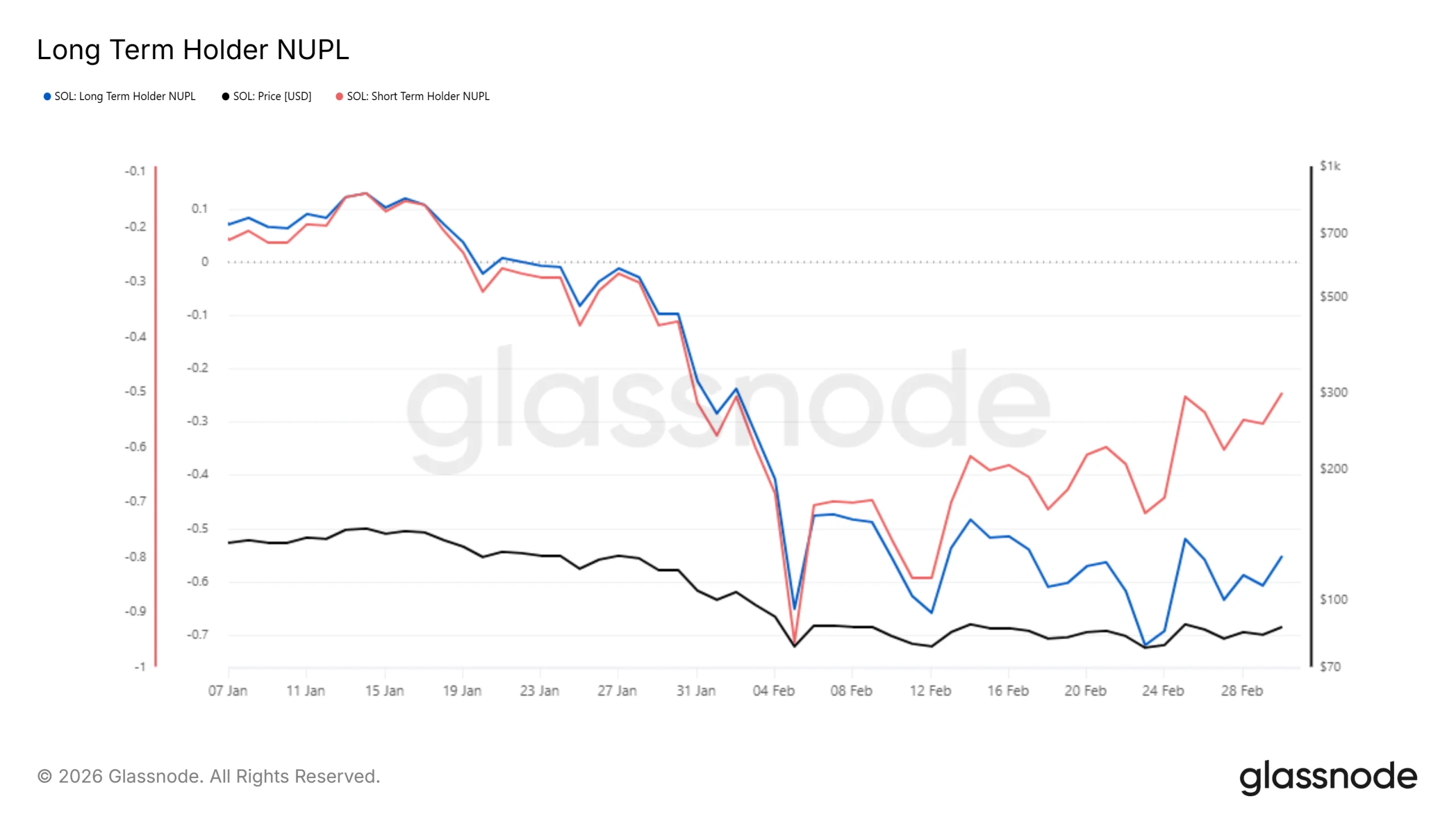
Solana (SOL) has been facing a period of consolidation, with its price fluctuating between $87 and $77 in recent weeks. However, recent developments in the market suggest that the cryptocurrency could be at risk of a significant downturn.
A bearish pattern has emerged, and shifting investor behavior could trigger a price crash, with potential losses of up to 38% if SOL breaks below key support levels.
Rising Concern: Solana STHs Profits
One of the key indicators raising concern for Solana is the LTH vs. STH NUPL (Long-Term Holder vs. Short-Term Holder Net Unrealized Profit/Loss). Since February, the unrealized profits of short-term holders (STHs) have been steadily climbing.
STHs are typically quick to sell when they see profits, and this could add significant selling pressure on Solana’s price. The absence of a similar profit rise among LTHs means that there is less stabilization from long-term holders.
Want more token insights like this? Sign up for Editor Harsh Notariya’s Daily Crypto Newsletter here.
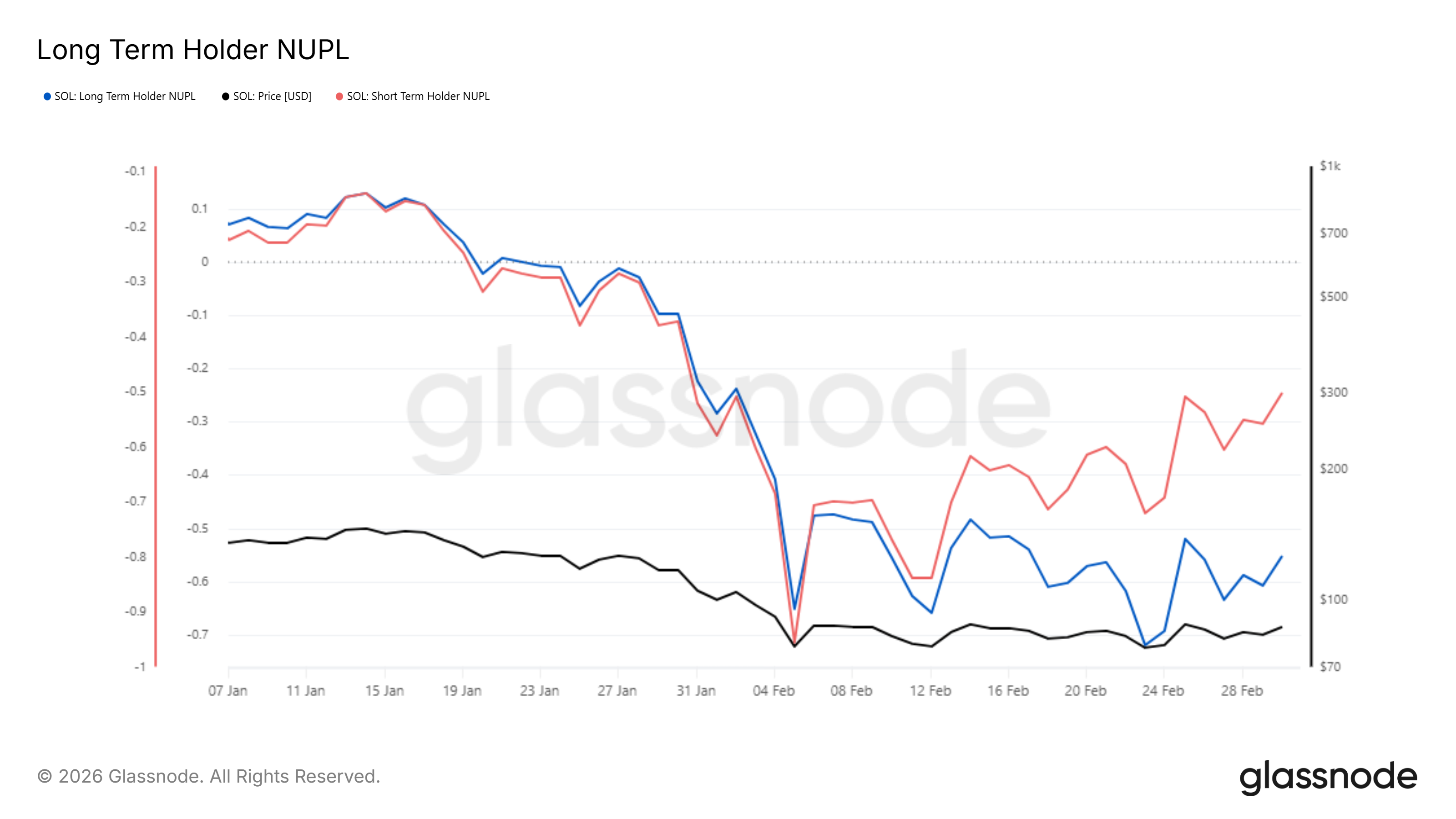
In fact, if the LTHs were to panic sell as well, it could further exacerbate the downward pressure on the price. The lack of support from these long-term holders raises the risk of intensified selling in the market.
Solana Faces Increased Selling Pressure
The overall macro momentum for Solana is showing signs of weakness. The Exchange Net Position Change indicator has highlighted a rising trend in exchange inflows, which signals increased selling activity.
Over the last four weeks, this indicator has consistently noted that Solana is facing selling pressure from investors, further contributing to the bearish sentiment surrounding the asset.
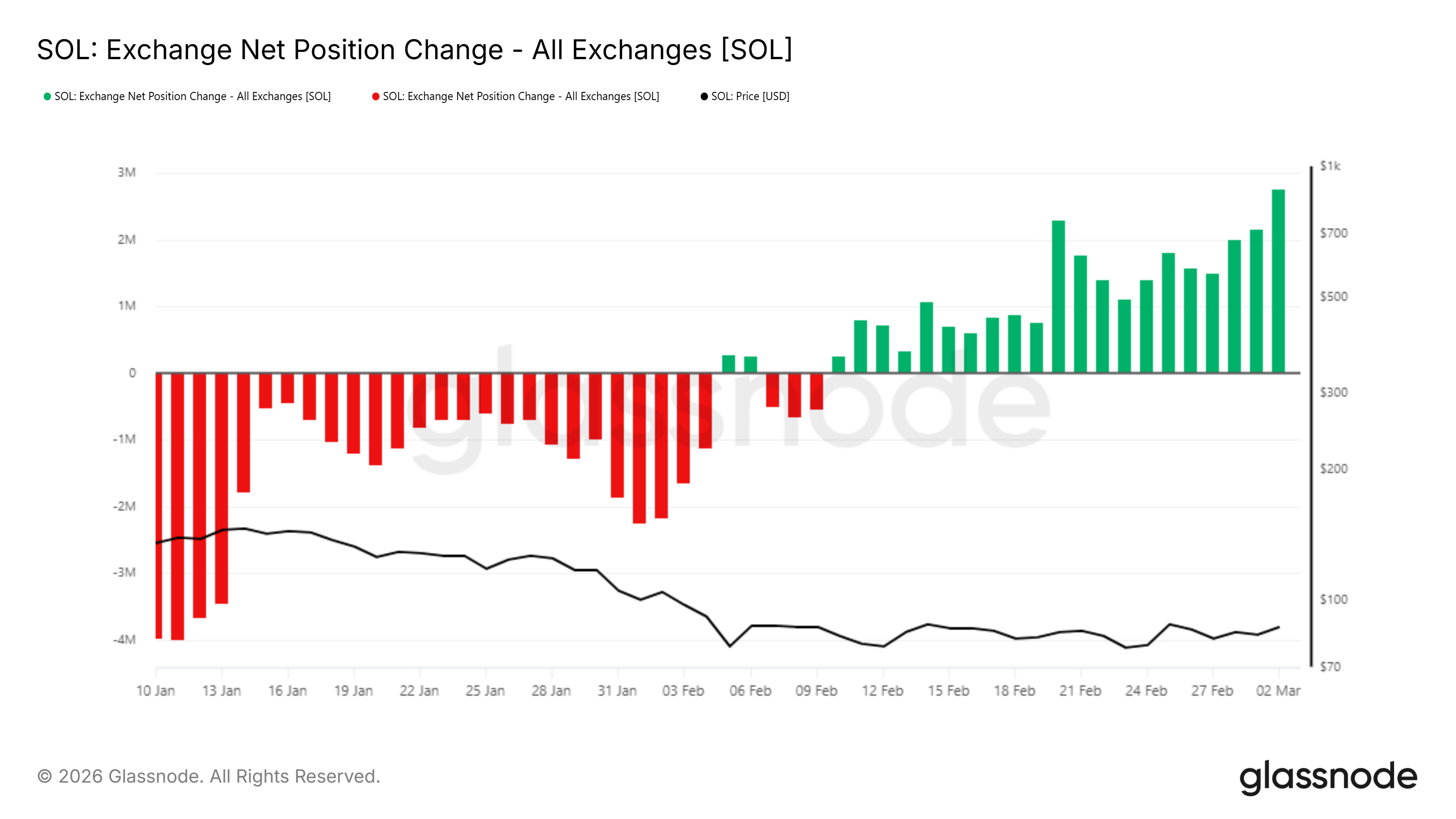
As more Solana holders sell their holdings, the downward pressure on SOL could intensify. This increasing sell-off could compound the bearish pattern forming on the charts, making it more likely that the price will break down below critical support levels.
SOL Price May Fall Out Of The Flag
At the time of writing, Solana is trading at $83, remaining rangebound between $77 and $87. The formation of a bearish flag pattern indicates that the price could experience a significant drop if it breaks below the $77 support level. A breakdown below this level could set Solana up for a 38% crash, with the price potentially falling to as low as $51.
In order for this crash to occur, the selling pressure would need to continue rising, and Solana would need to break the $64 support level. If this happens, the price could fall to $57, $51, and eventually $45, validating the bearish pattern.
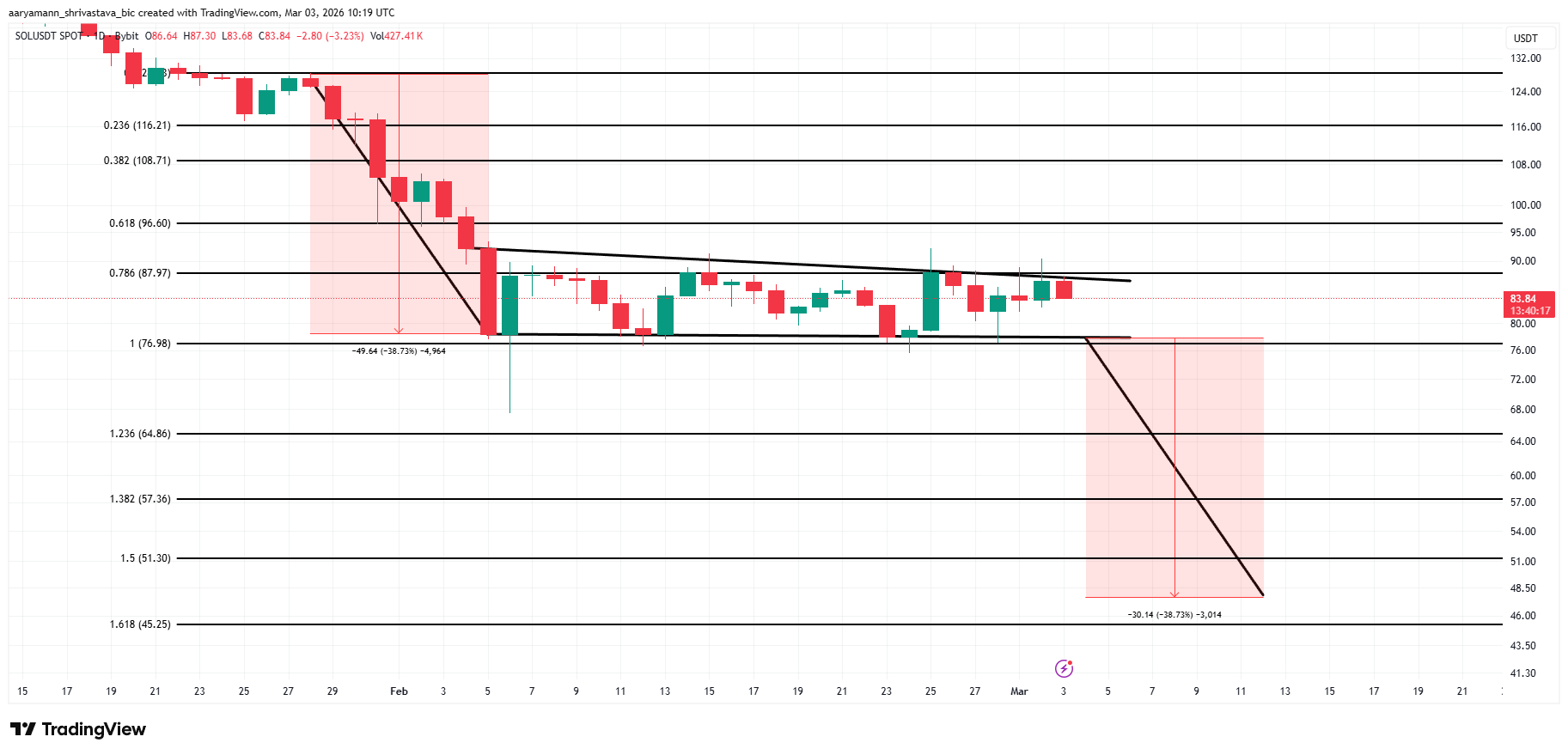
However, if investor sentiment shifts and focus turns toward supporting a recovery, Solana’s price could break out of the consolidation. If SOL manages to breach resistance levels at $88 and $96, it would invalidate the bearish outlook, potentially sending the price upward toward $100, marking a monthly high.


TLDR
- Missouri lawmakers advanced HB 2080 to create a state-managed Crypto Strategic Reserve Fund.
- The bill includes XRP alongside Bitcoin, Ethereum, Solana, and USDC as approved reserve assets.
- The State Treasurer would have authority to buy, hold, and manage digital assets using state funds.
- The legislation requires the Treasurer to hold acquired cryptocurrencies for at least five years.
- Missouri agencies could accept USDC for taxes, fees, and fines with approval from the Department of Revenue.
Missouri lawmakers have moved to create a state-managed crypto reserve that would include XRP. The House Committee Substitute for HB 2080 cleared the Commerce Committee in a 6–2 vote. The proposal now advances with a “Do Pass” recommendation and outlines direct authority for the State Treasurer.
Missouri Advances Bill to Establish Crypto Strategic Reserve Fund
Representative Ben Keathley sponsored HB 2080 to establish a Crypto Strategic Reserve Fund. The House Committee Substitute outlines how the State Treasurer would manage approved digital assets. Lawmakers advanced the measure after a 6–2 committee vote, and no member voiced opposition during hearings.
Under the bill, the Treasurer can buy, hold, and manage selected cryptocurrencies using state funds. The proposal requires the Treasurer to store acquired digital assets for at least five years. After that period, the Treasurer may sell, convert, or allocate holdings based on state strategy.
The fund can also receive digital assets through donations, grants, or transfers from residents and public entities. The legislation authorizes partnerships with third-party custodians to secure state-held assets. It also requires the Treasurer to publish transparency reports every two years.
Lawmakers included compliance measures to restrict transactions tied to foreign or illegal entities. The Department of Revenue would oversee approval for crypto payment systems within state agencies. These provisions aim to ensure oversight while enabling digital asset management.
XRP Included Alongside Bitcoin, Ethereum, Solana, and USDC
HB 2080 lists XRP among the digital assets eligible for state reserve holdings. The bill places XRP alongside Bitcoin, Ethereum, Solana, and USDC in the proposed fund. This classification allows the Treasurer to treat XRP as part of a long-term reserve strategy.
The Treasurer may purchase XRP directly with allocated state funds under the bill. The office may also accept XRP transfers from residents or other government bodies. The legislation frames these holdings as part of a structured reserve plan.
The proposal does not set a fixed dollar cap for XRP acquisitions. Instead, it grants the Treasurer discretion within existing state financial controls. The five-year minimum holding period applies to XRP and other approved assets.
Lawmakers structured the bill to mirror traditional reserve management models. The framework allows conversion or liquidation after the mandatory holding period. Officials must document these actions in the required biennial reports.
The committee vote advanced the bill without recorded public opposition. Representative Keathley stated that the measure supports “long-term financial strategy for the state.” The bill now proceeds through the legislative process for further consideration.
USDC Payments and Federal Digital Asset Reserve Efforts
The legislation also authorizes Missouri agencies to accept USDC for certain payments. Government entities may process USDC for taxes, fees, and fines with Department of Revenue approval. This step integrates stablecoin payments into state systems.
State agencies must follow strict compliance standards when accepting USDC. The bill prohibits transactions involving sanctioned or unlawful entities. Agencies may coordinate with approved custodians to manage payment processing securely.
The measure aligns with broader federal digital asset initiatives announced in 2025. President Donald Trump signed an executive order to establish a national Bitcoin reserve and an altcoin stockpile. Federal authorities continue to work to implement that directive.
Missouri lawmakers now await further legislative action on HB 2080. The bill outlines clear authority for reserve creation and digital asset management. Lawmakers will determine the next procedural steps in the current session.



The Solana Foundation has revealed it has secured Mastercard, Worldpay, and Western Union as early users of its newly launched developer platform, as part of ongoing efforts to attract enterprises to build on its blockchain.
The Solana Developer Platform (SDP) was announced on Tuesday to enable enterprise developers to build on the blockchain using a unified interface.
Much of the focus is on real-world asset tokenization, including stablecoins, which is currently a $328 billion market, according to rwa.xyz. More than half of the total value is held on Ethereum; however, with Solana holding 6.3% share of the tokenized real-world asset market.
“The early interest we’ve seen from enterprises and institutions signals strong demand,” said Catherine Gu, the head of product at the Solana Foundation.
The SDP will initially have three core modules: an issuance module to deploy tokenized real-world assets, a payments module to facilitate fiat and stablecoin flows, and a trading module due later this year that will support atomic swaps, vaults, and onchain forex.
Early users of the SDP include Mastercard for stablecoin settlement, Worldpay for merchant payments and settlement, and Western Union for cross-border payments, said the Solana Foundation.
Solana’s efforts to attract institutions
Solana invested in making the network enterprise-ready on a technical level with the Alpenglow upgrade in 2025, boosting transaction throughput. Meanwhile, in December, Visa launched USDC (USDC) settlement for US banks on the Solana blockchain.
“The next phase of digital asset innovation will be defined by practical use cases that integrate seamlessly with existing financial systems,” said Raj Dhamodharan, executive vice president, blockchain and digital assets, at Mastercard.
Related: Agentic AI commerce may spell the end of internet ads: a16z Crypto
Meanwhile, Malcolm Clarke, vice president of digital assets at Western Union, said the SDP is “not a replacement for our network,” but allows it to expand use cases and bring more cross-border activity.
Solana enters a crowded enterprise blockchain space
Enterprise-grade blockchain solutions are not new, and Solana’s latest platform enters a crowded market.
The Ethereum ecosystem has several strong offerings targeting the same enterprise audience, including Consensys’ Infura, a scalable API infrastructure powering thousands of decentralized applications.
Consensys also has the Linea layer-2, which is positioning itself as an institutional on-ramp to crypto.
Coinbase’s Ethereum layer-2 platform Base has modular components for checkout, APIs, and commerce payments that directly compete with SDP’s payments module.
Meanwhile, Ripple’s blockchain offerings, such as XRP Ledger, also primarily target enterprise and financial institutions, as it aims to become the standard for cross-border payments.
Magazine: Google flags crypto malware, retiree loses $840K in ‘expert’ scam: Hodler’s Digest
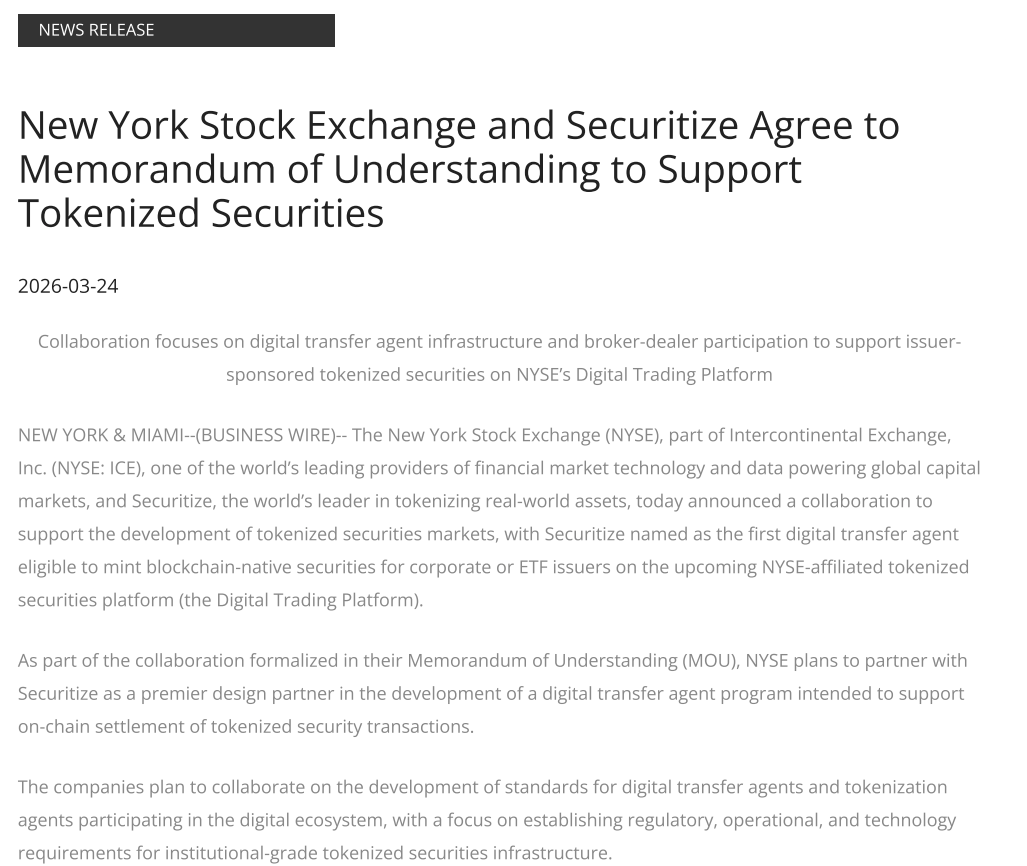
The New York Stock Exchange (NYSE) has signed a memorandum of understanding (MoU) with tokenization platform Securitize, as part of a broader effort to develop blockchain-based stock trading infrastructure for Wall Street.
Securitize will become the first digital transfer agent, enabling it to mint blockchain-based shares for stocks and exchange-traded funds (ETFs) on the upcoming tokenized securities platform, the Digital Trading Platform, according to a Tuesday announcement from Intercontinental Exchange (ICE), parent company of the NYSE.
Under the MoU, the companies plan to develop a digital transfer agent program and standards for digital transfer agents and tokenization agents, with a focus on regulatory, operational and technology requirements for tokenized securities infrastructure.
The announcement builds on ICE’s Jan. 19 plan for a tokenized securities venue designed for 24/7 trading, instant settlement, stablecoin-based funding and onchain settlement.
ICE said the planned venue is designed to support both tokenized shares that are fungible with traditionally issued securities and securities issued natively as digital tokens, while preserving traditional shareholder dividends and governance rights. Tokenized stocks are shares of traditional company stocks minted on the blockchain ledger, offering investors exposure to stock prices with advantages including 24/7 accessibility and fractional ownership.
The agreement is the latest sign that major exchange operators are building blockchain-based trading and settlement infrastructure, even as the regulatory and market structure for tokenized public securities is still taking shape.
The news follows the US Securities and Exchange Commission giving the regulatory greenlight to Nasdaq’s pilot proposal on Thursday to support the trading of tokenized versions of high-volume stocks and securities.

“As we explore how tokenization can enhance capital markets, it is critical that new infrastructure is developed in a way that preserves the trust, transparency, and protections investors expect,” said Lynn Martin, president at NYSE Group.
Related: US financial markets ‘poised to move on-chain’ amid DTCC tokenization greenlight
Tokenized stocks surpass $1 billion amid rising demand
Investor demand for blockchain-based tokenized stocks is increasing. The total value of tokenized stocks surpassed $1 billion on March 10, in a significant milestone for the real-world asset (RWA) sector.
Over the past 30 days, tokenized stockholders rose by 16% to 193,140, while the monthly transfer volume increased by 45% to $2.5 billion, according to data from RWA.xyz.
Still, tokenized stocks are only the sixth-largest segment of the $26 billion value locked into tokenized RWAs. Tokenized treasury debt was ranked first with $11.8 billion, and tokenized commodities second with over $5 billion.

Some of the leading crypto exchanges are also racing to launch tokenized stock offerings. Coinbase launched 24/7 stock perpetual futures for non-US traders on Friday, offering cash-settled exposure to major US stocks and indices, including Apple and Nvidia.
Crypto exchanges Binance and Kraken have also launched tokenized perpetual futures trading for non-US traders, along with numerous other offshore platforms.
Magazine: Can Robinhood or Kraken’s tokenized stocks ever be truly decentralized?
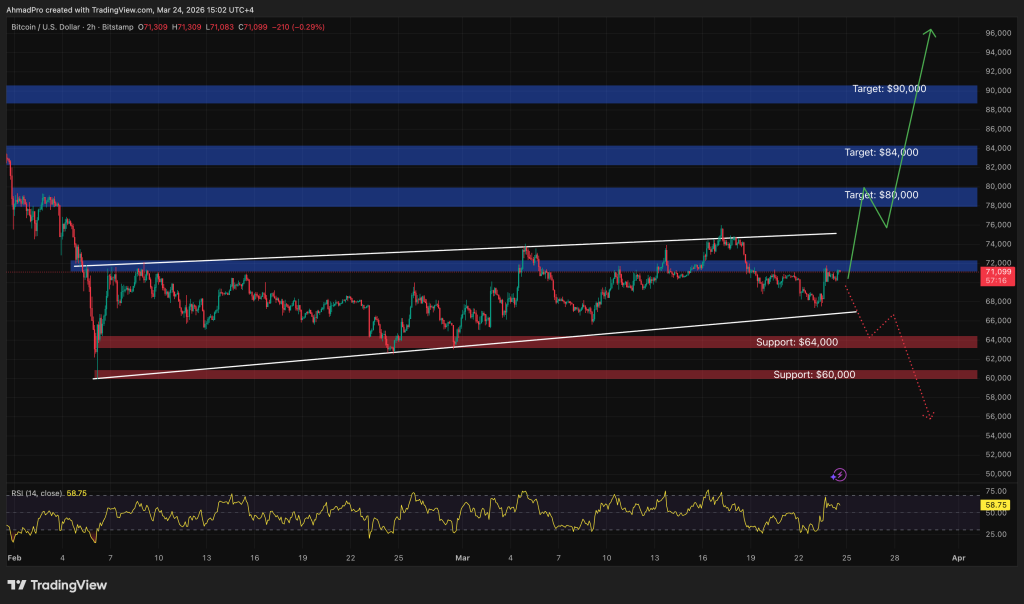
Bitcoin price is ripping. BTC USD reclaimed $71,000 Tuesday afternoon, erasing weekend losses immediately after President Trump ordered a five-day delay on strikes against Iranian energy infrastructure.
The sudden de-escalation signal triggered a violent capital rotation: oil futures collapsed nearly 10%, gold prices retreated 3.7%, and crypto assets surged in a classic risk-on relief rally.
Traders were positioned for immediate escalation following the expiration of a 48-hour ultimatum, but the pause caught bears offside.
While West Texas Intermediate (WTI) crude plummeted to $85.45 on the news, Bitcoin decoupled from the broad commodity sell-off, validating its role as a liquidity gauge rather than a pure safe haven in this cycle.
- Price Action: Bitcoin rallied from a low of $67,436 to a high of $71,782 within hours of the announcement.
- Macro Shift: Oil and gold plunged as war risk premiums evaporated, boosting risk asset liquidity.
- Market Signal: Short sellers were liquidated as sentiment flipped from fear to greed in under 60 minutes.
Can Bitcoin Price Reclaim $72,000 Price Resistance?
Bitcoin held $68,000 through peak uncertainty and is now pushing into the supply zone above $71,500.
Bulls need one thing: a confirmed 4-hour close above $72,000. That invalidates the lower-high structure built earlier this month and opens the next leg up.
Daily RSI has reset from overbought and is trending up near 58. Room for continuation exists. The 50-day EMA is the critical floor. Lose it and this rally gets exposed as a headline-driven bull trap.

Bull case: reclaim $72,000, consolidate, retest the March high at $75,620. Bear case: rejection at $71,800 sends price back to $68,500. Lose that and $65,000 opens up.
The short squeeze did the heavy lifting on the way up. CoinGlass data shows over $271 million in short positions liquidated in the hours after the White House announcement. Traders positioned for a breakdown below $67,000 got wiped and their forced covering poured fuel on the move.
Funding rates have ticked up but open interest has not reclaimed year-to-date highs. Spot buying and short covering are driving this, not leveraged froth. That is a healthier signal for trend sustainability than a derivatives-led pump.
The Macro Pivot: Why $85 Oil Matters
The correlation between Bitcoin and energy markets has inverted. While oil prices tumbled 9.8%—with Brent crude falling to $98.66—Bitcoin surged. This highlights the market’s current logic chain: lower oil prices reduce the risk of sticky inflation, which in turn lowers the probability of a hawkish Federal Reserve response.

Gold, traditionally the primary safe haven, dropped 3.7% as the immediate war premium exited the market. This divergence is critical.
While Bitcoin and gold decoupled during the Hormuz crisis, today’s action confirms that crypto is trading on liquidity dynamics rather than fear. When the threat of $150 oil vanished, the liquidity outlook improved, and Bitcoin pumped.
Investors should monitor the five-day deadline closely. If tensions flare again and oil reclaims $100, the headwinds for risk assets will return.
Traders are watching $70,000 holding as support into the daily close. Maintain this level, and the path to new highs is open. Fail here, and the market returns to choppy consolidation. The trend is up, but the geopolitical fuse is still lit.
BTC USD Price Is Bullish, And Investors Are Ready to Rotate to Infrastructure as Hyper Targets SVM Scalability
As the gold price crash and Bitcoin rally reshape portfolio allocations, smart money is beginning to rotate profits into high-growth infrastructure plays.
While Bitcoin secures its position as digital collateral, attention is turning to Bitcoin Hyper (HYPER), a protocol focused on bringing scalability to the Bitcoin network through high-performance Layer 2 solutions.
Bitcoin Hyper has now raised over $32 million in its ongoing presale, signaling strong institutional appetite for Bitcoin-native DeFi.
The project targets the scalability dilemma by integrating Solana Virtual Machine (SVM) architecture directly with Bitcoin’s security layer. With the token currently priced at $0.0136 and staking APY exceeding 89%, early entrants are positioning for the next phase of the Bitcoin ecosystem evolution.
Investors looking to hedge against spot volatility are diversifying into infrastructure layers that capture transaction volume regardless of short-term price action.
Visit the Official Bitcoin Hyper Website Here
The post Bitcoin Price Reacts as Trump Delays Iran Strike, Oil and Gold Volatile appeared first on Cryptonews.
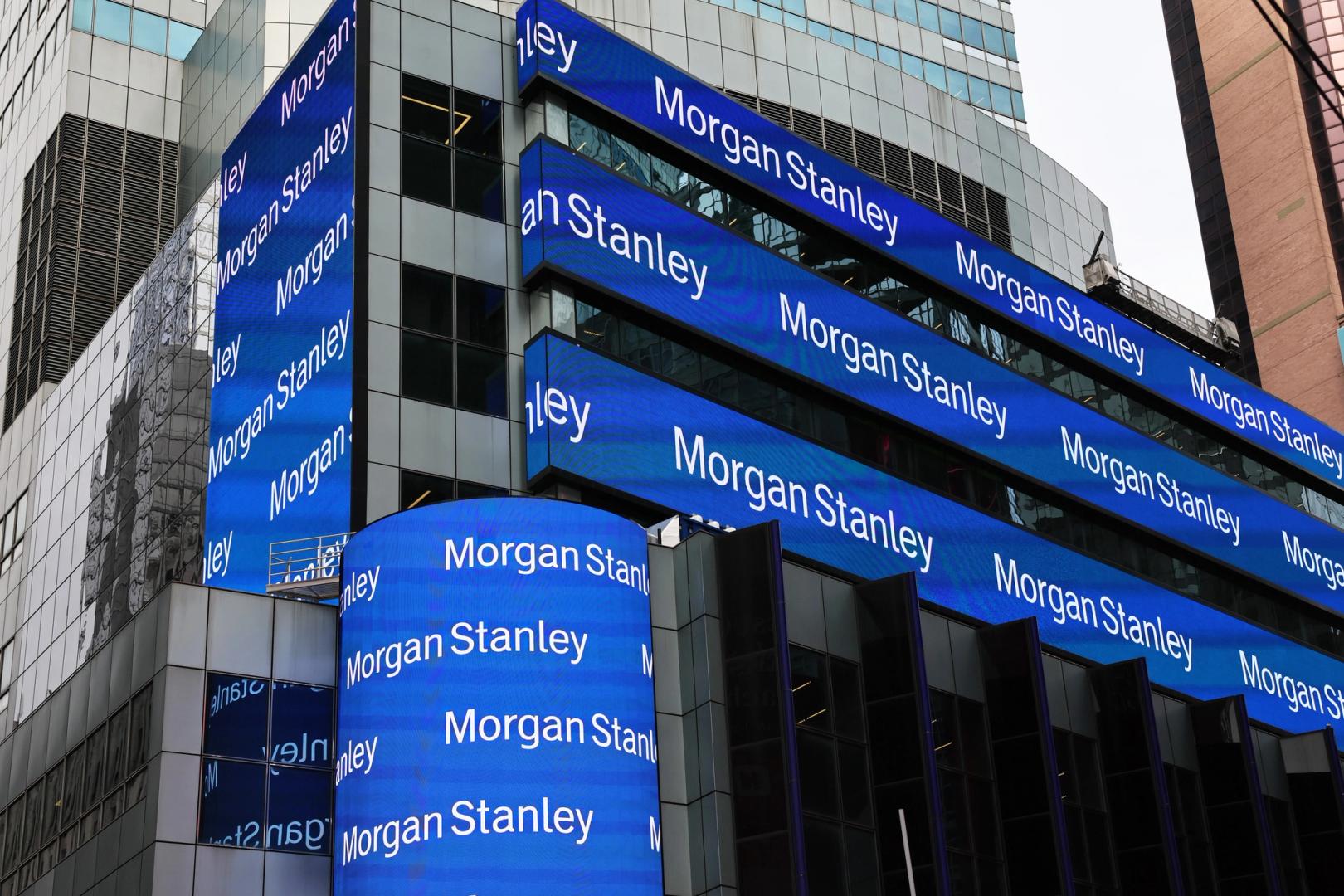
NEW YORK — Amy Oldenburg, the head of digital asset strategy at Morgan Stanley (MS), rejected the idea that Wall Street is only now embracing crypto due to fear of missing out, arguing that large banks are acting after years of preparation.
“TradFi is getting FOMO and is now getting involved … it really isn’t accurate,” Oldenburg said during a panel at the Digital Asset Summit in New York on Tuesday. “We’ve been on a journey around the entire modernization of financial infrastructure for years.”
Her comments come as major U.S. banks, long seen as cautious on crypto or latecomers to the industry, begin to expand their offerings. For years, firms like Morgan Stanley restricted activity to indirect exposure, such as offering wealthy clients access to bitcoin funds.
More recently, that’s included spot bitcoin exchange-traded funds (ETFs) on its E*Trade platform and the bank this month even filed to launch its own spot bitcoin ETF.
Broader participation was slowed by regulatory uncertainty and concerns around custody, compliance and market structure. That stance has started to shift, and Morgan Stanley has now outlined a more defined digital asset strategy, with efforts spanning trading, asset management and infrastructure.
Oldenburg said the bank is preparing to support tokenized equities trading on its alternative trading system.
“One of the things that we are planning for the second half of 2026 is turning on our trajectory cross … to support tokenized equities later this year,” she said. The platform already handles equities, ETFs and American depositary receipts (ADRs), which she described as a natural base for expansion.
Inside the firm, the transition requires reworking core systems. “We are having to re-teach ourselves what legacy infrastructure, pipes and plumbing look like,” Oldenburg said, pointing to the challenge of upgrading decades-old financial architecture to support faster settlement and continuous trading.
She also highlighted a gap between crypto startups and large institutions.
“There’s so many other connectivity points that we need to plug in around it,” she said, noting that founders often underestimate how complex bank systems are.
Even so, areas like stablecoins are gaining traction as a way to move money faster and at lower cost than traditional systems.
Adoption, however, depends on coordination across the financial system. “We can’t just modernize on our own,” Oldenburg said. “This is an incredibly complex, integrated global network.”
Despite weak token prices, she said activity continues to build. “It really is very early innings,” Oldenburg said, signaling that Wall Street’s deeper integration with crypto may be gradual, but its underway.
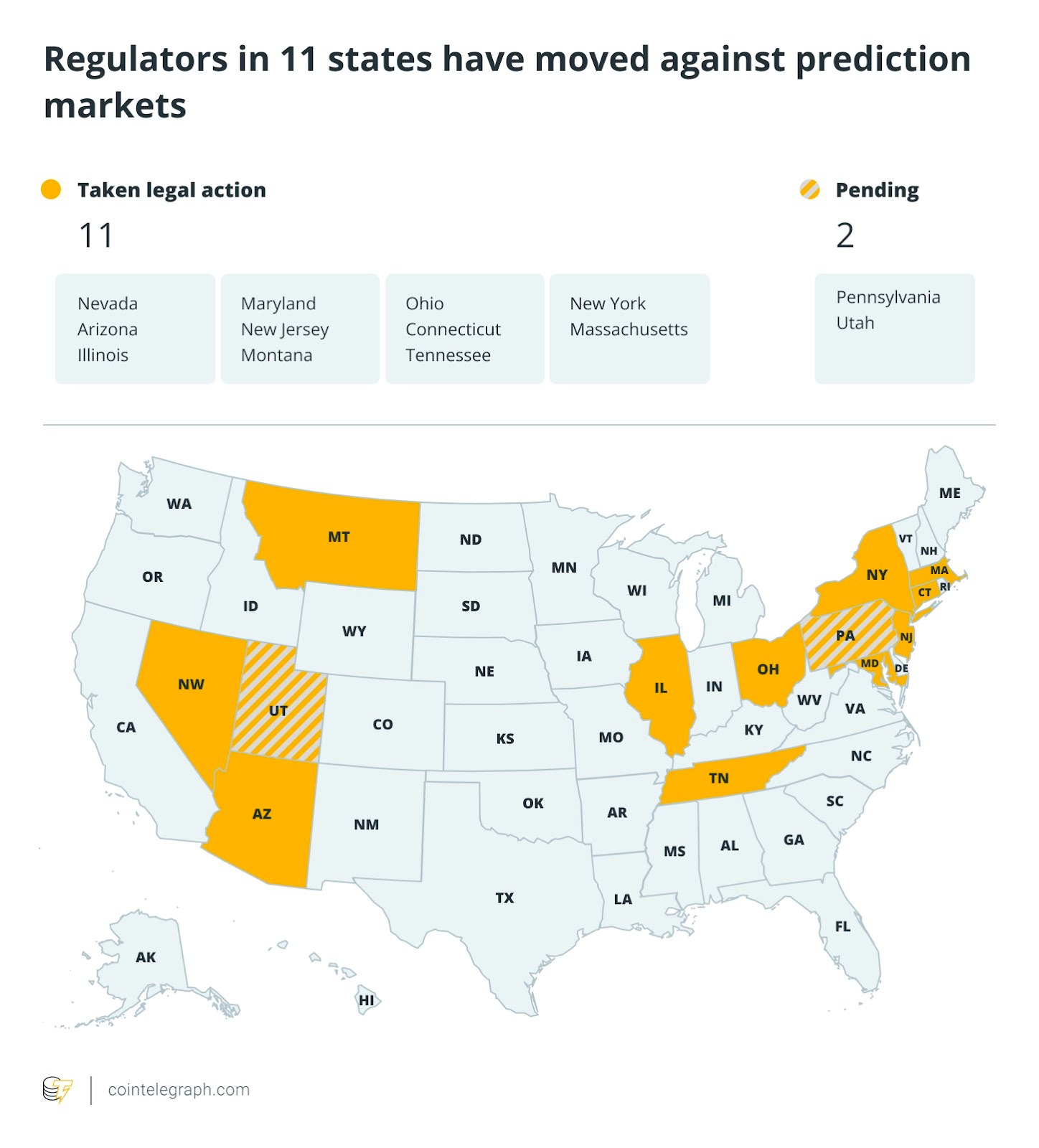
Momentum is building across US states to regulate or restrict prediction markets, with multiple legal actions targeting platforms such as Kalshi.
On March 20, Carson City District Court Judge Jason Woodbury in Nevada made his state the first to issue a temporary ban on prediction market Kalshi from operating. Gaming officials said that the platform violated state gambling laws.
Nearly a dozen other states have also issued various forms of legal proceedings. Most have filed cease-and-desist letters, while Arizona has even brought criminal charges against Kalshi. Other states are considering new legislation for prediction markets.
The patchwork enforcement across states has brought national attention, and regulations at the federal level are looming.

Nevada bans Kalshi while Arizona opens criminal charges
In 11 states across the US, local authorities have taken legal action against prediction markets like Kalshi and Polymarket.
The state of Nevada managed to initiate a temporary ban, which blocked Kalshi from operating in the state for 14 days. The motion was initially put forward by the Nevada Gaming Control Board.
The board’s chair, Mike Dreitzer, said that prediction markets “facilitate unlicensed gambling” and are therefore illegal in the state. “We have a statutory duty to protect the public,” he said.
Sports betting and gaming lawyer Daniel Wallach wrote that the order prevents Kalshi from offering “event-based contracts relating to sports, politics and entertainment to people within Nevada without first obtaining all required licenses.”
Just a few days earlier, the neighboring state of Arizona filed criminal charges against the firms behind Kalshi. Arizona Attorney General Kris Mayes’ office filed a complaint, alleging that Kalshiex LLC and Kalshi Trading LLC were “running an illegal gambling operation and taking bets on Arizona elections, both of which violate Arizona law.”
The announcement claimed Kalshi ”accepted bets from Arizona residents on a wide range of events in violation of Arizona law. These events included professional and college sporting contests, proposition bets on individual player performance, and whether the SAVE Act would become law.”
Betting on sports requires a gaming license, and Arizona law outright bans bets on elections.
Other states have either put forward or are considering new regulations. In Utah, State Representative Joseph Elison put forward HB243, which would define proposition betting as “a gambling bet on an individual action, statistic, occurrence, or non-occurrence.”

In Pennsylvania, Representative Danilo Burgos announced plans to introduce legislation that would regulate prediction markets and put them under the regulatory purview of the Pennsylvania Gaming Control Board. The bill will propose:
-
a 34% state tax and 2% local share assessment on gross revenue,
-
to ban underage users,
-
to include self-exclusion lists for user protection, and
-
strict Anti-Money Laundering (AML) and Know Your Customer (KYC) protocols.
Numerous other states have issued cease-and-desist letters to prediction markets and attempted to block their activities through the courts. Not all of them have been successful. In Tennessee, Judge Aleta Trauger of the US District Court for the Middle District of Tennessee blocked a state injunction that would prevent Kalshi from operating there. The court concluded that the event contracts were “swaps” under the Commodity Exchange Act (CEA), which gives the US Commodity Futures Trading Commission (CFTC) exclusive jurisdiction.
Kalshi did not respond to Cointelegraph’s request for comment at publishing time.
Who should regulate prediction markets?
The patchwork of different enforcement actions — and varying reactions to them by different courts — has brought into question who should regulate prediction markets and how. Prediction markets and their proponents believe that the power should lie with the federal government and the CFTC.
Elison, the sponsor of the law in Utah, told local media, “It’s a huge gray area and there’s lots of lawsuits all over the country right now […] debating this very thing, trying to find out what are the actual definitions.”
“They’re flying under what’s called prediction markets, and prediction markets are regulated by the Federal Commodities Exchange [sic]. That’s why they’re able to do it,” he said.
A Kalshi spokesperson previously told Cointelegraph, “States like Arizona want to individually regulate a nationwide financial exchange, and are trying every trick in the book to do it. As other courts have recognized and the CFTC affirms, Kalshi is subject to federal jurisdiction.”
“It’s different from what sportsbooks and casinos offer their customers, and it should not be overseen by a patchwork of inconsistent state laws,” they stated.
Aaron Brogan, founder of crypto-focused law firm Brogan Law, wrote, “Prediction markets’ ‘crime,’ the reason that so many states have pursued and will continue to pursue action against them until they win or are stopped, has nothing to do with the merits of these markets.”

Since they are currently regulated under the CEA, and therefore under the oversight of the CFTC, “states will not be able to control them, and more importantly, may not be able to tax them,” Brogan said. According to the American Gaming Association, at stake is billions of dollars in tax revenue across the 40 states where online sports betting is legal.
Some state lawmakers aren’t so shy about this. Burgos wrote that the “regulatory arbitrage” of prediction markets skirting state laws “leaves our constituents vulnerable and deprives the commonwealth of significant tax revenue.”
Speaking to local media, he said that the state should have the ability to tax an activity, particularly when it can harm constituents. “It’s another opportunity to expand the tax base. […] And like everything else that has a potential harm for our community, for our communities. It can create bad habits or worse habits in our communities. That’s one of the dangers that I see.”
There is also pressure at the federal level on prediction markets. Senator John Curtis of Utah introduced a bill called the Prediction Markets Are Gambling Act. This would amend the CEA to prevent “event contracts involving sports and casino-style games.”
Curtis told Utah state media that the act would put power back with the states. “Our bipartisan legislation clarifies regulatory jurisdiction, ensuring that states can maintain their authority over sports betting and casino gaming. The Prediction Markets Are Gambling Act is about respecting states’ authority, protecting families and keeping speculative financial products out of spaces where they don’t belong.”
In the meantime, the CFTC is seeking public input on its rulemaking for prediction markets. The CFTC currently has just one sitting commissioner, Chair Michael Selig. He has previously stated the agency would defend prediction markets.
According to Brogan, if the CFTC further liberalizes prediction markets, and the issue of preemption goes to the Supreme Court, “all that counts, through all the sound and fury, is counting to five.”
Magazine: Banks want to run Vietnam’s crypto exchanges, Boyaa’s $70M BTC plan: Asia Express

Network Strength Signals Growth
Monero continues to show strong network performance alongside rising demand. Its hash rate has climbed steadily, reflecting increased miner participation and confidence in the network. Moreover, consistent transaction activity indicates sustained user engagement rather than short-term speculation across the ecosystem. Search data highlights growing interest in private crypto conversions. Queries related to Bitcoin to Monero exchanges have reached their highest levels since 2022. Consequently, this trend aligns with increased awareness of financial privacy risks tied to transparent blockchain systems.
Blockchain tracking capabilities have advanced rapidly across global markets. Firms like Chainalysis and Elliptic now provide real-time monitoring tools used by authorities in multiple jurisdictions. As a result, Bitcoin transactions linked to regulated exchanges often create traceable records tied to user identities. Governments have introduced stricter rules governing digital asset transfers. The European Union and the United States have expanded reporting obligations for crypto transactions. Furthermore, similar frameworks in Asia and Australia have increased compliance requirements, limiting anonymous activity on regulated platforms.
Security incidents involving centralized exchanges have heightened privacy concerns. Several breaches exposed sensitive user information, including identification documents and transaction histories. Consequently, affected users face increased risks related to fraud and targeted attacks. The ecosystem supporting Bitcoin to Monero swaps has matured significantly. Non-custodial platforms now offer fast conversions without requiring user accounts or identity verification. Additionally, decentralized protocols and atomic swap tools have improved accessibility for users seeking direct cross-chain exchanges. Market behavior shows a clear preference for financial privacy features. Users increasingly treat Monero as a reserve for private transactions rather than speculative investment. Moreover, the ability to move funds discreetly has become a key consideration in portfolio strategies.
Strength of Network Data Signals
Monero also records consistent network traffic throughout this season of demand. The day-to-day transactions exceed 40,000, which is near the network’s high. The hash rate is constantly increasing, indicating sustained miner support and long-term confidence in the network. Search activity shows growing attention to private crypto conversions. The number of queries for Bitcoin-to-Monero swaps has been the highest since 2022. This trend aligns with heightened sensitivity to traceable financial transactions in financial records.
Chainalysis and Elliptic are examples of blockchain analytics firms that continue to expand their monitoring capabilities. They are now used to aid regulators and tax authorities across regions. Consequently, transactions involving regulated exchanges often leave a trace. Authorities have proposed broader reporting requirements for digital asset transactions. Compliance rules have been extended to exchanges by the European Union and the United States. Moreover, the same regulations have been enforced in Asia and Australia, increasing pressure on users within regulated systems.
Breaches in centralized platforms’ security have contributed to users’ concerns. Several breaches exposed personal identification data and transaction histories. As a result, users are increasingly concerned about privacy to reduce risks from data exposure and targeted attacks. The service that facilitates Bitcoin-to-Monero conversion has also developed. Swaps such as GhostSwap do not require account creation or identity verification. Additionally, decentralized protocols like THORChain offer more liquidity for cross-chain transactions.
Market Behavior Adjusts
The behavior of users is now characterized by an increased emphasis on financial privacy. The use of Monero by many holders is as a means of conducting confidential transactions rather than a speculative instrument. Furthermore, fast and immediate conversion features have become a major necessity for active crypto users. Increasing surveillance, growing regulations, and recurring data breaches continue to influence user preferences. As a result, Bitcoin-to-Monero swaps have become a key component in facilitating private transactions in the digital asset market.
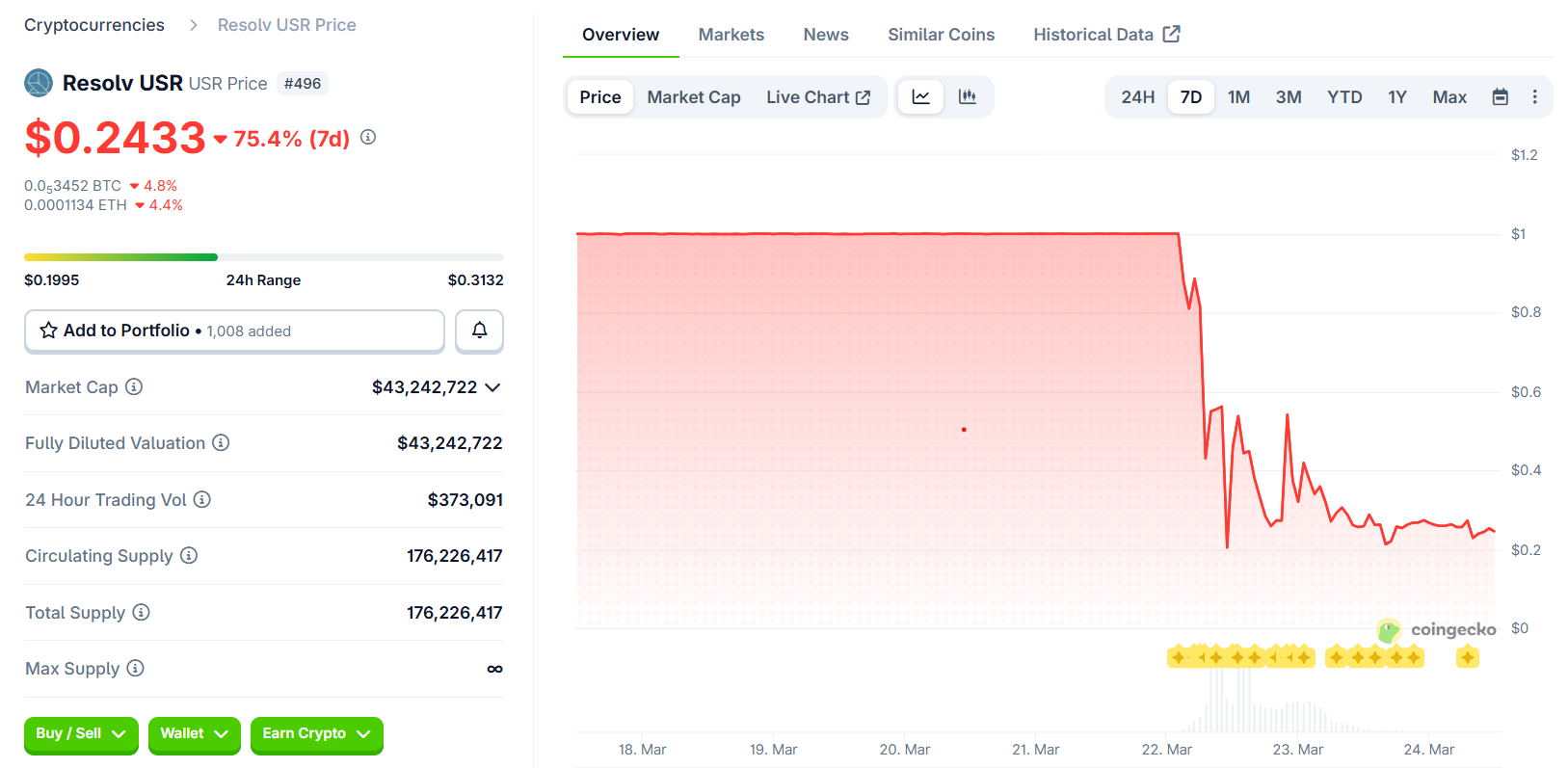
Resolv Labs has temporarily paused its protocol after an exploit on Sunday in which an attacker minted 80 million unbacked tokens, knocking the dollar stablecoin sharply off its peg and briefly plunging the token to $0.14.
The Resolv Foundation team announced on X on Monday evening that all protocol functions, including the app, were temporarily halted “to contain the impact of the exploit,” freezing Season 4 airdrop claims as well as staking and unstaking of RESOLV tokens.
Resolv previously said the collateral pool remained intact with no loss of underlying assets, despite onchain analysis showing that the attacker had successfully converted most of the minted USR into Ether (ETH) and sold around $25 million. USR is currently trading near $0.24, far below its intended dollar peg.
In an onchain ultimatum on Monday, Resolv offered the exploiter a white hat-style deal: return 90% of the converted funds (around $25 million in ETH) plus all remaining USR within 72 hours, keep 10% as a bounty, and cease further activity or face the consequences.
“Failure to comply within the stated timeframe will result in escalation,” the ultimatum states, such as asset freezes coordinated with exchanges and bridges, public tracing and law enforcement action. There have been no movements on the main wallet since.

Michael Pearl, vice president GTM and strategy at Web3 security company Cyvers, told Cointelegraph that redemptions had reopened only for legitimate pre-exploit holders, while Resolv and partners continued to trace “bad USR” and prepare a full post-mortem.
Related: Balancer Labs shuts down 4 months after $100M+ exploit, protocol to continue
Resolv exploit reignites stablecoin PTSD
Beyond Resolv, the incident has rekindled the industry’s unresolved trauma from the Terra ecosystem collapse of 2022, when the Terra USD (UST) algorithmic stablecoin’s death spiral erased tens of billions of dollars in value and reshaped regulatory and risk perceptions around stablecoins.
Pearl said the USR depeg had “opened a Pandora’s box,” noting that it had triggered roughly $180 million in liquidations on lending protocol Morpho and some $334 million in outflows from lending and liquidity platform Fluid, but “limited spillover overall,” as nervous stablecoin issuers revisit their own assumptions about peg reliability.
“We hear many stablecoin platforms that are petrified after this exploit,” he said, and with decentralized finance (DeFi) now deeply intertwined with stablecoins, Pearl warned that while protocols can sometimes absorb hacks and move on, a serious failure at the stablecoin layer “can finish the company,” a risk that USR’s collapse has just put back in sharp focus.
Magazine: South Korea gets rich from crypto… North Korea gets weapons


Solana launches an API-based developer platform for institutions, landing Mastercard, Western Union and Worldpay as early users for stablecoin and payment rails.
Summary
- The Solana Foundation launched the Solana Developer Platform (SDP) on March 24, a unified API-based platform targeting institutions and enterprises building tokenized assets, stablecoins, and payment flows on Solana.
- Mastercard, Western Union, and Worldpay have signed on as first adopters, with use cases spanning stablecoin settlement, cross-border payments, and merchant settlement.
- The platform launches as Solana processed a record $650 billion in stablecoin volume in February 2026, surpassing both Ethereum and Tron to become the leading chain for stablecoin activity.
The Solana Foundation on March 24 launched the Solana Developer Platform, a one-stop API-based infrastructure layer designed for financial institutions and enterprises seeking to build tokenized deposits, stablecoins, and real-world payment flows directly on the Solana (SOL) blockchain — with Mastercard, Western Union, and Worldpay joining as its first institutional adopters.
The announcement lands at a moment of considerable momentum for Solana as a payments infrastructure. In February 2026, the network processed a record $650 billion in stablecoin volume, more than doubling its previous peak and overtaking both Ethereum and Tron to claim the largest share of the $1.8 trillion global stablecoin market. The stablecoin sector itself now sits at approximately $328 billion in total market capitalization, according to rwa.xyz.
Solana – A Platform Built for Institutional Scale
The SDP is structured around three core modules: issuance, payments, and trading. The issuance and payments modules are live immediately, allowing institutions to issue tokenized deposits, GENIUS-compliant stablecoins, and tokenized real-world assets, while also managing fiat and stablecoin flows — including on-ramps, off-ramps, and on-chain transactions. A trading module supporting atomic swaps, vaults, and on-chain foreign exchange is expected later in 2026.
To underpin institutional requirements, Solana integrated more than 20 infrastructure partners across node infrastructure, wallets, compliance, and payment ramps. Modern Treasury, the payments software company, was selected as the platform’s payments infrastructure partner. “Solana processes tens of millions of transactions daily with near-instant settlement,” said Matt Marcus, co-founder and CEO of Modern Treasury. “By integrating Modern Treasury’s payments software, we’re helping make that infrastructure usable for enterprises that need strong controls, reliability, and compliance from day one.”
The three launch partners each represent a distinct institutional use case. Mastercard has joined to explore stablecoin settlement, Worldpay is using the tools for merchant payments and settlement, and Western Union — which has been deepening its Solana footprint since partnering with Crossmint in March to support its USDPT stablecoin on the network — is using the platform for cross-border payment flows.
Malcolm Clarke, VP of Digital Assets at Western Union, framed the integration as an extension of the company’s core infrastructure rather than a replacement. “Solana Developer Platform lets us extend what Western Union already does best — moving money reliably across borders — by adding an API-driven, on-chain layer that can orchestrate fiat and stablecoin flows end-to-end,” Clarke said. “It’s not a replacement for our network; it’s a modern extension that helps us innovate faster, expand new use cases, and bring more cross-border activity on-chain in a scalable, compliant way.”
Catherine Gu, Head of Product for Digital Assets at the Solana Foundation, described the platform as an “easy gateway” for any institution to start building immediately, noting that the fully API-based design removes the technical and operational barriers that have historically slowed enterprise blockchain adoption.
Solana’s Institutional Moment
The SDP launch is the latest in a string of enterprise moves on Solana, which has increasingly positioned itself as the settlement layer of choice for payment-focused blockchain applications. Wyoming launched its state-issued FRNT stablecoin on Solana in January 2026, while Backpack rolled out on-chain IPO access using Solana rails in March. SOL was trading near $84 to $95 at the time of the announcement, with $80 acting as key near-term support.

Nasdaq and Talos are wiring legacy infrastructure directly into crypto trading stacks to release $35 billion in stagnant capital. The partnership, announced Monday, integrates Nasdaq’s Calypso risk platform and Trade Surveillance technology with Talos’s institutional liquidity network.
This is not a pilot program. It is an industrial-scale attempt to solve the collateral bottleneck slowing institutional adoption employed by major banks. By bridging the gap between digital assets and traditional finance (TradFi), the move targets the inefficiency of capital sitting idle in redundant buffers.
- Deal Mechanics: Nasdaq Calypso and Trade Surveillance now run natively within the Talos institutional trading stack.
- The Problem: Fragmented systems lock up roughly $35 billion in collateral across “corrective and non-interest-bearing measures.”
- Market Implication: Real-time mobility for tokenized RWAs and traditional assets removes a critical barrier to institutional scale.
The Problem: What “Trapped Collateral” Actually Means
Institutional capital is notoriously inefficient. Nasdaq’s internal research estimates $35 billion in collateral sits idle at any given moment, tied up in “corrective and non-interest-bearing measures.” In plain English, this is dead money.
It is capital trapped in transit between fragmented settlement layers or locked in safety buffers because risk systems cannot talk to each other. For firms trading across digital and traditional markets, the friction is double. Moving Treasuries to cover a crypto margin call historically involves T+1 settlement lag and manual reconciliation.
That lag forces traders to pre-fund positions, killing capital efficiency. The bottleneck is not liquidity. It is mobility.
Talos increasingly sits at the intersection of traditional capital markets and digital assets. Today, we're proud to announce we're partnering with @Nasdaq to connect Talos’s digital asset infrastructure with Nasdaq’s Calypso and Trade Surveillance platforms. — Talos (@talostrading) March 23, 2026
 Read the… pic.twitter.com/90LF6jHUTO
The integration pipes Nasdaq’s post-trade infrastructure directly into the pre-trade execution environment. Talos clients—spanning hedge funds and brokers—gain access to Nasdaq Calypso, a platform already used by standard-bearer financial institutions for treasury and collateral management.
This creates a unified workflow. A trader can now manage tokenized real-world assets (RWA) alongside spot crypto and traditional equities through a single lens. “The evolution toward tokenized collateral is a natural progression for institutional capital markets,” said Anton Katz, Talos CEO.
Crucially, Nasdaq is also deploying its Trade Surveillance engine here. This allows firms to detect wash trading, layering, and spoofing across venues in real-time. It brings Wall Street audit trails to crypto rails.
Why Now: The Institutional Tokenization Push
This is not happening in a vacuum.
The race to tokenize real world assets has moved from experimental pilots to production infrastructure. BlackRock, DTCC, and Euroclear are all positioning to control the rails of tokenized collateral. Nasdaq’s decision to integrate Calypso rather than build a new crypto-native tool tells you everything about the strategy. They are not joining the new frontier. They are bringing the existing fortress to it.
Institutions are done with sandboxes. Firms either adapt their infrastructure or lose the asset flow. The fracture happening at legacy institutions is not a warning. It is already the outcome.
The surveillance component is the stick behind the carrot. By embedding Nasdaq’s abuse detection tools, Talos splits the market in two. Venues with institutional-grade surveillance on one side. Gray-market pools where wash trading still runs unchecked on the other. The gap between institutional crypto and TradFi is narrowing fast.
Atomic settlement of tokenized collateral kills the counterparty risk that terrified credit committees after FTX. Nasdaq EVP Roland Chai framed the problem directly. The industry cannot manage exposure across markets with a single risk and asset lens. That lens is now in place.
Unlocking $35 billion in collateral efficiency is the opening bid. Not the prize.
The infrastructure phase of this bull market is quiet and violent at the same time. Retail is chasing meme coins. Nasdaq and Talos are replumbing the settlement layer underneath them.
The real prize is becoming the default operating system for the next generation of capital.
Discover: The best new crypto in the world
The post Nasdaq and Talos Move to Unlock $35 Billion in Trapped Collateral appeared first on Cryptonews.

United Airlines ditches more economy seats for bigger premium cabins
Missouri Moves to Add XRP to State Crypto Reserve Fund

‘Jumanji’ Returns With Colossal Crossover Event in Shocking New Release [Exclusive]


-
 Crypto World4 days ago
NIO (NIO) Stock Plunges 6.5% as Shelf Registration Sparks Dilution Worries
-

 Fashion4 days ago
Weekend Open Thread: Adidas – Corporette.com
-

 Politics4 days ago
Jenni Murray, Long-Serving Woman’s Hour Presenter, Dies Aged 75
-

 Crypto World3 days ago
Best Crypto to Buy Now: Strategy Just Spent $1.57 Billion on Bitcoin During Fear While Early Investors Quietly Enter Pepeto for 150x Potential
-

 News Videos6 days ago
RBA board divided on rate cut, unusually buoyant share market | Finance Report | ABC NEWS
-

 Crypto World3 days ago
Bitcoin Price News: Bhutan Sells $72 Million in BTC Under Fiscal Pressure, but the Smart Money Entering Pepeto Sees What the Market Does Not
-

 Politics6 days ago
The House | The new register to protect children from their abusers shows Parliament at its best
-

 Tech5 days ago
inKONBINI Lets You Spend Summer Days Behind the Register
-

 Crypto World6 days ago
Canada’s FINTRAC revokes registrations of 23 crypto MSBs in AML crackdown
-

 Sports1 day ago
Remo Stars and Kano Pillars Strengthen Survival Hopes in NPFL
-
 NewsBeat6 days ago
Residents in North Lanarkshire reminded to register to vote in Scottish Parliament Election
-

 News Videos6 days ago
PARLIAMENT OF MALAWI – PAC MEETING WITH REGISTRAR OF FINANCIAL ON AMARYLLIS HOTEL – INQUIRY LIVE
-

 Politics5 days ago
Gender equality discussions at UN face pushbacks and US resistance
-

 Business2 days ago
No Winner in March 21 Drawing as Prize Rolls to $133 Million for Next
-

 Business6 days ago
Who Was Alex Pretti? 5 Key Facts About the ICU Nurse Killed by Federal Agents in Minneapolis
-

 Sports1 day ago
Gary Kirsten Accuses Pakistan Cricket Board Of ‘Interference’, Mohsin Naqvi Responds
-

 Tech2 days ago
Give Your Phone a Huge (and Free) Upgrade by Switching to Another Keyboard
-

 Sports4 days ago
2026 Kentucky Derby horses, odds, futures, preview, date: Expert who nailed 12 Derby-Oaks Doubles enters picks
-
Sports5 days ago
Vikings Free Agency Enters Phase 2 with Key Questions
-

 Tech7 days ago
Subnautica 2 might finally be entering early access in May
You must be logged in to post a comment Login