
Crypto World
Tokenized RWA Surge to $4T May Push LINK to $200 by End 2030: Standard Chartered



The LINK token may see a 25-fold increase to $200 by the end of 2030, as the growing real world asset market increases demand for the industry’s largest oracle services provider, according to Standard Chartered.
The Chainlink (LINK) token may see an more than 25-fold increase by the end of the decade, as tokenized real world assets (RWA) will reach $4 trillion by the end of 2028, according to a forecast by Geoff Kendrick, the global head of digital asset research at Standard Chartered.
Kendrick said that the growth in tokenized assets will require more external data to come securely onchain, which may increase Chainlink’s fee generation and push its LINK token to $200 by the end of 2030, up from $8 today, according to a Monday report shared with Cointelegraph.
The report also forecast a 37-fold rise in tokenized and crypto-native assets deployed in decentralized finance, pushing these assets to $2.7 trillion by the end of 2030. Kendrick said these assets will require trusted data, interoperability between networks, privacy-preserving compliance and integrations with existing financial systems, which “only Chainlink is currently equipped to provide.”
The report follows growing demand for tokenized assets. Tokenized RWA trading on decentralized exchanges (DEXs) reached a new all-time high of $141 billion in July, marking a 19.5% monthly rise largely driven by public equities, according to data provider CryptoRank.
Chainlink is the blockchain industry’s leading decentralized oracle provider for crosschain communication, with $34.4 billion in total value secured. Chronicle ranks second with $7.36 billion, according to data aggregator DefiLlama.
Standard Chartered’s Kendrick said that potential risks to its Chainlink price forecast include slower-than-expected institutional tokenization initiatives, competition from specialist oracle providers and potential technical setbacks.
Magazine: What NYSE’s exploration of onchain systems means for financial markets

Crypto World
Analyst Predicts Big Market Moves Before Q4 as Traders Grow Bored in Quiet Crypto Market

Crypto analyst Sykodelic said Bitcoin is building toward explosive moves well ahead of the Q4 low that many traders expect, as the market sits in an unusually quiet stretch that has left participants bored.
The trader has already entered a short position after a weak weekly close, looking for a quick drop that clears built-up liquidity before a reversal higher.
The Setup That Has Traders Watching Closely
Sykodelic described the current environment as one where “the lack of volatility and compression we are seeing here only ever finishes in one way. MASSIVE moves.” They noted that the quiet has left “everyone bored out of their minds” while they wait for Q4 lows, but added, “We are gonna move way before that. It’s gonna be soon.”
The trigger came when the $65,300 level was taken out, and Bitcoin posted a weak weekly close. “My short is filled,” they wrote. “After waiting weeks for a clear trigger, we now have one.” They expect a drop to $60,500 that would mark the final move lower before a meaningful advance.
Sykodelic has long viewed the February low near $60,000 as the major macro bottom and believes the market is close to moving higher overall. The short, they said, aims for a sharp liquidation that cleans up liquidity accumulated below for weeks.
That would create a bear-trap setup, where late sellers turn bearish and call for new lows, only for a quick reversal to squeeze them and push the price above $67,000 toward the mid-$70,000s.
“Whenever we have been sideways like this for a long time, a massive amount of liquidity builds up either side,” he wrote. “It is always so much better if the liquidity below is swiped before actually moving higher.”
That view lines up, loosely, with a separate read from Crypto Patel, who pointed to the fund market premium index holding around 0.14.
“For now, the signal is quietly bullish,” Patel wrote, adding that institutional selling pressure hasn’t shown up in the data yet, even with the premium sitting on the low side.
A Sideways Market With Mixed Signals
Bitcoin has given traders little to work with lately. It slipped to $62,200 early last week before buyers pushed it back to $65,000, only to get turned away thereafter when the CLARITY Act hit another delay in the Senate.
A weak jobs report on Friday gave it one more push to $65,400 before it settled back down, and it was trading near $65,000 at the time of writing, up about 0.8% on the day but still down close to 45% over the past year.
The quiet has produced some louder optimism elsewhere, including from analysts Ali Martinez, Michaël van de Poppe, and Merlijn The Trader, who all pointed to signs of a completed correction, citing everything from a rare monthly TD Sequential buy signal to what they read as a classic breakdown and reclaim pattern.
The post Analyst Predicts Big Market Moves Before Q4 as Traders Grow Bored in Quiet Crypto Market appeared first on CryptoPotato.
Crypto World
Trump Responds as Iran Says U.S. Must Meet These Six Demands If Strait of Hormuz Is to Reopen
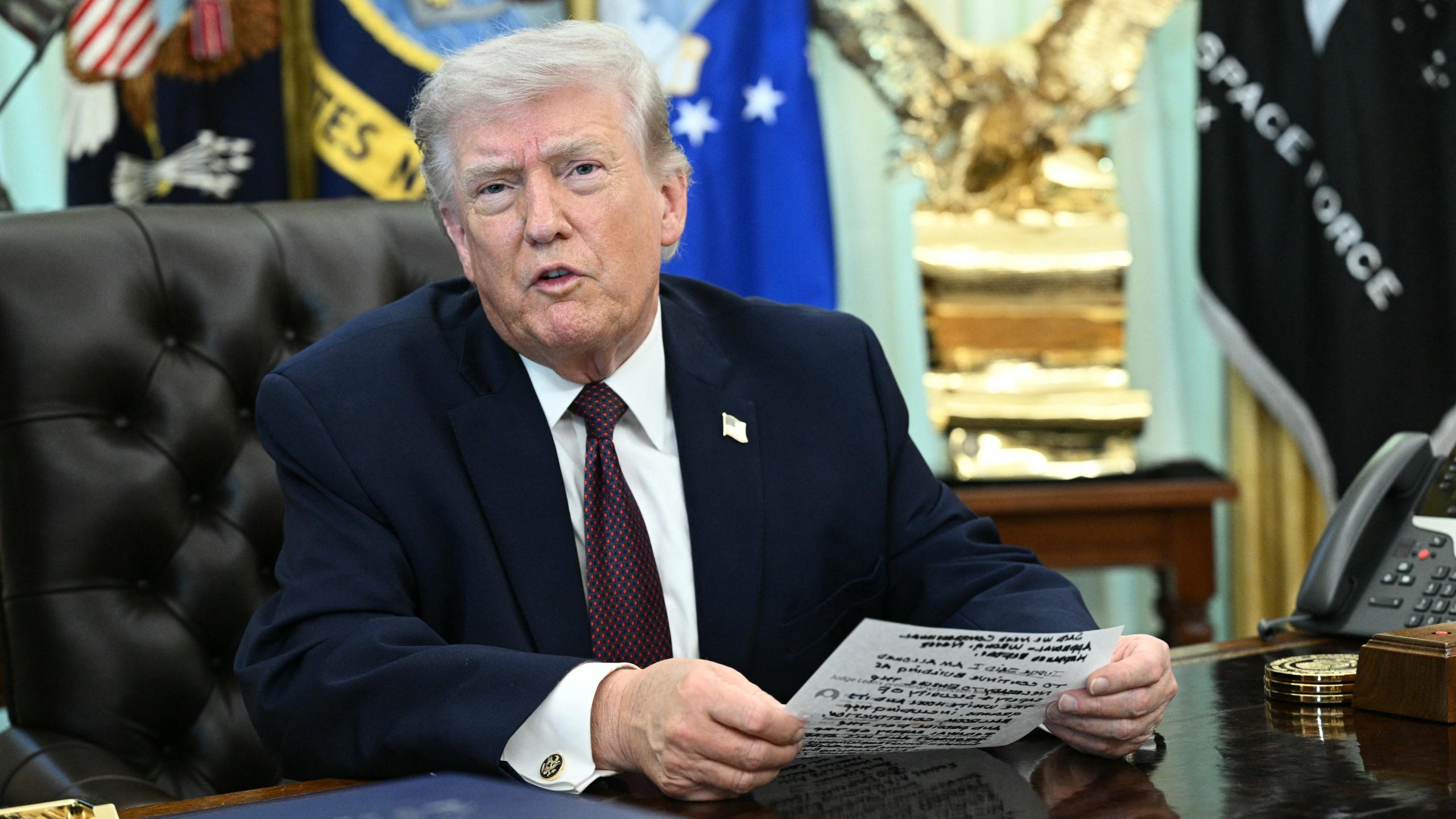
Never threaten Iran with any language or insult the sanctities of this nation.
End the war and aggression against Iran and its allies in Lebanon, Palestine, Yemen, and Iraq forever.
Lift the naval blockade and withdraw its military forces (naval and air) from around Iran.
Pay the damages of the two wars of aggression and imposition on Iran without any reduction or reduction.
Lift the cruel and illegal sanctions against the Iranian nation.
Unconditionally release the frozen and stolen assets of the Iranian people.


If you’ve ever suspected your dog can read your mind—sussing out through some canine intuition when you’re happy, sad, scared, or cross—you’re half right. Many dogs can do exactly that, but it’s not mind-reading that’s involved: it’s face-reading. That’s the word from a new study in the journal iScience, in which researchers not only established dogs’ ability to discern human moods by examining our facial expressions, but also pinpointed the spots in the brain where that processing takes place. They did this by scanning canine brains with functional magnetic resonance imaging (fMRI).
Figuring out how dogs read human emotions
“This ability to perceive emotions in humans is really hard to find in other species,” says Rául Hernández Pérez, professor of psychology at the University of Vienna and first author of the study. “Chimpanzees have a harder time than dogs. Wolves can also do it, but not at the same level as dogs can.”
Getting a dog to tolerate an MRI scanner is no small matter. The same things that so often freak people out about the MRI experience—the confined space and the infernal noise—can have a similar effect on a dog. That was an impediment to the kind of study the researchers planned to conduct. In order for a brain scan of the proper fidelity to be produced, the dogs must spend a minimum of six minutes in the machine, moving less than three millimeters in any direction. “If they move more than three millimeters, we can’t use the data,” says Laura Cuaya, professor of biological psychology at the University of Vienna and a co-author of the study.
Looking for dogs who could perform that feat, she and Hernández Pérez recruited 14 cooperative canines, consisting of 11 border collies—a highly trainable breed—two golden retrievers, and one Labrador, the last three of which were already working as service animals.
The animals then went through a series of at least 20 training sessions—the first involving just introducing them to the researchers and building a sense of trust. Next, the dogs were taught to lie still for just five seconds in the position they would have to maintain in the MRI scanner. “We reward them with treats, though some dogs prefer to play as a reward,” says Cuaya.
Over the course of several days, that brief five seconds was steadily extended to 10 full minutes. The dogs were then introduced to the headphones they would have to wear while in the machine to protect their hearing. “The headphones are not uncomfortable, but they’re weird,” says Cuaya. Finally, the dogs practiced holding their pose in a mock MRI scanner, and only then were they ready for the real, clanking, buzzing, banging machine.
In the study, the dogs were positioned in the machine and shown pictures of a human face wearing either a happy or neutral expression. All the while the fMRI churned on, peering through the dogs’ skulls into the brain below and looking for the areas that lit up as a result of the visual stimuli. When the dogs saw pictures of happy people, their temporal cortex and caudate nucleus became active. In humans, the temporal lobe plays a role in forming memories, mastering language, responding to visual cues such as familiar faces, and processing emotions. The caudate nucleus processes rewards and motivation and manages learning and memory. The neutral face did not elicit the same response in either region.
Next, the dogs were once again shown images of happy and neutral faces, but along with those they were also shown angry, frightened, and sad ones. The researchers were trying to determine whether the dogs processed human faces in a binary way—registering the positive, happy face in one part of the brain and the three negative ones together in one other part, or if each negative emotion had its own discrete brain region.
“This would mean that the dog brain is not only categorizing emotions between positive and negative,” says Cuaya. “We were using this [stage of the experiment] as a demonstration that there is more detailed processing.”
What dogs’ brains reveal about the dog-human bond
That was the result they got. Sadness and fear, for example, lit up the right rostral supra sylvian gyrus—which, in humans, contributes to the processing of visual information. Anger and fear were processed in the right ectosylvian gyrus and the left splenal gyrus—the former integrating visual, auditory, and other sensory information, and the latter managing visual perception, spatial orientation, and episodic memory.
“We found that the dog brain is not only categorizing emotions as positive or negative, but instead can exhibit more detailed processing, responding in different ways to emotions,” says Hernández Pérez.
This isn’t the first study to find that dogs respond in unique ways to human faces. Other research has shown that when a human face is happy, for example, dogs look more at the eyes than the mouth. They examine emotional faces longer than they examine neutral ones. And they have more difficulty reading the faces of people who are of a different gender from their principal caregiver.
There are benefits to the study—beyond the simple matter of adding to the body of knowledge on how dog brains operate. Hernández Pérez and Cuaya believe their work can also help improve the already deep ties dogs and humans share.
“Humans are not so good at perceiving the emotions of our dogs,” says Cuaya. “We are confused by them. Maybe this work can be an invitation to try to be more aware of the emotions of our dogs and how they are expressing [them].”
That understanding can also pay dividends when we are training our dogs. “When you are teaching something to your dog, you can have treats on hand, and you can give the treats when they are appropriate. But you can also show your emotion. You can say to the dog, ‘Very good!’ The dogs in our MRI machine were already reacting to the faces of strangers. Think about how much more activation there is with a familiar face expressing, ‘I love you so much. I am happy with you.’”
The dog-human love story—which has been going on for some 14,000 years now—has been a long and tender one. The more we understand the canine contribution to that bond, the more we can improve our own.


The Bitcoin chain enforcing BIP-110 has not produced a block since Saturday night, and the proposal's supporters — including Luke Dashjr, who maintains Bitcoin Knots and is chief technology officer of the mining pool Ocean — are now discussing a change to Bitcoin's proof-of-work algorithm…. Read the full story at The Defiant

The US Senate is moving the Digital Asset Market Clarity (CLARITY) Act toward a renewed floor push in mid-September after Majority Leader John Thune filed a cloture motion, according to reports from the Senate Daily Press and coverage of the filing by Cointelegraph. The procedural step is designed to bring the bill up for consideration, ending uncertainty that Congress might take additional action well beyond a year after the measure cleared the House.
As the Senate calendar reshuffles for a month-long recess, proponents of CLARITY say the delay is politically costly—coming with roughly 50 days before the 2026 midterm elections, a window that may compress lawmakers’ ability and appetite to finalize the bill.
Key takeaways
- John Thune filed cloture to advance the CLARITY Act to the Senate floor, with a vote now expected when the chamber reconvenes in mid-September.
- Even if the Senate votes, passage would require 60 senators, keeping the outcome highly dependent on broad bipartisan support.
- Industry leaders and advocates publicly criticized the lack of scheduling before the recess, while still framing September as the “finish the job” moment.
- Prediction market traders remain split: wagers on Kalshi imply strong odds of a September vote window, while Polymarket odds for passage within the current year look much lower.
Cloture filed as Senate returns from recess
On Saturday, Senate Daily Press reported that Majority Leader John Thune filed cloture on a motion to move the CLARITY Act to the chamber floor. The move, as described in coverage including this Cointelegraph report, reduces speculation that lawmakers would delay action beyond a year after the House passed the bill.
With the Senate set to reconvene in mid-September, the next procedural hurdle is not simply scheduling—it is the actual vote. Under Senate rules, CLARITY would need support from at least 60 senators to clear the chamber.
For advocates, the timing matters. Multiple industry figures have suggested that the push to September compresses the political runway ahead of the 2026 midterms. That compression could make it harder to assemble the supermajority needed to pass legislation of this scale.
Lawmakers’ delay draws frustration from crypto executives and senators
After the Senate did not set a vote before the recess, Senator Cynthia Lummis expressed frustration publicly. In a post shared Friday on X, cited in the reporting, Lummis said, “You can imagine how frustrated I am,” and added that she will “continue working with my colleagues to get this done,” characterizing the effort as “far from over” (Cynthia Lummis on X).
Crypto industry executives echoed the disappointment but did not pivot away from September. Coinbase CEO Brian Armstrong called the Senate’s action “disappointing,” while also indicating September would be when lawmakers “finish the job.” Coinbase’s chief policy officer Faryar Shirzad similarly pointed to September as the next push (Brian Armstrong on X) (Faryar Shirzad on X).
Not every market participant treated the setback as a meaningful break in momentum. Bitmine chair Tom Lee, in a company weekly report referenced in the coverage, suggested financial markets appeared more preoccupied with softer inflation and jobs data than with the implications of CLARITY stalling (Bitmine/PR Newswire).
Where negotiations may be stuck: ethics, investments, and stablecoin edge cases
Beyond pure scheduling, the broader legislative path has remained complicated. The coverage noted reports of progress in bipartisan discussions around crypto market structure, but also highlighted that Senate leaders did not announce solutions in response to Democratic calls for tighter ethics provisions—especially rules related to how President Donald Trump’s crypto investments are handled.
That ethics pressure sits within a larger political narrative in Congress. Reporting referenced continued scrutiny of Trump’s family’s crypto business, World Liberty Financial, and attention on a memecoin launched days before he took office.
Separately, there has been debate among banking advocates about how CLARITY’s framework could still allow certain activity involving stablecoin holders. A point raised in a Thursday Wall Street Journal editorial—published ahead of Thune’s cloture filing—suggested that, under CLARITY, smaller banks could miss out because they depend on interest payments to attract deposits. The editorial’s criticism centered on the idea that some crypto stakeholders want to operate like quasi-banks without the same regulatory obligations.
“The Clarity Act can serve a useful purpose with some language changes,” said the editorial board. “The crypto industry and its friends in Washington portray themselves as defenders of free markets. What they really want is to be quasi-banks without abiding by the same regulations.“
For readers, the practical implication is that CLARITY’s supporters and critics are not only arguing over whether a bill should pass, but over what regulatory tradeoffs it would institutionalize—particularly around banking-like functions and how stablecoin-related incentives are treated.
Prediction markets: odds diverge on vote timing versus yearly passage
Even after the Senate delay, prediction markets continue to price the likelihood of CLARITY advancing. On Kalshi, one event contract—referenced in the coverage—has reportedly wagered $1.23 million and priced users at an 88% chance that the Senate would vote on CLARITY before Oct. 1 (Kalshi).
On Polymarket, a related contract has offered a materially lower outlook. The coverage states the contract gave users a 26% chance of the bill being signed into law this year, with total wagers topping $5.79 million (Polymarket).
That gap between “vote odds” and “signed into law” odds is important. If the Senate does vote in September as expected, CLARITY would still need to return to the House for another vote if there are changes. Only then could it proceed to the president’s desk. In other words, markets appear to be separating procedural progress from the final end-state.
For participants, the uncertainty is unlikely to disappear quickly. The next decisions—cloture timing, scheduling, the 60-vote threshold, and any House re-approval requirements—could each move the probability landscape.
As the Senate reconvenes in mid-September, investors and builders who have been watching CLARITY for clearer regulatory treatment should focus on one concrete question: will cloture translate into a floor vote with enough support to overcome the 60-senator bar, and if it does, what changes (if any) trigger a second House vote?

Bitcoin’s price has made its first notable move since the end of the previous business week after it was rejected at $65,200 earlier today and has dropped by a grand and a half within minutes.
The full-on crypto critic Peter Schiff used the opportunity to lash out at the asset’s price moves by comparing it with gold and by weighing in on Strategy’s latest moves.
In one post, the economist said the Saylor-led company has apparently given up on the idea of digital credit, as it just announced its fourth BTC sale of the year. He believes Strategy has turned to the ‘good’ old-fashioned fiat money as superior protection since “lenders don’t have confidence in Bitcoin as collateral.” As such, he advised investors to “sell MSTR and sell Bitcoin now!”
Schiff took another stab at the cryptocurrency in a subsequent post, but this time by comparing it with gold. As reported over the weekend, the precious metal rebounded from the $4,000/oz support and gained 8% within a single week as China and other central banks continued to make large accumulations.
In contrast, BTC was stopped at $65,000 and remains deep in the red on a YTD scale. The asset just slipped below $64,000, and Schiff called bitcoin the “anti-gold.”
When gold initially broke out, Bitcoin broke down. When gold corrected, that’s when Bitcoin bounced. Now that the gold correction is over, and gold is back in rally mode, Bitcoin has resumed its decline. Bitcoin is anti-gold. The more gold goes up, the more Bitcoin will go down.
— Peter Schiff (@PeterSchiff) August 10, 2026
The post BTC Price Drops Below $64K as Peter Schiff Urges Investors to Sell Bitcoin appeared first on CryptoPotato.
Strategy sold another 1,690 Bitcoin last week and directed the entire $108.6 million in proceeds toward repurchasing its STRC preferred stock.
Summary
- Strategy sold 1,690 BTC for $108.6 million at an average price of $64,262.
- The company repurchased 1.15 million STRC shares using the sale proceeds.
- Strategy raised another $653.1 million by selling 6.59 million MSTR shares.
- Its dollar reserve increased to $4.65 billion, while Bitcoin holdings fell to 840,447 BTC.
Strategy sells Bitcoin for a second straight week
An Aug. 10 filing with the U.S. Securities and Exchange Commission showed that Strategy sold 1,690 BTC between Aug. 3 and Aug. 9.
The sale generated $108.6 million in net proceeds, reflecting an average price of $64,262 per Bitcoin. Strategy used the entire amount to repurchase 1,152,020 shares of its Variable Rate Series A Perpetual Stretch Preferred Stock, or STRC.
The transaction lowered Strategy’s Bitcoin reserve to 840,447 BTC. The company acquired those coins for a combined $63.36 billion, including fees and expenses, at an average cost of $75,385 per BTC.
Strategy has now sold Bitcoin for two consecutive weeks. As crypto.news previously reported, the company sold 1,638 BTC for $104.7 million between July 27 and Aug. 2.
The earlier disposal funded $52.4 million in STRC dividends and $52.3 million in preferred-stock repurchases. Strategy’s latest filing shows it has continued prioritizing STRC support over new Bitcoin purchases.
STRC buybacks target the $100 par value
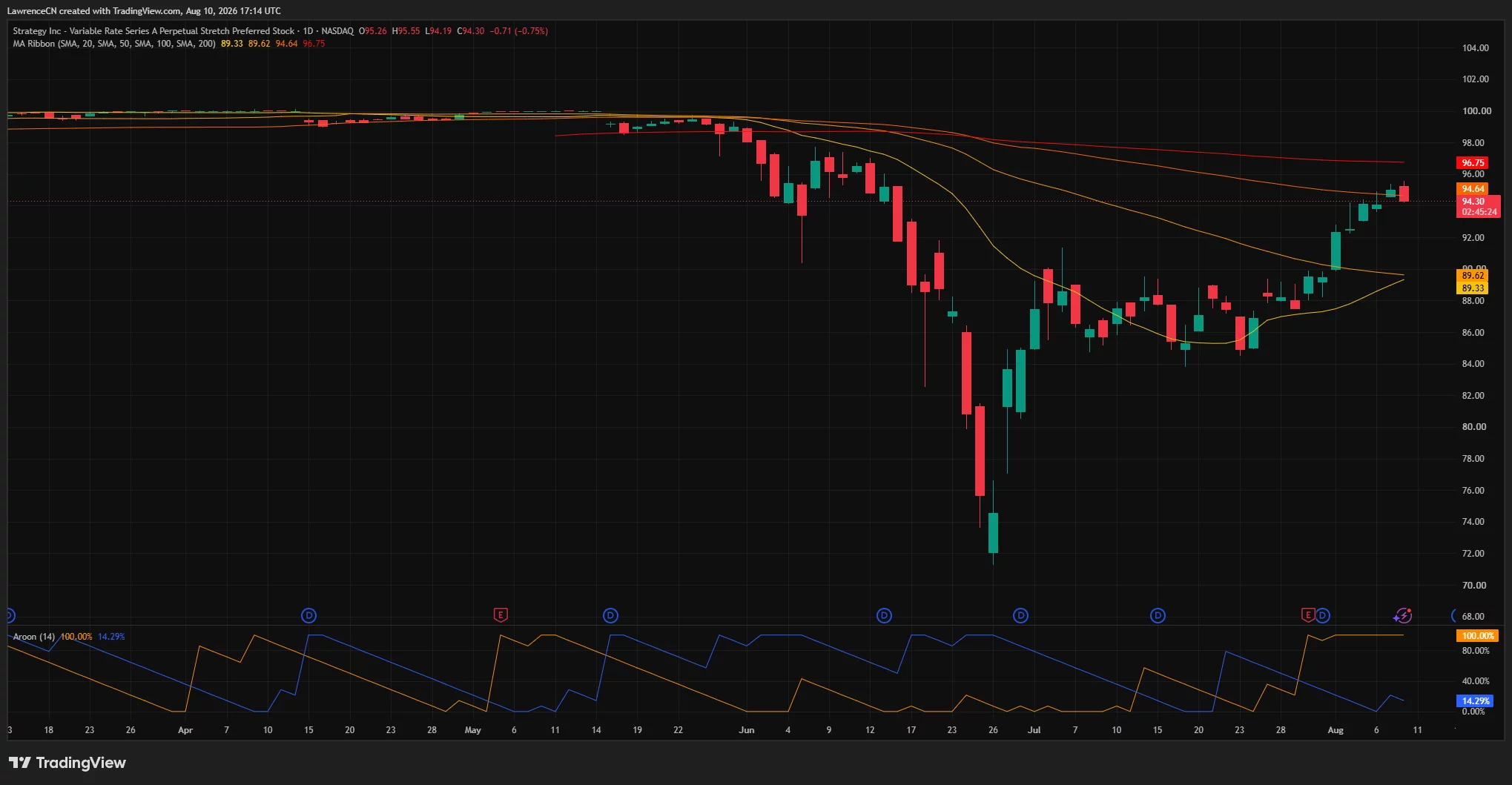
Strategy’s STRC preferred shares fell as low as roughly $72 in late June before recovering toward $95. The stock traded at $94.30 on Aug. 10, down 0.75% during the session but more than 30% above its June low.
The daily chart shows STRC facing immediate resistance near its 50-day moving average at $94.64. The 100-day average at $96.75 forms the next barrier before the security can retest its $100 stated value.
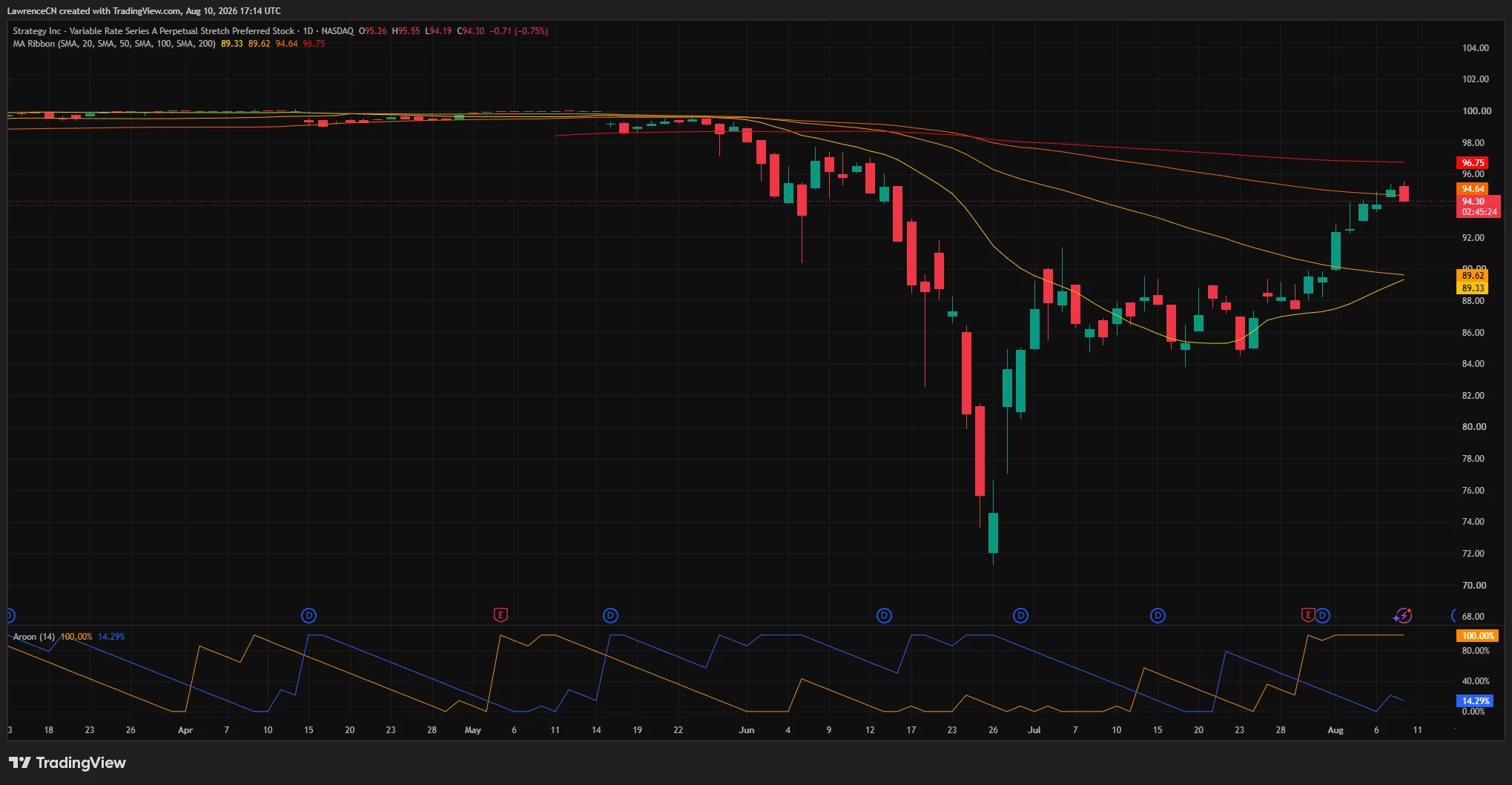
Momentum has improved, with Aroon Up reaching 100% while Aroon Down stood at 14.29%. However, a rejection below $96.75 could leave the stock vulnerable to a pullback toward its 20-day and 200-day averages around $89.33 and $89.62.
crypto.news previously reported that Strategy maintained STRC’s annual dividend rate at 12% for August. Management has said it wants the preferred stock to trade consistently near $100 before considering a lower rate.
Buying STRC below par also lets Strategy retire $100 of stated value for less than $100 while reducing the number of shares entitled to future distributions.
MSTR sales lift dollar reserve to $4.65 billion
Strategy separately sold 6,585,329 MSTR common shares through its at-the-market offering programs. These transactions produced approximately $653.1 million in net proceeds.
The company allocated $650 million to its U.S. dollar reserve and added the remaining $3.1 million to its unrestricted cash balance. Its dollar reserve consequently increased from about $4 billion to $4.65 billion.
Strategy had already built a $3.75 billion cash cushion by late July. The reserve is intended to support preferred-stock dividends and interest payments, although its board retains authority over how the funds are used.
The company also indicated that it could begin selling shares under a new $21 billion MSTR offering after exhausting the remaining capacity under its current program. Continued issuance would provide additional liquidity but increase the number of common shares outstanding.
Bitcoin weakness adds pressure to MSTR
MSTR traded below the psychological $100 level as Bitcoin struggled to establish a sustained breakout above $65,000. Strategy’s average Bitcoin acquisition price of $75,385 leaves its reserve below cost at current market levels.
The company remains the largest publicly disclosed corporate Bitcoin holder despite its recent sales. Future weekly SEC filings will show whether Strategy continues reducing its Bitcoin position to support STRC or shifts back toward accumulation as the preferred stock approaches par.
The latest sales come as Strategy marks six years since beginning its Bitcoin treasury strategy. In a Aug. 10 X post, Bitcoin Treasuries highlighted that Strategy’s holdings have grown nearly twelvefold, from 70,470 BTC in 2020 to 840,447 BTC, despite the recent weekly reductions.

Strive has grown its corporate Bitcoin treasury once again this month. The asset manager purchased 147 BTC and pushed total holdings to 20,167 BTC. The move confirms the company’s steady push to build one of the largest corporate Bitcoin reserves.
Strive Adds 147 Bitcoin to Treasury
Strive bought the 147 BTC between August 3 and August 7, according to a recent filing. The company paid an average price of about $64,812 per Bitcoin for this batch. That brings the total value of its holdings to roughly $1.3 billion.
Chief Executive Officer and Chairman Matt Cole confirmed the update on X. He stated that Strive now holds 20,167 BTC in total. BitcoinTreasuries.NET also ranked the company as the seventh-largest public corporate Bitcoin holder worldwide.
This purchase continues a pattern of steady accumulation throughout 2026. Strive bought 1,109 BTC in May and followed with 2,500 BTC in June. Smaller purchases in July and early August kept the momentum going.
Strive Reports 24% Bitcoin Yield in Q2
Strive posted a Bitcoin yield of 24% for the second quarter of 2026. The figure rose to 38% when measured across the first half of the year. The company uses this yield metric to track Bitcoin growth against diluted shares outstanding.
The asset manager also retired its debt completely during the second quarter. Strive currently holds about $155 million in cash reserves. This combination gives the company flexibility as it continues expanding its Bitcoin position.
Strive also introduced SATA, a preferred stock product that pays daily dividends. The company positions this product as part of a broader financial strategy. Bitcoin holdings, cash reserves, and debt management now work together under one plan.
On August 10, Strive launched a new Bitcoin treasury dashboard and website. The platform gives the public real-time updates on the company’s holdings. This transparency effort supports the company’s ongoing communication around its Bitcoin strategy.
Bitcoin Strategy Expands After Semler Merger
Strive’s Bitcoin treasury grew sharply after its all-stock merger with Semler Scientific. The deal closed in September 2025 and reshaped the company’s balance sheet. Bitcoin holdings jumped from about 5,000 BTC to roughly 10,900 BTC almost overnight.
Additional purchases continued steadily through 2026, including the latest 147 BTC addition. Strive has kept its focus on increasing Bitcoin holdings while running its asset management business. The strategy blends traditional financial services with a long-term Bitcoin accumulation plan.
Some tracking services estimate Strive’s average purchase price across its entire treasury at about $94,700 per BTC. The latest purchase price of roughly $64,812 sits well below that broader average. This gap suggests Strive picked up its newest Bitcoin at a comparatively favorable price.
Strive’s leadership continues to frame Bitcoin as a core treasury asset rather than a side bet. The company pairs its Bitcoin strategy with debt discipline and new financial products like SATA. Together, these moves signal a company building its identity around Bitcoin accumulation and asset management growth.


Bitmine Chairman Tom Lee believes Robinhood Chain could become one of 2026’s biggest crypto success stories by connecting the brokerage’s 27 million customers with Ethereum-based financial services.
Summary
- Lee called Robinhood Chain one of crypto’s biggest success stories of 2026 after its July 1 launch.
- Robinhood’s customer base gives the network a potential market of more than 27 million funded accounts.
- Robinhood Chain has recorded nearly $9 billion in cumulative DEX volume, although memecoins drove most early trading.
- The Ethereum Layer 2 uses ETH for transaction fees and settles activity on the Ethereum mainnet.
Tom Lee sees Robinhood Chain accelerating ETH adoption
Lee, who chairs Ethereum treasury company Bitmine and co-founded Fundstrat, said Robinhood Chain’s reach could take blockchain activity beyond crypto-native users and into mainstream financial markets.
“One of the biggest crypto success stories in 2026 is the breakaway success of the Robinhood Chain L2 mainnet on July 1, built on Arbitrum,” Lee said in a Bitmine statement.
Lee initially cited more than $1 billion in dollar-denominated trading volume shortly after the launch. He argued that the activity demonstrated demand for applications built on Ethereum infrastructure.
Robinhood Chain is an Ethereum Layer 2 developed using Arbitrum’s technology. ETH serves as its gas token, while its transactions ultimately settle on Ethereum. That structure means greater activity on the network can generate additional demand for ETH, although only a fraction of Layer 2 fees flows directly to Ethereum.
“Robinhood Chain uses ETH as the native gas token. And transaction fees are denominated in ETH, and the finality is settled on Ethereum,” Lee said. “Robinhood’s 27 million users are paying crypto fees denominated in ETH. In other words, everyday users are starting to see ETH as money.”
The 27 million figure refers to Robinhood’s wider customer base rather than the number of confirmed Robinhood Chain users. Robinhood reported 27.4 million funded customers at the end of the first quarter, up 1.7 million from one year earlier.
Lee’s argument is that Robinhood already has the distribution needed to introduce blockchain services to those customers. Actual adoption will depend on product availability, regulatory restrictions, and whether customers use the chain instead of remaining within Robinhood’s traditional brokerage interface.
Robinhood Chain records strong early activity
Network data provides some support for Lee’s positive view. crypto.news previously reported that Robinhood Chain approached $9 billion in cumulative decentralized exchange volume within three weeks of its mainnet debut.
The chain had accumulated $431 million in total value locked, close to $400 million in stablecoins and more than 250,000 daily active users, according to figures cited by FalconX. It was also processing about 6 million transactions per day.
However, the composition of that activity presents a more mixed picture. Memecoins accounted for over 80% of cumulative DEX trading volume during the network’s early weeks, while Robinhood designed the chain primarily for tokenized stocks, real-world assets and decentralized financial services.
Temporary incentives may also have contributed to the surge. Robinhood waived gas fees during the network’s first 90 days, reducing the cost of trading and potentially drawing short-term activity that may not continue once users must pay transaction fees.
Liquidity was concentrated in a limited number of applications. Morpho emerged as one of the network’s largest protocols after institutional deposits helped push locked value higher. Robinhood Earn, tokenized stocks and decentralized exchanges provided other sources of activity.
Robinhood Chain generated more than $2 million in cumulative revenue during its opening weeks, with approximately $200,000 sent to the Arbitrum ecosystem. Under the Arbitrum Expansion Program, 10% of the network’s net protocol revenue goes to Arbitrum, divided between its DAO treasury and developer funding.
Tokenized stocks could connect finance with Ethereum
Robinhood launched the network with tokenized stocks as one of its main products. Eligible users can trade blockchain-based instruments linked to publicly traded companies around the clock and use them in supported decentralized finance applications.
The company describes the network as infrastructure for bringing financial assets onchain. Along with tokenized equities, Robinhood Chain supports lending, borrowing, swaps and perpetual futures through third-party applications.
Early holder data suggests Robinhood’s distribution strategy is attracting retail participation. Its stock-token product reached approximately 328,000 holders after launching on July 1, giving Robinhood a 44% share of the tracked tokenized-equity market.
Those holdings were worth only about $44 million, producing an average position of roughly $134 per holder. The gap between the holder count and total value indicates that Robinhood’s early tokenization growth came from many small retail positions rather than a limited number of institutional accounts.
The figure also counts blockchain addresses and does not necessarily represent unique verified users. Still, the distribution differs from tokenization platforms where a small number of institutions control most of the assets.
For Ethereum, the potential benefit extends beyond transaction fees. Robinhood Chain gives users access to Ethereum-compatible wallets, smart contracts, stablecoins and lending markets. Customers who begin with a tokenized stock could later interact with other Ethereum-based assets and applications.
It should be noted that this expansion is not guaranteed. Robinhood must convert existing brokerage customers into active blockchain users, while addressing risks involving smart contracts, token liquidity, custody and regulatory compliance.
US users face limits on Robinhood Chain products
Robinhood’s US presence makes its customer base central to Lee’s adoption case, but several of the chain’s products were unavailable to American users at launch.
Robinhood introduced its Layer 2 mainnet with tokenized stocks in more than 120 countries. The company’s disclosures said the new onchain stock tokens were not offered in the United States, Canada, the United Kingdom and several other restricted markets.
The tokens provide economic exposure to underlying shares but do not grant legal ownership or beneficial rights in those shares. That difference may attract regulatory scrutiny, especially when tokenized assets cross jurisdictions or trade continuously outside conventional exchange hours.
Perpetual futures offered through Robinhood Wallet were also unavailable in the US. American retail traders face tighter restrictions on offshore-style crypto derivatives, limiting their access to one of the network’s main sources of trading activity.
US customers can still gain indirect exposure to the company’s blockchain strategy by holding Robinhood shares or using crypto products offered through its regulated domestic entities. However, the restrictions mean Robinhood cannot immediately connect its entire customer base to every feature Lee discussed.
Robinhood shares traded near $93.67 on Aug. 10, little changed during the session, while Bitmine shares fell about 2.2% to $18.40. ETH traded near $1,625.
Robinhood Chain’s early volume, active-user figures and tokenized-stock adoption show that the network has attracted attention. Its longer-term importance to Ethereum will depend on whether activity remains strong after incentives end and whether Robinhood can expand compliant access to its mainstream customer base.


Crypto projects lost roughly $110 million to hacks in July as Immunefi recorded more confirmed bug bounty reports and found that audit competitions uncovered more serious vulnerabilities than private audits.
Summary
- Crypto hacks caused approximately $110 million in losses during July.
- Immunefi paid researchers $2.32 million for confirmed vulnerabilities during the month.
- Audit competitions found 6.2 serious bugs per engagement, compared with 1.5 in private audits.
- Immunefi projects 114 major hacks in 2026, potentially surpassing the previous annual record.
Crypto hacks put 2026 on course for a record
Immunefi recorded 164 crypto hacks through Aug. 3, including 67 incidents that each caused more than $1 million in losses, according to data published by the security platform.
The company projects that the number of hacks exceeding $1 million could reach 114 by the end of 2026. That would surpass the previous annual record of 72 major incidents set in 2024. Only 49 such incidents had been recorded by the same point that year.
July’s estimated $110 million total added to an already costly year for the industry. A recent Blockaid report found that crypto security losses reached $1.1 billion during the first six months of 2026.
Several large attacks contributed to the July total. Ostium lost 23.75 million USDC after an attacker compromised its off-chain infrastructure and manipulated price data used by the protocol.
AFX suffered a separate $24.15 million bridge exploit during the month. Together, the two incidents accounted for more than $47 million in losses.
Bug bounty reports and payouts increased
Immunefi said its researchers received $2.32 million for confirmed vulnerabilities in July. The number of reports that were both confirmed and paid rose 18% from the previous month.
Its bug bounty programs prevented 374 threats, up from 317 in June and 339 in May. Cumulative payments to security researchers reached $143.1 million, compared with $140.8 million at the end of June.
The rise comes as artificial intelligence tools make it easier for researchers to scan code and prepare vulnerability reports. crypto.news previously reported that AI had driven a sharp increase in bug bounty submissions, although project teams also faced more low-quality reports and false positives.
Institutional interest in preventive security has also grown. Anchorage Digital invested in Immunefi earlier this year as part of a strategic push into on-chain security infrastructure.
Audit competitions found more serious flaws
Immunefi reviewed 1,178 audits conducted by tier-1 security firms and found a median of zero critical or high-severity vulnerabilities. However, the company’s comparison with 58 competitive audits produced a different result.
Audit competitions identified an average of 6.2 serious vulnerabilities per engagement, compared with 1.5 in private tier-1 audits, Immunefi said. Competitive reviews involve multiple independent researchers examining the same code and receiving rewards based on the vulnerabilities they find.
The average cost of identifying a critical flaw through an audit competition was $6,548. It compared with about $66,000 through a private tier-1 audit and an estimated $24.5 million when an attacker discovered the vulnerability first.
Recent incidents have shown that completed security reviews do not guarantee that code is free from exploitable flaws. A crypto.news investigation into the Coldcard breach found that an AI-assisted audit identified another 85 critical bugs across Bitcoin-related projects after a firmware weakness exposed wallet users.
Immunefi’s findings suggest that projects may need continuous bug bounty programs and competitive reviews alongside conventional audits. With 2026 already approaching the record for major incidents, the cost gap between preventive research and live exploitation remains substantial.
How to watch the “X-Men” movies in chronological order

AEW’s Andrade El Idolo posts injury update after MJF attack at Grand Slam Mexico

Meta's 'Open' Muse Glimmer Model Can Run On a Single Computer


-

 Fashion3 days ago
Weekend Open Thread: Mattifying Sunscreen
-

 Fashion3 days ago
Frugal Friday’s Workwear Report: Cap-Sleeve Pointelle Crewneck Sweater
-

 Sports5 days ago
Jordan Coyle & Cordiamo take Laya Arena Stakes at RDS
-

 News Videos2 days ago
Can Astrology Help Find Gold and Silver Trends? A Financial Astrology Guide
-
 Business5 days ago
US stocks: Dow closes at record on Mideast optimism; SpaceX, AMD drag Nasdaq
-
 Crypto World7 days ago
US Tech Stocks See Largest 5-Week Inflow in History: Can Nasdaq Break Its Downtrend?
-

 Politics4 days ago
Reform UK And Greens Sink To Lowest Favourability Ratings To Date
-

 Business6 days ago
Nvidia Stock Climbs 2.5% as Chip Sector Rally Builds Ahead of AMD Earnings, Nvidia’s Own Report Looms
-

 Crypto World6 days ago
Polymarket targets $20 billion valuation as competition heats up in prediction market sector
-

 Tech6 days ago
OpenAI, Anthropic AI agents targeted real people and systems in cyber tests
-

 Business5 days ago
Supply chain issues impact Ingredion
-
 Crypto World6 days ago
CLARITY Act Senate Vote Locked In, But 60-Vote Hurdle Looms Large
-

 Tech3 days ago
Rinn Pharma & Biopharma to join NordicPharmaTrain network
-

 Business2 days ago
How to Start a Cleaning Business: A Step-by-Step Guide
-

 Crypto World7 days ago
The Senate has one week: CLARITY’s last August window
-
 Crypto World6 days ago
Dow and S&P 500 Hit Records on AI Earnings: When Will the Bubble Burst?
-

 Business1 day ago
Datadog: Best Of Breed For Multiple Reasons
-

 Business7 days ago
CNH Industrial Shares Jump Over 15% After Beating Estimates and Raising Full-Year Earnings Guidance
-

 Business2 days ago
BDC Weekly Review: Private BDC Q2 Numbers Are Strong
-
 Crypto World6 days ago
Dollar Index Trapped at 100 as Hawkish Fed Meets Official Selling
You must be logged in to post a comment Login