Fundstrat co-founder Tom Lee says Ethereum (ETH) is becoming the settlement layer for Wall Street and artificial intelligence (AI). He repeated the claim as ETH held up better than most major cryptocurrencies over the past week.
Lee, who chairs BitMine Immersion Technologies (BMNR), made the comment in a reply on X. A trader had asked why Ethereum was outperforming nearly every other top ten coin during a broader crypto pullback.
The Wall Street and AI Thesis
Asked directly why Ethereum was holding its ground, Lee pointed to the network’s emerging role as financial plumbing.
“$ETH is the future settlement rails for Wall Street and AI.”
— Thomas (Tom) Lee (not drummer) FundstratDirect.com (@fundstrat) September 11, 2026
The reply echoes arguments from Lee’s bullish crypto outlook for the next 12 months. He ties Ethereum’s case to two forces, Wall Street’s tokenization of traditional assets and the rise of agentic AI. Agentic AI refers to autonomous software that can transact without human input.
Lee has also framed the recent ETH/BTC ratio breakout as evidence the market is pricing in that shift. BitMine has backed the thesis with purchases, pushing toward a 5% ether stake. The position still sits underwater on a cost basis.
Whether this reflects Lee’s thesis taking hold, or just short-term positioning, remains unclear. The answer may come clearer if Ethereum’s outperformance extends as other coins dip.
Advertisement
Ether Holds Up While Rivals Slip
Ether was among the few top-ten assets to trade higher over the past seven days. Tron (TRX) was the only other gainer, with stablecoins excluded. Bitcoin (BTC), BNB, XRP, Solana (SOL), Zcash (ZEC), and Hyperliquid (HYPE) all posted weekly losses, several exceeding 3%.
Ether changed hands around $2,518 on Monday, down roughly 0.1% over 24 hours. Bitcoin traded near $77,100, off more than 1.5% for the day.
US Senate Republicans released revised text of the CLARITY Act ahead of a Tuesday procedural vote that will determine whether the bill can move toward floor consideration. The updated proposal, described by its sponsors as a “final offer” following months of negotiations, spans 635 pages and includes notable changes to how federal ethics rules would apply to public officials and their digital-asset holdings.
The revised bill text also adjusts related frameworks, including the Blockchain Regulatory Certainty Act (BRCA) and provisions addressing stablecoin “yield” mechanics. Senate Banking Digital Assets Subcommittee Chair Cynthia Lummis released the draft with Senate Banking Chairs John Boozman and Tim Scott, and said the ethics provisions were agreed to by President Donald Trump.
Key takeaways
The final CLARITY Act draft strengthens ethics restrictions around federal officials’ significant digital-asset interests, with potential civil penalties for violations.
State attorneys general would gain enforcement authority tied to prohibitions on officials issuing, sponsoring, or holding significant interests, plus on exchanges listing assets in violation of those rules.
Stablecoin reward restrictions would be tied to deposit-loss findings involving community banks, with an 18-month sunset for that authority.
The revised BRCA expands protections beyond prior scope by extending treatment exemptions to miners and validators, while removing references to an unlicensed money transmitter provision.
Tuesday procedural vote sets the pace
Senate Republicans plan to test the CLARITY Act in a procedural vote Tuesday at 2:15pm ET. The vote is designed to establish whether the measure can advance toward potential floor debate. A Republican aide characterized the revised text as a final offer aimed at winning broader Democratic support, signaling that the party expects this version to carry the negotiations over the finish line.
Lummis said the bill’s final text reflects a year of intense, bipartisan work and that 126 changes were made at Democrats’ request. She framed the revisions as ready for Senate consideration, emphasizing the ethics package as a major bargaining point. In her remarks, Lummis said President Trump “voluntarily agreed” to what she described as sweeping ethics restrictions affecting federally elected officials, judges, and their spouses.
Ethics provisions broaden enforcement and add clearer divestment rules
The most prominent changes involve the ethics framework. The revised ethics rules would allow state attorneys general to enforce prohibitions on covered federal officials who issue, sponsor, or hold significant financial interests in digital assets. The draft would also authorize state-level enforcement actions related to exchanges that list assets in violation of those prohibitions.
Advertisement
Covered individuals would be required to divest significant financial interests or place them into a qualified blind trust. The bill specifies penalties for violations: $500,000 or 20% of the amount received in the prohibited transaction, whichever is greater.
According to the revised text, the ethics provisions would generally take effect 360 days after enactment. The bill also allows for earlier implementation if implementing regulations are finalized sooner, which could accelerate compliance obligations for relevant officials and market actors tied to the rules.
The breadth of enforcement—particularly the involvement of state attorneys general and the link to exchange listing behavior—could raise practical questions for exchanges and compliance teams if the measure becomes law. Traders may also watch how regulators define “significant” interests and the operational steps required for public officials and their spouses.
The sponsors’ announcement ties the ethics package to negotiated language they say was agreed at the White House level.
Advertisement
Stablecoin yield restrictions hinge on deposit-loss findings
On stablecoins, the revised bill would require the Treasury Secretary to introduce rules aimed at restricting rewards if Treasury determines that community banks are losing deposits on a substantial scale. The authority would not last indefinitely: it would expire 18 months after the bill becomes law.
This structure suggests Congress is attempting to address potential stablecoin “yield” incentives that could affect bank deposits—while limiting how long the special regulatory lever remains available. The key uncertainty for market participants will be what Treasury considers a “substantial” deposit loss and how Treasury will measure it in practice.
BRCA updates expand exemptions and adjust references
The revised BRCA retains protections aimed at preventing digital-asset developers from being treated as money transmitters or financial institutions under the Bank Secrecy Act. The revision also extends the protections to miners and validators, which were previously excluded.
In addition to expanding who receives the BRCA-style safeguards, the revised text would remove references to Section 1960 of Title 18 of the US Code, which concerns prohibitions on unlicensed money transmitting businesses.
Advertisement
Other revisions in the updated draft would strengthen safeguards around affiliate trading and conflicts of interest at digital commodity exchanges, brokers, and dealers. The bill also clarifies how consumer protection laws apply, signaling an effort to reduce ambiguity around enforcement and market conduct expectations.
These adjustments may matter for builders and network participants because they attempt to narrow the circumstances under which certain parties could face money-transmitter or financial-institution frameworks. Extending protections to miners and validators could reduce regulatory uncertainty for parts of network infrastructure that are often overlooked in traditional compliance debates.
Market odds reflect renewed attention, but the vote is still pending
While the procedural vote has not yet occurred, market-style betting odds have shifted. Polymarket odds for the CLARITY Act passing this year reached 35% on Monday, according to the Polymarket event page, and were described as the highest since late July.
Still, odds trading is not a substitute for Senate arithmetic. What matters most for investors and developers is whether Tuesday’s procedural step clears and whether the Senate can coalesce around the revised ethics and regulatory provisions without further changes.
Advertisement
All eyes will be on the exact mechanics of enforcement—especially how “significant” holdings are defined, how blind trusts are handled, and what Treasury ultimately uses as the threshold for stablecoin reward restrictions. Even with a “final offer” framing, the outcome of the procedural vote will determine how soon stakeholders can plan around a clearer regulatory pathway.
Risk & affiliate notice: Crypto assets are volatile and capital is at risk. This article may contain affiliate links. Read full disclosure
The gathering comes days after Dario Amodei and Sam Altman called for greater restraint at the AI frontier, warning that rapidly improving systems could pose increasingly difficult-to-control risks.
Robinhood CEO Vlad Tenev said issuers should be involved if tokenized products change shareholder rights or company obligations, but not when they create separate instruments backed by shares.
House tax writers have reportedly scheduled a Sept. 16 review of two bills that could change how U.S. miners, stakers and traders calculate federal taxes.
Summary
House tax writers reportedly plan to review two digital-asset bills during a September 16 markup.
H.R. 9175 offers qualifying miners and stakers an election to defer income until token disposal.
H.R. 9172 would extend wash-sale and constructive-sale restrictions to covered digital assets and related contracts.
Qualified dollar stablecoins and certain validation-related acquisitions receive targeted exceptions under the introduced anti-abuse bill.
Official committee records had not listed the reported September markup publicly as of Monday morning.
The House Ways and Means Committee plans to consider H.R. 9175 and H.R. 9172 on Wednesday. The committee’s public calendar had not posted a markup notice as of Sept. 14, leaving the meeting time and final bill list unconfirmed in official records.
The introduced bills address separate parts of the tax code. H.R. 9175 would create an optional income-deferral system for qualifying mining and staking rewards. H.R. 9172 would apply existing wash-sale and constructive-sale restrictions to covered digital assets.
Advertisement
A committee markup would allow lawmakers to debate, amend and vote on the legislation. Reports that Republicans may remove the mining deferral or limit it to five years have not been confirmed through a published committee amendment or substitute text.
The U.S. House Ways and Means Committee plans to review two crypto tax bills on Sept. 16.
The Mining and Staking Tax Clarity Act would defer taxes on newly generated tokens until disposal, while treating the income as ordinary income. Republicans are reportedly considering… pic.twitter.com/nOeoYRuT1R
Reported crypto tax markup remains off the calendar
Representatives Mike Carey and Jodey Arrington introduced the two bills on June 8. The Congressional Record confirms that both measures were referred to the Ways and Means Committee.
One day later, the committee held a legislative hearing covering those proposals and several other digital-asset tax measures. Witnesses included representatives from Fidelity, Coinbase and Coin Center, along with an NYU Tax Law Center official.
Committee Chairman Jason Smith presented the package as an attempt to give taxpayers clearer rules for digital assets. His statement argued that the existing framework had not kept pace with new financial technology. Such comments represent the committee majority’s policy position.
No official Sept. 16 notice appeared on the committee’s full committee page by Monday morning. Without a notice, the publicly available record does not confirm which measures will receive votes or what amendments members may offer.
Advertisement
The lack of a posted notice does not prove that the meeting will be canceled. It means the reported schedule remains provisional until the committee releases an agenda or another official announcement.
Under the bill’s default rule, a taxpayer would include the token’s fair market value in ordinary income when acquiring it through mining, staking or another qualifying validation process. The recognized amount would become the taxpayer’s basis in the asset.
Eligible taxpayers could elect to postpone recognition for qualifying tokens received during the elected tax year. The election would continue in later years unless the taxpayer obtained Treasury approval to revoke it.
Advertisement
When an elected token was sold or otherwise disposed of, the taxpayer would recognize the deferred gain. The bill classifies that gain as arising from property that is not a capital asset, producing ordinary tax treatment under the proposed language. Certain acquisition costs would be capitalized while the election remained effective.
Current IRS guidance generally treats mining and staking rewards as ordinary income when taxpayers gain control of them. As crypto.news explained in its guide to IRS crypto tax rules in 2026, later disposals can generate a separate capital gain or loss based on the asset’s changed value.
H.R. 9175 would not make every token or taxpayer eligible. The introduced text contains restrictions involving controlled foreign corporations, passive foreign investment companies and several foreign ownership structures. It contains sourcing rules based partly on a taxpayer’s residence when the asset is acquired or disposed of.
Reports indicate that Republican lawmakers have discussed removing the deferral election or allowing it for only five years. Neither option appears in the introduced text, and no official amendment confirming either change had been published as of Sept. 14.
Advertisement
The nonpartisan Joint Committee on Taxation estimated that the introduced bill would reduce federal revenue by $2.956 billion between fiscal years 2026 and 2036.
Wash-sale bill targets rapid crypto repurchases
The Applying Existing Tax Anti-Abuse Rules to Digital Assets Act, H.R. 9172, would expand two rules currently associated mainly with stocks and securities. Section 1091 of the tax code generally disallows an immediate loss deduction when a taxpayer sells stock or securities and acquires substantially identical property within 30 days before or after the sale. The disallowed loss normally adjusts the basis of the replacement property instead of disappearing permanently.
H.R. 9172 would replace references to “stock or securities” with a new category of “specified assets.” Covered property would include most digital assets and certain contracts or options connected to them. Tokenized or wrapped products could qualify as substantially identical to economically equivalent underlying assets. The Treasury Department would receive regulatory authority covering contracts and other arrangements linked to specified assets.
Qualified U.S. dollar-denominated stablecoins would be excluded if they met the bill’s statutory requirements. The definition relies on permitted payment stablecoin issuers recognized under federal law. A dollar stablecoin may not qualify for the exclusion when the taxpayer uses another functional currency.
Advertisement
Certain tokens received through mining, staking or comparable validation activity receive a narrower exception. The introduced language addresses particular acquisitions within the wash-sale calculation; it does not remove all mined or staked tokens from every part of the bill.
The measure would separately extend constructive-sale rules under Section 1259 to digital assets. Existing constructive-sale rules can require recognition when transactions offset an appreciated position so completely that the taxpayer has effectively removed the economic exposure without formally selling the asset.
The Joint Committee on Taxation estimated that H.R. 9172 would raise $2.074 billion over fiscal years 2026 through 2036. Earlier Treasury estimates cited for digital-asset wash-sale legislation covered different proposals and should not be treated as the official score for H.R. 9172.
Advertisement
Committee passage would begin another legislative stage
If the reported markup proceeds, committee members could approve the introduced bills, reject them or replace portions through amendments. The five-year mining deferral mentioned in press reports would require a formal amendment before becoming part of the legislation.
A favorable committee vote would permit the measures to be reported to the full House. Approval would not guarantee floor consideration because House leaders control the schedule, and no floor date has been announced. Any bill passed by the House would then require Senate approval. Differences between House and Senate versions would need to be resolved before identical legislation could reach the president.
The committee could combine the measures with other tax legislation during markup or at a later stage. Congress often moves tax provisions through larger packages, but no official document currently shows that either crypto proposal will be attached to another bill.
However, Until new committee text appears, the June versions remain the only verified legislative language. The committee had not published a chairman’s amendment, substitute text, meeting time or voting agenda for the reported Sept. 16 markup as of Sept. 14.
Although there are several major economic events taking place in the following five business days, the reality is that only a handful of them could (and most likely will) impact the cryptocurrency market. That impact, though, is expected to be quite vicious in either direction.
The Kobeissi Letter highlighted an auction of 20-year securities, August retail sales, and, most importantly, the Federal Reserve’s September interest rate decision on Wednesday. The latest data shows that markets assign an 85%-90% probability that the central bank will hike rates by 25 basis points, following contrasting economic data.
Fed in Focus
The Fed setup has changed dramatically in just a few weeks, starting with the August employment data from early September, which showed that the US economy had added 162,000 jobs last month, triple expectations. Later on, the PPI numbers indicated that the annual producer inflation had accelerated to 5.4%. Last Friday’s CPI report subsequently confirmed headline inflation at 3.4%, with monthly core CPI slightly hotter than expected.
This combination, plus the fact that oil prices remain above $100 and diesel hit a new record in the States, has strengthened the Fed’s case for tighter policy.
Advertisement
Bitcoin and the altcoins have already demonstrated their sensitivity to this shift, dropping sharply following Fed Chair Kevin Warsh’s speech from Jackson Hole several weeks ago, and again as rate-hike odds increase after the latest economic data.
The only question is whether this highly expected rate hike has been priced in, with BTC sliding from $82,400 to under $78,000 as of now. As such, investors will closely watch Warsh’s press conference after the meeting for clues as to whether the Fed’s decision on Wednesday is a one-off adjustment or the start of another tightening cycle.
The Tuesday Test
Before all eyes turn on the Fed on Wednesday, the crypto industry has another major event on Tuesday. The Senate’s cloture vote on the CLARITY Act is scheduled for 2:15 P.M. that day, and it requires 60 senators to advance the debate on the key bill.
The CLARITY Act aims to establish a comprehensive US crypto market structure and shed further details on the respective roles of the SEC and the CFTC.
Advertisement
Republicans released an updated text last week, adding new rules for non-decentralized DeFi protocols and clarifying how credit unions can deal in crypto. Moreover, they published their “last, best, and final” draft of the legislation on Sunday, including an ethics proposal backed by the POTUS.
President Donald Trump said on Sunday that the United States should pay the world’s lowest interest rates, no matter the data, days before the Federal Reserve’s Wednesday meeting.
Fresh Consumer Price Index figures posted their largest increase in four months. That has pushed traders to raise their bets on a rate hike this week.
Hike Odds Climb as Trump Pushes the Other Way
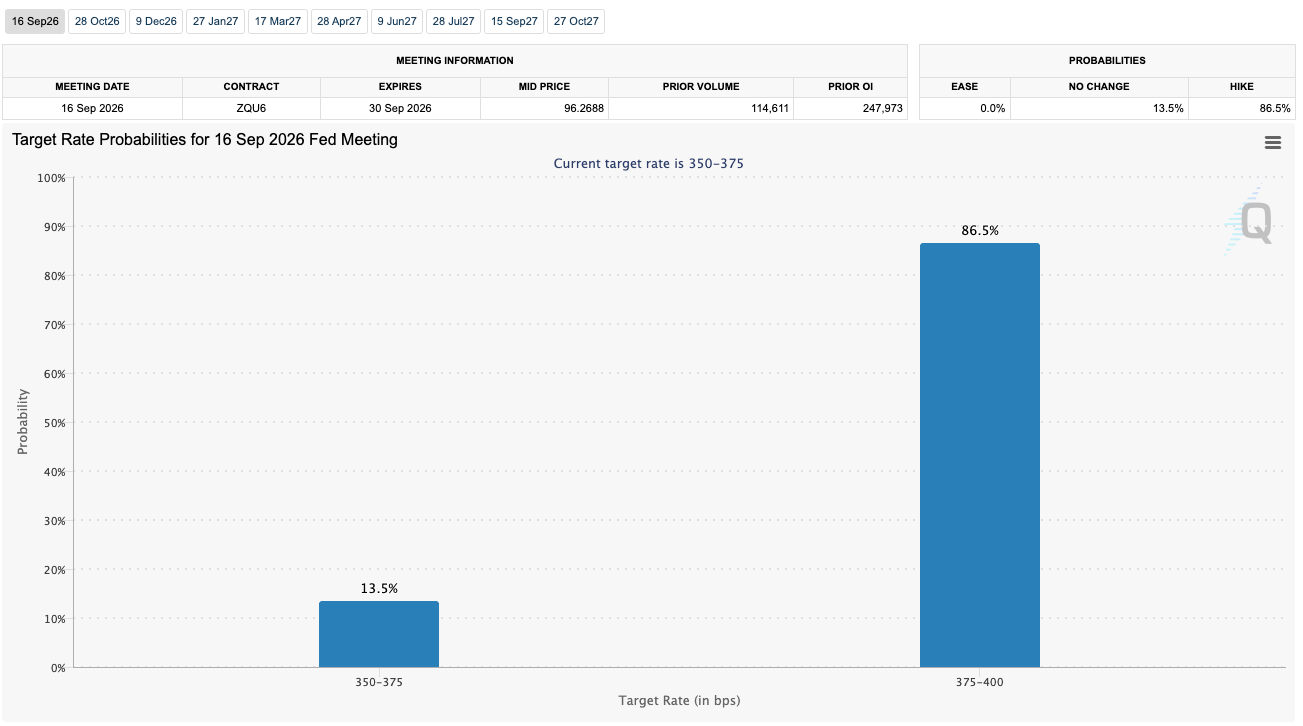
Markets now assign roughly an 86% probability that the Fed lifts its benchmark rate from 3.5% to 3.75%. That would mark the first increase in three years.
Odds have climbed as the next meeting looms. Image Source: CME
Inflation has also been fueled by tariffs and rising energy costs tied to the war in Iran.
Trump made the remarks at the Irish Open golf tournament in Ireland. He spoke even as his own pick for Fed chair, Kevin Warsh, faces mounting pressure to tighten policy.
Advertisement
“I know more about formulas than anybody, and with the best credit in the world, we make other countries rich.”
Two weeks ago, Trump escalated his pressure campaign in public, threatening to halt trade with deficit countries unless rates come down.
Midterms Add Political Weight to the Decision
The Fed’s meeting lands weeks before midterm elections that could decide control of Congress. A hike risks deepening voter frustration over affordability.
National Economic Council Director Kevin Hassett said Trump would defend Warsh’s independence regardless of the outcome. He added Trump would not be pleased if rates rise anyway.
Advertisement
Whether the Fed hikes Wednesday may depend less on Trump’s demands than on Warsh’s political room to maneuver.
US Senate Republicans have released revised text of the CLARITY Act, aiming to win Democratic support ahead of a procedural vote scheduled for Tuesday at 2:15pm ET. The updated 635-page proposal, led by Senate Banking Digital Assets Subcommittee Chair Cynthia Lummis along with Chairs John Boozman and Tim Scott, makes notable changes to ethics rules for federal officials and expands related provisions touching stablecoin rules and the Blockchain Regulatory Certainty Act (BRCA).
The bill’s timing is close: the procedural vote is intended to determine whether the Senate can move the measure toward floor consideration. Republican aides have characterized Sunday’s release as a “final offer” to Democrats, signaling a last round of adjustments before lawmakers decide whether the text can advance.
Key takeaways
The revised CLARITY Act includes new ethics provisions that would restrict federal officials and their spouses from holding or engaging in certain significant digital-asset financial interests.
State attorneys general would gain enforcement authority for those ethics-related restrictions, including rules against exchanges listing assets that violate the bans.
Civil penalties in the ethics framework could reach $500,000 or 20% of the amount received in a prohibited transaction, whichever is greater.
The updated BRCA would extend “safe harbor” style protections beyond prior exclusions to cover miners and validators, while removing references tied to unlicensed money-transmitting offenses.
Stablecoin-related provisions would require Treasury to introduce restrictions on certain rewards if community banks are losing deposits at a substantial scale, with that authority set to expire 18 months after enactment.
Ethics provisions become the centerpiece of the final text
In explaining the revised draft, Lummis said the current language reflects a year of bipartisan negotiations and includes 126 changes made at the request of Democrats. Her statement also asserted that the ethics changes had been agreed to by President Donald Trump.
According to Lummis, the revised ethics rules are designed to address government participation in the digital-asset sector. Under the new framework, state attorneys general would be able to enforce prohibitions on covered federal officials—along with their spouses—issuing, sponsoring, or holding significant financial interests in digital assets, along with related restrictions connected to exchanges listing assets that would be in conflict with those bans.
The text also requires covered individuals to either divest significant financial interests or place them into a “qualified blind trust.” Penalties for violations are set at either $500,000 or 20% of the amount received in the prohibited transaction, whichever is greater. The ethics provisions are scheduled to take effect 360 days after enactment, though they could begin earlier if implementing regulations are finalized.
Advertisement
The procedural vote timing suggests the ethics overhaul is intended to reduce political friction around the bill’s advancement. If the Senate permits the measure to move forward, this would mark a shift from earlier drafts toward a tighter government-conflict approach that may be central to how Democrats evaluate the bill on the merits and on governance concerns.
The revised proposal also revisits stablecoin oversight. Lummis said the Treasury Secretary would be required to develop rules limiting rewards, if Treasury determines that community banks are losing deposits on a substantial scale.
Importantly for industry participants, this authority would not be permanent. The power to impose those restrictions would expire 18 months after the bill becomes law, meaning any yield-related stablecoin restrictions would be time-bound unless Congress acts again or the rulemaking process produces continuing effects under other legal authorities.
For stablecoin issuers, exchanges, and other intermediaries, the key practical question will be how Treasury defines “substantial” deposit loss and what enforcement mechanism accompanies any reward limits. The bill text’s narrow trigger suggests targeted intervention rather than a broad, immediate crackdown, but the short expiration window may still concentrate risk and uncertainty into a relatively limited regulatory period.
Advertisement
BRCA revisions broaden protections for infrastructure actors
Beyond ethics and stablecoin provisions, the Senate’s updated CLARITY Act text modifies the BRCA. Lummis indicated the revised BRCA would keep protections intended to prevent developers from being treated as money transmitters or financial institutions under the Bank Secrecy Act.
In a change from earlier versions, the revised BRCA would extend those protections to miners and validators—groups previously excluded. That expansion matters because it shifts how certain participants in blockchain infrastructure might be evaluated under US anti-money-laundering and related compliance frameworks. While the precise boundaries of any safe harbor will depend on the final statutory language and follow-on rulemaking, the explicit inclusion of miners and validators is a significant narrowing of the government’s ability to characterize them as regulated financial intermediaries.
The updated BRCA would also remove references to Section 1960 of Title 18 of the US Code, which addresses prohibitions on unlicensed money transmitting businesses. Removing those references could affect how existing criminal and compliance interpretations are applied alongside the new regulatory structure described by the bill.
In addition, the revised proposal is described as including other changes aimed at conflict-of-interest and trading safeguards at digital commodity exchanges, brokers, and dealers, along with clarifying how consumer protection laws apply in the digital-asset context.
Advertisement
What happens next for the Senate
With Tuesday’s procedural vote approaching, the revised CLARITY Act text becomes the immediate focus for lawmakers assessing whether the Senate can move toward broader consideration. The most closely watched elements likely remain the ethics enforcement model—particularly the role of state attorneys general and the scope of the divestiture or blind trust requirement—as well as the BRCA’s expanded coverage for miners and validators and the time-limited stablecoin reward restrictions tied to Treasury’s community bank deposit findings.
Risk & affiliate notice: Crypto assets are volatile and capital is at risk. This article may contain affiliate links. Read full disclosure
The yen’s four-week climb collides with the Federal Reserve’s Wednesday rate decision. The size of the Fed’s move could decide whether Tokyo’s currency gains hold or reverse.
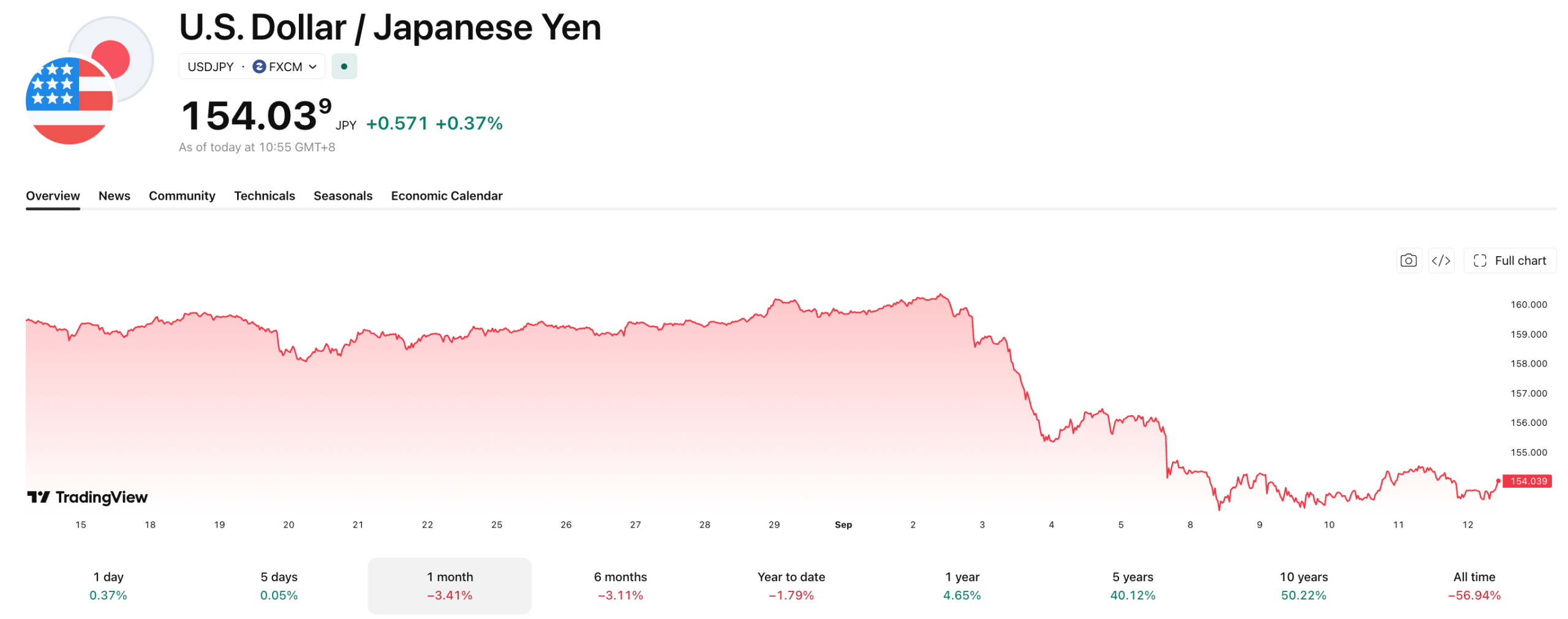
The yen traded at 153.49 per dollar on Monday, just off the 152.89 seven-month high reached last week. Speculators turned net-long on the yen for the first time since February, marking a shift in positioning.
Why the Fed Comes First
Consumer prices in the U.S. accelerated in August, based on data released Friday. Traders now price Fed rate hike odds at 86% for Wednesday. That figure comes from the CME FedWatch tool, which estimates odds using futures pricing.
The Bank of Japan meets two days later, on Friday. MUFG analysts said a quarter-point hike is already largely priced into markets. However, the bank said the yen needs a signal of faster future hikes to strengthen further.
Advertisement
The Yen has held onto its gains made since the unprecedented US intervention. Image Source: Trading View
A different risk applies if the BOJ leaves further hikes off the table for October and December. TD Securities therefore said that scenario could send dollar/yen back toward the 157 to 160 zone.
The Stakes Reach Beyond Tokyo
Hedge funds have already adjusted carry trade positioning as the yen’s moves ripple beyond Tokyo.
The pressure extends beyond Tokyo as well. The U.S. dollar index held steady at 99.15 after two weeks of declines. Meanwhile, the European Central Bank raised rates last week, and the Bank of England is expected to hold Thursday. Yet that vote looks close.
“Not hiking would be a catastrophic error. Not communicating robustly will be a significant own goal.”
Athey also pointed to repatriation flows and asset allocation shifts at GPIF, Japan’s giant public pension fund. Those forces are already pulling money back into the yen, separate from the rate decisions this week.
Advertisement
This month’s yen advance has almost reached 4%, adding to the pressure on Tokyo. Still, the bigger signal may come from Tokyo rather than Washington. Whether those gains hold depends less on the Fed’s Wednesday move than on the BOJ’s signal two days later.
Senate Republicans on Sunday released revised text of the CLARITY Act aimed at swaying Democrats ahead of a procedural vote on Tuesday, featuring major changes to rules relating to government officials’ involvement with digital assets.
The 635-page proposal, released by US Senate Banking Digital Assets Subcommittee Chair Cynthia Lummis alongside Chairmen John Boozman and Tim Scott, also includes changes to the Blockchain Regulatory Certainty Act (BRCA) and provisions governing stablecoin yield. Lummis said the new ethics provisions had been agreed to by US President Donald Trump.
“After a year of intense daily bipartisan negotiations, this bill is ready,” she said. “President Trump voluntarily agreed to unprecedented ethics restrictions, holding every federally elected official, judge, and their spouses to some of the toughest ethics restrictions in US history.”
The new bill text comes just two days before a procedural vote on the CLARITY Act on Tuesday at 2:15pm ET, which will determine whether the Senate can advance the bill toward floor consideration. The proposal has been described as a final offer on the bill, a Republican aide told reporters on Sunday.
Advertisement
Key changes in final CLARITY Act text
Lummis said the final bill text reflects a year of bipartisan negotiations and 126 changes made at the request of Democrats.
The revised ethics rules would allow state attorneys general to enforce bans on federal officials issuing, sponsoring or holding significant financial interests in digital assets, and on exchanges listing assets in violation of those bans.
Covered individuals would also be required to divest significant financial interests or place them in a qualified blind trust. Violations would carry civil penalties of $500,000 or 20% of the amount received in the prohibited transaction, whichever is greater, with the ethics provisions taking effect 360 days after enactment, or sooner if implementing regulations are finalized.
On stablecoins, the Treasury Secretary would be required to introduce rules restricting rewards if they determine that community banks are losing deposits on a substantial scale, though the authority would expire 18 months after the bill becomes law.
Meanwhile, the revised BRCA would retain protections against treating developers as money transmitters or financial institutions under the Bank Secrecy Act and extend the protections to miners and validators, which were previously excluded.
It would also remove references to Section 1960 of Title 18 of the US Code, which relates to the prohibition of unlicensed money transmitting businesses.
Other changes would strengthen safeguards around affiliate trading and conflicts of interest at digital commodity exchanges, brokers and dealers, and clarify how consumer protection laws apply.
Join Our Telegram channel to stay up to date on breaking news coverage
The Commodity Futures Trading Commission has opened at least three previously unreported investigations into suspected insider trading on Polymarket, according to a WIRED report.
Chairman Michael Selig approved the first investigation in early May, targeting pardon-related markets. It followed an NPR report that a trader earned more than $300,000 after correctly predicting several preemptive pardons. A second investigation, approved at the end of May, covers Iran-related contracts. That one followed a 60 Minutes report on accounts that reportedly earned $2.4 million with a 98% win rate.
In July, the CFTC approved a third investigation into suspected insider trading involving Google’s 2025 Year in Search ranking. An agency official said that probe would examine additional individuals and that the Southern District of New York is running a parallel investigation. CFTC enforcement officials said the Google matter is separate from an existing case against former Google engineer Michele Spagnuolo, who allegedly made more than $1.2 million trading Polymarket contracts on confidential information about the rankings.
Advertisement
Probes land on a young US operation
Polymarket, a prediction market where users trade event contracts on real-world outcomes, only relaunched in the United States in late 2025. The relaunch followed its acquisition of QCEX and put its event contracts under CFTC oversight. The new investigations test that arrangement before it is a year old.
Previously, the Justice Department and the CFTC examined whether Polymarket circumvented restrictions on US traders imposed under a 2022 settlement, a probe that ended in July. Polymarket itself is not reported to face exposure in the new insider-trading probes, and no outcome in any of the three has been announced.
Join Our Telegram channel to stay up to date on breaking news coverage

























































You must be logged in to post a comment Login