
Crypto World
US Republicans’ ‘final’ CLARITY Act offer to Democrats ahead of key vote


US Senate Republicans released revised text of the CLARITY Act ahead of a Tuesday procedural vote that will determine whether the bill can move toward floor consideration. The updated proposal, described by its sponsors as a “final offer” following months of negotiations, spans 635 pages and includes notable changes to how federal ethics rules would apply to public officials and their digital-asset holdings.
The revised bill text also adjusts related frameworks, including the Blockchain Regulatory Certainty Act (BRCA) and provisions addressing stablecoin “yield” mechanics. Senate Banking Digital Assets Subcommittee Chair Cynthia Lummis released the draft with Senate Banking Chairs John Boozman and Tim Scott, and said the ethics provisions were agreed to by President Donald Trump.
Key takeaways
- The final CLARITY Act draft strengthens ethics restrictions around federal officials’ significant digital-asset interests, with potential civil penalties for violations.
- State attorneys general would gain enforcement authority tied to prohibitions on officials issuing, sponsoring, or holding significant interests, plus on exchanges listing assets in violation of those rules.
- Stablecoin reward restrictions would be tied to deposit-loss findings involving community banks, with an 18-month sunset for that authority.
- The revised BRCA expands protections beyond prior scope by extending treatment exemptions to miners and validators, while removing references to an unlicensed money transmitter provision.
Tuesday procedural vote sets the pace
Senate Republicans plan to test the CLARITY Act in a procedural vote Tuesday at 2:15pm ET. The vote is designed to establish whether the measure can advance toward potential floor debate. A Republican aide characterized the revised text as a final offer aimed at winning broader Democratic support, signaling that the party expects this version to carry the negotiations over the finish line.
Lummis said the bill’s final text reflects a year of intense, bipartisan work and that 126 changes were made at Democrats’ request. She framed the revisions as ready for Senate consideration, emphasizing the ethics package as a major bargaining point. In her remarks, Lummis said President Trump “voluntarily agreed” to what she described as sweeping ethics restrictions affecting federally elected officials, judges, and their spouses.
Ethics provisions broaden enforcement and add clearer divestment rules
The most prominent changes involve the ethics framework. The revised ethics rules would allow state attorneys general to enforce prohibitions on covered federal officials who issue, sponsor, or hold significant financial interests in digital assets. The draft would also authorize state-level enforcement actions related to exchanges that list assets in violation of those prohibitions.
Covered individuals would be required to divest significant financial interests or place them into a qualified blind trust. The bill specifies penalties for violations: $500,000 or 20% of the amount received in the prohibited transaction, whichever is greater.
According to the revised text, the ethics provisions would generally take effect 360 days after enactment. The bill also allows for earlier implementation if implementing regulations are finalized sooner, which could accelerate compliance obligations for relevant officials and market actors tied to the rules.
The breadth of enforcement—particularly the involvement of state attorneys general and the link to exchange listing behavior—could raise practical questions for exchanges and compliance teams if the measure becomes law. Traders may also watch how regulators define “significant” interests and the operational steps required for public officials and their spouses.
The sponsors’ announcement ties the ethics package to negotiated language they say was agreed at the White House level.
Stablecoin yield restrictions hinge on deposit-loss findings
On stablecoins, the revised bill would require the Treasury Secretary to introduce rules aimed at restricting rewards if Treasury determines that community banks are losing deposits on a substantial scale. The authority would not last indefinitely: it would expire 18 months after the bill becomes law.
This structure suggests Congress is attempting to address potential stablecoin “yield” incentives that could affect bank deposits—while limiting how long the special regulatory lever remains available. The key uncertainty for market participants will be what Treasury considers a “substantial” deposit loss and how Treasury will measure it in practice.
BRCA updates expand exemptions and adjust references
The revised BRCA retains protections aimed at preventing digital-asset developers from being treated as money transmitters or financial institutions under the Bank Secrecy Act. The revision also extends the protections to miners and validators, which were previously excluded.
In addition to expanding who receives the BRCA-style safeguards, the revised text would remove references to Section 1960 of Title 18 of the US Code, which concerns prohibitions on unlicensed money transmitting businesses.
Other revisions in the updated draft would strengthen safeguards around affiliate trading and conflicts of interest at digital commodity exchanges, brokers, and dealers. The bill also clarifies how consumer protection laws apply, signaling an effort to reduce ambiguity around enforcement and market conduct expectations.
These adjustments may matter for builders and network participants because they attempt to narrow the circumstances under which certain parties could face money-transmitter or financial-institution frameworks. Extending protections to miners and validators could reduce regulatory uncertainty for parts of network infrastructure that are often overlooked in traditional compliance debates.
Market odds reflect renewed attention, but the vote is still pending
While the procedural vote has not yet occurred, market-style betting odds have shifted. Polymarket odds for the CLARITY Act passing this year reached 35% on Monday, according to the Polymarket event page, and were described as the highest since late July.
Still, odds trading is not a substitute for Senate arithmetic. What matters most for investors and developers is whether Tuesday’s procedural step clears and whether the Senate can coalesce around the revised ethics and regulatory provisions without further changes.
All eyes will be on the exact mechanics of enforcement—especially how “significant” holdings are defined, how blind trusts are handled, and what Treasury ultimately uses as the threshold for stablecoin reward restrictions. Even with a “final offer” framing, the outcome of the procedural vote will determine how soon stakeholders can plan around a clearer regulatory pathway.


Metaplanet has approved a wholly owned Hong Kong subsidiary with $1 million in planned capital to manage Bitcoin-linked investments during Asian market hours.
Summary
- Metaplanet approved a wholly owned Hong Kong subsidiary with $1 million in planned initial capital.
- The new unit will execute Bitcoin-related investment strategies and monitor positions during Asian trading hours.
- Simon Gerovich, Darren Winia and Kelvin Lee will serve as directors of the subsidiary initially.
- Metaplanet says the Hong Kong operation will complement its existing Miami asset-management company’s capabilities globally.
- The company expects the subsidiary to have minimal effect on its consolidated 2026 financial results.
Metaplanet said in a Sept. 11 disclosure that its board had authorized the creation of Metaplanet Asset Management Asia Limited. The company expects to incorporate the business in Hong Kong during September 2026.
The planned operation will invest client funds and Metaplanet’s own capital across Bitcoin, listed equities, preferred securities, credit products and other liquid instruments. Directors Simon Gerovich, Darren Winia and Kelvin Lee will oversee the new company.
Metaplanet described the subsidiary as an operating platform within Project Nova, its plan to develop financial services tied to Bitcoin. The company expects the unit to handle trading, position monitoring and risk controls when U.S. markets are closed.
Metaplanet’s Hong Kong unit will cover Asian hours
Based in Hong Kong, the subsidiary will execute purchases and sales for assets managed by Metaplanet’s investment businesses. Its planned duties include monitoring market conditions and managing positions during the Asian trading day.
The company said its structure would support investment coverage across Asia, the U.S. and Europe. Metaplanet Asset Management Asia will work with the group’s Miami operation, Metaplanet Asset Management, which was established in March 2026.
Miami serves as the group’s central institutional investment hub, while Hong Kong will provide execution and operational support from Asia. Metaplanet described the arrangement as infrastructure for its planned financial-services platform, not a separate change in corporate strategy.
An English reproduction of the company’s filing lists an initial capital contribution of $1 million. Metaplanet will own 100% of the subsidiary.
The disclosure did not provide a launch date for client services, identify initial assets under management or name outside investors. It did not announce that the Hong Kong operation had started managing customer money.
Project Nova turns Bitcoin into a financial-services base
Project Nova covers Metaplanet’s efforts to build securities, asset-management and capital-markets businesses around its Bitcoin treasury. The strategy includes credit products, preferred securities and investment structures connected to Bitcoin-focused companies.
During June, Metaplanet agreed to acquire Japanese brokerage Siiibo Securities for 2.1 billion yen. As crypto.news reported, the acquisition gave Metaplanet a licensed Japanese securities platform capable of distributing investment products.
Metaplanet completed the transaction in July and renamed the business Metaplanet Securities. The brokerage holds a Type I Financial Instruments Business registration in Japan, according to company documents cited in the report.
Working with JPYC and tokenization company Progmat, the group began studying Bitcoin-backed digital credit products. In related coverage, the companies said no product launch or commercial terms had been decided.
Possible structures include digital corporate bonds, security tokens and credit instruments supported by Bitcoin collateral. The participants said future products would require technical reviews, internal approvals and discussions with the relevant authorities.
The Hong Kong filing identifies several possible investment categories, including Bitcoin-related perpetual preferred securities, derivatives and structured-product income strategies. Equity and credit investments involving corporate Bitcoin holders could fall within the unit’s mandate.
No specific fund, preferred security or credit product was announced with the subsidiary. Any planned investment remains subject to the operational and regulatory requirements applying to the relevant product and jurisdiction.
Miami and Hong Kong divide Metaplanet operations
Metaplanet’s Miami business provides the U.S. side of its institutional investment framework. The Hong Kong company is designed to continue execution, monitoring and risk-management work as Asian markets open.
A separate U.S. transaction announced in August would place 2,100 BTC and $2.5 million into Nasdaq-listed Super League Enterprise. As previously reported, Metaplanet expects to secure a 95.7% stake before accounting for certain existing warrants.
Super League plans to change its name to Superplanet and has proposed the Nasdaq ticker SUPA. Metaplanet would appoint five members of the nine-person board under the announced transaction.
The proposed U.S. company would receive 2,100 BTC at closing and could use the assets to support future financing. Any preferred-share issuance would depend on decisions made after the transaction closes, the companies said.
Gerovich described Superplanet as Metaplanet’s route into U.S. capital markets. The agreement includes a five-year lockup covering common shares issued to Metaplanet through the initial transaction, warrant exercises or preferred-stock conversions.
Metaplanet reported 43,000 BTC in its treasury after buying 2,823 BTC during the second quarter. Gerovich later said the balance remained unchanged following transfers between company-controlled custodial addresses.
Crypto.news reported that 5,014 BTC moved between Metaplanet custodial addresses in August. Gerovich said, “No bitcoin was sold, and our holdings remain 43,000 BTC.”
Incorporation and regulatory steps remain ahead
Metaplanet plans to incorporate the Hong Kong subsidiary before the end of September. The filing did not disclose when trading operations would begin or whether the unit had hired employees beyond its three initial directors.
No Hong Kong Securities and Futures Commission license was identified in the announcement. The disclosure did not specify whether the planned activities would operate under a local license, an exemption or another regulated group entity.
Metaplanet said the new subsidiary “is expected to have a minimal impact” on its consolidated results for the fiscal year ending Dec. 31, 2026. The statement remains a management forecast, and the company said it would disclose any material financial effect if one emerges.
The board’s decision came as Metaplanet continued building separate financial operations in Japan and the U.S. It disclosure archive lists the Hong Kong notice alongside recent announcements covering Bitcoin investments, securities operations and changes to its capital structure.

The CLARITY Act has received another round of changes as Senate Republicans try to secure enough Democratic support for Tuesday’s procedural vote on the cryptocurrency market structure bill.
The latest version, which consists of 635 pages, includes an ethics framework backed by President Donald Trump that would restrict public officials from issuing or sponsoring digital assets. The revised text allows both the Department of Justice (DOJ) and the state attorneys general authority to enforce the rules.
Last-Minute Revisions
The change addresses one of the main issues Democrats had raised during negotiations. They had previously objected to an arrangement in which the DOJ would be responsible for enforcing the ethics provisions. The debate over the rules also came from concerns surrounding Trump and his family’s financial involvement in the crypto sector.
US Senate Banking Digital Assets Subcommittee Chair Cynthia Lummis stated,
“After a year of intense daily bipartisan negotiations, this bill is ready. President Trump voluntarily agreed to unprecedented ethics restrictions, holding every federally elected official, judge, and their spouses to some of the toughest ethics restrictions in US history… Democrats got what they wanted; now they need to take yes for an answer.”
The ethics section incorporates much of the Tillis-Gallego proposal. Among its provisions, officials would have to either sell substantial crypto-related financial holdings or move them into a blind trust.
Changes to the Blockchain Regulatory Certainty Act (BRCA) now limit its scope to the Bank Secrecy Act and civil enforcement. Language that would have extended its protections to criminal proceedings, including cases brought under Section 1960, has been taken out. The changes would also bring miners and validators under those protections.
Other Key Details
The bill’s stablecoin yield section has also been revised with a “circuit breaker” mechanism first floated by Tillis in July. It would give federal regulators the ability to step in if stablecoins were causing significant withdrawals from community banks.
Stricter limits on vertical integration have also been introduced, such as rules covering affiliate trading and potential conflicts involving digital commodity exchanges, brokers, and dealers. The text also confirms that state consumer protection laws remain in effect. Developer protections would not override derivatives regulations or change the rules governing prediction markets.
Last week, Coinbase CEO Brian Armstrong voiced support for the CLARITY Act ahead of the Senate vote. Speaking on CNBC’s Squawk Box Asia on September 10, the exec said the bill was ready for approval and claimed support from law enforcement groups, banks, and crypto companies. He also said Coinbase’s main concerns with the legislation had been addressed after the company previously raised several issues it considered essential.
The post Last-Minute Changes to the CLARITY Act: Will Democrats Finally Back the Crypto Bill? appeared first on CryptoPotato.
Senate Republicans released the final Clarity Act text on Sunday, folding in changes Democrats demanded and rewriting the ethics title that had been a sticking point.
The substitute runs 635 pages, 5 longer than the September 10 draft. Senators vote Tuesday afternoon on cloture for the motion to proceed, which needs 60 votes.
The Clarity Act Ethics Division Gets Rebuilt
Senators Cynthia Lummis, John Boozman, and Tim Scott said the text reflects more than a year of bipartisan negotiations. Their office counted 126 substantive edits that Democrats asked for.
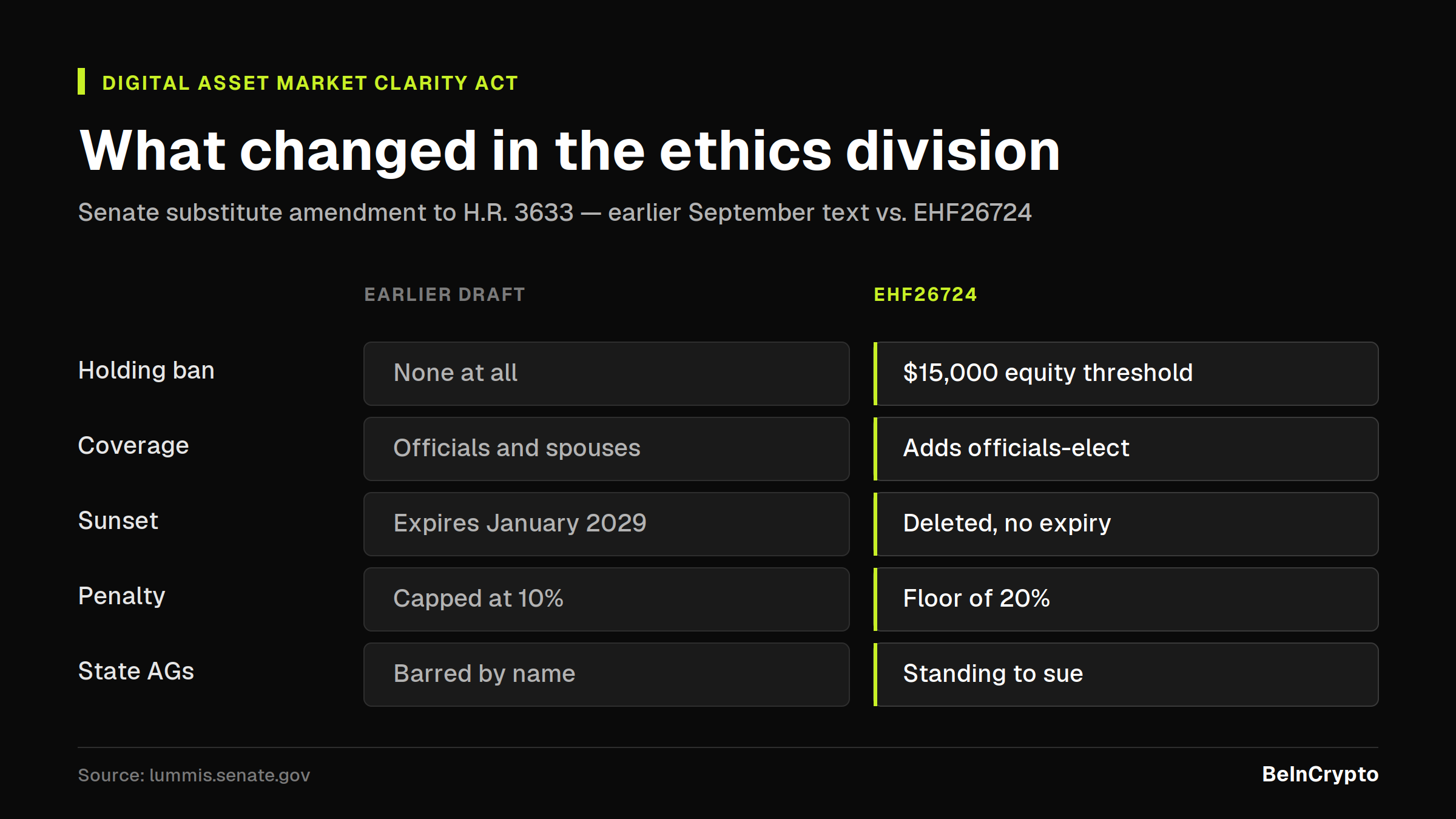
The newer draft (EHF26724) toughens the Clarity Act in several places that the industry will feel. The ethics division is the headline. It’s retitled and rebuilt:
- New ban on holding a “significant financial interest,” meaning $15,000-plus of equity in any business that drew a plurality of its revenue from issuing or sponsoring tokens in any of the past 3 years, with mandatory divestment or a blind trust. The earlier September draft had no holding ban at all.
- Coverage extended to presidents-elect, vice presidents-elect, and members-elect, before they’re sworn in.
- But it still stops at spouses. Children and dependents aren’t covered, a narrower reach than the federal disclosure law, which requires officials to report dependent children’s holdings.
- The 2029 sunset is deleted, along with the severability clause.
- Penalties flip from a 10% cap to a 20% floor, inflation-adjusted, and now apply to the interest itself as well as the transaction.
- State attorneys general gain standing to sue. The earlier draft barred them and private plaintiffs by name, and that subsection is gone.
Follow us on X to get the latest news as it happens

What the Final Clarity Act Text Does Outside the Ethics Title
Elsewhere, the exchange own-account rule is retitled a prohibition on proprietary trading, and its exceptions narrow from activities “in support of the business” to a test of what is “necessary,” subject to new CFTC rules.
Exchanges and wallets, not issuers, face a circuit-breaker: if Treasury finds within 18 months that community-bank deposits are bleeding into stablecoins, it must write rules reaching yield merely “similar to” bank interest, a lower bar than the ban already in the bill, and a threat to exchange rewards programs.
“Network token” now means a digital asset rather than a digital commodity, a broader category. States keep deceptive-practices enforcement unless preempted. CFTC exemptions must run through the CEA’s Section 4(c) process.
One trade cuts the other way. Software developers gain shields against BSA registration and financial institution status, but lose the express protection from criminal money-transmitting liability that the earlier draft gave them.
Republicans Say This Is the Last Version Democrats Get
The rewrite landed days after President Donald Trump met with advisers on Friday to discuss the ethics language. Journalist Eleanor Terrett reported that Republicans are pitching the draft as their last and best offer before Tuesday’s cloture vote.
“President Trump voluntarily agreed to unprecedented ethics restrictions, holding every federally elected official, judge, and their spouses to some of the toughest ethics restrictions in U.S. history,” Senator Lummis said.
Lummis framed the vote as a test of whether Democrats will take the deal they negotiated.
“A no vote on Tuesday means opposing real ethics reforms on politicians’ personal investments… Democrats got what they wanted; now they need to take yes for an answer,” she added.
Whether the rewritten ethics title buys the seven Democratic votes Republicans still need becomes clear tomorrow.
Subscribe to our YouTube channel to watch leaders and journalists provide expert insights
The post Republicans Release Final Clarity Act Text Before Tuesday's Vote. Here's What Changed appeared first on BeInCrypto.
Senate Democrats have met to assess a final 635-page Republican CLARITY Act proposal before a Sept. 15 procedural vote requiring 60 senators to begin debate.
Summary
- Politico reported Senate Democrats met before Tuesday’s cloture vote as Republicans sought seven opposition-party votes.
- Republicans released a 635-page CLARITY Act draft containing 126 changes requested by Democratic negotiators Sunday.
- Trump accepted revised ethics restrictions covering federal officials, judges, lawmakers and their spouses’ digital assets.
- Treasury would receive circuit-breaker authority if payment stablecoins trigger widespread deposit flight from community banks.
- Sixty votes are required to begin debate; Tuesday’s action will not determine final passage yet.
Politico reported that Senate Minority Leader Chuck Schumer convened the Democratic caucus on Sunday evening after Republicans released the revised text. No Democratic leader had announced the caucus’s position on the motion as of Sept. 14.
Senate Banking Digital Assets Subcommittee Chair Cynthia Lummis released the proposal with Senate Banking Committee Chair Tim Scott and Senate Agriculture Committee Chair John Boozman. Their statement called the draft the product of more than one year of negotiations and said it incorporated 126 substantive changes requested by Democrats.
A Republican aide described the proposal to Politico as the party’s “last, best and final” offer before Tuesday’s vote. Republicans hold 53 Senate seats, so at least seven members of the Democratic caucus must support cloture if every Republican votes yes.
CLARITY Act ethics text puts pressure on Democrats
Government ethics rules have remained the main obstacle in negotiations. Democratic senators have sought restrictions addressing the ability of elected officials and their families to profit from digital assets while influencing federal policy.
Republican sponsors said President Donald Trump accepted provisions based on “substantially all” of an ethics proposal developed by Sens. Thom Tillis and Ruben Gallego. The sponsors said the rules would cover federally elected officials, federal judges and their spouses.
Eleanor Terrett reported that the proposal would require covered officials to divest certain “substantial” crypto-related financial interests or place them in a blind trust. Her account attributed the description to a Republican aide familiar with the negotiations.
The revised enforcement structure gives state attorneys general a role after earlier drafts concentrated authority within the federal government. Politico reported that state officials could pursue action involving the Justice Department or crypto exchanges when they believe the restrictions are not being enforced.
Lummis said Trump had voluntarily agreed to the new provisions. Her claim that the text creates some of the toughest ethics restrictions in U.S. history represents the sponsors’ assessment and has not been endorsed by Democratic negotiators.
Democrats must now decide whether the revised language adequately addresses their concerns about Trump-linked digital asset businesses. Incorporating requested amendments does not bind the senators who proposed them to support the entire bill.
Stablecoin circuit breaker targets deposit flight
The final draft gives the Treasury secretary new authority to respond to deposit movements linked to payment stablecoins. Sponsors described the provision as a circuit breaker intended to protect community banks if stablecoin products draw deposits away from insured institutions.
Banking groups have argued that stablecoin rewards can function like interest-bearing accounts and compete directly with bank deposits. Crypto companies maintain that overly broad restrictions could prevent platforms from providing lawful customer incentives that do not originate from stablecoin issuers.
The new language would allow federal intervention when authorities find evidence of widespread deposit flight. Treasury Secretary Scott Bessent would hold the central decision-making role under the reported proposal.
As previously reported, the Sept. 15 Senate test will open debate without approving the bill. The stablecoin provision may still face amendments if senators agree to proceed.
The measure follows the GENIUS Act’s federal rules for payment stablecoin issuers. CLARITY addresses a separate question by setting rules for digital asset trading markets and dividing authority between the Securities and Exchange Commission and Commodity Futures Trading Commission.
Developer protections lose their criminal safe harbor
The revised Blockchain Regulatory Certainty Act language would shield qualifying software developers from federal money-transmission registration requirements. Republican sponsors said the text creates a civil safe harbor for developers who do not control customer funds.
Terrett reported that negotiators narrowed the provision to Bank Secrecy Act requirements and civil enforcement. Earlier language expressly extending protection to criminal cases, including prosecutions under Section 1960, was removed from the final offer.
Section 1960 covers unlicensed money-transmitting businesses. Its removal means the revised developer language does not provide the explicit criminal protection contained in previous versions, according to Terrett’s description of the changes.
The Agriculture Committee section places new limits on affiliate trading and conflicts involving digital commodity exchanges, brokers and dealers. It clarifies that state consumer-protection laws continue to apply to activities covered by the measure.
Developer protections in the agriculture section would not create exemptions from derivatives law or change the CFTC’s existing authority over prediction markets. Those clarifications respond to concerns that software protections could unintentionally reach regulated derivatives activity.
The full proposal would establish registration paths for digital commodity exchanges, brokers and dealers. It would give the CFTC authority over covered spot digital commodity markets while preserving SEC jurisdiction over securities and investment contracts.
Tuesday’s vote only decides whether debate begins
Senate Majority Leader John Thune scheduled cloture on the motion to proceed to H.R. 3633 for 2:15 p.m. Eastern on Sept. 15. The motion generally requires 60 votes under Senate rules.
Crypto.news previously reported that Republicans need at least seven Democratic votes if their conference remains united. The required number would rise if Republican senators oppose the motion or miss the vote.
If cloture succeeds, Lummis, Boozman and Scott plan to offer the 635-page text as an amendment in the nature of a substitute. The amendment would replace the text currently attached to the House-passed legislative vehicle.
Senators could then debate the proposal and consider further amendments. Passage would require another set of procedural and final votes, while any changes from the House version would require the House to accept the Senate text or negotiate a common bill.
The House passed its CLARITY Act version by 294-134 in July 2025. The Senate Banking Committee advanced its portion by 15-9 in May 2026, when Democratic Sens. Gallego and Angela Alsobrooks joined Republicans.
Committee support did not guarantee votes for the combined floor text. The final version now includes the Banking Committee framework, Agriculture Committee provisions, the revised ethics title, stablecoin language and developer protections.
If Tuesday’s motion fails, Senate leaders may reconsider it or negotiate another version. Senate rules do not automatically send the measure back to committee, and a failed cloture vote would not enact or reject the underlying regulatory provisions. The first recorded vote is scheduled for 2:15 p.m. Eastern. If 60 senators support cloture, the final Republican text will be offered as the substitute amendment during floor consideration.
The crypto market will welcome tokens worth more than $746.5 million in the third week of September 2026. Major projects, including LayerZero (ZRO), Connex (CONX), and Bedrock (BR), will release significant new token supplies.
These unlocks could introduce market volatility and influence short-term price movements. So, here’s a breakdown of what to watch.
1. LayerZero (ZRO)
- Unlock Date: September 20
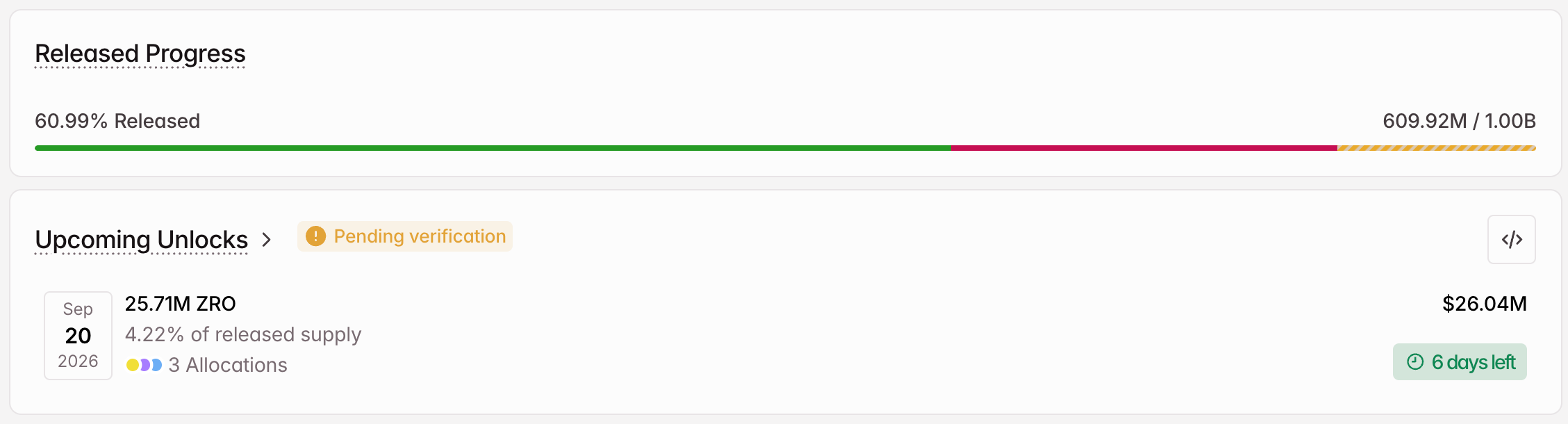
- Number of Tokens to be Unlocked: 25.71 million ZRO
- Released Supply: 609.92 million ZRO
- Total Supply: 1 billion ZRO
LayerZero is an interoperability protocol that connects different blockchains. Its primary goal is to facilitate seamless cross-chain communication. Thus, it enables decentralized applications (dApps) to interact across multiple blockchains without relying on traditional bridging models.
The team will unlock 25.71 million tokens on September 20, representing 4.22% of the released supply. Moreover, the supply is worth approximately $26 million.

LayerZero will award 13.42 million altcoins to strategic partners. Core contributors will get 10.63 million ZRO. Lastly, 1.67 million ZRO are for tokens repurchased by the team.
2. Connex (CONX)
- Unlock Date: September 15
- Number of Tokens to be Unlocked: 1.32 million CONX
- Released Supply: 93.89 million CONX
- Total supply: 100 million CONX
Connex is a permissionless, open, and collaborative Web3 professional network. The project integrates blockchain with networking, promoting transparency and fair value exchange among professionals in the digital economy. Holders can use CONX for payments and governance.
Connex will unlock 1.32 million CONX tokens into the market on September 15. The supply is worth approximately $13.21 million. It represents 1.41% of the released supply.

The team will allocate around 822,500 CONX to the ecosystem. Furthermore, the community treasury will get 500,000 altcoins.
3. Bedrock (BR)
- Unlock Date: September 20
- Number of Tokens to be Unlocked: 40.63 million BR
- Released Supply: 217.5 million BR
- Total supply: 1 billion BR
Bedrock is a liquid restaking protocol that issues tradable tokens, such as uniBTC, backed by deposited Bitcoin (BTC), Ethereum (ETH), and IoTeX, allowing holders to earn while keeping the assets usable elsewhere in DeFi. BR, its governance token, launched on BNB Chain in March 2025.
On September 20, the team will unlock 40.63 million tokens, representing 18.68% of the current released supply. The supply is worth approximately $12.74 million.

The founding team will receive 25 million tokens. In addition, the team will keep 15.63 million tokens for seed investment.
In addition to these, other prominent unlocks that investors can look out for in the third week of September include Arbitrum (ARB), Starknet (STRK), Sei (SEI), and YZY (YZY), and more.
The post 3 Token Unlocks to Watch in the Third Week of September 2026 appeared first on BeInCrypto.


The gathering comes days after Dario Amodei and Sam Altman called for greater restraint at the AI frontier, warning that rapidly improving systems could pose increasingly difficult-to-control risks.


Robinhood CEO Vlad Tenev said issuers should be involved if tokenized products change shareholder rights or company obligations, but not when they create separate instruments backed by shares.


House tax writers have reportedly scheduled a Sept. 16 review of two bills that could change how U.S. miners, stakers and traders calculate federal taxes.
Summary
- House tax writers reportedly plan to review two digital-asset bills during a September 16 markup.
- H.R. 9175 offers qualifying miners and stakers an election to defer income until token disposal.
- H.R. 9172 would extend wash-sale and constructive-sale restrictions to covered digital assets and related contracts.
- Qualified dollar stablecoins and certain validation-related acquisitions receive targeted exceptions under the introduced anti-abuse bill.
- Official committee records had not listed the reported September markup publicly as of Monday morning.
The House Ways and Means Committee plans to consider H.R. 9175 and H.R. 9172 on Wednesday. The committee’s public calendar had not posted a markup notice as of Sept. 14, leaving the meeting time and final bill list unconfirmed in official records.
The introduced bills address separate parts of the tax code. H.R. 9175 would create an optional income-deferral system for qualifying mining and staking rewards. H.R. 9172 would apply existing wash-sale and constructive-sale restrictions to covered digital assets.
A committee markup would allow lawmakers to debate, amend and vote on the legislation. Reports that Republicans may remove the mining deferral or limit it to five years have not been confirmed through a published committee amendment or substitute text.
Reported crypto tax markup remains off the calendar
Representatives Mike Carey and Jodey Arrington introduced the two bills on June 8. The Congressional Record confirms that both measures were referred to the Ways and Means Committee.
One day later, the committee held a legislative hearing covering those proposals and several other digital-asset tax measures. Witnesses included representatives from Fidelity, Coinbase and Coin Center, along with an NYU Tax Law Center official.
Committee Chairman Jason Smith presented the package as an attempt to give taxpayers clearer rules for digital assets. His statement argued that the existing framework had not kept pace with new financial technology. Such comments represent the committee majority’s policy position.
No official Sept. 16 notice appeared on the committee’s full committee page by Monday morning. Without a notice, the publicly available record does not confirm which measures will receive votes or what amendments members may offer.
The lack of a posted notice does not prove that the meeting will be canceled. It means the reported schedule remains provisional until the committee releases an agenda or another official announcement.
Mining tax bill offers an elective deferral
The Tax Clarity for Mining and Staking Act, H.R. 9175, would establish two possible tax treatments for qualifying newly created tokens.
Under the bill’s default rule, a taxpayer would include the token’s fair market value in ordinary income when acquiring it through mining, staking or another qualifying validation process. The recognized amount would become the taxpayer’s basis in the asset.
Eligible taxpayers could elect to postpone recognition for qualifying tokens received during the elected tax year. The election would continue in later years unless the taxpayer obtained Treasury approval to revoke it.
When an elected token was sold or otherwise disposed of, the taxpayer would recognize the deferred gain. The bill classifies that gain as arising from property that is not a capital asset, producing ordinary tax treatment under the proposed language. Certain acquisition costs would be capitalized while the election remained effective.
Current IRS guidance generally treats mining and staking rewards as ordinary income when taxpayers gain control of them. As crypto.news explained in its guide to IRS crypto tax rules in 2026, later disposals can generate a separate capital gain or loss based on the asset’s changed value.
H.R. 9175 would not make every token or taxpayer eligible. The introduced text contains restrictions involving controlled foreign corporations, passive foreign investment companies and several foreign ownership structures. It contains sourcing rules based partly on a taxpayer’s residence when the asset is acquired or disposed of.
Reports indicate that Republican lawmakers have discussed removing the deferral election or allowing it for only five years. Neither option appears in the introduced text, and no official amendment confirming either change had been published as of Sept. 14.
The nonpartisan Joint Committee on Taxation estimated that the introduced bill would reduce federal revenue by $2.956 billion between fiscal years 2026 and 2036.
Wash-sale bill targets rapid crypto repurchases
The Applying Existing Tax Anti-Abuse Rules to Digital Assets Act, H.R. 9172, would expand two rules currently associated mainly with stocks and securities. Section 1091 of the tax code generally disallows an immediate loss deduction when a taxpayer sells stock or securities and acquires substantially identical property within 30 days before or after the sale. The disallowed loss normally adjusts the basis of the replacement property instead of disappearing permanently.
H.R. 9172 would replace references to “stock or securities” with a new category of “specified assets.” Covered property would include most digital assets and certain contracts or options connected to them. Tokenized or wrapped products could qualify as substantially identical to economically equivalent underlying assets. The Treasury Department would receive regulatory authority covering contracts and other arrangements linked to specified assets.
Qualified U.S. dollar-denominated stablecoins would be excluded if they met the bill’s statutory requirements. The definition relies on permitted payment stablecoin issuers recognized under federal law. A dollar stablecoin may not qualify for the exclusion when the taxpayer uses another functional currency.
Certain tokens received through mining, staking or comparable validation activity receive a narrower exception. The introduced language addresses particular acquisitions within the wash-sale calculation; it does not remove all mined or staked tokens from every part of the bill.
The measure would separately extend constructive-sale rules under Section 1259 to digital assets. Existing constructive-sale rules can require recognition when transactions offset an appreciated position so completely that the taxpayer has effectively removed the economic exposure without formally selling the asset.
Crypto.news has previously reported that the statutory wash-sale rule does not currently cover cryptocurrency, allowing traders to sell a token at a loss and repurchase it without the same restriction that applies to covered securities.
The Joint Committee on Taxation estimated that H.R. 9172 would raise $2.074 billion over fiscal years 2026 through 2036. Earlier Treasury estimates cited for digital-asset wash-sale legislation covered different proposals and should not be treated as the official score for H.R. 9172.
Committee passage would begin another legislative stage
If the reported markup proceeds, committee members could approve the introduced bills, reject them or replace portions through amendments. The five-year mining deferral mentioned in press reports would require a formal amendment before becoming part of the legislation.
A favorable committee vote would permit the measures to be reported to the full House. Approval would not guarantee floor consideration because House leaders control the schedule, and no floor date has been announced. Any bill passed by the House would then require Senate approval. Differences between House and Senate versions would need to be resolved before identical legislation could reach the president.
The committee could combine the measures with other tax legislation during markup or at a later stage. Congress often moves tax provisions through larger packages, but no official document currently shows that either crypto proposal will be attached to another bill.
However, Until new committee text appears, the June versions remain the only verified legislative language. The committee had not published a chairman’s amendment, substitute text, meeting time or voting agenda for the reported Sept. 16 markup as of Sept. 14.
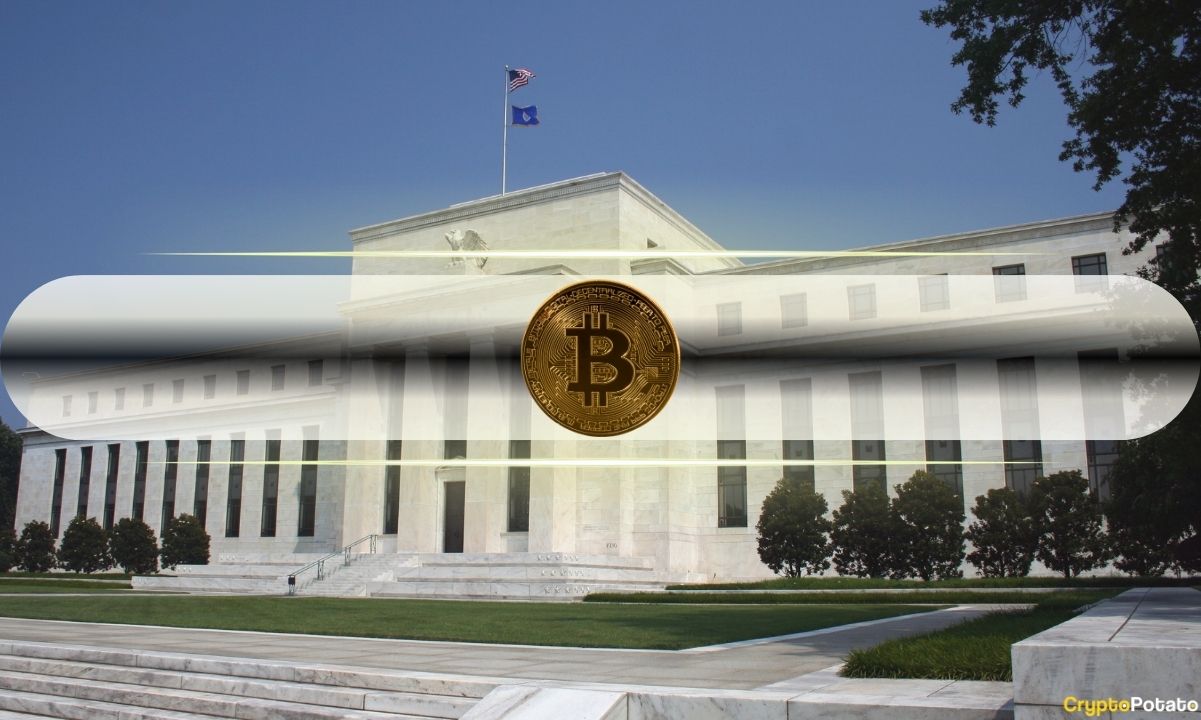
Although there are several major economic events taking place in the following five business days, the reality is that only a handful of them could (and most likely will) impact the cryptocurrency market. That impact, though, is expected to be quite vicious in either direction.
The Kobeissi Letter highlighted an auction of 20-year securities, August retail sales, and, most importantly, the Federal Reserve’s September interest rate decision on Wednesday. The latest data shows that markets assign an 85%-90% probability that the central bank will hike rates by 25 basis points, following contrasting economic data.
Fed in Focus
The Fed setup has changed dramatically in just a few weeks, starting with the August employment data from early September, which showed that the US economy had added 162,000 jobs last month, triple expectations. Later on, the PPI numbers indicated that the annual producer inflation had accelerated to 5.4%. Last Friday’s CPI report subsequently confirmed headline inflation at 3.4%, with monthly core CPI slightly hotter than expected.
This combination, plus the fact that oil prices remain above $100 and diesel hit a new record in the States, has strengthened the Fed’s case for tighter policy.
Bitcoin and the altcoins have already demonstrated their sensitivity to this shift, dropping sharply following Fed Chair Kevin Warsh’s speech from Jackson Hole several weeks ago, and again as rate-hike odds increase after the latest economic data.
The only question is whether this highly expected rate hike has been priced in, with BTC sliding from $82,400 to under $78,000 as of now. As such, investors will closely watch Warsh’s press conference after the meeting for clues as to whether the Fed’s decision on Wednesday is a one-off adjustment or the start of another tightening cycle.
The Tuesday Test
Before all eyes turn on the Fed on Wednesday, the crypto industry has another major event on Tuesday. The Senate’s cloture vote on the CLARITY Act is scheduled for 2:15 P.M. that day, and it requires 60 senators to advance the debate on the key bill.
The CLARITY Act aims to establish a comprehensive US crypto market structure and shed further details on the respective roles of the SEC and the CFTC.
Republicans released an updated text last week, adding new rules for non-decentralized DeFi protocols and clarifying how credit unions can deal in crypto. Moreover, they published their “last, best, and final” draft of the legislation on Sunday, including an ethics proposal backed by the POTUS.
The post Bitcoin’s Biggest Week of 2026 Is Here: Fed and CLARITY Vote Take Center Stage appeared first on CryptoPotato.


Fundstrat co-founder Tom Lee says Ethereum (ETH) is becoming the settlement layer for Wall Street and artificial intelligence (AI). He repeated the claim as ETH held up better than most major cryptocurrencies over the past week.
Lee, who chairs BitMine Immersion Technologies (BMNR), made the comment in a reply on X. A trader had asked why Ethereum was outperforming nearly every other top ten coin during a broader crypto pullback.
The Wall Street and AI Thesis
Asked directly why Ethereum was holding its ground, Lee pointed to the network’s emerging role as financial plumbing.
“$ETH is the future settlement rails for Wall Street and AI.”
— Tom Lee, in a reply on X
The reply echoes arguments from Lee’s bullish crypto outlook for the next 12 months. He ties Ethereum’s case to two forces, Wall Street’s tokenization of traditional assets and the rise of agentic AI. Agentic AI refers to autonomous software that can transact without human input.
Lee has also framed the recent ETH/BTC ratio breakout as evidence the market is pricing in that shift. BitMine has backed the thesis with purchases, pushing toward a 5% ether stake. The position still sits underwater on a cost basis.
Whether this reflects Lee’s thesis taking hold, or just short-term positioning, remains unclear. The answer may come clearer if Ethereum’s outperformance extends as other coins dip.
Ether Holds Up While Rivals Slip
Ether was among the few top-ten assets to trade higher over the past seven days. Tron (TRX) was the only other gainer, with stablecoins excluded. Bitcoin (BTC), BNB, XRP, Solana (SOL), Zcash (ZEC), and Hyperliquid (HYPE) all posted weekly losses, several exceeding 3%.
Ether changed hands around $2,518 on Monday, down roughly 0.1% over 24 hours. Bitcoin traded near $77,100, off more than 1.5% for the day.
The post Tom Lee Explains Ethereum's Killer Application as ETH Bucks Market Downturn appeared first on BeInCrypto.

CBS Fall 2026 Daytime TV Premiere Dates: Price Is Right, More

Money Song, Twinkle Twinkle Little Star + More Kids Songs | Gracie’s Corner Compilation

Man City mock Man United after Manchester derby win and Erling Haaland controversy


-
 Tech6 days ago
Memory prices are slowing because buyers ran out of money
-

 Tech17 hours ago
The Latest Weird Thing to Play Doom Is the Mapped-Out Brain of a Fruit Fly
-

 Business4 days ago
Micron Stock Climbs Above $1,031 as AI Memory Crunch and a $50 Billion Outlook Fuel the Rally
-

 Business4 days ago
AMD Stock Climbs After Management Lifts 2027 Data Center Outlook Toward $70 Billion in AI Sales
-

 Crypto World5 days ago
Bitcoin price risks $76K drop as $78K support weakens
-

 Fashion3 days ago
Weekend Open Thread – Corporette.com
-

 Crypto World6 days ago
Robinhood Stock: How To Take Advantage With Reduced Risk
-

 Crypto World3 days ago
XAG/USD: Silver’s Short-Term Rally Meets Its Moment of Truth
-

 Crypto World4 days ago
2 Chip Stocks Broke Out This Week. Neither Was Nvidia
-

 Crypto World5 days ago
Ethereum price stalls below $2,500 as ADX drops to 11
-

 NewsBeat6 days ago
England up in reading, maths and science rankings as Scotland and Wales dip
-

 Crypto World3 days ago
OKX launches 10x OpenAI, Anthropic X-Perps in Europe
-

 Business3 days ago
10 Most-Streamed Songs On Spotify In 2026 So Far, Led By Ella Langley’s Dominant Run On The Charts This Year
-

 Tech3 days ago
Battery life is the only iPhone 18 Pro and iPhone Duo upgrade I care about. Apple didn’t disappoint
-

 Crypto World3 days ago
Diesel Tops $6 a Gallon for the First Time as 28 States Set Records
-
 Crypto World6 days ago
Intel Stock Jumps 9% on Chip Price Hike Report, US Stake Gains $36 Billion
-

 Tech4 days ago
Apple Watch Ultra 4 vs Watch Ultra 3: Should you really spend another $799?
-

 Crypto World4 days ago
Bitcoin price risks $70K if $78K neckline breaks
-

 NewsBeat5 days ago
What went right this week: an ‘historic’ fall in violent crime, plus more
-

 Crypto World6 days ago
Pump Fun and Kraken delete Hunter Biden $LAPTOP promotion
You must be logged in to post a comment Login