
Crypto World
Top AI Crypto Wallet Development Companies in 2026 for Serious Businesses


Investors with enterprise ambitions need more than marketing slides and checklists. They need clarity about which Web3 crypto wallet providers can deliver secure, compliant, and future-proof infrastructure that supports scalable revenue models. In 2026, the winning wallet partners combine hardened cryptography, account abstraction for superior UX, and production-grade AI that meaningfully reduces operational risk and customer friction. This article is written for well-informed investors evaluating strategic bets in web3 infrastructure. It focuses on technical differentiators, observable production capabilities, and the commercial trade-offs that matter when moving from proof of concept to live financial rails. Read on for a concise technical framework, the top vendor shortlist, a head-to-head feature comparison, and a rigorous 10-question crypto wallet development company evaluation.
Why 2026 Is a Defining Year for AI-Smart Crypto Wallets?
The market dynamics making 2026 pivotal are technical, regulatory, and behavioral. On the technical side, account abstraction and smart account primitives have matured into usable production tooling, enabling programmable wallets that solve long-standing UX and recovery problems. This shift changes how cryptocurrency wallet solutions are built and consumed because it decouples signature management from the user experience and enables sponsored gas, batched operations, and policy-driven approvals. At the same time, multi-party computation and threshold signature schemes are moving from academic proofs into operational custody solutions, offering enterprises key-management alternatives that reduce single-point risk and regulatory exposure.
AI is no longer an experimental add-on. Leading teams embed machine learning for real-time anomaly detection, risk scoring, and personalized usage assistance, which materially lowers fraud losses and onboarding friction. Finally, enterprise demand is rising as financial institutions and high-net-worth services adopt tokenized assets and require wallets that can integrate with existing KYC, treasury, and audit systems. The intersection of account abstraction, MPC-class key management, and production AI is why investors should re-evaluate wallet vendors in 2026 with technical scrutiny.
Top 7 AI Cryptocurrency Wallet Development Companies of 2026
1. Antier Solutions
Antier has evolved into a platform-first provider for enterprise crypto wallets that fuse production AI, multi-model custody, and broad chain interoperability. Their white-label AI smart crypto wallet product emphasizes intelligent transaction processing, behavioral recovery flows, and predictive risk analytics designed for high-compliance environments. Antier presents architecture and runbook artifacts aimed at enterprise buyers, showing an operational approach to MPC and hybrid custody and clear support for multi-chain EVM ecosystems. For investors, Antier’s strength is not only in delivery speed but also in a repeatable architecture that embeds AI into the signing and policy layers so that fraud detection, onboarding automation, and recovery are measurable features rather than add-ons. This makes Antier the most compelling partner for institutional-grade wallet infrastructure.
2. Oodles Blockchain
Oodles brings a decade of blockchain engineering to mobile crypto wallet development projects with a service model built for custom enterprise implementations. Their wallet practice focuses on cross-platform wallets, DeFi integrations, and NFT support, and they have published explorations of AI in wallet monitoring and personalized insights. Oodles is strongest where deep integration with enterprise systems is required, including payment rails and legacy back ends. For investors, this firm is a reliable engineering house capable of producing robust non-custodial and custodial wallets quickly; their AI positioning is currently oriented toward transaction monitoring and fee optimization rather than embedded MPC. Use Oodles when you need platform engineering and rapid, audit-ready delivery for multi-chain wallets.
- Real-time transaction monitoring with rule-based AI alerting.
- Fee optimization suggestions driven by transaction pattern analysis.
- Personalized in-wallet recommendations using market and user signals.
- Integration patterns for embedding AI outputs into enterprise reporting.
Choose Wallet Infrastructure That Scales With Demand
3. PixelPlex
PixelPlex positions itself at the intersection of blockchain and intelligent assistants, offering wallets that act as “co-pilots” for users. Their public material highlights proactive scam detection, predictive insights for asset management, and an emphasis on UX that reduces human error in transactions. This renowned crypto wallet provider has experience scaling projects and building wallet layers that integrate with exchanges, DeFi rails, and custodial services. From an investor standpoint, PixelPlex is attractive where productized AI features, such as proactive scam alerts and contextual recommendations, are required alongside professional-grade engineering and proven delivery for consumer and institutional clients. Expect a strong UX and AI pairing, but validate custody model specifics for enterprise risk tolerance.
- Client-side assistive AI that reduces user error and improves retention.
- Proactive scam detection leveraging behavioral and network signals.
- Predictive portfolio insights that feed in-wallet recommendations.
- Plug-and-play AI modules for rapid feature integration.
4. BlocktechBrew
BlocktechBrew is a pragmatic wallet developer focused on white-label blockchain wallet apps with a strong emphasis on security and time to market. Their offering is oriented toward entrepreneurs and enterprises seeking complete wallet stacks, browser extensions, and mobile clients. BlocktechBrew’s AI footprint is currently focused on analytics and automated security checks that are integrated into the development lifecycle. For investors, the company represents a cost-effective engineering partner able to deliver MVPs and iterate rapidly; their strength is execution velocity rather than platformized AI governance. For portfolio companies that need fast, secure shipping of wallet products with AI-powered monitoring, BlocktechBrew is a sensible operational choice.
- Automated security and integrity checks during development and CI.
- Transaction analytics modules for post-deployment monitoring.
- White-label AI hooks for swapping in enterprise models.
- Lightweight fraud detection pipelines for early production stages.
5. BlockchainX
BlockchainX markets end-to-end Web3 cryptocurrency wallet solutions and white-label products aimed at businesses that need rapid deployment and rebranding. Their products emphasize multi-asset support and customization for local regulatory environments. BlockchainX is best for enterprises that want a full productized wallet stack with roadmap acceleration rather than heavy R&D in cryptographic custody. Their AI claims are more conservative and typically implemented as analytics and reporting layers to aid compliance and support teams. Investors should view BlockchainX as a commercial, modular provider suitable for scaling standard wallet features quickly across geographies.
- Compliance and reporting dashboards powered by analytics.
- Customer support augmentation via AI-summarized event logs.
- Automated KYC/AML signal enrichment feeding the wallet audit trail.
- Configurable AI alerts for operational monitoring.
6. Rapid Innovation
Rapid Innovation focuses on secure blockchain wallet development with an emphasis on UX, authentication, and integrations for web and mobile. Their public material highlights features such as multi-factor authentication, QR flows, and session controls. Rapid Innovation complements AI with applied analytics and automation that strengthen onboarding and reduce support costs. For investors, Rapid Innovation is a reliable engineering partner when robust authentication and solid engineering practices are primary goals and when you prefer to integrate third-party or bespoke AI services. Verify their custody posture and ask for AI performance metrics during diligence.
- AI-assisted onboarding flows to reduce drop-offs.
- Analytics-driven session and fraud detection.
- Modular AI connectors for third-party risk engines.
- Emphasis on secure authentication with AI-backed anomaly detection.
How Does Antier Stand Out From Other Vendors?
In 2026, market leaders will be defined by products users actually adopt, not those that are merely deployed. We build with that outcome in mind.
You must have heard Investors asking often, what does a company they hire bring them that others do not? Well, Antier has all the answers to it. Below is the curated list of capabilities that Antier holds rather than marketing claims.
| Feature area | Antier | Typical other vendors |
|---|---|---|
| AI-powered transaction analytics | Productionized predictive analysis & UX personalization. Public docs reference AI-native wallet modules. | Most vendors offer fraud detection or analytics, but many present these as integrations or roadmaps. |
| Key management options | Multi-model: seedless experiences, MPC and hybrid custody options, enterprise recovery flows. | Predominantly, seed phrase, multisig, HSM options. Few demonstrate integrated MPC in public collateral. |
| Multi-chain support | Claims broad EVM coverage and chain integrations; designed for cross-chain wallet UX. | Many vendors support multiple chains but often with narrower out-of-the-box integrations. |
| Account abstraction readiness | Focus on smart-wallet flows and sponsored transactions | Many provide ERC-4337 support as part of engineering engagements, but adoption varies. |
| Enterprise compliance & audit support | Emphasizes enterprise controls, audit readiness and recoverability | Most firms offer integration support; investors should request SOC2 and third-party audit evidence |
| Turnkey vs custom | Balance of white-label products and custom integrations | Several vendors focus primarily on white-label or custom, based on business needs |
It is always suggested that you partner with an experienced team of blockchain experts who are adept at crafting impactful and successful customized cryptocurrency wallet solutions.
How to Evaluate a Wallet Development Company in 10 Questions?
For investors doing diligence, these 10 technical and operational questions reveal whether a crypto wallet service provider is enterprise-grade or merely marketing-first.
- What is your key management model in production, and can you provide architecture diagrams and a failure mode analysis?
- Do you offer MPC or TSS-based signing? If so, provide a public audit or third-party review.
- How do you support account abstraction and ERC-4337 user operations? Provide sample UserOperation flows and bundler integration details.
- How is AI used in the stack, and what are measurable production outcomes for fraud reduction or onboarding improvements?
- Which chains and L2s are supported natively, and what is the process to integrate new chains?
- Provide SOC2 type II, ISO, or third-party audit evidence and recent penetration test results.
- What are your SLAs for transaction throughput, incident response, and key compromise scenarios?
- How is regulatory compliance built in, specifically AML tooling, on-chain metadata retention, and explainability for AI decisions?
- What is the upgrade and migration path for wallet contracts and key-management components?
- Provide client references where you implemented a production wallet with live volumes, and share anonymized KPIs.
Use these answers to rank vendors against the architecture and risk appetite of the target business.
Final Verdict: Choosing Antier for Serious Business Impact
For institutional investors and enterprise product owners, architecture and operational proof trump feature lists. Prioritize crypto wallet development companies that can demonstrate production MPC or hardened custody, an ERC-4337 smart account strategy, and measurable AI outcomes for fraud and UX.
Antier, as positioned in public product material, claims mature AI wallet modules, multi-chain coverage, and enterprise controls; these are the traits investors should seek and verify.
Our experience building and advising regulated web3 projects shows the following pattern. Projects succeed when businesses choose partners who deliver three things: a security-first signing model, programmable accounts for frictionless UX, and an AI stack that is auditable and measurable. Legal and compliance expertise is critical during architecture and vendor selection because custody, AML, and data residency requirements directly influence design choices. We help institutional teams navigate these trade-offs by validating cryptographic proofs, confirming audit evidence, and shaping deployment plans that map to local regulatory regimes. If you are evaluating strategic investments into blockchain wallet development infrastructure, focus your diligence on architecture diagrams, third-party audits, and production AI performance. Those artifacts distinguish long-term infrastructure from short-term launches.
Let’s move from intent to execution. Talk to our experts to understand where and how to begin.
Frequently Asked Questions
01. Why is 2026 considered a pivotal year for AI-smart crypto wallets?
2026 is pivotal due to advancements in account abstraction, smart account primitives, and the integration of AI for real-time anomaly detection and risk scoring, which enhance user experience and reduce operational risks in cryptocurrency wallet solutions.
02. What are the key technical differentiators investors should consider when evaluating crypto wallet providers?
Investors should focus on hardened cryptography, account abstraction for improved user experience, production-grade AI capabilities, and the ability to integrate with existing KYC, treasury, and audit systems.
03. What does the article provide for investors looking to evaluate crypto wallet development companies?
The article offers a concise technical framework, a shortlist of top vendors, a head-to-head feature comparison, and a rigorous 10-question evaluation guide for assessing crypto wallet development companies.

Crypto World
Bitcoin Price Prediction Flips Bullish After Strategy Loads $1 Billion in BTC but Pepeto Is the Best Crypto to Buy Now
The bitcoin price prediction is running hot after Strategy dropped $1 billion on 13,927 BTC in a single week, lifting total holdings to 780,897 coins and leaving the company just 19,103 BTC from the 800,000 mark, per CoinDesk. That kind of corporate conviction while the Fear and Greed Index sits at 12 tells you exactly where the biggest buyer on the planet expects this market to go next.
BTC hit $76,000 on April 14, its highest since mid-March, as short liquidations and geopolitical easing drove a sharp rally per Bloomberg. Strategy funded the entire buy through STRC preferred stock, and the ticker printed a record $1.16 billion in daily volume on April 13 per CoinDesk. Pepeto crossed $9.04 million raised at $0.0000001863 with 183% APY staking compounding daily, and every day this presale stays open is one day closer to the listing that changes this price forever.
Institutional demand through ETFs now absorbs more than 100% of Bitcoin’s newly mined annual supply, building a structural squeeze that Bitwise calls the main driver behind its bitcoin price prediction that BTC prints a new all-time high before 2026 ends.
Goldman Sachs filed for a Bitcoin Premium Income ETF on April 14, joining BlackRock in building yield products around BTC. When the bitcoin price prediction lines up this cleanly with corporate buying and Wall Street expansion, presale tokens with real tools are the ones that catch the biggest wave.
Bitcoin Price Prediction Goes Institutional: Pepeto Is Where Smart Capital Moves Next
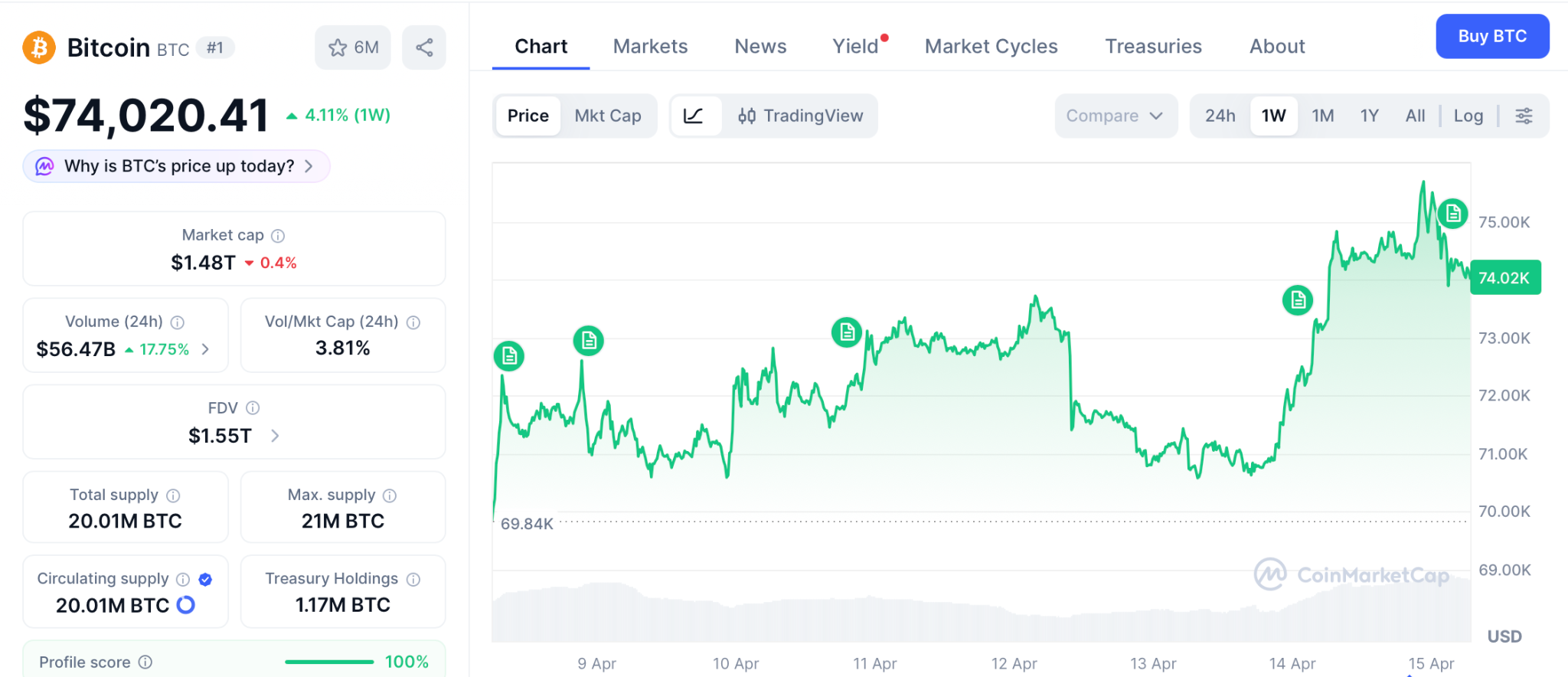
Pepeto stands as the best crypto to buy now after crossing $9.04 million raised while Bitcoin holds near $74,020 and the world’s largest corporate BTC holder keeps stacking during extreme fear.
Conviction keeps building because investors tracking the bitcoin price prediction understand the pattern. When BTC bounces off fear-driven dips, the altcoin wave that follows sends presale entries into return territory no big cap can reach.
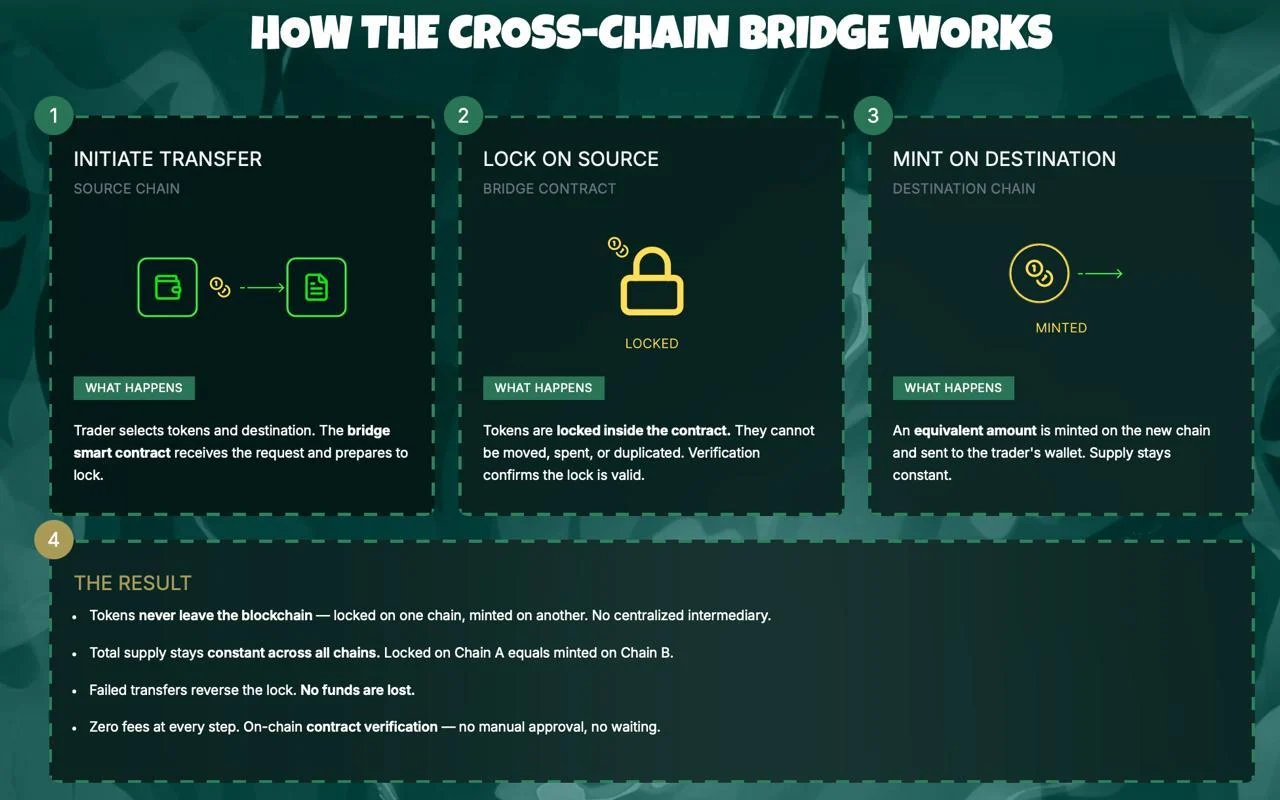
The core problem Pepeto attacks is fragmentation. Traders jump between five or six platforms to bridge, swap, check contracts, and track positions, losing fees and time at every step. The exchange pulls all of that into one place.
From one dashboard, users bridge across Ethereum, BNB Chain, and Solana at zero cost, run risk scores on any contract before committing capital, and track their full portfolio on a single screen. The zero-fee engine keeps every dollar productive instead of leaking through hidden charges.
The result is real tools powering smart decisions instead of guesswork across broken platforms. The bridge, risk scorer, token engine, and portfolio tracker all run on smart contracts verified by a SolidProof audit, giving a security base most presales never come close to building.
At $0.0000001863 right now, a $10,000 position earns roughly $18,300 in annual staking rewards at 183% APY, putting about $1,525 per month straight into your wallet while the listing draws closer. The cofounder who created the original Pepe coin built Pepeto to capture exactly this kind of moment. Buying presales while fear runs the market is how the biggest fortunes in crypto have always started, and the confirmed Binance listing on Pepeto means this entry price gets wiped out the moment the first trade clears.
Bitcoin (BTC) Price at $74,020 While Bitwise Targets a New All-Time High
Bitcoin (BTC) trades near $74,020 on April 15 per CoinMarketCap, after punching above $76,000 on April 14 for its highest print since the February crash that drove prices to $60,000. Bitwise holds firm on its bitcoin price prediction that BTC will break its $128,198 all-time high before this year closes.
Every major desk keeps lifting its bitcoin price prediction, but BTC still needs to nearly double to reach those targets. By the time it arrives, every wallet that locked in Pepeto at six zeros will already hold returns that large-cap buyers would need years to match.
Conclusion
Every signal right now points to the same outcome. The bitcoin price prediction turning bullish, Strategy loading $1 billion in BTC during peak fear, Goldman Sachs filing a Bitcoin ETF, and the exchange infrastructure that merged meme energy with real trading tools standing ready to capture the full move.
The wealth built this cycle will belong to the people who found the tools, the builder, and the timing behind Pepeto before anyone else showed up. Visit the Pepeto official website today because the listing gets closer with every passing hour and the entry you see right now disappears the moment trading goes live.
Click To Visit Pepeto Website To Enter The Presale

FAQs
What is the bitcoin price prediction for 2026 and can presale tokens outperform BTC?
Bitwise and Standard Chartered both project Bitcoin will break its all-time high this year, roughly 2x from current levels. Presale tokens with confirmed listings and working tools historically deliver far larger multiples, and Pepeto at $0.0000001863 sits at that exact entry point.
Will Bitcoin (BTC) break its all-time high of $128,198 before 2026 ends?
Bitwise projects Bitcoin (BTC) will top $128,198 before December 2026, backed by ETF inflows absorbing over 100% of newly mined supply. Strategy’s $1 billion weekly purchase and 780,897 BTC total stack add corporate weight to that call.
Disclaimer: This is a Press Release provided by a third party who is responsible for the content. Please conduct your own research before taking any action based on the content.


Charles Schwab, a heavyweight in the U.S. brokerage scene, plans to roll out spot cryptocurrency trading for retail clients in the coming weeks. The service will begin with Bitcoin and Ether, accessed through a dedicated crypto account linked to Schwab’s core brokerage platform, with custody handled by Schwab’s banking unit and trade execution facilitated through Paxos, the federally regulated trust company.
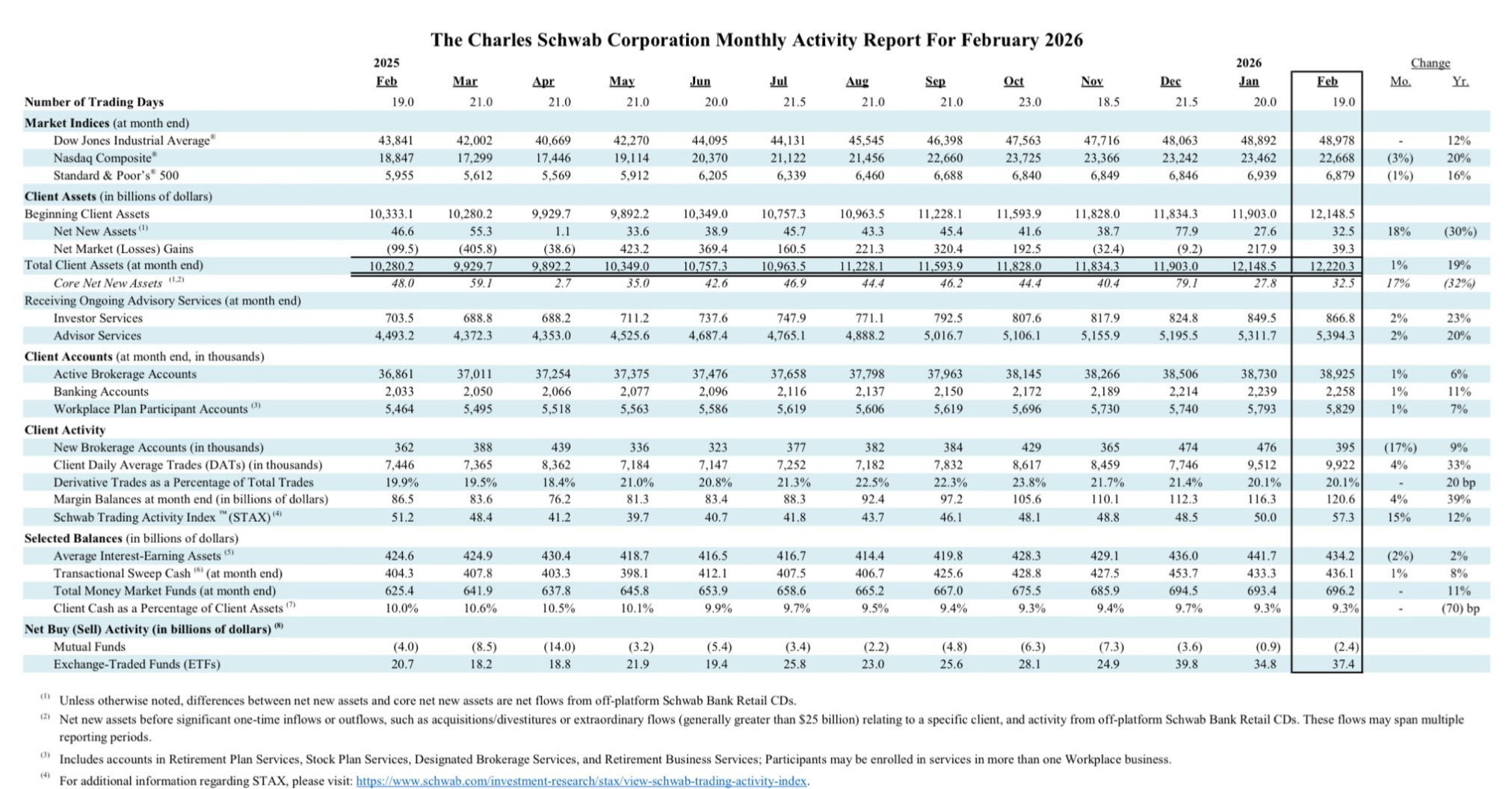
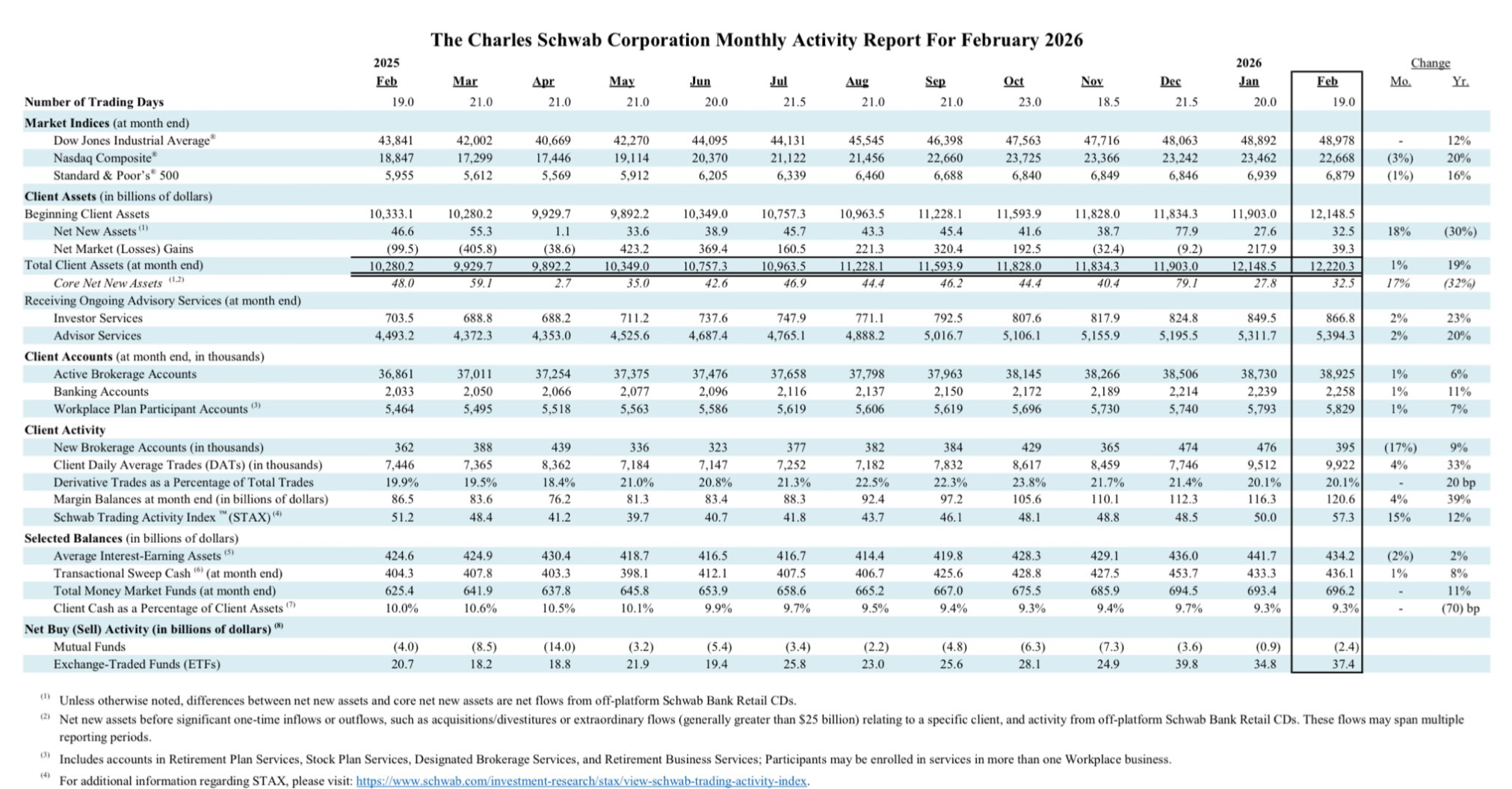
Schwab’s announcement places the firm among several traditional financial players expanding regulated crypto access for everyday investors. The company reported $12.22 trillion in total client assets as of February 2026, underscoring the scale it brings to any new crypto offering. Schwab already provides exposure to crypto through exchange-traded products, futures, and funds, and internal estimates suggest its clients collectively hold roughly 20% of spot crypto ETFs. The phased rollout will begin for eligible U.S. retail clients, with New York and Louisiana residents initially excluded.
Key takeaways
- Schwab will offer spot trading for Bitcoin and Ether to retail clients, via a separate crypto account linked to its brokerage platform, with custody by Schwab Bank and Paxos handling execution.
- The initial trading fee is 75 basis points per transaction, placing Schwab’s pricing above some U.S. crypto exchanges but on par with others for lower-volume traders.
- The service will be launched in phases over the coming weeks and will not be available to residents of New York and Louisiana at the outset.
- Schwab’s move extends its crypto footprint beyond ETFs, futures, and funds, reflecting a broader push by traditional finance into regulated crypto products and services.
Schwab’s custody model and how the service will work
Under Schwab’s plan, clients will access spot crypto trading through a distinct crypto account that sits alongside their regular brokerage activities. Assets will be held by Schwab’s banking subsidiary, adopting a custodial framework designed to integrate crypto assets into Schwab’s existing risk and compliance protocols. Execution will be provided via Paxos, a regulated trust company that has become a common partner for traditional institutions seeking compliant crypto trading rails. The design aims to blend crypto accessibility with the familiar Schwab experience—trading and viewing crypto alongside stocks and other assets across Schwab’s web, mobile, and Thinkorswim platforms.
The focus on custody and a trusted execution partner signals Schwab’s intent to reassure risk-conscious investors who have long viewed crypto as a separate, sometimes opaque corner of markets. By using a traditional banking arm for custody, Schwab aligns crypto holdings with its established custody standards and regulatory expectations, potentially reducing counterparty risk from a user perspective. However, the need to route trades through Paxos and vault assets in a bank-style custody structure also indicates a performance and settlement regime that may differ from highly automated, direct-exchange paths often seen in other fintech-friendly models.
Pricing, competition and pathway to broader access
From launch, Schwab’s spot-trading fee stands at 75 basis points per trade (0.75%). That rate sits higher than many crypto exchanges that have pitched low, volume-based pricing—Kraken’s public fee schedule, for example, starts around 0.25% to 0.40% and declines with higher trade volumes. By contrast, Schwab’s fee is broadly aligned with Coinbase’s lower-volume tier, which ranges from roughly 0.40% to 0.60%. The implication for traders is a decision point between the convenience and integrated experience Schwab offers and the typically cheaper on-exchange fees found on stand-alone crypto venues.
Schwab’s decision to set a higher introductory fee may reflect the value proposition of its custodial framework and the seamless integration with existing Schwab accounts. It also suggests a broader strategy: to render crypto trading part of a single, regulated, institution-backed suite of financial services rather than a separate crypto-only infrastructure. Investors will be watching how Schwab balances custody costs, regulatory compliance, and user experience as it expands beyond BTC and ETH to additional digital assets.
Industry context: incumbents expanding into crypto, while crypto-native firms push into traditional markets
Schwab’s move aligns with a wider industry trend of traditional financial firms embracing crypto as a regulated, investable asset class. In April, Morgan Stanley launched a spot Bitcoin ETF (MSBT) that drew $30.6 million in inflows on its first day of NYSE Arca trading, with total net assets reported around $87.6 million as of mid-April. The same month, Goldman Sachs signaled intent to offer a Bitcoin-linked ETF designed to generate income through options strategies, providing indirect exposure to Bitcoin while aiming to dampen volatility. These developments illustrate a bifurcated market where established banks seek regulated, structurally sound products for mainstream investors, while crypto-native platforms pursue hybrid offerings that bridge traditional markets and digital assets.
Meanwhile, on the crypto-native side, firms are expanding into traditional asset spaces in various ways. Coinbase began enabling trading for equities and ETFs on its platform, while Kraken explored tokenized equity perpetual futures, offering leveraged exposure to US stocks and other traditional assets. These moves reflect a broader experimentation with tokenized and digitized representations of conventional financial instruments, even as the regulatory backdrop continues to evolve for both fiat-backed and crypto-native vehicles.
Schwab’s announcement underscores a broader question for investors and builders: how far can regulated, mainstream financial infrastructure extend crypto access without compromising the guardrails that institutional players demand? The emphasis on custody, trust, and integrated account workflows suggests a future where crypto sits alongside traditional assets in standard brokerage environments, rather than existing as a niche appendage.
What this means for markets and readers
For Schwab’s clients, the introduction of spot crypto trading could simplify access to digital assets and consolidate reporting, tax documents, and custody within a single account framework. For the broader market, the move reinforces the trend of mainstream financial firms integrating crypto into their core product lines, which could spur greater investor participation and potentially shift liquidity and trading patterns as more participants gain regulated exposure. Yet, the phased rollout and geographic exclusions highlight that regulatory and state-level constraints remain a meaningful limiter on rapid, universal adoption.
As the rollout progresses, observers will be watching several key questions: How quickly will Schwab add other digital assets beyond BTC and ETH? Will the custody and settlement flow prove resilient at scale under higher-volume demand? And how will fee structures evolve as competition increases and the regulatory environment solidifies around crypto custody and market access?
With traditional finance expanding its footprint in crypto and crypto-native firms continuing to probe traditional markets, the next 12 to 18 months could reveal a more integrated, regulated, and widely accessible crypto trading landscape for ordinary investors. Market participants should keep an eye on regulatory developments, custody risk management, and the pace at which other legacy institutions emulate Schwab’s approach—or chart out alternative paths for their clients.
Readers should monitor Schwab’s rollout cadence, the list of supported assets, and any updates to access in previously restricted states. The broader takeaway is clear: mainstream financial institutions are continuing to incorporate crypto into conventional investing, signaling both opportunities and new risk considerations for users and builders alike.


BitTorrent Chain has upgraded the BTTC Bridge record page with dual views, richer filters and clearer tags so users can track incoming, outgoing and cross-chain flows faster.
Summary
- BitTorrent Chain has upgraded the BTTC Bridge transaction record page with new dual views and filters for cross-chain users.
- The update separates “All Records” from “In Progress” activity and adds multi-dimensional search by status, type and custom date range.
- Incoming, outgoing and cross-chain transactions now carry clearer visual tags to make following asset flows easier.
BitTorrent Chain has rolled out a functional upgrade to the BTTC Bridge transaction record page, aiming to give cross-chain users a clearer view of where their funds are and where they are going. According to the project’s official update, the new interface is now live and is designed to make tracking deposits, withdrawals and cross-chain moves “more efficient and transparent” for everyday users.
The refreshed page introduces a dual-view mode that splits activity into “All Records” and “In Progress,” allowing people who regularly move assets between BTTC, Ethereum, Tron and BNB Chain to quickly distinguish between completed and pending transfers. The team has also added a multi-dimensional filtering tool that lets users combine transaction status, operation type and custom date ranges in a single query, cutting down the time it takes to locate a specific bridge event.
As part of the same upgrade, BTTC says the bridge page now features stronger, dedicated markers for incoming, outgoing and cross-chain activities, visually flagging the direction and nature of each transaction. The goal, according to the team, is to help users “quickly locate the flow of funds,” a recurring pain point for less technical participants navigating multi-chain asset movements.
The latest tweak builds on a broader interface overhaul completed in late March, when BTTC redesigned the bridge to incorporate user feedback and streamline the overall flow. That earlier upgrade allowed users to send assets from BTTC addresses back to Ethereum without paying extra bridge fees beyond standard gas costs, while keeping the process fully decentralized and ensuring that private keys and asset details stay out of third-party hands.
BitTorrent Chain positions BTTC as a cross-chain layer connecting networks such as Tron, Ethereum and BNB Chain using a lock‑and‑mint bridge model, with the bridge itself sitting at the heart of that interoperability push. Its recent 2.0 mainnet upgrade to a proof‑of‑stake design, highlighted in BitTorrent’s own roadmap, was pitched as a way to boost throughput and make cross-chain transfers more reliable as volumes grow.
In previous crypto.news coverage of exchange and wallet UX improvements, reporters have noted that clearer transaction histories and better labeling can directly reduce support tickets, user errors and perceived security risks in cross-chain systems. BTTC’s latest bridge record upgrade moves in that same direction, giving power users more granular filters while offering newcomers a cleaner, less intimidating window into their on-chain activity.


Anthropic has released Claude Opus 4.7, its most advanced AI model to date, marking a significant upgrade in long-form reasoning, vision processing, and autonomous task execution.
The launch, announced on April 16, 2026, strengthens Anthropic’s position in the fast-moving enterprise AI race, where competitors are rapidly expanding capabilities for coding, analytics, and multimodal workflows.
A Major Leap in Capability and Control
Claude Opus 4.7 is designed to handle long-running, complex tasks with greater precision and reduced supervision, a key demand among enterprise developers and financial analysts.
According to Anthropic, the model “verifies its own outputs before reporting back,” improving reliability in high-stakes workflows such as software engineering and data modeling.
The update also introduces a new “xhigh” reasoning effort level, giving developers finer control over the balance between latency and computational depth.
A beta feature, task budgets, allows organizations to manage token usage across extended AI operations.
Stronger Vision and Multimodal Performance
One of the most notable improvements is in visual understanding. Opus 4.7 can process images at up to 2,576 pixels on the long edge (~3.75 megapixels). This is more than three times the resolution supported in earlier versions.
This upgrade unlocks new use cases in:
- High-fidelity document and diagram analysis
- Interface and slide generation
- Data extraction from dense visual materials
Anthropic says the model produces more refined outputs for professional-grade presentations and design tasks, especially in business environments.
Enterprise Tools and Developer Integration
Alongside the model, Anthropic introduced several platform upgrades. In Claude Code, a new ultrareview command performs automated deep code reviews, flagging issues that resemble human senior engineer assessments.
On cloud platforms including Amazon Bedrock, Google Cloud Vertex AI, and Microsoft Foundry, Opus 4.7 is available at the same pricing as its predecessor: $5 per million input tokens and $25 per million output tokens.
The company also highlighted improved instruction-following behavior, noting that prompts must now be more precise as the model executes instructions more literally than prior versions.
Safety, Cybersecurity, and Alignment Focus
Anthropic emphasized that Opus 4.7 maintains a similar safety profile to Opus 4.6, with improved resistance to prompt injection attacks and deceptive outputs in internal evaluations. However, the firm acknowledged mixed results in areas like overly detailed harm-related responses, highlighting ongoing alignment challenges.
A new Cyber Verification Program will allow security professionals to test the model in controlled environments for penetration testing and vulnerability research.
What Comes Next for Enterprise AI
Opus 4.7 signals a broader shift toward autonomous, tool-using AI systems built for sustained enterprise workloads rather than short interactions.
With competitors also advancing multimodal reasoning and agentic capabilities, the next phase of competition is expected to center on reliability, cost efficiency, and secure deployment at scale.
For enterprises, the immediate implication is that AI systems are moving from assistants to persistent operational agents reshaping how complex digital work is executed across software, finance, and analytics pipelines.
Meanwhile, Coinbase is reportedly courting Anthropic to bolster the exchange’s security infrastructure. Specifically, the exchange is reportedly pursuing access to Anthropic’s restricted Mythos AI model, a move inspired by Project Glasswing cybersecurity initiative launch.
While Anthropic touts Opus 4.7 as a breakthrough, the launch does not wipe from memory past instances of frustrating outages that left thousands of users locked out of Claude.ai and its tools this week. Scaling hype continues to outpace reliable infrastructure.
Additionally, its recent standoff with the Trump administration over military access has painted the company as both principled and vulnerable, raising questions about whether safety posturing serves users or just PR.
The post Anthropic Unveils Opus 4.7 as AI Rivalry Intensifies appeared first on BeInCrypto.

Cantor Fitzgerald has donated $10 million to Fellowship PAC, a crypto-focused super PAC chaired by Tether’s U.S. head of government affairs Jesse Spiro, according to Federal Election Commission filings disclosed Wednesday.
The donation comes at a moment when the line between traditional finance and crypto lobbying capital is becoming hard to define.
The headline number is large enough to matter. Whether it buys the regulatory outcomes the industry wants – and on what timeline – is the harder question.
- Donor: Cantor Fitzgerald committed $10 million to Fellowship PAC, disclosed in February FEC filings.
- Total raised: Wednesday’s FEC filing revealed $11 million in total contributions, including donations from other sources alongside Cantor’s $10 million.
- PAC leadership: Fellowship PAC is chaired by Jesse Spiro, Tether’s U.S. head of government affairs, and was established in 2025.
- Anchorage Digital: The digital asset bank separately contributed $1 million to Fellowship PAC.
- Spending to date: Fellowship has deployed $3 million on advocacy advertising and $1.5 million backing three Republican candidates, including Kentucky Senate candidate Nate Morris and Georgia Representative Clay Fuller.
- Cantor-Tether history: Cantor Fitzgerald has served as custodian for Tether’s reserve assets since 2021, making this donation an extension of an already entrenched institutional relationship.
- Political context: Fellowship PAC secured over $100 million in funding commitments ahead of the prior election cycle, positioning itself alongside rivals Fairshake and Defend American Jobs.
- Watch: FEC filings through 2025 and 2026 for additional commitments toward Fellowship’s $100 million goal and candidate endorsement patterns ahead of pivotal congressional sessions on crypto regulation.
How the Cantor-Fellowship Donation Actually Works, and What $10 Million Buys in Washington
A super PAC operates without contribution limits from corporations or individuals, provided it does not coordinate directly with candidates.
Fellowship PAC uses that structure to back pro-crypto candidates in federal races and fund issue-advocacy advertising – the $3 million already spent on advocacy ads is the clearest example of the latter in action.
Cantor Fitzgerald’s involvement is not a new relationship dressed up as political altruism. The firm has custodied Tether’s reserve assets since 2021, putting it at the center of the world’s most systemically significant stablecoin operation.
When Howard Lutnick, then Cantor’s CEO, now U.S. Secretary of Commerce, faced Senate confirmation hearings, lawmakers pressed him specifically on those crypto ties and their implications for liquidity markets and counter-terrorism financing policy.
Lutnick has since exited day-to-day operations; Cantor is now run by his sons. The $10 million donation follows that transition, which makes it a cleaner read on institutional intent rather than one executive’s personal calculus.
The firm is making a deliberate bet that pro-crypto regulatory outcomes in Washington are worth funding at scale.
The legislative target is not abstract. Congress is actively debating frameworks covering stablecoins and digital asset market structure under the CLARITY Act, and PAC money of this magnitude is aimed squarely at shaping who sits in the seats where those votes happen.
Anchorage Digital’s concurrent $1 million contribution to Fellowship signals the same logic from the crypto-native banking side.

The bullish read is straightforward: a $10 million check from a firm of Cantor’s standing signals that TradFi has moved from cautious observation to active political investment.
That is not the same as regulatory clarity arriving on any particular schedule. PAC spending influences candidate selection and creates political goodwill, it does not write legislation or guarantee floor votes.
The post Cantor Fitzgerald Donates $10 Million to Crypto PAC Led by Tether Executive appeared first on Cryptonews.
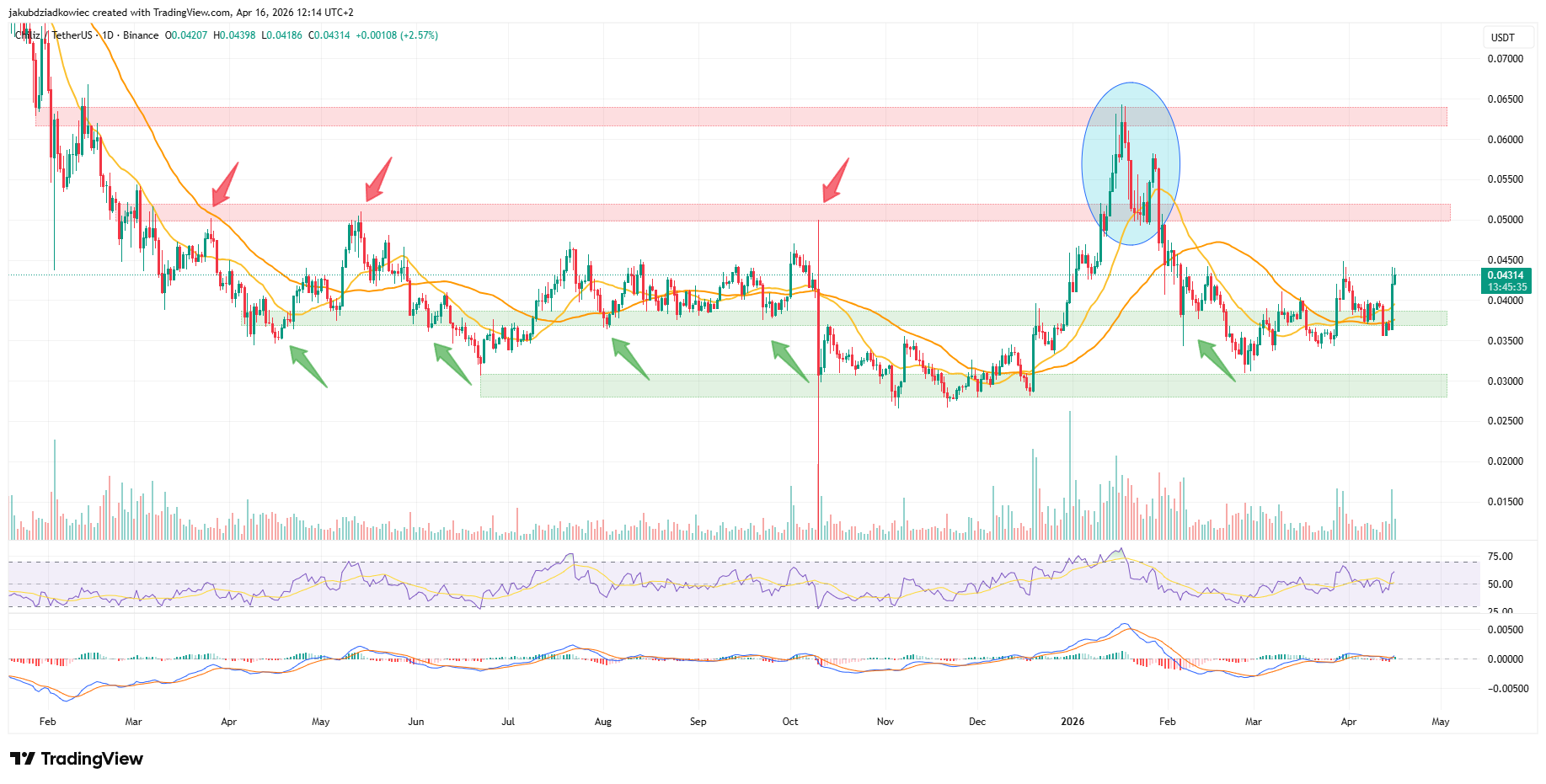
Chiliz (CHZ) surged 14.7% in the past 24 hours on April 16, trading at $0.0429 with a market cap of $441.9 million, as a convergence of technical and on-chain signals suggests a renewed push toward the $0.050 resistance zone.
Price broke above both the 20 and 50-period daily moving averages for the first time since the January 2026 fakeout. On-chain data shows exchange inflows near six-month lows, reinforcing the case for organic demand.
Daily Structure Points to a Breakout Attempt
CHZ has been building a base since February 2025, forming two distinct zones that have repeatedly absorbed selling pressure. The deeper support sits between $0.028 and $0.030. A secondary zone between $0.036 and $0.038 held on four separate occasions since mid-2025, with each rebound marked by green arrows on the chart.
On the resistance side, the $0.050 to $0.052 band has rejected CHZ at least three times over the same period (red arrows). In January 2026, the price temporarily pushed into the $0.062 to $0.064 region. That move failed quickly and price pulled back sharply through both resistance levels, resetting conditions for a more measured attempt.
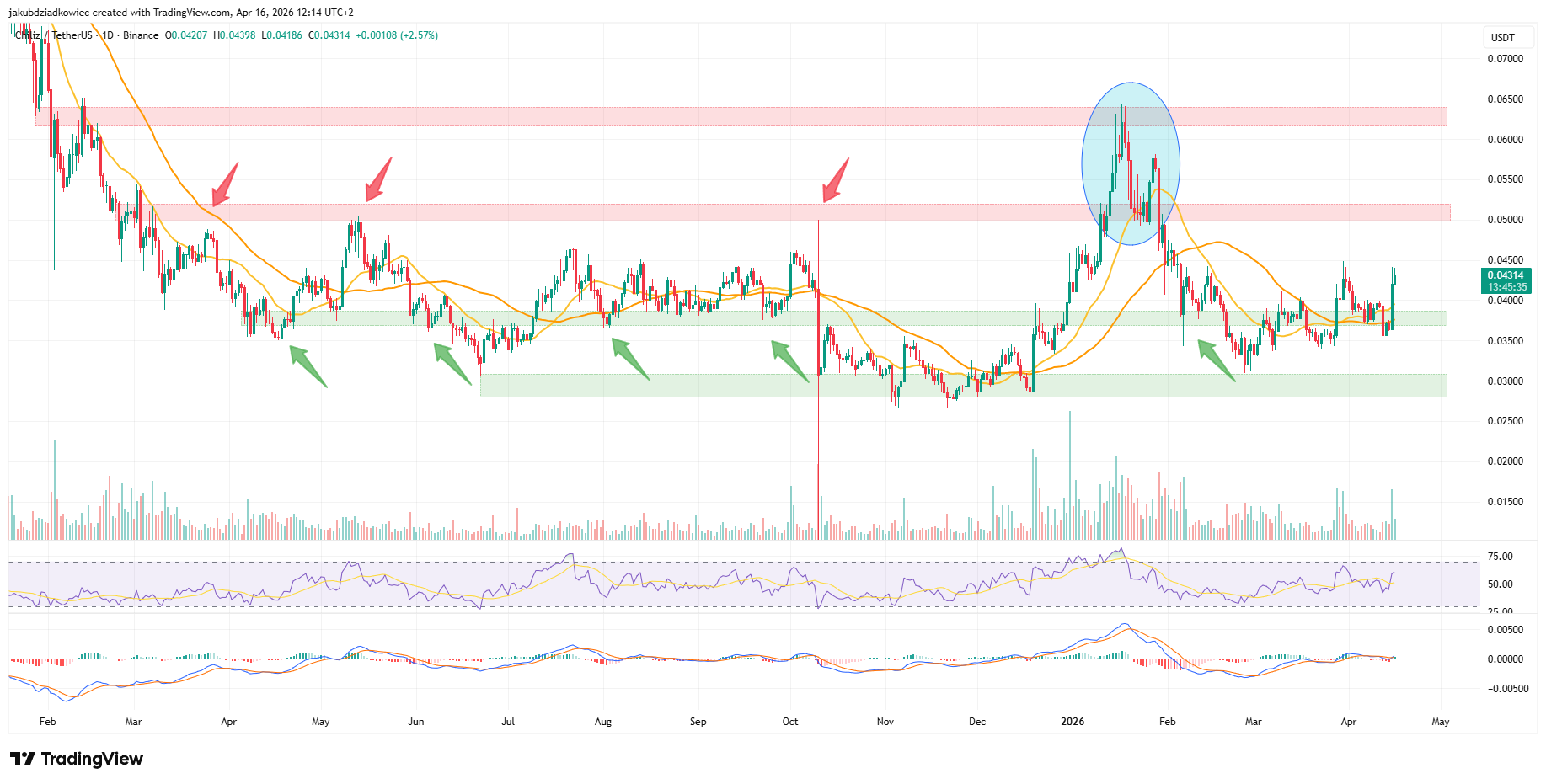
The April 16 daily candle closed at $0.04314, above both moving averages for the first time since the January peak (blue ellipse). Volume registered a notable spike alongside the close, ending a prolonged downtrend in trading activity.
The RSI is rising from neutral territory and has not yet reached overbought levels. The MACD histogram has turned positive, indicating that bullish momentum is accelerating on the daily timeframe.
Prior analysis of CHZ highlighted the difficulty of sustaining closes above these averages, making the current structure notable.
Four-Hour Channel Points to $0.046
The four-hour chart presents a parallel ascending channel dating back to February 19. Price has respected both the upper and lower bands as well as the midline throughout the pattern. Four distinct midline touches (blue circles) confirm its role as a dynamic pivot.
Chiliz is now trading above the midline at $0.04292. The upper band near $0.046 represents the next near-term target. A sustained close above that level would expose the $0.050 zone, which aligns directly with the daily resistance band. CHZ has previously required a confirmed daily close above $0.050 to sustain any move into the higher range.
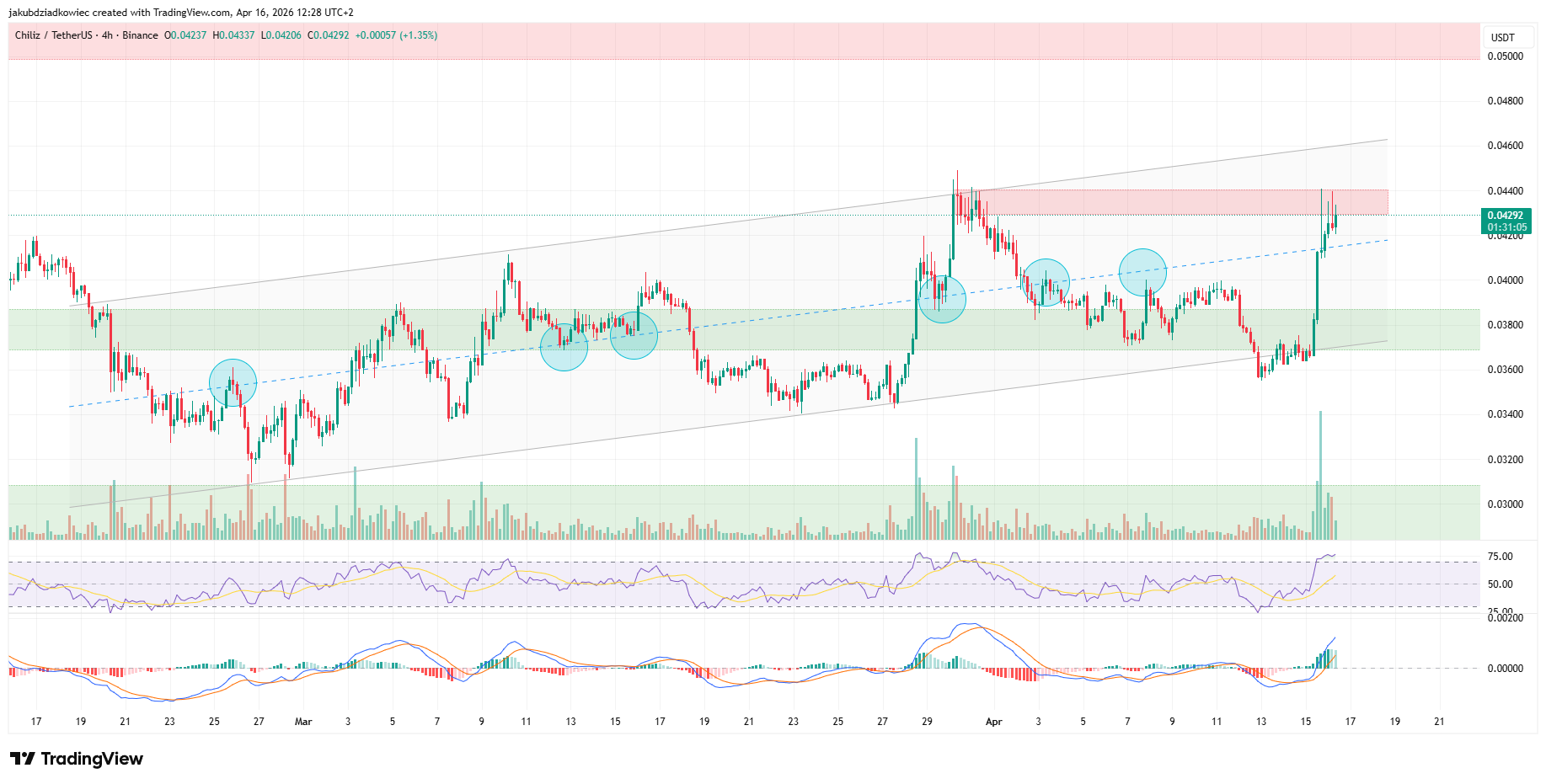
The four-hour RSI has climbed above 70, reflecting strong short-term momentum. The MACD remains positive but is beginning to lose steam, which may produce a brief consolidation before another leg higher.
A pullback toward the $0.036 to $0.038 zone would negate the current structure. There, the channel lower band converges with daily support to form a reinforced floor.
Chiliz Whale Activity and Low Inflow Support the Bullish Case
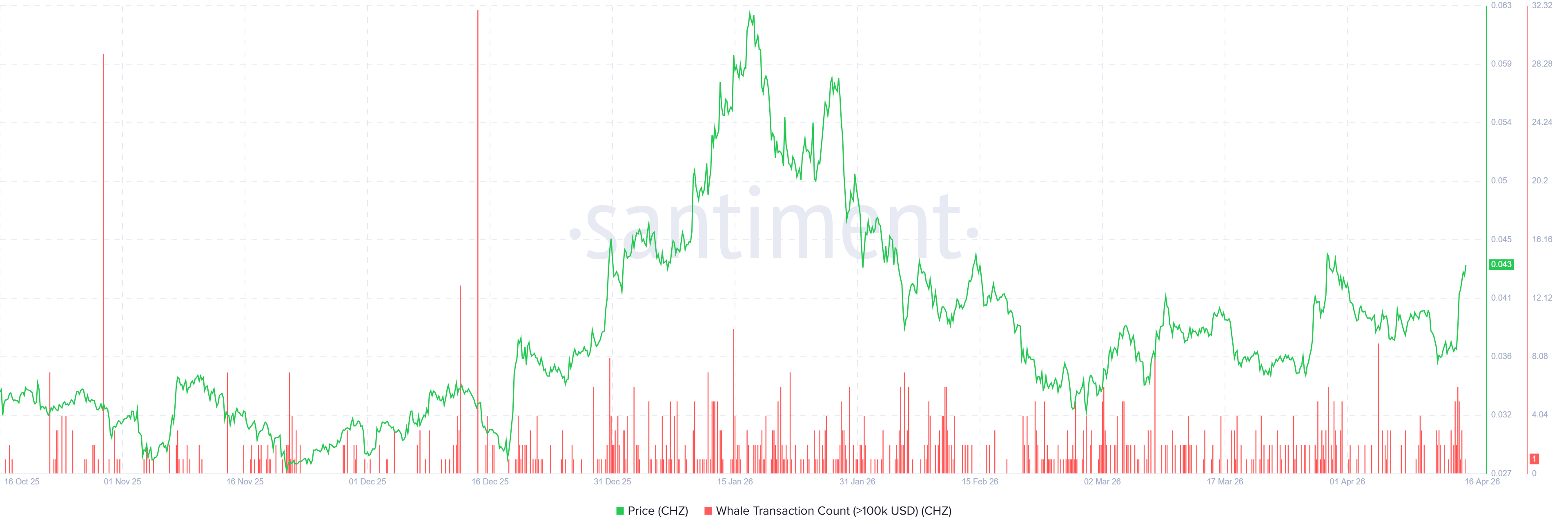
Santiment data shows that whale transaction count for CHZ, tracking transfers above $100,000, registered a modest uptick on April 16. The spike is small relative to the peaks recorded during the January 2026 rally and the December 2025 accumulation phase.
That context is constructive. It suggests large players are cautiously re-entering rather than aggressively positioning, a pattern that has historically preceded sustained moves. Prior rebounds driven by whale accumulation at similar structural support levels were followed by multi-week price advances.
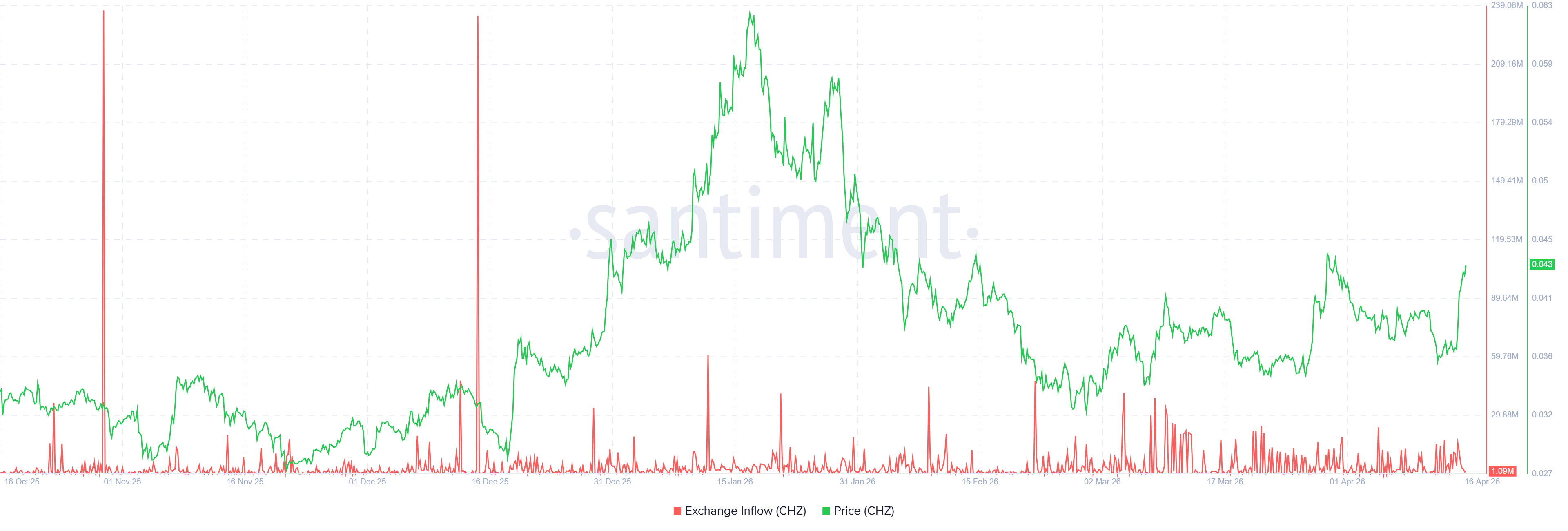
Exchange inflow data reinforces that reading. The current inflow stands at just 1.09 million CHZ, one of the lowest readings over the past six months. For comparison, spikes above 200 million CHZ were recorded in November and December 2025 during periods of heavy distribution.
Low exchange inflow indicates that holders are not moving assets to selling venues. That dynamic is consistent with organic accumulation rather than manufactured price movement, the kind of setup that preceded each of CHZ’s recoveries from the $0.036 to $0.038 support zone over the past year.
Chiliz may extend toward $0.046 in the near term, then test the $0.050 to $0.052 resistance band. A decisive daily close above $0.052 could open the path toward the $0.062 to $0.064 region last visited during the January fakeout.
A failure to hold $0.038 would shift the probability back toward the deeper $0.028 to $0.030 accumulation zone and suggest the current breakout attempt has run out of fuel.
The post Chiliz Eyes $0.05 as On-Chain Data and Parallel Channel Confirm Bullish Setup appeared first on BeInCrypto.


The U.S. Commodity Futures Trading Commission is leaning into artificial intelligence and automation as it faces massive new oversight responsibilities, according to congressional testimony from Chairman Mike Selig, even as his agency’s workforce has declined significantly under the administration of President Donald Trump.
About a quarter of the CFTC’s staff has left since 2025, under Trump’s demands that the federal workforce be cut significantly, according to agency records. But the CFTC is also being called upon to regulate new and rapidly growing arenas for cryptocurrency and the prediction markets.
“Tools such as AI are going to be very helpful in surveilling and bringing the investigations, and we’re incorporating that into various workflows,” Selig told lawmakers of the House Agriculture Committee at a Thursday hearing, citing widespread use of Microsoft’s Copilot AI tool as one productivity aid. When asked about the staff declines at his agency, Selig said, “we are running more efficiently and effectively.”
“We’re putting a lot on your plate with digital assets, and we’re obviously going down this path with prediction markets,” noted committee Chairman Glenn “GT” Thompson. He sought an assurance from the CFTC chief that if he finds himself “in a situation where you know the need for additional qualified staff emerges” that he’ll ask the panel for help.
“Absolutely,” Selig responded.
He asserted that proper enforcement of the markets is a “top priority” of his, though the CFTC budget request for next year asked for only three more enforcement staff to make 108 people — still about 23% shy of the 140 the division had in 2025.
The Digital Asset Market Clarity Act that the Senate continues to work on would elevate the CFTC into a central role over non-securities crypto trading, which would include transactions in leading assets such as bitcoin and Ethereum’s ether (ETH). The agency is also claiming a dominant legal jurisdiction over the prediction markets such as at leading firms Polymarket and Kalshi, which are rocketing from levels measured in the millions of dollars a year ago to multiple billions now.
Selig’s Democratic predecessor, former Chairman Rostin Behnam, had routinely argued that the agency would need more people to oversee crypto and didn’t have the resources to police the world as prediction markets spread in depth and in a virtually unlimited breadth of contract topics. During Selig’s brief tenure, the prediction markets have erupted in accusations of insider trading, a few of which have been addressed by the firms themselves. But the markets have drawn heavy scrutiny on certain trades around U.S. military actions and government statements that suggest small numbers of anonymous traders made significant money on correct bets, suggesting the potential for insider trading from people with government insight.
The chairman acknowledged “numerous investigations ongoing” in prediction markets, though he wouldn’t quantify a number or discuss their focus. He said the regulated platforms are the first line of defense against insider trading, fraud and market manipulation in the hundreds of new markets (binary event questions) that emerge every day on the platforms, while the CFTC itself is a second line of defense.
“We regularly reject contracts,” Selig noted. “We’re actively reviewing what’s out there,” he said, adding that his agency has a “zero tolerance” policy for illicit market activity.
“Anyone who engages in that behavior will face the full force of the law,” he said.
But Representative Angie Craig, the committee’s top Democrat, argued that “the agency’s workforce is stretched too thin,” especially considering the agency’s role as the “primary regulator of two of the fastest growing and most volatile markets.”
“We must give the CFTC the staff, the funding and the clear statutory authority it needs to do its job,” Craig said.
The personnel declines at the regulator includes the commission itself, which is supposed to have five members under the law — including two commissioners from the minority party — but which has been left by the White House as a solitary posting of Selig. The chairman was questioned repeatedly about that during the Thursday oversight hearing, including whether he’d proceed with major rules as a one-person commission.
“We cannot for the sake of the American people slow down our rulemaking,” he said, suggesting he’ll move alone on new regulations. The CFTC is pursuing a preliminary rule process to set up guardrails for U.S. prediction markets, and Selig has also pushed policy initiatives in crypto.
Read More: CFTC sues Illinois, Arizona, Connecticut over states’ sports prediction market efforts
Bitcoin trades below the profitability threshold for active holders, with early signs of BTC demand offering limited price support for now.
Bitcoin (BTC) hit range highs above $76,000 on Wednesday, but Glassnode analysts say data suggest that calling for the start of a new bull market is premature.
New capital inflows have stayed weak, with Bitcoin’s growth rate remaining negative across all 105 trading days in 2026, highlighting a gap between stable price action and limited new demand.
Bitcoin profitability signal remains unresolved
Glassnode analyst CryptoViz.art uses the true market mean (TMM) to estimate the average cost basis of active BTC investors. The metric divides investor capitalization by liveliness-adjusted circulating supply, filtering out inactive coins and the lost supply.
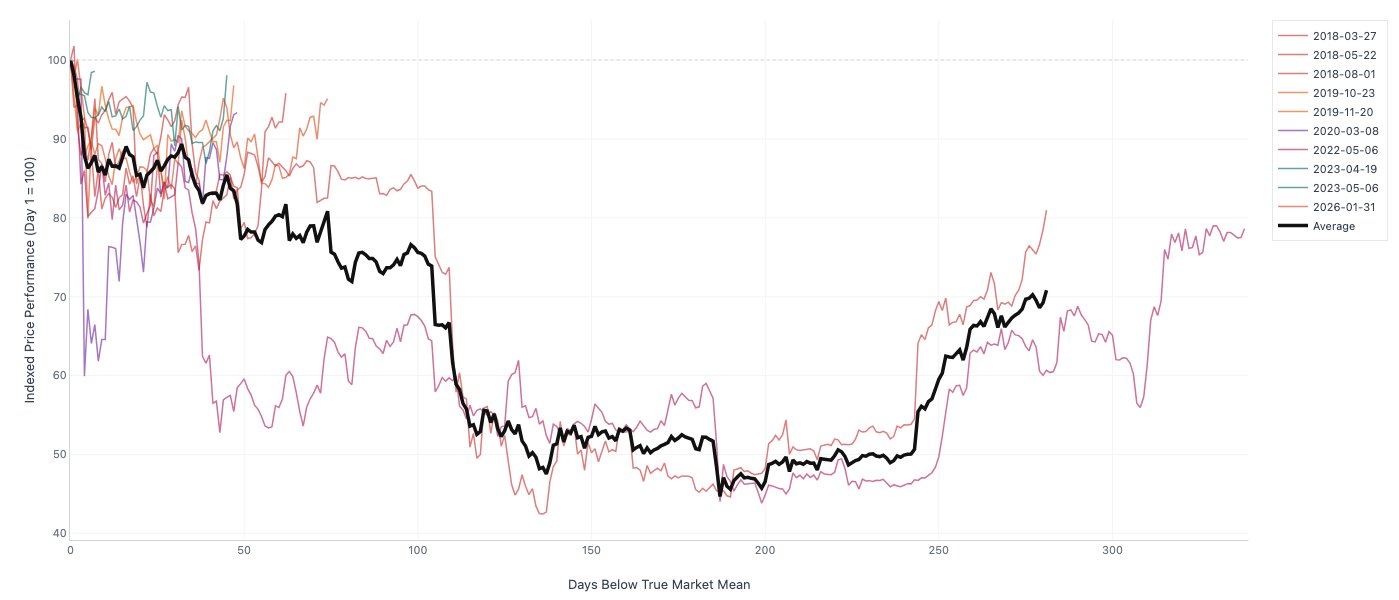
Bitcoin crossed below this level on Jan. 31 and has stayed there for 75 days. The move placed the average active holder in a loss position, with a peak drawdown of 20% and a current gap of about 5% below the entry level.

Historical comparisons show 10 similar breaks since 2016, with durations ranging from two days to over 11 months. The deepest drawdowns reached 57% during the 2018–2019 and 2022–2023 cycles, while the March 2020 event saw a 40% decline over 49 days. The analyst added,
“That said, 75 days is still early. The 2018 and 2022 episodes didn’t bottom until months 5-9. The signal isn’t “all clear” — it’s watch closely.”
Reclaiming the TMM, currently at $78,013, is key for active investors to return to profit, and it has aligned with momentum resets in earlier cycles.
Related: Adam Back says Bitcoin’s post-quantum shift may reveal true Satoshi stash
BTC capital outflows shape the price ceiling
Bitcoin researcher Axel Adler Jr. points to a steady outflow of capital from the BTC market. The 365-day growth rate of market cap relative to realized cap has remained negative for all 105 trading days in 2026, with the latest reading at -0.000652.

In simple terms, the market is not attracting enough new money to support higher prices.
The 30-day realized cap change shows the same trend. Only seven days saw positive inflows this year, all during a brief period in mid-January. Since Jan. 23, the metric has stayed negative, though it has improved slightly to -0.32% from early April lows near -0.54%.
Realized cap has also dropped to $1.08 trillion from $1.12 trillion since the start of the year, a 3.23% decline.
Adler Jr. said the recent improvement signals a slowdown in BTC outflows, not a bullish reversal. A meaningful shift would require both metrics to turn positive and hold above zero for a sustained period.

Related: Morgan Stanley’s Bitcoin fund overtakes WisdomTree after 6 trading days
This article is produced in accordance with Cointelegraph’s Editorial Policy and is intended for informational purposes only. It does not constitute investment advice or recommendations. All investments and trades carry risk; readers are encouraged to conduct independent research before making any decisions. Cointelegraph makes no guarantees regarding the accuracy or completeness of the information presented, including forward-looking statements, and will not be liable for any loss or damage arising from reliance on this content.


Charles Schwab, one of the largest US brokerage firms, will roll out spot cryptocurrency trading for retail clients in the coming weeks, starting with Bitcoin and Ether through a dedicated account linked to its brokerage platform.
According to Thursday’s announcement, the offering will allow clients to trade and view crypto alongside stocks and other assets across Schwab’s web, mobile and Thinkorswim platforms, with custody held by its banking unit and execution handled through a partnership with Paxos, a federally regulated trust company.
Schwab reported $12.22 trillion in total client assets as of February 2026, according to its latest filings, and operates as a brokerage providing trading, banking and wealth management services.
At launch, the service will support trading in the two biggest cryptocurrencies, Bitcoin (BTC) and Ether (ETH), at a fee of 75 basis points per transaction, with plans to add more cryptocurrencies and enable deposits and withdrawals over time.
At 75 bps, or 0.75%, Schwab’s fee places it above exchanges such as Kraken, where fees start around 0.25% to 0.40% and decline with volume, while broadly in line with Coinbase, where fees start at about 0.40% to 0.60% for lower-volume traders, according to information on those exchanges’ websites.
Clients will access the service through a separate crypto account, with assets held by Schwab’s banking subsidiary under a custodial model. The rollout will begin in phases over the coming weeks, initially limited to eligible US retail clients except residents of New York and Louisiana.
Schwab said the move expands its existing crypto offerings, which include exchange-traded products, futures and funds tied to digital assets. The company said its clients currently hold about 20% of spot crypto exchange-traded products, based on internal estimates.
Related: Binance adds spot trading guardrails to limit abnormal executions
Traditional financial firms expand crypto offerings
Traditional financial companies are expanding their crypto offerings across trading, exchange-traded funds (ETFs) and structured products.
On April 8, Morgan Stanley launched a spot Bitcoin ETF (MSBT) that recorded $30.6 million in inflows on its first day of NYSE Arca trading, marking its entry into the market for regulated crypto investment products. The fund website showed total net assets at $87.6 million as of April 15.
Also in April, Goldman Sachs filed with the US Securities and Exchange Commission to launch a Bitcoin-linked ETF designed to generate income through options strategies, offering indirect exposure to Bitcoin while aiming to limit volatility.
As traditional financial firms expand into crypto, crypto-native companies are moving in the opposite direction, pushing into traditional markets through tokenized equities.
In December, Coinbase introduced trading for equities and ETFs, while in February Kraken launched tokenized equity perpetual futures, offering leveraged exposure to US stocks, indexes and commodities.
Magazine: Forget stablecoin yield, how does the CLARITY Act treat DeFi?
Charles Schwab has begun a phased launch of spot Bitcoin (BTC) and Ethereum (ETH) trading, opening direct crypto access to its retail brokerage clients for the first time.
The product, called Schwab Crypto and operated by Charles Schwab Premier Bank, SSB, will roll out in stages starting in Q2 2026. An initial cohort of employees and early-access registrants will trade first before the platform opens to the firm’s broader client base.
Schwab Integrates Crypto Into Its Brokerage Ecosystem
Unlike standalone crypto exchanges, Schwab is embedding digital asset trading within its existing brokerage, banking, and research infrastructure.
Clients will access crypto alongside equities, ETFs, and fixed-income products through a single platform.
Pricing is set at 75 basis points per trade. Paxos provides the regulated custody, execution, and settlement infrastructure underpinning the service.
The regulated trust company already holds a federal banking charter from the Office of the Comptroller of the Currency.
The service will be available across all US states except New York and Louisiana, which have stricter crypto licensing frameworks.
Clients cannot deposit BTC or ETH from external wallets, and crypto holdings are not eligible for SIPC or FDIC insurance.
How Schwab’s Entry Reshapes the Retail Crypto Market
Schwab’s entry intensifies the battle for retail crypto investors. The firm manages approximately $12 trillion in client assets, giving it a built-in distribution advantage over crypto-native competitors like Robinhood and Coinbase.
Previously, Schwab offered digital asset exposure only through crypto-linked stocks, futures, and spot exchange-traded products.
The shift to direct spot trading reflects broader institutional momentum. US spot crypto ETFs drew nearly $670 million in net inflows on the first trading day of 2026 alone.
Regulatory tailwinds have also accelerated the timeline. The SEC rescinded Staff Accounting Bulletin 121 in January 2025, removing the requirement for custodians to record client crypto as balance-sheet liabilities.
The OCC followed in March 2025 by reaffirming that crypto custody and stablecoin activities are permissible for national banks.
Whether Schwab’s conservative pricing and trusted brand can draw crypto volume away from lower-cost platforms with broader token selection remains the central question heading into the second half of 2026.
The post $12 Trillion US Giant Charles Schwab Launches Spot Crypto Trading appeared first on BeInCrypto.

Bitcoin Price Prediction Flips Bullish After Strategy Loads $1 Billion in BTC but Pepeto Is the Best Crypto to Buy Now

Meet the new Reform UK councillor using your money to fund Israeli occupation
SI.com Drops ‘Dream Scenario’ for Vikings Draft

Why Israel is blocking foreign journalists from entering

Bitcoin: We’re Entering The Most Dangerous Phase

Alan Cumming Brands Baftas Ceremony A ‘Triggering S**tshow’

Ripple XRP YieldGate: The BIGGEST Financial Scam Of The Century (Federal Reserve EXPOSED)

Desperate Meghan Markle becomes a Masterchef judge for the money on humiliating Australian tour

Ripple CEO: “Now Is Our Moment” & The Real XRP Catalyst
-

 Politics6 days ago
US brings back mandatory military draft registration
-
 Sports6 days ago
Man United discover Nico Schlotterbeck transfer fee as defender reaches Dortmund agreement
-

 Fashion6 days ago
Weekend Open Thread: Veronica Beard
-

 Politics7 days ago
Malcolm In The Middle OG Turned Down ‘Buckets Of Money’ To Appear In Reboot
-

 Politics4 days ago
World Cup exit makes Italy enter crisis mode
-

 Business6 days ago
Tesla Model Y Tops China Auto Sales in March 2026 With 39,827 Registrations, Beating Cheaper EVs and Gas Cars
-

 Crypto World3 days ago
The SEC Conditionalises DeFi Platforms to Be Avoided for Broker Registration
-

 Crypto World3 days ago
SEC Signals Exemption for Crypto Interfaces From Broker Registration
-

 News Videos1 day ago
Secure crypto trading starts with an FIU-registered
-
 NewsBeat4 days ago
Pep Guardiola and Gary Neville agree over Arsenal title problem that benefits Man City
-

 Business5 days ago
Ireland Fuel Protests Enter Day 5 as Blockades Spark Shortages and Government Prepares Support Package
-

 Business6 days ago
OpenAI Halts Stargate UK Data Centre Project Over Energy Costs and Copyright Row
-

 Politics7 days ago
LBC Presenter Mocks Trump Over Iran War Failures
-

 Crypto World6 days ago
Federal judge blocks Arizona from bringing criminal charges against Kalshi
-

 NewsBeat2 days ago
Trump and Pope Leo: Behind their disagreement over Iran war
-

 Crypto World3 days ago
SEC Proposes Certain Crypto Interfaces Don’t Need to Register as Brokers
-
 NewsBeat4 days ago
JD Vance announces ‘no agreement’ with Iran over nuclear weapons fear
-

 Tech7 days ago
A version of Windows 10 released a decade ago is now eligible for additional security patches
-

 Business6 days ago
IMF retains floor for precautionary balances at SDR 20 billion
-

 Business6 days ago
Former Liverpool CEO eviscerates FIFA for World Cup ticket pricing
You must be logged in to post a comment Login