

Crypto World
Trader offers 10% bounty after claiming violent $24M crypto robbery



A cryptocurrency holder has claimed that attackers stole roughly $24 million in a crypto robbery following a violent assault, with blockchain security analysts now tracking the movement of the funds on-chain.
Summary
- A crypto user known as “Silly Tuna” claims attackers used violence and threats to steal roughly $24 million in digital assets.
- Blockchain security firm PeckShield said the funds were drained in an address poisoning attack and partially moved to staging wallets.
- Around $20 million in DAI is reportedly sitting in two wallets, while small portions have already been bridged to Arbitrum.
$24M crypto robbery linked to address poisoning
In a series of posts on X, a user operating under the handle “Silly Tuna” alleged that the theft occurred during a physical attack that involved weapons and threats of kidnapping and sexual violence. The user said police have been contacted and described the incident as a “violent assault and theft,” adding that the attackers targeted their crypto holdings.
“Still have limbs, phew,” the user wrote, claiming they were held down while attackers threatened them with axes and forced the transfer of funds.
The victim said the stolen assets were moved to an Ethereum wallet beginning with 0x6fe0…0322 and offered a 10% bounty on any recovered funds. The user also called on blockchain investigators to help trace the transactions.
Blockchain security firm PeckShield later reported that an address linked to the victim had been drained of approximately $24 million worth of aEthUSDC, describing the incident as an address poisoning attack.
According to the firm, about $20 million in DAI linked to the exploit is currently sitting in two attacker-controlled staging wallets, each holding roughly $10 million. These wallets have not yet been mixed, suggesting the funds remain traceable for now.
PeckShield also said the attacker has begun bridging small amounts of the stolen assets to the layer-2 network Arbitrum, a move often used by attackers attempting to fragment or obscure transaction trails.
The incident highlights the growing risk of physical attacks targeting cryptocurrency holders, sometimes referred to as “wrench attacks,” where criminals use coercion or violence to force victims to hand over private keys or execute transfers.
It remains unclear whether any of the stolen funds have been recovered at press time.

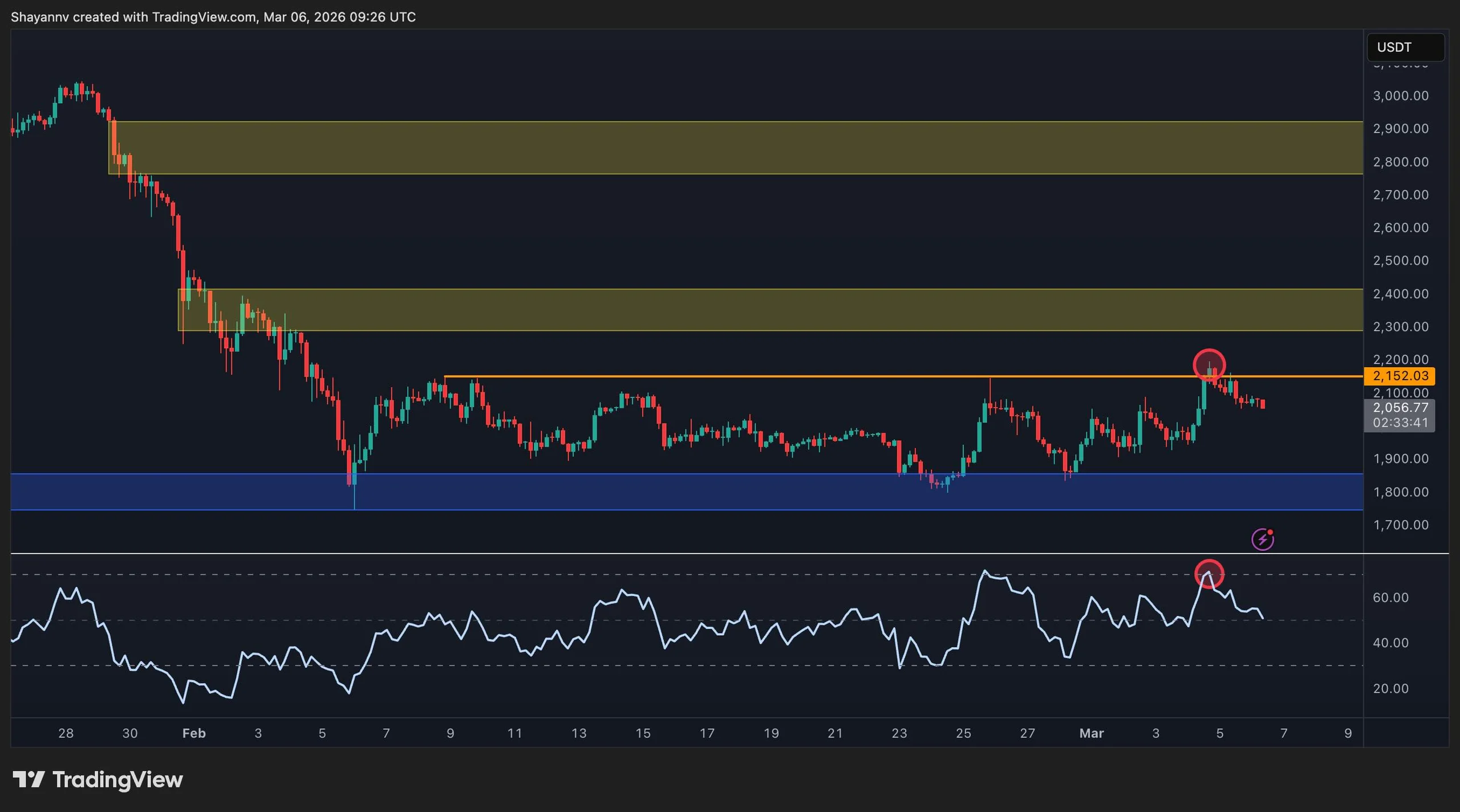
Ethereum is attempting to extend its rebound from the February lows, but the broader structure still reflects a market in recovery mode rather than a confirmed trend reversal. The next sessions should clarify whether this bounce can turn into a sustained move, or if it remains a corrective rally inside a larger downtrend.
Ethereum Price Analysis: The Daily Chart
On the daily chart, ETH remains within a descending channel and continues to trade below the major moving averages, with both the 100-day MA and the 200-day MA still acting as overhead pressure. This keeps the higher-time-frame bias cautious, as rallies into these dynamic resistance areas often attract supply unless price can reclaim them decisively.
From a level perspective, the first meaningful resistance sits around the $2,350 to $2,450 region, which aligns with prior structure and a visible supply area. A clean daily reclaim and hold above that zone would improve the outlook and put the $2,800 to $3,000 region back in play. On the downside, the $1,800 area remains the key demand zone that previously absorbed heavy selling. Losing it on a daily basis would expose the next lower band around $1,500.
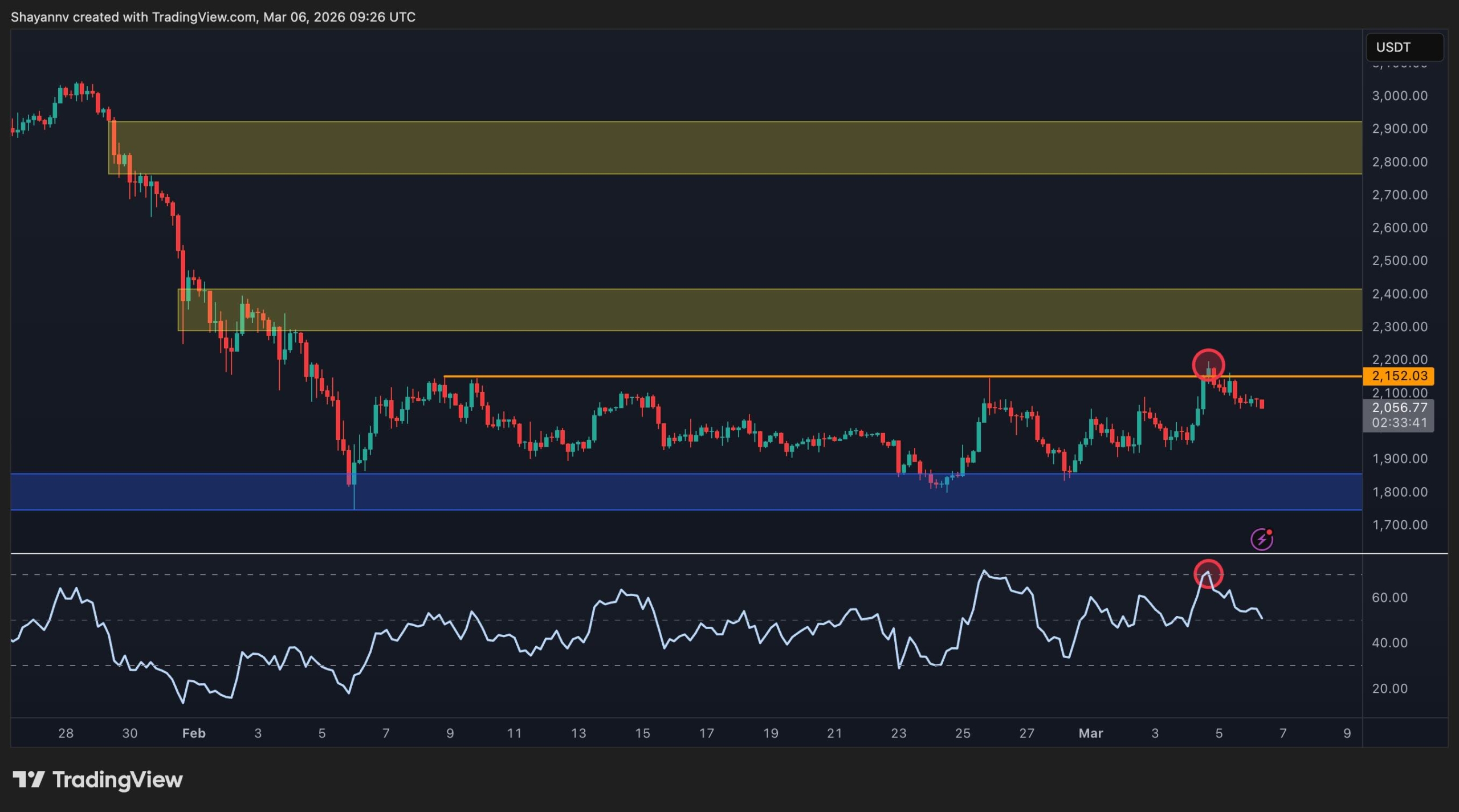
ETH/USDT 4-Hour Chart
The 4-hour chart shows ETH stabilizing after the sharp sell-off, but the price action is still capped by nearby resistance, with $2,150 standing out as the immediate pivot. Recent attempts at that level have been met with rejection, suggesting sellers remain active overhead and that buyers still need stronger follow-through to flip the short-term structure.
If ETH can reclaim the $2,150 level and then hold above it, the next upside path would likely target the $2,300-2,400 area first, as the resistance zone from the daily chart.
If the rejection continues, however, or the price fails to recover after the recent fake breakout, the focus shifts back to the $1,800 region as a short-term support, and then to the $1,600-$1,500 demand area. A break below that demand zone would materially weaken the consolidation setup and raise the odds of a much deeper continuation lower.

Sentiment Analysis
Funding rates have turned mildly positive again, indicating leverage is slowly rebuilding on the long side after the capitulation phase. This is a constructive sign if it comes alongside steady price appreciation, since a balanced funding environment often supports healthier continuation rather than fragile, overlevered pumps.
That said, the market is still vulnerable around key resistance. If ETH remains capped below $2,150 while funding stays positive, the risk of long positioning becoming crowded increases, which can lead to sharp downside wicks and forced de-risk events. The cleaner bullish scenario is a sustained push above resistance with funding staying controlled, rather than spiking higher, as that would signal demand is driving the move instead of leverage chasing it.
Binance Free $600 (CryptoPotato Exclusive): Use this link to register a new account and receive $600 exclusive welcome offer on Binance (full details).
LIMITED OFFER for CryptoPotato readers at Bybit: Use this link to register and open a $500 FREE position on any coin!
Disclaimer: Information found on CryptoPotato is those of writers quoted. It does not represent the opinions of CryptoPotato on whether to buy, sell, or hold any investments. You are advised to conduct your own research before making any investment decisions. Use provided information at your own risk. See Disclaimer for more information.
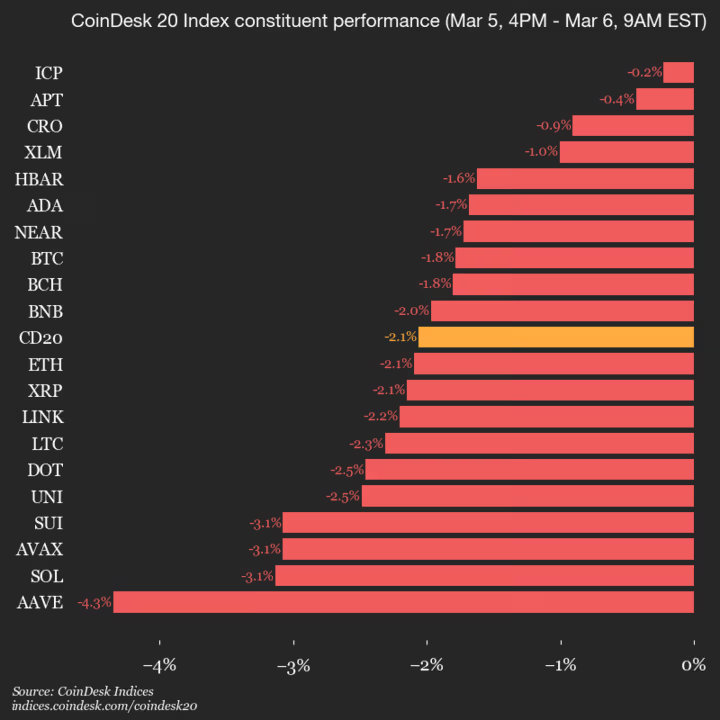
CoinDesk Indices presents its daily market update, highlighting the performance of leaders and laggards in the CoinDesk 20 Index.
The CoinDesk 20 is currently trading at 1991.98, down 2.1% (-41.93) since 4 p.m. ET on Thursday.
None of the 20 assets are trading higher.

Leaders: ICP (-0.2%) and APT (-0.4%).
Laggards: AAVE (-4.3%) and SOL (-3.1%).
The CoinDesk 20 is a broad-based index traded on multiple platforms in several regions globally.

Bitcoin (CRYPTO: BTC) cooled after marching toward a fresh high near $74,000 earlier in the week, setting up a critical debate among traders about whether the rally marks a local top or the next leg in a larger bullish sequence. The pullback comes as market participants weigh whether the current move mirrors patterns from prior cycles and what it portends for the path ahead. Notably, the market had already surged to a roughly $126,000 peak in October 2025, a reminder that outsized booms can be followed by sharp corrections. As sentiment remains mixed, analysts are scrutinizing structure, liquidity, and on‑chain dynamics to gauge the probability of renewed upside versus a deeper retracement.
Key takeaways
- Bitcoin’s current setup bears resemblance to the middle phases of prior bear markets, suggesting another potential leg down below $60,000 if buyers fail to sustain momentum.
- Several voices contend the bottom may be in, forecasting a breakout toward $75,000–$80,000 if demand persists and overhead resistance weakens.
- The move to $74,000 has been followed by caution signals, including a bearish chart pattern and persistent resistance near highs, which have sparked renewed debate about the cycle’s trajectory.
- Historical fractals from the 2022 bear market are often cited by bears as a reminder that euphoric rallies can precede severe declines, including revisits to sub-$60,000 levels.
- Commodity-style drivers such as strong spot‑BTC ETF inflows and tightening supply are cited as factors that could sustain a longer‑term rally, potentially supporting a climb toward the $75,000–$80,000 zone if conditions stay favorable.
Tickers mentioned: $BTC
Sentiment: Neutral
Price impact: Neutral. The narrative centers on potential scenarios rather than an established directional move.
Trading idea (Not Financial Advice): Hold. Given mixed signals and a lack of a clear breakout or breakdown, a cautious stance is warranted until clearer support or resistance levels emerge.
Market context: The broader market is digesting liquidity shifts and policy expectations as ETF inflows intensify and supply tightens, factors that could either reinforce a nascent rally or amplify a retest of lower levels depending on risk appetite and macro cues.
Why it matters
The ongoing tug-of-war around BTC’s price has broad implications for traders, institutions, and on‑chain participants. If the market can sustain momentum above key pivots, the narrative shifts toward a continued ascent into the mid-to-upper 70k range and beyond, potentially attracting fresh inflows from both retail and institutional players. Conversely, a failure to hold critical support could unleash a renewed wave of selling pressure, testing the resilience of buyers and reviving memories of the sharp drawdowns that defined earlier cycles.
One of the most salient factors shaping the near-term outlook is liquidity. The year has seen a divergence between price action and on-chain signals, with exchange outflows and the behavior of large holders cited by analysts as meaningful foreshadowing tools. For instance, a notable episode where substantial BTC moved off exchanges was highlighted as an indicator of potential accumulation. Observers also point to the interplay between on-chain activity and risk sentiment, noting that the absence or presence of major liquidity events often precedes meaningful price moves.
Another layer of complexity comes from the macro backdrop and regulatory considerations. As strategic investors reassess risk, the direction of ETF inflows—especially for spot BTC products—has become a barometer for institutional confidence. In this context, the current cycle’s mix of supply constraints and growing demand could tilt the market toward a more sustained rally, provided that macro conditions remain conducive and risk appetite stays buoyant. However, if macro momentum stalls or adverse developments emerge, the same structural strengths could be insufficient to prevent a retest of lower zones, underscoring the sensitivity of BTC to both investment flows and broad market psychology.
What to watch next
- BTC must hold above the $70,000 level to maintain the bullish setup; a break below could raise the risk of a reversion toward the mid-$60,000s.
- Sustained inflows into spot Bitcoin ETFs and related products would be a bullish catalyst, potentially reinforcing hands that expect higher highs in the near term.
- On-chain and market microstructure signals around the $62,000–$65,000 band will be pivotal for setting the next swing direction, as that zone is flagged by some analysts as a concentration of demand.
- Traders will be watching whether the market revisits sub-$60,000 levels in a worst-case scenario, as historical analogs have shown such levels can reappear even after renewed optimism.
Sources & verification
- Bitcoin price movements around the $74,000 high and subsequent pullback, with references to a rise toward $72k in related discussions.
- Historical context citing the October 2025 all-time peak near $126,000, used to frame the volatility of the current cycle.
- Reports of anomalous BTC exchange outflows and their potential implications for liquidity and future price action.
- Technical and chart-focused analyses that discuss patterns like death crosses and resistance levels that have influenced market sentiment.
Market reaction and key details
Market observers continue to dissect Bitcoin’s price behavior within a framework that weighs whether key milestones herald a durable pivot or a temporary pause before another leg lower. The move to approximately $74,000 has provoked a spectrum of interpretations, from calls for caution to bets on a renewed upswing. As with prior cycles, the narrative now centers on whether the current rally can sustain itself in the face of technical overheads, liquidity dynamics, and evolving macro cues.
What the data say about the near term
The fractal view—where past bear-market patterns repeat in a compressed timeline—remains a touchstone for many market watchers. Some analysts argue that the current structure mirrors the mid-phases of previous cycles, which could imply additional downside risk if the strength of the bounce fades. Others stress that the market environment has shifted through a combination of supportive factors, including tighter supply and escalating institutional interest, which could cushion against a sharp retreat.
Notable voices in the community have offered contrasting takes. One analyst highlighted that each cycle tends to form a local top before a new cycle of price discovery, a pattern that could imply a correction after the recent rally. Others point to a different dynamic this time around, arguing that the combination of liquidity pumps and on‑chain behavior may yield a higher probability of a sustained breakout. The discussion is nuanced, and the outcome will hinge on the durability of support at critical levels and the intensity of buying pressure as the market digests new information.
As part of the broader narrative, several observers emphasized the potential influence of external factors beyond price action alone. The trajectory of ETF inflows, for instance, could prove decisive in shaping near-term momentum, while shifts in risk appetite driven by macro developments will likely redefine the odds of success for a move above the $75,000 threshold. In that regard, the market remains highly sensitive to headlines and liquidity shifts, with traders adopting a careful stance until a clearer pattern emerges.
Analysts who track swing dynamics note that, even if the path stays volatile, there is a growing recognition that the market is being influenced by a broader regime shift—one where on‑ramp liquidity, speculative positions, and institutional participation interact in ways that were less pronounced in earlier cycles. The result is a more complex price landscape, where a single event or data point is unlikely to decide the outcome. Instead, market participants will likely respond to a constellation of signals, including on‑chain flows, ETF activity, and macro indicators, as they gauge whether the current cycle is setting up for a durable move or another retracement.
For now, the consensus remains mixed. The price action to date—coupled with warnings of potential sub-$60,000 revisits and the prospect of a breakout if certain levels hold—suggests that risk-managed positioning may be prudent for those navigating this period of uncertainty. The story remains about the balance of power between bears and bulls, with the outcome likely to be defined by the next few price swings rather than a single trend line.


Sam Bankman-Fried’s X account, which claims to relay the convicted fraudster’s words “through a proxy,” is now apparently spending much of its time following promoters of insider enrichment schemes.
Among those followed by the account, according to tracker service Web3 Alerts, are a robot memecoin promoter, a “chaos trader on Solana shitters,” and another memecoin trader.
Another follow claims to be “manifesting 1000x” but most probably hasn’t.
The tracker first flagged the pattern on February 26 when @SBF_FTX followed someone who claims to be a “copy trade messiah.”
Its owner openly promotes a token that’s lost one-quarter of its value in the past three months and is down 90% from its December 24 high.
The token’s description has all the hallmarks of AI slop, including run-on sentences, universality, superficiality, and a word salad of futuristic buzzwords. It reads:
“An end-to-end solution enabling agents across domains, frameworks, and specialties to work together seamlessly in a unified environment—combining custom cognitive frameworks, collaborative architectures, and intelligent integrations to enable novel ways of executing work. From business automation to creative production, users will have access to agentic-driven workflows that adapt to their needs, enabling them to streamline processes and tackle ambitious projects with more autonomy than ever before. The entire agent-powered teams can be configured, deployed, and tailored without necessitating any technical expertise. We are defining a new era in personal autonomy.”
Whoever controls Bankman-Fried’s X account also followed someone on March 5 whose bio advertises a “Trojan referal bot” (that probably follows all terms of service and spells correctly when it actually conducts those referrals).
That account promotes a Marco Rubio memecoin, “the most memeable guy right now” besides thousands of more famous people.
There are, of course, dozens of Marco Rubio memecoins with track records of near-total collapse, and a limitless supply of new, interchangeable celebrity memecoins.
Whoever is relaying Bankman-Fried’s messages from prison wants to know about them.
A proxy for prison communications
The @SBF_FTX account uses Bureau of Prisons-approved phone calls and emails to relay the prisoner’s words via tweets. Its bio reads: “SBF’s words. Posted through a proxy” and notes that follows don’t indicate endorsements.
That disclaimer does a lot of heavy lifting. In recent weeks, SBF has been re-litigating his criminal conviction in the court of public opinion. He’s serving a 25-year sentence for fraud and conspiracy after stealing roughly $8 billion from FTX customers.
Read more: SBF wants Trump to know he was working with Republicans all along
Federal inmates may not access social media directly. “A friend” manages it on Bankman-Fried’s behalf.
The follow spree from SBF’s account
All of this isn’t just disturbing, it has profound financial ramifications. Unfortunately, the @SBF_FTX account still moves markets.
For example, when it posted “gm” in September 2025, the former FTX token FTT surged 60% within minutes. Follows or mentions from the account can push real traffic toward obscure tokens, disclaimer or not.
The follow spree raises obvious, indeterminate questions. Has the convicted architect of one of crypto’s largest frauds directed his “friend” to follow memecoin promoters from a federal prison? Why is this person following a “chaos trader on Solana shitters”? Why is SBF’s account lending a million followers’ worth of credibility to coin peddlers in the first place?
Bankman-Fried took billions of dollars from FTX customers, without their consent, to trade at his offshore hedge fund, Alameda Research.
Now someone speaking for him is following the next generation of coin promoters.
Got a tip? Send us an email securely via Protos Leaks. For more informed news, follow us on X, Bluesky, and Google News, or subscribe to our YouTube channel.
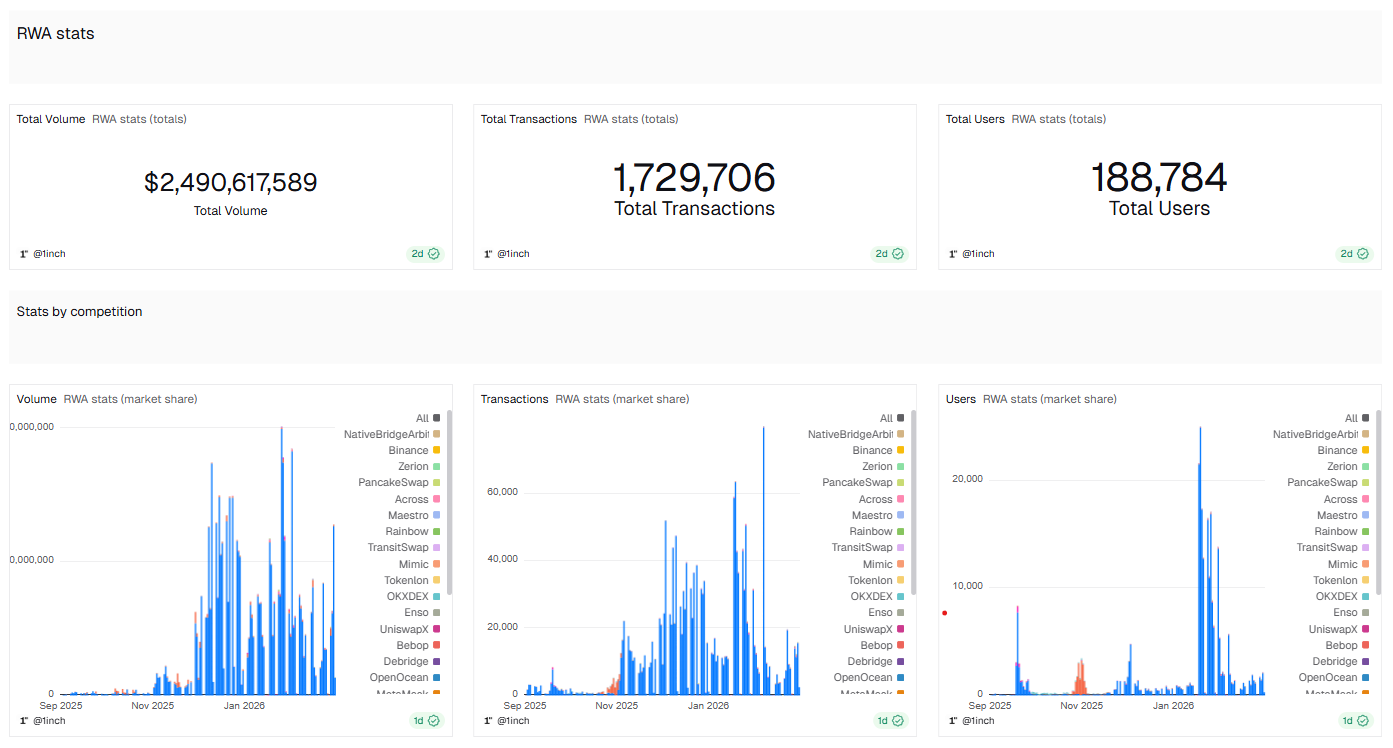
Trading volumes in tokenized stocks and exchange-traded funds (ETFs) routed through 1inch’s integration with Ondo have passed $2.5 billion since the partnership went live in September 2025.
According to data published on Dune Analytics and a release shared with Cointelegraph, real-world assets (RWAs) are now the fastest-growing volume category on 1inch. While they still account for a minority of overall flow, 1inch co-founder Sergei Kunz told Cointelegraph that “the direction of travel is clear,” and shows no signs of slowing down, despite the broader crypto slump.
Most of the activity is happening on BNB (BNB) Chain, where roughly $2 billion in related volume has been generated over 1.3 million transactions, with peak active users nearing 24,800 in a single period.

Kunz said that the combination of a low-friction user experience and massive retail distribution made BNB Chain “the natural place for RWA activity to occur,” adding that it was “happening faster and more retail-sized than on Ethereum (ETH).”
Related: MEXC expands tokenized stock offerings with new Ondo Finance listings
He added that both retail and advanced users were trading RWAs, and that the typical swap size was around $1,400, which he said showed “real capital, deployed with intent” rather than test traffic.
The most popular tokens are currently well-known traditional finance names such as Nvidia ($354 million in volume), Tesla ($332 million), Google ($249 million), and Netflix ($98 million), plus silver among non-equity assets ($225 million).
Tokenized RWAs defy slump as Ethereum nears $15 billion
The milestone comes as tokenized RWAs emerge as one of the few consistent growth stories in crypto. Ethereum’s RWA total value locked (TVL) has climbed to nearly $15 billion, up roughly 200% over the past year.
Tokenized US Treasuries have been a major driver of that growth, with a market cap that has risen by over $1 billion since the start of 2026, a roughly 50x increase since 2024, as products like BlackRock’s BUIDL fund help pull traditional fixed income onchain.
Related: Kraken’s xStocks tops $25B in volume with more than 80K onchain holders
At the same time, tokenized RWAs and the infrastructure behind them have continued to attract fresh capital. RWA tokenization projects were among the biggest winners in crypto venture funding in 2025, while onchain RWA markets climbed roughly 13.5% over 30 days during a period when the wider crypto market shed around $1 trillion in value.
RWAs to become everyday DeFi plumbing
1inch’s Ondo integration shows how aggregators are evolving into distribution rails for regulated RWA issuers. Kunz said 1inch remained non-custodial and did not issue the RWAs itself, with eligibility and jurisdictional controls enforced at the issuer level, while it focuses on routing, application programming interfaces (APIs) and disclosures.
Looking ahead, Kunz sees RWAs taking “the next leap forward” only when liquidity depth, standards and regulatory clarity align, at which point he expects tokenized assets to function as everyday “financial plumbing on DeFi” rails rather than a niche side bet.
AI Eye: IronClaw rivals OpenClaw, Olas launches bots for Polymarket

The U.S. Securities and Exchange Commission (SEC) moved Wednesday to settle its high-profile enforcement case against Justin Sun and his affiliated companies, proposing a $10 million civil penalty.
If approved by a federal judge, the judgment would dismiss all remaining claims against the TRON founder with prejudice, marking a decisive end to the years-long legal battle.
- Settlement Terms: Rainberry Inc. agrees to a $10 million penalty and an injunction against deceptive practices without admitting wrongdoing.
- Case Dismissal: All claims against Justin Sun, the Tron Foundation, and the BitTorrent Foundation will be dismissed with prejudice.
- Regulatory Signal: The deal represents a significant de-escalation by the SEC following recent leadership changes and industry pushback.
Discover: The best meme coins on Solana
SEC Deal: A $10 Million Resolution to Years of Litigation
According to a proposed final judgment filed yesterday in the U.S. District Court for the Southern District of New York, Rainberry Inc., the company behind the BitTorrent protocol, will pay the $10 million civil penalty.
The company also agreed to a permanent injunction barring it from violating anti-fraud provisions in future securities offerings. Crucially, Rainberry accepted the settlement without admitting or denying the SEC’s allegations.
In exchange for this penalty, the SEC agreed to dismiss all outstanding claims against Sun personally, as well as the Tron Foundation and BitTorrent Foundation. The dismissal is “with prejudice,” meaning the regulator cannot refile these specific charges against Sun or his foundations in the future. The agreement effectively clears Sun’s personal liability in the matter.
Sun confirmed the development on social media on today. In a statement on X, he noted that the resolution “brings closure” and declared his intention to focus on “accelerating innovation in the U.S. and around the world.”
I am very pleased to confirm that the SEC has moved to dismiss all claims against me, Tron Foundation, and BitTorrent Foundation.
Today’s resolution brings closure, but I never stopped building. I will continue to focus on accelerating innovation in the United States and around…— H.E. Justin Sun

(@justinsuntron) March 5, 2026
Context: From Celebrity Charges to Political Pivots
The SEC originally sued Sun in March 2023, alleging the unregistered sale of TRX and BTT tokens.
The regulator’s complaint was extensive, accusing Sun of directing wash trading to artificially inflate TRX volumes and orchestrating undisclosed payments to celebrities like Lindsay Lohan and Jake Paul for promotion.
Six of those celebrities settled in 2024 for roughly $400,000 combined.
This settlement arrives amid a broader shift in SEC enforcement strategy following the presidential inauguration.
Democratic lawmakers, including Rep. Maxine Waters, criticized the move in a recent letter, suggesting the agency is retreating from crypto enforcement cases involving figures with political connections.
Sun reportedly invested heavily in World Liberty Financial tokens and attended events associated with the new administration prior to this resolution.
What the Justin Sun Case Says About the SEC Now
The $10 million figure is relatively modest compared to the billions sought in other recent crypto cases. It signals that the current SEC is prioritizing case clearance over maximum punitive damages, a sharp departure from the “regulation by enforcement” era of 2023.
This shift aligns accordingly with a maturing market structure. As recently discussed on Cryptonews, the biggest winners of the next cycle may be the most regulated entities that successfully navigate the government’s requirements.
If this pragmatic approach continues, expect other stalled enforcement actions to resolve quickly in the coming months, likely with similar “no admission of guilt” structures.
Discover: The next crypto to explode!
The post SEC Moves to Settle Justin Sun of Tron Case With $10M Penalty appeared first on Cryptonews.
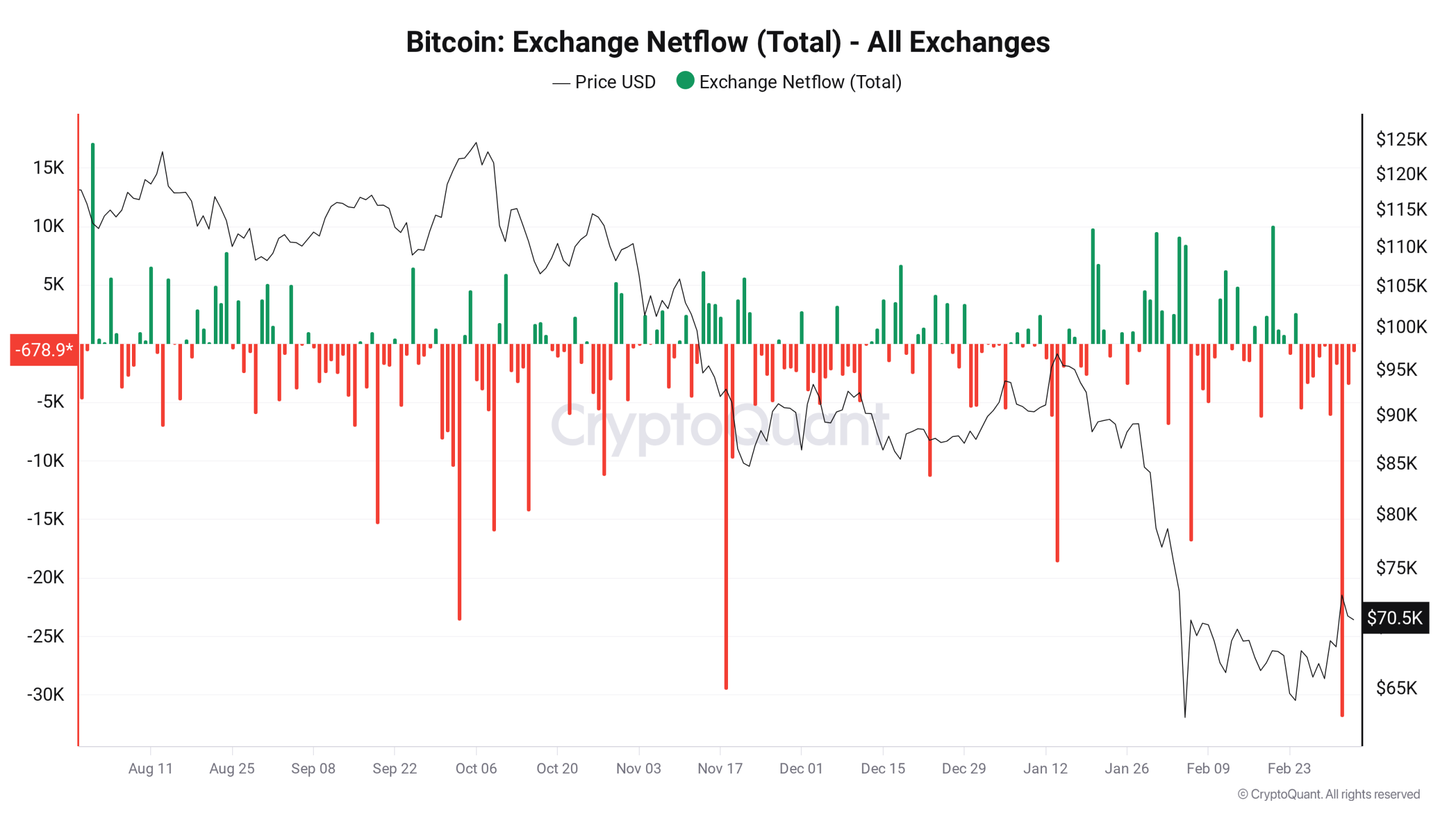
Bitcoin exchange withdrawals spiked to more than $2 billion of BTC on Wednesday, with analysis eyeing a potential major spot buy.
Bitcoin (BTC) “large-scale accumulation” is on the radar after 31,900 BTC left Bitfinex in a single day.
Key points:
-
Bitcoin exchange withdrawals spark hope of a fresh round of accumulation this week.
-
Bitfinex sees its largest daily BTC outflow since June 2025 at around 25,000 BTC.
-
Exchange stablecoin flows point to Bitcoin dip-buying.
Bitcoin withdrawal spike raises eyebrows
New analysis released on Friday by Axel Adler Jr., a contributor to onchain analytics platform CryptoQuant, confirmed that a major BTC buy occurred this week.
On Wednesday, exchange outflows suddenly spiked, with the day’s total withdrawals nearing 32,000 BTC ($2.26 billion).
“Total outflow for the week reached approximately 47,700 BTC – one of the highest weekly figures over the past year,” Adler wrote.
“The Mar 4 spike (-31,900 BTC) is anomalous: single-day events of this magnitude are most often associated with large position transfers to cold storage, though a portion of such spikes may reflect internal custodian movements.”

For the week through Friday, exchange flows were net negative every day — a phenomenon that Adler says has bullish implications for the BTC price trend.
“A sustained negative BTC netflow typically signals reduced potential selling pressure in the spot market,” he continued.
“Confirmation of the bullish interpretation will emerge if the netflow remains negative for another 3-5 days without a significant return of coins to exchanges – at that point the signal qualifies as ‘sustained accumulation.’”

CryptoQuant and CoinGlass data confirmed Wednesday’s outflow spike, with exchange Bitfinex as the venue. The outflow marked Bitfinex’s largest since June 2025.
Analysis suggests ”large spot purchase”
Stablecoin activity, meanwhile, was neatly aligned with the withdrawal, with capital flowing to exchange wallets, while BTC left, indicating buying.
Related: Bitcoin trader sees ‘lower soon’ as BTC price starts to erase $74K breakout
“In early March 2026, a large green bar (~$1.1B) was recorded – a significant liquidity inflow to exchanges – after which netflow declined to -$37.5M as of the current date,” Adler summarized.
The “anomalous” 32,000 BTC outflow thus points to accumulation at price levels around $70,000.
“This behavior is commonly observed during large spot purchases, where assets are acquired on exchange and then moved to cold custody,” the analysis concluded.
This article does not contain investment advice or recommendations. Every investment and trading move involves risk, and readers should conduct their own research when making a decision. While we strive to provide accurate and timely information, Cointelegraph does not guarantee the accuracy, completeness, or reliability of any information in this article. This article may contain forward-looking statements that are subject to risks and uncertainties. Cointelegraph will not be liable for any loss or damage arising from your reliance on this information.


The U.S. job market weakened appreciably in February, possibly putting back in play the chance of Federal Reserve rate cuts in the first half of 2026.
The country loss 92,000 jobs last month, according to Friday’s report from the Bureau of Labor Statistics. Economists had forecast an addition of 59,000 new jobs, compared with January’s gain of 126,000.
The unemployment rate rose to 4.4% versus economist expectations of 4.3%, and January’s reading of 4.3%.
Under pressure overnight ahead of the report and trading down to $70,000 as oil soared higher and equity markets dipped, bitcoin remained right around that mark in the minutes following the data.
U.S. stock index futures continue lower, with the Nasdaq down 1% and S&P 500 off 0.8%. The 10-year Treasury yield has fallen four basis points to 4.11%. Precious metals reversed an early decline, with gold now higher by 1% and silver by 2%. WTI crude oil is up 6.2% to $86 per barrel.
Ahead of this morning’s report, markets were pricing in a 95% probability that the Federal Reserve would hold rates steady at the March 18 meeting and an 85% chance of no rate cut in April.
Meanwhile, rising oil prices linked to tensions in the Middle East could add upward pressure to inflation expectations. If sustained, higher energy prices may feed into broader inflation, particularly through energy and food costs. Combined with signs that the U.S. economy may be re-accelerating, this could prompt markets to reassess the path of monetary policy.

Quick Summary
- BofA reinstated coverage with “buy” ratings for Ford, GM, and Tesla on March 4, 2026
- Price targets set at $17 for Ford (34% potential gain), $105 for GM (14% upside), and $460 for Tesla (14% upside)
- Both Ford and GM expected to capitalize on pivot away from EVs toward profitable trucks and SUVs
- Tesla’s buy rating driven primarily by robotaxi business, which BofA values at approximately 52% of total company worth
- Electric vehicle sales projected to decline over 20% in 2026 amid reduced incentives and slower manufacturer deployment
On March 4, 2026, Bank of America resumed its analysis of North American automobile manufacturers, designating Ford, General Motors, and Tesla as premier investment opportunities for the coming year.
According to analyst Alexander Perry, the automotive sector stands poised to exceed market projections in 2026. Perry cited evolving regulatory frameworks and renewed emphasis on traditional combustion engines as primary catalysts.
Ford earned a “buy” designation alongside a $17 price objective. This represents a potential 34% appreciation from the stock’s opening value on March 4.
According to Bank of America’s assessment, Ford stands in an advantageous position to capitalize on emerging U.S. regulatory shifts. The financial institution anticipates Ford will intensify its concentration on truck and SUV production, segments that deliver superior profitability compared to electric vehicle offerings.
Ford commands more than 30% of the pickup truck segment, with its F-Series maintaining its position as America’s best-selling vehicle nameplate. The automaker expanded its domestic market penetration by 50 basis points throughout 2025.
General Motors similarly earned a “buy” recommendation, accompanied by a $105 price objective — representing 14% appreciation potential from March 4 levels. GM maintains the leading position among U.S. automakers with 17.1% market share.
Electric Vehicle Momentum Slows
Bank of America indicates that both Ford and GM stand to gain as the automotive industry retreats from ambitious electrification goals. Substantial EV investments and stringent emissions regulations had compressed profitability margins over recent years.
The investment firm calculates variable profit margins for trucks and SUVs at $17,500 per unit, substantially exceeding the corporate average range of $10,000 to $12,000.
BofA projects electric vehicle sales will contract by more than 20% throughout 2026 as government subsidies diminish and manufacturers decelerate their EV deployment strategies.
Perry observed that multiple manufacturers are postponing or abandoning lower-margin electric vehicle initiatives while prolonging their internal combustion engine production timelines.
Bank of America additionally highlighted that the elimination of CAFE penalty structures and greenhouse gas emission relief measures are empowering automakers to optimize their product portfolios toward higher-margin vehicle categories.
Tesla’s Autonomous Vehicle Strategy
Tesla secured a “buy” rating with a $460 price objective, likewise representing 14% upside potential from March 4 values. BofA’s investment thesis for Tesla centers predominantly on its self-driving vehicle operations.
The firm anticipates rapid expansion of Tesla’s robotaxi network. Tesla’s autonomous taxi services currently function in San Francisco and Austin, with deployments planned for seven additional metropolitan areas during the first half of 2026.
BofA calculates that the robotaxi division comprises approximately 52% of Tesla’s overall enterprise value. While competing platforms employ comprehensive sensor arrays combining cameras, radar, and lidar technology, Tesla utilizes an exclusively camera-based system that the firm characterizes as more cost-effective and readily scalable.
Perry also identified favorable macroeconomic conditions supporting the broader automotive industry. The average age of vehicles on American roads has reached 12.8 years, while vehicle miles traveled have achieved record levels — dynamics that BofA suggests may initiate a significant vehicle replacement wave.

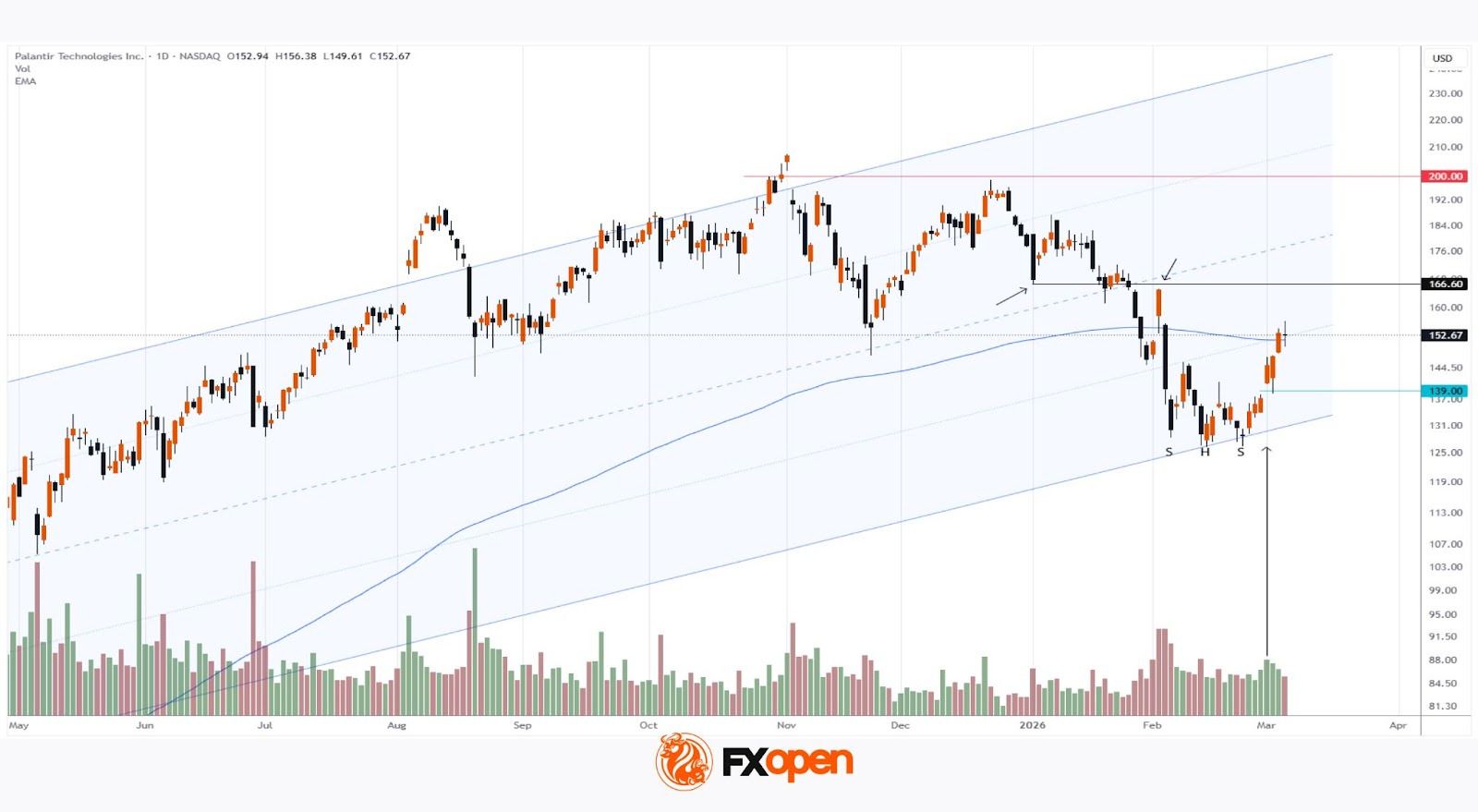
Shares of Palantir Technologies (PLTR), a company specialising in big data analytics software, have become one of the stock market’s standout performers at the start of this spring.
While the closing price on the last trading day of February was around $137, during yesterday’s session the stock climbed to $155.
Why Is PLTR Rising?
The stock’s strong performance is driven by a combination of fundamental factors, including:
→ Competitors’ problems at the Pentagon: News about temporary restrictions placed on the AI start-up Anthropic in its work with US government agencies has strengthened Palantir’s position as a reliable partner.
→ Use in the Middle East conflict: Analysts at Baird highlighted this week the ability of Palantir’s systems to operate in real time and deliver predictive analytics on the battlefield.
→ Higher price targets: Several agencies (including Zacks and Trefis) have raised their forecasts for PLTR shares amid expectations that revenue growth could reach around 78% by the end of the year.
In addition, technical factors are also playing a role.
Technical Analysis of the Palantir Technologies (PLTR) Share Price
In November 2025, we noted that the chart had taken on a bearish tone and that the $190–200 zone could act as resistance. Indeed, in December PLTR shares made a bearish reversal from that area and fell to around $130 in less than two months, breaking support near $166 (which later turned into resistance).
New data now makes it possible to outline a broader ascending channel. In this context, the price formed a bullish inverted head-and-shoulders pattern (H&S) near the lower boundary in February.
The bullish gap around the $139 level appears to represent a breakout above the neckline of the pattern, while the surge in trading volume highlights the strength of demand.
Considering that the stock has risen by more than 10% over the past week, it may now be regarded as technically overbought, making a short-term pullback a reasonable expectation.
From a broader perspective, however, the bulls’ attempt to resume the long-term upward trend in PLTR shares may ultimately prove successful.
Buy and sell stocks of the world’s biggest publicly-listed companies with CFDs on FXOpen’s trading platform. Open your FXOpen account now or learn more about trading share CFDs with FXOpen.
This article represents the opinion of the Companies operating under the FXOpen brand only. It is not to be construed as an offer, solicitation, or recommendation with respect to products and services provided by the Companies operating under the FXOpen brand, nor is it to be considered financial advice.

GloRilla Gives THICK In New Post And Fans Can’t Look Away

Celtic Illusion set for explosive show at Darlington Hippodrome

Diplomatic Advisory Hub launched in Leeds to help small businesses

Smart energy pays enters the US market, targeting scalable financial infrastructure

Why Israel is blocking foreign journalists from entering

Bitcoin: We’re Entering The Most Dangerous Phase

Antara Finansial dan Konflik, Dua Faktor yang Bikin Hubungan Retak #financial #podcastruangtunggu

This XRP Cycle Will NOT Play Out As You Expect.. – Raoul Pal

FIRE Explained: Can You Retire Early in India? The Truth About Financial Independence | The N Show
-

 Politics3 days ago
Alan Cumming Brands Baftas Ceremony A ‘Triggering S**tshow’
-

 Fashion7 days ago
Weekend Open Thread: Iris Top
-

 Tech5 days ago
Unihertz’s Titan 2 Elite Arrives Just as Physical Keyboards Refuse to Fade Away
-

 NewsBeat6 days ago
Abusive parents will now be treated like sex offenders and placed on a ‘child cruelty register’ | News UK
-
 NewsBeat6 days ago
Dubai flights cancelled as Brit told airspace closed ’10 minutes after boarding’
-
Sports6 days ago
The Vikings Need a Duck
-
 NewsBeat6 days ago
The empty pub on busy Cambridge road that has been boarded up for years
-

 NewsBeat5 days ago
‘Significant’ damage to boarded-up Horden house after fire
-

 Tech1 day ago
Bitwarden adds support for passkey login on Windows 11
-

 Entertainment4 days ago
Baby Gear Guide: Strollers, Car Seats
-
 Sports20 hours ago
499 runs and 34 sixes later, India beat England to enter T20 World Cup final | Cricket News
-
Politics6 days ago
FIFA hypocrisy after Israel murder over 400 Palestinian footballers
-
 NewsBeat5 days ago
Emirates confirms when flights will resume amid Dubai airport chaos
-

 NewsBeat4 days ago
Is it acceptable to comment on the appearance of strangers in public? Readers discuss
-

 Tech5 days ago
Viral ad shows aged Musk, Altman, and Bezos using jobless humans to power AI
-

 Video4 days ago
How to Build Finance Dashboards With AI in Minutes
-

 Business3 days ago
Guthrie Disappearance Enters Fifth Week as Family Visits Memorial
-
 Crypto World5 days ago
US Judge Lets Binance Unregistered Token Class Action Proceed
-
 NewsBeat4 days ago
Ukraine-Russia war latest: Belgium releases video showing forces boarding Russian shadow fleet oil tanker
-

 Fashion5 days ago
On the Scene at the 57th Annual NAACP Image Awards: Teyana Taylor in Black Ashi Studio, Colman Domingo in Yellow Sergio Hudson, Chloe Bailey in Christian Siriano, and More!