
Crypto World
Trump Media CEO Defends Truth API: Will Scrutiny Slow Sign-Ups?



Trump Media’s interim CEO, Kevin McGurn, defended the company’s Truth API service on CNBC Monday. He said customer sign-ups have grown to the mid-teens since the product launched on August 1.
Truth API sells high-frequency trading firms early access to President Donald Trump’s Truth Social posts. Critics say the arrangement lets paying customers trade on the president’s statements before the public sees them.
Sign-Ups Grow For Trump’s Signals
McGurn told CNBC’s Squawk Box that demand for the service came directly from the market, not from the company itself. He compared it to APIs long used by social platforms to feed trading firms, news outlets, and prediction markets.
“We’re getting into the mid-teens now, and we’re climbing.”
Kevin McGurn, CNBC
That is up from the more than 10 customer agreements McGurn cited on Trump Media’s earnings call two weeks earlier. Truth API costs up to $100,000 per month.
Congress Looking Into It
The service has drawn scrutiny from Congress and faces at least one lawsuit alleging it is unconstitutional. One federal complaint argues Trump cannot sell early access to posts the public effectively owns.
Trump holds his stake in Trump Media through a revocable trust. The structure lets him retain ownership without daily control. The company has already earned over $1 million from the service since its launch.
McGurn said Truth API also plans to expand into retail trading platforms, large language models, and prediction markets.
Whether the growing customer base outpaces the legal and political pressure remains the open question heading into the midterms.
The post Trump Media CEO Defends Truth API: Will Scrutiny Slow Sign-Ups? appeared first on BeInCrypto.

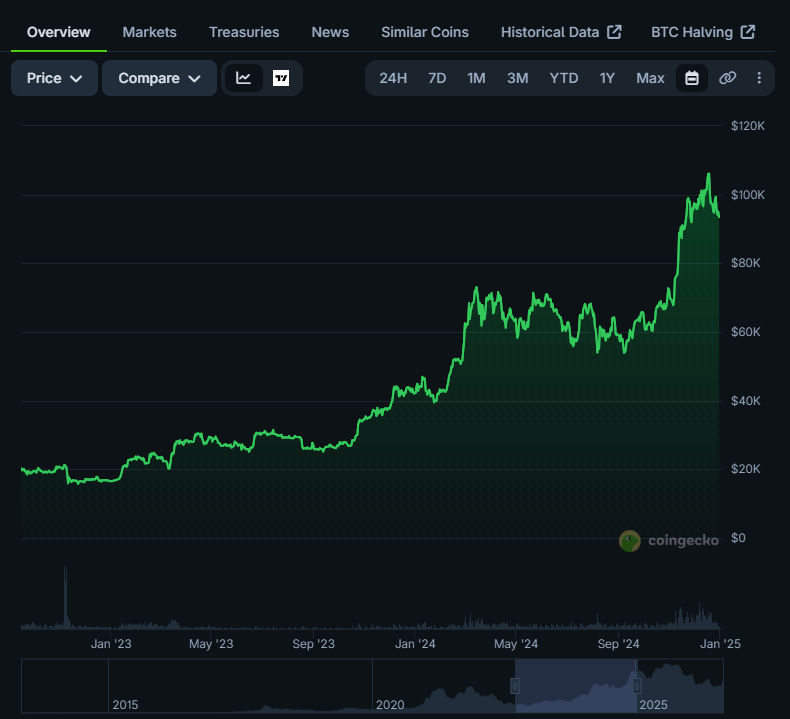
Arthur Hayes argues Treasury Secretary Scott Bessent is running the same money-printing playbook former Secretary Janet Yellen used in 2023. If the pattern holds, the math points to a six-figure Bitcoin target.
Bessent’s Treasury has already doubled long-term bond buyback operations this month. Hayes says the policy mirrors the liquidity mechanics that fueled Bitcoin’s 2023-2024 rally under Yellen.
Why Hayes Sees a Bessent-Yellen Repeat
Hayes, the BitMEX co-founder and Maelstrom chief investment officer, made a similar case in a recent Hayes interview. He argues Bessent faces the same problem Yellen did in 2023. Both face a government that keeps spending. Historically, that has forced a Treasury Secretary to defend the 10-year yield below 5%.
Yellen’s fix was shifting issuance toward short-term bills. The move drained the Fed’s reverse repo facility from $2.5 trillion to about $100 billion. That drawdown ran from mid-2023 to January 2025, when Bessent took over. That cash flowed into bank reserves and, Hayes argues, into Bitcoin’s 2023-2024 rally.

Bessent’s version of the same trade is already underway. The Treasury doubled long-term bond buybacks from $2 billion to $4 billion per operation this month. Officials are also weighing whether to tap the roughly $950 billion Treasury General Account (TGA) to fund even larger purchases.
The move briefly pushed Bitcoin to $80,000 before it slipped back near $78,800. That mirrors how quickly the bond market clawed back August’s earlier buyback rally.
The Bitcoin Math Behind the $224,000 Target
Applying Hayes’ 2023 comparison literally produces a specific target. Bitcoin traded near $26,000 in mid-2023, when Yellen’s bill-heavy issuance began draining the reverse repo facility. It peaked near $73,750 in March 2024, before the halving and spot ETF approvals added their own momentum. That’s a 2.84x move.
Applying the same multiple to Bitcoin’s current price of roughly $78,800 produces a target near $224,000. That figure is a simple calculation based on Hayes’ framework, not a number Hayes stated himself.
But, the number does carry some caveats. The 2023-2024 rally wasn’t driven by reverse repo drainage alone. Spot Bitcoin ETF approval in January 2024 and April 2024’s halving both landed in the same window. Each moved price independently of Treasury issuance mechanics. However, implicit money printing has always been a big catalyst for Bitcoin growth
Citadel Securities has also pushed back on Bessent’s buyback strategy. The firm warns the approach resembles financial repression that could weaken the dollar and stoke inflation.
Whether Bitcoin gets anywhere near that math depends on one thing.
Can Bessent’s buybacks hold up better than August’s first attempt did? Or will they fade the way the bond market rally already has twice this month?
The post If Bessent Repeats Yellen's 2023 Money Printing Playbook, BTC Math Points to $224K appeared first on BeInCrypto.


Bitcoin’s strongest weekly advance since March 2023 pushed the asset close to $80,000, but analysts said further gains may depend on easing US bond yields, continued spot ETF demand, and progress on the CLARITY Act.
Summary
- Bitcoin gained roughly 24% last week and reached a three-month high near $79,550.
- US spot Bitcoin ETFs recorded approximately $1.9 billion in weekly net inflows.
- Analysts linked the breakout to Treasury buybacks, ETF demand, and forced short covering.
- BTSE’s Jeff Mei sees $80,000–$90,000 as possible but warns of a return to $70,000.
Can Bitcoin hold near $80,000 after its strongest rally since 2023?
Bitcoin (BTC) traded near $79,800 on Aug. 24 after climbing from below $64,000 on Aug. 19. The cryptocurrency reached approximately $79,550 during the rally, its highest level since May.
The gain amounted to roughly 24% over the week, according to Gadi Chait, investment manager at Xapo Bank, making it Bitcoin’s strongest weekly advance since March 2023.
US policy developments helped trigger the move. On Aug. 19, the US Treasury announced that it would at least double the maximum size of its liquidity-support buybacks for nominal Treasury securities with maturities of 10 to 30 years.
The operations will increase from a maximum of $2 billion to at least $4 billion each, beginning Sept. 9. Markets interpreted the decision as an effort to improve liquidity in long-dated government debt after yields reached levels that weighed on risk assets.
Bitcoin also benefited from renewed expectations for clearer US crypto rules after President Donald Trump urged lawmakers to advance the CLARITY Act. The proposed legislation remains subject to action in the Senate, where its progress could provide the market with another policy catalyst.
ETF inflows strengthened the Bitcoin rally
Chait said the sources of demand behind the rally were as important as the size of the price increase.
“Approximately $1.9 billion flowed into US spot Bitcoin ETFs, providing evidence of genuine investor demand, while record short liquidations added further momentum.”
US spot Bitcoin ETFs recorded five consecutive trading days of inflows during the week ending Aug. 21. The approximately $1.9 billion total marked a sharp return of institutional demand after funds struggled to attract consistent capital earlier in the year.
The inflows also showed that forced buying in derivatives markets was not the rally’s only source of support. Traders holding leveraged short positions were liquidated as Bitcoin broke through resistance levels, creating additional market orders that accelerated the advance.
Justin d’Anethan, head of research at Arctic Digital, said changing expectations around US rates brought investors back to an asset that had underperformed for several months.
“In the case of Bitcoin, with pent-up demand and a multi-month underperformance, the trade wrote itself and algos along with sophisticated trading firms and asset managers piled back in.”
He said leveraged traders were caught on the wrong side of the breakout, producing what he described as the largest single-day short liquidation event. Profit-taking and selling from investors who had been waiting to exit could now produce a short-term pullback as the market absorbs the move.
Rising bond yields test the Treasury narrative
Jeff Mei, chief operating officer of crypto exchange BTSE, said enthusiasm surrounding the Treasury buybacks had cooled as bond yields began rising again.
“The size of these buyback operations is relatively small compared to the overall Treasuries market, which is over $30 trillion.”
Treasury buybacks are designed to support market liquidity by replacing older, less actively traded securities with newly issued debt. They do not amount to quantitative easing because the Treasury must finance its operations, while Federal Reserve asset purchases create central bank reserves.
Mei said the market would need to see whether the Treasury expands the program beyond the initial $4 billion maximum for each operation. Without an increase, the program’s effect on the broader bond market may remain limited.
D’Anethan viewed rates as the rally’s main driver, arguing that ETF flows, regulatory developments and large investor activity had failed to move Bitcoin substantially until expectations surrounding Treasury policy changed.
Chait said the macro shift also strengthened Bitcoin’s longer-term case as US government debt continued rising.
“As rising debt fuels concerns about potential currency debasement, its fixed supply and independence from any government or central bank become increasingly relevant.”
Bitcoin could reach $90,000 if US catalysts hold
Mei said Bitcoin could establish a range between $80,000 and $90,000 if the Treasury expands its buybacks and the CLARITY Act makes material progress by mid-September. A Federal Reserve rate cut or another form of monetary support could provide further upside, he added.
The scenario remains conditional because higher yields increase the relative appeal of government debt while raising borrowing costs across the financial system. A lack of new policy support or weakening ETF demand could therefore leave Bitcoin vulnerable after its rapid advance.
“Without further positive catalysts and sustained investor confidence, it’s also possible that Bitcoin could give back recent gains and fall again to the $70k mark,” Mei said.
The CLARITY Act provides another near-term US catalyst, although its passage is not guaranteed. Investors will be watching whether lawmakers move the bill forward and whether proposed rules translate into clearer conditions for exchanges, token issuers and institutional market participants.
Bitcoin charts point to a possible trend reversal
D’Anethan said bullish engulfing patterns had appeared on Bitcoin’s daily and weekly charts, while a similar monthly signal was developing but had not yet been confirmed by the candle’s close.
The patterns followed an extended period in which several momentum indicators remained in oversold territory. Their recovery may support a longer-term reversal, although the speed of the recent rally increases the possibility of consolidation or profit-taking.
Bitcoin’s immediate challenge is holding the area around $77,000 to $80,000 after reaching its three-month high. A sustained break above $80,000 would support Mei’s $80,000–$90,000 scenario, while a deeper retracement would bring $70,000 back into focus.
The mid-$60,000 range could become a broader accumulation area for long-term investors if Bitcoin fails to hold $70,000, according to d’Anethan. Near-term direction, however, will likely depend on bond yields, ETF demand and whether US policy developments produce concrete action after the initial rally.
Disclosure: This article does not represent investment advice. The content and materials featured on this page are for educational purposes only.
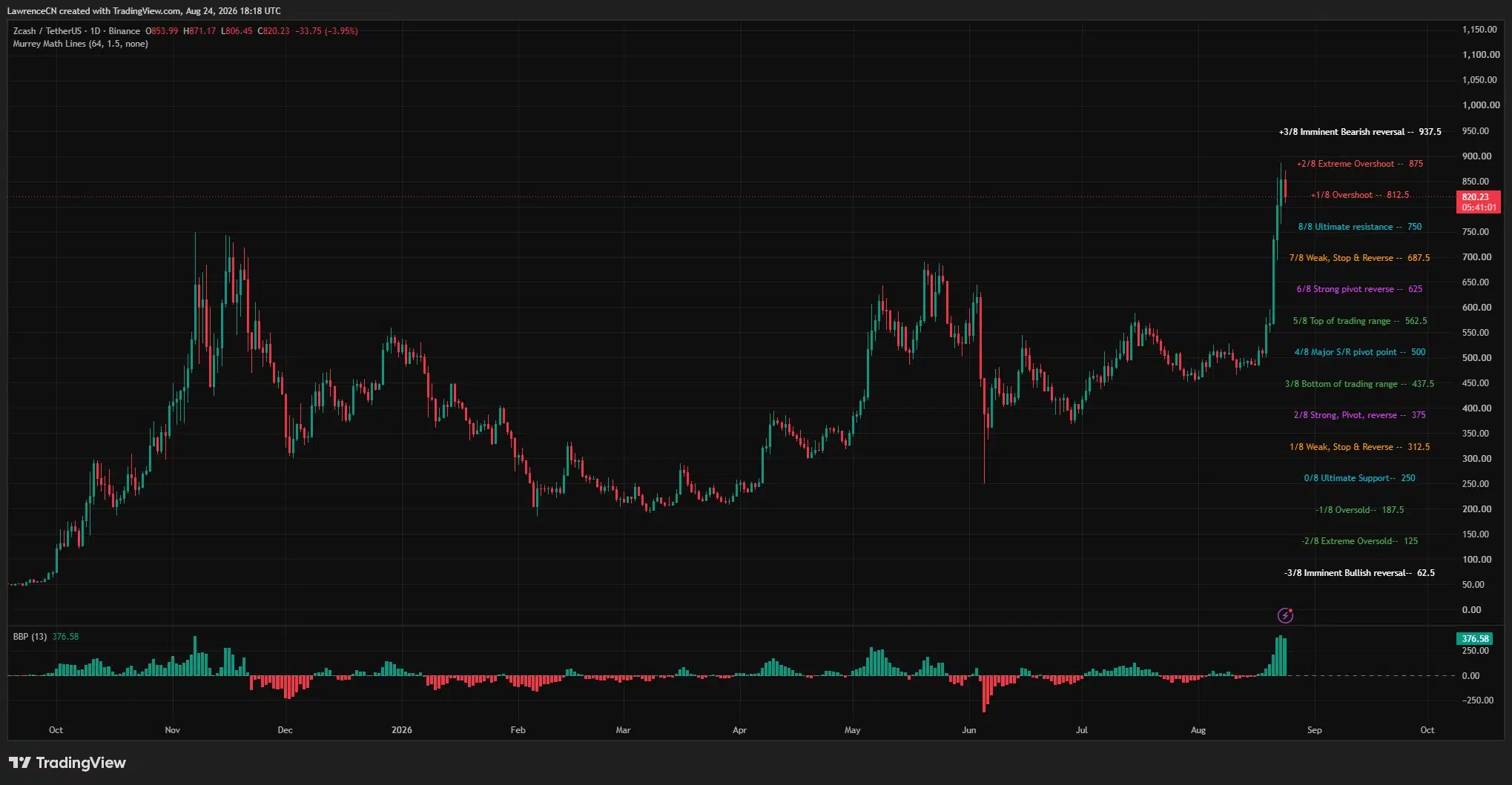
Zcash price surged more than 70% over the past week to an eight-year high near $885 before retreating below $820, as Grayscale’s ETF conversion plan and an NU7 governance vote drew traders toward ZEC.
Summary
- ZEC reached its highest price since 2018 after breaking above the major $750 resistance level.
- Grayscale’s amended filing seeks to convert its Zcash Trust into an NYSE Arca-listed spot ETF.
- NU7 voting eligibility was determined by the shielded ZEC held during an August 24 network snapshot.
- Technical charts show support near $812 and $750, while $875 remains the immediate resistance.
Zcash price pulls back after reaching $885
According to data from crypto.news, Zcash (ZEC) price traded near $820 at the time of writing after reaching approximately $885 earlier in the session, according to exchange data. The privacy coin gained more than 70% during the past seven days and reached its highest level since 2018.
The rally accelerated after ZEC cleared $562.50, which marked the upper boundary of its previous trading range on the daily chart. Buyers then pushed through successive levels at $625, $687.50, and $750.
ZEC moved as much as 77% above its August consolidation area near $500 before sellers emerged around $875. Its daily candle subsequently fell about 4%, with the price slipping from an opening level near $854 to approximately $820.
The retreat has not yet erased the wider breakout. ZEC remains above the former $750 resistance identified by Rand Group, which said the level would need to become support for another bullish wave to develop.
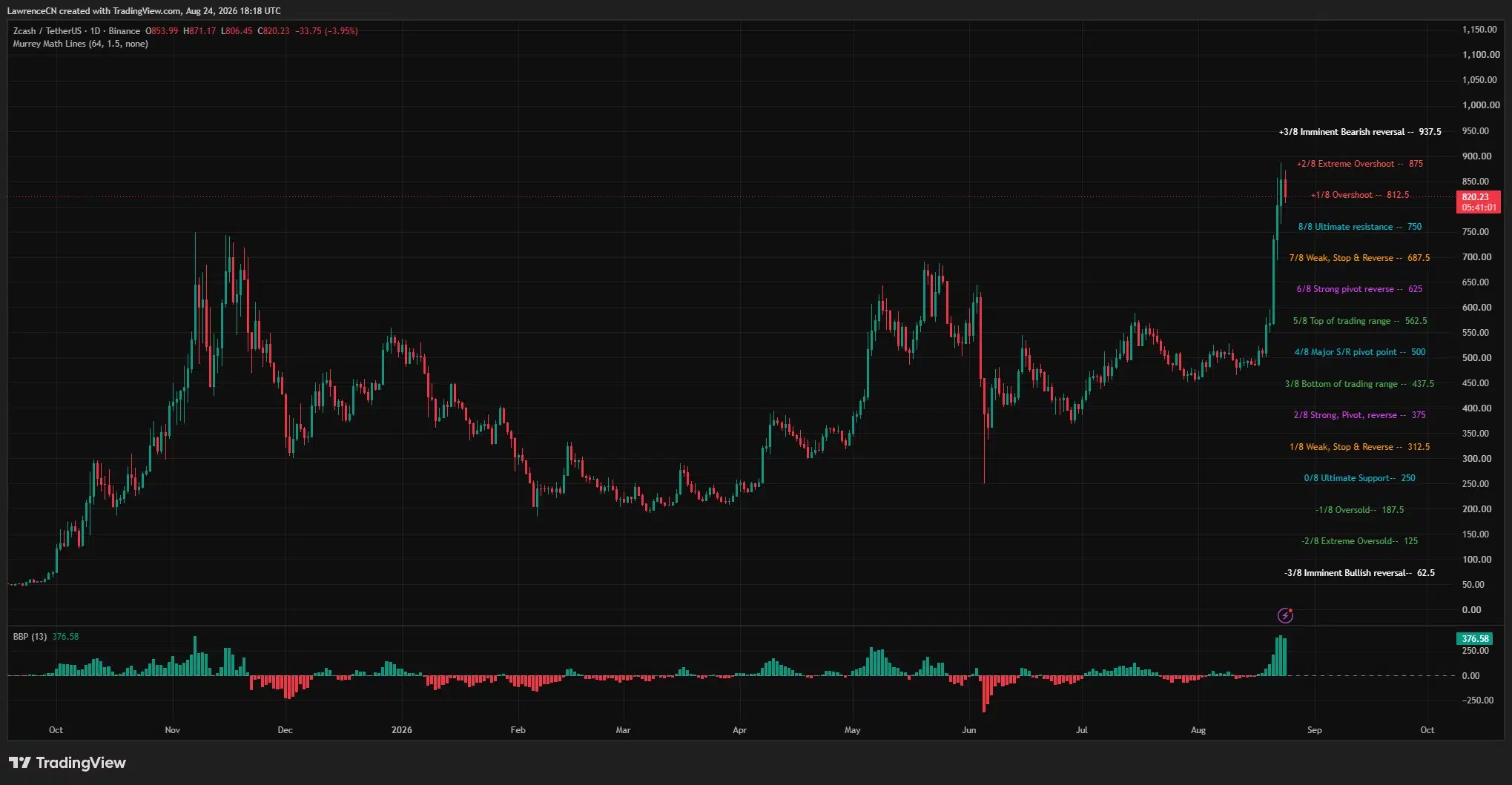
The daily Bull Bear Power reading stood at 376.58, showing that buying pressure remained elevated despite the pullback. However, the size of the indicator’s recent increase also reflects how far and quickly ZEC has moved away from its earlier range.
Grayscale ETF filing adds an institutional catalyst
The price advance followed Grayscale Investments’ latest amended registration statement for the Grayscale Zcash Trust.
Grayscale is seeking to convert the existing trust into an exchange-traded product expected to trade on NYSE Arca under the ticker ZCSH. An accompanying filing said shares were anticipated to begin trading on or around August 25, subject to regulatory approvals.
The proposed structure would give eligible US investors exposure to ZEC through a regulated brokerage product without requiring them to hold the token directly. The registration statement does not mean the SEC has approved the conversion, and the planned listing date remains subject to completion of the regulatory process.
The filing also disclosed non-binding discussions involving DCG International Investments Ltd., a Digital Currency Group subsidiary. Under the potential transaction, the company could contribute about 200,000 ZEC to the trust in exchange for shares.
At the valuation cited when the amendment was reported, the proposed contribution was worth approximately $110 million. The filing describes the transaction as being under discussion, meaning it should not be treated as a completed ZEC purchase or confirmed capital allocation.
Grayscale reported that the trust had about $263.5 million in assets under management as of August 21. The proposed conversion would bring a privacy-focused crypto asset into the US spot ETF market, although Zcash continues to face regulatory and exchange-access risks linked to its privacy features.
NU7 vote follows the Ironwood snapshot
A separate Zcash-specific event may have added demand for shielded ZEC ahead of the rally. According to the NU7 vote announcement on the Zcash Community Forum, Valar Group and Project Tachyon scheduled an approximately 18-day coinholder vote beginning August 25.
Voting eligibility was based on spendable, shielded ZEC held in the Ironwood pool at mainnet block height 3,459,350. The snapshot was expected at approximately 19:00 UTC on August 24, after which holders could move their funds without losing their voting rights.
Voting is scheduled to close on September 14 at 19:00 UTC. The process requires at least 1 million eligible ZEC to meet its minimum participation threshold, while supported wallets allow holders to vote privately and publish only aggregated results.
The ballot will help determine the scope of the planned NU7 network upgrade, including possible changes to Zcash’s issuance schedule and block-production model. The snapshot may have encouraged some holders to transfer tokens into the Ironwood shielded pool, but available data does not establish how much of the price increase came directly from voting-related transfers.
Zcash price faces resistance at $875
The 4-hour chart shows that ZEC remains above the Bollinger Bands’ middle line near $803.35. Holding that level would keep the short-term breakout structure intact, while a sustained drop below it could expose the psychological $800 level.
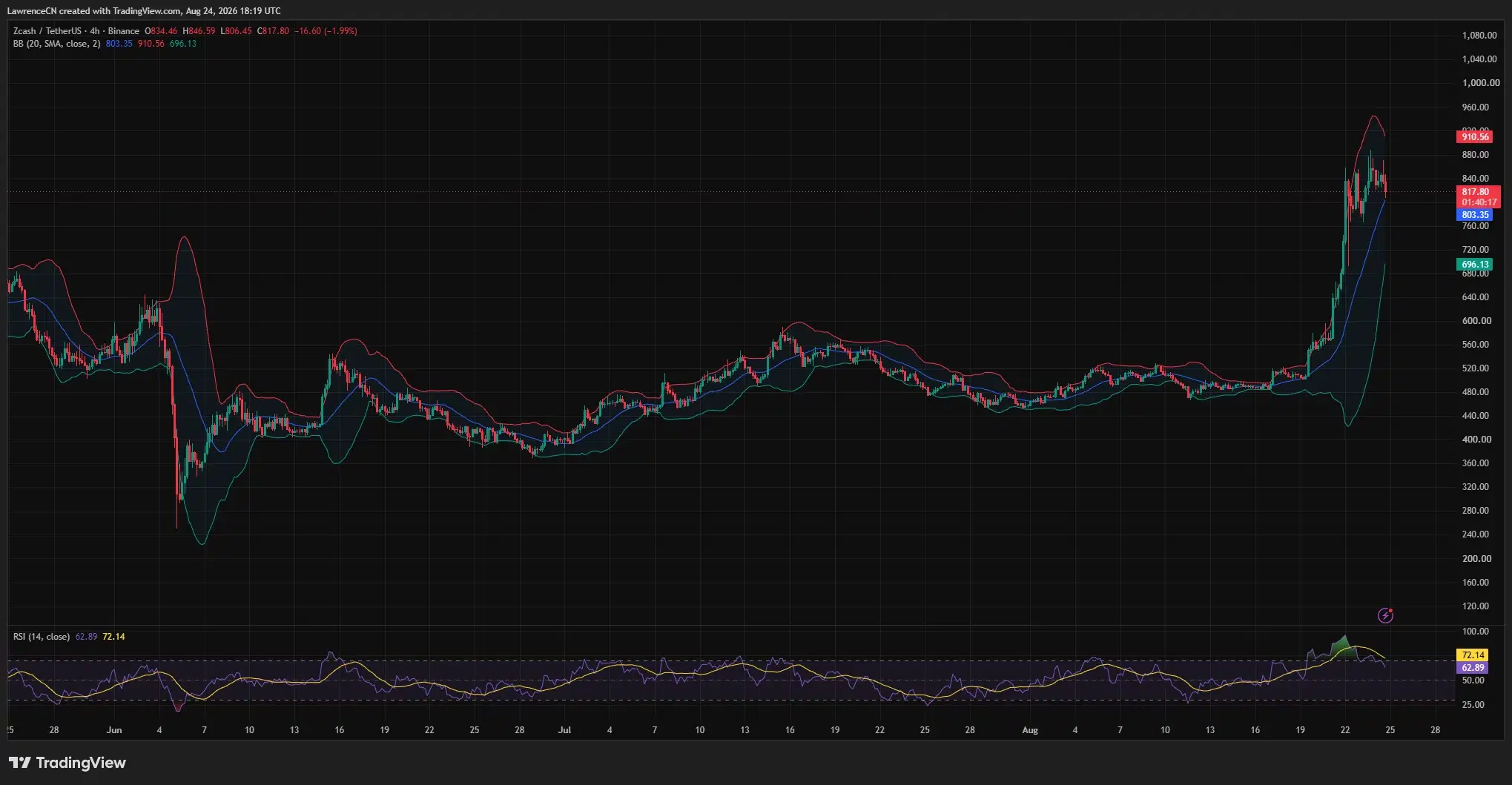
ZEC’s 4-hour Relative Strength Index fell to 62.89 after previously moving into overbought territory. The indicator’s moving average remained higher at 72.14, suggesting that momentum has cooled as the price pulled back from its peak.
The first upside barrier sits between $870 and $875. The daily Murrey Math chart marks $875 as an extreme overshoot level, while the upper 4-hour Bollinger Band stands near $910.56.
A decisive close above $875 could allow buyers to test $910 and then $937.50. The latter is identified on the daily chart as a zone where the risk of a bearish reversal may increase.
On the downside, $812.50 is the first key level to monitor. ZEC was trading only slightly above that line at the time of the chart capture, making it the immediate test for buyers after the intraday reversal.
Below $812.50, the Bollinger midpoint near $803 and the former breakout level at $750 provide the next support areas. A fall below $750 would weaken the breakout and could open a deeper correction toward $696 and $687.50.
Liquidation clusters could increase ZEC volatility
CoinGlass’ 24-hour liquidation heatmap showed concentrated leveraged positions on both sides of ZEC’s market price.
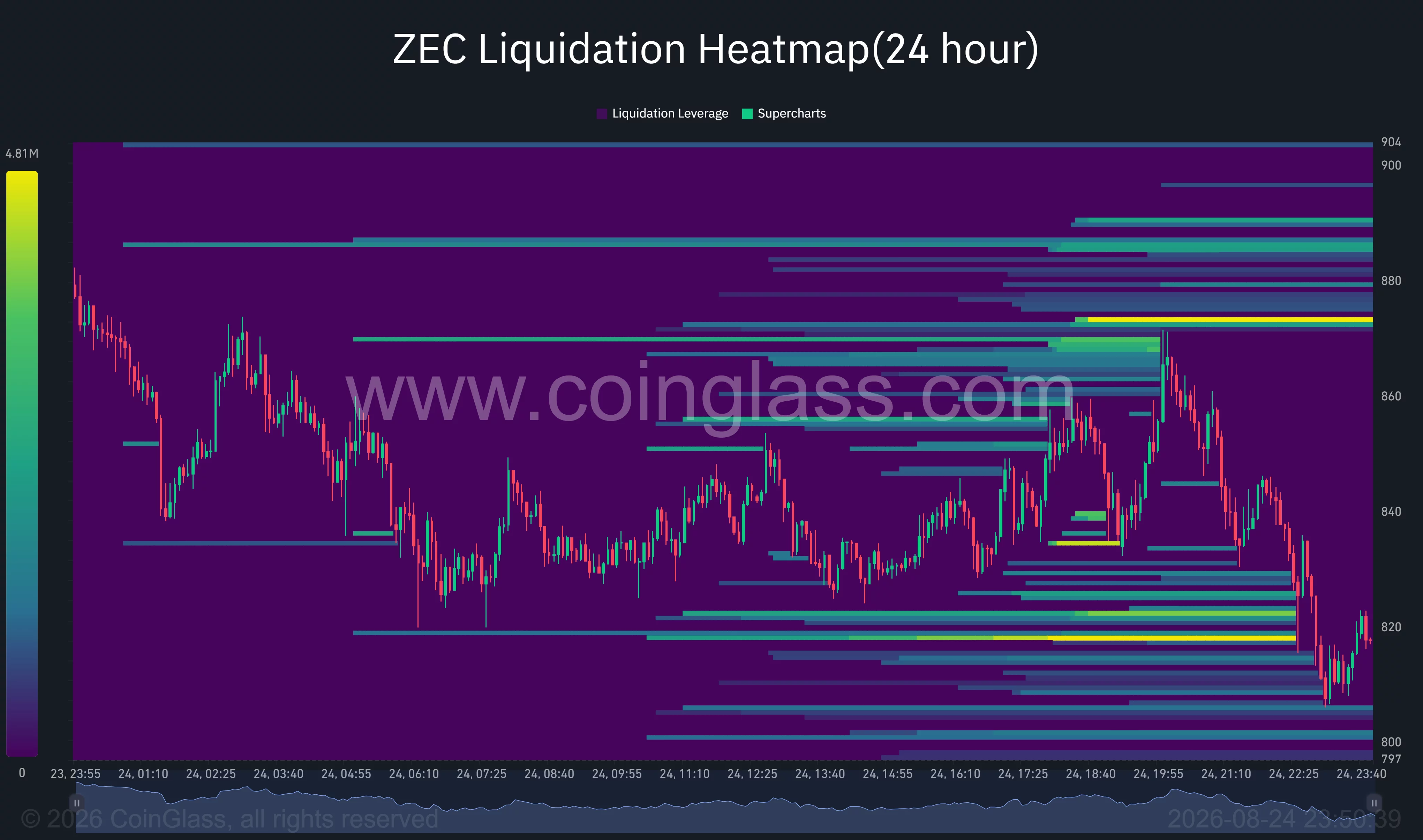
The largest nearby upside liquidity cluster appeared around $872 to $874, matching the chart’s immediate resistance zone. Additional liquidation levels were visible around $882 to $886, which could attract price if ZEC regains upward momentum.
Below the market, a strong concentration appeared near $818 to $820, with further liquidity around $808 and $800. ZEC briefly moved toward these lower clusters during its late-session decline before rebounding above $817.
Liquidation heatmaps show where leveraged positions may face forced closure, but they do not predict which level the price will reach first. With ZEC trading between dense clusters near $800 and $875 after a weekly gain exceeding 70%, a sharp move in either direction could trigger another round of liquidations.
Disclosure: This article does not represent investment advice. The content and materials featured on this page are for educational purposes only.

Elon Musk celebrated a new partnership between SpaceX and NVIDIA on Monday, confirming plans to launch an optimized Vera Rubin system into orbit as early as 2027.
Despite his enthusiasm, both companies’ stocks fell on the day of the announcement.
What Elon Musk Confirmed About the Deal
NVIDIA announced that SpaceXAI will deploy its new Vera CPU to power the next generation of agentic AI workloads, extending the chipmaker’s architecture from Earth-based data centers into orbital computing infrastructure. Musk responded directly on X.
He described Vera as the first CPU built for agents, saying it would accelerate the orchestration, code execution, and data processing that keep SpaceX’s AI agents acting fast.
“Our design is significantly simpler, lower cost, denser and lighter than a traditional rack,” Musk said on X.
Vera itself packs 88 NVIDIA-designed Olympus cores and up to 1.2 TB/s of memory bandwidth, claiming task completion times up to 1.8 times faster than comparable x86 processors.
SpaceXAI will pair the chip with NVIDIA’s broader Vera Rubin platform to scale infrastructure behind Grok toward gigawatt-level computing capacity.

Why Both Stocks Fell Anyway
NVIDIA shares fell 2.91% to $208.48, extending a rough week that left the stock down 5.95% over five sessions, according to TradingView data. The pullback comes just two days ahead of NVIDIA’s next earnings report, scheduled for August 26.
SpaceX stock declined as well. Shares of Space Exploration Technologies Corp, trading under the ticker SPCX since its June IPO, closed down 1.44% to $135, then slipped a further 0.22% in after-hours trading to $134.70.
Subscribe to our YouTube channel to watch leaders and journalists provide expert insights.

The joint decline suggests Musk’s endorsement was not enough to offset broader pressure on both names.
NVIDIA trades near its 52-week range amid ongoing concerns over memory costs and export uncertainty in China, while SpaceX shares remain well below their $135 IPO price and June peak of $225.64, still recovering from an all-time low of $104.83 hit on August 3.
Neither move appears large enough to be attributed directly to the Vera partnership alone, suggesting that NVIDIA’s upcoming earnings and SpaceX’s ongoing post-IPO volatility carried more weight with investors than Monday’s announcement or Musk’s public praise.
The post Elon Musk Praises New SpaceX and NVIDIA Partnership, Yet Both Stocks Fall appeared first on BeInCrypto.
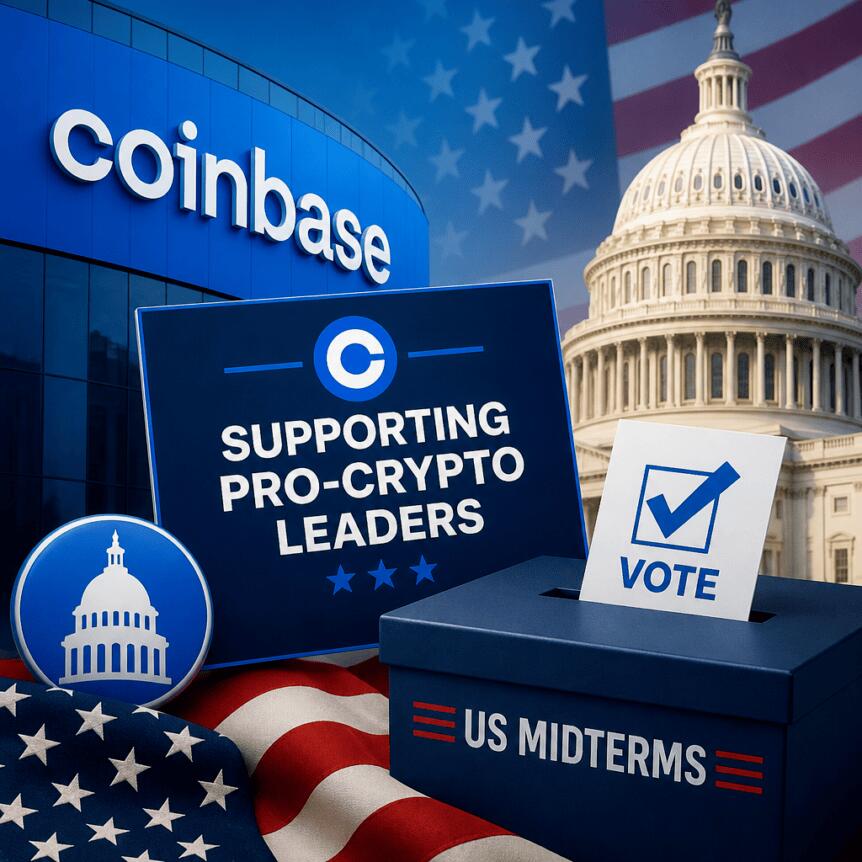
Stand With Crypto, the pro-crypto advocacy group launched by Coinbase in 2023, has endorsed 32 candidates for the 2026 US House elections, positioning the slate as part of a broader campaign to influence federal digital-asset policy ahead of the midterms.
In a notice released on Monday, the organization said its endorsements target lawmakers it describes as “proven digital asset policy champions,” with an emphasis on competitive districts where it believes its influence can most directly affect outcomes. Stand With Crypto also framed crypto voters as an increasingly dependable voting bloc during close races.
Key takeaways
- Stand With Crypto is backing 32 House candidates for the 2026 midterms based on their digital asset policy positions.
- The group says it will focus resources on winnable, competitive races where its advocacy is most likely to sway results.
- Stand With Crypto executive director Mason Lynaugh argues crypto voters could “swing” congressional outcomes as candidates look beyond traditional constituencies.
- The endorsements arrive amid uncertainty over whether the Senate will advance the Digital Asset Market Clarity (CLARITY) Act before the 2026 election.
- Recent political momentum around CLARITY includes calls from President Donald Trump to pass a “fair version,” though questions about conflicts remain in public polling.
A targeted endorsement slate for the 2026 midterms
According to Stand With Crypto, the 32-candidate program is designed to increase pressure on Washington to adopt clearer rules for digital assets. The organization’s framing suggests that endorsements are not simply symbolic, but strategically selected to shape outcomes during the 2026 House elections.
Stand With Crypto executive director Mason Lynaugh said crypto voters are now “durable” and motivated enough to matter in national politics. In his remarks, he linked the group’s push to what he described as a policy “inflection point” for digital assets in Washington—arguing that candidates from both parties may miss an important constituency if they do not engage crypto voters.
The notice also referenced how the advocacy strategy has evolved. Earlier coverage from the period surrounding its debut program noted that Stand With Crypto launched its first wave of endorsements in March. That initial slate included six candidates—three Republicans and three Democrats—each of whom advanced through their primaries to compete in November.
Crypto’s growing role in election spending and lobbying
The political emphasis on digital assets is occurring alongside rising involvement from crypto-related political spending. During the 2024 election cycle, organizations and political action committees backed by crypto companies spent more than $170 million supporting candidates they believed would be favorable to the industry, many of whom won their races, according to the organization’s statement.
Stand With Crypto also claimed that more than 270 “pro-crypto” candidates were sent to Congress in 2025, positioning its endorsement program as part of a continuing effort to shape legislative outcomes on matters affecting the sector. One example highlighted in its notice was the Guiding and Establishing National Innovation for US Stablecoins (GENIUS) Act.
For investors and market participants, the practical impact of these political efforts typically lies in how Congress responds to key regulatory questions—especially those tied to stablecoins and market structure. Even when bills move slowly, endorsement drives and campaign messaging can influence negotiations, committee priorities, and the willingness of lawmakers to take up complex rulemakings.
CLARITY’s timeline and the Senate’s decision window
Beyond election endorsements, one of the most immediate legislative uncertainties involves the fate of the Digital Asset Market Clarity (CLARITY) Act. The House passed CLARITY in July 2025 with bipartisan support, but the Senate has not advanced it in the same way. The remaining hurdles have included debate tied to ethics considerations as well as questions associated with tokenization and stablecoin rewards.
According to reporting referenced in the notice, CLARITY is expected to face a cloture motion once the Senate returns from recess on Sept. 15. However, the Senate’s calendar appears tight: the chamber would have only 14 days in session before it breaks ahead of the November election.
After the midterms, the Senate is expected to have another 22 days before 2027—creating a later opportunity for senators to return the bill to the House if additional steps are needed. If that pathway holds, CLARITY could still progress to the president for approval, but the timing remains uncertain as the election approaches.
That sequencing matters. For market participants, “delay risk” can translate into continued regulatory ambiguity—especially in areas where exchanges, custody providers, and other intermediaries want clearer rules on how digital assets fit into existing securities and commodities frameworks.
Trump’s call for a “fair version” and questions over conflicts
In the lead-up to the Senate’s next procedural phase, political attention has also focused on statements by President Donald Trump. Stand With Crypto’s broader context included references to Trump urging the Senate to pass a “fair version” of CLARITY alongside crypto industry executives.
Yet, concerns about conflicts can complicate the political environment around the bill. The notice pointed to a poll finding that a majority of Americans said Trump’s crypto investments were not “appropriate.” While public opinion does not determine legislative outcomes by itself, it can influence how senators weigh ethics arguments and how lawmakers respond to pressure from both supporters and critics.
For readers watching CLARITY, the key question remains whether the Senate can align its procedural path—including any amendments or debate around tokenization and stablecoin rewards—within the brief pre-election window. If senators do not move quickly, the legislative timetable may effectively shift the decision toward the post-midterm period.
As the 2026 campaign cycle ramps up, Stand With Crypto’s endorsements will likely serve as one signal of where the pro-crypto policy push is concentrating its political leverage. The most important thing to watch next is whether the Senate can progress CLARITY before the election, or whether the bill’s fate is deferred into the longer 2027 timeline—leaving market participants to navigate continued regulatory uncertainty.


The European Central Bank (ECB) is defending the privacy design of its planned central bank digital currency (CBDC).
In an Aug. 10 interview published Monday, ECB Executive Board member Piero Cipollone said the digital euro’s design would limit the amount of transaction information available to the central bank.
“The Eurosystem would not be able to identify the users making or receiving payments,” Cipollone said.
Cipollone said only banks involved in transactions would be able to identify users, including for anti-money laundering purposes, while the Eurosystem would not be able to directly link specific individuals to digital euro payments. Meanwhile, offline digital euro transactions would allow payment details to be available only to the payer and payee.
Despite the ECB’s efforts to quell privacy concerns over the planned digital euro, lawmakers, privacy advocates and crypto community members have warned that government-issued digital currencies could expand financial surveillance.
In the US, President Donald Trump prohibited federal agencies from developing or promoting a CBDC in January 2025, citing risks to financial stability, individual privacy and US sovereignty. House lawmakers have separately advanced the Anti-CBDC Surveillance State Act, which seeks to prohibit the Federal Reserve from issuing a CBDC.
Related: ECB picks 36 payment providers to test digital euro ahead of 2027 pilot
Digital euro pitched as payment sovereignty tool
Beyond privacy, the ECB has presented the digital euro as part of Europe’s effort to strengthen its payments infrastructure and reduce reliance on non-European payment providers.
In an April public lecture held in Latvia, Cipollone said that Europe’s reliance on non-European payment providers creates a strategic vulnerability. He said two-thirds of euro-area card transactions are governed by non-European companies, and that the digital euro could reduce that dependence and provide European-controlled payment infrastructure.
The European Parliament’s Economic and Monetary Affairs Committee backed its position on the digital euro legislation in June, while lawmakers later cleared the proposal for negotiations with the Council in July.
The ECB has said a digital euro could be issued as early as 2029, provided the necessary legislation is adopted and the project clears its remaining technical and operational stages.
Magazine: The digital euro: Surveillance money, or a better alternative to cash?


The Securities and Exchange Commission (SEC) has sent subpoenas to major Wall Street banks over their dealings with Situational Awareness, the artificial intelligence (AI) hedge fund that nearly collapsed last month.
Three people briefed on the outreach described the requests to the New York Times. Regulators want trade timing data and lender communications. The fund has not been accused of wrongdoing.
SEC Investigation Targets the Leverage Paper Trail
The subpoenas went to banks that cleared the fund’s trades and financed its positions. Bank of America, Citi, Goldman Sachs, and JPMorgan Chase ranked among its largest counterparties, according to a regulatory filing.
Investigators asked for the timing of specific trades. They also requested messages the banks exchanged with the fund about borrowed money, and told them to preserve every record tied to the San Francisco firm.
All four banks declined to comment. So did the SEC. A Situational Awareness spokesman said scrutiny of this kind was predictable.
“It is to be expected that regulators would closely examine any funds that are high profile, produce significant returns or have particularly dramatic drawdowns,” Situational Awareness said in a statement.
The timing lands as bank executives flag hidden borrowing across markets. JPMorgan chief Jamie Dimon warned this month that margin debt hit records.
A $30 Billion Book That Unwound in Days
At its peak the fund ran more than $30 billion and borrowed tens of billions more. Leopold Aschenbrenner, a 24-year-old former OpenAI researcher, founded it roughly two years ago.
Filings show the strategy turned far more aggressive before it broke. Protective put options worth $8.5 billion in March had largely disappeared by June 30, replaced by $12.5 billion in outright long positions.
AI names then dipped in late July while the traditional tech stocks the fund had shorted climbed. Margin calls followed, the portfolio fell about 67%, and Citadel bought the public book at a roughly 10% discount.
Bitcoin Miners Were Caught in the Middle
Crypto investors absorbed part of that unwind without knowing it. Mining stocks had grown to a quarter of the book, reaching $1.99 billion in the final 13F filing.
Core Scientific, Riot Platforms, and IREN led those positions. Ken Griffin’s firm has since cleared the miner overhang through nearly 100 block trades.
Any SEC investigation at this stage may never produce a case. The documents it gathers, however, could show how long the banks funded one concentrated AI bet before withdrawing credit.
Situational Awareness still holds a stake in Anthropic, which is weighing a public listing. That position now stands as the clearest measure of what survived July.
The post A $30 Billion AI Fund Implodes, Now the SEC Is Investigating Wall Street’s Role appeared first on BeInCrypto.
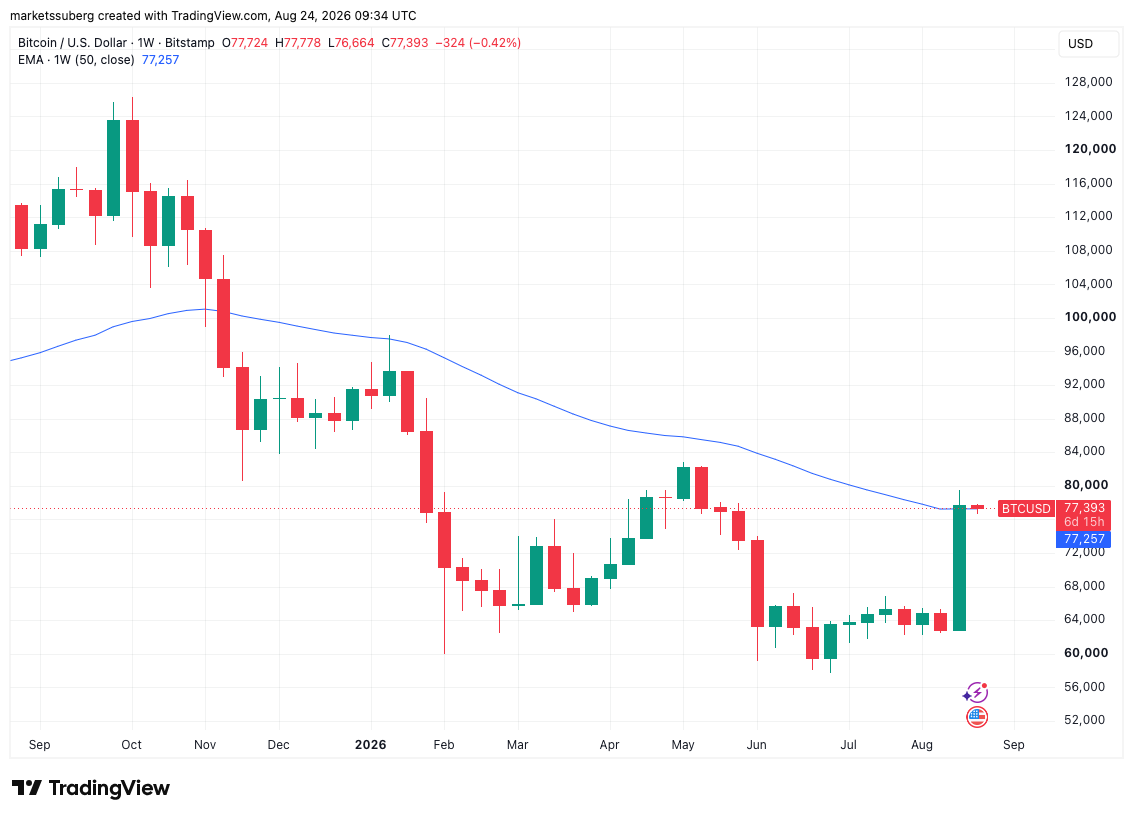
Bitcoin (BTC) starts the final week of August near its highest levels since mid-May as its bear-market recovery reaches a critical stage.
Key points:
- Bitcoin sees a weekly candle close above its 50-week exponential moving average (EMA) for the first time since November 2025.
- Amid its best August gains in almost a decade, BTC/USD returns investor cohorts to net profit, while new money enters at $73,000.
- Fed chair Kevin Warsh is in the spotlight ahead of the Jackson Hole symposium.
- US PCE data will be released on Wednesday as markets continue to respond to last week’s US Treasury debt buyback.
- Investor capital returns to exchange-traded products as Bitcoin ETF netflows hit $1.9 billion last week.
Bitcoin scrapes weekly close above key resistance
Bitcoin reached $79,550 last week, its highest levels since early May as a five-day rally brought gains of up to 27%. BTC/USD closed last week at $77,727 on Bitstamp, per data from TradingView. This signified a reclaim of its 50-week exponential moving average (EMA), a key resistance trendline that currently sits at $77,752.
The 50-week EMA is commonly brought into focus by traders during Bitcoin bear markets. The last candle close above this crucial line of resistance was in early November 2025. In prior bear markets, BTC has retested the 50-week EMA before capitulating into its ultimate macro lows. This has meant some traders remain unconvinced by last week’s strong price action.
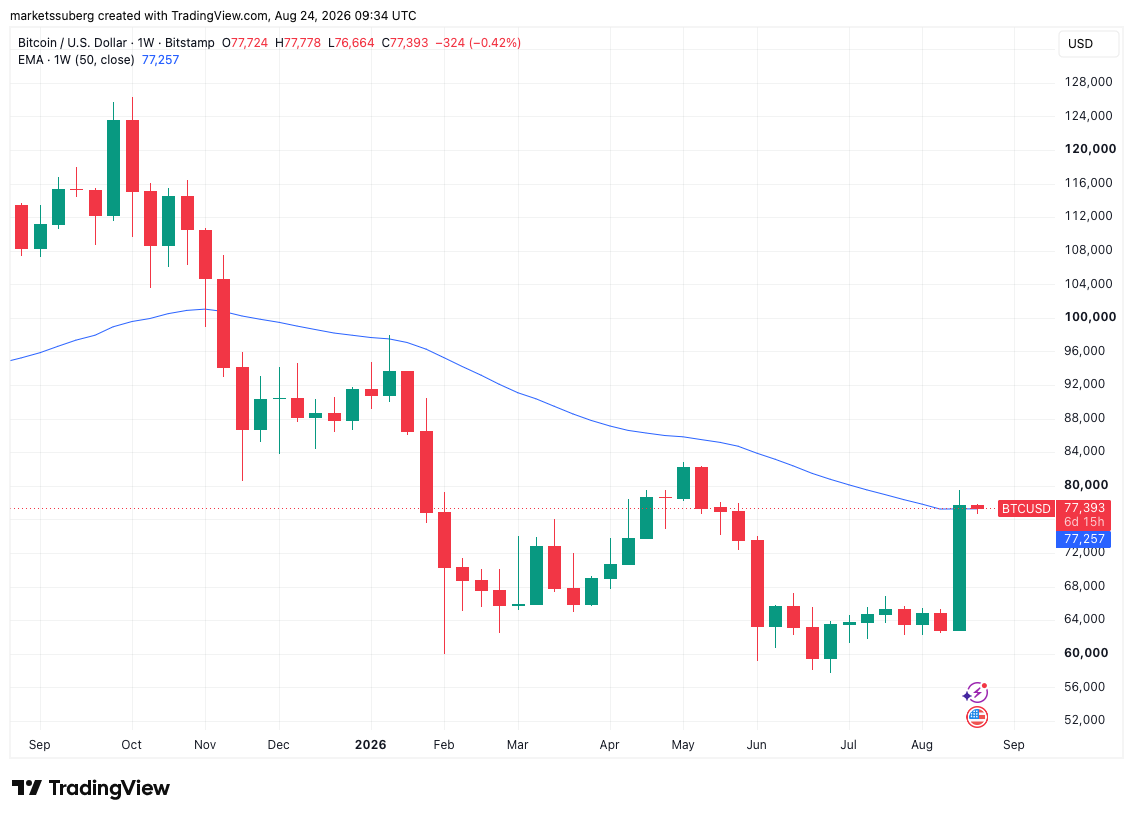
BTC/USD one-week chart with 50 EMA. Source: Cointelegraph/TradingView
Prior to the close, crypto trader and analyst Rekt Capital warned that not only the 50-week EMA but the entire area around $80,000 figured as resistance for bulls to overcome, while price so far has topped out lower.
“Each Bear Market Relief Rally thus far would retrace sharply in the week following a strong breakout rally,” he wrote in ongoing X analysis.
“Next weeks will be crucial. But maybe even already next week we’ll know whether Bitcoin can sustain these highs or not.”
An accompanying chart showed what Rekt Capital subsequently called a series of macro lower highs, potentially reinforcing the bear market despite recent strength.
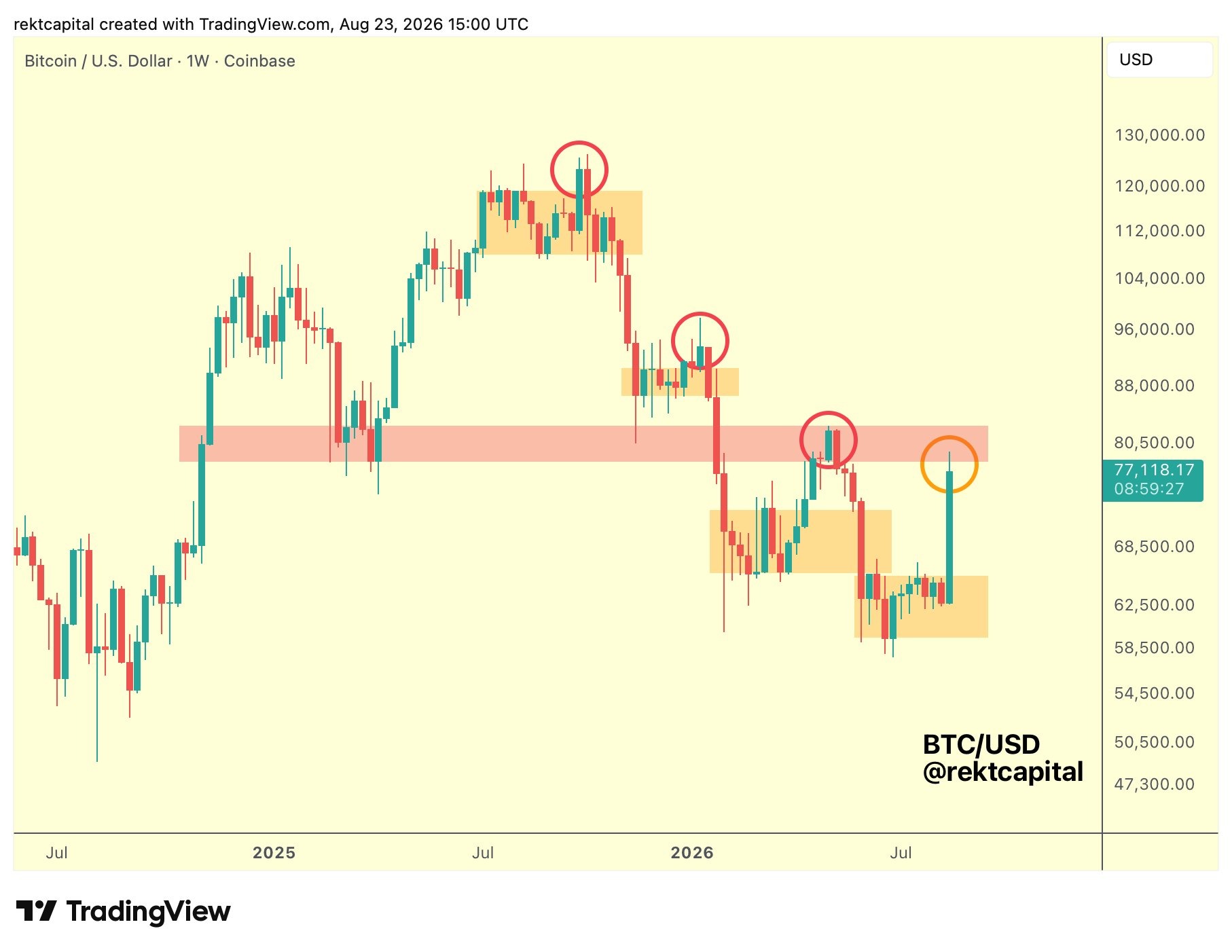
BTC/USD one-week chart. Source: Rekt Capital on X.com
Earlier, Cointelegraph reported on traders’ expectations of 2026 playing out in a similar manner to previous bear markets, with 2022 showing the most similarities in terms of timing.
“If history repeats, Bitcoin will try to get as close as possible to ~$93,000 in 2027. But first, Bitcoin needs to fully confirm its Bear Market bottom and fully confirm a break of the Macro Downtrend,” Rekt Capital added.
BTC price on track for best August in nine years
Bitcoin consolidated over the weekend, with price circling $77,500 at the time of writing, still up 22% month-to-date in its best performing August since 2017, per data from CoinGlass.
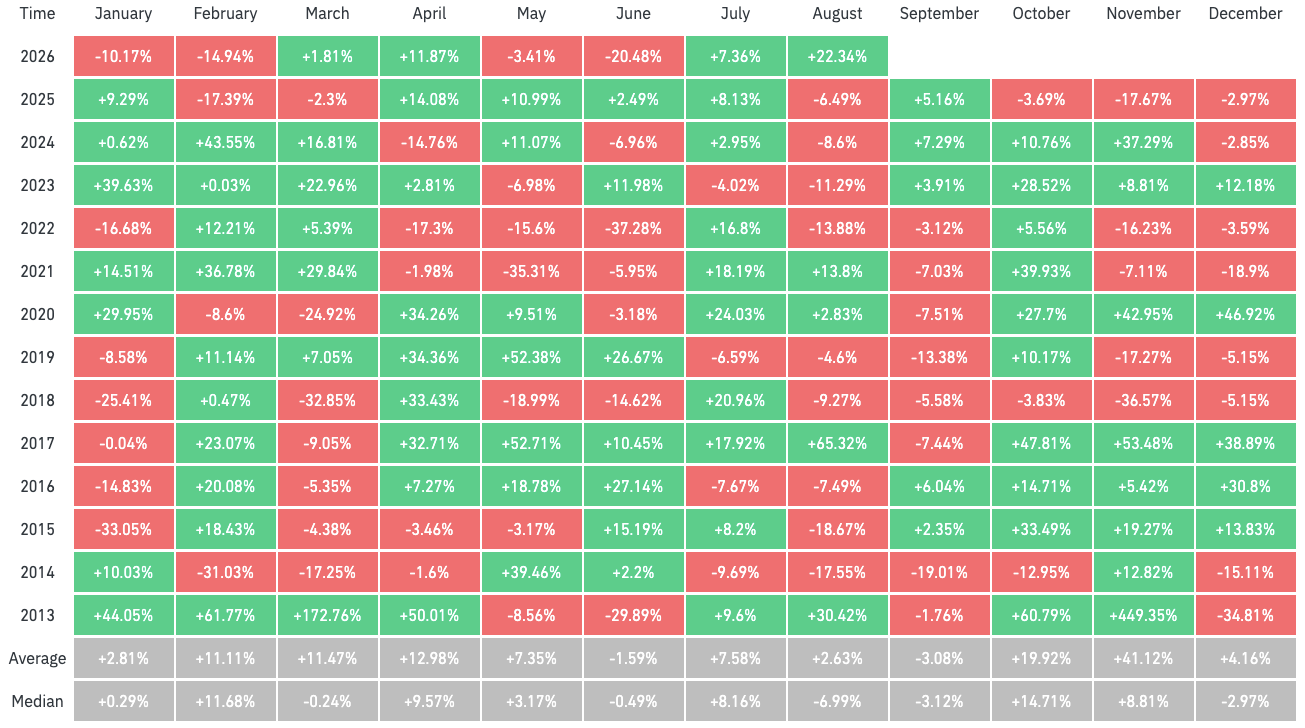
BTC/USD monthly returns (screenshot). Source: CoinGlass
The run-up saw the weekly candle reclaim several key price points, including the aggregate cost basis for short-term holders (STHs) — wallets holding a UTXO for less than 155 days — at $68,700. Onchain analytics platform CryptoQuant thus calculated STH net profitability at just over 11%.
“At the same time, Long-Term Holder profitability moved from approximately breakeven to +18.5%, while New Money profitability rose from -1.4% to +12.7%,” it reported on Monday.
Examining the cost basis of UTXOs as a whole, CryptoQuant noted that so-called “new money” now has a breakeven point at $73,000, above both the STH and LTH cost basis, leaving less margin for downside protection should BTC/USD reverse to attempt to find new support lower.
“That makes the 68K-73K region the key area to watch. Holding above it would suggest that the profitability reset is becoming structurally durable. Losing it would quickly push a large portion of recent buyers back into loss,” it added.
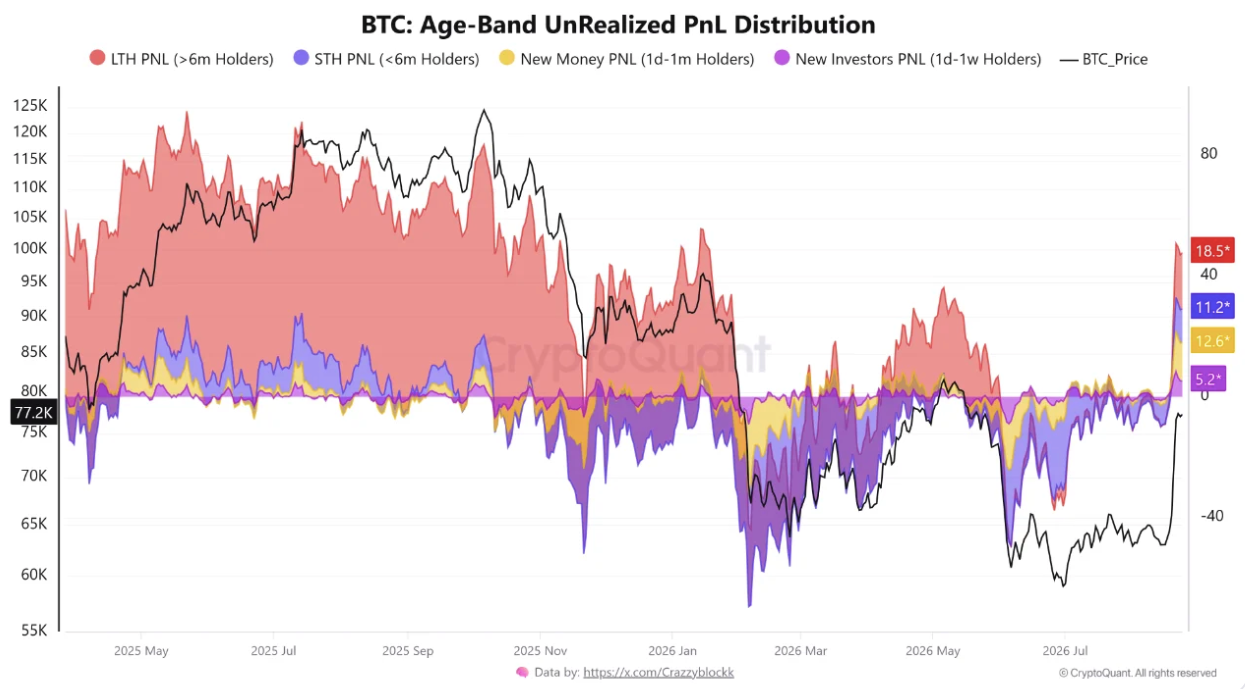
Bitcoin UTXO distribution by cohort age (screenshot). Source: CryptoQuant
Fed’s Warsh faces the music at Jackson Hole
All eyes are on the Federal Reserve and chair Kevin Warsh this week as the annual Jackson Hole economic symposium gets underway.
The event, which will feature central bankers from over 70 countries, sees Warsh’s first keynote speech as Fed chair and his first public speaking appearance since the press conference that followed the July Federal Open Market Committee (FOMC) meeting.
Warsh has maintained a tight-lipped stance on financial policy, especially when it comes to future interest-rate changes — a topic to which crypto and risk assets are sensitive. Recent inflation data has supported a softening of policy going forward, but the ever-present threat of oil-price spikes from the US-Iran war has kept markets wary.
The latest data from CME Group’s FedWatch Tool shows 63.1% odds of rates remaining at their current 3.50-3.75% level after the September FOMC meeting.
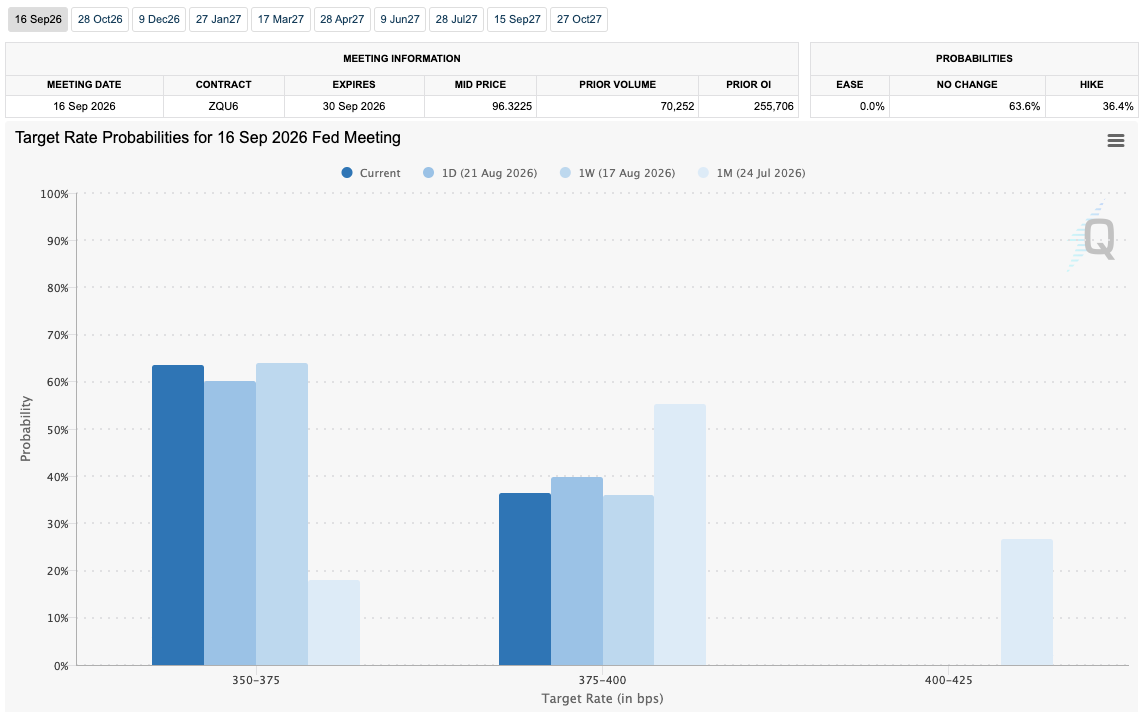
Fed target-rate probability comparison for September FOMC meeting (screenshot). Source: CME Group
Speaking to CNBC last week, Thierry Wizman, global foreign exchange and rates strategist at Macquarie Group, warned that Warsh now had to juggle the influence of the Treasury with his plan to reduce the market involvement of the Fed.
Wizman told the network that “were Warsh to signal that he would stay ‘dovish’ indefinitely, it could be self-defeating for him and the Treasury, since inflation breakevens would rise further, perhaps undoing the stability in the nominal long-term yields that [Treasury Secretary] Scott Bessent is trying to achieve.”
A survey of fund managers by Bank of America, quoted by Barchart and others, produced 72% odds of no rate hikes occurring before the US midterm elections in November. On policy, consensus coalesced around a “no landing” scenario over the next 12 months — where the economy avoids recession amid strong growth and low unemployment.
Yield curve control talk returns after Treasury debt move
Beyond geopolitics, a move by the US Treasury last week to at least double the size of its debt buyback purchases to $4 billion per operation was the key market mover last week. The announcement sparked a Bitcoin short squeeze that went on to wipe out a record $3.1 billion of crypto short positions over two days.
The extent of the reaction sparked suggestions that Bitcoin was once again anticipating global liquidity-regime changes amid the rising cost of government debt financing worldwide.
“The intervention ignited a move in assets sensitive to the outlook for liquidity, including gold and Bitcoin. That hints at market concerns over currency debasement should measures like quantitative easing make a return to contain interest rates,” trading resource Mosaic Asset Company wrote in the latest edition of its regular newsletter, The Market Mosaic.
Mosaic argued that the intervention represented not a mere liquidity move but a form of yield curve control (YCC), with short-term bonds issued to cover the cost of the added buybacks. Crypto commentators have long expected YCC to be all but guaranteed to prevent government bankruptcy.
“YCC is the end game. When it is finally implicitly or explicitly declared, it’s game over for the value of the USD vs. gold and more importantly Bitcoin,” Arthur Hayes, former CEO of crypto exchange BitMEX, forecast in a 2022 blog post.
“YCC is how we get to $1 million Bitcoin and $10,000 to $20,000 gold.”
The day prior to Warsh’s appearance, meanwhile, brings a crucial piece of US macroeconomic data that could skew the mood for markets.
The July print of the Personal Consumption Expenditures (PCE) index, due for release on Wednesday, is known to be the Fed’s “preferred” inflation gauge. In June it saw its first month-on-month drop since 2020.
Consensus around the upcoming print is for a 0.1% monthly increase, with the year-on-year increase cooling further to 3.6% versus 3.7% in June.
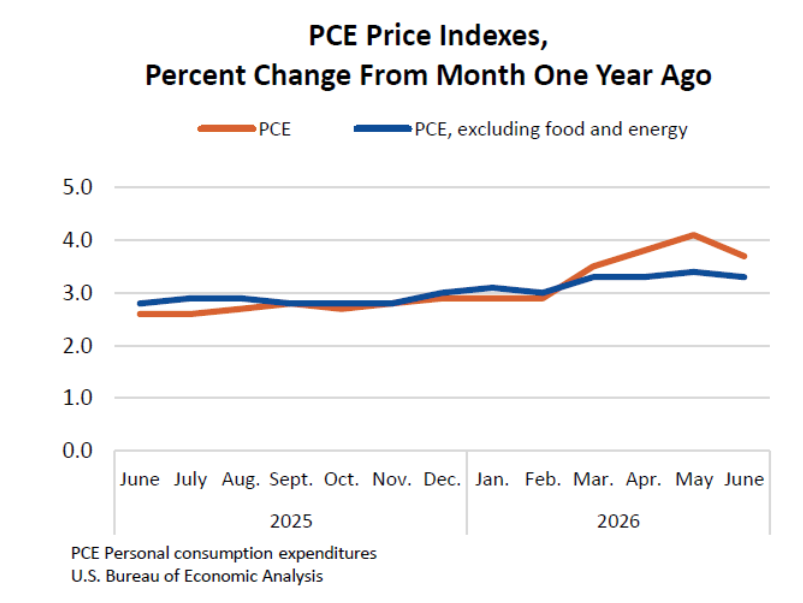
PCE index one-month % change (screenshot). Source: US Bureau of Economic Analysis
Bitcoin ETFs see strongest inflows in 10 months
Crypto fund inflows remain highly reactive to price volatility, with last week’s inflows to the US spot Bitcoin exchange-traded funds (ETFs) breaking records.
Related: Bitcoin has ‘largely purged’ froth that preceded 50% drop from $126K: BlackRock
Data from UK-based investment company Farside Investors shows the ETF cohort taking in $1.9 billion over the week’s five trading days — the strongest weekly tally since October 2025, when Bitcoin hit its latest all-time highs of $126,200.
Thursday saw particularly strong performance as BTC/USD extended gains beyond $70,000, with BlackRock’s ETF, the iShares Bitcoin Trust (IBIT), seeing net inflows of more than half a billion dollars.
“We saw net inflows on every trading day last week, which suggests renewed investor interest in Bitcoin,” Gracie Lin, chief executive officer of crypto exchange OKX SG, told Bloomberg.
“The question now is whether that momentum will hold. After such a strong move in Bitcoin, some profit-taking wouldn’t be surprising.”
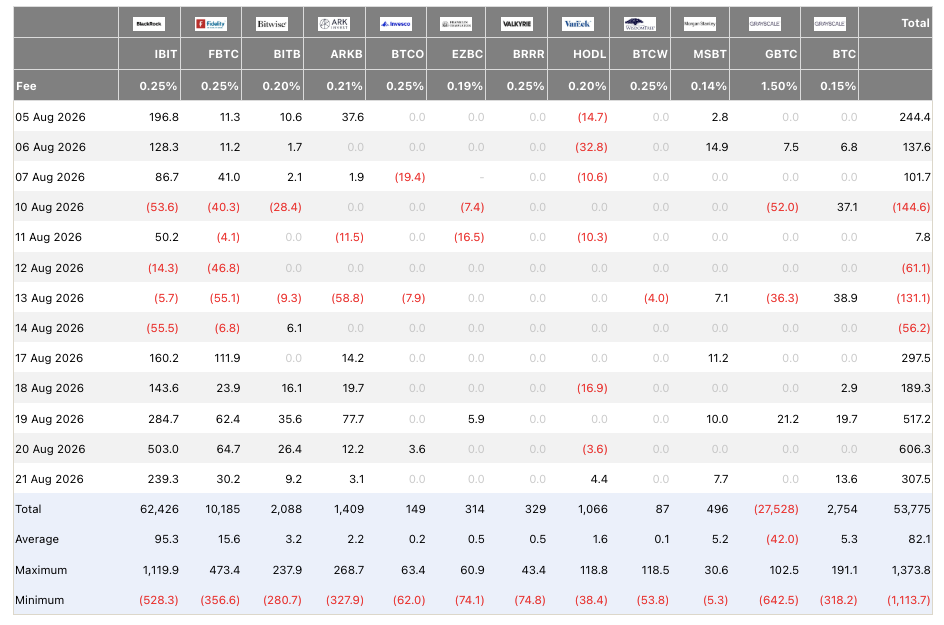
US spot Bitcoin ETF netflows (screenshot). Source: Farside Investors
The results heavily contrast with activity just two months ago, with June seeing unprecedented net outflows of more than $4.5 billion. At the end of last week, total August inflows stood at $2.38 billion, a new year-to-date record.
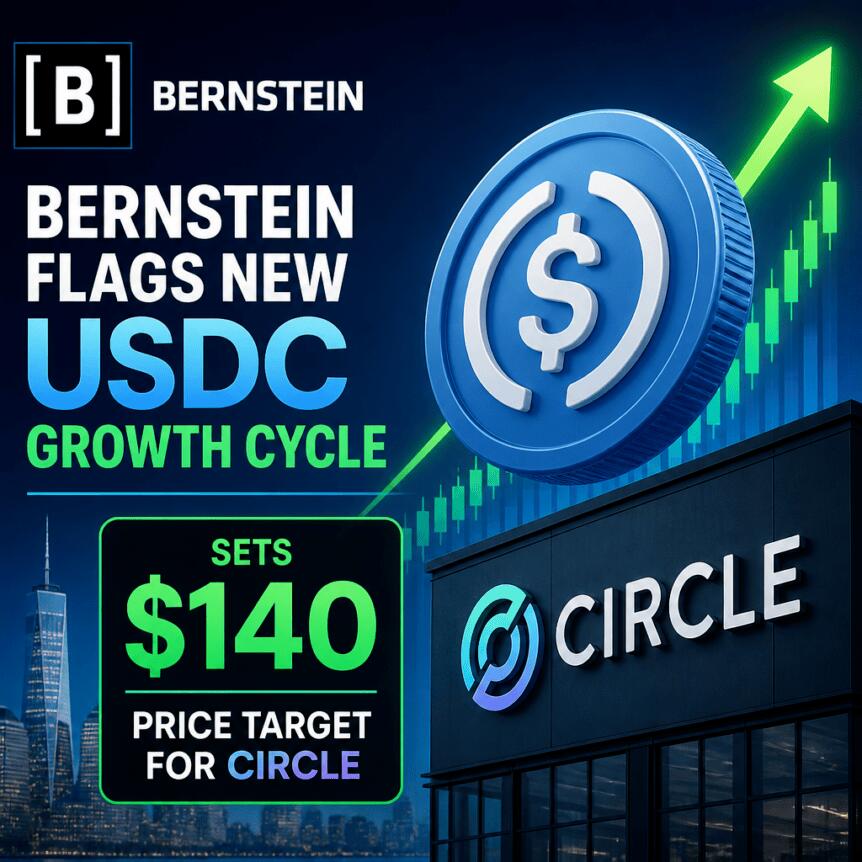
Circle is drawing fresh investor attention as analysts at Bernstein argue that USDC is entering a new expansion phase—one that could translate into meaningful momentum for the stablecoin issuer over the next year. In a research note published Monday, the firm pointed to a sharp pickup in USDC supply growth and an improvement in the stablecoin’s role within dollar-backed payments.
Bernstein said USDC is showing signs of what it called “digital dollar reflation” after its supply rose by roughly $2 billion in seven days, reversing a six-month stretch of stagnant or declining growth. The brokerage reiterated an Outperform rating on Circle and a $140 price target, implying about 60% upside from current levels. Circle shares have risen roughly 40% over the past month.
Key takeaways
- Bernstein cited a roughly $2 billion USDC supply increase over seven days, calling it “digital dollar reflation.”
- The firm maintained a $140 price target on Circle and an Outperform rating, expecting a boost over the next 12 months.
- Bernstein said USDC’s transaction presence improved, with its share of adjusted stablecoin volume rising from about 40% in 2025 to more than 60% so far in 2026, surpassing USDt by that metric.
- Analysts pointed to catalysts including renewed crypto market activity, clearer US regulation, tokenized capital markets, and stablecoins gaining traction in payments.
- Bernstein also noted early signs that AI agents may be using stablecoins in payments.
USDC supply and “digital dollar reflation”
The crux of Bernstein’s bullish case is an apparent shift in USDC’s growth dynamics. After months in which supply growth was described as stagnant or negative, the firm highlighted a sudden acceleration—about $2 billion added to USDC supply in just one week. For investors, that kind of reversal matters because stablecoin supply growth can be a leading indicator of broader on-chain and off-chain usage, which in turn can support the economics of issuance and ecosystem activity.
Bernstein’s note framed the move as “digital dollar reflation,” suggesting that demand for dollar-denominated digital assets may be strengthening again. The firm did not position this as a one-off event, instead describing it as the beginning of a broader growth cycle that could play out over the next year.
Why transaction share may be the bigger story
Beyond supply, Bernstein emphasized USDC’s increasing share of stablecoin transaction activity. While USDC remains the second-largest dollar-backed stablecoin by market capitalization, it trails Tether’s USDt (USDT). Still, Bernstein argued that USDC has gained ground in transactions, not just valuation.
According to the note, USDC’s share of adjusted stablecoin transaction volume rose from roughly 40% in 2025 to more than 60% so far in 2026, overtaking USDt on that measure. That matters because transaction volume is often treated as a proxy for real usage—transfers, swaps, and payments—rather than purely for holding patterns.
Put differently, Bernstein’s thesis suggests a divergence: even if USDC doesn’t lead by market cap, it may be winning by activity. Traders and businesses usually care about that distinction when stablecoins are used for settlement, routing, and payments where liquidity and flow can influence costs and reliability.
What Bernstein says could fuel the next growth cycle
Bernstein attributed the potential next phase of stablecoin growth to several overlapping factors. In its view, improved sentiment toward crypto more broadly could lift demand for stablecoins, while greater regulatory clarity in the United States could remove friction for issuers, partners, and regulated institutions.
The analysts also pointed to the expansion of tokenized capital markets and growing stablecoin adoption for payments. In practical terms, tokenization and payment use-cases can increase stablecoin demand by embedding dollar-denominated tokens into workflows that previously relied on bank transfers, prepaid balances, or legacy settlement rails.
Notably, Bernstein added that there are early signs of stablecoin use in payments made by artificial intelligence agents. While still an early signal, it aligns with a broader market pattern: as automation increases the number of transactions performed by software, stablecoins can become the unit of account for machine-to-machine payments—especially when they need dollar stability rather than crypto volatility.
Circle’s IPO-era volatility and recent fundamentals
Circle’s stock performance has reflected the volatility of public crypto exposure since it went public in June 2025. Bernstein’s note highlighted that the company priced shares at $31 in its IPO and raised roughly $1.1 billion. After an initial surge, the stock retreated toward its IPO level by November 2025 as the wider crypto market downturn weighed on publicly traded companies with sector exposure.
More recently, Circle has continued to report improved financial results. In its most recent quarter, the company reported $701 million in revenue and $48 million in net income, both higher than a year earlier.
For investors evaluating Bernstein’s stablecoin-growth thesis, that backdrop is important: improved operating performance can make it easier for markets to underwrite management’s ability to monetize stablecoin expansion rather than treating it as a purely narrative-driven trade.
Payments, regulation, and the “share of volume” test
Stablecoins sit at the center of several current crypto narratives—regulated dollar settlement, faster payment rails, and the infrastructure layer for tokenized finance. Bernstein’s emphasis on USDC’s transaction share suggests the firm believes the market is now grading stablecoins less on who is biggest by market cap and more on who is being used most in day-to-day activity.
At the same time, the regulatory and adoption catalysts Bernstein cites remain subject to real-world implementation and policy outcomes. That is why the near-term data points investors are likely to watch are continued supply growth, sustained improvements in transaction volume share, and evidence that payments use-cases—whether human-facing commerce or automation-driven transfers—are broadening beyond early experimentation.
For now, the debate centers on whether USDC’s recent supply acceleration and its rising share of transaction volume represent the start of a durable trend. If those metrics continue to climb while Circle’s fundamentals hold up, Bernstein’s “next 12 months” bet could look increasingly credible; if they fade, the market may revert to treating stablecoin growth as cyclical rather than structural.
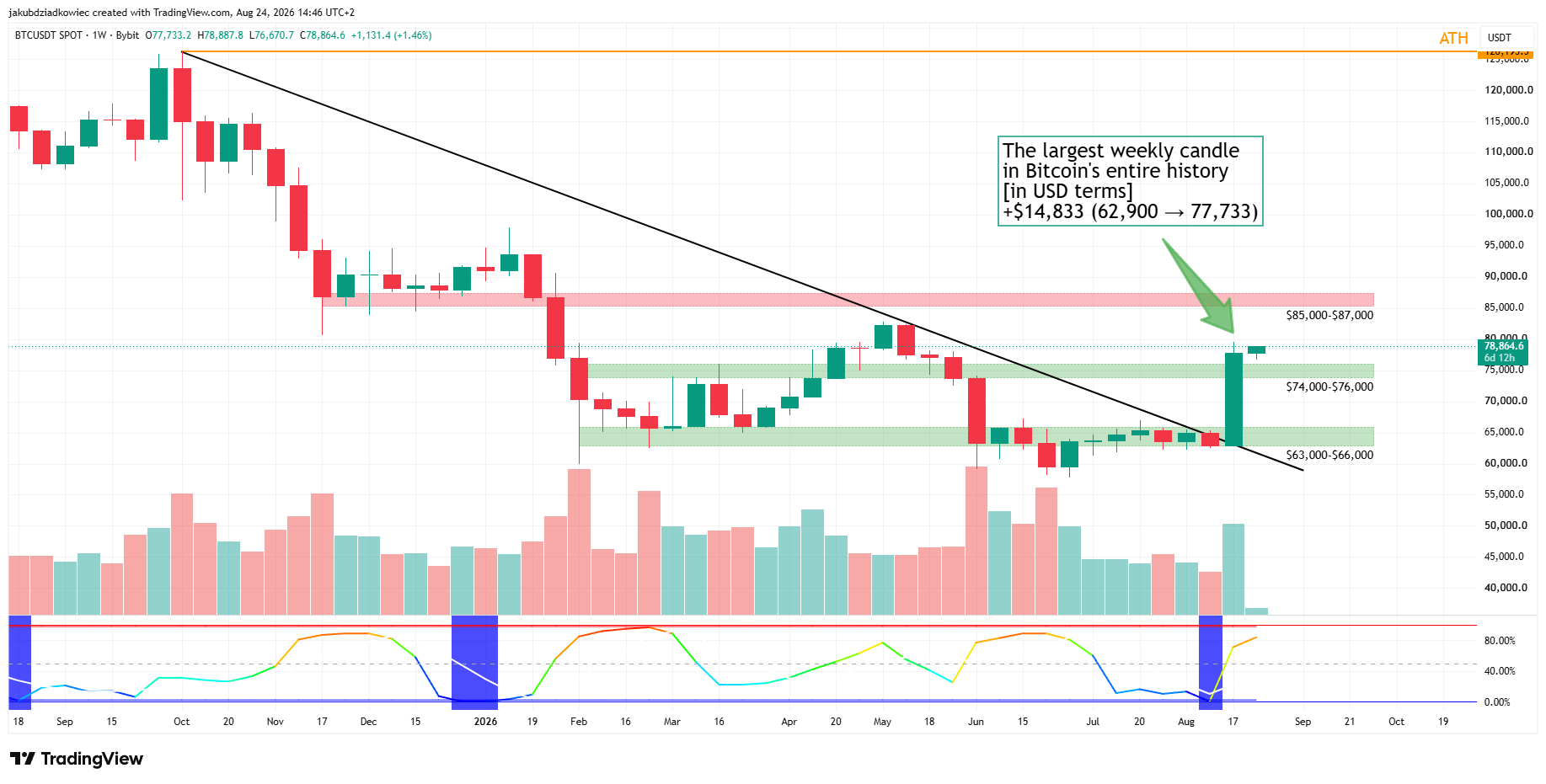
Bitcoin (BTC) rose 23.58% last week, its best week since 2023. The move added $14,833, the largest dollar gain of any week in Bitcoin’s history.
BTC trades near $79,000 at the time of writing, up 1.8% over 24 hours. The weekly candle broke a descending trendline stretching back to the October 2025 record high.
Bitcoin’s Best Week Since 2023 Breaks a 10-Month Downtrend
Structurally, Bitcoin’s price bounced from the $63,000 to $66,000 support zone. It then cleared the descending resistance line drawn from the record high of $126,195. Price also pushed through the $74,000-$76,000 band, which should now serve as support.
Weekly volume expanded alongside the move, though it stayed below June’s peak. The BBWP indicator expanded from an extreme low to near-maximum volatility, and it continues to rise. Historically, such squeezes signal a large move without indicating its direction.

The daily chart carries the more durable signal. BTC reclaimed its 200-day moving average near $69,000. That level had capped every advance of the downtrend since last October.
Daily RSI now reads 82, its highest since 2024. However, momentum has stretched rather than reversed on its two most recent occurrences.
The nearest resistance sits at the $82,215 swing high, followed by the $85,000 to $87,000 zone. BTC remains roughly 38% below its record high.

Funding Rates Hit a 2026 High While Open Interest Lags
Derivatives data complicates the bullish read. Roughly $2.7 billion of shorts liquidated on August 19, when the US Treasury doubled its long-dated bond buybacks.
Glassnode data shows aggregate perpetual funding reaching its highest level in 2026 during the squeeze. In contrast, April’s advance toward $79,000 was accompanied by persistently negative funding.
Traders paid to stay short then. They now pay to stay long, which suggests positioning has flipped rather than moderated.

Open interest tells a different story. CoinGlass data puts exchange open interest near $57.5 billion, up from roughly $46.5 billion before the breakout.
That total still sits below the January peak near $65.3 billion and the May peak near $64 billion. Both readings preceded sharp corrections this year.
Leverage has therefore returned without reaching saturation. A climb toward $64 billion would indicate a crowded market again.

Meanwhile, a weekly hold above $74,000 keeps the breakout structure intact. Losing that band would shift the burden back to the $63,000 to $66,000 range.
The post Bitcoin Books Best Week Since 2023 and Its Largest Dollar Gain Ever appeared first on BeInCrypto.

Dozens of people injured and hundreds of homes are damaged after tornado tears through French village

Renewable energy project deadlines extended up to four months due to West Asia disruptions

If Bessent Repeats Yellen's 2023 Money Printing Playbook, BTC Math Points to $224K





-

 Fashion3 days ago
Weekend Open Thread: Madewell – Corporette.com
-

 Business2 days ago
Musk’s Tesla, SpaceX Confirm $16.8 Billion ‘Terafab’ Chip Plant as World’s Largest Building in Texas
-

 Crypto World3 days ago
anatomy of crypto’s biggest liquidation event since 2021
-

 Business7 days ago
SMA Solar Technology AG (SMTGY) Q2 2026 Earnings Call Transcript
-

 Tech7 days ago
Qwen3.8-27B runs frontier-class coding agents and reasoning locally, no cloud API required
-

 Politics3 days ago
6 months on, Irish renters crushed by effects of government housing bill
-
 NewsBeat3 days ago
The ‘Lucky Dip Gang’ causing carnage for clicks: After five thugs were killed speeding in the wrong direction on a motorway, GUY ADAMS investigates a sick new trend… and why police aren’t even allowed to pursue them
-

 Tech6 days ago
GLM-5.3 hits the API at $1.4/$4.4 per million tokens
-

 News Videos5 days ago
Don’t Leave Your Financial Future To Chance | August 19, 2026
-

 Business2 days ago
Mystery AI Model ‘Ox Alpha’ Draws Developers With Free Access as Chinese Lab Origins Remain Debated
-
Tech7 days ago
5 Of The Most Reliable Car Brands To Consider If You’re Buying A Used SUV
-

 Tech7 days ago
Keychron K8 Ultra 8K review: a great value keyboard with comfort issues
-

 Business7 days ago
Stock Market Today: Tech Futures Slide As Treasury Yields Jump; Nvidia, Micron, Sandisk Sell Off
-

 Business5 days ago
Marvell Shares Jump 7% as Google Chip Deal Confirms Custom AI Silicon Partnership, Analysts
-

 Business4 days ago
Five Below: Kids Discount Retailer Reaps Rich Rewards
-

 Tech7 days ago
Ken Okuyama’s Kode89 Supercar Features Three Pedals and a Choice of V12s
-

 Politics6 days ago
The House Opinion Article | Security means more than military spending
-

 Fashion7 days ago
The Dressier Side of Shorts
-

 Business7 days ago
Nasdaq Ticks Higher as Wall Street Awaits Retail Earnings and Weighs Fed’s Next Move at Jackson Hole Meeting
-

 Crypto World7 days ago
Compound approves $52M institutional DeFi program
You must be logged in to post a comment Login