
Crypto World
Trump Media CEO Defends Truth API: Will Scrutiny Slow Sign-Ups?

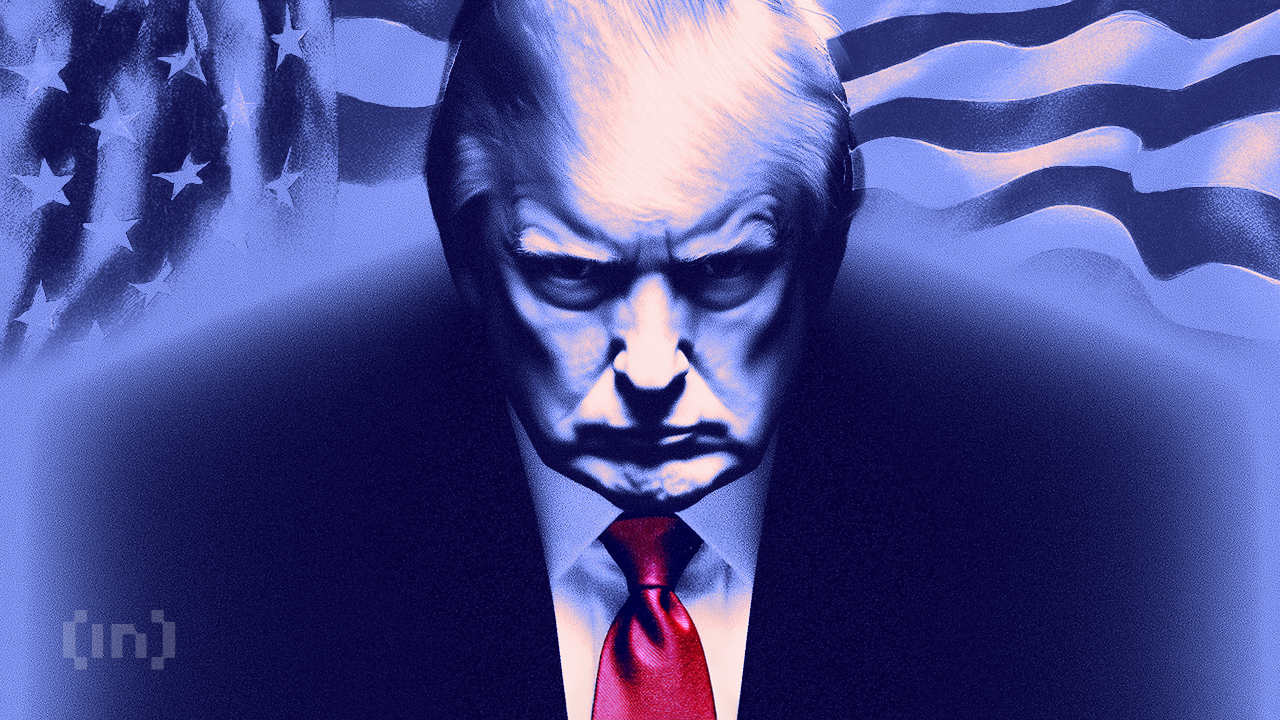

Trump Media’s interim CEO, Kevin McGurn, defended the company’s Truth API service on CNBC Monday. He said customer sign-ups have grown to the mid-teens since the product launched on August 1.
Truth API sells high-frequency trading firms early access to President Donald Trump’s Truth Social posts. Critics say the arrangement lets paying customers trade on the president’s statements before the public sees them.
Sign-Ups Grow For Trump’s Signals
McGurn told CNBC’s Squawk Box that demand for the service came directly from the market, not from the company itself. He compared it to APIs long used by social platforms to feed trading firms, news outlets, and prediction markets.
“We’re getting into the mid-teens now, and we’re climbing.”
Kevin McGurn, CNBC
That is up from the more than 10 customer agreements McGurn cited on Trump Media’s earnings call two weeks earlier. Truth API costs up to $100,000 per month.
Congress Looking Into It
The service has drawn scrutiny from Congress and faces at least one lawsuit alleging it is unconstitutional. One federal complaint argues Trump cannot sell early access to posts the public effectively owns.
Trump holds his stake in Trump Media through a revocable trust. The structure lets him retain ownership without daily control. The company has already earned over $1 million from the service since its launch.
McGurn said Truth API also plans to expand into retail trading platforms, large language models, and prediction markets.
Whether the growing customer base outpaces the legal and political pressure remains the open question heading into the midterms.
The post Trump Media CEO Defends Truth API: Will Scrutiny Slow Sign-Ups? appeared first on BeInCrypto.


Crypto policy and payments developments across Asia are moving in multiple directions at once: some regulators are tightening rules for digital asset firms, while banks and institutions pursue faster rails for cross-border settlement. Meanwhile, exchange licensing and tokenized finance continue to expand in jurisdictions that are still calibrating how to oversee crypto.
Below is a consolidated look at the week’s key developments—from South Korea and Japan to Pakistan, the UAE, and beyond—focusing on what changed, why it matters, and what to watch next.
Key takeaways
- South Korea’s Jeonbuk Bank partnered with Ripple to use a blockchain-based cross-border payments system for business customers.
- South Korean lawmakers proposed expanding FIU powers so the Financial Intelligence Unit can investigate suspected violations by unregistered crypto firms.
- Japan granted Laser Digital authorization as a crypto asset exchange service provider under the Payment Services Act, marking the first such approval in four years.
- Pakistan opened its crypto licensing portal for exchanges and other VASPs, with an NOC submission deadline tied to continued operations.
- Singapore and Hong Kong are competing via tax policy changes aimed at attracting fund managers and related investment professionals.
South Korea: payments partnerships and a push to expand FIU oversight
In payments, South Korea’s Jeonbuk Bank said it has partnered with blockchain payments company Ripple to deploy its cross-border payment system for business customers. The service is intended for companies such as import-export firms, technology startups, and online content creators.
Ripple framed the change around remittance speed and cost, arguing that conventional transfers—often routed through intermediary banks using SWIFT messaging—can take several days. By contrast, Ripple said its system would enable faster and less expensive cross-border capabilities for the bank’s commercial clients, positioning blockchain settlement as an operational upgrade rather than a consumer-facing novelty.
Regulatory momentum is also building in South Korea, but in a more enforcement-oriented direction. A group of lawmakers introduced a bill aimed at amending the Act on Reporting and Using Specified Financial Transaction Information to expand the Financial Intelligence Unit’s (FIU) authority over unregistered crypto businesses.
According to the filing reported by Cointelegraph, People Power Party lawmaker Eom Tae-young and nine other lawmakers submitted the proposal. Under the bill, anyone could report suspected violations to the FIU, and the FIU would be able to investigate and analyze alleged breaches, file complaints with relevant authorities, request criminal investigations, or provide information to investigators.
For market participants, the practical takeaway is that oversight capacity could broaden beyond traditional reporting frameworks. If passed, the FIU’s role in gathering and escalating cases involving unregistered entities may increase compliance pressure across the domestic crypto ecosystem—especially for smaller businesses operating without formal registration.
South Korea also moves on market conduct, custody licensing, and virtual asset crime
Separately, South Korean regulators were reported to be scrutinizing Polymarket. The Korea Media and Communications Commission stated Polymarket’s structure and operations amount to illegal gambling, even though it is designed as noncustodial and uses smart contracts.
On the custody side, BitGo Korea reportedly secured VASP registration for institutional crypto custody. The registration was accepted on Tuesday, two days before stricter VASP entry requirements took effect—an important sequencing detail that could affect other firms assessing their compliance timelines.
South Korea also planned new investigative capacity. The Serious Crimes Investigation Agency is set to be formally established in October and will include 2,567 investigators across seven categories, with a dedicated unit aimed at combating phishing and virtual asset crimes. For businesses and users, a targeted unit indicates regulators may treat digital-asset-related fraud and impersonation as a specialized enforcement priority rather than a general cybercrime category.
Finally, the Korea Exchange is expected to open a new fractional investment market—Novel Securities Market—in November. Cointelegraph reported that it will support fractional investments and non-traditional securities such as artworks, real estate, and music copyright, expanding the range of asset types accessible through the exchange infrastructure.
Japan: fresh exchange authorization and more institutional token adoption
Japan remains one of the clearest examples in Asia of how regulated crypto can develop through licensing under the Payment Services Act (PSA). Nomura Group’s digital asset subsidiary Laser Digital received authorization to operate as a crypto asset exchange service provider under the PSA, which Cointelegraph described as the country’s first crypto exchange approval in four years.
According to the Financial Services Agency (FSA) list published on Friday, Laser Digital received the authorization as reported by Cointelegraph. The article noted the last platform to receive FSA authorization was Binance Japan in October 2022, underscoring the long gap between approvals.
For investors and traders, the significance is less about headlines and more about access and compliance: each newly authorized venue can increase choice for Japan-based market participants that prefer regulated counterparties. It also signals that, even after a period of slower licensing, Japan’s framework can still produce new approvals for qualified operators.
Beyond exchange licensing, the Japan coverage also highlighted broader treasury and retail-access experiments. Metaplanet reportedly expanded its Bitcoin treasury strategy to the US through a proposed arrangement with Nasdaq-listed Super League Enterprise, using existing Bitcoin rather than additional purchases. Separately, Cointelegraph reported that Toyota Finance opened tokenized bonds to retail investors via a mobile payment app, allowing applications for a 1 billion yen bond without a securities account and with perks delivered through Toyota’s app. While these are not identical to exchange approvals, they reflect continued movement toward regulated digital finance products and distribution channels.
Pakistan and the UAE: regulated market access expands while token distribution grows
Pakistan’s Virtual Assets Regulatory Authority (PVARA) opened its crypto licensing portal for crypto exchanges and other virtual asset service providers (VASPs) operating in the country. Cointelegraph reported that companies providing virtual asset services on or before March 5 must submit an application for a no-objection certificate (NOC) by Sept. 5 or cease operations.
On its licensing site, PVARA frames the portal as a pathway into a regulated market with standards covering consumer protection, governance, compliance, and market integrity—an approach that aims to make compliance expectations concrete rather than abstract.
In the UAE, Capital.com reportedly plans to offer spot crypto services after its affiliate, Capital Vault, secured a virtual-asset license from the country’s Capital Market Authority (CMA). Cointelegraph reported that once live, UAE clients would be able to buy and hold actual crypto through the Capital.com app, with Capital Vault responsible for execution, custody, and settlement.
In parallel, Bitcoin.com integrated the UAE-registered US dollar stablecoin USDU into a self-custodial wallet. Cointelegraph said the integration expands access to USDU beyond institutional distribution channels, suggesting more routing options for stablecoin users who want direct wallet-based custody rather than relying solely on exchange accounts.
Singapore vs Hong Kong: tax policy as a competition lever for fund managers
Singapore’s Monetary Authority unveiled tax exemptions for fund managers and family offices and expanded a scheme aimed at attracting investment professionals. The government also plans to launch a co-investment scheme for funds that base operations in Singapore, Cointelegraph reported.
The announcement comes as Hong Kong cuts its own taxes for fund managers, reinforcing a regional pattern: crypto-related finance and traditional asset management are now competing through fiscal policy as well as regulatory posture. For industry participants, these changes can affect where teams locate and where investment entities choose to incorporate or operate.
While these measures are not exclusively tied to crypto, they matter because many digital asset strategies sit within broader investment platforms—meaning tax advantages can influence staffing, fund structure decisions, and where compliance infrastructure is built.
With more licensing portals, more targeted FIU authority, and fresh exchange authorizations in play, the next questions are straightforward: which proposed South Korean rules make it through the legislative process, how quickly Japan’s newly authorized operator pipeline expands, and whether Pakistan’s licensing window results in continued market consolidation or a shift toward regulated-only services.


While stablecoin adoption has increased significantly in 2026, real payments still represent only a fraction of the trillions moving on-chain. In 2025, around 3.6% of adjusted stablecoin volume came from actual payments. Much of it has to do with something called the checkout problem.
Paying with a stablecoin can still mean a second screen, another identity check and a checkout run by a company the user did not choose. These extra steps are easy to overlook in transaction charts, but they are often where adoption stalls.
Some products are trying to address this gap with newer innovations. For instance, payments company Banxa launched Native on August 20. It gives wallets, exchanges and fintech apps a way to place fiat-to-crypto and crypto-to-fiat transactions inside their own interfaces.
Banxa handles the regulated rails underneath, including price quotes, compliance validation and settlement.
A Checkout That Stays Put
Imagine buying $200 of USDC inside a wallet. The app requests a live price, checks whether the user and payment method are eligible, and then opens an Apple Pay sheet without sending the customer to a Banxa webpage.
The same flow works with cards and Google Pay. Bank transfers can run through the API.
Platforms that already verify customers can also pass the identity data to Banxa. A returning user may move directly to payment rather than complete KYC again.
So, the platform keeps its branding and customer relationship, and Banxa remains in the plumbing.
“The user experience across crypto remains fragmented and unnecessarily complex. Our goal is to simplify this and having Banxa onboard means users receive a seamless experience by embedding compliant fiat crypto access directly into the user journey,” Felix Fan, CEO at Trust Wallet, said.
Invisible Has a Boundary
Banxa’s Native does not make every payment method disappear into the app. Its documentation says PayPal, iDEAL, Klarna, PIX, and several other local options still move the customer into its hosted checkout for the payment step.
Partners also need user accounts, a backend, and their own KYC process. This is infrastructure for established platforms, rather than a plug-in for any app.
The regulatory layer matters as much as the interface. OSL completed its acquisition of Banxa in January, folding the company into a wider stablecoin payments push.
Banxa says it has more than 400 platform integrations, has served over 10 million users and has processed more than $10 billion in cumulative volume. Its Dutch entity also holds a MiCA licence covering 30 EEA countries.
But Native now faces a practical test. Do fewer users abandon a purchase when the crypto checkout stops looking like a detour?
The launch offers a credible technical answer to an old user-experience problem. Proof will come from how people behave at checkout.
The post Banxa Wants to Make Stablecoin Payments Invisible appeared first on BeInCrypto.
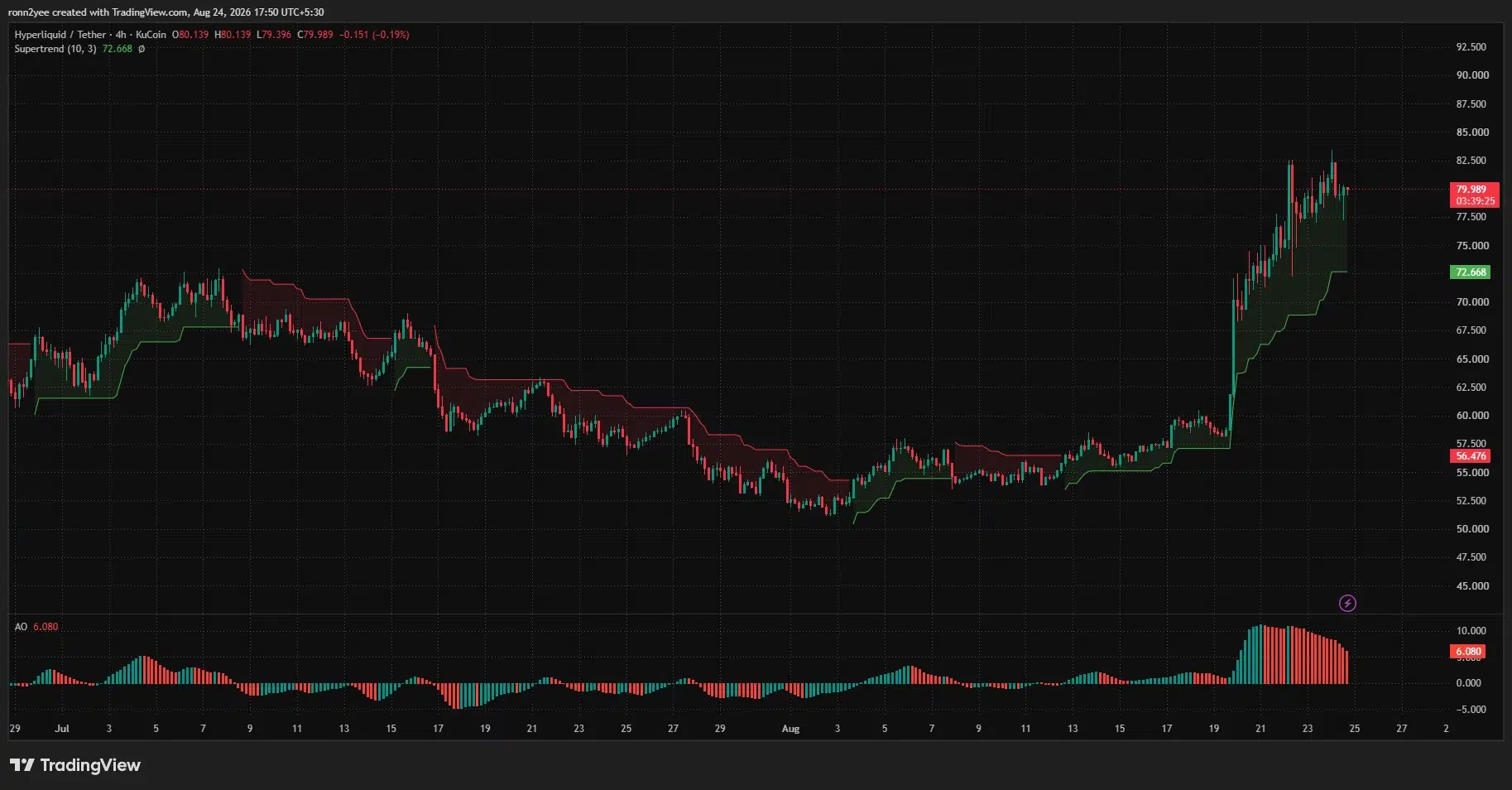
Hyperliquid price traded near $80 on Aug. 24 after reaching a record $83.27, as rising platform fees and a 32% weekly gain kept HYPE in price discovery.
Summary
- HYPE reached an all-time high of $83.27 before retreating toward $80.
- Hyperliquid generated $6.5 million in fees during a recent 24-hour period.
- Daily RSI reached 75.91, leaving the token overbought after its rapid advance.
- Liquidation data places the largest nearby liquidity cluster around $84.
Hyperliquid price consolidates below its record high
Hyperliquid (HYPE) price was trading at approximately $79.83 at the time of writing, down 1.15% over the previous 24 hours but up 32.3% over seven days. The token has also gained 35.8% over the past month.
HYPE reached an all-time high of $83.27 on Aug. 23, according to CoinGecko, before buyers encountered resistance between $82 and $84. Its market capitalization stood near $17.8 billion, placing it among the ten largest cryptocurrencies.
The 4-hour chart shows that the rally accelerated on Aug. 19, when HYPE climbed from below $60 to nearly $70 in a single session. Buyers then pushed the token through $75 and above $80 over the following four days.
Price remained close to $80 on Aug. 24 despite several attempts to take profits. The tight consolidation below the record high suggests buyers have not yet surrendered control, although the slowing momentum increases the risk of a short-term pullback.
HYPE also remained above the 4-hour Supertrend level at $72.67. A decisive fall below that line would weaken the current bullish structure and place the previous breakout area around $68 to $70 back in focus.
The Awesome Oscillator remained positive at 6.08, but its histogram declined after reaching a local peak. The change shows that bullish momentum is still present but no longer accelerating at the rate seen during the initial breakout.
Hyperliquid fees add support to HYPE demand
The price advance coincided with a surge in activity on Hyperliquid’s derivatives platform. Data cited by Token Terminal showed the protocol generated $6.5 million in fees over a recent 24-hour period, compared with $1.5 million for Pump.fun.
Hyperliquid also recorded about $5.6 million in revenue and 102,800 daily active users during the period. Increased leveraged trading during the broader crypto market rally contributed to the rise in fees.
The revenue matters for HYPE because the protocol directs most trading fees to its Assistance Fund. DefiLlama states that 99% of perpetual and spot trading fees, excluding certain builder fees, go to the fund for open-market HYPE purchases.
Hyperliquid generated $55.64 million in fees over the past 30 days, including $40.94 million in protocol revenue, according to DefiLlama. Sustained trading activity can therefore create recurring demand for HYPE, although lower volume would reduce the size of future purchases.
HIP-3 provides another source of demand by allowing builders to deploy their own perpetual futures markets. Under the official Hyperliquid documentation, a deployer must stake 500,000 HYPE and operate markets with independent order books, margin rules, and settings.
The framework has expanded the platform beyond crypto markets by supporting derivatives linked to commodities, equities, and foreign exchange. However, activity remains concentrated among a limited number of major deployers, making continued growth an important condition for the bullish fundamental case.
HYPE faces resistance at the $84 liquidity cluster
The daily chart shows HYPE trading above the upper Bollinger Band at $81.91 before pulling back. The middle band, represented by the 20-day simple moving average, stood at $62.43, showing how far price has moved above its short-term mean.
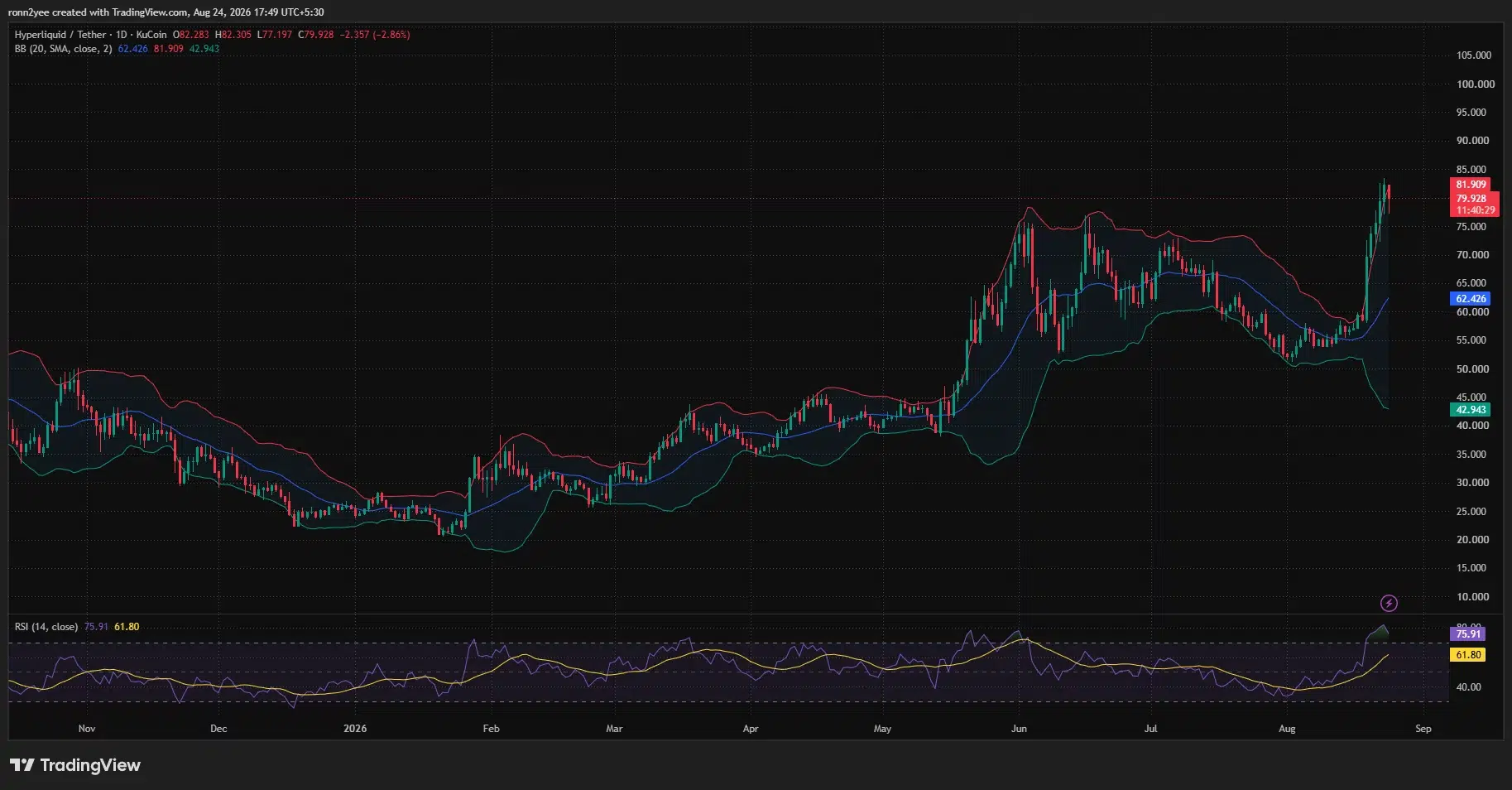
Daily RSI reached 75.91, well above the usual overbought threshold of 70. Its moving average was lower at 61.80. An overbought reading does not guarantee an immediate reversal, but it shows that the rally has become stretched and vulnerable to profit-taking.
The three-day CoinGlass liquidation heatmap identifies $84 as the strongest nearby concentration of leveraged positions. A clean break above that level could force additional short liquidations and reopen price discovery, with $86.30 forming the next visible upper boundary.
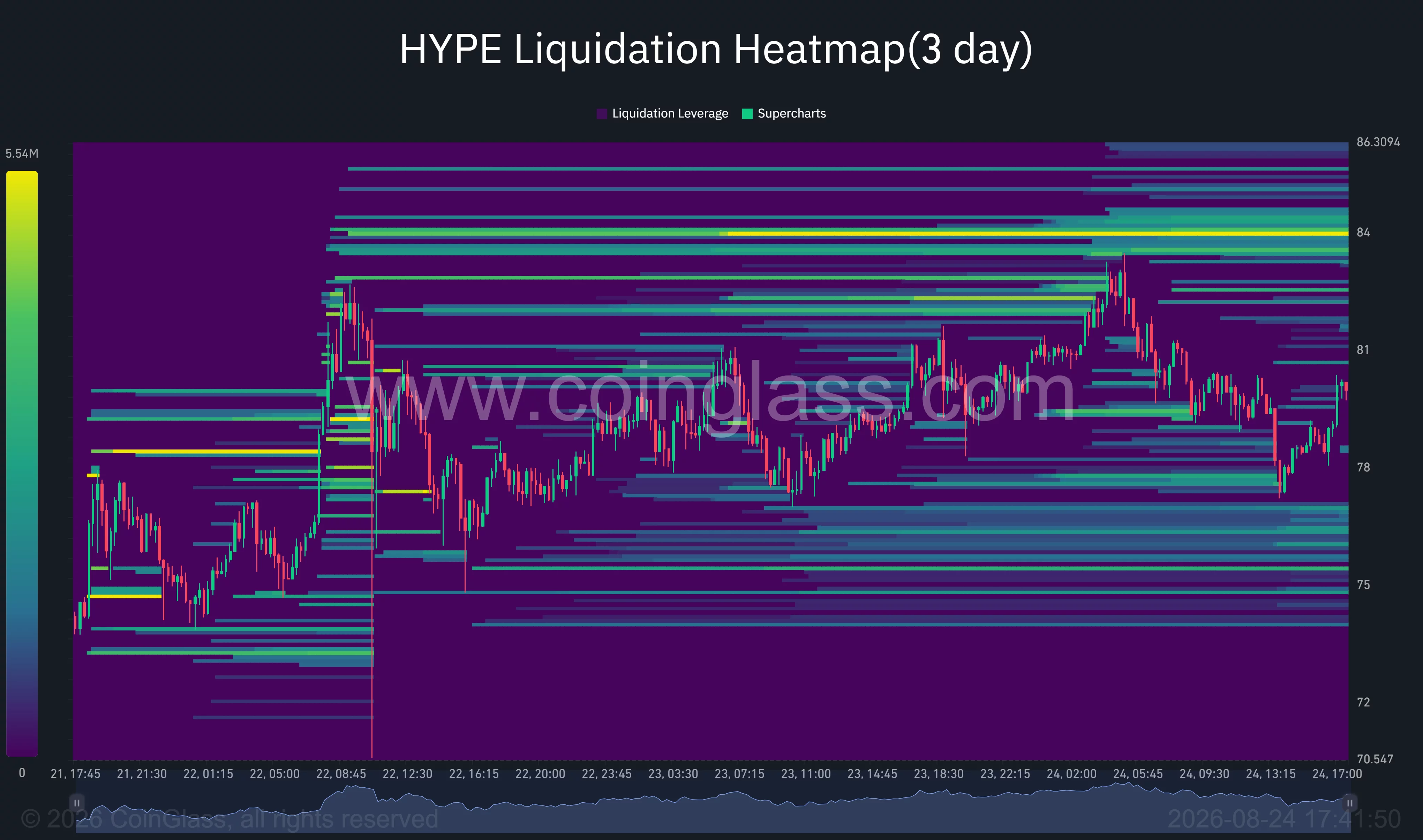
If HYPE fails to clear $84, the first support area sits between $78 and $79. The heatmap shows another concentration of positions near $77, while the broader chart places stronger support between $75 and $77.
A deeper correction could extend toward the 4-hour Supertrend at $72.67. Losing that level would raise the risk of a return to $68–$70, where the Aug. 19 breakout began.
Analysts watch for another expansion in volume
Pseudonymous trader Altcoin Sherpa said HYPE appeared to be approaching another breakout candle and suggested that a move toward $100 million in trading volume was becoming increasingly likely. The accompanying chart showed price holding near its highs while volume eased after the initial surge.
The bullish scenario requires HYPE to close above $84 with rising spot volume. Such a move would invalidate the immediate rejection and place $86.30, followed by the psychological $90 level, in focus.
The bearish scenario begins with a loss of $77. Falling below that level could trigger long liquidations and expose $75, followed by the Supertrend support near $72.67.
For U.S. investors, regulatory access remains an unresolved part of the outlook. Hyperliquid’s Policy Center says it is advocating for a legal route that would allow Americans to access decentralized markets, but no official White House or CFTC announcement was found confirming that the platform is being integrated into the U.S. market.
Disclosure: This article does not represent investment advice. The content and materials featured on this page are for educational purposes only.


Strategy has raised about $2 billion through common stock sales while leaving its Bitcoin holdings unchanged at 840,447 BTC and increasing its total cash position to $6.69 billion.
Summary
- Strategy raised about $2 billion by selling 18.26 million MSTR shares between Aug. 17 and Aug. 23.
- Total cash across its reserve and new cash account reached $6.69 billion.
- The company spent $136.4 million repurchasing about 1.43 million STRC preferred shares.
- Strategy made no Bitcoin purchases or sales, leaving its holdings unchanged at 840,447 BTC.
A Monday filing with the U.S. Securities and Exchange Commission showed the Bitcoin treasury company sold about 18.26 million MSTR shares between Aug. 17 and Aug. 23 through its at-the-market offering program.
Most of the proceeds were kept in cash after Strategy used $136.4 million to repurchase roughly 1.43 million shares of its STRC perpetual preferred stock. Another $300 million was transferred to the company’s existing U.S. dollar reserve, while about $1.59 billion went into a newly established U.S. dollar cash account.
The transactions left Strategy with $5.1 billion in its U.S. dollar reserve and $1.59 billion in the new cash pool as of Aug. 23, taking the combined balance across both accounts to $6.69 billion.
Strategy puts fresh MSTR proceeds into cash
Strategy said the new cash account gives management additional flexibility when deciding how to deploy capital under different market conditions.
Money held in the account can be used for Bitcoin purchases, preferred stock dividends, debt payments and repurchases of the company’s securities, according to the filing. The company did not commit the balance to any single purpose or provide a timetable for deploying it.
The latest increase extends a cash-building program that has accelerated since June. Crypto.news reported in July that Strategy had increased its dollar reserve to $3.75 billion by July 26 after adding $525 million during the week.
At the time, Strategy raised $544.5 million by selling about 5.43 million MSTR shares and used $25 million to repurchase STRC preferred stock. Its Bitcoin holdings remained unchanged during the period.
Another weekly filing covering Aug. 10 through Aug. 16 showed Strategy raising $333.7 million from roughly 3.46 million MSTR shares. Of those proceeds, $149.1 million was added to the dollar reserve, while $132.2 million funded STRC repurchases and $52.4 million went toward STRC dividends.
The dollar reserve stood at approximately $4.8 billion after those transactions, before the latest $300 million addition pushed it to $5.1 billion.
Strategy keeps its 840,447 Bitcoin unchanged
Despite raising about $2 billion last week, Strategy reported no Bitcoin purchases or sales between Aug. 17 and Aug. 23.
Its treasury therefore remains at 840,447 BTC, acquired for an aggregate $63.36 billion at an average price of $75,385 per Bitcoin, including fees and expenses.
Strategy arrived at its current Bitcoin balance after selling part of its holdings earlier this summer. The company held 847,363 BTC in late June before adopting a capital framework that gave management more options to use Bitcoin and cash for obligations linked to its securities.
Under that framework, the board authorized a BTC Monetization Program allowing up to $1.25 billion of Bitcoin sales to help fund the U.S. dollar reserve. The capital framework included separate $1 billion repurchase authorizations for common stock and preferred securities, alongside provisions covering dividend and interest payments.
Strategy then sold 3,588 BTC between June 29 and July 5 for about $216 million. The company said the proceeds were used for distributions on its Digital Credit securities and to replenish cash previously taken from its reserve.
The 3,588 BTC sale reduced Strategy’s holdings to 843,775 BTC and lifted its dollar reserve to $2.55 billion at the time.
Additional Bitcoin sales in August reduced the balance again. Between Aug. 3 and Aug. 9, Strategy sold 1,690 BTC for about $108.6 million and directed those proceeds toward repurchasing approximately 1.15 million STRC preferred shares.
Following that transaction, the company reported 840,447 BTC, the same balance it has maintained through the two subsequent weekly reporting periods.
STRC repurchases remain part of capital management
Preferred stock has become another major use of Strategy’s recently raised capital.
STRC, also known as Stretch, is a perpetual preferred security designed around a $100 reference value and a variable dividend rate. Strategy has used dividend adjustments, cash reserves and share repurchases as part of its efforts to manage the security.
During the week ended Aug. 23, the company spent another $136.4 million buying back approximately 1.43 million STRC shares.
The repurchase came after Strategy had already spent $132.2 million on about 1.39 million STRC shares during the previous week and $108.6 million on approximately 1.15 million shares during the week ended Aug. 9.
Earlier in July, Strategy CEO Phong Le tied future Bitcoin accumulation partly to conditions in STRC. As previously covered here, Le said the company planned to resume issuing STRC once the security returned to its $100 par value.
“We’ll continue to build that. And yeah, when Stretch gets back to par, we’ll issue more. We’ll buy more Bitcoin,” Le said at the time.
Strategy had already started directing common-stock proceeds toward liquidity during that period. Between July 13 and July 19, the company sold about 2.73 million MSTR shares for $263.5 million while keeping its Bitcoin holdings unchanged and increasing its dollar reserve to $3.225 billion.
Cash reserve has climbed from $1.44 billion
Strategy first established its U.S. dollar reserve in December 2025 with an initial balance of $1.44 billion.
The company created the reserve to fund preferred stock dividends and interest payments on outstanding debt, reducing its dependence on raising capital or selling Bitcoin whenever scheduled cash obligations came due.
By the end of May, the reserve had declined to about $900 million. Strategy began rebuilding it more aggressively in June as the company moved toward active management of its Bitcoin, common equity, preferred securities and cash obligations.
The balance subsequently rose to $2.55 billion by early July, $3 billion by July 12, $3.225 billion by July 19 and $3.75 billion by July 26.
Further additions brought the reserve to $4.65 billion on Aug. 9, and about $4.8 billion on Aug. 16 before the latest $300 million allocation increased it to $5.1 billion.
Strategy’s newly created $1.59 billion cash account sits separately from that reserve. According to the latest filing, management can deploy money from the account across Bitcoin purchases, debt obligations, preferred dividends, and securities repurchases depending on its capital requirements and market conditions.


Hyperliquid Policy Center has asked the SEC and CFTC to let qualifying equity perpetual contracts enter the U.S. as security futures after HIP-3 markets processed more than $480 billion in notional trading volume over their first 10 months.
Summary
- Hyperliquid Policy Center has asked the SEC and CFTC to recognize qualifying equity perpetual contracts as security futures.
- The proposal would place eligible equity perpetuals under an existing framework jointly overseen by the SEC and CFTC.
- HIP 3 markets have processed more than $480 billion in cumulative notional volume during their first 10 months.
- HPC wants regulators to keep perpetual contract classification consistent across asset types while preserving exchange listing flexibility.
Hyperliquid Policy Center said in an Aug. 24 comment letter that cash-settled equity perpetuals carrying the established characteristics of futures contracts should be eligible for classification as security futures, a category jointly overseen by the two U.S. regulators.
The filing responds to a joint request for comment from the Securities and Exchange Commission and Commodity Futures Trading Commission on how U.S. law should define swaps, security-based swaps and products that may fall outside those categories. HPC described the issue as a basic classification question that has remained unsettled even as perpetual contracts have expanded outside the United States.
Under HPC’s proposal, regulators would first look at the structure of a derivative and how it trades to decide whether it is a future or a swap. The asset referenced by the contract would then determine how regulatory authority is divided between the SEC and CFTC.
A perpetual contract on Bitcoin, crude oil or an individual stock should therefore receive the same initial product classification when each instrument has the same futures-like characteristics, the group argued. A contract tied to a single stock that qualifies as a future would fall into the security futures category and come under both agencies.
Hyperliquid group says equity perpetuals can qualify as security futures
At the center of HPC’s position is the structure of a perpetual contract, which has no predetermined expiration date but uses recurring funding payments to keep its price close to the asset it tracks.
When a contract trades above its reference price, long-position holders pay shorts. If the contract falls below the reference price, shorts pay longs. HPC said the mechanism creates a continuous incentive for the perpetual price to converge toward the underlying market, performing a function that expiration and final settlement serve in traditional dated futures.
HPC also cited features that courts and regulators have historically used when examining futures contracts, including standardized terms, fungibility, fixed unit quantities and the ability to close a position through an offsetting trade.
On Hyperliquid’s HIP-3 markets, positions open and close through a central limit order book, margin is maintained continuously, and contract prices are publicly available. Equity perpetual holders receive price exposure but do not obtain ownership, voting rights, or other claims attached to the referenced shares.
The lack of an expiry date does not automatically prevent futures classification, according to the filing. HPC cited federal court decisions finding that a specified future delivery or settlement date is not always required and that contracts of indefinite duration can still carry the futurity associated with a futures contract.
U.S. regulators have already applied that reasoning to crypto perpetuals. In May, crypto.news previously reported that the CFTC approved Kalshi’s Bitcoin perp as the first federally regulated Bitcoin perpetual futures contract in the United States. The May 29 approval classified BTCPERP as a futures contract even though it has no fixed expiration date.
Kalshi began offering the contract in June and subsequently expanded its regulated perpetual lineup to other cryptocurrencies. The CFTC said additional products would remain subject to review, leaving the treatment of contracts referencing other asset classes open to further regulatory analysis.
SEC and CFTC have yet to settle the classification question
Past enforcement cases have not produced a uniform answer for perpetual contracts.
HPC said earlier CFTC actions treated some perpetual products as swaps after examining parts of the Commodity Exchange Act’s swap definition without determining whether the instruments qualified for the statutory exclusion covering futures contracts. Other cases treated perpetual-style products as leveraged or margined retail commodity transactions subject to trading requirements similar to those applied to futures.
The SEC also used the term “perpetual futures” in its case related to the Mango Markets exploit while disputing that the products were futures contracts offered under regulated futures rules. According to HPC, neither an enforcement action nor a court had resolved the threshold question of whether the instruments themselves qualify as futures or security futures excluded from the swap definition.
The CFTC took a different approach with Kalshi in May, approving BTCPERP as a “contract for sale of a commodity for future delivery.” Its accompanying policy statement said perpetual contracts on other asset classes should undergo review and specifically identified equity-based products as an area where the CFTC and SEC should both be involved.
Disagreement over that interpretation has already reached federal court. CME Group later filed a legal challenge over perps, arguing that products such as Kalshi’s contract should fall under the swaps framework instead of being treated as ordinary futures. CME’s position contests the legal basis the CFTC used when approving the contracts.
Around the same period, the SEC and CFTC opened the definitions review that prompted HPC’s latest submission. The agencies sought public input on swaps, security-based swaps, exclusions from those definitions and emerging derivatives, including products that raise questions about the boundary between their jurisdictions.
HIP-3 volume puts $480 billion behind the regulatory debate
HPC tied its request to trading activity already taking place through Hyperliquid’s HIP-3 framework, where independent market operators known as deployers can create their own perpetual markets.
The protocol handles execution, price-time order matching, enforcement of margin requirements, funding transfers, clearing and settlement. Deployers control elements including the assets listed, contract specifications, oracle sources, leverage limits and open-interest caps.
HIP-3 markets now cover several traditional asset classes for users outside the United States, including crude oil, gold and other precious metals, foreign exchange, equity indexes, individual equities and exchange-traded funds.
Over the 10 months following HIP-3’s launch, those markets accumulated more than $480 billion in notional trading volume and maintained roughly $4 billion in open interest, according to the filing. Across Hyperliquid as a whole, markets processed nearly $3 trillion in notional volume during 2025 and more than $1.5 trillion during 2026 through Aug. 23.
Stock-linked products have become part of that expansion. A July examination of Hyperliquid equity perps detailed how the platform has hosted perpetual contracts tracking equities while giving traders synthetic price exposure without ownership of the underlying shares.
HPC said U.S. users currently cannot access Hyperliquid, meaning the liquidity and infrastructure described in its filing developed outside the country while regulated domestic access to perpetual contracts remained limited.
Security futures would put equity perps under both regulators
HPC proposed using the existing security futures framework for equity perpetuals that meet futures characteristics because the category already assigns oversight to both agencies.
Under the framework, a designated contract market regulated by the CFTC can list security futures after notice-registering with the SEC. A national securities exchange can cross in the other direction by notice-registering with the CFTC, while intermediaries have parallel registration routes.
Security futures have seen limited commercial activity since OneChicago closed in 2020, but the filing noted renewed interest this year. CME Group announced in June that it would launch single-stock futures beginning July 27, returning U.S. exchange activity to a product category that had been largely dormant.
HPC asked the agencies to confirm that cash-settled equity perpetuals carrying established futures characteristics may be listed as security futures, while allowing exchanges to retain flexibility when deciding how individual products should be classified.
The group also requested a consistent taxonomy between the two regulators and asked them to update the security futures framework so existing listing standards can accommodate new contract structures. HPC said classification should remain flexible enough for a bilateral, individually negotiated perpetual-style product to be treated as a swap or security-based swap when it lacks the fungibility, offset rights and multilateral execution associated with futures.
According to the filing, the SEC and CFTC could issue interpretive guidance, policy statements or staff-level guidance without waiting for a formal rulemaking. The agencies also have joint authority to modify security futures listing standards, which they previously used for American Depositary Receipts, ETFs, closed-end fund shares and debt securities.
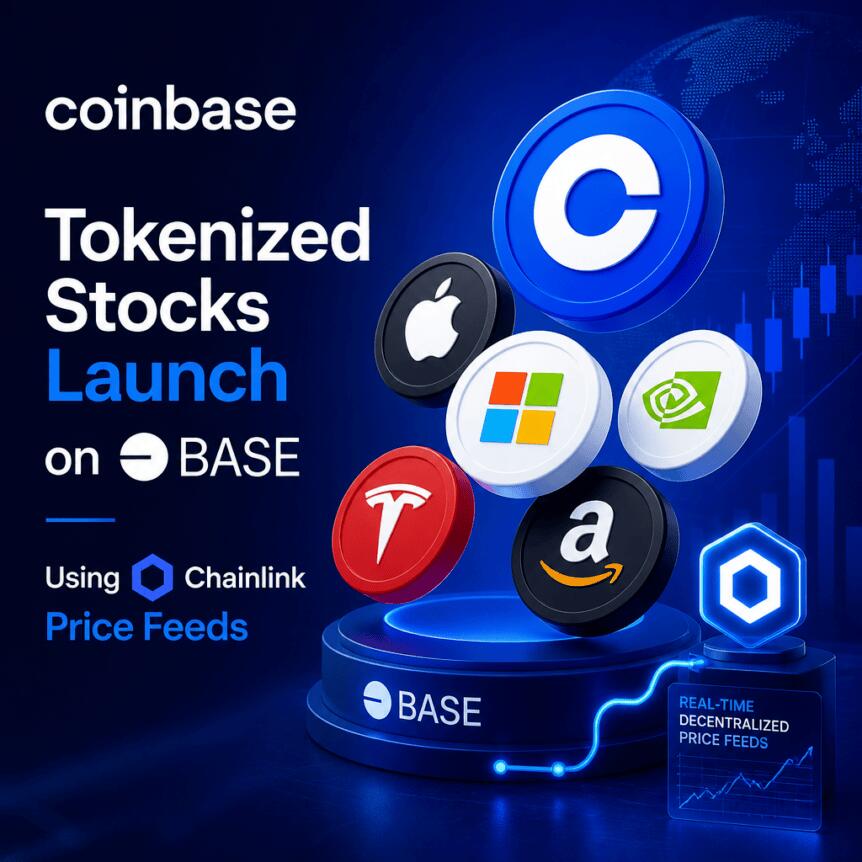
Coinbase has launched tokenized shares on its Base network, bringing a new set of regulated “tokenized equity” assets into DeFi. The move went live on Base alongside an integration from Chainlink, which will supply the pricing data needed for decentralized applications to use the tokens for functions such as lending, trading, and structured products.
Chainlink Data Feeds for Coinbase’s tokenized stocks are designed to provide continuous pricing for major U.S. equities, including Nvidia, Apple, Meta, and Alphabet. For DeFi platforms, reliable price inputs are a practical prerequisite—without them, mechanisms like collateral valuation or automated market-making can become unstable or overly manual.
Key takeaways
- Coinbase tokenized stocks launched on Base with Chainlink Data Feeds to support DeFi integrations.
- Chainlink will continuously price tokens tied to underlying Coinbase-supplied equity multipliers that account for dividends and corporate actions.
- Each B20 token on Base represents a direct claim on an underlying share held through a regulated broker-and-custodian setup supervised under Abu Dhabi Global Market.
- Base says the assets can be used across DeFi infrastructure, including collateral on lending platforms and assets for decentralized exchanges.
- Tokenized stocks remain on an upswing, with RWA.xyz reporting growth in value, transfer volume, and holder count.
Chainlink pricing for tokenized equity on Base
The technical backbone of this rollout is Chainlink’s pricing infrastructure. According to Chainlink documentation for its tokenized equity feeds, the Data Feeds value each token using the underlying stock price combined with a Coinbase-supplied multiplier intended to reflect dividends and corporate actions.
That multiplier concept matters because tokenized equities are not always a pure one-to-one reflection of a share’s price at every moment. Corporate events can change the economic exposure that holders should receive. By incorporating those adjustments into the feed’s valuation method, DeFi protocols can more accurately determine collateral value and settlement parameters without building custom logic per asset.
What the tokens represent and how they’re issued
Base states that the stocks are issued as B20 tokens natively on Base, Coinbase’s layer-2 network. Access is limited to non-U.S. users in eligible jurisdictions.
Each token corresponds to a direct claim on an underlying share that is held with regulated broker and custodian Alpaca. Base further describes that custody and issuance occur under an Abu Dhabi Global Market-supervised structure. Unlike many experimental tokenized products, Base emphasizes that the tokens can be held in self-custody wallets and traded around the clock.
This 24/7 trading feature is one of the main reasons tokenized equities attract builders: it potentially improves liquidity management compared with traditional market hours—while still aiming to preserve the economics of the underlying share through the token’s linkage and pricing mechanism.
DeFi use cases: lending, exchanges, and structured products
With Chainlink Data Feeds in place, Base says the tokenized stocks can be integrated with existing DeFi infrastructure. The platform points to collateral usage, including tokenized Nvidia shares being supplied as collateral for loans on Aave, and tokenized Apple shares being used on decentralized exchanges.
Beyond basic lending and swapping, the Chainlink-powered pricing feeds also support more complex DeFi patterns. The original announcement notes that structured products are among the intended use cases. In practice, structured products often rely on consistent and transparent valuations—again making the Data Feeds’ approach to pricing adjustments for dividends and corporate actions relevant to day-to-day operation.
Base also indicated that additional Coinbase tokenized stocks are expected to launch on Base in the coming weeks, which could expand the range of assets available to DeFi protocols that decide to support equity-style collateral or tokenized trading pairs.
Tokenized equities continue to expand
The Base and Chainlink integration arrives as the broader market for tokenized equities keeps growing. According to RWA.xyz data, the total value of tokenized stocks is about $2.48 billion, up 5.2% over the past 30 days. RWA.xyz also reports monthly transfer volume at $27.28 billion and a holder base that has surpassed 2.1 million.
While the figures reflect rapid adoption, they also highlight why infrastructure integrations are becoming increasingly important. As more tokenized equity products enter the ecosystem, DeFi protocols need standardized, dependable pricing and clearer economic representations to determine collateral risk and market behavior.
In that context, the Coinbase-on-Base rollout is notable not just for launching new assets, but for pairing them immediately with an established oracle network approach. If more tokenized stock issuers follow similar patterns—securing continuous pricing and aligning token economics with corporate actions—the sector could become easier for DeFi teams to integrate and for users to trust.
For investors and builders watching this space, the next key question is how quickly DeFi liquidity and borrowing markets develop around these new tokenized stocks on Base—and whether additional listed equities broaden the ecosystem fast enough to turn collateral demand into sustained on-chain activity.

“She was mentally healthy until she got snared in his web,” Ward said of Mica on July 15, 2024. “[There has been] no evidence or incident or evaluations or diagnosis of her having any mental health problem until after she gets involved with John-Paul.”
John-Paul, in turn, claimed that the Francis family was so religiously devout that taking medications was against their beliefs, and that they instead encouraged Mica to undergo holistic medical practices. “If her family had simply looked at her and said, ‘Mica if you love him, you can go home and we’ll support you,’ she’d be alive today,” John-Paul told Sun News. “The fact that we had such a great marriage that we did was pretty amazing. It’s very amazing, considering the stress of my job, considering the mental illness, considering her family. I mean, we did very, very well.”
Generations of controversy
John-Paul’s father, Reginald Wayne Miller, is also a pastor. Reginald founded the Cathedral Bible College, which offered degrees in theology, ministry, and other Christian studies. Reginald also once led one of South Carolina’s largest charismatic churches, rooted in the religious movement that emphasizes speaking in tongues, prophecy, and faith healing.

KOREA
South Korea’s Jeonbuk Bank taps Ripple for cross-border payments
South Korea’s Jeonbuk Bank has partnered with blockchain payments company Ripple to deploy its cross-border payment system for business customers.
The service targets businesses including import-export companies, technology startups and online content creators.
Ripple said its system would provide the bank with faster, less expensive remittance capabilities than conventional transfers routed through intermediary banks via the SWIFT messaging network, which can take several days.

South Korean lawmakers seek expanded FIU powers over unregistered crypto firms
A group of South Korean lawmakers has introduced a bill to amend an existing financial law and expand the Financial Intelligence Unit’s (FIU) authority to investigate unregistered crypto businesses.
On Thursday, People Power Party lawmaker Eom Tae-young and nine other lawmakers filed the bill, which aims to add a new provision to the Act on Reporting and Using Specified Financial Transaction Information.
Under the proposal, anyone could report suspected violations of the law to the FIU. The agency could investigate and analyze alleged violations, file complaints with the relevant authorities, request criminal investigations or provide information to investigators.
South Korea moves to block Polymarket over gambling concerns
The Korea Media and Communications Commission said Polymarket’s structure and operations amount to illegal gambling despite its noncustodial design and smart contracts.
BitGo Korea secures VASP registration for institutional crypto custody
Regulators reportedly accepted BitGo Korea’s registration on Tuesday, two days before stricter VASP entry requirements took effect.
South Korea sets up Joint Virtual Asset Crime Investigation Unit
The Serious Crimes Investigation Agency will be formally established in October and include 2567 investigators looking into seven categories. A specific unit will combat phishing and virtual asset crimes.
Korea Exchange to open new fractional investment market
Novel Securities Market is due to open in November and trade in fractional investments and non-traditional securities like artworks, real estate and music copyright.
JAPAN
Japan’s SBI leads $68M Fasset round at $1B valuation
Stablecoin neobanking platform Fasset has raised $68 million in a Series C funding round led by Japan’s SBI Group at a $1 billion valuation.
The companies also plan to jointly operate a digital bank in Malaysia and distribute Fasset-issued tokens, according to SBI.
Laser Digital gets Japan’s first crypto exchange approval in 4 years
Nomura Group’s digital asset subsidiary, Laser Digital, received authorization to operate as a crypto asset exchange service provider under Japan’s Payment Services Act (PSA)
A list issued by Japan’s Financial Services Agency (FSA) on Friday showed that Laser Digital received the country’s first crypto exchange license in four years. The last platform to receive FSA authorization was Binance Japan in October 2022.
Metaplanet expands Bitcoin treasury strategy to US with 2,100-BTC Nasdaq play
The proposed deal with Nasdaq-listed Super League Enterprise would give the Tokyo-based company a foothold in US capital markets while using existing Bitcoin rather than additional purchases.
Toyota Finance opens tokenized bonds to retail investors via mobile payment app
Retail investors can apply to buy the 1 billion yen bond without a securities account and receive perks through Toyota’s payment app.
MALAYSIA
Bitdeer signs $400M AI cloud computing deal for Malaysia facility
Bitcoin mining company Bitdeer’s artificial intelligence (AI) division, Bitdeer AI, signed a five-year customer deal covering about 50% of the capacity of its A102 Malaysia facility.
The deal was signed with an undisclosed AI customer of “high credit quality” and is expected to bring approximately $400 million in total revenue, Bitdeer revealed.
Bitdeer AI is targeting 350 megawatts of AI cloud data center capacity by the first quarter of 2028.
SINGAPORE
Singapore and Hong Kong compete on tax for fund managers
Singapore’s Monetary Authority has unveiled tax exemptions for fund managers and family offices. It will also expand a scheme to help attract investment professionals into the city state and launch a co-investment scheme for funds that base operations in Singapore.
The moves are in response to Hong Kong cutting its own taxes for fund managers as the two crypto hubs compete for business.

PAKISTAN
Pakistan opens crypto licensing portal
Pakistan’s Virtual Assets Regulatory Authority (PVARA) has opened its licensing portal for crypto exchanges and other virtual asset service providers (VASPs) operating in the country.
Companies providing virtual asset services on or before March 5 must submit an application for a no-objection certificate (NOC) by Sept. 5 or cease operations, according to the PVARA licensing website.
“The licensing window is officially open, creating a clear pathway for businesses to enter Pakistan’s regulated virtual asset market, with defined standards for consumer protection, governance, compliance and market integrity,” PVARA said on LinkedIn.
UAE
Capital.com plans UAE spot crypto services after affiliate wins licence
Trading platform and contracts for difference (CFD) broker Capital.com plans to offer spot crypto services to clients in the United Arab Emirates after its affiliate, Capital Vault, secured a virtual-asset license from the country’s Capital Market Authority (CMA).
Once the service goes live, UAE clients will be able to buy and hold actual crypto through the Capital.com app, with Capital Vault providing execution, custody and settlement.
Bitcoin.com integrates UAE-registered US dollar stablecoin into self-custodial wallet
The integration expands access to USDU, the UAE’s first central bank-registered US dollar stablecoin, as it builds distribution beyond institutional channels.
HONG KONG
OKX restricts Claude access for Hong Kong employees
OKX was forced to restrict employees in Hong Kong and those traveling through China, from using Anthropic’s Claude artificial-intelligence model after the company account was temporarily suspended for not complying with geographic restrictions. OKX reportedly spends up to $8 million a month on tokens across various LLMs.
Standard Chartered to distribute HKDAP
It’s reportedly the first bank to distribute Hong Kong’s new regulated stablecoin HKDAP, which is backed by Anchorpoint Digital.
Alibaba raises $10.2 billion to fund AI ambitions
Shares in China’s Alibaba slid after it sold off $10.2 billion shares at an 8.7% discount to help fund its AI ambitions. The money raised will fund chips, AI infrastructure and models.
TAIWAN
Taiwan busts money laundering network using USDT
Taiwanese authorities have reportedly dismantled a money laundering network that has been purchasing USDT via Hong Kong exchanges.
Cointelegraph publishes long-form journalism, analysis and narrative reporting produced by Cointelegraph’s in-house editorial team with subject-matter expertise. All articles are edited and reviewed by Cointelegraph editors in line with our editorial standards. Some articles contain affiliate links, from which Cointelegraph may earn a commission. These relationships do not influence which products we review or our editorial conclusions. Content published in here does not constitute financial, legal or investment advice. Readers should conduct their own research and consult qualified professionals where appropriate. Cointelegraph maintains full editorial independence.
Bitcoin’s 25% weekly rally has dragged a small group of altcoins sharply higher, with Zcash (ZEC), Aave (AAVE), and XRP printing the strongest weekly candles among large caps.
Bitcoin trades near $78,702 after reaching its highest level since May. Meanwhile, all three altcoins cleared long-standing technical resistance on rising volume, which suggests the move runs deeper than short-term momentum.
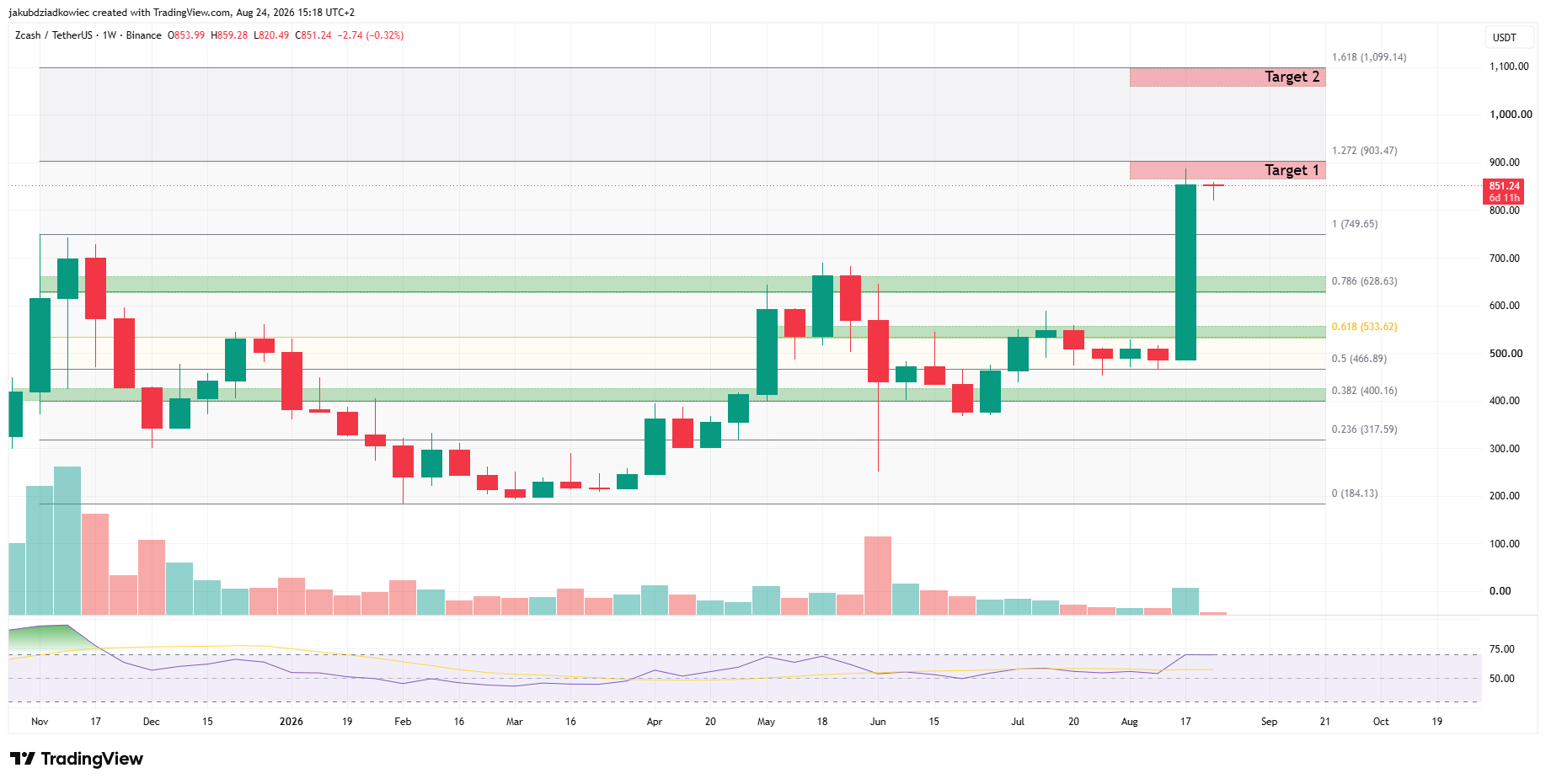
Zcash Clears Its November 2025 Peak and Tags the $903 Target
Zcash gained 75.5% last week, its largest weekly candle of the cycle. ZEC now trades at $846.51, down 1.19% over 24 hours.
The rally pushed ZEC above the November 2025 peak at $749. Price now sits inside the first target zone, which ends at the 1.272 Fibonacci extension at $903.

Above that level, the 1.618 extension at $1,099 becomes the next objective. Support sits at the 0.786 Fibonacci level near $628, with a deeper floor at $533.
However, the weekly RSI has reached 70, placing ZEC on the edge of overbought territory. Volume also stayed thin through the range before last week’s spike.
Aave Escapes a Seven-Month Descending Channel
Aave rose 64.5% and broke out of the descending parallel channel that had capped it since January. AAVE trades at $136.08, down 3.08% on the day.
The breakout cleared the $125 resistance band, which now flips to first support. Below that, the former channel floor near $90 marks the next line of defense.

The next hurdle sits at $150, the zone AAVE broke down from in early January. Last week’s high of $144.68 already came within 4% of it.
A weekly RSI of 60 leaves room before overbought conditions appear, unlike ZEC. Institutional interest in Grayscale and other funds has also built up throughout the year.
XRP Breaks a 13-Month Descending Trendline
XRP climbed 53% and broke the descending trendline drawn from its July 2025 record near $3.66. That line has rejected four rally attempts since then.
XRP trades at $1.50, down 1.02% over 24 hours. Volume on the breakout candle reached its highest level since February, indicating genuine participation.

Price also cleared the May swing high at $1.4735 and turned it into support. Resistance now sits at the 0.618 Fibonacci level at $1.70.
Weekly RSI at 57 remains neutral, leaving XRP with the most headroom of the three tokens.
Each setup rests on Bitcoin holding its gains. A rejection below $80,000 would likely stall these breakouts at their first resistance levels. Conversely, continued strength keeps $903 in ZEC, $150 in AAVE, and $1.70 in XRP in play.
The post Top 3 Altcoins Benefiting Most From Bitcoin's Latest Rally appeared first on BeInCrypto.


Webull recorded a nearly 300% jump in buy-side orders for Bitcoin (BTC) and ether (ETH) over the past week and a half, Chief Executive Officer Anthony Denier said.
Denier linked the surge to June’s repeal of the pattern day trading (PDT) rule, which had limited frequent trading for accounts under $25,000. Bitcoin traded near $78,919 at the time of writing.
A Rule Change Reshapes Retail Trading
Speaking in an interview with CNBC’s “Squawk on the Street,” Denier said the rule change reshaped how Webull’s retail base trades. The average account on the platform holds roughly $5,500, well under the old PDT threshold.
That meant most users previously could not day trade unrestricted assets at all. The repeal, effective June 4, opened that activity to the bulk of Webull’s client base.
“We’re seeing over the past week and a half, we’re seeing almost a 300% increase in buy-side orders for the big cryptos, Bitcoin and ETH.”
— Anthony Denier, CNBC
Treasury Moves and a Revenue Jump
Denier also credited recent Treasury purchase operations with sparking the broader Bitcoin rally, a dynamic that lines up with Bitcoin’s record weekly gain even as critics challenge the Treasury’s buyback plan.
The rule change has already shown up in Webull’s financials. Revenue rose from $160 million in the first quarter to near $200 million in the second.
“We went from a $160 million top line revenue in Q1 to near $200 million basically on one month’s addition, which was June of Q2 that removed the PDT rule.”
— Anthony Denier, CNBC
Denier said only a small share of clients actively day trade Bitcoin and ether. This is well below the roughly 10% who day trade across all products, without giving an exact figure.
Most customers hold long-term positions, he said. And, they trade actively mainly during volatile stretches, including swings tied to artificial intelligence stocks.
Webull has never reported a quarter of declining client assets under management, Denier said, even with an active trading base.
The post Webull Sees Bitcoin, ETH Buy Orders Jump Nearly 300% After Rule Repeal appeared first on BeInCrypto.

Wyndham Clark’s meteoric turnaround has 1 main club behind it

How To Use Samsung’s New My FanCam Feature To Make Yourself The Main Character In Your Videos

Pov:you got lucky at the worst moment!!





-

 Fashion3 days ago
Weekend Open Thread: Madewell – Corporette.com
-

 Business3 days ago
Musk’s Tesla, SpaceX Confirm $16.8 Billion ‘Terafab’ Chip Plant as World’s Largest Building in Texas
-

 Crypto World3 days ago
anatomy of crypto’s biggest liquidation event since 2021
-

 Business7 days ago
SMA Solar Technology AG (SMTGY) Q2 2026 Earnings Call Transcript
-

 Tech7 days ago
Qwen3.8-27B runs frontier-class coding agents and reasoning locally, no cloud API required
-

 Politics3 days ago
6 months on, Irish renters crushed by effects of government housing bill
-
 NewsBeat3 days ago
The ‘Lucky Dip Gang’ causing carnage for clicks: After five thugs were killed speeding in the wrong direction on a motorway, GUY ADAMS investigates a sick new trend… and why police aren’t even allowed to pursue them
-

 Tech6 days ago
GLM-5.3 hits the API at $1.4/$4.4 per million tokens
-

 News Videos5 days ago
Don’t Leave Your Financial Future To Chance | August 19, 2026
-

 Business2 days ago
Mystery AI Model ‘Ox Alpha’ Draws Developers With Free Access as Chinese Lab Origins Remain Debated
-

 Tech7 days ago
Keychron K8 Ultra 8K review: a great value keyboard with comfort issues
-

 Business7 days ago
Stock Market Today: Tech Futures Slide As Treasury Yields Jump; Nvidia, Micron, Sandisk Sell Off
-

 Business5 days ago
Marvell Shares Jump 7% as Google Chip Deal Confirms Custom AI Silicon Partnership, Analysts
-

 Business4 days ago
Five Below: Kids Discount Retailer Reaps Rich Rewards
-

 Tech7 days ago
Ken Okuyama’s Kode89 Supercar Features Three Pedals and a Choice of V12s
-

 Politics7 days ago
The House Opinion Article | Security means more than military spending
-

 Fashion7 days ago
The Dressier Side of Shorts
-

 Business7 days ago
Nasdaq Ticks Higher as Wall Street Awaits Retail Earnings and Weighs Fed’s Next Move at Jackson Hole Meeting
-
 Crypto World7 days ago
Compound approves $52M institutional DeFi program
-

 Tech7 days ago
Payments giant Stripe is about to drop over $7 billion to become a gateway to AI token sales
You must be logged in to post a comment Login