
Crypto World
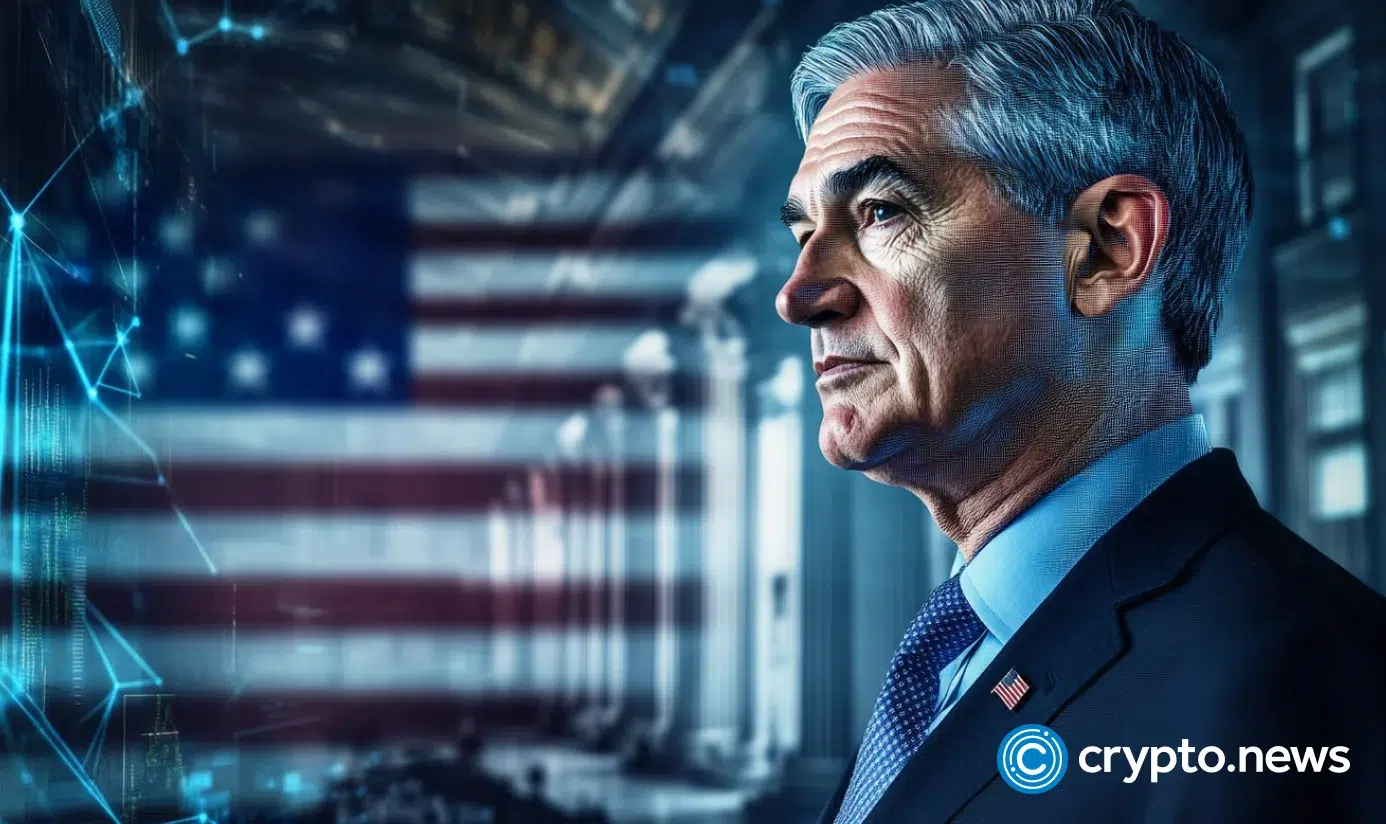
Trump pressures Powell to cut rates as Fed holds line on inflation



Trump ramps up pressure on Powell to slash rates to 1% even as the Fed holds at 3.50%–3.75%, lifts inflation forecasts, and warns the Iran oil shock risks stagflation.
Summary
- Trump renews attacks on Powell, demanding immediate cuts and even 1% rates despite Brent above $110 and inflation expectations rising with the Iran war energy shock.
- The Fed leaves rates at 3.50%–3.75% and signals only one 2026 cut, with officials warning that oil-driven inflation could keep PCE near 3% and delay any easing.
- Economists say the U.S. now faces a classic stagflation trap, as cutting to appease Trump risks entrenching inflation while holding steady deepens demand destruction.
U.S. President Donald Trump renewed his public pressure campaign on Federal Reserve Chair Jerome Powell on Thursday, stating that Powell should cut interest rates — a demand that stands in direct contradiction to the Fed’s posture just 24 hours earlier, when the central bank held rates unchanged and signaled it expects only one cut for the entirety of 2026.
Trump’s statement, reported by Jinshi on Thursday, follows a pattern of escalating attacks on the Fed chair that has intensified since the Iran war began on February 28. As recently as March 12, Trump took to Truth Social to write: “Where is the Federal Reserve Chairman, Jerome ‘Too Late’ Powell, today? He should be dropping Interest Rates, IMMEDIATELY, not waiting for the next meeting!” The president has reportedly called for rates as low as 1%, even as soaring oil prices are pushing inflation expectations sharply higher.
Crypto markets have been trading this showdown in real time: Bitcoin has already slipped back below $70,000 after briefly tagging the mid‑$73,000s last week, while Ethereum has faded toward the low‑$2,200s as Fed funds futures price in barely a single cut for 2026 and the market starts to contemplate a “no‑cut” year. That leaves BTC caught between two narratives — a stagflation hedge if Powell caves to Trump and lets real yields fall, or just another high‑beta risk asset if the Fed digs in and higher-for-longer rates collide with an oil shock to crush liquidity across both TradFi and crypto.
The Fed voted to keep its benchmark rate in the 3.50%–3.75% range at its March 18 meeting, citing persistent uncertainty around both the Iran conflict’s economic impact and the residual effects of Trump’s 15% global tariff regime. Powell acknowledged that a rate hike remains unlikely but did not rule it out, noting that the Fed “will need to assess how enduring this situation is” in reference to the global energy crisis.
The Fed’s updated forecasts are expected to revise inflation projections upward, with many economists anticipating the central bank will now forecast inflation remaining as high as 3% by late 2026 — a level difficult to reconcile with rate cuts. Trump’s own nomination of Kevin Warsh to succeed Powell when his term concludes in May had been expected to usher in a more dovish era, but the Iran conflict may delay or complicate that transition.
The core tension is acute. Trump wants lower rates to stimulate a slowing economy and support financial markets battered by oil-driven uncertainty. But the Fed faces a classic stagflation dilemma: cutting rates risks entrenching oil-fueled inflation, while holding or hiking risks amplifying the demand destruction already underway as energy costs squeeze consumers and businesses.
CME FedWatch data shows markets assigning over 99% probability to no change at the current meeting, and Wall Street economists are increasingly calling for a zero-cut year. Oxford Economics chief U.S. economist Lydia Boussour noted that “given our elevated forecasts for headline and core PCE inflation, we have adjusted our baseline to reflect only one 25 basis point cut in 2026 — but it is entirely plausible the Fed won’t implement any rate cuts this year.”
The oil shock has already erased the inflation buffer that lower energy prices had provided earlier in 2026 in the face of Trump’s tariffs. With Brent crude above $110 and Iranian strikes on Gulf energy infrastructure widening on Thursday, the Fed’s margin for maneuver is narrowing — even as Trump’s demands grow louder.



Apex Group’s Tokeny has tapped Polygon Labs to launch T-REX Ledger, a compliance-focused blockchain designed to help regulated tokenized assets move across networks without repeating investor checks and transfer restrictions.
In a Thursday release shared with Cointelegraph, the project said it targets a key friction point in tokenized markets. ERC-3643 is an Ethereum-based token standard for permissioned tokens representing real-world assets that can support compliant issuance of RWAs, but identity checks, eligibility rules and transfer restrictions often remain fragmented when the same asset is distributed across multiple blockchains.
T-REX Ledger is being pitched as a shared compliance layer that other chains can query, while settlement continues to take place on external networks. Built with Polygon’s Chain Development Kit and connected to Agglayer, the system is intended to act as a common registry for investor eligibility and transfer rules across tokenized securities.
The launch comes as financial and crypto infrastructure groups race to build infrastructure for tokenized markets. The New York Stock Exchange parent company, Intercontinental Exchange, has outlined plans for a new platform for tokenized stocks and exchange-traded funds (ETFs), while the Depository Trust and Clearing Corporation (DTCC) joined the ERC-3643 Association in 2025 as institutions push deeper into tokenized collateral and securities infrastructure.
Fixing fragmented compliance
In the release, the network was described as a “shared source of truth” for investor eligibility and transfer rules.
The core problem T-REX aims to solve is that ERC-3643 enables compliant issuance but does not maintain a shared compliance state across chains. The same security measures applied to Ethereum and Polygon, for example, still run separate eligibility checks, identity attestations and transfer restrictions.
Joachim Lebrun, co-founder of T-REX Network and chief blockchain officer of Tokeny, told Cointelegraph that T-REX Ledger would support the issuance and lifecycle management of regulated digital securities, including bonds, funds, equities and structured products, with identity, eligibility and transfer rules embedded directly into ERC-3643 tokens.
Apex Group will act as the first onchain transfer agent and plans to adopt T-REX Ledger as its default multi-chain orchestration layer with an initial target of $100 billion in tokenized assets by June 2027.
Related: New Ethereum standard aims to set baseline for real-world asset tokenization
T-REX Ledger centralizes compliance logic in a dedicated chain that other networks can query, while settlement remains on external chains.
Lebrun said, “The market has grown into a multi-chain world for tokenization” and argued that T-REX Ledger turned other blockchains into “distribution channels,” enabling regulated assets to move to “wherever liquidity exists with speed, compliance, and control.”
Slotting into the tokenization race
Related: SEC gives go-ahead to Nasdaq for tokenized trading trial
T-REX is pitching itself as a neutral registry layer that can sit alongside players in the tokenization race. Lebrun said that a security issued via T-REX Ledger “could ultimately settle at DTCC” because “the compliance validation doesn’t need to live on the same network as the settlement.”
The chain itself will run as a sovereign Polygon CDK network governed by a dedicated steering committee, while ERC-3643 and its compliance framework remain open source under the ERC-3643 Association, not Polygon.
Magazine: Ethereum’s Fusaka fork explained for dummies — What the hell is PeerDAS?

Key Highlights
- Figma’s shares plummeted approximately 8% on Wednesday following Google’s unveiling of significant enhancements to its Stitch AI design tool
- Google introduced “vibe designing” functionality — an innovative prompt-driven method for creating user interfaces and generating frontend code
- The Stitch platform now connects seamlessly with Google Workspace applications including Docs and Drive, appealing to organizations already embedded in Google’s suite
- Figma disclosed $1.06B in fiscal 2025 revenue, representing a 41% year-over-year increase, though net losses expanded to $1.25B
- FIG shares are currently down approximately 80% from their post-IPO peak of $142.92
Figma has endured a challenging period, and Wednesday’s trading session offered no relief. Shares declined roughly 8% following Google’s announcement of substantial upgrades to Stitch, its artificial intelligence-driven user interface design platform. By Thursday midday in New York, FIG continued trading lower by approximately 5%.
The market reaction was swift. Investors didn’t require detailed feature-by-feature analyses — the mere involvement of Google proved sufficient to trigger selling pressure.
While Stitch had already registered on Figma’s competitive landscape, Wednesday’s reveal brought the threat into clearer view. Google Labs centered its announcement around a fresh approach dubbed “vibe designing” — fundamentally leveraging conversational language prompts to create refined UI layouts and frontend code, bypassing traditional wireframing stages.
“When ‘vibe designing’ in Stitch, you can explore many ideas quickly leading to a higher quality outcome,” Google stated in its release. The platform now supports voice commands as well, enabling users to request instant modifications such as alternative color schemes or revised navigation elements.
The updated Stitch also introduced templates spanning multiple sectors including SaaS dashboards, healthcare applications, entertainment platforms, and utility services — sectors that align directly with Figma’s core customer segments.
The Significance of Google’s Strategic Play
The worry extends beyond feature parity. The underlying infrastructure presents the larger challenge. Stitch’s integration with Google Docs, Drive, and the broader Workspace environment — platforms already woven into the daily workflows of countless organizations — substantially lowers migration barriers for companies contemplating alternatives to Figma.
Google’s proven ability to rapidly scale products adds weight to the competitive threat. This historical capability gives market participants legitimate grounds for concern, regardless of Stitch’s current maturity level.
Figma CEO Dylan Field commented on market fluctuations during a February CNBC appearance, noting: “I think volatility is probably good at strengthening companies long-term.”
Nvidia CEO Jensen Huang challenged the prevailing narrative suggesting AI platforms will entirely displace established software firms. “It is the most illogical thing in the world and time will prove itself,” Huang remarked during a Cisco AI conference.
Analyzing Figma’s Financial Performance
Figma’s financial results present a complex picture. The company achieved $1.06 billion in revenue for fiscal 2025, marking a 41% year-over-year climb. Net dollar retention reached 136%, indicating existing customers increased their platform spending by 36% compared to the previous year.
However, losses are accelerating. Net losses totaled $1.25 billion in 2025, climbing from $732 million in 2024. Escalating stock-based compensation and operational expenditures are widening this deficit.
Shares initially surged following the Feb. 18 earnings disclosure, buoyed by projections of 38% revenue expansion in Q1 2026. That momentum proved short-lived.
FIG currently trades near $24.50 — substantially beneath its IPO price of $33 per share, and nearly 80% below its post-IPO zenith of $142.92. The 52-week trading range spans from $19.85 to $142.92.
With a price-to-sales multiple hovering around 13, the valuation remains elevated but increasingly reasonable compared to comparable high-growth SaaS companies demonstrating similar revenue trajectories.
The stock has yet to retest its early February nadir, which certain market observers interpret as potential support establishing itself.

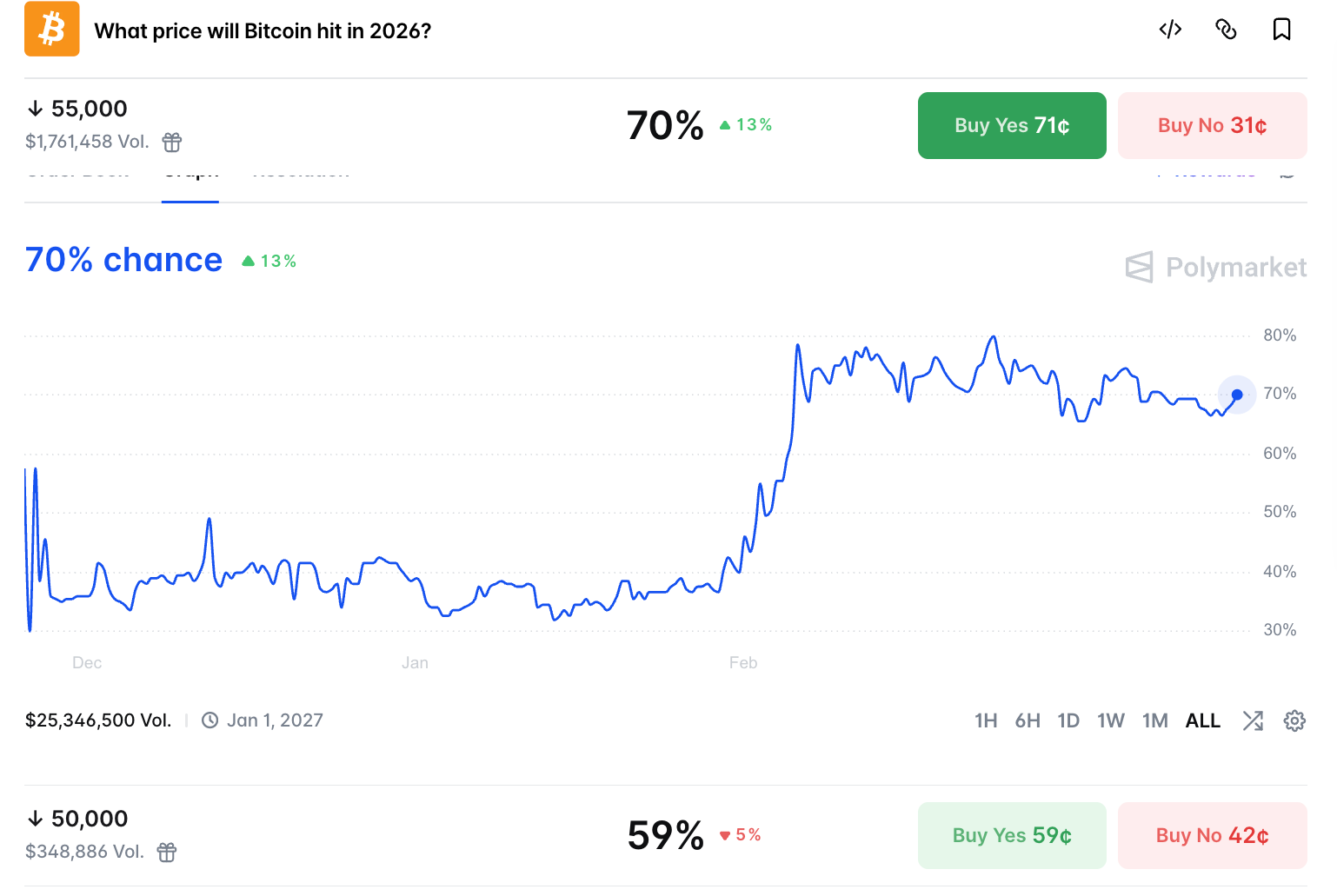
Bitcoin (BTC) may go as low as $55,000 in 2026 as the market lacks bullish catalysts amid macroeconomic uncertainties.
Key takeaways:
-
BTC price has a 65%-71% chance of dropping below $55,000 before Dec. 31, according to prediction markets.
-
Bettors don’t expect Strategy to sell its BTC holdings in 2026.
-
Whale selling and negative ETFs flows add to Bitcoin’s sell-side pressure.
Prediction markets see BTC bear market continuing
The majority of traders on Polymarket and Kalshi expect Bitcoin to resume its downtrend throughout 2026, with targets as low as $40,000.
Related: Bitcoin tests old 2021 top as gold falls to six-week lows under $4.7K
As of Thursday, Polymarket bettors are pricing in about 71% odds of BTC dropping below $55,000 before Dec. 31, a 13% increase from the previous day.
Traders set 59% odds of BTC crossing below the $50,000 psychological level and a 46% chance that it goes as low as $45,000 before the end of the year.

The lower price target forecasts for BTC mimic those elsewhere. On fellow prediction site Kalshi, traders set 71% odds of Bitcoin dropping below $60,000, with a 65% chance that it drops below $55,000. The lowest price target on Kalshi is $40,000, with a 31% possibility that BTC drops to this level before Dec. 31.

Bitcoin’s low for 2026 sits at $59,940, reached on Feb. 6, and the last time the BTC/USD pair traded below $55,000 was in February 2024.
As Cointelegraph reported, some analysts believe that the long-term BTC price downtrend is still in play, warning that the rebound to $76,000 was a bull trap.
Will Strategy sell Bitcoin in 2026?
Bitcoin’s recent drop to $69,000 saw it slide below Strategy’s average BTC cost price, which is $75,696 at the time of writing.
But despite the expected drawdown in price, Polymarket odds for Strategy selling Bitcoin in 2026 remain below 15%, while expectations for routine buys remain elevated.

Polymarket traders still see routine Strategy purchases throughout the year as a high-probability event, with a 96% chance of it holding over 800,000 BTC by Dec. 31.
Last week, Strategy expanded its Bitcoin treasury to 761,000 BTC after buying 22,337 coins for roughly $1.6 billion.
Bitcoin ETF flows tread water
Meanwhile, the US spot Bitcoin exchange-traded funds (ETFs) returned to net negative flows on Wednesday.
These were driven mostly by outflows from the Fidelity Wise Origin Bitcoin Fund (FBTC), data from investment firm Farside shows.

As Cointelegraph reported, the largest ETF offering from asset manager BlackRock saw $34 million in outflows as investor sentiment returned to “extreme fear.”
This article does not contain investment advice or recommendations. Every investment and trading move involves risk, and readers should conduct their own research when making a decision. While we strive to provide accurate and timely information, Cointelegraph does not guarantee the accuracy, completeness, or reliability of any information in this article. This article may contain forward-looking statements that are subject to risks and uncertainties. Cointelegraph will not be liable for any loss or damage arising from your reliance on this information.

Key Takeaways
- Micron’s fiscal Q2 2026 delivered $23.86 billion in revenue with adjusted EPS of $12.20, surpassing analyst expectations
- The company projected fiscal Q3 2026 revenue of approximately $33.5 billion, significantly exceeding Street estimates
- Capital expenditure guidance for fiscal 2026 increased to more than $25 billion, roughly $5 billion higher than previous projections
- Shares declined following the earnings announcement despite impressive financial performance, primarily due to elevated spending concerns
- Analyst sentiment remains overwhelmingly positive with 29 Buy ratings, 5 Strong Buys, and no Sell recommendations according to MarketBeat data
Micron Technology unveiled exceptional quarterly results on March 19, yet the market’s response told a more complex story. Despite impressive revenue figures and unprecedented free cash flow generation, shares retreated as Wall Street digested the company’s ambitious capital investment strategy.
The memory chip giant reported fiscal second-quarter 2026 revenue reaching $23.86 billion alongside adjusted earnings of $12.20 per share. Micron also highlighted that it closed the period with $16.7 billion in cash and investments, marking a company record for free cash flow generation.
While these figures impressed, it was the forward-looking commentary that captured the most attention—both positive and negative.
For fiscal Q3 2026, Micron projected revenue of approximately $33.5 billion, substantially exceeding Wall Street’s expectations. The company attributed this robust outlook to explosive demand for high-bandwidth memory (HBM) products, which are essential components in AI data centers and acceleration hardware.
HBM represents today’s most sought-after memory technology. Micron operates within an oligopoly of just three major global producers, joined by Samsung and SK hynix. This concentrated supply structure has bolstered pricing power and supported healthy profit margins.
Understanding the Post-Earnings Decline
Notwithstanding the impressive financial performance, Micron’s stock price declined following the announcement. The catalyst? A significantly revised capital spending forecast.
The company disclosed that fiscal 2026 capital expenditures would surpass $25 billion, representing an approximate $5 billion increase from earlier guidance. Management explained the investment is necessary to expand clean-room infrastructure and accelerate DRAM manufacturing capacity to satisfy AI-driven demand.
This scenario represents a classic semiconductor industry dilemma—deploying massive capital to capture growth opportunities while risking oversupply if market conditions deteriorate. Memory manufacturers have historically encountered this challenge, and investors maintain vivid memories of past overcapacity cycles.
Additionally, the stock’s valuation had already reflected substantial optimism. Prior to Thursday’s retreat, Micron had surged more than 61% during 2026, building on strong momentum from 2025. At such elevated levels, any hint of risk can trigger profit-taking behavior.
Wall Street Maintains Conviction
The analyst community showed no signs of wavering. According to MarketBeat data released on March 19, Micron holds five Strong Buy ratings, 29 Buy ratings, and four Hold ratings. Notably, zero analysts recommend selling the stock.
This represents nearly unanimous bullish positioning. The four Hold ratings suggest some analysts advocate patience at current valuations, but bearish recommendations remain completely absent.
Price targets underwent revisions as analysts updated their financial models following the report. MarketBeat’s consensus tracking indicated a range settling between approximately $425.62 and $446.66.
Several firms subsequently raised their targets. Needham elevated its price objective to $500. UBS similarly increased its target while reaffirming its Buy rating. Both institutions cited the sustained strength of AI-related memory demand as their primary rationale.
These $500 price targets represent more than optimistic projections—they embody a conviction that Micron’s AI-driven growth trajectory extends further than current market pricing acknowledges.
The investment debate surrounding Micron has evolved. Questions no longer center on whether the company is emerging from a downturn. Instead, the focus has shifted to whether Micron can sustain expansion without excessive capital deployment.
Presently, analysts are answering affirmatively. With 34 Buy or Strong Buy ratings and zero Sell recommendations in current MarketBeat data, Micron stands as one of the most broadly supported equities in the AI semiconductor sector.
The stock declined on March 19. The analyst community’s conviction remained intact.


The European Central Bank is looking for experts who can help define how a potential digital euro can be used across ATMs and payment terminals.
Summary
- ECB opens applications for expert workstreams to define how a digital euro would function across ATMs and payment terminals.
- Workstreams will focus on technical specifications and certification frameworks to ensure integration with existing payment systems, including offline capability.
The ECB published an announcement on Wednesday, opening applications for two workstreams under its Rulebook Development Group. The first will focus on implementation specifications for ATM and terminal providers, while the other will work on certification and approval frameworks for payment solutions.
Experts joining the workstreams would contribute to how a potential digital euro would integrate across existing payment systems and technologies, including offline functionality and interoperability with standards used across Europe.
The workstreams will report to the Rulebook Development Group, which includes representatives from merchants, payment service providers and consumers.
“The draft rulebook currently being developed will be sufficiently flexible to accommodate any future adjustments and will be updated in accordance with the outcome of the digital euro legislative process. A possible decision by the ECB’s Governing Council to issue a digital euro would only be taken after the legislative act has been adopted,” the ECB said.
As previously reported by crypto.news, last year, the ECB announced providers for five components and services after a similar call for applications published in 2024.
The banking regulator had also put out invitations to tender for firms that could offer technology solutions and components around alias lookup, fraud and risk management, offline services and software development kits, among others.
While the ECB is making progress around the digital euro rollout, it has continued issuing public warnings about the risks of stablecoins, which are seen as one of the biggest competitors to any central bank digital currency.
The ECB is concerned that if euro-denominated stablecoins gain serious traction, it could weaken the effectiveness of monetary policy and reduce the funding base of traditional banks.
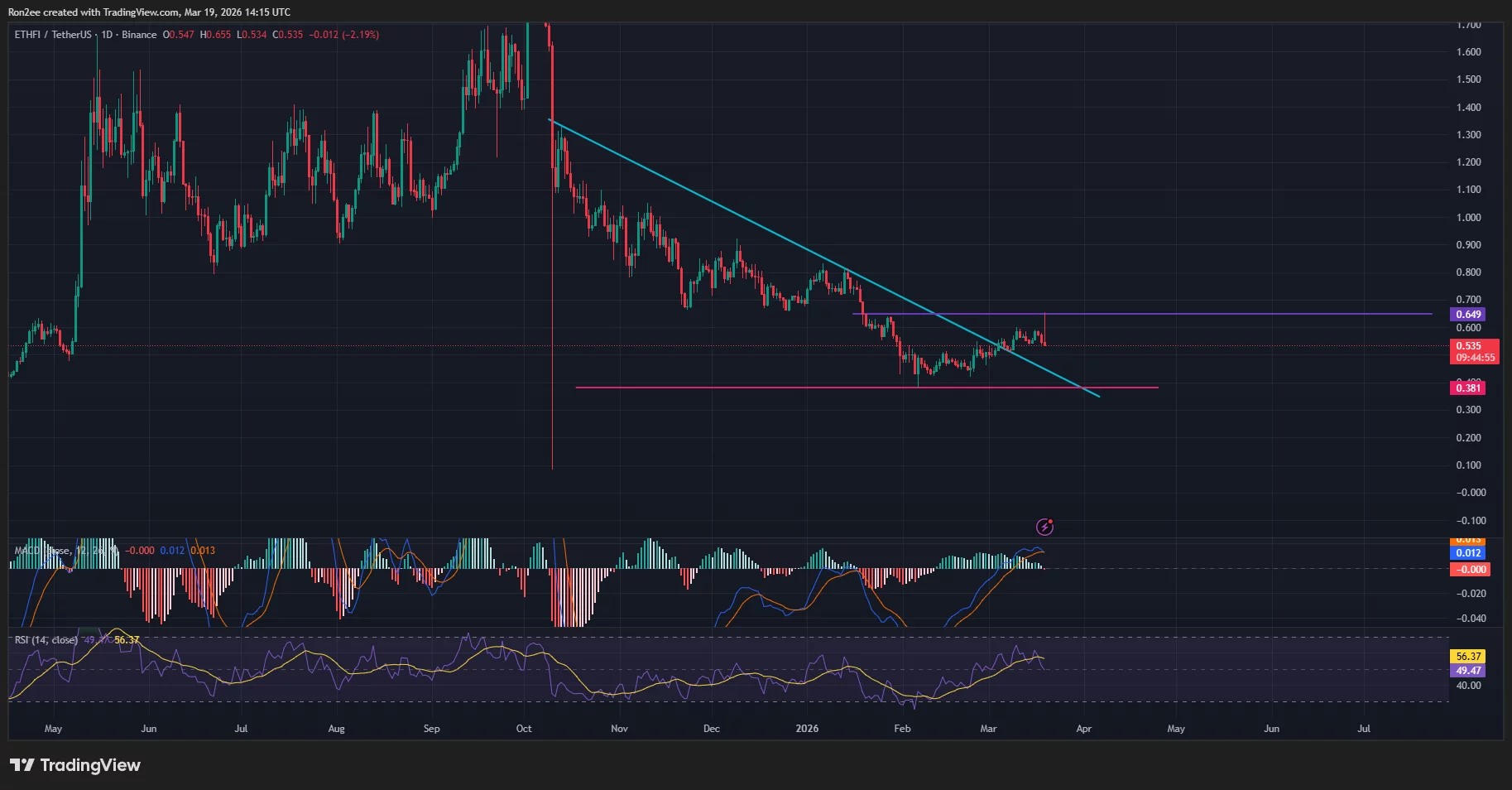
Arthur Hayes, a veteran trader and co-founder of BitMEX, has once again placed a bet in ETHFI nearly a month after a possible exit from the token.
Summary
- Arthur Hayes re entered ETHFI with a $72,800 purchase shortly before Upbit announced a KRW listing, drawing attention to the timing of the move.
- ETHFI price briefly surged nearly 12% following the listing before retracing, highlighting volatility tied to exchange driven catalysts.
- Technical signals remain mixed, with a breakout above trendline resistance suggesting upside potential, while MACD and RSI indicate lingering bearish pressure.
According to a March 19 X post by on-chain tracker Lookonchain, Hayes invested around 132,730 ETHFI tokens worth $72,800 today. The tokens were received from Anchorage Digital at an average price of $0.55 each.
While such transfers are common for institutional players, the report highlighted the significance of the timing of the purchase. It revealed that the transfer from Anchorage Digital happened just five hours ahead of a KRW market listing for the token by South Korea’s largest crypto exchange, Upbit.
Typically, a KRW listing on Upbit has often acted as a major catalyst for crypto assets. As reported by crypto.news earlier, CPOOL, the native token of the DeFi institutional credit protocol Clearpool, soared over 70% in a single day following a similar listing. However, the token later gave up a portion of those gains as profit-taking set in.
Lookonchain added another twist to the development. Notably, Hayes had transferred 2.15 million ETHFI tokens worth around $1 million out of his wallet a month ago, likely exiting from the position.
The latest receipt of ETHFI tokens could likely mark a potential re-entry into the token, though at a much smaller scale than when Hayes previously exited the position. Hayes has also historically rotated capital across DeFi tokens, including PENDLE, LDO, ENA, and ETHFI, depending on market conditions.
Ether.Fi (ETHFI) shot up nearly 12% to $0.60 within an hour after Upbit listed the token. It, however, retraced back to around $0.54 at press time, down 2.3% over the past 24 hours.
On the daily chart, ETHFI price has broken out of a descending trendline that had been acting as dynamic resistance for the token following its decline since early October. A sharp breakout from the pattern typically signals a potential trend reversal and opens the door for further upside if supported by volume.
Technical indicators like the MACD and the RSI also suggest mixed momentum. Notably, the MACD lines were still pointing downwards, indicating lingering bearish pressure, while the RSI hovered near the neutral zone, reflecting indecision among traders.
For now, $0.649 would be the key resistance level traders would be keeping an eye on. A break above that could strengthen bullish momentum and push the price toward higher levels.
On the contrary, $0.500 would be the key support level. A drop below that could lead to a retest of the Feb. 6 low of $0.381.
Disclosure: This article does not represent investment advice. The content and materials featured on this page are for educational purposes only.


Bitcoin sinks below $71k as Powell’s hawkish tone and Iran’s oil shock trigger a $542M liquidation wave across leveraged crypto markets.
Summary
- Bitcoin drops to about $71,313, Ethereum to $2,201, as crypto and stocks sell off on Fed projections and oil shock fears.
- Powell flags oil-driven inflation, keeps just one 2026 rate cut in the dot plot, crushing hopes for easier policy and triggering a risk-off move.
- Over $542M in mostly long liquidations and Brent above $110 show how leveraged crypto positioning collides with Iran-driven energy turmoil.
Crypto markets extended their slide into Thursday as the combined aftershock of the Federal Reserve’s March policy meeting and an escalating oil shock from the Iran conflict continued to rattle risk assets. Bitcoin (BTC) fell to approximately $71,313 (-4.62%), Ethereum dropped to $2,201 (-5.92%), and a cascade of leveraged long positions was wiped out — with total network-wide liquidations reaching $542 million over 24 hours, of which $448 million were long positions. It was the largest liquidation event in weeks, and the most heavily one-sided since the early stages of the U.S.-Iran conflict in late February.
The proximate trigger was Wednesday’s Federal Open Market Committee decision and, more critically, the press conference that followed. The Fed held its benchmark rate at 3.5%–3.75% as universally expected, with the FOMC voting 11-1 to maintain that range. But the new Summary of Economic Projections — the first of 2026 — delivered the information markets least wanted to hear. The Fed raised its 2026 PCE inflation forecast to 2.7%, up from a prior estimate of 2.4%, citing the oil shock stemming from Iran’s blockade of the Strait of Hormuz as a direct driver. The dot plot’s median remained anchored at just one 25-basis-point cut for all of 2026, dashing residual hopes for a more accommodative path.
Fed Chair Jerome Powell was unambiguous in his press conference. “The oil shock for sure shows up,” he said, referring to its impact on the central bank’s projections. In his opening statement, he noted that near-term inflation expectations “have risen in recent weeks, likely reflecting the substantial rise in oil prices caused by the supply” disruption — a reference to the Hormuz closure that has taken roughly 20% of global oil flows offline since late February. Core PCE rose 3.0% in the 12 months through February, well above the Fed’s 2% target. Powell rejected comparisons to 1970s stagflation, arguing unemployment remains near normal levels, but acknowledged the tension between the Fed’s dual mandate goals in the current environment.
The market reaction was swift and familiar. Bitcoin dropped from approximately $74,000 to $70,900 within hours of the press conference — its eighth decline following an FOMC meeting out of the last nine. The Nasdaq closed down 1.5% on Wednesday, the Dow and S&P 500 reversed five consecutive sessions of gains to hit their lowest levels since November, and 10-year Treasury yields climbed more than 5 basis points. On Thursday, the selloff continued, with the Dow opening down 420 points (-0.91%), the S&P 500 -0.89%, and the Nasdaq -1.23%.
The liquidation breakdown tells its own story: Bitcoin longs alone accounted for $172 million in forced selling, ETH longs for $126 million, with a total of 143,776 traders liquidated globally. The largest single liquidation — an ETH position worth $17.98 million on Aster — underscores how aggressively leveraged some participants were ahead of the FOMC. Long-term Bitcoin holders were also reported to have sold over 1,650 BTC worth approximately $117 million in the wake of Powell’s remarks.
With Brent crude now above $110 per barrel following renewed Iranian attacks on regional energy facilities, and a Fed that has explicitly incorporated oil-driven inflation into its baseline forecast, the conditions for a near-term rate cut have seldom looked more remote.
Fed unveils a 90-day comment plan to ease Basel III and G-SIB capital rules, modestly cutting requirements for large banks and more for regional lenders.
Summary
- Fed launches a 90-day comment period on proposals that slightly lower capital requirements for large banks and more materially for smaller regionals.
- Bowman’s “four pillars” overhaul spans stress tests, eSLR, Basel III and G-SIB surcharges, aiming to free credit and shareholder payouts without scrapping post-2008 safeguards.
- Industry groups cheer the recalibration as growth-friendly, while critics warn easing buffers amid oil shocks and higher-for-longer rates risks weakening prudential defenses.
The Federal Reserve voted Thursday morning to formally release a sweeping package of proposed bank capital reforms, launching a 90-day public comment period on changes that would modestly reduce capital requirements for the largest U.S. financial institutions — and more substantially ease the burden on smaller regional banks. The proposals, previewed by Fed Vice Chair for Supervision Michelle Bowman in a March 12 speech at the Cato Institute, represent the most significant overhaul of the post-2008 bank capital framework in years and a clear victory for Wall Street institutions that had spent years lobbying against an earlier, more stringent version of the rules.
The package addresses what Bowman described as “the four pillars” of the regulatory capital framework for the largest banks: stress testing, the enhanced supplementary leverage ratio (eSLR), the Basel III endgame rules, and the G-SIB surcharge applied to globally significant institutions. Together, the proposals would produce a net decrease in capital requirements for large banks “by a small amount,” while smaller banks focused on traditional lending would see “slightly larger reductions”. For major institutions such as JPMorgan Chase and Goldman Sachs, the modest increase from revised Basel III calculations would be more than offset by a recalibrated G-SIB surcharge — one Bowman argued had grown disproportionate to the risks these banks actually carry.
The philosophical underpinning of the reform is a conviction that capital requirements imposed after the 2008 financial crisis have gradually overshot their intended purpose. “When capital requirements become excessive, they hinder the banking system’s essential role of providing credit to the real economy,” Bowman said in her Cato Institute remarks. She described the proposals as a “sensible recalibration” designed to remove redundant standards and better align requirements with actual institutional risk profiles, rather than a wholesale rollback of post-crisis prudential safeguards.
The eSLR reforms are particularly significant. A final rule approved by the FDIC and Federal Reserve in November 2025 — effective April 1, 2026 — had already replaced the existing 2% eSLR buffer for global systemically important banks with a buffer equal to half of each institution’s Method 1 G-SIB surcharge, capped at 1% for subsidiary banks. FDIC staff estimated that change alone would reduce aggregate Tier 1 capital requirements by $13 billion, or under 2%, for G-SIBs, and by $219 billion — or 28% — for major bank subsidiaries. The new proposals being voted on Thursday extend that logic across the Basel III and G-SIB surcharge frameworks.
The banking industry responded favourably. The American Bankers Association, Financial Services Forum, and Bank Policy Institute issued a joint statement praising Bowman’s approach as “a thoughtful, bottom-up” resolution to the concerns raised by 97% of commenters on the prior Basel proposal, calling for a capital framework that “reflects the actual risks in the banking system, rather than over-calibrated requirements that impede economic growth”.
The timing carries broader market significance. With the Fed holding rates steady at 3.5%–3.75% and explicitly raising its 2026 inflation forecast to 2.7% on Wednesday, the capital easing offers Wall Street a degree of policy relief that monetary policy itself is not currently providing. Freeing up capital for lending, share buybacks, and dividends — precisely the stated aim of the reform — may inject some flexibility into a financial system otherwise navigating a geopolitical oil shock and a higher-for-longer rate environment.
Critics, however, argue that loosening capital buffers during a period of elevated macro uncertainty runs counter to the spirit of prudential regulation. Bowman indicated no implementation timeline beyond coordinating with other international jurisdictions — leaving the final shape of the rules subject to the 90-day comment process.

Bitcoin (BTC) dipped under $69,000 on Thursday, sliding back into its six-week range after briefly touching highs above $76,000. The retreat comes as futures selling accelerates and demand from U.S.-based investors shows signs of stalling, though analysts argue the market could still mount a renewed rally if key levels hold and the broader setup unfolds in a favorable way.
The shift reflects a shift in market dynamics where derivatives activity increasingly dominates spot flows, underscoring the ongoing tug-of-war between leveraged traders and cash-based demand. While the immediate move raised questions about momentum, a familiar chart pattern suggests a potential path back toward the region’s previous highs if the balance of risk and reward tips back in favor of buyers.
Key takeaways
- BTC briefly fell below $69,000, pulling the price back into a six-week range after testing above $76,000 in recent sessions.
- Derivatives activity has regained influence over spot demand, with the Coinbase premium turning negative and cumulative volume delta (CVD) shifting toward sellers on both spot and perpetual contracts.
- Funding rates turned modestly positive (about 0.05%), signaling a shift toward a net long bias in the futures market even as spot liquidity wanes in the near term.
- Technical patterns echo a prior bounce in early March: lower daily lows accompanied by bullish RSI divergences, bolstering case for a retest of higher levels if the price can reclaim key pivots.
- Key levels to watch include reclaiming $70,000, a possible move to $72,000–$76,000, and protection above $68,300 to prevent a slide toward $65,000–$62,000 in a downside scenario.
Derivatives leadership matches fluctuating spot demand
Recent data from on-chain analytics show a notable shift in the relationship between spot volumes and derivatives activity. After a period of robust demand for BTC on spot venues, the Coinbase Premium gap turned negative, suggesting that U.S.-based buyers did not sustain the previous pace of purchases into the dip. That pattern aligns with observations from traders watching the balance between cash markets and the leveraged side of the market.
Analysts highlighted a stark divergence in flow across the two market segments. The cumulative volume delta (CVD) for spot BTC declined by about $40.64 million, while the CVD for perpetual futures fell by roughly $506.75 million. The discrepancy indicates stronger selling pressure from leveraged traders relative to spot buyers over the same period, a dynamic that can amplify short-term price swings even when long-term bias remains mixed.
Despite the softer near-term spot demand, the funding rate has shifted into positive territory, around 0.05%. This implies long-position holders are now paying shorts, a sign of more constructive sentiment within the derivatives market and a potential tilt toward a bullish bias if funding pressures persist in favor of long exposure.
Order-book data further shows stubborn bid support around the $70,000 mark, with market depth hinting at buyers stepping in at or near that level in both spot and perpetual markets. The dynamic suggests that even as selling pressure arises from leveraged traders, a floor exists where demand can reassert itself should prices approach the pivot region.
For context, market watchers also flagged a broader pattern tying into a Bitcoin-centric DeFi push that aims to unlock native liquidity and yield on BTC without resorting to wrapped assets. While not a certainty, such developments could contribute to deeper buyers’ interest at critical levels.
Fractal pattern hints at a potential rebound
On shorter timeframes, Bitcoin’s price movement has formed a fractal pattern reminiscent of early March, when a dip and a sweep of internal liquidity levels preceded a decisive reversal higher. The current setup mirrors that sequence: successive lower lows followed by signals that momentum may be fading and buying pressure could reemerge.
From a momentum perspective, a bullish RSI divergence is unfolding. In the previous instance, the RSI held higher than its own prior low while price dipped, signaling that selling pressure was waning even as price trended downward. A comparable divergence is developing now, reinforcing the case for a fractal rebound rather than a deeper retreat.
Liquidation activity has also framed the narrative in both episodes. In each instance, long-side liquidations have briefly reduced open interest and flushed out overleveraged positions, which can set the stage for a swift reallocation of risk once buyers regain conviction. A breach of the fractal’s boundary would be a red flag, but the current data tilt toward potential stamina in the near term.
Looking ahead, reclaiming the $70,000 area is depicted as a pivotal moment. If bulls push past $72,000 and sustain the move, the door could open to retesting the higher band near $76,000. A key risk sits at $68,300: breaking below this level would widen the path toward liquidity pockets around $65,000 and $62,000, where larger time-frame orders may offer support but where the risk of a more protracted downside expands.
Industry observers have also flagged a practical anchor for bulls: the $73,000 level as a base. Ryan Scott, founder of Trading Stables, emphasized that failure to stabilize above this threshold could signal weak buyer response and raise the odds of a test of range lows around $62,000 in a less favorable scenario.
For readers tracking market sentiment and potential catalysts, these dynamics sit within a broader context. Prediction market chatter has floated scenarios where BTC could revisit declines in the mid-to-high $50,000s in more adverse cycles, but the present fractal framework suggests a more conditional path—one that hinges on continued support near $70,000 and a successful reentry into the higher rung of the range.
Related: OP_NET launches native DeFi push for Bitcoin highlights the broader trend of on-chain options aimed at expanding BTC’s utility beyond traditional spot trading, a development that could help anchor more robust demand in the event of protracted volatility.
What this means for traders and builders
The current setup underscores a broader theme in crypto markets: price action is increasingly shaped by the tug-of-war between leveraged bets and real-money demand. While the near-term risk remains tilted toward a retest of the range’s lower boundary if liquidity dries up, the structural signals favor a rebound scenario as long as price holds above the critical supports and rotating demand persists into the next session.
From an investor standpoint, the situation calls for careful risk management around the $68,300–$70,000 area. Traders aiming for a breakout to the $76,000 vicinity should monitor the 72,000–73,000 zone as a potential pivot, watching for solid acceptance in that band that could fuel a short squeeze if weak shorts get trapped. Conversely, a break below $68,300 could shift the focus to the mid- to lower-$60,000s where higher-timeframe liquidity sits, complicating a quick recovery.
Next steps to watch
Market participants should keep a close eye on bid-ask dynamics around the $70,000 mark and the flow of funding rates in the coming sessions. A sustained positive funding environment and renewed spot demand would bolster the case for a renewed ascent toward recent highs, while a renewed deterioration in derivatives positioning could reassert the range-bound dynamic. In addition, broader adoption and on-chain DeFi developments around Bitcoin may offer extra support should buyers look to deploy capital in more diverse BTC-enabled protocols.
Readers should stay tuned for how the price responds to the pivotal $70,000 to $72,000 zone and whether the fractal pattern continues to unfold. As always, ongoing monitoring of liquidity, funding, and on-chain signals will be essential to gauge whether the market is leaning toward continuation of the uptrend or a renewed test of lower bands.


Opinion by: Arthur Azizov, founder of B2 Ventures
Transaction cost analysis (TCA) has long been an important tool in equity trading. With this instrument, traders can see the hidden costs that a transaction carries and minimize the difference between the expected and the actual price.
As crypto matures, it begins to resemble traditional financial markets and functions like other tradable instruments. Crypto transactions also come with costs: fees that investors pay every time they buy or sell crypto.
Yet there is one thing that is clearly not keeping pace with this development. Execution costs for crypto analyzed systematically. Understanding how much it actually costs to execute a deal leaves much to be desired.
This opacity demands the crypto industry urgently adopt transaction cost analysis before it kills market trust.
Invisible costs in the crypto market
To the untrained eye, major crypto pairs can seem liquid; order books are deep, and quoted spreads are competitive. In the end, however, the final execution price can deviate from the expected one due to slippage.
For example, an investor wanted to buy 1 Bitcoin (BTC) for $90,000, but because of the sudden market volatility, the final price was $90,900. The slippage, in this case, would be $900, or 1% of the intended trade amount.
This problem is inherent not only in crypto; it also exists in traditional finance. In equity markets, however, these costs are measured precisely, compared and analyzed with the use of TCA, coupled with best execution.
In contrast, for crypto, the real price of entry or exit is often hard to calculate or predict manually. This is precisely where TCA becomes valuable, as it can allow crypto traders to break down the true cost of execution, knowing exactly bid-ask spreads, market effect and order routing fees.
With TCA tools, crypto transactions can become more transparent, and traders can easily identify the sources of costs associated with executing trades.
Crypto transactions can be hard to price
If it were that easy in real life, however, TCA analysis would already be an integral part of crypto markets. The main issue is that cryptocurrency prices are highly volatile, changing every millisecond and trading happens around the clock. It has a significant influence on trade execution costs, as sometimes investors are simply not on time when making purchases.
The liquidity is low, and the fragmentation, due to the existence of a number of exchanges, remains high. This situation worsens as some platforms may have outages or less available liquidity, which causes even more slippage.
Speaking of costs, things get opaque in crypto. Some costs can often be included quietly within the trade prices, complicating the “total consideration.” It’s difficult to really know the full cost of a trade.
There is an issue of a lack of data as well. A meaningful transaction cost analysis requires standardized data. For example, in equity markets, information is typically available from centralized sources. As cryptocurrencies have a decentralized nature, trading activity is fragmented across numerous exchanges and platforms, making it difficult to aggregate data and perform reliable analysis.
The crypto market also suffers from the absence of regulation and a universal definition of TCA or best execution. As a result, the portfolio performance is highly dependent on external factors such as the speed of a trade or the “health” of the venue and not on the capabilities of an asset manager or investor.
Toward measurable execution
Regulators are beginning to recognize this gap in execution. For example, in 2025, the European Securities and Markets Authority updated its standards, including best execution, to extend beyond equities to include asset classes such as foreign exchange, commodities and, most importantly, crypto.
Related: Temple Digital Group launches 24/7 institutional trading built on Canton
This does not introduce a transaction cost analysis per se and does not prescribe specific performance indicators, but it’s an important precedent. Execution transparency becomes more mandatory for digital assets.
Although regularization alone cannot solve the problem of invisible trading costs, it still makes investors think more about the need for TCA. If market participants can see how much trading really costs and how these additional fees differ between exchanges, the market will become more efficient.
The dilemma of scattered data and lack of standardization is now being solved with cloud computing and big data analysis that made it significantly easier and more cost-effective to collect large volumes of data and process it. Powered by machine learning, platforms can conduct transaction cost analysis across venues and identify patterns that were previously inaccessible.
The massive use of TCA would help traders reduce costs and increase liquidity. Trading volume flows would gradually move to a place where there are better conditions, which would stimulate competition between the exchanges and assets.
Opinion by: Arthur Azizov, founder of B2 Ventures.
This opinion article presents the author’s expert view, and it may not reflect the views of Cointelegraph.com. This content has undergone editorial review to ensure clarity and relevance. Cointelegraph remains committed to transparent reporting and upholding the highest standards of journalism. Readers are encouraged to conduct their own research before taking any actions related to the company.

Online Bot Traffic Will Exceed Human Traffic By 2027, Cloudflare CEO Says

The best water flossers, tried and tested for healthier teeth

Hints, Answers and Full Breakdown for Puzzle #1013 on March 20, 2026


-
 Crypto World6 days ago
HYPE Token Enters Net Deflation as HyperCore Buybacks Outpace Staking Rewards
-

 Tech4 days ago
Your Legally Registered ‘Motorcycle’ Might Not Count Under Proposed US Law
-

 Fashion6 days ago
Weekend Open Thread: Addict Lip Glow
-
 Tech2 days ago
Are Split Spacebars the Next Big Gaming Keyboard Trend?
-
Sports5 days ago
Why Duke and Michigan Are Dead Even Entering Selection Sunday
-

 Business4 days ago
Search for Savannah Guthrie’s Mother Enters Seventh Week with No Arrests
-

 Business6 days ago
US Airports Launch Donation Drives for Unpaid TSA Workers as Partial Government Shutdown Enters Fifth Week
-
Crypto World5 days ago
Coinbase and Bybit in Investment Talks: Could Bybit Finally Enter the US Crypto Market?
-

 Business4 days ago
Australian shares drop as Iran war enters third week
-

 Business6 days ago
Country star Brantley Gilbert enters growing non-alcoholic beer market
-

 Crypto World4 days ago
Crypto Lender BlockFills Enters Chapter 11 with Up to $500M in Liabilities
-

 Sports6 days ago
College Basketball Best Bets: Conference Tournament Semifinal Picks
-

 Politics2 days ago
The House | The new register to protect children from their abusers shows Parliament at its best
-

 Fashion4 days ago
25 Celebrities with Curly Hair That Are Naturally Beautiful
-

 News Videos1 day ago
RBA board divided on rate cut, unusually buoyant share market | Finance Report | ABC NEWS
-

 Crypto World1 day ago
Canada’s FINTRAC revokes registrations of 23 crypto MSBs in AML crackdown
-

 Crypto World5 days ago
Crypto Losses Drop 87% in February, But Hackers Are Now Targeting People, Not Code
-
 Politics2 days ago
Real-time pollution monitoring calls after boy nearly dies
-
 NewsBeat1 day ago
Residents in North Lanarkshire reminded to register to vote in Scottish Parliament Election
-

 Business4 days ago
Meta planning major layoffs as AI spending and automation reshape workforce


You must be logged in to post a comment Login