

Crypto World
Trump to Hold Senate Talks on CLARITY Act Thursday, Politico Says

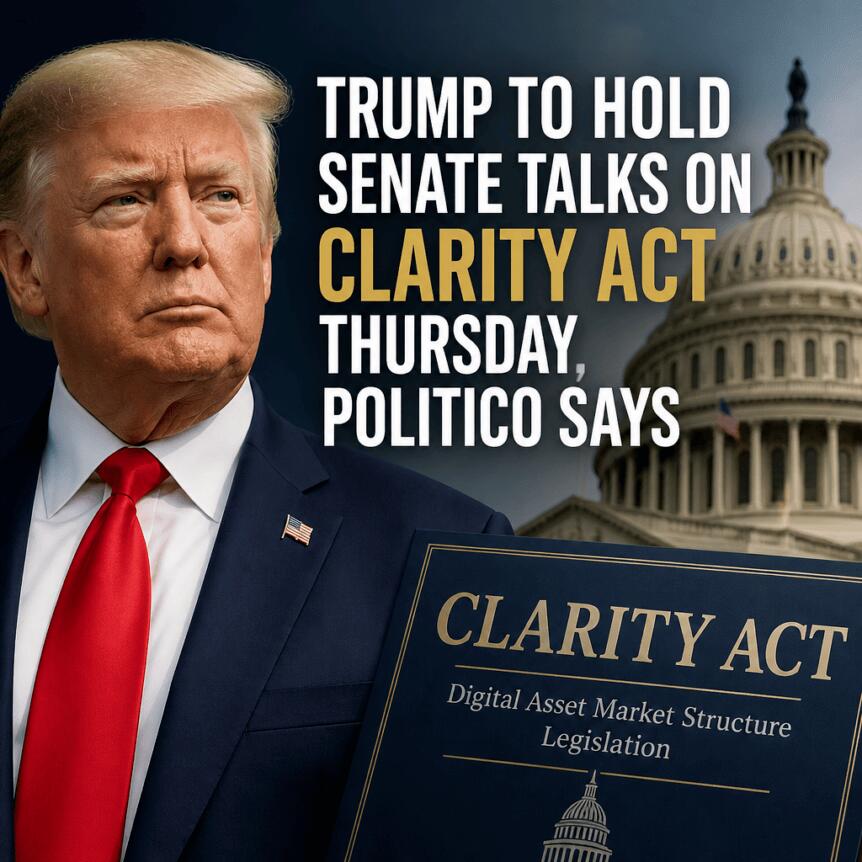
U.S. President Donald Trump is scheduled to meet with multiple senators at the White House this Thursday to discuss the status of the crypto market structure bill—commonly referred to as the CLARITY Act—and how momentum for the legislation can be sustained.
According to Politico, Senator Bernie Moreno said a group of senators will brief the president on the bill and “its path to success,” with Senator Cynthia Lummis also expected to attend, according to a Senate Republican aide. The meeting arrives as lawmakers try to finalize a revised version of the bill before the Senate’s August recess.
Key takeaways
- Trump is set to meet with senators Thursday on progress toward passing the CLARITY Act.
- Lawmakers are racing to agree on unresolved provisions and move toward a Senate vote before the August recess.
- Senator Cynthia Lummis says a new draft will be introduced in the coming days and could reach the Senate floor next week.
- Prediction market pricing currently implies a higher likelihood of a pre-recess Senate vote than of the bill becoming law this year.
White House meeting signals push for urgency
The White House discussion is framed as part of a broader push to keep the CLARITY Act moving through the legislative process. Moreno, speaking to Politico, said senators would review “the entirety of the bill” with the president, adding that Trump has been closely engaged with the effort.
Moreno’s remarks underscore how the initiative is being treated as a political and regulatory priority rather than a routine bill. For investors and builders, the potential stakes are straightforward: a clearer federal market-structure framework could affect how crypto-related products and services are regulated, what compliance pathways look like, and how market participants prepare for enforcement risk.
The meeting also points to how timing has become central. The push is being designed around the Senate calendar, with lawmakers seeking what they describe as the last realistic chance to pass the bill before midterm elections.
Lawmakers seek agreement before the August recess
According to Politico, senators are aiming to reach agreement by the end of this week. Senator Thom Tillis—identified by Politico as one of the lawmakers working through “unresolved provisions”—said he is hoping negotiators can come to terms before the August recess window closes.
“I think it’s critical if we’re going to try and get this across the floor before August recess.”
That statement highlights the bill’s current status: while the legislative push is moving forward, negotiators still appear to be addressing remaining sticking points that could determine whether the bill can secure enough support to advance.
Lawmakers are reportedly awaiting a revised draft of the legislation, which is expected to clarify or adjust the provisions that have slowed progress. The existence of an updated draft matters because it can change what senators consider “vote-ready,” and because revisions often influence how stakeholders—such as financial intermediaries, exchanges, and compliance teams—assess operational readiness.
Senator Lummis: revised bill soon, Senate vote likely next week
In an interview on Fox Business on Wednesday, Senator Lummis said a new draft version of the CLARITY Act will be introduced in the next few days and that she expects it to be on the Senate floor next week.
The prospect of a refreshed text entering the floor schedule suggests that negotiations are nearing a stage where the remaining questions are either narrowed or resolved enough to allow a formal vote process to begin. For market participants, the practical implication is that uncertainty may be compressed quickly—though the exact policy content of the revised draft is what ultimately determines whether support broadens or fractures.
Cointelegraph attempted to reach Lummis for further comment.
Prediction markets: pre-recess vote seems more likely than passage into law
While lawmakers try to close the gap on legislative details, traders are also publishing their expectations through prediction markets. On Kalshi, traders have assigned a 79% chance that the Senate will vote on the CLARITY Act before the August recess, up from 68.8% the previous day, according to the current market view on the platform.
At the same time, those markets still reflect skepticism about the bill becoming law within the same calendar year. A $3 million Kalshi market gives the legislation a 36% chance of becoming law in 2026, and a 62% chance of doing so before the end of 2027.
Polymarket traders similarly place the chance lower for near-term enactment, pricing a 39% probability that the CLARITY Act will be signed into law this year.
Together, these two sets of odds point to a common pattern in Washington timelines: a vote can be scheduled well before final enactment, but turning that vote into signed legislation can require additional steps, bargaining, or reconciliation of competing priorities.
What to watch next
The next key developments are the arrival of the revised CLARITY Act draft and whether it secures enough support to get scheduled for a Senate floor vote—especially given the compressed timeline ahead of the August recess. Traders and lawmakers will likely treat the updated text as the moment when remaining unresolved issues move from negotiation to decisional politics, with follow-through into final passage still far from guaranteed.

EUR/USD and GBP/USD continue to recover moderately following the recent weakening of the US dollar. European currencies have been supported by expectations that US inflationary pressures will continue to ease after softer-than-expected CPI and PPI data, reinforcing market hopes for a more accommodative Federal Reserve policy. However, the upside potential for both the euro and the pound remains limited amid persistent geopolitical tensions. The United States continues to carry out strikes against targets in Iran, supporting demand for defensive assets and periodically boosting the US dollar.
Today, traders will closely monitor a series of important economic releases from the United Kingdom, the eurozone, and the United States, which could determine the next direction for the major currency pairs.
EUR/USD
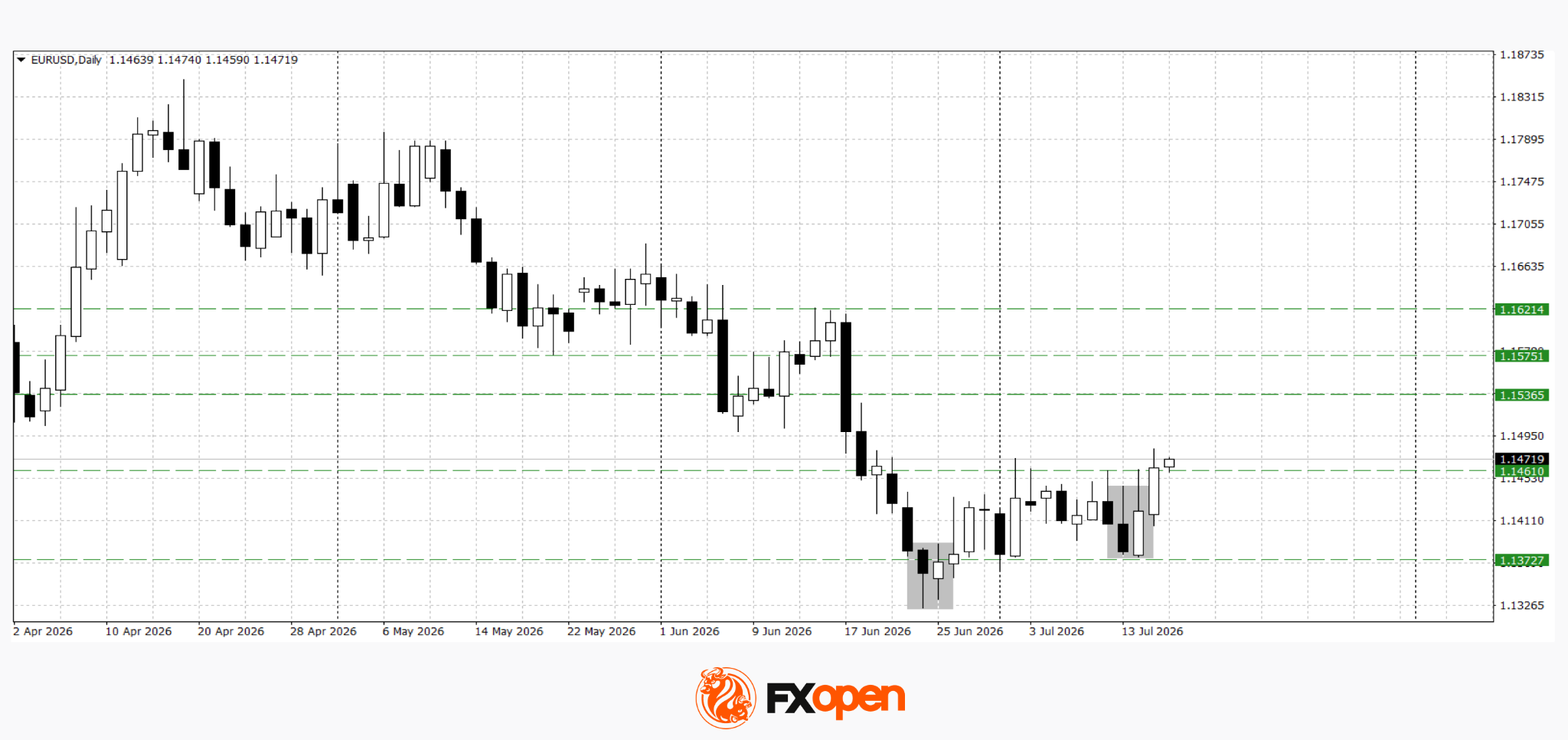
EUR/USD continues to develop after a bullish engulfing reversal pattern while attempting to establish itself above the key resistance level at 1.1460. Technical analysis suggests the pair could extend its advance towards the 1.1540–1.1580 area. The bullish scenario would be invalidated by a decisive move below 1.1370.
Key events for EUR/USD:
- 11:40 (GMT+3): Spain 10-year government bond auction;
- 15:30 (GMT+3): US Core Retail Sales;
- 15:30 (GMT+3): US Philadelphia Fed Manufacturing Index.
GBP/USD
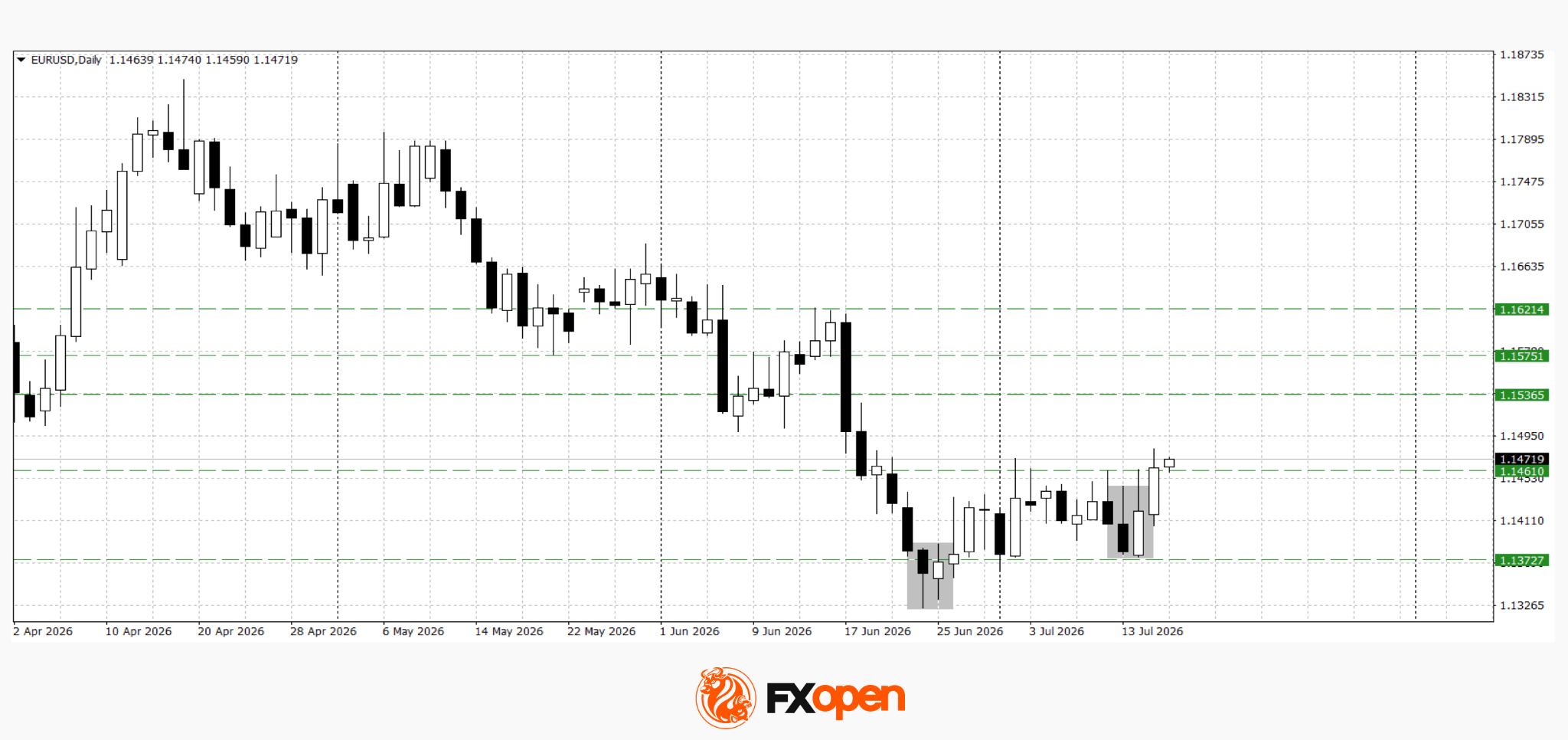
GBP/USD is recovering more strongly than EUR/USD. Buyers have managed to establish the pair above the important 1.3500 resistance level, and positive UK macroeconomic data could pave the way for a further advance towards the 1.3610–1.3680 region. At the same time, after such a rapid rally, a corrective pullback could see the pair retest the 1.3440–1.3480 area, this time as support.
Key events for GBP/USD:
- 09:00 (GMT+3): UK Gross Domestic Product (GDP);
- 14:00 (GMT+3): NIESR Monthly UK GDP Tracker;
- 18:30 (GMT+3): Atlanta Fed GDPNow estimate.
Overall, European currencies retain the potential to extend their recovery as markets continue to price in a more accommodative Federal Reserve. However, today’s economic releases from the UK, the eurozone, and the US could significantly reshape market sentiment. If US data once again disappoint expectations, EUR/USD and GBP/USD may receive additional support. Conversely, stronger-than-expected US figures could revive demand for the dollar and limit further gains in European currencies.
Trade over 50 forex markets 24 hours a day with FXOpen. Take advantage of low commissions, deep liquidity, and spreads from 0.0 pips (additional fees may apply). Open your FXOpen account now or learn more about trading forex with FXOpen.
This article represents the opinion of the Companies operating under the FXOpen brand only. It is not to be construed as an offer, solicitation, or recommendation with respect to products and services provided by the Companies operating under the FXOpen brand, nor is it to be considered financial advice.
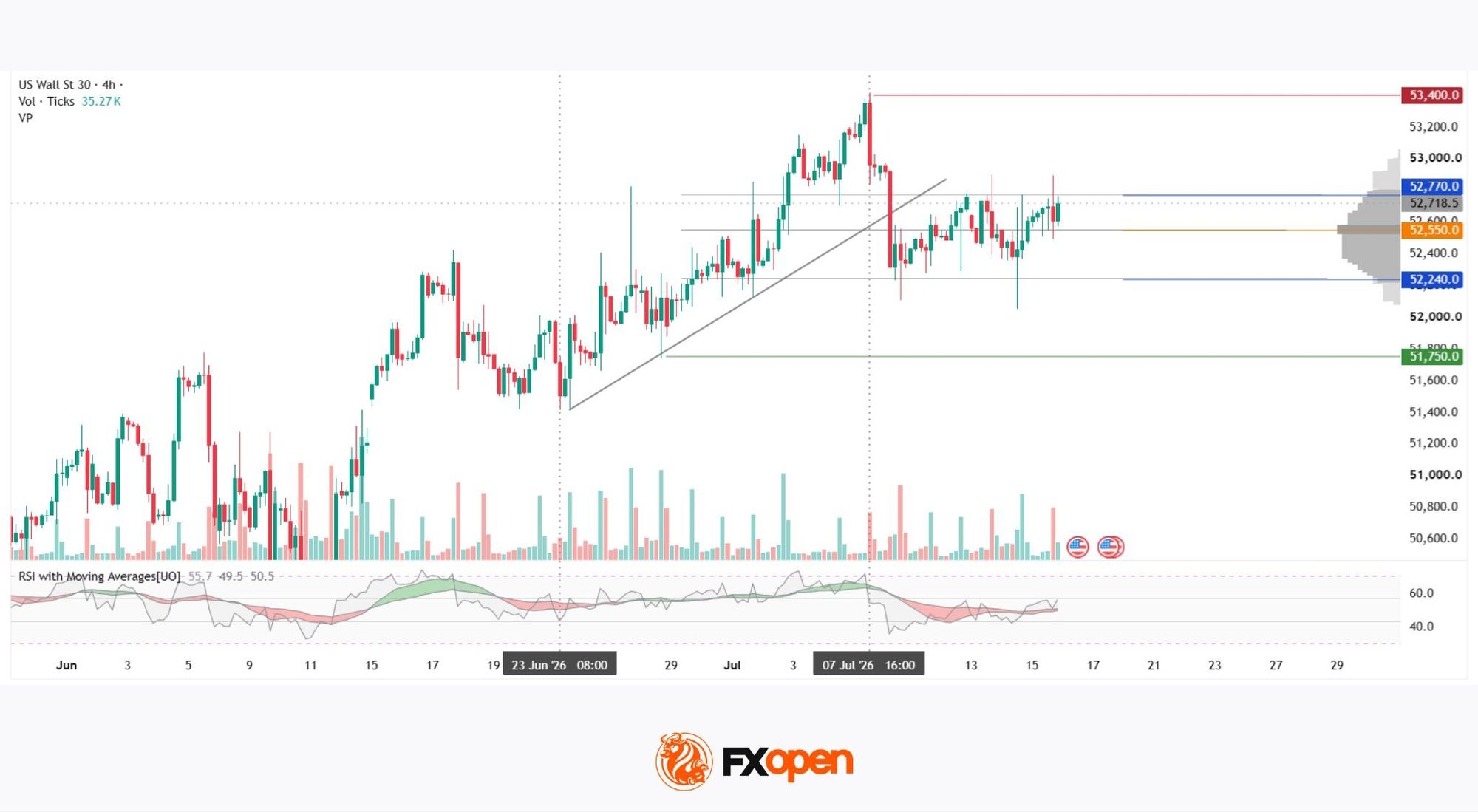
Federal Reserve Chair Kevin Warsh testified before Congress on 14–15 July, reaffirming the Fed’s commitment to bringing inflation back to target while providing no clear guidance on the future path of interest rates. Meanwhile, June inflation data came in softer than expected, with annual consumer price growth slowing to 3.5% from 4.2% in May, temporarily supporting risk appetite. At the same time, the earnings season got underway, with Goldman Sachs reporting better-than-expected results on 14 July, providing additional support for the Dow Jones Industrial Average index (Wall Street 30 on FXOpen).
Technical Picture
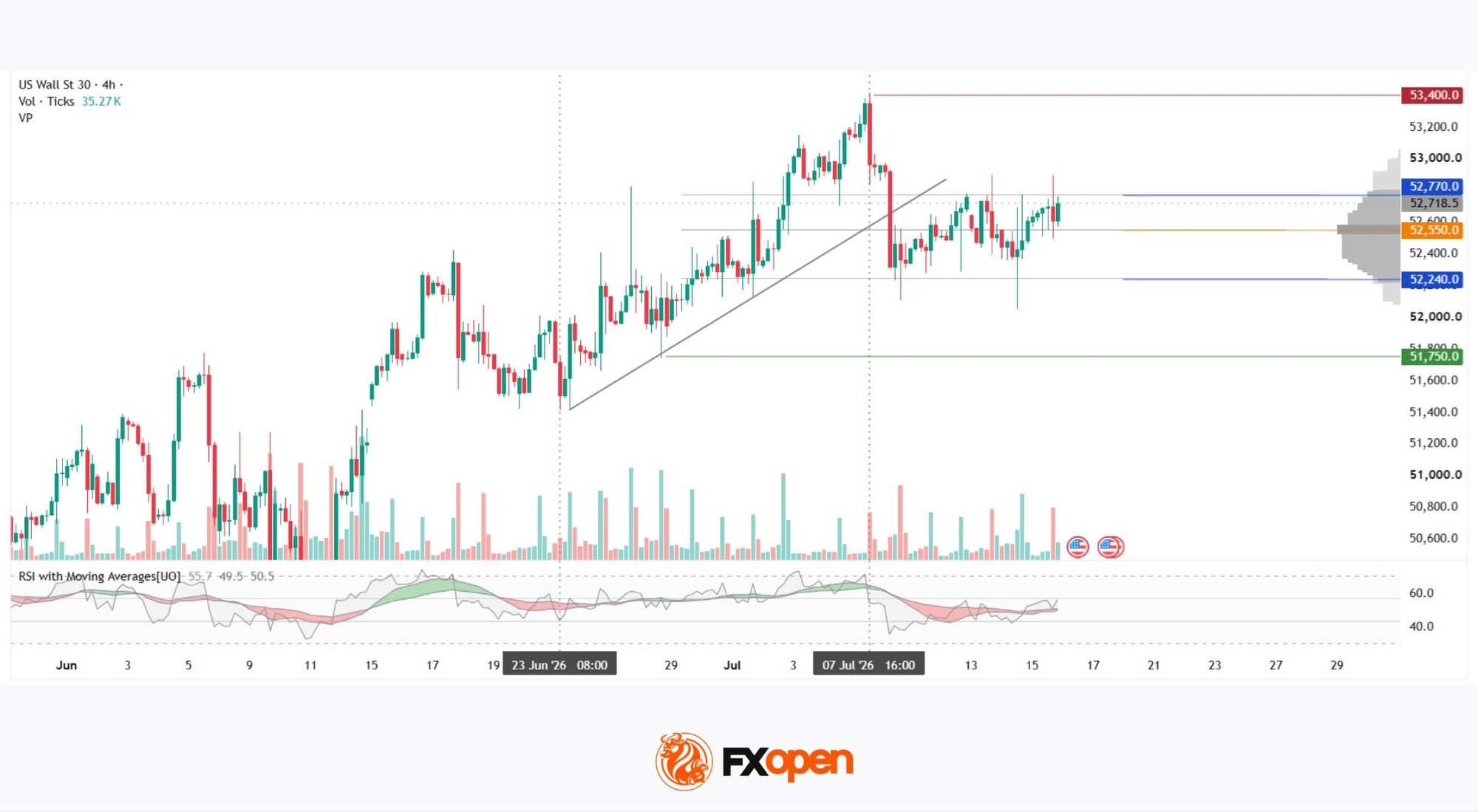
The Dow Jones Index (WS30m on FXOpen) advanced along an ascending trendline from its 23 June low, reaching the 53,400 area on 7 July, marked by the red resistance level. A sharp decline then followed, breaking below the trendline, with prices subsequently consolidating within the range of the large bearish breakout candle. Since then, the index has been trading within the current market profile, compressed between the profile’s upper boundary at 52,770 and the Point of Control (POC) at 52,550, awaiting a catalyst to break out of the current range.
If the bearish scenario unfolds and the price falls below both the trendline and the lower boundary of the market profile at 52,240, market participants might focus on the 51,750 area, where the index could potentially find support during a further decline. The RSI + MAs indicator currently shows readings of 55, 49, and 50 respectively, with all three remaining in neutral territory and providing no clear directional signal.
Summary
With the RSI lacking momentum and price remaining confined to a narrow range between the POC and the upper boundary of the market profile, the market appears to be in a pause following the failed trend breakout. A potential catalyst for a decisive move could come from the US June Retail Sales report, due later today, 16 July, while the Federal Reserve’s policy meeting on 29 July may provide the next major directional trigger.
Trade global index CFDs with zero commission and tight spreads (additional fees may apply). Open your FXOpen account now or learn more about trading index CFDs with FXOpen.
This article represents the opinion of the Companies operating under the FXOpen brand only. It is not to be construed as an offer, solicitation, or recommendation with respect to products and services provided by the Companies operating under the FXOpen brand, nor is it to be considered financial advice.


Bitcoin’s latest rebound may lack the buying support needed for a lasting breakout, according to the latest Bitfinex Alpha report.
Summary
- Bitfinex says Bitcoin’s CPI rally lacks sustained spot buying and relies heavily on macroeconomic repricing.
- Sustained ETF inflows could help Bitcoin secure acceptance above the key $68,000 to $68,300 band.
- Softer inflation data reduced rate-hike fears, but Bitfinex remains cautious about Bitcoin demand durability.
Bitcoin closed at $65,086 on July 14, gaining 4.4% and recording its highest close since June 22. Bitfinex said softer US inflation data drove most of the move by changing expectations around interest rates rather than attracting steady Bitcoin-specific demand.
The report described the rally as “borrowed strength,” citing limited spot buying, a negative Coinbase premium and inconsistent inflows into US spot Bitcoin exchange-traded funds.
Softer inflation data drives Bitcoin higher
The June Consumer Price Index fell 0.4% from the previous month, while annual inflation slowed to 3.5% from 4.2%. Core inflation stood at 2.6%, below market expectations.
The weaker inflation data reduced expectations for another Federal Reserve rate increase. According to Bitfinex, the odds of a July rate hike fell from 42% to around 12.3%, while the two-year US Treasury yield dropped as much as 14 basis points.
Bitcoin moved toward $65,000 as Treasury yields declined and the US dollar weakened after the inflation release.
Bitfinex said Bitcoin had shown little asset-specific demand before the CPI report. The firm pointed to ETF outflows, unchanged corporate holdings at Strategy and a negative Coinbase premium as evidence that macro conditions remained the main driver.
Bitcoin ETF flows remain a major test
US spot Bitcoin ETFs recorded $424.7 million in net outflows on July 13, according to the Bitfinex Alpha report. The outflow erased gains from the previous week, which had marked the first positive week after nine consecutive weeks of withdrawals.
The funds then attracted $181.1 million in net inflows on July 14. BlackRock’s IBIT accounted for $138.9 million of the total.
Bitfinex said future ETF flows will show whether institutional demand can continue beyond the immediate reaction to the CPI report. The firm wants to see steady inflows that continue regardless of short-term price movements.
Strategy also reported no change in its Bitcoin holdings during the latest reporting period. Its holdings remained at 843,775 BTC, while the company raised $466.7 million through an equity offering to support its corporate obligations.
$68,000 to $68,300 becomes Bitcoin’s key test
Bitfinex identified the $68,000 to $68,300 range as Bitcoin’s main decision zone. The short-term holder cost basis stood near $68,073, while the second-quarter opening price sat around $68,266.
The firm said Bitcoin needs sustained ETF demand and stronger spot buying to establish acceptance above this range. A rejection could keep the cryptocurrency within its broader trading range.
Options markets also showed continued caution. Bitfinex said traders were paying higher premiums for put options, which provide downside protection, even as Bitcoin rallied 4.4%.
The report also noted that rising funding rates could add risk if Bitcoin approaches $68,000 without stronger spot demand. Bitfinex said a rise above 15% to 20% in annualized funding near the resistance zone would increase the risk of another pullback.
Macro conditions remain central to the rally
Further inflation data has continued to support risk assets. As reported by crypto.news, softer producer price data also helped Bitcoin trade above $65,000 while reducing expectations for tighter monetary policy.
Bitfinex warned, however, that Bitcoin’s current rally remains closely tied to the interest-rate outlook. The firm said a rise in oil prices or renewed inflation concerns could quickly change market expectations.
The report identified ETF flows, the Coinbase premium and the $68,000 to $68,300 range as the main indicators to watch. Bitfinex remains cautious until Bitcoin shows sustained spot demand that can support prices even when macroeconomic conditions become less favorable.
Base has overhauled its growth strategy after its creator-first approach fell behind competing blockchain ecosystems in prediction markets and perpetual futures, prompting founder Jesse Pollak to step back from leading the Base App.
Summary
- Jesse Pollak admitted Base fell behind in prediction markets and perpetual futures after focusing on social products.
- Pollak will hand leadership of the Base App back to Coinbase while focusing on development of the Base blockchain.
- Base is now prioritizing trading, payments, stablecoins, and AI tools after abandoning its creator focused growth strategy.
According to a Wednesday post by Base creator Jesse Pollak on X, the network underestimated the importance of financial applications after betting that creator tools, content, and messaging would bring crypto to mainstream users.
Pollak said the strategy failed as demand for social products “disintegrated completely,” leaving Base behind in sectors that had become more important. While the network launched perpetual futures through Avantis and prediction markets through Limitless, he acknowledged both products trailed larger competitors.
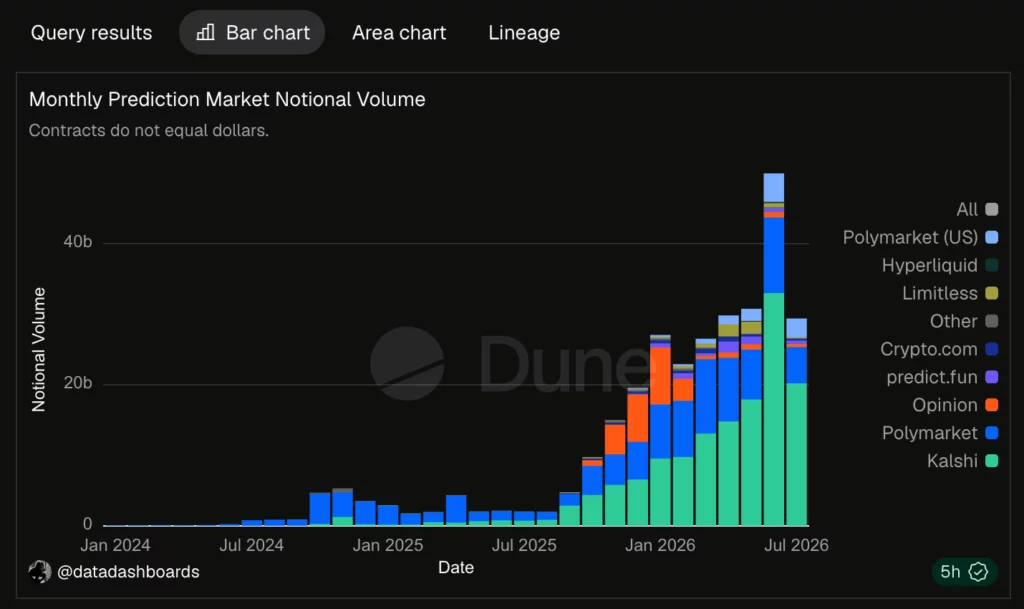
Dune Analytics data shows Base-native prediction market Limitless accounted for just 0.5% of total monthly notional prediction market volume in July.
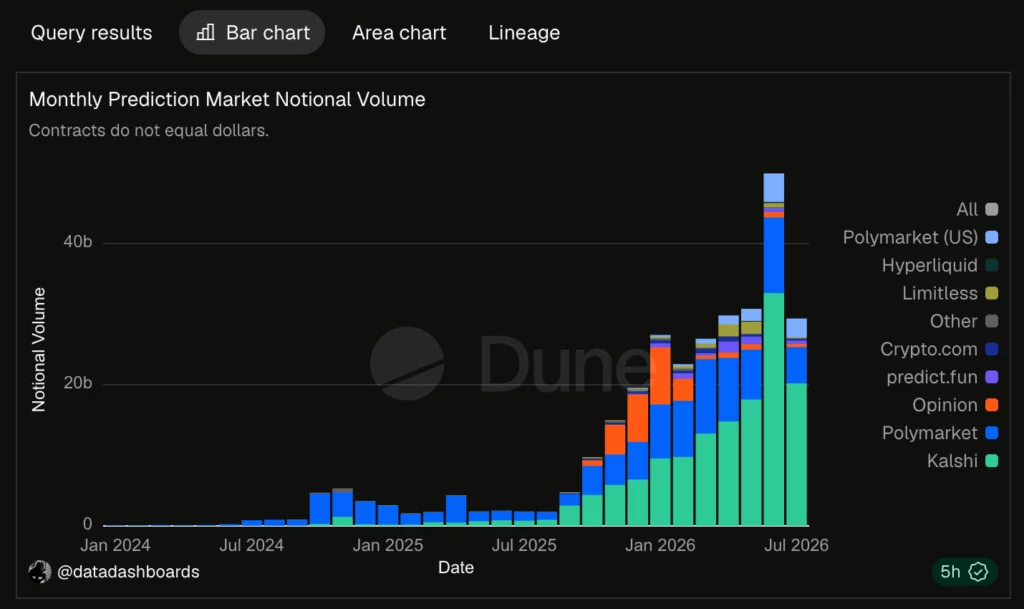
Source: Dune Analytics.
“We realized how our focus on social had meant that Base had fallen behind in key areas that were now increasingly critical,” Pollak wrote, adding that the network had “made the wrong bet.”
Base hands app leadership back to Coinbase
Alongside the strategic reset, Pollak said he will hand leadership of the Base App back to Coinbase, where Jordan Fish, better known as Cobie on X, will oversee the product. Pollak said he will instead concentrate on developing the Base blockchain.
The announcement comes days after Coinbase CEO Brian Armstrong publicly admitted the company’s content coin strategy had failed.
“They didn’t work and we pivoted early this year. We messed up, time to turn the page,” Armstrong said, responding to criticism on X earlier this week
Armstrong also said Coinbase now prioritizes trading, payments, and AI agents, with most of the company’s resources currently directed toward trading infrastructure. He added that payment systems require foreign exchange capabilities, while AI agents can build on both trading and payment tools.
Earlier this year, Base ended its Creator Rewards program and removed its Farcaster-powered social feed as part of the same strategic change. The rewards program, introduced in July 2025, was designed to let creators earn income from engagement, while Pollak described the Base App as an “imperfect Farcaster client.”
The decision follows more than a year of experiments with social products, including Farcaster integration, Zora content coins, and miniapps. Base had promoted those tools as a way to bring crypto to “a billion people,” but both Pollak and Armstrong have since said financial applications offer a stronger path for adoption.
Stablecoins and AI remain part of roadmap
While stepping away from social products, Base continues to expand its financial infrastructure.
Pollak said Base still intends to become “the blockchain for global finance” and “the place that the world’s money settles over the next century,” underscoring the network’s renewed focus on financial use cases over creator-led social experiences.
Last week, the network activated its B20 token standard on mainnet, creating a native framework for stablecoins, tokenized real-world assets, and other fungible tokens.
A few months earlier, Base introduced Base MCP, a Model Context Protocol tool that lets users manage crypto directly through AI chat interfaces while interacting with protocols including Morpho, Moonwell, Uniswap, Aerodrome, Avantis, Bankr, and Virtuals.
In April, Base said it was upgrading core infrastructure to support what it described as an AI agent economy. Its 2026 roadmap identifies tokenized real-world assets, stablecoins, prediction markets, global markets, and AI-powered applications among its development priorities.


Onchain investigator ZachXBT has criticized hardware wallets, arguing that users should not rely on them for critical transaction signing or storing large amounts of cryptocurrency.
Summary
- ZachXBT says current hardware wallets are unsuitable for critical transactions, naming Ledger as the worst.
- He argues a dedicated iPhone used only for crypto could provide a better operational setup.
- Recent wallet scams show attackers continue targeting crypto holders through fake apps and social engineering methods.
In a Telegram post, ZachXBT described hardware wallets as “complete garbage” and said he does not advise using them for important tasks. Instead, he suggested using a separate iPhone dedicated entirely to managing crypto assets.
ZachXBT singles out Ledger over frequent updates
ZachXBT directed his strongest criticism at Ledger, one of the largest hardware wallet manufacturers. He called Ledger “the worst” and claimed that frequent updates to Ledger Live can interfere with basic functions.
He said Ledger Live receives “regular updates for UI / apps for no good reason that break simple actions.” The comments represent ZachXBT’s personal assessment. He did not provide evidence that Ledger devices had suffered a new security breach or that their private-key protection had been compromised.
Ledger has since renamed Ledger Live to Ledger Wallet. According to the company’s official release notes, Ledger Wallet version 4.8.0 was released on June 11 with security improvements, interface changes and minor bug fixes.
The company continues to promote hardware-based signing as a way to keep private keys separate from internet-connected devices. ZachXBT’s proposal takes a different approach by using a smartphone reserved only for crypto transactions.
Hardware wallet users remain targets for crypto scams
The criticism comes as attackers continue targeting hardware wallet owners through social engineering and fake applications. These attacks do not necessarily involve breaking the security of the physical wallet itself.
As previously reported by crypto.news, a crypto holder lost more than $282 million in Bitcoin and Litecoin in January following a hardware wallet social engineering scam. ZachXBT reported that the attackers quickly moved the stolen funds through several services and converted part of them into Monero.
The incident showed how attackers can target users without directly compromising a hardware wallet’s technical security. Social engineering instead attempts to convince victims to reveal sensitive information or take actions that give criminals control over their assets.
Ledger users have also faced attacks involving software that impersonates official company products. Such cases can create security risks even when the physical hardware device continues working as designed.
Fake Ledger app stole $9.5 million from users
In April, a fake Ledger Live application listed on Apple’s App Store stole at least $9.5 million from more than 50 victims in one week, as reported by crypto.news. The fraudulent application copied Ledger branding and appeared to users searching for the company’s wallet software.
Victims reportedly entered their recovery phrases into the fake application, allowing attackers to gain control of their wallets. The stolen assets included Bitcoin, Ethereum, Solana, Tron and XRP. Apple later removed the fraudulent application from its store.
ZachXBT’s recommendation of a dedicated iPhone would reduce some exposure associated with using a device for everyday browsing, messaging and other online activity. However, a smartphone still depends on its operating system, installed software, backup practices and the user’s security habits.
The debate comes down to different approaches to crypto self-custody. Hardware wallets focus on keeping private keys isolated from general-purpose internet-connected devices. ZachXBT instead favors strict device separation through a phone used only for crypto. In both cases, users can still face risks from phishing, fake applications, exposed recovery phrases and social engineering.
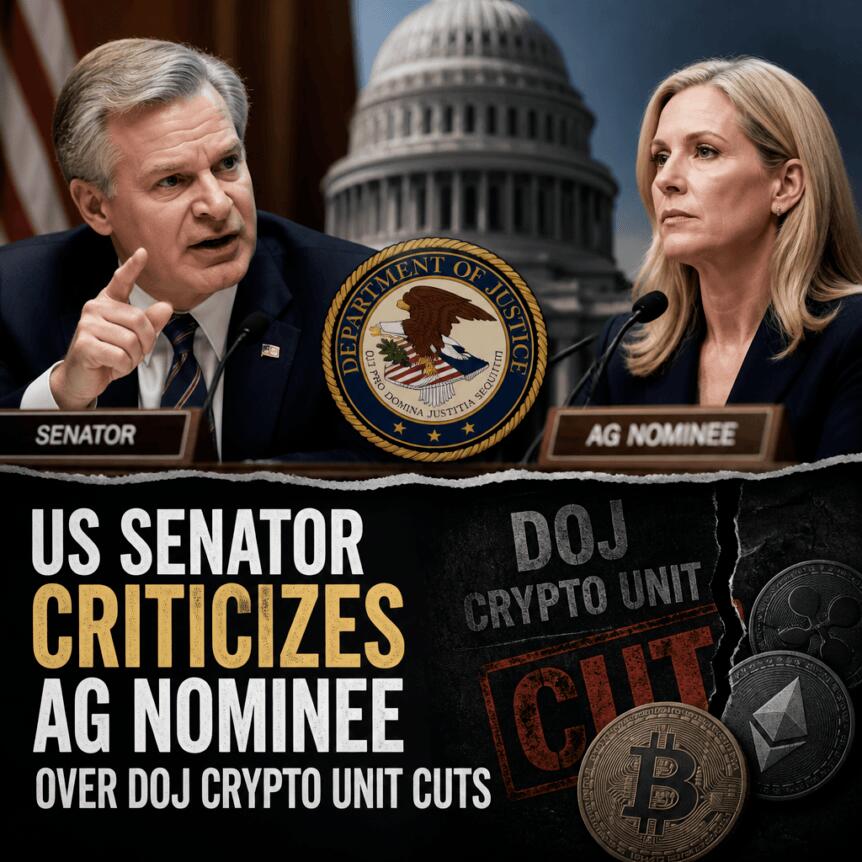
Acting U.S. Attorney General Todd Blanche faced sharp criticism during his Senate Judiciary Committee confirmation hearing on Wednesday, as lawmakers questioned whether the Justice Department’s approach to crypto enforcement is weakening and favoring President Donald Trump’s network.
Ranking member Sen. Dick Durbin said Blanche’s tenure has included actions that, in his view, dismantled the department’s capacity to pursue crypto-related crime, pointing in particular to a reported move that disbanded a DOJ crypto enforcement unit in April 2025. The hearing also featured questions about Binance CEO Changpeng “CZ” Zhao’s pardon and whether DOJ will revisit how such clemency decisions were reached.
Key takeaways
- Sen. Dick Durbin accused Blanche of dismantling DOJ crypto enforcement and closing out investigations tied to the industry.
- Durbin tied the alleged DOJ shift to potential conflicts of interest, including claims involving Trump and family business World Liberty Financial.
- Blanche said DOJ would not investigate or charge blockchain developers who are not third-party users and are not knowingly aiding illicit activity.
- Republican Sen. Thom Tillis pressed Blanche on whether CZ Zhao’s pardon raises concerns; Blanche said he would review the pardon process if confirmed.
- With Mitch McConnell hospitalized, Senate Republicans hold a narrow 52–47 margin to confirm Blanche if the nomination advances.
Durbin’s critique centers on enforcement capacity and investigations
Durbin’s comments focused on Blanche’s role in reshaping DOJ’s posture toward crypto enforcement. At the hearing, he criticized what he described as Blanche “dismantling” enforcement teams and shutting down ongoing criminal investigations involving the crypto sector.
Durbin’s argument referenced reporting that Blanche was behind the reported disbanding of DOJ’s crypto enforcement unit in April 2025, when he was deputy attorney general. The accusation aligns with earlier coverage noting that the unit was effectively dismantled through a memo distributed within DOJ. According to Fortune’s reporting on the development, the disbanding occurred as part of a broader internal restructuring.
Durbin also raised a conflict-of-interest allegation, saying that the actions he described would enable Trump to benefit financially from ties to the crypto industry. He pointed to Trump’s family’s business, World Liberty Financial, and argued that Blanche’s policies would protect that ecosystem from aggressive enforcement.
In addition, Durbin accused CZ Zhao of “broker[ing] a deal to channel $2 billion” into World Liberty, which he said resulted in a presidential pardon. The hearing comments connected the pardon to CZ Zhao’s earlier legal resolution: in 2023, Zhao agreed to plead guilty to one felony charge related to the Anti-Money Laundering (AML) regime at Binance.
“Every smarmy, suspect deal in this administration has cryptocurrency behind the curtain,” Durbin said during the hearing.
Confirmation odds remain tight as Republicans seek a simple majority
Outside the substance of crypto enforcement, the political math around confirmation could prove decisive. Republicans need only a simple majority of lawmakers present to confirm Blanche if his nomination clears the Senate Judiciary Committee and moves forward.
With Sen. Mitch McConnell still hospitalized after what his team described as a fall that led to pneumonia, Senate Republicans have a slim 52–47 margin to confirm Blanche, according to the reporting referenced in the source article.
Supporters and skeptics alike are watching whether the nomination will survive additional scrutiny beyond crypto issues. The hearing context described pushback not only on crypto policy, but also on other DOJ actions, including immigration-related enforcement and questions surrounding how the department may handle the release or processing of Jeffrey Epstein-related materials.
Blanche draws a line between developers and wrongdoing
While Durbin’s critique emphasized perceived restraint toward enforcement, Blanche’s own responses suggested a more targeted approach rather than a blanket retreat. The acting AG has previously signaled that DOJ’s crypto posture would shift toward differentiating between culpable actors and peripheral technical contributors.
The hearing record referenced a 2025 DOJ memo described as pushing “ending regulation by prosecution” in the crypto industry. Blanche was also described as having held at least $159,000 in digital-asset-related investments prior to divesting them to his children and grandchildren.
Blanche has said DOJ will focus on illicit conduct and will not pursue cases involving blockchain developers who are not responsible for criminal activity on platforms. In remarks cited from the Bitcoin 2026 conference, he said that if someone is developing software and is not a third-party user—and is not helping and knowing that third parties are using the development to commit crimes—then they “are not going to be investigated and not going to be charged.”
The distinction matters for builders and technical teams because it frames the threshold for criminal exposure around intent, knowledge, and the role in facilitating wrongdoing. For investors and users, it signals that enforcement priorities may concentrate more heavily on operational participants rather than on the mere act of writing or maintaining code.
At the same time, the department’s enforcement footprint is not portrayed as entirely dormant. The source notes that federal prosecutors are expected to retry Tornado Cash co-founder Roman Storm after a jury in 2025 failed to reach a verdict on two charges. That ongoing effort suggests DOJ’s approach may still include high-profile prosecutions tied to platforms alleged to be used for illegal activity.
Pardon questions and what Blanche says he will do next
Another flashpoint in the hearing was the presidential pardon granted to CZ Zhao. Republican Sen. Thom Tillis told Blanche he was “concerned that the Binance CEO got pardoned,” framing the clemency as part of broader concerns about accountability and fairness in how crypto-related cases are resolved.
Blanche responded that, if confirmed, he would review the pardon process. The comment did not specify whether that review would lead to any particular legal action, but it indicates a willingness to scrutinize decision-making rather than treat the pardon as settled beyond DOJ’s reach.
As the confirmation process continues, readers should watch not only for whether Blanche secures the votes he needs, but also for what DOJ’s internal guidance means in practice—especially whether prosecutors continue pursuing developer-focused cases, how ongoing trials like Roman Storm’s proceed, and whether Blanche’s promised review of the pardon process signals broader changes to enforcement strategy.


The deal gives Hyperion an equity stake in Skew and a share of listing-service revenue as it expands the utility of its HYPE treasury assets.


A California pair has been indicted on allegations of running a darknet drug operation that prosecutors say generated hundreds of thousands of dollars in cryptocurrency proceeds from fentanyl and methamphetamine sales.
Summary
- California prosecutors have charged two people with running a darknet drug operation that allegedly laundered crypto proceeds from fentanyl and methamphetamine sales.
- Authorities said the suspects shipped more than 500 drug parcels and operated an illegal ghost gun manufacturing setup.
- The case adds to a series of U.S. actions targeting cryptocurrency linked to drug trafficking and money laundering.
According to a Wednesday statement from the U.S. Department of Justice, Nicholas Aguilar and Jessica Marcolina allegedly operated vendor accounts under the name “HotGirlzClub” across multiple darknet marketplaces and shipped more than 500 drug parcels across the United States during a seven-month period in 2025.
Federal prosecutors allege the pair laundered proceeds from those sales through cryptocurrency transactions intended to hide the origin of the funds before law enforcement identified the operation.
Searches of the suspects’ California residence uncovered drug packaging materials, a food processor containing suspected narcotics residue, firearms, and warning labels advising customers to “be safe until you know your tolerance for the product,” the Justice Department said.
Investigators also accused Aguilar and Marcolina of operating an illegal firearms manufacturing operation that produced ghost guns, suppressors, and upper and lower firearm receivers.
If convicted, each defendant faces up to life in prison on drug trafficking conspiracy charges and up to 20 years in prison for conspiracy to commit money laundering, according to the department.
Crypto remains part of anti-drug enforcement efforts
The indictment adds to a series of cases in which U.S. authorities have targeted cryptocurrency used to move or conceal proceeds from narcotics trafficking.
In May, the Treasury Department’s Office of Foreign Assets Control sanctioned more than a dozen individuals and entities that it said helped convert fentanyl cash proceeds into cryptocurrency on behalf of Mexico’s Sinaloa Cartel.
Earlier in March, a federal grand jury in Ohio indicted two Chinese pharmaceutical companies and six Chinese nationals on charges tied to trafficking fentanyl precursor chemicals and laundering proceeds through cryptocurrency, according to federal prosecutors.
Law enforcement agencies outside the United States have also expanded their use of blockchain analytics in drug investigations. In April, South Korean authorities extradited alleged drug trafficking leader Park Wang-yeol from the Philippines, and investigators used blockchain forensics to trace at least 6.8 billion won (about $5 million) in Bitcoin-linked drug proceeds.
Authorities have also demonstrated that older crypto holdings linked to drug crimes remain within reach of investigators. In March, Ireland’s Criminal Assets Bureau, with technical assistance from Europol’s European Cybercrime Centre, recovered access to and seized a wallet holding 500 Bitcoin that was tied to convicted drug dealer Clifton Collins after the assets had long been considered inaccessible.
The United States has also continued pursuing operators of crypto-enabled darknet marketplaces. In February, a federal court in New York sentenced the Taiwanese founder of the Incognito dark web marketplace to 30 years in prison after prosecutors said the platform facilitated illegal drug sales using cryptocurrency.


Crypto investigator ZachXBT criticized hardware wallets Thursday, calling them unreliable for signing transactions or storing meaningful funds.
In his view, all hardware wallet solutions present today fall short on security and usability, making them unsuitable for high-stakes operations.
He recommends using a dedicated iPhone solely as a signing device, stripped down for wallet purposes only. This approach, he said, offers better control and fewer vulnerabilities than traditional hardware wallets, though he added the tongue-in-cheek caveat: “Only do this if you are not low iq.”
The investigator singled out Ledger as the worst offender, pointing to frequent Ledger Live updates that unnecessarily overhaul the UI and apps, often breaking basic functions in the process. The post quickly sparked debate ion crypto social media, with users sharing their own experiences with hardware wallet frustrations.
Trump has stepped up efforts to advance the Senate’s crypto market structure bill by convening key Republican senators at the White House as lawmakers push to secure a floor vote before the August recess.
Summary
- President Donald Trump is meeting senators as the Senate pushes to advance the CLARITY Act before the August recess.
- Senator Cynthia Lummis said a revised draft will be introduced within days with a floor vote expected next week.
- Prediction markets have raised the odds of a Senate vote before the recess even as debate over ethics provisions continues.
According to Politico, President Donald Trump is scheduled to meet several Republican senators at the White House on Thursday to discuss the Senate’s crypto market structure bill and the remaining steps needed to move it toward a vote.
Senator Bernie Moreno told the publication that lawmakers will brief Trump on the legislation and “its path to success,” while a Senate Republican aide confirmed that Senator Cynthia Lummis will also attend the meeting.
“We’ll be talking about the entirety of the bill. I mean, obviously the president’s been very engaged in this bill,” Moreno said. “He’s the one who’s really driven the innovation that I think will pay dividends.”
The White House meeting comes as Senate Republicans work to pass the legislation, known as the CLARITY Act, before lawmakers leave Washington for the August recess. Many lawmakers have described the current work period as the best opportunity to move the bill before campaigning for the midterm elections intensifies.
Senate negotiations continue ahead of expected floor vote
Speaking to Politico, Senator Thom Tillis said he hopes lawmakers can resolve the remaining issues by the end of the week so the legislation can reach the Senate floor before the recess.
“I’m hoping that we can come up with some agreement by the end of this week,” Tillis said. “I think it’s critical if we’re going to try and get this across the floor before August recess.”
Attention has also turned to a revised draft of the bill. In an interview with Fox Business on Wednesday, Lummis said an updated version will be introduced within the next few days and said she expects the legislation to reach the Senate floor next week.
The Senate measure has been under negotiation for months, with lawmakers still discussing conflict-of-interest provisions, protections for non-custodial software developers, and rules governing stablecoin-related rewards. Senate Majority Leader John Thune previously said the chamber would vote on the CLARITY Act before the August recess, although he did not commit to a specific date.
The legislation requires 60 votes to pass, meaning Republicans will need Democratic support after the House approved its version of the bill last year.
Meanwhile, several Democratic senators have continued pressing for stronger ethics safeguards before backing the legislation. Senators Chris Murphy, Jeff Merkley, and Chris Van Hollen have argued that the final bill should explicitly prevent the president, vice president, members of Congress, senior executive officials, and their immediate families from profiting from crypto businesses that could be affected by future regulation.
Murphy said during a July 14 press conference that “there is no reason to pass a new regulatory system for crypto if this system does not stop Trump’s corruption,” linking his criticism to President Trump’s reported financial interests in World Liberty Financial and other crypto ventures. Trump has denied wrongdoing related to his digital asset businesses.
Prediction markets see better odds of Senate action
Away from Capitol Hill, prediction market traders have become more confident that the legislation will receive a Senate vote before lawmakers leave for the August recess.
On Kalshi, traders have raised the probability of a Senate vote before the recess to 79%, up from 68.8% a day earlier.
Confidence about the bill becoming law remains more restrained. Kalshi’s roughly $3 million market assigns a 36% chance that the CLARITY Act will become law this year and a 62% chance that it will be enacted before the end of 2027.
On Polymarket, traders currently place a 39% probability on the CLARITY Act being signed into law during 2026.

Cairngorms wildfire spreads 3.5km wide as crews work through night tackling blaze

At Close of Business podcast July 16 2026

European Currencies Strengthen Ahead of Key Macroeconomic Releases


-

 Fashion7 days ago
Loro Piana Fall 2026 Enters Houston’s Art Scene
-

 Fashion5 days ago
Weekend Open Thread: Nutriplenish Leave-In Conditioner
-
 Sports7 days ago
2026 Genesis Scottish Open Thursday TV coverage: Round 1
-

 Sports6 days ago
Super Eagles star Moses Simon opens up on Liverpool transfer regret
-

 Tech7 days ago
Character.AI enters the microdrama arena with its own productions, but there’s a twist
-

 Politics20 hours ago
Young campaigners urge incoming PM to act on outdoor junk food ads
-

 News Videos1 day ago
XRP BOMBSHELL… XRP OMBOARDED FOR TRANSACTIONS!!!
-

 Tech2 days ago
Get Your ESP32 Sunny Side Up With This Solar Dev Board
-

 Tech1 day ago
Dark Secrets Emerge When Jailbreaking LLMs
-
 Sports11 hours ago
New Cornerback Enters Vikings Trade Rumor Mill
-
 Entertainment15 hours ago
Disney’s Most Ambitious Failed Star Wars Attraction Is Coming to SDCC
-

 Tech7 days ago
Level Infinite Launches Gangstar Mirage City in India with Pre-Registrations
-
 NewsBeat7 days ago
Major update after Huntingdon train attack as man enters plea
-

 News Videos3 days ago
how to make coin bank box with cardboard #scienceproject #money #diy #shorts
-
 Tech3 days ago
Cloudflare Precursor Watches Your Mouse and Keyboard To Decide If You Are Human
-
 Entertainment13 hours ago
Vicki Gunvalson Defends Discussing Heather Dubrow’s Money
-

 NewsBeat10 hours ago
Watch: Is Donald Trump facing a popular backlash on immigration?
-
Crypto World2 days ago
Ripple, Coinbase, Circle Join Linux x402 Foundation to Help Shape AI Payments
-

 Sports8 hours ago
Michigan officials not expected to discuss AD Warde Manuel at Thursday meeting
-
 NewsBeat10 hours ago
Firefighters issue update on Dovestone moorland blaze as fire enters fourth day
You must be logged in to post a comment Login