
Crypto World
UK Expands Bank of England Mandate to Cover Stablecoins



The UK is moving to put stablecoins at the center of a new Bank of England mandate aimed at supporting innovation in digital payments.
The government plans to give the Bank of England, the UK’s central bank, a secondary objective to support innovation in payment systems and emerging forms of digital money, HM Treasury announced on Thursday.
The mandate will cover payment systems that use digital settlement assets such as stablecoins, while financial stability will remain the BoE’s primary objective.
The proposal comes as the UK steps up its work on stablecoins through regulatory changes, payment experiments and closer coordination with the US.
BoE innovation mandate faces September debate
The new responsibility would extend an existing approach used to regulate central counterparties (CCPs) and central securities depositories (CSDs), which help clear, hold and settle financial assets.
Under the proposed change, the central bank would report annually to Parliament on its progress toward the payments innovation objective.
“Developments in digital payments technology, including tokenisation and DLT [distributed ledger technology], have the potential to transform financial markets across the globe,” City Minister Lucy Rigby said.
The government expects to implement the objective through amendments to the Financial Services and Markets Bill, which is scheduled for further debate in the House of Lords on Sept. 7 and 9.
Stablecoin rules still face industry concerns
The new mandate’s impact may depend on how BoE uses its annual reporting requirement, Maksym Sakharov, co-founder and CEO of on-chain banking infrastructure provider WeFi, told Cointelegraph.
“The objective is secondary to financial stability, so it overrides nothing, but the bank will have to publish an annual account of its innovation efforts in payments and digital money,” Sakharov said. This requirement could put greater public scrutiny on stablecoin rules the central bank finalized in June.
Related: Binance to plan UK relaunch with FCA license application: Report
Sakharov pointed to requirements for systemic stablecoin issuers to hold at least 30% of their backing assets in non-interest-bearing deposits at the central bank.
“The reserve split is the first thing to fix,” he said, adding that the requirement could determine whether a stablecoin business is commercially viable.
UK steps up stablecoin push
The new mandate follows increasing UK efforts involving stablecoins, or crypto assets designed to maintain a stable value by tracking assets such as the US dollar.
In August, a group participating in the Bank of England’s Digital Pound Lab began testing whether a stablecoin and a simulated digital British pound could work together in a cross-border trade payment. The experimental platform does not use real customers or money.
Related: Revolut rolls out euro stablecoin in 3 European markets
In mid-July, the UK and US published a joint statement on stablecoins, with the governments saying they “intend to enable the use of stablecoins in cross-border finance” and calling for greater alignment of their regulatory frameworks.
BoE also previously dropped plans to limit stablecoin holdings to 20,000 British pounds for individuals and 10 million pounds for businesses, replacing them with a temporary 40 billion pound ($52.9 billion) issuance cap for each systemic stablecoin.
Magazine: MiCA cracks down on USDT in Europe… but no one else cares


Hyperliquid Strategies has raised $647 million in equity capital and more than doubled its treasury to 29.3 million HYPE tokens, valued at $1.9 billion at the end of June.
Summary
- Hyperliquid Strategies held 29.3 million HYPE and $149.9 million in cash on June 30.
- The Nasdaq-listed company reported $305.5 million in annual net income and no debt.
- PURR shares gained nearly 18% after the fiscal-year results were released.
- Since December, the firm has spent $773.4 million buying about 16.5 million HYPE.
Hyperliquid Strategies builds a $1.9 billion HYPE treasury
Hyperliquid Strategies said in its fiscal-year results that its HYPE holdings increased from an initial 12.5 million tokens to approximately 29.28 million by June 30. At the token’s fiscal year-end price of $65.04, the position carried a value of $1.90 billion.
Alongside the token reserve, the company reported $149.9 million in cash and cash-like assets, including $12 million held in USDC. Total assets reached $2.06 billion, while stockholders’ equity stood at $1.87 billion.
No debt remained on the balance sheet at the end of the period, according to the results. The company also said substantially all its HYPE tokens were staked and generating income.
“This was the year we built the platform,” CEO David Schamis said. He added that the company had doubled its treasury, launched a validator with Unit, and completed its exit from legacy biotechnology operations.
Operating the Hyperliquid Strategies x Unit validator produced another source of income tied to the network. The company described it as Hyperliquid’s third-largest validator when excluding wallets connected to the Hyper Foundation.
During the 12 months ended June 30, the company recorded $9.5 million in staking revenue and validator commissions. Interest income added $2.7 million, while selling, general, administrative, and research and development expenses totaled $14 million.
Net income reached $305.5 million for the fiscal year. According to the company, $709.9 million in unrealized gains on its HYPE holdings accounted for a large part of the result.
Several charges reduced the benefit of the token appreciation. Hyperliquid Strategies recorded a one-time $169.2 million loss related to HYPE contributed when its business combination closed, a $35.6 million write-off tied to the former Sonnet operation and $183.5 million in deferred tax expenses.
$647 million equity facility funds token purchases
Since the business combination closed on Dec. 2, 2025, Hyperliquid Strategies has deployed $773.4 million to buy approximately 16.5 million HYPE at an average price of $46.77 per token. The purchases brought its total position to 29.3 million tokens as of Aug. 19.
Funding came mainly through a committed equity facility, which generated $646.6 million at an average issue price of $8.70 per PURR share. Issuing stock through the facility provided capital for token purchases but also increased the number of shares outstanding.
Part of the available capital went back into the company’s stock. Hyperliquid Strategies spent $27.8 million repurchasing approximately 5.8 million PURR shares at an average price of $4.80.
After the HYPE purchases and share repurchases, cash stood at $132.6 million on Aug. 19, including $12 million in USDC. The company continued to report no debt.
Earlier accumulation had already made the firm one of the largest identified corporate HYPE holders. In February, crypto.news reported that a five-million-token purchase cost about $129.5 million at an average of $25.90, raising the treasury to 17.6 million HYPE at the time.
The company’s exposure later attracted outside institutions seeking access through a U.S.-listed security. Duquesne Family Office disclosed a $23 million PURR position in its second-quarter Form 13F, giving Stanley Druckenmiller’s investment firm indirect exposure to the token.
Wyoming also reported an indirect HYPE investment through PURR shares in its second-quarter filing. Neither disclosure showed the institutions purchasing or holding HYPE directly.
For U.S. investors, PURR provides stock-market exposure to a company whose asset value and earnings are heavily tied to HYPE. The shares trade on Nasdaq, while options on PURR began trading through the Nasdaq Options Market in March.
Hyperliquid activity supports treasury income
Hyperliquid Strategies said that about $945 million in value accrued to the Hyperliquid ecosystem during the 12 months through June. The figure came from public ecosystem data that the company said it had not independently verified.
According to the results, Hyperliquid’s share of global perpetual futures volume, including centralized exchanges, reached about 9.4% on June 30. By Aug. 23, the protocol accounted for roughly 63% of open interest across decentralized perpetual markets, more than five times the share of its nearest competitor.
Activity expanded beyond crypto perpetual contracts during the summer. Real-world asset markets accounted for more than half of weekly platform volume for two consecutive weeks in July, while open interest across HIP-3 markets exceeded $4 billion for the first time in August.
A recent policy submission has placed that activity within the U.S. regulatory debate. The Hyperliquid Policy Center asked federal regulators to treat qualifying equity perpetual contracts as security futures jointly supervised by the SEC and CFTC. The group said HIP-3 markets had processed more than $480 billion in notional volume over their first 10 months.
President Donald Trump said on Aug. 19 that CFTC Chairman Michael Selig was working to bring Hyperliquid into the United States “in a fully compliant and legal fashion.” However, Hyperliquid Strategies stated in a footnote to its results that the CFTC had not granted an application, registration, exemption or rulemaking involving the protocol.
The company also said it was unaware of any pending CFTC process and warned that no U.S. regulatory route could be assured. Hyperliquid users in the United States currently remain unable to access the protocol, according to the Policy Center’s filing.
PURR gains as HYPE extends monthly rally
Following the earnings release, PURR shares rose nearly 18% to around $13.59 during Thursday’s trading session. The move placed the Nasdaq-listed company’s market capitalization near $1.8 billion.
PURR’s multiple to adjusted net asset value, or mNAV, reached about 1.35 times, its highest level since May. The company calculates adjusted net asset value using factors that include cash, its HYPE holdings, and the number of shares outstanding.
HYPE gained about 77% during the quarter ended June 30, while total crypto market capitalization fell approximately 13% over the same period, according to figures included in the company’s release. More recently, the token has risen over 50% during the past month.
By Aug. 23, total open interest on Hyperliquid had climbed to a record of approximately $13 billion. The company also reported that HYPE became one of the five largest constituents in the S&P Pantera Digital Asset Index when the benchmark launched on July 21.


Disclosure: This article does not represent investment advice. The content and materials featured on this page are for educational purposes only.
Crypto payments are entering mainstream checkout flows as merchants weigh fees, coin support, settlement and regulation in 2026.
Summary
- Heleket charges fees from 0.4 percent on incoming crypto payments and applies zero withdrawal fees.
- NOWPayments supports over 350 cryptocurrencies, giving merchants the widest asset coverage among major payment gateways.
- CoinGate holds a MiCA license and settles crypto payments directly in euros, dollars, and pounds.
Cryptocurrency has moved from the edges of online commerce into everyday checkout flows. Online shops, SaaS platforms, gaming studios, and freelance marketplaces now treat digital assets as a working payment rail rather than a curiosity.
In a sea of countless crypto payment processing providers, finding the right one can be the harder part. Dozens of gateways compete on fees, coin coverage, settlement options, and regulatory standing, and the best fit changes with where a company operates and how it prefers to hold its money.
There is no one-size-fits-all solution when it comes to choosing a crypto payment processing platform. Some merchants prioritize direct fiat settlement to a bank account, while others prefer to retain custody of their crypto and avoid intermediaries.
The five gateways below stand out in 2026, starting with a merchant-focused platform built around low fees and quick integration.
1. Heleket
Heleket is a crypto payment processor built for online businesses that want to accept digital assets through a ready-made platform — without the cost or complexity of building payment infrastructure in-house. Onboarding starts with an email address alone. After confirming it, a merchant creates a project, and the system generates API keys and a merchant ID that link a website to Heleket’s payment layer.
Project moderation runs up to 24 hours, and each merchant gets a personal account manager from day one, which keeps time-to-launch short for small teams.
On pricing, Heleket lists fees starting from 0.4 percent on incoming payments with no withdrawal fees and no setup costs. Their fees are among the lower headline rates in the category. The platform supports Bitcoin, Ethereum, USDT (both TRC-20 and ERC-20), Litecoin, TRON, and other popular tokens, with 30-plus assets listed on its own currencies page. Auto-conversion turns incoming payments into a stablecoin such as USDT the moment they land, which shields merchants that run on thin margins from overnight price swings.
The tooling reaches beyond basic acceptance. Heleket ships ready plugins for WooCommerce, WHMCS, and XenForo, along with management panels and Telegram tools, so teams can bolt crypto onto systems they already run. Merchants also get mass payouts for high-volume disbursement, an in-dashboard converter, automatic withdrawals on a schedule, and a dedicated account manager for onboarding and technical questions.
Heleket also has a referral program where partners earn up to 30% of the fees generated by the users they bring in.
The trade-off is settlement coverage. A business that needs long-tail altcoins or direct fiat bank settlement may want to pair Heleket with a second rail.
2. NOWPayments
NOWPayments is a crypto-native gateway favored by merchants who serve altcoin-heavy audiences. The platform offers one of the broadest ranges of supported cryptocurrencies on the market, accepting payments in more than 350 digital assets. Pricing, per its published rates, runs 0.5 percent for same-coin payments and around 1 percent for transactions that auto-convert into a different asset, with no monthly or setup charges.
Merchants can settle non-custodially and keep control of their funds, and the platform connects to Shopify, WooCommerce, Magento, and OpenCart through plugins. Batch processing handles large payout runs in a single sweep, useful for flash sales and promotions.
The limitations sit around fiat and compliance. Direct fiat settlement is thin and often routes through third parties, so a business that needs euros or dollars in a bank account has more work to do.
3. CoinGate
Operating out of Lithuania since 2014, CoinGate has built its reputation on European regulatory standing. The platform carries MiCA authorization alongside a payment-institution license, settles in EUR, USD, and GBP, and processes across 180-plus countries. Merchants get a flat 1 percent processing fee, a mobile point-of-sale app, a gift-card marketplace, and plugins for WooCommerce, Magento, and PrestaShop, with support for 70-plus coins.
For a European seller that needs clean, licensed fiat settlement, CoinGate is often the default. The catch is that full merchant KYC is mandatory, which slows onboarding, and the flat 1 percent rate sits at the pricier end of the market once cheaper non-custodial options enter the picture.
4. BitPay
BitPay has run since 2011, making it one of the oldest crypto processors still operating. Its strength is dependable daily fiat settlement to US bank accounts, backed by a mature compliance stack that larger companies value. Pricing is volume-tiered and rewards scale, so the biggest merchants earn the best rates.
That structure is also the drawback for smaller businesses, which pay proportionally more until their volume climbs. Merchants should confirm current rates directly, as BitPay’s tiers have shifted over time. KYC is mandatory, and the platform’s acceptable-use policy bars certain sectors such as gambling, so operators in restricted categories need to look elsewhere.
5. BTCPay Server
BTCPay Server takes the opposite approach to every commercial gateway on this list. It is open-source, self-hosted, and fully non-custodial, so a merchant runs the software themselves and pays no platform fee at all. The only cost comes from network costs of moving funds. BTCPay Server supports Bitcoin and the Lightning Network, requires no provider KYC, and hands complete custody to the business.
The price of that control is effort. Running BTCPay Server means maintaining a server and, ideally, a Bitcoin node, and support comes from the community rather than an account manager. Its focus is Bitcoin-centric, so it suits merchants who value sovereignty and can handle the setup more than those who want a plug-and-play button.
Comparison at a glance
| Gateway | Type | Headline fee | Supported assets | Settlement | Best for |
| Heleket | Custodial gateway | From 0.4% (0% withdrawals) | 15+ | Crypto/stablecoin | Low fees, fast setup |
| NOWPayments | Custodial / non-custodial | 0.5% (≈1% w/ conversion) | 350+ | Mostly crypto | Broadest coin coverage |
| CoinGate | Custodial gateway | 1% flat | 70+ | Fiat (EUR/USD/GBP) | EU-regulated settlement |
| BitPay | Custodial gateway | Volume-tiered | 30+ | Fiat (USD focus) | US enterprise |
| BTCPay Server | Self-hosted, non-custodial | 0% (network only) | BTC + Lightning | Direct to wallet | Technical, zero-fee control |
Fees, supported assets, and regional availability change frequently. Merchants should verify current terms with each provider before going live.
The takeaway
No single gateway wins for every business. For merchants who put low fees, quick integration, and responsive support first, Heleket makes the strongest case. Fees from 0.4 percent on incoming payments, zero withdrawal fees, ready-made plugins, auto-conversion to stablecoins, and a dedicated account manager add up to a practical, cost-efficient entry point into crypto acceptance.
A European store that needs licensed fiat payouts leans toward CoinGate; a US enterprise moving large daily volume fits BitPay; a merchant selling to altcoin natives wants the reach of NOWPayments; and a technical team chasing zero fees can self-host BTCPay Server.
Disclosure: This content is provided by a third party. Neither crypto.news nor the author of this article endorses any product mentioned on this page. Users should conduct their own research before taking any action related to the company.


Charles Schwab has announced plans to add Solana, Avalanche and Chainlink to its crypto platform in the coming months, extending direct trading beyond Bitcoin and Ethereum for its U.S. retail clients.
Summary
- Schwab Crypto will add SOL, AVAX and LINK, taking its planned token lineup to five.
- The brokerage reported $13.1 trillion in client assets and 39.8 million active accounts in the second quarter.
- SOL rose more than 9% over 24 hours, while AVAX and LINK recorded smaller gains.
- Schwab charges 0.75% per crypto transaction and plans to add more digital assets over time.
Charles Schwab selects three established altcoins
Charles Schwab said in an Aug. 27 announcement that clients will be able to buy and sell Solana (SOL), Avalanche (AVAX), and Chainlink (LINK) through Schwab Crypto in the coming months.
A launch date was not disclosed. Schwab also did not say whether all three assets would become available at the same time or whether access would follow the phased approach used for its first crypto products.
The additions will take Schwab Crypto’s planned selection from two assets to five. Bitcoin and Ethereum were the only cryptocurrencies available when direct trading began earlier in 2026.
Schwab said it chose the three tokens after considering customer interest and focusing on established digital assets. The company did not publish its selection criteria or provide details about trading limits for the incoming assets.
“With this expansion, clients will have more choices to build a digital asset allocation alongside the investing and banking experience they know and trust at Schwab,” Joe Vietri, Schwab’s head of digital assets, said in the announcement.
Demand will continue to guide which cryptocurrencies are listed, according to Schwab. The firm confirmed that it expects to add other assets over time, although it did not name the next tokens under consideration.
XRP, Hyperliquid, and Zcash were not included in the announcement despite public requests from some crypto users. Schwab has not said whether regulatory concerns, liquidity requirements, or other factors affected their exclusion.
Schwab Crypto builds on its Bitcoin and Ethereum launch
In August, crypto.news reported on Schwab’s rollout of direct Bitcoin and Ethereum trading at a fee of 75 basis points, or 0.75% of the dollar value of each transaction.
Charles Schwab Premier Bank holds customer assets, while Paxos provides trade execution and sub-custody. Clients can view their crypto holdings alongside stocks, bonds, exchange-traded funds, and other investments through Schwab.com, Schwab Mobile, and thinkorswim.
At the end of the second quarter, Schwab reported $13.1 trillion in total client assets and 39.8 million active brokerage accounts. The firm also recorded $7.1 billion in quarterly revenue, up 21% from a year earlier, while daily average trades increased 57% to 11.9 million.
Such figures describe the size of Schwab’s existing business rather than the amount available for cryptocurrency purchases. Still, the account base gives the firm a large pool of customers who can access crypto without opening an account at a separate exchange.
Before Schwab introduced direct trading, its customers could gain crypto exposure through exchange-traded funds, futures, and the Schwab Crypto Thematic ETF. Chief executive Rick Wurster previously said clients held about $25 billion in crypto exchange-traded products through the company.
The retail service began without support for external deposits and withdrawals. During its July earnings update, Schwab said it had started testing crypto transfers, which could eventually let clients move eligible assets between the brokerage and external platforms.
Pricing places Schwab between several financial competitors. Its 0.75% transaction fee sits below Fidelity’s reported charge of about 1% but above the 0.5% fee attached to Morgan Stanley’s E*Trade crypto service.
E*Trade included Solana alongside Bitcoin and Ethereum during its pilot, giving Schwab another reason to add support for assets outside the two largest cryptocurrencies. Zerohash provides infrastructure for Morgan Stanley’s offering, while Schwab relies on Paxos for execution and sub-custody.
U.S. clients face access and custody limits
For American investors, the announcement adds another route to buy SOL, AVAX, and LINK through a regulated banking subsidiary connected to a major brokerage. It does not give Schwab users access to the tokens immediately, as availability remains subject to the company’s rollout schedule.
Schwab Crypto was initially unavailable to customers in New York, Louisiana, U.S. territories, and international markets. The company’s latest announcement did not say whether geographic availability will change when the three assets are introduced.
Customers also need a separate Schwab Crypto account linked to their existing relationship with the brokerage. Unlike a self-custody wallet, the service leaves asset custody with Schwab Premier Bank and its infrastructure provider.
The arrangement can simplify access for investors who already hold stocks and funds at Schwab, but it does not currently offer the same transfer functions as a conventional crypto exchange. Schwab has not disclosed whether staking, on-chain withdrawals or deposits will be available for SOL, AVAX, and LINK at launch.
The company is separately preparing to bring digital-asset services to registered investment advisers. A mid-2027 advisor rollout is under consideration for spot trading, transfers and custody, although Schwab managing director Jalina Kerr has said the timing may change.
Advisers still use exchange-traded products for much of their clients’ crypto exposure, according to Kerr. Demand for direct holdings has grown among customers who already keep digital assets on other platforms, creating interest in custody and transfer services inside Schwab’s adviser system.
SOL, AVAX and LINK rise after the announcement
Solana traded at about $104.84 after the announcement, gaining more than 9% over 24 hours. Its intraday range stretched from $95.23 to $105.55, while reported trading volume climbed almost 70%.
SOL recorded the strongest daily performance among the three selected assets. The token’s advance also followed a rally across several large cryptocurrencies, making it difficult to attribute the full move to Schwab’s announcement alone.
Avalanche rose about 2% within an hour of the news, according to market data cited in the original report. Chainlink also gained more than 2% during the same period and extended its 24-hour increase beyond 5%.
Alongside crypto trading, Schwab is adding other products tied to markets and digital finance. Cboe introduced binary options based on the Mini-S&P 500 Index in June, with Interactive Brokers providing initial access and Schwab expected to follow.
The Cboe Predicts contracts trade as security options under the rules governing U.S.-listed options. Cboe launched them under the XSPBW and XSPBX tickers, allowing investors to take yes-or-no positions on where the Mini-S&P 500 Index will finish.


Crypto for Advisors: How staking on Ethereum is changing in 2026


Ripple Prime has launched a Delta One business that lets institutional clients trade total return swaps tied to U.S.-listed equities, indexes and digital assets through its multi-asset prime brokerage platform.
Summary
- Ripple Prime has launched Delta One, allowing institutional clients to trade total return swaps linked to US equities, indexes and digital assets.
- Clients can use a single counterparty and cross margin supported exposures across Ripple Prime’s multi asset brokerage platform.
- The service targets hedge funds, asset managers and other financial institutions seeking exposure without directly owning the underlying assets.
- Ripple Prime was formed after Ripple completed its $1.25 billion acquisition of Hidden Road in October 2025.
- The brokerage secured a $200 million debt facility in May and closed a $275 million private placement of senior unsecured notes in August.
Ripple said Thursday that the service is live for hedge funds, asset managers and other financial institutions, extending Ripple Prime further into U.S. equity derivatives while retaining digital assets within the same brokerage framework.
Clients can use a single counterparty for the transactions and cross-margin positions across supported asset classes. Ripple Prime said the setup operates around the clock, allowing institutions to manage collateral and exposures across traditional and digital markets through one relationship.
Total return swaps give investors exposure to the economic performance of an underlying asset without requiring them to own it directly. Under the structure, payments between counterparties are generally based on the return of the referenced asset and financing terms agreed under the swap.
“The launch of our Delta One business is an important development for Ripple Prime and a natural extension of the platform we’ve built,” Ripple Prime President Noel Kimmel said.
Ripple Prime Delta One brings US equities into its multi-asset platform
With Delta One, Ripple Prime is extending a business that already covers foreign exchange, derivatives, fixed income and digital assets into swaps linked to U.S. equities and indexes.
The firm said the product can be structured around different investment horizons, risk requirements and reporting needs. Institutional clients can execute total return swaps across the supported markets while managing the resulting exposures under Ripple Prime’s existing prime brokerage relationship.
Ripple Prime operates with more than $1 billion in regulatory net capital, according to Ripple. The firm provides clearing, financing and prime brokerage services for institutional investors across several asset classes.
The equity derivatives launch follows several additions to its institutional trading infrastructure this year. In May, Ripple Prime integrated with EDX Markets, giving clients access to EDX spot liquidity and perpetual futures offered by EDXM International through a unified brokerage arrangement. crypto.news previously reported that RLUSD was expected to serve a settlement and collateral role within the integration.
Through the arrangement, Ripple Prime provides credit intermediation, collateral management and net settlement while institutions access EDX liquidity. The integration followed several months of expansion across both centralized and decentralized digital asset markets.
Institutional derivatives access has expanded during 2026
Earlier in February, Ripple Prime added Hyperliquid access, allowing institutional clients to trade through the decentralized derivatives venue while cross-margining those positions against other assets held through the prime brokerage platform.
Ripple said at the time that supported exposures included digital assets, foreign exchange, fixed income, over-the-counter swaps and cleared derivatives. Clients retained a single counterparty relationship while accessing liquidity available through Hyperliquid.
The Delta One rollout applies a similar multi-asset structure to U.S.-listed equities and indexes, with Ripple Prime handling the swap relationship while clients receive the economic return of the referenced instruments.
Ripple Prime’s expansion into equity derivatives follows the company’s move into U.S. digital asset spot brokerage late last year. In November 2025, it launched spot prime brokerage for U.S. institutional customers, supporting over-the-counter digital asset transactions after Ripple completed the Hidden Road acquisition.
The original Hidden Road business had already operated across traditional and digital markets, including foreign exchange, derivatives, fixed income and cryptocurrency products.
Hidden Road deal created Ripple Prime
Ripple completed its $1.25 billion purchase of Hidden Road in October 2025 and renamed the institutional brokerage operation Ripple Prime.
The Hidden Road acquisition gave Ripple ownership of a global multi-asset prime broker providing institutions with clearing, financing and brokerage services across foreign exchange, derivatives, fixed income and digital assets.
Ripple had announced the transaction in April 2025 before closing it roughly six months later. The company said when the deal was completed that Ripple Prime would continue integrating Ripple’s digital asset infrastructure with the brokerage business, including the use of its RLUSD stablecoin within certain prime brokerage products.
Since the acquisition, Ripple Prime has also expanded the amount of financing available to support institutional client activity.
In May, the brokerage secured a $200 million debt facility from funds managed by Neuberger Specialty Finance. The facility was structured to increase Ripple Prime’s capacity to provide financing as institutional borrowing demand increased across crypto, equities, fixed income and foreign exchange.
Ripple said at the time that Ripple Prime’s revenue had tripled year over year since the acquisition, while client demand had increased across both traditional and digital markets. The Neuberger financing facility could be drawn according to institutional borrowing demand and was intended to support margin services offered through the platform.
Ripple Prime has raised more capital for expansion
Financing continued this month when Ripple Prime closed a $275 million private placement of senior unsecured notes on Aug. 18.
Ripple said the offering had been increased from its original size following demand from institutional investors. The notes received a BBB investment-grade rating from KBRA, while Piper Sandler acted as the lead placement agent.
Proceeds were designated for working capital and general corporate purposes within the regulated entity, including investment in technology and personnel supporting the brokerage operation.
Kimmel said after the placement that the financing provided Ripple Prime with another source of capital as it expanded its multi-asset clearing, prime brokerage and financing business.
The debt placement followed the $200 million Neuberger facility secured in May, giving Ripple Prime separate sources of capital for financing institutional activity and funding its own operations.
Ripple Prime currently provides services across digital assets, foreign exchange, precious metals, exchange-traded derivatives, over-the-counter swaps and fixed income repo markets. Ripple says the platform clears more than $3 trillion annually across markets and serves more than 300 institutional customers.
The Delta One service is now live for total return swaps tied to U.S.-listed equities, indexes and digital assets, with Ripple Prime serving as the counterparty and providing cross-margining across supported positions.


Moonwell has halted new borrowing across its Core Markets on Base after an apparent MAMO collateral price manipulation exploit drained about $8.7 million from the decentralized lending protocol.
Summary
- Moonwell has restricted new borrowing across its Base Core Markets after an apparent MAMO collateral price manipulation exploit drained about $8.7 million.
- CertiK said the attacker manipulated the relatively illiquid MAMO token’s collateral price before borrowing real cbBTC from Moonwell’s mCBTC market.
- Moonwell lowered all Base Core Market borrow caps to 1 wei and also set MAMO and WELL supply caps to 1 wei while it investigates the incident.
- PeckShield estimated losses at roughly $8.7 million and said the attacker consolidated the stolen funds into DAI at a single address.
Moonwell said in an Aug. 27 post on X that it was investigating an issue affecting the MAMO Core Market and had lowered borrow caps across all Core Markets on Base to 1 wei as a precaution, effectively preventing users from opening new borrowing positions while the investigation continues.
“As a precaution, borrow caps for all Core Markets on Base have been set to 1 wei, preventing new borrowing and limiting the potential for further impact,” Moonwell said.
Supply caps for MAMO and WELL were also reduced to 1 wei, while supply limits for other assets were left unchanged, according to the protocol. Moonwell said it would provide further updates once more information became available.
Blockchain security firms PeckShield and CertiK separately estimated that approximately $8.7 million had been taken, while Blockaid traced the apparent attack to manipulation of the MAMO token’s collateral price.
Moonwell exploit used MAMO collateral price to borrow cbBTC
According to CertiK, the attacker manipulated the collateral value of MAMO, a relatively illiquid token, before using the inflated collateral to borrow real cbBTC from Moonwell’s mCBTC market.
Blockaid identified the same mechanism, initially reporting that 50.6 cbBTC worth more than $4 million had been drained as it monitored the transactions. PeckShield later estimated total losses at about $8.7 million and said the attacker had consolidated the proceeds into DAI at a single address.
The use of a thinly traded asset as collateral was central to the attack described by the security firms. By changing MAMO’s market price, the attacker was able to increase the value assigned to the collateral position before borrowing assets with deeper liquidity.
MAMO has previously experienced sharp price swings. The token fell after its Coinbase debut in August 2025 after gaining more than 120% during the preceding week. At the time, crypto.news reported that MAMO had reached an all-time high of $0.227 before losing nearly 20% as selling activity increased.
Price pressure returned following Thursday’s security incident. Moonwell’s WELL token was down about 13% over the preceding 24 hours, according to CoinGecko data cited in the initial report, while MAMO had fallen roughly 9% over the same period, according to DEX Screener.
The restrictions imposed by Moonwell cover borrowing across its Base Core Markets, not only the MAMO market where the issue was identified. Existing supply caps for assets other than MAMO and WELL remained unchanged while the team investigated the incident.
Moonwell has faced previous oracle and governance problems
Thursday’s incident follows other security problems at Moonwell during 2026, including a pricing failure that left its lending markets with about $1.78 million in bad debt.
In February, an oracle calculation error mispriced Coinbase Wrapped ETH, or cbETH, at roughly $1.12 when the asset was trading near $2,200. The incorrect price allowed liquidators and automated bots to repay positions at the distorted valuation and seize cbETH collateral, according to the protocol’s disclosure cited by crypto.news.
The faulty oracle logic reportedly included code generated with Anthropic’s Claude Opus 4.6 model. Moonwell said at the time that an incorrect scaling factor in the calculation caused the large difference between the oracle value and the market price.
Another Moonwell security issue surfaced the following month when an unknown party acquired about $1,800 worth of MFAM tokens and used the holdings to push a malicious governance proposal through quorum on the protocol’s Moonriver deployment.
The March proposal sought control of seven lending markets, Moonwell’s comptroller and its oracle through an attacker-controlled contract, putting about $1.08 million of assets at risk. Moonwell’s Break Glass Guardian multisig provided an emergency mechanism capable of stopping the proposal before execution, while subsequent votes moved against it.
Unlike the February pricing failure, security firms assessing the Aug. 27 incident have described the latest attack as active manipulation of the market price used for MAMO collateral. Moonwell has not yet published a detailed post-mortem identifying the exact contracts, oracle structure or transaction sequence involved.
DeFi exploits have remained elevated since April
The Moonwell exploit comes after a series of large DeFi attacks during the second quarter of 2026, with April accounting for several of the year’s biggest losses.
CertiK warned in April that AI misuse and infrastructure weaknesses were becoming significant parts of crypto security risk. The firm said attackers were using social engineering, infrastructure vulnerabilities and more advanced automated tools, including AI-assisted phishing, deepfakes and exploit techniques.
By April 18, crypto protocols had lost more than $606 million across at least 12 incidents during the month, according to DefiLlama data cited by crypto.news. The total exceeded losses recorded during the entire first quarter of 2026.
Kelp DAO accounted for one of the largest incidents after attackers drained roughly 116,500 rsETH worth about $292 million from its cross-chain setup on April 18.
LayerZero later said the Kelp DAO exploit involved compromised RPC infrastructure used by its decentralized verifier network and affected Kelp DAO’s single-DVN rsETH configuration. The company said preliminary evidence pointed to North Korea-linked TraderTraitor, which it associated with the Lazarus Group.
The incident also affected lending markets holding rsETH. Aave experienced large withdrawals and was left with substantial bad debt after stolen rsETH was used as collateral to borrow other assets, while SparkLend and Fluid restricted affected markets.
In June, Binance Research said April’s DeFi exploits had contributed to about $13 billion in total value locked outflows from on-chain protocols. Its May market report put DeFi TVL at $82.7 billion at the end of April, down 10.7% from the previous month, while exploit losses for the month totaled $635.24 million.
Moonwell has not yet disclosed whether the $8.7 million estimate represents its final loss from the MAMO Core Market incident or whether any of the affected assets can be recovered. The protocol said its investigation remains active and that further information will be released when available.


Ripple Prime, Ripple’s multi-asset prime brokerage business, launched a Delta One service for institutional investors, expanding into US equity derivatives.
The offering allows clients to execute total return swaps linked to US-listed equities, indexes and digital assets, Ripple said in a Thursday announcement.
Total return swaps provide exposure to an asset’s returns without requiring ownership of the underlying asset.
The service targets hedge funds, asset managers and other financial institutions. Ripple said clients can use a single counterparty and cross-margin exposures across the supported asset classes around the clock.
“The launch of our Delta One business is an important development for Ripple Prime and a natural extension of the platform we’ve built,” Ripple Prime President Noel Kimmel said.
Ripple Prime’s existing prime brokerage, clearing and financing services cover foreign exchange, derivatives, fixed income and digital assets. Ripple said the business has more than $1 billion in regulatory net capital.
Ripple Prime was created after Ripple completed its $1.25 billion acquisition of Hidden Road in October 2025 and rebranded the business.
Earlier in August, Ripple Prime closed a $275 million private placement of senior unsecured notes to support its growth. In May, Ripple Prime secured a $200 million debt facility from funds managed by Neuberger Specialty Finance to expand its lending capacity for institutional clients.
Related: South Korea’s Jeonbuk Bank taps Ripple for cross-border payments


Bain Capital led the investment in the U.S. clearing and custody firm, which plans to expand its digital asset and tokenization infrastructure.
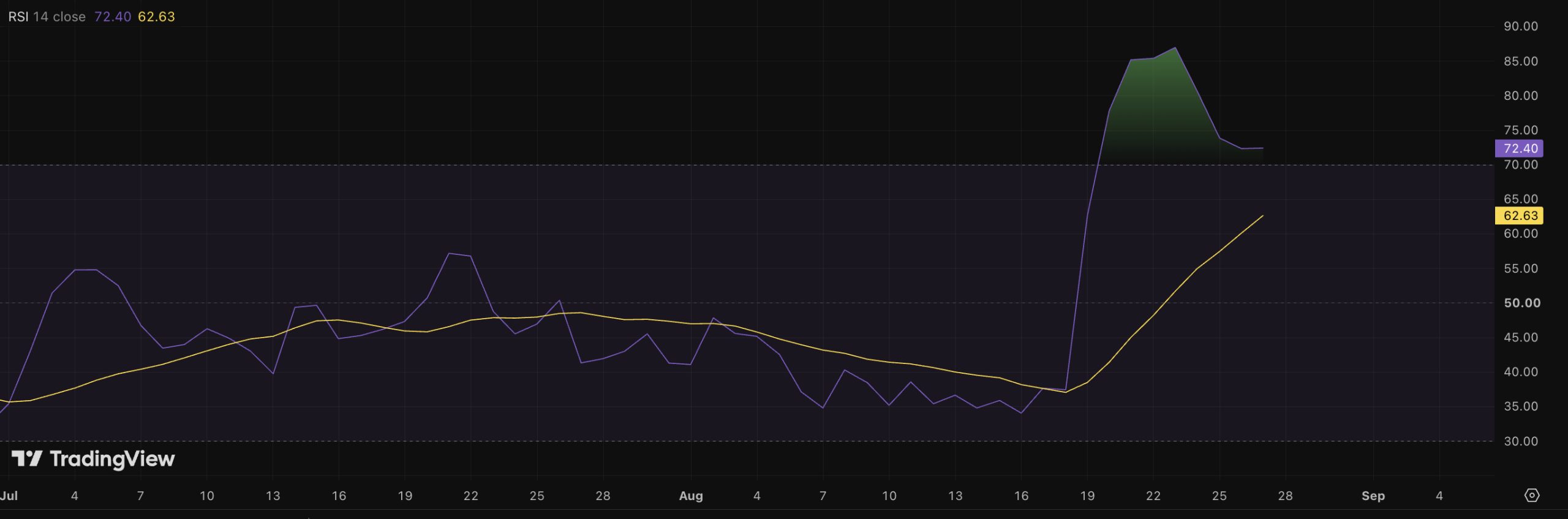
XRP price is changing hands above $1.40 after swinging between $1.37 and $1.45 in a single day, confusing its own prediction. This is a coin fighting for direction in real time. The bigger question traders are asking isn’t where XRP sits right now, but whether this volatility is the last gasp of a tired rally or the setup for another leg higher.
The whipsaw traces back to an overheated August run. XRP rallied by more than 50% on the week before buyers failed to hold the $1.45–$1.55 zone, triggering a cascade of long liquidations as leveraged positioning unwound.

Network activity data shows institutional flows into spot XRP ETF products and expanding transfer volumes on the ledger are still supportive, even as derivatives markets reset. MACD readings flash a buy signal (0.069 on the 12,26,9), while RSI at 72 sits in slightly overbought territory. This all came after screaming an overbought signal days ago, but close enough to keep shorter-term traders cautious.
Macro tailwinds like Fed rate expectations and manageable Treasury yields have kept risk appetite intact across crypto. That’s the backdrop. The question now is whether XRP’s technical structure can hold long enough to capitalize on it.
Discover: The Best Crypto to Diversify Your Portfolio
XRP Price Prediction: Hit $2 This Week?
XRP trades at the $1.45 level with an intraday range compressing between $1.38 and $1.45. Volume has picked up alongside the bounce, consistent with short covering rather than pure fresh accumulation. Worth watching before calling this a trend reversal.
Immediate resistance sits at $1.41–$1.45, a level XRP has rejected repeatedly this week; a daily close above $1.45 would materially improve the technical picture and open a path toward $1.55 and eventually $2.00 on continuation. Support holds near $1.36, with deeper structural demand at $1.28 and the $1.00–$1.05 zone that’s defended every major pullback in 2026.

In a good scenario, XRP needs to reclaim $1.45, ETF inflows persist, and momentum carries toward $1.55–$1.65. Or, it continued to chop between $1.36 and $1.45 as leverage resets.
However, the bear case comes if it breaks below $1.28 and reopens the $1.00 floor, especially if escrow-related selling pressure resurfaces. Traders watching for confirmation should track whether volume expands on any breakout attempt.
Trade XRP on Bybit and Get a Chance to Win Our $1,000 USDT Airdrop
Maxi Doge Targets Early Mover Upside as XRP Tests Key Levels
XRP holders riding this bounce have reason to feel validated; a 50% daily gain isn’t nothing. But at a market cap north of $80 billion, a move from $1.45 to $2.00 is a solid trade, not a life-changing one.
The above math is exactly why traders with risk appetite left over are scouting earlier-stage plays where the upside math looks different.
Enter Maxi Doge ($MAXI), a meme token built around leveraged-trading culture rather than another dog-with-a-hat rehash. The presale has raised $4.8 million at a current price of $0.0002835, with dynamic APY staking live at 65% for holders who’d rather not just hold and hope.
Standout features include holder-only trading competitions with leaderboard rewards and a “Maxi Fund” treasury earmarked for liquidity and partnerships, infrastructure that most meme launches skip entirely.
Research Maxi Doge before presale ends.
Discover: The Best Token Presales
The post XRP Price Prediction: Why Is XRP Fluctuating So Much Today? appeared first on Cryptonews.


TOKEN2049 returns to Marina Bay Sands in Singapore on Oct. 7-8, bringing together 25,000 attendees from over 7,000 companies across 160 countries.
The first 100 speakers have been announced, including Shayne Coplan, Founder and CEO of Polymarket; Jeff Yan, CEO of Hyperliquid Labs; Adena Friedman, Chair and CEO of Nasdaq; Jenny Johnson, CEO of Franklin Templeton; Eric Trump, Executive Vice President of The Trump Organization; Raoul Pal, Co-Founder and CEO of Real Vision; and Tom Lee, Managing Partner and Head of Research at Fundstrat.
Institutional participation will be a major focus of this year’s edition, with senior leaders from BlackRock, J.P. Morgan, Morgan Stanley, Nasdaq, NYSE, CME and Franklin Templeton expected across the event.
Taking over all five floors of Marina Bay Sands, TOKEN2049 will create a large-scale environment spanning content, networking, wellness, live experiences and its hospitality.
Across TOKEN2049 Week, more than 1,000 events, from conferences and hackathons to investor gatherings, meetups and networking receptions, will fill venues throughout the city. Other major gatherings taking place in Singapore that week include Digital Asset Summit Asia, Sui Basecamp, the Network State Conference, the Milken Institute Asia Summit, and the Forbes Global CEO Conference, all against the backdrop of the Formula 1 Singapore Grand Prix.
Alex Fiskum, Co-Founder of TOKEN2049, said: “With our Dubai edition moving to 2027, our full focus this year is on Singapore. We’re seeing strong interest, with more than 70% of the exhibition floor already secured. We’ll also unveil new tracks and formats in the coming weeks as we expand the institutional side of the programme. We can’t wait to welcome everyone back to TOKEN2049 this October for another edition in Singapore.”
The 2026 programme will also feature the second edition of TOKEN2049 Origins, a 36-hour hackathon, and the return of the NEXUS Startup Competition, with registrations and applications across both programmes. This year’s finalists are set to be judged by leading venture capital firms Dragonfly, Multicoin, and Maelstrom.
Happy Bird tickets are currently available. For tickets and further information, visit TOKEN2049 Singapore.
ABOUT TOKEN2049
TOKEN2049 is the world’s leading crypto event series, bringing together decision-makers from across the global digital asset ecosystem to connect, exchange ideas and shape the industry. TOKEN2049 is the meeting place for founders, executives, institutions, investors, builders and policymakers from around the world.
The post TOKEN2049 Singapore Returns to Marina Bay Sands This October appeared first on BeInCrypto.

Fitbit and Pokemon Made a Fitness Tracker That Might Actually Help Me Catch My Zs

Red Diamond Coffee & Tea names Away From Home SVP

Hyperliquid Strategies doubles HYPE holdings to 29.3M





-

 Fashion6 days ago
Weekend Open Thread: Madewell – Corporette.com
-

 Crypto World2 days ago
SpaceX stock could rise 75% to $240, JPMorgan says
-

 Business5 days ago
Musk’s Tesla, SpaceX Confirm $16.8 Billion ‘Terafab’ Chip Plant as World’s Largest Building in Texas
-

 Crypto World5 days ago
anatomy of crypto’s biggest liquidation event since 2021
-

 Crypto World3 days ago
A $30 Billion AI Fund Implodes, Now the SEC Is Investigating Wall Street’s Role
-

 Politics5 days ago
6 months on, Irish renters crushed by effects of government housing bill
-

 Crypto World2 days ago
Did Trump Just Move SpaceX Stock With One Truth Social Post?
-

 Business4 days ago
Mystery AI Model ‘Ox Alpha’ Draws Developers With Free Access as Chinese Lab Origins Remain Debated
-
 NewsBeat5 days ago
The ‘Lucky Dip Gang’ causing carnage for clicks: After five thugs were killed speeding in the wrong direction on a motorway, GUY ADAMS investigates a sick new trend… and why police aren’t even allowed to pursue them
-

 Business3 days ago
Moderna CEO warns China is pouring state money into mRNA technology
-

 Business7 days ago
Five Below: Kids Discount Retailer Reaps Rich Rewards
-

 Business3 days ago
NVIDIA Stock Drops Nearly 2 Percent to $210 on Seventh Losing Day Ahead of Critical AI Earnings
-
 Crypto World6 days ago
Nvidia Stock Suffers Longest Losing Streak Since 2022: Will Q2 Earnings End It?
-

 Business6 days ago
UK firms in critical financial distress rise 9% to 53,756
-

 Sports4 days ago
Deshaun Watson fires back at Browns fans after being booed: ‘It’s a disrespectful thing’
-
 Crypto World4 days ago
Google Gemini AI Predicts Ethereum Could Become the Trade Retail Misses in 2026
-

 Tech6 days ago
Unitree’s New Superman Robot Claims to Outjump and Outrun Every Human, Usain Bolt Included
-

 Tech6 days ago
Faster chip in a familiar form factor
-

 Business5 days ago
Will Tesla Stock Be Higher or Lower a Year From Now? Here’s What Wall Street Analysts Are Saying
-

 Crypto World7 days ago
SEC Regulation Crypto vs CLARITY Act: which framework wins
You must be logged in to post a comment Login