

Crypto World
UK watchdog raids eight London sites over illegal P2P crypto trading



UK regulator FCA raided eight London sites over alleged illegal P2P crypto trading, issuing stop notices and escalating its wider crackdown on unregistered platforms.
Summary
- The UK Financial Conduct Authority raided eight London locations tied to alleged illegal peer-to-peer crypto trading.
- Stop notices were issued as part of multiple anti-money laundering and counter-terrorist financing probes.
- No peer-to-peer crypto traders are currently registered with the FCA in the UK.
According to Reuters, the UK’s Financial Conduct Authority (FCA) has raided eight locations across London suspected of running illegal peer-to-peer cryptocurrency trading operations, in a coordinated sweep conducted on April 22 with tax authorities and the Metropolitan Police.
Stop notices were issued at every site, effectively ordering the alleged operators to cease all unregistered cryptoasset activity while multiple criminal investigations into potential anti-money laundering (AML) and counter-terrorist financing breaches continue.
In a statement, the FCA said the raids were part of “ongoing criminal investigations under the Money Laundering Regulations 2017 and counter-terrorist financing legislation,” underscoring that cryptoasset exchange providers must be registered to operate legally in the UK.
Notably, there are currently zero registered peer-to-peer crypto trading businesses with the FCA, meaning any P2P platform offering UK-facing services is doing so without formal authorization.
The latest action builds on previous FCA operations that have targeted unregistered crypto ATMs and unlicensed exchanges, including raids that disrupted at least 26 illegal crypto machines across the country.
In 2024, the regulator and Metropolitan Police arrested two individuals in London suspected of running an unlicensed cryptoasset exchange that allegedly processed more than $1.25 billion worth of unregistered crypto over several years, according to the FCA and Sky News.
Therese Chambers, the FCA’s Executive Director of Enforcement and Market Oversight, has warned that “crypto businesses operating without registration are illegal” and pledged that the watchdog “will do everything in our power to stop crypto firms from operating illegally in the UK.”
The FCA has also rejected roughly 90% of crypto firms seeking registration in recent years due to AML and fraud-prevention failures, approving only a small fraction of applicants under its tightened regime.
The London raids come as UK authorities step up enforcement against crypto platforms that either ignore registration rules or promote services illegally to local investors, including recent court actions over unlawful financial promotions.
With the FCA warning consumers they should be prepared to lose all their money in crypto and emphasizing that unregistered P2P trading offers no regulatory protection, the message to UK-facing platforms is increasingly blunt: register, or risk being shut down.

Just 4% of surveyed Americans say they would weigh a political candidate’s stance on crypto policy in deciding who to vote for.
Affordable housing, consumer fraud protection and lower bank fees were the top three issues respondents said they wanted Congress to tackle, according to a survey of 2,035 US adults released on Wednesday by POLITICO and conducted by polling firm Public First.
Just 18% of respondents considered establishing rules for the crypto market a top priority for Congress, just one percentage point ahead of regulating large banks.
The results show a divide between the average American voter’s top priorities and those of crypto industry lobbyists, who have been pushing Congress to pass crypto legislation ahead of the midterm elections.
Crypto lobbies poured more than $130 million into the 2024 elections, the most of any industry, and have already spent $320 million to influence the November midterms, according to data compiled by researcher Molly White.
Crypto lobbyists have made it clear that they will use their significant funds against any candidate who doesn’t support the industry, having spent over $5.5 million on opposing candidates in congressional races in Illinois this year.
Less than a third oppose making crypto mainstream
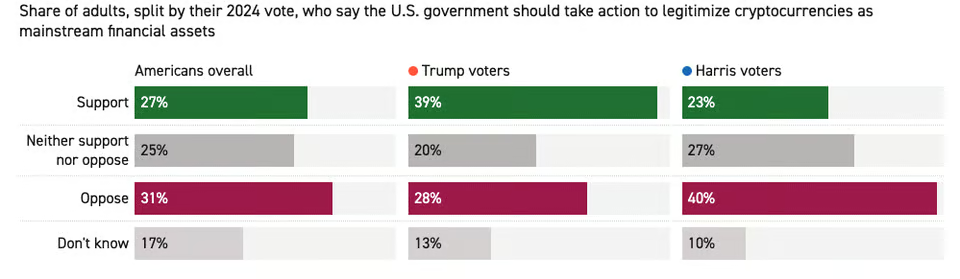
According to the survey, just 27% said they support or strongly support the US government taking action to legitimize crypto as a mainstream financial asset, while 31% said they oppose or strongly oppose it.

Poll responses to whether the US government should legitimize crypto as a mainstream asset. Source: POLITICO
Related: Crypto and AI could be dirty words on 2026 midterm campaign trail
“Most voters don’t care about digital assets,” Republican Representative Dusty Johnson told POLITICO. “But those who do care a lot. It is a high-intensity issue. And I think it’s going a little bit more mainstream. The number of people who ask me about it is still very small, but I would say growing.”
More than half of the respondents said they had not, and would not, consider trading crypto, while 19% had traded crypto. Of those who trade crypto, 7% said a political candidate’s stance on crypto would impact their vote.
The poll also found that 45% of respondents viewed investing in crypto as a risk not worth taking, even if it offered high returns, compared with 25% who said it was worth it.
The latest poll clashes with another poll of 2,008 registered voters released on Friday by HarrisX, which found 47% said they would be at least somewhat likely to consider voting for a candidate outside their preferred party if the candidate supported passing a long-awaited crypto bill that would lay out how the industry is regulated.
The Senate Banking Committee on Thursday will vote on whether to advance such a bill that has seen involvement from the White House to cut a deal with crypto and banking lobbies. A version of the bill passed the House in June as the CLARITY Act.
Magazine: Clarity Act risks repeat of Europe’s mistakes, crypto lawyer warns

A Bitcoiner’s post has gone viral on X after he claimed to use Anthropic’s AI chatbot Claude to recover 5 Bitcoin worth about $320,000 that he had been unable to access for more than a decade.
In an interview with MTS on Wednesday, pseudonymous X user Cprkrn said he made fairly “really complicated passwords” on blockchain.info and forgot one of three passwords after changing it several years ago.
Over the last eight weeks, Cprkrn said he used AI to attempt to brute force “trillions of passwords,” but to no avail.
Then, in a “last-ditch effort” earlier this week, Cprkrn said he gathered all of his old college notebooks as well as a laptop he had used into Claude, which helped him recover an old password and a crucial wallet backup file that corresponded with that password, ultimately enabling him to access the Bitcoin wallet.

Source: Cprkrn
Industry reports predict that between 2.3 million and 4 million Bitcoin (BTC) are inaccessible, representing roughly 11% to 19% of the cryptocurrency’s maximum supply because of forgotten or lost seed phrases, burned coins or other reasons. There are entire businesses dedicated to helping cryptocurrency users recover lost coins.
How Cprkrn used Claude to recover his Bitcoin
Cprkrn’s seed phrase hunt was conducted over eight weeks, with Claude helping him search two Macs, two external hard drives, an Apple Notes export, iCloud Mail, a Gmail inbox and X messages, totaling more than 1 gigabyte of data.
One of those devices was his college computer, on which Claude discovered a critical wallet backup file from December 2019.
From there, Cprkrn, with Claude’s assistance, managed to decrypt the file using a password derived from a notebook mnemonic, enabling him to find the seed phrase for the long-dormant Bitcoin wallet.
While Cprkrn didn’t provide direct evidence of Claude searching through his devices, he shared a link from Blockchain.com’s Bitcoin explorer showing that about 5 Bitcoin was transferred from wallet address “14VJy…ofuE6” across five transactions on May 13.
Prior to those transactions, the coins had been dormant since early 2015.
Over 3.5 trillion passwords were tested before succeeding
The recovery came after Claude unsuccessfully used BTCRecover — an open-source seed recovery tool — and the software program Python to test around 34 billion passwords with brute force.
Related: Bitcoin whale ‘still short’ BTC despite facing $13M in losses
Claude also used password recovery tool Hashcat to test another 3.4 trillion passwords, which also proved unsuccessful.
Just $15 in AI compute was used to conduct the searches and test passwords, according to Claude’s summary of the recovery efforts.

Source: Cprkrn
Despite the success, some members of the crypto community said Cprkrn overstated Claude’s role in retrieving the Bitcoin, arguing that it only assisted with the searching efforts and didn’t crack the wallet as Cprkrn suggested.
“Claude didn’t do anything other than search his files,” Reddit user MeteorSwarmGallifrey said in the technology subreddit, adding that Claude didn’t do anything “groundbreaking.”
Magazine: eToro founder timed Bitcoin top perfectly due to belief in 4 year cycles

Metaplanet reported a ¥114.5 billion (around $725.6 million) net loss in the first quarter of fiscal year 2026, as declining Bitcoin prices led to massive accounting valuation losses on its holdings.
The company reported an ordinary loss of ¥114.9 billion ($728 million), largely driven by ¥116.3 billion ($736 million) in Bitcoin valuation losses recorded during the quarter.
Metaplanet Quarterly Loss
Despite the losses, Metaplanet posted strong operating growth. Its net sales rose 251.1% year-over-year to ¥3.08 billion ($19 million), and its operating profit increased 282.5% to ¥2.27 billion ($14.3 million). Revenue from its Bitcoin Income Generation business, which includes option premium strategies tied to BTC derivatives, rose sharply to ¥2.54 billion.
Metaplanet’s Bitcoin holdings increased to 40,177 BTC by the end of March 2026, up from 35,102 BTC at the end of December 2025. It has managed to retain its position as the largest Bitcoin-holding listed company outside the United States, according to the filing.
During the quarter, the company continued raising capital through common share issuances, preferred shares, stock acquisition rights, and Bitcoin-backed credit facilities to support additional BTC purchases.
Metaplanet also disclosed that it secured a $500 million Bitcoin-collateralized credit facility and had drawn $302 million under the arrangement as of May 13, 2026. Total assets fell to ¥466.7 billion at the end of March from ¥505.3 billion at the end of 2025, mainly due to lower Bitcoin valuations.
“The Company will continue to accumulate Bitcoin, grow Bitcoin per share, and allocate capital with discipline. Over time, it intends to develop financing capabilities, operating businesses, and institutional relationships that make its Bitcoin position more productive and durable. This work sits inside a larger shift in how money and capital markets are organized. The Company intends to contribute to the development of Japan’s digital capital markets.”
Metaplanet’s Disclosure Practices Controversy
The results come as the company faces criticism online over its Bitcoin acquisition strategy and disclosure practices. Earlier this year, CEO Simon Gerovich defended the company’s strategy while explaining that all Bitcoin purchases, wallet addresses, and borrowing arrangements had been disclosed in real time.
Gerovich also said the company’s options strategy was aimed at acquiring BTC below spot prices through premium income rather than speculating on short-term price movements.
The post Japan’s Biggest Corporate Bitcoin Holder Reports $736 Million Valuation Loss appeared first on CryptoPotato.


The copper gold ratio has broken above its 200-day moving average for the first meaningful time since September 2020.
Summary
- The ratio now stands at 0.00142, with copper at $6.65 per pound and gold near $4,700 per ounce, up 25% from its recent lows.
- Previous surges in 2013, 2017, and 2021 aligned with the early stages of major Bitcoin price cycles.
- The correlation between Bitcoin and the ratio has rebounded sharply from near negative 1.0, suggesting the relationship is beginning to strengthen.
The copper gold ratio is a closely watched macro signal measuring the relative strength of copper, an industrial metal tied to economic expansion, against gold, which traditionally rises during risk-off conditions.
A rising ratio signals improving global risk appetite, and the current reading of 0.00142 represents a 25% climb from the ratio’s recent lows, according to market analysis tracking both assets.
The breakout above the 200-day moving average is the first of meaningful size since September 2020. That prior instance coincided with the early stages of the Bitcoin rally that carried the asset from roughly $10,000 to its then-record high. Comparable surges in 2013, 2017, and 2021 also aligned with the onset of major Bitcoin price cycles.
What the signal means for Bitcoin now
The correlation coefficient between Bitcoin and the copper gold ratio currently sits at negative 0.11 on a 20-day moving average. That number has rebounded sharply from near negative 1.0, suggesting the divergence phase is closing.
Historically, the correlation has moved toward 1.0 during Bitcoin’s strongest bull runs, with both assets trending together as macro risk appetite improves.
The ratio is also viewed as a leading indicator that has historically preceded Bitcoin price moves by several weeks to months, meaning any sustained Bitcoin response would likely unfold over the coming weeks rather than immediately.
The signal arrives alongside a separate CryptoQuant bullish reading, which flipped positive on May 12 for the first time since March 2023. That prior reading preceded a sustained run taking Bitcoin from $20,000 to above $73,000 by April 2024. Bitcoin currently tests the $79,000 to $82,000 range, with analysts flagging resistance at $82,000 to $83,000 and key support at $77,500.
Neither indicator constitutes a guarantee of further gains. Analysts consistently caution that correlation does not establish causation, and that macro signals can produce false breakouts, particularly in cycles where institutional ETF flows and regulatory dynamics shape Bitcoin’s trajectory in ways the copper gold ratio does not capture.

The US Senate confirmed Kevin Warsh as Federal Reserve Chair in a 54-45 vote. The margin was the narrowest ever recorded for a Fed chair.
Pennsylvania Senator John Fetterman was the only Democrat to vote in favor. Warsh inherits a central bank under direct pressure from President Donald Trump to cut interest rates.
Kevin Warsh Officially Confirmed to Lead the Federal Reserve
Lawmakers first signed off on Warsh’s 14-year term as a Federal Reserve governor, clearing the way for the subsequent vote that handed him a concurrent four-year stint as chair.
He still needs to be sworn into both roles, which is pending the White House’s final signatures on the paperwork forwarded by the Senate.
Warsh takes over from Jerome Powell, whom Trump has repeatedly criticized for not lowering interest rates, mocking him with the nickname “Too Late.” Powell’s run as chair wraps up Friday.
Warsh previously served on the central bank’s Board of Governors between 2006 and 2011. He chairs his first Federal Open Market Committee (FOMC) meeting on June 16 and 17. During his confirmation hearing, Warsh said he was committed to keeping monetary policy “strictly independent.”
Follow us on X to get the latest news as it happens
The new Fed Chair takes over a central bank boxed in by hot data. Headline US CPI rose 3.8% year over year in April, the highest reading since May 2023. Producer prices, measured by the PPI, climbed 6%.
The numbers have prompted Wall Street to revise its outlooks. Goldman Sachs pushed its first rate cut forecast back to December 2026, citing sticky inflation.
Pimco went further, flagging the possibility of a rate hike. Warsh’s June FOMC vote will signal whether he leans toward Trump’s preference for cuts or holds the line on inflation.
Subscribe to our YouTube channel to watch leaders and journalists provide expert insights
The post Trump’s Pick Kevin Warsh Confirmed as Fed Chair After Tight Senate Vote appeared first on BeInCrypto.
Crypto World
Can TAO Push Past $470 After Subnet Expansion While Pepeto’s Final Presale Tokens Disappear Before Listing Day?
The Bittensor price prediction crowd just stacked its third bullish catalyst this month. Opentensor doubled subnet capacity to 256 on May 3, Wormhole bridged TAO to Solana two days later, and today the Conviction Locks upgrade goes live, locking staked TAO for extended periods and compressing liquid supply further.
TAO sits at $311 while bigger wallets rotate into the next entry tier, and Pepeto is in the middle of that rotation with nearly $10 million raised, the presale 97% filled, and a Binance listing approaching that turns presale wallets into full positions before the first public trade.
Opentensor opened 128 fresh subnet slots with Robin τ on May 3, taking total capacity to 256 according to CoinMarketCap.
Wormhole bridged TAO to Solana two days later per CoinDesk, Grayscale reopened its TAO Trust on May 9, and today’s Conviction Locks upgrade compresses liquid supply by requiring extended lock periods for governance power.
Q1 revenue hit $43 million in subnet fees and Nvidia holds roughly $420 million in TAO. Capital chasing the AI rotation is already looking for the next entry that has not run yet.
Why Smart Money Is Pairing TAO With Pepeto Right Now
Pepeto: A Marketplace Already Live, A Listing Already Approaching
Pepeto runs a meme coin marketplace built on Ethereum for buyers who refuse to surrender tokens to bots or rug contracts, and the reason TAO holders are watching it is that the same logic applies: enter before the crowd prices you out.
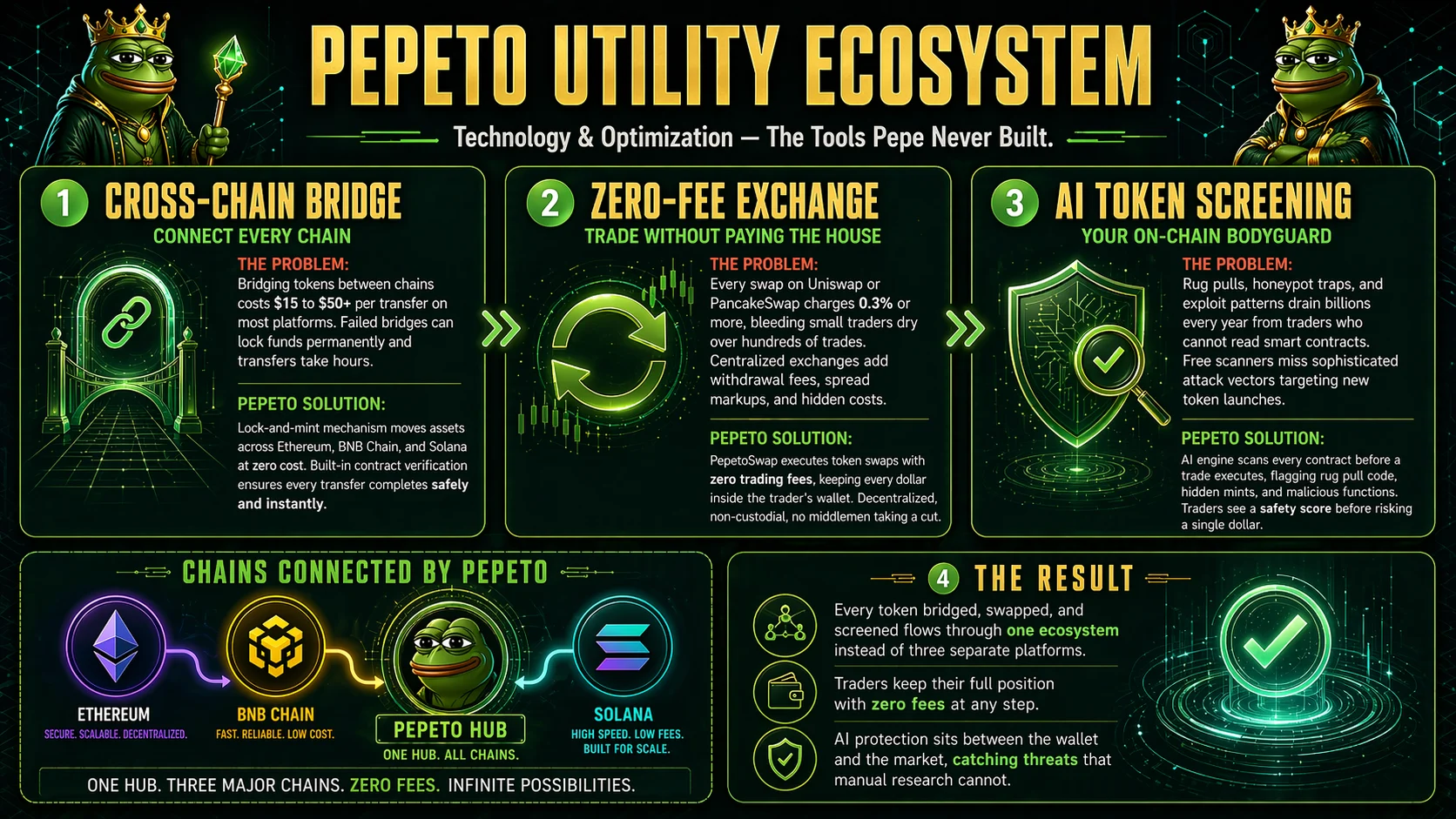
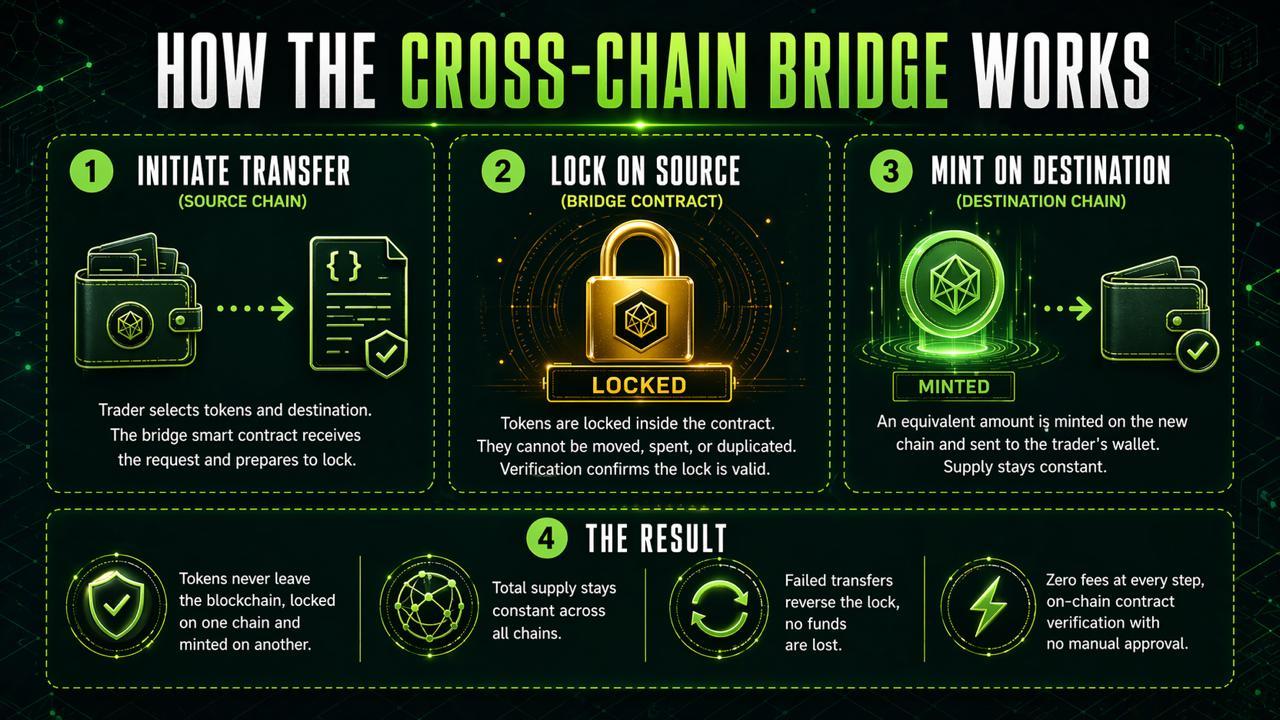
The cross chain bridge transfers tokens between networks at zero cost, which feeds directly into PepetoSwap’s zero fee trading engine, so capital that enters stays fully deployed instead of leaking into fees at every step.
SolidProof audited every contract and 173% staking is compounding tokens for wallets that arrived first, which means early holders are growing their positions while the presale is still open.
Pepeto trades at $0.0000001868, the supply matches Pepe at 420 trillion, and the same builder who carried the first Pepe coin past $11 billion with no products is steering this project alongside a Binance veteran on the engineering side.
The presale is 97% filled right now, stages clear in under 48 hours, and the smart contract closes automatically the second the last token sells with no warning, just a closed window and a listing within days. The multiplier math from this entry to even a fraction of Pepe’s old cap lands in 100x territory, and that number is why wallets that missed the original frog are acting this time.
Bittensor Price Prediction: The Roadmap For TAO Through 2026
TAO trades at $311 today per CoinMarketCap with a $3 billion market cap, sitting 58% below its $760 all time high from April 2024. Changelly projects the range between $388 and $474 by December 2026, with the bull case anchored on subnet adoption and the pending Grayscale TAO spot ETF decision.
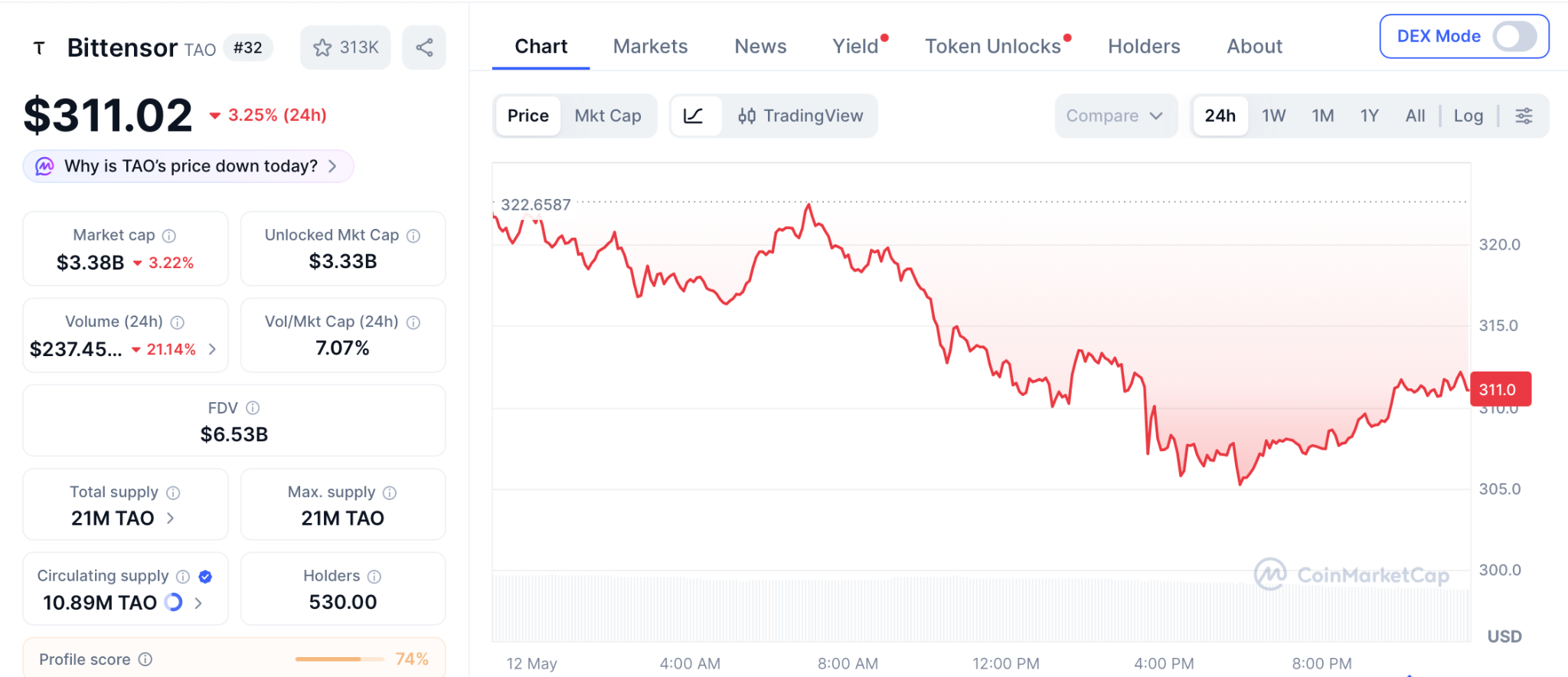
CoinCodex holds support at $260 and resistance at $350. Even the most bullish Bittensor price prediction caps the upside near 48% over months, while a presale entry into a working marketplace carries multiplier math that no $3 billion cap can match.
Conclusion:
The Bittensor expansion is real and the AI rotation is forming, but TAO upside from $311 caps near 48% over months while the Pepeto presale stages keep absorbing fresh capital with every round, and the gap between those two numbers is where life changing decisions get made.
Last cycle made millionaires out of the wallets that moved first into the right founder, not the wallets that waited for confirmation. Pepeto is that same moment with an approaching Binance listing and a working marketplace already running.
The presale is 97% filled, the smart contract closes the second the last token sells with no warning, and every day that passes is a day closer to a window that simply vanishes. The return math from $0.0000001868 to even a fraction of what the original Pepe reached is the kind of number that stays in a person’s head for years if they let it pass. The Pepeto official website carries the entry that turns into the return after the first listing day candle, and hesitating on this one could be the regret that defines the entire cycle.
Click To Visit Pepeto Website To Enter The Presale

FAQs
What is the Bittensor price prediction for the rest of 2026?
Changelly projects the Bittensor price prediction between $388 and $474 by December 2026, with TAO at $311 sitting 58% below its $760 all time high. Support holds at $260.
Why are TAO holders watching Pepeto before listing day?
Pepeto carries a live marketplace, SolidProof audited contracts, and the Pepe cofounder. The presale is 97% filled at $0.0000001868 with a Binance listing days away.
Disclaimer: This is a Press Release provided by a third party who is responsible for the content. Please conduct your own research before taking any action based on the content.


U.S. President Donald Trump (R) is greeted by Chinese President Xi Jinping at the Great Hall of the People on May 14, 2026 in Beijing, China. The trip by Trump is focused on trade, regional security, and strengthening bilateral ties between the world’s two largest economies.
China Pool | Getty Images News | Getty Images
BEIJING — U.S. President Donald Trump met his Chinese counterpart Xi Jinping in Beijing on Thursday morning, kickstarting a high-stakes summit that runs through Friday.
The relationship between the two countries is going to be “better than ever before,” Trump told Xi in his opening remarks, according to official broadcast footage. Highlighting their relationship, Trump said the two leaders have known each other personally for longer than any other U.S. or Chinese president.
Speaking just ahead of Trump, Xi noted the global attention on the meeting, and said a major question for the two countries was whether they could avoid the “Thucydides Trap,” according to an official English translation of his Chinese remarks broadcast by CCTV.
Thucydides Trap refers to how tensions historically between a rising and ruling power have often resulted in war. Graham Allison, the Harvard professor who popularized the concept, told CNBC’s “Squawk Box Asia” that he expects the trade truce Trump and Xi reached at their meeting in South Korea last fall will become a formal agreement.
“The big word will be stabilization,” Allison said Thursday.
The two presidents wrapped up their first meeting after about an hour, including a welcome ceremony, and are set to have multiple discussions through midday Friday.
Later on Thursday, Trump is expected to visit the Temple of Heaven historic landmark in the afternoon, and attend a state banquet in the evening.
Iran, Taiwan and artificial intelligence are among the many topics the two sides are expected to discuss, on top of tariffs and rare earths. The last time a sitting U.S. president visited China was in 2017.
On Thursday, Xi walked down the stairs of the Great Hall of the People in Beijing to shake hands with Trump, according to official broadcast footage. The U.S. president first shook hands with Chinese officials, followed by Xi greeting the U.S. delegation.
China’s top diplomat, Wang Yi and Zheng Shanjie, head of the economic planning agency, were among the Chinese representatives, the footage showed.
The U.S. contingent included Secretary of State Marco Rubio as well as business executives such as Tesla’s Elon Musk, Apple’s Tim Cook and Nvidia’s Jensen Huang.
Images of the initial Xi-Trump meeting also showed U.S. Secretary of War Pete Hegseth and his Chinese counterpart Dong Jun were also present.
Crypto World
Bonk Price Sits 88% Below All Time High While Pepeto Presale Hits $10 Million With a Working Exchange and Binance Listing Ahead
The Bonk price shows a token still waiting for a catalyst that has not arrived, with BONK trading at $0.0000071 and sitting 88% below its November 2024 peak. Tuttle Capital filed a 2x leveraged BONK ETF while Bonk Holdings on Nasdaq targets $115 million in reserves, but even those moves cannot close a gap that wide.
Pepeto has collected nearly $10 million in presale with an exchange already processing trades and a Binance listing approaching, and analysts project 100x to 300x from the current entry.
CoinDesk reported that Tuttle Capital filed a 2x leveraged BONK ETF, and Bonk Holdings on Nasdaq targets $115 million in reserves by year end. CoinMarketCap shows BONK at $0.0000071 with a $673 million market cap.
The institutional interest is real, but the Bonk price still sits 88% below its peak, and recovery from that depth moves in percentages that presale tokens can match in a single listing day.
BONK ETF Filing, Pepeto, and Where Meme Coin Returns Split
Pepeto
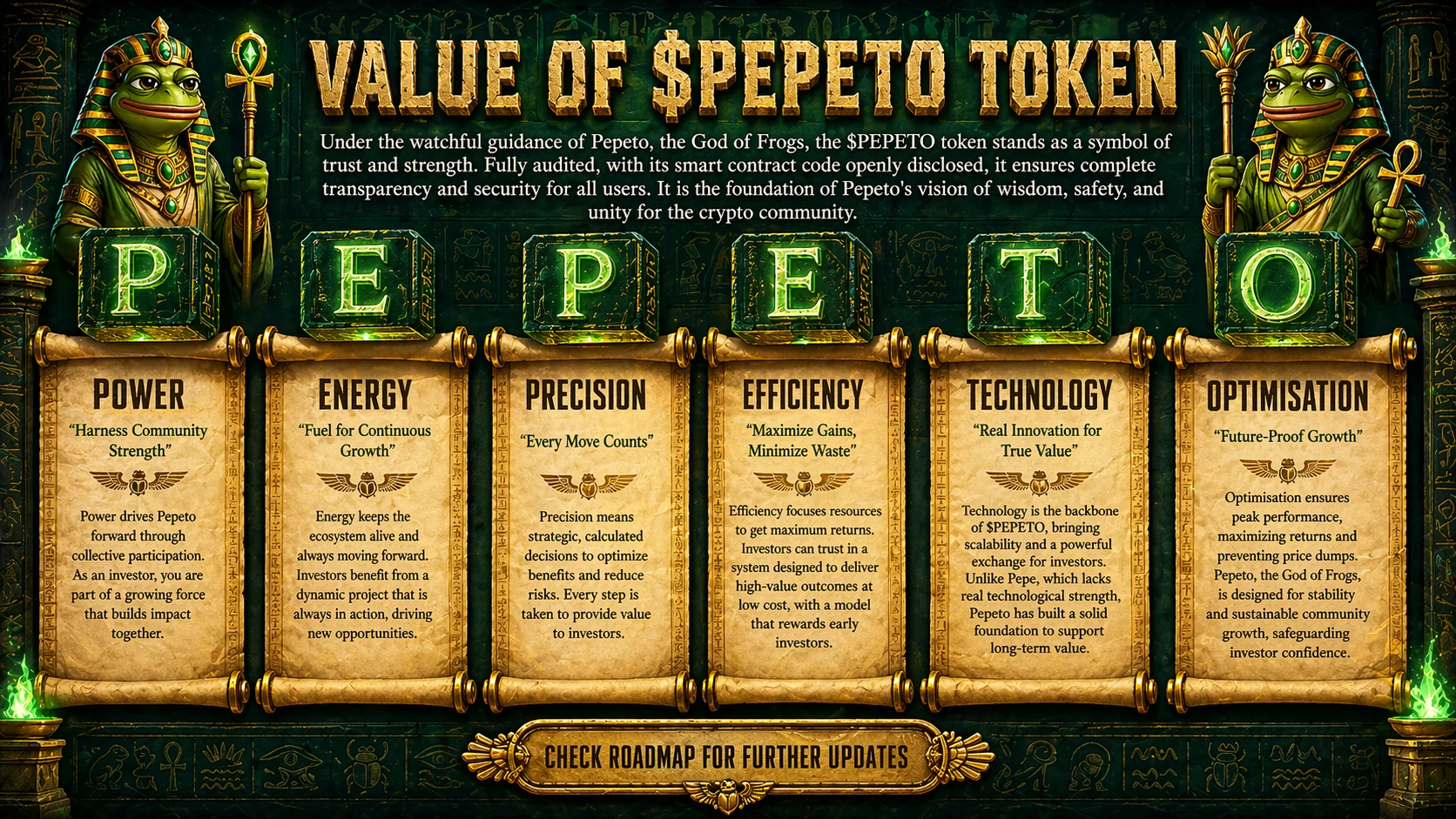
The BONK recovery struggle shows what happens when a meme coin runs on hype alone, and Pepeto answers that with a live exchange, a cross chain bridge linking Ethereum, BNB Chain, and Solana at zero cost, and a contract risk scanner that catches problems before capital goes in.
Nearly $10 million collected during fear proves the gap between a plan and a working result that wallets already trust with real money, and that trust keeps growing because each presale stage fills faster than the last while BONK needs years of steady buying just to close an 88% gap.
The team behind that momentum includes a former Binance expert and the person who built the original Pepe coin to $11 billion on the same 420 trillion token model and no utility behind it. SolidProof covers every contract, staking pays 173% APY before listing, and the Pepeto presale sits at $0.0000001868 right now. The zero fee exchange means every trade after listing feeds volume directly back into the token instead of leaking value to gas costs, and that is the kind of built in buying pressure that BONK never had and still does not have at $0.0000071.
The CoinMarketCap listing page went active in May, a signal that only appears when trading is near, and the sale ends without warning the second the allocation runs out, so the wallets entering now are building positions at a price that the rest of the market will never see again. One wallet put $8,000 into Shiba Inu in January 2021 and cashed out $9 million by August according to CNN, and with the level of demand flowing into Pepeto, analysts see the same kind of return setup forming for presale holders right now.
Bonk Price Prediction
BONK sits at $0.0000071 per CoinMarketCap, 88% below its $0.00005898 all time high. Changelly projects a 2026 ceiling near $0.0000154, while Coinpedia maps a high of $0.000033 if the Bonk price reclaims resistance.
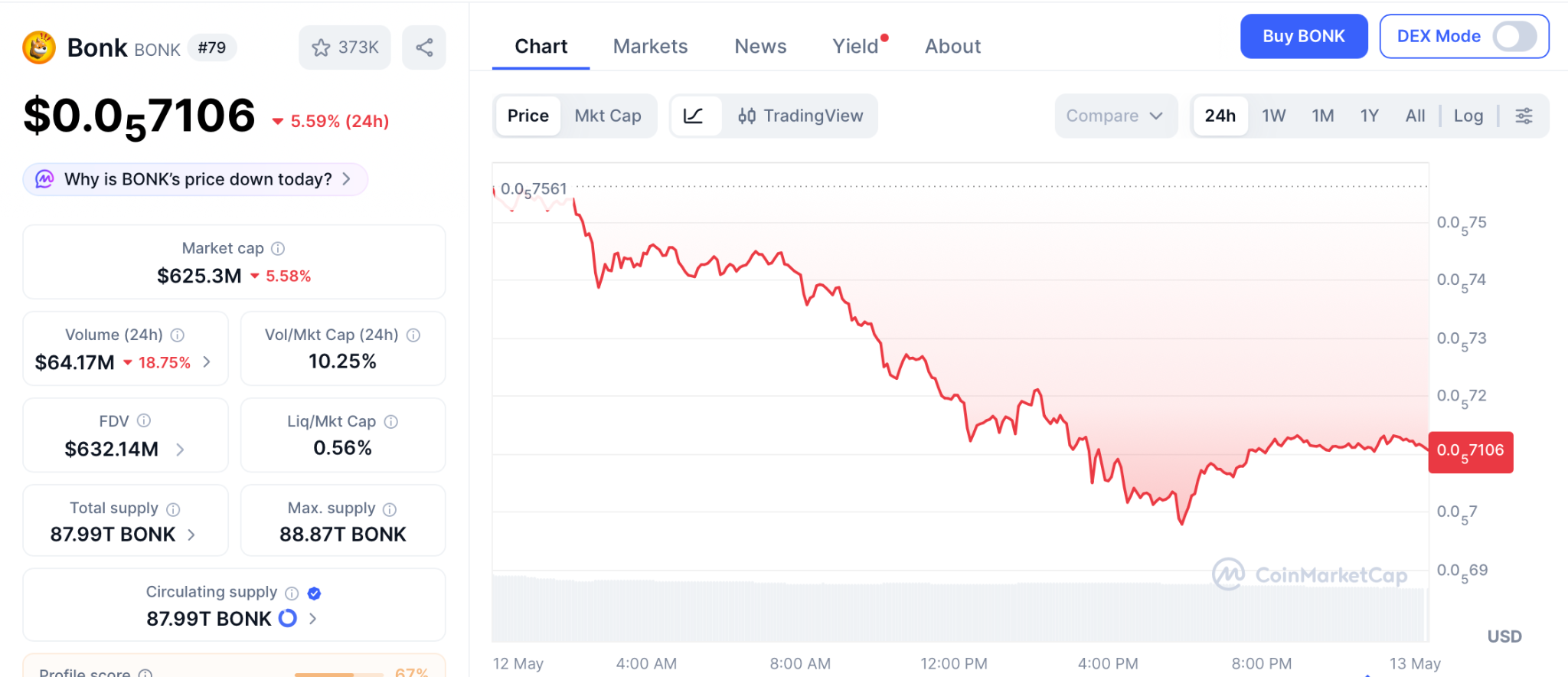
The best case gives roughly 4x on the year, solid for a meme coin but nowhere near what a presale to listing event delivers.
The Final Word
Pepeto was built with timing that fits this cycle perfectly, where meme coins fight to recover and the smartest capital finds the one that shipped what others still promise.
The cofounder proved this math works once before, taking Pepe coin to $11 billion with zero products and the same 420 trillion supply, and repeating that from the current presale price is over 150x with a working exchange and real trading tools behind it this time.
The Bonk price tells the story of a meme coin trapped in recovery mode, waiting for a second chance that keeps getting pushed further out, while Pepeto offers that chance right now at a price that vanishes forever the day the listing goes live.
Entering the presale is betting on a pattern that already delivered generational returns once, and the wallets inside right now are the ones that will look back on this entry the way early Pepe holders look back on theirs, knowing that the only real mistake was not buying more. The Pepeto official website is where that entry exists for a few more days, and the listing could come at any moment because the remaining allocation shrinks with every wallet that enters.
Click To Visit Pepeto Website To Enter The Presale

FAQs:
Why is the Bonk price struggling to recover from its 88% drop?
The Bonk price struggles because BONK depends on hype cycles without exchange tools. Recovery from 88% takes quarters that presale tokens skip through a listing event.
Can Pepeto deliver better returns than Bonk price recovery in 2026?
Pepeto can deliver better returns than Bonk price recovery because the presale price of $0.0000001868 gives 100x to 300x potential once the Binance listing opens. The best Bonk price forecast gives roughly 4x for 2026.
Disclaimer: This is a Press Release provided by a third party who is responsible for the content. Please conduct your own research before taking any action based on the content.
Crypto World
Dogecoin Price Prediction Signals Breakout for 2026 as Whale Holdings Hit Record While Pepeto Nears $10M With Listing Days Away
The latest Dogecoin price prediction data shows DOGE forming a bullish pattern after whale wallets loaded a record $11.6 billion worth of tokens, and Bitcoin above $80,000 is pulling capital back into altcoins and meme tokens at a pace not seen since late 2025.
Pepeto is pulling fresh presale attention with nearly $10 million raised and a Binance listing expected ahead.
According to Santiment data, the 149 largest DOGE wallets now hold 108.52 billion tokens worth $11.6 billion, the highest on record. Analysts tracked 739 transactions above $100,000 in a single day.
DOGE trades at $0.11 after clearing every major moving average for the first time since October 2025.
Several Dogecoin price prediction models point to $0.118 resistance, and CoinMarketCap reports ETF inflows returned despite short term bearish signals.
Dogecoin Price Prediction and Pepeto Lead the Crypto Entries Worth Watching in 2026
Pepeto Builds a Working Exchange Before Listing Day While the Market Chases Price Targets
The crypto market rewards people who enter before the rest of the crowd catches on, and Pepeto is that entry right now at $0.0000001868 before the expected Binance listing changes that number for good.
The PepetoSwap exchange, cross chain bridge, and 173% staking system are already built and working, verified by a completed SolidProof audit, which is why the Pepe cofounder who took the original PEPE token to an $11 billion market cap with zero tools is now steering a project that has real tools behind it from day one.
Dogecoin turned early holders into millionaires with nothing but community energy, and Pepeto carries that same energy with an exchange already running underneath it.
Multiple Dogecoin price prediction analysts rank Pepeto alongside the top presale entries because it already delivers more utility than most listed meme coins, and with nearly $10 million raised the presale is almost full, which means the listing could trigger any day and every wallet that hesitated will be staring at an entry that vanished overnight.
Today the entry remains at the lowest number it will ever be, and the moment the listing goes live, this window shuts and the presale buyers are the ones sitting on the returns.
Dogecoin Price Prediction
The Dogecoin price prediction for the rest of 2026 carries real weight after this month’s breakout. DOGE is trading at $0.11 with a market cap of $17 billion according to CoinMarketCap and daily volume above $600 million. The token printed a cup and handle pattern on the daily chart, a classic sign that a run higher is forming.
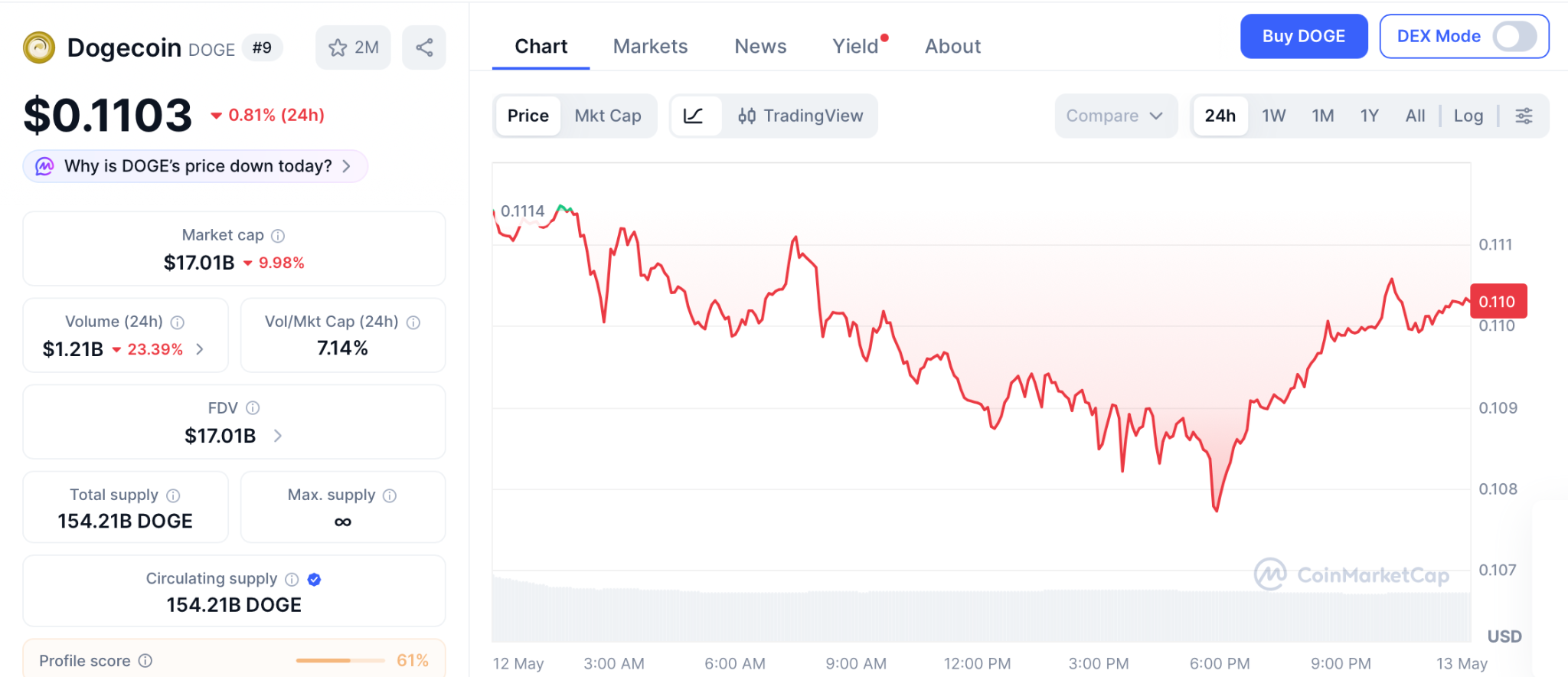
Resistance sits at $0.118 where the 0.618 Fibonacci level lines up with the top of a descending channel, and clearing that opens a path toward $0.155 by year end based on CoinCodex models.
Support holds at $0.087 where buyers stepped in three times since February. The Dogecoin price prediction outlook gets stronger if spot ETF inflows stay positive and X Money integration rumors turn real, because that could push DOGE back toward its 2025 high near $0.27.
Conclusion
The Dogecoin price prediction points to DOGE running toward $0.15 by late 2026, and that kind of move from a large cap delivers about 40% returns over months of waiting.
The original PEPE token reached an $11 billion market cap with zero products behind it, and Pepeto was built by the same cofounder with a working exchange, bridge, and 173% staking already running, which means the math from presale to listing points at returns that a 40% large cap move will never touch.
Nearly $10 million already flowed into this presale, and that number keeps climbing every day because the wallets doing the math understand what happens when a token moves from fractions of a cent to exchange price on listing day.
The presale is still open right now, but the listing could trigger any moment once the final tokens clear, and every day of hesitation is a day closer to watching from the outside while early holders collect the returns. This is the kind of decision that looks obvious in hindsight, and the wallets that act before the window closes are the ones who will not spend the rest of 2026 wishing they had moved when the entry was still there.
Click To Visit Pepeto Website To Enter The Presale

FAQ
What is the Dogecoin price prediction for the rest of 2026?
The Dogecoin price prediction targets $0.155 by year end if the cup and handle breaks $0.118 resistance. DOGE trades at $0.11 with whale wallets holding a record $11.6 billion.
Why are analysts watching the Pepeto presale alongside DOGE right now?
Pepeto raised nearly $10 million with a working exchange, 173% staking APY, and an expected Binance listing. The presale at $0.0000001868 is almost full.
Disclaimer: This is a Press Release provided by a third party who is responsible for the content. Please conduct your own research before taking any action based on the content.
French hardware wallet maker Ledger has paused its planned US initial public offering (IPO), joining Kraken on the sidelines and thinning what was set to be crypto’s biggest listing year.
Sources familiar with the process said Ledger has not filed a confidential S-1 with the Securities and Exchange Commission (SEC), the formal first step toward a US listing, and may pursue private fundraising instead.
A Thinning 2026 IPO Pipeline
Ledger had hired Goldman Sachs, Jefferies, and Barclays earlier this year to lead a potential New York listing valued above $4 billion.
The pause leaves that mandate idle and removes one of the most anticipated crypto issuances from the 2026 schedule.
Kraken shelved its own IPO in March after confidentially filing in November 2025. The exchange’s valuation slipped to $13.3 billion in April from a $20 billion peak last year, a signal that public markets are already discounting crypto operators.
The Cost of Staying Private
Pausing comes with tradeoffs. Existing Ledger investors and employees lose a near-term exit, leaving secondary sales as the main liquidity option.
The company tapped that route in March with a $50 million share sale, but private rounds rarely match the depth of public markets.
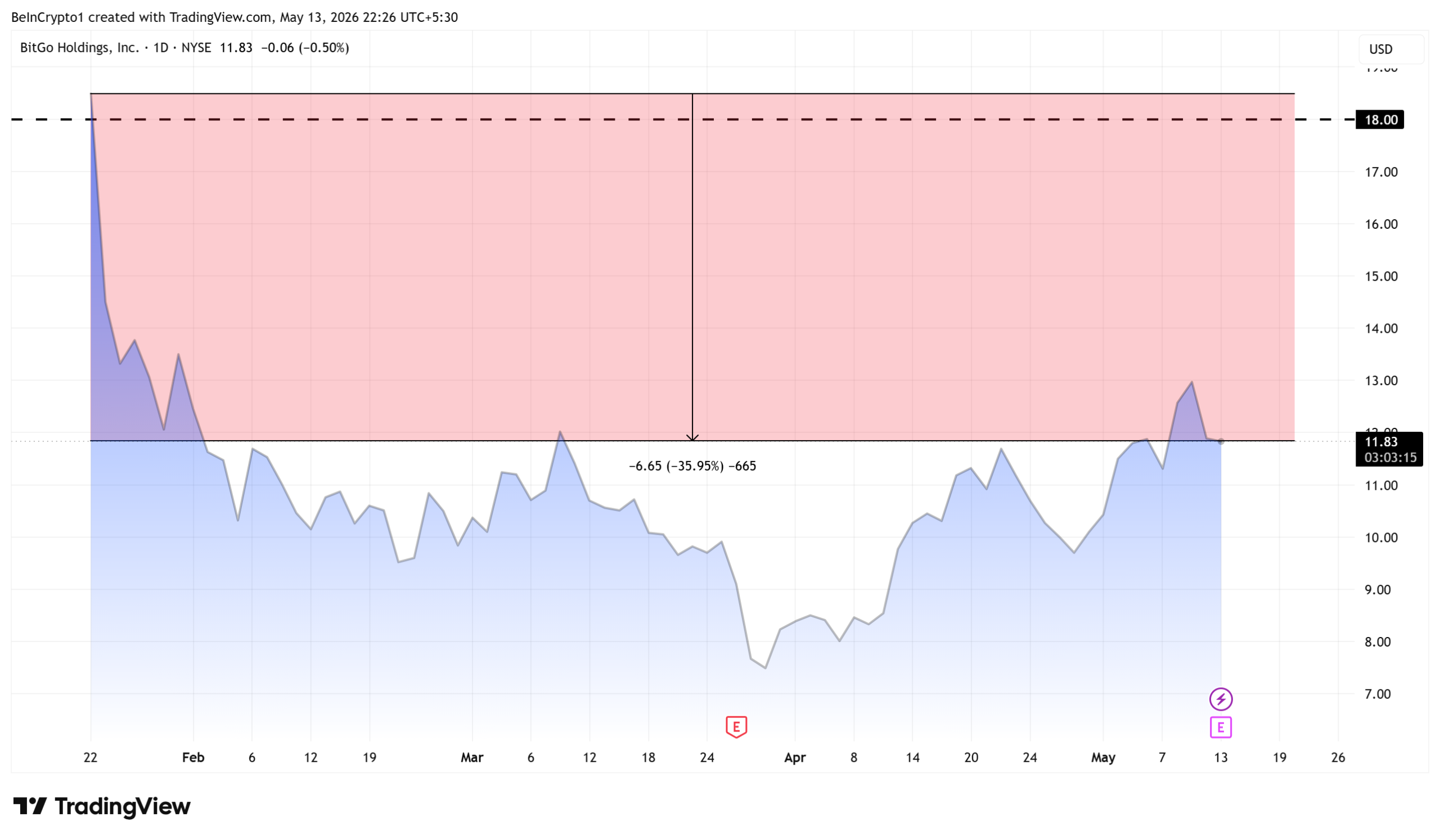
BitGo, the only crypto firm to complete a US listing this year, debuted in January at $18 per share and now trades near $12, more than 30% below its offer price.

That performance gives peers a clear reason to wait rather than test investor appetite.
Ledger’s Growth Story Continues
Notwithstanding, the Paris-based firm is growing US operations, recently hiring a chief financial officer from stablecoin issuer Circle and building enterprise custody products for banks.
Founded in 2014, Ledger says it secures over $100 billion in client crypto assets.
The IPO pipeline reopening by the second half of 2026 depends on token prices, trading volumes, and how the next crypto-adjacent listing performs.
In the meantime, the pause keeps Ledger private and the broader sector waiting.
The post Ledger Joins Kraken in Pausing US IPO, Stalling Crypto’s 2026 Public Listing Wave appeared first on BeInCrypto.

OpenAI calls for a US-led global AI governance body that includes China
Just 4% of US Considers Crypto in Candidate Choice: Poll
“Survivor 50” announces $100K Sia Fan Favorite prize to be voted on by viewers

Manchester United reach agreement with Casemiro over contract clause amid transfer speculation

US brings back mandatory military draft registration

Steven Gerrard disagrees with Gary Neville over ‘shock’ Chelsea and Arsenal claim | Football

Trump’s Canada Plan BLOWS UP In Financial Disaster As Threats Backfire Spectacularly

Trump says he doesn’t think about Americans’ financial situations as he negotiates with Iran

Trump’s stunning comments about Americans’ financial struggles while Iran war rages on
-
 Crypto World6 days ago
HarrisX Poll Found 52% of Registered Voters Support the CLARITY Act
-

 Fashion5 days ago
Weekend Open Thread: Marianne Dress
-

 Crypto World7 days ago
Upbit adds B3 Korean won pair as Base token gains Korea access
-
 NewsBeat7 days ago
NCP car park operator enters administration putting 340 UK sites at risk of closure
-

 Fashion2 days ago
Coffee Break: Travel Steam Iron
-

 Tech4 days ago
Auto Enthusiast Carves Functional Two-Stroke Engine from Solid Metal
-

 Fashion3 days ago
What to Know Before Buying a Curling Wand or Curling Iron
-

 Politics2 days ago
What to expect when you’re expecting a budget
-
 Business5 days ago
Ignore market noise, India’s long-term story intact, say D-Street bulls Ramesh Damani and Sunil Singhania
-

 Politics5 days ago
Politics Home Article | Starmer Enters The Danger Zone
-

 Tech3 days ago
GM Agrees To Pay $12.75 Million To Settle California Lawsuit Over Misuse Of Customers’ Driving Data
-

 Politics6 days ago
Simon Cowell Says He Was ‘Horrible’ To Susan Boyle During BGT Audition
-

 Entertainment7 days ago
Sarah Paulson Called Out For Met Gala ‘Hypocrisy’
-

 Entertainment6 days ago
General Hospital: Ric & Ava Bombshell – Ric’s Massive Secret Exposed!
-

 Sports7 days ago
UEFA Champions League final schedule, teams, venue, live time and streaming | Football News
-

 Entertainment7 days ago
Why David Letterman Called CBS ‘Lying Weasels’
-
Entertainment7 days ago
Hayden Panettiere reveals she's estranged from mom, addresses brother Jansen's sudden death: 'I was floored'
-
 Sports7 days ago
Mike Tyson speaks out on status of Floyd Mayweather fight
-
 Entertainment7 days ago
Paramount+’s ‘Landman’ Season 3 Gets Promising New Update From Returning Director
-

 Entertainment5 days ago
YNW Melly Denied Bond Again Ahead Of Double Murder Retrial
You must be logged in to post a comment Login