
Crypto World
Ukraine shuts crypto investment scam with up to $1M monthly turnover



Ukraine has dismantled a network of fake crypto investment platforms that allegedly drained wallets belonging to people in more than 20 countries, with investigators identifying 62 victims so far.
Summary
- Ukraine dismantled fake crypto investment platforms that targeted victims across more than 20 countries.
- Investigators have identified 62 victims, while the network reportedly handled up to $1 million a month at its peak.
- Victims were shown fake investment gains before a wallet drainer stole their crypto when they tried to withdraw funds.
- Police conducted 34 searches and seized more than 100 computers, over 100 phones and 15 vehicles.
The National Police of Ukraine said investigators from its Main Investigation Department worked with the Security Service of Ukraine and the Office of the Prosecutor General to uncover the operation, which maintained several offices in Kyiv and the surrounding region.
Поліцейські припинили діяльність мережі фейкових інвестиційних платформ, через які шахраї викрадали криптовалюту у громадян понад 20 країн
Наразі поліцейські встановили 62 потерпілих. 🔗 Деталі: https://t.co/e4OZtqg0gB pic.twitter.com/QblK1EWXi8
— Національна поліція України (@NPU_GOV_UA) September 1, 2026
More than 46 Ukrainians were recruited into the network, while authorities are still identifying other participants, victims and the total amount stolen.
Fake crypto investment platforms targeted more than 20 countries
Investigators said the group created websites designed to look like legitimate investment platforms and used them to offer supposedly profitable cryptocurrency projects.
The Security Service said the scheme began with advertising distributed through Telegram, where potential customers were offered opportunities to invest in crypto projects. Users who registered were instructed to connect a cryptocurrency wallet and transfer funds to the platform.
Behind the websites, developers maintained the infrastructure and worked to keep the platforms accessible when attempts were made to block them. Other members of the group staffed offices, communicated with customers and provided security for the operation.
Once funds were deposited, employees manually simulated investment activity. Customers could see account balances rising inside their dashboards, although investigators said the displayed trading activity was fabricated.
A 25-year-old IT specialist organized the network, according to the Security Service. At its peak, the operation had monthly turnover of up to $1 million.
Authorities have so far identified 62 victims from more than 20 countries. They included citizens of Germany, Poland, Lithuania, Latvia, Spain, France, the UK, Canada and Israel.
The number could rise as investigators continue examining information recovered from the network’s infrastructure and determining how many people transferred cryptocurrency through its websites.
Wallet drainer activated during withdrawal attempts
The alleged theft entered another stage when customers attempted to withdraw their funds.
Operators blocked withdrawal requests and told victims that another verification procedure was required before their money could be released. Users were instructed to connect their primary cryptocurrency wallet and approve a small test transaction to demonstrate that the platform was functioning.
Investigators said the websites contained a wallet drainer that used the authorization to transfer assets from a connected wallet to addresses controlled by the group. After the cryptocurrency had been moved, the victim lost access to the investment platform.
The method relied on the same type of malicious authorization used in wallet drainer attacks, where users can unknowingly give an attacker-controlled contract permission to move their tokens. As crypto.news previously reported in July, approval phishing can involve token approvals, permit signatures and other authorizations that allow assets to be transferred without an attacker obtaining the wallet owner’s private key.
A similar technique surfaced in August when a Hyperliquid user lost roughly 550,000 USDC after interacting with a fraudulent website promoted through a Google advertisement. Security firm Salus later connected the fake Hyperliquid website to infrastructure associated with the Inferno drainer ecosystem.
Salus said that operation included malicious scripts, approval-command generation, automated draining, cross-chain withdrawals and tools for consolidating stolen funds. The Ukrainian case used a different investment pitch, but investigators similarly said victims were induced to authorize a transaction before assets were removed from their wallets.
The fake platforms collected more than cryptocurrency. Registration and verification procedures gathered victims’ passport information, phone numbers, email addresses, account logins, passwords and photographs, according to Ukrainian authorities.
Netherlands servers held records of victims and stolen crypto
Investigators traced server equipment used by the network to the Netherlands and obtained access to a database stored there.
The records contained information about victims, including cryptocurrency wallet addresses and the amounts allegedly stolen from individual users. Authorities said the servers held internal correspondence between members of the group and records describing how the fraudulent platforms operated.
Access to the database helped investigators trace the network across several countries and identify people who had interacted with the websites.
The international element follows several law enforcement operations targeting online investment fraud and crypto-linked social engineering schemes. INTERPOL said in August that Operation Jackal IV resulted in 58 arrests and identified 263 suspects after authorities in 22 countries targeted investment scams, romance fraud and related money laundering networks.
South African authorities seized $2.67 million during that operation and blocked 257 bank accounts, while Romanian police arrested 11 suspects in an investment scheme associated with an estimated €143 million, according to INTERPOL.
A larger INTERPOL crackdown reported in July produced 5,811 arrests across 97 countries and territories. Operation First Light intercepted $293 million in illicit assets, blocked more than 31,000 bank accounts and identified over 142,000 victims while targeting investment fraud, romance scams, impersonation and other forms of social engineering.
Investigators in that operation uncovered crypto laundering activity that used several digital assets and cross-chain swaps. INTERPOL said one wallet linked to a Thai investigation had processed more than $122.5 million over a 10-month period.
Approval phishing has drawn separate enforcement attention. A UK-led operation involving authorities in the United States and Canada froze more than $12 million in suspected scam proceeds earlier this year and identified more than 20,000 potential victims.
The operation focused on schemes in which victims were persuaded to sign malicious blockchain authorizations that gave scammers permission to move cryptocurrency from their wallets.
Police seized more than 200 computers and phones
Ukrainian officers carried out 34 searches at homes, offices and vehicles across Kyiv and the surrounding region as part of the investigation.
More than 100 computers and other pieces of computer equipment were seized along with over 100 mobile phones, 79 SIM cards and a GSM gateway. Police recovered cash and records connected with the operation, while 15 vehicles were taken during the searches.
Some cars and real estate used by members of the network had been registered in the names of suspects’ wives and other relatives, investigators said. The alleged organizer traveled with armed guards.
The criminal proceedings are being conducted under Part 5 of Article 190 of Ukraine’s Criminal Code, which covers fraud. Authorities have not disclosed a final loss figure because they are continuing to identify suspected members of the network and additional victims.
Ukraine has separately been developing procedures for handling cryptocurrency recovered through criminal cases. Authorities transferred more than $8.3 million in seized USDT to a state-managed wallet in June, the first time confiscated cryptocurrency had been placed under direct state management.
The Royal United Services Institute has estimated that stronger rules for tracing, seizing and managing illicit cryptocurrency could help Ukraine recover at least $10 billion in stolen funds and lost tax revenue.
Police said investigators are continuing to identify everyone involved in the fake investment network, locate further victims and determine the total value of cryptocurrency stolen through the platforms.



Standard Chartered will now hand institutional clients real Bitcoin (BTC) and Ether (ETH) in the United Arab Emirates. Those clients receive the coins themselves, not a derivative that only tracks the price.
The bank announced the desk on Thursday through its Dubai arm. Only 29 lenders worldwide carry the too big to fail label. Just one of them now delivers coins.
Standard Chartered’s Bitcoin Desk Sits Inside a Too Big to Fail Bank
The Financial Stability Board names those 29 banks every year. Its 2025 list puts Standard Chartered in the lowest risk bucket, carrying a 1% capital surcharge.
JPMorgan sits three tiers above it. Citigroup and HSBC sit two. Standard Chartered says no rival G-SIB offers the same deliverable spot service.
The smallest of the systemic banks moved first, not the biggest. Deliverable may be the key word here, seeing as the client ends up holding Bitcoin. This means someone at the bank must move real coins and guard them.
The appeal is the fee stream. The bank earns on the spread, the settlement and the custody, rather than losing that revenue to crypto exchanges.
Why Dubai Got This Before New York
Standard Chartered built the Dubai stack in pieces. Custody came first, in September 2024, with hedge fund Brevan Howard Digital as its opening client.
Spot trading followed in London in July 2025. The bank then added USDC minting there in July 2026. Execution was the last gap.
Every step cleared the Dubai Financial Services Authority. All four launches happened in Dubai or London, never in the United States.
Rivals, meanwhile, are behind. Citi is still readying bitcoin custody, a service Standard Chartered has run for two years.
Banks are not chasing a rally. They are building while the price is low, for clients rich enough to qualify. Retail is nowhere on that list.
The post A ‘Too Big to Fail' Bank Is Now Delivering Actual Bitcoin and Ethereum to Institutions appeared first on BeInCrypto.
Kraken is joining SoFi’s settlement network and list SoFiUSD as the companies link traditional banking with crypto markets.
Futures for the Dow Jones Industrial Average and the other major stock indexes traded mixed Thursday, as Treasury yields cooled off from recent gains. Meanwhile, artificial intelligence stock Broadcom (AVGO) sold off on the stock market today after the company’s earnings report while Snowflake (SNOW) rocketed higher. Ahead of Thursday’s open, Dow futures rose 0.2%, while S&P 500 futures hovered…
Copyright ©2026 Investor’s Business Daily, LLC. All rights reserved. 87990cbe856818d5eddac44c7b1cdeb8

For investors seeking a high-yield real estate investment trust that can hold up even if the economy weakens, UMH Properties (UMH) looks like a strong candidate — and the stock is currently in a buy zone. Headquartered in Freehold, N.J., UMH is a REIT specializing in manufactured home communities. The company owns a portfolio of 145 communities with more than…
Copyright ©2026 Investor’s Business Daily, LLC. All rights reserved. 87990cbe856818d5eddac44c7b1cdeb8
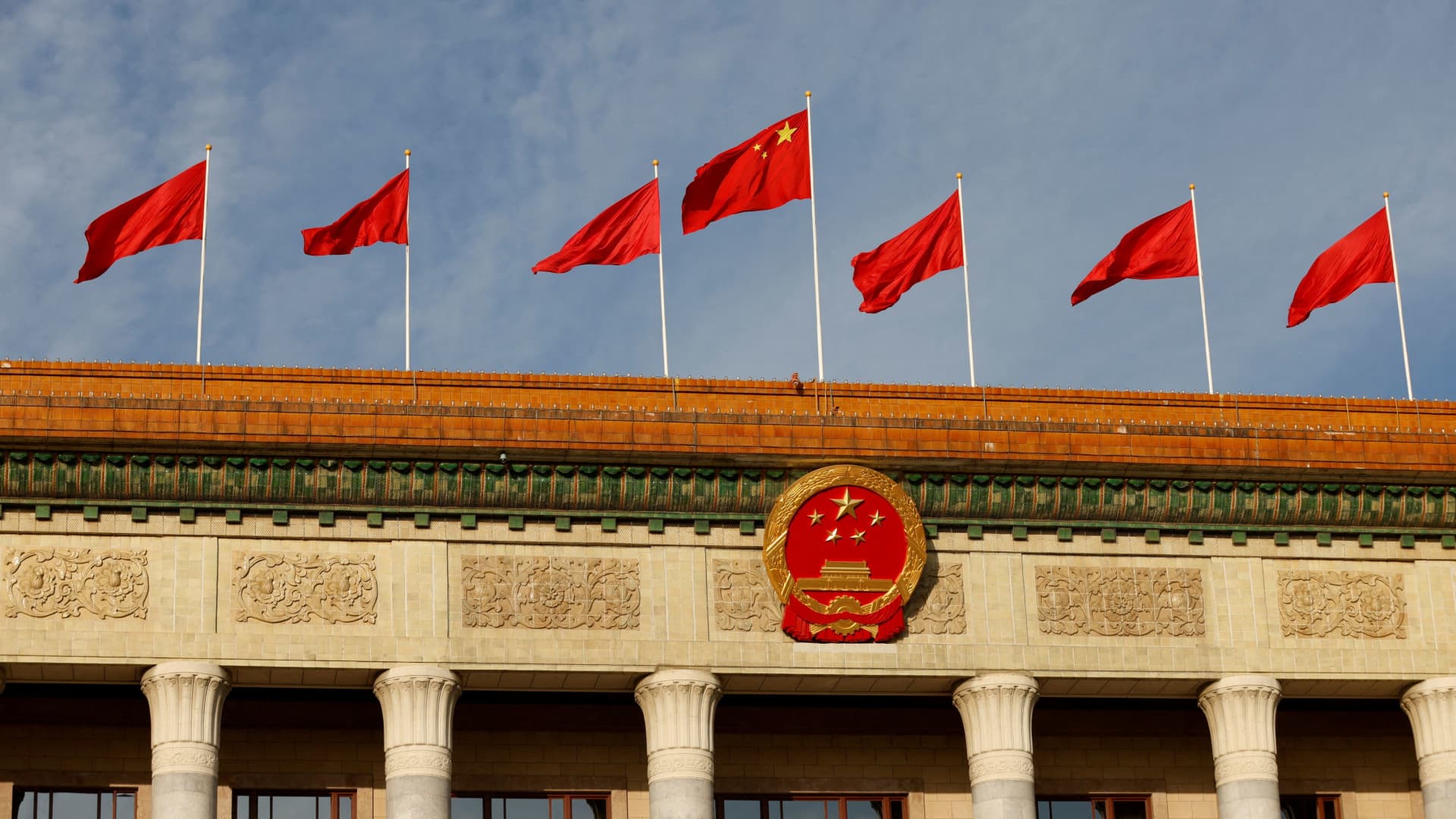
A Chinese flag flutters on top of the Great Hall of the People ahead of the opening ceremony of the Belt and Road Forum (BRF), to mark 10th anniversary of the Belt and Road Initiative, in Beijing, China October 18, 2023.
Edgar Su | Reuters
BEIJING — China has accused other G20 nations of “promoting protectionism,” after they criticized economies that rely heavily on exports.
U.S. Treasury Secretary Scott Bessent on Tuesday said 19 of the G20 members agreed to address the “unsustainable equilibrium” resulting from a “stream of cheap exports.” China was the only G20 member to dissent from a joint statement over references to such “imbalances.”
The Commerce Ministry on Thursday pushed back on trade complaints from the U.S. and Europe, calling them “an excuse to pressure and restrict China.”
“China believes that taking advantage of the G20 and other multilateral mechanisms to hype up so-called ‘economic imbalances’ and ‘overcapacity’ is essentially promoting protectionism,” Ling Huang, Commerce Ministry spokesperson, said in Chinese, translated by CNBC.
“China is firmly opposed,” she said during a weekly press conference. “This will only disrupt the global economic and trade order, and harm the healthy development of the global economy.”
The words come amid a flurry of different multilateral meetings and growing anticipation for Chinese President Xi Jinping’s trip to Washington, D.C. later this month.
When asked by CNBC about the latest U.S. anti-Iran sanctions, which can extend beyond Iranian entities to foreign companies or individuals accused of helping Iran, Huang said the U.S. should “immediately correct its wrong practices and lift sanctions against relevant Chinese companies and citizens.”
“Despite repeated requests from China, the U.S. has used Iran as an excuse for repeatedly imposing sanctions on Chinese companies and citizens, to which China is strongly dissatisfied and firmly opposes,” she said.
Early last week, Bessent announced that any entity, including Chinese banks, that facilitates money laundering or sanctions evasion on behalf of Iran could be cut off from the U.S. financial system.
Huang on Thursday also urged France to halt implementation of a new law aimed at curbing the low prices charged by Chinese e-commerce companies such as Temu.
“If France persists in its course of action, China will take necessary measures to safeguard the legitimate rights and interests of Chinese enterprises, and France will bear all consequences,” she said.
China and the European Union more broadly have also been engaged in trade talks this summer as Europe wants to reduce its record trade deficit with China by October. EU Trade Commissioner Maroš Šefčovič warned in an interview with Euronews this week that Beijing must deliver “concrete results” by October or face “harsher measures.”
Huang said China is willing to work with the EU, but said demands should not be made unilaterally, and threats should not be made to close markets.


Student loan real-world asset (RWA) protocol Pencil Finance completed a $1 million onchain student loan cycle, offering financing to thousands of students in Southeast Asia who were underserved by traditional lenders.
Pencil said it completed its first fully onchain student loan cycle on the blockchain, where the platform deployed $1 million in capital as a lender that was repaid by borrowers to the bundle’s funders with yield, the company revealed in a Thursday announcement shared with Cointelegraph.
The bundle was funded in July 2025 by Animoca Brands, Open Campus and New Campus, structured as a senior tranche with fixed returns and a junior tranche with variable returns and first-loss risk.
The $1 million onchain loan cycle offered financing to about 6,600 students across 118 schools and universities in Southeast Asia. Pencil Finance claims this is the first-ever fully onchain lending cycle financing student loans transparently recorded on the blockchain network.
Of the 6,600 students, about 1,050 received direct funding. Pencil said the loans were designed for students underserved by traditional lenders, with 50% female borrowers and 93% stemming from lower-income households.
Tokenized RWAs are increasingly being used to issue or collateralize loans.
In July, Brazil’s B3 stock exchange issued a 100,000 Brazilian reais ($19,600) loan secured by 10 tokenized cows as collateral, where each cow received a unique digital token linked to an encrypted digital identity, while AI-powered smart collars from agriculture tech company Cowmed monitored each animal’s health.
Related: Standard Chartered launches spot Bitcoin and Ether trading in UAE
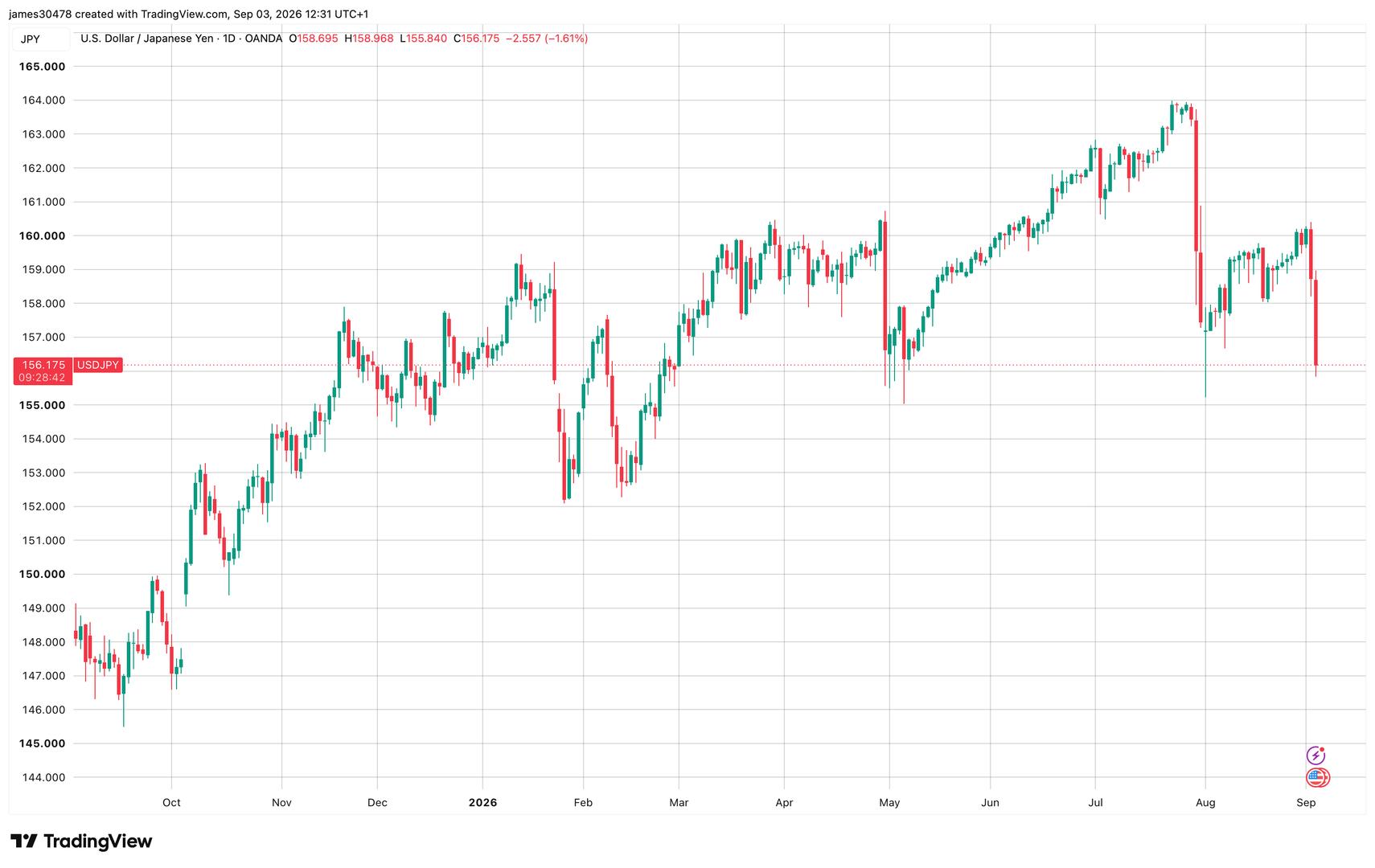
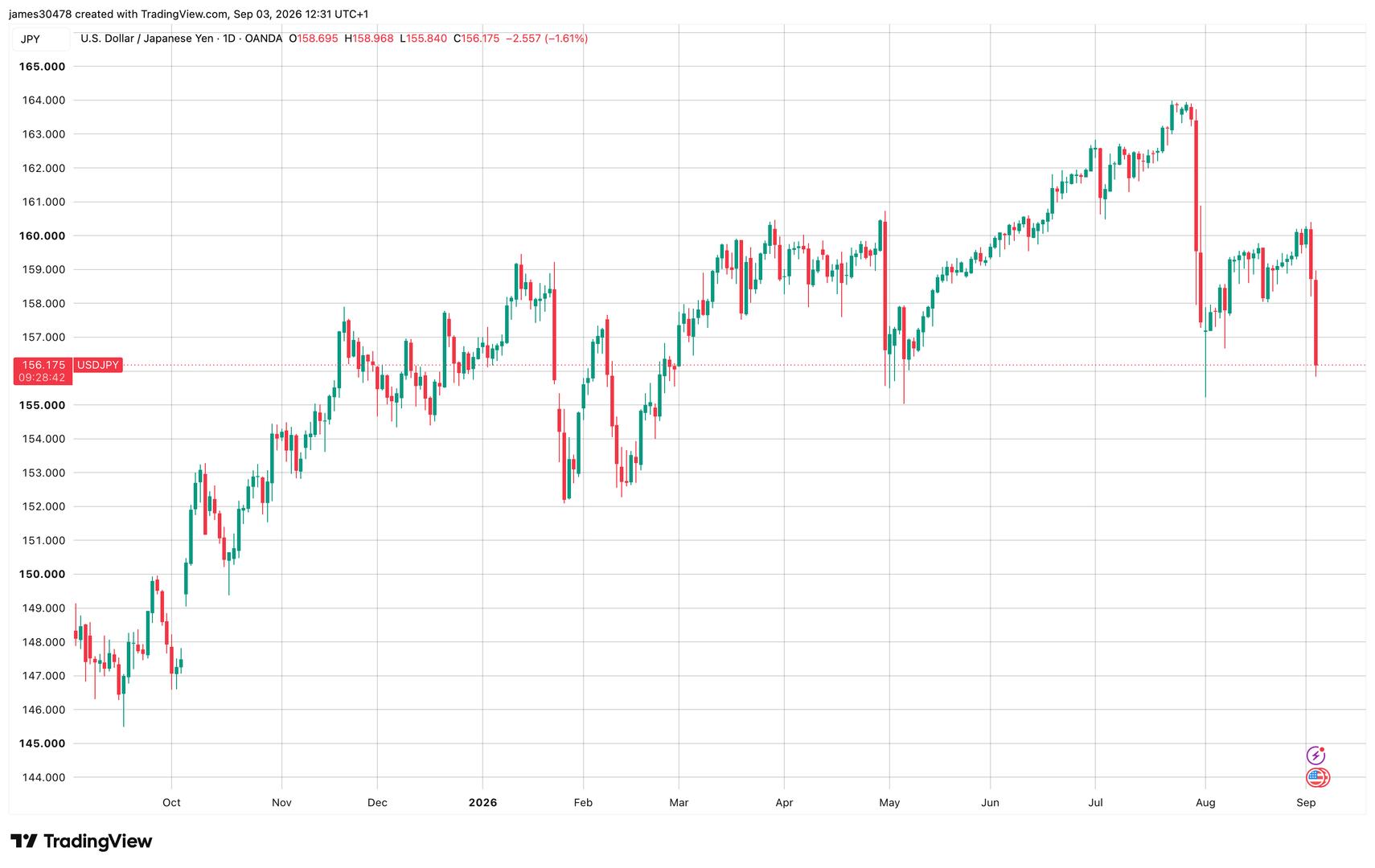
Yen’s rise has led to a broad-based USD weakness, driving the Dollar Index lower. BTC and gold are loving it, for now.
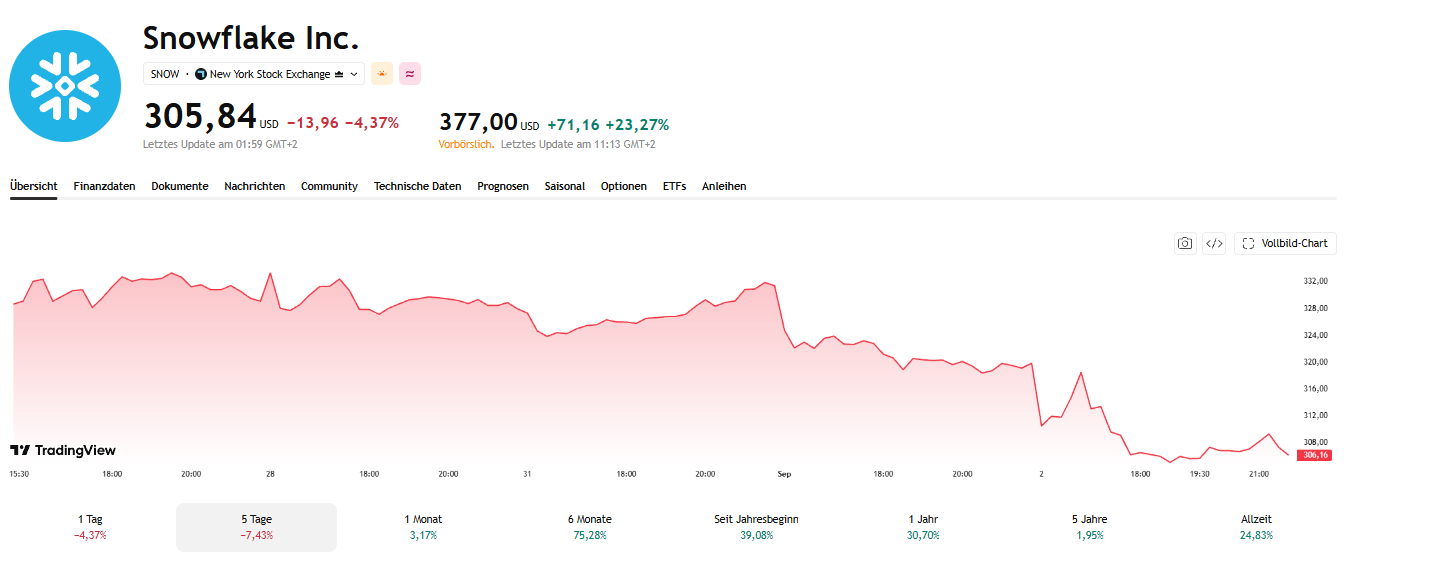
Jim Cramer expects a huge move in Snowflake stock after a blowout quarter. Broadcom earned a far more cautious verdict.
The CNBC host weighed in after both companies reported. Snowflake and Broadcom both cleared estimates, yet only one drew unqualified praise in the artificial intelligence (AI) trade.
Jim Cramer Snowflake Verdict Follows a Blowout Quarter
Snowflake reported product revenue of $1.49 billion for its fiscal second quarter, up 37% from a year earlier. Adjusted earnings hit $0.62 per share.
Management lifted full-year product revenue guidance to $6.07 billion. Shares jumped 23.27% to $377.00 in pre-market trading from Wednesday’s $305.84 close.
The stock had slid 7.4% over the five sessions into the report.
Cramer flagged the valuation in the same breath as the beat. He called it the cleanest way for hesitant enterprises to buy compute on demand.
His enthusiasm marks a shift. Last week, he praised Marvell’s quarter yet warned that its price had already run too far.

Broadcom Triples AI Revenue Yet Wall Street Hesitates
Broadcom delivered $16.7 billion in AI semiconductor revenue, a 221% jump. Total revenue rose 86% to $29.6 billion, and adjusted earnings reached $3.32 per share.
Chief Executive Hock Tan guided fourth-quarter AI sales to $21.7 billion. He has secured a supply to roughly double AI revenue to about $115 billion in fiscal 2027.
Tan flagged a path toward $230 billion in fiscal 2028. Investors still balked.
Cramer welcomed the raises, then hedged.
Hock giving you some nice raises for next year and the year after. That’s what we have been looking for. Maybe i am too hopeful… Small position for the trust…
Jim Cramer, post
The trust is his CNBC Investing Club portfolio.
Total fourth-quarter guidance of $34.8 billion landed just under consensus. The stock slipped 2.58% to $357.76 in pre-market trading, extending a 4.5% monthly decline.

Analyst forecasts before earnings were already skewed heavily bullish, leaving little room for surprise.
AMD’s post-earnings selloff in August showed how fast strong chip numbers can disappoint.
Cramer’s split verdict leaves one clear test. Snowflake has to turn AI demand into margin, while Broadcom has to prove Tan’s 2028 math.
The post Jim Cramer's Says This Stock Is Primed for a “Huge Move” appeared first on BeInCrypto.
Your day-ahead look for Sept. 3, 2026
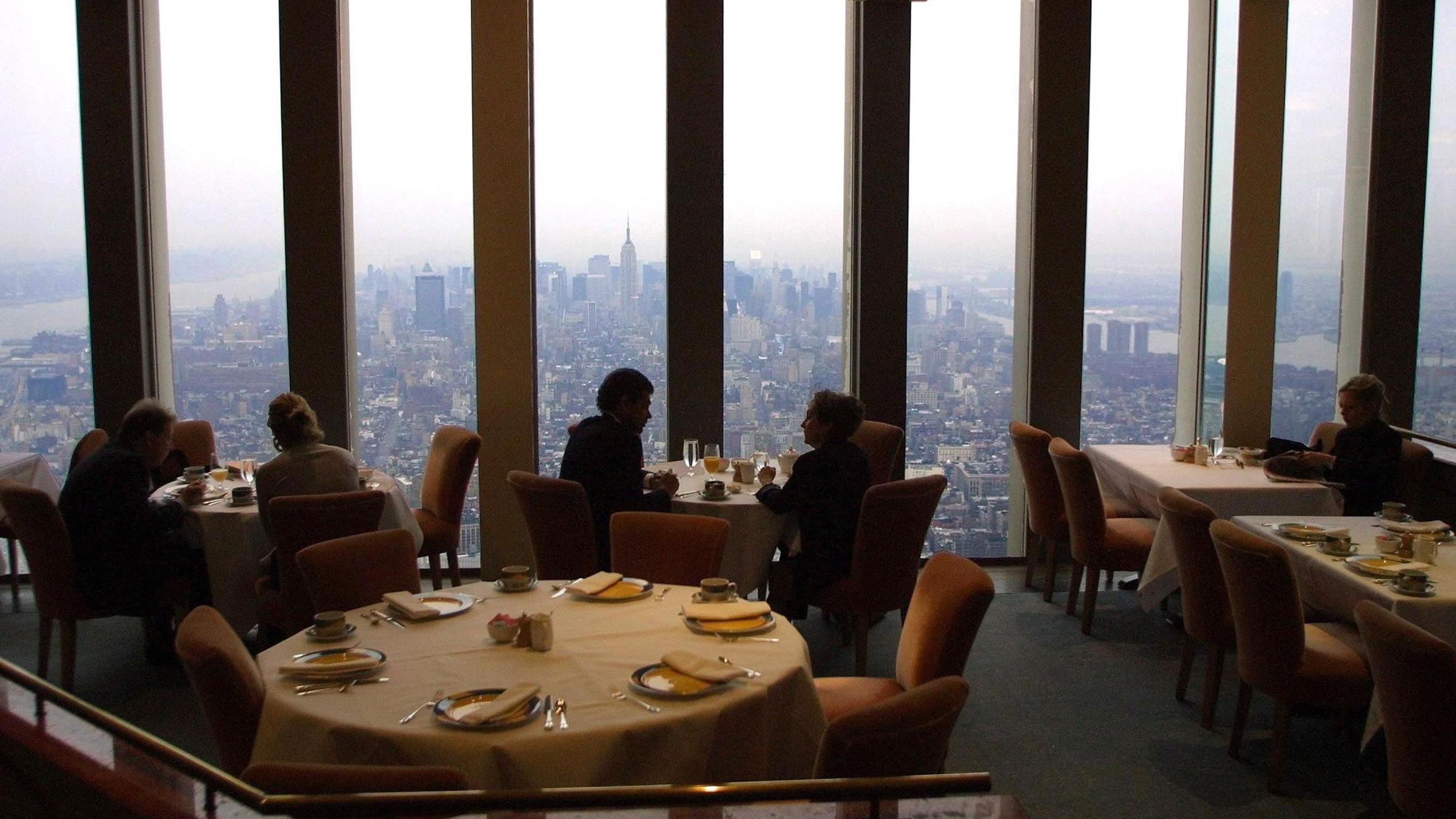
“The memories are so vivid,” says Lomonaco, who helped start a fund for the families of his staff and who has gone on to run several successful restaurants in the city. “A generation has grown up since then, but it still seems like yesterday to me.”
A 25th anniversary marks a swath of time that can be illuminating because, to someone who is younger than 30, it feels like an eternity. Or a lifetime, which to someone who actually is 25, it is. But to someone who is over 50, as I am, it feels like a chapter. A long one, perhaps. But, still, a part of something else.
9/11 is a hinge of time that separates generations. It shouldn’t be surprising—but it always is—when I ask young folks about 9/11, and they just can’t get their hearts around it. It’s something that they learned about in class or saw on YouTube. They don’t feel it like I do. Like we do.
Those of us who are moved by this anniversary—no matter how close we were to the actual tragedy—should find some way to talk about it. “We have an obligation,” Lomonaco says. “When we talk about the people who died, we’re acknowledging the significance of their lives.”

Once You Get Money, Upgrade These 10 Things ASAP

I went to cheapest charity shop in Manchester and found bargain worth hundreds

Anker’s New SleepLab Pro Uses Bedside Radar To Track Your Sleep Without Any Wearable Device First Look





-

 Fashion6 days ago
Weekend Open Thread: Maeve – Corporette.com
-

 Crypto World7 days ago
Bitcoin’s 22% rally now needs real demand to outlast Treasury liquidity boost
-

 Business7 days ago
Apple Confirms September 9 Keynote and Reveals Its Full Pre-Order Schedule
-

 Crypto World12 hours ago
CLARITY Act could advance within weeks, Atkins says
-

 Business6 days ago
Salesforce Stock Soars 19% as Blowout Earnings and Agentforce AI Growth Silence Software Skeptics
-

 Business5 days ago
Onto Innovation Stock: AI’s Next Bottleneck Is Yield (NYSE:ONTO)
-

 Crypto World5 days ago
Bitcoin price tests $82K resistance as Brandt stays long
-
 Tech5 days ago
Hugging Face built a $4.5 billion empire on free AI models. Now Nvidia is buying it for $12.9 billion
-

 Business6 days ago
iPhone 18 Pro Pre-Orders Could Shift to Saturday as Apple Reportedly Avoids September 11 Anniversary
-

 Crypto World6 days ago
Truflation calls for Fed rate cut after PCE forecast
-

 News Videos4 days ago
Charlie Munger on Robinhood: No one should believe that Robinhood’s trades are free
-

 Tech5 days ago
PaperCut releases second emergency patch for exploited flaws
-

 Crypto World1 day ago
Elon Musk Says Grok 4.7 Lands in 10 Days and Will Beat Every Model
-

 Tech6 days ago
The fix for the AI agent that hijacked a company’s DNS: it can propose the change, but it can’t approve it
-
 Entertainment6 days ago
‘Adults’ Creators Break Down Season 2’s Most Shocking Moments and Tease a Potential Season 3
-

 Tech5 days ago
Tamagotchi Ring Takes the 30-Year Digital Pet and Places it on Your Finger
-

 Tech4 days ago
As the influencer economy drives retail sales, Seattle startup raises $22M to play matchmaker
-
 Crypto World1 day ago
Bitcoin slips below $77.5K as macro pressure offsets ETF inflows
-
 NewsBeat4 days ago
Trump posts AI video of ‘Lake America’ being protected by an army of bequiffed ‘Donald Ducks’
-
 Entertainment4 days ago
Taylor Swift Reportedly ‘Frustrated’ With Travis Kelce After ‘Short’ Honeymoon
You must be logged in to post a comment Login