

Crypto World
Uniswap API Captures Over Half of MetaMask Swaps on Ethereum Mainnet


TLDR:
- Uniswap API won 52.4% of 554,137 MetaMask swaps over 99 days, beating all rivals combined by count
- The API recorded the lowest median slippage of 0.21–0.88 bps and a 0.12% failure rate across all providers
- OKX’s volume lead of 25.3% stemmed from whale concentration, with one signer routing $42.6M in six trades
- Excluding top 100 wallets per provider, Uniswap led adjusted volume at 32.9%, ahead of Kyber and 1inch v6
The Uniswap API has emerged as the dominant routing provider inside MetaMask’s swap architecture on Ethereum mainnet.
An independent researcher identified as Vaish analyzed 554,137 successful swaps over 99 days, totaling $567.8 million in volume.
The study found the Uniswap API won 52.4% of all routed transactions by count. That figure exceeds every competing provider combined, raising questions about how AMM-based routing holds its ground against RFQ desks.
Uniswap API Leads on Transaction Count and Execution Quality
MetaMask operates a multi-provider swap architecture where each trade request goes out to roughly a dozen routing providers simultaneously.
The platform selects the best quote net of fees and presents it to the user. Since Uniswap’s API integration in March 2026, it has consistently won more of those head-to-head quote competitions than any rival.
Realized execution data backs the routing outcome. Vaish’s study measured slippage as the deviation between a user’s actual fill and the on-chain mid-price at execution time.
The Uniswap API posted the lowest median slippage across all five trade-size buckets, ranging from 0.21 to 0.88 basis points. Competitors recorded medians between 1 and 27 basis points.
Vaish summarized the finding directly: “Among the hundreds of thousands of ordinary users whose wallet shops their order across a dozen providers, Uniswap is the routing outcome more often than every competitor combined, and the settled trades justify the routing.”
The Uniswap API also recorded a failure rate of just 0.12%, the lowest among all major providers. Competing platforms ran failure rates between 0.27% and 0.64%.
At MetaMask’s transaction volume, that gap translates to thousands of avoided failed swaps and their associated gas costs.
The routing advantage held across pair types, gas conditions, and times of day, with transaction share staying between 52% and 55% in every UTC hour.
OKX Volume Lead Tied to Whale Concentration, Not Broad User Demand
By raw dollar volume, OKX led the dataset at 25.3%, compared to Uniswap’s 21.3%. However, the researcher found that figure came from extreme wallet concentration. OKX’s $143.8 million in volume originated from just 13,850 wallets, with the top 10 accounting for 48% of it.
A single intermediary contract operated by one signer sent $42.6 million through OKX across just six transactions. That entity alone represented roughly 30% of OKX’s total volume in the study period.
On this distinction, Vaish was direct: “Routing share by transaction count is a tally of independent quote competitions, one per user decision. Routing share by raw volume is that same tally reweighted by a few large actors.”
Uniswap, by contrast, drew its volume from 134,876 wallets, with only 5.4% concentrated among its top 10. After excluding the top 100 wallets from each provider, Uniswap led the adjusted volume ranking at 32.9%. Kyber followed at 18.2%, with 1inch v6 at 15.7%, OKX at 13.3%, and 0x at 12.9%.
On routes involving five or more legs, OKX captured 43.1% of volume while Uniswap dropped to 4.1%. That split reflects a structural divide: AMM-based routing performs strongest on standard retail trades, while RFQ desks hold an edge on complex, large-ticket routes above $100,000.
The Uniswap API was the only major provider whose share rose consistently under progressive whale exclusion.



Algorand has unveiled a roadmap aimed at making its network resistant to future quantum computing attacks. The plan, discussed by Algorand Foundation technology chief Bruno Martins, targets upgrades to the protocol’s infrastructure by the end of 2027.
The move comes as researchers and security agencies increasingly warn that sufficiently capable quantum computers could eventually undermine today’s widely used cryptographic schemes. While quantum hardware is still in early development, businesses and regulators are already planning for “migration” to quantum-safe cryptography rather than waiting for a break to occur.
Key takeaways
- Algorand says it will pursue broad “quantum resilience” with protocol and cryptographic upgrades scheduled through end-2027.
- The roadmap includes shifting to quantum-resistant signatures based on Falcon for new accounts involved in consensus.
- Algorand also plans to update parts of its consensus design that currently rely on cryptography it says is not quantum-resistant.
- The network is considering migration approaches such as a “hybrid mix” of classical and quantum-resistant signatures.
- The announcement adds to a growing list of crypto and government efforts to prepare for quantum-era cryptography timelines.
Algorand targets quantum upgrades by end-2027
In remarks posted Thursday, Bruno Martins said the foundation has been researching the quantum threat for several years and is now formalizing an infrastructure update path. According to Martins, governments, standards bodies, and security experts are already planning for a world where quantum computers could break cryptographic systems that protect modern digital infrastructure.
Algorand’s approach focuses on ensuring that the network can keep operating securely as the cryptographic assumptions underpinning current systems become obsolete. The project frames the roadmap as a way to prevent quantum-enabled attackers from exploiting weaknesses in how blockchain participants authenticate and how the network reaches agreement.
Falcon signatures and changes to consensus cryptography
A central part of Algorand’s plan is a shift toward quantum-resistant digital signatures. Martins said the roadmap includes introducing new accounts that use Falcon, a signature scheme designed for post-quantum cryptography.
Algorand also intends to update its consensus mechanism, noting that its current cryptography is not quantum-resistant. In addition, the network will revise how accounts involved in consensus operate, alongside research into possible transition strategies.
One of the options under exploration is a “hybrid mix” that combines classic signatures with quantum-resistant ones—an acknowledgement that migrations in distributed systems often require careful coordination rather than a single abrupt switch.
Why this matters as “migration deadlines” spread
Algorand’s announcement lands amid heightened concern across the crypto market. Quantum computing is expected to be vastly more powerful than today’s supercomputers, but it is still early enough that practical “break crypto” scenarios remain uncertain. Even so, multiple efforts are underway to reduce the risk of being caught unprepared.
Earlier coverage highlighted that Google researchers, in a March paper, suggested quantum computers may need fewer resources than previously estimated to compromise certain cryptographic protections used by blockchains. That same paper pointed to Algorand as likely among the most quantum-ready networks, while also noting that Ethereum and Solana are exploring preparations.
Beyond crypto, governments have been setting expectations for quantum-resistant upgrades. The French cybersecurity agency ANSSI said it will stop certifying security products that do not include quantum-resistant encryption, aiming to push businesses toward quantum-safe systems by 2030. In the United States, the NSA has required new national security systems to use its quantum-resistant algorithms starting Jan. 1, 2027, with non-quantum-resistant systems expected to be phased out by end-2030.
Meanwhile, Google has reportedly set an internal readiness deadline of 2029, citing the pace of progress in quantum computing hardware and error correction. While these deadlines are not directly comparable across organizations, they underline the same core logic: once quantum capabilities grow, timelines for migration may not be long enough to handle complex security changes later.
Quantum readiness is becoming a competitive network feature
Algorand is not alone in addressing quantum risk. Tezos has launched a prototype blockchain for quantum-resistant private payments, while Circle has released a roadmap aimed at making its Arc blockchain quantum-ready. Academic research also continues to explore whether a functional quantum computer might require fewer resources than originally believed, with some scenarios suggesting deployment could occur before 2030.
What distinguishes Algorand’s plan is its focus on both authentication and consensus mechanics. Many “quantum-safe” efforts start at the cryptographic layer—upgrading signatures or encryption—yet blockchain security depends on a broader set of protocol assumptions. By highlighting consensus updates and considering transitional methods such as hybrid signature approaches, the roadmap emphasizes that quantum resilience is not just about swapping algorithms, but about maintaining safe system behavior throughout the transition.
Looking ahead, market participants will likely watch for how Algorand phases these changes from research into implementation, including whether the network targets staged activation milestones beyond the end-2027 timeline. Just as importantly, readers should monitor how closely other major protocols align their migration strategies, since the risk posed by quantum advances will depend not only on theoretical capability, but on how quickly systems can evolve without disrupting users and validators.


The U.S. Commodity Futures Trading Commission (CFTC) has settled its enforcement action against Celsius Network founder Alex Mashinsky.
Summary
- CFTC’s order bans Mashinsky from regulated trading and registration after Celsius customer fraud claims ended.
- The settlement closes the CFTC’s first enforcement case against a digital asset lending platform operator.
- Mashinsky still faces SEC allegations while challenging his 12-year criminal sentence in federal court filings.
A federal court consent order permanently bans him from trading in markets overseen by the agency. It also bars him from registering with the CFTC.
The order ends the CFTC case filed in July 2023 against Mashinsky and Celsius. The agency said the action was its first case against a digital asset lending platform. Celsius had already settled with the regulator, leaving Mashinsky as the final defendant in the matter.
The ban covers commodities, futures, and derivatives markets under CFTC oversight. It gives the regulator a final court order against the former Celsius chief, who once promoted the company as a safer way for customers to earn yield on crypto deposits.
Regulator cites customer fraud claims
The CFTC said Mashinsky and Celsius misled customers about the safety, profits, and legal status of the company’s crypto lending business. The agency alleged that they ran a “scheme to defraud” hundreds of thousands of customers while promoting Celsius as a safe place for digital assets.
According to the regulator, Celsius pooled customer crypto and used the assets to seek returns for weekly interest payments. The CFTC alleged that the firm took growing risks, including uncollateralized loans and risky decentralized finance deals, while telling customers their assets were safe.
The regulator said Celsius received about $20 billion in funds during the period covered by the case. Celsius later filed for bankruptcy after heavy losses and a freeze on customer withdrawals. The collapse became one of the main crypto lending failures of 2022.
Other legal cases still matter
Mashinsky is already serving a 12-year prison sentence. In May 2025, a federal judge sentenced him after he pleaded guilty to commodities fraud and securities fraud. The court also ordered a $50,000 fine and forfeiture of more than $48 million tied to the criminal case.
The CFTC settlement follows an April 2026 Federal Trade Commission order that barred Mashinsky from promoting or offering services tied to deposits, exchanges, investments, or withdrawals of assets. That order included a $4.72 billion judgment, though most of it remains suspended if he meets payment and disclosure terms.
Celsius-related recoveries have also continued through the bankruptcy process. As crypto.news reported in August 2025, Celsius began a third creditor distribution worth $220.6 million, bringing recoveries to 64.9% of creditor claims.
SEC action remains open
Mashinsky still faces a civil case from the Securities and Exchange Commission. The SEC accused him and Celsius of unregistered securities offerings, false statements about the company, and manipulation of the Celsius token. The agency has also sought limits on his future activity in crypto asset securities.
The latest CFTC order closes one more part of the legal fallout from Celsius’s 2022 collapse, but it does not end every case tied to Mashinsky. He has asked a federal court to vacate his prison sentence. His filings blamed former FTX chief Sam Bankman-Fried for CEL token manipulation and claimed problems with his legal defense.
A court has ordered prosecutors to respond to that request by mid-August. Until then, the CFTC settlement stands as the permanent market ban against Mashinsky, adding to bars from crypto and asset-related services.

Ireland has released a national risk assessment on digital assets for the first time in seven years, detailing “very significant” concerns around money laundering and terrorism financing while also warning that crypto can be attractive to fraudsters and may help criminals evade sanctions.
The assessment, published by the Irish Department of Finance as part of the government’s policy priorities, comes as Ireland moves toward implementing industry standards on how crypto-related activities are accepted as a source of funds by the second half of 2027.
Key takeaways
- Ireland’s 2026 national risk assessment describes crypto assets as posing “very significant” risks for money laundering and terrorism financing.
- The government cites increased enforcement pressure, including more prosecutions related to money laundering and fraud incidents in which the use of crypto is “particularly attractive” to criminals.
- The report flags vulnerabilities beyond illicit finance, including potential sanctions evasion and difficulties in tax compliance and enforcement.
- Ireland highlights regulatory inconsistency internationally as a risk for Irish service providers, alongside gaps in oversight for largely unregulated areas such as decentralized finance.
- Political donation concerns remain part of the picture, even as Ireland has already prohibited cryptocurrency donations to political parties for more than four years.
Seven-year gap and a sharper focus on illicit finance
In the risk assessment released Thursday, Ireland said crypto-related activity presents “very significant” risks connected to money laundering and terrorism financing. The Department of Finance framed the assessment as a response to the evolving threat landscape, pointing to higher levels of legal and criminal activity involving digital assets since the last time such a country-specific evaluation was published.
According to the Department of Finance, the period since the previous assessment has included an increase in prosecutions tied to money laundering, along with incidents of fraud where crypto was “particularly attractive” to criminal groups. The government also described how digital assets can be leveraged to exploit compliance and enforcement weaknesses.
Beyond money laundering: sanctions, taxation, and bribery
Ireland’s assessment did not limit itself to illicit finance channels alone. It also warned that crypto assets present vulnerabilities that “may facilitate sanctions evasion.” In parallel, the government highlighted challenges for tax compliance and enforcement, suggesting that the way crypto is used can complicate oversight and detection.
The report further notes risks associated with corruption. Ireland stated that crypto has been used to bribe officials involved in decisions affecting the sector. While the assessment describes vulnerabilities broadly across criminal use cases, it also emphasizes how administrative and regulatory roles can be exploited when oversight is weak or fragmented.
Regulatory patchwork and uneven protections
A central theme in the assessment is the uneven regulatory environment around crypto. Ireland pointed to “inconsistent international regulation” as a vulnerability affecting Irish service providers, implying that companies operating in Ireland may face risks not only from domestic enforcement but also from cross-border standards and gaps.
The government also singled out parts of the ecosystem that remain comparatively less regulated. The risk assessment highlights “largely unregulated areas of the industry such as decentralized finance,” indicating concern that oversight and controls may not be aligned with the same expectations applied to more traditional financial intermediaries.
Ireland’s approach is notable given its relatively high crypto participation compared with some other markets. The report references research from the Central Bank of Ireland published in December, which said about 10% of the population invested in crypto.
Where policy is heading: standards by 2027 and ongoing enforcement
Ireland’s assessment was issued alongside a wider policy direction tied to implementing industry standards relating to the acceptance of crypto-related activities as a source of funds, with a target of the second half of 2027. The framing suggests the government wants to reduce ambiguity around how crypto can be treated within the financial compliance system—particularly in contexts tied to anti-money laundering and related safeguards.
Recent enforcement actions in the country also underscore that the issue is not purely theoretical. In November 2025, the Central Bank of Ireland fined Coinbase Europe Limited about $24 million for Anti-Money Laundering and Countering the Financing of Terrorism violations, citing delayed reporting failures in its transaction monitoring system.
On the political side, the assessment references that concerns about crypto being used to pay corrupt officials are persistent—yet Ireland has already moved to restrict political donations. According to the risk assessment, official cryptocurrency donations to political groups have been banned in Ireland for more than four years. In April 2022, Irish officials proposed that no Irish political parties be allowed to accept cryptocurrencies such as Bitcoin, Ether, privacy coins, and others.
What to watch next
With Ireland targeting implementation of relevant standards by mid-to-late 2027, the immediate question for users, exchanges, and service providers will be how quickly regulatory expectations tighten around acceptance of crypto-related funds, compliance controls, and oversight of riskier parts of the ecosystem. Readers should also monitor how Ireland’s “very significant” risk framing translates into concrete supervisory actions and guidance over the next reporting cycle.
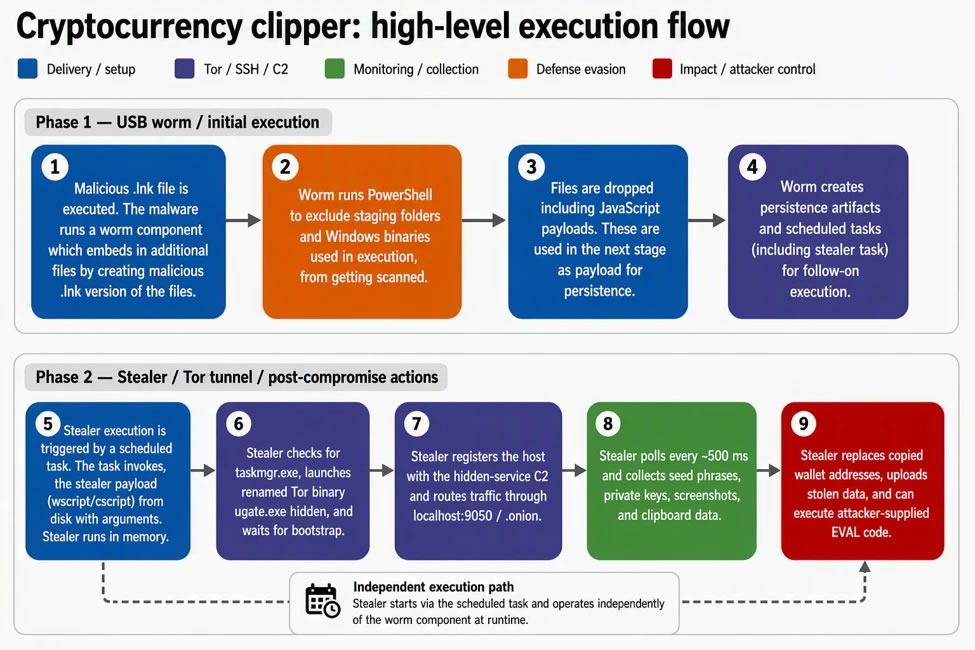
Microsoft Threat Intelligence is warning Windows users about a cryptocurrency clipper strain of malware transmitted via USB drives.
The malware, which has been affecting users since February, steals clipboard data to extract wallet credentials using “high-frequency clipboard theft, screenshot exfiltration, and wallet-address substitution,” Microsoft said Wednesday.
The crypto clipper also hides legitimate files and replaces them with lookalike shortcuts, so victims unknowingly execute malware while a worm component propagates automatically to USB storage devices.
This malware is insidious because it’s more than just an info stealer, it functions as a backdoor, meaning that attackers can push and execute arbitrary code on infected machines at any time, turning a simple crypto theft into a persistent foothold for ransomware.
The execution of this clipper is also notable because it does not depend on a traditional installer or exposed IP-based infrastructure, the Microsoft researchers said.
“This malware family shows how lightweight, script-based stealers can deliver outsized impact when paired with anonymized communications and runtime tasking.”
Tor network used for obfuscation
The malware deploys two obfuscated JavaScript payloads in the Windows Documents directory and creates scheduled tasks for both the worm and stealer components.
The malware also secretly installs a copy of Tor on the victim’s computer but renames it ugate.exe to disguise it as something innocent. It then uses the anonymizing Tor network to connect to its malicious operators at hidden “onion” addresses.
Related: ‘TrapDoor’ malware targets crypto dev tools in supply chain attack
“The combination of Tor-routed C2, clipboard targeting, screenshot capture and remote code execution gives attackers both immediate monetization paths and continued control over compromised devices,” Microsoft said.
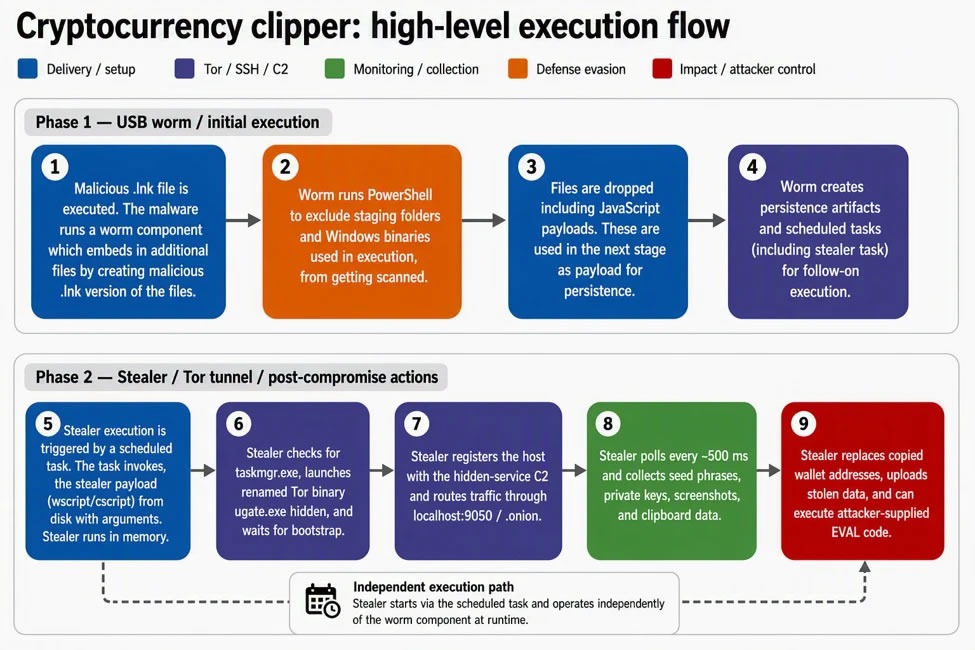
Crypto clipper execution flow. Source: Microsoft
Private keys and seed phrases targeted
The crypto clipper focuses on “high-value financial artifacts” from the clipboard, including BIP39 mnemonic seed phrases and Bitcoin and Ethereum private keys.
It also replaces copied wallet addresses with attacker-controlled ones across Bitcoin, Tron and Monero and takes screenshots every ten seconds for additional context.
Microsoft Defender Antivirus detects the malware as Trojan:Win32/CryptoBandits.A.
Microsoft recommended disabling autoplay on removable media, blocking .lnk execution from USB drives, and monitoring for proxy activity and spawned scripts.
2026 has seen a significant escalation in Windows-based crypto stealers. A new Windows malware strain called Lucid Stealer that targets browser extensions and crypto wallets was identified earlier this month by the Foresiet Threat Intel Team.
Magazine: The end of anon? AI could unmask crypto’s hidden identities


Former Ethereum Foundation contributor Trent Van Epps has warned that Ethereum could face a core development funding gap within the next three to nine months.
Summary
- Van Epps says Ethereum core development may need about $30 million yearly to remain stable.
- He links the pressure to EF spending cuts and the Client Incentive Program’s expiry now.
- Protocol Guild and new institutions are presented as possible routes for future Ethereum support funding.
In a new article, he said the network may enter a “slow-burning funding crisis” as the Foundation reduces spending and a major client funding program ends.
Van Epps worked at the Ethereum Foundation from May 2021 to April 2026. He focused on core development coordination, Protocol Guild funding, and Ethereum’s political economy. His comments add a new layer to debate over who should fund the people who maintain Ethereum’s base software.
He estimated that Ethereum’s core development system needs about $30 million a year to stay healthy. That money supports client teams, researchers, and coordination groups that ship upgrades and keep the network reliable.
Client program expiry raises pressure
Van Epps pointed to two main sources of pressure. One is the Ethereum Foundation’s treasury policy, which aims to cut annual spending from 15% of its treasury to a 5% baseline by 2030. The other is the end of the Client Incentive Program, known as CIP.
The CIP started in 2021 to reward client teams that maintain key Ethereum software. The Ethereum Foundation said at launch that client diversity helps protect the network from bugs and attacks. Under the program, client teams received validator-based rewards that unlocked over time if they kept meeting network needs.
Van Epps said the CIP expired in April 2026 and that no replacement appears ready. He argued that losing steady support could push experienced developers away. He also warned that funding gaps may make it harder to handle long-term work such as scaling and quantum-related security research.
Debate turns to new funding models
The article also questioned the Ethereum Foundation’s long-term role. Van Epps cited Vitalik Buterin’s view that the Foundation was “not designed to be an eternal steward.” He said institutions and funding systems may need to take on more responsibility.
Gabriel Shapiro argued on X that protocol funding may require governance structures that Ethereum does not have. Van Epps replied that his goal was to secure neutral and steady funding for core contributors, not to give one group unchecked control.
As previously reported by crypto.news, Ethereum developers are already preparing major technical work through the Glamsterdam upgrade. That roadmap includes changes for Layer 1 scaling, block building, and gas pricing. The funding debate now puts a sharper focus on the teams expected to deliver that work.
Protocol Guild remains part of the discussion
Protocol Guild is one existing funding path. Gitcoin describes it as a collective fund that supports Ethereum Layer 1 contributors through long-term token vesting. The fund sends donated assets to active contributors and does not set protocol priorities.
Crypto.news earlier reported that the Ethereum Foundation’s Q1 2026 grants supported Geth, Erigon, Lighthouse, validator security tools, cryptography research, and core infrastructure. Those grants show that funding continues, but Van Epps argues that Ethereum needs more durable sources of support.
The warning does not mean Ethereum faces technical failure. It does show growing concern over how the network pays for maintenance and upgrades. For Van Epps, the question is whether Ethereum can fund shared infrastructure without making the Foundation its permanent center.

The Commodity Futures Trading Commission (CFTC) has closed the book on Celsius. A federal court has entered a consent order resolving the agency’s 2023 case against the founder, Alexander Mashinsky.
The order, entered in the Southern District of New York, permanently bars Mashinsky from trading in CFTC-regulated markets and from registering with the agency in any capacity.
What the CFTC Case Against Celsius Covered
This brings closure to CFTC’s enforcement action. Mashinsky is also barred from violating the anti-fraud provisions of the CEA and the agency’s rules.
“The consent order permanently enjoins Mashinsky from further violations of certain anti-fraud provisions in the CEA and CFTC regulations and imposes permanent trading and registration bans against him,” the CFTC said.
The CFTC sued Celsius and Mashinsky in July 2023. Regulators accused the pair of defrauding hundreds of thousands of customers.
“The complaint alleged Celsius was an online platform on which Celsius’ customers would allow Celsius to pool their digital assets and deploy these pooled assets to generate revenue for Celsius, which purportedly would be returned to the customers in the form of weekly interest payments or ‘rewards,” the press release read.
The complaint covered conduct from 2018 through at least June 2022. According to it, Mashinsky marketed Celsius as a safe, bank-like alternative for digital assets.
He promised high-yield interest payments while the platform took on growing risk. Celsius reportedly extended uncollateralized loans and entered risky Decentralized Finance (DeFi) agreements.
Follow us on X to get the latest news as it happens
Bankruptcy, Criminal Charges, and Sentencing
Celsius told users their funds were safe even as losses mounted. The platform later filed for bankruptcy. Celsius’ ultimate collapse episode joined a wave of high-profile cases across the sector.
Mashinsky pleaded guilty to commodities and securities fraud in December 2024. A judge sentenced Mashinsky to 12 years in prison in May 2025. The court also ordered a $50,000 fine and $48.39 million in forfeiture.
Subscribe to our YouTube channel to watch leaders and journalists provide expert insights
The post CFTC Secures Trading Ban Against Jailed Celsius Founder Alex Mashinsky appeared first on BeInCrypto.
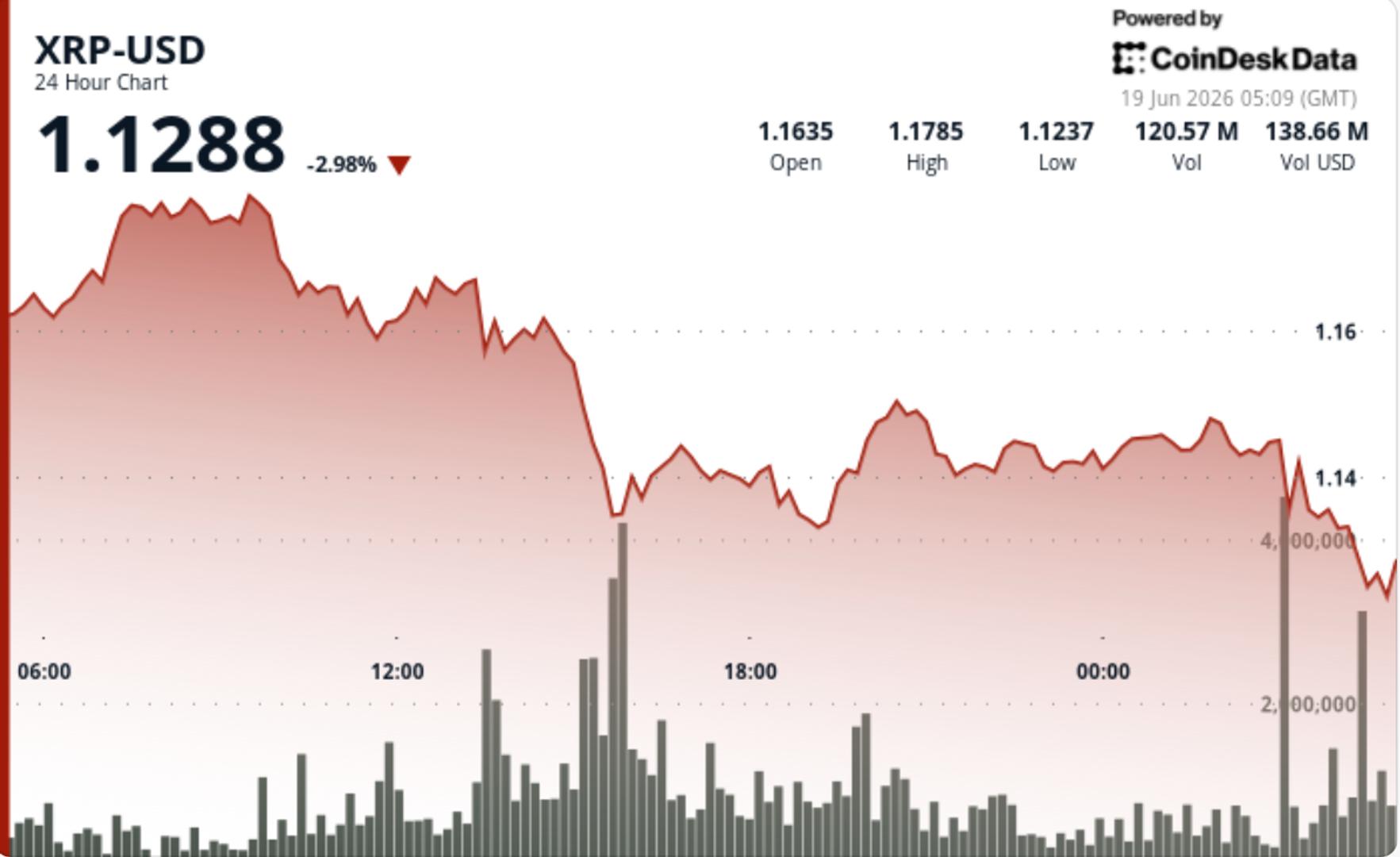
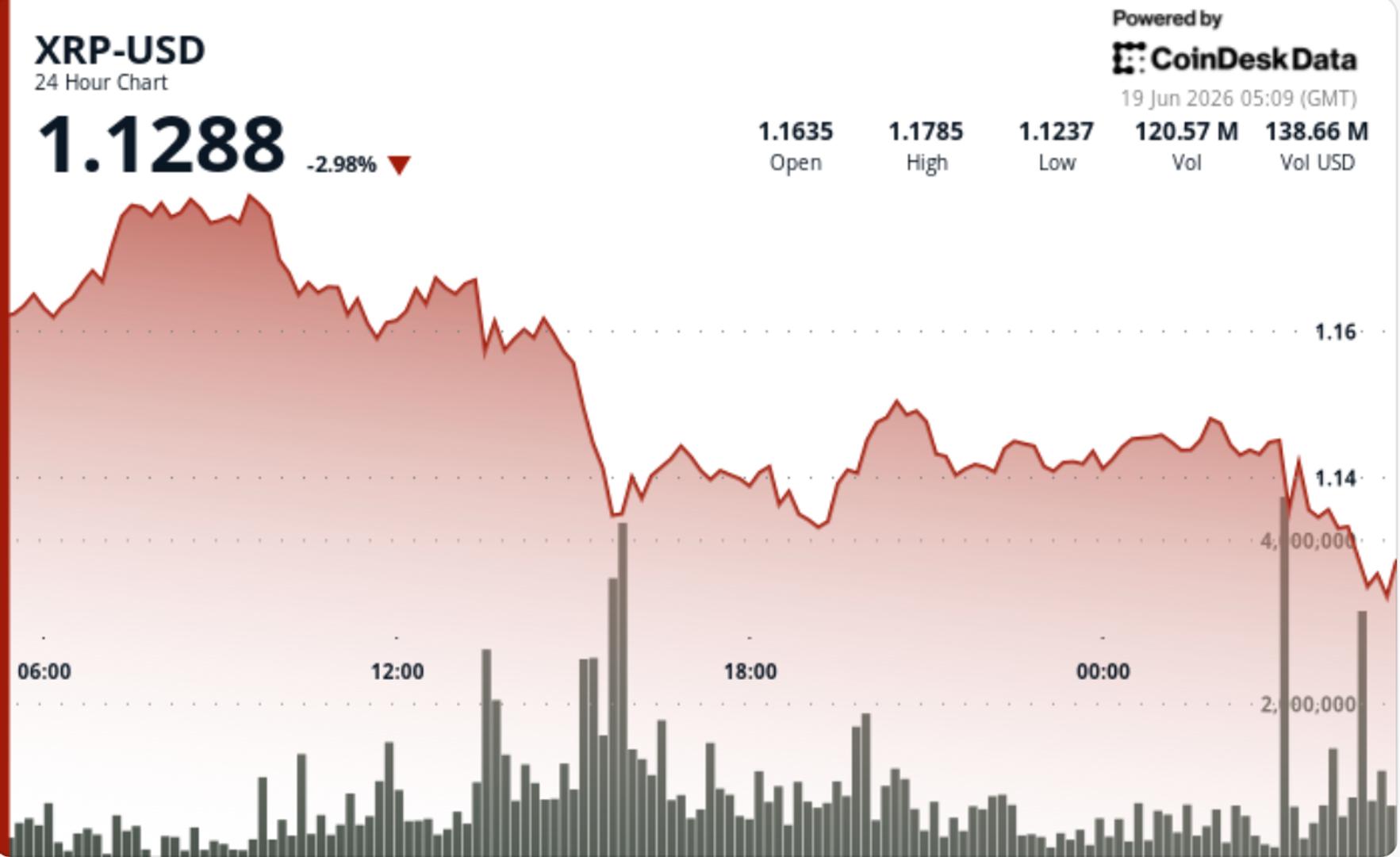
XRP gave back more of last week’s rally on Wednesday after sellers pushed the token through $1.15 support, a level traders had been watching since the recent move above $1.20.
The decline came on some of the session’s heaviest volume and followed another rejection below the descending trendline that has capped every recovery attempt for months.
News Background
• XRP remains caught between growing expectations for U.S. crypto legislation and a market that continues to prioritize technical levels over narrative.
• Traders are also watching the year-long symmetrical triangle that has compressed price action between support near $1.10 and resistance around $1.25.
Price Action Summary
• XRP fell from $1.1873 to $1.1465 during the 24-hour session, losing 3.4%.
• The sharpest selling arrived around 15:00 UTC when volume surged to 134.2 million XRP, roughly 170% above average, breaking support at $1.1550.
• Buyers emerged near $1.13 and helped lift XRP back toward $1.15 into the close, though the rebound failed to reclaim broken support.
Technical Analysis
• The key development was the loss of $1.15. That level had acted as support following last week’s breakout and now risks turning into resistance.

BlackRock’s spot Bitcoin ETF is doing more than simply introducing mainstream investors to crypto, according to Jay Jacobs, the firm’s US head of equity ETFs. In remarks shared with Cointelegraph on its Chain Reaction podcast, Jacobs said that many investors who first buy BlackRock’s iShares Bitcoin Trust (IBIT) go on to explore other traditional exchange-traded funds—suggesting a two-way bridge between Wall Street and digital assets.
Jacobs also highlighted BlackRock’s broader framing of market convergence, arguing that investors increasingly view decentralized finance, active strategies, and traditional index products as components of a single portfolio toolkit rather than as mutually exclusive categories. The comments arrived alongside BlackRock’s launch of a new Bitcoin-income product, the iShares Bitcoin Premium Income ETF (BITA), which generates yield by selling covered call options on Bitcoin holdings.
Key takeaways
- BlackRock says a large share of IBIT buyers are first-time ETF investors, implying Bitcoin has functioned as an entry ramp into the wider ETF market.
- Jacobs described a “two-way” shift: after gaining Bitcoin exposure, many investors also add other BlackRock funds such as S&P 500, AI-themed, and gold ETFs.
- BlackRock launched BITA, a Bitcoin strategy designed to produce income through covered call options on its Bitcoin exposure.
- BlackRock’s Jacobs ties the trend to a broader “Great Convergence,” where TradFi and DeFi are increasingly treated as portfolio building blocks.
Bitcoin ETFs as an ETF “on-ramp”
Jacobs’ central point is that IBIT has attracted investors who may not have previously owned ETFs at all. He told Cointelegraph that “around three-quarters” of investors in iShares Bitcoin Trust have never owned an ETF before, positioning the product as a pathway into the ETF ecosystem rather than a standalone crypto vehicle.
BlackRock launched iShares Bitcoin Trust in January 2024 and has since positioned it as its flagship crypto offering. According to the figures cited in Jacobs’ discussion, the fund manages about $48 billion in assets and holds 765,936 BTC. That scale has helped make Bitcoin exposure accessible through familiar brokerage channels and regulated fund structures.
But Jacobs emphasized that the relationship doesn’t stop at Bitcoin. He characterized IBIT as a starting point for many investors who later diversify within BlackRock’s broader lineup—an outcome that matters for both asset managers and investors because it suggests crypto products can change how capital is allocated across traditional market segments.
Where investors go after IBIT
In Jacobs’ account, once investors acquire Bitcoin exposure through IBIT, many “start buying other BlackRock funds,” including traditional benchmark and thematic ETFs. He pointed to examples such as an S&P 500 fund (IVV), an artificial intelligence-focused product (BAI), and a gold ETF (IAU).
This is a meaningful behavioral signal: it implies that crypto ETF adoption may accelerate familiarity with the wider ETF wrapper, potentially reducing the friction that often keeps investors segmented between “crypto” and “traditional” strategies. For traders and portfolio managers, the practical takeaway is that Bitcoin allocations might increasingly behave like a component of an ETF-managed portfolio rather than a separate, stand-alone bet—especially for investors building through mainstream channels.
For BlackRock, the pattern also supports a broader thesis about distribution and product chaining—crypto launches that can feed into traditional fund demand after the investor base expands.
BITA adds a new angle: covered-call income on Bitcoin
BlackRock introduced its newest Bitcoin-related ETF on Wednesday: the iShares Bitcoin Premium Income ETF (BITA). The product is designed to generate income by selling covered call options against its Bitcoin holdings.
Covered call strategies are commonly used in equity and income-focused ETFs to generate option premium, typically with trade-offs such as potential limits on upside during strong rallies. In the context of Bitcoin, the structure gives investors a different risk-and-return profile compared with pure spot exposure—shifting the objective from simply tracking Bitcoin’s price to adding an income mechanism that can support yield generation across market cycles.
What remains to be seen is how investors will differentiate between IBIT (spot exposure) and BITA (income via covered calls). If Jacobs’ “entry ramp” theory holds, investors who first bought IBIT for access could be the same pool considering additional strategies within the same product family.
BlackRock’s “Great Convergence” thesis
Jacobs connected the investor behavior he described to BlackRock’s “Great Convergence” narrative—an idea that the boundaries separating crypto, decentralized finance, and traditional finance are becoming less relevant. He said historically investors held assets in separate silos, such as DeFi versus TradFi, active funds versus index funds, and private assets versus publicly listed instruments.
In his view, those divisions are fading as investors look for portfolio solutions that can mix approaches. Jacobs suggested the conversation is moving from “versus” framing to “ampersands,” arguing that people are increasingly combining strategies instead of choosing between them.
That perspective aligns with broader industry experimentation around how crypto traders access traditionally unavailable opportunities. The discussion referenced a recent high-profile SpaceX IPO where crypto participants reportedly sought ways to get exposure ahead of TradFi trading. According to the article, this included pre-IPO perpetual futures and tokenized stock offerings.
While Jacobs did not provide a direct performance forecast, the linkage underscores the same theme: crypto market participants are increasingly finding routes into TradFi-style assets and events, while TradFi-style wrappers (like ETFs) are increasingly used to bring crypto exposure into conventional portfolios.
Pre-IPO perps show crypto-to-TradFi demand
The text cited CryptoQuant for data showing that pre-IPO perp trading volumes on crypto exchanges rose sharply—from around $1 billion in early May to roughly $22 billion in the period leading up to the comments. It also noted Binance as the largest venue, based on CryptoQuant’s reporting.
For readers, this matters because it provides a concrete example of investor appetite for TradFi-adjacent exposures, even when the underlying asset (private company shares or early access mechanics) doesn’t map cleanly onto traditional market access. It also illustrates why fund and derivative structures are evolving: investors want access through instruments that match their preferred liquidity and execution environment.
At the same time, these numbers also highlight how quickly activity can concentrate once a new access method spreads across venues. If volume growth continues—or reverses—could influence how exchanges and liquidity providers decide which TradFi-linked products to expand next.
Going forward, investors should watch whether BlackRock’s product roadmap reinforces the same behavioral pattern Jacobs described—Bitcoin as an initial entry, followed by broader ETF participation—and whether covered-call Bitcoin strategies like BITA attract meaningfully different demand compared with spot-focused exposure. The pace of “convergence” will likely be measured less by headlines and more by how frequently new ETF buyers expand into additional traditional allocations.


A hawkish Federal Reserve is bolstering the U.S. dollar, bitcoin ETFs have seen persistent outflows, and Strategy, the largest publicly listed bitcoin holder, faces mounting pressure.
Strategy’s preferred stock, STRC, has plunged to record lows well below its $100 par value, complicating the company’s aggressive bitcoin accumulation strategy.
Arca CIO Jeff Dorman highlighted the precarious situation:”Either sell an enormous amount of BTC and MSTR to help bring $STRC back up near par, and at least buy yourself some time, or continue to watch every part of your cap structure melt because of the uncertainty you’ve created,” he said on X.
As of writing, BTC changed hands near $62,400, down 0.8% since midnight UTC hours, according to CoinDesk data. Prices hit highs near $67,000 early this week.
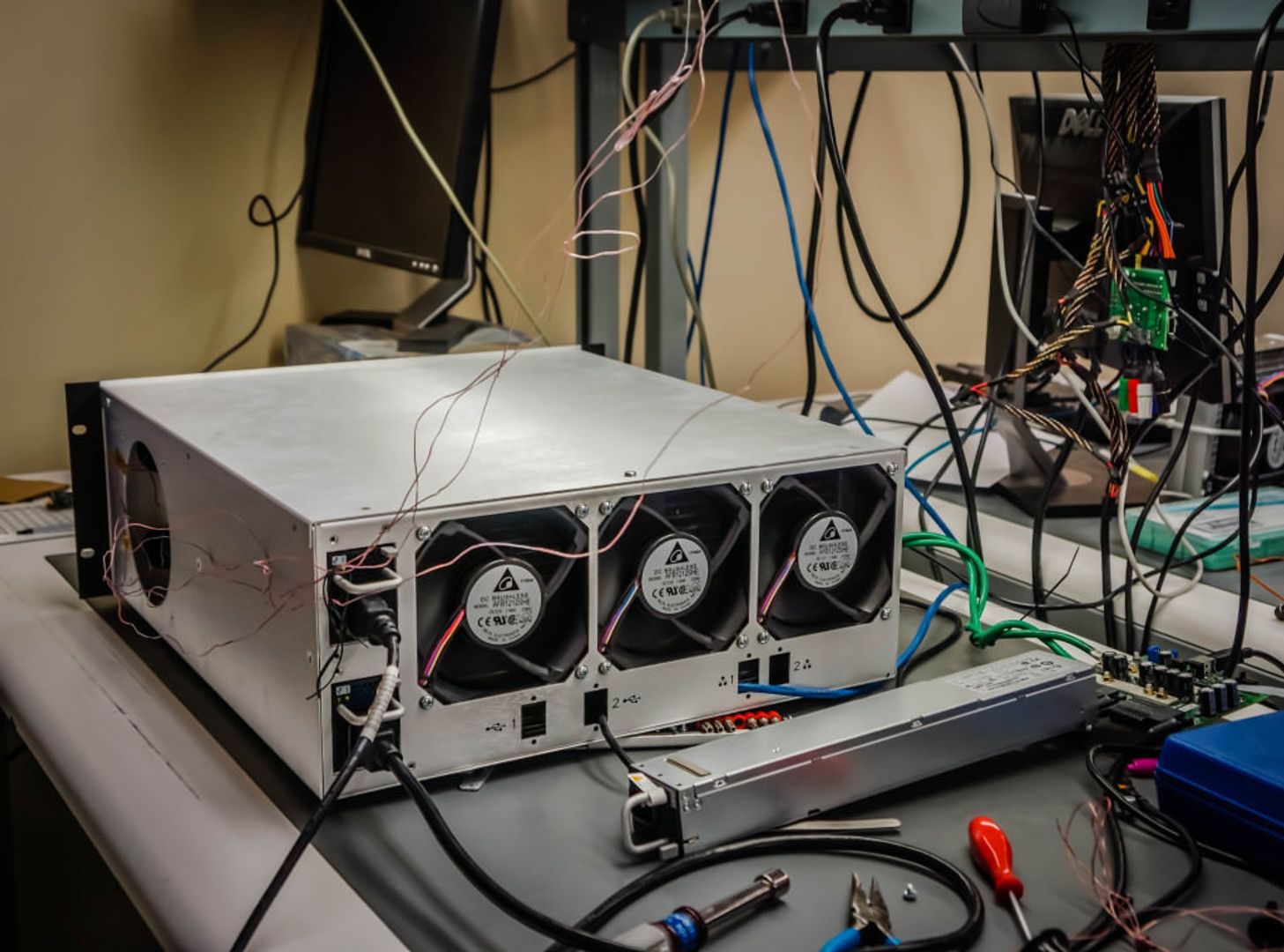
Bitcoin has spent five straight months trading below what it costs to produce, squeezing miners and forcing some to sell, JPMorgan said in a note. The bank pegs the cost to mine one bitcoin at about $78,000, well above the roughly $62,500 the asset fetches now.
The strain is showing and about 20% of miners are now unprofitable, the bank said citing CoinShares data, and publicly traded miners sold more than 32,000 bitcoin in the first quarter to cover operating costs, more than they offloaded in all of 2025.
The network is adjusting on its own. When the price drops below cost, higher-cost miners power down, the hashrate, or total computing power securing the network, falls, and mining difficulty, the automatic setting for how hard it is to mine, resets lower.
That played out in early June, when difficulty dropped 10%, the second decline of that size this year.
Miners are also reacting faster than before. JPMorgan says the sensitivity of difficulty to price has climbed, with more operators sitting near breakeven and flipping machines on or off as prices move. The bank expects larger and more frequent adjustments for as long as bitcoin stays below its production cost.
The outlook is cautious, but JPMorgan flags one upside. The weak sentiment around the sector could itself prove a bullish contrarian signal, echoing the run of accumulation readings, from whale buying to falling exchange reserves, pointing the same way this month.
Doha Dimaond League: Neeraj Chopra eyes fresh start after injury-hit season | Other Sports News

UK orders Google to make search more transparent for businesses

P.Louise confirms Trafford megastore opening date with huge queues expected


-

 Business5 days ago
No Jackpot Winner as $257 Million Prize Rolls Over to $269 Million Monday Draw
-

 Fashion6 days ago
Weekend Open Thread: Tuckernuck – Corporette.com
-
Crypto World4 days ago
Zimbabwe Requires Crypto Businesses to Register Annually Under New FIU Regulations
-

 Crypto World6 days ago
Bitget enters Argentina’s regulated crypto market through PSAV registration
-

 Tech6 days ago
NanoClaw integrates JFrog registries to secure AI agent downloads
-

 Tech7 days ago
This Week In Security: Microsoft On Microsoft, Register Your Domains, Linux On ARM, And FreeBSD Joins The File Cache Club
-

 NewsBeat6 days ago
FBI searches office of Ohio voter registration group
-
 Entertainment4 days ago
Matt Damon’s Viral Sci-Fi Thriller Has Taken Over HBO Max
-

 Business4 days ago
Anthropic staff to meet White House officials next week, Axios reports
-

 Tech5 days ago
As AI companies race to go public, who else is along for the ride?
-
 Crypto World4 days ago
Bitcoin could crash to $48,000, if this historical pattern is triggered
-

 Politics4 days ago
“Israel’s” ban on ICRC visits ruled illegal, but Knesset moves to stop them permanently
-
Entertainment7 days ago
Ana Navarro unleashes explosive tirade on ex-Trump aide, Disney Channel star in epic on-air fight: 'Have you no shame?'
-
 NewsBeat4 days ago
Warning of disruption as Cardiff Crossrail works to start
-

 News Videos4 days ago
Financial Accounting | Last Day Revision Strategy and Booster | CMA Inter – June 2026
-
 NewsBeat4 days ago
Tributes to former deputy head teacher at Cambridge school among death and funeral notices
-
 Crypto World5 days ago
Market Preview: SpaceX (SPCX) IPO Record, Federal Reserve Meeting, and Iran Nuclear Agreement
-
 NewsBeat4 days ago
what doctors are seeing in ebike crashes
-

 Entertainment5 days ago
Deion Sanders Shares Powerful Post After Viral Advice To Deiondra
-
 Entertainment4 days ago
Kate Middleton Glare Goes Viral After Kids Booed At Royal Event
You must be logged in to post a comment Login