
Crypto World
Uniswap Labs buys PONS as Robinhood Chain launchpad fees surge



Uniswap Labs has purchased PONS, the token of a Robinhood Chain launchpad generating $5.95 million in daily fees, as PONS climbed to a new all-time high above $0.52.
Summary
- Uniswap Labs purchased PONS for what the launchpad called long term alignment, but neither party disclosed the size, price or structure of the transaction.
- Pons generated $5.95 million in fees over 24 hours and has earned more in daily fees than Solana based pump.fun every day since Aug. 29.
- Robinhood Chain accounted for $901.5 million, or 56.3%, of Uniswap V4’s $1.6 billion in trading volume across supported networks.
- PONS rose 17.5% to $0.5013 and reached an all time high of $0.5242, while its market capitalization climbed to $357.1 million.
Pons said Thursday that Uniswap Labs had “purchased $PONS for long-term alignment,” describing the transaction as a deepening of the relationship between the two projects.
The parties did not disclose how many tokens changed hands, the amount Uniswap Labs paid, when the purchase occurred or the address holding the position. Pons did not specify whether Uniswap Labs acquired PONS on the open market or received an allocation, a distinction raised by several users responding to the announcement.
Uniswap Labs had not issued its own statement detailing the transaction at the time of the disclosure.
PONS traded at $0.5013, up 17.5% over the previous 24 hours, according to CoinGecko. The token reached an all-time high of $0.5242 earlier Thursday after trading as low as $0.3476 during the same period, while turnover stood at $135.2 million.
Its market capitalization reached $357.1 million, placing PONS 118th among cryptocurrencies by market value.
The move came one day after Binance added PONS and FLORK to Binance Alpha 1.0. Crypto.news previously reported that Pons was generating $5.95 million in daily fees when the exchange announced the additions.
Uniswap Labs takes PONS position as V4 activity expands
Pons launched on July 13 and deployed its V2 contracts on Aug. 3, linking tokens that graduate from its bonding curve directly with Uniswap V4 liquidity pools.
Before the deployment, Pons had detailed an ETH bonding curve alongside Uniswap V4 integration, creator payouts in ETH and support for custom trading pairs involving tokenized assets.
Under the model, tokens begin trading through the launchpad’s bonding curve before liquidity moves into Uniswap V4 once a token graduates. The V2 plan included pairs using assets such as USDG and tokenized versions of NVDA, AAPL and HOOD.
Robinhood Chain has since become the largest network for Uniswap V4 trading by volume.
Uniswap V4 processed $1.6 billion across supported chains over the latest 24-hour period, according to DefiLlama. Robinhood Chain contributed $901.5 million, or 56.3% of that total.
Ethereum followed with $465.5 million, while BNB Chain recorded $93.9 million and Base handled $52.5 million.
Uniswap’s deployment on Robinhood Chain held $207 million in total value locked and generated $7.72 million in fees over the past day.
The PONS purchase consequently puts Uniswap Labs on the token holder side of an application that sends graduated assets into its V4 pools, although the size and structure of the company’s position remain undisclosed.
Pons competes with Uniswap’s own Robinhood Chain launchpad
Uniswap Labs operates another token launch platform on the same network.
The company launched Pools.trade on Aug. 5, two days after Pons shipped its V2 contracts. The platform allows users to create tokens through crowd or instant launches and routes completed launches into permanently locked Uniswap V4 liquidity.
Pools.trade charges no fee to launch a token, while trades carry a standard 0.25% liquidity provider fee.
The platform recorded more launches than Pons during its first day, but Pons subsequently pulled well ahead in fee generation.
By Aug. 31, Pools.trade was collecting $38,553 in daily fees compared with $4.89 million for Pons V2.
Pons has since generated $5.95 million in fees over 24 hours, $28.83 million over seven days and $40.84 million over 30 days, DefiLlama data showed. Approximately $1.11 million of the latest daily total was retained as protocol revenue.
The launchpad has out-earned Solana’s pump.fun in daily fees every day since Aug. 29. Pons had previously led pump.fun for six days in late July before falling behind for approximately a month.
Its revenue has become a large component of activity generated by applications on Robinhood Chain. A recent DefiLlama snapshot showed Robinhood Chain application revenue reaching $2.66 million over 24 hours, temporarily placing the network ahead of Hyperliquid, Ethereum and Base under the same metric.
GMGN, Pons and Uniswap together accounted for approximately 93% of the measured application revenue in that snapshot. Pons generated roughly $1.03 million, compared with around $1.11 million for GMGN and $327,707 for Uniswap.
Robinhood Chain carries most Uniswap V4 trading
Robinhood launched its chain mainnet on July 1 as an Ethereum Layer 2 built using Arbitrum technology, with tokenized equities forming a central part of its trading offering.
Memecoin issuance began during the network’s first week. Launchpads later started combining memecoins with tokenized equities in the same trading markets, giving users pairs denominated in assets linked to publicly traded companies.
Uniswap has become one of the main liquidity venues for that activity. Combined tokenized stock volume through Uniswap on Robinhood Chain passed $1 billion in August.
The figure covered cumulative swaps involving several stock tokens and did not represent the amount of tokenized equities held on the network. Markets have included tokens tracking companies such as Nvidia, Apple and Alphabet.
Across decentralized exchanges, Robinhood Chain settled $1.35 billion in volume over the latest 24 hours. Total value locked stood at $818.6 million after rising 9.1% on the day, while stablecoins on the network were valued at $868.5 million.
The chain collected $4.45 million in gas fees and retained $4.01 million in revenue after Ethereum settlement expenses and the 10% share owed to Arbitrum.
Trading activity has remained concentrated among a smaller number of applications and assets. On Aug. 30, Pons alone generated $445 million of Robinhood Chain’s $874.8 million in DEX volume, according to a subsequent analysis of the network’s trading activity.
PONS buybacks have removed more than 29% of supply
Pons uses a large portion of its protocol fees to buy its native token.
Approximately 80% of protocol fees are directed toward PONS purchases, according to Pons and DefiLlama’s accounting of protocol revenue.
Pons said Thursday that 29.34% of the total token supply had been burned. CoinGecko put circulating supply at 712.1 million PONS against a maximum supply of 1 billion.
The token’s record price came as UNI recorded its own weekly gains. Uniswap’s native token traded at $6.28, up 7.9% over 24 hours and 36.1% over seven days, giving it a market capitalization of $3.92 billion.
Pons has continued adding markets tied to Robinhood Chain’s tokenized-equity ecosystem. The launchpad listed another group of stock-token pairs Thursday, including UPS, SNAP, LULU, PFE and JNJ.



Binance has continued serving and onboarding some European Union customers more than two months after missing the bloc’s MiCA licensing deadline, using regulatory provisions and offshore routing while it seeks authorization elsewhere.
Summary
- Binance continues serving some EU customers despite missing the July 1 MiCA licensing deadline and withdrawing its Greek application in June.
- The exchange has relied on reverse solicitation to onboard customers who approach it independently, while some EU trading has been routed through an Abu Dhabi entity.
- ESMA has sought confirmation that Binance is properly winding down its EU operations as the exchange works toward securing MiCA authorization elsewhere.
- Binance still controlled more than 45% of global spot trading volume in late August, while its euro trading share remained largely unchanged from before the MiCA deadline.
According to a Bloomberg report, the world’s largest crypto exchange has remained active in parts of the 27-member bloc despite withdrawing its Greek Markets in Crypto-Assets application in June and entering July without the authorization required for EU-wide operations.
People familiar with the matter said Binance has relied partly on MiCA’s “reverse solicitation” provision, which permits certain services when customers approach an unlicensed crypto company on their own initiative instead of being targeted through marketing. Binance has interpreted the provision as allowing it to onboard new customers who independently seek out the platform, the people said.
Trading for some EU-based customers has meanwhile been routed through a Binance entity in Abu Dhabi, where the business operates under a different regulatory framework, according to the report.
The arrangements have allowed Binance to maintain part of its European business while pursuing MiCA authorization. Binance said in a statement that it follows regulations in jurisdictions where it operates and remains committed to doing business in the EU on a “long-term, compliant basis.”
“We are actively working toward becoming MiCA-authorised and view this as an important step in providing users with a consistent, regulated, and trusted service across the European market,” the exchange said.
Binance has kept some EU customers after the MiCA deadline
Binance’s continued presence follows months of uncertainty over what would happen to its European operations after the July 1 licensing cutoff.
Crypto.news previously reported that Binance was still opening EU accounts in August, more than seven weeks after the deadline. Tests across Austria, France, Germany, Spain and Belgium found that some new users could complete registration and identity verification, while crypto deposits remained available on active accounts.
One account created on Aug. 19 using a European identity document and residential address was verified and subsequently funded with cryptocurrency. Binance remained absent from the European Securities and Markets Authority’s register of authorized crypto providers.
MiCA requires crypto asset service providers to secure authorization from a regulator in one EU member state. Once approved, a license can be used to provide covered services across participating markets in the bloc.
ESMA had instructed unauthorized providers before the deadline to stop onboarding new EU customers and limit remaining services to steps required for customers to exit. By July 1, those companies were expected to have implemented their wind-down plans.
For Binance, the change affected customers differently depending on where they lived. In France, Spain, Italy, Poland, Sweden and Lithuania, where Binance previously maintained local entities, customers received multiple emails asking them to leave the exchange, Bloomberg reported.
Most affected accounts were restricted to withdrawals instead of active trading, although some customers were subsequently allowed to return under Binance’s interpretation of reverse solicitation.
Binance had told customers that assets would remain accessible when MiCA service changes began on July 1. CEO Richard Teng said affected users would retain access to previously communicated options, including withdrawals.
Greek MiCA application ended before a regulatory decision
Binance had sought to obtain its MiCA authorization through Greece, which would have given the exchange access to customers across the EU through the regulation’s passporting system.
Its prospects deteriorated in June as scrutiny of the application increased. The Hellenic Capital Market Commission was expected to consider Binance’s application at a board meeting on June 17, according to Bloomberg, but the company withdrew the filing on June 16. The regulator said no decision was therefore made.
Before the withdrawal, Binance maintained that it had received no formal indication that its application would be rejected. The exchange said it believed it had met the relevant MiCA requirements.
Concerns over the Greek application had surfaced earlier in June when the licensing process moved toward rejection, putting Binance’s ability to continue serving EU customers after the transition period at risk.
European Central Bank President Christine Lagarde personally intervened behind the scenes to prevent the application from being approved, Bloomberg reported, citing people familiar with the matter. The ECB declined to comment.
Reports of Lagarde’s involvement had emerged while Binance’s Greek licensing bid stalled ahead of the deadline. Binance maintained at the time that its application met MiCA requirements and warned that delays to authorization could affect competition and liquidity.
As the Greek process ran into trouble, Binance said it would pursue another EU route if the application did not advance. The exchange has yet to publicly confirm which member state could handle its next application.
ESMA has sought details on Binance’s EU wind-down
European regulators have continued examining how the exchange is handling customers without a MiCA license.
ESMA recently contacted Binance seeking confirmation that the company was appropriately winding down its EU business, Bloomberg reported, citing people familiar with the communication. The authority declined to discuss an individual company and said national regulators are responsible for imposing sanctions over non-compliance.
Binance’s interpretation of reverse solicitation has become particularly relevant because the exemption depends on a customer initiating contact without being solicited by the provider.
Nina-Luisa Siedler, a lecturer at the Berlin University of Applied Sciences who advises companies on MiCA compliance, told Bloomberg that failing to receive a license does not automatically require Binance to close every account belonging to European customers.
“The fact that they did not obtain the license does not necessarily mean that they need to close all accounts they have for European customers,” Siedler said.
Restrictions have nevertheless remained in place in individual markets. Binance users in France lost access to trading after the July 1 deadline, including spot and margin trading, while withdrawals remained available.
The exchange’s app availability has varied across the bloc. In late July, the Binance app disappeared from Google Play in some EU countries, including reports from users in Spain and Latvia, while it remained available in Poland. Binance attributed the changes to updates in Google Play policies affecting crypto applications in certain markets.
Binance trading activity has held up despite MiCA restrictions
The regulatory setback has not substantially changed Binance’s position as the largest crypto exchange globally.
Kaiko data cited by Bloomberg showed Binance accounted for more than 45% of global spot crypto trading volume in late August. Its share of euro-denominated trading stood between 3% and 4%, a measure that does not capture every transaction involving European customers.
The euro trading share was not meaningfully different from levels recorded before the July 1 deadline, according to the report.
Binance has remained among the most downloaded crypto trading applications through Apple’s App Store in the EU, with its position showing little change over recent months.
Licensed competitors have entered the post-transition market under a different regulatory status. Coinbase and other approved providers can use MiCA passporting rights to offer covered services across EU member states, while Binance continues looking for another licensing route.
The exchange’s European difficulties follow its $4.3 billion settlement with U.S. authorities in 2023 over anti-money laundering, sanctions and unlicensed money transmission violations. Co-founder Changpeng Zhao separately pleaded guilty to failing to maintain an effective anti-money laundering program, served a prison sentence and was pardoned by U.S. President Donald Trump last year.
Binance has since increased its compliance spending and cooperation with authorities. In June, the exchange said its annual compliance spending reached $300 million and reported handling more than 313,000 law enforcement requests globally.
Its next MiCA application remains unresolved. Binance had been preparing to seek authorization from an EU member state other than Greece, according to Bloomberg, but the jurisdiction where it may file has not been confirmed.
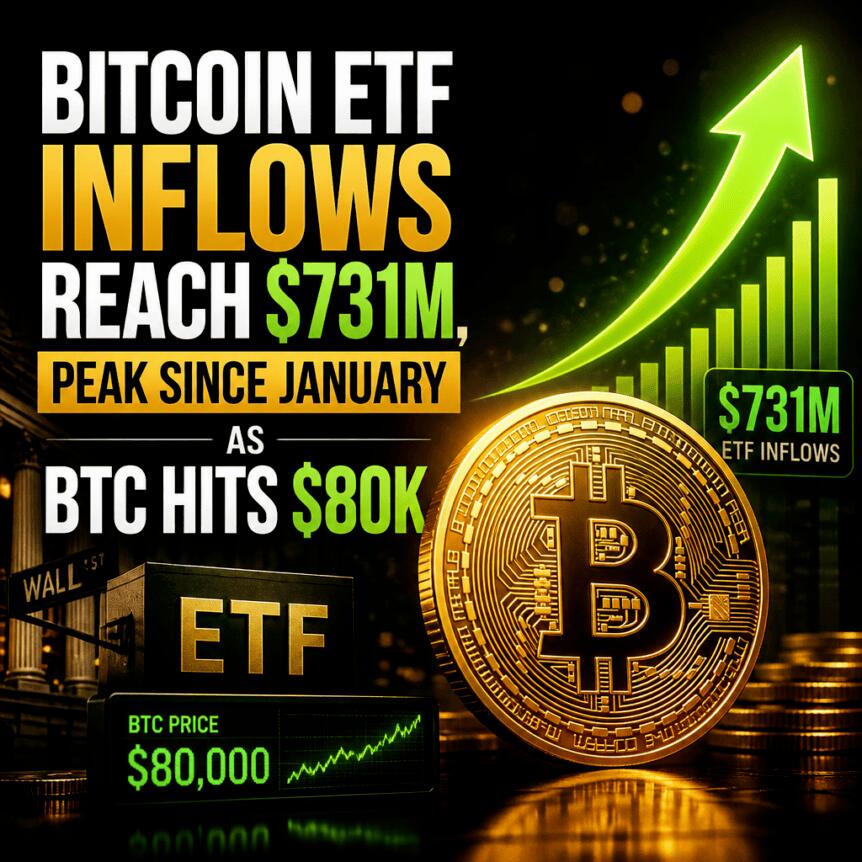
US-listed spot Bitcoin exchange-traded funds logged their strongest single-day inflows in nearly eight months after Bitcoin pushed back above the $80,000 mark. The rebound coincided with a broader improvement in ETF demand, though on-chain analysts warned that the move still leans heavily on positioning changes rather than entirely fresh spot buying.
According to SoSoValue, US spot Bitcoin ETFs received $730.9 million in net inflows on Thursday, the largest daily total since Jan. 14, when the funds attracted $843.6 million. That strong print followed $101.2 million in net inflows on Wednesday, as Bitcoin traded roughly between $76,000 and $81,000 earlier in the week before reclaiming the $80,000 level, based on CoinGecko price data.
Key takeaways
- Spot Bitcoin ETF inflows surged: Thursday’s US net inflows totaled $730.9 million, the highest since mid-January.
- BlackRock’s IBIT led the day: $454 million flowed into IBIT, about 62% of the overall total, per Farside Investors.
- Not all funds contributed equally: most gained, while VanEck’s HODL and WisdomTree’s BTCW were the only two with outflows.
- CryptoQuant sees limited fresh demand: it pointed to short covering and profit-taking rather than a clear shift to new long demand.
- Key resistance is near $83K: CryptoQuant highlighted it as a threshold for confirming a new bull phase, with the 365-day moving average around $82,300.
ETF inflows hit a late-January high
The day’s inflow figure marks a notable acceleration compared with the prior session. SoSoValue data shows the Thursday total of $730.9 million followed Wednesday’s $101.2 million, indicating that ETF demand concentrated sharply in a single session rather than building steadily.
Tracking by Farside Investors shows the strongest contribution came from BlackRock’s iShares Bitcoin Trust (IBIT). The fund pulled in $454 million on Thursday—roughly 62% of all net inflows. Farside also indicates IBIT previously drew a larger single-day inflow of $503 million as recently as Aug. 20, underscoring that today’s jump is significant but not unprecedented.
Who bought—and who sold
Beyond IBIT, ARK Invest and 21Shares’ ARKB added $137.7 million. Fidelity’s FBTC brought in $74.4 million, while other major issuers did not show the same level of inflow.
On the downside, VanEck’s HODL and WisdomTree’s BTCW were the only funds to post net outflows on Thursday, recording $19.6 million and $5.2 million respectively. For investors monitoring fund-level sentiment, the distribution of flows suggests the rally day was broadly supportive, but not uniform across products.
CryptoQuant: rally may depend on positioning, not new demand
Even with the sharp improvement in ETF inflows, CryptoQuant cautioned that Bitcoin’s move may not yet reflect a strong wave of new long-term accumulation. In an assessment shared with Cointelegraph, CryptoQuant pointed to weaker spot demand alongside heavy short covering—a pattern that can lift price quickly without guaranteeing sustainability.
The analysis also referenced realized profit activity. CryptoQuant said holders realized approximately 23,000 BTC in net profits on Aug. 21, the highest daily amount this year. It further estimated that holders have realized roughly 110,000 BTC in net profits in total since Aug. 19, implying that parts of the rally coincided with profit-taking rather than solely fresh entries.
This matters for traders because ETF inflows are often treated as a proxy for institutional interest, but CryptoQuant’s framing suggests the immediate price advance may have been amplified by market mechanics—particularly the unwind of short positions—at least in the near term.
Attention turns to $83K and the 365-day moving average
CryptoQuant’s next major checkpoint sits near Bitcoin’s 365-day moving average, which it placed at about $82,300. Historically, CryptoQuant said this level has divided prior bull and bear regimes, with Bitcoin reaching $81,400 on Aug. 28 before slipping back below that threshold.
In its view, a decisive close above $83K would be the type of confirmation that signals the start (or resumption) of a new bull market phase. Conversely, CryptoQuant warned that if price fails to hold above the area, the pullback risk could extend toward the 200-day moving average near $69,000.
For market participants, the immediate takeaway is that today’s strong ETF inflows may help support the bid, but whether they translate into a durable trend likely depends on whether Bitcoin can overcome the key technical zone around the 365-day moving average and sustain trading above it.
Going into the next sessions, investors should watch for follow-through in ETF net flows after Thursday’s spike and for whether Bitcoin can secure and maintain closes above the $83K region highlighted by CryptoQuant—because that combination would better indicate that demand is shifting from short-covering and profit-taking toward sustained buying.


US diesel prices set an all-time high of $5.820 per gallon on Thursday, according to live GasBuddy data.
The previous record of $5.819 dated back to June 17, 2022. The record arrives as US distillate inventories are at their lowest seasonal level ever.
Diesel Tops 2022 All-Time High
Patrick De Haan, head of petroleum analysis at GasBuddy, posted the new high on X. He recently said 2026 is on track to become the most expensive year for diesel in US history.
Follow us on X to get the latest news as it happens
The price surge arrives amid thin stockpiles. EIA data showed that distillate stocks were about 14% below the five-year average in the week ending August 28, 2026.
The stocks averaged their weakest August levels this time of the year since 1982. In addition, East Coast inventories have fallen to a record low.
Refiners are already running hard, with utilization at 98% for the week ending August 28. Diesel crack spreads topped $100 per barrel, according to Reuters.
“This is especially problematic as September marks the start of the fuel’s peak-demand period. The diesel market is facing a major shortage,” The Kobeissi Letter said.
Fuel Costs Feed the Inflation Debate
Researchers at Brown University have put a dollar figure on the squeeze. The Iran War Energy Cost Tracker estimates a consumer burden of $97.5 billion since fighting began on February 28.
That works out to $743.99 per US household. Diesel accounts for $44.14 billion of the total, with the national average up 57.6% from a pre-war $3.670.
Diesel has traded above $5 per gallon since July 15. Harvest season and winter heating demand still lie ahead. Analysts at Rystad Energy expect higher diesel costs to be passed on to consumers.
“Think of the groceries that get shipped around the nation, and fruits and vegetables that come from California and move by truck or rail. It’s inflationary,” Susan Bell, senior vice president of downstream research at Rystad Energy, said.
Energy shocks have already lifted European gas prices and eurozone inflation this year. The next EIA inventory report, due September 10, will show whether refiners can rebuild stocks before demand rises.
Subscribe to our YouTube channel to watch leaders and journalists provide expert insights
The post US Diesel Sets All-Time High as War Fuel Bill Hits $97.5 Billion appeared first on BeInCrypto.
Aster (ASTER) leads every perpetual decentralized exchange token launched in the past year by holder count, with roughly 256,000 wallets.
Data published Thursday ranked seven perp DEX tokens by holders. The spread runs from Aster at the top down to Paradex, which counted 582.
Aster’s Holder Base Dwarfs Its Perp DEX Rivals
The ranking, compiled by CryptoRank, covers tokens whose generation events fell inside the past 12 months.
RollX (ROLL), a Base-network perpetuals platform, ranked second with 50,300 holders. GRVT (GRVT) followed at 30,900, and edgeX (EDGE) at 16,100.
Follow us on X to get the latest news as it happens
Lighter (LIT) placed fifth with 7,300. Backpack (BP) counted 5,100, while Paradex (DIME) trailed the group at 582.
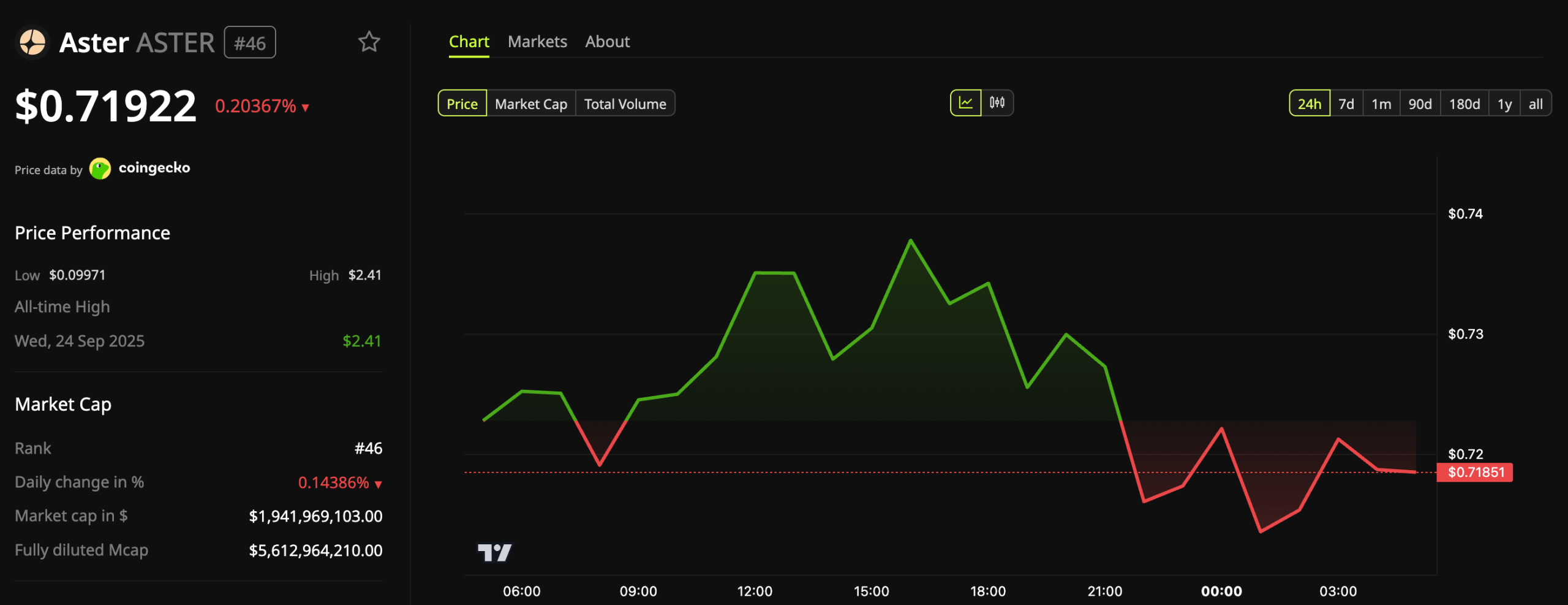
Holder counts do not track valuation here. Lighter has a $1.08 billion market capitalization, second only to Aster’s $1.94 billion, despite its narrow base of holders. It signed a Circle revenue-sharing deal in February that drew institutional attention.
Token Prices Lag Behind Holder Growth
The price tells another side of the story. ASTER traded near $0.719 on Friday, down 0.20% over 24 hours. That leaves the ASTER price about 70% below its $2.41 record from September 2025.

Every token in the cohort is trading below its all-time high. Paradex’s DIME fell 19% to roughly $0.0101, around 86% below its March peak. GRVT traded at $0.160, some 65% below its July high.
Several names rallied on Friday. EDGE jumped 36% to $0.629 after edgeX became the flagship perpetuals platform on Arc, Circle’s own blockchain. LIT rose 12% to $4.34.
Backpack’s BP added 6% to $0.452, while RollX’s ROLL gained 8.5% to $0.129.
The sector has reshuffled repeatedly this year, with perp DEX volume leadership changing hands more than once. Aster now has the widest distribution, though prices across the group have yet to follow suit.
Subscribe to our YouTube channel to watch leaders and journalists provide expert insights
The post Aster Leads Perp DEX Tokens With 256,000 Holders, 5 Times Its Nearest Rival appeared first on BeInCrypto.
Smart ring maker Oura filed for a US initial public offering (IPO) on Thursday. The Oura IPO will put the company on Nasdaq under the ticker OURA.
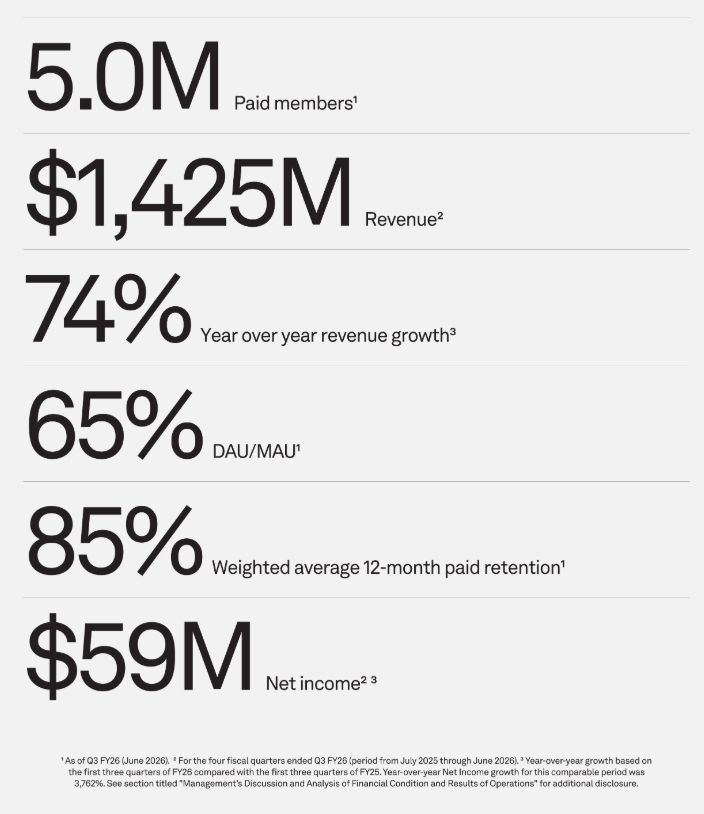
Revenue climbed 74% to $1.21 billion over the first nine months of the fiscal year. Bloomberg reported that the listing could value Oura above $16 billion.
Ring Sales and Subscriptions Both Doubled
The product is a sensor-equipped ring worn on the finger. Optical sensors read blood flow, heart rate, body temperature and movement through the night. The app then converts that into daily sleep, activity and readiness scores.
The business model matters here. Buyers own the hardware outright, yet the full app sits behind a paid membership. Therefore each ring can earn revenue twice. Daily users also equal 65% of monthly users, a sign that people keep wearing it.
The prospectus covers the nine months that ended June 30, 2026. Oura shipped 3.1 million rings in that stretch, up from 1.8 million a year earlier. Those sales brought in $974 million.
Full-year revenue for fiscal 2025 came to $907.9 million, more than double the $406.8 million a year earlier. Across the four quarters through June, the figure reached $1.43 billion.

Subscriptions grew faster. Membership revenue reached $240.5 million, a 121% increase, while paid members doubled to 5 million.
Profitability improved as well. Net income hit $60.8 million, against $1.6 million a year earlier. However, Oura still reported a $924.3 million loss attributable to common shareholders. That charge follows a $1.09 billion buyback of preferred stock from early backers.
Oura IPO Joins a Crowded Listing Queue
The timing matters. Wall Street has absorbed a heavy run of debuts this year, and crypto investors have watched several closely. Anthropic could also list this month, while Kraken has delayed its own listing to 2027.
Oura filed confidentially in May. Bloomberg reported a raise of up to $3 billion, with early backers selling a large block of stock.
Pricing remains unpredictable. Unitree Robotics opened 629% above its offer price in Shanghai in August. Therefore, the $16 billion figure stays a target rather than a settled number.
Goldman Sachs, Morgan Stanley, J.P. Morgan, Allen & Company and Jefferies are leading the deal. Oura has not set a share count or a price range yet.
Until then, one question hangs over the deal. Can a hardware company hold a software multiple?
The post Oura IPO Could Hit $16 Billion Valuation as Revenue Jumps 74% appeared first on BeInCrypto.
Most coverage of Monero focuses on getting into it. The reverse direction gets less attention and is arguably more practical, because at some point most holders want to convert privacy assets back into something more liquid.
Moving XMR back into Bitcoin is straightforward, but the options have narrowed and the trade-offs are worth understanding.
Why the reverse trade is harder than it should be
Getting Bitcoin is easy. Nearly every venue lists it. Getting rid of Monero is where people run into friction, because the same delisting wave that removed XMR from major exchanges also removed the obvious exit route.
More than seventy exchanges have delisted Monero since 2024, and European regulation is expected to restrict privacy assets at regulated venues by 2027. A holder who acquired XMR two years ago through a centralised exchange may find that the exchange no longer supports trading out of it.
This has made non-custodial swaps the practical default for the reverse direction rather than a niche alternative.
How to exchange Monero for Bitcoin
The mechanics mirror the forward trade. You exchange Monero to Bitcoin by selecting the pair, providing a Bitcoin destination address, and sending your XMR to the deposit address generated for that swap. Settlement typically takes under ten minutes once the Monero transaction confirms.
Four details worth getting right:
- Rate type. Floating settles at the market rate when your coins arrive. Fixed locks the rate upfront for a small premium. Monero can be volatile, so on a large trade the fixed rate is usually the sensible choice.
- Destination accuracy. Your Bitcoin address must be correct. Blockchain transactions cannot be reversed.
- Refund address. Always set one. If the swap cannot be completed at the quoted terms, your Monero is returned there rather than leaving you to open a support ticket. One exception is worth knowing about: a deposit that the licensed liquidity partner’s automated screening flags can be held pending review, and that is a manual process rather than an automatic return.
- Confirmation time. Monero requires around ten network confirmations, which takes roughly twenty minutes. Factor that into your timing rather than assuming the swap has stalled.
A note on what changes when you convert back
Worth understanding clearly: converting Monero into Bitcoin moves value from a private ledger to a public one. The Bitcoin you receive lands at an address on a transparent chain, and its subsequent movements are publicly visible like any other Bitcoin.
The Monero side of the transaction remains private, and the swap does not publish a link between your XMR and the Bitcoin you receive. But the Bitcoin itself behaves like Bitcoin from that point forward. People sometimes assume that passing through Monero permanently anonymises the output, and that is not an accurate way to think about it.
Rates, fees and liquidity
XMR to BTC is one of the more liquid privacy-coin pairs, so spreads are usually reasonable. Two costs apply: the service fee, quoted upfront, and network fees on both chains. Monero network fees are typically low. Bitcoin fees depend on congestion and can matter on smaller trades.
Because liquidity for Monero has thinned at custodial venues, check on larger trades that the quoted output amount is the amount that actually lands, and that no further deduction appears at settlement.
Rotating in both directions
Many holders do not treat this as a one-way decision. A common pattern is to hold a working balance in Bitcoin for liquidity and rotate a portion into Monero when they want that portion to stop being publicly readable, then convert back when they need to transact at scale.
Both directions run through the same mechanism. Services such as GhostSwap support the full round trip, and moving in the other direction to swap Bitcoin to Monero follows an identical process.
Summary
Converting Monero back into Bitcoin takes minutes through a non-custodial swap and does not require an account. Set a refund address, verify the destination, allow for Monero’s confirmation time, and use a fixed rate if the amount is large enough that a price move during settlement would matter. The exit route from Monero has narrowed at custodial venues, but it has not closed.
The largest altcoin is on the move again alongside the rest of the market, surging by over 4% daily to $2,150 as of press time. It even tapped $2,530 earlier today before it was stopped.
Its market cap has risen to well over $300 billion, but this has provided some market participants with a proper exit opportunity.
Lookonchain has repeatedly reported on a major whale who has been disposing of their ETH tokens for days. The selling spree began at the start of the month, when the unknown entity received $408 million worth of the altcoin before transferring $174 million to exchanges.
The deposits continued in the following days, with another major transfer of $253 million to multiple trading platforms. The latest was reported earlier today, which culminated in the sale of all 167,855 tokens ($408 million), meaning that the whale has disposed of the entire ETH fortune in just five days.
Insane!
This mysterious #Ethereum whale has sold off all 167,855 $ETH($408M) in the past 5 days.https://t.co/PdCiRP6taI pic.twitter.com/YbajyBEhLf
— Lookonchain (@lookonchain) September 4, 2026
Despite this substantial sell-off in just days, the underlying asset has rebounded swiftly from its dip below $2,400. It’s up by more than 4% daily and now sits above $2,500 with a market cap of $305 billion.
Its market dominance has also increased lately, going past 11% on CoinMarketCap.
The post Ethereum Whale Keeps Offloading as ETH Price Rockets Past $2.5K appeared first on CryptoPotato.


From a humble pitch in Rosario, Argentina, where a young boy’s footwork revealed his extraordinary talent, to a remote village by a Norwegian fjord, where a tall, blond teenager caught the eye of European giants with his astonishing finishing ability, from Messi to Haaland, fans have witnessed the legendary rise of countless “wonderkids” from obscurity to global football stardom.
Yet, behind all these legendary figures, beyond talent and hard work, lies something equally important: the eye to spot potential at the right moment.
This is certainly true on the football pitch, and it is no different in real life. We cheer for decisive goals and delight in the surprise of an underdog defeating a powerhouse. When the match ends, we all yearn for such “goals” in our own lives, opportunities that we recognize and seize at just the right moment.
Opportunities for wealth are like hidden talents. The first to discover them wins.
Just as football scouts around the world hunt for the next superstar, FTmining scouts for hidden “digital mines.”
This is a professional hash power leasing, or mining, platform that uses technology and data to simplify and bring transparency to the complex process of cryptocurrency mining. This allows anyone, even those without technical expertise, to become a “mining scout” and seize mining opportunities the moment they arise.
Whether you want to start with a small investment or aim for steady, long term growth, FTmining operates like a well structured club training system, offering packages to suit every budget and pace.
Turn your phone into a “money making machine” in just three steps.
There is no need to understand complex mining technology or maintain your own hardware.
All you need is a smartphone and a user account. In just three simple steps, you can launch an automated income stream and start earning money anytime, anywhere.
Step 1 | Free registration & quick start
Visit the official FTmining website: https://ftmining.com
Create an account by entering your email address and password. New users receive a $15 sign-up bonus and a daily login bonus of $0.75.
Take advantage of promotional offers for a free trial—perfect if you want to test the waters on a small scale before committing fully.
Step 2 | Choose the right hashpower package
A variety of contract options are available to suit different budgets and goals. Users can choose from the following:
Starter Contract: $100 — 2-day term — Total profit approx. $108
Stable Contract: $800 — 5-day term — Total profit approx. $852.80
Professional Contract: $5,000 — 20-day term — Total profit approx. $6,520
Premium Contract: $25,000 — 28-day term — Total profit approx. $38,300
Step 3 | One-click start, fully automated operation
Once you select and pay for a package, your computing power goes to work immediately.
The system operates fully automatically, 24/7, requiring no manual intervention or technical expertise.
Track your earnings anytime via mobile or PC. Profits are updated daily, and withdrawals are fast and flexible.
The Battle for Opportunity—On the Field and in the “Financial Playground”
Winners on the field are those who know exactly when to make their move. Wealth accumulation works the same way—those who act first reap the greatest rewards.
For football fans looking to boost their income, FTmining serves as your “off-field money-making machine.” While you watch the match, the system runs automatically in the background. Your time transforms into income, turning your phone into a tool that quietly generates profit.
Conclusion
Legends aren’t born by accident, behind every superstar lies a series of crucial decisions made at pivotal moments. From the pitch to real life, true winners aren’t those who wait for miracles, but those who spot opportunities and seize them. Whether you are a football fan, a novice investor, or someone looking for an additional source of automated income, you can find your next “goal” here. Be an early adopter and let time generate returns for you.
Official Website: https://ftmining.com
Customer Service Email: [email protected]

Inside Silo 1, we see Daniel waking from cryo-sleep. Except he’s no longer called Daniel: He is now Troy. And while Troy looks physically the same as Daniel, he’s completely changed. That’s made crystal clear when he settles into his shift and has to deal with the outbreak in Silo 17, the same silo Juliette ventured to in Season 2. Troy, without hesitation, delivers a ruthless decision to execute every single person—man, woman, and child—who left the silo. A top priority of Silo 1 is to prevent silos from discovering that any other silos exist. His decision to unleash drone warfare is met with disapproval by drone pilot Susan, who is actually Daniel’s sister Charlotte (Jessica Brown Findlay). Neither of them recognizes one another from the past. “He’s completely bloodless about it. Totally unemotional. It’s just his job,” says Yost. (Yost does suggest that Charlotte’s negative reaction to Troy’s behavior is worth our attention, though he won’t say why).

US-listed spot Bitcoin exchange-traded funds (ETFs) notched their biggest inflows in nearly eight months as BTC reclaimed $80,000.
Bitcoin ETFs recorded $730.9 million in net inflows on Thursday, the largest daily haul since Jan. 14, when the funds attracted $843.6 million, according to SoSoValue data.
The surge followed $101.2 million inflows on Wednesday and came as Bitcoin reclaimed the $80,000 level after trading in a range between roughly $76,000 and $81,000 this week, according to CoinGecko.
Despite the spike in ETF inflows, CryptoQuant remained cautious about Bitcoin’s rally, citing weaker spot demand and heavy short covering as $83,000 emerges as a key bull market threshold.
BlackRock’s IBIT draws $454 million in a day
BlackRock’s iShares Bitcoin Trust (IBIT), the largest US spot Bitcoin ETF by net assets, led Thursday’s buying with $454 million in inflows, accounting for about 62% of the total, according to Farside Investors data.
While total spot Bitcoin ETF inflows reached their highest level since January, IBIT alone drew a larger $503 million inflow as recently as Aug. 20.

Daily US spot Bitcoin ETF flows since Tuesday. Source: Farside Investors
ARK Invest and 21Shares’ ARK 21Shares Bitcoin ETF (ARKB) followed with $137.7 million, while Fidelity’s Wise Origin Bitcoin Fund (FBTC) drew $74.4 million.
VanEck’s Bitcoin ETF (HODL) and WisdomTree’s Bitcoin Fund (BTCW) were the only funds to record outflows on Thursday, at $19.6 million and $5.2 million, respectively.
Bitcoin rally still needs fresh buyers
Bitcoin’s recent rally was driven largely by traders closing short positions rather than opening new long positions, pointing to limited fresh buying demand, CryptoQuant said in a Thursday report shared with Cointelegraph.
The report mentioned that Bitcoin holders realized 23,000 BTC in net profits on Aug. 21, the highest daily amount this year, and about 110,000 BTC in total since Aug. 19, reflecting substantial profit-taking during the rally.
Related: Bitcoin’s apparent demand turns negative as price struggles with $77K
According to CryptoQuant, Bitcoin’s next major test sits around its 365-day moving average, which CryptoQuant placed at roughly $82,300.
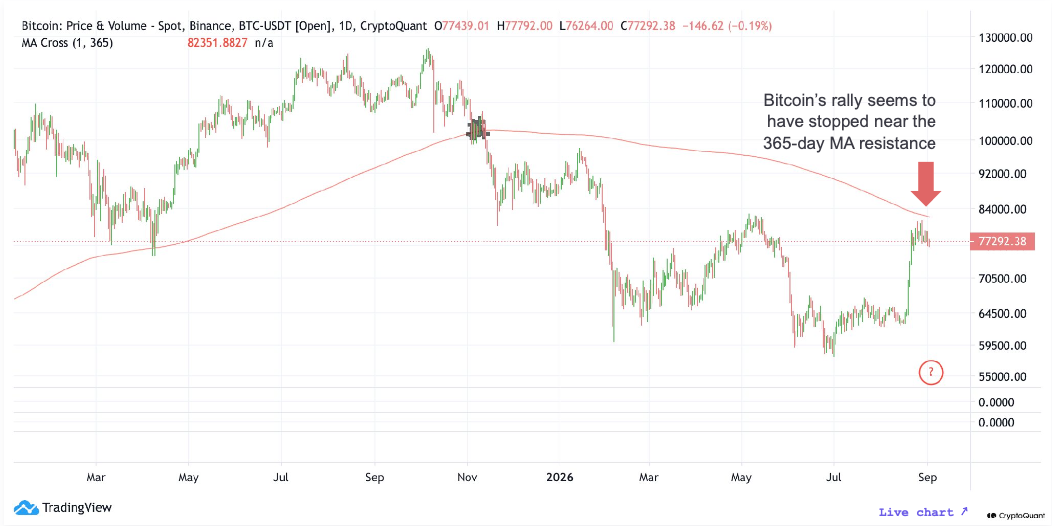
Source: CryptoQuant
The company said the moving average has historically marked the divide between Bitcoin bull and bear markets, with Bitcoin reaching $81,400 on Aug. 28 before retreating below the threshold.
“A decisive close above $83K would confirm the new bull market,” CryptoQuant said, while a rejection could trigger a pullback toward the 200-day moving average near $69,000.
Magazine: Bitget CEO isn’t buying the Bitcoin rally — She’s waiting for $50K

Spring ambitions kick-off at Sandown 2026

Gemma Collins says ‘my whole world fell apart’ as cameras capture year she didn’t expect

The Case For Late-Stage Private Market Investing





-

 Fashion7 days ago
Weekend Open Thread: Maeve – Corporette.com
-

 Crypto World1 day ago
CLARITY Act could advance within weeks, Atkins says
-

 Business6 days ago
Onto Innovation Stock: AI’s Next Bottleneck Is Yield (NYSE:ONTO)
-

 Crypto World2 days ago
Elon Musk Says Grok 4.7 Lands in 10 Days and Will Beat Every Model
-

 Crypto World6 days ago
Bitcoin price tests $82K resistance as Brandt stays long
-
 Tech5 days ago
Hugging Face built a $4.5 billion empire on free AI models. Now Nvidia is buying it for $12.9 billion
-

 Business7 days ago
iPhone 18 Pro Pre-Orders Could Shift to Saturday as Apple Reportedly Avoids September 11 Anniversary
-
 Entertainment7 days ago
‘Adults’ Creators Break Down Season 2’s Most Shocking Moments and Tease a Potential Season 3
-

 Tech6 days ago
PaperCut releases second emergency patch for exploited flaws
-

 News Videos5 days ago
Charlie Munger on Robinhood: No one should believe that Robinhood’s trades are free
-

 Crypto World1 day ago
Kalshi seeks CFTC approval for WTI perpetual
-

 Tech5 days ago
As the influencer economy drives retail sales, Seattle startup raises $22M to play matchmaker
-
 Crypto World2 days ago
Bitcoin slips below $77.5K as macro pressure offsets ETF inflows
-

 Tech5 days ago
Tamagotchi Ring Takes the 30-Year Digital Pet and Places it on Your Finger
-
 Business2 days ago
Oil Price Today (September 2): Crude oil nears $97 as war tensions escalate. Will it hit $100 again?
-
 Entertainment4 days ago
Taylor Swift Reportedly ‘Frustrated’ With Travis Kelce After ‘Short’ Honeymoon
-

 Business7 days ago
Apple Confirms September 9 iPhone Launch Event as Tim Cook Prepares to Hand CEO Reins to John Ternus
-

 News Videos5 days ago
News kii Crypto ugu danbeeyey & Suuqa oo dhaqaaqey
-
 NewsBeat5 days ago
Trump posts AI video of ‘Lake America’ being protected by an army of bequiffed ‘Donald Ducks’
-
 Entertainment6 days ago
Kendall Jenner’s Circle Concerned About Jacob Elordi Romance
You must be logged in to post a comment Login