

Crypto World
Uniswap vote could supercharge UNI burn with Robinhood Chain fees



Uniswap governance is preparing to vote on two proposals that could expand the protocol’s UNI burn by adding new fee sources from Uniswap v4 and Robinhood Chain.
Summary
- Uniswap voters will decide whether v4 and Robinhood Chain fees should expand the UNI burn.
- Robinhood Chain crossed $6 billion in cumulative Uniswap swap volume within ten days of launch.
- New protocol fees would flow into TokenJar contracts before UNI is burned on Ethereum mainnet.
The measures are scheduled for onchain voting from July 19 through July 26.The proposals follow the UNIfication overhaul approved in December 2025, which connected protocol fees to a UNI burn system. Uniswap founder Hayden Adams said current trading activity, especially on Robinhood Chain, could increase the amount of UNI removed from circulation. The votes use an expedited governance process created for later fee updates.
Two votes target v4 and Robinhood Chain fees
The official Robinhood Chain protocol fee proposal would activate protocol fees for Uniswap v2 and v3 on the network. Uniswap launched all three versions of its decentralized exchange on Robinhood Chain when the layer-2 network went live on July 1.
According to the proposal, Uniswap deployments on Robinhood Chain crossed $6 billion in cumulative swap volume by July 10. The separate Uniswap v4 fee proposal would activate fees for selected pools on Ethereum, Arbitrum, Base, BNB Chain, Polygon, Optimism and Robinhood Chain. A second v4 vote is planned for five other networks.
New protocol fees would feed the UNI burn
Both proposals would direct collected protocol fees into Uniswap’s existing TokenJar system. Searchers can claim accumulated fee assets by providing UNI of equal value, which the system then sends to a burn address. UNI collected on other networks is bridged back to Ethereum before it is destroyed.
Adams said in his announcement on X, “Based on current volumes, especially Robinhood, we expect the impact on UNI burn to be substantial.” The proposal documents say protocol fees are already active across v2 and v3 pools on 11 networks. They also record a one-day burn of 186,000 UNI last month.
As reported by crypto.news, Uniswap had already recorded its largest single-day UNI burn before the latest governance push, showing how higher fee activity can increase the number of tokens removed through the mechanism.
Robinhood Chain activity raises the stakes
Robinhood Chain has quickly become a major source of Uniswap trading activity since its July launch. As reported by crypto.news, the network reached $500 million in daily Uniswap volume within eight days and moved behind only Ethereum mainnet for daily activity at that stage.
Crypto.news also reported that Robinhood Chain attracted more than $70 million in bridged Ether during its first week, while total value locked moved above $106 million. The new fee proposals would allow Uniswap governance to capture part of the trading activity generated on the network and route it into the burn mechanism.
The Robinhood proposal uses the same cross-chain governance pattern applied to Arbitrum One. If approved, governance messages would travel from Ethereum to Robinhood Chain, where contracts would redirect the relevant protocol fees toward TokenJar.
Uniswap v4 requires a different fee system
Activating fees on v4 requires a different structure because v4 pools can use hooks and dynamic fees. The proposal introduces a V4FeePolicy contract to calculate protocol fees and a V4FeeAdapter to apply governance rules and collect the proceeds.
The first v4 vote covers three categories: static-fee pools, pools launched through continuous clearing auctions and aggregator-hook pools. A later proposal will cover Celo, Soneium, Worldchain, X Layer and Zora because Uniswap’s GovernorBravo contract limits the number of actions in one governance proposal.
Uniswap’s fee-switch model has linked protocol activity with UNI burns since the UNIfication overhaul. The July votes would extend that system to v4 for the first time and add Robinhood Chain’s v2 and v3 activity if governance approves both measures.


Loyalty programs have been around for decades. From airline miles and hotel points to coffee shop punch cards and retail rewards, businesses have long relied on incentives to keep customers coming back. However, traditional loyalty systems often suffer from limited flexibility, poor transparency, expiration rules, and rewards that are difficult to redeem.
Blockchain technology is changing that.
By bringing transparency, security, and interoperability to reward systems, blockchain-based loyalty programs are creating a more engaging experience for both businesses and consumers. Instead of locking rewards inside a single ecosystem, blockchain allows digital loyalty assets to become more flexible, secure, and valuable.
What Is a Blockchain Loyalty Program?
A blockchain loyalty program is a customer rewards system that records loyalty points, memberships, or digital rewards on a blockchain instead of a centralized database.
Customers still earn rewards by making purchases, completing tasks, or participating in promotions, but the rewards are stored as blockchain-based digital assets that are verifiable and secure.
Unlike traditional databases that are controlled by one company, blockchain creates an immutable record of every reward earned and redeemed.
Why Traditional Loyalty Programs Fall Short
Most loyalty systems have several common problems:
- Points expire unexpectedly.
- Rewards cannot be transferred.
- Customers struggle to track balances.
- Fraud and duplicate rewards occur.
- Programs are isolated from one another.
- Redemption options are often limited.
Many consumers forget they even have reward points because accessing them is inconvenient.
Blockchain addresses many of these challenges.
How Blockchain Improves Loyalty Programs
1. Transparent Rewards
Every reward transaction is recorded on-chain.
Customers can independently verify:
- Points earned
- Reward history
- Redemptions
- Bonus campaigns
This transparency builds trust between brands and customers.
2. Improved Security
Blockchain significantly reduces the risk of:
- Account manipulation
- Duplicate rewards
- Fraudulent redemptions
- Unauthorized balance changes
Since blockchain records cannot easily be altered, businesses gain a more secure infrastructure for managing rewards.
3. True Ownership
Instead of existing only inside a company’s private database, blockchain-based loyalty assets can be owned directly by users through their digital wallets.
Customers have greater control over their rewards rather than relying entirely on centralized systems.
4. Cross-Brand Interoperability
One of blockchain’s biggest advantages is interoperability.
Imagine earning rewards from:
- An airline
- A hotel
- A restaurant
- A ride-sharing app
Instead of maintaining four separate point systems, blockchain could allow these rewards to interact within a shared ecosystem.
Customers gain more flexibility while businesses expand their reach through partnerships.
5. Instant Redemption
Traditional loyalty systems often require:
- Manual approvals
- Delayed processing
- Customer support intervention
Blockchain enables near-instant verification and redemption through smart contracts.
The result is a smoother customer experience.
Tokenized Loyalty Points
Some blockchain loyalty programs tokenize rewards.
Rather than simple database entries, loyalty points become blockchain tokens.
These tokens may allow users to:
- Redeem products
- Access premium memberships
- Unlock exclusive experiences
- Participate in community events
- Receive discounts
- Earn additional rewards through staking mechanisms
Not every loyalty token is tradable, but tokenization opens many possibilities beyond traditional reward systems.
NFTs in Loyalty Programs
Non-fungible tokens (NFTs) introduce another layer of customer engagement.
Brands can issue NFTs that represent:
- VIP memberships
- Lifetime customer status
- Event tickets
- Limited-edition collectibles
- Special access passes
- Exclusive product launches
Unlike traditional membership cards, NFTs can include programmable benefits that automatically unlock perks when owned by a customer.
Smart Contracts Automate Rewards
Smart contracts eliminate much of the manual work involved in loyalty programs.
They can automatically:
- Award points after purchases
- Trigger bonus campaigns
- Validate eligibility
- Process redemptions
- Prevent duplicate claims
Automation reduces operational costs while improving customer satisfaction.
Benefits for Businesses
Blockchain loyalty programs provide several business advantages.
Lower Fraud
Immutable records reduce reward abuse.
Better Customer Retention
Flexible rewards encourage repeat engagement.
Reduced Administrative Costs
Automation minimizes manual management.
Richer Customer Engagement
Digital collectibles and tokenized experiences create stronger emotional connections.
Easier Partnerships
Multiple brands can collaborate through shared blockchain infrastructure.
Benefits for Consumers
Customers enjoy several improvements.
- Greater transparency
- Faster reward redemption
- Increased security
- Digital ownership
- More valuable rewards
- Cross-platform usability
- Personalized experiences
Instead of forgetting points inside dozens of accounts, users can potentially manage rewards from multiple brands in a single wallet.
Real-World Use Cases
Blockchain loyalty is already appearing across multiple industries.
Retail
Reward tokens for purchases and referrals.
Travel
Airline and hotel points with broader redemption options.
Food & Beverage
Digital memberships and collectible reward NFTs.
Gaming
Cross-game loyalty rewards and digital collectibles.
Entertainment
Concert tickets combined with long-term fan rewards.
E-commerce
Tokenized cashback and loyalty incentives.
Challenges Still Exist
Despite its advantages, blockchain loyalty programs still face several hurdles.
User Experience
Wallet setup and blockchain interactions remain unfamiliar to many consumers.
Regulation
Different jurisdictions have varying rules for digital assets and tokenized rewards.
Scalability
Large consumer brands require networks capable of processing millions of transactions efficiently.
Education
Many customers still do not understand blockchain technology, making onboarding a challenge.
As blockchain infrastructure matures, these barriers are expected to diminish.
The Future of Loyalty
The next generation of loyalty programs may become far more personalized and interconnected.
Future systems could enable customers to:
- Carry loyalty rewards across multiple brands.
- Receive personalized incentives powered by AI.
- Earn rewards for both online and offline activity.
- Access exclusive communities through digital memberships.
- Trade or combine rewards across participating ecosystems.
- Interact with brands through gamified experiences.
Rather than simply collecting points, customers will increasingly participate in digital ecosystems where loyalty becomes an interactive and valuable asset.
Conclusion
Blockchain loyalty programs are transforming how businesses build lasting relationships with customers. By combining transparency, automation, security, and digital ownership, they address many of the limitations of traditional reward systems.
As adoption grows, loyalty points may evolve from isolated database entries into versatile digital assets that can be used across multiple brands and experiences. For companies, this creates new opportunities to deepen engagement and foster long-term customer relationships. For consumers, it means rewards that are more accessible, flexible, and meaningful.
In the years ahead, blockchain-powered loyalty programs are poised to become a key component of the digital economy, reshaping customer engagement in ways that traditional systems simply cannot.
REQUEST AN ARTICLE


The exploiter who drained Ostium, a real-world-asset perpetuals protocol on Arbitrum, has moved 10,540 ETH into Tornado Cash, blockchain security firm PeckShield said in a post on Thursday. PeckShield reported that Ostium's public OLP vault "has been drained of ~$24M $USDC." The firm said the… Read the full story at The Defiant
Crypto World
Binance, OKX Users Face $1900 fines in Vietnam, Crypto to be National Asset in Korea: Asia Express

VIETNAM
Vietnam goes after the little guys
Vietnam will fine retail crypto users up to $1900 if they trade on unlicensed overseas platforms such as Binance, OKX and Bybit, instead of on licensed local exchanges.
There’s just one problem: Vietnam’s Finance Ministry has yet to issue any exchange licenses for its regulated digital asset market which is due to start on September 1. Five exchanges have been approved in principle however.
Domestic investors who trade crypto that’s been designated exclusively for foreign investors can be fined up to $3800. Crypto companies providing or advertising services without a license, those who fail to properly ID customers, or unlawfully deal with crypto account data, can be fined up to $7600.
MALAYSIA
Network school dragged into Israeli citizen controversy
Balaji Srinivasan’s utopian Network School in Forest City, Malaysia is under fire over allegations it has been hosting Israeli citizens using second passports.
The claims trace back to an activist group Malaysia Protest 4 Palestine, which has accused the school of becoming a “gathering place for Israeli entrepreneurs.”
In other countries such a kerfuffle might result in a few BDS protesters or a boycott, but Malaysia has no diplomatic relations at all with Israel, and bans Israeli citizens from even visiting.
That said, dual nationals with Israeli passports are allowed… for now, although the controversy suggests that particular loophole may be closed soon.

Vitalik, Bryan and Balaji at the Network School. (X)
The incident made international headlines after Srinivasan threatened to pull the Network School and its millions in investments out of the country.
The Immigration Department said its investigation had found the 266 foreigners have valid documents, while the Johor state government is plowing ahead with a probe to ensure compliance with regulations on business licenses, building usage and commercial operations.
Ironically, the Network School is based on the concept of online network states, which are meant to be above such petty IRL squabbles.
JAPAN
Japan reclassifies crypto as financial assets
The Japanese parliament has passed revisions to the Financial Instruments and Exchange Act and now classifies cryptocurrencies as financial assets.
The move takes crypto regulations out of the Payment Services Act and comes with a mixed bag of tax benefits along with harsher fines and regulations that befit crypto’s new status up there alongside TradFi assets.
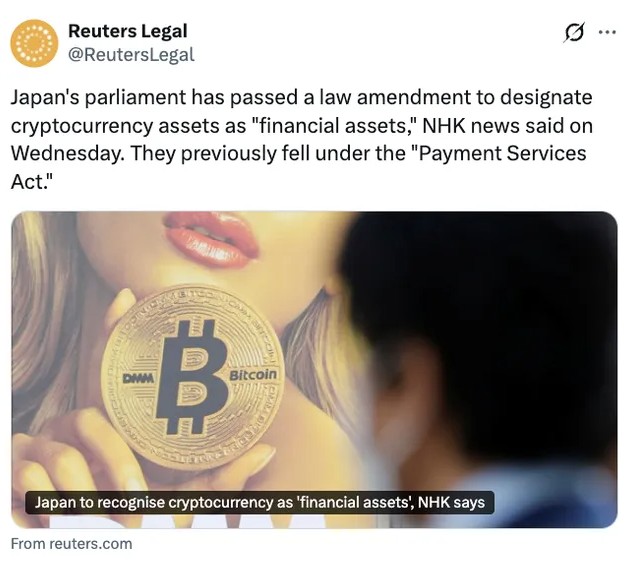
Source: Reuters, X.
Unlicensed crypto platforms face a fine of 10 million yen or 10 years in jail and there’s a new ban on insider trading in crypto that will be policed by the Securities and Exchange Surveillance Commission.
On the upside, current crypto tax rates of up to 55% will be slashed to approximately 20%, with a three year carry forward provision for any losses… which neatly lines up with a bull run every fourth year.
Unfortunately the new tax rules don’t come into effect until 2028.
SOUTH KOREA
South Korea adds crypto to public wealth management rules
South Korea has proposed updating its national asset management scheme to include crypto and IP under the definition of “national assets.”
The Ministry of Economy and Finance announced it is rewriting the 1950 State Property Act, as the National Asset Basic Act, which would make it the first national sovereign asset management statute to embed cryptocurrency.
The existing law was built around an economy focused on real estate which no longer reflects the range of assets the government holds. The new framework also changes the emphasis from managing assets to instead generating value from them. So perhaps we’ll see the Korean Government yield farming on Aave one day soon.
More news from Korea
— South Korea’s Financial Supervisory Service (FSS) has begun sanction procedures against Upbit operator Dunamu, after the platform was hacked for $30 million in November. FSS has been investigating to determine if the incident violated the Virtual Asset User Protection Act, however that law doesn’t provide sanctions for hacks or IT failures.
— That particular oversight is expected to be addressed in the forthcoming Digital Asset Basic Act. Legislators have finally restarted talks on the new act after four months.
— Korea’s Financial Services Commission is extending victim compensation schemes to cover crypto scams.
— Weekly trading volume on Korea’s five top exchanges has more than halved since early June to just 8 trillion won.
— The Bank of Korea will expand its Project Hangang CBDC pilot to nine banks. Phase two, which kicks off in September, also adds biometric payments and person to person transfers.
— Officials from South Korea’s National Tax Service have proposed changing the law to establish clear procedures for seizing self hosted crypto wallets during investigations.
— Consensys unwittingly hired a North Korean dev and gave him access to Metamask’s code. It says an investigation didn’t uncover any security issues.
CHINA and HONG KONG
Is Coinbase allowing Chinese users to verify?
Wu Blockchain reports that Coinbase has opened up verification for users who are solely based in China. Previously Chinese users needed to provide a Hong Kong address, but they can now reportedly verify on the platform using only a Chinese ID card and a Chinese address. However, China still does not appear in Coinbase’s list of supported countries.
— Hong Kong has approved its first crypto native tokenized fund from Baillie Gifford, that allows professional investors to have direct ownership of assets on the blockchain.
INDONESIA
— Bybit is launching a regulated platform in Indonesia, following its acquisition of the local NOBI exchange. It will retain NOBI’s senior management team to run the Bybit Indonesia operation.
Cointelegraph publishes long-form journalism, analysis and narrative reporting produced by Cointelegraph’s in-house editorial team with subject-matter expertise. All articles are edited and reviewed by Cointelegraph editors in line with our editorial standards. Content published in here does not constitute financial, legal or investment advice. Readers should conduct their own research and consult qualified professionals where appropriate. Cointelegraph maintains full editorial independence.


CASHCAT, the flagship token of the two-week-old Robinhood Chain, has fallen roughly 70% from its record high, unwinding most of the run that briefly carried its market value above $200 million after leveraged trading arrived. The token changed hands at about $0.065 on Friday, down about 70% from… Read the full story at The Defiant


Celsius co-founders Shlomi Daniel Leon and Hanoch “Nuke” Goldstein have been ordered to pay over $6 million to settle Federal Trade Commission charges alleging they misrepresented the safety of the Celsius platform before the company collapsed.
Goldstein, Celsius’ former chief technology officer, was ordered to pay $2.014 million under an order signed Monday by US District Judge Denise Cote. Leon, the firm’s former chief strategy officer, was ordered to pay $4.1 million under a separate order entered on June 29.
The settlements extend the fallout from the 2022 collapse of Celsius beyond its former CEO Alex Mashinsky. The crypto lending platform, which held $25 billion in assets at its peak, owed its users $4.7 billion when it filed for bankruptcy in July 2022.
The order also bars Leon from marketing or selling products or services that can be used to deposit, exchange, invest or withdraw assets, the FTC said in a statement Monday.
“Similarly, Goldstein has agreed to a ban on marketing or selling retail products or services that can be used to buy, sell, deposit, withdraw, distribute or trade cryptocurrency.”
Related: Celsius’ Mashinsky gets permanent trading ban in CFTC settlement
FTC allegations against Celsius co-founders
The FTC alleged that Celsius falsely told customers it held sufficient reserves to meet withdrawal demands, maintained a $750 million insurance policy covering customer deposits and did not issue unsecured loans.
“The FTC, however, alleged that the promises were false and that its top executives continued to claim that customers’ deposits were safe days before the company filed for bankruptcy,” it said.
Mashinsky settles FTC case for $10 million
In April, Mashinsky agreed to an FTC settlement that permanently bars him from promoting asset-related products and required him to pay $10 million as part of a broader, partially suspended $4.72 billion judgment.
The $2.014 million and $4.1 million payments from Goldstein and Leon, respectively, will also be credited against the $4.72 billion judgment. The judgments reflect the consumer harm alleged by the FTC.
Separately, Mashinsky was sentenced to 12 years in prison in May 2025 after pleading guilty to commodities and securities fraud charges, with prosecutors saying he misled Celsius customers about the company’s profitability, investment risks and the safety of customer funds.
Magazine: Binance & OKX users face $1900 fines in Vietnam, Coinbase in China? Asia Express


Tokenized stocks are seeing more onchain trading and are starting to be used as lending collateral, though both remain a small share of DeFi activity, according to data published July 16 by Token Terminal, an onchain analytics provider. The firm's dashboard put spot DEX trading volume for tokenized… Read the full story at The Defiant


OKX said its Unified Tokenized Stocks product is now live for eligible traders, with users in the United States and the European Union excluded. The crypto exchange listed more than 40 tokenized US stocks and ETFs, including XNVDA, XAAPL and XTSLA, tradable against the USDT stablecoin. The design… Read the full story at The Defiant
Crypto World
Vietnam Targets Binance and OKX Users With $1,900 Fines; Coinbase Faces Scrutiny in China
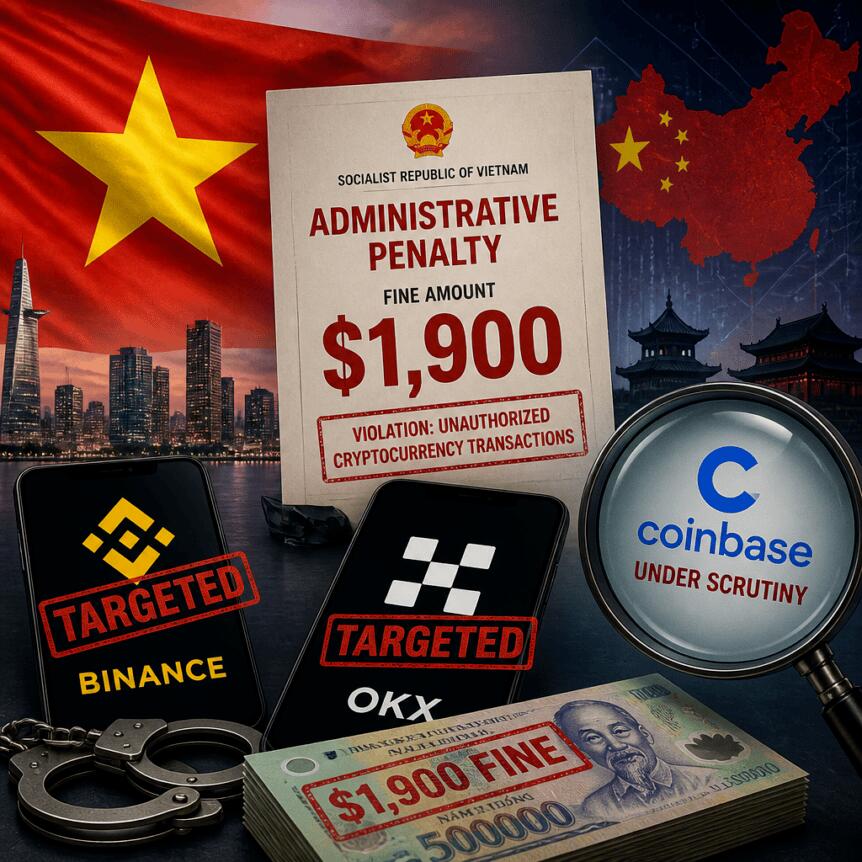
Vietnam is moving to tighten oversight of crypto trading by cracking down on retail users who access overseas platforms not licensed in the country. At the same time, lawmakers and regulators across Asia are continuing to reshape how digital assets fit into financial law—through new classifications, asset-management rules, and enforcement actions.
Below is a regional roundup of the most consequential policy and compliance developments highlighted across Vietnam, Malaysia, Japan, South Korea, China and Hong Kong, and Indonesia.
Key takeaways
- Vietnam plans penalties of up to $1,900 for retail crypto trading on unlicensed offshore exchanges such as Binance, OKX, and Bybit, ahead of a regulated market rollout that is scheduled to begin on September 1.
- Japan’s parliament has passed revisions that reclassify cryptocurrencies as financial assets, shifting oversight away from the Payment Services Act and introducing new compliance requirements.
- South Korea is seeking to include crypto within the country’s “national assets” framework by rewriting the State Property Act as a National Asset Basic Act.
- In South Korea, regulators have begun sanction procedures against Upbit operator Dunamu following a $30 million hack, while broader legislative gaps around digital asset failures remain under review.
- Malaysia’s immigration and local authorities are investigating an Israeli citizenship controversy tied to Network School in Forest City, amid claims that the venue has been used through second passports.
Vietnam sets penalties for retail trading on offshore exchanges
Vietnam’s Finance Ministry has outlined fines targeting retail users who trade crypto on unlicensed overseas platforms rather than using locally licensed exchanges. The proposed penalties can reach up to $1,900 for retail participants, depending on the specifics of the activity and the platform involved.
The enforcement focus extends beyond individual traders. Domestic investors who trade crypto assets designated exclusively for foreign investors can face fines up to $3,800. Meanwhile, crypto companies that provide or advertise services without a license—or fail to properly identify customers—or unlawfully handle crypto account data can be fined up to $7,600.
The policy is scheduled to take effect alongside a regulated digital asset market framework due to start on September 1. However, the sticking point is that Vietnam’s regulator has not yet issued exchange licenses for the regulated market, even though five exchanges have reportedly been approved “in principle.”
For investors and traders, this gap matters: penalties are aimed at use of unlicensed offshore venues, but the local licensing pipeline is still not operational. Market participants should watch closely for when Vietnam’s first regulated exchange licenses are formally issued and which products and investor categories each approved platform will be allowed to support.
Malaysia investigation highlights passport and visa compliance risk
Malaysia’s immigration authorities are investigating claims that Network School in Forest City—founded by Balaji Srinivasan and designed around the idea of “network states”—has been hosting Israeli citizens via second passports.
According to reporting linked in the source coverage, the allegations trace back to an activist group, Malaysia Protest 4 Palestine, which accused the school of operating as a “gathering place for Israeli entrepreneurs.” In response to the controversy, Srinivasan had threatened to remove the Network School and its associated investments from Malaysia, according to earlier international headlines mentioned in the source.
The Immigration Department said its investigation found that 266 foreigners have valid documents. Separately, the Johor state government is continuing its probe to ensure compliance with local rules, including business licenses, building usage, and commercial operations.
From a policy perspective, the episode underscores how quickly immigration, licensing, and nationality rules can collide with crypto-adjacent narratives and cross-border talent flows. While dual nationals holding Israeli passports are reported to be allowed “for now,” the controversy suggests scrutiny could intensify, potentially closing loopholes that make certain residency or entry routes easier than regulators intend.
Japan reclassifies crypto as financial assets
Japan has moved to tighten the legal framework around digital assets by passing revisions to the Financial Instruments and Exchange Act that reclassify cryptocurrencies as financial assets.
As described in the source coverage, this change takes crypto regulations out of the Payment Services Act. The shift is framed as a mixed outcome for market participants: it brings regulatory expectations closer to traditional finance (TradFi), including stricter enforcement and compliance burdens, while also changing the tax profile for holders.
One of the most immediate implications is enforcement. The source notes that unlicensed crypto platforms could face penalties of 10 million yen or up to 10 years in jail. A new ban on insider trading in crypto is also included, to be policed by the Securities and Exchange Surveillance Commission.
On the tax side, current crypto tax rates—reported as up to 55%—are expected to be reduced to approximately 20%, with a three-year carry forward for losses. However, the revised tax rules do not take effect until 2028.
This timing gap creates uncertainty for investors trying to plan around a trading and tax strategy that spans the transition. Market participants should consider how current tax treatment applies until the 2028 effective date, and whether future guidance clarifies how trading activity should be recorded across the regulatory transition.
South Korea proposes crypto inclusion in national asset management
South Korea is looking to formally expand the scope of state asset management to include both crypto and intellectual property. The Ministry of Economy and Finance announced it is rewriting the 1950 State Property Act into a National Asset Basic Act, which would define “national assets” in a way that explicitly embeds cryptocurrency.
The source coverage emphasizes that the older framework was developed during an economy centered largely on real estate, and that the update would shift emphasis from merely managing assets to generating value from them. The practical implications for the industry are straightforward: if crypto is treated as a category of national assets, it could influence how the state approaches custody, risk management expectations, and the boundaries of public participation or oversight.
Regulatory enforcement and legislative follow-through
South Korea’s broader regulatory direction also includes enforcement actions. The source notes that the Financial Supervisory Service (FSS) has started sanction procedures against Upbit operator Dunamu after the platform was hacked for about $30 million in November. The FSS is reportedly determining whether the incident violated the Virtual Asset User Protection Act, while the source highlights that the law may not provide sanctions specifically for hacks or IT failures.
The coverage further states that legislators are expected to address that oversight in a forthcoming Digital Asset Basic Act, with talks reportedly restarted after a four-month pause.
Alongside enforcement and legislation, the source includes other ongoing developments, such as extensions of victim compensation schemes to cover crypto scams and a proposal by tax authorities to establish clearer procedures for seizing self-custodied crypto wallets during investigations.
Coinbase verification shift for mainland China users
Separately, Wu Blockchain reports that Coinbase has opened up user verification for accounts solely based in China. Previously, Chinese users reportedly needed to provide a Hong Kong address; the source claims they can now verify using only a Chinese ID card and a Chinese address.
However, the report also states that China does not currently appear in Coinbase’s list of supported countries on its help documentation. That mismatch suggests either a narrow operational change or a staged rollout of verification capabilities that does not equate to full country support for services.
For users, the practical takeaway is to confirm eligibility directly during onboarding and to treat verification availability as distinct from whether all account features are accessible in a given jurisdiction.
Other regional updates: Hong Kong tokenized funds and Bybit’s Indonesia platform
In Hong Kong, the source notes that the territory approved its first crypto-native tokenized fund from Baillie Gifford, allowing professional investors to have direct blockchain-based ownership of underlying assets.
Meanwhile in Indonesia, the coverage says Bybit is launching a regulated platform following its acquisition of the local NOBI exchange. Bybit is reportedly retaining NOBI’s senior management team to run the Bybit Indonesia operation, signaling continuity on the operating side while shifting regulatory posture under the new ownership structure.
Across the region, the common theme is that regulation is tightening while timelines and operational gaps remain: Vietnam’s licensing is still pending even as penalties loom, Japan’s tax relief arrives years after the legal reclassification, and South Korea’s state-asset framework is taking shape alongside enforcement for platform security. The next signal to watch is how quickly regulators turn policy announcements into functioning compliance infrastructure—especially licenses, tax guidance, and enforcement standards that affect day-to-day trading and custody decisions.
A memecoin riffing on Coinbase Chief Executive Brian Armstrong has collapsed after he dropped the token's artwork as his X profile picture and switched to a CryptoPunk, the latest sign of how tightly Base's markets track the moves of the chain's most prominent backer. The $BRIAN token, a… Read the full story at The Defiant


Strategy raised another $263.5 million by selling Class A common stock while leaving its Bitcoin holdings unchanged for a second straight week.
Summary
- Strategy raised $263.5 million through MSTR sales while keeping its Bitcoin holdings unchanged this week.
- Strategy increased its U.S. dollar reserve to $3.225 billion to support dividends and debt obligations.
- STRC valuation debate continues as investors assess cash flows, leverage, dividend coverage and Bitcoin exposure.
The company sold 2,732,318 MSTR shares between July 13 and July 19 through its at-the-market program, according to a July 20 filing with the U.S. Securities and Exchange Commission. Strategy reported no sales under its STRC, STRF, STRK or STRD preferred stock programs during the period.
Strategy also made no Bitcoin purchases or sales during the week. Its holdings therefore remained at 843,775 BTC, acquired for about $63.69 billion at an average cost of $75,476 per Bitcoin, including fees and expenses. The company’s official Bitcoin tracker confirms the same total.
MSTR sales push cash reserve above $3.2 billion
The latest share sales lifted Strategy’s U.S. dollar reserve to $3.225 billion as of July 19. The figure includes expected proceeds from ATM sales that had not yet settled by the reporting date. Strategy uses the reserve to support preferred stock dividends and interest payments on outstanding debt.
The company still had about $23.53 billion available under its MSTR ATM program after the latest transactions. It also reported no share repurchases during the week, despite having previously authorized programs covering both common and preferred securities.
The latest capital raise follows an even larger stock sale in the prior week. As crypto.news reported, Strategy raised $466.7 million by selling about 4.82 million MSTR shares between July 6 and July 12. Its Bitcoin holdings also remained unchanged at 843,775 BTC during that period, while the U.S. dollar reserve reached $3 billion.
Together, the two weekly updates show Strategy continuing to raise cash through common equity without adding to its Bitcoin position. The company has now increased its reserve by $675 million since July 5, when it reported $2.55 billion in cash after a separate Bitcoin sale.
Bitcoin holdings remain unchanged after earlier sale
Strategy’s current 843,775 BTC balance follows the sale of 3,588 Bitcoin between June 29 and July 5. The company raised about $216 million from that transaction and said the proceeds would support payments tied to its Digital Credit securities. Crypto.news reported at the time that the sale reduced Strategy’s holdings to their present level.
That transaction followed Strategy’s introduction of a broader Digital Credit Capital Framework. The plan gives the company authority to sell up to $1.25 billion in Bitcoin under certain conditions, primarily to strengthen its U.S. dollar reserve and meet dividend, interest and other capital needs. The authorization does not require Strategy to sell the full amount.
As previously reported by crypto.news, the framework also included $2 billion in authorized repurchases across common and preferred securities. Strategy also raised STRC’s annual dividend rate to 12% from 11.5%, effective from July.
For now, Strategy has chosen common stock sales rather than further Bitcoin sales to add liquidity. The company’s current Bitcoin balance remains below the 847,363 BTC it held before its July transactions, while its cash reserve has continued to rise.
STRC valuation debate continues as shares trade below par
The latest filing comes as investors continue to assess Strategy’s preferred stock structure. STRC closed at $85.29 on July 17, well below its $100 reference value, while MSTR ended the same session at $94.85, according to Yahoo Finance historical data.
Credit investor Khing Oei argued that investors may be placing too much weight on STRC’s current headline yield when valuing the security. “Never value a stream by dividing this year’s coupon by today’s price,” Oei wrote, arguing that investors should instead examine expected future cash flows and Strategy’s ability to fund distributions. His assessment represents his own valuation view rather than company guidance.
Strategy has already changed STRC’s payment structure as part of its effort to support the security. As crypto.news reported in June, the company moved toward semi-monthly STRC dividend payments while the shares continued trading below their $100 reference level.
The growing U.S. dollar reserve gives Strategy more cash available to service those obligations without immediately selling additional Bitcoin. However, dividend costs, debt interest, future capital raises and Bitcoin prices remain factors investors are tracking when assessing the company’s securities and treasury structure.
Strategy’s latest filing shows that common equity remains a large source of available financing. After raising $263.5 million during the week, the company retained approximately $23.53 billion of capacity for additional MSTR sales under its ATM arrangements.
The company has not indicated when it will use that remaining capacity or when it could resume buying Bitcoin. Its last two weekly filings showed no Bitcoin acquisitions, while its U.S. dollar reserve rose from $3 billion to $3.225 billion.

Hackers Are Exploiting Recently Patched WordPress Bugs, Putting Millions of Websites at Risk

Man Utd news: Marcus Rashford latest as transfer completed with Tottenham for star
Asia stocks climb as easing oil rally supports risk appetite


-
 NewsBeat5 days ago
London Mayor Sadiq Khan handed a peerage by Keir Starmer alongside 15 other Labour figures… just days before the PM leaves No10
-

 Fashion3 days ago
Weekend Open Thread – Corporette.com
-

 Politics3 days ago
The House | The City of London can help the new chancellor deliver growth in every postcode
-

 Politics6 days ago
Young campaigners urge incoming PM to act on outdoor junk food ads
-

 Crypto World5 days ago
CFTC blocks Kalshi from unwinding Michigan trades after court order
-
 Crypto World4 days ago
Two July Windows Left: The CLARITY Act’s Senate Fight and What Failure Means
-

 Crypto World3 days ago
Ripple Payments Joins MiCA With 14 Firms, Does It Mean Anything For XRP?
-

 Business5 days ago
Nvidia Stock Slips After Big Tuesday Rally as Huang Confirms Vera Rubin Chip Is Now in Production Today
-

 Politics2 days ago
Democrats look to World Cup watch parties to register thousands of voters
-
 Entertainment5 days ago
Disney’s Most Ambitious Failed Star Wars Attraction Is Coming to SDCC
-

 Crypto World3 days ago
Ripple wins EU-wide access as ESMA adds it to MiCA register
-

 Business5 days ago
Palantir Shares Rise After Expanded Nvidia Partnership and Fresh Analyst Upgrades Ahead of Earnings Day
-

 Crypto World4 days ago
Injective Submits SEC Transfer-Agent Registration to Onchain Ownership Records
-

 Tech3 hours ago
Sail Virtually Aboard The “Itanic” With IA-64 Emulator
-

 News Videos6 days ago
XRP BOMBSHELL… XRP OMBOARDED FOR TRANSACTIONS!!!
-

 NewsBeat4 days ago
Registration is now open for March for Men with Kev 2026
-

 Tech7 days ago
Get Your ESP32 Sunny Side Up With This Solar Dev Board
-

 Tech6 days ago
Dark Secrets Emerge When Jailbreaking LLMs
-

 NewsBeat17 hours ago
Unregistered fitter used Gas Safe logo on business flyers
-
 Sports5 days ago
New Cornerback Enters Vikings Trade Rumor Mill
You must be logged in to post a comment Login