
Crypto World
United Wholesale Mortgage plunges 40%; suspends dividend, raises capital


United Wholesale Mortgage at the NYSE, January 22, 2021
Source: The New York Stock Exchange
Shares in UWM Holdings, parent of United Wholesale Mortgage, plunged 40% on Thursday after the biggest U.S. mortgage lender suspended its dividend and raised fresh capital.
UWM announced a $2.05 billion equity investment from Oaktree Capital Management and SFS Group Capital LLC, a newly formed investment vehicle owned by family of CEO Mat Ishbia. The family is also the majority owner of the NBA’s Phoenix Suns.
Pontiac, Michigan-based UWM also said it suspended its quarterly dividend to preserve capital.
“We’re taking decisive action to make UWM stronger, more liquid and better positioned to win for years to come,” Ishbia said in a statement.
UWM shares have now collapsed about 85% from their 52-week high, set in September 2025.

UWM Holdings year to date
The capital raise comes as UWM’s financial position weakened during the latest quarter. Total equity fell to about $1 billion as of June 30 from $1.6 billion at the end of March, while available liquidity stood at approximately $1.3 billion, including $498 million in cash and borrowing capacity.
The moves come as mortgage lenders continue to grapple with one of the toughest operating environments in years. Investors have recently pushed up Treasury yields amid renewed expectations that benchmark Federal Reserve lending rates could stay where they are or even move up in the face of stubborn inflation. Elevated mortgage rates that are tied to the Treasury market have in turn kept homebuyers on the sidelines and limited refinancing activity, further dimming the outlook for the housing market.
UWM lost $451.9 million on revenue of $888 million in the second quarter, reversing net income of $170.4 million in the first quarter and a profit of $314.5 million a year earlier.
Mortgage originations totaled $39.7 billion in the second quarter, down from $44.9 billion in the prior quarter but were essentially unchanged from a year earlier.

Crypto analyst Ali Martinez said on August 6 that Ethereum’s recent move above a major MVRV pricing level could open the way toward a $3,000 target.
The market watcher’s view is based on historical on-chain patterns that have previously appeared before major ETH recoveries, though resistance levels remain ahead.
Ethereum Reclaims MVRV Level as Analysts Watch $3K Target
“ETHEREUM IS HEADING TO $3,000,” Martinez announced in a post on X.
He said the asset turned bullish after breaking above its 0.8 MVRV Pricing Band near $1,800 and explained that this level has historically acted as a point where ETH goes from weakness into recovery phases.
The move followed an earlier July 6 post from the analyst, where he had identified $1,800 as the level Ethereum needed to clear. At the time, ETH was testing that area as resistance, with a successful daily close above it expected to increase the chances of a move toward its Realized Price.
In his August 6 post, Martinez confirmed that the world’s second-largest cryptocurrency had since reclaimed the MVRV as support. According to him, similar recoveries over the last six years have often led Ethereum toward, or above, its Realized Price, which currently sits near $2,300.
He also pointed to an MVRV Momentum golden cross that formed after ETH’s recovery, with previous signals of this type being followed by rallies of 50%, 166%, 74%, and 113%. The metric compares Ethereum holder profitability with its 160-day moving average and is used by analysts to track shifts between selling periods and recovery phases.
The asset was trading around $1,900 at the time of writing after rising 1.6% in the last 24 hours. It has gained almost 7% over the last 30 days but remains down more than 47% over the last year. ETH reached an all-time high near $4,950 in August 2025 and is still around 62% below that level.
According to Martinez, the $3,000 area is the next major target if buying pressure continues. The analyst pointed to on-chain transaction data showing more than 10 million ETH previously changed hands around that price, making it a major resistance zone.
Market Watches Ethereum’s Breakout Attempt
Other traders have also focused on Ethereum’s recovery, with trader Ted Pillows saying it could move toward $2,000 if it holds the $1,800 region following an 18.5% jump in July, adding that the fact that there was spot buying activity was a positive sign.
Michaël van de Poppe also said holding $1,800 could lead to a move above $2,000 and then toward $2,300.
Some traders believe a stronger ETH move could improve sentiment across the wider market, possibly affecting the next phase for altcoins, although that depends on whether Ethereum can continue breaking through resistance levels.
For now, Martinez’s $3,000 forecast relies on ETH maintaining its MVRV breakout and continuing the pattern seen in previous cycles. According to him, the next areas traders should be watching are around $1,980 to $2,080, followed by the $2,773 region he had mentioned in a previous update.
The post Analyst Forecasts Ethereum Rally to $3K After Key On-Chain Breakout appeared first on CryptoPotato.
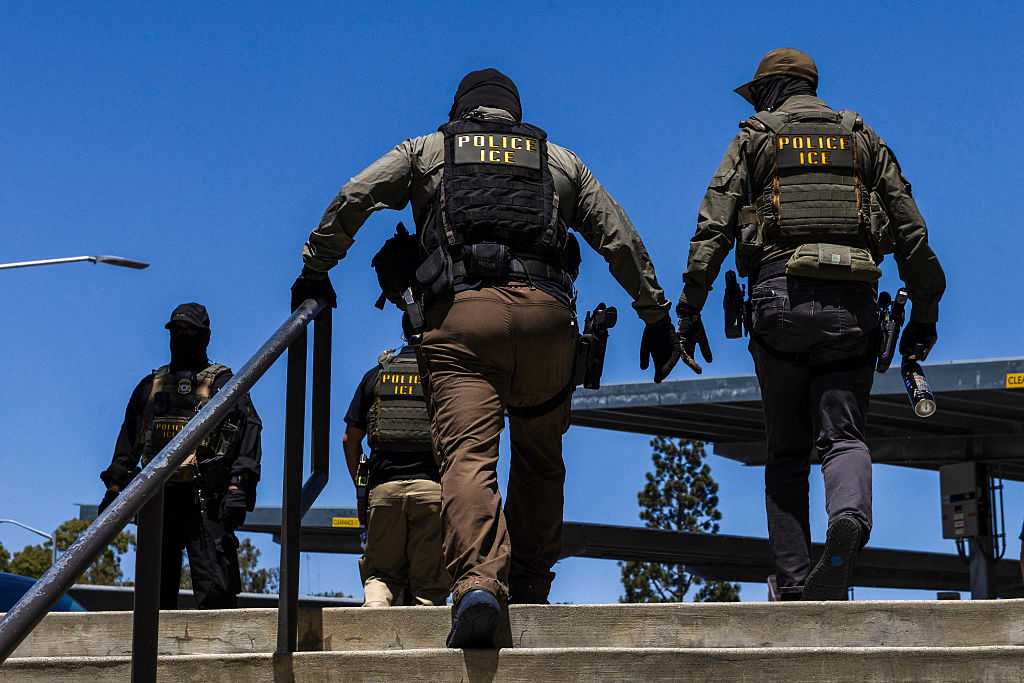
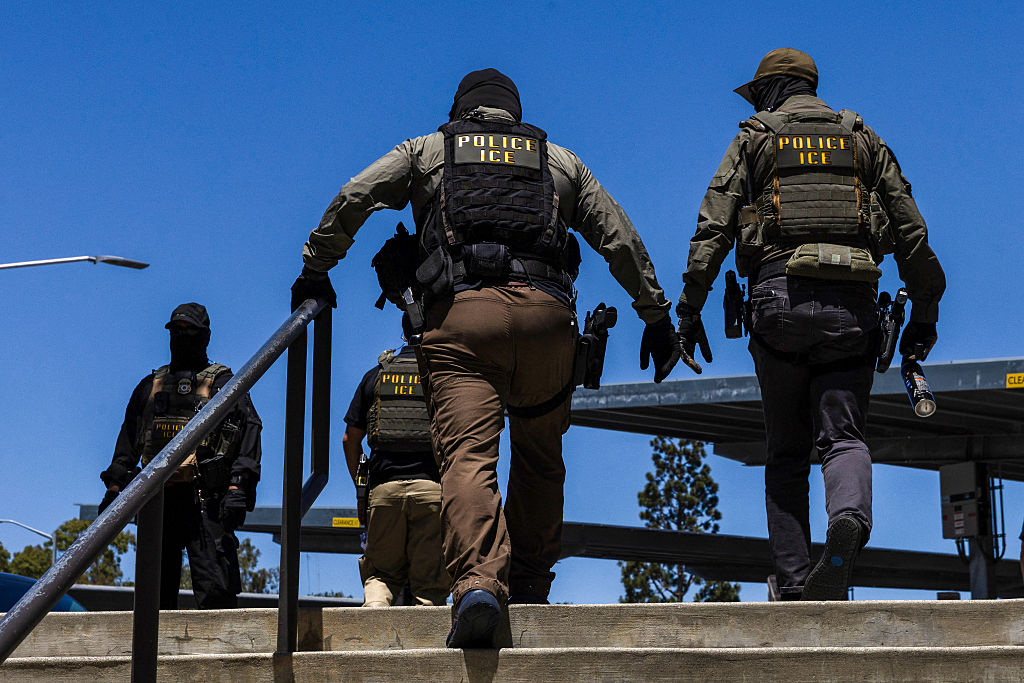
Within the span of just six days, immigration enforcement agents fatally shot two more people, Lorenzo Salgado Araujo in Texas and Johan Sebastián Durán Guerrero in Maine. Their deaths are not an aberration, they’re an indictment: President Donald Trump’s mass deportation machine is deadly and wreaks havoc on American streets every day.
Juiced by tens of billions in funding from Congress, the Trump Administration has amassed thousands of law enforcement personnel and deployed them in a nationwide “surge”—with a public mandate to deport one million people per year, regardless of the chaos their actions cause in American streets. These latest shootings, which Immigrations and Customs Enforcement (ICE) now admits took the lives of people who weren’t even their intended targets, reveal the sloppy, reckless, and cruel results of the Trump Administration’s unprecedented arrest escalation.
The New York Times reports that six other people have been fatally shot by Immigration and Customs Enforcement (ICE) since the start of President Trump’s second term, as the agency pursues aggressive arrest quotas. Without change, this pattern of reckless enforcement threatens to become the go-to playbook for immigration enforcement for years to come.
A new report from the ACLU only provides more clarity on ICE’s track record of lawlessness, as ICE and the agents working for it are operating under new norms that put people in danger, undermine our basic freedoms, and are already changing the nature of American life for the worse. Through a detailed accounting of more than 1,200 enforcement incidents across eight states in 2025, the report found that immigration agents routinely used violence and the threat of physical force against those they encountered to compel immediate obedience to their commands, not because they faced serious threats to their own safety.
Our report identifies 418 times agents shoved, tackled, or pinned people; 76 times they pulled people from cars; 130 times they brandished weapons and 69 times, they verbally threatened to use weapons or force; 361 times they pepper-sprayed or used other chemical irritants on people; and 81 times they used tactics so dangerous that they’re sharply prohibited by many law enforcement agencies because they’re deadly, such as chokeholds and grabbing people by the neck.
When armed officers begin encounters with force as a default tactic, it puts lives at risk. A minor stop, confusion, or an attempt to drive away can become deadly in seconds. Injury and death are not just accidents—they are risks created by the method of enforcement itself. The dangers have only magnified as immigration agents moved their operations into the spaces of everyday public life—where people live, work, commute and go to school—exposing anyone who may happen to be in the vicinity to the disruption and violence. For instance, children are often caught in the cross-hairs. We identified more than 200 who were detained or subjected to law enforcement misconduct, including 32 U.S. citizen children.
In this way, violent immigration enforcement isn’t just a threat to public safety, it’s a threat to the very cornerstone of our democracy. Research from the ACLU identified 782 people who were watching, documenting, protesting, or otherwise bearing witness and were targeted, detained, or subject to law enforcement misconduct. This, we determine, is an attack on the First Amendment, effectively suppresses free speech, and threatens to roll back civil liberties.
These findings should worry all Americans. The Trump Administration has turned the nation’s largest federal law enforcement agencies into a kind of paramilitary force, threatening the rights and safety of communities across the country. In the brutal and swift pursuit of its ambition to achieve 100 million deportations—approaching a third of our nation’s population—this deportation force has fundamentally reshaped American life.
The White House should de-escalate its enforcement surge. But without serious, lasting reform, everyday places will remain danger zones for immigrants and U.S. citizens alike, and deaths and serious injuries will continue. It’s time to replace ICE, an agency that was conceived about a quarter century ago and has proven reckless and unaccountable, with a new system designed to manage immigration effectively. We must bring our neighbors and loved ones out of the shadows, and on a path to citizenship and to undisputed, full protection under our laws. This new agency should be charged with a mission to keep families together, support all our communities to thrive, and uphold our rights—not attack them.
Mr. Salgado Araujo and Mr. Durán Guerrero are not the first people to be killed by ICE agents, but they must be the last.


MetaMask has launched Agent Wallet, a self-custodial product that lets AI agents execute on-chain transactions while operating within limits set by users.
Summary
- Agent Wallet supports autonomous transactions across EVM-compatible networks and Hyperliquid.
- Users can impose spending caps, protocol restrictions, and risk settings before an agent begins operating.
- Eligible transactions receive up to $10,000 in monthly Transaction Protection, subject to MetaMask’s terms.
- The wallet supports AI development tools including Claude Code, Codex, Cursor and OpenClaw.
MetaMask Agent Wallet gives AI agents controlled access
MetaMask announced the wider launch of Agent Wallet on Thursday after introducing the product to roughly 200 early-access users in June.
The wallet targets traders and developers who use AI agents to monitor markets, identify opportunities and execute on-chain strategies. Supported activities include token swaps, perpetual futures trading, prediction market positions and liquidity provisioning.
Agent Wallet works with Claude Code, Codex, Cursor, OpenClaw, Hermes and OpenCode. Users can deploy agents across Hyperliquid and supported Ethereum Virtual Machine networks, according to MetaMask.
Unlike systems that give an AI model unrestricted wallet access, Agent Wallet lets users establish rules before funding the account. These include daily spending limits, approved protocols and broader risk preferences.
“This security-first model is why Agent Wallet is built around rules, not blind delegation,” MetaMask said. “The agent can act, but it acts inside the user’s boundaries.”
Users remain in control of their private keys and can export their secret recovery phrase, preserving the wallet’s self-custodial structure.
Guard Mode and Beast Mode offer different controls
Agent Wallet includes two operating settings based on how much autonomy a user wants to give an AI system.
Guard Mode is the default option. Transactions that exceed spending limits, interact with unapproved protocols, or violate another wallet policy pause for human approval through two-factor authentication. Users can review and approve the request through MetaMask Mobile or an email link.
Beast Mode reduces the number of approval interruptions for experienced traders and developers. Security checks remain active, while transactions identified as potentially malicious still require human authorization.
The wallet also uses gas abstraction. Agents can transfer or swap tokens without holding the network’s native asset to cover transaction fees. MetaMask instead settles the fee using the asset being moved.
“Agents can transfer and swap without holding a chain’s native token for gas; MetaMask settles the network fee in the token being moved.”
Transaction protection covers eligible losses up to $10K
Supported EVM transactions pass through simulation, threat scanning, and MetaMask’s Smart Transactions protection against maximal extractable value risks before reaching the blockchain.
Transactions that clear these checks may qualify for up to $10,000 in Transaction Protection coverage per month if they still result in a loss. The protection is subject to eligibility requirements and does not mean every trading loss, failed strategy, or unsupported transaction will receive reimbursement.
The distinction matters because autonomous trading remains exposed to market volatility, smart-contract failures, and incorrect instructions. Wallet-level limits can restrict what an agent is authorized to do, but they cannot eliminate every financial or technical risk.
MetaMask said the system is designed to prevent AI agents from overriding user policies, reducing reliance on the agent interpreting each instruction correctly.
MetaMask joins the race for AI-powered finance
The launch places MetaMask in competition with other crypto companies developing payment and trading infrastructure for autonomous software.
U.S.-based Coinbase introduced Agentic Wallets in February, giving AI systems programmable tools to spend, earn, and trade with built-in guardrails. MoonPay has also expanded MoonAgents, including a Telegram-based interface for managing crypto through natural-language commands.
Agent Wallet also extends MetaMask’s move beyond a standard browser wallet. In June, the company launched Money Account, a self-custodial account built around mUSD that combines variable DeFi yield, trading and card spending through one balance.
MetaMask has not introduced a native token alongside Agent Wallet. Adoption will instead depend on whether traders and developers are willing to give autonomous systems limited authority over real on-chain capital.


Three circuit judges disputed the former FTX CEO’s claims that the defunct crypto exchange’s investors could have been made whole and wouldn’t have experienced any losses.
Crypto World
a16z's Miles Jennings Says Banks Fighting the CLARITY Act Are 'Accelerating Their Own Obsolescence'
a16z crypto policy head Miles Jennings argued on X on Thursday that the banking industry's campaign against the CLARITY Act will backfire, because blocking the bill leaves in place the stablecoin yield arrangement banks have lobbied hardest to stop. "The bewildering thing about TradFi's extreme… Read the full story at The Defiant

Minor damage was observed on the aircraft after it landed in Hanover, the capital city of Lower Saxony, Germany.
The southern runway at Leipzig/Halle reopened on Wednesday at 6:46 p.m, local time, an airport spokesperson told TIME, adding that “flight operations have been running without restrictions” since then.
What have German officials said about the incident?
Dobrindt said Germany’s authorities are investigating what appears to be “a professional” explosive device. “We are not dealing with amateurs, but with professional actors,” he stated.
Saxony’s Interior Minister Armin Schuster told ZDF he would describe the incident as “a suspected attack scenario, because this is the first time we’ve had a drone that was also loaded with explosives.”
German authorities have stated that the perpetrators of the incident at the airport have not yet been identified.
Roderich Kiesewetter, a member of the German Bundestag, said he is “assuming” the incident was a “targeted attack attempt directed by Russia” and suggested Germany “initiate Article 4 consultations in NATO.”


As a lifelong lover of reptiles, Eric Goode has known about the world of exotic reptile smuggling for decades. “I didn’t become acutely aware of the criminality of it until probably into the late ‘80s,” says the director of Tiger King and Chimp Crazy ahead of his latest documentary, another foray into wildlife crime, Monsters of God. The five-episode HBO series is Goode’s most ambitious project to date, surveying the explosion of endangered reptiles trafficked into the country in Florida from the 1970s until today. The series guides us through the web of feuding smugglers and law enforcement crackdowns that connect the Sunshine State to the fauna of Madagascar, Indonesia, Malaysia, and many more countries.
Through remarkable archival footage and an incredible range of interviews, Monsters of God digs into the egotistical and ruthless mentalities that supported competing criminal empires and the undercover operations that dismantled them. The series points a finger at animal lovers who felt uniquely connected to exotic creatures while also treating them as a commodity to be exploited and abused.
“We were really intentional about not making it a traditional true crime doc,” says Jeremy McBride, an executive producer on the series. “It’s really a portrait of how obsession drives people to get the rarest of the rare, no different than the pathology of people collecting baseball cards, or stamps, or rare coins.” There is one difference: baseball cards can’t bite.

The introduction to Monsters of God’s stolen world
Monsters of God’s first episode, airing Aug. 6, ushers us into the world of reptile smuggling through a major rivalry: Tommy Crutchfield and Hank Molt. Based in Philadelphia, Molt’s obsession with exotic climates and wildlife led him to search the world for exotic reptiles in the 1960s and sell them from his newly acquired Pennsylvania pet store. Molt is considered a crucial figure in the growth of reptile houses in American zoos, which at the time were a rare attraction. He prepared and distributed a price list of rare reptiles—including snakes, turtles, lizards—and sold them to a wide variety of eager customers and competitive zoos. Molt often carried them into the country in suitcases, easily circumventing the relatively lax customs regulations. When the Endangered Species Act came into effect in 1973, Molt’s smuggling business boomed—declaring a reptile species as “endangered” also meant it was rarer and more valuable, allowing Molt to fetch a higher price.
In Molt’s view, Crutchfield rode his coattails. Crutchfield is a Florida native whose introduction to the reptile business began in high school capturing snakes for the “Snake-a-torium” in Panama City Beach. As the smuggling market grew, Crutchfield graduated to the big leagues by mimicking Molt’s established business plan, selling smuggled reptiles to collectors, pet owners, and zoos. Crutchfield and Molt’s rivalry is explored in the book Stolen World by Jennie Erin Smith—like Monsters of God’s first episode, the author uses the two men as a window into how smuggling has fuelled the popularity of reptiles in modern America.
Crutchfield is also a certified braggadocio, at one point referring to himself as “John Dilligenger, Bonnie and Clyde all wrapped up in one”. But it’s true that his criminal activities attracted serious heat—in 1997, the threat of his third round of criminal charges as part of the United States Fish and Wildlife Service (USFWS) five-year-long “Operation Chameleon” made Crutchfield flee to Belize.
When Molt went to prison at the tail end of the 1970s, Crutchfield took his place at the top of the food chain—something his former mentor resented when he was released. According to Maria Palladini, former special agent for the Fish and Wildlife Service, Molt had a habit of taking couriers and dealers under his wing only to betray them. While Crutchfield’s business was soon dominating Molt’s—raking in millions in reptile sales and trades every year—his reckless spending and imports soon put him squarely in the Feds’ crosshairs.
In 1995, Crutchfield asked Molt to help hide an import of endangered Fiji Island iguanas so they weren’t discovered by the Fish and Wildlife Service. Molt agreed—and according to Crutchfield, Molt took his revenge by killing the iguanas. (Molt denies causing them harm.) When USFWS informed Molt he was being charged along with Crutchfield, Molt handed over the dead iguanas and cut a deal to avoid being charged. Crutchfield pled guilty—his second of three criminal convictions in the ‘90s—and cut all ties with Molt.

Monsters of God’s wider gallery of rogues
Don’t expect Tommy and Hank to lead every episode of Monsters of God. Rather than zeroing in on one unstable dynamic like Goode did in Tiger King and Chimp Crazy, Monsters of God expands its scope to the entire reptile trafficking ecosystem throughout the ‘80s and ‘90s.
“This was more of a history lesson about the reptile trade in the United States, so it was a very different kind of storytelling—much more nuanced and complex,” says Goode. “We also really wanted to make sure that we got all sides of the story: law enforcement, the big zoos that were complicit, the reptile dealers, the consumers. It was a global story.”
Subsequent episodes reveal who defined Florida’s exotic reptile trade. Ray Van Nostrand, a New York-born collector and seller who moved to Florida in the ‘70s, took advantage of the power vacuum left by Crutchfield and Molt and smuggled huge quantities of illegal reptiles into the country. His son Mike—one of Monsters of God’s most memorably cantankerous interviewees—took over with a legal, legitimate reptile selling business, euphemistically named “Strictly Reptiles,” until he too was tempted by smuggling’s illicit rewards.
But this went way bigger than just reptiles. Ray was in business with returning Tiger King character Mario Tabraue, a “Cocaine Cowboy” druglord with his own exotic animal sanctuary who would smuggle both reptiles and drugs into Florida in the same shipments. On the other side of the law is former DEA agent Larry Loveless and USFWS special agents George Morrison and Ken McCloud, whose respective “Operation Cobra” and “Operation Chameleon” form a clear dramatic backbone to two episodes.
But all these smugglers pale in comparison to Anson Wong, a Malaysian smuggler who was dubbed the “Pablo Escobar of animal trafficking.” Wong had been smuggling illegal animals and products through his export company based in Penang since the ‘80s and gained a reputation as an incredibly elusive and dangerous figure. Wong haunts the stories of the Floridian smugglers, connected to many of the feuds and undercover operations. He emerged as the thread on Goode’s evidence board, tying together the pieces of the director’s most complex documentary so far.
“We had over 174 interviews. We had 1,500 hours of footage. We had Eric’s personal archive and research. We needed a pace that could get people through it, we needed this propulsion, and Eric’s quest trying to get to Anson Wong is that propulsion. Anson Wong is this sort of throughline in all of our characters’ stories, like Keyser Söze,” says McBride.

Monsters of God was a different beast to produce
Each episode of Monsters of God is packed with talking heads who talk candidly about their criminal exploits and feuds, but that doesn’t mean it was easy to get them all to talk—compared Joe Exotic and Tonia Haddix, the subjects of Tiger King and Chimp Crazy, the reptile community is far more paranoid. “Joe and Tonia were unique in that way, where they just wanted to be peacocks. They desperately wanted the attention. The reptile world, for the most part, is much more guarded,” says Goode.
While some people had ongoing charges and declined to speak until their cases were adjudicated, others had already been convicted and were willing to talk because double jeopardy protected them from being charged a second time. Others were happy to put everything on the table. “Hank Molt was proud that he could smuggle the way he did, he enjoyed circumventing the laws, and he liked that there were laws because it made it more of a challenge, like Catch Me If You Can with Leonardo DiCaprio,” explains Goode.
In Tiger King and Chimp Crazy, the wildlife crimes spiralled out of control while cameras were rolling. “The story unraveled contemporaneously with the filming, so we didn’t know that Joe Exotic was going to try to kill Carol Baskin, that he would get arrested and go to prison. We just happened to be filming different people, and then they all intersected in real time,” says Goode. By contrast, Monsters of God is interested in how the present was shaped by history, so it’s exclusively concerned with reconstructing the past.
The sheer breadth of the material meant that, according to McBride, the shape of each episode wasn’t clear at first, leading them to evolve their true crime storytelling. “What makes this series so distinctive is this psychological character study and this high-stakes true crime documentary, and within all of that, you have this chronology that we analyze with bigger themes involving the extinction crisis and our impact on this planet,” says McBride. “We wanted to draw these big ideas to an everyday person and how it touches their life, how this world overlaps with culture and criminality in a way that a lot of shows don’t touch on.”

The beating heart of Monsters of God
“This story for me is deeply personal,” Goode says in voiceover at the beginning of the series. “I was part of the problem.” But he was definitely the right man for the job: while Goode used to buy reptiles from shady dealers, he had turned a new page by 2003, when he co-founded The Turtle Conservancy to protect the many species of turtles who risk extinction from poachers and smugglers. His reptile expertise made him the ideal filmmaker to handle the cautious and shifty characters wary of appearing on camera—as Goode says, “I can speak their language about reptiles very fluently.” He knows the history of exotic animal collections and menageries in America and Europe, and the hypocrisy displayed by the subjects of Monsters of God—on both sides of the law—infuriates him.
Monsters of God expands on a theme from Goode’s previous docs—that a cultural obsession with rare animals leads to rampant commodification that exploits wildlife, encouraging animal lovers to embrace becoming consumers in a violent and exploitative transaction. Although Monsters of God looks to history, Goode isn’t convinced enough has been done to stop wildlife from being commodified. “It’s become more popular because of pop culture. Films like Jurassic Park can trigger these things. Finding Nemo—everyone wanted to buy a clownfish. Or Harry Potter. When I went to Southeast Asia, all the bird markets in Jakarta had baby owls everywhere. Hopefully this show doesn’t fuel interest in reptiles and bring in more illegal animals.”

The world’s largest cryptocurrency exchange will conduct a major scheduled upgrade on Saturday that will pause certain trading activities.
The second major statement from the firm outlined the delisting of numerous trading pairs, one even against BTC.
An Upgrade and Delistings
Binance revealed that it will temporarily halt US stock trading on the platform on August 8 due to a scheduled system upgrade carried out by a partner broker. The process is set to be completed in approximately three hours, and during this period, users will not be able to access such services.
The company has the habit of briefly pausing operations to support certain improvements. Not long ago, it performed wallet maintenance for the Tron Network, making TRX deposits and withdrawals unavailable for about an hour. It also supported a Zcash hard fork, temporarily suspending ZEC deposits and withdrawals.
Binance also regularly checks all listed spot trading pairs available on its platform and scraps those that no longer meet important criteria like adequate liquidity and volume. Based on its latest analysis, it will delist QNT/BTC, RPL/USDC, SIGN/BNB, and SKL/USDC on August 7.
“The delisting of a spot trading pair does not affect the availability of the tokens on Binance Spot. Users can still trade the spot trading pair’s base and quote assets on other trading pair(s) that are available on Binance,” it clarified.
The Previous Announcement
The aforementioned disclosure did not cause a significant decline in the involved cryptocurrencies, which is rather normal, as such a reaction is usually witnessed in the event of a total delisting. Being the leading crypto exchange, withdrawing support from Binance leads to reduced availability, thinner liquidity, and reputational damage.
Earlier this month, Binance said goodbye to Across Protocol (ACX), Hashflow (HFT), PIVX (PIVX), Vulcan Forged PYR (PYR), Vanar (VANRY), and Viction (VIC), and their prices headed south by double digits.
Prior to that, the company terminated all services with Alchemix (ALCX), Ardor (ARDR), NFPrompt Token (NFP), and Marlin (POND), triggering a similar collapse for the affected tokens.
The post Binance Pauses Services and Delists Several Crypto Pairs: Who Is Affected? appeared first on CryptoPotato.
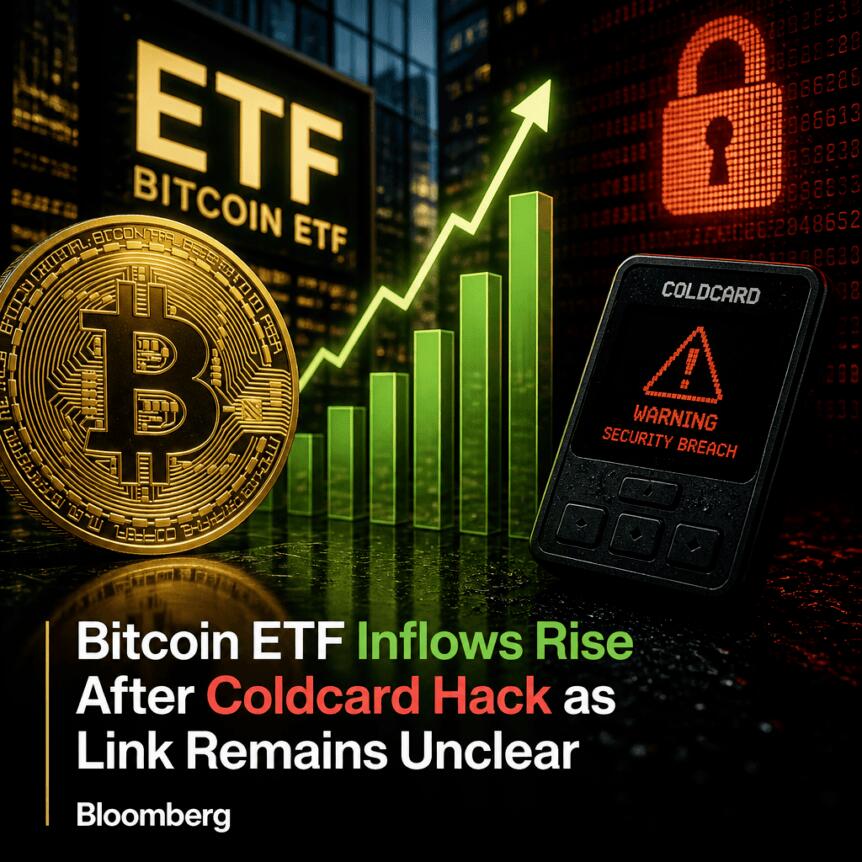
Demand for US spot Bitcoin exchange-traded funds (ETFs) picked up over the past week, according to Bloomberg ETF analyst Eric Balchunas, with multiple products posting inflows on every trading day since the Coldcard wallet exploit. The timing has sparked fresh discussion about whether some investors are reassessing the risks of self-custody.
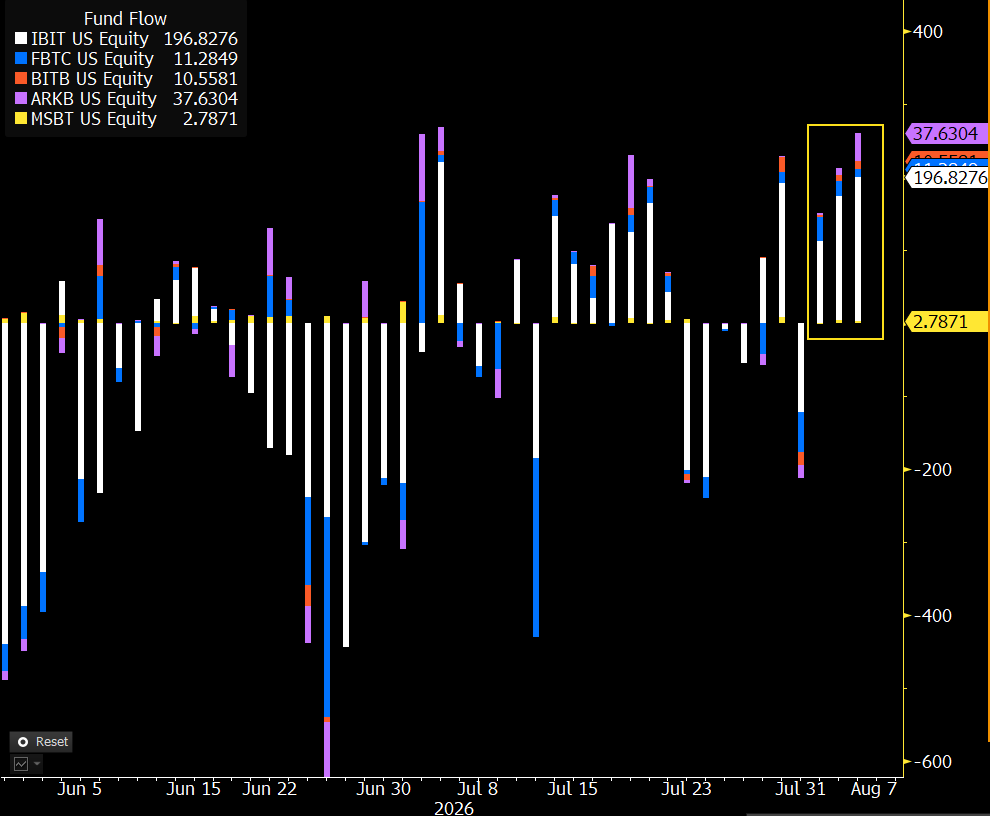
Balchunas said that BlackRock’s iShares Bitcoin Trust (IBIT), Fidelity’s Fidelity Wise Origin Bitcoin Fund (FBTC), Bitwise’s Bitcoin ETF (BITB), ARK 21Shares’ Bitcoin ETF (ARKB), and Defiance Daily Target 2X Long MSTR ETF (MSBT) all recorded inflows every day since the weekend breach. The combined total was roughly $620 million, aligning with Cointelegraph’s earlier reporting on an ETF inflow streak.
Key takeaways
- Bloomberg’s Eric Balchunas attributes the latest run of daily inflows (about $620 million) to several major spot Bitcoin ETFs starting after the Coldcard exploit.
- TRM Labs estimates the Coldcard attack drained more than $116 million in Bitcoin from over 5,200 wallet addresses.
- Balchunas cautioned that a direct connection between the hack and ETF buying is unproven, but acknowledged some investors may be shifting toward regulated custody.
- Industry figures including Binance co-founder Changpeng Zhao argued that, based on available data, exchange custody may be “statistically safer” than self-custody—though underreporting remains a concern.
- Broader security debates are intensifying as AI-assisted exploits accelerate the pace at which vulnerabilities are identified and attacked.
Spot Bitcoin ETFs see daily inflow streak after Coldcard exploit
In his update shared on X, Balchunas highlighted a multi-day pattern of inflows across several leading spot Bitcoin ETFs. The list included large, established issuers (including BlackRock and Fidelity) as well as other active fund providers. Per Balchunas, inflows have continued every trading day since the weekend of the Coldcard exploit, with the group’s cumulative figure landing at roughly $620 million.
Cointelegraph previously reported on the continuation of a Bitcoin ETF inflow streak, noting that the latest totals were consistent with that trend. Together, the data suggest that recent capital flows have been persistent rather than limited to a single “reaction” day after the incident.
Still, Balchunas explicitly framed the connection as speculative. “I’m not saying it’s connected, we just don’t know,” he wrote, while adding that over the long term he can’t imagine there aren’t investors who choose to migrate away from self-custody after incidents like this.
Coldcard hack highlights exposure even for hardware wallet users
The renewed self-custody debate traces back to the Coldcard wallet exploit. Cointelegraph reported that the incident involved an attack against the Coldcard ecosystem, draining more than $116 million worth of Bitcoin from over 5,200 wallet addresses, according to blockchain intelligence firm TRM Labs.
For many participants in the market, hardware wallets are viewed as a last line of defense—designed to keep private keys offline and reduce the risk of direct theft through compromised online environments. However, the Coldcard incident underscored that end-to-end security still depends on firmware integrity and operational handling, and that even users of advanced self-custody tools may be vulnerable if software components are compromised.
Self-custody vs regulated custody: CZ’s “statistically safer” argument
The Coldcard hack fed into a longer-running argument about the relative risks of self-custody and centralized exchange (CEX) custody. Binance co-founder Changpeng “CZ” Zhao weighed in, suggesting that storing crypto on centralized exchanges could now be “statistically safer” than self-custody.
Zhao pointed to analysis by Willy Woo, claiming that cumulative Bitcoin losses from self-custody incidents have surpassed losses from exchange hacks. In his X post, Zhao also argued that differences in reporting make direct comparisons difficult: “Hack data is easier to collect on the CEX side, usually major news. It is harder on the self-custody side, where hacks, lost coins, etc are often not reported.”
That framing matters for investors because it shifts the conversation from a purely technical question (“Which custody model is more secure?”) to an evidentiary one (“Which system’s failures are more visible and therefore easier to measure?”). Until self-custody incidents are tracked with the same completeness as major exchange events, any conclusion about relative safety remains inherently asymmetric.
Security pressure is mounting as AI-assisted attacks evolve
Beyond the Coldcard case, the broader cyber threat landscape is intensifying. Cointelegraph earlier reported that on Monday, Bitcoin swap service Boltz suspended its non-custodial bridge after citing a steady rise in AI-assisted exploits. The service said attackers were using artificial intelligence to identify and exploit vulnerabilities faster than its team could patch them.
While that suspension does not confirm a direct link to the Coldcard incident, it reinforces a common theme across current security discussions: defenders face a faster and more adaptive attack cycle. For ordinary users, this can translate into a growing sense that the gap between “known risks” and “unknown vulnerabilities” is narrowing.
For ETF investors, the implication is more indirect but still important. Regulated investment products typically centralize custody with institutional providers and established operational controls, meaning some risks are moved away from individual users and into broader compliance and security frameworks. Whether that results in higher safety in practice is difficult to quantify, but the market’s recent capital flows suggest that at least some investors are paying close attention to custody trade-offs after high-profile self-custody failures.
Going forward, readers should watch whether the daily inflow pattern persists beyond the immediate post-incident window, and whether additional analysis clarifies how (or if) the Coldcard exploit influenced investor behavior. The key open question is whether the ETF buying reflects a short-term narrative shift or a longer-term reallocation toward regulated custody.
Demand for US spot Bitcoin exchange-traded funds (ETFs) has accelerated over the past week, with a string of daily inflows coinciding with the Coldcard wallet hack — timing that has prompted speculation about whether some investors are reconsidering self-custody.
According to Bloomberg senior ETF analyst Eric Balchunas, BlackRock’s iShares Bitcoin Trust (IBIT), Fidelity Wise Origin Bitcoin Fund (FBTC), Bitwise Bitcoin ETF (BITB), ARK 21Shares Bitcoin ETF (ARKB) as well as Defiance Daily Target 2X Long MSTR ETF (MSBT) have recorded inflows every trading day since the weekend exploit, totaling roughly $620 million. The cumulative figure is consistent with Cointelegraph’s recent reporting on the ETF inflow streak.
The Coldcard exploit drained more than $116 million worth of Bitcoin from over 5,200 wallet addresses, according to blockchain intelligence firm TRM Labs.
“I’m not saying it’s connected, we just don’t know,” Balchunas said in a post on X. “[Although] long-term I can’t imagine there aren’t some who migrate over.”
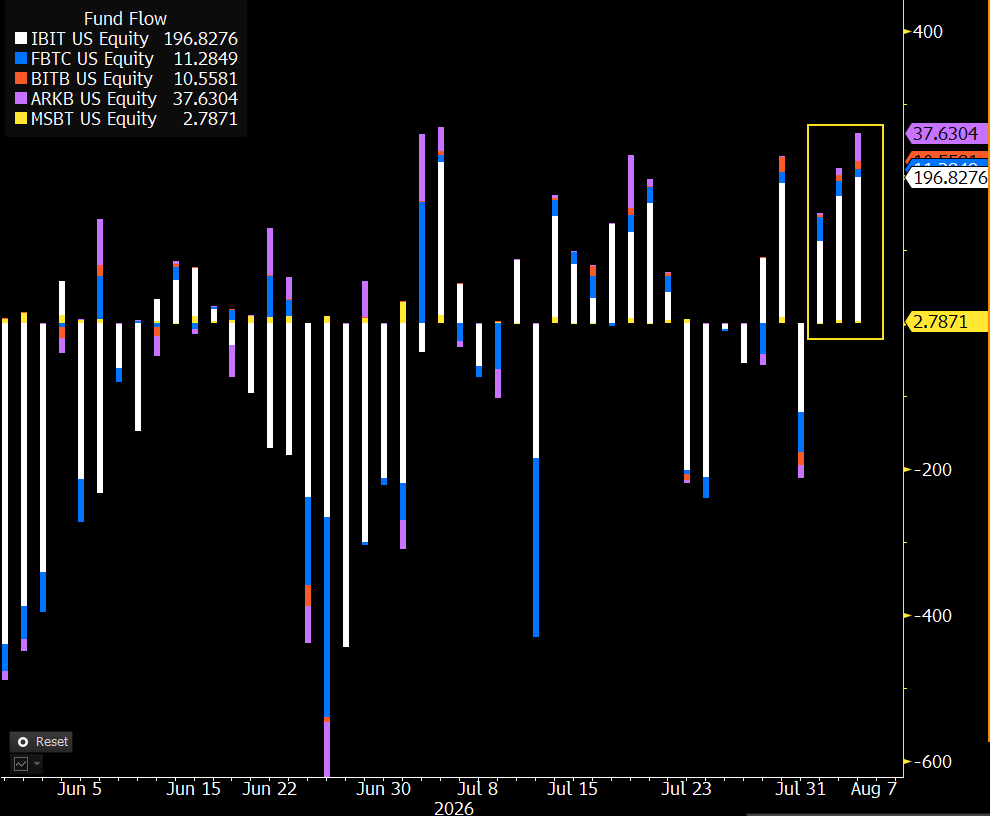
Source: Eric Balchunas
Related: Bitcoin Red Team reports 5K findings in sweeping security audit
Coldcard exploit renews debate over self-custody risks
The Coldcard hack renewed concerns that even hardware wallet users can be exposed to firmware flaws and software vulnerabilities, highlighting the operational risks that come with self-custody.
The incident also reignited debate over the trade-offs between holding Bitcoin directly and gaining exposure through regulated investment products such as spot Bitcoin ETFs, where asset custody and security are handled by institutional providers.
Binance co-founder Changpeng “CZ” Zhao also weighed in on the debate, arguing that storing crypto on centralized exchanges may now be “statistically safer” than self-custody, citing data from analyst Willy Woo that cumulative Bitcoin losses from self-custody incidents have surpassed those from exchange hacks.
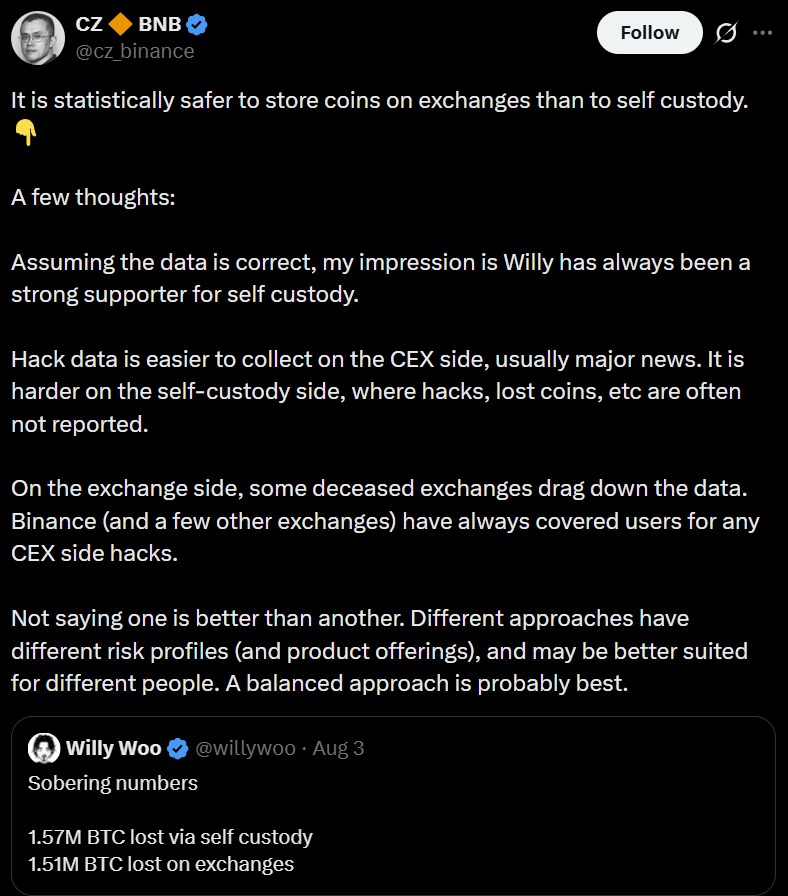
Source: Changpeng Zhao
“Hack data is easier to collect on the CEX side, usually major news. It is harder on the self-custody side, where hacks, lost coins, etc are often not reported,” CZ said.
The debate comes as AI-assisted cyberattacks are becoming increasingly sophisticated. On Monday, Bitcoin swap service Boltz suspended its non-custodial bridge, citing a steady rise in AI-assisted exploits that were allowing attackers to identify and exploit vulnerabilities faster than its team could patch them.
Magazine: Do the Coldcard attacks mean all hardware wallets are now insecure?

Trump’s Oval Office Stunt COLLAPSES As Disastrous Financial Truth Surfaces

Wales breaking news plus weather and traffic updates (Thursday, August 6)
Bankers Are Betting on Supersize Bonuses This Year With Profits Surging


-

 Fashion6 days ago
Weekend Open Thread: Wit & Wisdom
-

 Politics6 days ago
Meta enters AI-training agreement with far-right ‘propaganda rag’ Newsmax
-

 Politics4 days ago
Zack Polanski: an incitement to murder Nigel Farage?
-

 Crypto World5 days ago
MicroStrategy Post-Earnings CLARITY Act Push Could Add New Catalyst for Its Stock
-

 Crypto World6 days ago
XRP Ledger v3.3.0 brings five institutional features
-

 Sports7 days ago
Seema Kaliramna Wins Discus Throw Bronze, Takes India’s CWG Medals Tally To 17
-

 Crypto World6 days ago
New York sues Kalshi over prediction market gambling
-

 Crypto World4 days ago
Crypto PAC spending tops $2M in Michigan House race
-

 Business4 days ago
DTCR: Deleveraging And A Hedge Fund Collapse Point To A Possible AI Bottom
-

 Business6 days ago
Trump Announces Hamas Disarmament Agreement as Iran Strikes Kuwait Air Base and US Attacks Pause Overnight
-
 Crypto World6 days ago
3 Fed Officials Just Explained Their Rate Hike Vote: Is Inflation Winning?
-

 Tech5 days ago
ESET tracks rise in malicious AI skills and adaptable malware
-

 Tech6 days ago
Gemini Spark can now use Chrome logins and saved passwords to run errands on your behalf
-

 Sports5 days ago
France Cricket implodes: letters hidden in a drawer and a board at war
-

 Tech6 days ago
Building A Reproduction PlayStation Motherboard
-
Crypto World4 days ago
XRP Ledger urges node upgrade after manifest flood
-

 Crypto World6 days ago
Moneyflip CEO charged in $40K murder-for-hire plot
-
 Sports6 days ago
Bruno Fernandes decision made as Man United ‘discuss’ striker transfer option
-

 News Videos5 days ago
Financial Crash Expert: The 90-Day Collapse Timeline They Are Desperately Hiding.
-

 NewsBeat7 days ago
Spain sending troops as thousands enter enclave of Ceuta from Morocco
You must be logged in to post a comment Login