
Crypto World
US Consumer Sentiment Hits Record Low as S&P 500 Stays Near Peak Levels


TLDR:
- US consumer sentiment fell to 47.6, marking its lowest level amid rising cost pressures
- The S&P 500 remains near highs, showing a sharp disconnect from household expectations
- Retail outlook weakens as discount chains report softer demand and cautious guidance
- Strong premium travel demand contrasts with declining confidence among lower-income groups
A widening gap between financial markets and household outlook is drawing attention across the United States. Equity benchmarks remain elevated, yet US consumer sentiment has dropped sharply, raising concerns about how long this divergence can persist without affecting broader economic stability.
Record Gap Between Markets and Households
Recent commentary shared by Global Markets Investor described an unusual disconnect between Wall Street performance and everyday financial expectations. The post noted that US consumer sentiment fell to 47.6 in April, marking a record low reading.
At the same time, the S&P 500 continues to trade near peak levels. This contrast places US consumer sentiment at levels seen during past recessions, while equities reflect continued optimism. The gap between the two indicators now stands at its widest point on record.
The update pointed to rising living costs as a key factor weighing on US consumer sentiment. Higher gas prices and persistent inflation continue to pressure lower-income households. These pressures have intensified following disruptions linked to the Strait of Hormuz closure.
Meanwhile, asset price growth has supported wealthier households. This trend has helped sustain equity valuations despite weakening US consumer sentiment. As a result, financial conditions vary sharply across income groups.
The same post indicated that more than a quarter of households expect their finances to worsen. This marks the highest level since May 2024. Such expectations further reflect declining US consumer sentiment across the country.
Diverging Spending Patterns and Economic Signals
Retail data shows early signs of strain among cost-conscious consumers. Discount chains have reported cautious outlooks, aligning with the drop in US consumer sentiment. Walmart issued measured guidance, while Dollar General noted softer expectations.
At the same time, spending patterns remain uneven. Premium travel and cruise bookings continue to perform well. This divergence suggests that higher-income consumers remain less affected by declining US consumer sentiment.
The contrast between retail segments reflects a broader economic divide. While some households maintain discretionary spending, others are scaling back. These shifts are closely tied to ongoing weakness in US consumer sentiment.
The US economy depends heavily on consumer activity. As US consumer sentiment weakens, questions arise about future demand. Market participants are watching whether reduced confidence will translate into lower spending levels.
Equity markets continue to price in a stable outcome. However, declining US consumer sentiment presents a different narrative. If household confidence continues to fall, corporate earnings could face pressure in the coming months.
This divergence leaves uncertainty about which trend will adjust. Either markets may reprice risk, or consumer conditions may stabilize. Until then, US consumer sentiment remains a key measure shaping expectations across sectors.



Metaplanet, a Tokyo-listed firm, has issued 8 billion Japanese yen in zero-interest ordinary bonds to EVO FUND, earmarking the proceeds for additional Bitcoin purchases, according to a Thursday filing. The bonds constitute the 20th series in Metaplanet’s ongoing program and mature in April 2027; they are unsecured, extending the company’s use of capital markets to expand what is already one of the largest corporate Bitcoin treasuries.
Under the terms disclosed, the bonds will be redeemed at par at maturity, with EVO FUND allowed to request early redemption with five business days’ notice. Metaplanet may also redeem part or all of the bonds if it completes future financings with the same investor. EVO FUND, a Cayman-based fund at the core of Evolution Financial Group, specializes in structured financings for digital-asset companies and is identified as the main subscriber to Metaplanet’s zero-interest bonds used for Bitcoin purchases.
The financing moves fit within Metaplanet’s broader Treasury-First approach, where the company leans on capital markets to grow its Bitcoin holdings rather than relying solely on operating cash flow. In the first quarter, Metaplanet disclosed it added 5,075 BTC, lifting its total to about 40,177 BTC and reinforcing its position as the third-largest publicly listed Bitcoin holder.
Market observers noted the development against a backdrop of volatility for crypto assets. Bitcoin has traded near $77,000 in recent sessions, while Metaplanet’s stock was down roughly 3.7% at the time of writing, according to Yahoo Finance data. The issuance also aligns Metaplanet with a broader narrative of publicly traded entities pursuing Bitcoin exposure through debt-financed buybacks and treasury management, a path that has drawn comparisons to a U.S. counterpart widely associated with similar balance-sheet strategies.
Key takeaways
- Metaplanet raises 8 billion JPY in zero‑interest ordinary bonds to fund more Bitcoin purchases; the issue is the 20th in its series and matures in April 2027.
- The bonds are unsecured and redeemable at par at maturity; EVO FUND can request early redemption with five business days’ notice; Metaplanet may redeem if it completes additional financings with the same investor.
- EVO FUND, a Cayman-based fund central to Evolution Financial Group, is the main subscriber backing Metaplanet’s zero-interest issuance for Bitcoin accumulation.
- The deal reinforces Metaplanet’s debt-fueled treasury expansion strategy, signaling ongoing capital-market activity beyond ordinary operating cash flow.
- Metaplanet’s Bitcoin holdings rose to about 40,177 BTC in Q1, cementing its place as the third-largest publicly listed Bitcoin holder; market reaction included a share-price dip alongside a BTC price around $77,000.
Debt-funded expansion of a Bitcoin treasury
The latest bond issuance underscores a deliberate, ongoing strategy: to grow a sizable BTC reserve by tapping structured finance channels rather than relying solely on cash generated from business operations. EVO FUND’s role as the primary subscriber highlights a specialized financing relationship that aligns the interests of a crypto-focused fund with a corporate treasuring approach. This arrangement allows Metaplanet to deploy capital for Bitcoin accumulation while keeping the terms of the financing relatively straightforward—zero coupon, par redemption at maturity, and potential early redemption tied to the investor’s options.
In the Japanese market context, Metaplanet’s approach sits alongside other Asian-listed entities that have pursued Bitcoin exposure through varied financing structures. The company’s Q1 update, which recorded a significant BTC addition, reinforces its place among a growing cohort of publicly traded firms seeking to diversify treasuries with Bitcoin as a potential long-hold asset. While the macro environment remains volatile, the accumulation pace suggests management continues to view Bitcoin as a strategic reserve rather than a tradeable instrument.
Bond terms, investor role, and financial impact
From a structural standpoint, the bonds’ terms are straightforward: redeemable at par at maturity, with EVO FUND entitled to request early redemption after five business days’ notice. Metaplanet reserves the right to redeem all or part of the issue if it completes future financings with the same investor. Such provisions provide a transparent mechanism for liquidity management and potential reassessment of the financing arrangement as the company’s Bitcoin treasury evolves.
The company described the bond sale as unlikely to meaningfully affect consolidated results for fiscal 2026. However, it noted that if the issuance or related activities yield any material financial impact, Metaplanet would provide an update. This stance reflects a cautious balance between pursuing aggressive Bitcoin accumulation and maintaining visibility over reported earnings and capital structure.
Market context and what comes next
Metaplanet’s ongoing financing approach mirrors a well-known pattern in the sector: using equity and debt markets to scale a Bitcoin treasury. The dynamic has drawn frequent comparisons to MicroStrategy’s balance-sheet framework, illustrating a broader, cross-regional strategy of corporate treasury management in the crypto era. For investors, the key question is how such financings influence risk, balance-sheet resilience, and long-term exposure to Bitcoin’s price trajectory, particularly as macro conditions and regulatory scrutiny evolve.
Looking ahead, observers will watch whether Metaplanet continues to tap similar financing arrangements with EVO FUND or opens access to new partners as its Bitcoin holdings climb. The durability of this approach will depend on market liquidity for the bonds, Bitcoin’s price path, and any regulatory shifts in Japan or globally that could affect corporate treasury strategies in crypto assets.
In the meantime, Metaplanet’s latest filing reinforces a concrete, ongoing effort to grow a substantial Bitcoin reserve, using structured funding to support asset accumulation while maintaining a disciplined approach to debt and liquidity. The balance between aggressive accumulation and financial prudence will be the story to watch as the year unfolds.
Readers should keep an eye on any subsequent filings or disclosures that detail the ongoing impact of these issuances on Metaplanet’s earnings, as well as the evolution of its Bitcoin holdings in the context of a fluctuating crypto market.
References and related coverage: According to the filing, Metaplanet issued 8 billion JPY in zero-interest bonds to EVO FUND; the company’s Q1 update noted an addition of 5,075 BTC to bring holdings to about 40,177 BTC. EVO FUND is a Cayman-based fund central to Evolution Financial Group; market data cited by Yahoo Finance shows the stock price movement around the issue date. For broader context on similar treasury strategies, see prior coverage comparing such approaches to notable U.S. benchmarks in the sector.

Key Highlights
- First-quarter earnings decreased 6% year-over-year to $752 million (50 cents per share) versus $797 million in the prior year
- Geopolitical tensions in the Middle East compelled operational pullbacks in several nations
- Quarterly revenue climbed 2.7% to $8.72 billion, surpassing Wall Street projections of $8.63 billion
- Adjusted earnings per share reached 52 cents, marginally exceeding the 51-cent analyst consensus
- Adjusted EBITDA contracted 12% to $1.77 billion; company withheld annual guidance
Shares of SLB tumbled 3.7% during Friday’s premarket session following the oilfield services provider’s announcement of diminished first-quarter earnings, as escalating Middle East tensions significantly disrupted business activities.
Chief Executive Olivier Le Peuch characterized the period as “a challenging start to the year,” noting that customer-directed demobilizations were implemented to safeguard workers and infrastructure across multiple territories.
Quarterly net earnings slipped 6% compared to the same period last year, settling at $752 million, equivalent to 50 cents per diluted share. This marked a decline from the $797 million, or 58 cents per share, recorded in the first quarter of 2025.
When adjusted for one-time items, earnings per share registered at 52 cents—narrowly surpassing the Street’s 51-cent projection, based on FactSet consensus data.
The company’s top line expanded 2.7% to $8.72 billion, outperforming analyst expectations of $8.63 billion. Despite the revenue upside, investor focus shifted to profitability concerns.
Adjusted EBITDA tumbled 12% to $1.77 billion, a metric widely viewed as the primary catalyst behind the premarket selloff.
Regional Performance: North America Strength Versus International Weakness
Revenue from North American operations surged 26% to $2.17 billion, delivering a notable bright spot amid broader headwinds.
Conversely, international revenue declined 3.8% to $6.47 billion—a direct consequence of Middle East-related operational disruptions affecting the company’s expansive global presence.
Management indicated that the well construction and reservoir performance segments bore the brunt of conflict-driven challenges.
SLB opted not to provide full-year financial projections. However, the firm reiterated its 2026 capital expenditure plan of $2.5 billion, representing a modest increase from the $2.4 billion deployed in 2025.
Leadership Anticipates Industry Rebound by 2027
Le Peuch noted that ongoing regional instability has “accelerated” the global rebalancing of liquid hydrocarbon supply and demand dynamics while highlighting critical weaknesses in energy infrastructure resilience.
He anticipates that nations will shift focus toward supply chain diversification and domestic resource cultivation once geopolitical stability returns.
The CEO also projected increased capital allocation toward short-cycle drilling programs across North America and Latin America, alongside expanded deepwater offshore initiatives.
“Absent a prolonged conflict leading to an economic slowdown and demand destruction, these supply responses reinforce our conviction of a broad-based recovery in upstream markets in 2027 and 2028,” he said.
Earlier this year in January, SLB had indicated that regional challenges were subsiding. Friday’s quarterly report painted a contrasting picture.
Premarket trading showed shares changing hands at $52.70, representing a decline from Thursday’s closing price.


Pi Network’s PI token (PI) has remained under pressure even as several major cryptocurrencies recovered over the past week.
Summary
- Almost 3 million PI tokens moved to centralized exchanges, raising short-term selling concerns.
- Nearly 200 million PI tokens are scheduled to unlock over the next 30 days.
- Pi Network’s Protocol 22 deadline and smart contract updates remain key ecosystem events.
Bitcoin and other large assets gained after easing geopolitical concerns, but PI fell by about 4% during the same period.
The token’s market capitalization has dropped to around $1.75 billion. That is far below the nearly $20 billion level reached in February last year, showing that PI has not recovered from its earlier decline.
The weak price action comes despite new ecosystem updates from the Pi Network team. The project has continued to expand smart contract tools and prepare nodes for a key protocol deadline.
Exchange inflows raise selling concerns
On-chain data shows that almost 3 million PI tokens moved from self-custody wallets to centralized platforms in the past 24 hours. The total PI balance on exchanges has now reached nearly 508 million coins.
Large exchange inflows often raise selling concerns because holders may be preparing to trade or exit positions. This does not confirm a sell-off, but it adds pressure during a weak market phase.
PI also faces heavy token unlocks over the next 30 days. Nearly 200 million coins are scheduled for release, with May 1 expected to bring the largest daily unlock of 20.9 million tokens.
Protocol 22 deadline nears
Pi Network has kept protocol upgrades at the center of its April update cycle. A PiCoreTeam notice referenced by Coindar said Mainnet nodes must upgrade to Protocol 22 by April 27 to “remain connected to the network.”
Community members said the upgrade “ensures network stability and paves the way for full smart contract functionality.” The deadline keeps attention on node readiness as Pi continues to work toward broader network utility.
In its Pi Day 2026 update, the team said Mainnet and Testnet2 moved through v19.6 on February 15, v19.9 on March 1, and v20.2 on March 13. These updates formed part of the groundwork for smart contract features.
Smart contract tools expand on Testnet
On April 17, Pi Network introduced subscription smart contract capability on Testnet. The team said the tool can support recurring blockchain-based services and business models.
Pi described the update as part of its push toward “real, recurring, utility-driven” use cases. The feature may support future apps that need repeated payments or service access inside the Pi ecosystem.
The project will also appear at Consensus 2026, where its co-founders are expected to discuss utility and digital identity.
Disclosure: This article does not represent investment advice. The content and materials featured on this page are for educational purposes only.
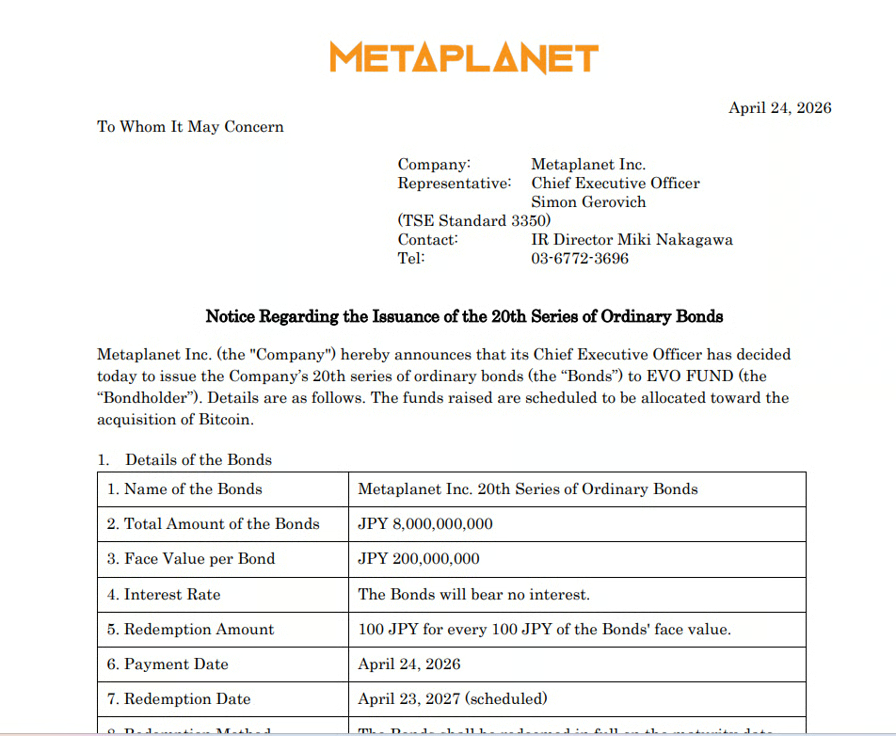
Tokyo-listed Metaplanet has issued 8 billion Japanese yen ($50 million) in zero-interest bonds to EVO FUND, with the proceeds earmarked for additional Bitcoin purchases, according to a Thursday filing.
According to the filing, the 20th series of ordinary bonds matures in April 2027 and is unsecured, giving Metaplanet another source of zero-interest funding as it expands one of the largest corporate Bitcoin treasuries in the market.
EVO FUND, a Cayman-based fund at the core of Evolution Financial Group, specializes in structured financings for digital asset-focused companies and is the main subscriber to Metaplanet’s zero-interest bonds used to fund Bitcoin purchases.
Under the terms of the deal, the bonds will be redeemed at par on maturity, though EVO FUND can request early redemption with five business days’ notice. Metaplanet may also redeem part or all of the bonds if it completes future financings with the same investor.
Related: Nakamoto sells $20 million in Bitcoin and cuts Metaplanet stake
The latest raise extends a financing strategy Metaplanet has used repeatedly as it leans further into its Bitcoin treasury model, tapping capital markets rather than relying solely on operating cash flow.
Metaplanet’s share price was down around 3.69% at the time of writing, according to data from Yahoo! Finance.
Metaplanet expands Bitcoin holdings with debt-funded strategy
The latest raise follows an aggressive first quarter in which Metaplanet added 5,075 BTC, lifting its total holdings to about 40,177 BTC and cementing its position as the third-largest publicly listed Bitcoin holder.
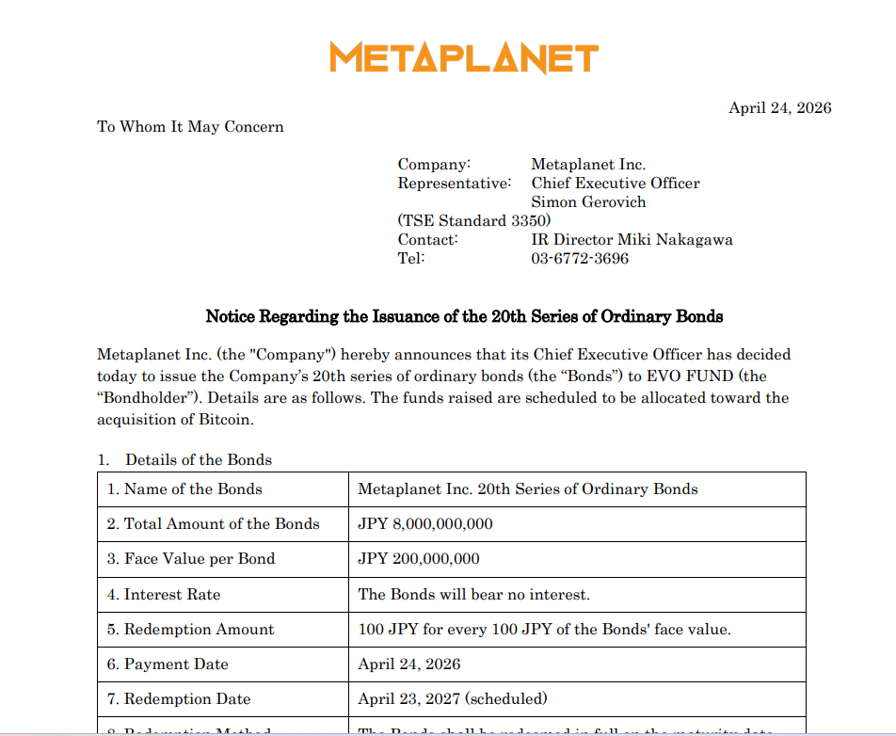
Metaplanet Issues $50 million in 0% Ordinary Bonds to Purchase Additional $BTC. Source: Metaplanet
That expansion has made the company one of the clearer examples in Asia of a public firm using debt and equity financing to accumulate Bitcoin as a treasury asset, drawing frequent comparisons to MicroStrategy’s balance sheet strategy in the United States.
With the new issuance, Metaplanet is signaling that it intends to keep buying even after a volatile stretch for crypto markets, with BTC trading around $77,000 in recent sessions.
The company said in the filing that the bond sale is expected to have only a minimal impact on its consolidated results for fiscal 2026, and that, if “any material impact” on its financial performance or other matters arises, it will provide an update promptly.
Magazine: AI-driven hacks could kill DeFi — unless projects act now


Ripple CTO Emeritus David Schwartz has rejected claims that XRP is part of a secret U.S. government plan.
Summary
- David Schwartz rejected claims that XRP is tied to secret US government or central bank plans.
- He said Ripple NDAs reflect normal business privacy, not hidden government XRP agreements.
- Schwartz warned XRP investors against relying on emotions or hidden signals for market decisions.
His comments came as old theories about XRP’s role in global finance resurfaced among parts of the crypto community. The claims suggest that XRP could become a reserve asset or form a hidden settlement layer for banks and governments.
Schwartz described such views as a “conspiracy theory” and warned investors against treating hidden signals as a basis for market decisions.
The renewed debate comes as XRP remains linked to major regulatory and banking discussions. Interest has grown around the CLARITY Act and Ripple’s recent national trust bank status, which have brought fresh attention to the company.
Ripple NDAs tied to business work
Schwartz said Ripple does have confidential agreements, but he linked them to normal business activity. He said these agreements are standard non-disclosure arrangements used by banking partners to protect commercial interests.
The comments were aimed at claims that Ripple’s NDAs prove hidden government or central bank plans for XRP. Schwartz said those claims do not reflect how Ripple’s business relationships work.
Ripple’s ties with financial firms such as Deutsche Bank and Société Générale are public. These institutions use Ripple-linked infrastructure for services such as messaging or settlement, including fiat and stablecoins such as RLUSD, rather than secret XRP programs.
Escrow claims also dismissed
Schwartz also addressed rumors about secret contracts tied to XRP held in Ripple escrow accounts. He said the escrow system remains visible on-chain and can be tracked by anyone.
The comment pushed back on claims that large buyers or government-linked groups have private access to pre-allocated XRP outside public view. According to Schwartz, investors should not build expectations around such theories.
Ripple’s escrow structure has long been a focus of XRP market debate because of its large token supply. However, Schwartz said the system is transparent and does not support claims of hidden distribution plans.
Ripple seeks clearer market image
Schwartz also warned against investing based on emotion or searching for “hidden signals” in meetings and public documents. He said that approach can lead investors to losses.
His comments suggest Ripple wants to move attention toward its role as a technology and payments infrastructure provider. The company appears focused on public business activity rather than speculative narratives around XRP.
The response comes as institutions continue to demand clearer rules, stronger compliance, and predictable systems in crypto markets. By rejecting secret plan theories, Ripple is trying to distance XRP from claims that lack public evidence.


China’s DeepSeek is making waves again by claiming its new V4 models are now just months away from catching up to industry leaders like OpenAI and Google.
Summary
- DeepSeek launched V4-Pro and V4-Flash preview models, claiming performance just 3 to 6 months behind leading systems from OpenAI and Google.
- The open-source V4-Pro leads rival open models in maths and coding benchmarks, while V4-Flash offers similar reasoning with faster speeds and lower cost.
- The rollout follows the impact of DeepSeek-R1 and comes amid rising regulatory scrutiny and a narrowing US-China AI performance gap, according to the Stanford AI Index 2026 report.
Roughly a year after its previous release, the Hangzhou-based startup introduced the DeepSeek V4 Pro and V4 Flash preview models on Friday, signaling a massive leap for Chinese AI development.
Performance narrows gap with closed models
The DeepSeek V4 Pro and V4 Flash models are positioned as top-tier contenders. DeepSeek states that V4 Pro leads all open-source models in math and coding benchmarks. Although it lags behind closed systems like Google’s Gemini 3.1 Pro in general knowledge, the performance gap is small.
DeepSeek estimates that they are now only three to six months behind leading models. The V4 Flash model is designed for speed and efficiency. It offers similar reasoning capabilities to the Pro model but at a lower cost for large-scale use.
This release follows DeepSeek R1, which some, like Marc Andreessen, considered a turning point in AI. That release showed high-level reasoning could be achieved with less capital, as DeepSeek claimed a training cost of under $6 million. The efficiency of their architecture is apparent, though some analysts are skeptical of that low figure.
The rapid rise of DeepSeek has led to scrutiny. Because AI has become a central part of the competition between the U.S. and China, these models are under heavy review.
Some regions, including Taiwan, Australia, and parts of the U.S., have restricted the use of earlier DeepSeek models due to data privacy and national security concerns.
The Stanford AI Index 2026 report confirms that while the U.S. still leads in high-impact patents and model breakthroughs, China has closed the gap in publication volume and industrial applications.
Competition intensifies across open and closed AI models
DeepSeek continues to use an open-source approach, allowing developers to modify and use their code freely. This puts them in competition with Google’s recently released Gemma 4, which focuses on agent-style workflows and task automation.
As OpenAI refines its closed, enterprise-grade systems, V4 suggests that the choice between open-source accessibility and closed-door performance is becoming more difficult for developers.


Senior Republican officials reportedly contacted Commerce Secretary Howard Lutnick after a crypto-linked super PAC signaled plans to spend $1.75 million in Texas.
Summary
- Republican leaders reportedly contacted Howard Lutnick after Fellowship PAC signaled a Texas ad spend.
- The crypto-linked PAC listed a $1.75 million spend backing Ken Paxton but placed no ads.
- Fellowship PAC has drawn attention after Cantor Fitzgerald seeded it with a $10 million donation.
The planned spending would have supported Texas Attorney General Ken Paxton in a Republican Senate runoff against Sen. John Cornyn, according to Axios.
The filing drew attention because President Donald Trump had not taken a side in the race. Republican leaders viewed the planned move by Fellowship PAC as a possible disruption in a sensitive primary contest.
Fellowship PAC was seeded by Cantor Fitzgerald, the firm Lutnick led before joining the Trump administration. Lutnick divested his interests last year, and his sons now run the firm, Axios reported.
Planned ad buy did not move forward
Axios reported that Fellowship PAC did not place the ad buy listed in the Federal Election Commission filing. Republican leaders were later told the group had not aired and was not preparing to air pro-Paxton ads.
The report also said media-tracking data showed neither Fellowship PAC nor its ad firm had run political ads this cycle. It remains unclear whether Lutnick acted after the calls from Republican officials.
The National Republican Senatorial Committee criticized the reported filing after it surfaced. The concern centered on the PAC entering a race that GOP leaders were watching closely.
Crypto PAC draws national attention
The crypto angle has made Fellowship PAC one of the more closely watched political groups ahead of the 2026 midterms. Cantor Fitzgerald donated $10 million to the group, according to federal filings reported by Bloomberg and Yahoo Finance.
Fellowship PAC is chaired by Jesse Spiro, Tether’s head of government affairs. The group also received $1 million from Anchor Labs, a crypto infrastructure firm linked to Cantor, according to earlier reports.
Fellowship PAC had reportedly aimed to raise $100 million for the 2026 election cycle. By mid-April, it had brought in $11 million from disclosed backers.
Crypto spending remains under scrutiny
The episode comes as crypto political spending grows in Washington. Axios reported that crypto groups spent roughly $120 million to $130 million in the 2024 elections, including about $40 million from Fairshake.
The 2026 cycle is drawing more attention because the industry is also pushing for clearer digital asset rules. This week, more than 100 crypto companies and lobbying groups urged Congress to move forward on market structure legislation.
Fellowship PAC’s reported Texas filing shows how crypto-linked political spending can attract attention beyond digital asset policy. It also shows how party leaders may respond when outside groups move into contested races.
Crypto World
Meta (META) Stock Dips 2.3% Despite Announcing 8,000 Job Cuts – Here’s What Investors Are Missing

TLDR
- Meta is preparing to eliminate approximately 8,000 positions (10% of total staff) effective May 20, 2026
- The workforce reduction aims to help finance the company’s ambitious AI infrastructure budget of up to $135 billion this year
- An additional 6,000 unfilled positions are being eliminated from hiring plans
- The company has introduced a controversial internal monitoring system that captures keyboard and mouse activity for AI training purposes
- Shares of META declined 2.31% in response to the workforce reduction announcement
Meta has revealed intentions to eliminate approximately 8,000 positions — representing roughly 10% of its total employee base — scheduled to become effective on May 20. The announcement triggered a 2.31% decline in META shares.
The social media behemoth positioned the workforce reduction as a streamlining initiative, though the resulting cost savings are projected to be completely absorbed by the company’s ambitious artificial intelligence investment strategy. Meta has publicly committed to allocating up to $135 billion toward AI infrastructure development throughout 2026.
What distinguishes this round of job eliminations from earlier ones is the absence of compensatory hiring in alternative divisions. Meta is simultaneously eliminating 6,000 vacant positions from its recruitment pipeline. This approach suggests the reductions represent more than a simple reallocation of human capital.
In an internal communication, Janelle Gale, Meta’s chief people officer, recognized that providing a month’s advance notice before individual notifications would prove “incredibly unsettling” for the workforce. She explained that premature disclosure became unavoidable following information breaches.
Workplace morale at Meta has experienced a dramatic deterioration. Information from Blind, an anonymous professional networking platform for verified company employees, indicates that over 80% of Meta-related commentary posted this year has carried negative sentiment. By comparison, only approximately 20% of such posts were negative throughout 2024.
Just days ago, leaked internal documentation unveiled a newly implemented software system that captures employee keyboard inputs, cursor positioning, and click patterns. The company states this information will serve to train artificial intelligence systems in executing routine computing operations. Participation is mandatory for all employees, with personal email usage subject to the same monitoring protocols.
The leaked documentation spread rapidly across social platforms and generated substantial criticism on Meta’s internal communication channels. A highly-rated employee comment asked: “This makes me super uncomfortable. How do we opt out?”
A Vision of Smaller Teams
Andrew Bosworth, Meta’s chief technology officer, circulated an internal position paper outlining two distinct operational models currently functioning within the organization. The first maintains conventional practices — expansive teams, comprehensive documentation, formalized evaluation processes. The second operates with minimal headcount, accelerated timelines, and AI-integrated workflows.
“These teams are tiny. They move extremely quickly,” Bosworth explained. He characterized 2025 as feeling “like 100 years ago” considering the rapid transformation enabled by AI-assisted productivity.
Meta CEO Mark Zuckerberg has become progressively more outspoken regarding artificial intelligence’s capacity to reduce team sizes. “We’re starting to see projects that used to require big teams now be accomplished by a single very talented person,” he stated during January remarks.
The organization has already reorganized segments of its engineering division with extremely flat hierarchical structures featuring 50-person-to-one-manager ratios. Meta is additionally building what it describes as a “CEO agent” designed to assist Zuckerberg in accessing and synthesizing information from throughout the enterprise.
Spending Concerns Persist
Previously, investors responded favorably to Meta’s workforce reductions. The company’s elimination of 21,000 positions throughout late 2022 and early 2023 catalyzed significant share price appreciation. However, the market’s current response has been considerably more reserved.
The primary concern centers on the likelihood that savings generated from workforce reductions will simply be reallocated toward AI capital investments, which have already reached unprecedented levels. Meta’s projected AI expenditure of up to $135 billion for 2026 may face upward revision when quarterly financial results are disclosed.
Meta Superintelligence Labs has recently unveiled a next-generation AI system. The organization indicated that the keystroke-monitoring technology will support that division in teaching its models fundamental computer proficiencies including dropdown menu navigation and keyboard shortcut utilization.
TLDR:
- EIP-8182 proposes a shared shielded pool built directly into Ethereum as a native system contract.
- Fewer than 1 in 10,000 Ethereum transactions were private in 2025, still below the 2020 peak.
- The pool has no admin key or governance token and upgrades only through Ethereum’s hard-fork process.
- Users can swap tokens on a DEX and reshield funds in one transaction while keeping their identity private.
EIP-8182 is a draft proposal that could bring private transfers directly into the Ethereum protocol. Currently, nearly every Ethereum transaction is fully public, exposing balances, payment amounts, and counterparties.
The proposal aims to address this by embedding a shared shielded pool into Ethereum itself. Fewer than 1 in 10,000 Ethereum transactions were private in 2025, remaining below 2020 levels.
The Core Problem With Ethereum’s Current Privacy Landscape
Existing privacy solutions on Ethereum face a structural challenge known as the anonymity-set chicken-and-egg problem.
Privacy on Ethereum works by pooling funds together, making individual transactions harder to trace. Larger pools offer stronger privacy for all users. Smaller, fragmented pools weaken privacy across the board.
New privacy applications cannot offer meaningful privacy to early users. Without sufficient privacy, new users have little reason to join.
Once a pool grows large enough, users are reluctant to leave, even for a better product, because migration reduces their privacy protection.
This dynamic means the largest pool tends to stay dominant, regardless of quality. More competing apps mean smaller individual pools and worse outcomes for users overall. A shared standard has therefore been absent from the ecosystem.
A second problem compounds this: app-level privacy systems require upgrade mechanisms controlled by specific parties — multisig holders, token holders, or DAOs. Public transfers on Ethereum carry no such trust requirement, and a private-transfer default cannot either.
How EIP-8182 Addresses These Structural Issues
EIP-8182 places a shared shielded pool directly into Ethereum as a system contract at a fixed address. It also introduces a ZK proof-verification precompile. The pool has no admin key, no governance token, and no on-chain upgrade mechanism.
In April 2025, Ethereum co-founder Vitalik Buterin called for privacy tools to be built into existing wallets. He wrote: “Wallets should have a notion of a shielded balance, and when you send to someone else, there should be a ‘send from shielded balance’ option, ideally turned on by default.” A year on, that integration has not materialized at scale.
Any wallet integrating EIP-8182 connects to one shared anonymity set. Every new user strengthens privacy for all existing participants. Applications can then compete on user experience, proving speed, and developer tooling rather than pool size.
The pool evolves only through Ethereum’s hard-fork process — the same mechanism governing all other protocol changes. This removes the need to trust any third party for upgrades.
What Developers Can Build Using EIP-8182
Recipients use standard Ethereum addresses and ENS names. No separate privacy-specific address format is required, and no off-chain coordination step is needed. A recipient registers once, and private sends work to their existing address thereafter.
EIP-8182 separates transaction authorization from proof generation. Users sign transaction details in their existing wallet and can optionally send them to a remote prover.
As the proposal notes, “the prover has the power to compute but not the power to decide,” meaning altered transaction parameters will simply fail verification.
Private funds can also leave the pool, interact with any public Ethereum smart contract, and return — all within one transaction.
This pattern supports swapping one token for another on a decentralized exchange while keeping the user’s identity and destination private.
EIP-8182 is currently in draft status. The proposal is open for review at eip8182.com, where a full specification and reference implementation are also available.
Crypto World
BTC price, U.S. dollar move in near-perfect opposition. It hasn’t been this extreme in almost 4 years.
For bitcoin traders, the direction of the Dollar Index (DXY), a measure of the greenback’s strength against a basket of other currencies, hasn’t mattered this much in nearly four years.
That’s because the 30-day correlation coefficient between the two now stands at -0.90, according to TradingView, the most negative reading since September 2022. A reading below 0 indicates an inverse relationship: When the dollar weakens, bitcoin gains, and vice versa.
Keep in mind, though, that the reading, while widely tracked, can be influenced by bitcoin’s 24/7 trading structure, particularly weekend price action that is not mirrored in the Dollar Index’s weekday-only trading.
The coefficient of determination, or correlation squared, comes in at 0.81, implying that roughly 81% of bitcoin’s short-term price moves are statistically associated with moves in the index.
Notably, bitcoin’s rally has stalled since hitting highs above $79,000 on Wednesday. This comes as DXY bounced to 98.75 from the April 17 low of 97.63.
This is an excerpt from CoinDesk newsletter ‘Daybook.’ Sign up here, if you haven’t already.
The outlook for the Dollar Index appears supported by broader macro risks, including elevated oil prices tied to the tanker traffic disruptions in the Strait of Hormuz and a continued U.S.-Iran standoff over ceasefire negotiations.
“Macro is still trying to lean against it [BTC’s continued rally]. Oil has risen for five straight sessions and Hormuz remains effectively constrained. That should be a headwind because it keeps the inflation channel alive and keeps risk premia from fully unwinding,” analysts at Marex said in an email.
One positive is the sustained inflows into the U.S.-listed spot exchange-traded funds (ETFs). While those are keeping prices supported, industry leaders are still taking a cautious approach.
Anthony Scaramucci, founder of SkyBridge Capital, said bitcoin may not see a meaningful recovery until October or November, and the current price action aligns with BTC’s four-year reward halving cycle. He said that whales, who hold large numbers of BTC, and long-time holders have continued to sell into ETF-driven demand. Stay alert!
Read more: For analysis of today’s activity in altcoins and derivatives, see Crypto Markets Today . For a comprehensive list of events this week, see CoinDesk’s “Crypto Week Ahead.”
What’s trending
- Pentagon email floats suspending Spain from NATO, reassessing UK’s Falklands claim over Iran war rift (Reuters): A memo circulating at high levels in the Pentagon lays out options to punish NATO allies that denied access, basing and overflight rights for the Iran campaign.
- Morgan Stanley launches Stablecoin Reserves Portfolio, a money-market fund for issuers (CoinDesk): Morgan Stanley Investment Management unveiled MSNXX, a $1 NAV government money market fund holding only Treasuries and government repo, built to meet the Genius Act’s reserve requirements.
- Wisconsin sues Kalshi, Coinbase, Polymarket, Robinhood and Crypto.com over prediction markets (CoinDesk): Attorney General Josh Kaul’s complaints allege sports event contracts are unlicensed gambling, citing the platforms’ own marketing.
- DOJ arrests Special Forces soldier who made $400K on Polymarket betting on Maduro’s capture (ABC News): The master sergeant was involved in the January operation and placed around $33,000 in bets hours before Trump announced the capture, netting more than $400,000. This is believed to be the first U.S. insider-trading prosecution tied to a prediction market.
Today’s signal

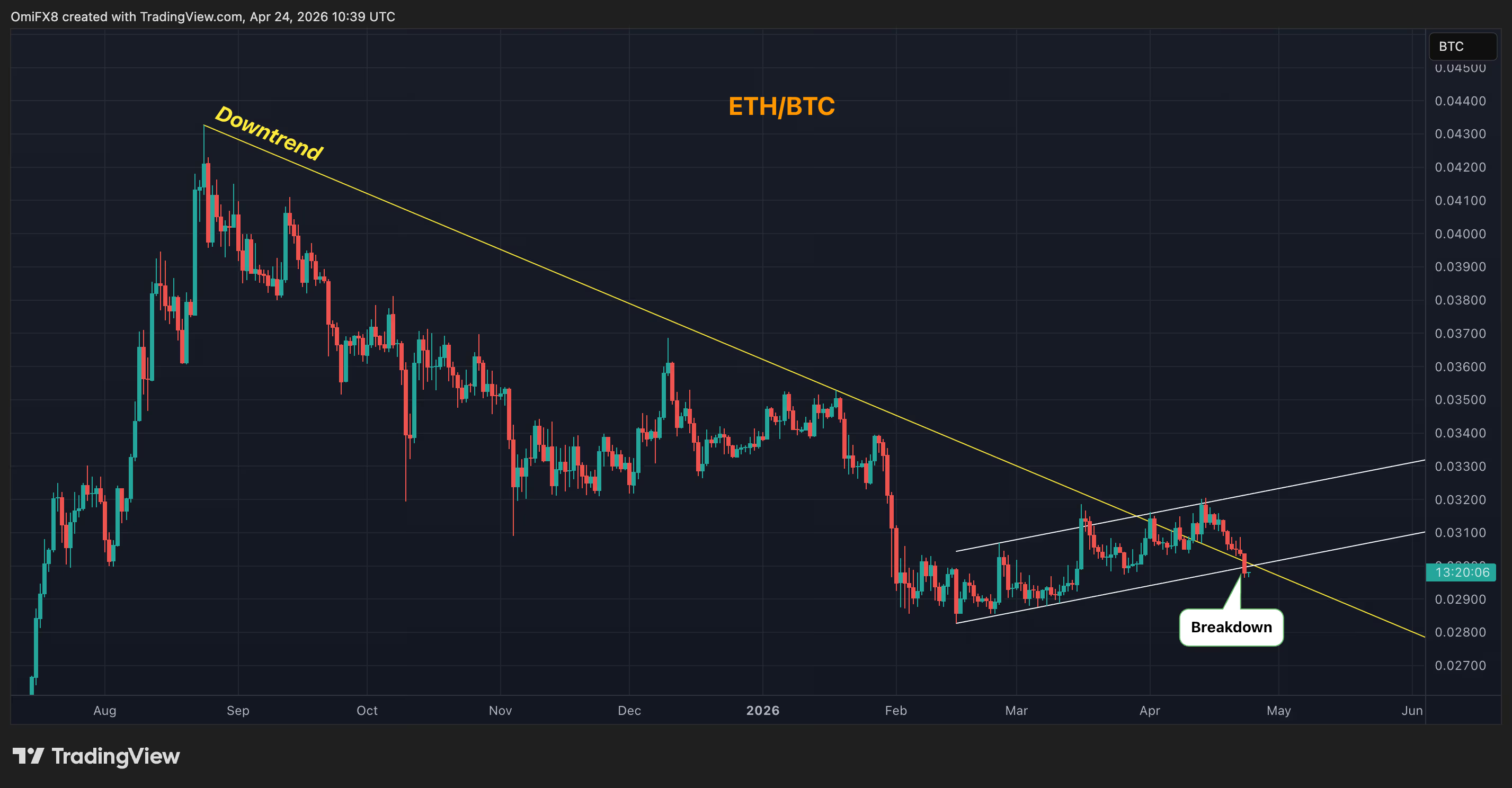
The chart shows daily swings in the ether-bitcoin (ETH/BTC) ratio in candlestick format since July last year.
This week, the ratio fell nearly 3% to 0.02965, its lowest since March 15. The move has two bearish implications.
First, it confirms a downside break from the short-term ascending channel that had guided the recovery from early February lows. Second, it pushes the ratio back below the broader downtrend line that has defined the decline since August.
This breakdown reinforces bearish momentum and increases the likelihood of further downside or extended consolidation in the ETH/BTC pair, that is, it points to continued underperformance of ether relative to bitcoin ahead.

Metaplanet taps $50M in zero-interest bonds to deepen Bitcoin exposure

Deontay Wilder called out by bitter rival years after sparring session ended in hospital trip

Big solana airdrop #crypto #cryptocurrency #ripple #bitcoin #trading

Manchester United reach agreement with Casemiro over contract clause amid transfer speculation

US brings back mandatory military draft registration

Steven Gerrard disagrees with Gary Neville over ‘shock’ Chelsea and Arsenal claim | Football


-

 Fashion7 days ago
Weekend Open Thread: Theodora Dress
-

 Politics7 days ago
Palestine barred from entering Canada for FIFA Congress
-

 Business5 days ago
Powerball Result April 18, 2026: No Jackpot Winner in Powerball Draw: $75 Million Rolls Over
-
Entertainment5 days ago
NBA Analyst Charles Barkley Chimes in on Ice Spice McDonald’s Fiasco
-

 Tech5 days ago
Auto Enthusiast Scores Running Tesla Model 3 for Two Grand and Turns It Into Bare-Bones Go-Kart
-

 Politics5 days ago
Zack Polanski demands ‘council homes not luxury flats for foreign investors’
-

 Crypto World7 days ago
Russia Pushes Bill to Criminalize Unregistered Crypto Services
-

 Politics4 days ago
Gary Stevenson delivers timely reminder to register to vote as deadline TODAY
-

 Business2 days ago
Rolls-Royce Voted UK’s Most Iconic Trade Mark as IPO Register Hits 150
-

 Politics2 days ago
Disabled people challenge government SEND proposals over segregation concerns
-

 Politics2 days ago
Making troops accountable for war crimes threatens US alliance, ex-SAS colonel warns
-

 Crypto World7 days ago
Russia Introduces Bill To Criminalize Unregistered Crypto Services
-

 Politics2 days ago
Starmer handler McSweeney to be dragged from shadows by Foreign Affairs Committee
-
Politics2 days ago
Wings Over Scotland | How To Get Away With Crimes
-

 Politics2 days ago
Zack Polanski responds to home secretary’s taser threat
-
Crypto World5 days ago
Kelp DAO rsETH Bridge Hack Drains $292M as DeFi Losses Top $600M in Two Weeks
-

 Politics2 days ago
‘Iran is still a nuclear threat’
-

 Crypto World3 days ago
New York sues Coinbase, Gemini over prediction market offerings
-

 Business2 days ago
The Job Benefits Most Men Don’t Know to Negotiate
-

 Politics5 days ago
Reform investigating candidate who ‘hates’ the NHS
You must be logged in to post a comment Login