
Crypto World
US CPI Inflation Set to Jump in March, Putting an End to Gradual Two-Year Decline

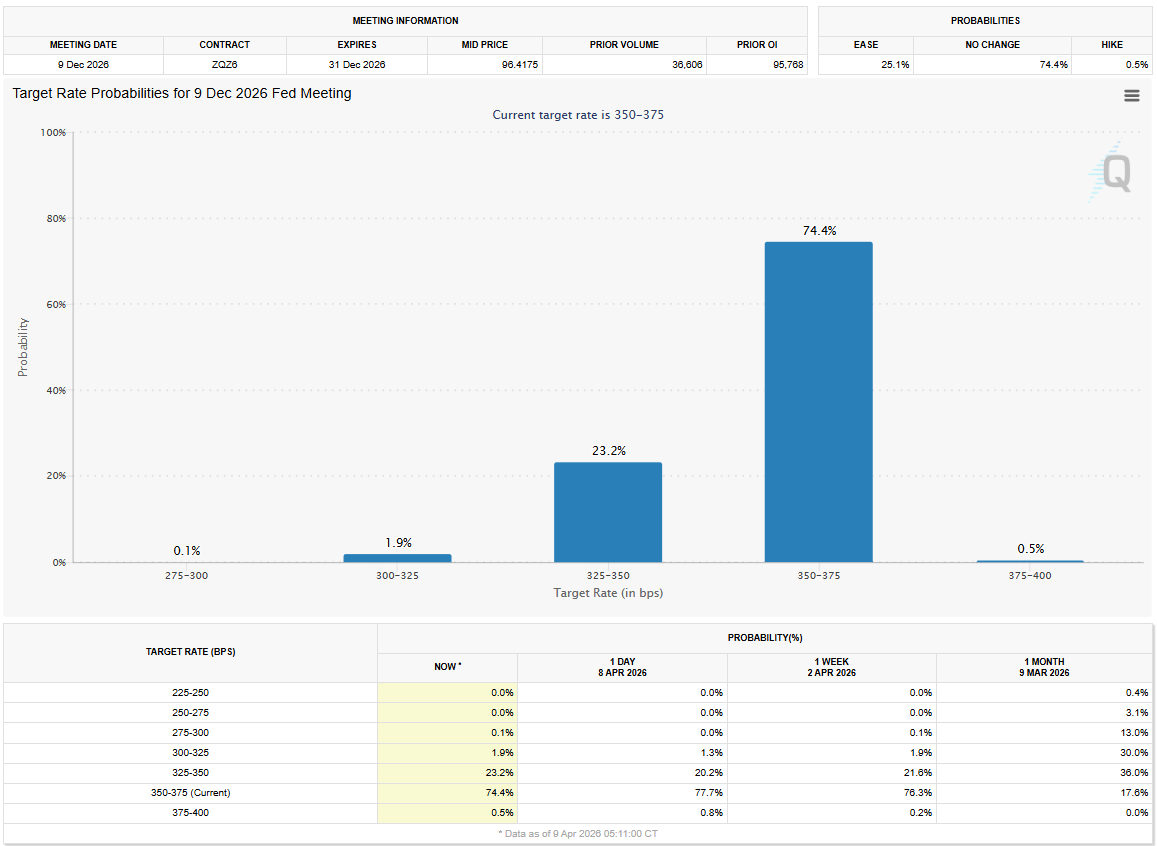
The US Bureau of Labor Statistics (BLS) will publish the March Consumer Price Index (CPI) data on Friday. The report is expected to show a jump in inflation, driven by the upsurge seen in crude Oil prices after the United States (US) and Israel launched a joint attack on Iran.
The monthly CPI is forecast to rise 0.9%, following the 0.3% increase recorded in March, while the annual reading is seen climbing to its highest level since May 2024 at 3.3%, from 2.4% in February. Core CPI figures, which exclude volatile food and energy prices, are expected to come in at 0.3% and 2.7%, on a monthly and yearly basis, respectively.
Since the beginning of the conflict in the Middle East on February 28, the barrel of West Texas Intermediate (WTI) is up about 40%, even after the sharp decline seen following the announcement of a two-week ceasefire between the US and Iran earlier this week. In March, WTI gained nearly 50%, rising from about $67 per barrel to settle near $100 by the end of the month.
Previewing the inflation data, “the recent surge in crude prices will be the main factor behind the 0.9% m/m jump in the CPI. The Y/Y rate will leap close to 1pp to 3.3% in March, a two-year-high,” said TD Securities analysts.
“Core inflation will stay shielded from the oil shock for now, rising 0.27% m/m. We look for tariff pass-through to continue playing a role by lifting goods prices. Supercore inflation likely stayed firm at 0.3%,” they added.
What to Expect in the Next CPI Data Report?
CPI figures for March will reflect the impact of high oil prices on inflation, which shouldn’t be surprising. Even if the annual CPI inflation rises 3.3% in March, as forecast, investors could see that as a temporary increase in case they remain confident that Oil prices will come down significantly, with a permanent truce in the Middle East allowing the Strait of Hormuz to remain open.
However, the growing uncertainty about the sustainability of a ceasefire and Iran’s condition to retain control of the strait in a peace agreement complicates the picture and raises doubts about a steady pullback in Oil prices. Hence, the developments in the Middle East are likely to shape inflation expectations, rather than the March CPI reading itself.
The Minutes from the Federal Reserve’s (Fed) March meeting showed that a number of policymakers are already pushing back the timing of potential rate cuts, reflecting lingering concerns that inflation could prove more persistent than expected.
In fact, a large majority flagged the risk that price pressures could stay elevated for longer, particularly if higher Oil prices feed through more broadly.
“Provided that underlying inflation excluding energy remains contained, the Fed can afford to look through the oil-price shock and refrain from raising rates amid a mixed US labor market backdrop,” BBH analysts said.
How Could the US Consumer Price Index Report Affect Eur/USD?
Markets currently see about a 75% chance of the Fed leaving the policy rate unchanged at 3.5%-3.75% by the end of the year, compared to a 17% probability seen on March 9, according to the CME FedWatch Tool.
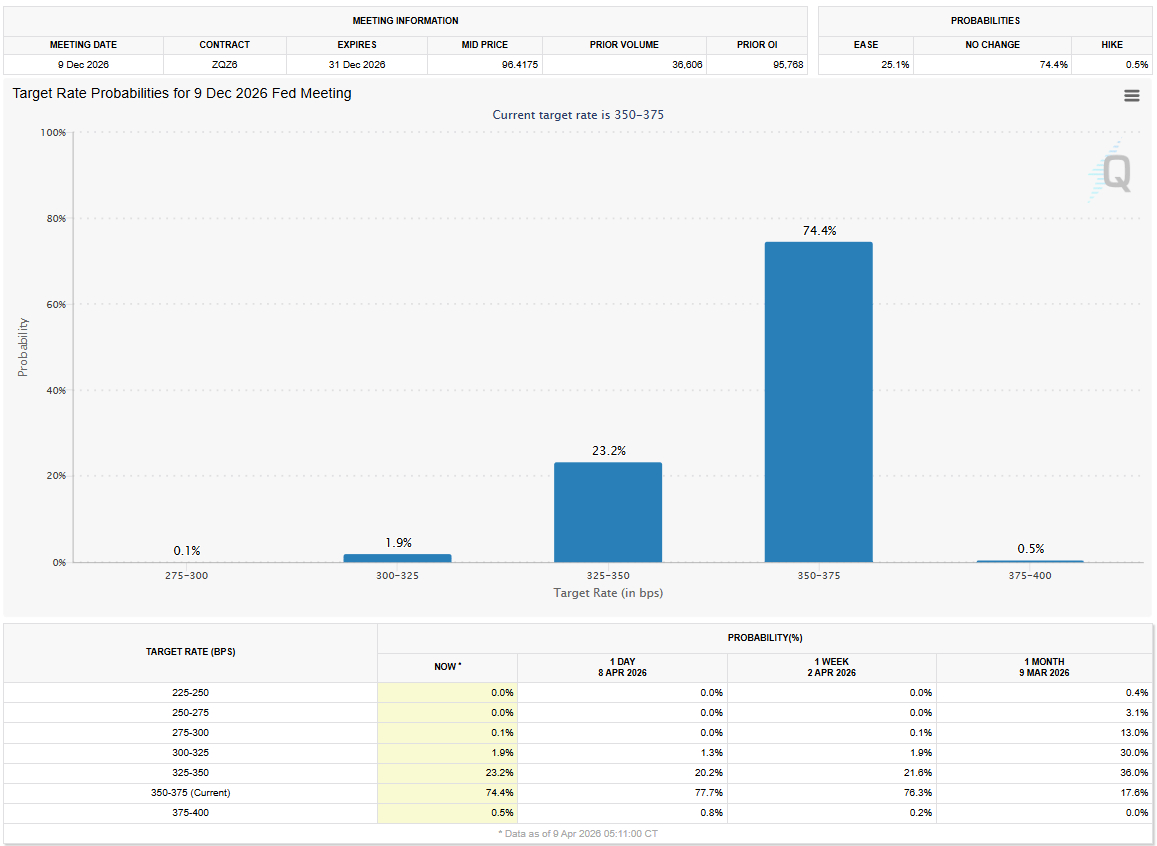
A stronger-than-forecast monthly CPI print for March might not be able to influence the market pricing of the Fed’s interest-rate outlook in a significant way.
However, if a hot inflation print is combined with a re-escalation of the conflict in the Middle East and growing expectations about the naval activity in the Strait of Hormuz not going back to its pre-war state anytime soon, investors could reassess the probability of a Fed hike in response to persistent inflation. In this scenario, the US Dollar (USD) could gather strength and force EUR/USD to turn south.
Conversely, the USD could remain under bearish pressure – and allow EUR/USD to extend its rebound – in case crude Oil prices continue to come down in a steady way, regardless of the March CPI figures.
In summary, March inflation prints are unlikely to trigger a significant market reaction, while market focus remains on the US-Iran crisis and its impact on Oil prices.
Eren Sengezer, FXStreet European Session Lead Analyst, shares a brief technical outlook for EUR/USD.
“EUR/USD’s near-term technical outlook points to a bullish tilt. The Relative Strength Index (RSI) indicator on the daily chart climbed above 50 for the first time since the beginning of the US-Iran war and the pair broke above the two-month-old descending trend line.”
“The Fibonacci 50% retracement level of the February-April trend aligns as the next resistance level at 1.1730 ahead of 1.1800 (Fibonacci 61.8% retracement) and 1.1900 (Fibonacci 78.6% retracement). On the downside, the immediate support is located at 1.1650 (Fibonacci 38.2% retracement). In case this support fails, technical sellers could show interest, opening the door for an extended slide toward 1.1560 (Fibonacci 23.6% retracement) and 1.1500 (static level, round level).”
The post US CPI Inflation Set to Jump in March, Putting an End to Gradual Two-Year Decline appeared first on BeInCrypto.



Securitize announced integration with TRON Network to bring tokenized assets to one of the world’s largest blockchains, expanding its multichain presence.
Securitize integrated with TRON Network on April 10, enabling tokenized assets issued by Securitize to be deployed on TRON, one of the world’s largest blockchains. The partnership expands Securitize’s multichain footprint and brings institutional-grade assets to a high-performance network designed for efficient, programmable financial systems.
The integration aligns with growing demand for tokenization infrastructure that bridges traditional finance and blockchain networks. TRON operates as a high-throughput blockchain platform, and this partnership enables Securitize’s tokenized assets—which typically include securities and institutional products—to access TRON’s user base and ecosystem.
Sources: Securitize
This article was generated automatically by The Defiant’s AI news system from publicly available sources.

Bittensor token price has collapsed by 17% in less than 6 hours after one of the network’s most prominent subnet developers publicly torched its relationship with the ecosystem, and the price prediction is getting bearish. The governance bombshell driving this selloff raises a harder question than most traders are asking right now.
On Thursday, Covenant AI, the team behind the Covenant-72B model, widely credited as the largest decentralized LLM pre-training run in history, announced its exit from Bittensor.
— BSCN (@BSCNews) April 10, 2026
 LATEST: BITTENSOR DROPS 16% AS COVENANT AI EXITS THE NETWORK OVER CENTRALIZATION CONCERNS
Covenant AI (@covenant_ai) has exited Bittensor citing concerns over centralized control.
The team said governance is not truly decentralized in practice. It alleged key decisions remain… pic.twitter.com/QlA4AoMWbG
Founder Sam Dare stated that “the promise that drew builders, miners, validators, and investors into this ecosystem is a lie,” accusing co-founder Jacob Steeves of asserting centralized control over Covenant’s subnet after it grew too prominent to ignore.
Steeves has not publicly responded. The statement hit markets like a circuit breaker. TAO had surged 140% over six weeks, with 105% of those gains coming since March 8 alone, largely on the back of Covenant-72B’s success narrative and Grayscale’s filing for a TAO Trust. That entire credibility stack just developed a serious crack.
Discover: The best crypto to diversify your portfolio with
Bittensor Price Prediction: Can TAO Recover?
At current levels near $280, TAO sits in genuinely dangerous technical territory. $300 was the immediate support level, and the price is already trading below it, which means the level has effectively been lost.
On-chain data confirms the severity of the move, with TAO’s 24-hour decline registering among the steepest in the large-cap AI token sector. The April 9 rejection at $360 resistance preceded a bearish MACD crossover, with sellers already positioning before the news dropped.
Social dominance for TAO reached a one-year high in early April, yet retail sentiment shows only 1.5 positive comments per negative comment, suggesting conviction in the prior rally was thinner than price action implied.
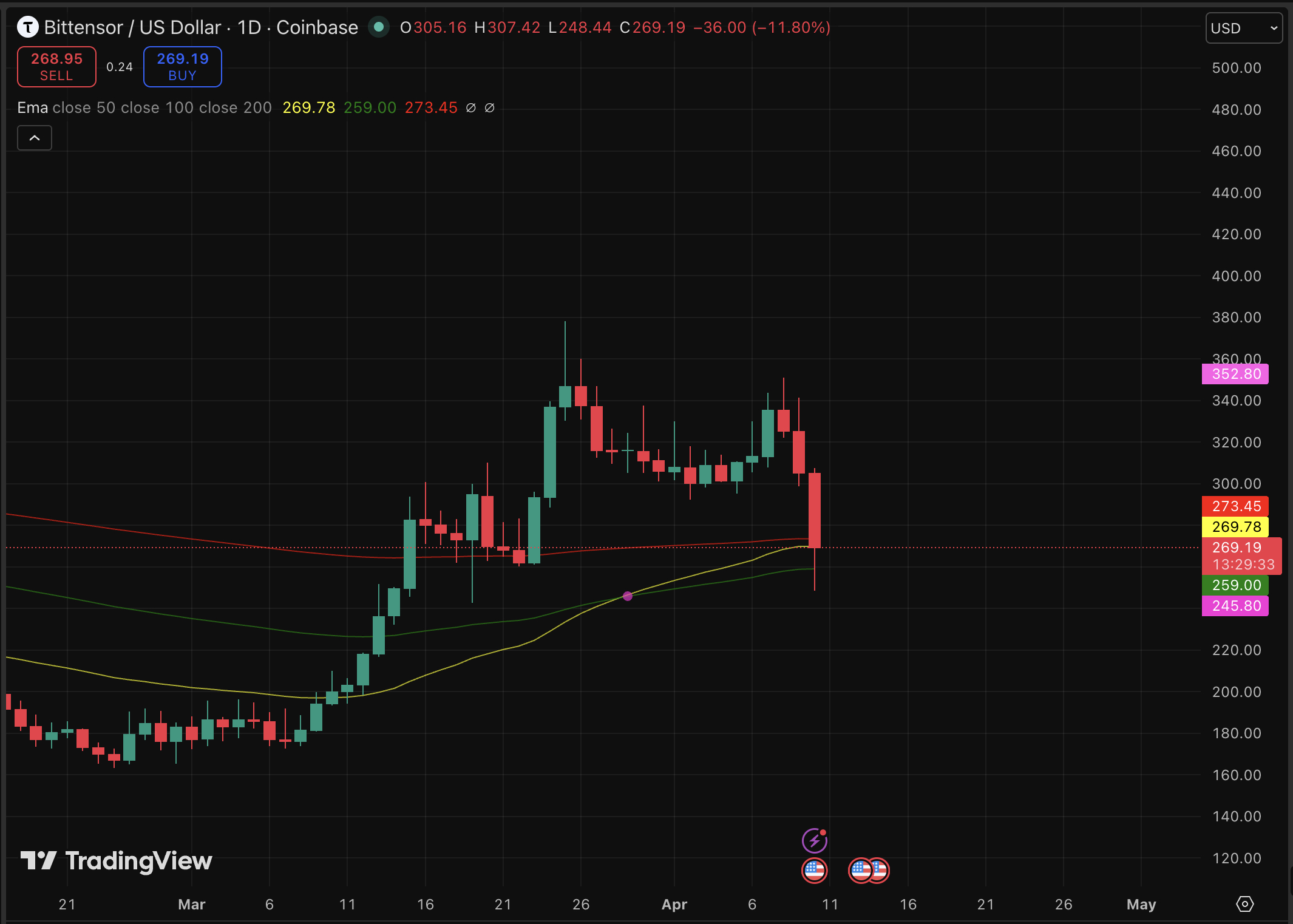
TAO needs to reclaim $300 within 48 hours on a credible response from Steeves or Bittensor’s governance structure for it to stage a recovery toward $320–$330. But continued silence from leadership and further subnet departures can accelerate selling pressure toward $250 or lower.
The parallel to other ecosystem selloffs triggered by major internal exits suggests recoveries can take weeks, not days. Watch the $300 level; this is the line.
Discover: The best pre-launch token sales
Bitcoin Hyper Draws Early Movers as TAO Tries to Recover
Governance risk just repriced TAO’s entire decentralization premium, and that’s the precise vulnerability traders with longer memory have warned about. When a network’s core value proposition gets called a lie by its most successful builder, rotating capital doesn’t wait for confirmation. It moves.
One destination attracting that rotated attention is Bitcoin Hyper ($HYPER), a Bitcoin Layer 2 project positioning itself as the first-ever BTC chain with Solana Virtual Machine (SVM) integration.
The pitch is structural: Bitcoin’s security and liquidity combined with sub-Solana-speed smart contract execution, breaking through BTC’s native limitations of slow transactions, high fees, and zero programmability. No governance triumvirate. No subnet politics.
The presale has raised $32 million at a current price of $0.0136, with staking available for early participants. The project’s Decentralized Canonical Bridge handles BTC transfers natively.
Research Bitcoin Hyper before the next price step triggers.
The post Bittensor Price Prediction: Covenant AI Exits TAO, Forcing 16% Drop appeared first on Cryptonews.


“I am happy to bet $1 billion USD,” Binance founder Changpeng Zhao (CZ) told OKX founder Star Xu, “that: I am officially divorced.”
That escalated quickly.
With one of the largest peer-to-peer bets ever publicly offered, the Binance-OKX feud went nuclear this week.
As if the bet wasn’t interesting enough on its face, according to Xu’s responses, gambling isn’t legal for United Arab Emirates residents, yet polygamy is.
For context, CZ worked at Xu’s crypto exchange, OKCoin, but left under contested circumstances before creating Binance. The two exchanges have been fierce competitors ever since, with periodic public spats over listings and various market practices.
CZ left OKCoin in early 2015 after Xu attempted to renegotiate his equity stake. OKCoin’s 2015 Reddit statement accused CZ of contributing no code, running his own trading bots on company systems, and mounting a campaign of “lies and desperate nonsense” after his departure.
CZ’s memoir characterizes his departure more vaguely, as a clash of vision.
Anyway, what happened that escalated their disagreement to $1 billion?
CZ’s memoir airs years of dirty laundry
When CZ published his book Freedom of Money on April 8, Xu called him a “habitual liar.” Among many accusations, Xu claimed CZ lied about his marital status.
CZ doubled-down, calling Xu’s bet and pushing in $1 billion in chips.
Xu also claimed CZ published falsehoods about his career at OKCoin, his contract dispute with Roger Ver, his alleged manipulation of crypto markets, and whether he was a government informant against Justin Sun.
Fed up, CZ demanded of Xu, “You can apologize now.” He offered “$1 billion USD (or any number you choose),” giving Xu 24 hours to accept.
A refusal, according to CZ’s characterization, would “clearly show who has been mis-representing to the public.”
Xu declined, citing not only the illegality of gambling in his country of residence, but also his professional obligations.
“As the ultimate beneficial owner of a regulated company, publicly offering a $1 billion bet is hardly professional conduct,” he said.
Yi He backs up CZ
Xu demanded details about the largest source of CZ’s personal wealth. “Has your Binance stake been legally separated with your ex-wife or not?”
Yi He, the mother of CZ’s children and obviously implicated in the debate, didn’t stay quiet on social media. In 2014, after meeting CZ at a blockchain event, Yi helped CZ join OKCoin as chief technology officer.
Soon, they were romantically involved.
Yesterday, she promoted a Binance on-chain prediction market asking users to wager on whether Xu would publicly apologize to CZ.
She taunted Xu to engage.
CZ claimed Star Xu got Leon Li arrested
The memoir’s most explosive new allegation concerns Huobi (now HTX) founder Leon Li.
In his book, CZ wrote that Xu (using Star Xu’s real name, Mingxing) reported Li to Chinese police, leading to Li’s November 2020 detention.
Xu called that claim “purely false information.”
The disagreement is yet another example of the CZ versus Xu battle.
Contested details of an OKCoin agreement
This week, Xu resurfaced a 2015 video showing an OKCoin accountant’s QQ account, allegedly accessed in the presence of a notary.
Within that QQ account, a video shows CZ apparently sending two versions of a Bitcoin.com domain agreement. The video shows Version 7 first, then a modified Version 8 with a six-month termination clause absent from Version 7.
CZ had previously attributed the chat records to an unauthorized account intrusion.
“Do you believe such an explanation?” Xu asked rhetorically.
Roger Ver sued OKCoin’s Hong Kong entity for approximately $570,000 over the contract dispute.
In other words, CZ and Xu are essentially arguing this week about that contract via a decade-old QQ video.
Read more: CZ cries FUD as anti-Binance posts flood X
More feuds
Xu had spent months previewing his arguments in public before CZ’s book arrived.
Following the 2025 flash crash, Xu blamed Binance for the de-peg of Ethena’s USDE stablecoin.
“October 10 was caused by irresponsible marketing campaigns by certain companies,” Xu wrote. “No complexity. No accident.”
He also accused Binance of repeatedly launching what he called Ponzi-like schemes and using influencer campaigns to suppress dissent.
CZ said he’d “try not to comment on this topic further” and retweeted rebuttals from allies.
In 2023, CZ pleaded guilty to failing to maintain effective anti-money laundering programs, paid a $50 million criminal fine, and watched the company he founded pay over $4.3 billion in penalties.
After serving a four-month prison sentence, he received a presidential pardon from Donald Trump last year.
Got a tip? Send us an email securely via Protos Leaks. For more informed news, follow us on X, Bluesky, and Google News, or subscribe to our YouTube channel.
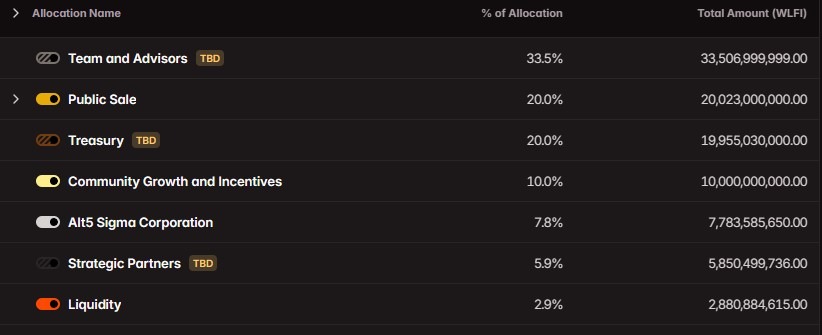
Decentralized finance (DeFi) platform World Liberty Financial said Friday it plans to put forward next week a governance proposal that would set a phased unlock schedule for WLFI tokens held by early retail purchasers.
The Trump family-linked DeFi platform said the proposal will be opened for community input before proceeding to a formal vote. According to the project, the vote will not cover a full, immediate unlock, but instead a structured, long-term vesting plan designed to release tokens in stages.
WLFI tokens remain largely locked for early buyers, with transferability tied to governance-approved unlocks. Tokenomist data shows that about 24.67% of WLFI’s 100 billion token supply has been released, while roughly 75.33% remains locked or pending future unlock decisions.
The proposal could determine when early buyers can finally access liquidity in WLFI, whose use is largely limited to governance. It comes as some holders publicly push back against the prolonged lockups and threaten legal action.
The concerns add to earlier governance decisions around token restrictions. On March 16, WLFI token holders approved a proposal introducing a six-month lock-up rule for certain transfers, marking one of the first formal changes to the project’s transferability framework.

Retail buyers challenge prolonged WLFI lockups
World Liberty’s early sale materials said WLFI tokens were non-transferable and could remain locked indefinitely, with any future unlock subject to a governance vote no earlier than 12 months after the token sale and with no guaranteed timeline.
That 12-month threshold has already passed, with WLFI’s public sale beginning around mid-October 2024, placing the current proposal roughly 18 months after the initial sale. The company raised at least $550 million from WLFI token sales across two funding rounds.
Some self-identified WLFI presale buyers have publicly complained that most of their holdings remain locked, even as parts of the broader token supply have become transferable.
At least one self-identified buyer said they had filed legal notices and were pursuing claims in the United States and the Netherlands against World Liberty Financial and its backers. Cointelegraph could not independently verify that any lawsuit had been filed.
Cointelegraph reached out to World Liberty Financial for comments, but had not received a response by publication.
Related: WLFI proposes governance staking system and USD1 usage incentives
Onchain borrowing activity adds to holder concerns
One community member said in an X post that the project’s borrowing activity raised concerns among token holders, questioning how treasury funds were being used. Onchain data shows that World Liberty Financial’s treasury borrowed roughly $75 million in stablecoins from Dolomite using WLFI as collateral.
Magazine: Should users be allowed to bet on war and death in prediction markets?


Simplechain raises $15m to build an RWA‑first layer 1 and dataipo protocol, extending ex‑jd.com and ant group execs’ push into compliant asset tokenization.
Summary
- SimpleChain closed a $15 million seed round to build an RWA‑focused Layer 1 blockchain.
- The core team includes former executives from Shuqin Technology, JD.com, and Ant Group, extending prior compliant fintech work.
- The project is also developing the DataIPO protocol to support on‑chain real‑world asset issuance and trading.
Real‑world asset (RWA) startup SimpleChain has raised $15 million in seed funding to build a dedicated Layer 1 blockchain aimed at tokenizing assets such as credit, energy infrastructure and other off‑chain collateral at scale. The company said the new capital will go toward engineering, compliance and ecosystem incentives as it races to position its infrastructure as a base layer for regulated RWA issuance. The round comes amid a broader rush by Chinese and Asia‑based fintech players to move asset tokenization on‑chain, with Hong Kong emerging as a key testing ground.
According to Chinese outlet PANews, SimpleChain’s founding team includes former executives from Shuqin Technology, JD.com and Ant Group, who previously helped build compliant fintech and supply‑chain finance platforms for traditional markets. Their new blockchain is pitched as a continuation of that work, but with settlement and asset logic moving fully on‑chain. “The launch of SimpleChain and the DataIPO protocol is an extension of years spent building compliant infrastructure for real‑world assets,” the team said in comments reported by industry media, framing the project as a way to “bridge institutional capital with public blockchains without sacrificing regulatory standards.”
Beyond the base Layer 1, SimpleChain is developing an ecological protocol called DataIPO, designed to standardize how real‑world asset deals are originated, tokenized and distributed to investors. In promotional materials shared on X, the DataIPO team said it wants to “turn structured deals into programmable on‑chain IP,” making it easier for asset originators to issue compliant tokens tied to revenue‑generating projects. That approach echoes broader RWA trends tracked by analytics platform RWA.xyz, where tokenized treasuries, private credit and infrastructure have grown into a multi‑billion dollar segment over the past two years.chain+4
The raise underscores how competition over RWA infrastructure is heating up, particularly in Greater China. Ant Group’s digital arm has already led pilots tokenizing up to $8.4 billion in renewable‑energy assets, including electric‑vehicle charging networks and solar plants, according to Bloomberg, while exploring dedicated chains such as its Jovay and Pharos projects. As regulators in Hong Kong and other hubs refine rules for tokenized securities, projects like SimpleChain are betting that purpose‑built Layer 1s, rather than generalized smart‑contract chains, will win a growing share of institutional RWA flows.

Key Takeaways
- Bridge vulnerability contained swiftly by Aethir, keeping damages under $90,000
- Major cryptocurrency exchanges mobilize rapidly to freeze attacker accounts
- Core Ethereum token reserves remain uncompromised throughout incident
- User compensation framework set for rollout following security breach
- Multi-chain forensic investigation underway to track stolen assets
Aethir demonstrated rapid incident response after detecting a vulnerability in its bridge infrastructure connecting multiple blockchain networks. Through immediate coordination with exchange partners and security specialists, the decentralized computing platform successfully capped financial losses at approximately $90,000. The company has assured users that its primary Ethereum-based token inventory remained untouched and that services continued without interruption.
Multi-Chain Bridge Vulnerability Quickly Isolated
Security monitoring systems at Aethir flagged suspicious transactions targeting bridge contracts that facilitate cross-chain token transfers between Ethereum and other blockchain networks. The technical team immediately took defensive action by disconnecting vulnerable contract components and halting unauthorized token movements. This prompt intervention significantly curtailed potential financial damage and restored operational stability.
Blockchain intelligence services had already begun tracking the malicious activity and documented fund flows spanning several networks. Security firm PeckShield’s analysis revealed that perpetrators routed stolen assets from BNB Chain through Tron using a network of intermediary addresses. Aethir’s internal investigation pinpointed the AethirOFTAdapter smart contract module as the compromised component.
The platform immediately engaged with major cryptocurrency trading venues to implement restrictions on identified malicious wallets. Leading exchanges including Binance, Upbit, Bithumb, and HTX executed swift wallet blacklisting measures. This collaborative security approach proved instrumental in preventing further asset dispersion.
Token Integrity Preserved, Recovery Measures Announced
Aethir provided assurance that its main ATH token reserves hosted on the Ethereum blockchain escaped compromise during the security incident. The platform’s core tokenomics and distributed network infrastructure maintained full operational continuity throughout the event. Standard services across the decentralized GPU network proceeded without disruption.
Management revealed plans to unveil a comprehensive user reimbursement initiative within the coming week. Alongside compensation details, the organization will publish complete attacker wallet information and a detailed technical breakdown of the incident. These transparency measures are designed to rebuild confidence and document remediation steps.
Meanwhile, Aethir continues collaborating with law enforcement agencies and specialized blockchain forensics teams to recover misappropriated funds. Security partner ZeroShadow provided in-depth investigative analysis supporting the ongoing recovery effort. Current activities concentrate on mapping attack methodologies and implementing enhanced protective protocols.
Platform Expansion Amid Broader Security Challenges
Aethir functions as a distributed GPU cloud infrastructure serving artificial intelligence development, gaming applications, and corporate computing needs. Rather than depending on traditional centralized server farms, the network distributes computational capacity worldwide. This architecture enables flexible scaling across diverse geographical locations.
Financial disclosures indicate Aethir generated $127.8 million in platform revenue throughout 2025, demonstrating robust market acceptance of its decentralized physical infrastructure model. By year’s end, the network had deployed over 440,000 GPU container units spanning 94 nations globally. Strategic investment from prominent backers including Animoca Brands and HashKey fueled this rapid ecosystem expansion.
The decentralized finance industry as a whole continues confronting escalating security threats targeting protocol infrastructure. Malicious actors successfully extracted nearly $170 million from various DeFi platforms during the opening quarter of 2026. Events such as this Aethir bridge compromise underscore the critical importance of advancing cross-chain security frameworks.

Crypto World
Bitcoin Price Tests $72K Resistance as Traders Hedge Against ‘Fragile’ Middle East Truce

Bitcoin price is sitting at $72,000 resistance, up 8% on the week, and the chart is telling two stories at once. The Iran-Israel truce gave traders a reason to cover shorts.
It hasn’t given them a reason to go long with conviction. Bulls point to $411 million in April ETF inflows and rising open interest.
Bears point to a two-week ceasefire window that Bybit’s chief market analyst Han Tan describes as sitting on ‘shaky ground.’ Both are right. That’s the problem.
The setup heading into the weekend is binary. Either the Iran-Israel truce holds and institutional investment flows accelerate, or it doesn’t – and crypto volatility returns fast, in thin liquidity, on a Saturday.
Discover: The best pre-launch token sales
Can Bitcoin Price Break $75,000 as Geopolitical Risk Unwinds?
Bitcoin is trading in a tight band between $71,800 and $72,100 as of Thursday. The $72,000 level is functioning as both psychological resistance and a technical ceiling – the zone where the rally stalled twice in the past six sessions.
Volume context matters here: the breakout above $70,000 was real, but the follow-through has been thin, which itself is a signal.
Bybit’s derivatives data put $56 million in bearish liquidations on Bitcoin perpetual contracts during the surge.
But open interest climbed alongside price, meaning traders were adding fresh exposure rather than simply covering. Funding rates stayed contained. That’s controlled risk-taking, not euphoric leverage – and it’s the more durable kind of rally base.

The support cluster we’re watching sits at $70,000–$71,000 on a closing basis. A clean break below $70,000 opens the path toward $63,000–$65,000, the range where ETF demand materialized during the February-March selloff from near $90,000.
The bull case requires clearing $75,000–$76,000 with volume confirmation – that’s the level that would shift the structure from relief rally to trend resumption.
For us, the activation conditions are straightforward: the ceasefire holds through the weekend, spot volume expands on the next leg up, and Bitcoin closes above $72,500 on the daily. Until then, the chart is mending. It hasn’t healed.
Iran-Israel Truce: Why Traders Are Bracing for a ‘Flight to Liquidity’
The geopolitical backdrop driving Bitcoin’s price is more mechanically complex than a simple risk-on/risk-off toggle.
The conditional two-week truce includes steps tied to reopening the Strait of Hormuz – the shipping corridor that carries roughly one-fifth of global LNG supply.
Five weeks of disruption turbocharged inflation fears and raised the credible prospect of central bank rate hikes, a direct headwind for risk assets including crypto.
If the ceasefire fractures, the sequence runs: oil spike, inflation repricing, rate hike expectations rise, risk-off rotation accelerates.
Bitcoin gets sold first – not because it’s the problem, but because it’s liquid and margined. The ‘flight to liquidity’ dynamic is the institutional hedge that never fully came off, even as it got cheaper to maintain.
Tan’s note flagged that options skew has eased but downside protection hasn’t been abandoned. Traders are paying less for the hedge. They haven’t dropped it.
The weekend dimension makes this structural. US-Iran diplomatic contacts are scheduled in Pakistan on Saturday. Traditional markets are closed. Exchange liquidity thins materially after Friday’s close – bid-ask spreads widen, and outsized price moves on any headline become more likely in both directions. The inflow data is bullish. The calendar is not. Those two realities coexist, and neither cancels the other out.
Discover: The top crypto to diversify your portfolio with
Bitcoin Hyper Targets Early-Mover Upside While BTC Consolidates at $72K
Bitcoin at $72,000 resistance with a geopolitical overhang is a particular kind of frustrating for spot holders. The macro case is improving.
The chart needs confirmation. The weekend introduces a binary risk. That’s a slow-moving setup – and the math on asymmetric returns at current levels is harder to justify than it was at $65,000.
Bitcoin Hyper is the asymmetric play worth examining in this environment.

The project is built as a Bitcoin layer-2 infrastructure protocol targeting the speed and programmability gaps that limit BTC’s utility as an active settlement layer – addressing Bitcoin’s structural weaknesses of slow transactions, high fees, and absent programmability in a single architecture.
Institutional appetite for Bitcoin-adjacent infrastructure is growing alongside spot ETF demand, and early-stage positioning in that layer captures upside the spot price can’t offer at $72K.
Key presale stats: $32 million raised to date, current token price at $0.0136783, with staking APY running at 36% for early participants. The presale window closes as the protocol approaches mainnet launch sequencing.
Visit the Bitcoin Hyper presale website here
The post Bitcoin Price Tests $72K Resistance as Traders Hedge Against ‘Fragile’ Middle East Truce appeared first on Cryptonews.
Crypto World
Trump-backed WLFI token drops 12% to record lows after team defends multi-million lending position
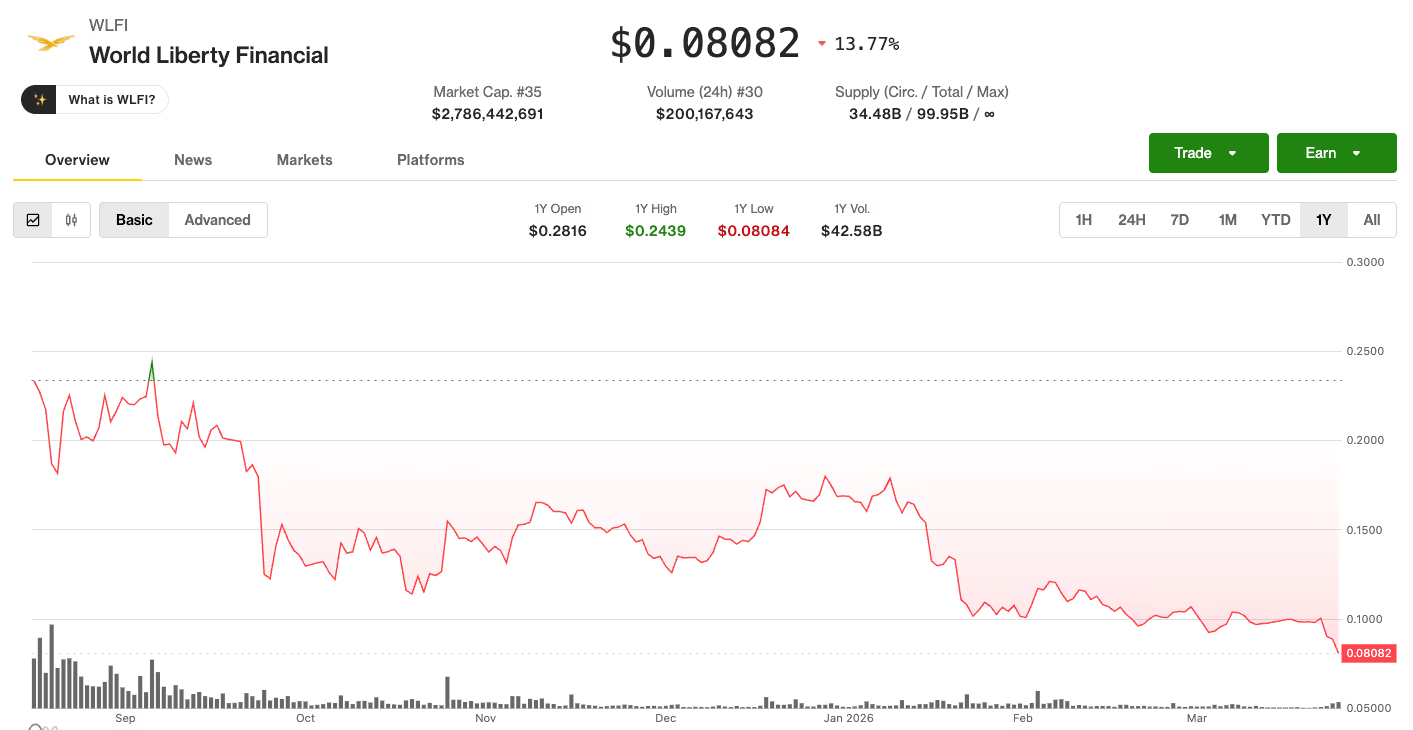
World Liberty Financial’s WLFI token fell about 12% in the past 24 hours after the Trump-linked crypto venture published a thread on X defending its lending position on Dolomite, the DeFi protocol whose co-founder advises WLFI.
The thread came in response to CoinDesk’s reporting that WLFI had deposited its own governance token as collateral, borrowed stablecoins against it, and drained the USD1 lending pool to the point where other depositors could not withdraw.
WLFI did not dispute the transactions but instead argued that the position was intentional and beneficial.
“We are one of the largest suppliers and borrowers on WLFI Markets,” the X account posted. “Yes, we supplied WLFI as collateral and borrowed stablecoins. No, we are nowhere near liquidation, and frankly, even if markets moved dramatically against us, we’d simply supply more collateral.”
The statement that WLFI would add more of its own token as collateral to avoid liquidation further highlights, rather than resolves, the concern raised in CoinDesk’s reporting.
Adding more WLFI to back a position denominated in WLFI on a protocol advised by WLFI’s own advisor is a form of circularity that investors may want to keep track of.
WLFI framed its role as “anchor borrower,” saying the borrowing generates yield for other users at a time when traditional markets offer little. The team disclosed $65.58 million in open-market buybacks of 435.3 million WLFI tokens at an average price of $0.1507 over the past six months, and said a governance proposal to unlock tokens for early holders would be posted next week.
The token is now trading roughly 48% below the buyback average, meaning WLFI’s own treasury purchases are significantly underwater.

WLFI has now hit its lowest level since its 2025 launch.
Meanwhile, three billion additional WLFI tokens sit in an intermediary wallet after the treasury transferred them on April 2 and April 7. That stash is worth roughly $234 million as of current prices, down from $266 million a week ago.
The math works against WLFI on every side if those tokens follow the same path into Dolomite. Lower prices mean less borrowing power per token, and depositing more tokens to borrow more stablecoins from a pool that is already nearly drained makes it harder for other depositors to withdraw. The collateral backing the position becomes even more concentrated in a token that just lost 12% in a day.
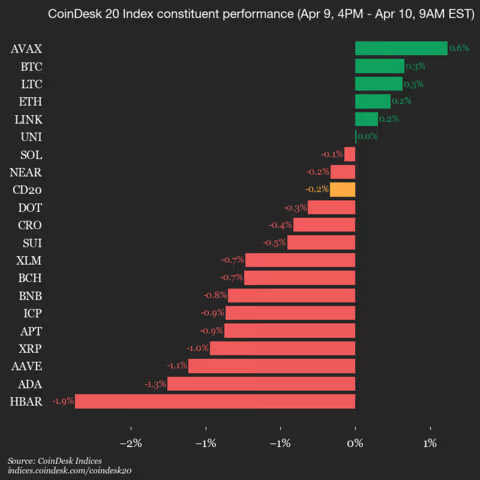
CoinDesk Indices presents its daily market update, highlighting the performance of leaders and laggards in the CoinDesk 20 Index.
The CoinDesk 20 is currently trading at 2007.93, down 0.2% (-3.4) since yesterday’s close.
Six of 20 assets is trading higher.

Leaders: AVAX (+0.6%) and BTC (+0.3%).
Laggards: HBAR (-1.9%) and ADA (-1.3%).
The CoinDesk 20 is a broad-based index traded on multiple platforms in several regions globally.

Bitget is expanding its product suite with IPO Prime, a proxy offering tied to the pre-initial public offering (pre-IPO) phase of SpaceX. The exchange said the initial token, preSPAX, will give retail users economic exposure to SpaceX’s post-IPO performance without granting direct ownership of SpaceX shares. SpaceX has not endorsed, approved, or authorized the offering, and Bitget emphasized that the instrument is a tokenized exposure rather than a security stake.
Key takeaways
- Bitget launches IPO Prime, offering pre-SPAX as a Republic-issued token designed to track SpaceX’s post-IPO performance without giving holders equity in SpaceX.
- The preSPAX subscription window runs April 18–21, with distribution on April 21 and subsequent OTC trading slated for later that day. VIP users reportedly receive early access via exclusive airdrop rounds.
- SpaceX’s IPO status remains unconfirmed publicly, but Bloomberg’s report highlights investor interest and potential valuation in the trillions of dollars range.
- IPO Prime fits a broader trend of crypto exchanges angling for TradFi access, placing tokenized versions of traditional assets—stocks, ETFs, and pre-IPO exposures—on crypto trading platforms.
- Industry peers and traditional market players are already experimenting with tokenized or expanded access to mainstream assets, signaling a potential shift in how retail investors participate in early-stage or pre-IPO opportunities.
Bitget’s bet on tokenized pre-IPO exposure
Bitget frames IPO Prime as a “new route” to traditional finance opportunities, part of the company’s broader aim to build a “universal exchange” that brings more TradFi assets under tokenized wrappers. The platform’s rollout centers on a subscription-based model, allowing users to apply for allocations through a tiered structure and then receive a proportional stake in the instrument.
Cointelegraph, she said: “Pre-IPO exposure used to be limited to small circles, but tokenization has changed that, providing access to traditional assets that were typically out of reach. preSPAX is our first offering and we will be bringing more such opportunities to our users this year.”
“Pre-IPO exposure used to be limited to small circles, but tokenization has changed that, providing access to traditional assets that were typically out of reach. preSPAX is our first offering and we will be bringing more such opportunities to our users this year.”
TradFi on chain: a wider push for tokenized access
Bitget’s IPO Prime sits within a broader pattern of crypto exchanges courting traditional financial products through tokenized wrappers. The concept is not unique to Bitget; several other crypto platforms have previously or currently pursued similar paths to broaden their investor base and offer a one-stop venue for traditional and digital assets.
Earlier this year, Bitpanda, a Vienna-based exchange, announced an expansion of its product suite to include around 10,000 stocks and exchange-traded funds (ETFs), signaling a push into regulated equity access via a crypto-enabled interface. Other industry actors have pursued comparable moves: Kraken unveiled a program in 2025 to offer 11,000 U.S.-listed stocks and ETFs with commission-free trading as part of a broader “phased national rollout,” while Coinbase has integrated stock trading into its ecosystem and reoriented its wallet toward a broader “everything app” concept aimed at 24/7 access to stocks, ETFs, and crypto assets. The industry framing sees these efforts as part of a broader “universal exchange” agenda to unify traditional and digital asset markets under a single platform.
Delphi Digital, a crypto research firm, has described the trend as the onset of a “super app” era in which users gravitate toward platforms that aggregate assets and trading products. The implication is that value could tilt from standalone protocols to the platforms that capture the most user attention and trading activity, as tokenized TradFi products become increasingly routinized for retail participants.
Industry peers emphasize that tokenized pre-IPO products are part of a broader expansion into professional-grade finance on crypto rails, raising both opportunities and questions. On the upside, greater accessibility could unlock early-stage and high-growth exposure for a wider audience. On the downside, investors must evaluate the liquidity, valuation methodologies, and regulatory underpinnings of tokenized pre-IPO instruments, which operate at the intersection of securities, derivatives, and digital assets.
Bitget’s strategy is not happening in a vacuum. The same week Bloomberg highlighted SpaceX’s rumored confidential IPO filing, reigniting interest in a potential post-IPO trajectory for the aerospace company. If SpaceX proceeds to public markets, tokenized pre-IPO instruments could become a more visible ladder for retail investors to engage with a stock-market-ready asset—albeit one that remains subject to the evolving regulatory and listing framework governing tokenized assets.
What to monitor next
Investors should track how pre-IPO tokenization evolves in practice: the accuracy of post-IPO performance tracking, liquidity dynamics in the OTC window, and the degree of regulatory clarity surrounding tokenized exposure to privately held companies. The SpaceX narrative—whether the company confirms an IPO timeline or refrains from public disclosure—will be a crucial backdrop for assessing the real-world demand for such products. Additionally, the reception of IPO Prime among users, and how Bitget and similar platforms refine their tiered allocations and airdrop strategies, will indicate how quickly tokenized pre-IPO access could scale across the market.
For readers seeking historical context, the broader trend toward TradFi assets on crypto platforms has already drawn attention from both crypto media and traditional financial circles. If the momentum continues, the next 12 to 18 months could define how retail investors navigate a blended landscape where tokenized stocks, ETFs, and pre-IPO exposures sit alongside digital assets in a single, cross-asset trading environment.
As markets watch SpaceX’s publicly announced or speculative IPO trajectory, IPO Prime stands as a concrete signal that crypto exchanges are actively testing the perimeter of traditional finance within blockchain-enabled product rails. Whether this approach will endure or face regulatory pushback remains to be seen, but the track record of Bitget’s latest launch indicates a continuing push to normalize access to otherwise exclusive financial opportunities.
Further reading and related coverage from the crypto press illustrate how the space is evolving. For example, reports on Bitpanda’s expansion into stocks and ETFs and Kraken’s broadened U.S. listings highlight a shared industry direction. Readers can also review Cointelegraph coverage on how exchanges are pricing, listing, and managing risk around traditional assets in a crypto context, as well as parallel analyses of the broader regulatory and market implications of these developments.
What remains uncertain is the precise regulatory treatment of tokenized pre-IPO products and how safeguards for retail investors will be enforced as these platforms scale. Yet the momentum is clear: tokenization is reshaping access to mainstream assets, and SpaceX’s rumored IPO is now part of a wider experiment in how the crypto industry can bridge private markets and public markets for a global audience.

Gaza ceasefire deal marks 6 months amid Iran war tensions

DoubleDown Interactive: May Look Cheap On Paper, But It Could Be A Trap

Securitize Integrates with TRON Network to Expand Tokenized Asset Offerings


-

 Fashion7 days ago
Weekend Open Thread: Spanx – Corporette.com
-

 Business5 days ago
Three Gulf funds agree to back Paramount’s $81 billion takeover of Warner, WSJ reports
-

 Sports6 days ago
India men’s 4x400m and mixed 4x100m relay teams register big progress | Other Sports News
-

 Business6 days ago
Expert Picks for Every Need
-

 Tech3 days ago
How Long Can You Drive With Expired Registration? What Florida Law Says
-

 Business5 days ago
No Jackpot Winner, Prize to Climb to $231 Million
-

 Fashion4 days ago
Massimo Dutti Offers Inspiration for Your Summer Mood Board
-

 Fashion3 days ago
Let’s Discuss: DEI in 2026
-

 Crypto World2 days ago
Bitcoin recovers as US and Iran Agree a Ceasefire Deal
-

 Business6 days ago
Akebia Therapeutics, Inc. (AKBA) Discusses Pipeline Progress and Strategic Focus on Kidney Disease Treatments at R&D Day – Slideshow
-

 Crypto World1 day ago
Canary Capital Files SEC Registration for PEPE ETF
-

 Politics6 days ago
The UK should not pay a penny in slavery reparations
-

 Tech4 days ago
Samsung just gave up on its own Messages app
-

 Tech4 days ago
Haier is betting big that your next TV purchase will be one of these
-

 Tech7 days ago
Flat tire? Dead battery? Speedy’s serves stranded Seattle riders as a quicker e-bike picker-upper
-

 Fashion7 days ago
Weekly News Update, 4.3.26 – Corporette.com
-
Sports7 days ago
A Kevin O’Connell Theory Can Now Be Retired
-

 NewsBeat7 days ago
Kemi Badenoch talks ‘spring cleaning’ Reform defections
-

 Tech4 days ago
Gamer Restores the Original PlayStation Portal From Two Decades Ago
-

 Tech4 days ago
The Xiaomi 17 Ultra has some impressive add-ons that make snapping photos really fun
You must be logged in to post a comment Login