
Crypto World
US Nonfarm Payrolls Miss Sends Bitcoin Above $65,000

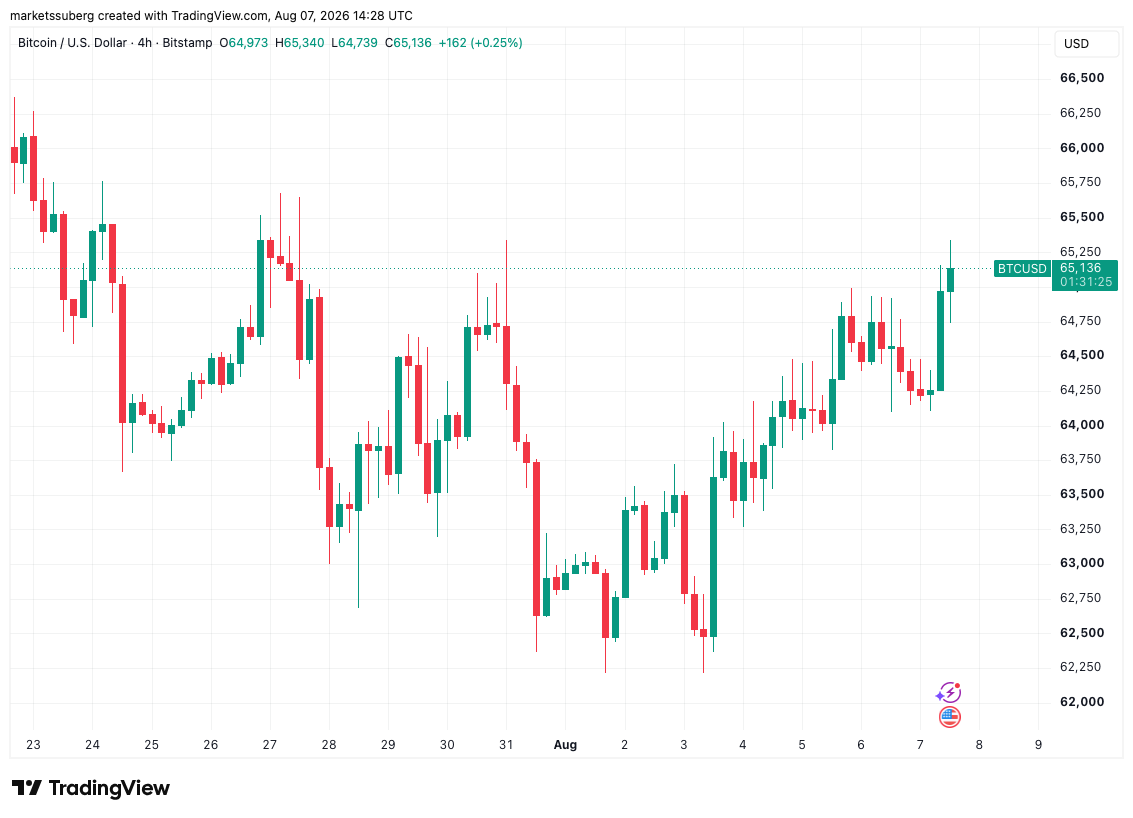
Bitcoin (BTC) hit new August highs into Friday’s Wall Street open as markets reacted to weaker US jobs numbers.
Key points:
- Crypto and risk assets gained after US nonfarm payrolls fell by 23,000 in July.
- Fed interest-rate bets for September shift from a 0.25% hike to a pause on signs of a weaker labor market.
- Bitcoin and altcoins stayed “resilient” after a week of bearish surprises, per analysis from QCP Capital.
Crypto, stocks higher on low nonfarm payrolls print
Data from TradingView showed BTC/USD hitting $65,340 on Bitstamp, up 1.3% on the day, as fresh US labour-market data was released.
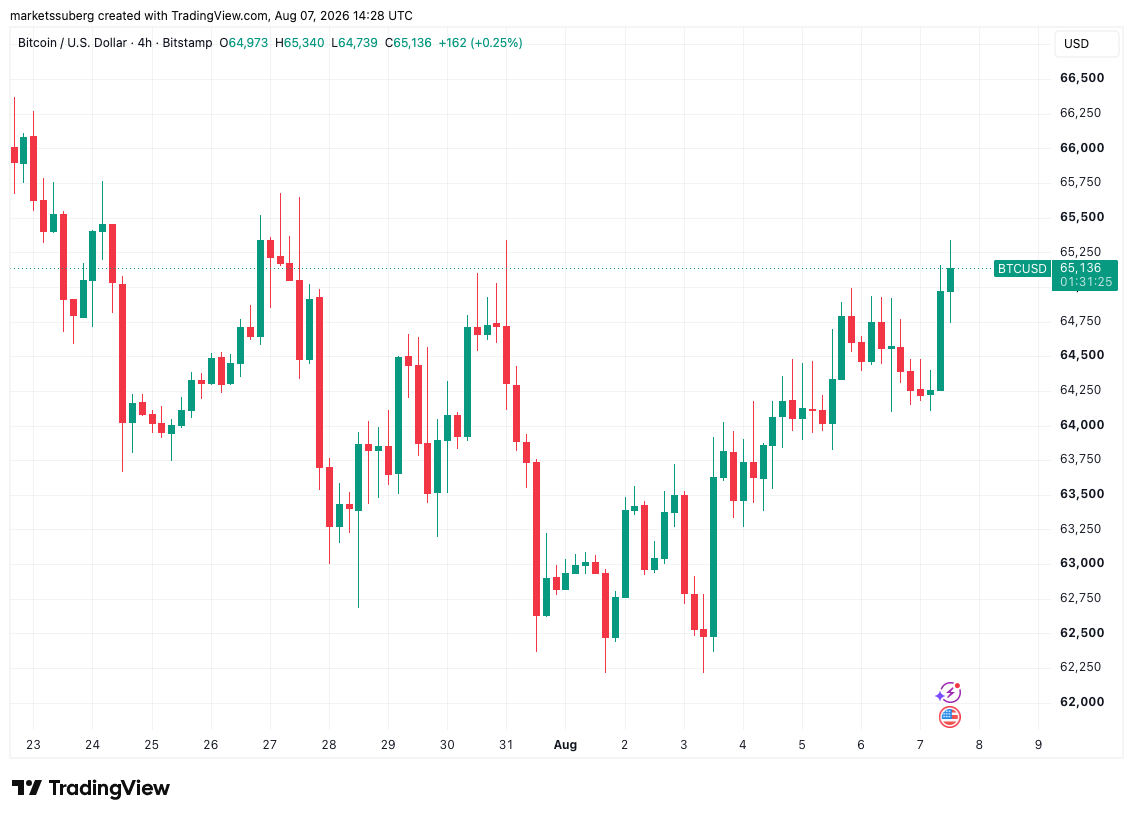
BTC/USD four-hour chart. Source: Cointelegraph/TradingView
The US economy lost 23,000 jobs in July, per nonfarm payrolls data from the Bureau of Labor Statistics (BLS), with the unemployment rate at 4.1%, numbers it described as “little changed” versus the month prior.
“The change in total nonfarm payroll employment for May was revised down by 66,000, from +129,000 to +63,000, and the change for June was revised down by 37,000, from +57,000 to +20,000. With these revisions, employment in May and June combined is 103,000 lower than previously reported,” an official statement added.
The combination of negative July values and downward revisions appeared to boost both crypto and US stocks, with traders linking weaker labor-market conditions with potential policy softening from the Federal Reserve.
The S&P 500 index opened 0.5% higher, while the tech-heavy Nasdaq Composite Index added just over 1%.
Data from CME Group’s FedWatch Tool reveals that markets are now expecting the Fed to hold interest rates at current levels at its September meeting. As late as yesterday, majority odds had favored a 0.25% rate hike.
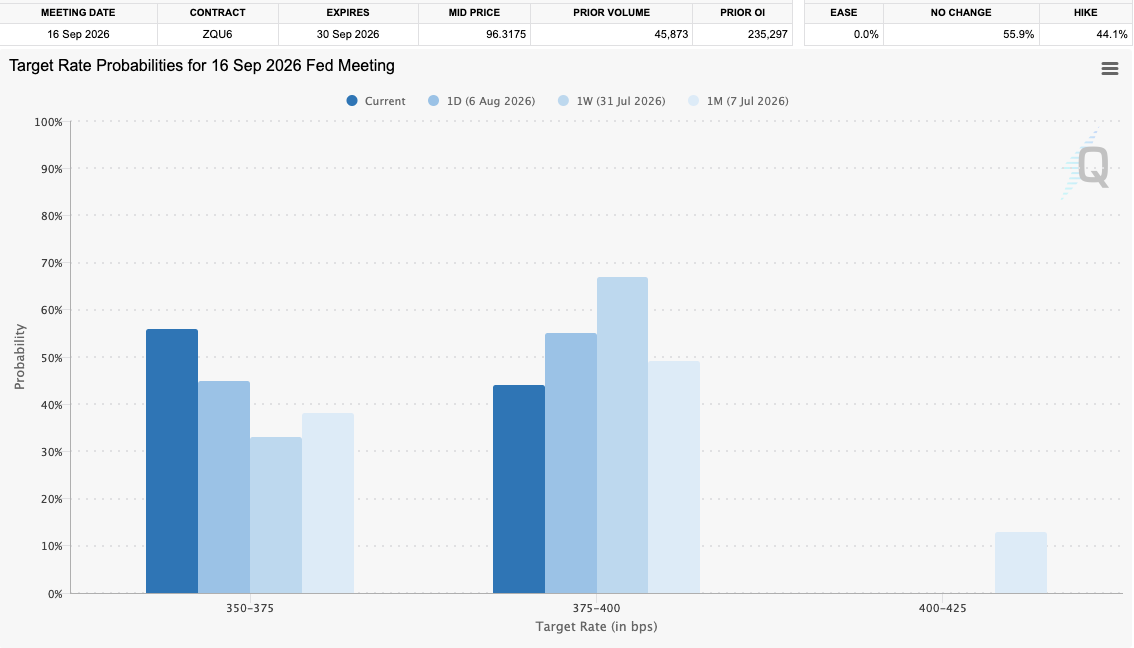
Fed target-rate probability comparison for September FOMC meeting. Source: CME Group
Prior to the employment data release, Ryan Lee, chief analyst at Bitget Research, said that it would “set the tone” for both the September meeting and the Fed’s annual economic Jackson Hole economic symposium, taking place at the end of August.
Fabian Dori, CIO at Sygnum Bank, predicted that Fed chair Kevin Warsh would be influenced by the extent to which payrolls data shifted lower.
“An orderly slowdown supports the liquidity relief case, while a print weak enough to raise growth concerns can still pressure risk assets even as rate odds move,” he said in comments sent to Cointelegraph.
Analysis praises Bitcoin, altcoin “resilience”
In its latest crypto and macro overview released on the day, trading company QCP Capital described the macro picture as “uncertain” for Bitcoin.
Related: Bitcoin price-metric basket sees longest capitulation since FTX blow-up: Glassnode
“For crypto, the week’s price action points to resilience rather than clear directional confirmation,” it summarized.
QCP noted that the fallout from the Coldcard wallet exploit, along with BTC sales by corporations including Strategy, had only sparked “limited demand for panic protection” on options markets.
Previously, Cointelegraph reported on option traders’ expectations for a BTC price trading-range breakdown to occur next month.

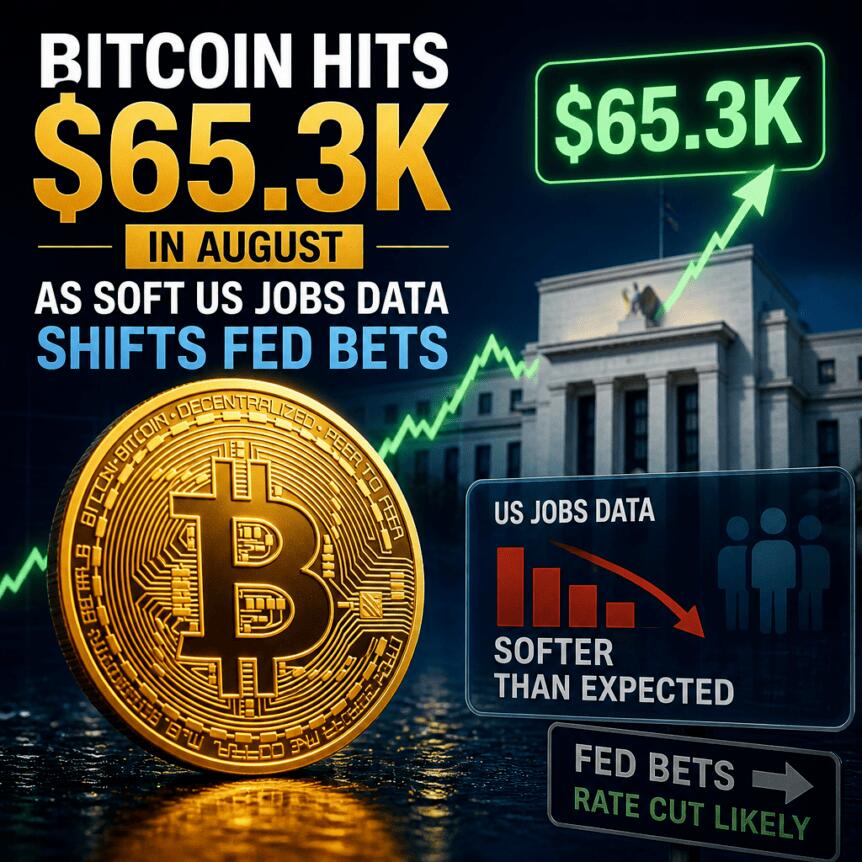
Bitcoin extended its rally into Friday’s Wall Street open after a softer-than-expected US jobs report triggered a broad pullback in rate-hike expectations. TradingView data showed BTC/USD reaching $65,340 on Bitstamp, up about 1.3% on the day.
The catalyst was the Bureau of Labor Statistics’ nonfarm payrolls release for July, which showed the US economy losing 23,000 jobs. With unemployment steady at 4.1% and revisions cutting prior months’ employment gains, markets recalibrated toward the Federal Reserve holding rates rather than raising them in September.
Key takeaways
- US nonfarm payrolls fell by 23,000 in July, with unemployment at 4.1%, lifting risk appetite across crypto and equities.
- CME Group’s FedWatch Tool shifted September expectations from a potential 0.25% hike toward a rate pause.
- Bitcoin traded near $65,340 on Bitstamp, holding gains despite a week marked by bearish crypto headlines.
- QCP Capital said this week’s price action looks more like “resilience” than a confirmed directional breakout.
Jobs data eases the policy path
According to the BLS, July nonfarm payrolls declined by 23,000. The agency also flagged downward revisions to earlier data: employment for May was revised down by 66,000 (from +129,000 to +63,000) and June by 37,000 (from +57,000 to +20,000). Combined, these revisions put May and June employment 103,000 lower than previously reported, per the BLS statement.
Traders linked the weaker labor-market picture with a more cautious Fed stance. The result was a firmer open for US equities: the S&P 500 added roughly 0.5% and the Nasdaq Composite was up just over 1% at the start of trading.
Interest-rate pricing moved quickly. CME Group’s FedWatch Tool indicates markets now expect the Fed to hold interest rates at its September meeting. Before the jobs report, expectations had leaned toward a 0.25% hike, with the majority of odds favoring increases as late as the prior day.
From hike odds to a pause—what investors are watching
Analysts tied Friday’s print to how traders will position ahead of key Fed moments later this month. Ryan Lee, chief analyst at Bitget Research, said the jobs data would “set the tone” for the September meeting and the Fed’s Jackson Hole symposium at the end of August. Fabian Dori, CIO at Sygnum Bank, suggested the degree of labor-market deterioration would shape how strongly Fed chair Kevin Warsh is influenced by the numbers.
“An orderly slowdown supports the liquidity relief case, while a print weak enough to raise growth concerns can still pressure risk assets even as rate odds move,” Dori said in comments sent to Cointelegraph.
That nuance matters for traders because weaker payrolls can push markets toward rate relief, but an overly pronounced deterioration can revive fears about demand and corporate earnings. For Bitcoin and other high-beta assets, the direction of rate expectations may be helpful only if it is paired with a calmer macro narrative rather than an accelerated recession risk.
QCP sees resilience rather than confirmation
Even as the macro backdrop improved, analysts emphasized that crypto’s recent trading behavior has not yet converted into a clean trend signal. In a crypto and macro overview released on the day, QCP Capital described the environment for Bitcoin as “uncertain,” adding that the week’s price action suggests resilience rather than “clear directional confirmation.”
QCP pointed to specific stress factors from the prior week, including the fallout from the Coldcard wallet exploit and additional BTC sales attributed to corporate holders, including Strategy. Despite those shocks, QCP said options markets showed only “limited demand for panic protection,” implying that traders were not rushing to hedge tail risks to the same extent they might in a stronger selloff scenario.
Earlier reporting referenced how options positioning could set up expectations for a price-range breakdown, with Cointelegraph noting that some market participants anticipated a move out of a trading range next month. Taken together, the current picture appears to be one where macro improves sentiment, but crypto derivatives data has not fully signaled that a lasting trend is already in place.
Stocks up, crypto holding—still a “wait and see” setup
Bitcoin’s ability to remain bid into the Wall Street open aligns with the immediate effect of the US jobs report: lower rate expectations typically ease discount-rate pressure across risk assets. However, the presence of ongoing crypto-specific uncertainties—highlighted by QCP—suggests investors may be cautious about declaring a sustained recovery solely on one macro release.
For now, the market’s key near-term task is to test whether the jobs-driven shift in rate odds holds through the next batch of economic data. If labor-market weakness persists without escalating into broader growth concerns, Bitcoin may continue to benefit from a friendlier liquidity narrative. If, instead, economic deterioration accelerates, the same move that lifts “pause” odds could also reignite risk-off pressure.
As traders look ahead, the next decisive signal to monitor will be how upcoming labor and inflation data interact with Fed communication—especially whether markets keep pricing a September pause—or revert toward hike expectations.


Circle has launched native USDC and its Cross-Chain Transfer Protocol on OKX’s X Layer, giving developers and businesses direct access to the regulated stablecoin across payments, DeFi and automated applications.
Summary
- Native USDC is now available on X Layer, replacing the need to rely solely on bridged tokens.
- Circle’s CCTP enables cross-chain USDC transfers without wrapped assets or conventional liquidity pools.
- The launch expands native USDC support to 36 networks, while CCTP now connects 26 blockchains.
- Qualified businesses can issue and redeem USDC through Circle Mint on X Layer.
Circle launches native USDC on X Layer
Circle announced on Aug. 7 that native USDC and CCTP are now live on X Layer, an Ethereum-compatible layer-2 network developed by crypto exchange OKX.
The integration gives applications on X Layer access to USDC issued directly by Circle. Previously, users primarily depended on USDC bridged from Ethereum, which represents tokens locked on one network and recreated on another.
Native issuance removes that additional bridge structure. It also gives developers a standard version of USDC that can connect with Circle’s broader payment and cross-chain infrastructure.
Payment providers, trading platforms and decentralized applications can use native USDC for transfers, settlements, lending and other financial services. Qualified businesses can also access issuance and redemption through Circle Mint, subject to Circle’s eligibility requirements.
X Layer offers compatibility with Ethereum applications while aiming to provide lower transaction fees and faster settlement. OKX is positioning the network for DeFi, payments, tokenized real-world assets and applications involving artificial intelligence.
CCTP connects X Layer to 26 blockchains
Circle’s Cross-Chain Transfer Protocol allows users to move USDC between supported networks through a burn-and-mint process. USDC is burned on the originating chain before an equivalent amount is issued on the destination chain.
The structure differs from conventional bridges, which typically lock tokens in a smart contract and issue a wrapped representation on another network. CCTP therefore moves native USDC without requiring wrapped assets or third-party liquidity pools.
Following the X Layer integration, Circle said CCTP is available across 26 blockchains. Native USDC has now expanded to 36 networks.
X Layer will continue supporting USDC bridged from Ethereum during the transition. Circle and the network’s ecosystem participants, however, are encouraging developers and users to shift toward the native asset over time.
The rollout could help consolidate USDC liquidity on X Layer instead of dividing activity between multiple bridged representations. It also lets developers build cross-chain applications that connect X Layer with other CCTP-supported ecosystems.
USDC supports payments and AI agents
Circle said native USDC can support X Layer’s x402 ecosystem, which is designed for automated payments between AI agents, application programming interfaces and digital services.
Under that model, software agents could use USDC to pay for data, computing resources or online services without requiring a person to approve each small transaction. Developers could also add spending limits and other controls at the application level.
The integration follows Circle’s broader expansion into programmable payments and machine-driven finance. As previously reported by crypto.news, Circle’s nearly 1,000-patent acquisition from IBM covers infrastructure supporting USDC, its payments network, Arc blockchain and tools for AI agents.
For U.S. businesses, access through Circle Mint remains subject to onboarding, compliance and geographic eligibility requirements. The X Layer launch does not automatically make every OKX or Circle service available to all U.S. users.
Circle expands its regulated infrastructure
Circle’s network expansion comes as USDC activity continues to grow. Crypto.news reported that USDC circulation reached $73.3 billion during the second quarter, up 19% from a year earlier, although it declined 5% from the previous quarter.
On-chain USDC transaction volume rose 151% year over year to $14.8 trillion, showing that transfer activity grew faster than the stablecoin’s circulating supply.
Circle is also preparing to launch the public mainnet of its Arc blockchain on Sept. 16. BlackRock, DTCC, Mastercard, Visa and other financial institutions will serve as founding validators.
The company recently secured a limited-purpose trust charter from the New York Department of Financial Services and final approval for a national trust bank from the Office of the Comptroller of the Currency. Circle plans to move USDC issuance gradually to its New York trust entity, placing more of its stablecoin operations under direct U.S. regulatory oversight.


The rollout gives X Layer users access to Circle-issued USDC and crosschain transfers as the stablecoin expands across major blockchain ecosystems.
Joseph Chalom said SharpLink opposes EIP-8363, a draft Ethereum proposal that would burn part of validator rewards as the staking ratio climbs, in an article published on X on Friday. "Sharplink opposes it," he wrote. Chalom described the proposal, titled "Tapered Issuance Burn," as phasing in a… Read the full story at The Defiant

Firmus has secured $2 billion in fresh equity funding to expand its artificial intelligence infrastructure business across Australia and the Asia-Pacific region. The financing increased the company’s post-money valuation above $10.5 billion and strengthened support for its regional expansion plans. The capital will accelerate new AI factory projects while reinforcing Firmus’ shift from Bitcoin mining toward high-performance computing services.
Firmus Directs Fresh Capital Toward AI Factory Expansion
Firmus completed the equity round with full commitments from existing backers Coatue and Nvidia. Meanwhile, funds managed by Blackstone Tactical Opportunities and other Blackstone vehicles joined the financing. Jane Street also participated and expanded the group of institutional supporters backing the company.
The funding almost doubled Firmus’ valuation from the $5.5 billion recorded during its April financing round. As a result, the company has raised more than $3 billion in equity over the past year. The additional capital will support Project Southgate and wider infrastructure development across Australia.
Firmus plans to accelerate the next stage of Project Southgate with the newly secured funding. At the same time, the company will prepare selected projects across the Asia-Pacific region. Early development work has also started on an Indonesian project designed for AI-focused customers.
Manufacturing Strategy Supports Regional Deployment
Firmus has already established Australian manufacturing for its proprietary HyperCube infrastructure platform. The company uses Nvidia’s DSX AI Factory Reference Architecture to build its computing systems. Consequently, the design supports faster deployment while improving energy efficiency and operational resilience.
The latest financing also strengthens Firmus’ partnership with Nvidia beyond infrastructure deployment. In June, both companies expanded their relationship through a cloud infrastructure agreement. Under that arrangement, Firmus agreed to purchase Nvidia systems while delivering cloud services powered by the company’s technology.
Australia remains the center of Firmus’ expansion strategy despite broader regional ambitions. The company plans to use its manufacturing capability and software platform to speed domestic deployments. Afterward, it expects to extend additional infrastructure projects across selected Asia-Pacific markets.
AI Infrastructure Continues Attracting Institutional Capital
The latest financing reflects growing demand for companies building physical AI infrastructure instead of traditional technology businesses. Large financial firms have increasingly supported data centers, computing capacity, and electricity infrastructure. These assets continue gaining importance as artificial intelligence services require greater processing power.
Former Bitcoin mining companies have also accelerated their transition toward AI infrastructure during the past year. Core Scientific agreed earlier this year to provide AMD with up to 2.5 gigawatts of future data center capacity. The agreement will begin in 2027 and supports the company’s ongoing business transformation.
Other companies have also expanded their AI strategies through infrastructure investments. IREN acquired Spain-based Nostrum Group in June and added approximately 490 megawatts of secured grid-connected power. Meanwhile, Hyperscale Data sold about 100 Bitcoin and secured a Bitcoin-backed credit facility for its Michigan AI campus.
Firmus stated that Australia will remain the primary destination for most of the newly raised capital. The company believes its existing production capacity will support faster deployment before additional regional expansion begins. Firmus also confirmed that the transaction remains a private financing rather than a public securities offering under United States securities regulations.

The UK political fallout from the Sam “SBF” Bankman-Fried saga is widening, as Reform UK’s chairman has demanded an investigation into reported crypto-linked donations connected to Defense Secretary Wes Streeting.
In a report published by The Telegraph, Reform UK chair Lee Anderson called on the parliamentary commissioner for standards to examine Streeting over claims that he received £50,000 in donations via a think tank during 2022 and 2023. The reported funding is said to have originated from Labour for the Long Term, an organization whose founder—according to the same report—previously accepted a £675,000 gift from Bankman-Fried before transferring money to Streeting.
Key takeaways
- Reform UK’s Lee Anderson has asked the parliamentary commissioner for standards to probe allegations involving Defense Secretary Wes Streeting’s reported £50,000 donation.
- The alleged funds are linked, via Labour for the Long Term, to a prior £675,000 gift attributed to former FTX CEO Sam “SBF” Bankman-Fried.
- Streeting is reported to have said he never had contact with Bankman-Fried, and his name reportedly did not appear on a donor list provided to him.
- UK rules allow some unincorporated associations to provide large political donations, potentially creating a reporting gap for donors’ sources.
- Separate US proceedings continue to narrow Bankman-Fried’s legal options, with the Second Circuit upholding his conviction and 25-year sentence.
Reform presses standards investigation over alleged donation chain
Anderson’s demand is aimed at whether parliamentary donation rules were followed in practice, given the alleged involvement of Bankman-Fried-related money. According to The Telegraph, the reported contributions to Streeting traced back to a think tank—Labour for the Long Term—which was established by David Lawrence.
The reporting describes a sequence in which the think tank received money that, in turn, was reportedly tied to Bankman-Fried. It then suggested that funds were used to support Streeting’s political activities without Bankman-Fried being directly identified in any donor list Streeting reviewed before acceptance, per The Telegraph.
Reform’s move underscores how the Bankman-Fried case is continuing to influence political scrutiny beyond the US courtroom—particularly where political funding structures may obscure ultimate funding sources.
Streeting response and think tank clarification
As described by The Telegraph, Streeting asked Labour for the Long Term for a list of its donors before accepting the reported £50,000. The same report states that Bankman-Fried’s name was not included in that list.
The defense secretary also reportedly said he had never been in contact with the former FTX CEO, who is currently serving a 25-year prison sentence after being convicted on seven felony charges.
David Lawrence, the founder of Labour for the Long Term, told The Telegraph that Streeting’s contribution was funded by a donor other than Bankman-Fried. Lawrence also said that Labour for the Long Term “did not receive any donations from the FTX Foundation or Mr. Bankman-Fried,” according to the report.
The UK political funding loophole at the center of the debate
The dispute highlights a compliance challenge that is familiar to observers of UK political finance: certain organizational structures can make it harder to trace the provenance of money reaching politicians.
According to the International Bar Association, unincorporated associations are permitted to give more than £675 directly to politicians. The International Bar Association notes that such regulations can function as a loophole, potentially allowing organizations with business interests in the UK to act as “conduits for foreign or dark money” without reporting the underlying sources of funds.
For investors, builders, and users watching crypto’s broader regulatory and reputational effects, the practical takeaway is that large, politically visible controversies involving digital-asset figures can spill into governance and compliance debates—even when direct interaction between a politician and the crypto-linked actor is denied.
Farage’s own crypto scandal adds pressure to the timing
The Reform controversy arrives as Nigel Farage prepares to face voters in a by-election triggered by his resignation as a member of parliament amid his own crypto-related scandal. Earlier coverage from Cointelegraph noted that Farage received $6.7 million in donations from crypto billionaire Christopher Harborne and financial assistance from George Cottrell, a convicted fraudster connected to a crypto casino. Farage has claimed the contributions were “gifts.”
While the allegations involving Streeting and Labour for the Long Term are separate from Farage’s case, the overlap in timing reflects how political scrutiny can become a multi-front process—where multiple parties seek to frame one another’s compliance failures while voters weigh the overall integrity of political funding.
US appellate mandate narrows Bankman-Fried’s options
Even as UK officials face new questions, Bankman-Fried’s legal situation in the United States continues to tighten. Earlier this week, the US Court of Appeals for the Second Circuit issued a formal mandate upholding his felony conviction and 25-year sentence, as reported by Cointelegraph.
The appeals court’s June decision reportedly reduced the remaining legal routes that could lead to potential early release. The same coverage states that Bankman-Fried may still pursue an appeal to the US Supreme Court or wait for a possible presidential pardon.
Taken together, the parallel developments—standards investigations in the UK and mandate-level enforcement in the US—suggest that the Bankman-Fried legacy is likely to remain politically and legally consequential even after the courtroom stage moves toward finality.
For the next phase, readers should watch whether the parliamentary commissioner for standards accepts Reform’s request and what procedural outcomes follow, as well as whether any further appellate steps in the US change Bankman-Fried’s prospects or prompt renewed attention to the financial pathways that link crypto figures to political fundraising.
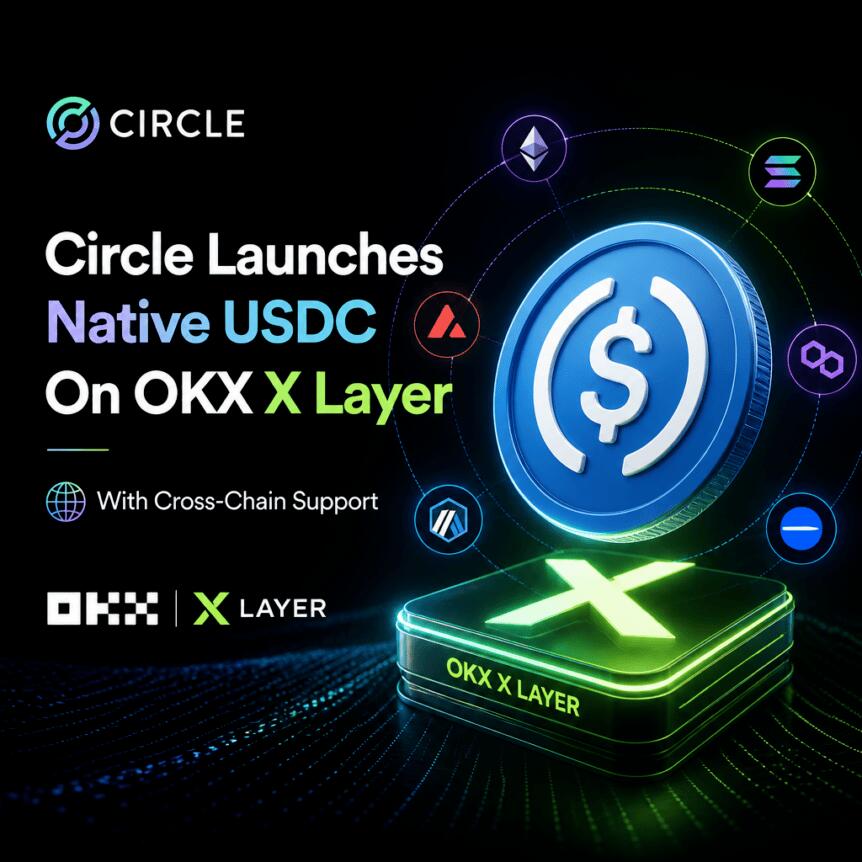
Circle has expanded its blockchain payment infrastructure by launching native USDC and the Cross-Chain Transfer Protocol on OKX’s X Layer. The integration increases access to regulated digital dollar payments while improving cross-chain functionality for developers and businesses. It also strengthens X Layer’s position as a network supporting decentralized finance, payments, tokenized assets, and artificial intelligence applications.
Native USDC Brings Direct Stablecoin Access To X Layer
Circle has introduced native USDC on X Layer, an Ethereum-compatible layer-2 blockchain developed by OKX. The launch gives developers and businesses direct access to Circle-issued stablecoins across the network. It also reduces dependence on bridged versions that previously supported USDC activity.
The integration allows decentralized applications to use native USDC for payments, trading, lending, and other financial services. Developers can also build applications with regulated dollar liquidity from the network itself. As a result, projects gain direct access to Circle’s stablecoin infrastructure.
Qualified businesses can issue and redeem USDC through Circle Mint on X Layer. The service provides institutional access to regulated stablecoin liquidity for settlement and treasury operations. Meanwhile, Circle expands its infrastructure for enterprise blockchain adoption through the integration.
X Layer operates as an Ethereum-compatible layer-2 network with lower transaction costs and faster settlement speeds. The blockchain supports decentralized finance, payment services, tokenized real-world assets, and artificial intelligence applications. Therefore, native USDC strengthens payment capabilities across multiple sectors operating on the network.
Circle continues supporting bridged Ethereum-based USDC on X Layer during the transition period. However, the company encourages applications and ecosystem participants to migrate toward native USDC over time. This approach improves consistency while reducing reliance on external bridge infrastructure.
Cross-Chain Transfer Protocol Expands Multi-Chain Connectivity
Circle also activated its Cross-Chain Transfer Protocol (CCTP) on X Layer. The protocol allows users to move native USDC between supported blockchain networks. Unlike traditional bridge models, CCTP transfers native tokens instead of wrapped assets.
The addition brings the number of blockchains supporting CCTP to 26. At the same time, native USDC now operates across 36 blockchain ecosystems following the X Layer integration. Consequently, developers gain broader access to liquidity across multiple chains.
Cross-chain functionality supports decentralized applications that require efficient movement of stablecoins between different ecosystems. Developers can build services without creating separate liquidity pools for every blockchain. This design also simplifies payment and settlement processes across supported networks.
Circle designed CCTP to improve interoperability between blockchain ecosystems while maintaining native asset movement. The protocol removes the need for wrapped stablecoins during supported transfers. Therefore, developers can create applications with more direct cross-chain payment capabilities.
The expanded network also strengthens X Layer’s position within the broader blockchain ecosystem. Applications can connect with supported chains while maintaining access to regulated USDC liquidity. This combination supports payment services and decentralized financial products across several blockchain environments.
Expansion Supports Payments, AI Applications, And Enterprise Services
Native USDC also supports payment providers, fintech companies, decentralized applications, and automated financial systems operating on X Layer. Businesses can settle transactions with regulated digital dollars across the blockchain. Furthermore, developers can integrate stablecoin payments into consumer and enterprise services.
The integration connects with X Layer’s x402 ecosystem, which focuses on automated payments between artificial intelligence agents and digital services. Developers can use USDC for application programming interfaces and machine-driven payment processes. As a result, automated systems gain access to regulated blockchain settlement.
Circle continues expanding its blockchain infrastructure beyond the X Layer launch. The company recently introduced founding validators for its Arc blockchain initiative. Participants include BlackRock, DTCC, Galaxy, Mastercard, Visa, Standard Chartered, and other financial and technology organizations.
The validator group reflects Circle’s broader strategy to expand regulated blockchain infrastructure across financial markets. Enterprise participation also supports the company’s long-term network development goals. Meanwhile, Circle continues increasing the availability of native USDC across additional blockchain ecosystems.
The X Layer integration represents another step in Circle’s broader expansion strategy. Native USDC, Circle Mint, and CCTP now provide additional payment and settlement options for businesses and developers. Together, these services strengthen regulated stablecoin infrastructure across an expanding multi-chain blockchain ecosystem.


“The order is intended to preserve identified stolen digital assets while the litigation continues, representing an important step in Bybit’s ongoing efforts to recover funds, support international law enforcement investigations, and reinforce accountability for large-scale cybercrime,” Bybit said in the release.
“Our focus has never changed: protect our users first, recover what we can, and make sure the people behind these attacks are held accountable,” said Ben Zhou, co-founder and CEO of Bybit, in a statement. “The Lazarus attack wasn’t just an attack on Bybit. It was an attack on trust in our industry. That’s why we’ve worked closely with investigators, exchanges, regulators, law enforcement, and now the courts.”
The preliminary injunction means a federal judge ordered the respondents not to transfer or sell the assets they’re holding while the case is ongoing, Bybit said. The exchange added that it will look for further relief from the court.
“The civil action is being pursued independently of ongoing criminal investigations conducted by U.S. law enforcement authorities,” the firm added.
The company’s deteriorating financial performance compounded these concerns. BitMEX continued to lose market share throughout the sale process as trading activity migrated to larger centralized exchanges and decentralized perpetual futures platforms. This made potential acquirers reluctant to pay the revenue multiple typically reserved for growing businesses, the person said.
Both and BitMEX and Exodus did not respond to requests for comment by publication time.
The exchange was reportedly seeking a valuation of around $1 billion during the process, although it is unclear whether formal bids were ever submitted.
BitMEX was one of crypto’s most influential exchanges, pioneering the perpetual futures contract in 2016 with the launch of its XBTUSD perpetual swap. Unlike traditional futures, perpetuals have no expiry date and instead use a funding-rate mechanism to keep prices aligned with the underlying asset, allowing traders to maintain leveraged long or short positions indefinitely.
The product revolutionized crypto derivatives trading, was rapidly adopted across the industry, and today accounts for the vast majority of crypto derivatives volume on other exchanges such as Binance, Bybit and Hyperliquid.
The company announced on July 24 that it would wind down operations following a strategic review by its parent, HDR Global Trading, and immediately halting new account registrations ahead of its planned Sept. 23 closure.


Rarible said on Thursday that its NFT marketplace is live on Solana, opening with the Claynosaurz collection as its first featured drop. The marketplace now lists Solana as a supported network alongside Ethereum, MegaETH and Base, with dedicated Solana Explore, Mint and Gacha pages. Solana's… Read the full story at The Defiant

Broncos DL Matt Henningsen carted off at Friday’s practice

ClickFix attack pushes macOS infostealer for crypto theft attacks

Is a Variable Capital Company the Right Fund Structure for Your Singapore Investment Platform?


-

 Politics7 days ago
Meta enters AI-training agreement with far-right ‘propaganda rag’ Newsmax
-

 Politics5 days ago
Zack Polanski: an incitement to murder Nigel Farage?
-

 Crypto World6 days ago
MicroStrategy Post-Earnings CLARITY Act Push Could Add New Catalyst for Its Stock
-

 Crypto World7 days ago
XRP Ledger v3.3.0 brings five institutional features
-

 Crypto World7 days ago
New York sues Kalshi over prediction market gambling
-

 Crypto World5 days ago
Crypto PAC spending tops $2M in Michigan House race
-

 Business5 days ago
DTCR: Deleveraging And A Hedge Fund Collapse Point To A Possible AI Bottom
-

 Tech6 days ago
ESET tracks rise in malicious AI skills and adaptable malware
-
 Crypto World7 days ago
3 Fed Officials Just Explained Their Rate Hike Vote: Is Inflation Winning?
-

 Sports6 days ago
France Cricket implodes: letters hidden in a drawer and a board at war
-
Crypto World5 days ago
XRP Ledger urges node upgrade after manifest flood
-

 Crypto World6 days ago
Moneyflip CEO charged in $40K murder-for-hire plot
-
 Sports7 days ago
Bruno Fernandes decision made as Man United ‘discuss’ striker transfer option
-
Business7 days ago
FIFA has scrapped $20 billion World Cup sell-off plan, New York Post reports
-

 News Videos6 days ago
Financial Crash Expert: The 90-Day Collapse Timeline They Are Desperately Hiding.
-

 Sports2 days ago
Jordan Coyle & Cordiamo take Laya Arena Stakes at RDS
-

 Sports7 days ago
Commonwealth Games 2026 Live Updates | Day 9 CWG 2026: Lovlina Borgohain, Sachin Siwach Enter Final After Indian Judokas Script History
-
 Crypto World4 days ago
US Tech Stocks See Largest 5-Week Inflow in History: Can Nasdaq Break Its Downtrend?
-
 NewsBeat6 days ago
Tourist plane on sightseeing flight in Peru crashes into a field, killing all 13 people on board
-

 NewsBeat6 days ago
Arsenal reach full agreement with Newcastle over Bruno Guimaraes transfer | Football
You must be logged in to post a comment Login