
Crypto World
US, UK Launch Joint Crypto Scam Center Alliance



The United States and United Kingdom have formed a joint law enforcement alliance targeting scam centers involved in crypto and cyber-enabled investment fraud.
On Thursday, the US Department of Justice announced that the US Attorney’s Office for the District of Columbia, the Crown Prosecution Service of England and Wales and the UK National Crime Agency signed a memorandum of understanding. The DOJ described it as the “first-of-its-kind” international cooperation agreement aimed at disabling such scam centers.
Under the agreement, the agencies will conduct parallel investigations into common targets, share information on organized crime syndicates and discuss which jurisdictions should prosecute specific cases. The DOJ said the authorities have already identified overlapping cases and plan an in-person disruption operation with private-sector partners in London in early October.
The cross-border pact comes as reported US losses from crypto investment fraud continue to climb. Losses reported to the FBI’s Internet Crime Complaint Center rose 89% from $4.57 billion in 2023 to $8.65 billion in 2025, according to the DOJ.
International efforts target crypto scam compounds
The agreement expands the Scam Center Strike Force, which US Attorney Jeanine Ferris Pirro launched in November 2025 to target Chinese organized crime networks operating scam centers primarily in Southeast Asia. Their schemes include crypto investment fraud and are often linked to human trafficking and money laundering, according to the DOJ.
The task force includes the FBI, US Secret Service, Internal Revenue Service Criminal Investigation, Homeland Security Investigations and Justice Department offices. It also works with the US Treasury and State departments and private companies to disrupt scam operations and recover victims’ funds.
Related: Chinese newspaper warns of Bitcoin extortion scam using its name
International authorities have coordinated raids against similar operations. On April 29, the DOJ reported a Dubai police-led operation involving the FBI and China’s Ministry of Public Security, which resulted in 276 arrests and the closure of at least nine crypto scam centers. Six people were charged over schemes that allegedly used fake crypto investment platforms to solicit deposits from victims.
Governments in Southeast Asia have also pursued tougher domestic measures. On May 15, Myanmar’s military government had released draft legislation proposing sentences ranging from 10 years to life in prison for digital currency fraud, with the death penalty possible when people coerced into working at scam centers were killed.
On July 28, Parliament approved the bill, though presidential assent had not been confirmed.
Magazine: Recovery specialists crack $1B crypto wallet… but find just $10


The International Monetary Fund (IMF) says private donations, rather than public resources, have driven El Salvador’s Bitcoin (BTC) reserve growth since the first review.
The finding came alongside a staff-level agreement on El Salvador’s combined second and third program reviews. Approval by the Executive Board would release around $140 million.
IMF Expects No Further Bitcoin Accumulation Beyond Documented Donations
El Salvador entered the 40-month Extended Fund Facility (EFF) in February 2025. The arrangement carries total access of roughly $1.4 billion, equal to 360% of the country’s quota at the fund.
Bitcoin has shadowed the program ever since. Earlier this year, falling prices cut the value of El Salvador’s Bitcoin holdings. The country’s credit default swaps climbed to a five-month high.
At the first review, completed on June 27, 2025, the Fund said public-sector Bitcoin holdings had not moved since the program began. Coins appearing in the Strategic Bitcoin Reserve Fund had been gathered from other state-held addresses.
The IMF said that it has now verified the source of coins added since the first review.
“Documentation has been provided verifying that Bitcoin accumulation since the first review reflects private donations and that no public resources were used,” the statement read.
No further accumulation beyond the documented donations is expected going forward.
Follow us on X to get the latest news as it happens
New Rules for Digital Assets and a Handover at Chivo
Meanwhile, both sides also settled on plans to modernize the legal, regulatory, and supervisory framework for digital assets. They agreed to tighten oversight and risk controls on the crypto that the public sector holds.
Public involvement in the Chivo e-wallet has been substantially unwound. A private operator took majority ownership and day-to-day control.
The state retained a small stake and continues to safeguard customer assets. Staff added that Work is also underway to improve the transparency of Bitcoin held across its various wallets.
Mr. Torres, Mission Chief for El Salvador, projected real gross domestic product (GDP) growth of 4.5% in 2026, helped by investment, consumption, remittances, and tourism. The non-financial public sector primary surplus should widen from 2.9% of GDP this year to 3.7% in 2027.
Subscribe to our YouTube channel to watch leaders and journalists provide expert insights
The post IMF Says Donations, Not Public Funds, Drove El Salvador Bitcoin Growth appeared first on BeInCrypto.
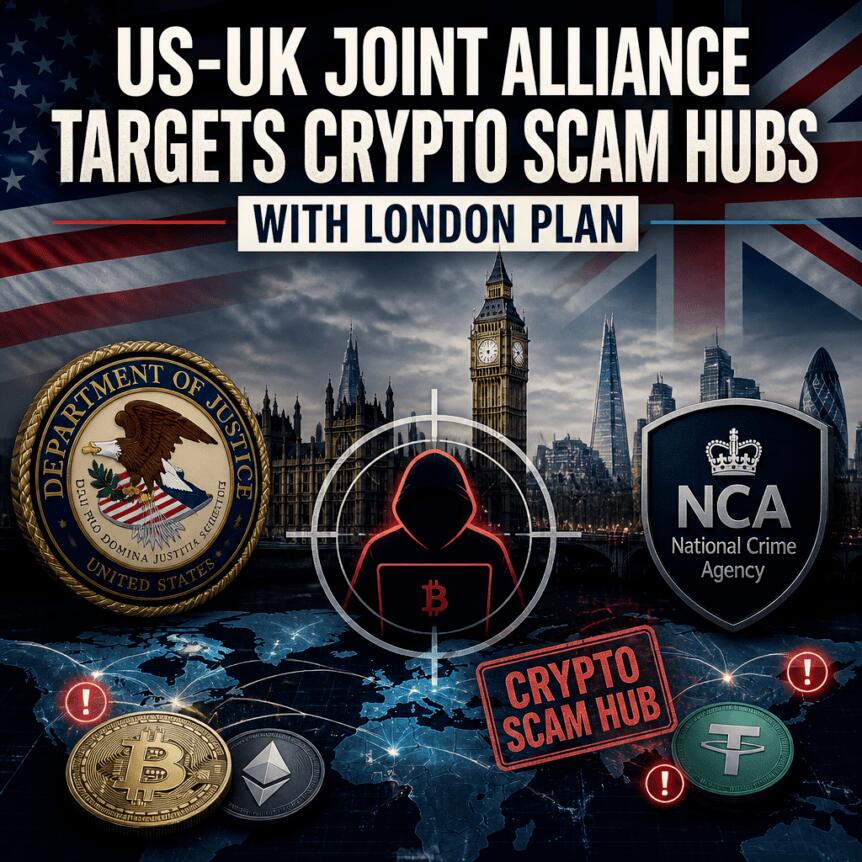
The United States and the United Kingdom have announced a new joint law-enforcement effort aimed at dismantling “scam centers” that fuel crypto-related and cyber-enabled investment fraud. The U.S. Department of Justice says the initiative is structured as a first-of-its-kind international cooperation agreement designed to disable organized scam operations that move victims’ funds across borders.
In a statement released Thursday, the DOJ said the U.S. Attorney’s Office for the District of Columbia, the Crown Prosecution Service for England and Wales, and the UK’s National Crime Agency signed a memorandum of understanding outlining how the two countries will coordinate investigations. The agencies expect to identify shared targets, align investigative work, and determine which jurisdictions should prosecute specific cases.
Key takeaways
- The U.S. and UK signed a memorandum of understanding to coordinate investigations into crypto and cyber-enabled investment fraud run from scam centers.
- Agencies will conduct parallel investigations, share intelligence on organized crime groups, and discuss jurisdiction-specific prosecution strategy.
- The DOJ says overlapping cases have already been identified, with plans for an in-person disruption operation in London in early October.
- The announcement highlights rising U.S. losses tied to crypto investment fraud as reported to the FBI’s Internet Crime Complaint Center.
- The joint pact builds on the U.S. Scam Center Strike Force launched in late 2025 to target Chinese organized crime networks operating primarily in Southeast Asia.
U.S. and UK coordinate parallel investigations
According to the DOJ, the memorandum of understanding sets out a practical framework for cross-border cooperation. The partners plan to pursue common targets through parallel investigations, exchange information about organized crime syndicates, and coordinate which legal jurisdictions will take the lead on prosecutions.
The DOJ also linked the announcement to existing investigative overlap, stating that authorities have already identified common cases. As part of the next phase, the agencies plan an in-person “disruption operation” with private-sector partners in London scheduled for early October.
Crypto investment fraud losses keep climbing
The new cooperation comes as reported U.S. harm from crypto investment fraud continues to rise. The DOJ cited data indicating that losses reported to the FBI’s Internet Crime Complaint Center increased by 89% in 2025 to $8.65 billion, up from $4.57 billion in 2023.
That escalation matters for how law enforcement allocates resources. While scams can vary in their methods—sometimes using fake investment platforms and other times employing more direct criminal coercion—the scale of victim losses increases the urgency to disrupt the criminal infrastructure behind them, including money flows, recruitment networks, and the operational hubs that process or redirect funds.
Expanding the U.S. “Scam Center Strike Force”
The joint U.S.-UK pact expands the scope of the Scam Center Strike Force, a U.S. initiative launched in November 2025 by U.S. Attorney Jeanine Ferris Pirro. The DOJ described the effort as focused on Chinese organized crime networks operating scam centers primarily in Southeast Asia, where schemes can include crypto investment fraud.
In the DOJ’s account, these operations are frequently intertwined with other serious crimes, including human trafficking and money laundering. The force is therefore not limited to prosecuting individual fraudsters; it is also aimed at dismantling the broader systems that enable recruitment, victim control, and financial movement.
The Strike Force includes a multi-agency set of U.S. partners: the FBI, U.S. Secret Service, Internal Revenue Service Criminal Investigation, and Homeland Security Investigations, alongside Justice Department components. The DOJ added that the initiative also works with the U.S. Treasury and State Department and with private-sector partners to disrupt scam operations and pursue victim fund recovery.
Other international raids show the pattern
The alliance is part of a wider enforcement trend in which agencies coordinate across jurisdictions to target scam center networks and the infrastructure around them. For example, the DOJ previously reported a Dubai police-led operation conducted with the FBI and China’s Ministry of Public Security. That action, announced on April 29, resulted in 276 arrests and the closure of at least nine crypto scam centers, according to the DOJ. The DOJ also said six people were charged over schemes that allegedly used fake crypto investment platforms to solicit deposits.
These cross-border actions reflect an operational reality: scam networks often rely on fragmented control across countries—where perpetrators, intermediaries, and the mechanisms used to receive or transfer illicit payments may not all sit in a single legal jurisdiction. Coordinated enforcement can therefore reduce the time criminals have to adjust or move operations after early disruptions.
In Southeast Asia, policymakers have also moved toward harsher criminal penalties. On May 15, the Myanmar military government released draft legislation proposing sentences ranging from 10 years to life in prison for digital currency fraud, with the death penalty possible in cases involving coercion at scam centers where coerced workers were killed. Later, on July 28, Parliament approved the bill, though presidential assent was not confirmed at the time of reporting.
Elsewhere, the scam ecosystem continues to evolve in ways that increase the complexity of enforcement. Earlier coverage from Cointelegraph noted a Bitcoin extortion scam that used the name of a Chinese newspaper, underscoring how criminals may rely on branding, impersonation, and attention-grabbing tactics to draw victims into payment or disclosure schemes.
What to watch next from the London operation
For investors, traders, and everyday users, the practical value of agreements like this is not in public statements alone, but in operational follow-through—especially when authorities plan disruption actions that bring together multiple investigative and prosecutorial systems. With the DOJ saying overlapping cases have already been identified and an in-person disruption operation is planned in London in early October, the next sign readers should look for is whether authorities announce specific arrests, charges, or confirmed closures of targeted scam centers as the cooperation moves from paperwork to courtroom and enforcement outcomes.


Pocket Bitcoin said on Sept. 3 that its August security incident exposed additional personal and financial information involving 5,411 customers, expanding the scope described in its initial disclosure.
Summary
- Pocket Bitcoin confirmed that two exposed data groups contained records involving 5,411 customers in total.
- Bank transaction lists exposed names, addresses, transfer amounts, dates and sometimes customer IBAN account numbers.
- Another 291 customers faced possible exposure of identity documents, Bitcoin addresses and sensitive funding records.
- Pocket said its customer databases, transaction systems, private keys and customer Bitcoin remained directly unaffected.
- Authorities in Switzerland and Liechtenstein received notifications, while Pocket also formally filed a police report.
The Swiss Bitcoin services provider identified two distinct groups after completing its forensic investigation. One contained bank transaction information involving 5,120 customers. The other covered correspondence containing potentially more sensitive records from 291 customers.
Pocket Bitcoin breach exposed two data groups
The larger group consisted of transaction lists that partner banks sent to Pocket Bitcoin during compliance checks. Those lists contained customer names, residential addresses, transfer amounts and transaction dates. Some also included the IBAN connected to a transfer.
The smaller group involved correspondence Pocket Bitcoin sent to partner banks. Depending on the customer, the exposed material included names, postal addresses, public Bitcoin addresses, identity document copies and source-of-funds records.
The company said the information appeared in different combinations, meaning every customer in the 291-person group did not necessarily have every listed data type exposed. Pocket Bitcoin has contacted affected customers individually with details about their cases.
The two groups cover 5,411 customers combined. Other customers may have had email addresses or support conversations exposed under the company’s original disclosure, but Pocket said those without a new personal notification should continue relying on that initial notice.
Core databases and customer Bitcoin were unaffected
Pocket Bitcoin said attackers did not compromise its main customer or transaction databases. Instead, the records came from correspondence and bank-generated lists stored in a copied backup within the affected support system.
This distinction explains why data resembling transaction and identity records was exposed even though the underlying databases remained secure. The affected support material contained copies of information produced or received during regulatory compliance procedures.
Pocket Bitcoin operates as a noncustodial service and does not hold customers’ private keys. The company said Bitcoin balances were never accessible to the attacker, while buying and selling services continue to operate normally.
A disclosed Bitcoin address cannot authorize a transfer. However, linking a public address to a customer’s identity may allow another person to inspect its visible blockchain activity. Pocket noted that moving Bitcoin cannot erase the address’s existing transaction history.
Exposed records create physical phishing risks
Pocket Bitcoin said it currently has no indication that the exposed information has been misused. That statement reflects information available after its investigation and does not guarantee that misuse will not occur later.
“As things stand, we have no indication that any of the affected information has been misused,” Pocket Bitcoin said.
The company identified forged letters and other physical communications as particular risks because names and postal addresses were included. A fraudster could refer to a genuine bank transfer or Bitcoin transaction to make an impersonation attempt appear credible.
Email addresses and login credentials were not linked to the two newly identified data groups, according to Pocket Bitcoin. The company therefore said it does not see a direct targeted email-phishing risk arising specifically from those records.
The incident follows several disclosures involving customer information held outside core crypto systems. As crypto.news reported, three recent breaches exposed 253,487 records, raising concerns that residential and transaction data could support phishing or physical targeting years later.
A separate August incident at Bits of Gold potentially exposed customer identity, banking and wallet information through a third-party system. That investigation similarly found that customer funds and passwords remained unaffected.
Pocket Bitcoin notified regulators and police
Pocket Bitcoin reported the incident to Switzerland’s Federal Data Protection and Information Commissioner and Liechtenstein’s Data Protection Office. It also filed a police report but did not identify the suspected attacker or provide details about the investigation.
The company said the vulnerability behind the incident has been closed and additional safeguards have been installed. It is reviewing how bank correspondence and related compliance records are stored and transferred.
Pocket expects to publish more information about those changes in the coming weeks. It does not expect to identify further exposure categories, although it said it would notify customers if later findings changed that assessment.
Affected users should monitor bank activity and treat unexpected letters, calls or messages cautiously. Pocket Bitcoin said it will never ask customers to disclose a seed phrase or transfer Bitcoin through an unsolicited telephone call or letter.

XRP’s spot trading volume climbed to its highest level since February during August, and the token’s price is now up roughly 8% in the last day to trade near $1.45.
The pickup in trading activity landed as the broader crypto market came back to life, with Bitcoin clearing $80,000 for the first time in a week and altcoins moving right along with it.
Volume Returns Across Major Exchanges
Data shared by CryptoQuant contributor Arab Chain showed XRP’s spot trading volume rising across several major exchanges last month, reaching its highest point since February.
Binance accounted for the largest share, logging about $7.28 billion in XRP trades during August, followed by Upbit at around $4.68 billion and Bithumb Korea at close to $2.59 billion.
Bybit processed about $1.40 billion, Gate.io around $1.33 billion, and KuCoin near $1.23 billion, while Bitget and Coinbase each came in just under the billion-dollar mark, at $918.5 million and $915.4 million, respectively.
On its own, a jump in trading volume does not point to higher or lower prices ahead. It simply means more buyers and sellers are active. Still, hitting a six-month high on volume points to a real improvement in liquidity around XRP, and if that pace holds, it could help the token absorb bigger price swings going forward.
Price Follows the Rest of the Market Higher
XRP is changing hands around $1.45 as of this writing, up more than 6% in the last 24 hours, per CoinGecko. The token has traded between $1.35 and $1.48 in the last day and between $1.31 and $1.48 in the last week, and the weekly change of just 1.4% suggests most of the recent gain came in one quick move rather than a steady climb.
Looking further out, XRP is up around 36% on the month, though it still sits about 49% below where it was a year ago and roughly 60% under its all-time high of $3.65, reached in July 2025.
The move ties into a wider rebound that took hold on Thursday, when Bitcoin pushed past $80,000 for the first time in a week, as CryptoPotato reported earlier, after briefly dipping to a 10-day low near $76,200 amid tension in the Middle East.
XRP was among the bigger movers in that stretch, gaining 9% on the day and clearing $1.40, ahead of ETH’s climb toward $2,500 and BNB’s push above $720.
The post XRP Trading Activity Hits Highest Level Since February as Price Jumps 8% appeared first on CryptoPotato.


The company is subsidizing access to its Daybreak security platform after saying Astra can independently find previously unknown software flaws and turn them into working attacks.
Bitcoin (BTC) and Ethereum (ETH) climbed to multi-month highs again this week, but prediction market traders still assign low odds to either asset approaching record territory in 2026.
Polymarket traders give Bitcoin a 32% chance of touching $100,000 this year. Ethereum traders price a move to $3,500 at just 31%.
Rate Pause Signals and ETF Inflows Lift Crypto
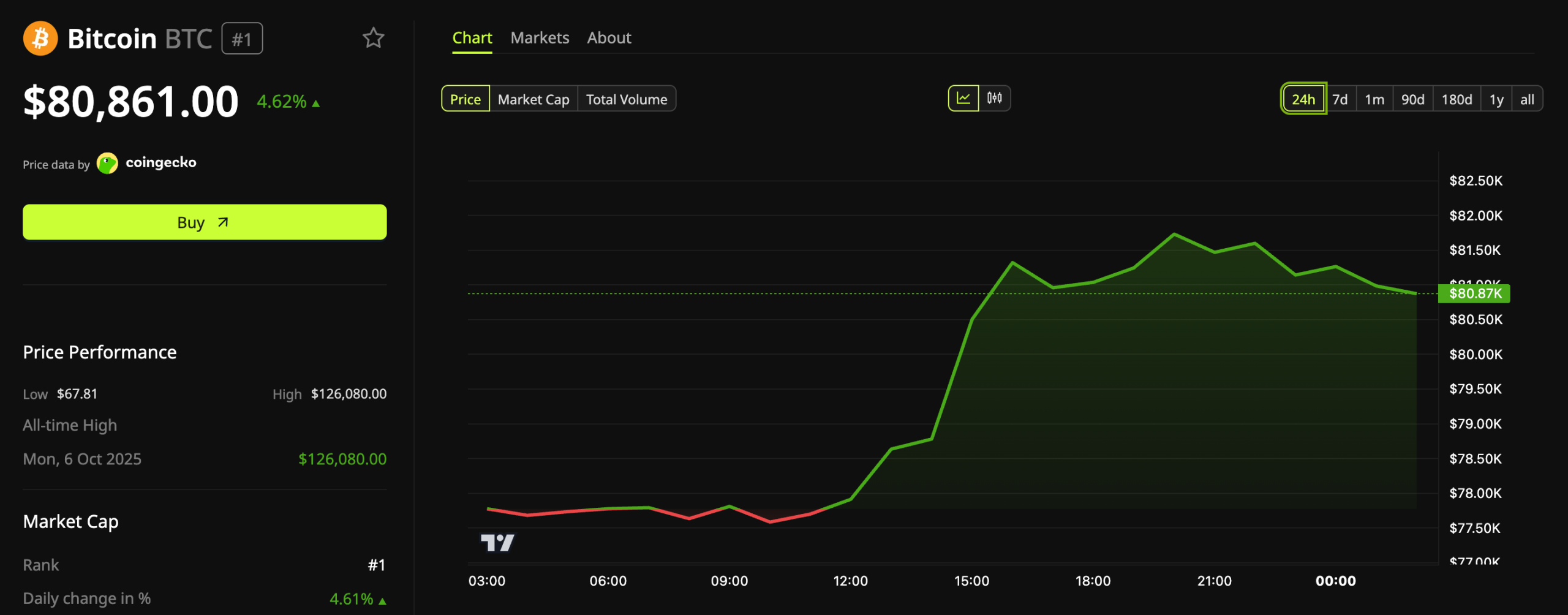
Bitcoin rose 4.62% over 24 hours to $80,861, while Ethereum gained 4.85% to $2,501, according to BeInCrypto Markets data.

The rally follows reports suggesting the war in Iran could be over. In addition, Federal Reserve Governor Christopher Waller said he could support holding rates steady.
Odds of a September Federal Reserve rate hike fell to 50% today after reaching as high as 70%
Weak labor data reinforced the move. ADP reported that US private employers added 38,000 jobs in August. That fell short of expectations, near 47,000, and marked the weakest increase since January.
Institutional demand also returned. Spot Bitcoin exchange-traded funds (ETFs) drew about $101.1 million in net inflows, led by the iShares Bitcoin Trust.
Follow us on X to get the latest news as it happens
Traders Reprice the Range, Not the Ceiling
Polymarket traders moved aggressively on the near end of the curve. The $85,000 Bitcoin contract jumped 43 points to 81%, while odds of a drop to $70,000 fell 28 points to 48%.
Higher targets stayed put. The $95,000, $100,000, $110,000, and $120,000 contracts showed no 24-hour change, holding at 44%, 32%, 20%, and 12%. The $90,000 line slipped 2 points to 61%.

Ethereum shows the same pattern. The $2,750 contract climbed 25 points to 75%, and the $3,000 contract added 4 points to 54%. However, $3,500 and $4,000 held flat at 31% and 17%.
Downside bets have not disappeared. Traders still give 72% odds that Bitcoin will revisit $75,000 and 56% odds that Ethereum will slip to $2,250.
Friday’s US jobs report will test whether the rate-pause trade holds. For now, positioning treats the move as a range shift rather than a path back toward the records of $126,080 and $4,946.
Subscribe to our YouTube channel to watch leaders and journalists provide expert insights
The post Bitcoin and Ethereum Hit Multi-Month Highs but Traders Cap 2026 Upside Bets appeared first on BeInCrypto.


Notional Finance may have suffered a $1.7 million exploit involving an escrow contract, blockchain investigators reported on Sept. 4. The reported losses include approximately $69,242 in DAI and $1.66 million in USDC.
Summary
- Researchers reported $1.7 million in DAI and USDC leaving an escrow contract linked to Notional.
- The reported losses comprise $69,242 in DAI and $1,658,423 in USDC, according to Specter researchers.
- The suspected attacker exchanged the stablecoins for 689.2 ETH before depositing funds into Tornado Cash.
- PeckShield cited Specter’s findings, while Notional had not publicly confirmed the incident when last checked.
- The exploit’s technical cause, affected users and prospects for recovering assets remain publicly unconfirmed.
Security firm PeckShield cited findings published by blockchain investigation group Specter. Neither report provided a complete technical explanation of how the assets left the contract.
“The Notional Finance escrow contract may have been exploited,” PeckShield said, preserving uncertainty about the incident’s status.
Notional Finance exploit report identifies two addresses
Researchers identified two Ethereum addresses allegedly connected to the movement of the assets. The first address is 0xC954…De69, while the second is 0xDaCC…Ce38.
The addresses were labelled as theft addresses by Specter. That description remains an investigator attribution rather than a finding confirmed by Notional Finance, law enforcement or a court.
The available reports do not identify the precise escrow function involved. They also do not establish whether the event resulted from a smart-contract vulnerability, compromised credentials, faulty permissions or another cause.
Stablecoins were reportedly converted into 689.2 ETH
The suspected attacker reportedly exchanged the DAI and USDC for approximately 689.2 ETH. The Ether was then deposited into Tornado Cash, according to Specter and PeckShield.
Tornado Cash is a set of Ethereum smart contracts designed to reduce the visible connection between deposits and later withdrawals. Its use can complicate blockchain tracing, although depositing assets into the protocol does not independently prove criminal ownership or intent.
The rapid conversion of stablecoins may also reduce opportunities for issuers or centralized platforms to restrict the assets. Both DAI and USDC can be followed publicly before conversion, while subsequent withdrawals from a mixer become harder to associate with the original address.
In related coverage, crypto.news reported that an address tied to the Drift Protocol exploiter moved $44 million through Tornado Cash after remaining inactive for several months.
No technical cause or official response is available
Notional Finance had not published a public incident report or confirmation through its official account when checked. The project had also not disclosed whether contracts were paused, whether remaining assets were secured or whether users needed to take protective action.
The lack of confirmation means the reported $1.7 million loss should remain described as preliminary. It is also unclear whether the affected assets belonged directly to users, the protocol treasury or another party using the escrow contract.
No verified market reaction can be attributed to the report. Without an official assessment, linking token-price movements or changes in deposited value directly to the suspected exploit would be premature.
Previous recoveries depended on rapid containment
DeFi projects commonly respond to suspected exploits by pausing vulnerable contracts, contacting stablecoin issuers and exchanges, tracing connected wallets and offering return agreements. Those options can become more limited after assets enter privacy protocols.
Some projects have still recovered positions or protected unaffected products after an attack. As crypto.news reported, Term Labs recovered its affected fixed-rate positions following an $8.5 million governance exploit, although several products remained closed.
Stake DAO also secured its Ethereum backing and closed a bridge after an unauthorized minting incident, according to related coverage. Those cases involved direct project responses that are not yet available for Notional Finance.
Meanwhile, Notional Finance operates as an Ethereum-based lending protocol focused on fixed-rate, fixed-term borrowing. Its documentation explains that deposited currencies can support borrowing obligations denominated in other currencies.
This makes contract-level accounting and collateral controls central to maintaining solvent user positions. However, researchers have not established whether the reported escrow incident affected Notional’s primary lending system, a separate integration or an older contract.
DAI and USDC have long formed part of Notional’s supported lending markets. The protocol’s technical materials describe currency pairs connecting those stablecoins with their interest-bearing equivalents.
The reported loss therefore involves assets used within Notional’s broader lending architecture, but the available evidence does not show that open loans, collateral balances or fixed-term positions were affected. An official contract identification is needed before the exposure can be measured accurately.
What happens next for Notional Finance
The next confirmed update would likely need to establish which contract was involved, how the transactions were authorized and whether other funds remain exposed. A post-mortem could also clarify the ownership of the lost assets.
Investigators may continue tracking any Ether withdrawn from Tornado Cash. Exchanges and blockchain analytics companies could monitor later transactions, but the reported mixer deposits make attribution and recovery more difficult. Until Notional publishes an assessment, the scale, cause and effect on users remain unresolved.


Curve DAO approved yRisk as its new risk-management provider for crvUSD and Llamalend on Sept. 2, assigning the mandate to two contributors who are also primary developers of Resupply.
Summary
- Curve DAO approved yRisk to monitor crvUSD and Llamalend through a twelve-month risk management mandate.
- yRisk will receive 125,000 frxUSD and 568,181 CRV through two revocable one-year vesting streams separately.
- Its two contributors disclosed being primary Resupply developers, whose protocol suffered a 2025 donation attack.
- The proposal and Curve comparison did not mention Resupply’s approximately $9.6 million exploit explicitly anywhere.
- yRisk’s binding funding vote passed with 621.2 million veCRV supporting and virtually none opposing it.
The binding onchain vote closed with approximately 621.2 million veCRV supporting the proposal and 5.33 veCRV opposing it. The proposal was executed about 87 minutes after voting ended.
yRisk will receive 125,000 frxUSD and 568,181 CRV through separate revocable vesting streams lasting one year. The package represents the team’s requested annual budget of approximately $250,000.
Curve DAO gives yRisk a twelve-month mandate
yRisk will provide risk assessment and monitoring across crvUSD mint markets and Llamalend isolated lending markets. Its responsibilities include reviewing collateral, liquidity, oracle design, concentration and governance risks.
The team will also recommend debt ceilings, market parameters, PegKeeper limits and other risk controls. Curve governance and its emergency DAO retain authority over final decisions and execution.
According to its original proposal, yRisk plans to build public monitoring systems, dashboards, alerts and automated code-analysis tools. Work funded by the mandate will generally be released under an open-source license.
The team consists of contributors known as Wavey and Dudesahn. The proposal identifies both as core developers at Yearn and Resupply and describes them as Resupply’s primary developers.
Resupply exploit was absent from reviewed materials
Resupply suffered a donation attack in June 2025 that caused approximately $9.6 million in losses. A QuillAudits analysis attributed the incident to exchange-rate manipulation affecting a lending market.
The attacker donated assets to a nearly empty vault, causing an exchange-rate calculation to round toward zero. That manipulation allowed the attacker to borrow against artificially inflated collateral.
yRisk’s Curve proposal disclosed its contributors’ Resupply roles but did not mention the exploit. Curve’s comparative assessment also discussed their Resupply experience without referring to the incident.
The omission does not establish that yRisk violated a disclosure requirement. Curve’s call for proposals requested relevant experience, methodology, capacity and pricing, but the published requirements did not expressly demand disclosure of every incident involving a contributor’s previous projects.
Curve reviewers identified a staffing concern
Swiss Stake reviewed nine competing applications before Curve conducted its preference votes. Its assessment credited yRisk with practical knowledge of Curve, Llamalend, Yearn and Resupply.
The review also identified capacity as its main concern. It questioned whether two contributors with other responsibilities could monitor a growing number of markets and provide adequate incident coverage.
“It is not yet clear whether they can sustain that workload and provide sufficient incident coverage as the number of markets expands,” Swiss Stake said.
The statement described uncertainty rather than a finding that yRisk lacked the necessary resources. Swiss Stake recommended an initial limited mandate and a public review checkpoint for whichever provider Curve selected.
During a nonbinding preference vote, yRisk received approximately 536.97 million veCRV votes in favor and none against from 47 voters. That represented about 68.78% of the voting supply at the snapshot block.
yRisk replaces LlamaRisk across Curve markets
Curve began seeking a replacement after LlamaRisk ended its engagement early. LlamaRisk had renewed its mandate in April 2026 with plans to continue through April 2027.
The provider announced its departure on May 29 and stopped active work on June 30. It returned approximately 270,247 crvUSD in unvested funding to Curve’s treasury.
LlamaRisk described the departure as a structural decision about how it allocated resources, rather than criticism of Curve. Curve opened its replacement process on July 7.
The new mandate arrives as Curve expands Llamalend. Crypto.news previously reported that Llamalend v2 introduced isolated lending markets on Optimism before a planned Ethereum deployment.
Risk management has remained a central concern for the ecosystem. In March, an improperly configured oracle enabled an attacker to extract approximately $240,000 from a Llamalend market, as crypto.news reported in its coverage of the sDOLA-crvUSD pool exploit.
Public reporting will test yRisk’s delivery
yRisk must now review LlamaRisk’s existing reports, models, dashboards and repositories. The team will determine which resources should be retained, rebuilt or retired.
Its proposal commits to monthly progress reports, continuous monitoring and incident support. The revocable funding structure gives Curve DAO the ability to stop the remaining vesting streams before the twelve-month term ends.
A future public review would allow governance participants to assess whether yRisk has met its monitoring, reporting and response commitments. Curve has not announced a specific date for that checkpoint.


Apple’s memory bill for the iPhone 18 Pro has reportedly jumped 400% in a year. The company looks set to pass some of that cost onto buyers next week.
Research firm TrendForce says the 256 gigabyte Pro model’s memory costs are nearly 400% higher than a year earlier. Apple is expected to confirm new iPhone pricing next week.
Memory Costs Squeeze Apple’s Margins
TrendForce said Apple’s efforts to negotiate cheaper prices elsewhere will not offset the added memory costs. That leaves Apple choosing between absorbing the hit or raising the iPhone’s retail price. The firm’s report put it in stark terms.
“For the 256GB Pro model, memory costs in 3Q26 are expected to be nearly 400% higher than a year earlier… An increase in retail prices appears increasingly unavoidable while hardware costs remain elevated.”
Apple has so far spared iPhone buyers from the price increases it applied elsewhere. The company raised prices on Mac, iPad, and Apple TV models in June. Apple said it had delayed the move as long as possible.
A Roughly $100 Increase Looks Likely
Current estimates point to a roughly $100 increase for the iPhone 18 Pro over the iPhone 17 Pro, per TrendForce. That figure is notably softer than analyst Jeff Pu’s earlier estimate of $250 to $300.
TrendForce expects Apple to lean more on Services revenue instead of passing on the full 400% memory increase. The firm also cited cautious consumer spending as a reason Apple will want to limit sticker shock.
Frequent upgraders may feel it most. Steeper prices could push buyers to stretch their upgrade cycles. That trend matters to investors, especially with AAPL shares recently slipping slightly around Apple’s leadership change.
Apple’s already announced lease-to-buy Apple Upgrade program could soften the blow. It would spread the higher cost across monthly payments instead of one upfront jump.
Whether Apple confirms the increase, and by how much, should become clear once the new iPhone lineup debuts next week.
The post Apple's Memory Costs Jump 400%, iPhone 18 Pro Price May Rise $100 appeared first on BeInCrypto.


Hargreaves Lansdown opened access to nine Bitcoin and Ether exchange-traded notes on Sept. 3, bringing regulated cryptocurrency exposure to eligible users of the United Kingdom’s largest retail investment platform.
Summary
- Hargreaves Lansdown added nine Bitcoin and Ether ETNs for eligible users through Advanced Investing service.
- Approximately two million platform clients may access products after successfully completing required investor protection checks.
- Investors must self-certify, pass an appropriateness assessment, and complete a 24-hour cooling-off period before access.
- The FCA reopened eligible crypto ETNs to retail investors in October 2025 under safeguards nationally.
- Crypto ETNs track asset prices without giving investors direct ownership of Bitcoin or Ether themselves.
The products come from BlackRock’s iShares, WisdomTree, 21Shares, Invesco, CoinShares and Bitwise, according to a Financial Times report. The issuers charge annual product fees ranging from 0% to 0.35%.
Hargreaves Lansdown serves approximately two million investors. However, the crypto ETNs are only available through its Advanced Investing service and are not automatically accessible to every customer.
Hargreaves Lansdown adds crypto after long delay
The launch comes almost 11 months after the Financial Conduct Authority ended its four-year restriction on retail access to qualifying crypto ETNs. Other major British investment platforms had already introduced the products.
Hargreaves Lansdown initially adopted a more cautious position. In October 2025, the platform told investors that “Bitcoin is not an asset class,” while acknowledging that some customers might still want speculative exposure.
Doug Abbott, Hargreaves Lansdown’s chief product officer, said the platform delayed its launch to ensure client testing and safeguards were properly designed. He said customers should understand the products and encounter the “right level of friction” before investing.
The company’s current crypto ETN page warns that the instruments are volatile and high risk. It says investors could lose all the money they commit.
Investors face eligibility checks and a waiting period
Customers must first self-certify as advanced investors. They must then complete an online appropriateness assessment designed to test whether they understand the products and associated risks.
Eligible customers must also complete a 24-hour cooling-off period before viewing the available ETNs. They need either a Fund and Share Account or a self-invested personal pension to buy, hold or sell the instruments.
Hargreaves Lansdown charges a 0.35% annual platform fee for holding crypto ETNs, capped at £12.50 per month. Dealing charges range from £3.95 to £6.95, depending on the customer’s trading frequency. These charges are separate from each product’s management fee.
The notes trade during London Stock Exchange market hours. They do not provide continuous 24-hour trading like cryptocurrency exchanges.
Crypto ETNs provide exposure without direct ownership
Crypto ETNs are listed financial instruments designed to follow the price of an underlying digital asset. Investors purchase a note issued by a financial institution rather than buying Bitcoin or Ether directly.
The issuer arranges custody of the underlying cryptocurrency. Customers therefore do not control private keys, manage wallets or withdraw the digital assets represented by their investment.
This structure introduces risks that differ from direct cryptocurrency ownership. Investors depend on the issuer, custodian, trading venue and investment platform. Product fees and market spreads may also cause returns to differ from movements in the underlying asset.
Crypto.news previously reported that BlackRock listed its Bitcoin product on the London Stock Exchange after the retail restrictions changed. The listing was among several products introduced as regulated providers prepared for wider individual access.
FCA rules restrict how platforms offer crypto ETNs
The FCA lifted its retail prohibition on qualifying crypto ETNs on Oct. 8, 2025. Products must appear on the regulator’s Official List and trade through a recognized U.K. investment exchange.
The regulator classifies the products as restricted mass-market investments. Its official guidance requires appropriateness assessments, customer categorization, cooling-off periods and prominent risk warnings.
Platforms cannot offer incentives encouraging customers to invest. They must also identify an appropriate target market and take reasonable measures to prevent foreseeable consumer harm.
As crypto.news reported when the policy was announced, the FCA reopened retail access while keeping crypto derivatives prohibited. The regulator said investors would not receive the same protections available for conventional regulated investments.
Demand remains an open question
Hargreaves Lansdown said it had received a consistent level of customer enquiries about crypto ETNs, particularly from experienced investors. That interest has not yet established how many eligible clients will invest.
Other platforms have described British retail uptake as modest. Restrictions preventing newly purchased crypto ETNs from being held in conventional stocks-and-shares ISAs may also limit demand.
The launch nevertheless gives Hargreaves Lansdown customers a regulated route to Bitcoin and Ether price exposure without opening an exchange account. Future adoption will depend on investor demand, cryptocurrency prices and whether the available product range expands.

Smriti Mandhana scripts history, surpasses Mithali Raj to become highest run-scorer in women’s cricket

Tuft & Needle Promo Codes: 30% Off | September 2026

4 Crore Cryptocurrency Holders at Risk? Only 4 Days Left! | Bol News

Weekend Open Thread – Corporette.com

Weekend Open Thread: Brooks Brothers

London Mayor Sadiq Khan handed a peerage by Keir Starmer alongside 15 other Labour figures… just days before the PM leaves No10
4 Crore Cryptocurrency Holders at Risk? Only 4 Days Left! | Bol News

You need to get a j o b @HiggsfieldAI #higgsfieldpartner #money #sidehustle #success

Ripple XRP MOON DATE CRACKED ISHOWSPEED CONFIRMED DAVID SCHWARTZ BLACKSWAN RIP BANK OF AMERICA WOW!
-

 Fashion7 days ago
Weekend Open Thread: Maeve – Corporette.com
-

 Crypto World1 day ago
CLARITY Act could advance within weeks, Atkins says
-

 Business6 days ago
Onto Innovation Stock: AI’s Next Bottleneck Is Yield (NYSE:ONTO)
-

 Crypto World2 days ago
Elon Musk Says Grok 4.7 Lands in 10 Days and Will Beat Every Model
-

 Crypto World6 days ago
Bitcoin price tests $82K resistance as Brandt stays long
-
 Tech5 days ago
Hugging Face built a $4.5 billion empire on free AI models. Now Nvidia is buying it for $12.9 billion
-

 Business7 days ago
iPhone 18 Pro Pre-Orders Could Shift to Saturday as Apple Reportedly Avoids September 11 Anniversary
-
 Entertainment7 days ago
‘Adults’ Creators Break Down Season 2’s Most Shocking Moments and Tease a Potential Season 3
-

 News Videos5 days ago
Charlie Munger on Robinhood: No one should believe that Robinhood’s trades are free
-

 Tech6 days ago
PaperCut releases second emergency patch for exploited flaws
-

 Tech5 days ago
As the influencer economy drives retail sales, Seattle startup raises $22M to play matchmaker
-
 Crypto World2 days ago
Bitcoin slips below $77.5K as macro pressure offsets ETF inflows
-

 Crypto World1 day ago
Kalshi seeks CFTC approval for WTI perpetual
-

 Tech5 days ago
Tamagotchi Ring Takes the 30-Year Digital Pet and Places it on Your Finger
-
 Business2 days ago
Oil Price Today (September 2): Crude oil nears $97 as war tensions escalate. Will it hit $100 again?
-

 News Videos5 days ago
News kii Crypto ugu danbeeyey & Suuqa oo dhaqaaqey
-
 Entertainment4 days ago
Taylor Swift Reportedly ‘Frustrated’ With Travis Kelce After ‘Short’ Honeymoon
-

 Business6 days ago
Apple Confirms September 9 iPhone Launch Event as Tim Cook Prepares to Hand CEO Reins to John Ternus
-
 NewsBeat5 days ago
Trump posts AI video of ‘Lake America’ being protected by an army of bequiffed ‘Donald Ducks’
-
 Entertainment6 days ago
Kendall Jenner’s Circle Concerned About Jacob Elordi Romance
You must be logged in to post a comment Login