
Crypto World
USA Rare Earth (USAR) Stock Slides 3.6% Despite Major Production Milestone and Strong Insider Buying


Key Highlights
- USAR shares dropped 3.6% on Friday, reaching an intraday low of $15.05 before settling near $15.42, with trading volume significantly lighter than typical sessions.
- The firm launched its commercial-scale magnet manufacturing facility in Stillwater, Oklahoma, positioning itself to accept customer orders for sintered NdFeB permanent magnets beginning in Q2 2026.
- Initial production (Phase 1a) is projected to achieve an annual run rate of 600 metric tons by Q4 2026, with total facility capacity expanding to 1,200 mtpa by Q1 2027.
- Wall Street analysts collectively rate the stock a “Moderate Buy” with an average price target of $34.33 — representing potential upside exceeding 120% from current levels.
- Company insiders control approximately 46.6% of outstanding shares, with two board members acquiring a combined $2.17 million worth of stock in January.
USA Rare Earth (USAR) finished Friday’s session at $15.42, marking a 3.6% decline from Thursday’s closing price of $16.00, after touching a session low of $15.05.
The rare earth company achieved a significant operational milestone this week, declaring successful commissioning of its commercial magnet manufacturing line at the Stillwater, Oklahoma location. This development positions the firm to begin processing customer orders for sintered neodymium-iron-boron (NdFeB) permanent magnets from the second quarter of 2026 onward.
Friday’s price retreat occurred alongside subdued trading activity, with approximately 8.74 million shares changing hands — representing roughly 55% below the stock’s typical daily volume of 19.5 million shares.
According to company statements, the commissioning represents a sophisticated, multi-phase manufacturing process. Raw rare earth and metallic components are transformed into ultra-fine powder, then jet-milled to particle sizes between 3 and 5 microns within oxygen-controlled environments. The material subsequently undergoes pressing, precision machining, protective coating application, and magnetization to produce finished magnets.
Over 100 workers at the Stillwater location oversee the complete production cycle.
USAR’s initial Phase 1a manufacturing line is projected to scale up to an annual production run rate of 600 metric tons (mtpa) by the conclusion of Q4 2026.
Expansion of Manufacturing Capacity
With the addition of a subsequent production line, the company forecasts total operational capacity at the Stillwater site reaching 1,200 mtpa by the first quarter of 2027.
Technical indicators show the stock trading significantly below its 50-day moving average of $20.15 and its 200-day moving average of $18.76 as of Friday’s close.
USAR maintains a market valuation near $2.05 billion, posts a PE ratio of -29.65, and displays a beta coefficient of 1.05.
Wall Street Outlook and Insider Transactions
Notwithstanding the recent price weakness, analyst sentiment remains constructive on the stock. Six research firms maintain Buy recommendations while one holds a Sell rating, resulting in a consensus “Moderate Buy” assessment. The mean price objective stands at $34.33 — more than doubling Friday’s trading level.
Canaccord Genuity elevated its price target from $23 to $33 during January, while Cantor Fitzgerald increased its forecast from $28 to $35, maintaining an “overweight” stance.
Benchmark initiated coverage with a Buy recommendation in January, and UBS reaffirmed its Buy rating in December.
Insider purchasing activity has intensified recently. In late January, Board Member Michael Blitzer acquired 100,000 shares at $21.44 per share, representing an investment of roughly $2.14 million. This transaction expanded his holdings by 13.4%.
Board Member Carolyn Trabuco similarly purchased 1,300 shares at $22.60 during the same timeframe.
Collectively, company insiders now control approximately 46.6% of USAR’s total outstanding equity.
Institutional investors have also been accumulating positions. Larson Financial Group expanded its stake by 217.5% during Q4, while NewEdge Advisors increased its holdings by 158.2%.
The company’s flagship Round Top deposit located in West Texas — a polymetallic rare earth resource — continues to serve as its primary asset base, while the Stillwater manufacturing facility represents its strategic move into downstream production capabilities.
The Phase 1a commissioning milestone establishes USAR’s entry into commercial-scale magnet manufacturing, with the subsequent production line anticipated to elevate total output capacity to 1,200 mtpa by early 2027.


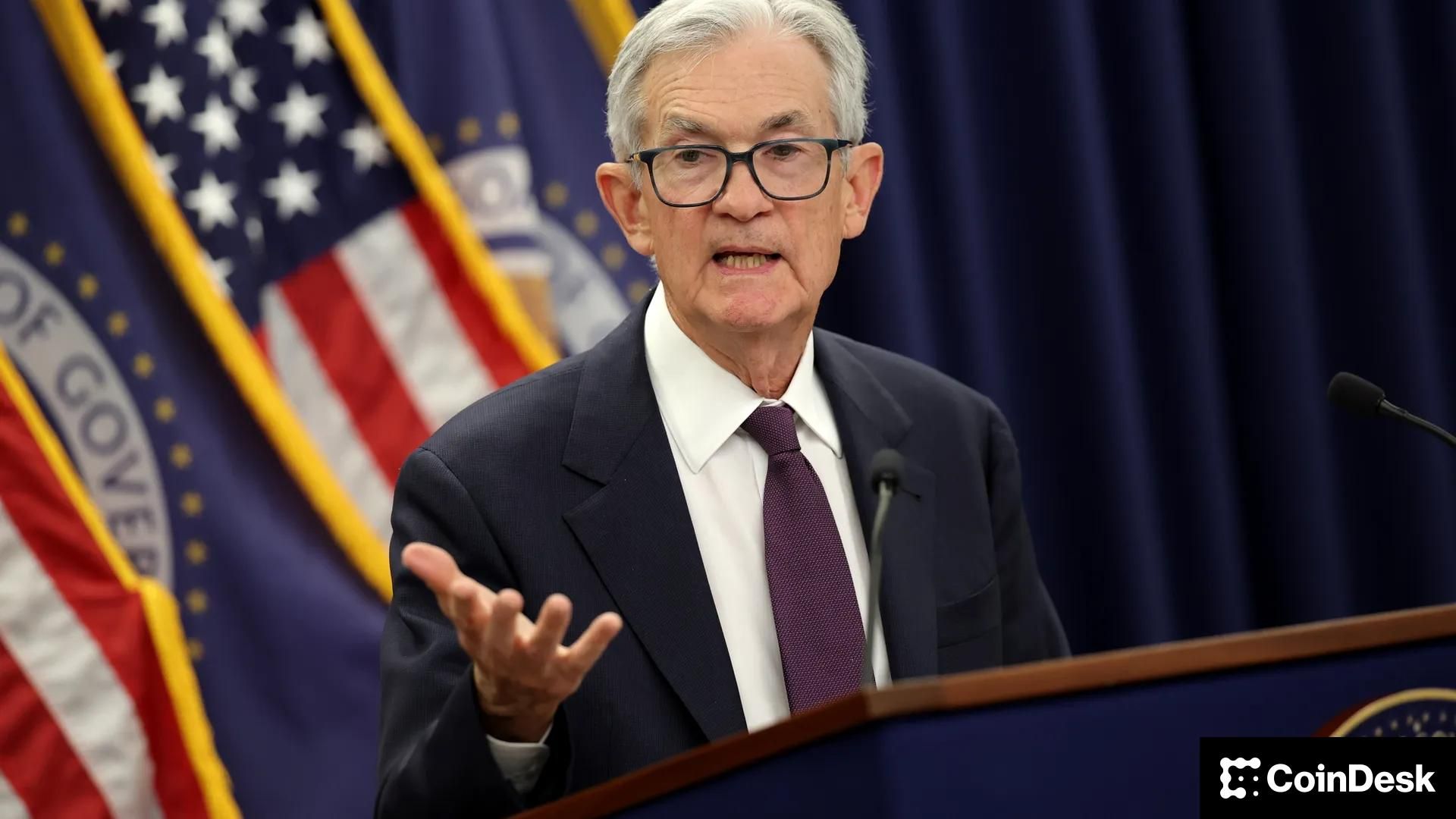
A “180” hardly does justice to the recent shift in market expectations regarding central bank monetary policy.
Expecting multiple Federal Reserve rate cuts in 2026 just weeks ago, markets have seriously begun to price in rate hikes this year.
Current pricing on CME FedWatch Tool shows nearly a 30% chance that the fed funds rate will be higher to end the year than its current level of 3.50%-3.75%. The odds that rates might go lower, meanwhile, have crashed to 2.9%.
The shift has been driven largely by renewed inflation fears tied to energy markets. Since the escalation of tensions in the Middle East at the end of February, the price of Brent Crude oil has risen from about $70 per barrel to its current level of $111. That’s helped send yields at the long end of the Treasury curve sharply higher, the 10-year yield rising to the current 4.40% from below 4% weeks ago.
“Food and energy prices are tragically going to climb and remain high for a while, at least until the utter mess of Middle East shipping is sorted out,” according to Crypto is Macro Now Newsletter. “Even if a peace deal were to be agreed tomorrow (unlikely), that would take months at best.”
Even prior to oil’s gains, inflation was still running well above the Fed’s 2% target. Core inflation in February came in at a 2.5% year-over-year pace and has not fallen below that 2% level since April 2021.
Longer-term inflation expectations remain above target as well, with 5-year and 10-year measures at 2.5% and 2.3%, respectively, suggesting markets expect inflation to exceed the Federal Reserve’s mandate beyond the immediate term.
“The US economy as a whole will, of course, benefit from higher energy prices as it is a net exporter,” Crypto is Macro Now continued. “And military spending will shoot up to replenish hardware, adding further stimulus. Both sectors should help keep GDP from dropping sharply.”
Bitcoin outperforms, but there’s more to the story
Still holding in the $65,000-$70,000 area, bitcoin , by holding roughly steady, has — on paper — outperformed since the start of the Iran war.
Gold, for instance, is lower by about 20% since the U.S. attacks began, while the Nasdaq on Friday entered correction territory by falling more than 10% from its 2026 highs.
But consider what came prior. Gold at the start of March was in the midst of a historic run higher, its price more than doubling over the preceding year. The Nasdaq, too, was near a record high, up 50% from its April 2025 lows. Bitcoin, meanwhile, was down about 50% from its early October 2025 record.
Taken on anything but the shortest of time frames, bitcoin continues to sizably underperform key assets like stocks and gold.
Crypto World
Jane Street vs. Terraform Labs: How One Federal Lawsuit Is Putting Crypto Market Makers on Trial

TLDR:
- Terraform’s wind-down trust sued Jane Street in February 2026 over alleged insider trading during the 2022 Terra collapse.
- A Jane Street-linked wallet allegedly withdrew 85M UST after Terraform quietly pulled 150M UST from Curve’s 3pool.
- The complaint invokes the Commodity Exchange Act and Rule 10b-5, applying traditional anti-fraud law to crypto markets.
- Binance has already updated market-maker guidelines, banning wash trading, profit-sharing deals, and undisclosed arrangements.
Jane Street vs. Terraform Labs is now one of the most closely watched legal battles in crypto history. Filed in Manhattan federal court in February 2026, the lawsuit pits Terraform’s court-appointed wind-down administrator against one of Wall Street’s most sophisticated trading firms.
The complaint accuses Jane Street of insider trading, fraud, and market manipulation during the May 2022 Terra collapse.
Jane Street has denied all wrongdoing. Regardless of outcome, the case is already forcing a hard industry reckoning.
The Clash at the Center of the Case
Jane Street vs. Terraform Labs traces back to the catastrophic May 2022 collapse of TerraUSD and Luna. The Terra ecosystem lost roughly $40 billion in market value within days.
The algorithmic stablecoin’s peg to the dollar broke, triggering a death spiral that shook the entire crypto market. That collapse is now the backdrop for a dispute over who knew what and when.
Terraform’s wind-down trust alleges Jane Street used material nonpublic information to exit UST positions at a precise moment.
The complaint claims Jane Street gained that access through direct and indirect contacts with Terraform insiders, including a private chat referred to in reporting as “Bryce’s Secret.”
While Jane Street allegedly unwound exposure, Terraform and the Luna Foundation Guard were buying billions of UST to defend the peg. Those purchases exceeded 1.9 billion UST between May 8 and May 10 alone.
The complaint adds a specific detail that sharpens the allegation considerably. A Jane Street-linked wallet withdrew around 85 million UST from Curve’s 3pool shortly after Terraform quietly pulled 150 million UST from the same pool.
That sequence sits at the core of the insider trading theory. Jane Street disputes this framing entirely and calls the lawsuit “a desperate attempt to shift blame for a multibillion-dollar fraud that Terraform itself created.”
Why This Case Could Reshape Crypto Market Making
Jane Street vs. Terraform Labs is significant because it applies established securities and commodities law to crypto market-making conduct.
The complaint invokes the Commodity Exchange Act, CFTC Rule 180.1, and Exchange Act Rule 10b-5. That legal structure treats the alleged behavior not as a crypto anomaly but as conventional fraud and manipulation.
Market makers like Jane Street provide liquidity by continuously quoting prices across trading venues. That role narrows spreads and improves execution for ordinary participants.
The problem arises when a firm’s edge stems from insider access rather than analytical skill or technological capability.
As one industry analysis framed it, the case asks whether sophisticated liquidity providers were “stabilizing the room or trading against it.”
“Crypto has often celebrated sophisticated liquidity providers as the adults in the room,” one widely circulated commentary noted. This lawsuit challenges that reputation directly.
It asks whether some of that activity operated with too little transparency and too much informational privilege, particularly during the most fragile moments of a market crisis.
Regulatory and Industry Consequences Taking Shape
The Jane Street vs. Terraform Labs dispute arrives as United States regulators are advancing a more coordinated digital-asset oversight framework in 2026.
The case hands policymakers a vivid, well-documented example of alleged market-maker misconduct. That makes the argument for tighter conduct standards considerably easier to advance publicly.
Binance has already moved in this direction by publishing updated market-maker guidelines. The exchange now bans wash trading, coordinated sell-offs, one-sided liquidity behavior, and guaranteed-profit arrangements with market makers.
Projects must also disclose market-maker identities and contract terms directly to the platform, and violating firms face blacklisting.
Traders and investors should watch whether the case survives early dismissal and what discovery eventually surfaces. They should also track whether regulators cite the lawsuit in formal policy consultations or market-structure proposals.
If that happens, the case’s reach extends well beyond the courtroom. The central question the industry now faces is stark: “when markets are opaque and information is unevenly shared,” are the most sophisticated players stabilizing crypto or exploiting it?
Crypto World
Plug Power (PLUG) Stock Rallies 21% as New Leadership Delivers Historic Profitability Milestone

Key Highlights
- The hydrogen fuel cell manufacturer achieved its first positive gross margin in company history.
- CEO Jose Luis Crespo unveiled a strategic plan to monetize $275 million in assets.
- Short interest approaching 25% of outstanding shares may be fueling an accelerated rally.
- Wall Street analysts have raised their earnings projections following recent operational improvements.
- Management has established clear financial milestones: EBITDA profitability by Q4 2026, operating profit in 2027, and net income by 2028.
The past several years have been challenging for Plug Power. Shares have declined more than 80% over three years and approximately 94% across a five-year period. However, investor sentiment appears to be shifting.
The stock has climbed approximately 21.8% during the last 30 days. Since the beginning of the year, shares have advanced around 15%. Currently, the stock trades roughly 20% beneath the Wall Street consensus price objective of $2.74.
This upward momentum stems from several concurrent developments — new executive leadership, a landmark financial achievement, and market dynamics that have created urgency among traders.
Jose Luis Crespo has assumed the chief executive role, replacing long-serving leader Andy Marsh. This leadership transition has introduced a more disciplined operational approach. Crespo has outlined specific targets: achieving positive EBITDA by the end of 2026, generating operating income during 2027, and reaching comprehensive profitability by 2028.
These represent aggressive objectives for an organization currently carrying a net loss of $1.63 billion. However, Crespo has simultaneously revealed a $275 million asset monetization initiative, demonstrating his commitment to bolstering cash flow and strengthening the balance sheet beyond simple expense reduction.
The organization has now posted its first positive gross margin in its entire operating history. This represents a critical inflection point. Gross margin indicates whether a business earns money on its core products before factoring in operational expenses. Achieving positive territory — regardless of magnitude — represents the breakthrough moment that shareholders have anticipated.
Technical Factors Amplifying the Upward Move
With approximately 25% of PLUG’s available shares currently held in short positions, this rally extends beyond fundamental improvements alone. A technical chart breakout seems to have surprised bearish investors, compelling them to purchase shares to exit their positions. This forced buying creates additional upward pressure and can drive stock prices beyond levels supported by fundamentals alone.
Wall Street has responded accordingly. Earnings forecasts have been adjusted upward following the improved business trajectory, lending institutional validation to the recent price action.
Nevertheless, significant challenges persist. The company’s cash reserves provide less than twelve months of operating runway. Historical shareholder dilution has been considerable, and any forthcoming capital raising would likely create additional downward pressure on current stakeholders. While revenues reach $709.9 million, the distance to sustained profitability remains substantial.
Liquidity Concerns and Dilution Continue to Loom
Pending legal matters related to previous regulatory filings remain unresolved. For the moment, market participants seem willing to overlook these concerns, concentrating instead on whether Crespo’s strategic initiatives will translate into measurable results with sufficient speed.
The current share price of $2.18 remains notably below the analyst consensus valuation of $2.74. Financial professionals covering the company have begun raising their forecasts, acknowledging the stronger-than-anticipated gross margin performance and the new management team’s declared emphasis on fiscal responsibility.
Crespo’s fundamental strategy is clear: transform the hydrogen and fuel cell operations into financially viable businesses, not merely technologically advanced ones. Whether this vision materializes according to his stated timeline is the central question that market participants are now evaluating.
TLDR:
- Ethereum’s total transaction count is rising sharply in 2026 despite price remaining largely range-bound in crypto markets.
- DeFi liquidity is returning to lending, stablecoin provision, and DEX trading after two years of capital outflows and declining yields.
- The U.S. CLARITY Act introduces a safe harbor for non-custodial developers, removing direct legal liability tied to publishing smart contract code.
- Network activity is leading price movement in this cycle, pointing to a structurally grounded growth phase rather than speculation-driven momentum.
Ethereum is recording clear structural changes in 2026, with total transaction counts rising sharply despite flat price performance.
This divergence separates real network usage from speculation-driven behavior. Capital that left the ecosystem during 2024 and 2025 is now returning to decentralized finance protocols.
Meanwhile, U.S. legislative efforts are reshaping the regulatory environment for on-chain development. Together, these shifts are building conditions that could support sustained structural growth across the Ethereum ecosystem.
DeFi Liquidity Returns to Drive Real Ethereum Network Usage
On-chain data shows Ethereum’s total transaction count climbing steadily through early 2026. The growth reflects genuine protocol activity rather than short-term speculative behavior in the broader market. This activity pattern has not been observed at this level since before the 2022 market downturn.
Between 2024 and 2025, regulatory uncertainty and declining yields pushed capital away from DeFi protocols. Those conditions have since shifted, and liquidity is returning to on-chain lending, trading, and stablecoin markets. The recovery appears measured and connected to real protocol use cases.
Stablecoin-based liquidity provision, lending platforms, and decentralized exchange trading are all recording higher volumes in 2026.
These core DeFi segments are recovering in parallel, reflecting authentic demand for on-chain financial services. Growth is distributed across multiple protocol categories rather than concentrated in one area.
XWIN Research Japan noted in a recent post that this cycle differs from prior ones. Network activity is leading price movement, not the other way around.
That distinction points to a more structurally grounded early phase of growth than markets have previously seen.
CLARITY Act Shifts Developer Risk and Sets Stage for Institutional DeFi Entry
The U.S. CLARITY Act marks a turning point in how legislators are addressing decentralized finance. It is the first serious effort to formally define how DeFi protocols should coexist within existing financial systems. The legislation is also considered the most substantive regulatory proposal for DeFi made in the U.S. to date.
Before this legislation, developer liability was one of the most serious obstacles to ecosystem growth. Writing and deploying smart contract code carried legal uncertainty that discouraged builders from participating. That environment functioned as a structural brake on DeFi innovation over multiple years.
The latest draft introduces a safe harbor provision specifically for non-custodial developers. Under this provision, publishing code alone does not classify a developer as a financial institution. This removes a meaningful layer of legal exposure from the development and deployment process.
Open issues remain, including KYC scope and restrictions on stablecoin yield products. The regulatory debate has, however, shifted from whether DeFi should be permitted to how it should be integrated. As legal clarity replaces ambiguity, institutions with previously restricted exposure may begin allocating capital toward on-chain platforms.


A group of Ethereum projects have announced a new effort aimed at fixing a growing problem in Ethereum: its ecosystem is becoming too fragmented.
Revealed at the EthCC conference in Cannes, the project — called the “Ethereum Economic Zone” (EEZ) — is designed to make Ethereum’s many add-on networks (known as layer 2s, or L2s) work together more seamlessly.
The framework is being developed by Gnosis, Zisk and the Ethereum Foundation. Gnosis is a longtime Ethereum infrastructure developer, while Zisk focuses on zero-knowledge proving technology.
It comes as Ethereum for years relied on L2 networks to scale, though these networks often operate like separate islands. Users have to move assets between them using bridges, which can be slow, costly and risky, while developers often have to rebuild the same tools on each network.
The EEZ aims to change that by making all these networks feel like one unified system. In simple terms, it would allow apps and transactions on different Ethereum networks to interact instantly — without needing bridges — while still relying on Ethereum’s core security.
The announcement comes as Ethereum’s long-term reliance on L2 scaling has faced renewed debate. Ethereum co-founder Vitalik Buterin has recently suggested the ecosystem may need to rethink parts of its L2-heavy roadmap, particularly as fragmentation and user experience issues persist. The EEZ appears to directly address those concerns by trying to unify liquidity, infrastructure and user flows across networks, rather than adding more isolated chains
The idea is to create shared liquidity (so funds can move freely), simpler infrastructure for developers, and a smoother experience for users. The system would also continue to use ETH as its main token for fees, rather than introducing new ones.
The project is being developed openly with input from the wider Ethereum community.
“Ethereum doesn’t have a scaling problem. It has a fragmentation problem. Every new L2 is a silo that makes it harder to seamlessly extend and drive value back to the Ethereum mainnet,” said Friederike Ernst, co-founder of Gnosis, in a press release shared with CoinDesk. “The EEZ is designed to do the opposite.”

After 14 years, Tether has finally hired KPMG for a full independent audit. Verifying its $185 billion circulation and $122 billion in US Treasuries is the most critical transparency event in crypto history. If these reserves check out, the industry’s longest-standing systemic risk vanishes overnight.
While Tether secures the market’s foundation, aggressive investors are already pivoting to DeepSnitch AI (DSNT). Raising $2.6 million and locking in 210% presale gains through a hostile macro environment, DSNT is proving its absolute resilience.
Tether needed KPMG for credibility; DSNT just needs its March 31st Uniswap listing. This next crypto to explode opportunity will definitely close in three days.
Tether hires KPMG for its first full audit
The Financial Times reports Tether has officially engaged KPMG for its first full independent audit, with PwC preparing its internal systems. Moving away from mere reserve attestations, this comprehensive review will cover USDT’s massive $185 billion circulation, including its $122 billion in US Treasuries.
The significance cannot be overstated. A successful Big Four audit would eliminate crypto’s longest-standing systemic risk, cementing stablecoins as auditable financial infrastructure ahead of Tether’s potential US expansion under the GENIUS Act.
Top 3 next cryptos to explode: DeepSnitch AI, Bitcoin & Ethereum
DeepSnitch AI
Tether’s engagement of KPMG for a full audit proves crypto is the new global financial infrastructure. But as on-chain activity scales, so does the sophistication of threats. Rug pulls and honeypots are daily risks for retail traders, especially during the volatile market shifts we’re seeing now.
This is exactly where DeepSnitch AI (DSNT) dominates. While Tether solidifies the market’s foundation, DSNT’s five live AI agents run 24/7 inside Telegram to protect your capital and find the next crypto to explode. They bridge the intelligence gap instantly, identifying malicious contracts and surfacing alpha without requiring a Bloomberg Terminal.
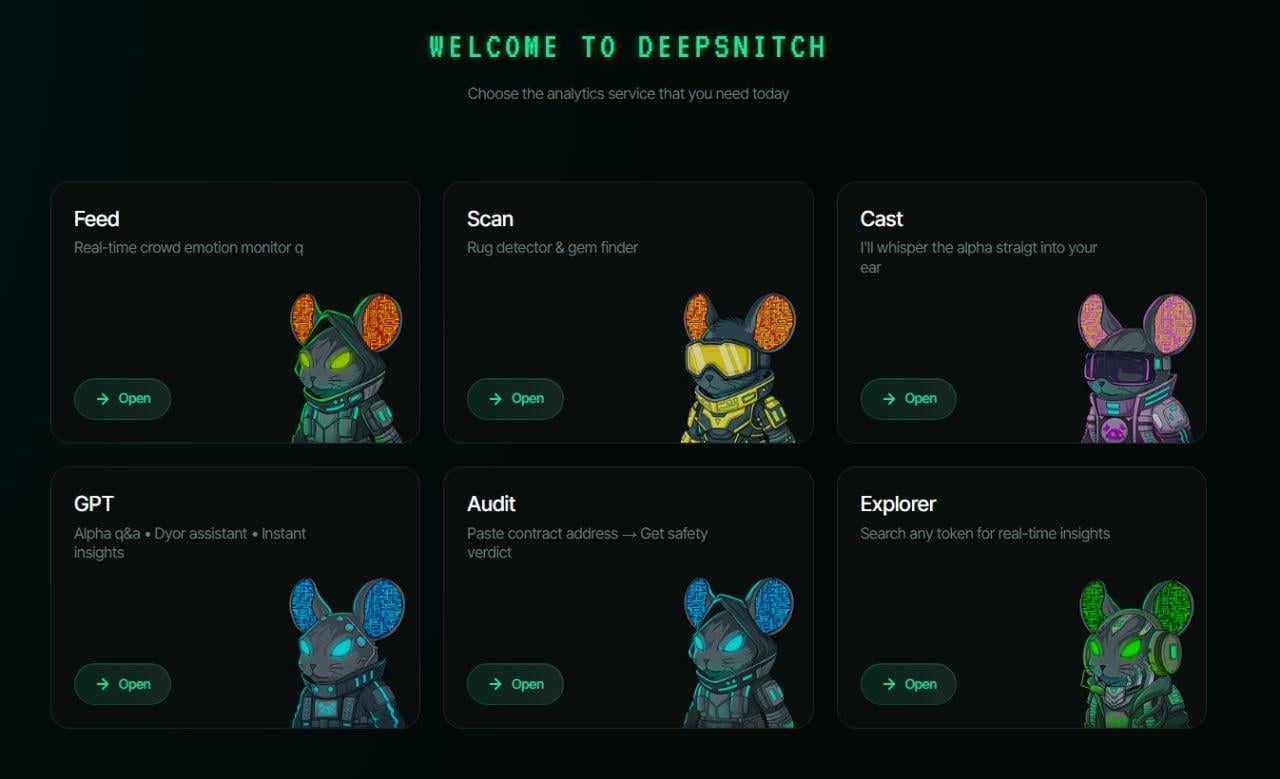
Unlike other presales selling empty promises, DeepSnitch is a fully functional product with massive adoption potential. As auditable infrastructure brings millions of new users into the ecosystem, the demand for DSNT’s real-time protection will skyrocket.
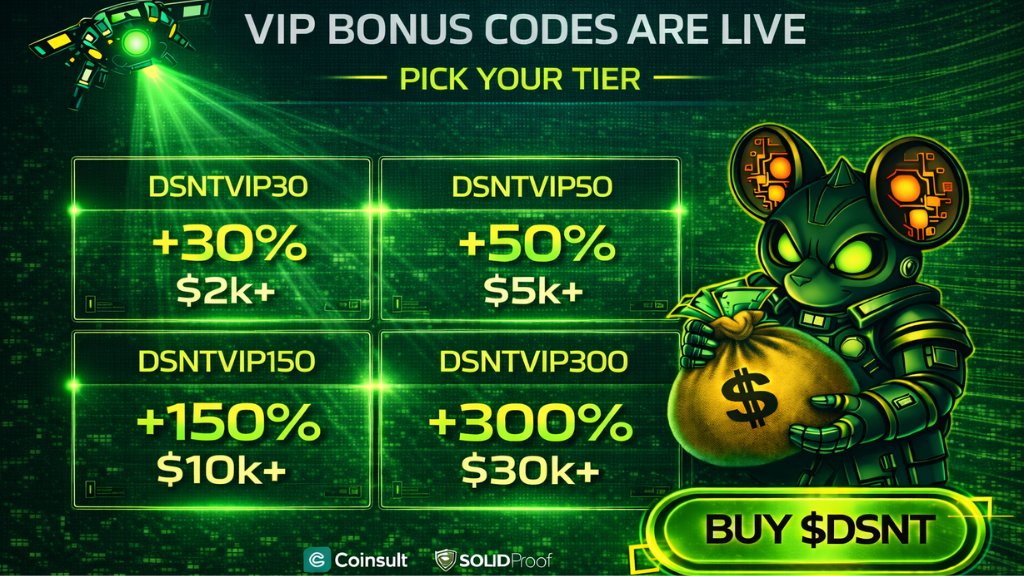
Currently in Stage 8 at $0.04669 with $2.6 million already raised, community projections are locked on 100x to 300x returns, targeting $4.50 post-launch. With Tier-1 listings like KuCoin and Binance on the horizon, the March 31st Uniswap launch is your final chance to secure DeepSnitch AI’s ground-floor prices.
Bitcoin
Bitcoin just dropped below $67,000, shedding 3% on March 27 as over $50 million in long positions were violently liquidated in a single hour.
Broad macro headwinds are suffocating the market: 10-year Treasury yields are approaching 4.5%, the DXY is surging, and rising oil prices keep inflation fears alive. Bitcoin’s recovery now completely depends on uncontrollable macroeconomic forces.
DeepSnitch AI (DSNT) does not. While Bitcoin waits for macro conditions to reverse, DSNT’s March 31st Uniswap listing is permanently locked.
The launch won’t shift for cascading liquidations or dollar strength. Secure your $0.04669 entry before this ground-floor window definitively closes in exactly three days.
Ethereum
Ethereum has slipped below $2,000, dropping 4% on March 27 as escalating Middle East tensions trigger a massive risk-off sweep. Institutional demand is severely cracking, marked by seven consecutive days of spot ETF outflows totaling $392 million.
While whales like BitMine are quietly accumulating ETH to provide underlying structural support, brutal macro conditions are currently overriding the fundamental case, violently liquidating over $100 million in long positions.
DeepSnitch AI (DSNT) is completely immune to this macro chaos. With its March 31st Uniswap launch definitively locked, DSNT’s explosive upside isn’t waiting for ETF inflows to reverse or geopolitical risk to fade.
Closing thoughts
Tether just tapped KPMG for its first full audit in 14 years, finally removing crypto’s longest-standing systemic risk. Meanwhile, extreme macro hostility is wreaking havoc: Bitcoin plunged below $67,000 amid cascading liquidations, and Ethereum is bleeding through seven straight days of ETF outflows.
Yet, through all this chaos, DeepSnitch AI (DSNT) just crossed $2.6 million raised, being the next crypto to explode. Capital isn’t flowing in despite the volatility, it’s flowing in because of it. DSNT’s five live AI agents protect retail traders from market chaos directly inside Telegram, requiring zero technical expertise.
While Bitcoin waits for Treasury yields to fall, DSNT is only waiting for March 31st. With rumored listing targets like Binance and KuCoin, community projections are firmly locked on explosive 100x to 300x returns. The presale definitely closes in exactly three days.
Visit the official website for more information, and join X and Telegram for community updates.
FAQs
Which next crypto is attracting capital even as Bitcoin drops below $67,000 and liquidations cascade?
DeepSnitch AI is the next crypto to explode: $2.6M raised through peak market chaos, five live Telegram agents catching scams and honeypots in real time, and a confirmed March 31st Uniswap listing.
What is the next 100x crypto as Tether’s KPMG audit removes crypto’s longest-standing systemic risk?
DeepSnitch AI at $0.04669: community projections of 100x to 300x backed by a live product that protects retail investors from the fraud that scales alongside on-chain adoption. KuCoin, BitMart, and Binance are named as listing targets following the Uniswap launch. The presale closes in days.
Which altcoins offer retail investors real protection during cascading liquidations and geopolitical chaos?
DeepSnitch AI stands out as the next crypto to explode: five AI agents catching scams, honeypots, and malicious contracts in real time inside Telegram, no technical knowledge required. Built specifically for the volatility retail investors face daily, and raising capital through exactly that volatility rather than despite it.
Disclaimer: This is a Press Release provided by a third party who is responsible for the content. Please conduct your own research before taking any action based on the content.
TLDR:
- BNP Paribas launches six crypto-asset ETNs tied to Bitcoin and Ether for retail clients in France
- Clients access crypto exposure through securities accounts without directly holding digital assets.
- All six ETNs are issued by asset managers selected by BNP Paribas for risk and financial strength
- The bank plans to gradually extend crypto ETN access to wealth management clients beyond France.
Crypto-asset ETNs are now part of BNP Paribas’ retail exchange offering in France. Europe’s third-largest bank announced six new products tied to Bitcoin and Ether.
Clients can access these securities through a standard securities account. No direct purchase of digital assets is required.
The products fall under MiFID II regulation, ensuring investor protection. Available from March 30, 2026, the ETNs mark a new chapter in the bank’s investment offering.
BNP Paribas Opens Crypto-Asset ETN Access Through Securities Accounts
The six crypto-asset ETNs will be available to clients starting March 30, 2026. Individual, entrepreneurial, and private banking clients in France can subscribe.
Hello bank! clients are also included in this initial rollout. Clients can invest autonomously without any guidance from a banking advisor.
The products offer indirect exposure to Bitcoin and Ether performance. Investors do not need to buy or hold the underlying digital assets directly.
Instead, the ETNs track price performance through a regulated securities structure. This setup lowers the barriers for traditional investors entering the crypto space.
These securities were issued by asset managers carefully selected by BNP Paribas. The bank evaluated each issuer based on financial solidity and risk management quality.
Only managers meeting the bank’s internal standards were included in this offering. This selection process provides clients with an added level of confidence.
BNP Paribas already offers a broad range of products on its exchange platform. Stocks, bonds, ETFs, SCPIs, and structured products are all currently available.
The addition of crypto-asset ETNs responds directly to growing client demand. The bank continues to expand its product lineup to match evolving investor interest.
MiFID II Framework and Plans to Extend Access to Wealth Management Clients
The crypto-asset ETNs are offered under the MiFID II regulatory framework. This European regulation sets standards for investor protection in financial markets.
Under its rules, clients receive proper product disclosures and risk assessments. Compliance with this framework makes these products accessible within regulated banking channels.
The ETNs are structured to meet the requirements for retail investors. They provide crypto exposure without the complexities of direct ownership.
Clients can hold these products within an existing securities account. No additional wallets or crypto exchange registrations are needed to invest.
BNP Paribas also plans to gradually extend the offering to wealth management clients. This expansion will move beyond France to include clients in additional markets.
The phased rollout allows the bank to manage compliance and overall client readiness. It also gives advisors adequate time to integrate these products into existing client portfolios.
The availability of regulated crypto-asset ETNs through a traditional bank is a meaningful development. It reflects growing acceptance of crypto-linked products within mainstream finance.
By offering these products, BNP Paribas gives clients more choice within a familiar framework. Investors can now approach crypto exposure using the same process applied to other asset classes within their portfolio.


Co-funded by the Ethereum Foundation, the EEZ promises synchronous composability between Ethereum mainnet and Layer 2 networks, aiming to address ecosystem fragmentation.
Crypto markets closed the weekend with activity spread across derivatives, token sales, regulation and ETF flows.
Summary
- Hyperliquid’s HIP-3 market hit $5.4 billion in commodity and macro futures volume on March 23.
- World Assets sold 239 million WLD for $65 million as WLD traded near record lows.
- US spot Bitcoin ETFs posted $296.18 million in weekly outflows, ending a four-week inflow streak.
Onchain commodity trading kept growing, World Foundation disclosed a new WLD sale, Washington sued Kalshi, and spot Bitcoin ETFs ended the week with net outflows.
Onchain commodity trading stayed in focus after Hyperliquid’s HIP-3 market posted a new record on March 23. The venue handled about $5.4 billion in perpetual futures volume across commodities and macro assets. Silver led with $1.3 billion, followed by WTI crude at $1.2 billion, Brent crude at $940 million and gold at $558 million. Equity index products tied to the Nasdaq and S&P 500 also drew volume.
Market participants said the trend is moving beyond crypto-native traders. Theo chief investment officer Iggy Ioppe said weekend oil futures volume onchain is now above $1 billion a day, adding that “geopolitics does not stop on Friday afternoon.”
At the same time, liquidity remains a constraint, with 1inch co-founder Sergej Kunz saying traditional venues still lead on depth and execution quality.
World Foundation discloses new WLD token sale
World Foundation said its token issuance unit, World Assets, completed $65 million in over-the-counter WLD sales with four counterparties. The first settlement took place on March 20, and the average sale price was about $0.2719 per token, which puts the total at roughly 239 million WLD sold. The foundation also said $25 million worth of those tokens carry a six-month lockup.
The disclosure arrived as WLD traded near recent lows. Reports on March 29 said the token was near $0.27 after touching a record low around $0.2444, and a July 23, 2026 unlock is scheduled to cover about 52.5% of total supply. World Foundation said the proceeds will support core operations, research and development, orb manufacturing and ecosystem growth.
Kalshi faces a new state lawsuit
In regulation, Washington state sued Kalshi on March 27. Attorney General Nick Brown said the prediction market operator violated state gambling and consumer protection laws by offering contracts tied to sports, elections and other events. The civil suit seeks to stop Kalshi’s operations in Washington, recover money lost by residents and pursue civil penalties.
Kalshi pushed back and said it operates under federal oversight as a CFTC-regulated exchange. Reports said the company moved to shift the case to federal court and argued there had been “no warning or dialogue” before the lawsuit. The case adds to a wider legal fight, with Nevada and Arizona also taking action against Kalshi in recent weeks.
Spot Bitcoin ETFs reverse course
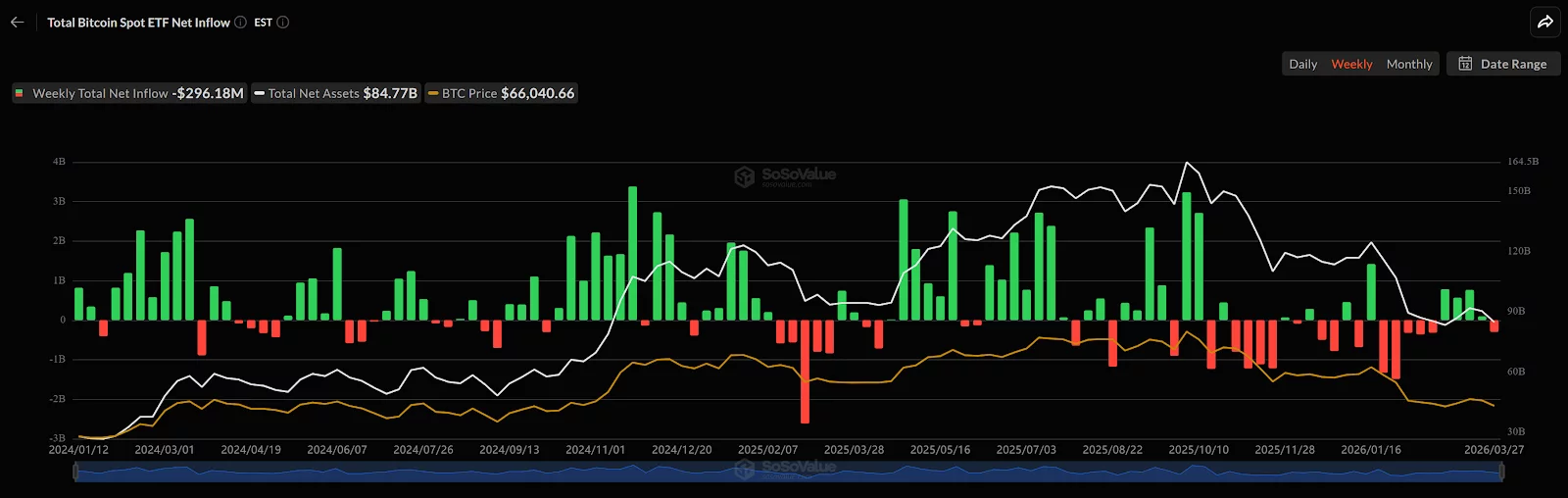
US spot Bitcoin ETFs closed the week with $296.18 million in net outflows, ending a four-week inflow streak. The reversal followed more than $2.2 billion in inflows across the prior four weeks, according to SoSoValue data.
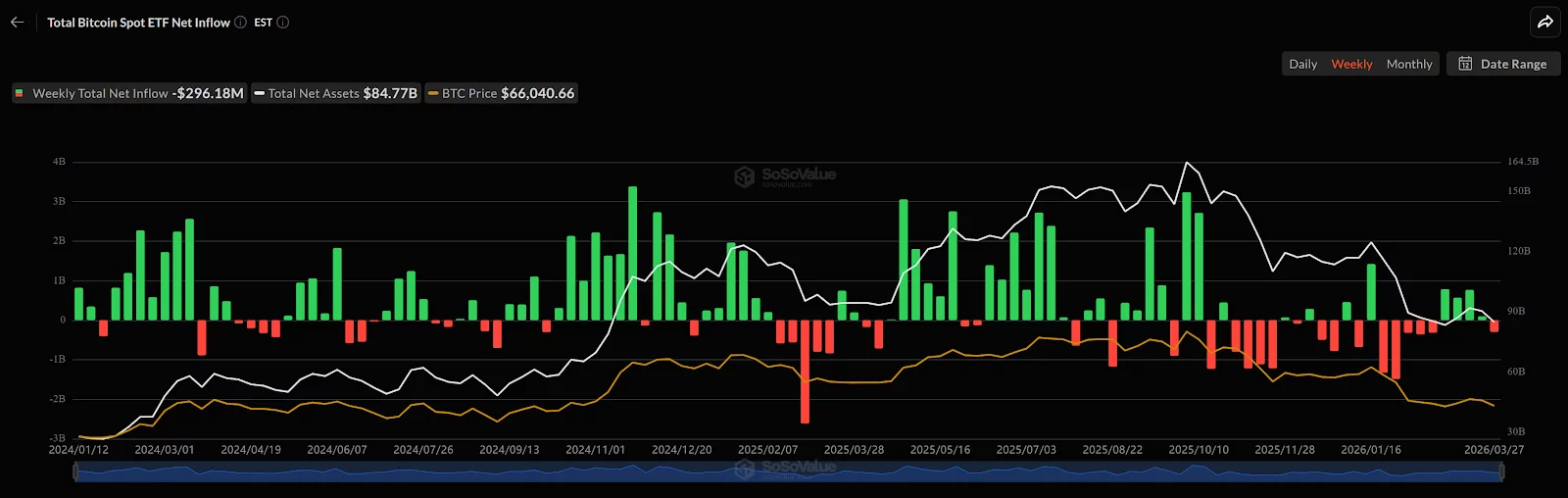
The weekly outflow came after two straight days of withdrawals on Thursday and Friday, including $225.48 million on Friday alone. Total net assets for spot Bitcoin ETFs slipped to $84.77 billion, down from more than $90 billion a week earlier, while weekly trading volume fell to $14.26 billion from $25.87 billion earlier in March.


Bitcoin margin long positions on Bitfinex have climbed to levels not seen since November 2023, drawing fresh market attention during a period of weak price action.
Summary
- Bitfinex margin long positions climbed to 79,193 BTC, the platform’s highest level since November 2023.
- Adam Back said buyers may use TWAP strategies to accumulate Bitcoin below $69,000 during pullbacks.
- Back estimated leveraged accumulation now exceeds 300 BTC daily, or about $20 million each day.
The move has added a new data point to the wider debate over whether large buyers are building exposure during the current correction.
Recent market data shows Bitfinex margin long positions rising to about 79,193 BTC. That marks the highest level recorded on the platform since November 2023.
The increase came as many traders kept their attention on macro risks, including oil prices and geopolitical tension. Even so, activity on Bitfinex pointed to a different trend, with leveraged Bitcoin accumulation continuing in the background.
Adam Back, chief executive of Blockstream, described the pattern as “unprecedented.” He linked the move to a market structure where larger buyers appear to be adding exposure in a steady and deliberate way.
Back said a group of institutional participants may be using a time-weighted average price strategy, also known as TWAP. Under that approach, buyers spread purchases over time instead of placing one large order.
He said this buying appears to focus on Bitcoin below the $69,000 level. According to his reading of the market, those orders have absorbed available supply during the recent pullback.
Back also said Bitfinex margin accumulation has been building since late 2020. He estimated that the pace now stands at 300 BTC or more per day through organic trades.
Using that rate, the daily flow would equal about $20 million at recent prices. That works out to around $14,000 per minute, with an average purchase rate between 450 and 600 BTC over a full day.
Accumulation builds during a correction phase
The timing of the buildup has drawn attention because it is taking place during a correction. While price action has remained under pressure, long positioning on Bitfinex has continued to expand.
Back said this does not look like “artificial speculation.” Instead, he described it as longer-term positioning by buyers whose identities remain unclear.
That view reflects a wider idea now circulating in the market. Some traders believe the current phase is shifting Bitcoin from weaker holders to entities with a longer holding period.
Several analysts have also pointed to signs of bearish exhaustion on the weekly chart. In that setting, a large leveraged buildup can become a closely watched market signal.
Back said the size of the Bitfinex long book could tighten available supply if the current pace continues. He added that reduced market depth could make Bitcoin react faster if a positive catalyst appears.

Tributes paid to ‘beautiful, bubbly girl’ who died in Leeds as murder probe launched

St. Louis Lambert International Airport TSA Wait Time Averages of Under 15 Minutes

Here is why traders are pricing in a rate hike and how it impacts bitcoin


-
 NewsBeat4 days ago
Manchester United reach agreement with Casemiro over contract clause amid transfer speculation
-

 News Videos4 days ago
Parliament publishes latest register of MPs’ financial interests
-

 Sports6 days ago
Remo Stars and Kano Pillars Strengthen Survival Hopes in NPFL
-

 Sports6 days ago
Gary Kirsten Accuses Pakistan Cricket Board Of ‘Interference’, Mohsin Naqvi Responds
-

 Tech7 days ago
Give Your Phone a Huge (and Free) Upgrade by Switching to Another Keyboard
-

 Tech7 days ago
AI enters the chat: New Seattle dating app relies on tech to facilitate meaningful human connections
-

 Business3 days ago
Instagram, YouTube Found Responsible for Teen’s Mental Health Struggle in Historic Ruling
-

 News Videos6 days ago
Ch 9 Financial Management Part 1 | Detailed One Shot | Class 12 Business Studies Boards 2026
-

 NewsBeat2 days ago
The Story hosts event on Durham’s historic registers
-
 NewsBeat4 days ago
Tesco is selling new Cadbury Dairy Milk bar and people can’t wait to try it
-

 Tech6 days ago
Samsung will soon let you control smart home devices from your car’s dashboard
-

 Sports6 days ago
2026 Kentucky Derby horses, odds, futures, preview, date: Expert who hit 12 Derby-Oaks Doubles enters picks
-
 Entertainment18 hours ago
Lana Del Rey Celebrates Her Husband’s 51st Birthday In New Post
-
 Entertainment6 days ago
Cynthia Bailey Dishes on ‘RHOA’ Season 17, Discusses Kandi
-

 Fashion5 days ago
Does It Matter What You Wear When You’re Laid Off and Looking?
-
 NewsBeat6 days ago
Colombian military plane with 110 soldiers onboard crashes following takeoff
-

 Business5 days ago
More women enter wealth management, but few in advisory roles: study
-

 Sports4 days ago
Fantasy Baseball Week 1 Preview: Top sleeper hitters for both five- and 12-day period led by Munetaka Murakami
-

 Politics6 days ago
How Media Platforms Balance Performance and Accessibility in Image Delivery
-

 Business5 days ago
Late-paying firms face multimillion-pound fines under new crackdown
You must be logged in to post a comment Login