

Crypto World
Ethereum Network Activity Rises as DeFi Liquidity and U.S. Regulatory Clarity Converge


TLDR:
- Ethereum’s total transaction count is rising sharply in 2026 despite price remaining largely range-bound in crypto markets.
- DeFi liquidity is returning to lending, stablecoin provision, and DEX trading after two years of capital outflows and declining yields.
- The U.S. CLARITY Act introduces a safe harbor for non-custodial developers, removing direct legal liability tied to publishing smart contract code.
- Network activity is leading price movement in this cycle, pointing to a structurally grounded growth phase rather than speculation-driven momentum.
Ethereum is recording clear structural changes in 2026, with total transaction counts rising sharply despite flat price performance.
This divergence separates real network usage from speculation-driven behavior. Capital that left the ecosystem during 2024 and 2025 is now returning to decentralized finance protocols.
Meanwhile, U.S. legislative efforts are reshaping the regulatory environment for on-chain development. Together, these shifts are building conditions that could support sustained structural growth across the Ethereum ecosystem.
DeFi Liquidity Returns to Drive Real Ethereum Network Usage
On-chain data shows Ethereum’s total transaction count climbing steadily through early 2026. The growth reflects genuine protocol activity rather than short-term speculative behavior in the broader market. This activity pattern has not been observed at this level since before the 2022 market downturn.
Between 2024 and 2025, regulatory uncertainty and declining yields pushed capital away from DeFi protocols. Those conditions have since shifted, and liquidity is returning to on-chain lending, trading, and stablecoin markets. The recovery appears measured and connected to real protocol use cases.
Stablecoin-based liquidity provision, lending platforms, and decentralized exchange trading are all recording higher volumes in 2026.
These core DeFi segments are recovering in parallel, reflecting authentic demand for on-chain financial services. Growth is distributed across multiple protocol categories rather than concentrated in one area.
XWIN Research Japan noted in a recent post that this cycle differs from prior ones. Network activity is leading price movement, not the other way around.
That distinction points to a more structurally grounded early phase of growth than markets have previously seen.
CLARITY Act Shifts Developer Risk and Sets Stage for Institutional DeFi Entry
The U.S. CLARITY Act marks a turning point in how legislators are addressing decentralized finance. It is the first serious effort to formally define how DeFi protocols should coexist within existing financial systems. The legislation is also considered the most substantive regulatory proposal for DeFi made in the U.S. to date.
Before this legislation, developer liability was one of the most serious obstacles to ecosystem growth. Writing and deploying smart contract code carried legal uncertainty that discouraged builders from participating. That environment functioned as a structural brake on DeFi innovation over multiple years.
The latest draft introduces a safe harbor provision specifically for non-custodial developers. Under this provision, publishing code alone does not classify a developer as a financial institution. This removes a meaningful layer of legal exposure from the development and deployment process.
Open issues remain, including KYC scope and restrictions on stablecoin yield products. The regulatory debate has, however, shifted from whether DeFi should be permitted to how it should be integrated. As legal clarity replaces ambiguity, institutions with previously restricted exposure may begin allocating capital toward on-chain platforms.



Kraken signaled a rapid move to bring Bitcoin perpetual futures trading onshore in the United States, saying on Friday it expects to launch CFTC-regulated perpetual contracts within about 30 days after the regulator approved the instruments. The exchange tied the plan to Bitnomial Exchange, a CFTC-regulated venue that Kraken’s parent company, Payward, recently acquired, with the goal of offering Kraken Pro clients access to Bitnomial’s perpetual futures product.
Payward announced in mid-April that it was acquiring crypto derivatives platform Bitnomial for as much as $550 million, a deal aimed at expanding Kraken Pro’s access to regulated futures and derivatives trading. While Kraken’s Friday update framed the move as imminent, a Sunday review of Bitnomial’s public filings with the CFTC did not show a Bitcoin perpetual contract filing, as noted in the company’s statement that the filing had been submitted and that efforts would push onshore activity through a regulated venue. Kraken later confirmed on social media that US clients would soon be able to trade perpetual futures on Kraken Pro.
Crucially, the race to become the leading US-regulated perpetually-traded product is intensifying. KalshiEX had previously gained CFTC approval for trading a BTC perpetual futures contract, though it also sought confidential treatment for its filing. Separately, Coinbase moved quickly to give US institutional clients access to global crypto options and perpetual futures markets through its recently acquired Deribit platform, which Coinbase bought in 2025 as part of its expansion into derivatives. Deribit remains the largest crypto options exchange by open interest, underscoring the strategic importance of onshore access for derivatives users.
Key takeaways
- Kraken foresees launching CFTC-regulated BTC perpetual futures in the US within about 30 days, with Bitnomial slated as the listing venue.
- The Bitnomial acquisition, announced by Payward in April, aims to bring Kraken Pro customers onto a CFTC-regulated onshore venue for perpetual futures trading.
- As of Sunday morning, Bitnomial’s public filings did not show a Bitcoin perpetual contract filing, though Kraken’s announcement framed the filing as submitted and moving forward with plans to onshore activity.
- Meanwhile, regulatory momentum in the US includes Kalshi’s BTC perpetual approval and Coinbase/Deribit’s push to provide regulated access to US institutions, signaling a broader shift toward onshore derivatives trading.
- Beyond regulatory approvals, the landscape is evolving with CFTC chair statements stressing American oversight and a staff memo encouraging 24/7 trading, clearing, and settlement for crypto derivatives.
Onshore perps move gains momentum amid regulatory positioning
The central takeaway from the latest developments is that US-regulated perpetual futures trading for crypto assets is transitioning from offshore corridors to domestic venues. The CFTC’s decision to approve a BTC perpetual futures contract—combined with the explicit push to bring such products onshore—creates a framework in which traders, institutions, and market makers can operate under the American rule of law.
Kraken’s public posture underscores the importance of the Bitnomial platform as a regulatory-compliant onramp for US clients. By tying its onshore ambitions to Bitnomial’s listings, Kraken signals that it intends to leverage a venue already subject to CFTC oversight rather than expanding solely on offshore infrastructure or unregulated offshore platforms. The company stated that “US clients will soon be able to trade perpetual futures on KrakenPro,” a proclamation that aligns with the broader regulatory trend toward domestic access.
In parallel, the landscape is evolving as other market participants obtain a foothold in the onshore niche. KalshiEX’s BTC perpetual futures entry, supported by CFTC approval, marks a notable milestone in the industry’s maturation under American oversight. The regulatory path for Kalshi, which had sought confidential treatment in its filing, illustrates the balance regulators strike between transparency and strategic considerations in high-stakes product launches.
On the institutional frontier, Coinbase’s move to provide regulated access to global perpetual and options markets through Deribit further accelerates the push. Deribit’s prominence—being the largest crypto options exchange by open interest—gives Coinbase a credible platform for institutions seeking robust risk management and liquidity within a regulated framework. The arrangement also reflects a broader trend: major exchanges are partnering with or acquiring derivative specialists to ensure compliant, scalable access for sophisticated traders.
Regulatory backdrop and market implications
The push toward onshore perpetual futures is bolstered by a pair of recent regulatory signals. In September, the US Securities and Exchange Commission and the CFTC jointly signaled their interest in exploring ways to bring perpetual futures trading onshore. The agencies’ statement acknowledged that perpetual contracts had largely been constrained to offshore markets due to jurisdictional and regulatory complexities, even as the demand for crypto derivatives continued to grow.
Adding to the momentum, CFTC chair Michael Selig argued that the question surrounding crypto asset perpetual contracts was not whether they would exist, but whether they would operate under American oversight and standards. His framing highlights a broader shift: crypto derivatives are increasingly expected to function within a regulated domestic regime, with clearer governance, surveillance, and dispute-resolution pathways.
Meanwhile, the CFTC’s staff issued guidance on 24/7 trading, clearing, and settlement, noting that crypto asset derivatives may be particularly well suited to continuous-market dynamics. This guidance is timely for exchanges contemplating around-the-clock liquidity, risk management, and operational resilience in a global market that never sleeps. Taken together, these signals paint a picture of a derivatives market that is steadily moving toward greater regulatory alignment, even as firms compete to establish the most effective, compliant, and liquid US platforms.
Competition, strategy, and what to watch next
The competition among US-regulated venues for crypto perpetuals is heating up. Kraken’s Bitnomial tie-up positions the Payward group to leverage an established CFTC-regulated venue, potentially shortening the path to a synchronized onshore product launch. The absence (as of Sunday) of a BTC perpetual filing in Bitnomial’s recent submissions does not deter Kraken; instead, it underscores the complex, iterative nature of regulatory filings and product approvals in a nascent market with high stakes for liquidity and compliance.
Meanwhile, Coinbase’s institutional access via Deribit signals a parallel track aimed at ensuring regulated gateways for large market participants. Deribit’s role as a leading options venue—with significant open interest—gives the US ecosystem a critical liquidity backbone as more perpetual futures products come online. Kalshi’s earlier approval serves as a benchmark for what regulators are willing to authorize within a domestic framework, even as firms navigate confidentiality considerations in initial filings.
For traders and institutions, the immediate question is timing and execution. Kraken’s stated timeline—launch within roughly 30 days upon approval—puts the industry on a short fuse for onshore liquidity, price discovery, and risk-management tools aligned with US standards. Investors should monitor: (1) any public confirmation or update from Bitnomial’s regulatory filings about a BTC perpetual product, (2) the specific contract terms and margin frameworks to be applied on Bitnomial for the onshore market, and (3) how competing platforms’ products will converge or diverge in terms of liquidity, funding rates, and cross-exchange arbitrage opportunities.
What this means for users and market structure
The ongoing shift toward US-regulated perpetual futures broadly benefits professional traders and institutions seeking the comfort of regulatory oversight, enforceable disclosures, and standardized risk controls. While offshore venues remain part of the ecosystem, the expanding menu of onshore options offers a more predictable trading environment, potentially tighter spreads, and clearer pathways for client onboarding, custody, and compliance reporting.
As the regulatory framework continues to evolve, there is an ongoing tension between speed to market and the depth of supervision. The balance regulators strike will shape which platforms can compete most effectively on liquidity, reliability, and investor protections. For market participants, the story is as much about who can deliver a trusted, scalable onshore platform as it is about the specific contract design or the immediacy of a listing.
In sum, the US derivatives narrative for crypto assets appears to be consolidating around domestic venues that combine regulatory clarity with the liquidity engines built by major exchanges and derivatives platforms. Kraken’s Bitnomial strategy, alongside Coinbase/Deribit and Kalshi’s path to BTC perps, signals a broader industry shift—one that could redefine how institutional users access perpetual futures in a mature American market.
Readers should watch for updates on Bitnomial’s BTC perpetual filing, any concrete launch announcements from KrakenPro, and further regulator statements about the scope and safeguards of onshore crypto derivatives trading as the first wave of regulated BTC perpetuals begins to take shape.
TLDR:
- CAKE trades above a critical accumulation zone after recovering from a 96% decline from its ATH.
- A liquidity sweep and reclaim of support have strengthened the bullish market structure outlook.
- Market capitalization rebounded from $430M to nearly $500M, signaling renewed investor interest.
- Traders are watching resistance closely as targets at $3.45, $9.77, and $25.44 remain in focus.
CAKE PancakeSwap has rebounded from a prolonged downturn and reclaimed key support levels. Traders are now monitoring a tightening market structure, growing capital inflows, and a potential breakout that could shape the token’s next major move.
CAKE Holds Critical Support as Bullish Structure Develops
The CAKE token is trading near $1.55 after successfully reclaiming a major weekly support zone between $1.18 and $1.37.
This area has emerged as a significant accumulation region, with buyers repeatedly stepping in to defend prices during recent market weakness.
A widely shared chart on X points to a liquidity sweep beneath support, followed by a strong recovery. Such moves are often viewed as bear traps, where sellers push prices lower before demand quickly absorbs available supply. The subsequent reclaim has strengthened attention around the current setup.
Another key feature is the multi-year ascending trendline that has remained intact since 2022. Despite several tests over the past market cycle, the structure continues to attract buying interest. The latest reaction from this trendline suggests long-term participants remain active within the current range.
The analysis also notes that CAKE has already endured a correction of roughly 96% from its all-time high. Historically, assets that survive such drawdowns often enter lengthy re-accumulation phases before establishing a new trend. For now, maintaining support above $1.15 remains essential for preserving the current market structure.
Market Cap Recovery Supports Breakout Narrative
Beyond price action, CAKE’s market capitalization has begun showing signs of improvement. The seven-day chart reveals a recovery from the $430 million region, with valuation recently climbing toward the $500 million mark.
The advance followed a period of consolidation that prevented new lows from forming. Instead, market capitalization established a stable base between $430 million and $445 million before moving higher. This pattern has drawn attention from traders looking for evidence of renewed demand.
Volume activity also increased during the recovery phase. Rising participation alongside market capitalization growth is often viewed as a constructive development, especially after extended periods of weakness. The move above the $475 million area further reinforced the improving market conditions.
According to the shared chart, upside targets remain positioned at $3.45, $9.77, and $25.44 if a breakout materializes. The longer-term $50 projection remains dependent on sustained ecosystem growth and broader market strength, though traders continue to monitor the setup closely.
TLDR:
- The Cardano Summit 2026 was canceled after the treasury vote reached only 65.21%, missing the 66.67% supermajority required.
- A revised 7.8M ADA proposal replaced an original 14.07M ADA request, adding audited fund management and milestone-gated payments.
- Despite 135 DReps voting in favor versus 61 against, stake-weighted rules prevented the summit proposal from passing.
- EMURGO’s TOKEN2049 Platinum Sponsorship proposal passed separately, keeping Cardano present at the Singapore crypto conference.
The Cardano Foundation confirmed the cancellation of Cardano Summit 2026 after a treasury funding vote narrowly missed the required two-thirds approval threshold.
A revised proposal requesting 7.8 million ADA, worth approximately $2 million, received 65.21% support from delegated representatives (DReps).
This fell short of the 66.67% supermajority required for treasury withdrawals under Cardano’s governance rules. The Foundation stated it would begin winding down summit execution following the vote’s expiration on May 29.
Treasury Vote Falls Short Despite Strong Headcount Support
The vote drew majority backing by delegate count, with 135 DReps voting in favor and 61 against. An additional 24 delegates abstained, and the Constitutional Committee approved the measure.
However, Cardano’s governance framework weighs stake rather than headcount alone for treasury actions. That distinction proved decisive, as the proposal expired without ratification.
The Foundation had already significantly revised the original request before the final vote. An earlier proposal had sought 14.07 million ADA, approximately $3.66 million, bundling the summit with an EMURGO-run TOKEN2049 sponsorship.
The two events were later separated, and the summit budget was trimmed by more than 20%. The revised plan also included audited fund management, milestone-gated payments, and an independent oversight committee.
Cardano founder Charles Hoskinson and Foundation CEO Frederik Gregaard each publicly urged DReps to approve the revised proposal before voting closed.
Despite their late endorsements, the stake-weighted outcome did not cross the required threshold. The Foundation itself abstained from voting on the summit proposal to avoid influencing the result.
The Foundation acknowledged the community’s engagement following the outcome. “Governance requires not only participation, but also a commitment to accept collective decisions,” it wrote on X. It also noted it had reviewed all feedback submitted by DReps throughout the process.
EMURGO’s TOKEN2049 Proposal Passes as Treasury Scrutiny Continues
While the summit vote failed, EMURGO’s separate TOKEN2049 Platinum Sponsorship proposal successfully passed.
The Cardano Foundation voted in favor of that proposal. As a result, Cardano will maintain a presence at the major Singapore crypto conference despite the summit cancellation.
The Foundation stated it will now review current commitments and move forward with winding down summit-related execution. It confirmed that its broader roadmap and operational focus remain unchanged. Work tied to the Cardano ecosystem will continue under that direction.
The summit cancellation is part of a wider pattern of treasury scrutiny in 2026. DReps have pushed back on multiple spending proposals connected to Hoskinson, EMURGO, and Input Output Global this year.
A scaled-back IO funding package tied to the Leios mainnet development was among the proposals that faced resistance.
The outcome reflects how Cardano’s decentralized governance structure places spending decisions firmly in the hands of its delegate community, regardless of organizational backing.
TLDR:
- Stellar Lumens (XLM) breaks multi-year trendline as weekly structure shifts into bullish phase.
- RSI rises above long-term resistance, confirming momentum alignment with the price breakout move.
- Key support at 0.2263 and resistance at 0.2730 define XLM’s short-term trading range.
- MACD strength and overbought RSI signal volatility risk after a sharp weekly rally expansion.
Stellar Lumens (XLM) is showing a notable shift in market structure after breaking a multi-year resistance trendline, as traders reassess momentum, volatility, and key price levels shaping its short-term and long-term direction across broader crypto market conditions today phase unfolding
Breakout Structure and Trendline Reversal
Stellar Lumens (XLM) has confirmed a breakout above its long-standing descending trendline on the weekly chart, marking a structural shift that traders have monitored across multiple market cycles.
The move follows repeated rejection phases where the price failed to sustain gains under persistent seller pressure at the same resistance zone.
Recent weekly candles show stronger bullish engagement, supported by volume expansion that suggests absorption of supply near critical levels.
RSI movement above multi-year resistance further confirms momentum alignment, as the indicator approaches mid-to-overbought territory while price holds structure.
Market structure now reflects a transition from prolonged accumulation into early markup conditions across higher timeframes.
Traders note that the breakout zone has acted as a multi-year ceiling, where liquidity has repeatedly concentrated during prior rejection phases.
With the trendline now breached, attention shifts toward whether the price can maintain weekly closes above this level without reversal pressure.
Volume data across exchanges reflects increasing participation, suggesting that buyers are gradually gaining control in the current structure.
Earlier consolidation near lower support zones created a base that has supported the recent upward expansion. Market participants are monitoring whether momentum can extend beyond historical resistance without losing weekly structure integrity.
Volatility Expansion and Key Price Levels
Following the breakout, Stellar Lumens (XLM) experienced sharp volatility, with intraday movements reflecting rapid shifts in sentiment.
Price action showed a 17 percent correction after a strong weekly rally that previously pushed momentum to new highs.
Despite the pullback, weekly performance remained positive, supported by elevated trading volume across major exchanges. Support at 0.2263 has become a key level, with traders closely watching for sustained defense of this zone.
Resistance near 0.2730 defines the upper boundary of the current short-term trading range. If price breaks above resistance, momentum could extend toward higher targets established on prior chart structures.
Conversely, failure to hold support may expose lower demand zones that previously absorbed selling pressure. MACD indicators have turned positive, showing early signs of trend strengthening on daily timeframes.
At the same time, RSI has moved above 70, placing Stellar Lumens (XLM) in overbought conditions. Such readings often align with heightened volatility and potential consolidation phases in the near term.
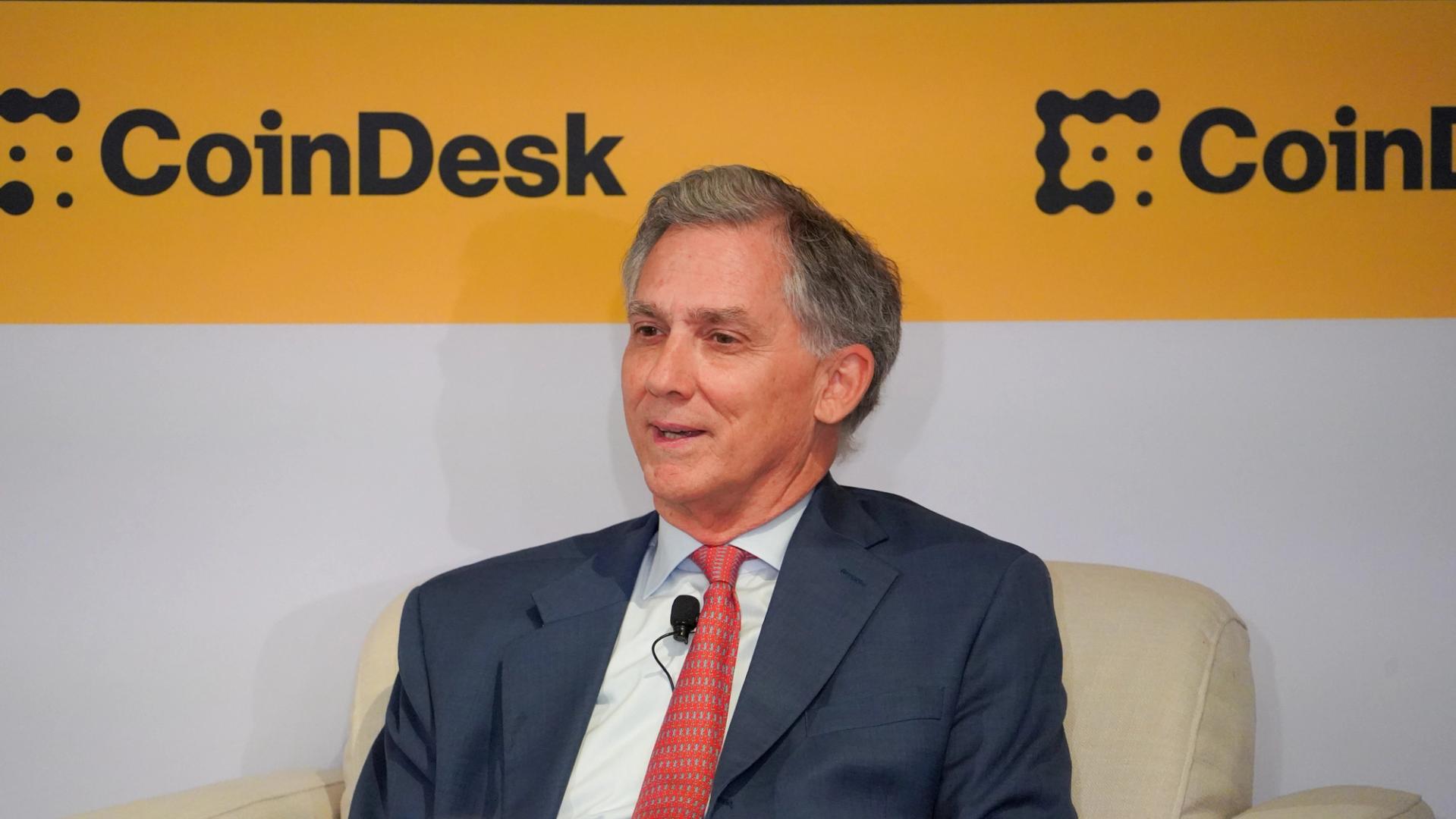
Last month, Rep. French Hill, who chairs the House Financial Services Committee, told CoinDesk that he expected the Clarity Act to secure bipartisan consensus, that tokenization was the next major agenda item and that crypto would continue to receive bipartisan support.
You’re reading State of Crypto, a CoinDesk newsletter looking at the intersection of cryptocurrency and government. Click here to sign up for future editions.
The narrative
After stablecoins and market structure, tokenization is the next major focus for the House Financial Services Committee, Chairman French Hill told CoinDesk last month.
Why it matters
The House Financial Services Committee is one of the few groups in Congress with direct oversight over federal regulators working on digital asset policy. It played a key role in advancing both the stablecoin-focused GENIUS Act and the market structure-focused Clarity Act. Hill has run the committee since former Chairman Patrick McHenry retired from Congress.
Breaking it down
The House of Representatives found a way to get bipartisan agreement on stablecoin sales practices, decentralized finance and ethics rules before passing its version of the Clarity Act, Hill said.
“These are all things we dealt with in the House bill successfully and got 78 Democratic votes in the House last year,” he said. “So I don’t see any reason why they can’t find consensus in the Senate on the House bill.”
Hill spoke to CoinDesk at the Digital Assets and Emerging Tech Policy Summit hosted by Vanderbilt University and the Blockchain Association in early April about a range of issues his committee is examining.
He said the Senate counterpart to the House’s bill had begun adopting some of the House version’s details as lawmakers negotiated aspects of the legislation ahead of this month’s Senate Banking Committee markup.
“I think the Senate’s relied quite a bit on the House work on both FIT21 [the Financial Innovation and Technology for the 21st Century Act] from the previous Congress and Clarity in this Congress,” he said in April. “I think you see that quite clearly in the Senate Agriculture markup, I think you see that in the basic draft of many of the components in the Senate bill.”
Senate negotiators have kept their House counterparts “apprised of the process,” he said, adding that both he and Rep. Bryan Steil, who chairs the House Subcommittee on Digital Assets, Financial Technology, and Artificial Intelligence, have been in touch with senators working on the Clarity Act.
His committee is now looking at other issues, like tokenization and lawmakers’ role in that area, he said. The Financial Services Committee held a hearing on tokenization in late March, which Hill said was aimed at helping lawmakers consider what the Securities and Exchange Commission (SEC) and bank regulators might need in terms of additional authorities or rules to facilitate companies engaging in tokenizing real-world assets.
Part of this effort is determining whether there even needs to be a legislative effort, or if policymaking could remain at the regulator level, he said.
“Tokenization of an asset, such as a common stock, is really an exercise in changing systems,” he said. “It’s not changing the law. All the legal or regulatory requirements about common stock are also applied to a common stock token, right? And so in our view, that’s why these hearings bring up member awareness.”
The House and Senate, as overseers of the regulatory agencies, can, for example, use hearings to ask how existing systems can be adopted to blockchain-based systems, he said.
In a similar vein, Hill said he was looking at the possible tokenization of deposits in the commercial banking industry, which could enable direct debit payments without needing an intermediated stop.
This isn’t necessarily imminent, but it is an area that his committee may explore, he said.
“You think about going from call-out markets right to paper-based markets to digitization of that paper-based system, which took place in the 1970s and 1980s, and that’s increased accuracy, reduced fraud, increased speed, decreased the need for liquidity [and] improved settlement,” he said. “We went from T+5 on equities in the 1970s to T+1. So to me, this is an operating decision, and the interoperability of it is the biggest challenge, not the mechanical, technical aspect of doing it.”
Tokenized markets will, therefore, need work on interoperability and compliance, he said.
“We’ll find out if there needs to be some, you know, legislative activity versus purely regulatory, and that’s good. That’s what Congress’s job is,” he said.
The other major topic he’s tracking — at least in the crypto world — is the effort to update tax regulations around digital assets, he said. The House Ways and Means Committee is already working on tax issues, and a bipartisan group of lawmakers reintroduced a bill specifically targeting crypto taxes earlier this month.
And of course, there will be an election later this year that will determine control of the House of Representatives and Senate. The crypto industry is, as it was in 2024, heavily engaged in primary races, trying to bolster candidates that the various political action committees see as being friendly toward crypto.
Hill said the Financial Services Committee in particular has long been engaged in digital assets, referencing work by former Rep. Patrick McHenry and his Democratic counterpart, Rep. Maxine Waters, over the past 10 years.
“In the past four years, we’ve seen the digital assets ecosystem really engage, not only on policy points, but also politically,” Hill said. “And you saw that in the 2024 election … So I anticipate that the digital assets ecosystem, political activity will be important to the 2026 election. It’s bipartisan. It’s supportive of people who are pro-innovation.”
Hill said the industry’s political engagement in this year’s vote is important, and that there is already bipartisan appetite for crypto.
“If we’re successful in GENIUS rulemaking, and we’re successful in passing Clarity, you’ll commence about a 12-month joint rulemaking process between the CFTC and SEC,” Hill said. “And I really think policy attention will track back into the regulatory agencies to try to make sure that our vision in the House of an integrated, common, fit-for-purpose approach is absolutely implemented.”
Thursday
- 14:00 UTC (10 a.m. ET) The House Financial Services Committee will hold an oversight hearing with federal bank regulators.
If you’ve got thoughts or questions on what I should discuss next week or any other feedback you’d like to share, feel free to email me at nik@coindesk.com or find me on Bluesky @nikhileshde.bsky.social.
You can also join the group conversation on Telegram.
See ya’ll next week!
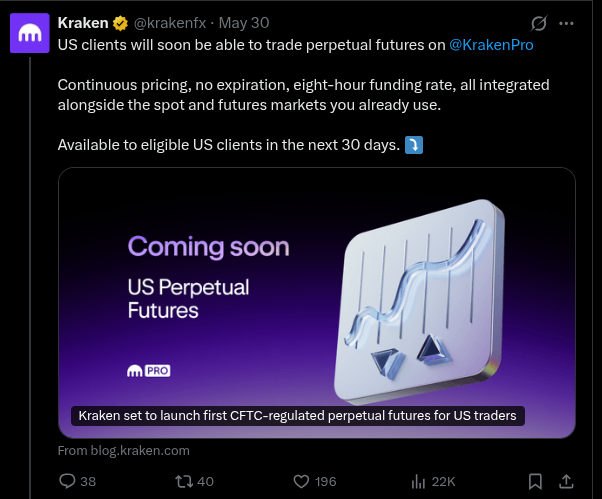
Kraken said late Friday that it expects to launch CFTC-regulated perpetual futures contracts in the US in the next 30 days, hours after the US Commodity Futures Trading Commission approved the instruments.
The exchange said when it gains approval, the contracts will be listed on Bitnomial Exchange, a CFTC-regulated exchange recently acquired by Kraken’s parent company, Payward.
Payward said on April 17 that it was acquiring crypto derivatives platform Bitnomial for as much as $550 million, aimed at providing Kraken Pro customers with access to Bitnomial’s perpetual futures offering.
However, while Kraken’s announcement said that a filing had been submitted on Friday, no filing for a specific Bitcoin (BTC) perpetual contact was found among Bitnomial’s recent CFTC filings as of Sunday morning. “Today’s announcement sets in motion plans to bring that activity onshore through a CFTC-regulated venue,” the announcement said.
“US clients will soon be able to trade perpetual futures on @KrakenPro,” read a company social media post on Saturday.
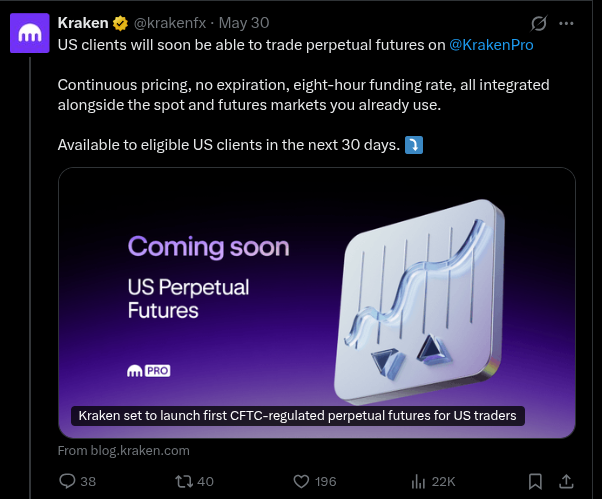
Source: Kraken on X.com
Requests for further information on the filing sent to two Kraken executives and Bitnomial’s chief regulatory officer were not immediately answered.
To be sure, companies frequently file requests for confidential treatment of their applications. KalshiEX, which on Friday gained CFTC approval of trading of a BTC perpetual futures contract, had originally requested confidential treatment of that application in an undated letter to the CFTC.
Related: CFTC seeks to reverse settlement deal with Gemini
Race is on to gain perps lead in regulated US market
Shortly after the CFTC approved BTC perp contracts on Friday morning, Coinbase Financial Markets was fast out of the blocks to offer US institutional clients access to global crypto options and perpetual futures markets through a regulated futures commission merchant, Deribit.
Deribit, which Coinbase acquired in August 2025 as part of its expansion into crypto derivatives, is the largest crypto options exchange by open interest.
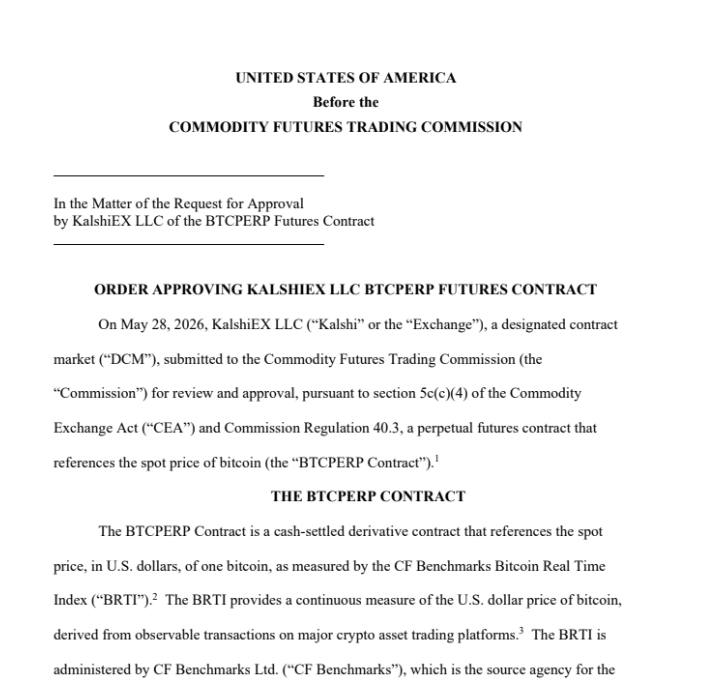
CFTC approval notice for BTC perpetuals trading on Kalshi. Source: CFTC
The US Securities and Exchange Commission and CFTC said in September they would explore ways to bring perpetual futures trading onshore. In a joint statement, the agencies said perpetual contracts had been largely confined to offshore crypto markets due to regulatory and jurisdictional constraints.
CFTC chair Michael Selig said on Friday “In my view, the question was never whether crypto asset perpetual contracts would exist. Instead, the question was whether they would exist under American oversight, American standards and American rule of law.”
Also on Friday, CFTC staff issued guidance on 24/7 trading, clearing and settlement, saying crypto asset derivatives may be particularly well suited to round-the-clock markets.
Magazine: HYPE chases $100 target, ETH could dump below $1800: Market Moves
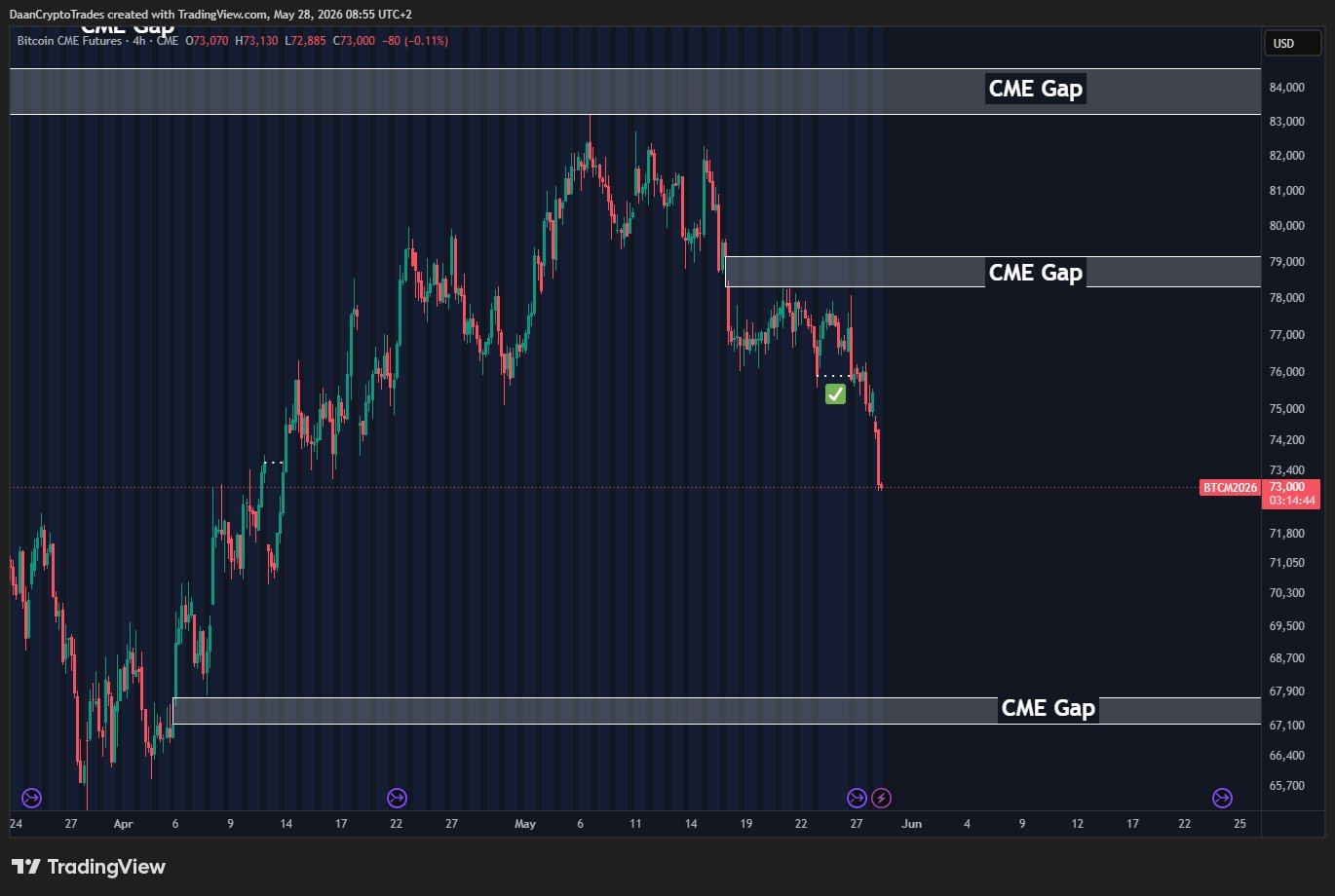
Bitcoin (BTC) starts its first full trading week with no new CME futures gap on the chart. The shift ends an eight-year market quirk that traders relied on to forecast short-term price targets.
The Chicago Mercantile Exchange (CME) moved its regulated cryptocurrency futures and options to around-the-clock trading on May 29. The change removed the weekend closure that had produced visible price gaps since Bitcoin futures launched in December 2017.
Why the CME Gap Mattered for Bitcoin Traders
For nearly nine years, CME Bitcoin futures closed every weekend while spot exchanges and offshore perpetual markets kept trading.
Any weekend move produced a chart gap when futures reopened. Price often returned to fill it within days or weeks.
Historical fill rates ranged from 70% to more than 90%. The pattern became one of the most watched short-term signals in crypto.
The structure also frustrated institutions, which could not adjust hedges over weekends on a regulated venue.

“BTC Closed last weekend’s CME gap and is now trading in the big area between the other few remaining gaps. This weekend, 24/7 trading starts for the Bitcoin CME futures so there won’t be any new gaps created anymore going forward. The ones left standing will of course still sit there on the chart,” wrote analyst Daan Crypto Trades.
Follow us on X to get the latest news as it happens
What Changes Under Continuous Trading
CME now runs Bitcoin, Ether (ETH), Solana (SOL), and six other contracts continuously. Daily maintenance windows run two minutes on weekdays and two hours on Saturdays.
The shift gives portfolio managers, ETF issuers, and corporate treasuries a regulated channel to hedge weekend exposure in real time.
“Client demand for risk management in the digital asset market is at an all-time high, driving a record $3 trillion in notional volume across our Cryptocurrency futures and options in 2025,” read an excerpt in the announcement, citing Tim McCourt, CME Group’s Global Head of Equities, FX and Alternative Products.
The expansion follows record activity across CME crypto products during 2025.
Bitcoin Volatility futures, a new contract tracking 30-day implied volatility, are scheduled to debut on June 1.
Where the Market Sits Now
BTC traded near $73,441 on Sunday, down 3.7% on the week, after the quietest weekend in recent memory.

Three legacy gaps stay open on the chart. Two sit above current price near $78,500 and $80,000, and one below in the $67,000 to $70,000 zone.
Whether those gaps still pull price action under continuous trading is the first real test of the post-gap era.
Early CME volume and open interest on Monday will signal how quickly institutions adapt their playbooks.
The post Bitcoin’s First CME Gap-Free Monday Puts a Popular Trading Signal to the Test appeared first on BeInCrypto.
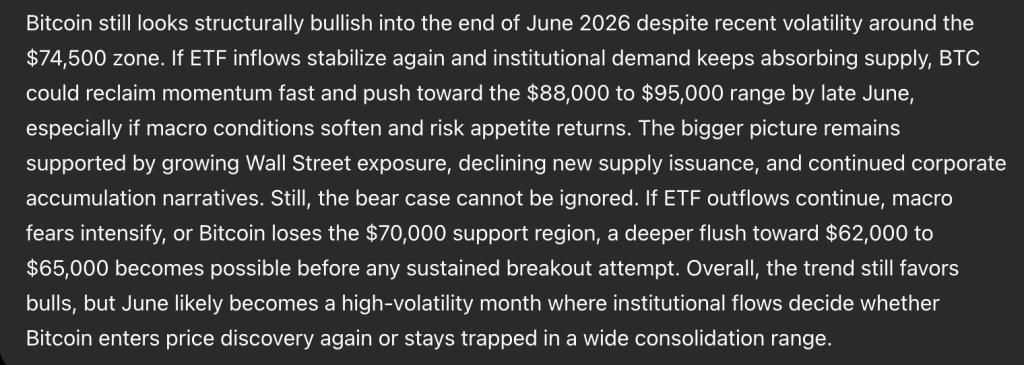
ChatGPT AI is keeping its Bitcoin predicts constructive despite the recent turbulence, targeting $88,000 to $95,000 by end of June 2026 from a current price of $73,516, with the thesis resting on whether institutional flows can step back in and absorb the selling pressure that has been building.
The structural argument Sam Altman’s AI is making is not complicated but it is grounded. Wall Street exposure to Bitcoin has been growing in a way that creates a demand floor that did not exist in previous cycles.
Every major dip gets evaluated by institutional desks that were not in the market 2 years ago, and the post-halving supply dynamics mean fewer new coins are hitting the market each month.
Corporate accumulation narratives are still active, with companies continuing to add BTC to balance sheets as a treasury strategy.
When ETF inflows stabilize and that institutional machinery starts buying again, ChatGPT is saying the path to $88,000 opens up quickly.
June is framed as the deciding month. Not a quiet grind higher, but a high-volatility period where the flows call it either way. If the institutional bid returns and macro conditions soften even slightly, the momentum reclaim toward $95,000 happens fast. If it does not, the range stays wide and unresolved.

The bear case is the one the chart is currently flirting with. ETF outflows continuing, macro fears intensifying around sticky inflation and rates, or a clean break below $70,000 support could trigger a flush toward $62,000 to $65,000 before any recovery attempt gets traction.
ChatGPT is not dismissing that scenario, it is just putting it in the minority column for now.
Bitcoin Is Sitting on the Edge of the Most Important Support Level on This Entire Chart
BTC price is printing $73,516 on the daily and the situation is more delicate than it looks at first glance. The chart shows a clean narrative: a peak near $124,000 in late October, a grinding selloff through November and December, a capitulation wick toward $61,000 in February, a recovery to $98,000 in April, and then another leg down that has brought price back to where it sits right now.
That April recovery to $98,000 failing is the most important recent structure on this chart. It showed that the $95,000 to $100,000 zone is loaded with supply from the distribution that started in November, and that bulls could not sustain buying pressure long enough to clear it.
Since the April rejection price has put in a series of lower highs, and the current $73,516 level is sitting right on top of the $70,000 to $74,000 support band that has absorbed demand on multiple tests since February.
This is the level ChatGPT is watching. A daily close below $70,000 with follow-through changes the entire short-term structure and opens the flush toward $62,000 to $65,000 that the bear case describes. Holding here and building a base above $74,000 is what keeps the June recovery narrative alive.
The immediate resistance on the way back up is $80,000, which capped the most recent rally attempt in early May. Above that $88,000 is the first real test of whether buyers have enough conviction to make ChatGPT’s target range a realistic conversation.
ChatGPT AI Predicts Bitcoin Hyper to Outperform XRP by 1000x
Bitcoin has carried the same limitations since the beginning and the industry has quietly accepted them as permanent.
No smart contracts without leaving the network. No high-speed execution. No programmability that does not require a full migration to a different ecosystem.
Developers who started on Bitcoin did not abandon it because they wanted to. They abandoned it because the infrastructure gave them no other choice. Ethereum and Solana exist partly because Bitcoin never solved its own usability problem.
Bitcoin Hyper is building the solution inside Bitcoin rather than around it.
The architecture combines a Layer 2 directly on Bitcoin with Solana Virtual Machine integration. That means the execution speed and programmability that sent developers to Solana is now available without abandoning Bitcoin’s security model. Fast transactions, near-zero fees, and full smart contract support running on top of the most trusted network in crypto rather than in competition with it.
This gap has been sitting open since Bitcoin launched. Every attempt to solve it has required users to trust a bridge, accept a different security model, or leave the ecosystem entirely. Bitcoin Hyper is the first serious attempt to close it from within.
The presale is at $0.013679 with over $32 million raised and staking incentives for early participants.
Moving Bitcoin’s price by even 10% requires tens of billions in new capital. Early stage infrastructure plays do not work that way. A fraction of that capital moves the needle dramatically at this stage. The upside is asymmetric and so is the risk.
The gap is real. The question the market has not answered yet is whether this is the team that closes it.
The post Sam Altman ChatGPT AI Predicts Bitcoin Price By End of June 2026 appeared first on Cryptonews.
TLDR:
- USDT supply fell as large redemption waves removed over $1.2B from circulation in 24 hours.
- Market cap changes reflect minting and burning cycles tied to stablecoin demand flows data.
- Chain swaps and treasury transfers can distort short-term USDT supply readings across networks.
- Liquidity trends in stablecoin markets often act as early indicators of crypto capital rotation.
$USDT minting and redemption flows drive stablecoin liquidity across exchanges and institutional desks, with recent data showing a sharp contraction following large-scale redemption activity in short-term markets.
Liquidity Rotation and $1.2B Supply Contraction Signal
The recent $1.2B reduction in USDT Market Cap reflects a concentrated redemption wave across major trading platforms.
This movement indicates that large holders converted stablecoins into fiat, reducing circulating liquidity across the ecosystem.
Such behavior is often associated with risk-off positioning and capital preservation strategies among institutional participants.
Exchange data shows that redemption clusters occurred within a compressed 24-hour window across multiple wallets.
Stablecoin supply contraction of this scale often signals temporary liquidity tightening rather than structural weakness.
However, interpretation requires context because chain swaps can distort apparent supply changes without affecting net issuance.
Tether’s mint and burn mechanism ensures that the circulating supply always reflects real demand across markets. Therefore, short-term declines do not necessarily imply sustained capital exit from digital asset markets.
Analysts emphasize monitoring multi-day supply trends instead of isolated snapshots to avoid misleading conclusions.
Broader liquidity cycles often align with macroeconomic sentiment, exchange inflows, and derivative market positioning shifts.
These interconnected factors collectively shape how the $USDT Market Cap evolves across different market phases. Market participants continue to treat stablecoin supply as a proxy for crypto liquidity conditions globally.
This metric is widely observed across exchanges, research desks, and institutional analytics platforms for decision-making. Recent contraction remains within the normal volatility range of circulating stablecoin supply cycles.
USDT Supply Mechanics and Market Cap Adjustments
$USDT Market Cap is determined entirely by circulating supply changes rather than price fluctuations across trading venues globally.
When institutional demand rises, Tether issues new tokens through minting processes backed by equivalent dollar reserves deposits.
This expansion increases liquidity available across exchanges, often correlating with higher trading activity and capital inflows. Such movements are recorded on-chain and reflected in real-time market capitalization tracking dashboards across ecosystems.
Redemption events reduce the USDT Market Cap when holders return tokens to Tether for fiat settlement processing.
This process permanently removes tokens from circulation, creating a measurable contraction in total stablecoin supply across networks.
Such reductions often occur during risk-off sentiment when investors rotate capital from crypto into cash positions.
Chain-level data confirms these burns as verifiable supply adjustments across blockchain records and issuance ledgers.
Market observers track these flows to assess liquidity tightening within stablecoin ecosystems over defined reporting periods.
Short-term volatility in reported supply figures may also stem from operational wallet movements across custodial systems.
These transfers do not always indicate actual market exits but rather internal treasury allocation adjustments. Distinguishing between real redemption and internal transfers is essential for the accurate interpretation of the $USDT Market Cap trends.

A sweeping new executive order from President Donald Trump reshapes how millions of unbanked immigrants may interact with crypto and the US financial system, and who stands to benefit.
Trump has recently signed an executive order “to restore integrity to America’s financial system,” directing federal regulators, including the Treasury Department, to tighten fraud screening and customer identification protocols for undocumented immigrants accessing financial services. The White House cited “gaps in customer identification practices” exploited by criminal networks.
Crypto will fix the immigration issue, we won’t need borders anymore. — BitStrange (@Threadit_us) May 31, 2026
I’ve been saying this for years, they let in all these immigrants so they can make the excuse for digital ID and digital currency  . They will be forced out by starving them and no way to get paid. https://t.co/rvhfDb7ZdN
Policy analysts note the directive could functionally push a large, cash-dependent population further outside traditional banking, and toward crypto rails, stablecoins, and Bitcoin ATMs. It is, ironically, the same pressure that Eric Trump and Donald Trump Jr. have publicly cited as the origin story of World Liberty Financial: “We got into crypto because, out of necessity, we were debanked.”
Trump immigration order could push undocumented migrants toward crypto, stablecoins
On May 19, Trump issued an executive order tasking Treasury and federal regulators to tighten fraud screening and restrict credit lines for undocumented immigrants, citing national security… pic.twitter.com/Eclzn7ZEoG— NewsTongue (@NewsTongueX) May 31, 2026
Today, millions of people are being nudged out of legacy finance, which is, historically, a stablecoin growth event. Trump’s crypto-friendly posture has already shifted regulatory tone in Washington, and this order extends that dynamic into payments infrastructure, a long-term tailwind for digital asset adoption.
Discover: The Best Crypto to Diversify Your Portfolio
Can Bitcoin Price Break Its Resistance? Is Trump the Crypto President?
Bitcoin bounced from a six-week low of $72,600 and has stabilized in the $73,400–$73,900 range, with nearest support at $73,400 and immediate resistance at $75,900. A clean break above that level opens the door to $78,000 and then $79,300, with Bollinger-band resistance capping the near-term upside around $81,200. Below support, deeper demand sits near $68,900.
A prominent chart analyst flagged a rising-wedge breakdown with bearish RSI divergence on the daily timeframe, projecting a downside target near $69,700 and a larger bear-flag target as deep as $52,000, only invalidated on a sustained move above $91,300. Our in-house analyst expects a relatively contained range of $72,300–$75,700 in the near term.
If BTC could hold $73,400 and macro risk sentiment stabilizes, it could push through $75,900 toward $78k+. However, the most likely scenario for now is to see it range, consolidating between $72k–$76k as traders await Washington catalysts and US macro data.
Discover: The Best Token Presales
Bitcoin Hyper Targets Bigger Upside Than Bitcoin and Major Alts Like ETH, SOL, and XRP
When Bitcoin chops sideways, the asymmetric upside tends to hide one layer down the stack. Infrastructure plays, particularly those that solve Bitcoin’s core limitations, attract attention precisely when BTC’s spot chart disappoints. That rotation logic is worth understanding right now.
Bitcoin Hyper ($HYPER) is positioning itself as that infrastructure layer: the first-ever Bitcoin Layer 2 with Solana Virtual Machine (SVM) integration, built to deliver sub-second finality and low-cost smart contract execution on top of Bitcoin’s security model.
The pitch is direct. Hyper breaks through Bitcoin’s three core constraints of slow transactions, high fees, and no programmability without abandoning the trust layer underneath. The project has raised more than $32 million at a current presale price of $0.0136, with 36% APY staking rewards active for early participants.
A Decentralized Canonical Bridge on Hyper handles BTC transfers, keeping the architecture non-custodial.
Research Bitcoin Hyper before the presale closes.
The post Trump Crypto Vision: Immigration Order and Stablecoin Economy Set Stage for Bitcoin appeared first on Cryptonews.

Thomas Tuchel suffers World Cup blow as major rule change which will impact England emerges

Korea And Japan Worry Me More Than The Strait of Hormuz (SP500)

Kraken to Offer Regulated Perpetual Futures as Rivals Move Fast


-

 NewsBeat4 days ago
Israel says it has killed new Hamas military leader in Gaza City airstrikes
-

 Tech4 days ago
NASA taps Blue Origin to deliver lunar rovers for Moon Base initiative
-

 Politics6 days ago
Bridgerton Season 5: Cast, Release Date And Everything We Know So Far
-

 News Videos5 days ago
XRP *JUST* SUCCEEDED!!!! CLARITY ACT EXPOSED!!! (SHE EXPOSED IT)
-

 Sports6 days ago
2026 NBA Finals schedule, odds: Knicks await Thunder or Spurs after winning East
-
Crypto World7 days ago
Brian Armstrong Outlines Crypto Vision for the Future Financial System
-
Crypto World5 days ago
Micron Crosses $1 Trillion Market Cap as AI Demand Reshapes Memory Sector
-

 Business5 days ago
Selena Gomez Reportedly Upset Over Benny Blanco’s Comments on Her ‘Terrible’ Diet
-

 News Videos2 days ago
This is BROKEN! INSANE 5x MONEY CAR WASH WEEK! The NEW GTA Online UPDATE Today! (GTA5 New Update)
-

 Business6 days ago
BTS Sells Out Four Las Vegas Shows at Allegiant Stadium for ARIRANG World Tour
-
 Tech6 days ago
China assigns ID codes to 28,000+ humanoid robots
-
 NewsBeat6 days ago
Hottest May day ever as London hits 34.8C in 2C leap from previous records
-

 Tech6 days ago
Microsoft’s quiet Claude Code retreat and the real cost of enterprise AI
-

 Tech3 days ago
Waymo dominates autonomous vehicle registrations as Tesla trails behind
-

 Business6 days ago
Nikkei 225 Surges Past 65,000 for First Time as Iran Peace Hopes Fuel Record Rally
-
Tech4 days ago
The Samsung pay deal is the moment Korean unions changed register
-

 NewsBeat6 days ago
Crowds find riverside shade in York as temperatures soar
-

 Tech6 days ago
Westone Audio and Etymotic Acquired by Fidelity Collective in Major IEM Market Move
-
 Entertainment6 days ago
‘Breaking Bad’ Star’s Easy-to-Binge 6-Part Crime Series Spin-Off Is Finally Heading to Free Streaming
-

 Tech5 days ago
Millions of AI agents imperiled by critical vulnerability in open source package
You must be logged in to post a comment Login