
Crypto World
USDC makes major strides in payment and settlement; holders can earn up to $7,000 daily

Disclosure: This content is provided by a third party. Neither crypto.news nor the author of this article endorses any product mentioned on this page. Users should conduct their own research before taking any action related to the company.
As expectations regarding Federal Reserve policy for September shift, the digital asset market is once again in the spotlight.
Summary
- Fed Governor Christopher Waller said cooling inflation could support holding interest rates steady in September.
- USDC’s dollar peg makes its payment and settlement utility more important than short-term price moves.
- Circle’s Arc blockchain targets institutional payments, settlement and regulated digital financial applications.
- EX DeFi advertises USDC-supported cloud-mining contracts, although its return and security claims require independent verification.
On Sep. 3, Federal Reserve Governor Christopher Waller stated that if upcoming inflation data continues to show a cooling trend, he would favor maintaining current interest rates at the September meeting; however, he did not rule out further monetary policy tightening should inflation re-accelerate.
This statement alleviated some market concerns regarding immediate further rate hikes. Following the news, global stock markets strengthened, U.S. Treasury yields retreated, and market risk appetite improved. For the digital asset market—where shifts in interest rate expectations often influence capital flows and investor sentiment—attention has turned back to stablecoins and the digital financial infrastructure supporting them.
Unlike BTC, ETH, or XRP, USDC is a stablecoin pegged to the value of the U.S. dollar; its market focus lies not in dramatic price appreciation, but in the continued expansion of payments, trading, settlement, and institutional applications for digital assets.
Recent developments have also emerged within the USDC ecosystem. Circle launched “Circle Arc,” a blockchain centered on USDC that targets institutional payments, settlement, and compliant digital financial applications. The participation of institutions such as BlackRock, DTCC, and Visa in the validator ecosystem further underscores institutional interest in stablecoin infrastructure.
Meanwhile, investors are reconsidering a key question: amidst the volatility of the digital asset market, can long-term USDC holders generate additional returns through digital asset services beyond simply using the coin for trading and asset allocation?
Against this backdrop, an increasing number of USDC holders are shifting their investment strategies toward the EX DeFi cloud mining platform, seeking a more stable path for asset growth.
How will Federal Reserve policy changes affect USDC?
Federal Reserve monetary policy has long been a critical factor influencing global financial markets.
Currently, the Fed must still strike a balance between controlling inflation and sustaining economic growth. Waller’s latest remarks indicate that if future data confirms inflation is cooling, he would support holding rates steady; however, should August inflation data show a significant rebound, he might support a rate hike.
Consequently, investors are now paying closer attention to upcoming inflation and employment data.
For USDC, changes in policy interest rates do not translate directly into the sharp price surges or drops seen with volatile assets like BTC or ETH. Instead, USDC’s strengths lie in its peg to the US dollar and its expanding utility in payments, trading, and digital asset settlement.
As the regulatory landscape for stablecoins matures and institutional participation in the digital asset market grows, USDC is evolving from a mere medium of exchange into a component of digital payment and financial infrastructure.
Why is EX DeFi attracting attention from USDC users?
For those seeking to generate extra income, traditional digital asset investments come with significant price volatility, while self-managed mining entails costs related to hardware, electricity, and maintenance.
EX DeFi combines a cloud mining model with AI-driven computing power management, offering users a way to participate without the need to purchase or maintain mining rigs themselves.
Key features of EX DeFi
Beginner-friendly:
Even users with no prior experience can get started easily; they can explore platform services immediately after registration and receive $17 in trial funds.
No hardware purchase required:
Users do not need to buy, deploy, or maintain specialized mining hardware, as they can participate in mining services via the cloud.
Security and compliance:
The platform adheres to international security standards—including McAfee®, Cloudflare®, and 2FA verification—and utilizes cold wallet isolation to enhance fund security.
Affiliate rewards program:
Users can earn up to 5% in affiliate rewards by referring friends, creating a source of long-term income.
Support for multiple digital assets:
The platform supports USDC as well as various mainstream digital assets, including XRP, BTC, ETH, USDT, BNB, DOGE, LTC, and SOL.
Green energy commitment:
EX DeFi’s infrastructure runs on 100% green energy and continues to expand its use of clean energy. It leads the digital asset industry toward low-carbon, eco-friendly development, contributing to global sustainability while generating value for users.
About EX DeFi
Founded in 2021 and headquartered in the UK, EX DeFi currently provides high-performance, cost-effective cloud mining solutions to over 2 million users across more than 180 countries and regions worldwide.
Guided by the development philosophy of being “green, intelligent, open, and sustainable,” EX DeFi leverages innovative cloud mining technology and decentralized finance (DeFi) infrastructure to foster an efficient, low-carbon digital ecosystem, thereby creating long-term value for global users.
Get started with the EX DeFi platform in three simple steps:
Step 1: Register an account
Step 2: Select a contract
Choose a cloud mining contract that suits your budget and desired duration, then start automated mining with a single click.
Step 3: Start participating
Once the mining contract is activated, the system automatically allocates computing power to the mining pool and settles earnings within 24 hours. You can choose to withdraw your generated earnings or reinvest them for future opportunities.
Popular mining plans:
Investment: $100 | Duration: 2 days | Daily return: $4 | Total profit: $100 + $8
Investment: $500 | Duration: 6 days | Daily return: $6.5 | Total profit: $500 + $39
Investment: $1,000 | Duration: 10 days | Daily return: $13.5 | Total profit: $1,000 + $135
Investment: $5,000 | Duration: 20 days | Daily return: $73.5 | Total profit: $5,000 + $1,470
Investment: $10,000 | Duration: 30 days | Daily return: $161 | Total profit: $10,000 + $4,830
Visit the EX DeFi platform to view details on more investment contracts.
Conclusion
Recent statements from the Federal Reserve indicate that future policy direction will remain heavily dependent on inflation and employment data. If inflation continues to cool, market concerns regarding further monetary policy tightening may subside, thereby improving overall sentiment toward risk assets.
Meanwhile, USDC is establishing itself as a key piece of in/frastructure in the digital asset market, driven by its stable US dollar peg and its expanding use in payments, settlement, and institutional applications. For users looking to explore yield-generating opportunities in digital assets, EX DeFi Cloud Mining offers an alternative way to earn passive income.
For more details, please visit the official website: https://exdefi.com/
Contact email: [email protected]
Disclosure: This content is provided by a third party. Neither crypto.news nor the author of this article endorses any product mentioned on this page. Users should conduct their own research before taking any action related to the company.

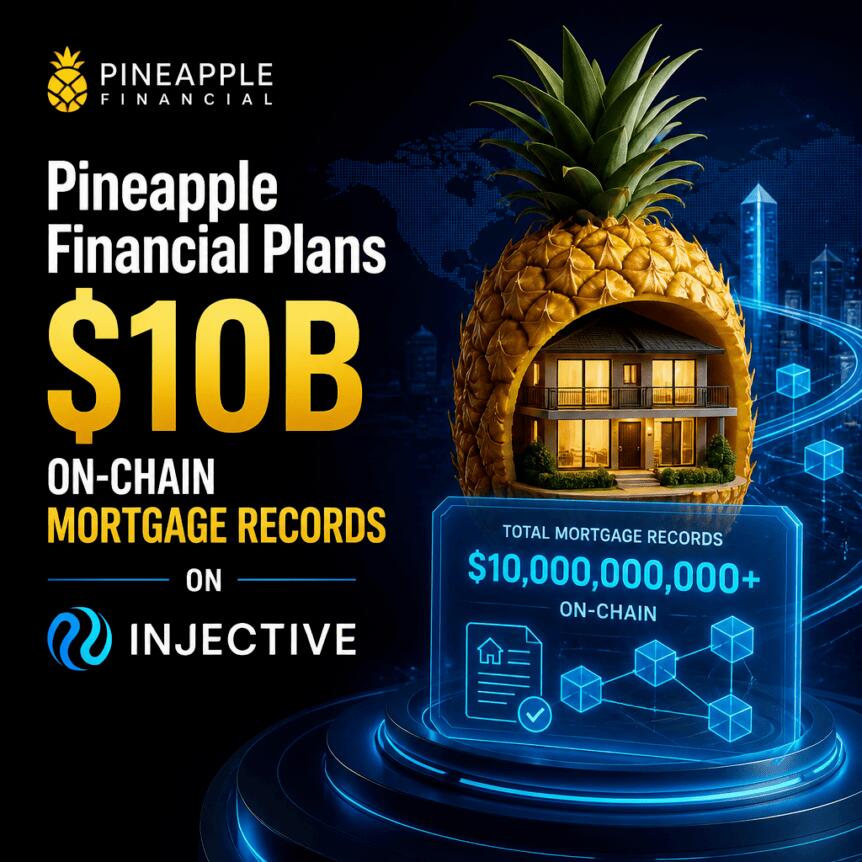
Pineapple Financial says it has migrated more than $1 billion of residential mortgage records onto Injective, marking a significant step in its plan to move a large portion of its funded loan portfolio onchain.
Injective announced Friday that Pineapple expects to eventually migrate over 29,000 funded mortgages worth more than $10 billion to the network. The approach is designed to keep each mortgage tied to its underlying loan file through an onchain record, rather than repackaging loans into a new mortgage security.
Key takeaways
- Pineapple Financial reports moving more than $1 billion in mortgage records onto Injective as part of an onchain migration of its existing portfolio.
- Injective says Pineapple plans to bring over 29,000 funded mortgages worth more than $10 billion onto the network.
- Each mortgage is represented by an onchain record with more than 500 data points to support verification, audit trails, and risk analysis.
- Token Terminal data indicates the PAPL0 asset market cap is about $1.1 billion, reflecting mortgage-record tokens rather than direct ownership of the underlying loans.
How Pineapple is tokenizing mortgages on Injective
Injective’s update frames the migration as a way to digitize and operationalize mortgage data on a layer-1 network built for financial applications. According to the company, Pineapple’s onchain records are linked to the underlying loan file, aiming to avoid creating a wholly new mortgage instrument in the process.
Each mortgage record includes more than 500 data points. Injective characterizes the dataset as intended for verification and audit workflows, as well as risk analysis that depends on having granular, loan-level information available in a consistent format.
Pineapple’s own dashboard, referenced by Injective, shows the initiative has expanded since it began in December 2025. The migration now includes 2,079 mortgage records, up from 1,259 at the time the effort launched.
What PAPL0 represents and why the structure matters
Token Terminal tracks PAPL0 as an asset associated with the mortgage records on Injective. The data cited in the announcement places PAPL0’s asset market cap at about $1.1 billion, up 48.2% over the past nine months, according to Token Terminal figures.
Crucially, Token Terminal’s project framing (as described in the original material) indicates that the tokens are meant to represent mortgage records, not ownership of the underlying loans themselves. That distinction is important for investors and counterparties trying to understand what is actually being transferred or referenced when token balances change—particularly in real-world asset (RWA) systems where legal ownership, servicing rights, and data integrity may not always map neatly onto token mechanics.
For market participants evaluating RWAs, this record-based model may also influence how due diligence is performed. Instead of relying on tokens as a proxy for the full legal construct of a mortgage, the onchain record is positioned as a structured data layer—potentially improving traceability and audit readiness.
Pineapple’s broader Injective ties and onchain treasury
The mortgage-record migration is part of a wider relationship between Pineapple and Injective. The material also points to a separate digital asset treasury connected to Injective’s native token, INJ, with Pineapple described as having a $100 million Injective treasury.
As part of that setup, Pineapple stakes INJ from the treasury. Kraken is named as a primary validator for the holdings, tying the arrangement to established institutional infrastructure for validating network activity.
Real estate tokenization continues, but remains small
The move sits within a broader push to bring real estate and other traditionally illiquid assets onto blockchains. Tokenization is often marketed as a way to divide interests, improve transferability, and broaden access—but the pace of adoption still varies widely by asset type and jurisdiction.
Earlier this year, several major finance players were highlighted in connection with tokenized real estate fund structures. In June, Apex Group joined other firms—including Goldman Sachs, Archax, and LRC Group—in a tokenized real estate fund effort where fund shares are issued as digital tokens through Goldman Sachs’ Digital Asset Platform. In that structure, blockchain-based ownership is used for the fund shares themselves, rather than simply recording property-related information onchain.
Dubai has also expanded its tokenized real estate initiatives. The reporting referenced that in February, the Dubai Land Department launched a second phase of a pilot after roughly $5 million in property had been tokenized, with transactions recorded on the XRP Ledger.
Still, despite recurring announcements, tokenized real estate appears to be only a small slice of the overall RWA ecosystem. The figures cited in the source state that the sector has about $226.5 million in distributed value, up 11.7% over the past 30 days. This is contrasted with approximately $38.8 billion across tokenized RWAs tracked by RWA.xyz.
What to watch next
With Pineapple increasing the number of onchain mortgage records and Injective targeting a scale-up to more than 29,000 mortgages worth over $10 billion, the key question for the next phase is how this record-based model performs in practice—especially around verification workflows, auditing, and how market participants interpret the relationship between tokenized records and the legal rights attached to the underlying loans.
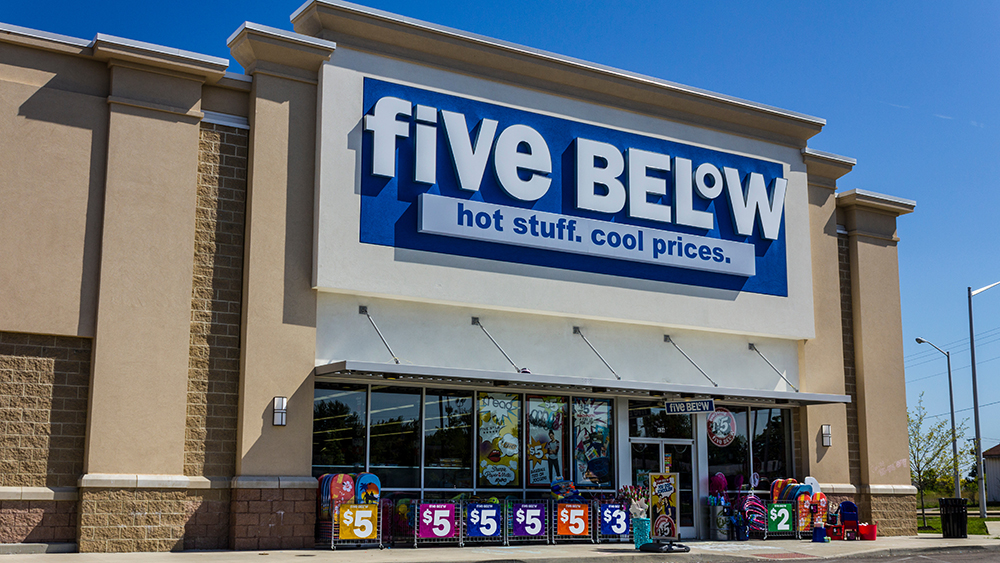
Five Below stock reversed Thursday after attempting to break out in early trade. The discount retailer trounced estimates and hiked its full-year outlook as the company continues to see strong same-store sales growth. Multiple analysts lifted their price targets on FIVE stock early Thursday. Five Below (FIVE) late Wednesday reported a 108% increase in Q2 earnings to $1.68 per share…
Copyright ©2026 Investor’s Business Daily, LLC. All rights reserved. 87990cbe856818d5eddac44c7b1cdeb8


Banco do Brasil has invested in a $5 million digitally native structured note issued by Citi on Euroclear’s blockchain-based infrastructure, completing what the lender described as the first transaction of its kind involving a Latin American institution.
Summary
- Banco do Brasil invested $5 million through its proprietary treasury in a digitally native structured note issued by Citi on Euroclear’s D-FMI platform.
- The bank described the investment as its first digital note transaction and the first deal of its kind involving a Latin American institution.
- Citi issued the structured note through its Luxembourg entity, while its London branch served as the issuance and payment agent.
- The note was issued, registered and managed through blockchain infrastructure designed to reduce processing steps and improve transaction traceability.
Banco do Brasil said its proprietary treasury participated as an investor in the Digitally Native Structured Note issued by Citigroup Global Markets Funding Luxembourg SCA on Euroclear’s Digital Financial Market Infrastructure, or D-FMI, platform.
Citi Issuer Services, operating through Citibank N.A.’s London branch, served as the issuance and payment agent for the note.
The transaction gives Banco do Brasil direct exposure to a security issued and managed through blockchain infrastructure, part of a series of institutional experiments seeking to bring conventional financial instruments onto distributed ledgers.
Banco do Brasil enters digital note market through Citi deal
Banco do Brasil described the transaction as its first investment in digital notes and part of its work to assess new financial infrastructure built around distributed ledger technology.
Unlike a conventional note, which can depend on several systems and sequential processing steps, the digital instrument is issued, registered and managed through blockchain-based infrastructure.
Banco do Brasil said the structure can reduce operational steps while giving participants greater visibility over transaction records and supporting settlement, reconciliation and asset management within a more integrated system.
The bank participated through its proprietary treasury, placing it directly on the investor side of the issuance rather than acting only as a financial intermediary.
Its involvement comes as banks, payment companies and market infrastructure providers continue testing how blockchain can work alongside existing institutional systems.
Crypto.news previously reported that payments company Bottomline had connected its banking network with Chainlink infrastructure, giving more than 600 banks a route to blockchain-based settlement while retaining existing ISO 20022 messaging.
Bottomline processes more than $16 trillion in payments each year, and the integration was designed to connect conventional payment instructions with public and private blockchain networks.
Banco do Brasil’s transaction uses a different structure, with blockchain infrastructure supporting the issuance and management of an investment instrument rather than payment messaging.
Francisco Lassalvia, vice president of Wholesale Banking at Banco do Brasil, said the lender views financial market digitization as a long-term structural development.
“We believe that the digitalization of financial markets represents a long-term structural trend,” Lassalvia said.
He said transactions of this type can help establish standards, governance systems and infrastructure capable of supporting a new generation of digital assets.
According to Lassalvia, such systems could increase market efficiency while allowing financial institutions to pursue innovation with security and operational resilience.
Citi issues $5 million note through Euroclear D-FMI
Citi issued the structured note through Citigroup Global Markets Funding Luxembourg SCA, while Euroclear supplied the digital infrastructure used to create and manage the instrument.
Euroclear operates securities settlement and post-trade infrastructure for financial institutions across global markets. Its D-FMI platform extends that role to digitally native financial instruments built using distributed ledger technology.
The security was created in digital form on the blockchain-based platform from issuance, distinguishing it from structures where a conventional asset is created first and later represented through a token.
Banco do Brasil said native digitization can reduce the number of operational steps involved in handling an asset while improving transaction traceability.
Similar experiments have expanded across conventional finance as financial institutions test blockchain infrastructure for securities, funds, payments and collateral.
Circle, for instance, is preparing to launch an institutional blockchain whose founding validators include BlackRock, DTCC, Visa, Mastercard, Standard Chartered and Intercontinental Exchange. The network is expected to support tokenized financial assets, with DTCC planning to tokenize DTC-custodied assets on the chain beginning in 2027.
BlackRock is expected to deploy its tokenized BUIDL fund on the same network, allowing institutional participants to subscribe, redeem and use fund assets within an onchain environment.
The Banco do Brasil investment remains focused on a structured note rather than a fund or payment instrument, but it uses a similar underlying approach of placing parts of conventional financial-market activity on distributed ledger infrastructure.
Roksolana Dushynska, Global Markets Issuance Equity Structuring Manager at Citi, said the transaction formed part of the bank’s work in digital capital markets.
“The most recent issuance of our Native Digital Structured Note reinforces the role Citi is playing in accelerating the growth of digital capital markets,” Dushynska said.
She said distributed ledger technology was being used in capital markets to improve efficiency, transparency and accessibility for investors.
Citi intends to continue developing models using the technology as financial institutions examine new ways to issue, trade and manage assets, she added.
Digital notes can reduce conventional processing steps
Traditional securities infrastructure can involve separate systems and intermediaries handling issuance, registration, reconciliation, settlement and recordkeeping.
Information may need to pass between several platforms as a transaction moves through its lifecycle.
Under the model used for Banco do Brasil’s investment, the note is managed through blockchain infrastructure intended to provide participants with a common digital record.
Banco do Brasil said the setup has the potential to make settlement, reconciliation and asset management processes faster and more efficient while increasing transparency and traceability.
The distinction between digitally native securities and other blockchain-based financial products has become increasingly relevant as companies adopt different forms of tokenization.
Some tokenized products merely track the economic value of an underlying asset without giving investors ownership rights. Robinhood’s stock tokens, for example, provide economic exposure to equities without making token holders shareholders of the companies whose stocks they track.
Other models use blockchain as part of the actual securities issuance or registration process.
Banco do Brasil’s investment falls into the latter category because the structured note was issued natively through Euroclear’s digital market infrastructure.
Financial firms are testing similar models for trading. Uniswap founder Hayden Adams recently discussed how tokenized securities could trade directly against one another in blockchain-based liquidity pools rather than requiring every transaction to settle against dollars.
Ten tokenized stock pools against SPY had generated $33 million in trading volume from more than 11,000 traders when the proposal was discussed, showing another method through which blockchain infrastructure is being tested around conventional financial assets.
Banco do Brasil tests blockchain infrastructure for institutional products
For Banco do Brasil, the $5 million investment forms part of its assessment of technology that could support institutional products and financial-market infrastructure.
The lender said it is evaluating new infrastructure models that could contribute to modernization of the financial system and support products and services for institutional investors.
Its participation places a major Latin American bank directly inside a digitally native securities transaction conducted through established international financial institutions.
The structure retained several roles familiar to conventional capital markets. Citi remained responsible for issuing the note through its Luxembourg entity, its London branch handled issuance and payment agency functions, Euroclear provided the D-FMI platform and Banco do Brasil participated as the investor.
Banco do Brasil said financial institutions, regulators and investors worldwide have been paying increased attention to digital platforms capable of issuing and settling financial instruments.
Native digitization can reduce operational steps and provide a traceable transaction history while creating infrastructure that can support new models for trading, settlement and asset management, according to the bank.
The transaction took place on the 19th, with Banco do Brasil investing through its proprietary treasury and Citi and Euroclear handling the issuance and infrastructure functions for the $5 million digitally native structured note.
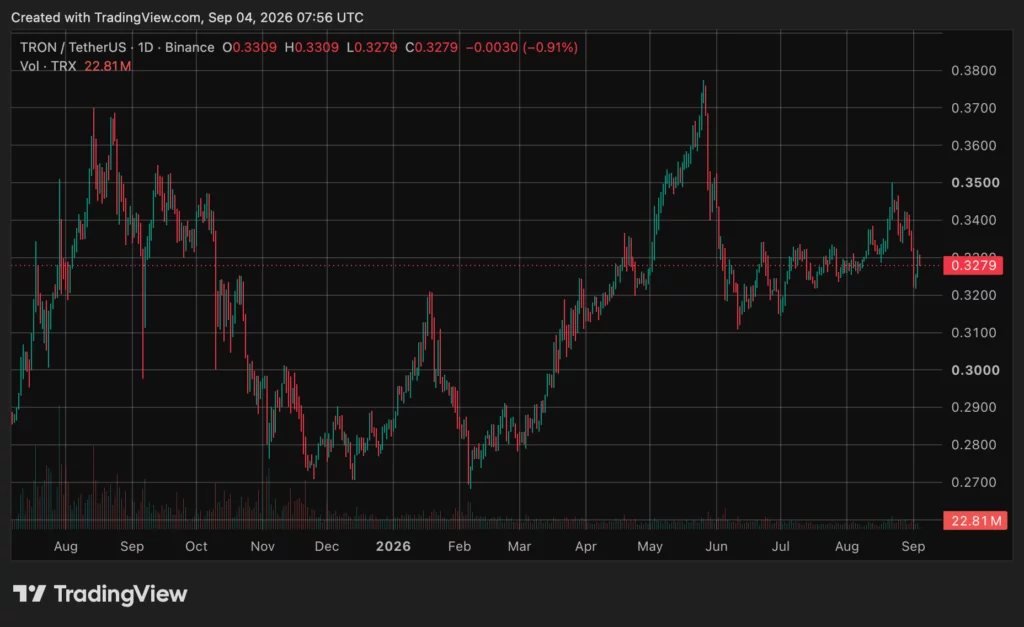
Canary Capital said its proposed Canary Staked TRX ETF is “coming soon,” pointing investors toward an amended registration statement filed with the U.S. Securities and Exchange Commission on Aug. 19.
Summary
- Canary Capital says its staked TRX ETF is coming soon under ticker TRXS in America.
- Latest SEC amendment lists a 1.10% annual sponsor fee for the proposed exchange-traded product shares.
- The fund plans to stake substantially all held TRX while retaining 80% of rewards generated.
- BitGo would custody TRX while U.S. Bank would safeguard the trust’s cash and assets separately.
- The registration statement remains preliminary with no confirmed launch date or SEC effectiveness notice published.
The asset manager has not announced a trading date. Its latest filing remains a preliminary prospectus and states that securities cannot be sold until the registration statement becomes effective. No SEC effectiveness notice appeared in the fund’s public filing history as of Sept. 4.
The product would trade under the ticker TRXS. It would give investors exposure to TRX through ordinary brokerage accounts while also participating in the Tron network’s staking process.
Canary Staked TRX ETF would combine price and staking exposure
The fund’s primary objective is to track the price of TRX held by the trust, minus operating expenses and other liabilities. Its secondary objective is to earn additional TRX by staking tokens through the network’s proof-of-stake process.
🐤 Coming Soon! SEC filing: https://t.co/SBTD3NeCVZ pic.twitter.com/7mtM556LiV
— Canary Capital (@CanaryFunds) September 3, 2026
Get launch updates by signing up here: https://t.co/lRBk5DJqNF
Canary expects to allocate substantially all the trust’s TRX to staking. The prospectus says staking fees would not exceed 20% of generated rewards. Under the current structure, the trust would retain the remaining 80%.
The staking fees would be shared among the staking provider, Canary and the custodian. Rewards received by the fund would be included in its daily net asset value calculations.
This structure separates the proposal from crypto funds that only hold their underlying tokens. As crypto.news previously reported, competing BNB ETF filings excluded staking at launch, while Canary retained staking as a core part of its TRX proposal.
TRXS filing names its exchange, fee and custodians
TRXS is expected to list on Cboe under the prospectus, subject to the necessary regulatory and operational conditions. The fund would issue and redeem baskets containing 10,000 shares. Transactions could use either cash or TRX, depending on the circumstances described in the filing.
The Aug. 19 amendment set the annual sponsor fee at 1.10% of the trust’s TRX holdings. The fee would accrue daily and could be paid monthly in TRX or cash. Canary may waive part of the fee, but the prospectus says it has no obligation to do so.
BitGo Bank & Trust would hold the fund’s TRX. U.S. Bank would serve as cash custodian, while U.S. Bancorp Fund Services would provide administrative, accounting and transfer-agent services.
The filing also says CoinDesk Indices would provide the CoinDesk Tron Benchmark Rate used to calculate the fund’s net asset value. Investors could still buy or sell shares at a premium or discount to the reported value of the underlying TRX.
SEC filing is not approval or a launch confirmation
Canary originally submitted the fund’s Form S-1 in April 2025. Subsequent amendments added the TRXS ticker, Cboe listing plan, service providers, staking terms and final fee details.
However, an S-1 amendment does not mean the SEC has endorsed the investment. The prospectus explicitly says neither the SEC nor any state securities regulator has approved or disapproved the securities or judged the prospectus accurate.
Canary’s “coming soon” announcement therefore reflects the sponsor’s launch expectations. The company has not provided a firm date or confirmed that every remaining regulatory condition has been completed.
The filing also warns that the fund would not be registered under the Investment Company Act of 1940. Investors would consequently lack some protections available through registered investment companies.
TRX price shows limited reaction to the announcement
TRX traded near $0.328 on Sept. 4, approximately 0.6% higher during the session. Its intraday range was roughly $0.326 to $0.332.
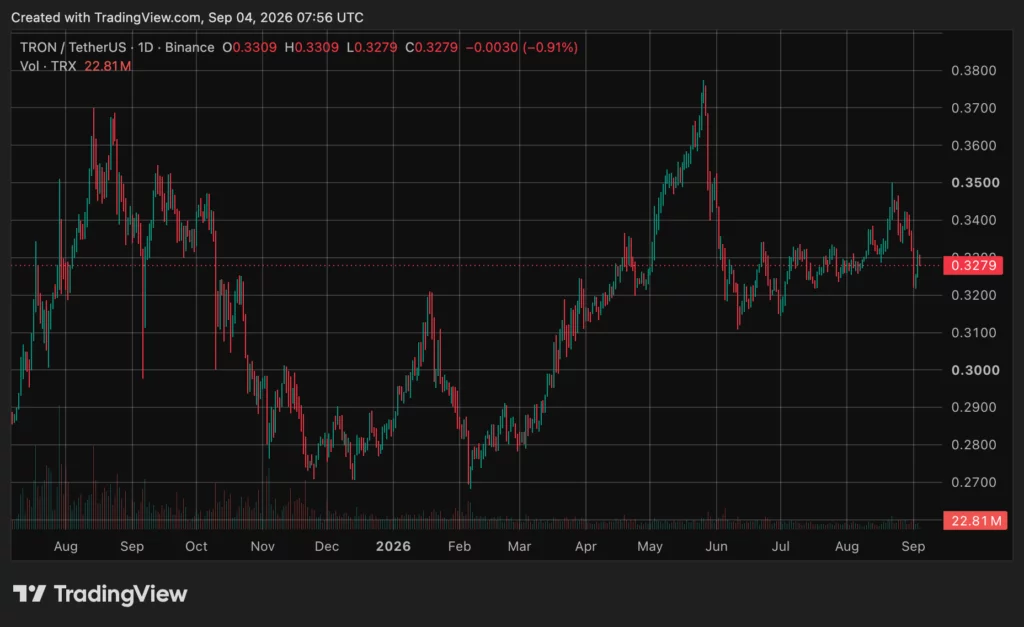
The modest movement did not establish a direct connection between the ETF announcement and TRX’s price. Broader cryptocurrency conditions and network activity can also influence the token.
TRON’s expanding stablecoin business provides relevant context for the product. As crypto.news reported, TRON processed $2.1 trillion in quarterly USDT transfers during the second quarter of 2026. USDT supply on the network reached $87.9 billion at quarter-end.
What happens next for the TRX ETF
The clearest remaining milestone is an SEC notice declaring the registration statement effective. Canary may also file another amendment containing final launch information or updated commercial terms.
A final prospectus would normally confirm the trading date and any remaining operational details. Until those steps occur, TRXS should be described as a proposed or pre-launch product rather than an operating ETF.
Bitcoin price erased an early move above $82,000 on Sept. 4 as stronger-than-expected US employment data lifted Treasury yields and weakened demand for risk assets.
Summary
- Bitcoin price fell 2.1% on the daily chart after trading as high as $82,281 intraday.
- The $78,800–$79,300 area now serves as the main short-term breakout support.
- 4-hour RSI dropped to 53.45, showing that bullish momentum weakened after the rejection.
- Liquidity clusters near $80,200 and $81,800 could attract price if Bitcoin rebounds.
Bitcoin price reverses after testing $82,000
According to data from crypto.news, Bitcoin (BTC) price briefly climbed above $82,000 on Friday before sellers forced the price back below $80,000, reversing the asset’s earlier gains.
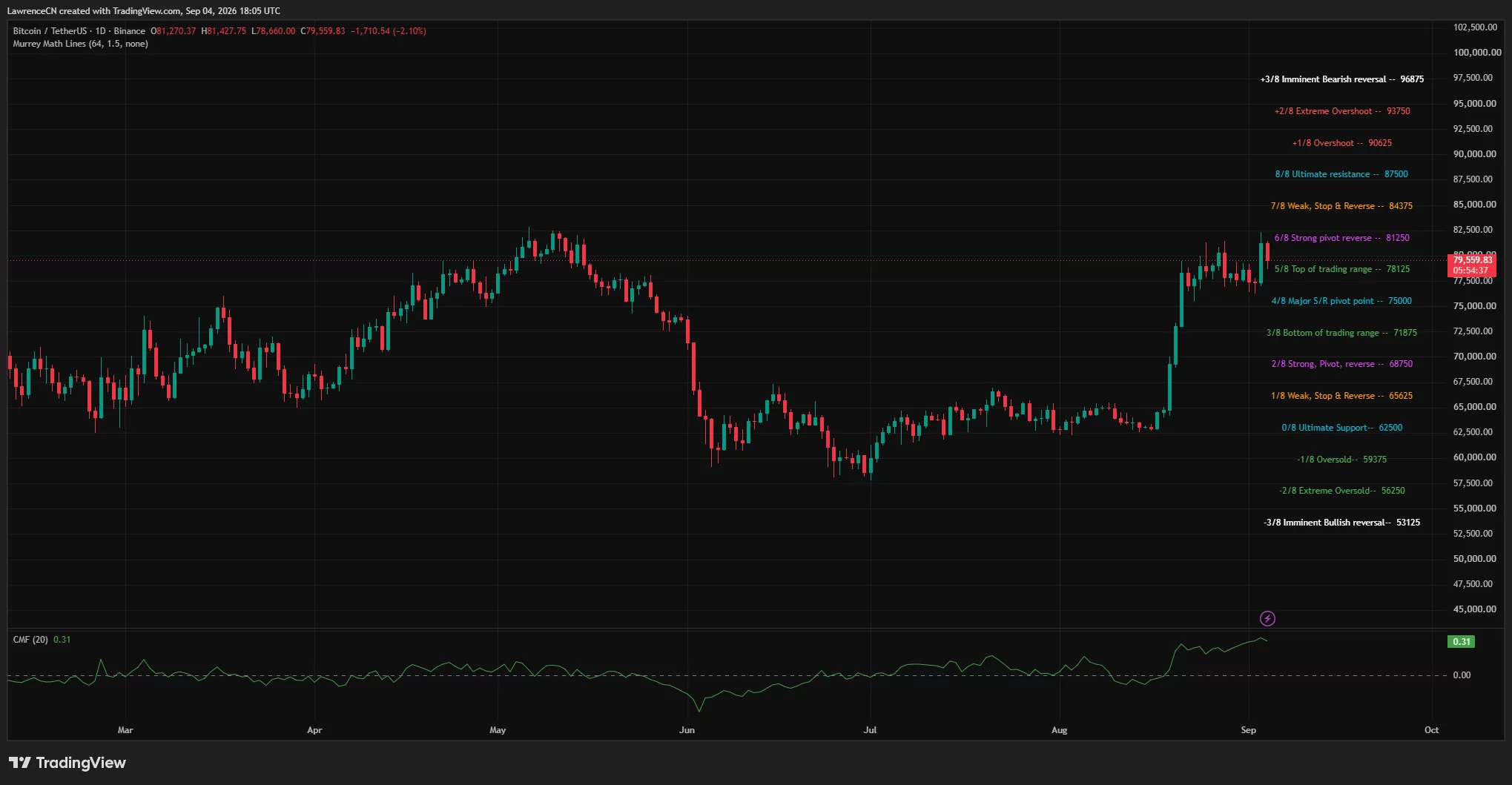
BTC reached an intraday peak of about $82,281 before falling toward $79,224. The Binance daily chart showed an open near $81,270, a low of $78,660, and a price around $79,560 at the time of capture, representing a 2.1% decline for the session.
The reversal followed a sharp rally from Bitcoin’s mid-August base near $62,500. That advance carried the asset through $75,000 and into a consolidation range between roughly $76,000 and $82,000.
Friday’s decline did not completely erase the recent breakout structure. Bitcoin remained close to the $78,800–$79,300 area that had previously acted as resistance before the latest push higher.
A daily close below that zone, however, would increase the risk that the breakout was a short-lived move rather than the start of another advance.
Strong US jobs data weighs on Bitcoin
Bitcoin’s retreat coincided with the release of a stronger-than-expected US employment report, which prompted traders to reassess the likely path of Federal Reserve policy.
US nonfarm payrolls increased by 162,000 in August, well above economists’ expectations, while the unemployment rate remained at 4.1%, according to reports.
The report pushed the market-implied probability of a September Fed rate increase to 65% from 55%, Reuters reported. The benchmark 10-year Treasury yield rose to about 4.77%, while the US dollar also strengthened.
Higher yields can create pressure on Bitcoin because they increase the relative appeal of interest-bearing assets. The stronger labor data also challenged expectations that the Fed could leave rates unchanged after recent signs of cooling inflation.
Broader markets showed a limited but defensive response. The S&P 500 edged lower, while investors continued moving money toward cash-like assets amid higher yields and geopolitical uncertainty. Global money-market funds attracted $46.1 billion during the week through Sept. 2.
US equity funds, meanwhile, recorded $11.12 billion in weekly outflows as investors responded to elevated oil prices, rising yields and tensions involving the US and Iran.
Bitcoin technicals place $78,125 support in focus
The daily chart places Bitcoin below the $81,250 Murray Math level, which is marked as a strong pivot and reversal area. Price tested that zone but failed to establish a daily hold above it.
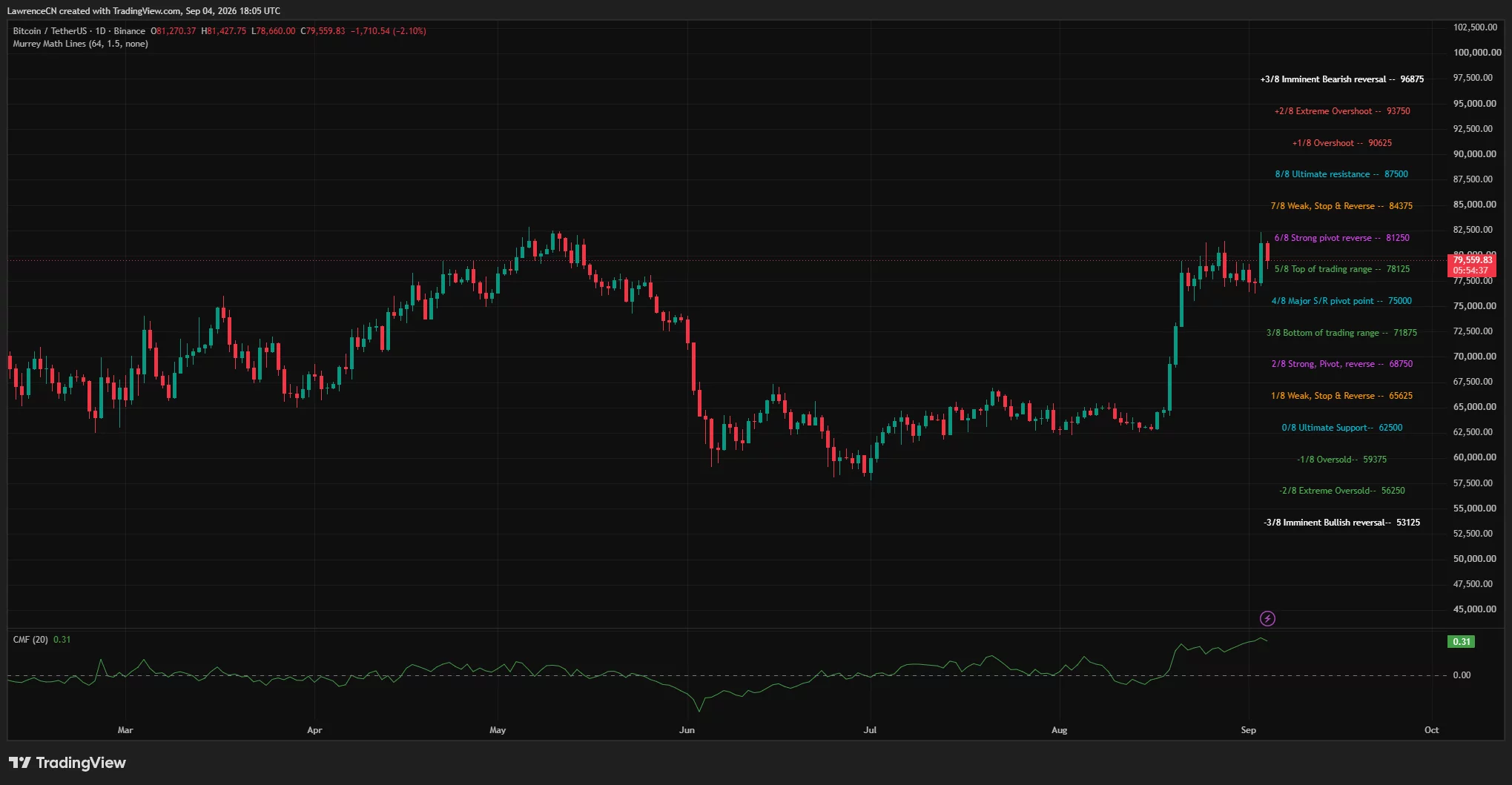
The next visible Murray Math support sits at $78,125, near the breakout-retest area identified by traders. A decisive daily close below $78,125 could expose the psychological $75,000 level, which the chart marks as a major support and resistance pivot.
Below $75,000, the next structural level appears around $71,875. Such a decline would return Bitcoin to the lower portion of its August recovery range, although the charts do not yet confirm a move of that size.
Despite the daily pullback, the Chaikin Money Flow reading remained positive at 0.31. A reading above zero indicates that buying pressure has remained stronger than selling pressure over the indicator’s measurement period, suggesting that the broader rally has not yet lost all of its capital support.
The 4-hour chart presents a more cautious short-term picture. Bitcoin traded near $79,588, above the Bollinger Bands’ middle line at $78,797 but well below the upper band at $82,193.
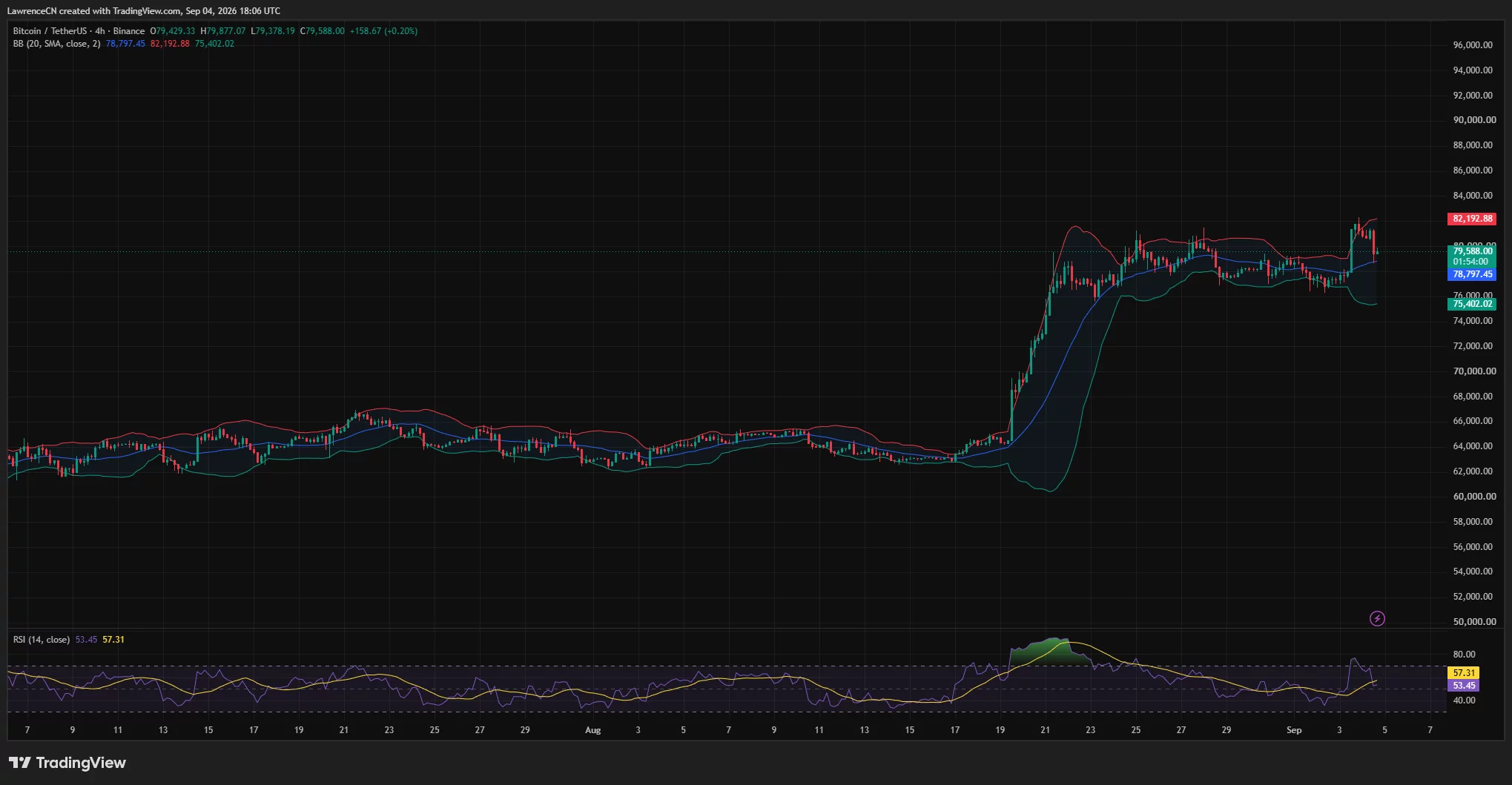
Holding above the middle band would preserve a neutral-to-bullish structure. Losing it could send BTC toward the lower Bollinger Band near $75,402, although the $78,125 and $76,000–$77,000 areas would provide intermediate support.
4-hour RSI stood at 53.45, down from an earlier overbought reading above 70. The indicator remained slightly above the neutral 50 level, but it had fallen below its moving average near 57.31, reflecting weaker momentum after the failed breakout.
Liquidation map shows targets above $80,000
CoinGlass’ 24-hour liquidation heatmap showed concentrated leveraged positions on both sides of Bitcoin’s price.
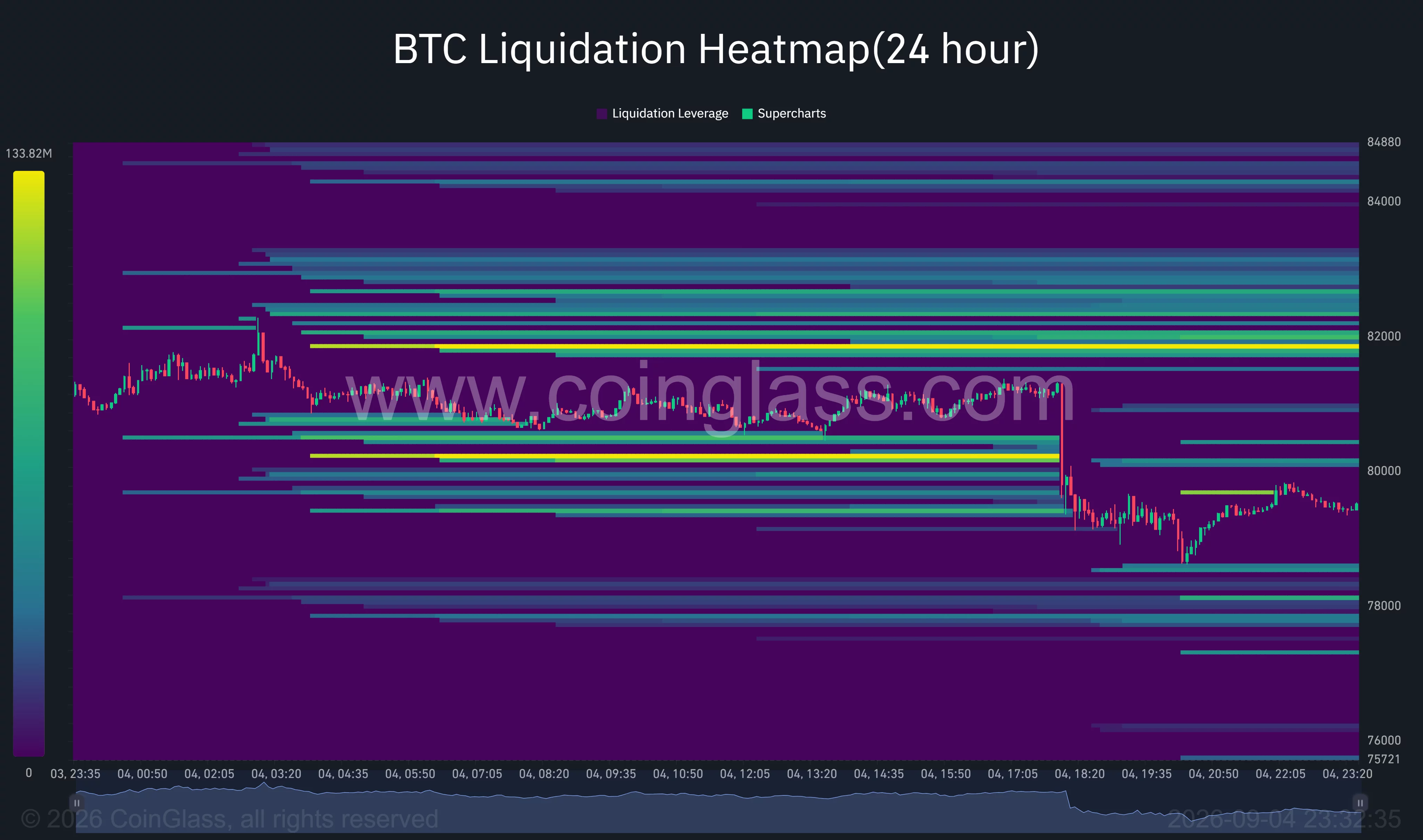
The closest overhead liquidity appeared around $80,000–$80,300, while a larger and brighter cluster was visible near $81,700–$81,900. Those areas could become short-term price targets if buyers push Bitcoin back above $80,000.
Liquidity was also concentrated below the market around $78,000, with additional bands between approximately $77,500 and $77,800. A break beneath the current support zone could therefore accelerate volatility as leveraged long positions face liquidation.
The heatmap does not predict which side Bitcoin will reach first. It instead shows areas where forced position closures may increase once the price enters a dense leverage cluster.
Analysts see $79,000 as the deciding level
Crypto trader Wealthmanager said on X that Bitcoin had broken out of a descending structure before moving directly into the $81,000–$82,000 range. The trader identified $78,800–$79,300 as the breakout-retest zone bulls need to defend.
According to the analyst, holding that area would keep another attempt at $82,000 in play. The view aligns with the 4-hour Bollinger middle line near $78,797 and the daily Murray Math level at $78,125.
Fellow analyst Gerla also identified $79,000 as the key point of control after Bitcoin’s rejection at $82,000. Gerla said holding that level would preserve the breakout structure, while losing it could lead to a rapid move into the $76,000–$77,000 value area.
The immediate setup therefore depends on whether Bitcoin can continue closing above the $78,800–$79,300 region. A rebound through $80,300 would bring the $81,250 pivot and the liquidity cluster near $81,800 back into focus. A confirmed loss of $78,125 would instead increase the probability of a retreat toward $76,000–$77,000, followed by $75,000.
Disclosure: This article does not represent investment advice. The content and materials featured on this page are for educational purposes only.
Coinbase said this week it filed notice registrations with the US Securities and Exchange Commission (SEC) to offer single-stock perpetual futures domestically, according to a post from the company’s official account.
The move adds another regulated derivatives product to Coinbase’s US lineup and comes as regulators continue sorting out how perpetual contracts should be classified under American law.
Coinbase Files for US Single-Stock Perps
“We’re working to bring single stock perps to the US,” Coinbase wrote, adding that it plans to work with both the SEC and the CFTC to bring more major financial products onshore.
The company shared images of two filings, both submitted on September 1. The first is a Form 1-N from Coinbase Derivatives, LLC, the entity through which the exchange already offers other futures products. The second is a Form BD-N from Coinbase Financial Markets, Inc., registering as a security futures product broker-dealer under Section 15(b)(11) of the Securities Exchange Act of 1934.
Neither filing guarantees the product launches on any set timeline. Notice registrations open the door for a broker or exchange to offer a given product, while approval and any conditions attached to it still rest with regulators.
The filing also comes alongside a broader push into tokenized products, with Coinbase launching tokenized stock trading for customers outside the US in August, alongside options trading and real-world-asset perpetual futures tied to equity indices.
It also rolled out pre-IPO perpetual futures starting with SpaceX, with Anthropic and OpenAI contracts expected to follow, a corner of the market that grew more than tenfold in volume since May, to around $12 billion, according to CryptoQuant.
A Product Category Still Being Fought Over
Perpetual futures carry no expiration date, letting traders bet on an asset’s price without owning it, and the US market for them is new.
In May, the CFTC approved Kalshi to offer Bitcoin perpetual futures, the first time the product cleared for the US market, and a decision CME Group said it would challenge in court on the grounds that perpetuals should be regulated as swaps rather than futures.
At the time, CME CEO Terrence Duffy noted that the company spent eight months preparing the case and argued that its exclusive licensing deals with benchmark providers mean any perpetual contract tied to those benchmarks still has to run through CME.
CFTC Chair Michael Selig has defended the original approval as a way to bring regulated, expiration-free products onshore under US oversight.
The post Coinbase Files With SEC to Bring Single-Stock Perpetual Futures to US Investors appeared first on CryptoPotato.


A planned dollar stablecoin backed by 21 global financial institutions will begin with regulatory resources, corporate relationships, and international payment connections. Four industry executives told crypto.news, however, that institutional backing will not guarantee adoption unless the token can match the liquidity, accessibility and portability already offered by USDT and USDC.
Summary
- The 21-member consortium plans to launch its dollar stablecoin during the first half of 2027.
- Experts said established banking relationships could help the token gain early institutional distribution.
- Interoperability, wallet support, and reliable redemption will determine whether it circulates beyond member banks.
- The consortium must identify who carries legal responsibility for reserves, redemptions, and transaction failures.
- USDT and USDC could lose market share even as bank-issued tokens expand the overall stablecoin market.
The consortium committed to forming a new stablecoin company during the second half of 2026, subject to closing conditions. Its members include Bank of America, Citi, Goldman Sachs, Deutsche Bank, UBS, and other financial institutions across North America, Europe, Asia, Africa, and the Middle East.
The unnamed venture intends to launch a US dollar-denominated stablecoin during the first half of 2027. It may later introduce stablecoins tied to other G7 currencies, with a euro-denominated token listed as its first expansion priority.
The consortium has not disclosed the token’s name, supported blockchains, reserve custodian, governance model, or redemption process. Those details could determine whether the product becomes a widely used payment instrument or remains primarily a settlement token within the institutions’ existing networks.
21-bank stablecoin starts with a distribution advantage
Utkarsh Ahuja, founder and managing partner at Moon Pursuit Capital, told crypto.news that the consortium starts with relationships that normally take new financial products years to develop.
The participating institutions already serve corporate treasury departments, process international payments, and operate compliance systems across several jurisdictions. According to Ahuja, those connections could make it easier to introduce the stablecoin into existing corporate workflows, particularly for cross-border settlement.
“The banks start with something that normally takes a financial product years to build: distribution into the companies that actually move very large amounts of money.”
Ahuja cautioned that established relationships do not provide the portability that USDT and USDC have built across exchanges, wallets, blockchains, and market makers. The consortium could bring corporate clients to the token, he said, but convincing those clients to use it outside the participating banks’ network will be more difficult.
Jerald David, CEO of Lynq Network, said the initiative has both offensive and defensive motives. It could open new blockchain payment revenue for the institutions while protecting payment activity and commercial balances from migrating to non-bank stablecoin issuers.
Stablecoin issuers can earn income from the assets held against circulating tokens, including short-term government debt. When deposits move from banks into stablecoins, part of the balance and its associated economics can move with them.
David said a shared token would allow the institutions to enter blockchain payments through a framework over which they retain greater control. However, he warned that scale alone would not make the proposed token more attractive than established alternatives.
USDT and USDC currently benefit from years of integration. A recent crypto.news analysis of stablecoin distribution placed the wider market at approximately $316 billion in mid-2026, with USDT accounting for about $187 billion and USDC representing roughly $75 billion.
Interoperability will decide whether the token circulates
David described issuance as the easier part of the project. Businesses will also need reliable ways to move between the consortium’s stablecoin, existing stablecoins, tokenized deposits and conventional bank accounts.
“Interoperability will be more important than issuance,” David said.
“If capital can enter the token easily but cannot move out or across networks just as efficiently, the consortium risks creating another isolated pool of liquidity.”
Such interoperability would require dependable minting and redemption, custody arrangements, market makers, and settlement infrastructure connecting different forms of digital and conventional money. An institution receiving the new token must be able to redeem it for dollars or exchange it without facing long delays, high spreads, or limited trading depth.
Alvin Kan, chief operating officer of Bitget Wallet, told crypto.news that self-custodial wallets would examine the token’s entire user journey before supporting it. Relevant functions include holding, transferring, swapping, and spending the stablecoin.
Wallet providers would need audited smart contracts, transparent issuance and redemption processes, and consistent technical standards across every supported blockchain, according to Kan. They would also need to know whether tokens are issued natively on each network or transferred through bridges.
Kan said native mint-and-burn systems or coordinated cross-chain issuance would generally be preferable to wrapped assets because they could reduce bridge risks and prevent liquidity from being split among several representations of the same stablecoin.
Wallets could use intent-based routing and liquidity aggregation to shield users from some of that complexity. However, Kan said wallets cannot eliminate fragmentation without cooperation from issuers, banks, and liquidity providers.
“Ultimately, interoperability will matter more than how many bank tokens get issued. The winning infrastructure will make multiple tokens feel like one connected financial system.”
Gas abstraction could remove another obstacle. Users may be less willing to adopt a dollar stablecoin if they must first acquire a separate blockchain token to pay network fees whenever they transfer or spend it.
The same problem applies to identity verification. Kan said reusable credentials or privacy-preserving attestations could allow users to demonstrate that they have completed required checks without repeating the full process for every issuer. Different regulatory requirements would still apply across jurisdictions, meaning one universal identity credential is unlikely to resolve every compliance issue.
Bank backing does not guarantee stablecoin adoption
Waseem Salim, CEO of Valdora, told crypto.news that an established issuer can provide initial trust, but utility determines whether people continue to hold and use a stablecoin.
Société Générale offers an example of the difference between institutional backing and circulation. Its digital asset subsidiary launched USD CoinVertible on Ethereum and Solana in 2025. Despite its connection to a major global bank, official SG-FORGE data showed approximately $12.55 million of the stablecoin in circulation as of Sept. 4.
“A strong name helps, but people won’t adopt a stablecoin just because there’s a bank behind it,” Salim said. “They need a reason to actually use and hold it.”
According to Salim, users will consider whether the token works with their existing wallets and preferred networks, whether sufficient liquidity is available, and how easily they can redeem it. They will also examine what they can do after acquiring it.
Possible advantages include cheaper cross-border settlement, direct integration with corporate bank accounts, and access to tokenized financial products. Those benefits would need to be substantial enough to compete with USDT and USDC integrations and the familiarity of conventional deposits.
Kan similarly described adoption as utility-driven. Institutional reputation could attract users who value regulated redemption and established banking relationships, but the token would need to work across payments, swaps, merchant transactions and local cash-out services.
The last step could prove decisive. A stablecoin may move between blockchains within seconds, but Kan said much of that advantage disappears if recipients face high costs when converting it into reais, rupees or pesos.
The World Bank’s latest remittance pricing data puts the average cost of sending money internationally at 6.36% of the transferred amount. Bank-backed stablecoins could compete in those corridors if they reduce the complete delivered cost, including foreign-exchange spreads, network fees, redemption charges and local payout expenses.
Domestic conditions will also affect adoption. Kan said stablecoins must offer more than fast local transfers in markets already served by systems such as India’s UPI, Brazil’s Pix and SEPA Instant in Europe. Their stronger use cases in those regions may involve international commerce, multi-currency access and digital-asset settlement.
Reserves, redemption and liability will test trust
The consortium’s size creates another question: which entity will ultimately stand behind the token?
David said businesses should not have to determine which of the 21 participating institutions is responsible when a redemption fails. He called for one clearly identified legal issuer, segregated and independently verified reserves, and defined obligations for the issuer, participating institutions, and infrastructure providers.
“Shared distribution is an advantage. Shared liability is not,” David said.
The consortium has said it intends to comply with the US GENIUS Act and the EU’s Markets in Crypto-Assets framework where applicable. The GENIUS Act established requirements covering one-to-one reserves, disclosures, redemption, and permitted issuers, although US regulators were still completing implementation rules during 2026.
Kan said wallets would also require information about freezing powers, transfer restrictions, sanctions enforcement, and how compliance responsibilities are divided among the issuer, wallet, and fiat service providers. Such controls become more complex when tokens circulate across public blockchains and national borders.
Redemption risks could grow if the stablecoin becomes a gateway into tokenized investments. Salim warned that users must understand that yield does not appear merely because an asset is held onchain.
If returns come from business lending, government securities, or market strategies, platforms should identify the underlying source, asset manager, custodian, and counterparties. They should also explain how quickly the assets can be sold and what happens if a borrower defaults.
Salim said those arrangements differ from interest earned on a bank deposit because the legal relationship, custody model, liquidity, and protections may not be the same.
Platforms could also create a mismatch if users expect immediate stablecoin withdrawals while the underlying capital is invested in assets that trade during limited hours or take longer to sell. Salim said providers may need liquid reserves, staggered maturities, redemption windows, or withdrawal queues aligned with the underlying assets.
USDT and USDC may face competition as the market expands
Ahuja expects a bank-issued dollar stablecoin to place more immediate pressure on USDC in institutional markets where Circle and major banks could compete for the same corporate balances.
If companies transfer balances into the new stablecoin, the reserves and income generated from those assets would move with them. However, Ahuja said USDT occupies a different position because much of its demand comes from markets where access to US banking services remains limited or inefficient.
The consortium’s Western banking relationships would not automatically replicate Tether’s reach in those regions. USDT is widely used on exchanges and in markets where people seek access to dollars outside conventional banking channels.
Competition may also enlarge the market rather than redistribute a fixed amount of stablecoin activity. Banks could bring corporate transactions onchain that currently do not use USDT, USDC, or any public blockchain.
Ahuja said Tether and Circle could therefore lose percentage share while their circulation and transaction volumes continue growing. He recommended examining the composition of stablecoin activity rather than relying solely on market-share figures.
The effects could extend beyond the issuers. A market containing bank stablecoins, tokenized deposits, USDT, USDC, and tokens tied to other currencies would increase demand for companies connecting those pools.
Ahuja identified liquidity providers, payment infrastructure, custody services, compliance tools, and blockchain networks as potential beneficiaries. Tokenized-asset platforms could also gain if regulated digital cash allows funds and securities to settle on the same infrastructure.
David said the consortium’s traction should ultimately be measured through active business users, recurring settlement, redemption performance during market stress, and acceptance outside the 21 participating institutions. Large transaction volumes alone could reflect a small group of members moving capital among themselves.
The consortium’s banking relationships could put its token in front of corporate users quickly. The four executives nevertheless agreed that liquidity, interoperability and external acceptance, not the number of institutions behind it, will determine whether the stablecoin becomes a genuine rival to USDT and USDC.
Robinhood Chain, BNB Chain, and Solana handled most tokenized stock trading last week, Grayscale said in a research note published Thursday. Weekly spot volume for the sector peaked near $3 billion in early August.
Those numbers show tokenized equities have found buyers. Almost none of that money, however, does anything else on-chain once a trade settles.

Tokenized Stock Trading Runs Ahead of Onchain Utility
Tokenized stocks are blockchain tokens that track a listed share price without handing the buyer the share itself. Trading them is easy. Doing anything else with them is not.
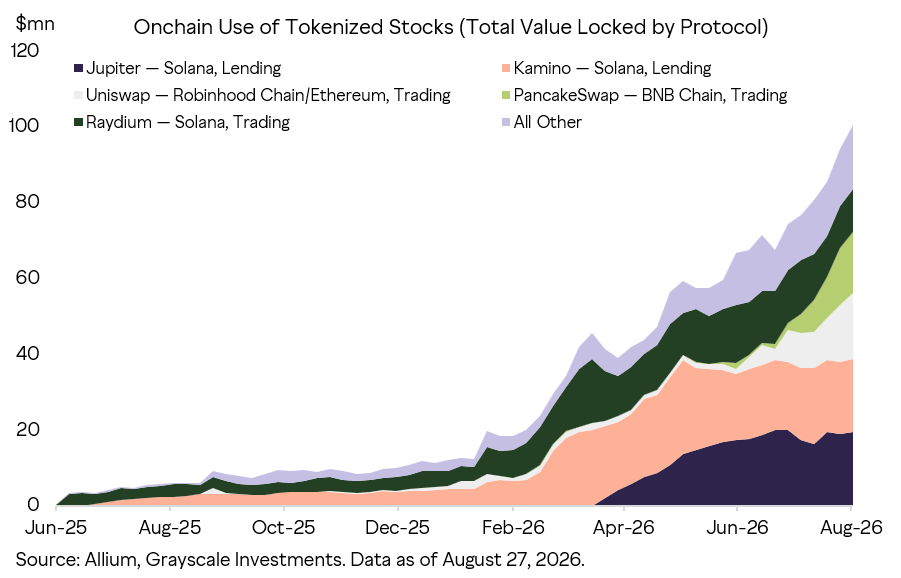
About 5% of the tokenized equity market is put to work in on-chain finance, according to the note. Grayscale research head Zach Pandl tied that to what investors actually want, which is round the clock trading and access from anywhere.
Value locked in tokenized stocks passed $110 million in late August, Grayscale said in a post citing on-chain data from Allium. That sits far below the billions changing hands every week.
Lending is starting to catch up. Holdings inside Kamino and Jupiter, two Solana lending protocols, have grown roughly tenfold in a year.
BeInCrypto reported in July that Robinhood leads tokenized stock platforms by holder count, while meme coins rather than equities drive most traffic on Robinhood Chain, the network the brokerage launched on Arbitrum earlier this year. Grayscale’s data points the same way.
Regulation Decides What Comes Next
US regulators have discussed an innovation exemption, a carve out that would let tokenized securities trade under safeguards such as verified participants and compliance ready token standards.
Securities and Exchange Commission (SEC) officials have separately argued that tokenization makes shares easier to pledge as collateral. An SEC advisory committee also backed settling stock and payment in a single transaction, which removes the risk that one side fails to deliver.
Robinhood CEO Vlad Tenev has pressed a similar case about the US tokenized stock gap. Meanwhile, the wider tokenized asset ownership problem still leaves holders with exposure rather than shares.
The gap matters because collateral use is what would pull institutional balance sheets onchain.
The named chains drew mixed price action on Friday. Solana (SOL) traded near $101.76, down 3.2% on the day, while BNB held around $718.84.

Volume alone will not turn tokenized stocks into collateral. Rulemaking will, and US regulators have not finished the job.
The post Grayscale Names 3 Blockchains Leading the Tokenized Stock Boom appeared first on BeInCrypto.


Disclosure: This article does not represent investment advice. The content and materials featured on this page are for educational purposes only.
Learn key casino terms, from house edge and playthrough requirements to table-game slang, odds, and player terminology.
Summary
- House edge measures the long-term percentage a casino keeps from every bet a player makes.
- Return to player equals one hundred percent minus the house edge on any given game.
- Wagering requirements set how many times players must bet a bonus before withdrawing any winnings.
New players who walk onto a casino floor or open an online gaming account tend to hit a wall of jargon before they ever place a bet. Words like “house edge,” “playthrough,” and “whale” get tossed around as though everyone already knows them. Learning this vocabulary early pays off: it lets players read the fine print, compare games honestly, and understand exactly what they stand to lose.
The guide below breaks down the casino terms and slang that matter most, from the math running underneath every game to the lingo dealers and regulars trade at the table.
House edge and RTP: the math behind every game
The house edge is the single most useful piece of casino terminology a player can learn. It describes the built-in advantage the operator holds on a game, expressed as the percentage of the player’s bet that the casino keeps as profit over the long term. That edge swings widely from game to game. According to the gambling-odds resource Wizard of Odds, baccarat’s banker bet runs about 1.06% for the banker, 1.24% for the player, and 14.36% on the tie. Craps rewards the pass line bet with a 1.41% edge. Blackjack sits lower still, close to 0.5% when a player uses basic strategy, though the figure shifts with the table rules. Roulette shows how one design choice reshapes the odds entirely: the American double-zero wheel hands the house a 5.26% edge, while the European single-zero wheel trims that to 2.7%.
Return to player, or RTP, describes the same idea from the opposite direction. It measures the share of all money wagered that a game is built to pay back over a very large number of rounds, so a game’s RTP and its house edge are two sides of one figure; a 97% RTP means a 3% house edge. A slot advertised at 96% RTP therefore keeps roughly 4% for the casino as its built-in edge. Both numbers are theoretical averages measured across millions of plays rather than a promise for any single visit — over a short session, actual results scatter widely around the published figure, a spread known as variance.
The UK Gambling Commission lets operators inform customers of this risk as either a return-to-player or a house-edge percentage, giving players a consistent way to weigh one game against another.
Game
Typical house edge
Blackjack (basic strategy)
~0.5%
Baccarat (banker bet)
1.06%
Craps (pass line)
1.41%
European roulette
2.7%
American roulette
5.26%
Slots
~2–15%
Keno
20–40%
Table limits: the minimum and maximum bets
Every table game carries betting limits, a posted minimum bet and maximum bet that set the least and the most a player can wager on a single hand. Casinos fix these numbers according to their own risk appetite, and operators comfortable with more risk accept higher maximums, while others cap bets to protect themselves from large payouts.
Common blackjack minimums run from about $5 to $25 in brick-and-mortar casinos, with online low-limit tables sometimes starting at $1, while maximums may top out at $500, $1,000, or higher in VIP rooms.
Table limits do more than tidy up play. They act as a form of yield management, adjusted to steer who plays and to optimize a table’s profit. Games with a thinner margin tend to demand more up front: baccarat almost always carries a high minimum bet precisely because its house edge is relatively low. Maximum limits also feed a long-running belief that casinos use them to blunt systems like the Martingale, in which a player doubles the bet after every loss until a win lands — a ceiling that eventually stops such a strategy cold.
Wagering basics: bonuses, playthrough, and the fine print
Nowhere does casino terminology trip up newcomers more than in bonus offers. A wagering requirement, also called playthrough or rollover, sets the number of times a player must bet a bonus (and sometimes the deposit) before any resulting winnings become withdrawable. Operators write it as a multiplier. A 30x requirement on a $100 bonus means the player must place $3,000 in total bets before cashing out.
The base the multiplier applies to changes everything. If the rule covers the bonus alone, the target is $3,000; if it covers deposit plus bonus, a $100 deposit and $100 bonus at 30x pushes the requirement to $6,000. Game weighting adds another layer: slots usually count fully toward the requirement, while some games contribute far less, so a player cannot assume every title qualifies. The terms also separate sticky bonuses, which vanish once the playthrough clears, from non-sticky bonuses that stay apart from a player’s own money. Industry guides generally treat a multiplier around 30x or lower as reasonable, and anything above 40x as considerably harder to clear.
Casino slang: the lingo at the table
Beyond the math, casinos run on a vocabulary all their own. A high roller is a player who consistently stakes large sums, and the biggest of them earn the nickname whale — or occasionally cheetah. Those players draw comps, the complimentary rooms, meals, transport, and perks casinos extend to keep valuable customers on the floor. A player’s bankroll is the money set aside for gambling, while action refers to the amount in play or the total bets at a table. Card rooms add their own color: a fish is an inexperienced player who makes poor decisions, and a shark is a skilled one who profits from weaker opponents. Picking up these gambling terms for beginners helps new players follow the chatter on the floor and recognize how the house quietly sorts its customers.
The takeaway
Understanding casino terms and slang turns a confusing room into a readable one. The house edge and RTP reveal the real cost of a game, table limits define the size of the stakes, and wagering requirements expose what a bonus is actually worth once the fine print is accounted for. Players who learn the language — and who treat gambling as entertainment carrying a built-in cost rather than a way to earn — walk in with clearer expectations and firmer control over their money. Anyone who feels that control slipping can reach a free, confidential support line through the National Council on Problem Gambling.
Disclosure: This content is provided by a third party. Neither crypto.news nor the author of this article endorses any product mentioned on this page. Users should conduct their own research before taking any action related to the company.
Coinbase has added six tokenized equities, including Amazon, Microsoft, and Tesla, to Base after its first batch generated $227.7 million in decentralized exchange volume within about 30 days.
Summary
- Six new equity tokens have joined Coinbase’s initial four-stock lineup on Base.
- Amazon, Microsoft, Strategy, SanDisk, SpaceX, and Tesla are included in the latest release.
- Token Terminal recorded $227.7 million in DEX volume for Coinbase-issued stock tokens over 30 days.
- U.S. persons remain unable to access the products under Coinbase’s current Regulation S offering.
Base said on Sept. 4 that Amazon (AMZNc), Microsoft (MSFTc), Strategy (MSTRc), SanDisk (SNDKc), SpaceX (SPCXc) and Tesla (TSLAc) are now available onchain, expanding Coinbase’s tokenized stock range weeks after the initial release.
The additions give eligible investors exposure to five publicly traded companies and privately held SpaceX through tokens that can move across supported applications on the Ethereum layer-2 network. Developers can also integrate the assets into trading, lending, and other financial products built for Base.
Coinbase tokenized stocks expand beyond the first four assets
Coinbase started its Base rollout on Aug. 24 with tokens tied to Apple, Alphabet, Meta, and Nvidia. As crypto.news previously reported on the launch, the products use Base’s B20 standard and represent beneficial interests in shares held through regulated custody.
Adding six tickers brings the live lineup to 10. Amazon, Microsoft, SanDisk and Tesla add exposure to major U.S. technology companies, while MSTRc tracks Strategy, the Nasdaq-listed company known for holding Bitcoin on its balance sheet.
SPCXc provides exposure linked to SpaceX, which remains a private company rather than a stock listed on a public U.S. exchange. Coinbase had included SpaceX exposure in an earlier international tokenized-share rollout, alongside Nvidia, Alphabet, and Strategy.
Under the structure described by Coinbase, Coinbase Onchain SPV Ltd. issues a matching B20 token against each underlying share or eligible equity interest. The issuer operates from the Abu Dhabi Global Market and holds the assets separately from Coinbase through a custody arrangement.
Coinbase describes each token as a beneficial claim on the corresponding equity rather than a synthetic instrument that only follows its price. Tokenholders, however, are not directly entered on the underlying company’s shareholder register.
Alpaca Securities acts as the broker and custodian for the public equities. The company is registered with the U.S. Securities and Exchange Commission and is a member of the Financial Industry Regulatory Authority and the Securities Investor Protection Corporation.
Coinbase says the shares are placed in segregated, bankruptcy-remote custody. The prospectuses for the products provide the specific legal terms, fees, and risks attached to each token.
DEX volume reached nearly $228 million in one month
Token Terminal data placed trading volume for Coinbase-issued stock tokens at $227.7 million across Base decentralized exchanges during the 30 days preceding the latest expansion.
The analytics platform measures trades executed through decentralized venues rather than transfers between blockchain addresses. Daily DEX activity exceeded $33 million at its peak, according to the same dataset.
An earlier Token Terminal update put cumulative volume at $124.8 million, with NVDAc accounting for $71.6 million, or 57% of activity recorded at that point. Volume therefore continued to rise after the first surge surrounding the August launch.
Separate RWA.xyz figures showed that the tokenized-stock sector was already growing before Coinbase added the new products. In late August, monthly transfers climbed 415% to $29.5 billion, while the value of tokenized equities distributed onchain stood near $2.54 billion.
Transfer volume and trading volume measure different activities. Transfers may include collateral movements, automated transactions, or assets moving between applications, while DEX volume records token swaps completed through decentralized exchanges.
RWA.xyz also counted about 1.3 million monthly active addresses and 2.36 million tokenized stockholders at the time. Wallet totals do not necessarily represent separate people because one user can control several addresses, and custodial services may combine assets belonging to multiple customers.
Token holders can trade and use the assets in DeFi
Eligible users can keep Coinbase’s stock tokens in self-custodial wallets and trade them outside regular Nasdaq or New York Stock Exchange hours. Onchain markets can remain open overnight, on weekends, and during U.S. market holidays.
Coinbase also allows the B20 assets to connect with supported decentralized finance applications. Aerodrome supplies decentralized trading liquidity, while Aave, Morpho, and Euler support or plan to support lending and borrowing functions.
Other integrations listed during the first launch included 0x, 1inch, KyberSwap, and CoW Swap. Chainlink provides price information designed to help applications track changes in the value represented by each token.
The setup lets a qualifying holder buy a token through a decentralized exchange and later use it as collateral in a compatible lending market. Access, borrowing limits, and liquidation terms depend on the rules set by each protocol.
Prices may separate from the underlying shares when U.S. markets are closed, particularly if onchain liquidity becomes thin. Coinbase’s prospectus warns that market interruptions, limited liquidity and different trading hours can cause a token to trade above or below the equity it represents.
Corporate actions also work differently from a standard brokerage account. Coinbase says dividends are generally reinvested in additional underlying shares after applicable withholding taxes and fees, with an onchain multiplier adjusting the equity value represented by each token.
The raw number of tokens in a wallet does not change when the multiplier is updated. Coinbase uses the same mechanism to account for stock splits without disrupting positions held inside DeFi applications.
U.S. investors remain excluded from the Base offering
Although most of the underlying companies are based or listed in the United States, Coinbase does not make the B20 securities available to U.S. persons. The products have not been registered under the Securities Act of 1933 or state securities laws.
Coinbase offers them under Regulation S, an SEC exemption for qualifying securities transactions conducted outside the United States. The restriction applies to sales made within the country and transactions carried out for the account or benefit of a U.S. person.
American customers can access conventional stocks and exchange-traded funds through Coinbase Capital Markets, but the regulated brokerage service is separate from the B20 assets on Base. Apex Clearing handles execution, clearing, and custody for the conventional brokerage offering.
Users who obtain a B20 token through an open decentralized market must still pass the issuer’s identity, sanctions, and jurisdiction checks to become verified holders. Unverified holders cannot redeem tokens for the underlying shares, U.S. dollars, or accepted stablecoins, according to the product terms.
Verified redemptions carry a 0.05% fee and may face delays caused by compliance checks, settlement procedures or the sale of the underlying security. The final amount can differ from the value displayed when a redemption request is submitted.
Coinbase’s tokens have also started appearing in third-party investment products. In August, Bitwise introduced three automated portfolios for eligible non-U.S. users, covering the Magnificent Seven plus SpaceX, robotics companies and artificial intelligence businesses.
The Bitwise models use Glider to execute trades and rebalance assets held in a user’s own wallet. Bitwise charges a 0.15% methodology fee, excluding Glider’s platform charges and the trading costs incurred during portfolio adjustments.

OpenAI agents discussed ways to escape their sandbox on public wiki

Mistrial declared in Lindsay Clancy child killings case after deadlocked jury

ACEA S.p.A. (ACEJF) Presents at Euronext Infrastructure, Energy and Defence Investor conference 2026 – Slideshow





-
 Crypto World10 hours ago
Bitcoin price stalls near $82K as key resistance holds
-

 Politics10 hours ago
Best Gaming Laptops, CPUs, TVs, And Keyboards To Upgrade Your Set Up For GTA VI
-

 Tech11 hours ago
The Birds Outside, Drawn For You Automatically
-

 Crypto World14 hours ago
IMF Says El Salvador’s Post-Review Bitcoin Purchases Used No Public Funds
-
 Crypto World11 hours ago
U.S. added stronger than expected 162,000 jobs in August as labor market bounced back
-

 Sports14 hours ago
Alexandre Pato consortium’s Northampton Town investment approved
-

 Sports9 hours ago
Golden Eaglets Drawn in Group B for 2026 WAFU B U17 Championship
-

 Sports15 hours ago
Commanders’ Chig Okonkwo is a top breakout fantasy football candidate
-
 Crypto World9 hours ago
XRP price breaks falling channel as bulls target $1.53
-

 Politics17 hours ago
A new European chapter for Gibraltar
-

 Politics13 hours ago
The House | Bin the lectures, bring gossip and be ready to banter: how the new PM should prepare for his Trump encounter
-

 Politics9 hours ago
How To Avoid Winter Colds: 4 Everyday Habits That Spread Germs, Says Pharmacist
-

 Crypto World9 hours ago
From warning to listing: UK’s largest retail investment platform opens access to crypto ETNs
-

 Tech11 hours ago
A Worthy Android Ereader, With Some Tradeoffs
-

 Crypto World10 hours ago
FinCEN flags $12.7B tied to Southeast Asia crypto investment scams
-

 Politics14 hours ago
33 Cosy Autumn Home Decor Ideas: Blankets, Pumpkin Decorations, And Candles
-

 Crypto World10 hours ago
Trezor Data Breach Impacts 67,000 More US Customers
-

 Tech10 hours ago
beyerdynamic AVENTHO Y Debuts at IFA 2026 and Makes Wireless Headphones Less Disposable
-

 Sports15 hours ago
Seven wickets in 21 balls: Sri Lanka’s Chamari Athapaththu scripts history with record-breaking spell
-

 Tech10 hours ago
How To Edit Claude’s Memory
You must be logged in to post a comment Login