

Crypto World
Visa and Stripe-Owned Bridge Roll Out Stablecoin-Linked Cards to 100+ Countries



The program allows fintech firms and wallet providers to offer cards that let users spend stablecoin balances at any of Visa’s 175 million merchants worldwide.
Visa and Bridge, the stablecoin infrastructure platform now owned by Stripe, announced a major expansion of their collaboration that will bring stablecoin-linked Visa cards to more than 100 countries across Europe, Asia Pacific, Africa and the Middle East by the end of 2026, according to an announcement posted on the Visa website today.
The program, which is already live in 18 countries, allows fintech firms and wallet providers to offer cards that let users spend stablecoin balances at any of Visa’s 175 million merchant locations worldwide, the announcement said.
Onchain Settlement
Under the expanded partnership, Bridge’s stablecoin-funded cards will leverage Visa’s payments network while settlement can occur on-chain through a pilot involving Lead Bank, a participating issuer in Visa’s stablecoin settlement initiative. Lead Bank settles Visa’s stablecoin transactions on the Solana blockchain as part of Visa’s stablecoin settlement pilot.
The pilot is evaluating whether settling card transactions with stablecoins can increase operational efficiency, improve reconciliation and give issuers more flexibility in how value moves across payment networks.
“Visa is committed to meeting businesses where they operate, and increasingly, that’s onchain,” said Cuy Sheffield, Visa’s Head of Crypto.
Crypto Rails for Payments
Sheffield described the expanded Bridge collaboration as a step toward integrating blockchain-native currency settlement into the broader payments ecosystem while maintaining the convenience and ubiquity of Visa’s network.
Stripe’s acquisition of Bridge in 2025 underpins much of the technical infrastructure for the offering, enabling developers and fintech platforms to issue stablecoin-backed Visa cards through a single API.
Popular digital wallet providers such as Phantom and MetaMask are already using the solution, giving millions of users the ability to spend stablecoins for everyday purchases, the announcement said.
Custom Stablecoins
Bridge’s co-founder Zach Abrams said the expansion will help businesses launching custom stablecoins integrate them seamlessly into card programs, an approach he described as part of a multi-year effort to help firms “own their own financial stack.”
The announcement comes days after MoonPay and M0 launched PYUSDx, a platform designed to simplify the creation and management of application-specific stablecoins. PYUSDx leverages PYUSD, the stablecoin developed by PayPal and issued by Paxos Trust Company.
Industry analysts see the rollout as emblematic of how traditional payments firms and crypto infrastructure providers are increasingly working together. Stablecoin-linked cards have grown rapidly as a bridge between digital assets and real-world spending, offering a way for stablecoins to be used at scale without requiring direct merchant acceptance of blockchain payments.
Visa’s move also aligns with broader experimentation in the payments industry around stablecoins and blockchain settlement, as regulatory frameworks such as the GENIUS Act in the U.S. establish clearer rules for stablecoin issuance and use.

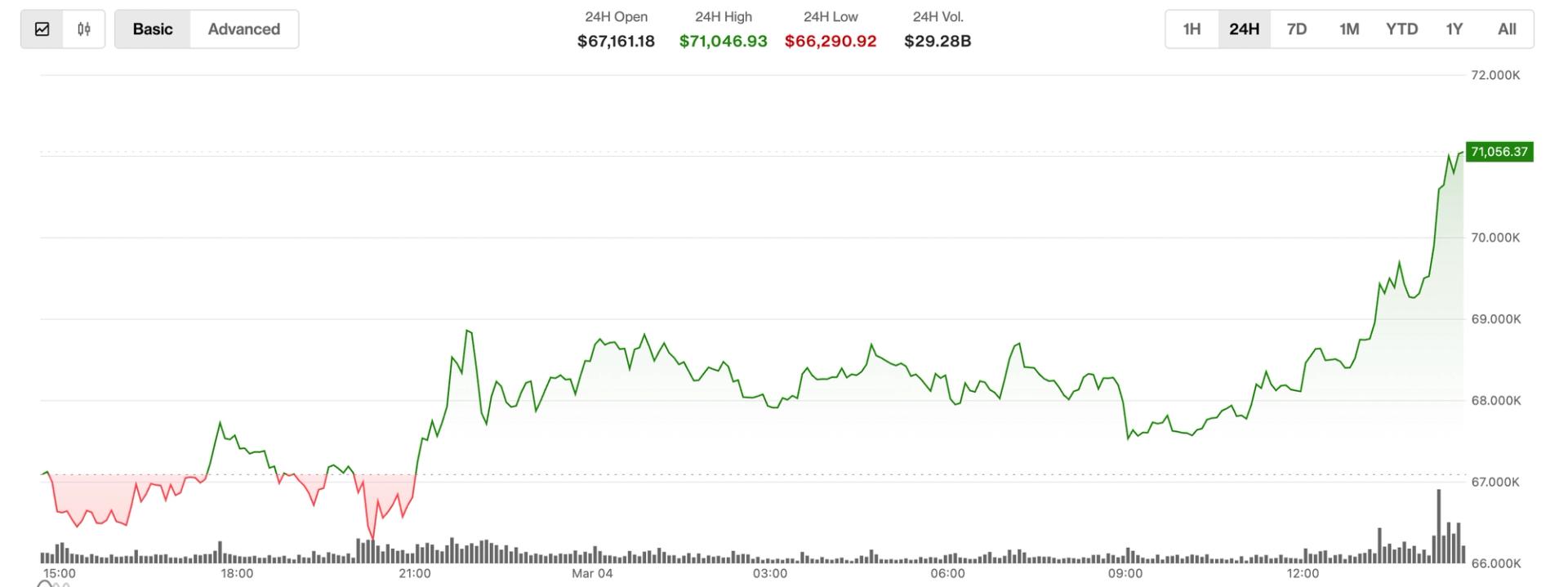
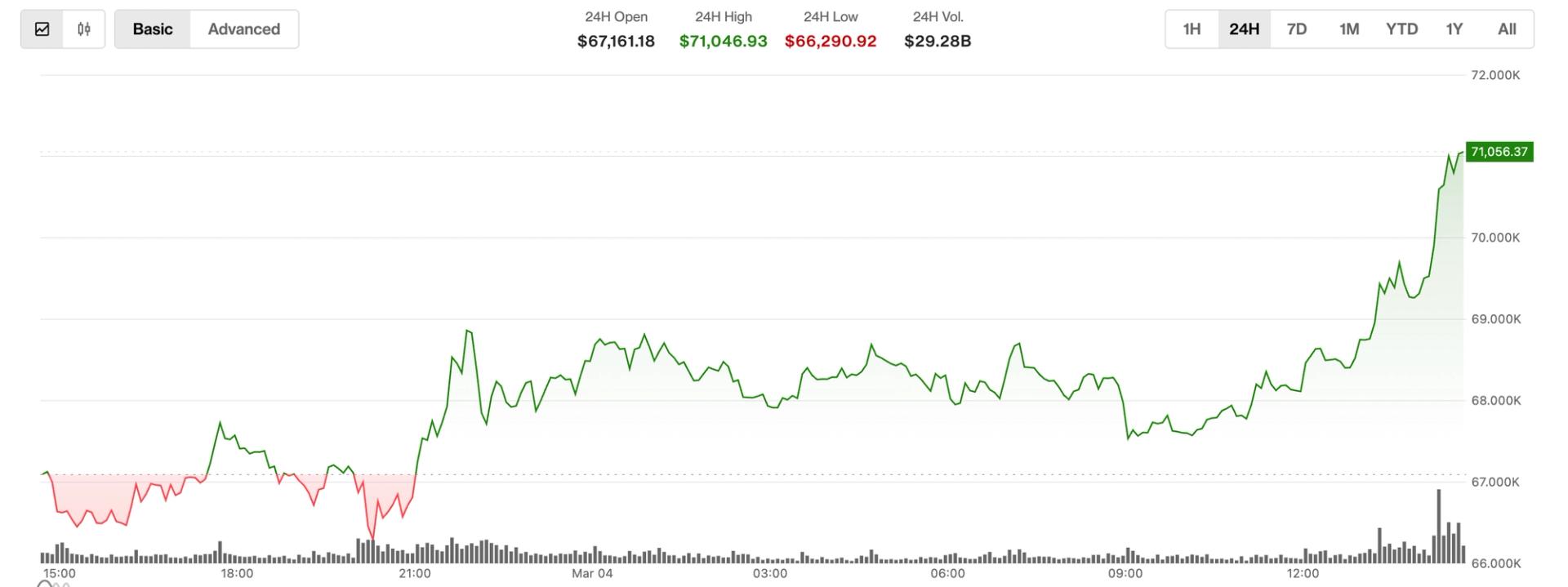
Bitcoin surged Wednesday, underscoring it’s growing resilience to turmoil in the Middle East, while gold, a traditional safe haven, lagged.
The leading cryptocurrency by market value rose to $71,023 during the European hours, up over 6% on a 24-hour basis, according to CoinDesk data. Other majors such as ether (ETH), XRP (XRP) and solana (SOL) followed bitcoin’s lead, rising 4% to 6%, respectively.
The CoinDesk 20 Index, a broader market gauge, rose over 5% to 2,025 points.
“Bitcoin may now exhibit some defensive characteristics during crisis periods, but gold’s retreat highlights that even classic safe-havens are not immune to market dynamics, positioning Bitcoin as a more flexible yet still high-beta alternative,” Tagus Capital said in its daily newsletter.
BTC’s latest move to multi‑week highs follows even as the crisis has intensified, with Iran blocking oil supplies through the Strait of Hormuz and raising the spectre of energy‑price inflation around the world. Since the conflict between Israel, the U.S., and Iran erupted on Saturday, bitcoin has proved surprisingly resilient, with the downside capped around $65,000.
Meanwhile, gold, a traditional safe haven, peaked above $5,400 per ounce on Monday and has since declined to $5,160. Asian equity indices, led by South Korea’s Kospi index, have bled heavily as oil imports cost rise.
American Bitcoin Corp. is not slowing down.
The company confirmed it just added 11,298 new ASIC miners, boosting capacity by 3.05 EH/s. That brings its total owned hash power to around 28 EH/s, a serious expansion at a time when network difficulty is already near record levels.
Led by Eric Trump, the firm is scaling hardware while holding more than 6,000 BTC in its treasury.
- American Bitcoin: Added 11,298 ASIC miners, boosting capacity by 3.05 EH/s.
- Operational Scale: Total owned fleet now stands at 89,242 machines creating 28.1 EH/s.
- Treasury Strategy: Retained a 6,000 BTC treasury despite market volatility and expansion costs.
American Bitcoin Scales 3 EH/s in Alberta
The acquisition targets immediate deployment at the company’s Drumheller, Alberta, site this month. These aren’t older models. The new units are rated at 13.5 joules per terahash (J/TH), a high-efficiency spec that directly impacts operating margins.
Once energized, American Bitcoin’s owned fleet will size up to 89,242 miners. That represents approximately 28.1 EH/s of total computing power. While other firms have been forced to liquidate holdings to fund operations, American Bitcoin is mirroring the strategy seen elsewhere in the market, where companies like BitMine are making treasury purchases rather than drawing them down.
According to the announcement, the company has held its 6,000 BTC treasury steady despite recent price volatility.
Mining Economics: Efficiency vs. Difficulty
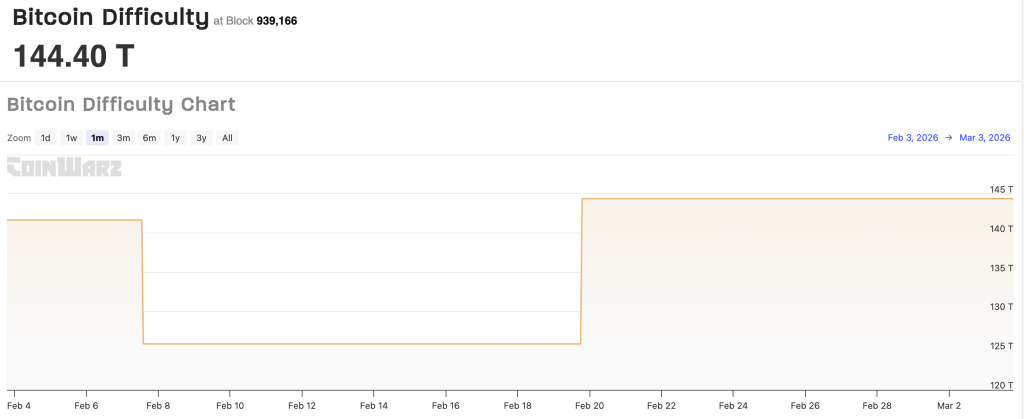
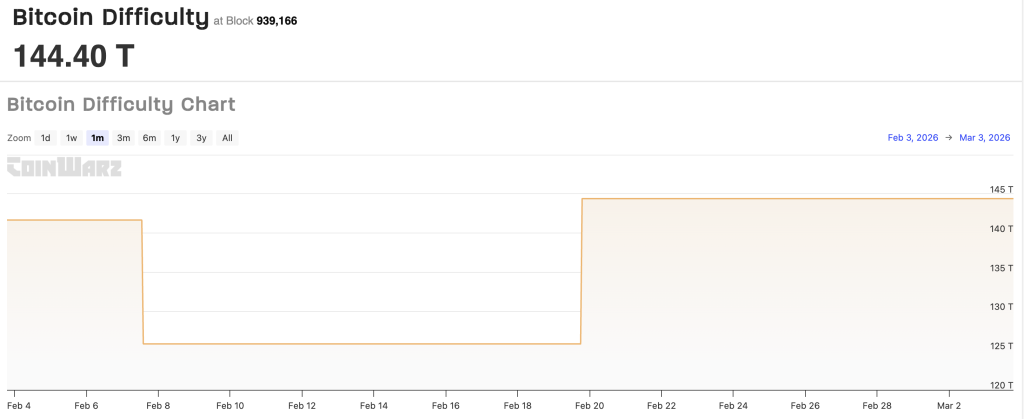
This push comes at a brutal time for miners. Network difficulty is sitting at 144.40 T, meaning 144.40 trillion hashes are needed to mine a single block. It has stayed elevated since mid-February, squeezing margins across the sector.
In this kind of environment, efficiency is survival. Hardware rated at 13.5 J/TH gives American Bitcoin a meaningful edge on power costs versus older rigs. The added 3.05 EH/s slightly boosts its odds of earning block rewards, but real profitability still hinges on where Bitcoin trades.
Macro conditions could offer a tailwind. Some analysts argue miner capitulation often marks cycle bottoms, and firms that expand during peak stress tend to benefit most on the rebound.
For now, shares traded mostly flat, moving in line with broader equity weakness.
The key variable is timing. If the additional 3 EH/s is fully deployed in Alberta before the next difficulty adjustment, the company effectively upgrades its fleet efficiency at a critical moment. In this margin environment, that sequencing is not a small detail.
Discover: The best new crypto in the world
The post Eric Trump’s American Bitcoin Company Adds 11,298 Mining Machines, Expands by 3 EH/s appeared first on Cryptonews.
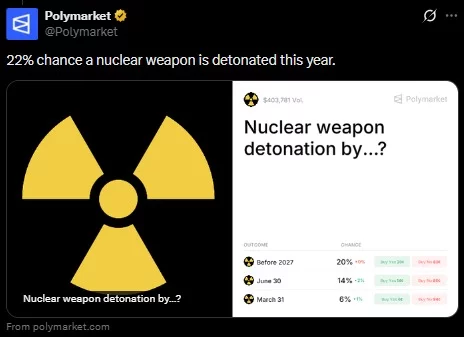
Offshore prediction market Polymarket has quietly archived a longstanding contract that allowed users to wager on the likelihood of a nuclear weapon detonation within specific timeframes, removing the market from its platform amid mounting public and political scrutiny.
Summary
- Polymarket archived its nuclear detonation contract shortly after promoting updated odds on X, without issuing a detailed public explanation.
- Concerns are mounting that insiders with access to military or policy decisions could exploit prediction markets, particularly following heavy betting activity around recent Iran-related military developments.
- U.S. senators are increasing scrutiny of so-called “death-linked” and war-related markets, pressuring regulators to examine platforms such as Polymarket and Kalshi.
Polymarket’s nuclear bet sparks outcry
The move came hours after the company posted updated odds on X suggesting a roughly 22 % probability of nuclear detonation by year-end, drawing intense criticism across social media and from market analysts.
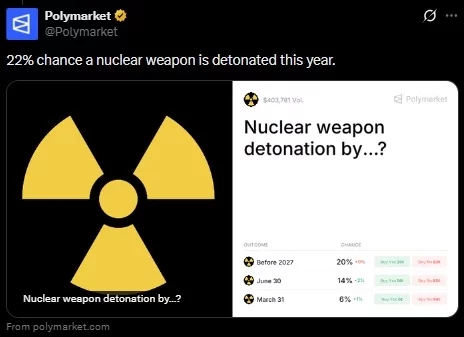
The nuclear detonation contract, which had been active for years and showed notable trading volumes, including more than $1.7 million in bets on a contract expiring in 2025, has disappeared from Polymarket’s listings without formal announcement.
The removal follows a broader surge in controversy surrounding Polymarket’s geopolitical markets, particularly those tied to the recent U.S. and Israeli military strikes on Iran.
During that crisis, more than $529 million in bets were placed on contracts related to the timing and outcomes of the attacks, dwarfing typical activity on the platform and fueling speculation about the ethical implications of wagering on war.
Analysts from blockchain surveillance firms flagged a series of newly created wallets that earned over $1 million by placing timely bets just hours before the strikes commenced, prompting accusations that insiders with advance information may be exploiting the unregulated markets.
Critics argue that prediction markets like Polymarket, which require only a crypto wallet and operate largely outside established financial regulations, create incentives for participants to profit from real-world conflicts and tragedies, raising both moral and legal questions.
The controversy has caught the attention of U.S. lawmakers, with several Senators urging regulatory action to curb markets tied to death, war, or high-stakes geopolitical events. Federal regulators, including the Commodity Futures Trading Commission, are advancing rulemaking aimed at clarifying how such platforms should be supervised.
Polymarket has not issued a public statement explaining the removal of the nuclear market or detailing wider changes to its listings. The platform’s response to criticism generally emphasizes the value of aggregated market insights, but the latest developments underscore intensifying pressure on prediction markets over ethics, transparency and potential insider exploitation.

Harvard, one of the world’s most prestigious Universities, just trimmed its Bitcoin ETF position by roughly $72M and rotated the capital into Ethereum.
SEC filings show the Univertisities $57Bn endowment cut its stake in BlackRock’s IBIT in Q4 2025, while initiating an $86.8M position in iShares Ethereum Trust (ETHA).
— That Martini Guy ₿ (@MartiniGuyYT) February 16, 2026
 CHECK THIS
Harvard just moved from Bitcoin to Ethereum
The prestigious US university sold about 21% of its Bitcoin ETF and used some of that cash to buy $87 million in an Ethereum ETF pic.twitter.com/3vf02zyGzH
This move plays into the growing sentiment in the market that ETH USD represents a stronger conviction play in 2026, driven by continued network upgrades and consistent institutional adoption from some of the world’s biggest firms.
It comes as the total crypto market cap climbed 2.6% overnight and is back above $2.4 trillion, with Bitcoin price and Ethereum USD reclaiming key levels at $69,000 and $2,000, respectively.
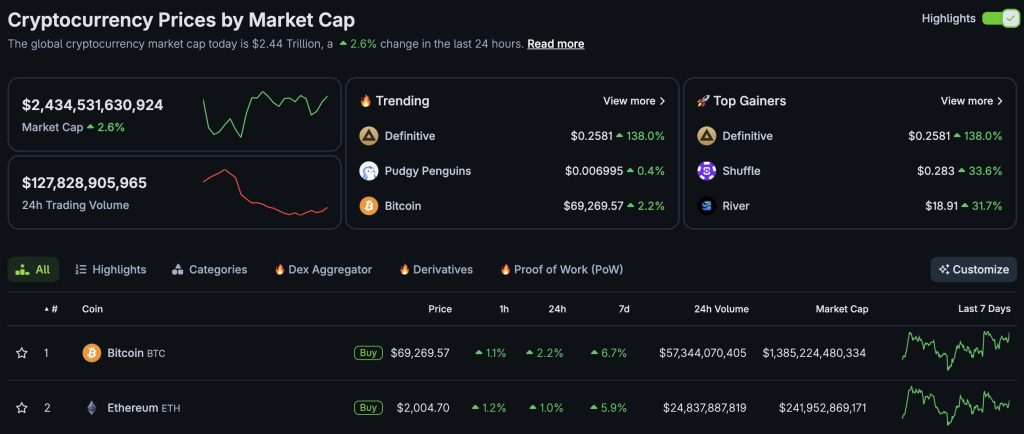
Q4 Filing Shows $72M Bitcoin ETF Trim, $86.8M Ethereum Add
The changes from America’s most prestigious University were disclosed in an SEC Form 13F filed on February 13, covering the quarter ended December 31, 2025.
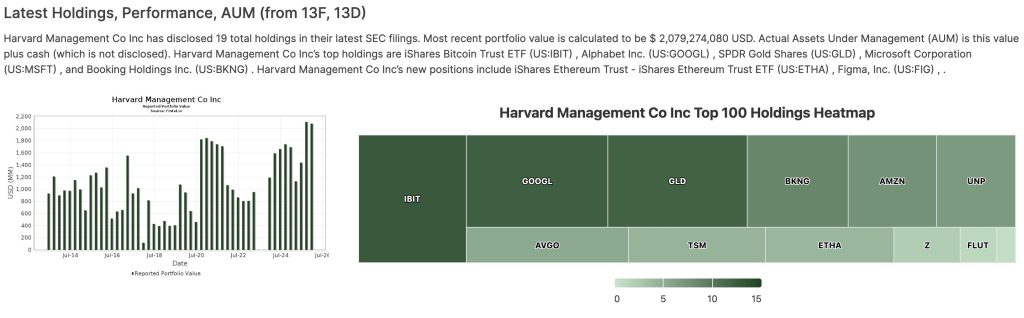
Harvard Management Company cut its IBIT stake to 5,353,612 shares, valued at $265.8M at year-end prices. That’s down from the prior quarter, equating to roughly $72M in net sales based on IBIT’s December 31 close of $49.65.
At the same time, the endowment initiated a 3.87M-share position in ETHA, valued at $86.8M. It’s Harvard’s first disclosed allocation to an Ethereum ETF since US spot ETH products launched in mid-2024.
Bitcoin remains the largest single disclosed equity holding in the University’s 13F portfolio, still larger than positions in Google, Microsoft, or Amazon, highlighting the University’s firm belief in Bitcoin’s long-term prospects and now in Ethereum’s.
EXPLORE: Best Crypto Presales to buy in 2026
What Does Harvard’s Rotation from Bitcoin ETF to Ethereum Signal for Institutions and Everyday Investors?
The main takeaway is simple: Harvard is rotating from its Bitcoin ETF exposure and into Ethereum USD. It is yet another institution betting on ETH being the stronger play for the foreseeable future.
However, another angle with this story is diversification within crypto, not away from one particular asset. Even after the trim, combined exposure sits at $352.6M.
You don’t have to be an ETH bull or BTC maxi to acknowledge that it’s a meaningful crypto allocation for a conservative endowment, regardless of your allegiance, and this comes from someone who is a huge Ethereum maxi.
The structure also matters. Crypto now represents about 12.8% of Harvard’s reportable US equity holdings. That’s not experimental sizing; it highlights the University’s firm belief in digital assets.
Why is Ethereum Being Seen as the Golden Ticket in 2026?
— Blockchain Daily News (@blckchaindaily) March 2, 2026
BREAKING: BITMINE BOUGHT 50,928 ETH LAST WEEK AT $1,976; HOLDS 4,473,587 ETH; TOTAL ASSETS $9.9B AS OF MAR 1, 2026 pic.twitter.com/CLH1CrCyCY
Meanwhile, institutional Ethereum interest is building elsewhere. Public companies are adding ETH to treasuries, as seen in BitMine’s recent allocation, where shares jumped after the firm expanded its ETH holdings.
On-chain data also shows large holders accumulating during drawdowns, according to recent analysis of whale and RWA flows.
Fidelity, a $5.9 trillion asset manager, also recently launched its own stablecoin on Ethereum, one of many TradFi giants that have chosen the Vitalik Buterin-led network for their products.
This is the broader trend right now: Bitcoin as a macro reserve asset and Ethereum as the number one growth-layer infrastructure.
Bitcoin Price and Ethereum USD Price Levels: Key Zones After Q4 Volatility
Bitcoin is currently trading near $69,300 after a sharp retracement from its $126,000 October 2025 high. The $60,000–$62,000 zone remains structural support and has remained intact so far. However, a loss of that magnitude could quickly bring $52,000 into view.
On the upside, $72,000 is the first significant resistance. Reclaim that with volume, and the market likely moves toward $80,000 next. No follow-through, and it will likely spell a period of the Bitcoin price staying range-bound for some time.
Ethereum USD, meanwhile, trades just over $2,000 after a roughly -30% correction in Q4. The $1,800 level is the line in the sand. It has held throughout all of this ongoing volatility, and if $2,000 can hold, $2,400 is back on the table.
DISCOVER: Next Crypto to Explode in 2026
The post Harvard Picks ETH USD After Trimming Bitcoin ETF Exposure appeared first on Cryptonews.


BTCC is a well-known centralized cryptocurrency exchange. It was founded in 2011, making it one of the veterans in the space.
The platform provides cryptocurrency derivatives trading, as well as traditional services through a mobile application and a web interface.
As of 2026, BTCC reports over 9 million registered users and an expanded product offering, including, but not limited to, futures trading, copy trading, promotional incentive programs, multi-asset trading through its BTCC TradFi initiative, and more.
The following review takes a closer look at the core BTCC products, its security protocols, ease of use, user feedback, and more, and attempts to answer whether it’s a safe crypto exchange to use in 2026.
Main Takeaways
- BTCC was founded in 2011 and currently has over 9 million registered users.
- The platform supports more than 400 trading pairs and leverage of up to 500x on selected major assets.
- BTCC offers copy trading and provides various rewards for new users.
- The exchange also has a TradFi section where users can trade gold, forex, commodities, and more.
Pros:
- Long operational history (since 2011)
- Large number of trading pairs
- Includes additional services such as copy trading and TradFi
- No security breaches since inception
Cons:
- High leverage levels carry inherent risk for beginners.
- TradFi asset trading is limited in its support for USDT settlement only.
Company Background
BTCC was founded in June 2011, during the earliest development periods of Bitcoin and the rest of the nascent crypto industry. Since its establishment, the company has operated through multiple market cycles, witnessing four Bitcoin halving events.
The exchange states that it has seen zero security breaches since inceptions, which is a notable milestone. There are also no public records of any incidents.
As of 2026, BTCC reports over 9 million users registered globally.
Operating under the slogan “Exchange for a better future,” the company states that its vision is to make crypto trading accessible and reliable to everyday users, as well as to experienced traders alike.
It defines its core values as Focus, Growth, Experience, and Fairness, which also supposedly guide product development, service quality, and overall platform support.
Core Products and Trading Services
Naturally, BTCC supports spot trading for a number of different cryptocurrencies. In fact, at the time of this writing, it’s ranked 26 on CoinMarketCap’s list by means of daily trading volume.
The focus, however, seems to be on its derivatives trading section, where the exchange is currently 16th by means of open interest.
Cryptocurrency Futures Trading
Being a well-known centralized exchange, one of the core products that BTCC has to offer is its futures trading platform. As of 2026, the exchange lists more than 400 trading pairs.

Some of the major digital assets, which are available for futures trading include:
- BTC
- ETH
- DOGE
- SOL
- XRP, and more.
Perpetual futures are incredibly popular in the cryptocurrency industry. They are a type of futures contract, but unlike traditional ones, they don’t have an expiration date, meaning that traders can open and close them at any given moment.
For these major assets, the exchange supports leverage of up to 500x. For lesser-known, less popular altcoins, leverage ratios range from 10x to 100x. It’s worth noting that trading with a 500x leverage ratio is incredibly risky and can lead to temporary liquidations. Experienced and disciplined traders rarely use leverage of more than 2-5x, as this significantly increases the risk of losing capital.
USDT-M Perpetual Futures
Those specific perpetual futures contracts are settled exclusively in USDT.
COIN-M Perpetual Futures
These perpetual futures contracts can be settled in select cryptocurrencies, which is convenient for those of you who don’t wish to off-ramp to stablecoins.
Copy Trading
In addition to the above, BTCC also supports Copy trading. For those unfamiliar, this trading feature is very popular in the industry, and it enables users to replicate the trading strategies of other traders on the platform.

As you can see, the interface is relatively simple and easy to use. Users are presented with different traders to copy. Their performance results are clearly indicated.
Moreover, BTCC regularly has different promotional terms to incentivize people to use various products of its platform, including Copy trading.
BTCC TradFi
Launched in February 2025, BTCC TradFi enables users to trade a number of traditional financial instruments through its platform, unifying the broader experience and further expanding its product offering.
Some of the available asset classes include:
- Gold
- Foreign Exchange (FOREX)
- Commodities
- Indices
- CFDs (contracts for difference) and others.
Security and Risk Management
As mentioned above, BTCC’s security hasn’t been compromised since its establishment. The exchange states that their security and risk control measures are properly integrated within the platform’s infrastructure.
It implements a number of best practices, such as storing a portion of user funds in secured cold wallets, as well as asset segregation.
According to the official security page of BTCC, it stores assets 1 to 1. This means that if the user deposits Bitcoin, then BTCC will store Bitcoin. If they deposit USDT, the exchange will store USDT.
In addition, standard security measures such as Two-factor authentication (2FA) are also available, but in addition to that, the BTCC web app has a login history section so that users can monitor when and where they have been logged in.
BTCC also requires identity verification procedures, which are in accordance with its AML and KYC policies. These are designed to identify each user and monitor transactions in line with regulatory compliance practices.
The exchange also states that it conducts regular system monitoring and maintenance to manage operational risk.
Customer Support
It’s important to outline that BTCC has developed a very thorough support page where users are able to resolve a lot of the more frequently faced issues themselves. You can find it here.
Moreover, there is an automated chatbot, which can help you navigate the situation and, if needed, connect you to a representative via live chat.
The support is available 24/7 ,and the assistance is multilingual, so you wouldn’t have to worry about the language barrier.
User Experience
The exchange boasts a familiar interface, which makes it easy for users to navigate the entire platform.
Right from the get-go, the tools feel easy to use and there are no complexities, which are commonly present in a lot of other crypto exchanges.
From the copy trading features to the derivatives trading, it all seems quite cohesive and easy to work with.
At the same time, the trading tools contain the necessary complexities for advanced traders who handle hundreds, even thousands, of orders per session.
How to Create a BTCC Account
Following a similar theme, registering a BTCC account is quite easy.
First, you need to visit the official website and decide whether you want to register with your email or with your phone number – both are fine.
As soon as you have your account officially registered, we highly recommend that you go to your security settings and immediately turn your 2FA on. The importance of security can never be understated.

Once that’s done, you should head to the KYC section and verify your identity. This will lift any restrictions your account may have and as soon as this is done, you can proceed to depositing funds and start trading.
SPECIAL OFFER FOR CRYPTOPOTATO READERS
CryptoPotato readers are entitled to a special promotion, which gives you a first deposit bonus of over 500 USDT, as well as 10% trading funds. Terms and Conditions apply. Use this link.

Conclusion: BTCC Exchange Review in 2026
As of 2026, BTCC operates a popular centralized cryptocurrency exchange, offering all the well-known trading features and beyond.
One of the primary characteristics is its considerably higher leverage, which can both amplify your winnings but also substantially elevate your risk parameters.
The platform includes copy trading functionalities, different margin-settlement options, select traditional financial instruments, and more.
With over 9 million registered users as of the time of this writing, BTCC is a highly-ranked crypto exchange and a prominent player in the industry.
Binance Free $600 (CryptoPotato Exclusive): Use this link to register a new account and receive $600 exclusive welcome offer on Binance (full details).
LIMITED OFFER for CryptoPotato readers at Bybit: Use this link to register and open a $500 FREE position on any coin!

Social media platform X will suspend creators from its revenue-sharing program for 90 days if they post AI-generated war footage without clearly disclosing that the content was created using artificial intelligence.
On Wednesday, X’s head of product, Nikita Bier, said the rule aims to maintain “authenticity of content on Timeline” during wartime events, when misleading media can spread quickly.
“During times of war, it is critical that people have access to authentic information on the ground,” Bier wrote. “With today’s AI technologies, it is trivial to create content that can mislead people.”
Related: Bitcoin holders show ‘zero panic‘ as BTC hits $70K amid Middle East tensions
The move adds financial penalties to X’s existing moderation tools, linking disclosure of AI-generated media to monetization eligibility.

Monetization enforcement tied to AI disclosure
Unlike traditional moderation measures such as labels or removals, the new rule targets the platform’s creator economy by restricting access to revenue-sharing for policy violations.
X said creators who publish AI-generated conflict footage must clearly disclose that the content was created with artificial intelligence. Failure to do so could lead to a 90-day suspension from the program.
Related: 6 Polymarket traders net $1M on US-Iran strike, spark insider fears: Report
Under the update, posts flagged by Community Notes or detected through metadata or other signals from generative AI tools may trigger enforcement.
Accounts that repeatedly post undisclosed AI-generated conflict videos may face permanent removal from X’s creator revenue-sharing program.
The policy applies specifically to videos depicting armed conflicts and does not amount to a broader ban on AI-generated content posted to the platform.
Middle East conflict raises misinformation concerns
The announcement comes as geopolitical tensions in the Middle East continue to dominate online discussions across social media platforms.
On Feb. 28, the United States and Israel launched joint airstrikes on Iran. Bitcoin (BTC) briefly dropped to about $63,000 but later recovered. At the time of writing, it traded near $70,000, according to CoinGecko.
AI is also becoming more deeply embedded in modern conflict environments. On March 1, the US military used Anthropic’s Claude AI model to assist with intelligence analysis and targeting during operations linked to the Iran strikes.
Magazine: Bitdeer sells all Bitcoin, Metaplanet rejects misconduct claims: Asia Express
XDC has skyrocketed the most today, followed by ICP and JUP. In contrast, AAVE has lost the most value.
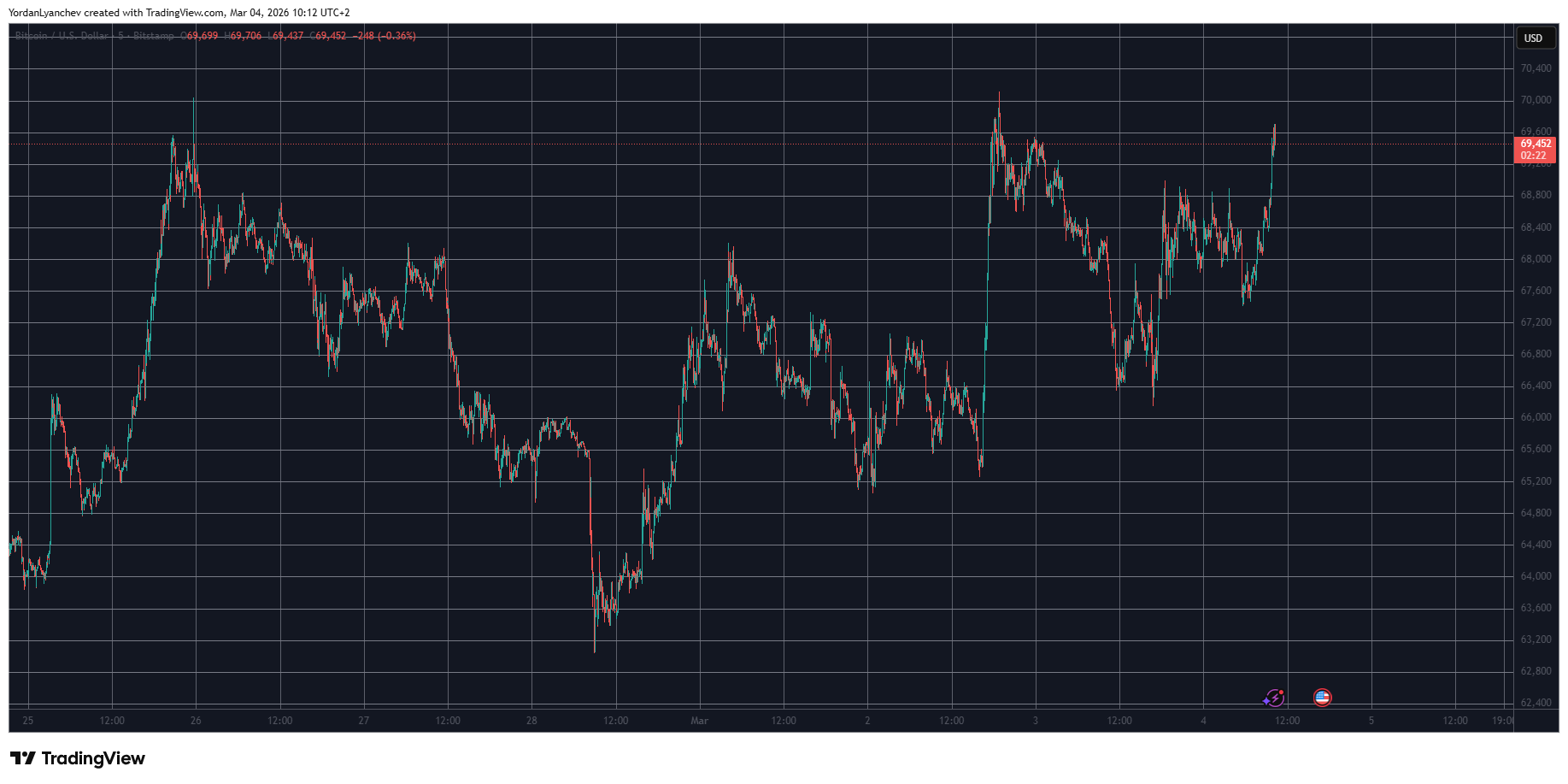
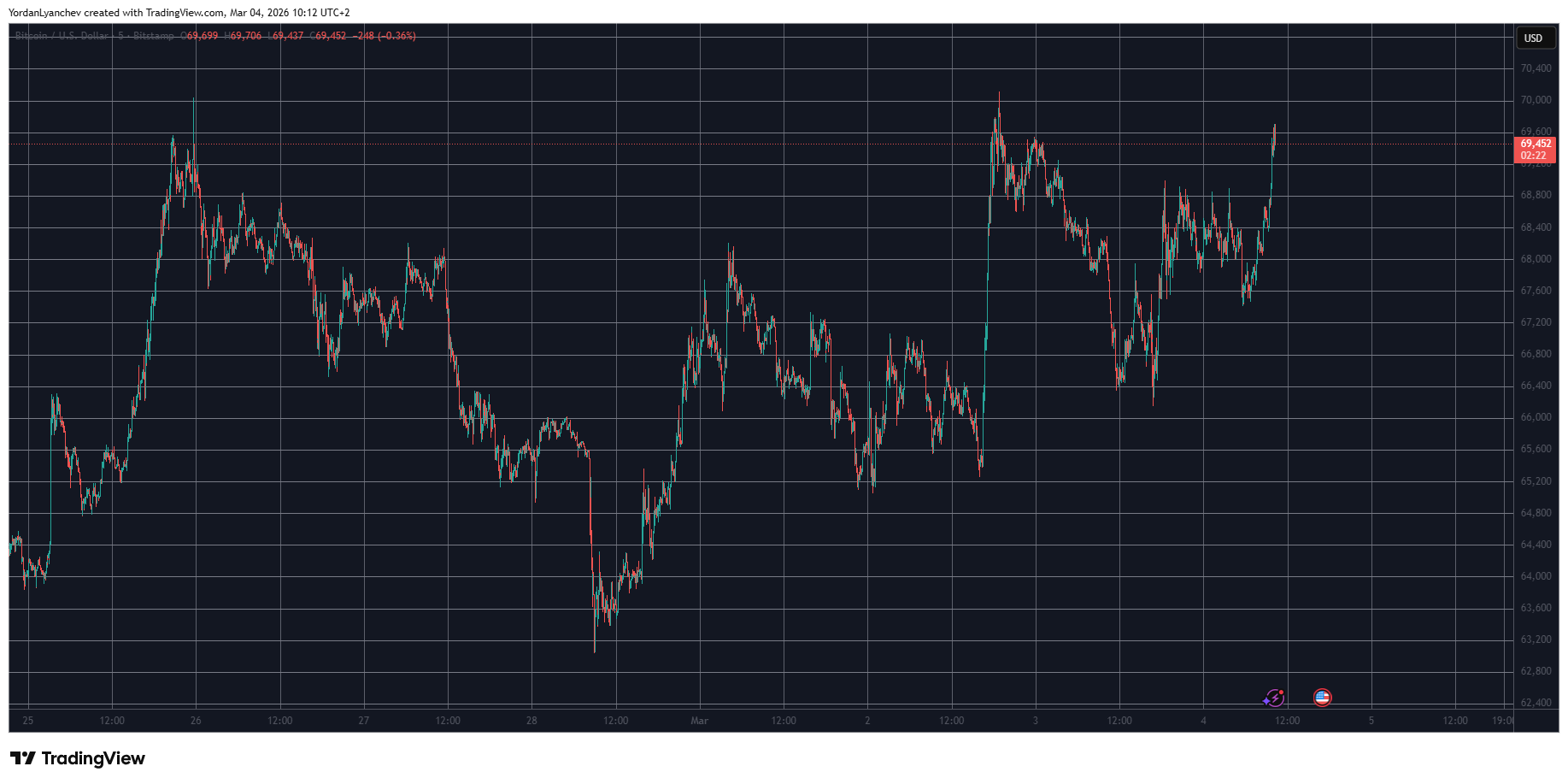
Bitcoin’s price volatility continued in the past 24 hours as the asset slipped below $66,200 at one point, only to rebound and aim at $70,000 once again.
Most altcoins are slightly in the green as well on a daily scale, with ETH challenging $2,000 and BNB tapping $640. SOL is up by over 2% daily.
BTC Aims at $70K Again
It was last Thursday when bitcoin jumped to $70,000 for the first time in over a week, only to be halted and driven south hard. It remained around $68,000 by Friday when it suddenly dumped to under $65,000. Although it had rebounded to $66,000 by Saturday morning, it quickly plunged to $63,000 after the attacks in the Middle East began.
Instead of dumping further as the geopolitical tension began, BTC rebounded strongly to over $68,000 after reports emerged that Iran’s Supreme Leader was killed in the attacks. However, it couldn’t go any higher and dropped to $65,000 by Monday.
Then came an unexpected and rare hourly rally, in which the asset jumped to over $70,000 again in minutes. Another rejection followed, which pushed BTC down to $66,200. More volatility ensued, and the cryptocurrency now trades just under $70,000 again, but some analysts believe there’s a major obstacle in its way.
Its market cap has climbed to almost $1.4 trillion, while its dominance over the alts is up to 57% on CG.
ETH Challenges $2K
Most larger-cap alts have posted more modest gains than BTC in the past day. ETH has climbed to just over $2,000 as of press time, while BNB is up to $640 and remains above XRP in terms of market cap positioning. SOL and BCH are up by 2%, while DOGE, ADA, HYPE, and CC have lost somewhere between 1-3% daily.
AAVE has lost the most value from the larger-cap alts, dropping by 6% to $113. In contrast, XDC has rocketed by 9% and now trades at $0.035. ICP and JUP follow suit.
The cumulative market cap of all crypto assets has gained nearly $100 billion since yesterday’s low and is up to $2.440 trillion on CG.

Binance Free $600 (CryptoPotato Exclusive): Use this link to register a new account and receive $600 exclusive welcome offer on Binance (full details).
LIMITED OFFER for CryptoPotato readers at Bybit: Use this link to register and open a $500 FREE position on any coin!
Disclaimer: Information found on CryptoPotato is those of writers quoted. It does not represent the opinions of CryptoPotato on whether to buy, sell, or hold any investments. You are advised to conduct your own research before making any investment decisions. Use provided information at your own risk. See Disclaimer for more information.


Ark Invest has added more shares of Coinbase and Robinhood across its exchange-traded funds on Tuesday as crypto equities dipped in response to geopolitical concerns.
Summary
- Ark Invest bought 22,452 Coinbase shares and 158,587 Robinhood shares across its ARKK, ARKW and ARKF exchange-traded funds.
- Coinbase shares were down 1.55% while Robinhood shares had dropped over 3.4%.
The Cathie Wood-led firm has acquired a total of 22,452 shares in Coinbase through its ARKK, ARKW, and ARKF exchange-traded funds. The total investment amounted to a little over $4 million.
On top of this, the company picked up 158,587 shares of Robinhood, with the investment valued at $12.06 million based on the stock’s March 2 closing price of $76.07.
Coinbase shares were down 1.55%, while Robinhood stock had also dipped by over 3.4%. Crypto-linked equities have been pressured over the past few sessions as shareholders reacted to growing concerns surrounding the U.S.-Iran war.
Major cryptos like Bitcoin and Ethereum have also felt the pressure of the recent selloff and remain suppressed below key resistance levels. Recent breakout attempts for both assets have failed as capital remains sidelined.
Ark Invest, however, has capitalized on these recent dips by continually rebalancing its portfolio and, on many occasions, increasing its exposure to several crypto-facing companies.
As previously reported by crypto.news, the company added over $32 million worth of Robinhood shares across two of its exchange-traded funds earlier this month. Around the same time, the company also acquired positions in Coinbase, alongside crypto exchange Bullish and stablecoin issuer Circle.
After the latest purchase, Coinbase and Robinhood are the company’s sixth and seventh-largest holdings within its ARKK fund as of March 4. Meanwhile Robhinhood stands as the fifth-largest holding within the ARKW fund, and Coinbase stands at the eighth position.
Ark’s investment strategy limits any individual holding to about 10% of a fund’s portfolio. Coinbase and Robinhood stocks currently account for between 3% and 6% across its ETFs.
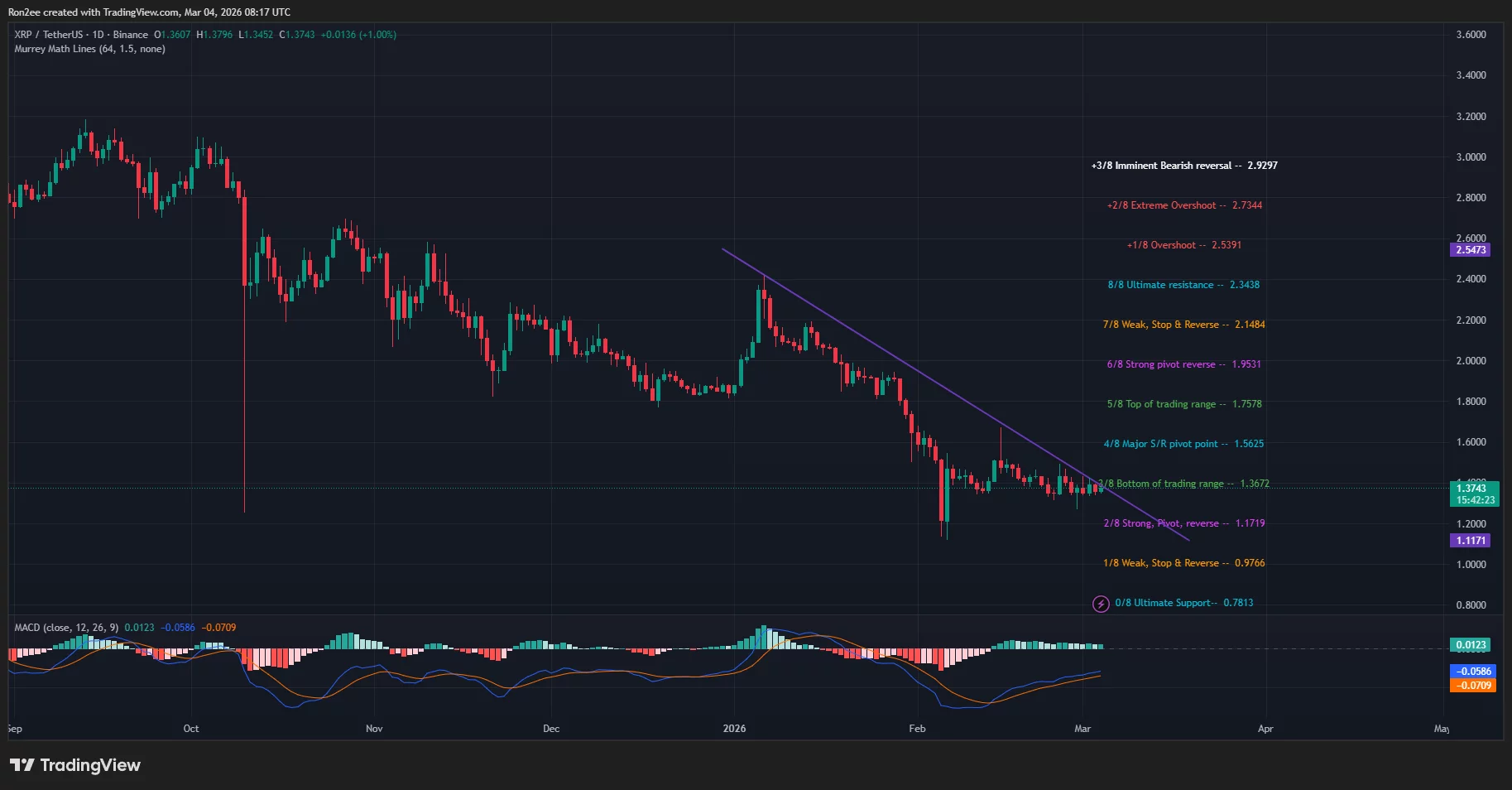
XRP price is close to confirming a breakout from a multi-week descending trendline that could potentially kickstart an uptrend over the coming sessions.
Summary
- XRP price has fallen 43% from its yearly high amid a sector-wide downturn.
- XRP is close to breaking above a descending trendline resistance on the daily chart.
XRP (XRP) price has dropped nearly 17% from mid-February and nearly 43% from its year-to-date high of $2.39.
XRP has mirrored Bitcoin’s recent move lower, as the bellwether slipped beneath several key support levels while investor appetite for risk assets remained subdued amid rising macroeconomic and geopolitical uncertainty.
XRP price has also been in a downtrend as funding rates softened, while the forced unwinding of leveraged long positions accelerated the drop beyond what spot selling alone would have caused.
The lack of institutional inflows since the beginning of this year also played a part in dampening investor demand for the token this year. SoSoValue data shows that the U.S. spot XRP ETFs drew in $88 million over the past three months, far under the $1.16 billion recorded in the November to December period.
On the daily chart, XRP price is close to breaking out from a descending trendline that has been acting as a dynamic resistance level since early January. A successful breakout from the pattern has historically been followed by significant bullish momentum.
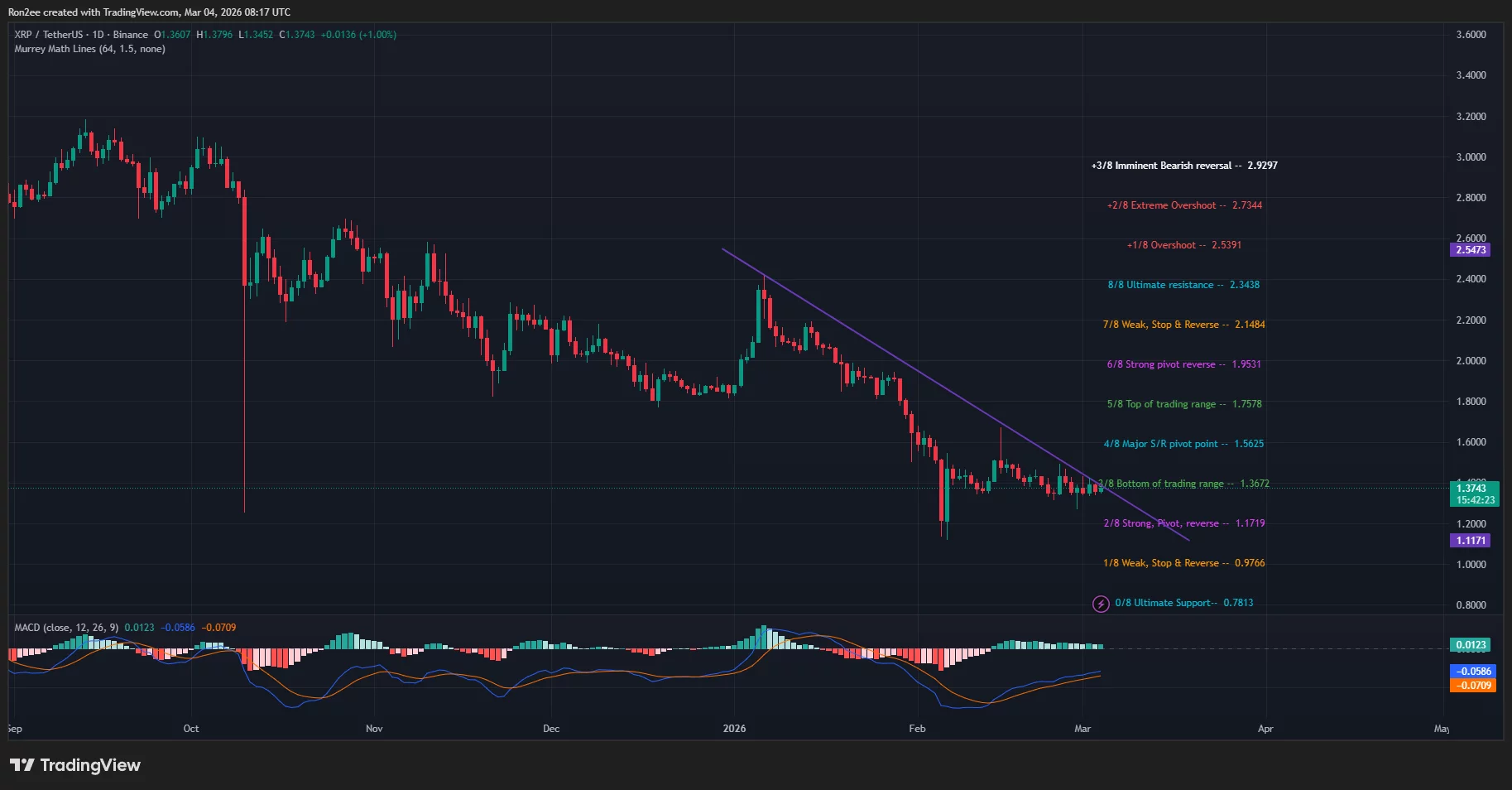
At press time, XRP price was trading at $1.36, close to breaking out of the pattern. Notably, $1.36 also marks the bottom of the trading range in Murrey Math lines. The line is considered a key support level for price reversals.
A breakout from this key psychological level could trigger a sharp rally to $1.75, where the top of the trading range for Murrey lines lies, or even to the strong pivot reverse point at $1.95.
On the contrary, failure to break the resistance could extend the downtrend over the coming weeks, potentially towards the strong pivot reverse of the Murrey lines at $1.17, where bulls could look to re-establish a floor.
Nevertheless, concerns tied to the situation in the Middle East remain a key factor weighing on risk appetite at the moment. Although the volatility seen over the weekend has eased somewhat over the past 48 hours, traders are still likely to stay cautious until clearer signs of de-escalation begin to emerge.
Disclosure: This article does not represent investment advice. The content and materials featured on this page are for educational purposes only.


The US military strike on Iran over the weekend intensified global tensions and investor anxiety. Yet, Matt Hougan, Chief Investment Officer at Bitwise, stated that it also highlighted the important role of crypto and on-chain markets.
With major stock exchanges closed, on-chain markets stepped in as the primary venue for global price discovery.
US Strike on Iran Exposed a Structural Gap That Only Crypto Markets Could Fill
In a recent memo titled “The Weekend That Changed Finance,” Hougan noted that when President Trump announced a military strike on Iran at 2:30 a.m. ET on Sunday, global markets were closed. Stocks, futures, forex, and exchanges across Europe and Asia had all gone dark for the weekend.
The only traditional markets still running were small Middle Eastern exchanges in Saudi Arabia and Qatar. Hougan suggested that on-chain markets were the only venues that responded in real time. Thus, they filled a structural void left by closed traditional exchanges.
“In years past, if a major geopolitical shock hit on a Sunday morning, investors would wait until the U.S. futures markets opened at 6 p.m. ET on Sunday to find out what the impact would be. But as this weekend showed, they now have an alternative: They can turn to crypto-based rails, which trade 24/7/365, globally. And this weekend, they did,” he said.
BeInCrypto also reported that the impact of the attacks was quickly evident in the crypto market, with Bitcoin (BTC) dropping on the news. According to Hougan, for most of that Sunday, “on-chain finance was the center of the financial world.”
He noted that Hyperliquid, a decentralized perpetual exchange, became a “focus.” Hyperliquid’s HIP-3 decentralized exchanges allowed traders to trade synthetic perpetual futures contracts tied to traditional assets.
BeInCrypto reported that HIP-3’s open interest exceeded $1 billion. Overall, the platform saw over $11.5 billion in trading volume across Saturday and Sunday, according to DeFiLlama data.
Follow us on X to get the latest news as it happens
Meanwhile, tokenized gold also drew a rush of investor interest. Tether’s XAUT logged more than $300 million in 24-hour trading volume as demand spiked. At the same time, activity on Prediction markets like Kalshi and Polymarket also surged.
“Sunday’s attacks put the spotlight on markets that never close. Don’t expect traders to forget it,” Hougan remarked.”It was the first time I remember crypto-enabled markets being ‘the market,’ full stop.”
The executive also shared that the weekend’s activity has prompted him to lower his projection of when finance would move on-chain.
“I thought that crypto-enabled markets would grow up along the edges—that, for the next 5-10 years, they would mostly serve crypto natives and others who don’t fit cleanly into the traditional financial system…The shift to onchain finance is inevitable. After this weekend, I’m convinced that shift is coming sooner than any of us had imagined,” he mentioned.
Hougan, in his analysis, also wrote that hedge funds, banks, or any other investors must now adapt to compete in global, real-time markets.
“If you are a hedge fund, bank, or any other investor who wants to trade competitively, you no longer have a choice: You have to set up a stablecoin wallet and learn how to trade on Hyperliquid. You need to understand XAUT. You need to read about tokenized stocks. Because even if you don’t, everyone else will,” he claimed.
Thus, the weekend of the US-Iran strikes showed that always-on financial markets may be moving from the margins to the mainstream, and investors are now paying attention.

Man United’s predicted line-up vs Newcastle as Reds weigh up Harry Maguire and Luke Shaw gamble

Black Money of Politicians & Bureaucrats #shortsfeed #viralreels #popular #machine #food #rajivdixit

Musk to take stand in Twitter shareholder trial


-

 Politics5 days ago
ITV enters Gaza with IDF amid ongoing genocide
-

 Politics1 day ago
Alan Cumming Brands Baftas Ceremony A ‘Triggering S**tshow’
-

 Fashion5 days ago
Weekend Open Thread: Iris Top
-

 Tech3 days ago
Unihertz’s Titan 2 Elite Arrives Just as Physical Keyboards Refuse to Fade Away
-

 NewsBeat6 days ago
Cuba says its forces have killed four on US-registered speedboat | World News
-
Sports4 days ago
The Vikings Need a Duck
-
 NewsBeat4 days ago
Dubai flights cancelled as Brit told airspace closed ’10 minutes after boarding’
-
 NewsBeat6 days ago
Manchester Central Mosque issues statement as it imposes new measures ‘with immediate effect’ after armed men enter
-

 NewsBeat3 days ago
‘Significant’ damage to boarded-up Horden house after fire
-
 NewsBeat4 days ago
The empty pub on busy Cambridge road that has been boarded up for years
-

 NewsBeat4 days ago
Abusive parents will now be treated like sex offenders and placed on a ‘child cruelty register’ | News UK
-

 Business6 days ago
Discord Pushes Implementation of Global Age Checks to Second Half of 2026
-

 Entertainment2 days ago
Baby Gear Guide: Strollers, Car Seats
-

 Business6 days ago
Only 4% of women globally reside in countries that offer almost complete legal equality
-
 Tech5 days ago
NASA Reveals Identity of Astronaut Who Suffered Medical Incident Aboard ISS
-
Politics3 days ago
FIFA hypocrisy after Israel murder over 400 Palestinian footballers
-
 NewsBeat3 days ago
Emirates confirms when flights will resume amid Dubai airport chaos
-

 Crypto World5 days ago
From Crypto Treasury to RWA: ETHZilla Retreats and Relaunches as Forum Markets on Nasdaq
-

 NewsBeat2 days ago
Is it acceptable to comment on the appearance of strangers in public? Readers discuss
-

 Tech3 days ago
Viral ad shows aged Musk, Altman, and Bezos using jobless humans to power AI