
Crypto World
WBT’s new all-time high comes as crypto infrastructure gets more institutional


Disclosure: This article does not represent investment advice. The content and materials featured on this page are for educational purposes only.
WBT trades around $72.70 after hitting a new high, as its four-year milestone coincides with broader developments in blockchain infrastructure and digital assets.
Summary
- WBT hits a new all-time high above $72, extending gains as exchange tokens gain utility across trading and blockchain ecosystems.
- Whitechain is transitioning to an Ethereum Layer 2 using the OP Stack, with WBT remaining its native gas token.
- WBT’s full supply is now unlocked while WhiteBIT’s active burn program targets a long-term reduction toward 200 million tokens.

WBT is trading around $72.7 after reaching a new all-time high, extending its gains beyond the previous $64.11 record set in December 2025. The move comes as the four-year-old token reaches another stage in its development, while the wider crypto industry continues shifting toward more established infrastructure and institutional participation.
Utility is becoming more important for exchange tokens
The role of an exchange token has changed considerably from the early days of crypto.
WhiteBIT offers users trading-related benefits, including reduced fees, while holdings can also affect referral rewards and eligibility for certain Launchpad activities. Staking and reward programs provide additional ways for users to interact with the asset.
The token also has a blockchain function. WBT is used as the native gas asset on Whitechain, connecting it directly to transactions taking place outside the exchange environment.
That broader utility is relevant as crypto platforms increasingly serve users who expect more than a place to buy and sell assets. Trading, blockchain infrastructure, token launches and rewards are increasingly being combined within connected ecosystems.
WBT is one example of that model.
Whitechain is taking a different route to scalability
The infrastructure side of the story is developing at the same time.
Whitechain is transitioning from its original standalone Layer 1 into an Ethereum Layer 2 built with the OP Stack. The network’s Sepolia testnet is already operational, while mainnet development is targeting later in 2026.
The move places Whitechain within a much larger ecosystem. Ethereum Layer 2 networks have become an established way to handle blockchain activity while settling transactions back to Ethereum.
Whitechain’s architecture remains EVM-compatible, which means developers can continue using familiar Ethereum development tools. WBT remains the native gas token after the transition.
The development is particularly relevant to WBT because it gives the token a role in network activity that does not depend solely on exchange trading.
A new phase for token supply
WBT has appreciated 28.3% over the past 12 months and was among the global top 10 cryptocurrencies by market capitalization in figures released around its fourth anniversary.
The price move is noteworthy, but it is taking place alongside several structural changes that are affecting how exchange-linked digital assets are used.
WBT’s tokenomics have also reached a transition point.
The token’s full supply has been unlocked as of 2026. Meanwhile, its burn mechanism remains active. WhiteBIT says the buyback program uses an amount corresponding to 33% of trading-fee income and 5% of income from other exchange activities, with the stated aim of reducing total supply toward 200 million WBT.
This is different from the supply dynamics during WBT’s earlier years, when scheduled unlocks were still taking place.
The combination of completed unlocks and continuing burns gives traders another variable to consider when looking at the token’s longer-term supply profile.
It also means the recent all-time high is arriving after a significant change in the mechanics governing how much WBT is circulating.
More markets are opening up
The token’s wider market presence has changed alongside its utility. WBT was listed on Kraken in March 2026 with WBT/USD and WBT/EUR markets, giving the asset additional access outside its original exchange environment.
That matters for liquidity and visibility, particularly for an exchange-linked token whose early use was closely associated with a single platform.
WBT’s fourth anniversary provides another reference point. Four years after launch, the token is trading above its previous record, has gained 28.3% over the last year and has developed uses spanning exchange services and blockchain infrastructure.
The new high does not establish where the token goes next. What it does show is that WBT is entering a different stage of its lifecycle, one in which market performance is being watched alongside token utility, supply changes and the development of the network that uses it.
Disclosure: This content is provided by a third party. Neither crypto.news nor the author of this article endorses any product mentioned on this page. Users should conduct their own research before taking any action related to the company.


Stand With Crypto, an advocacy group launched by Coinbase in 2023, has endorsed 32 candidates for U.S. House races ahead of the 2026 midterm elections. The group says the move is designed to shape federal digital-asset policy by backing lawmakers it views as credible champions for the sector.
In a notice issued Monday, Stand With Crypto framed its candidate slate as part of a broader effort to mobilize “crypto voters,” arguing that digital-asset issues may become more influential in close races where candidates seek support beyond traditional political constituencies. The organization’s executive director, Mason Lynaugh, said the timing reflects what he called an inflection point for crypto policy in Washington.
Key takeaways
- Stand With Crypto endorsed 32 House candidates for the 2026 midterms based on their stated digital asset policy views.
- The group is targeting competitive races where it believes its influence is most likely to matter for outcomes.
- Stand With Crypto argues crypto voters are becoming a durable bloc that can affect tight congressional elections.
- The push lands as the Senate’s next steps on the Digital Asset Market Clarity (CLARITY) Act remain uncertain.
A targeted endorsement strategy for 2026
Stand With Crypto said its slate is intended to influence how digital assets are regulated and overseen at the federal level. The group did not present a full list of criteria in the notice excerpt, but it characterized the backed candidates as “proven digital asset policy champions” and emphasized its focus on races most likely to swing based on its outreach.
The endorsement announcement follows earlier activity from the organization. It previously unveiled initial endorsements in March as part of its broader midterm plan, describing a battleground approach meant to help candidates move from their primaries into the November election. According to the notice, that initial tranche included three Republicans and three Democrats who advanced to the general election.
While the group’s messaging is political, it arrives in a wider environment where crypto-linked spending has increasingly intersected with U.S. election cycles. During the 2024 election cycle, organizations and political action committees backed by crypto companies spent more than $170 million to support candidates they believed would be favorable to the industry, and many of those candidates won, according to the notice.
Why the midterms matter for crypto legislation
Stand With Crypto’s endorsement push is anchored to the argument that congressional elections can determine whether major crypto policy proposals move forward. The group pointed to the 2025 flow of pro-crypto candidates into Congress, claiming that more than 270 such candidates were sent to Washington in 2025—an outcome the organization linked to potential progress on legislation, including the GENIUS Act, which concerns stablecoin-related frameworks.
For investors and builders, the practical implication is straightforward: crypto policy is still shaped less by broad market narratives and more by whether specific bills gain traction in both chambers and the extent to which lawmakers treat digital-asset regulation as a near-term priority. In that sense, the group’s focus on competitive House seats fits a common legislative dynamic—narrow margins in the House can change committee influence and voting outcomes.
At the same time, the organization’s claims about crypto voters being a “durable, motivated” bloc reflect a strategic bet: that voters attentive to digital-asset issues may be sufficiently organized to affect campaigns even when crypto does not dominate national headlines.
CLARITY still faces timing risk in the Senate
Separate from the endorsement slate, the legislative timeline for one of the sector’s key policy proposals remains a live issue. The Digital Asset Market Clarity (CLARITY) Act, which the House passed with bipartisan support in July 2025, is still pending in the Senate. The notice highlights that Senate discussions have included topics such as ethics requirements, tokenization provisions, and stablecoin rewards.
Under the current schedule described in the coverage, CLARITY is expected to be considered through a cloture motion once the Senate returns from recess on Sept. 15. However, the Senate would have only 14 days in session before breaking ahead of the November election, creating a narrow window for the bill to advance.
After the midterms, the Senate would have another 22 days before 2027 to bring CLARITY back to the chamber. If the bill reaches final action in that later period, it could then return to the House and ultimately move to the president for approval.
The notice also points to political pressure on the Senate in the immediate term. Earlier coverage cited the president, Donald Trump, standing alongside several crypto CEOs and executives to urge lawmakers to pass what he described as a “fair version” of CLARITY. That push, however, may face credibility hurdles given the broader public scrutiny around Trump’s financial ties to the industry, with a cited poll showing a majority of Americans calling those crypto investments not “appropriate.”
For market participants, these dynamics matter because the Senate calendar and the bill’s handling—whether it can be processed in time to clear major procedural hurdles—could determine whether a clearer regulatory structure arrives before or after the 2026 election cycle. Even when legislation is broadly supported, procedural delays can push outcomes into later sessions and lengthen uncertainty around implementation.
What to watch next
As the 2026 midterm clock moves forward, attention should track not only which candidates Stand With Crypto supports, but also whether CLARITY can progress through the Senate in the limited post-recess window. The biggest open question for the next phase of U.S. crypto regulation remains timing: whether lawmakers can convert the legislative momentum already shown in the House into Senate action before politics and procedural constraints reshuffle priorities.


Analysts say consolidation could strengthen bitcoin’s rally, while thin trading above $80,000 may set up sharper price moves.

Bringing Together HR Leaders to Shape the Modern Workplace in South Africa
16th September 2026 | Johannesburg, South Africa
Johannesburg, 3 July 2026: As South Africa’s business landscape evolves in response to rapid technological advancement, changing workforce expectations, and increasing economic complexity, the role of Human Resources has become more strategic than ever before. Today, HR leaders are responsible for workforce planning, leadership development, employee experience, skills transformation, and building organisational capability while aligning people strategies with business priorities.
Recognizing the critical role of HR in shaping the evolving workforce, Exito Media Concepts, a global B2B events organiser, announces the 5th Edition of HR World Summit South Africa 2026, taking place on 16 September 2026 at Focus Rooms – Universe, Johannesburg. Designed as a platform for industry discussions and networking, the summit will bring together more than 200 CHROs, HR Directors, People & Culture Leaders, Talent Acquisition Heads, Learning & Development Executives, Employee Experience Specialists, business leaders, and solution providers to discuss workforce planning, leadership, talent strategy, and the future of work.
Through keynote presentations, panel discussions, fireside conversations, and interactive sessions, attendees will explore strategies for addressing today’s workforce challenges and preparing organisations for AI adoption, evolving workforce expectations, and future skills requirements. The summit offers HR leaders an opportunity to exchange ideas, build strategic partnerships, and explore current workforce trends.
Shaping the Next Chapter of Work and Leadership
organisations across South Africa are adapting to rapid technological advances, changing workforce expectations, and shifting business priorities. Technologies such as artificial intelligence (AI), automation, and data-driven decision-making are redefining how organisations operate, compete, and manage their workforces.
To remain adaptable, organisations must rethink traditional approaches to leadership, talent management, learning, employee wellbeing, and organisational culture. HR leaders are integrating AI into HR processes, strengthening employee engagement, expanding learning and development initiatives, and building skills needed for an increasingly digital workplace. The summit agenda addresses these priorities through industry discussions, case studies, and real-world examples.
The agenda focuses on the key workforce priorities shaping HR strategy across South African organisations.
Key discussions will include:
- Navigating Work, Leadership, and Innovation in a rapidly changing business landscape
- Exploring the role of Artificial Intelligence in HR and workforce planning
- Strengthening employee wellbeing and workforce engagement
- Building skilled workforces for an evolving world of work
- Developing strategies to attract, retain, and develop talent
- Building a culture of continuous learning and skills development
- Learning from CHROs on people, culture, and change management
- Creating inclusive workplaces that support innovation and organisational performance
These discussions will provide practical insights, case studies, and proven approaches that HR leaders can apply across talent management, leadership development, employee experience, and workforce planning.
A Platform Where HR Leaders Shape the Future
The summit will provide delegates with practical examples of workforce transformation, leadership development, HR technology adoption, and people strategy from organisations across
South Africa.
Alongside the conference sessions, attendees will have opportunities to network with peers, connect with solution providers, and exchange real-world insights on workforce trends and workforce challenges.
Learn from South Africa’s Leading HR Visionaries
The speaker lineup includes HR leaders from organisations including:
- Tebogo Maenetja- Chief Human Resources Officer, MTN
- Michele Seroke- Chief Human Resources Officer, Mediclinic
- Nomsa Lewisa- CIO Group Human Technology, First Rand
- Mikateko Nkuna- Valoyi, Managing Executive: Talent & Culture, Vodacom
- Lerato Thelejane- Executive: People Change Readiness and Enablement, Absa Group
Event Details
Event: 5th Edition of HR World Summit South Africa 2026
Date: 16 September 2026
Time: 9:00 am – 5:00 pm
Venue: Focus Rooms – Universe, Johannesburg, South Africa
About Exito Media Concepts
Exito Media Concepts is a global B2B events organisation with over 16 years of experience delivering conferences across technology, cybersecurity, digital transformation, healthcare, finance, human resources, and other industries.
Exito brings together business leaders, solution providers, and decision-makers through conferences focused on knowledge sharing, collaboration, and executive networking.
For more details on the HR World Summit South Africa 2026, visit:
https://exito-e.com/hrworldsummit/south-africa/
For Media Enquiries, please contact:
Ashrith Shetty | Senior Marketing & PR Executive, Exito Media Concepts Email: ashrith.shetty@exito-e.com


Stand With Crypto, an advocacy organization launched by Coinbase in 2023, endorsed 32 candidates for House of Representatives seats ahead of the 2026 US midterm elections based on their digital asset policy views.
In a Monday notice, Stand With Crypto said its slate of 32 candidates for the 2026 midterm elections was part of efforts to influence digital asset policy in the federal government. The organization said it had endorsed politicians who were “proven digital asset policy champions,” also targeting competitive races “where Stand With Crypto advocate numbers are most likely to influence outcomes.”
“Crypto Voters have become a durable, motivated voting bloc, which has the potential to swing key congressional races in the midterms,” said Stand With Crypto executive director Mason Lynaugh, adding:
“The midterms come at a key inflection point for crypto policy in Washington, D.C. As candidates from both parties are trying to reach voters outside of more traditional constituencies, they overlook Crypto Voters at their own peril.”
The move comes as some experts expect crypto policy to be a potential swing issue for voters in many close elections. Stand With Crypto announced six candidates for its first group of endorsements in March — three Republicans and three Democrats — all of whom advanced from their primaries to compete in the November election.
Related: Ripple- and Coinbase-funded PAC spends $2M in Florida race with little mention of crypto
During the 2024 election cycle, organizations and political action committees (PACs) backed by crypto companies spent more than $170 million supporting candidates they considered to favor the industry, many of whom went on to win their races. Stand With Crypto said that more than 270 “pro-crypto“ candidates were sent to Congress in 2025, potentially influencing votes on legislation like the Guiding and Establishing National Innovation for US Stablecoins (GENIUS) Act.
CLARITY vote still waiting for Senate’s return
The makeup of the next US Congress in both the House and Senate could potentially impact whether a comprehensive crypto market structure bill becomes law. Although the House passed the Digital Asset Market Clarity (CLARITY) Act with bipartisan support in July 2025, the Senate’s consideration of the legislation has been marked by discussions over ethics, tokenization and stablecoin rewards.
CLARITY is scheduled for a cloture motion once the Senate returns from recess on Sept. 15, but the chamber will only have 14 days in session before breaking before the November election. After the midterms, the Senate will have another 22 days before 2027 to return the bill to the House, after which it could then head to the president’s desk for approval.
Last week, President Donald Trump stood alongside several crypto CEOs and executives, urging the Senate to pass a “fair version” of CLARITY. However, the Trump family’s financial ties to the industry could complicate a potential vote, with a majority of Americans calling the crypto investments not “appropriate” in a recent poll.
Magazine: Bitget CEO isn’t buying the Bitcoin rally — She’s waiting for $50K

Intelligent Finance for a Digital-First Economy
17 September 2026 | Johannesburg, South Africa
Johannesburg, 3 July 2026: As organisations across South Africa adopt digital technologies, accelerate digital initiatives, advance digital capabilities, navigate economic uncertainty, and adapt to an increasingly data-driven business environment, the role of the Chief Financial Officer has evolved far beyond traditional financial stewardship. Today’s finance leaders are expected to guide capital allocation, strengthen liquidity management, improve forecasting accuracy through FP&A and predictive analytics, oversee enterprise risk, and lead the adoption of AI and digital finance technologies that support informed business decision-making.
The CFO Leadership Summit South Africa, taking place on 17 September 2026 at Focus Rooms – Universe, Johannesburg, is set to convene South Africa’s prominent finance leaders, CFOs, and industry experts to discuss how CFOs are strengthening financial resilience, improving capital efficiency, modernising finance operations, and preparing organisations for an increasingly data-driven economy. As one of the region’s prominent gatherings of finance executives, the summit will bring together over 200 CFOs, Finance Directors, Group Finance Executives, Controllers, Treasury Leaders, Risk & Compliance Heads, Tax Leaders, Digital Finance Experts, business leaders, and technology innovators to explore the strategies, technologies, and leadership approaches shaping the future of finance.
Designed as a major platform for sharing insights and executive networking, the summit will facilitate discussions among senior finance professionals, industry experts, and solution providers committed to supporting finance transformation. Through keynote presentations, executive panel discussions, fireside conversations, and interactive sessions, attendees will gain practical insights into AI-powered finance, modern FP&A, treasury optimisation, automation, ESG reporting, regulatory compliance, and enterprise risk management.
Redefining Finance Leadership in the Digital Era
South African organisations are navigating economic uncertainty, rising operating costs, evolving regulatory requirements, and rapid advances in AI and automation. As finance teams respond to these challenges, CFOs are increasingly focused on improving forecasting accuracy, optimising liquidity, strengthening governance, and using real-time financial data to support faster business decisions. The summit has been designed to showcase practical case studies, implementation strategies, and lessons from organisations leading finance transformation.
With an agenda focused on emerging finance trends designed for finance and business leaders, the summit will spotlight the key trends transforming modern finance.
Strategic discussions will include
- Architecting Financial Agility in an increasingly volatile and unpredictable economic landscape
- Managing Cash Flow, Controlling Costs, and Optimising Liquidity Through Intelligent, Data-Driven Financial Strategies to Navigate Persistent Inflationary and High-Cost Business Environments
- Advancing Precision Finance through Real-Time FP&A, Predictive Analytics, and Data-Driven Decision-Making
- Redefining the CFO’s Role as a Growth Architect through strategic capital allocation and value creation
- Evolving from a compliance function into a source of competitive advantage
- Integrating ESG and Sustainable Finance to drive long-term profitability, cash flow, and operational efficiency beyond regulatory compliance
These discussions will provide finance leaders with practical approaches to improving forecasting accuracy, strengthening liquidity, modernising finance operations, adopting AI responsibly, and supporting sustainable business growth.
A Platform Where Finance Leaders Drive Business Transformation
The summit will feature a notable line-up of experienced CFOs, senior finance executives, digital transformation leaders, and industry experts representing some of South Africa’s most respected organisations. As a CFO Summit, the event will provide delegates with case studies on finance automation, AI adoption, FP&A modernisation, treasury management, ESG reporting,
regulatory compliance, and enterprise risk management.
Beyond the conference sessions, the event will offer networking opportunities, enabling senior executives to establish professional connections, exchange ideas with peers, explore AI, FP&A, treasury, ERP, analytics, and finance automation solutions.
Learn from South Africa’s prominent Finance Visionaries
- Mikaeel Tayob- Regional CFO, Bridgestone Middle East & Africa
- Polani Sokombela- Chief Financial Officer, Auditor-General of South Africa
- Qiniso Mthembu– Chief Financial Officer, Johannesburg Stock Exchange
- Akesh Bansee- Chief Financial Officer, Unilever
- Bradley Wentzel- Chief Financial Officer, Barloworld Equipment
Event Details
Event: CFO Leadership Summit South Africa 2026
Date: 17 September 2026
Time: 9:00 am – 5:00 pm
Venue: Focus Rooms – Universe, Johannesburg, South Africa
About Exito Media Concepts
Exito stands for “success,” a principle reflected in every experience we create. With over 16 years of expertise, Exito Media Concepts is a globally recognised B2B events organisation delivering more than 240 conferences annually across technology, cybersecurity, digital transformation, healthcare, finance, human resources, and other emerging enterprise sectors.
Through carefully curated agendas, globally recognised speakers, and market-driven insights, Exito creates high-impact platforms that foster strategic collaboration, accelerate innovation, and enable business leaders to address the evolving challenges of their industries.
For more details on the CFO Leadership Summit South Africa 2026, visit:
https://cfoleadershipsummit.com/south-africa/
For Media Enquiries, please contact:
Ashrith Shetty | Senior Marketing & PR Executive, Exito Media Concepts Email: ashrith.shetty@exito-e.com
Ethereum price broke above $2,500 this week during a sharp market-wide rally, and BitMine Immersion Technologies used the moment to make its largest weekly purchase since early July.
The Tom Lee-chaired firm added 32,447 ETH, pushing its position closer to a stated “5% Alchemy” target.

BitMine’s Largest Purchase in Weeks
BitMine spent $81 million to buy the new tokens, bringing its total holdings to 5,847,611 ETH, valued at approximately $14.6 billion at current prices.
Including 210 Bitcoin (BTC), stakes in Beast Industries and Eightco Holdings, and $308 million in cash and marketable securities, the company reported a combined treasury of $14.9 billion, up from $11.4 billion the previous week.
The company has purchased ETH every single week since launching its treasury strategy on June 30, 2025, a run of roughly 14 months without interruption.
Its current holdings amount to roughly 4.8% of Ethereum’s total supply, putting the firm about 97% of the way toward the 5% threshold it has pursued publicly since the strategy began.
Roughly 5,067,309 ETH, or 87% of BitMine’s holdings, sits staked through its Made in America Validator Network.
The company projects that the position could generate around $330 million in annualized revenue, though actual returns depend on network conditions and validator performance rather than being guaranteed.
Why Tom Lee Sees This Rally as Different
ETH traded near $2,511 as of August 24, according to BeInCrypto data, after surging roughly 30% over the past week, its strongest gain since May 2025. That climb outpaced Bitcoin’s own advance of roughly 22% over the same period.
Lee framed the past week’s price action as historically significant. This marks the largest weekly gain since May 2025, and in the two prior instances of similar magnitude, such a move signaled the launch point of a much larger rally, one he noted was followed by gains exceeding 160% in earlier cycles.
He pointed to several tailwinds behind the move: Wall Street’s growing tokenization efforts, expanding agentic AI applications built on blockchain infrastructure, supportive policy signals out of Washington, and easing broader financial conditions.
BitMine’s continued buying, even as ETH rallies rather than dips, signals institutional conviction rather than opportunistic bottom-fishing.
As the largest publicly traded Ethereum treasury company, it positions its steady accumulation and staking operations as a structural force behind the network’s growth, regardless of short-term price swings.
Whether this week’s breakout above $2,500 marks the start of the larger move Lee described will likely depend on whether the fundamental catalysts he cited continue building momentum in the weeks ahead.
Subscribe to our YouTube channel to watch leaders and journalists provide expert insights.
The post Tom Lee’s BitMine Buys $81 Million in Ethereum as ETH Hits $2,500 appeared first on BeInCrypto.
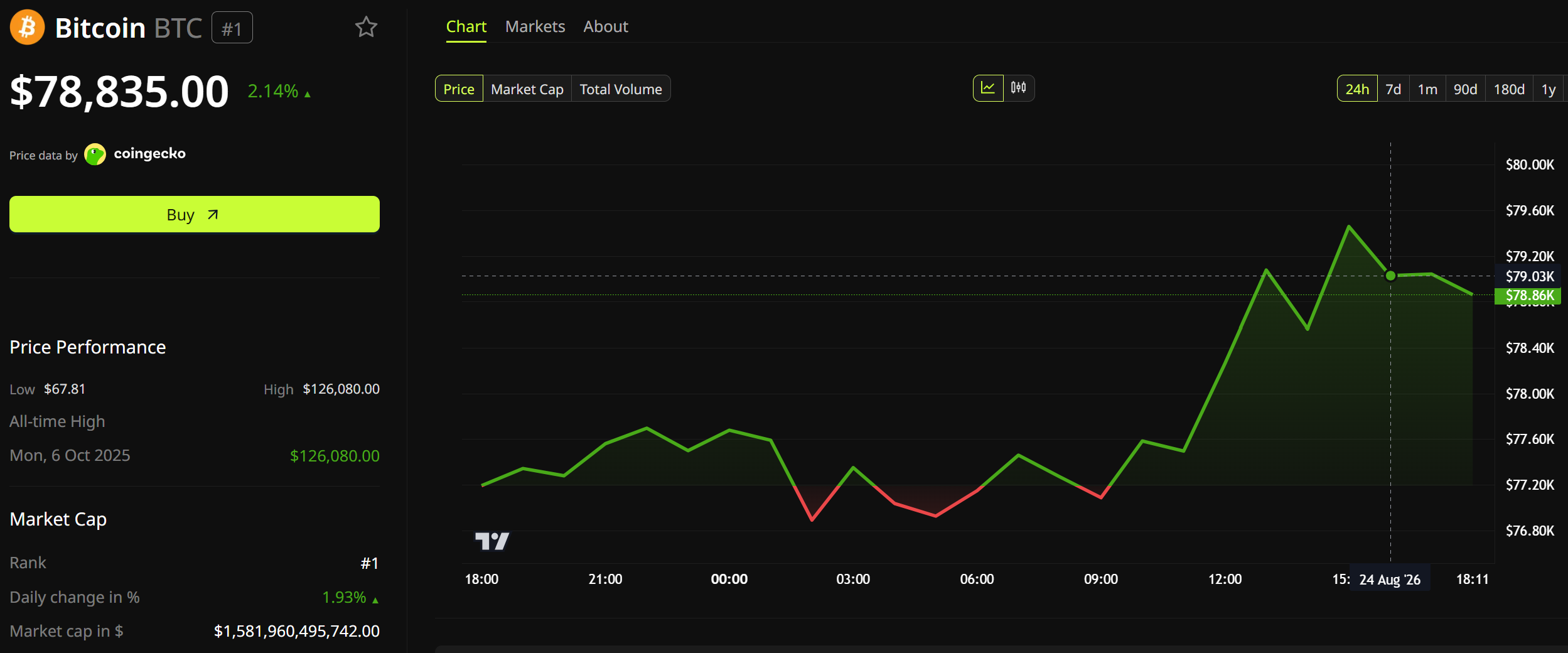
Bitcoin (BTC) touched $80,000 on Monday, then handed the level straight back. Critics are lining up against the US Treasury plan that sparked the move.
The token traded near $78,835 at press time. The bond market had already run this exact play last week, and it did not hold.

What Pushed Bitcoin to $80,000
The Treasury General Account (TGA) is the government’s checking account at the Federal Reserve. Tax receipts fill it. Treasury Secretary Scott Bessent has let it swell, with reports pegging the account near $950 billion.
Treasury’s own daily cash statement showed $935.1 billion on August 20, the latest official reading. Two senior Treasury officials told CNBC that money could fund bond buybacks.
Treasury doubled those buybacks on August 19. Long-end operations rose from $2 billion to at least $4 billion each. The first lands on September 9, per the department’s own announcement.
Traders liked the plumbing. Spending TGA cash does not grow the Fed’s balance sheet. It just moves money into bank reserves. That reads as liquidity, and liquidity has been Bitcoin’s fuel all month.
The Bond Market Already Round-Tripped This Trade
Treasury’s own yield data tells the story. The 30-year yield hit 5.31% on August 17, its highest reading since 2007.
The buyback news knocked it down to 5.19% two days later. By August 21 it sat at 5.27%. The entire rally vanished in two sessions.

Monday delivered a second bounce. The 30-year eased to 5.21% and the 10-year to 4.69%. Bitcoin’s spot price rode that wave to $80,000, then slid.
Why Critics Say It Will Not Hold
Bessent calls the strategy a “Treasury Twist.” The name echoes Operation Twist, the 1961 attempt to bend long-term rates lower.
Citadel Securities calls it financial repression. The firm warns it could weaken the dollar and stoke inflation. The deficits behind the yield spike go untouched.
Peter Schiff, chief economist at Euro Pacific Asset Management, has long warned about bond markets.
“This reckless plan will substantially shorten the average maturity of the national debt, increasing our exposure to rising short-term rates… It’s a recipe for massive QE and runaway inflation. Got gold?” Schiff wrote.
Benjamin Chabot, a former economist at the Federal Reserve Bank of Chicago, asked the sharper question.
“Does it matter if Treasury uses the TGA to buy bonds? Probably not. TGA funds are mostly spoken for. What matters is how Treasury refills the TGA after purchases,” he stated.
Fundstrat’s Tom Lee took the other side. He says the shift favors long-duration assets, crypto included.
Treasury has not spent a dollar of the account. September 9 is when the talk becomes numbers.
The post Bitcoin Loses $80,000 as Critics Swarm Treasury's $950 Billion Buyback Plan appeared first on BeInCrypto.


CME Group has added three regional U.S. dollar reference rates and real-time indices for Ethena’s ENA token, with daily publication beginning Aug. 24.
Summary
- ENA reference rates now cover the London, New York, and APAC market closes.
- CF Benchmarks calculates the rates using trades from eligible spot exchanges.
- Daily benchmarks remain available on weekends and holidays, matching crypto’s continuous trading schedule.
- The pricing tools may support portfolio valuation, risk controls, and ENA-linked financial products.
CME Group adds ENA rates for three market closes
CME Group said it had added Ethena (ENA) to its single-asset cryptocurrency benchmark suite, extending standardized U.S. dollar pricing to the token across three major trading regions.
CF Benchmarks, the benchmark administrator that manages CME’s cryptocurrency indices, will calculate and publish the new products. The lineup contains daily reference rates that provide a fixed valuation point, along with real-time indices that update during the trading day.
Under the regional format, the CME CF Ethena-Dollar Reference Rate tracks the London close under the ENAUSD RR identifier. ENAUSD NY provides a New York closing rate, while ENAUSD AP covers the end of the APAC trading day.
Each rate is published at 4 p.m. in its respective region. By using three local closing times, the suite lets firms select a valuation point that corresponds with their working day instead of applying one global cutoff to a market that never closes.
Publication continues seven days a week, including weekends and public holidays. ENA trades continuously on cryptocurrency exchanges, so its price can change when traditional stock, bond, and derivatives markets are closed.
Alongside the daily rates, the associated real-time indices provide updated dollar prices throughout the day. Trading desks may use those figures to monitor positions, compare execution prices or measure intraday exposure, while a daily rate gives accountants and fund administrators a fixed figure for reporting.
ENA pricing draws from multiple spot exchanges
Rather than taking ENA’s price from one trading platform, CF Benchmarks draws on transactions from eligible spot exchanges that meet its constituent venue rules. The method reduces the reliance on any single exchange’s order book, liquidity conditions or temporary pricing differences.
Reference rates and real-time indices serve different purposes. A reference rate produces a price at a set time and can support portfolio valuation, net asset value calculations, and contract settlement. A real-time index follows the asset during the day and can assist with trading, collateral monitoring, and risk controls.
A benchmark does not involve the purchase or custody of ENA by itself. It provides a standardized price that banks, asset managers, trading firms, or product issuers can cite when valuing exposure or designing a separate financial instrument.
The distinction also means CME’s announcement is not the same as launching ENA futures, options, or an exchange-traded fund. Any listed product would require its own contract terms, launch process and applicable regulatory treatment; CME’s post announced pricing benchmarks and did not identify a tradable ENA contract.
CF Benchmarks already administers rates used across CME’s cryptocurrency products. In March 2025, Crypto.com became a constituent exchange for several Bitcoin and Ether indices, adding its market data to a group that also included Coinbase, Kraken, Gemini, Bitstamp, itBit, Bullish and LMAX Digital. As previously reported by crypto.news, CME said at the time that data from another eligible venue would add depth and improve pricing accuracy for those benchmarks.
CME crypto benchmarks move beyond Bitcoin and Ether
The ENA addition places the Ethena governance token beside a growing list of crypto assets covered by CME-linked pricing tools. CME’s benchmark and derivatives lineup has expanded beyond Bitcoin and Ether to assets including Solana, XRP, Cardano, Chainlink, Stellar, Avalanche and Sui.
In June, the exchange launched Nasdaq CME Crypto Index futures tied to a basket containing Bitcoin, Bitcoin Cash, Ether, Solana, XRP, Cardano, Chainlink, and Stellar Lumens. The cash-settled index contract gave market participants a way to track several cryptocurrencies through one regulated product without holding the underlying tokens.
CME also introduced standard and micro futures for Avalanche and Sui in May. Both products settle in cash against their respective CME CF reference rates, illustrating how a standardized spot benchmark can later support settlement for a listed derivative when the exchange launches one.
No comparable ENA derivative was included in the Aug. 24 announcement. The immediate addition consists of the three daily regional reference rates and their corresponding real-time indices.
For U.S. firms, the New York variant supplies an ENA price at 4 p.m. local time, aligning the benchmark with the close of the American equity trading day. Fund administrators operating on U.S. schedules can therefore value ENA exposure at a familiar cutoff, even though the underlying token continues trading afterward.
American investors should not treat the benchmark’s inclusion as regulatory approval of ENA or an endorsement of Ethena’s products. CME Group operates major U.S. derivatives markets, but the announcement concerns the availability of pricing data rather than the legal classification of the token or authorization of a new investment product.
Ethena expands its institutional market connections
ENA’s addition follows several steps that have brought Ethena’s ecosystem into institutional trading and asset-management channels. The token governs the protocol behind USDe, a synthetic dollar whose backing model uses crypto assets, derivatives positions and other approved reserve arrangements.
On Aug. 19, Ethena and FalconX launched a $1 billion secured lending facility that uses part of USDe’s backing assets to finance overcollateralized loans for institutional borrowers. Under the institutional lending facility, FalconX originates and services loans through a special-purpose vehicle, while qualified custodians hold collateral worth more than each borrower’s outstanding balance.
Ethena had already incorporated institutional lending into USDe’s backing structure earlier in 2026. Governance records cited in August showed agreements with Anchorage Digital, Maple Institutional, and Coinbase Asset Management had been completed during March and April.
In June, BlackRock integrated USDe into its Aladdin investment platform, which is used by institutions overseeing more than $20 trillion in assets. Ethena also said BlackRock’s BUIDL tokenized fund would serve as a main asset for a white-label product and support liquidity arrangements involving tokenized assets.
Coinbase Ventures separately disclosed an open-market ENA purchase in June as Coinbase and Ethena prepared products focused on on-chain finance and savings. Unlike a discounted private allocation, the venture arm acquired its ENA position through the public market.
More recently, ENA gained about 65% in the week leading up to Aug. 21 and approached $0.1465 following the FalconX agreement. A technical review of ENA found that its four-hour relative strength index had climbed close to 94, an overbought reading that increased the risk of profit-taking even as the token retained its upward momentum.
The same analysis placed resistance at $0.1465, followed by potential levels at $0.1587 and $0.1709, while support stood near $0.1343, $0.1221, and $0.1099. CoinGlass data cited in the report showed leveraged-position clusters around $0.118 to $0.120, with additional liquidity between $0.104 and $0.116.

XRP trades at just under $1.50 after failing to hold the handle. The question now is whether this is a routine cooldown or the start of something uglier. Here’s our full XRP price prediction.
Just last week, XRP spiked over 20%, briefly touching $1.70 on August 22, its highest print since January. The rally unwound fast once Bitcoin stalled near $80,000 and dropped below $76,000, triggering a market-wide leverage flush that dragged XRP down with it.
$XRP ran from $1.00 to $1.70 fast. Now sitting at $1.47–$1.50 cooling off. Structure still intact — this looks like a reset, not a reversal.https://t.co/XWBgZfmqS5
— Ripple Bull Winkle | Crypto Researcher

 (@RipBullWinkle) August 24, 2026
Daily RSI hit roughly 80, way overbought territory, just right as price hit the $1.70 resistance zone, an area stacked with trapped longs from multiple 2025 swing highs looking to break even.
Bitcoin has since clawed back to around $77K, but the broader market has largely priced in last week’s positive catalysts and needs something new to keep pushing higher. For XRP specifically, that “something new” has a name and a date: the Clarity Act, potentially hitting the Senate floor in mid-September.
Discover: The Best Token Presales
XRP Price Prediction: Hit $1.70 Again This Week?
XRP is consolidating in a tight band between $1.45 support and $1.51 resistance, with the daily pivot sitting at $1.49, essentially a coin flip zone. Volume has cooled from last week’s frenzy, a sign the FOMO-driven buying has largely exhausted itself for now.
Trading above every major daily moving average still technically favors bulls, but stretched momentum after a 51-52% weekly gain rarely resolves cleanly. If A Senate vote on the Clarity Act in September removes regulatory overhang, spot volume could surge, and XRP could clear $1.70 to challenge $2 and eventually $3.

However, price could chop in the $1.40-$1.51 range while the market waits for a catalyst, testing patience more than conviction. A clean break below $1.45 opens the door to the 0.382 Fibonacci support at $1.35-$1.40, with deeper structural floors at $1.25 and $1.18 if momentum fully unwinds.
A bullish structure survives a test of $1.35, but it won’t survive a break below it.
Trade XRP on Bybit and Get a Chance to Win Our $1,000 USDT Airdrop
LiquidChain Targets Early Mover Upside as XRP Tests Key Levels
Anyone who bought XRP under $1.20 last week is sitting comfortably. But here’s the uncomfortable math: even a clean breakout to $3 from here is roughly a 2x from current levels. It’s solid, but not the kind of move that changes a portfolio’s trajectory.
At XRP’s market cap, the era of 50x moves is over. That capital has to go somewhere if traders want asymmetric upside, and increasingly it’s rotating toward earlier-stage infrastructure plays.
LiquidChain is one of the presales absorbing that rotation. It’s a Layer 3 execution environment fusing Bitcoin, Ethereum, and Solana liquidity into a single unified layer. With Liquid, developers deploy once and reach all three ecosystems, rather than fragmenting liquidity across chains.
LiquidChain is making “which chain? — LiquidChain (@getliquidchain) August 23, 2026
 ” a thing of the past.
  ⟁https://t.co/vqvBcdSQYC pic.twitter.com/ip83gw1P0u
The presale sits at $0.0149 per token with $950K raised so far, still 100X from here to the current XRP price.
Core features include Single-Step Execution and Verifiable Settlement, both aimed at solving the cross-chain liquidity fragmentation problem that’s plagued DeFi for years.
Research LiquidChain while the raise is still active.
Discover: The Best Crypto to Diversify Your Portfolio
The post XRP Price Prediction: $1.50 Pullback, or End of the Rally? appeared first on Cryptonews.

Bitcoin reclaimed the $80,000 level on Monday, pushing through a key psychological and technical milestone after last week’s sharp rally drew fresh momentum from traders. The breakout marked BTC’s first trade above $80,000 since mid-May, with price up roughly 3% at the time of reporting before easing after the European session.
As the market tested higher levels, activity on leveraged venues also picked up—most notably in short liquidations—underscoring how crowded positions may have been forced to unwind during the advance.
Key takeaways
- BTC/USD moved above $80,000 for the first time since May 15, ending a more than three-month absence from that range.
- CoinGlass data showed crypto short liquidations passed $220 million over the prior 24 hours as Bitcoin approached the $80,000 mark.
- Support appears to be clustering around the mid-$70,000s, with a bid liquidity band centered on $76,700, according to a CoinGlass liquidation heatmap.
- Analyst Rekt Capital said the “real test” will be whether Bitcoin can sustain strength, pointing to the 50-week exponential moving average near $77,251.
Bitcoin breaks back above $80,000 for the first time since May
TradingView charts showed BTC/USD crossing $80,000 for the first time since May 15, reaching the level during the Wall Street open. The move came alongside another roughly 3% gain on the day before pullbacks occurred following the European close, suggesting the market was still digesting the breakout rather than entering immediately into a smooth trend.
This return matters because it represents more than a single price point. Levels around $80,000 have historically functioned as both a reference for market positioning and a threshold traders watch for continuation signals. When Bitcoin re-enters a range it previously failed to hold for months, it can quickly shift expectations for whether the market is simply rebounding or genuinely transitioning to a stronger phase.
Short liquidations surge as leveraged traders unwind
Higher prices drew in additional leverage-related activity. According to CoinGlass, crypto short liquidations exceeded $220 million over the preceding 24 hours at the time of writing. While liquidations can occur in both directions, large short liquidation bursts typically accompany fast upward moves as price rallies force shorts to cover.
CoinGlass also highlighted a liquidation heatmap feature: a band of bid liquidity centered around $76,700. In practical terms, that cluster can act as a near-term “gravity point” during pullbacks—buyers who respond to forced liquidation dynamics may help slow a downside reversal if price falls back toward that zone.
Still, it’s important to remember that liquidation clusters are reactive, not predictive. They can help explain why certain retracements stabilize, but they don’t guarantee that a move back down will be limited or that new support will permanently hold.
The focus shifts from rally to “staying power”
Even with Bitcoin returning to a key higher range, market observers emphasized that sustaining the breakout is the real challenge. Earlier coverage from Cointelegraph had flagged concerns among some traders that bearish market patterns could reassert themselves later in the year, with downside potentially returning from September onward to trigger broader capitulation to new macro lows.
In that context, the latest push above $80,000 looks less like a finish line and more like the opening stage of a longer test. Rekt Capital, a trader and analyst, argued in his market commentary that Bitcoin must prove it can hold those levels. He pointed out that Bitcoin has closed the week at the highs and framed the next phase as a “real test” for whether strength persists.
“Bitcoin has Weekly Closed at the highs. Now starts the real test,”
Rekt Capital also cautioned that if the rally is only a “bear market relief” bounce, Bitcoin could pull back as early as the current week or within the following few weeks. That distinction—relief rally versus durable trend—has major implications for traders and portfolio managers because it changes expectations around volatility, timing of entries, and the likelihood of retesting lower ranges.
Key technical level in view: the 50-week EMA
Rekt Capital highlighted one technical benchmark in particular: the 50-week exponential moving average, currently around $77,251. He noted that Bitcoin achieved its first weekly close above that trend line since November 2025.
He also drew a comparison to the 2022 bear market, when BTC/USD managed two weekly closes above the same type of trend line before subsequently dropping to cycle lows. The point of the comparison isn’t to claim a repeat outcome, but to show how quickly markets can revert when trend-breaking closes occur without sustained follow-through.
For investors watching this level, the near-term question becomes whether price can remain above a widely tracked dynamic benchmark long enough to change market structure. If Bitcoin continues to close above the 50-week EMA and keeps higher levels defended on retracements, it would strengthen the case that the rebound is progressing into something more persistent. If not, the market may revert back toward the mid-$70,000s where liquidation-driven support has begun to form.
Next, traders are likely to monitor whether Bitcoin can hold above $80,000 on subsequent sessions and, more importantly, whether weekly closures continue to support the breakout thesis. The debate between “relief rally” and “sustained strength” will likely hinge on follow-through around the 50-week EMA near $77,251 and how price behaves during pullbacks toward the liquidation liquidity band centered at $76,700.

Operation Economic Outcast: US Treasury targets Iran sanctions

Coinbase-Linked Group Backs US Midterm Candidates Ahead of Vote

Gordon Ramsay’s Most Ambitious ‘MasterChef’ Episode Leaves No Room for Error





-

 Fashion3 days ago
Weekend Open Thread: Madewell – Corporette.com
-

 Business6 days ago
SMA Solar Technology AG (SMTGY) Q2 2026 Earnings Call Transcript
-

 Crypto World3 days ago
anatomy of crypto’s biggest liquidation event since 2021
-

 Business2 days ago
Musk’s Tesla, SpaceX Confirm $16.8 Billion ‘Terafab’ Chip Plant as World’s Largest Building in Texas
-

 Tech7 days ago
Qwen3.8-27B runs frontier-class coding agents and reasoning locally, no cloud API required
-

 Crypto World7 days ago
OCC Greenlights Trump Family Crypto Firm for Trust Charter
-

 Politics2 days ago
6 months on, Irish renters crushed by effects of government housing bill
-
 NewsBeat2 days ago
The ‘Lucky Dip Gang’ causing carnage for clicks: After five thugs were killed speeding in the wrong direction on a motorway, GUY ADAMS investigates a sick new trend… and why police aren’t even allowed to pursue them
-

 Crypto World7 days ago
NAVI Prime launches institutional lending framework on Sui
-

 Tech5 days ago
GLM-5.3 hits the API at $1.4/$4.4 per million tokens
-

 News Videos5 days ago
Don’t Leave Your Financial Future To Chance | August 19, 2026
-
Tech7 days ago
5 Of The Most Reliable Car Brands To Consider If You’re Buying A Used SUV
-
 Crypto World7 days ago
Dow’s 3-Year Winning Run Isn’t a Crash Signal, Still 49% Odds of Double-Digit Gains
-

 Tech7 days ago
Keychron K8 Ultra 8K review: a great value keyboard with comfort issues
-
 Tech7 days ago
Nvidia discloses $21B stake in SpaceX
-

 Business6 days ago
Stock Market Today: Tech Futures Slide As Treasury Yields Jump; Nvidia, Micron, Sandisk Sell Off
-

 Business5 days ago
Marvell Shares Jump 7% as Google Chip Deal Confirms Custom AI Silicon Partnership, Analysts
-

 Business4 days ago
Five Below: Kids Discount Retailer Reaps Rich Rewards
-

 Business1 day ago
Mystery AI Model ‘Ox Alpha’ Draws Developers With Free Access as Chinese Lab Origins Remain Debated
-
Business7 days ago
Fabrinet (FN) Q4 2026 Earnings Call Transcript
You must be logged in to post a comment Login