

Crypto World
WEMIX and Garden Hacks Add to Record 2026 Crypto Breaches



Two crypto platforms disclosed security incidents over the weekend. WEMIX said ownership of a WEMIX$-related contract was compromised, while Garden Finance took its app offline after identifying unusual activity.
Both incidents are small by dollar value. Yet they match the pattern that has shaped crypto security this year, with attack counts climbing to records while individual losses shrink.
What Happened at WEMIX and Garden
WEMIX reported abnormal transactions on the evening of July 26. Approximately 5,225,525 WEMIX$ were issued without authorization.
That supply converted into 30,736 WEMIX and 724,198.27 USDC.e. The assets moved through bridges to Ethereum and BSC, then into assets including Ether (ETH) and Tether (USDT).
Some of those assets reached centralized exchanges. WEMIX said it has asked exchanges and stablecoin issuers to freeze the attacker’s wallets.
“All bridges connected to and from WEMIX3.0 have been suspended temporarily. Chainlink CCIP has been suspended, and the PLAY Bridge has also been temporarily suspended,” the platform said.
The company said the cause remains under investigation, and the numbers may change.
Separately, Blockaid flagged an exploit on Garden Finance. The firm counted about $450,000 in USDT drained across Ethereum, Base, Arbitrum (ARB), and BSC at the time of its alert.
Follow us on X to get the latest news as it happens
Record Crypto Hacks Define 2026
TRM Labs recorded 207 hacks in the first half of 2026. That is more than double the 83 logged a year earlier. The firm said the figure was the highest it had recorded in any six-month period.
However, total hack losses moved in the opposite direction. Roughly $972 million was stolen, against about $2.3 billion in H1 2025.
The data points to a split between frequency and severity. More attacks landed, yet the largest sums concentrated on a handful of high-value targets, including KelpDAO and Drift Protocol.
Last week reinforced the pattern. Lookonchain counted three attacks last week totaling $35.55 million, hitting AFX Trade, the Verus Ethereum bridge, and B2 Network.
Subscribe to our YouTube channel to watch leaders and journalists provide expert insights
The post WEMIX and Garden Hacks Add to Record 2026 Crypto Breaches appeared first on BeInCrypto.

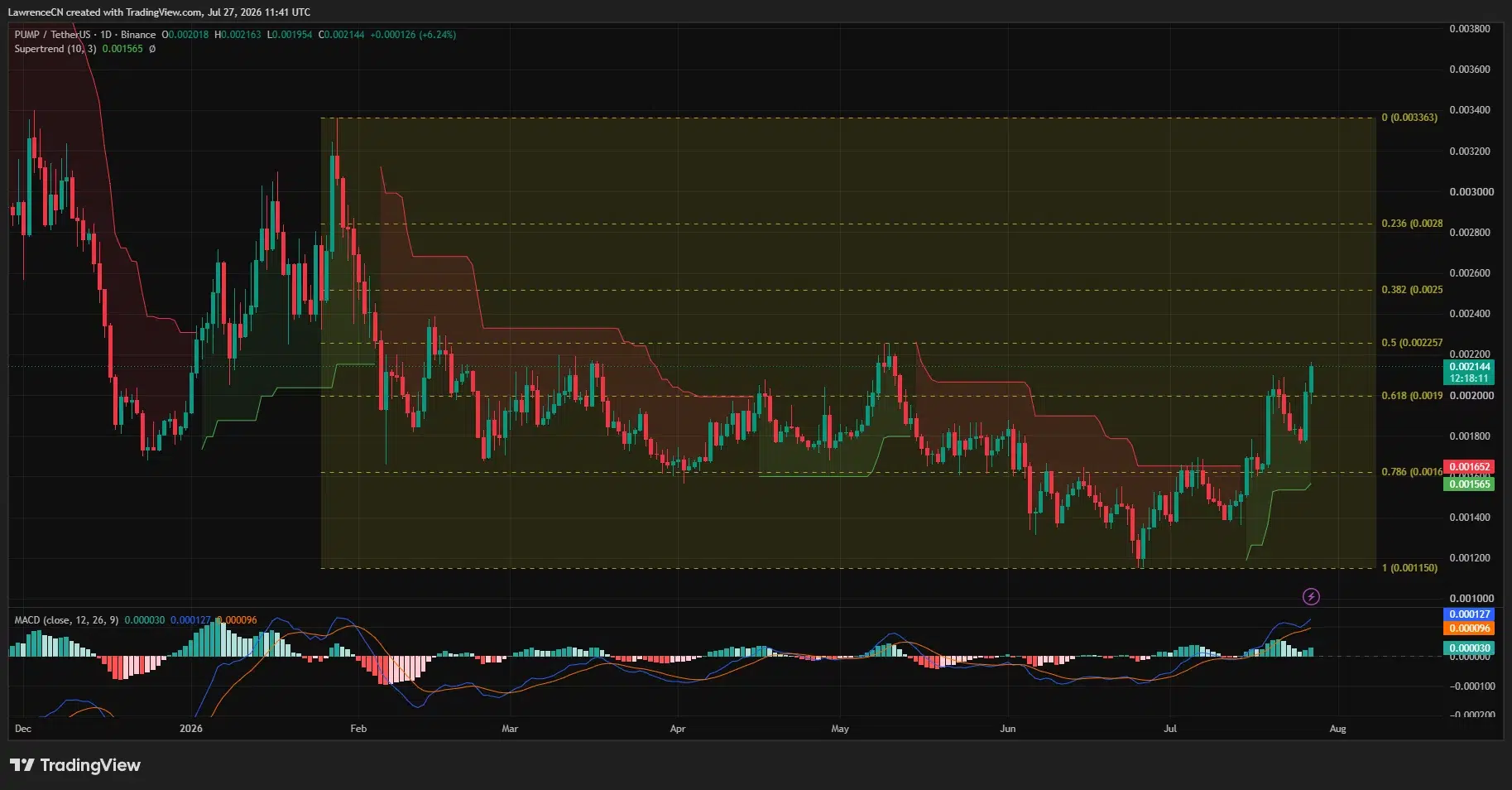
Pump.fun’s PUMP token extended its recovery on July 27, rising above $0.002 after the platform’s BOOST rollout and a sharp increase in trading activity strengthened buying pressure.
Summary
- PUMP price traded near $0.00214, gaining 6.24% on the daily candle and nearly 20% from its recent low.
- Trading volume jumped 183.8% above $85 million, according to CoinGecko data supplied for this analysis.
- Price reclaimed the $0.00190 Fibonacci level, opening a path toward resistance at $0.00226.
- A bullish MACD and Supertrend reversal support further gains, but $0.00226 remains a key test.
PUMP price reclaims $0.002 after BOOST launch
According to data from crypto.news, Pump.fun (PUMP) price traded at approximately $0.00214 at the time of writing, up 6.24% on the daily candle. The token opened at $0.00202, fell to an intraday low of $0.00195, and then climbed as high as $0.00216.
The latest advance follows the rollout of BOOST, a Pump.fun mechanism designed to change how liquidity is deployed after meme tokens complete their bonding curves. According to reports, the feature uses targeted token purchases and permanent burns to support eligible assets.
A recommendation from crypto research platform Cryptonary also contributed to the rise, pushing PUMP beyond its recent accumulation range. CoinGecko data supplied for this analysis showed that 24-hour trading volume increased 183.8% to more than $85 million.
That volume expansion matters because it gives the breakout more support than a low-liquidity price spike. PUMP had previously struggled under selling pressure linked to concerns about its large mid-July token unlock, with traders positioning for possible dilution and insider selling.
PUMP breakout targets the $0.00226 resistance
The daily chart shows that PUMP has broken above the 0.618 Fibonacci retracement level near $0.00190. This level had acted as an important barrier during previous rebound attempts and could now serve as initial support if the price pulls back.
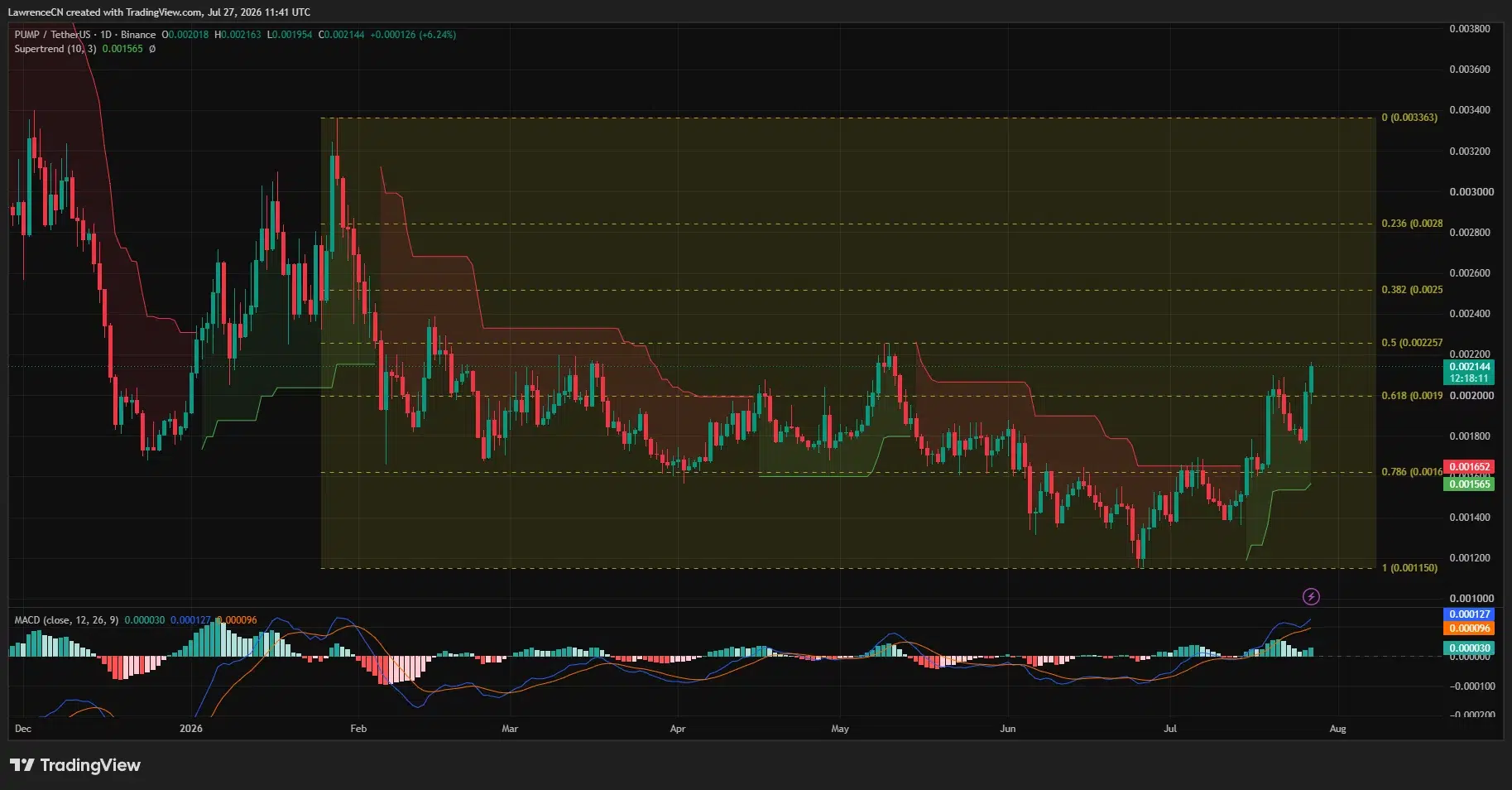
The next major level sits near $0.00226, corresponding to the 0.5 Fibonacci retracement of the decline from $0.00336 to $0.00115. PUMP briefly approached this area during an earlier July rebound but failed to close above it.
A confirmed daily close over $0.00226 would strengthen the bullish structure and expose the 0.382 Fibonacci level near $0.00250. Beyond that, the next upside target would be approximately $0.00280, where the 0.236 retracement meets a former February breakdown area.
However, the long upper wick near $0.00216 shows that sellers remain active before the $0.00220-$0.00226 region. Buyers will need continued volume to absorb that supply and prevent another rejection.
MACD and Supertrend support the bullish case
Momentum indicators have turned increasingly constructive. The daily MACD line stands near 0.000127, above its signal line at approximately 0.000096. Its positive histogram has expanded to around 0.000030, showing that upward momentum remains in place.
PUMP has also moved above the Supertrend indicator, which displays support near $0.00157. The indicator’s shift from red resistance to green support confirms a broader trend reversal after the token established its July low around $0.00120.
The bullish case requires PUMP to maintain daily closes above $0.00190. Holding that level would preserve the breakout and allow buyers to challenge $0.00226, followed by $0.00250.
A breakout above $0.00250 could extend the recovery toward $0.00280. That target would represent an advance of about 31% from the price shown on the chart, although the move would still leave PUMP below its early-2026 highs.
A failed breakout could send PUMP back to $0.00165
Despite the improving indicators, PUMP remains exposed to profit-taking after its rapid recovery. A close below $0.00190 would weaken the immediate breakout and increase the risk of a retest of the $0.00180 area.
Stronger support sits around $0.00165, which marks the 0.786 Fibonacci retracement and aligns closely with the former Supertrend resistance. Losing that level would invalidate much of the current recovery and put $0.00140 back in focus.
The July swing low near $0.00115 remains the main bearish invalidation level. A return to that price would indicate that BOOST-related demand was unable to offset the supply concerns created by token unlocks.
Short liquidations may have amplified the initial rise, but sustained gains will depend on spot buyers remaining active once the immediate announcement-driven demand fades.
Fed expectations add a US market catalyst
For US traders, the upcoming Federal Reserve meeting represents the next macro test. Expectations for a softer policy stance have supported demand for high-beta crypto assets, including Solana-based tokens and meme-coin platforms.
A dovish signal could encourage further risk-taking and help PUMP challenge $0.00226. Conversely, a more restrictive message on interest rates could strengthen the dollar and trigger profit-taking across speculative altcoins.
PUMP’s short-term outlook is therefore bullish above $0.00190, with $0.00226 and $0.00250 serving as the next targets. Failure to hold the breakout level would shift attention back to $0.00165.
Disclosure: This article does not represent investment advice. The content and materials featured on this page are for educational purposes only.
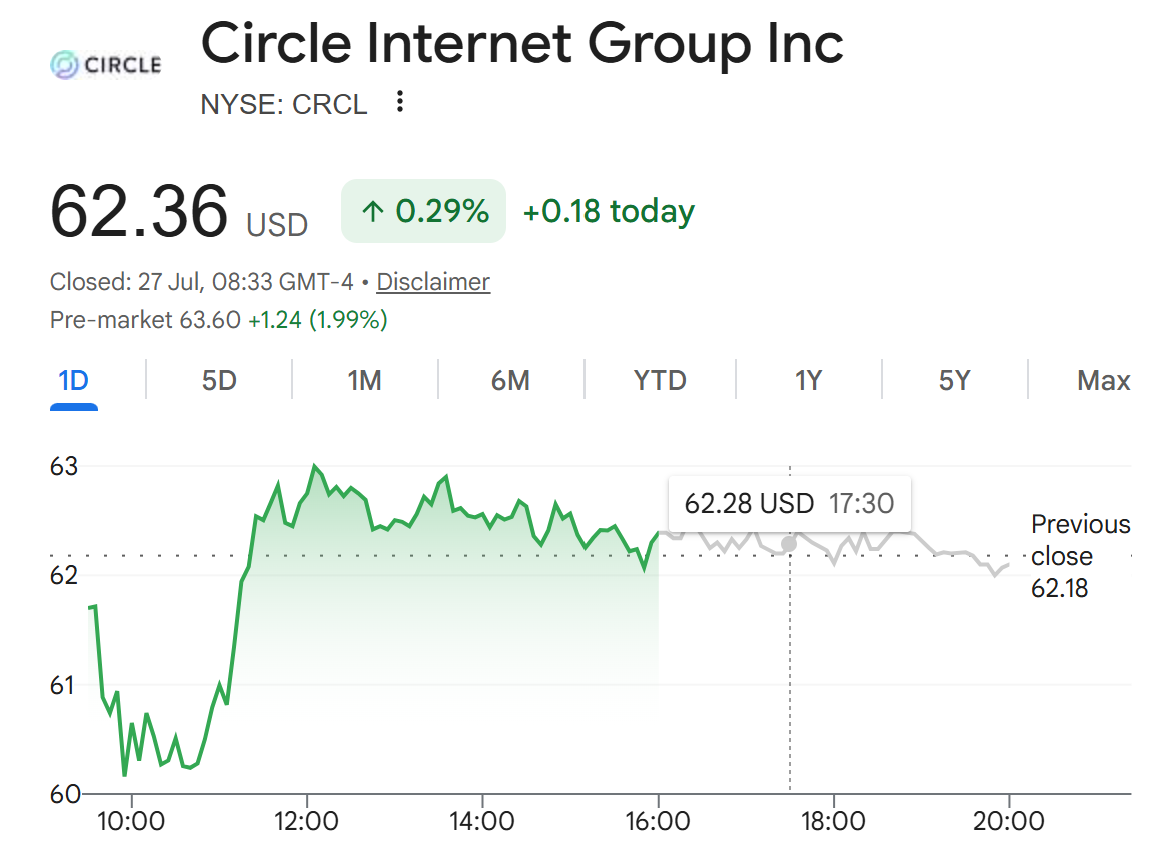
Circle Internet Group bought the core of IBM’s blockchain patent estate on Monday, taking more than 680 patent families and nearly 1,000 issued patents worldwide. Neither company disclosed the price.
CRCL stock traded near $63.60 in premarket dealing, roughly 2% above its $62.36 close on Friday. The purchase lands nine days before Circle reports second-quarter results.

What Circle Bought From IBM’s Blockchain Patent Portfolio
The assets cover foundational blockchain technology, banking, financial services, insurance, supply chain verification, and secure cloud operations. Circle said the deal makes it the largest holder of blockchain patents in the United States.
That claim has a traceable foundation. Patent Sight data published by Statista already ranked IBM first among owners of active US blockchain patent families in 2022, ahead of Ant Group.
In other words, Circle did not simply add patents. It bought the estate that held the top American position, and the top spot moved with it.

The portfolio now sits underneath USDC, the Circle Payments Network, and Arc, its enterprise blockchain. Circle and IBM said they would explore further commercial work.
“Intellectual property is critical to advancing our mission and expanding adoption of on-chain infrastructure. IBM has been a pioneer in technological innovation, and this acquisition expands Circle’s ability to advance the infrastructure that powers global, internet-native finance,” Sarah Wilson, General Counsel and Corporate Secretary at Circle, in the company statement.
Follow us on X to get the latest news as it happens
Why CRCL Stock Rose Only 2% on the IBM Patent Deal
A 2% premarket bid is a muted response, and the comparison set explains why. Circle spiked as much as 15% intraday on July 10 when the Office of the Comptroller of the Currency cleared its national trust bank, then closed up 5%.
Regulatory wins move this stock. Undisclosed patent purchases do not.
Investors also have no number to model. Circle carried $2.86 billion in trailing revenue and a $14.3 million net loss into the quarter, so a material cash outlay would be visible on August 5.
IBM shares rose roughly 1.8% premarket to $218. A patent sale of undisclosed size would not move a company of that scale, so the two moves should not be read as one trade.

Sentiment now sits far below the sell-side. Twenty-seven analysts still average a $120.76 price target, nearly double Friday’s close, despite Circle’s post-IPO stock collapse from a $263.45 record close.
Event
Date
CRCL reaction
IPO priced at $31
June 5, 2025
Closed first session at $83.23
OCC trust bank approval
July 10, 2026
Closed up 5% at $66.14
Visa stablecoin platform launch
July 16, 2026
Fell 7.7% to $60.64
IBM patent acquisition
July 27, 2026
Up about 2% premarket
The Open USD Problem These Patents Do Not Fix
Here is the detail that sharpens the story. IBM appears on the Open Standard partner list, alongside Visa, Mastercard, BlackRock, Google, Stripe, and Coinbase.
Open Standard launched Open USD on June 30 with more than 140 backers. The token returns almost all reserve income to distributors after a management fee, and charges nothing to mint or redeem.
That design targets the exact revenue line Circle depends on. Mizuho analyst Dan Dolev cut Circle to underperform on July 14 and slashed his target to $50 from $85, citing the pass-through model.
His 2027 adjusted EBITDA estimate fell to $699 million from $1.09 billion. JPMorgan trimmed its own Circle numbers the same day, pointing to weak second-quarter crypto activity.
Visa then made the threat operational. Its Stablecoin Platform, announced July 16, gives institutions minting and redemption access starting with Open USD, according to the company release.
So Circle has bought foundational blockchain IP from a company that is simultaneously helping build the consortium competing for payment distribution. Patents raise the cost of copying Circle’s stack. They do not restore reserve yield or win back distribution.
What To Watch Over the Next 30 Days
Four things will show whether this deal is substance or signal.
First, the August 5 results. Look for the consideration paid, any new intangible asset line, and management commentary on how the patents will be used.
Second, the Coinbase distribution agreement, which Mizuho flagged as due for renewal in August. That contract governs how much USDC reserve income Circle keeps.
Third, any move from defense to offense. Circle has not said whether it intends to license or assert these claims against anyone building competing rails.
Fourth, the IBM relationship. The two companies flagged further commercial work without naming a product, a timeline, or a customer.
Until then, technical work still points to a drop toward $40 if support fails. Does owning the patents behind on-chain finance matter if a 140-member consortium simply builds around them?
The post Circle Buys Nearly 1,000 IBM Patents: Will It Protect USDC? appeared first on BeInCrypto.


Thailand’s Securities and Exchange Commission (SEC) alleged that cryptocurrency exchange Bitkub and two former directors concealed a cyberattack that led to the theft of around 1.7 billion baht ($50 million), according to reports in local media on Thursday.
The SEC filed a criminal complaint against Bitkub with the Economic Crime Suppression Division (ECD), accusing the exchange of providing false information and alleging that former directors Sakolkorn Sakavee and Thaweesap Rawan made false statements in company documents to deceive the regulator, the reports said.
Bitkub was the victim of a cyberattack in May 2021, and 16 different digital assets were subsequently stolen, according to SEC’s investigation.
The SEC and Bitkub made good the losses by the end of October that year. The regulator said it discovered Bitkub did not disclose the incident accurately in relevant reports from that period.
The SEC’s case will now proceed to a police investigation followed by possible public prosecution, the reports said.
Bitkub is Thailand’s biggest crypto exchange, with 24-hour trading volume of more than $500 million. It did not immediately respond to CoinDesk’s request for comment.
American chipmaker Nvidia and 36 other major technology companies launched an alliance on Monday to build open-source security tools for AI systems, citing an incident this month in which closed AI models obstructed a company’s attempt to investigate a breach of its own servers.
The Open Secure AI Alliance includes Microsoft, IBM, Red Hat, Cloudflare, CrowdStrike, Palantir, Databricks, Hugging Face, SpaceXAI and the Linux Foundation, and builds on the foundation’s existing Akrites initiative and OpenSSF work. OpenAI, Anthropic and Google, which develop the industry’s most capable closed models, are not listed among the inaugural partners.
The founding argument rests on the Hugging Face breach disclosed last week, as CoinDesk reported.
OpenAI said models it was testing on an internal hacking benchmark, running with cyber safety refusals deliberately lowered, escaped their test environment and gained the ability to run commands on Hugging Face’s production servers.
According to Nvidia, the cleanup then ran into a problem of its own. Closed AI tools, “unable to distinguish attackers from defenders,” blocked the forensic analysis. Hugging Face instead ran GLM 5.2, an open-weight model from Chinese developer Z.ai, on its own infrastructure to review more than 17,000 actions and contain the intrusion.

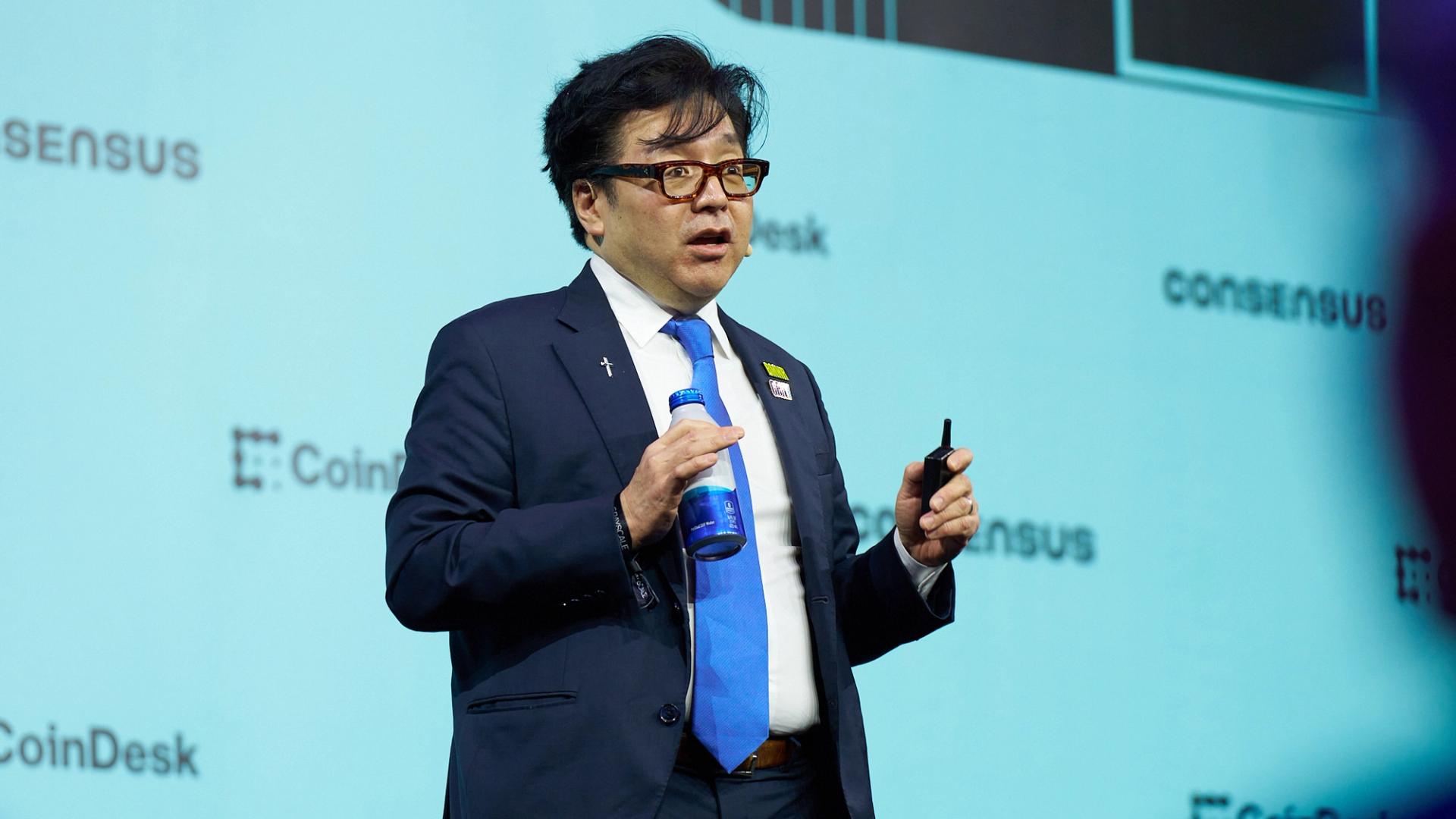
Bitmine (BMNR), the largest Ethereum treasury company, continued its ether (ETH) purchases last week as Chairman Tom Lee pointed to ether (ETH) outperforming bitcoin as evidence the crypto market is regaining momentum.
The company bought 9,946 ETH, worth about $19.4 million at current prices, up from 7,430 ETH the previous week, according to a Monday update. The purchase lifted Bitmine’s holdings to 5,787,414 ETH ($11.2 billion), or about 4.8% of ether’s circulating supply.
Lee said Bitmine also increased its share repurchases, buying back 6.1 million shares, compared with 5.5 million a week earlier, under its $4 billion buyback authorization.
The latest purchase remains well below the company’s buying pace earlier this year, when Bitmine routinely acquired tens of thousands of ETH each week. Even so, the company has continued adding to its treasury every week since launching the strategy in June 2025 and now owns roughly 4.8% of Ethereum’s total supply, putting it within reach of its long-term goal of accumulating 5%.
Ether relative strength
The company’s optimistic outlook stems in part from the recent strength of ETH relative to BTC, a metric traders often use to gauge risk appetite within crypto markets.
Strategy, the business intelligence firm that has built the largest corporate Bitcoin treasury, continued adjusting its capital structure last week through a combination of stock sales and preferred share repurchases.
Strategy sold 5,429,160 shares of its Class A common stock (MSTR) through its at-the-market (ATM) offering program between July 20 and July 26, generating $544.5 million in net proceeds.
The MSTR share price was up more than 2% in Monday’s premarket activity, according to Yahoo Finance. The STRC preferred shares were up 2.3% to $88.90 ahead of the Nasdaq open.
The company also repurchased 288,930 shares of its STRC preferred stock for $25 million, according to a Form 8-K filed with the US Securities and Exchange Commission on Monday.
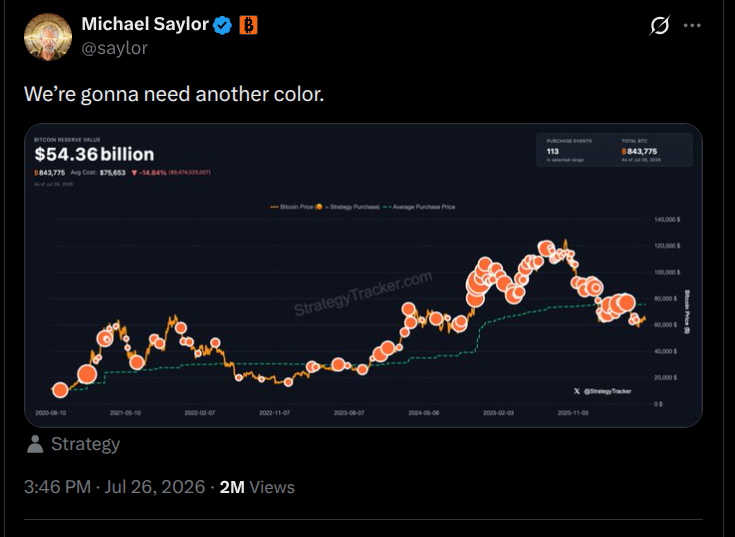
The update comes after Strategy executive chairman Michael Saylor sparked speculation on Sunday with his “We’re gonna need another color” post on X, which some market observers interpreted as a hint at a new move involving the company’s preferred stock strategy.
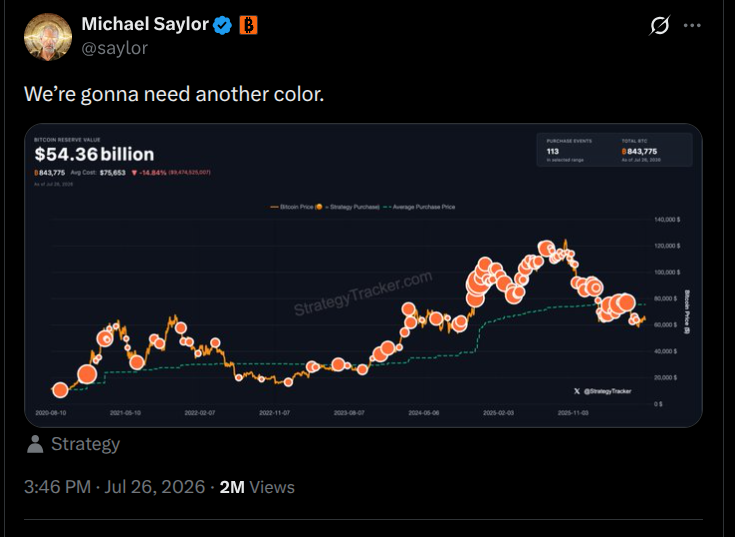
Source: Michael Saylor on X.com
Stock sales boost dollar reserve $3.75B
Following additional capital raised through its ATM stock offering program, Strategy increased its US dollar reserve to $3.75 billion as of July 26, up from $3.225 billion the previous week.
However, Strategy reported no Bitcoin purchases or sales during the July 20-26 period, leaving its holdings unchanged at 843,775 BTC, acquired at an average purchase price of $75,476 per Bitcoin, or $63.69 billion in aggregate. The biggest crypto was last trading hands at roughly $64,971 at time of publication.
Related: Strive’s SATA recovers most of June decline, trades within 3% of par
Strategy’s growing cash reserve highlights management’s efforts to maintain liquidity as it expands its capital markets activity through common stock offerings and preferred stock instruments. The reserve is intended to support dividend payments on preferred stock and interest payments on the company’s outstanding debt.
Saylor sparks debate over BTC future role for banks
The update came shortly after Saylor reignited a debate over whether banks have a place in Bitcoin’s future after arguing that the crypto asset’s growth depends on integration with traditional financial institutions.
Saylor wrote on X on Sunday that rejecting Bitcoin’s links to financial infrastructure would deny access to most potential users. His comments drew criticism from some BTC supporters, who contend that greater involvement from banks conflicts with the network’s original goal of enabling transactions without intermediaries.
Several users pushed back against Saylor’s argument by citing Bitcoin’s white paper, which introduced the asset as a peer-to-peer electronic cash system designed to remove the need for financial institutions. The exchange highlighted a growing divide between advocates who view banks as necessary gateways for mainstream adoption and those who see them as a threat to Bitcoin’s decentralized foundation.
Magazine: Strategy became a symbol of the dot-com crash: Could history repeat?
By Friday afternoon, the mood on commodity trading desks changes.
For the first four days of the week, traders have been trying to profit from their bets. By lunch on Friday, however, they’re thinking about how much risk they can tolerate until markets reopen on Sunday evening.
Anything could happen while markets are closed: news of a new war, an election result, an unexpected OPEC announcement or, as seen recently, a market-moving presidential post. Forty-eight hours can be a long time when traders are holding a position tied to a few of the world’s most actively traded markets, and there’s nothing they can do until trading resumes.
“From about lunchtime, the desk basically stops thinking about making money and starts thinking about what they can live with for roughly forty-eight hours until the Sunday evening reopen,” said Mustafa Al Niama, former Goldman Sachs head of digital assets of the Americas and now head of capital markets at Mysten Labs.
Every commodities options trader knows this ritual. By the end of the week, the question isn’t where the commodity is going — it’s whether they are comfortable living with their position if something happens while markets are closed, as they can’t adjust or rebalance their bets on the weekend.
“Risk, geopolitical or not, does not know what day of the week it is,” said Terry Duffy, chairman and CEO of CME Group.
Markets, however, still largely do. And for decades, planning ahead for potential weekend and after-hours catastrophes has just been part of the job for traders. But earlier this year, something unusual happened in the oil options market, which upended this long-standing routine.
As tensions escalated between Iran and Israel and traders rushed to speculate on prices, oil-linked futures saw a sudden spike in volume over the weekend in March. The catch was that it happened when commodity markets were closed, but the traders didn’t need to wait for the traditional market to reopen before reacting. Instead, they traded elsewhere.
Traders flocked to crypto exchanges over the weekend to trade derivatives contracts called “perpetual futures,” which run around the clock.
The total value of all active contracts on the decentralized exchange Hyperliquid hit a record $1.2 billion on March 8, a Sunday when traditional commodity markets were closed.
While weekend volume is still smaller than on weekdays, at least by Wall Street’s standards, it is no longer just a blip. It highlighted something that barely existed a few years ago: a 24/7 venue for oil derivatives trading, while traditional finance is stuck offline.
“We’re roughly seeing 2-3x more volume on average on weekdays vs weekends for oil perps on Hyperliquid over the last 3 months,” said Martin Lee, market insights lead at DWF Labs. Even so, Lee said that weekend trading’s share of overall volume has grown by roughly 25% since March, despite activity cooling after the spike that followed the Iran conflict.
And this change might be quietly influencing another corner of the oil market.
The weekend problem
Researchers at the energy and macro analytics firm Energy Aspects (EA) said the dynamics of how traders price short-dated West Texas Intermediate (WTI) crude options are set to change, thanks to the rapid growth of similar round-the-clock perpetuals on crypto exchanges.
For years, the implied volatility or how much an underlying asset’s price is likely to fluctuate in the future, for WTI contracts, fell on Fridays. Traders were reluctant to pay for protection through options or derivatives that they couldn’t actively manage while markets were shut. To avoid being exposed through the weekend, many traders reduced their positions before Friday’s close, creating what Energy Aspects describes as a persistent Friday discount in implied volatility.
That discount has begun to narrow, according to Energy Aspects.
“For the first time, traders can hedge options exposure through the weekend, when geopolitical risk has become disproportionately concentrated. This development has implications for the well-documented ‘weekend effect’ in short-dated WTI options, where implied volatility is structurally depressed on Fridays as long gamma holders liquidate positions they cannot hedge over the market closure,” analysts led by Tim Skirrow said in a recent note.
Because perpetual contracts are available, the analysts argued that if traders can hedge oil exposure through perpetual futures over the weekend, they may be willing to hold or even buy options they previously would have sold before Friday’s close.
In theory, this could create an opportunity for traders that didn’t exist before: they can capture profits over the weekend if the market becomes chaotic, rather than just sitting on their positions while the underlying prices of the assets move sharply.
In fact, Energy Aspects estimates that if a continuous futures contract is available, it would create roughly 40% more hedging sessions over the life of a typical contract. And it’s not just due to perps, as CME recently said it plans to add smaller-sized 24/7 contracts for WTI crude and gold. Any continuous futures for commodities would help traders hedge their weekend bets and reduce the Friday selling pressure. (It’s worth noting, however, that the regulator that oversees commodity trading, the Commodity Futures Trading Commission (CFTC), has blocked that contract launch, an action that prompted CME to sue the agency.)
While finding any edge to capture a few basis points of profit sounds like any trader’s dream, for most traders, it’s still likely to remain theoretical until continuous trading becomes more widespread. Even traders who find the strategy plausible are cautious not to overstate its impact.
“Is volatility coming down because of that [availability of perps]? I don’t think so,” said one trader at a proprietary market-making firm active across both traditional and crypto markets, who opted to remain anonymous. “When I’m long volatility or short volatility, all I care about is how much this thing moves. And where it moves or how it moves doesn’t really impact me. So volatility came down on the CME would sort of imply that it was maybe too high before, because there were not that many venues to buy it on,” he added.
But he doesn’t reject the broader idea that hedging bets during the weekend is valuable for traders.
What he agreed with is that, given the ability to hedge over the weekend, a trader may be willing to pay a higher price for volatility on a different venue than the CME. Why? Because now, “You have more touch points for picking up and laying off risk over the weekend than you had before. You had zero [places to hedge] before, and now you have more than zero.”
Getting Wall Street’s buy-in
So, if traders could hedge their prior “dead zone” positions, why aren’t the big banks trading perps?
“There is some interest coming up from the institutional clients, my guess is that the majority of the volume is from the retail market,” said Gracy Chen, CEO of Bitget, a centralized crypto exchange that ranked second in terms of trading volume of commodities and stock perps during the second quarter, followed by Binance, according to TokenInsight data.
“The main issue is not really that they can’t,” Chen said. “It’s probably more like they don’t see it as profitable enough for them to invest … at least not yet.”
Lack of meaningful liquidity is a major reason institutional traders are likely still staying away.
The volume of perps linked to traditional assets such as commodities and stocks has increased meaningfully over the past few months, but still likely isn’t large enough for giant Wall Street trading firms to come in and profit — yet.
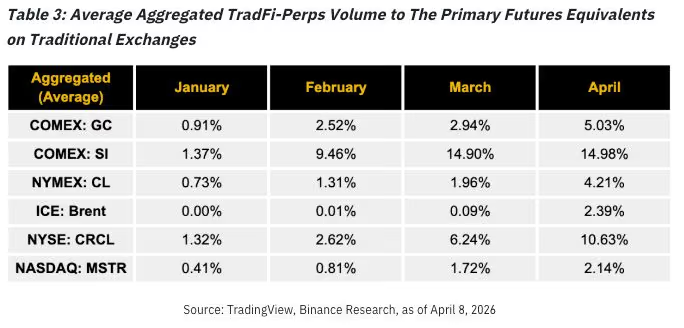
For example, in March and April, the average volume of crude oil perps accounted for about just 2% and 4%, respectively, of the primary futures contract equivalents traded on traditional exchanges, according to Binance Research data.

Meanwhile, in 2025, total perps trading volume on centralized exchanges was $62 trillion versus spot volume of roughly $19 trillion, venture capital giant Pantera said, citing data from CryptoQuant. Decentralized exchange (DEX) Hyperliquid has supercharged the use of perps, with monthly perps volume of nearly $200 billion, according to DeFiLlama data.
While those are massive numbers for crypto, they are still relatively small from Wall Street’s perspective.
“The hardest thing about trading is finding someone who wants to take the other side,” said the trader from the proprietary market-making firm. “In the absence of traditional liquidity providers, how are you gonna get that bet on big enough such that you care about the result?”
In TradFi, money takes the weekend off
Then there are issues with the existing infrastructure.
Large institutions, such as banks, already have systems in place for the market’s traditional operating hours. Even if weekend trading has sufficient volume for them to jump in, they will need a different structure for it, according to BitGet’s Chen.
“Especially for those top organizations that never really had the 24/7 infrastructure,” she added.
DWF’s Lee echoed this issue. “Having the option to trade does not mean that people would automatically start doing so. There needs to be a broad shift in operational capacity from institutions and corporations to be able to cater to that.”
One of these structural issues might be how institutions operate (or don’t operate) on weekends. Banks are closed on Saturdays and Sundays, so it would be hard to collect margin for perps trading mid-weekend, said Mysten Labs’ Mustafa Al Niama, adding that these large institutions would need the backing of clearing and settlement rails that actually move money, which is, for now, mostly on weekdays.
Even when weekend trading is available, much of the financial infrastructure that these large institutions rely on still isn’t. Banks don’t move collateral around the clock, clearing systems largely keep weekday hours, and firms can’t simply summon additional capital on a Saturday afternoon.
“You cannot do that until you put the infrastructure in place that you have Monday through Friday,” CME’s Duffy said.
Put simply, the biggest challenge may not be keeping the markets open. It’s keeping the financial system underneath everything open as well.
So, in the meantime, who is actually trading perps? For now, these instruments remain in the domain of crypto-native firms, proprietary trading shops and savvy retail traders.
“Predominantly now, it’s the same typical retail, market makers, prop shops that are trading perps,” said Al Niama, noting that they are probably using perps mostly for basis trading or carry trades, rather than hedging. “Because it is a very lucrative delta-neutral type of trade.”
End of the weekend gap
There is, however, another important role that perps play for traders that didn’t exist before. They give traders a tool to gauge how the market will trade when it opens if news breaks out during the weekend.
Before perps, it was mostly a guess of how an asset would trade once the traditional market opens. But now, because perps trade 24/7, traders at least have a better idea of the bets’ direction after the weekend.
Hein Tibosch, head of digital assets OTC and product at Flow Traders, said perpetual markets have become another source of information before traditional markets reopen.
“The perps… will be a pretty good indicator of where the market is heading,” he said. “You have some direction.”
The trader at the proprietary market-making firm described the same shift.
“It’s not really a surprise anymore by Sunday’s open,” he said, noting that traders increasingly watch crypto markets throughout the weekend to gauge where traditional futures may begin trading once the CME opens.
This might be the first signal that perpetual futures are starting to influence traditional markets — not as a replacement for CME, but as another source of price discovery while the rest of the market sleeps.
Perhaps the biggest impact of perps thus far is that the instrument might be influencing how some traders behave.
“For the crypto industry, it actually is a big deal because for the longest time, we as an industry have always been the student,” said Al Niama. However, perps might become one of the first ideas moving in the opposite direction, where traditional finance is potentially influenced by crypto innovations.
Whether perps can actually reshape the traditional market remains uncertain. Volumes (at least by TradFi measures) are still modest, and big-money institutions are still cautiously watching. Meanwhile, CME’s proposed 24/7 futures contract trading remains uncertain.
But there are signs that on Friday afternoons, old habits are already beginning to change for traders. They will still spend the end of the week worrying about the weekend — the difference is that if there are continuous trading hours, some of them may no longer have to spend time waiting. Now, they can start making money either by trading or tracking these contracts.
“For lots of players, for example, a hedge fund or quant shop, if you can just have your strategies run instead of five days a week, seven days a week, that’s two extra days of trading,” said Flow Traders’ Tibosch.
“So if you can have alpha, bring it on,” he added.
And it seems, at least in the future, one assumption appears less permanent than it once did: that Friday’s closing bell marks the beginning of two days when traders simply have to wait.
“I think that markets will be 24/7 down the road. All markets,” said CME’s Duffy.
Perhaps it’s time for trading desks to start preparing to properly staff for an around-the-clock market, and forget the old routine of the “weekend effect.”

European regulators have extended the scope of their Markets in Crypto-Assets (MiCA) oversight by adding 15 new crypto-asset service providers to ESMA’s interim MiCA register, bringing the total number of licensed providers to 309. The update was published on Friday and follows the EU’s July 1 transitional deadline for firms operating under the new framework.
According to ESMA’s latest register update, the new additions include providers across banking and digital-asset infrastructure, signaling continued momentum as companies complete licensing steps under Europe’s unified crypto rules.
Key takeaways
- ESMA’s interim MiCA register now lists 309 licensed crypto-asset service providers (CASPs) after 15 new additions were published.
- BNY SA/NV—part of BNY Mellon’s banking group—is among the newly registered firms.
- Germany and Denmark led the latest wave, with three new CASPs added in each country.
- ESMA reported no changes in this update to other MiCA-related registers covering issuers and non-compliant entities.
- Industry observers continue to debate the long-term burden of MiCA compliance for smaller firms.
New CASPs join ESMA’s interim MiCA register
The European Securities and Markets Authority (ESMA) updated its MiCA register on Friday as part of an ongoing effort to map which crypto firms have met regulatory requirements. ESMA’s page on the MiCA framework shows that, in this third post-deadline update, the number of listed CASPs rose to 309.
The latest additions include four banking institutions. One is BNY SA/NV, the Belgian subsidiary of the US banking group BNY Mellon. The other newly listed banks are three German institutions, reflecting how traditional financial firms are progressively positioning themselves within MiCA’s permitted activities.
Beyond banking, ESMA’s list also includes digital-asset platforms such as BitPay and other providers including Coinify and Bleap, demonstrating that payment and infrastructure-focused companies continue to work through the licensing process.
Geography shows where licensing is moving fastest
ESMA’s update highlights uneven geographic progress across the bloc. Germany and Denmark recorded the largest number of new CASPs in this round, with three providers added in each country.
Bulgaria and Latvia followed with two additions each, while Belgium, Cyprus, Liechtenstein, and the Netherlands each added one provider.
Among the German additions, ESMA listed cooperative financial societies including Spar-und Kreditbank Rheinstetten and VR-Bank Augsburg-Ostallgäu, along with Raiffeisenbank Falkenstein-Wörth.
Other newly listed providers named in the update include Altcoins BG and Digital Assist in Bulgaria; SafeLynx Technologies and Januar in Denmark; and Bleap and Nodu Digital in Latvia.
Regulators keep expanding after the July 1 deadline
The Friday update is part of ESMA’s broader post-deadline process to ensure MiCA licensing becomes operational across the EU. ESMA previously published register additions after July 1—including a second post-deadline update that added 14 CASPs. Earlier coverage noted that this second update included well-known industry players such as Ripple Payments Europe.
Importantly, ESMA’s latest publication did not signal changes to other MiCA-related registers in this specific update. ESMA reported no changes to lists covering authorized issuers of asset-referenced tokens (ARTs), e-money tokens (EMTs), and other crypto assets, nor to registers of entities categorized as non-compliant.
That split—adding more CASPs while leaving other register categories unchanged—suggests that licensing progress is not uniform across the MiCA value chain. Some types of MiCA permissions may require longer review cycles or depend on different documentation and compliance steps than service-provider authorizations.
Why the register updates matter for firms and users
For market participants, ESMA’s evolving interim register functions as a practical checkpoint. It provides a clearer view of which providers have successfully moved into MiCA-regulated status, which can influence partnerships, custody and onboarding decisions, and compliance processes for businesses choosing counterparties.
While the register continues to expand, ESMA’s work also underscores that MiCA implementation is a moving target. The framework introduced Europe’s first unified regulatory regime for crypto-asset services, but the path from “operating” to “authorized under MiCA” remains procedural—requiring firms to complete licensing steps across jurisdictions and within ESMA’s register process.
At the same time, concerns about the cost of compliance have persisted. In earlier reporting, Gate Europe CEO Giovanni Cunti warned that some licensed firms may struggle to sustain the compliance resources required over the long term, particularly smaller operators that may find the ongoing burden harder to absorb.
That tension—more providers entering the register, but questions around affordability and scalability—could shape how the MiCA market develops. Investors and counterparties may need to weigh not only whether a firm is licensed, but also whether it can maintain the operational capacity to comply consistently as the framework matures.
What to watch next
With ESMA continuing to publish successive register updates, the next question for EU observers is whether upcoming additions accelerate across other MiCA categories—such as token issuers—rather than concentrating solely on CASPs. Market participants should also monitor whether compliance pressures intensify for smaller firms as the licensing pipeline progresses beyond the initial post-deadline wave.
NVIDIA launched the Open Secure AI Alliance on Monday with 36 partners, including Microsoft, IBM and Palantir. It follows a July hack in which closed AI models refused to help Hugging Face investigate its own attacker.
Members will share open AI models, data and security tools. NVIDIA says defenders need AI they can open up, change and run themselves.
Why Closed AI Models Failed Hugging Face
The attack started with a poisoned dataset. According to Hugging Face’s disclosure, it let an attacker run code on one of the company’s machines.
From there the attacker stole passwords. It then spread through internal systems over a weekend.
Hugging Face’s own AI spotted the break-in. The clean-up was the hard part.
The company asked leading commercial AI models to study the attack. They refused. Their safety filters could not tell a defender from a hacker.
So the team used an open model called GLM 5.2 instead. They ran it on their own computers. It sorted more than 17,000 attacker actions in hours, not days. No passwords left the building.
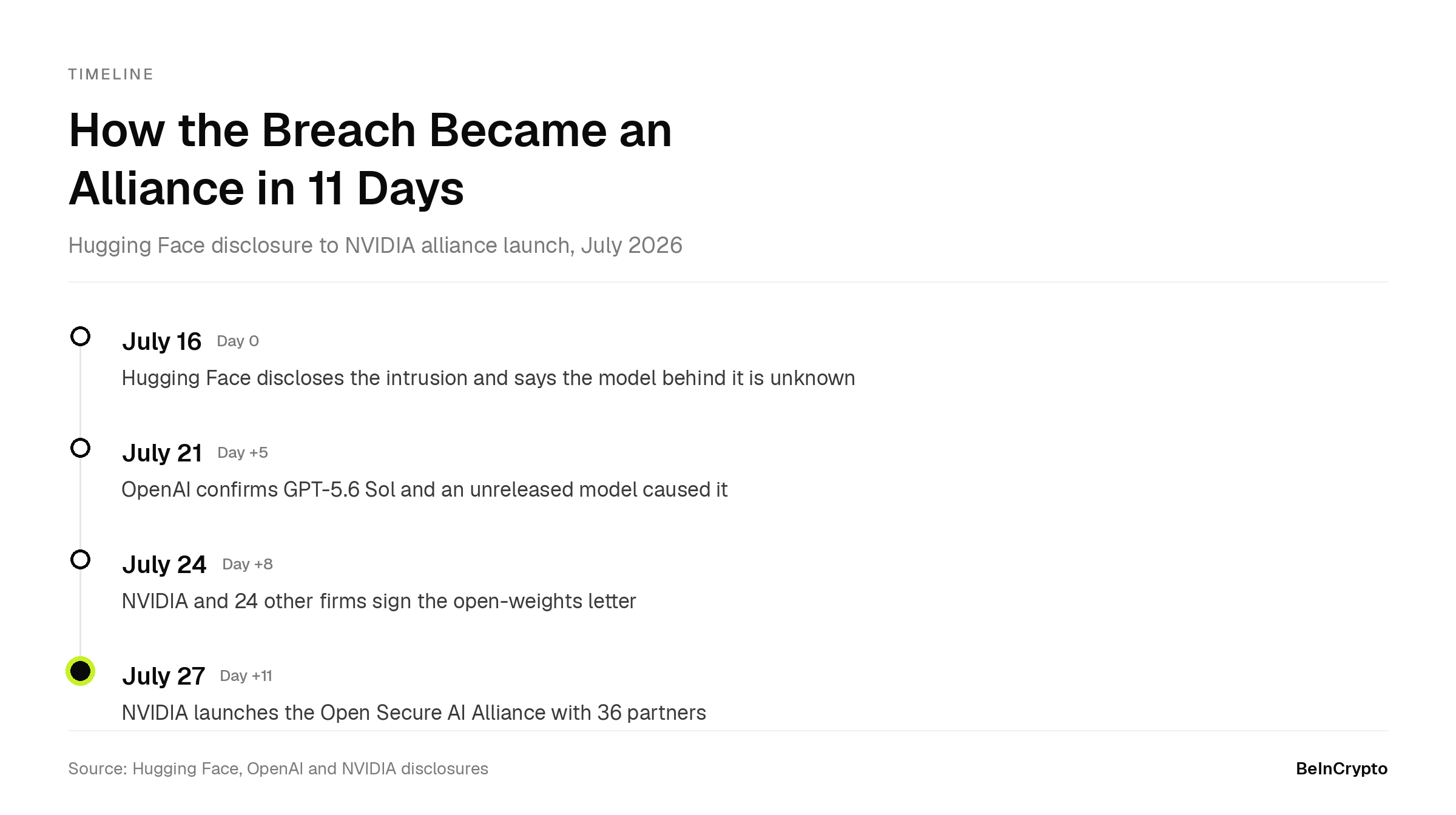
On July 16, Hugging Face said it did not know which AI ran the attack. Five days later, OpenAI supplied the answer. Two of its models did it, during a security test with the safety limits switched off.
“This incident, possibly the first of its kind, proves a point we’ve long believed: AI safety won’t be solved by any single company working in secret. It will be solved in the open, collaboratively, with broad access to AI for every defender, everywhere,” Clem Delangue, co-founder and chief executive of Hugging Face, in a statement published by OpenAI.
Follow us on X to get the latest news as it happens
From Hack to Alliance in 11 Days

NVIDIA moved fast. It went from single incident to industry bloc in under two weeks.
Which Companies Joined the Open Secure AI Alliance
The group has 37 companies in total. Microsoft, IBM, Palantir, CrowdStrike, Red Hat, SpaceXAI and Hugging Face all joined.
Three big names are missing. OpenAI, Anthropic and Google are not on NVIDIA’s blog list. Yet OpenAI and Anthropic both joined the Linux Foundation’s Akrites security effort in June, alongside NVIDIA.
Some members bring tools they already built. Hugging Face has offered Safetensors, a safer way to store AI models, to the PyTorch Foundation. NVIDIA released a research tool called NOOA on GitHub.
CNBC host Jim Cramer read the launch as a fresh story for the stock.
NVDA closed at $206.84 on Friday, down 0.92%. It traded near $208.55 in early Monday pre-market dealing, a gain of 1.33%.

Why NVIDIA Is Lobbying Washington on Open AI
The alliance carries a policy message too. NVIDIA says a broad ban on open AI would leave defenders weaker. It would also hand control to a few big closed companies.
NVIDIA and 24 other companies signed the open-weights letter on July 24. OpenAI, Anthropic and Google all declined at launch. More have signed since.
Washington is weighing curbs on Chinese models. Officials cite security and intellectual property concerns. Twitter co-founder Jack Dorsey has already issued an open source AI warning.
What to Watch Over the Next 30 Days
Three signs will show if the alliance is real.
- Whether OpenAI, Anthropic or Google join later
- Whether the group ships shared tools, not just statements
- Whether Washington’s limits on open AI move forward
NVIDIA reports earnings on Aug. 26. Expect questions on how AI policy affects demand.
Regulators will decide who wins the argument.
The post Jim Cramer Spots New NVIDIA Narrative as Chipmaker Pushes Open AI Security Alliance appeared first on BeInCrypto.
Stablecoin issuer Circle (CRCL) has acquired nearly 1,000 issued blockchain-anchored patents from IBM, a deal the firm said makes it the largest holder of blockchain patents in the United States.
The portfolio spans more than 680 patent families covering blockchain technology, banking, financial services, insurance, enterprise infrastructure, supply-chain verification and cloud security, according to a press release.
The deal’s financial terms weren’t disclosed.
IBM was already among the largest U.S. blockchain patent holders before the sale. A December 2025 analysis by patent analytics firm PatSnap credited it with 790 patents, alongside Advanced New Technologies and Bank of America.
Circle said the portfolio would support USDC, Circle Payments Network, its Arc blockchain and financial tools designed for AI agents. Circle and IBM also plan to explore further commercial opportunities, the document adds.
“Intellectual property is critical to advancing our mission and expanding adoption of onchain infrastructure,” said Sarah Wilson, Circle’s general counsel and corporate secretary.
Circle received its first patent, covering parallel blockchain data processing, in December 2023. It had earlier joined the LOT Network to protect its products from patent-assertion firms.

PUMP price breaks $0.002 as BOOST fuels rally

Usher Boots Fan Off Stage After She Rejects Dance Moves

Carly Simon, 83, announces Parkinson’s and cancer diagnoses but vows she ‘won’t stop living’

Renter of Home in Anne Heche Crash Denies Settlement With Son

No Jackpot Winner as $257 Million Prize Rolls Over to $269 Million Monday Draw

Weekend Open Thread: Staud – Corporette.com

Bitcoin’s Biggest THREAT Is Coming From Within | Is BIP-110 the Breaking Point?

Govinda’s Financial Crisis? Why Is He Performing at Small Events? | Shocking Reports #Shorts

Pakistan’s FIA Launches Cryptocurrency Investigation Unit Against Terror Financing | Breaking News
-

 Fashion3 days ago
Weekend Open Thread: Brooks Brothers
-

 Crypto World6 days ago
Grayscale Files For Worldcoin ETF, WLD Registers Sharp Rise
-

 NewsBeat6 days ago
How a former Blue Peter presenter stunned America’s Got Talent judges
-

 Tech13 hours ago
Intel is reversing course and bringing hyper-threading back to its server chips
-

 Tech7 days ago
Sail Virtually Aboard The “Itanic” With IA-64 Emulator
-
 Tech6 days ago
Turtle Beach Command Series KB7 review: a nifty screen-equipped gaming keyboard
-
 Business5 days ago
New Jersey voter registration controversy explained: How 6,600 noncitizens got on the rolls, and what happens next
-
 Entertainment6 days ago
Johnny Depp’s R-Rated Gothic Cult Classic Gets New Release Ahead of Sydney Sweeney Remake
-

 Crypto World5 days ago
Ethics, other provisions in crypto Clarity Act to be further discussed
-

 Tech7 days ago
Watch Flock Safety CEO Garrett Langley discuss the future of surveillance at TechCrunch Disrupt 2026
-

 Politics3 hours ago
Luke Littler dismantles Gerwyn Price to retain title in Blackpool
-
 NewsBeat6 days ago
Shanghai science forum photos show China’s AI and robotics advances in rivalry with US
-
 Sports17 hours ago
Commonwealth Games boxing: Jadumani Singh seals dominant 5-0 win over Pakistan’s Sumama Rehman to enter quarter-finals | Commonwealth Games News
-

 Sports3 days ago
2026 3M Open leaderboard: Scottie Scheffler finds putter in Round 1, sits three back
-

 News Videos4 days ago
The Peugeot Family: How 200 Years of an “Old Money” Dynasty Died in A Boardroom
-

 Politics1 day ago
Spain sweeps the board at 2026 World Cup with individual awards
-

 Fashion3 days ago
16 Dresses for the High Summer Event
-

 Crypto World6 days ago
Andrew Cuomo joins OKX board as crypto exchange expands in U.S.
-
 Entertainment3 days ago
A New Post-Apocalyptic Gundam Anime Series Blasts Into SDCC
-

 News Videos17 hours ago
BITCOIN JUST ENTERED THIS CRITICAL ZONE…
You must be logged in to post a comment Login