
Crypto World
whale sells $9 billion over quantum concerns

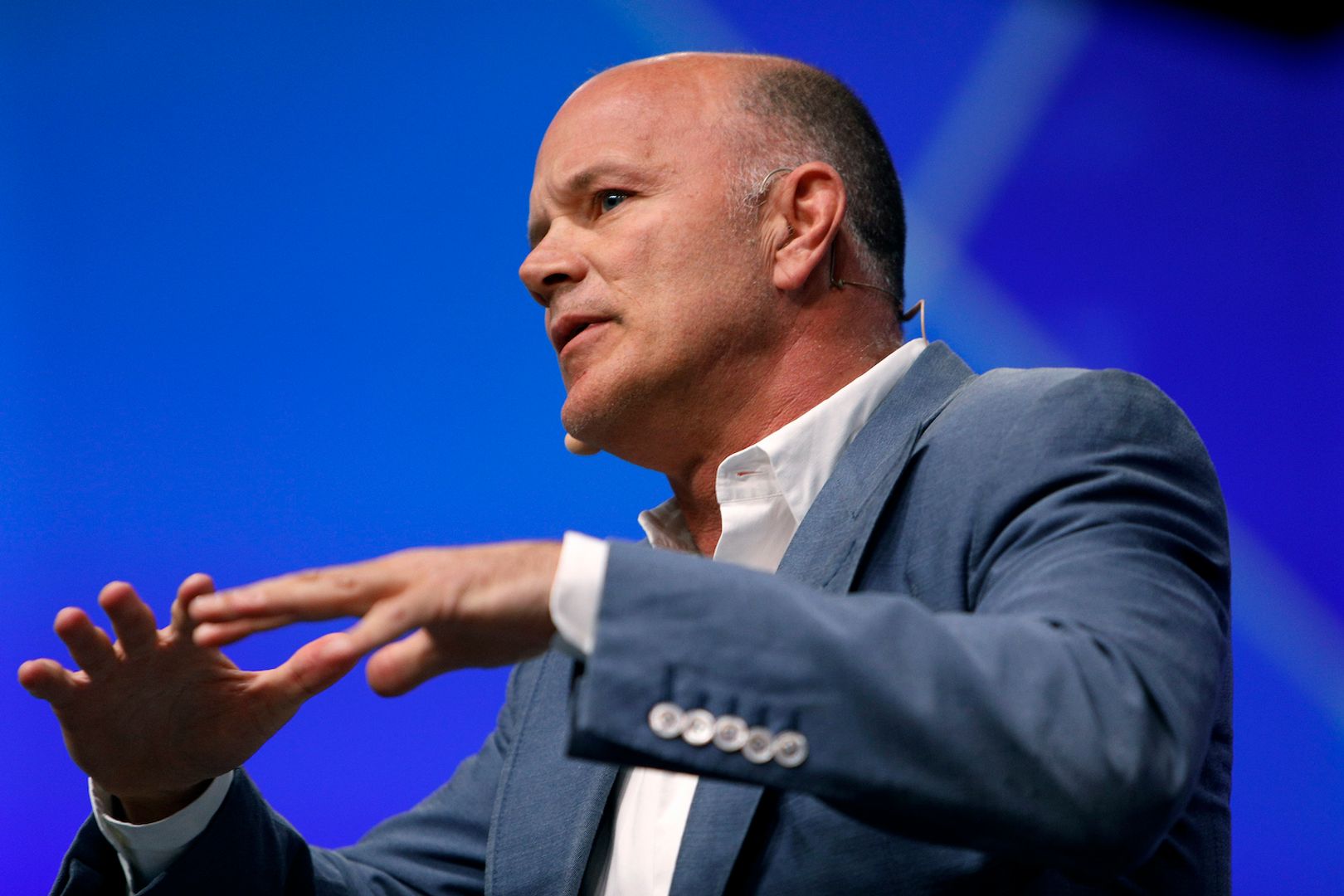
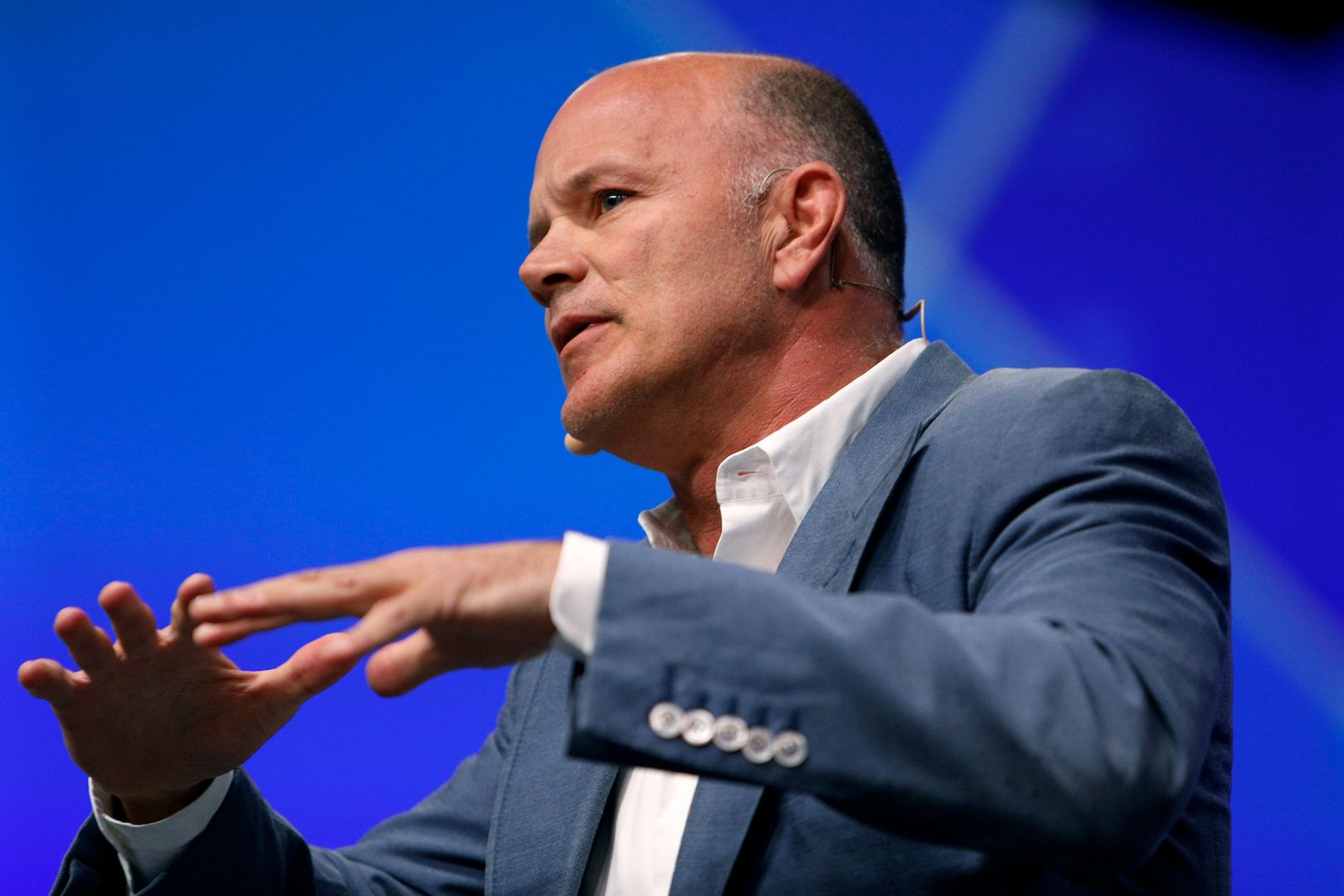
$9 billion bitcoin sale by a single Galaxy client reignites quantum debate
A single Galaxy Digital (GLXY) client sold $9 billion worth of bitcoin last year, and quantum computing may have been the reason for it.
The sale, CEO Mike Novogratz said during the company’s Q4 2025 earnings call, helped drag crypto markets as the position took time to unwind. It came from a Satoshi-era investor as an estate planning move.
“It’s like distributing an IPO, price usually goes down then the distribution ends, it goes back up,” Novogratz said after revealing a single customer sold $9 billion worth of bitcoin. “I think that’s the part of the cycle we’re in right now. As I said earlier, I don’t know when the seller’s exhaustion happens. There’s not that much leverage in the system anymore.”
Novogratz implied the decision to sell was part of a broader wave of profit-taking by early bitcoin adopters that the company has been seeing. While the community has long championed “HODLing” through volatility, that conviction appears to be weakening.
“There were a tremendous amount of these religious believers in this concept of HODLing and not letting go of your bitcoin ,” he said. “And somehow that fever broke and you started seeing some selling.”
While the sale isn’t new and was reported last year, it was seen as symbolic, igniting a debate among bitcoin’s OG holders about losing faith. What caught everyone’s attention now is the possibility that the reason was the risk posed by quantum computing to bitcoin.
‘Big excuse’
Novogratz called the quantum threat the “big excuse” being used for the sale. The crypto industry, he said, has expected quantum technology to be a threat.
And he isn’t wrong, in recent times the debate has been heating up. Investors and industry observers alike are now weighing the real threat of quantum breaking Bitcoin’s encryption.
While some say quantum computing technology is still a long way from becoming a reality, some developers have argued that as we get closer to quantum threats, the Bitcoin network will need to be upgraded to become quantum-resistant. The risk, however, is that “developers all get obstinate and they fight amongst each other,” Novogratz said, although noting that’s an unlikely scenario.
“I just don’t see that happening. In the long run, quantum will not be a big issue for crypto,” he said. “It’ll be a big issue for the world but crypto, and Bitcoin especially will be able to handle it.”
Still, the break from the idea that one should hold on to their bitcoin forever, Novogratz mentioned, could be rooted in something deeper than the market’s current bearish trend.
Cardano founder Charles Hoskinson has in the past highlighted Cardano’s proactive push for quantum-resistant upgrades, while early Bitcoin developer Adam Back has pointed to ongoing R&D on secure cryptographic schemes for Bitcoin.
To the CEO of Bitcoin technology firm JAN3, Samson Mow, quantum would first be a threat to the banking industry. Still, the Ethereum Foundation has just this month formally elevated post-quantum security to a strategic priority with the creation of a dedicated Post-Quantum team.
The quantum threat
Maybe one of the bigger stories on the threat that made a splash is that Coinbase has acknowledged that quantum computing could be a real, long-term threat to the cryptocurrency market, as Shor’s algorithm could break the signatures protecting the private keys of bitcoin addresses.
That would essentially allow bad actors to leverage quantum computers to access funds in any wallet whose public keys — often compared to an International Bank Account Number (IBAN) in crypto — are already exposed on the blockchain.
Modern Bitcoin addresses hash their public keys, concealing them until funds are spent on the blockchain. This means that around one-third of bitcoin’s supply is estimated to be under threat from quantum computers.
Another threat, Grover’s algorithm, could outcompete the computing power protecting the network, disrupting Bitcoin’s economic and security model.
The threat, however, isn’t imminent. Current quantum computers aren’t at 1,000 qubits — the unit used to measure the power of quantum computers — while millions are estimated to be necessary to compromise Bitcoin’s cryptography.
The threat is nevertheless producing real-world consequences for Bitcoin.
Jeffries’ global head of equity strategy, Christopher Wood, last month removed a 10% allocation to bitcoin from his model portfolio due to the threat quantum computing poses.


TLDR:
- Grinex halted operations after a cyberattack drained over $13M in user crypto wallets.
- Elliptic traced rapid USDT transfers across TRON and Ethereum networks post-breach activity.
- The exchange is linked to Garantex, previously sanctioned for illicit crypto transaction flows.
- On-chain data shows $15M in suspicious transfers executed shortly after the hack incident.
Grinex suspended operations after a large-scale cyberattack drained more than 1 billion rubles, or roughly $13.1 million, from user wallets. The exchange linked the incident to what it described as a coordinated intrusion targeting its infrastructure.
Grinex also pointed to foreign intelligence services as the source of the attack. Data from Elliptic shows funds quickly moved across multiple blockchain networks after the breach.
Grinex Crypto Exchange Hack Triggers Sudden Shutdown and Fund Losses
Grinex halted all operations immediately after confirming the cyberattack and associated wallet drains. The exchange reported losses exceeding 1 billion rubles in user digital assets.
Although registered in Kyrgyzstan, Grinex maintained strong operational ties to Russia. It processed more than $6 billion in crypto transactions tied to ruble conversion flows.
Elliptic analysis indicated that compromised accounts executed outgoing USDT transfers worth approximately $15 million. These transactions occurred within hours of the initial breach.
On-chain movement shows attackers routed funds through TRON and Ethereum networks. The stolen USDT was converted into TRX or ETH to reduce freezing risk.
On-Chain Tracking of Grinex Crypto Exchange Hack Funds
Blockchain tracking from Elliptic shows rapid redistribution of stolen assets across multiple wallets. Analysts observed structured transfers designed to obscure origin points.
Grinex previously functioned as a successor to Garantex, a sanctioned exchange linked to illicit crypto flows. The platform also handled activity involving the A7A5 ruble-backed stablecoin.
Garantex had earlier faced sanctions from the U.S. Treasury’s OFAC office for alleged laundering tied to ransomware and darknet markets. Authorities previously froze tens of millions in stablecoins connected to its wallets.
The latest breach adds pressure on exchanges tied to sanctions-sensitive corridors, especially those relying on stablecoin liquidity for cross-border transfers.



President Donald Trump said Thursday that a US-Iran deal is “looking very good,” with negotiations between Washington and Tehran set to resume this weekend ahead of the current ceasefire’s expiration.
The remarks came as oil prices slipped, US equities pushed to record territory, and crypto markets posted modest gains on renewed diplomatic optimism.
US Iran Ceasefire Talks Gain Momentum
Vice President JD Vance led last weekend’s negotiations with Iranian officials in Islamabad, though those discussions ended without a formal agreement. Meanwhile, a recent ceasefire between Israel and Lebanon has added to the sense of progress, though concerns remain.
Follow us on X to get the latest news as it happens
Abas Aslani, a senior research fellow at the Center for Middle East Strategic Studies in Tehran, called the Lebanon truce a “promising” signal that a broader deal may be within reach.
“Iran has been seriously insisting on its core demand that a ceasefire needs to be inclusive, not just limited to Iran but other parts of the region, including Lebanon,” he told Al Jazeera.
However, Gulf Arab and European leaders believe a final deal could take roughly six months to negotiate, as per Bloomberg. Those officials are pushing to extend the ceasefire to cover that timeline.
They also want the Strait of Hormuz reopened immediately to restore energy flows. They are warning privately that a global food crisis could develop if the waterway remains blocked through next month.
Markets Respond With Cautious Optimism
Despite the uncertainty, experts suggest that extreme-scenario risks have eased. The markets reflect this. Oil and fuel prices declined across the board on Friday.
WTI crude fell 1.51% to $93.26, while Brent dropped 1.12% to $98.28. Gasoline eased 0.17% to $3.16, and heating oil slipped 0.43% to $3.82.
US equities opened higher, extending a rally that pushed the S&P 500 and Nasdaq to new all-time highs this week. The former index rose roughly 0.26%, while the Nasdaq gained 0.36%. The Dow Jones added 0.25%.
Crypto markets also moved higher, gaining nearly 1% over the past 24 hours. Bitcoin (BTC) held near $74,650 as large-cap digital assets posted modest gains in the same timeframe.
Now, the upcoming weekend’s talks and ceasefire deadline will test whether both sides can maintain momentum toward a lasting resolution.
Subscribe to our YouTube channel to watch leaders and journalists provide expert insights
The post President Trump Signals US-Iran Deal Progress as Oil Drops and Crypto Markets Rise appeared first on BeInCrypto.


Orbs is handing control of its Layer-3 trading protocol and multi-million dollar fee stream to a new DAO, betting seasonal on-chain governance can keep pace with volatile DeFi markets.
Summary
- Orbs will roll out a DAO that hands protocol governance and revenue allocation to its community.
- The Layer-3 trading network has processed more than $3 billion in volume and over $3 million in protocol revenue.
- Seasonal on-chain governance will set tokenomics, fee distribution, and network priorities.
Orbs has launched a decentralized autonomous organization (DAO) that will shift control over protocol decisions and revenue allocation from core contributors to its global community in the coming weeks, formalizing a move to fully on-chain governance for its Layer-3 trading infrastructure.
The Tel Aviv-based protocol, which specializes in execution-layer infrastructure for advanced onchain trading, said the DAO launch follows years of product deployment, integrations, and regulatory preparation rather than a rush to decentralize.
Orbs’ suite of live Layer-3 protocols — including dLIMIT, dTWAP, Liquidity Hub, Perpetual Hub and dSLTP — has processed more than $3 billion in cumulative trading volume and generated over $3 million in protocol revenue to date, across more than 30 decentralized exchange integrations on multiple chains and backed by over 1 billion staked ORBS tokens.
“Governance only works when there is something real to govern,” said Ran Hammer, Chief Business Officer at Orbs, arguing that the DAO is launching only once the protocol has meaningful products, revenue, and adoption.
“After years of building products, generating revenue, and scaling adoption, we are now in a position where the community can actively shape the protocol’s future with real data and real impact,” Hammer added.
The new DAO will control key levers of the protocol, including how fees generated by Orbs’ trading products are allocated, token economic parameters, network upgrades, validator oversight and ecosystem grants, placing revenue and resource allocation in the hands of token holders rather than a centralized team.
A defining feature is its seasonal governance model, where decisions are made in defined cycles so the community can revisit priorities, adjust tokenomics, and reallocate resources as market conditions evolve, in contrast to static governance frameworks adopted by some earlier DeFi protocols.
The rollout will open with two initial on-chain votes: one to ratify the DAO’s core structure, voting mechanisms and operational framework, and a second to define “Season 1” tokenomics, including how protocol revenue is split between token burns, staking incentives, liquidity provisioning and treasury reserves.
Orbs said the DAO extends its existing governance architecture of Guardians and Delegators, which currently secure the network through Proof-of-Stake and participate in decision-making, into a broader, protocol-level model for capital allocation and long-term strategy.
The move comes as more decentralized finance projects turn on revenue governance, with protocols such as Uniswap and others activating or expanding fee switches and treasury control as DeFi matures into a cash-flow generating sector scrutinized by institutional and retail investors alike.
Within this context, Orbs positions its DAO as a way to align a revenue-producing Layer-3 infrastructure network with its token holders at a time when advanced execution tools and real economic flows — not just speculative governance tokens — increasingly define competitive advantage in onchain markets.
Crypto World
The U.S. government moves $606,000 in bitcoin linked to the 2016 Bitfinex hack to Coinbase


The U.S. government is active on the blockchain again, moving approximately $606,000 worth of bitcoin to Coinbase Prime.
These are not just any coins. On-chain data suggests the transferred 8 BTC are linked to Ilya Lichtenstein, the man behind the decade-old hack of the OG exchange Bitfinex, according to data tracked by Arkham.
Transfers to exchanges are often interpreted as a sign of potential selling pressure. However, that is not always the case and could also reflect routine wallet movements, custody changes, or other non-selling activity.
These coins have destination
The bitcoin tied to the Bitfinex hack, which saw Lichtenstein walk away with 119,756 BTC, has a court-mandated destination and it’s not U.S. Treasury.
In early 2025, federal proceedings solidified the in-kind restitution of the seized assets to Bitfinex, requiring the government to return the coins rather than liquidate them independently.
Bitfinex intends to use the returned funds to fully redeem all outstanding Recovery Right Tokens – digital claims issued to customers who suffered losses in the hack – and to allocate at least 80% of the remaining net proceeds to repurchase and burn its UNUS SED LEO token.
The 2016 hack
In August 2016, Lichtenstein hacked into Bitfinex and fraudulently authorized more than 2,000 transactions, transferring 119,756 BTC to a wallet under his control. At that time, the exploit was worth roughly $72 million. (As of today, it would be worth $8.9 billion)
What followed were years of sophisticated money laundering via crypto mixers, darknets, and chain-hopping between coins, as well as the purchase of gold.
Finally, in 2022, investigators caught up and seized a portion of the stolen BTC, then worth $3.6 billion. In 2024, Lichtenstein was sentenced to 60 months in federal prison and was released in January 2026 under the First Step Act, thanking President Donald Trump on X.
The stolen coins, however, remained in government custody. The U.S. said last year that its holdings of seized BTC would form part of a national strategic bitcoin reserve. As of writing, the government holds bitcoin valued at about $24.54 billion, ether at roughly $146 million, and several other cryptocurrencies.
TLDR:
- Bitcoin correlation with Nasdaq has dropped to -0.20, marking a rare decoupling phase in 2026
- Correlation ranged 0.40–0.70 in 2021-2022, then peaked 0.85 during late 2022 volatility periods
- Van de Poppe notes Bitcoin averages +45% in 3 months and +370% in 12 months post-correction
- BTC trades near $74.8K with $42B volume, showing mixed momentum but steady participation levels
Bitcoin’s correlation with the Nasdaq has shifted sharply into negative territory, according to recent market commentary from Michaël van de Poppe.
The change marks one of the weakest alignment phases between the two assets in a decade-long dataset. Historical readings show a transition from strong positive linkage to outright divergence in recent quarters.
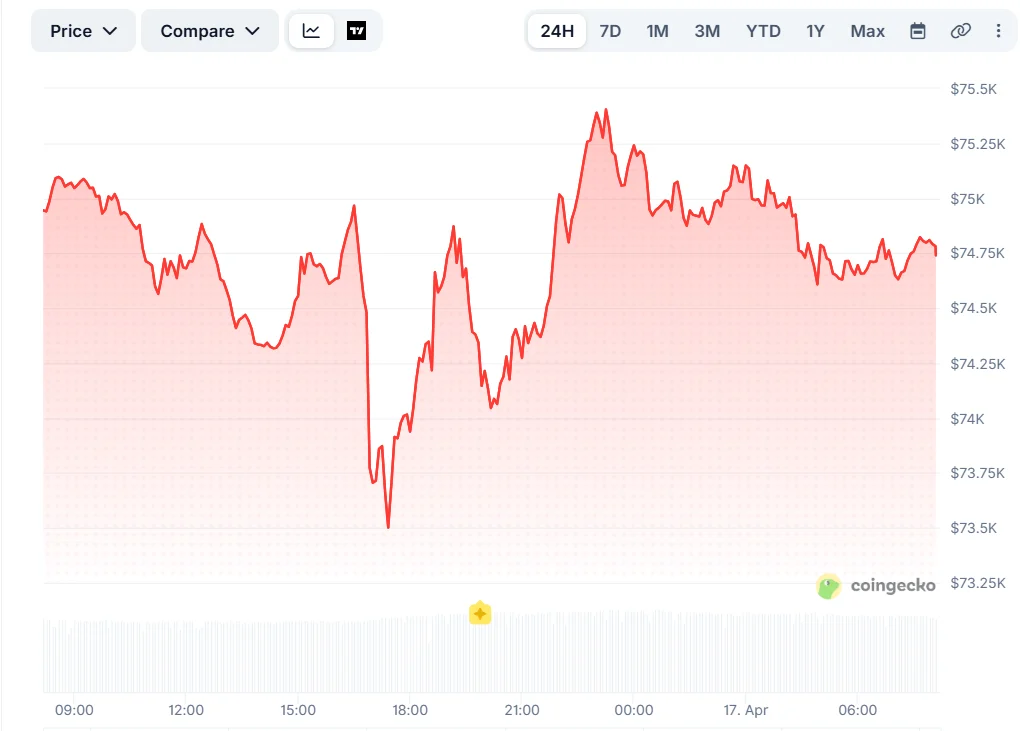
Bitcoin now trades near $74,819 as equity relationships weaken and market structure adjusts.
Data shared by Michaël van de Poppe indicates the Bitcoin-Nasdaq correlation ranged between 0.40 and 0.70 during 2021 to 2022, climbed to 0.75 to 0.85 in late 2022, and has recently fallen to around -0.20 in late 2025 and early 2026.
This divergence has raised attention on whether equities will lead crypto markets or vice versa in the current cycle.
Bitcoin Correlation and Nasdaq Breakdown Across Equity Cycles
Market data shows a notable breakdown in the historical relationship between Bitcoin and the Nasdaq in recent months.
This divergence marks a shift from tightly coupled behavior seen in prior macro cycles. This shift follows years of evolving correlation structures between traditional and digital markets.
Between 2021 and 2022, both assets moved in stronger alignment, with correlation holding between 0.40 and 0.70.
Risk-on sentiment drove synchronized trading patterns across crypto and equities. Institutional inflows and macro liquidity conditions reinforced parallel movement during this period.
That alignment intensified in late 2022, when correlation readings climbed into the 0.75 to 0.85 range during high-volatility conditions.
Macro tightening conditions contributed to synchronized sell-offs across both markets. Both assets reacted similarly to aggressive rate expectations and liquidity tightening phases.
In 2025 and early 2026, the relationship weakened significantly, coinciding with the ETF era and shifting liquidity flows, pushing correlation to around -0.20.
Market participants now track whether this decoupling persists. ETF-related flows introduced new dynamics that altered traditional correlation behavior across cycles
Bitcoin Price Action and Post-Correction Market Signals
Bitcoin continues to trade near $74,819, reflecting a slight 24-hour decline and a nearly 4% weekly increase, according to CoinGecko.
Price action remains within a tight short-term consolidation range. Short-term volatility remains influenced by macroeconomic uncertainty and trading activity.
Daily trading volume remains above $42 billion, signaling sustained participation despite mixed short-term momentum. Liquidity conditions remain elevated across major exchanges. Exchange order books show steady depth despite intraday fluctuations.
Historical patterns highlighted by van de Poppe suggest Bitcoin has averaged a 45% gain within three months following sharp corrections.
These patterns reflect recurring post-drawdown recoveries. Besides, these trends often emerge after significant market dislocations in previous cycles.
Longer-term data indicates average returns of up to 370% within twelve months after similar market drawdowns, based on historical cycles. These figures derive from past volatility regimes.
However, outcomes vary depending on macro liquidity and investor positioning.

Disclosure: This article does not represent investment advice. The content and materials featured on this page are for educational purposes only.
Chainlink gains steady traction as BlockchainFX draws attention in early-stage crypto market.
Summary
- BlockchainFX (BFX) gains attention as investors seek utility-driven crypto amid steady Chainlink (LINK) growth
- BFX positions as a multi-asset trading platform bridging crypto, forex, stocks, ETFs, and bonds
- BlockchainFX introduces revenue-sharing model with staking rewards and token burns to reduce supply
Ever felt that stinging regret after watching a coin moon while your bags stayed empty?
Many people ignore crypto news and price charts until it is too late. Waiting for the perfect moment often means missing out on the best cryptos to buy now and watching others claim the wealth that should have been yours.

The crypto market currently moves at light speed with Chainlink (LINK) news showing steady growth. Meanwhile, the BlockchainFX (BFX) launch is turning heads because it bridges traditional finance with decentralization. This project stands out among the best cryptos to buy now for its massive utility and institutional-grade vision.
BlockchainFX: The all-in-one trading powerhouse and best cryptos to buy now
BlockchainFX is not just another token. It is the bridge between blockchain and global finance. This platform allows trading of 500+ assets, including crypto, forex, stocks, ETFs, and bonds on one unified dashboard. The project solves the problem of fragmented liquidity by putting everything in one place. By targeting the $7.5 trillion daily forex market, BlockchainFX is moving into a space that is nearly 100x larger than the current crypto market.
The BFX crypto presale 2026 is moving fast because of its unique revenue model. While other projects just offer empty promises, BlockchainFX (BFX) gives back. Participants earn daily staking rewards in $BFX and USDT. Up to 70% of platform trading fees go back to the community. This creates a deflationary cycle where 20% of the buybacks are permanently burned, reducing the supply while you earn.
Why early adopters are swarming the crypto presale
The numbers tell a compelling story of rapid growth. The project has already raised over $14.25 million, with more than 23,350 participants joining. The price is currently $0.035 because the demand is surging as people realize the official launch price is locked at $0.05. This represents a built-in gain before the coin even hits public exchanges.
Feature
BlockchainFX details
Total Raised
$14.25 Million+
Current Price
$0.035
Launch Price
$0.05
Participants
23,350+
Bonus Code
BFX20 (20% Extra Tokens)
Early adopters also unlock the Founder’s Club perks. Depending on the tier, participants receive exclusive Metal or 18-Karat Gold BFX Visa Cards. These cards allow worldwide spending with limits up to $100,000 per transaction. High-tier participants even receive up to $25,000 in trading credits. With a team holding 25 years of fintech experience, the growth plan is solid. Revenue is projected to hit $1.8 billion by 2030.
Huge update: The $15 million launch trigger is almost here
The energy is electric because the finish line is in sight. BlockchainFX is currently sitting at over $14.25 million raised. The team announced that once the presale hits the $15 million mark, the token will officially launch on public exchanges. This means the window to use the bonus code BFX20 for 20% extra tokens is closing fast. Waiting even a day could mean paying a much higher price. Grab the bonus now before the $15 million milestone triggers the end of this opportunity.
Chainlink price history: The lesson of the missed ICO
Chainlink started with an ICO price of only $0.11. Many doubted the oracle technology back then. Those who grabbed LINK early saw their bags multiply by over 450x at its peak. It turned small amounts into life-changing wealth for early adopters who ignored the skeptics and trusted the utility.
Missing the LINK news in 2017 felt like a punch to the gut for many. Watching a coin go from pennies to double digits is hard when sitting on the sidelines. However, the crypto world always brings new chances for those brave enough to take them. BlockchainFX offers that same ground-floor feeling for those who want real utility.

Ready to secure the best cryptos to buy now?
The window to join the BlockchainFX journey is small, but the potential is massive. This project combines a professional trading platform with a generous rewards system that pays out daily. Early buyers are already seeing the community grow toward the projected 25 million users. Is this the right time to act?
The BlockchainFX presale is the ultimate second chance for anyone who missed previous cycles. Buy tokens at the current $0.035 price before the $0.05 launch. Use code BFX20 for a 20% bonus and start earning daily staking rewards immediately. Do not wait for the $15 million milestone to pass by. Securing BFX now is the move for those who want to be wealthy.
For more information, visit the official website, X, and Telegram.
Disclosure: This content is provided by a third party. Neither crypto.news nor the author of this article endorses any product mentioned on this page. Users should conduct their own research before taking any action related to the company.


A Solana-backed super PAC is spending $8m to boost pro-crypto Jon Husted against Sherrod Brown, as crypto war chests like Fairshake and Fellowship reshape 2026 races.
Summary
- Sentinel Action Fund will spend $8 million backing Republican Jon Husted against Sherrod Brown in Ohio.
- The super PAC is bankrolled by the Solana Institute, Multicoin Capital and major Wall Street donors.
- Crypto PACs like Fairshake and Fellowship now wield war chests nearing $200 million ahead of November.
Sentinel Action Fund, a U.S. super PAC backed by the Solana Institute, will deploy $8 million with its advocacy arm Right Vote to support Republican Jon Husted in Ohio’s November Senate race against Democrat Sherrod Brown. The group said in a Wednesday statement that the spend is aimed at boosting a candidate it views as “strongly supports crypto” against one it accuses of blocking digital asset innovation.
Husted has repeatedly called for a “pro‑innovation framework for digital assets,” arguing that crypto and blockchain represent the “next wave of economic opportunity for working families.” In contrast, Brown has pushed for a crackdown on the use of crypto to fund terrorism and evade sanctions, and he lost his Senate seat in the 2024 race to crypto‑friendly Republican Bernie Moreno, who was heavily backed by industry money.
Sentinel’s crypto funding is anchored by a $750,000 donation from the Solana Institute and $250,000 from venture firm Multicoin Capital, according to Federal Election Commission records. “Brown has stood in the way of pro‑innovation policies when it comes to digital assets,” Sentinel Action Fund president Jessica Anderson said, casting the PAC’s intervention as part of a wider fight over the regulatory direction of U.S. crypto policy.
The PAC has also drawn checks from Blackstone CEO Stephen Schwarzman and Fisher Investments chairman Kenneth Fisher, underscoring the extent to which traditional finance is now funding explicitly pro‑crypto political vehicles. Sentinel’s Ohio play is its third endorsement of the 2026 cycle, after it backed Maine Senator Susan Collins and Michigan Republican Mike Rogers, both considered friendly to digital assets.
Crypto super PACs more broadly have amassed substantial firepower heading into November. Fairshake, which is backed by firms such as Coinbase and a16z, has built a $193 million war chest and pledged to oppose “anti‑crypto politicians” as Congress moves toward a key vote on comprehensive digital asset legislation.
Another pro‑crypto vehicle, Fellowship PAC, recently received a $10 million donation from Cantor Fitzgerald, the Wall Street firm formerly owned by current U.S. Commerce Secretary Howard Lutnick, according to FEC filings. The group has named Tether U.S. executive Jesse Spiro as chairman to lead “its next phase of expansion” and will soon publish its first slate of endorsed candidates, signalling that stablecoin issuers are stepping more directly into U.S. electoral politics.
In previous crypto.news coverage of U.S. policy battles over stablecoins and market structure, reporters have highlighted how Solana‑linked entities, ETF issuers and exchange groups are increasingly turning to political spending as they seek friendlier rules for onchain finance.
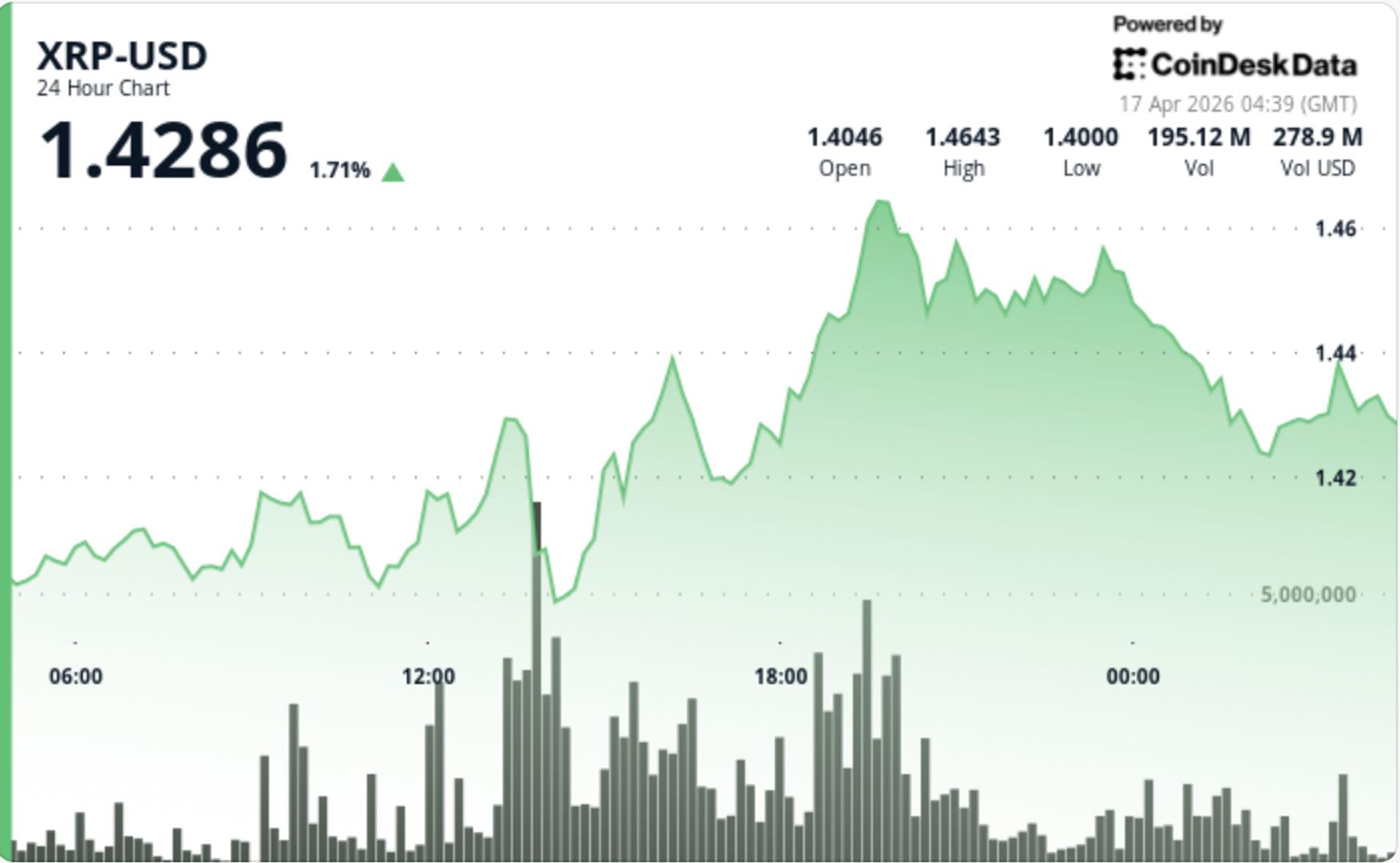
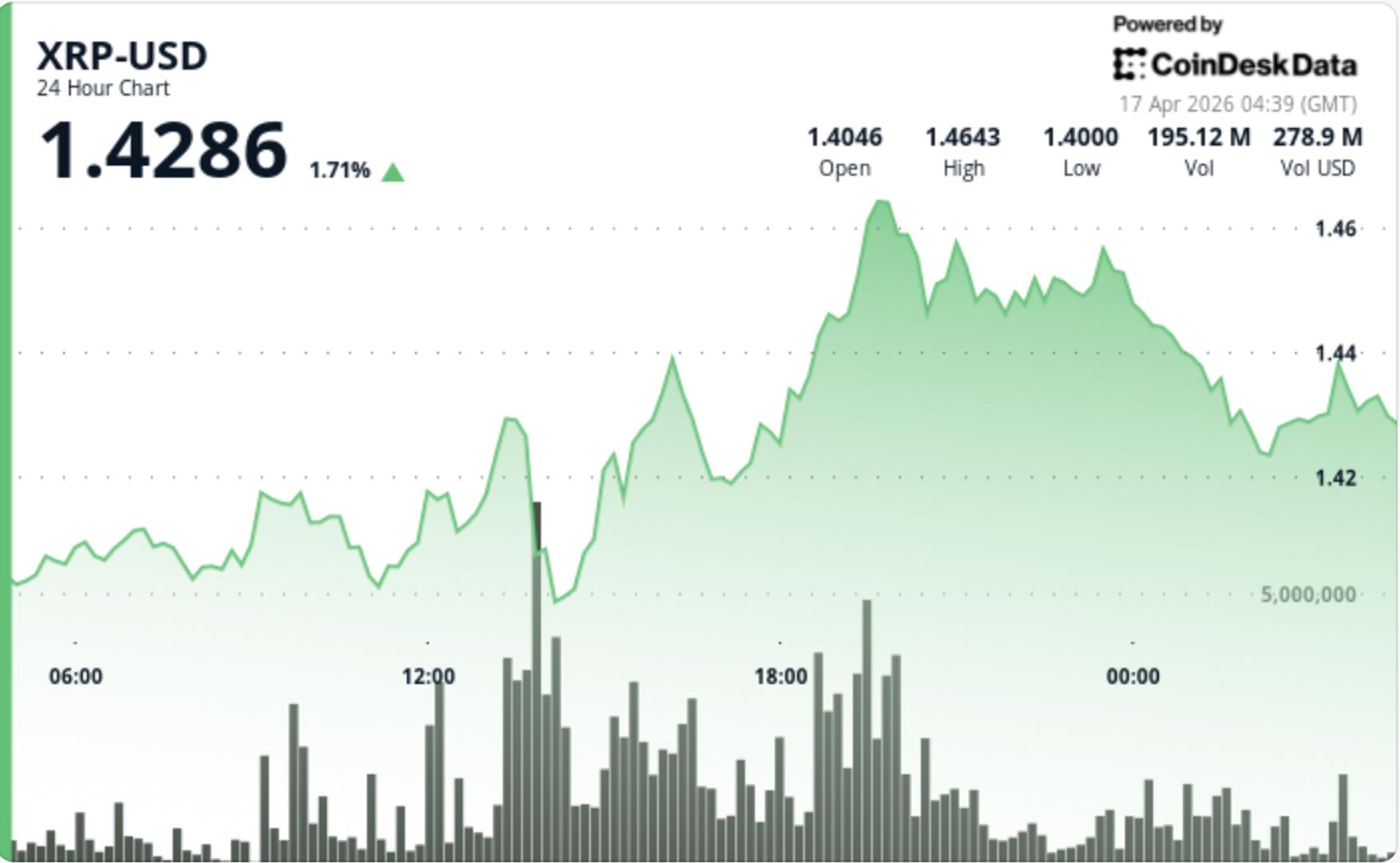
XRP is quietly outperforming the market, but it still hasn’t done enough to break out. The move higher looks steady rather than aggressive, which points to accumulation, but without stronger volume, it’s not a convincing shift yet.
News Background
• XRP is the top weekly performer among major cryptocurrencies, gaining around 6.4% and outperforming bitcoin, ethereum, and BNB over the same period.
• The move comes as broader crypto markets remain mixed, with capital rotating selectively into higher-beta assets rather than driving a full market-wide rally.
Price Action Summary
• XRP climbed to around $1.43, holding a steady upward structure across the week.
• The move developed gradually, with no sharp spikes, indicating controlled accumulation rather than speculative momentum.
• Price remains capped below the $1.44 resistance zone despite multiple attempts to break higher.
Technical Analysis
• The key signal is relative strength. XRP is outperforming peers even without strong volume support.
• Volume remains subdued at roughly 70% of its weekly average, which limits conviction behind the move.
• The structure shows higher lows, but resistance continues to absorb upside near $1.44.
• This combination typically signals consolidation rather than a confirmed breakout.
What traders should watch
• $1.44 remains the key resistance. A clean break is needed to validate upside continuation.
• $1.40 acts as near-term support. Holding above it keeps the structure intact.
• Continued low volume risks a pullback, especially if broader market momentum fades.
TLDR:
- Class action alleges Circle allowed USDC flows after Drift Protocol $280M exploit on Solana
- Filing claims attackers moved $230M via USDC and CCTP bridge without intervention for hours
- Drift Protocol halted trading after exploit while ecosystem actors froze portions of stolen assets
- Hackers routed funds from Solana to Ethereum, using bridges and swaps to obscure transaction trails
A class action lawsuit filed in Oakland has targeted Circle Internet Financial over its role in a major crypto exploit.
The case stems from the April 1, 2026 Drift Protocol hack that drained roughly $280 million in digital assets. Plaintiffs claim attackers moved about $230 million through USDC and Circle’s CCTP bridge without any effective intervention.
The filing seeks damages for affected investors and raises questions about whether frozen funds could have limited losses.
Circle Sued Over Drift Protocol Hack Allegations Over USDC Freeze Response
Gibbs Mura, A Law Group, filed the class action on April 14, 2026 representing Drift Protocol investors.
The complaint positions Circle Internet Financial and Circle Internet Group as defendants in a case tied to one of the largest crypto exploits recorded in 2026 on the Solana network. Moreover, the filing focuses on how stablecoin infrastructure handled transaction flows during the aftermath of the breach.
The lawsuit states that within an hour of the hack, crypto users on X flagged the incident widely. Several market participants urged immediate intervention as stolen funds began moving across chains.
According to the filing, some ecosystem operators froze portions of the assets while activity continued through Circle’s USDC infrastructure.
Investigators referenced in the complaint describe the attackers as potentially linked to North Korea. The assets were routed from Solana to Ethereum in an effort to reduce traceability.
Once on Ethereum, funds were converted into Ether and moved through multiple decentralized applications.
Plaintiffs argue Circle had visibility into the ongoing movement of stolen assets.
The complaint claims the company retained the technical ability to restrict or freeze USDC-related flows. Despite that capability, the filing alleges no effective disruption occurred during the key offloading window.
Drift Protocol $280M Exploit and CCTP Bridge Scrutiny
On April 1, attackers reportedly seized control of Drift Protocol’s asset transfer systems in roughly 12 minutes.
The breach enabled rapid draining of funds across multiple wallets. It marked one of the most significant DeFi security incidents of the year on Solana.
After the initial theft, attackers shifted assets from Solana to Ethereum.
The move aimed to complicate tracking and delay recovery efforts. On Ethereum, funds were converted into Ether and distributed through multiple applications.
The complaint highlights an eight-hour offloading phase involving USDC and Circle’s Cross-Chain Transfer Protocol.
Roughly $230 million moved during this window, according to the filing. Plaintiffs argue monitoring systems should have flagged or restricted the flows during active exploitation.
Drift Protocol halted all trading immediately after detecting the breach. The team also issued alerts to users and froze platform activity.
Some ecosystem participants also restricted portions of the stolen funds, but Circle allegedly continued processing related transactions.


Polkadot price rebounded over 10% on Thursday as it recovered from a sharp drop earlier this week.
Summary
- Polkadot price rebounded over 10% after a sharp sell-off triggered by a bridge exploit that did not impact its core network security.
- The token found support near $1.15 as RSI signaled oversold conditions, prompting a relief bounce and improved market sentiment.
- A break above $1.31 resistance could open the door for further upside toward the $1.42 level in the short term.
According to data from crypto.news, Polkadot (DOT) price rose 10.4% to an intraday high of $1.29 on April 16, while bringing its market cap back above $2.16 billion. The bounce follows after the token fell nearly 13% this week.
Polkadot price bounced after rumors of a systemic network failure triggered a sell-off earlier this week. Notably, a security breach on the Hyperbridge gateway allowed an attacker to mint 1 billion bridged DOT tokens on the Ethereum network.
Despite an immediate knee-jerk reaction from the market, the panic-driven selloff subsided once investors realized the exploit did not compromise Polkadot’s native Relay Chain or its core security architecture. This clarity allowed the community to view the incident as an isolated bridge issue rather than a fundamental flaw in the Polkadot ecosystem.
Consequently, major exchanges like Upbit and Bithumb are moving back towards resuming normal services after a temporary suspension to protect users from potential volatility. This has significantly reduced the immediate liquidity bottleneck and restored a sense of normalcy to the trading environment.
Meanwhile, following the 27% drop over the past month, Polkadot price has reached a critical psychological bottom at $1.15 yesterday.
The Relative Strength Index, an indicator used to measure the speed and change of price movements, fell to 33.80, signaling that the token had entered a deeply oversold territory and was due for a relief bounce.
As of now, intraday price action has been strong, with DOT testing immediate resistance at $1.31. A successful close above this level could trigger bulls to target the $1.42 zone as the next logical destination for this recovery.
Disclosure: This article does not represent investment advice. The content and materials featured on this page are for educational purposes only.

Ukraine-Russia war latest: Zelensky calls Putin a ‘global threat’ after Moscow’s deadliest aerial attack this year

Anthony Albanese Responds to Donald Trump’s Latest Criticism: ‘There’s Been No Change’
$13M Grinex Hack Triggers Shutdown of Sanctions-Linked Exchange


-

 Politics6 days ago
US brings back mandatory military draft registration
-
 Sports7 days ago
Man United discover Nico Schlotterbeck transfer fee as defender reaches Dortmund agreement
-

 Fashion6 days ago
Weekend Open Thread: Veronica Beard
-

 Politics5 days ago
World Cup exit makes Italy enter crisis mode
-

 Business6 days ago
Tesla Model Y Tops China Auto Sales in March 2026 With 39,827 Registrations, Beating Cheaper EVs and Gas Cars
-

 Crypto World3 days ago
The SEC Conditionalises DeFi Platforms to Be Avoided for Broker Registration
-

 Crypto World3 days ago
SEC Signals Exemption for Crypto Interfaces From Broker Registration
-

 News Videos2 days ago
Secure crypto trading starts with an FIU-registered
-
 NewsBeat4 days ago
Pep Guardiola and Gary Neville agree over Arsenal title problem that benefits Man City
-

 Business6 days ago
Ireland Fuel Protests Enter Day 5 as Blockades Spark Shortages and Government Prepares Support Package
-

 Business7 days ago
OpenAI Halts Stargate UK Data Centre Project Over Energy Costs and Copyright Row
-

 Crypto World6 days ago
Federal judge blocks Arizona from bringing criminal charges against Kalshi
-

 NewsBeat3 days ago
Trump and Pope Leo: Behind their disagreement over Iran war
-

 Politics7 days ago
LBC Presenter Mocks Trump Over Iran War Failures
-

 Crypto World3 days ago
SEC Proposes Certain Crypto Interfaces Don’t Need to Register as Brokers
-
 NewsBeat5 days ago
JD Vance announces ‘no agreement’ with Iran over nuclear weapons fear
-

 Business6 days ago
IMF retains floor for precautionary balances at SDR 20 billion
-

 Business6 days ago
Former Liverpool CEO eviscerates FIFA for World Cup ticket pricing
-
Crypto World4 days ago
Sei Network Enters Quiet Reset Phase as On-Chain Metrics Signal a Slowdown in 2026
-
 Entertainment7 days ago
A ‘Bridgerton’ Star’s New Survival Thriller Is a Must-Watch on Netflix This Weekend
You must be logged in to post a comment Login