
Crypto World
What About the Ethereum 2.0 Roadmap?

The founder of the Ethereum project, Vitalik Buterin, unveiled a new roadmap for Ethereum a few weeks ago. His goal is to fix the weaknesses created by the migration from ETH1.0 (PoW) to ETH2.0 (PoS) regarding security and decentralisation. Vitalik, therefore, acknowledges that Ethereum has become centralised to the point where it can become dangerous, a risk that many people warned The Merge posed.
Ethereum roadmap:
The key to this change lies in whether these new modifications will be enough to make Ethereum a network with guarantees of decentralisation and resistance to censorship. We should wait a while to find out, as the new Ethereum roadmap is extensive and applies technologies that could be a success if well implemented. Without further ado, let’s take a look at the phases of this roadmap one by one:
First Phase: The Surge, truly scaling Ethereum
The Surge is the first phase of this new roadmap and aims to increase Ethereum’s scalability. Its construction relies on a series of improvements. Among them, the following stand out:
1.- The activation of EIP-4844 (Proto-Danksharding): Proposed improvement consisting of enabling a new transaction format for Ethereum. Transactions can have “data BLOBs” that can be transparently integrated into the nodes and their operation. This is similar to how rollups work and could facilitate rollup operations on Ethereum. This way, Ethereum would increase its scalability, leaving behind the ‘PoS = more scalability’ farce sold during the pre-The Merge.
2.- A series of cryptographic improvements focused on offering a ZKP (Zero Knowledge Proof) model. These improvements would enable more private and secure transactions, as well as lay the foundations for the construction of zk-Rollups and zkEVM, which would allow for private smart contracts.
3.- Alongside ZKP would come SLE or Secret Leader Election (SLE). An improvement that seeks to make the election of the PoS validator node an event protected by ZKP cryptography. This is intended to prevent manipulation of the network to some extent.
Second phase: The Scourge, re-centralising the network
In this second phase, there is a need for SLE from the previous phase to be fulfilled. This is because The Scourge needs it to build its significant improvement Proposer / Builder Separation (PBS). PBS is a proposed solution to the problem of censorship and MEV (Maximum Extractable Value) attack on the Ethereum network. The idea lies in making the construction of blocks and the proposal of new blocks to be assigned to different parts of the network, avoiding the validator carrying the weight in both tasks.
The separation of roles also occurs in other blockchains such as Dash, where there is a similar scheme with Dash miners and Masternodes, each with very clear and well-defined roles in the network. Well, Ethereum wants to take this approach to make the network have two roles:
1. Generate the role of Block Proposer, dedicated to proposing blocks to the network, a job for which it could receive rewards. However, this still needs to be clarified in Ethereum, but in other networks, these nodes receive rewards (e.g. Flow).
2. Generate the role of Block Validator, which is in charge of validating the proposed block and receiving rewards for it.
Both roles would be under an SLE type selection, but only the Block Validator could write data to the blockchain. The problem with PBS is that the reward scheme needs to be adjusted, which will directly impact Ethereum tokenomics.
Third Phase: The Verge, speeding up transaction verification
One issue that is a severe problem in Ethereum is transaction verification on the network. On-chain transaction verification is fast. However, the problem lies in the synchronisation and verification of transactions and their entire history.
This is where the third phase aims to make a significant change, making transactions able to include a series of ZKP enhancements using zk-SNARKs cryptography. Ultimately, Buterin wants Ethereum to implement zk-SNARKs as a cryptographic stack to generate the proofs needed to verify new transactions on the network. This has the advantage that zk-SNARKs are more secure than the current system using EdDSA (i.e. zk-SNARKs have higher resistance to quantum computers than EdDSA). Still, it has the disadvantage that
zk-SNARKs are algorithmically more complex. Catastrophic errors can be made, and bugs can be challenging to detect.
Fourth Phase: The Purge
This phase aims to make Ethereum simpler. As such, Buterin seeks to make the network have capabilities that allow for greater portability. These capabilities include:
1.- Enable a Fast sync. In other words, fast synchronisations only require downloading a part of the blockchain to have a functional node. Currently, the entire blockchain has to be downloaded.
2.- With the arrival of zk-SNARKs and verkle trees, unnecessary data could be discarded from the blockchain, which would allow nodes to need less disk space to store the blockchain, enabling small devices to serve as nodes (e.g. a smartphone). This would be another achievement, but it is complex, and the impact on validator nodes (which must have complete data to operate) is unknown.
3.- Further improvements in EVM to reduce gas usage and overhead (overhead on nodes and the network in general).
Fifth phase: The Splurge
In this last phase of the roadmap, the aim is to repair everything that can be repaired in Ethereum. On the one hand, to say goodbye to the manipulation of gas costs with the EIP-1559. This would eliminate the current gas costing scheme and the token burning that currently prevails in Ethereum. On the other hand, activating the VDF (Verifiable Delay Function) is a type of cryptographic function that makes data verification more efficient. It is also intended to move everything from the EVM to the zkEVM.
Another goal is to change the account abstraction scheme in Ethereum, considering EIP-4337, which entails abstracting the wallets and associated accounts to a point away from the consensus because the accounts are no longer related to the consensus, but their operations are.
Conclusion: Relative decentralisation
The design of Ethereum’s roadmap makes us think that its creator is concerned about the degree of decentralisation it shows to the world.
Indeed, some things would make Ethereum advanced and decentralised, such as the use of zk-SNARKs, PBS and SLE. However, its success depends on a reliable setup for the security it provides to be effective.



Employees can elect to receive a portion of their salary in shares of WTGXX, earning yield from the day compensation is paid.


- XRP, Solana, and Cardano prices hover near $1.30, $80, and $0.24, respectively.
- Currently, BTC trades around $66,430 after retreating from highs of $68,000.
- Analysts say the week is heavy on macroeconomic data releases, and that’s likely to impact volatility.
XRP, Solana, and Cardano prices hover at critical support levels amid a potentially volatile week for cryptocurrencies, with Bitcoin poised just above $66,000 as traders brace for a fresh wave of macroeconomic data.
While geopolitical risk from the Iran war continues to roil markets, investors weighing the next moves might also want to pay attention to key macroeconomic events this week.
QCP Group has noted, via a post on X, that these data releases will likely shape the next leg of the Bitcoin price.
On Monday, analysts at Greeks.live opined that, in addition to macroeconomic factors, volatility could also hinge on announcements from US President Donald Trump.
Bitcoin led altcoins briefly higher after Trump announced that the US was looking to end its military operation in Iran.
Key macro events to watch this week
This week’s macro calendar is packed, with analysts at QCP Capital highlighting several data releases as potential volatility triggers across traditional markets and cryptocurrencies.
For investors, the key focus is how incoming data shapes expectations for US growth, inflation, and the interest-rate path—factors that continue to drive risk assets, including Bitcoin.
Key macro events to watch for this week:
Mar 31: CAD GDP m/m
Mar 31: US Consumer Confidence, JOLTS Job Openings, Chicago PMI
Apr 1: S&P Global US Manufacturing PMI, ISM Manufacturing PMI
Apr 2: Jobless Claims, Trade Balance
Apr 3: Non-Farm PayrollsMain volatility triggers:…
— QCP (@QCPgroup) March 31, 2026
On March 31, attention turns to US Consumer Confidence, JOLTS Job Openings, and the Chicago PMI.
QCP identifies JOLTS as a key volatility catalyst, as signs of labour market cooling or tightness directly influence Federal Reserve expectations and the dollar, with spillover effects on crypto flows.
Tokens such as XRP, Solana, and Cardano are likely to track Bitcoin’s direction.
On April 1, the S&P Global US Manufacturing PMI and ISM Manufacturing PMI will be released, with the ISM reading seen as particularly important.
A weaker print could strengthen expectations for rate cuts and support crypto, while stronger data may reinforce a “higher for longer” rate outlook and weigh on digital assets.
A similar dynamic applies to jobless claims data, another closely watched indicator.
A sharp rise could signal labour market weakness and potentially support Bitcoin as markets adjust expectations for monetary easing.
The week culminates on April 3 with the release of US Non-Farm Payrolls (NFP).
QCP flags this as a primary macro event that could revive inflation concerns and strengthen the dollar.
Historically, a stronger greenback has pressured Bitcoin, while softer payrolls tend to support the broader digital asset market through expectations of looser policy.
XRP, SOL, and ADA price outlook
From a technical perspective, Bitcoin enters this data-heavy period with a constructive but fragile setup on the daily chart.
Traders are balancing macroeconomic risks with geopolitical tensions, particularly around the Iran conflict and disruptions linked to the Strait of Hormuz.
The result is a market caught between competing drivers of volatility, with implications across risk assets.
Bitcoin’s sensitivity to incoming data could drive broader moves in altcoins.
XRP is holding near $1.30 support but may slip toward $1.20 if BTC weakens following non-farm payrolls data.
On the upside, softer inflation readings could support a move toward $1.50.
Solana (SOL), trading near $80, is testing key moving averages and could face downside risk toward $70.
A stronger bullish push, however, may open the path toward $100.
Meanwhile, Cardano (ADA) has declined to around $0.24, with potential for further downside toward $0.22.
A renewed influx of buyers could instead see the token attempt a move back toward the $0.30 resistance level.
Crypto World
Warren Buffett says he sold Apple too soon and would buy more of it, though not in this market

Warren Buffett said he sold Apple too soon and would buy more of it, though not in the current market.
“I sold it too soon. But, I bought it even sooner, so,” Buffett told CNBC’s Becky Quick in an interview Tuesday on “Squawk Box” in which he announced he’s bringing back his famed charity lunch.
Apple remains Berkshire Hathaway’s largest holding even after the conglomerate trimmed its stake to $61.96 billion at the end of last year, according to InsiderScore.
However, Buffett said Tuesday that he would continue to add to the position if it gets cheaper. He said the iPhone maker is not yet attractive even after falling more than 14% off its recent high, and dropping more than 6% this month. That’s amid turmoil in the broader market, with both the Dow Jones Industrial Average and the Nasdaq Composite in a correction.

Apple performance year to date
“I’m very happy to have it be our largest holding,” Buffett said. “I was not happy to have it be as large as almost everything else combined.”
“It’s not impossible that Apple would get to a price, we would buy a lot of it,” he added. “But not in this market.”
Buffett said the firm has made more than $100 billion in the stock pretax, and was favorable in his comments regarding Tim Cook‘s leadership of the firm over Steve Jobs.
“Tim Cook has done better with the hand. Steve Jobs — he couldn’t have done what Steve Jobs did — but Steve Jobs handed him a hand that Steve would not have done as well,” Buffett said.
“Tim was a fantastic manager, and he’s a good guy, and somehow he gets along with everybody in the world,” he added. “That’s a technique I wouldn’t have, for example, certainly my partner, Charlie Munger, wouldn’t have had it.”
Buffett stepped down as Berkshire’s CEO at the beginning of 2026 after six decades running the conglomerate. He remains chairman of the firm.
Read more from CNBC’s interview with Warren Buffett


Perp DEX edgeX launches its $EDGE TGE tonight with 25% airdrop unlocked, as closed X comments stoke community concerns over transparency and distribution.
Summary
- EdgeX will launch its $EDGE token via TGE at 20:30 Beijing time on March 31, 2026, with trading to begin the same day.
- The token has a total supply of 1 billion, with 25% allocated to a fully unlocked community airdrop at TGE, targeting points and NFT holders.
- Pre-market $EDGE perpetuals are already live on Binance with up to 5x leverage, even as the project faces criticism for limiting discussion on its TGE countdown post.
Decentralized perpetual exchange edgeX will finally launch its native token $EDGE tonight, holding its long-awaited token generation event at 20:30 Beijing time on March 31, 2026, after previously delaying the sale to “ensure stability” and avoid further date changes. The TGE and initial exchange listings are set to go live on the same day, with platforms like Phemex and others noting that the event marks “a significant milestone” for the derivatives-focused protocol. But the build-up has not been entirely smooth: community members have criticized edgeX after the team quietly closed comments on its TGE countdown post on X without explanation, stoking concerns about transparency around the airdrop and early distribution.
edgeX, which positions itself as a “real trading + revenue-driven” perpetual DEX rather than a zero-fee yield farm, has attracted sizable liquidity and volume ahead of launch. According to a December update on MEXC, co-founder KF.edge told a community call that edgeX already processed about $2.28 billion in 24-hour trading volume and had $775 million in open interest, placing it in the same conversation as rivals like Hyperliquid and Aster. A July 2025 report from DL News said the project’s deposits “grew to over $100 million in July, a 1,000% increase since the start of the month,” while monthly perpetuals volume hit roughly $13 billion at its peak, underscoring the scale of airdrop expectations.
The $EDGE token will have a fixed supply of 1 billion units, with 25% earmarked for community airdrops at TGE and fully unlocked from day one, a design that mirrors earlier distributions from competitors like Hyperliquid and has energized points farmers and NFT holders. As MEXC summarized, “25% of EDGE tokens will distribute at TGE to points and NFT holders; points capped at 7,310,000,” with additional pre-TGE trading rewards paid out separately from the initial allocation. The team has framed this approach as a way to “reward real traders,” arguing in a Binance pre-market post that EDGE is “not about the complexity on the chain, but rather turning the experience towards CEX” while maintaining non-custodial infrastructure under the hood.
At the same time, the decision to close comments under the official TGE countdown on X, despite heavy airdrop marketing, has raised eyebrows among users who worry about unseen allocation changes or undisclosed investor terms. One Binance Square post touting pre-market trading urged users to “get ready to charge” and “comment ‘666’ in the comments if you want to join,” but subsequent promotional posts saw comments disabled, limiting public questioning about vesting, market makers or potential listing spreads.
Even before spot and standard perpetual contracts go live, Binance Futures has opened EDGEUSDT pre-market trading with up to 5x leverage, allowing traders to speculate on $EDGE pricing ahead of TGE. Binance said pre-market contracts will be “converted to standard perpetual futures contracts gradually,” once the token is live on exchanges, giving early participants a bridge into regular derivatives markets.
For previous coverage of derivatives-focused DeFi growth, readers can look to a crypto.news story on zero-knowledge proof investments and scalable infrastructure for high-throughput trading, another story detailing how crypto ETF flows have reshaped leverage and volatility in perpetual markets, and a third story on emerging VR and gaming projects tapping on-chain derivatives rails for novel incentive models. If you include the $EDGE market later, remember to link the token name once to its dedicated price page in the crypto.news market-cap section.

Franklin Templeton’s SOEZ Solana crypto ETF pulled $1.50M in a single day on March 25, 2026 – a one-day haul equal to roughly 15.9% of the fund’s total $9.60M in assets under management.
The inflow lands against a backdrop that makes the conviction harder to ignore: SOL has shed approximately 33.5% over the past three months, currently trading around $83.06.
Someone is buying the drawdown through a regulated wrapper, and the size relative to AUM suggests it’s deliberate positioning, not drift.
— BSCN (@BSCNews) March 29, 2026
 MARKETS: SOLANA ETFS BLEED OVER $4 MILLION THIS WEEK
According to data from @SoSoValueCrypto, the suite of spot @Solana $SOL ETFs in the US have collectively seen some $4.24 million in outflows over the past week.
This is the products' first week of net outflows since as far… pic.twitter.com/xmmRk4yLkk
Discover: The best pre-launch token sales
Can Solana Crypto Reclaim $96 as SOEZ Inflows Signal Institutional Accumulation?
SOEZ quietly went live on February 23 and it is not your typical spot product, it actually holds real SOL and stacks staking rewards on top, usually around 5–7% APY, which means you are not just riding price but earning yield while holding, and that adds a layer most spot exposure does not have, with shares sitting around $14.34 by March 30.
On the chart, everything keeps pointing back to that $80 level, because as long as SOL holds above it, the structure is still alive.

Especially with ETF demand slowly soaking up sell pressure and AUM climbing in the background, which gives price room to grind higher and eventually retest the $96 zone.
Right now it looks more like a slow rebuild than a breakout, with SOL likely moving inside the $80 to $92 range while shorts start getting squeezed out and buyers keep absorbing dips, setting up a potential push higher if momentum comes back.
But if $80 gives way with real volume, the story flips fast, because that level is the foundation of the current structure, and losing it opens the door for a sharper drop into the low $70s where the next real support sits.
Explore: Best crypto assets to diversify your portfolio
The post Solana Bets Rise as Franklin’s SOEZ ETF Attracts $1.53M Overnight appeared first on Cryptonews.

Google Quantum AI researchers have published a study suggesting that the cryptography safeguarding Bitcoin and Ethereum could be cracked with far fewer quantum hardware resources than previously believed. The work, released this week, estimates that a practical quantum computer might break the 256-bit elliptic curve cryptography (ECDLP-256) used by major blockchains with under 500,000 physical qubits, given current hardware assumptions.
In tests conducted on superconducting-qubit cryptographically relevant quantum computers, the researchers demonstrated a 20-fold reduction in the number of qubits needed to derive the private key from a public key, a step that underpins the security of most cryptocurrency accounts. The paper highlights a scenario in which a quantum attacker could recover a Bitcoin private key in about nine minutes, potentially enabling an “on-spend” attack within Bitcoin’s typical 10-minute block interval.
“We should estimate the time required to launch an on-spend attack starting from this primed state at the moment the public key is learned to be roughly either 9 minutes or 12 minutes.”
One of the authors, Ethereum researcher Justin Drake, publicly acknowledged growing confidence in a quantum-day timeline. In a social post, he suggested there’s a meaningful chance that by 2032 a quantum computer could recover a private key from an exposed public key, noting specifically that this is not merely a theoretical concern but a material possibility on the horizon.
Ethereum’s “at-rest” risk compounds the challenge
The Google study also casts light on what it calls an “at-rest” vulnerability in Ethereum’s account model. Unlike the Bitcoin scenario, where an attacker would need to time their attack to a specific moment, an at-rest attack relies on a public key that has already been revealed when an account first transacts. Once that public key becomes visible on the blockchain, a quantum adversary could take their time to derive the corresponding private key, potentially compromising the account at any future point.
The researchers warn that this is a systemic exposure that cannot be mitigated merely by user behavior. It argues for a protocol-wide shift to post-quantum cryptography (PQC) to harden security before credible threats can materialize.
Google estimated that the top 1,000 Ethereum accounts, collectively holding around 20.5 million ETH, could be cracked in fewer than nine days under certain quantum scenarios. The finding underscores a key distinction: Bitcoin’s risk window is time-bound, while Ethereum’s exposure could be persistent once a public key has left the user’s control.
The paper ties these technical insights to a broader warning for the crypto community: the clock toward quantum threats is moving faster than many had anticipated, and transitional security measures are urgently needed.
Google’s research is part of a broader push to raise awareness about quantum risk in crypto and to offer concrete recommendations for security upgrades. The team argues that the community should accelerate the adoption of PQC and begin transitioning systems now, rather than wait for a real quantum attack to materialize.
What changes are on the horizon for post-quantum security?
The research arrives amid a wave of activity around post-quantum cryptography and blockchain security. In parallel with the study’s release, Google signaled a firm deadline for its own post-quantum cryptography migration: 2029. While this timeline is specific to Google’s internal deployment, it has intensified industry discussions about how quickly protocols, wallets, and consensus layers across major networks must evolve.
Industry voices have varied in their assessment of the urgency. Nic Carter, a crypto researcher and commentator, summarized the tension in a recent thread, noting that elliptic-curve cryptography could be “on the brink of obsolescence.” He argued that Ethereum developers have already started exploring post-quantum approaches, while Bitcoin communities have been slower to adopt such changes. Carter’s assessment reflects a broader concern that, even if the risk is not imminent for all networks, the potential for accelerated disruption is real and requires proactive planning.
On the development front, Ethereum’s community has been alert to quantum risk for some time. The Ethereum Foundation released a post-quantum security roadmap earlier this year, outlining the kinds of changes needed to signatures, data storage, account structures, and cryptographic proofs to withstand quantum-era threats. Vitalik Buterin himself has highlighted the need for substantial updates across validator signatures, storage formats, accounts, and proofs to build resilience against future quantum capabilities.
Google’s paper and the ensuing discussion have heightened attention on how networks can migrate toward quantum-resistant schemes. The recommendations call for a coordinated transition that minimizes user disruption while upgrading core cryptography, a complex engineering challenge that spans client implementations, node operators, and ecosystem tooling.
Why this matters for investors, users, and builders
The potential for quantum-assisted breaches touches several layers of the crypto stack. For investors, it introduces a strategic risk horizon that could compress security timelines and affect long-hold strategies for large holdings, especially if the most valuable accounts rely on exposed public keys. For users, the findings emphasize the importance of wallet and key-management practices that minimize exposure of public keys and support seamless upgrades to quantum-resilient schemes. For builders and developers, the message is clear: security audits, protocol upgrades, and cross-ecosystem interoperability will need to accelerate in tandem with cryptographic research.
The divergence in risk models between Bitcoin and Ethereum also highlights how different design choices influence vulnerability. Bitcoin’s on-spend risk translates into a window of opportunity for attackers, whereas Ethereum’s account model could face a broader, systemic threat if and when quantum-ready cryptography is not universally deployed. The study’s authors stress that this is not a distant concern but a practical risk requiring immediate attention from protocol designers, wallet providers, and exchanges alike.
What to watch next
As the crypto industry digests Google’s findings, the next several quarters will likely feature intensified focus on post-quantum readiness. Key areas to watch include: the pace of PQC standardization and adoption across major platforms, the ability of wallet providers to roll out user-friendly upgrades, and how layer-2 ecosystems and centralized services handle migration without disrupting service. The Ethereum Foundation’s roadmap and ongoing development work on quantum-resistant signatures and proofs will be critical to gauge whether practical, broad-based adoption can start within a few years. Meanwhile, Bitcoin developers face the challenge of aligning security upgrades with long-standing principles of decentralization and backward compatibility.
Experts caution that even with a clear migration path, incentives and coordination across a diverse set of actors will determine how quickly the ecosystem can transition. The study’s authors emphasize a proactive stance: by beginning the transition now, networks can reduce the risk of a sudden, disruptive quantum-enabled event in the future.
In sum, the Google study reframes the quantum threat as both more tangible and more nuanced than earlier forecasts suggested. It underscores the urgency of moving toward post-quantum cryptography while acknowledging the complexity of achieving a seamless, ecosystem-wide upgrade. For market participants, the message is practical: begin planning today, monitor progress on standards, and be prepared for the first wave of PQC-enabled solutions to arrive sooner than expected.
Readers should keep an eye on updates from major blockchain projects, standard-setting bodies, and security researchers as the push toward quantum resilience accelerates. The question is not merely whether quantum computers will crack current cryptography, but how quickly the industry can adapt to ensure the security of stored value and the integrity of decentralized networks in a quantum-enabled era.
Warren Buffett speaking with Becky Quick on CNBC’s Squawk Box from Omaha, NE on March 31st, 2026.
Gerard Miller | CNBC
Warren Buffett is bringing back his famed charity lunch — this time with a high-profile twist.
The 95-year-old Berkshire Hathaway chairman will be joined by Stephen Curry, a four-time NBA champion and two-time MVP, along with author and lifestyle entrepreneur Ayesha Curry, for a new fundraising auction that pairs investing icon with celebrity appeal.
“Over the years, I’ve seen how the business community and innovative nonprofits can work together to create real change, and I’ve always believed in supporting organizations that are making a meaningful difference,” Buffett said in a statement. “This event is about coming together again — in a new way — with people I admire, to support work that truly matters. Partnering with Stephen and Ayesha to help launch something new in support of these communities is something I’m very happy to be part of.”

Online bidding for the lunch will open May 7 at 7:30 p.m. PDT on eBay and run through May 14 at 7:30 p.m. PDT, with proceeds benefiting the Glide Foundation and the Eat. Learn. Play. Foundation, a charitable group founded by the Curry family focused on childhood literacy, nutrition and active lifestyles. San Francisco-based Glide provides services for vulnerable populations, including meals, shelter, health-care testing and job training.
The winning bidder — along with up to seven guests — will join Buffett and the Currys for an exclusive lunch in Omaha, Nebraska, on June 24. Proceeds from the auction will be split evenly between the two charities.
Buffett last hosted the lunch in 2022, capping a two-decade run that raised millions of dollars for charity. The auction reached an all-time high winning bid of $19 million in 2022 and has generated more than $50 million in total.
Previous winners have included prominent money managers such as David Einhorn, while Ted Weschler — now an investment manager at Berkshire — was among those who famously paid millions for the opportunity.
Buffett stepped down as Berkshire’s CEO at the beginning of 2026 after six decades running the conglomerate. He remains chairman of the firm.
Read more from CNBC’s interview with Warren Buffett

Tether Holdings SA released two senior precious metals traders it recruited from HSBC Holdings Plc just months ago.
The departures mark a sudden reversal for the stablecoin issuer, which had framed the hires as central to its ambitions in the global bullion market.
Why the Hires Mattered
Vincent Domien, HSBC’s former global head of metals trading and a board member of the London Bullion Market Association (LBMA), joined Tether in late 2025.
Mathew O’Neill, who oversaw precious metals origination across Europe, the Middle East, and Africa at the bank, followed him.
Both were recruited as part of CEO Paolo Ardoino’s plan to compete directly with banks like JPMorgan and HSBC in bullion trading.
Ardoino had previously told Bloomberg the company needed to build the best gold trading floor in the world.
Tether has accumulated roughly 140 tons of physical gold, stored in a former Cold War nuclear bunker in Switzerland.
That hoard is valued at approximately $24 billion, making the firm one of the largest known holders of bullion outside central banks, exchange-traded funds and commercial banks.
A Crypto Firm in a Commodities World
The rapid turnaround raises questions about how smoothly a crypto-native company can integrate traditional commodities talent.
Tether bought over 70 tons of gold last year, outpacing nearly every central bank except Poland. The company had also signaled it would actively trade its reserves to capture arbitrage between futures and physical prices.
However, the physical gold market operates on long-standing relationships between banks, refiners, miners and dealers.
Bridging the gap between crypto treasury management and institutional bullion trading has proven difficult.
Tether has not publicly explained the reason for the departures. Neither Domien nor O’Neill has commented.
The company continues to hold substantial gold reserves and issues Tether Gold (XAUT), which accounts for roughly 60% of the gold-backed stablecoin market.
Whether Tether replaces the traders or restructures its gold desk entirely may signal how committed the firm remains to Ardoino’s vision of rivaling sovereign-scale gold holders.
The post Tether Fires HSBC Gold Traders Months After Hiring Them appeared first on BeInCrypto.
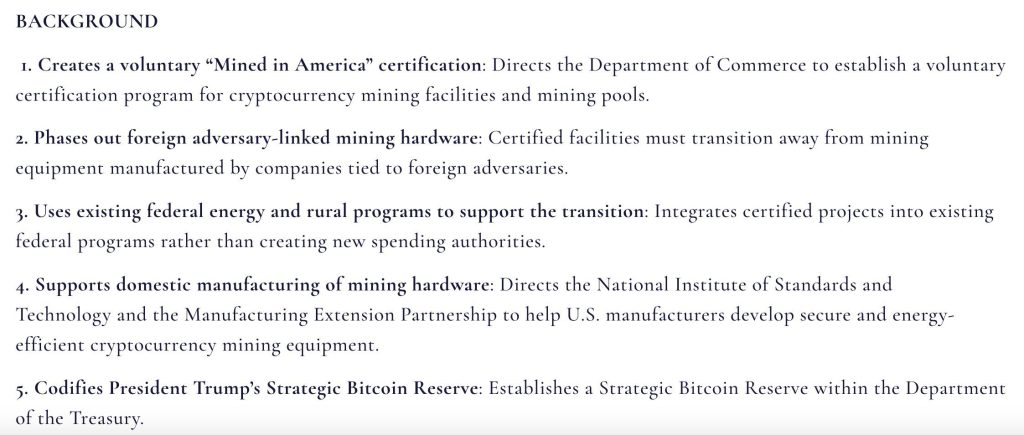
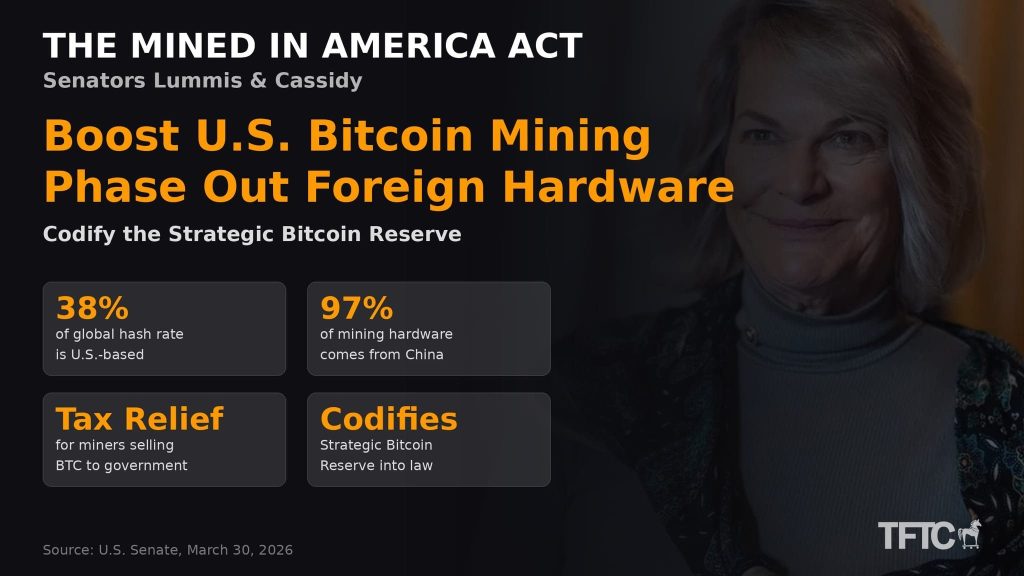
Senators Bill Cassidy (R-LA) and Cynthia Lummis (R-WY) introduced the Mined in America Act on March 30, creating a federal certification program for domestic Bitcoin mining operations and codifying President Trump’s Strategic Bitcoin Reserve executive order into law.
The bill targets a structural vulnerability that the industry can no longer ignore: the U.S. controls 38% of global Bitcoin hash rate but sources 97% of its mining hardware from China.
That asymmetry is the entire legislative thesis. Hash rate geography and hardware dependency are two different things – and right now, they’re pointed in opposite directions.
Key Takeaways:
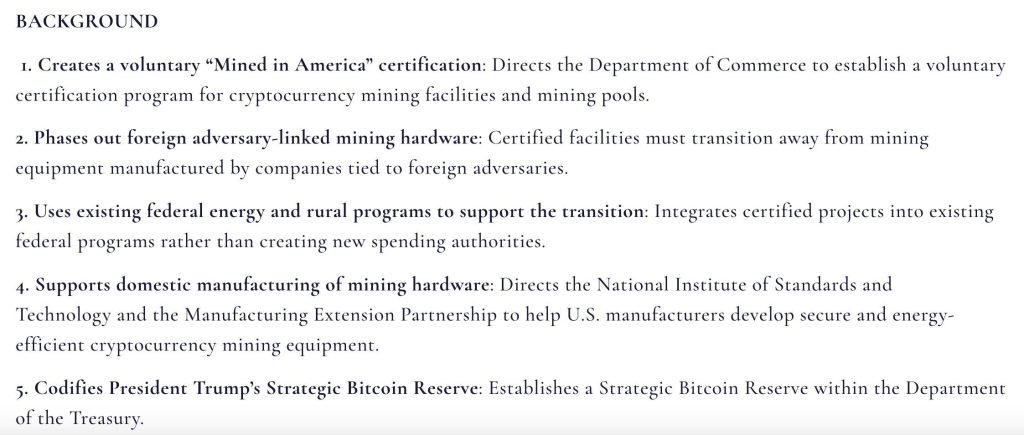
- Legislative Scope: The Mined in America Act creates a voluntary Commerce Department certification for mining facilities that commit to phasing out hardware from foreign adversaries, with full transition required by end of decade.
- Federal Access: Certified miners unlock existing DOE and USDA programs for grid stabilization, renewable absorption, and methane capture – no new federal spending required.
- Reserve Pipeline: The bill codifies Trump’s Strategic Bitcoin Reserve and creates a mechanism for certified U.S. miners to sell newly mined BTC directly to the reserve in exchange for capital gains tax exemptions.
- Hardware Vulnerability: Late 2024 customs inspections found firmware vulnerabilities in Chinese mining rigs enabling potential remote access – the security case underpinning the bill’s hardware phase-out mandate.
- What to Watch: Committee assignment to Senate Commerce or Energy and Natural Resources – that referral determines hearing timeline and amendment exposure for the incentive structure.
What the Mined in America Act Actually Does – and Why the Certification Structure Matters
The bill’s core mechanism is a voluntary certification program administered by the Commerce Department. Mining entities that opt in commit to a phased elimination of hardware manufactured by companies tied to foreign adversaries – China and Russia named explicitly – with full phase-out required by the end of the decade.
That distinction matters operationally. Voluntary means no penalty for non-participants, but the incentive architecture is designed to make certification economically attractive. Certified facilities gain access to existing Department of Energy and USDA rural financing programs – covering grid-stabilizing load, excess renewable absorption, and methane capture from landfills and oil fields.
No new appropriations required, which is the bill’s primary political insulation against deficit hawks.
The National Institute of Standards and Technology and the Manufacturing Extension Partnership would be directed to support U.S. firms developing domestic ASIC miners, with domestic assembly mandates attached.
NIST’s role here is notable – it signals the bill frames hardware security as a standards problem, not just a trade policy problem.
The Strategic Bitcoin Reserve codification adds a direct supply-chain-to-reserve pipeline. Certified miners can sell newly mined BTC to the reserve in exchange for capital gains tax exemptions – a budget-neutral expansion mechanism that doesn’t require Treasury to go to market.
Dennis Porter, CEO and co-founder of the Satoshi Action Fund, which co-crafted the legislation, put it plainly: “America controls 38 percent of the world’s Bitcoin hash rate, but 97 percent of the hardware powering it comes from China. That is not leadership, that is a liability.”
Discover: How MicroStrategy’s Bitcoin strategy could shift under new US mining policy
What to Watch
The bill’s immediate gating variable is committee referral – Senate leadership will assign it to either the Commerce, Science, and Transportation Committee or the Energy and Natural Resources Committee, likely within weeks.
The Commerce referral is the faster path; Energy and Natural Resources has a heavier docket and more competing priorities in Q2 2026.
Watch for a companion House bill within 60 days – Lummis has coordinated House counterparts on prior crypto legislation and the political incentive to move in parallel is strong ahead of midterm positioning.
NIST’s initial ASIC development guidelines are also a near-term signal – if those drop within 90 days of potential passage, it indicates the executive branch is moving implementation infrastructure ahead of floor votes, which is typically a signal of White House prioritization.
For mining stocks, the first-mover indicator is DOE program eligibility guidance – if Commerce and DOE issue joint certification criteria quickly, expect MARA, RIOT, and CLSK to move on the news before any operational benefit materializes.
The bill is on the calendar. Whether the incentive structure survives committee markup intact – particularly the capital gains exemption for reserve sales – is the variable traders need to track.
Discover: The best Bitcoin investment strategies for the current macro environment
The post Senators Introduce ‘Mined in America’ Bill to Boost US Bitcoin Mining appeared first on Cryptonews.

A bipartisan push in Congress is pressing federal regulators to curb insider trading risks tied to prediction markets. In a letter addressed to the Commodity Futures Trading Commission (CFTC) Chair Mike Selig and the Office of Government Ethics (OGE), at least 42 Democratic lawmakers urged executive-branch guidance that would require federal employees to refrain from using nonpublic information to trade on prediction-market contracts. The move comes amid heightened scrutiny of platforms like Kalshi and Polymarket, which have faced questions about how their markets could be leveraged for insider information.
The letter, prompted by “multiple incidents” that have sparked speculation about possible insider trading by federal employees in prediction markets, asks the CFTC and OGE to circulate guidance that applies across the entire federal workforce. The request, highlighted in a press release from Senator Elizabeth Warren’s office, emphasizes the need for clear rules to prevent government workers from exploiting inside information in these markets. Warren’s release notes the concern that such activity could undermine public trust and risk regulatory violations.
Among the incidents cited by the lawmakers are reported trades connected to geopolitical events and political developments, including bets on the capture of Nicolás Maduro and wagers tied to the length of a White House press briefing. The letter also references later reports of suspicious trades related to the invasion of Iran and the death of Ayatollah Khamenei, drawing national-security implications into the debate over how prediction markets operate within federal oversight. The lawmakers describe these events as signaling the need for stronger guardrails and enforcement mechanisms. Related coverage provides context on the broader growth and scrutiny of prediction-market activity.
In their request, the lawmakers ask for a briefing and written responses by April 13, including whether the CFTC has investigated or received reports of federal employees engaging in insider trading on prediction markets and what steps the agency is taking to detect and deter such activity. The push explicitly seeks to understand how regulators plan to monitor and enforce the line between legal participation in markets and improper use of inside information.
Key takeaways
- Executive guidance urged to curb insider trading by federal workers: A broad call for a formal, government-wide warning against using confidential information to trade in prediction markets.
- Incidents cited as catalysts for renewed oversight: Examples range from bets on Maduro’s capture to the length of a White House briefing, with later reports alleging suspicious trades tied to geopolitical events and public personnel decisions.
- Legal framework invoked: STOCK Act and derivatives status: The lawmakers argue the STOCK Act applies to prediction-market activity, given the CFTC’s view that event contracts are derivatives with potential financial consequences.
- Clear deadline and asks for transparency: The group seeks a briefing and written answers by April 13, including any investigations or measures underway to prevent insider trading by federal employees.
Regulatory framework and the broader implications
The lawmakers’ letter leans on the idea that prediction markets, which trade contracts based on future events, sit at the intersection of financial markets and public governance. They point to the Commodity Exchange Act (CEA) framework and the CFTC’s characterization of event contracts as derivatives—an interpretation that would bring such activity under the STOCK Act’s prohibitions on insider trading by government officials. The STOCK Act, originally signed into law by President Barack Obama in 2012, was designed to clarify that government officials cannot use material, nonpublic information for personal gain. The letter argues that the CFTC’s position effectively extends insider-trading prohibitions to prediction-market activity, in line with the spirit of the STOCK Act.
“Thus, the CEA’s prohibition on government officials engaging in insider trading also applies to such activity in prediction markets.”
This framing matters because it ties the governance of prediction markets to a long-standing public-integrity regime. If regulators and lawmakers treat event contracts as derivatives under the STOCK Act, federal employees would be barred from participating in these markets when they possess material nonpublic information—regardless of the market’s private platform semantics. That reinterpretation could tighten compliance obligations for agencies that use or monitor prediction-market data, while also shaping how future reforms are drafted.
Platform responses and what to watch next
Industry players have responded to rising scrutiny with efforts to reinforce guardrails. Kalshi and Polymarket, two of the largest prediction-market platforms, have announced steps to curb potential insider-trading exploits by tightening participant restrictions and introducing new safeguards. These moves come amid broader industry discussions about how to separate legitimate trading activity from signals that could reveal sensitive information or enable manipulation. For context, prior reporting has highlighted ongoing debates about insider-trading allegations and the regulatory pathway for prediction markets, including proposals for tighter controls and user bans. Platform guardrails reflect a pragmatic early response to a problem regulators say warrants formal clarification.
The letter’s examples underscore why such guardrails are not merely theoretical: incidents involving geopolitical bets, public-safety events, and personnel decisions highlight how quickly prediction markets can become channels for signaling or leakage of sensitive information. Regulators face the challenge of balancing the innovative potential of prediction markets—what they can reveal about collective expectations and risk—with the need to prevent improper disclosures and manipulation. The April 13 deadline for regulator responses will help determine whether more formal guidance, rulemaking, or legislative proposals follow, potentially shaping how these markets operate inside federal ecosystems and beyond.
What this means for investors, users, and builders
For market participants, there is an evolving risk calculus around prediction-market participation, particularly for individuals connected to or employed by the government. If regulators codify stricter guidance or broaden the STOCK Act’s application to prediction markets, investors and traders might see tighter eligibility criteria, more stringent compliance checks, and clearer disclosure expectations. For builders and platform operators, the development signals a growing imperative to implement robust user-verification processes, enhanced surveillance for unusual trading patterns, and transparent communications about governance and risk controls. The growing regulatory clarity could also help align prediction-market ecosystems with traditional derivatives markets, potentially unlocking broader institutional participation while reducing the risk of misuse.
In the near term, market watchers should monitor how the CFTC, the OGE, and lawmakers articulate expectations for insider-trading prevention. The April 13 briefing deadline will likely set the tone for whether regulatory momentum translates into concrete guidance, targeted rulemaking, or even new legislative proposals that further define the boundaries of prediction-market activity for federal actors and private participants alike.
As prediction markets continue to grow in adoption and scale, the tension between rapid experimentation and robust governance remains a defining theme. The coming weeks will reveal whether regulators favor a cautious, clearly defined framework or a more expansive approach that aggressively constrains insider-information dynamics in these markets.
Readers should watch for formal regulator communications and any legislative initiatives that spell out the exact scope of protections for nonpublic information, as well as how platforms implement the guardrails described by lawmakers. The alignment (or misalignment) between enforcement expectations and market incentives will shape how investment and participation in prediction markets evolve in 2026 and beyond.
This article was originally published as Dems press CFTC, ethics board on prediction-market insider trades on Crypto Breaking News – your trusted source for crypto news, Bitcoin news, and blockchain updates.

PJ Washington Speaks Amid Wife Alisah & Brittany Renner’s Beef

Are the Conservatives doomed to irrelevance?

World champion vows to make it look easy against Shakur Stevenson: “I’ve beaten better”


-
 NewsBeat6 days ago
Manchester United reach agreement with Casemiro over contract clause amid transfer speculation
-

 News Videos6 days ago
Parliament publishes latest register of MPs’ financial interests
-

 NewsBeat4 days ago
The Story hosts event on Durham’s historic registers
-
 Tech5 days ago
Intercom’s new post-trained Fin Apex 1.0 beats GPT-5.4 and Claude Sonnet 4.6 at customer service resolutions
-

 Business5 days ago
Instagram, YouTube Found Responsible for Teen’s Mental Health Struggle in Historic Ruling
-
 NewsBeat6 days ago
Tesco is selling new Cadbury Dairy Milk bar and people can’t wait to try it
-

 Sports4 days ago
Sweet Sixteen Game Thread: Tide vs Michigan
-

 NewsBeat7 days ago
Entrepreneurs Forum survey reveals optimism in North East
-
 Entertainment3 days ago
Lana Del Rey Celebrates Her Husband’s 51st Birthday In New Post
-
Entertainment1 day ago
Fans slam 'heartbreaking' Barbie Dream Fest convention debacle with 'cardboard cutout' experience
-
Crypto World6 hours ago
Dems press CFTC, ethics board on prediction-market insider trades
-

 Sports6 days ago
Fantasy Baseball Week 1 Preview: Top sleeper hitters for both five- and 12-day period led by Munetaka Murakami
-

 Tech6 days ago
US FCC Prohibits Approval Of New Foreign-Made Consumer Routers
-

 Tech7 days ago
Embedding compliance in AI adoption
-
Sports6 days ago
One Team in Particular Is Monitoring Kirk Cousins
-

 Fashion7 days ago
Althea Mink: Patrice Taylor’s Atlanta Couture Brand Built on Legacy, Resilience, and Architectural Glamour
-
 NewsBeat7 days ago
DWP to close two benefits for all new and existing claimants before April
-
 Fashion6 days ago
How to Style Spring Like WeWoreWhat: Easy Outfit Ideas for 2026
-

 Entertainment6 days ago
HBO’s Harry Potter Series Will Definitely Fail For One Big Reason, And It’s Not J.K. Rowling Or Snape
-
 Sports7 days ago
Bhubaneswar gets 2028 World Indoor Athletics Championships hosting rights | Other Sports News
You must be logged in to post a comment Login