

Crypto World
What are “the trenches”? Solana memecoin culture



If you spend any time around Solana memecoins, you will hear about “the trenches.” It is where traders called degens fight over brand-new tokens that mostly go to zero, in a culture with its own language, rituals, and brutal economics. Here is what the trenches are, the slang you need to follow them, and the hard reality behind the romance.
Summary
- “The trenches” is crypto slang for the chaotic, high-risk frontier of on-chain memecoin trading, especially brand-new Solana tokens on launchpads like Pump.fun.
- The traders who operate there are called trenchers or degens, and the culture has its own dense vocabulary, rituals, and a war-themed self-image of survival against the odds.
- The trenches run on launchpads, decentralized exchanges, and fast trading tools, where tokens can rocket and collapse within minutes and bots compete for the first buys.
- The romance of life-changing gains is real but rare, and is built on heavy survivorship bias, since the large majority of tokens die fast and most participants lose money.
- Understanding the trenches and its slang is useful for following crypto culture and protecting yourself, but the honest framing is that it functions more like a casino than a market.
“The trenches” is crypto slang for the chaotic, high-risk frontier of on-chain memecoin trading, especially the world of brand-new Solana tokens launched on platforms like Pump.fun, where traders fight for fast profits amid rampant scams, bots, and a flood of coins that mostly go to zero. The phrase is a war metaphor, and it is chosen deliberately. To be “in the trenches” is to be down in the mud of the riskiest, fastest, most unforgiving part of crypto, trading tokens that are minutes old, against opponents who include automated bots and seasoned predators, where fortunes are made and lost in the time it takes to read a chart. It is a culture as much as an activity, with its own dense vocabulary, its own rituals and heroes, and its own grim economics.
The term has spread well beyond its origins, and you will now hear it used for the early, high-risk stage of any speculative crypto play, but its heartland is the Solana memecoin scene, where the conditions that birthed it, instant token creation, near-zero fees, and a permanent firehose of new coins, are most intense. This guide is a map of the trenches for people who want to understand the culture without necessarily entering it, or who are entering it and want to know what they are walking into. It explains what the trenches are and where they physically exist on-chain, the mindset and culture that define the people in them, a working glossary of the slang you need to follow any trenches conversation, how a typical trench play actually unfolds from launch to death or survival, a recent episode that captures the culture in motion, and, most importantly, the hard reality behind the romantic self-image.
That last part matters more than all the slang, because the trenches present themselves as a place of opportunity and camaraderie, and they are also a place where the overwhelming majority of participants lose money to a structure designed to extract it. Learning the language is the easy part. Understanding the economics is what protects you. This guide tries to do both, in that order, so that the culture is legible and the danger is unmistakable.
What the trenches are and where they live
At its core, the trenches refers to the earliest and riskiest stage of memecoin trading, where tokens are brand new and the action is fastest. The phrase captures both a place and a phase. As a phase, it means trading coins in their first minutes and hours of life, before they have established markets, when prices move violently and information is scarce. As a place, it refers to the venues and channels where this happens.
The trenches live on launchpads, above all the dominant Solana launchpad, where anyone can deploy a token in seconds and it begins trading immediately against a bonding curve. For readers new to that pricing model, the mechanism under every launch is the bonding curve, which automatically changes a token’s price as buyers and sellers move in and out. The trenches extend to the decentralized exchanges where tokens move after they graduate from those launchpads, and to the social channels, especially memecoin-focused chat groups, that are themselves often called the trenches, because that is where traders gather to share tips and coordinate.
The infrastructure of the trenches is built for speed, which shapes the entire experience. Traders use specialized tools and bots that let them buy a token within seconds of its launch, read on-chain data in real time, and execute faster than a human could click, because in a world where a coin can rise and fall in minutes, milliseconds of timing translate into enormous differences in entry price. This is why the trenches are not a level playing field: automated snipers and bots routinely buy into a token in its first moments, ahead of the humans who see it trending later. The reason all of this concentrated on Solana is structural: Solana’s very low fees and fast transaction speeds make it cheap and quick to launch coins and to trade them rapidly, which is exactly what a high-frequency, high-churn memecoin culture needs.
The launchpads that lowered the barrier to creating tokens did the rest. The trenches, then, are the on-chain frontier where the cheapest, fastest, most permissionless token creation meets the most speculative trading culture in crypto. The combination produces both the energy and the carnage the term implies. It is why the trenches feel like a live market, a chatroom, and a casino floor at the same time.
The mindset and the culture
The trenches have a distinct culture, and understanding the mindset is as important as understanding the mechanics, because the culture is part of what keeps people in a game that mostly loses them money. The self-image is heroic and martial: participants cast themselves as warriors surviving in hostile territory, enduring losses, hunting for the one coin that will pay for all the others. There is genuine camaraderie in it, a shared identity among people who understand a world outsiders find baffling or repellent, and a folklore of legendary trades and legendary traders. The dominant ethos is captured in the word degen, short for degenerate, which trenchers wear as a badge rather than an insult.
To be a degen in the trenches is to accept that you are gambling and to lean into it with a certain dark humor. That humor and identity are woven through the culture’s language and rituals. Trenchers talk about “locking in,” meaning to focus intensely on the goal of making money quickly with minimal effort, and about hunting for a “gem,” an undervalued coin spotted before the crowd. The culture prizes “alpha,” valuable information or insight shared among insiders, and it runs on a constant cycle of fear of missing out and fear of being wrong, the twin emotions that drive impulsive buying and panic selling.
There is a player-versus-player quality to it, an awareness that in a zero-sum scramble over a worthless token, your profit is someone else’s loss, which the culture acknowledges with a kind of cheerful brutality. All of this creates a powerful social pull. The trenches are not just a market; they are a community with a language, a value system, and an emotional rhythm. That social dimension is a large part of why people stay even as they lose, because belonging and the thrill of the hunt are their own rewards.
Recognizing the culture’s grip is important, because the same camaraderie that makes the trenches compelling is also what makes them hard to walk away from. The community tells itself stories about survival and conviction, and some of those stories are true. But many of them are also retrospective myths built around the tiny number of trades that worked. That is why the culture has to be understood together with the economics, not separately from them.
A working glossary of trench slang
To follow any conversation in the trenches, you need the vocabulary, and the slang is dense enough that an outsider can find a discussion incomprehensible. What follows is a working glossary of the most important terms, enough to read a typical trenches exchange. Begin with the people: a trencher or degen is a high-risk memecoin trader; a jeet is a derisive term for someone who sells too early or panic-sells, dumping on others; and a whale is a holder large enough to move a token’s price with their trades. The verbs of entry and exit matter too: to ape, or ape in, is to buy a token impulsively without much research; to snipe is to buy in the very first moments of a launch, usually with a bot; and to bundle is to coordinate multiple wallets to buy at launch, often to create a false impression of demand.
The lifecycle of a coin has its own terms. A fair launch means a token released with no presale or insider allocation, where everyone enters through the same curve. Graduation is the moment a token completes its bonding curve and moves to a normal exchange. A rug, or rug pull, is the most common trench ending: a scam where the creator pulls liquidity or dumps their holdings, collapsing the price to near zero.
A CTO, or community takeover, is when holders take over a coin the original creator abandoned, running it themselves to try to revive it. The emotional and evaluative vocabulary rounds it out: a gem is an undervalued find; alpha is valuable insight; FOMO and FUD are the fear of missing out and fear, uncertainty, and doubt that drive buying and selling; bags are the tokens you hold; to be underwater is to hold at a loss; and to moon or send it is to rise sharply or to take the plunge on a risky buy. Newer coinages appear constantly, such as a stimmy, slang adopted from stimulus payments to describe handing money to traders, which entered wide use when an influencer pledged to airdrop fees to the trenches. The vocabulary keeps evolving, but these terms form the durable core, and knowing them turns an impenetrable trenches conversation into something you can actually follow.
How a trench play unfolds
To see the culture and mechanics together, follow how a typical trench play unfolds from birth to death, because the lifecycle is remarkably consistent. It begins with a launch: someone deploys a new token on a launchpad, giving it a name, an image, and a ticker, and it starts trading instantly against its bonding curve. In the first seconds, before any human has really noticed, automated snipers and bots may buy in, taking the earliest and cheapest positions, sometimes coordinated across bundled wallets to create the look of organic demand. This is the first hard truth of the trenches: by the time a human sees a coin, bots have often already moved.
Next comes the attention phase. If the coin has a catchy theme, a connection to a trending narrative, or a push from an influencer or a coordinated group, it begins to spread across social channels, and human traders start to ape in, sending the price climbing up the curve as buying accelerates. If the momentum builds far enough, the coin graduates, its accumulated liquidity moving to a normal exchange, which can attract a fresh wave of traders who treat graduation as a sign of legitimacy. Then comes the decisive phase, which for the overwhelming majority of coins is the end.
As the early buyers and any insiders take profit, selling into the latecomers, the price stalls and reverses. If a creator or whale dumps a large position, or pulls liquidity outright in a rug, the price collapses toward zero, often within hours of the peak. Most coins simply fade as attention moves to the next launch and buyers stop arriving, the price bleeding down the curve as holders capitulate. A small number survive, and an even smaller number, occasionally, get a second life through a community takeover, when stubborn or spiteful holders seize the abandoned coin and try to rebuild momentum themselves, which usually fails but can, if executed well, give the holders a better exit.
This lifecycle, launch, snipe, hype, climb, distribution, collapse, plays out thousands of times a day, and recognizing its shape is the difference between understanding what you are watching and being its raw material. It is also why who profits from the churn matters. Launchpads, creators, and early entrants can profit from volume and timing even when the token itself has no lasting value. Late buyers often discover that the chart they are chasing is already in its distribution phase.
The trenches in action
A recent episode captures the culture vividly and ties the abstractions to a concrete moment. In late June 2026, a frenzy erupted around a cluster of Solana memecoins using the name of a prominent influencer, and it played out as a textbook trenches event. Multiple competing tokens using the same name launched at once, and the trading community flipped between them in exactly the player-versus-player scramble the culture is known for, with no single coin crowned the real one for a stretch as trenchers fought over which version would win. One version went parabolic, running to tens of millions in market cap within days, while dramatic individual outcomes, including a trader turning a few thousand dollars into hundreds of thousands, became the kind of folklore that draws more people into the next launch.
The episode also showcased the culture’s vocabulary and rituals in real time. The influencer at the center publicly took the side of the trenches against the launchpad, criticizing how it handled rewards and pledging to airdrop his accumulated fees back to traders, framing it in the community’s own slang as giving the trenches a stimmy because the platform would not. The word stimmy, the framing of small traders as a community owed a payout, the swarm of copycat tokens, the parabolic run, and the rapid churn all embodied the trenches in a single story. It also showcased the danger.
The same influencer disavowed other tokens trading on his name, copycats and impersonations proliferated, and the headline pump figures often did not survive a look at the actual on-chain data. The episode was the trenches in miniature, the camaraderie and the opportunity and the manipulation and the carnage all braided together, which is exactly why it drew such attention. For a student of the culture, it was a live demonstration of every dynamic this guide describes. It was also a reminder that behind the romance of the heroic trade sits a machine that mostly transfers money from latecomers to insiders and platforms.
The reality behind the romance
Strip away the war metaphors and the folklore, and the trenches are, in hard economic terms, a place where most participants lose money to a structure built to extract it, and saying so plainly is the most useful thing this guide can do. The data is unambiguous. Studies of Solana memecoin launches have found that roughly two out of three coins are effectively dead within their first day, with the vast majority of their liquidity gone, and that on the order of 80% or more lose over 90% of their value within about a week. Recent Pump.fun lifespan data showed the same pattern, with nearly seven in 10 reviewed launches recording their final bonding-curve trade on launch day.
By some estimates, the overwhelming majority of tokens launched on the dominant launchpad are scams, pump-and-dumps, or jokes with no lasting value. The life-changing gains that make the folklore are real, but they are extraordinarily rare, and they are visible precisely because they are rare, while the millions of losing trades are invisible. That produces a powerful survivorship bias: you hear about the trader who turned a few thousand into a fortune, never about the thousands who did the opposite. This is the same dynamic that makes the assets traded in the trenches so culturally powerful and financially dangerous.
The structural reality reinforces this. The platforms that host the trenches earn from trading volume regardless of whether any coin succeeds, so the house profits from the churn itself, much like a casino. Bots and insiders routinely get the earliest, cheapest positions, leaving the human trader who arrives on a trending coin to buy from people already in profit. Creator fees and large insider holdings give those who launch and promote coins tools and motives to manufacture hype around tokens they benefit from.
The emotional culture, the FOMO, the camaraderie, the heroic self-image, is itself part of what keeps people trading through losses. None of this means the trenches are not real or that no one ever profits; some skilled and disciplined traders do, and the culture has genuine creativity and community in it. But the honest framing, shared by the more responsible voices in the space, is that the trenches function far more like a casino than like an investment market, that the odds are structurally against the individual, and that anyone entering should treat it as gambling with money they can afford to lose entirely, not as a path to wealth. The slang is fun and the stories are thrilling, but the math is brutal, and the math is what determines what happens to almost everyone who goes in.
Frequently asked questions
What does “the trenches” mean in crypto?
The trenches is slang for the chaotic, high-risk frontier of on-chain memecoin trading, especially brand-new Solana tokens on launchpads like Pump.fun. It is a war metaphor: to be in the trenches is to trade coins that are minutes old, in the fastest and most unforgiving part of crypto, against opponents that include automated bots. The term refers to both a phase, the earliest and riskiest stage of a token’s life, and a place, the launchpads, exchanges, and chat groups where this trading happens. Memecoin-focused chat channels are themselves often called the trenches. The phrase has spread to mean the early high-risk stage of any speculative crypto play. In practice, though, its strongest association remains Solana memecoin trading, because Solana’s speed, low fees, and launchpad culture created the conditions where the slang took hold. It is less a formal market category than a cultural label for the most chaotic edge of on-chain speculation.
Who are “trenchers” and “degens”?
Trenchers are the traders who operate in the trenches, buying and selling brand-new memecoins. Degen, short for degenerate, is a closely related term that trenchers wear as a badge rather than an insult; it describes someone who takes large speculative risks, does minimal research, and embraces gambling openly. The culture is built around this identity: a self-image of risk-taking warriors hunting for the one coin that pays for all the losses. There is real camaraderie and folklore among them, a shared language and value system. That social identity is part of what makes the trenches compelling and part of what keeps people trading even as the structure causes most of them to lose money over time. It gives the activity a story larger than the trade itself. The danger is that the story can make repeated losses feel like proof of toughness rather than evidence that the odds are bad.
Where do the trenches actually happen?
On-chain, primarily on Solana. The trenches live on launchpads, above all the dominant Solana launchpad, where anyone can deploy a token in seconds and it trades instantly against a bonding curve, and on the decentralized exchanges where tokens move after they graduate. They also live in social channels, especially memecoin-focused chat groups that are themselves called the trenches. The infrastructure is built for speed, with specialized tools and bots that let traders buy within seconds of a launch and read on-chain data in real time. Solana became the heartland because its very low fees and fast transactions make it cheap and quick to launch and rapidly trade coins, which is exactly what the high-churn memecoin culture needs. The chain’s infrastructure makes small, fast trades economically possible in a way that would be harder on more expensive networks. That is why the trenches are as much a product of technical design as they are of internet culture.
What does “stimmy” mean, and other common slang?
A stimmy is slang, adopted from stimulus payments, for handing money to traders; it entered wide use when an influencer pledged to airdrop fees to the trenches. Other core terms include ape, to buy impulsively without research; snipe, to buy in a launch’s first moments, usually with a bot; rug, a scam where the creator collapses the price; CTO, a community takeover of an abandoned coin; jeet, a derisive term for someone who panic-sells; whale, a holder big enough to move the price; bags, the tokens you hold; alpha, valuable insight; and FOMO and FUD, the fear of missing out and the fear and doubt that drive buying and selling. The vocabulary evolves constantly, but these form its durable core. The slang matters because it does more than describe trades. It builds identity, signals belonging, and compresses complex market behavior into quick phrases that move through chats fast. Understanding it helps you follow the culture, but it should not make the activity seem safer than it is.
Can you actually make money in the trenches?
Some people do, but the odds are structurally against the individual, and most participants lose money. The data is stark: roughly two of three Solana memecoins are effectively dead within a day, and 80% or more lose over 90% of their value within about a week, while the overwhelming majority of launchpad tokens are scams, pump-and-dumps, or jokes. The life-changing gains that fuel the folklore are real but extremely rare, and they create survivorship bias because the countless losses are invisible. Bots and insiders get the earliest positions, platforms profit from the churn regardless of outcomes, and creator fees give promoters motives to manufacture hype. Skilled, disciplined traders exist, but the structure resembles a casino more than an investment market. The rare wins are easy to screenshot and share, while the typical losses disappear into wallet history. That imbalance is exactly why the romance of the trenches can be so misleading.
Is trading in the trenches a good idea?
This guide does not recommend it, and the honest framing is that the trenches function far more like a casino than an investment market, with the odds structurally against the individual participant. The platforms profit from trading volume regardless of whether coins succeed, bots and insiders take the best positions, and most tokens are designed to extract money from latecomers. The culture’s camaraderie and heroic self-image are genuine and are also part of what keeps people trading through losses. If someone chooses to participate anyway, the only responsible approach is to treat it strictly as gambling, risking only money they can afford to lose entirely, verifying contracts and holder concentration, and never mistaking the rare success stories for the typical outcome. That means treating every new coin as hostile until proven otherwise. It also means understanding that speed, information, and discipline matter, but even those do not erase structural disadvantages. The safest way to learn the trenches is as a culture and a warning before treating it as a trading venue.
This article is educational information about crypto culture, not financial advice or encouragement to trade memecoins. Descriptions of trenches culture, slang, and failure statistics reflect reporting available as of June 29, 2026, and can change. Memecoin trading is extremely high-risk, resembles gambling, and causes most participants to lose money. Verify any specific token or platform independently and consult a qualified professional before making any financial decision.


TL;DR
- UK FCA sets October 2027 deadline for crypto licensing.
- Existing AML registrations must be replaced with new approvals.
- Stablecoin rules eased after industry feedback.
- UK pushes toward a fully regulated crypto market.
Crypto companies operating in the United Kingdom now have a clear timeline to secure regulatory approval after the Financial Conduct Authority (FCA), which started the year with a crackdown on crypto companies, finalized its long-awaited crypto framework, setting October 25, 2027, as the date the new regime officially takes effect.
The announcement marks one of the country’s biggest regulatory overhauls for digital assets, bringing exchanges, custodians, stablecoin issuers, staking providers, and other crypto businesses under a unified licensing system. Firms currently registered under the UK’s anti-money laundering (AML) rules will not automatically qualify under the new framework and must submit entirely new applications if they wish to continue operating.
Firms Face Strict Authorization Timeline Under UK FCA
According to the FCA, the application window will open on September 30, 2026, and remain available until February 28, 2027. During that period, companies intending to provide regulated crypto services in the UK must either apply for a fresh license or amend their existing financial services permissions.
The regulator warned businesses not to delay their applications, noting that incomplete submissions or late filings could slow the approval process and potentially interrupt operations before the new rules become effective.
One notable revision concerns stablecoin issuers. The regulator reduced its proposed capital requirement from 2% of issued stablecoin value to 1%, acknowledging feedback that the original proposal was unnecessarily burdensome for businesses entering the market.
Despite the softer capital requirement, issuers will still be required to maintain adequate reserves, ensure timely redemption of tokens, and comply with strict operational standards.
The FCA also confirmed that sterling-backed stablecoins will fall under its direct supervision, while larger stablecoins considered systemically important may instead come under the oversight of the Bank of England.
Stronger Risk Controls for Crypto Businesses
Beyond licensing, the new framework introduces significantly tougher operational requirements for crypto companies.
Businesses will be expected to demonstrate that they can withstand severe market disruptions by maintaining sufficient capital against higher-risk assets and conducting annual stress tests that assess their financial resilience during periods of economic uncertainty.
Unlike major banks, which receive standardized stress-testing scenarios from the Bank of England, crypto firms will be allowed to design their own testing models based on their internal risk assessments before submitting the results to the FCA for review.
According to FCA Executive Director for Payments and Digital Finance David Geale, the framework applies the same regulatory principles already used across traditional financial services, ensuring firms manage comparable risks under comparable standards.
The FCA has also indicated that decentralized finance will remain a regulatory priority as the sector evolves.
As regulation gets tight around the world, future guidance is expected to distinguish between protocols that operate without any identifiable controlling entity and platforms that maintain centralized governance or management structures. Services with identifiable operators or controlled decentralized autonomous organizations (DAOs) are more likely to fall within the regulator’s supervisory scope.


XRP is continuing to hold above the crucial $1.00 support level, trading near $1.04 after falling to a 19-month low of around $1.01 on June 25.
Despite the recent price weakness, Santiment found that interest in the XRP Ledger has remained strong.
FOMO Returns
According to the latest data, the XRP Ledger recorded 4,941 new wallet creations in a single day, which is its highest level of network growth in more than three months. This suggests that new users are entering the ecosystem at a time when XRP’s price is under pressure, the analytics firm explained.
At the same time, social sentiment has turned increasingly optimistic. Santiment’s data reveal there are now 3.7 bullish comments for every bearish comment, the highest positive-to-negative ratio in three months. As such, many traders are treating the $1.00-$1.05 range as a dip-buying opportunity, which reflects growing fear of missing out (FOMO).
The firm said this optimism is partly driven by XRP’s history of rebounding after sharp declines, ongoing discussions around ETFs and institutional adoption, and the view that larger holders have continued accumulating during the downturn. Santiment added that it remains important to see whether the surge in new wallets develops into steady buying demand or proves to be only short-term FOMO.
Separate data from CryptoQuant showed that whale activity is becoming more prominent across centralized exchanges overall, but less concentrated on Binance. It found that whales are increasingly spreading their activity across multiple trading platforms.
Institutional Demand
Even as the price continues to struggle, XRP investment products have managed to attract fresh capital. US-based spot XRP ETFs attracted $15.34 million in net inflows on June 29. The Bitwise XRP ETF accounted for the largest share at $11.94 million, followed by Canary XRPC at $3.40 million.
June’s total has now surpassed $62 million, bringing cumulative net inflows across all the spot XRP ETFs to $1.48 billion, according to data compiled by SoSoValue.
The post Is XRP Ready for a Reversal? Wallets Surge as FOMO Hits 3-Month Peak appeared first on CryptoPotato.
Crypto World
RedotPay Selects OpenPayd to Strengthen Global Stablecoin Payment Infrastructure for Millions of Customers
[PRESS RELEASE – London, United Kingdom, June 30th, 2026]
RedotPay, a global stablecoin-based payment fintech, has selected OpenPayd, a leading financial infrastructure provider, to enhance its treasury operations, multi-currency payments, and cross-border remittances for customers worldwide.
The collaboration strengthens RedotPay’s payment infrastructure, enabling a more seamless experience for global fund movement so users can navigate between local and digital currencies effortlessly.
As a result of the integration, RedotPay users benefit from faster, more efficient cross-border remittances and frictionless multi-currency payment options. The integration also optimizes how liquidity is managed behind the scenes. As a result, transactions are processed securely and without unnecessary delays, regardless of where the user is located.
By leveraging OpenPayd’s infrastructure and integrating the best of traditional and digital finance into a single, intuitive platform, RedotPay enables users to move seamlessly between local and digital currencies as it continues to scale its global footprint. Throughout, it maintains its commitment to a fast, flexible, and user-centric payment experience.
Jonathan Chan, Head of Partnerships & Co-Founder of RedotPay, said: “Our goal has always been to make digital finance accessible and practical for everyday use. By partnering with world-class infrastructure providers, we’re removing the friction from cross-border payments. This collaboration allows RedotPay users to enjoy effortless multi-currency payments and faster cross-border remittances, allowing us to better serve customers as our global reach expands.”
Lux Thiagarajah, Chief Commercial Officer at OpenPayd, said: “RedotPay is building one of the most compelling payment experiences at the intersection of traditional finance and digital assets. As they continue to scale globally, the ability to move seamlessly between payment rails, currencies, and stablecoins becomes a competitive advantage. OpenPayd is proud to provide the infrastructure that enables RedotPay to deliver faster, more efficient, and more flexible money movement for customers around the world.”
About RedotPay
RedotPay is a global stablecoin-based payment fintech that integrates blockchain solutions with traditional banking and finance infrastructures. Our intuitive platform empowers millions around the world to spend and send digital assets, ensuring faster, more accessible, and inclusive financial services. RedotPay advances financial inclusion for the unbanked and supports crypto enthusiasts, driving global adoption of secure and flexible stablecoin-powered financial solutions to bring crypto to real life. For more information, visit www.redotpay.com.
About OpenPayd
OpenPayd is building the universal financial infrastructure for the digital economy. Founded in 2018 by Dr. Ozan Ozerk, its rails-agnostic platform enables businesses to move and manage money globally – across fiat and digital assets – through a single, powerful API. OpenPayd provides embedded accounts, FX, domestic and international payments, Open Banking, and stablecoin on/off ramps – delivering interoperability between traditional finance and digital assets. With one of the most comprehensive banking networks in the market, OpenPayd enables real-time money movement, everywhere.
Trusted by global brands including eToro, Kraken, OKX, and B2C2, OpenPayd processes more than $240 billion in annual volumes for over 1100 businesses. It is the infrastructure layer powering the next generation of financial services.
The post RedotPay Selects OpenPayd to Strengthen Global Stablecoin Payment Infrastructure for Millions of Customers appeared first on CryptoPotato.
Crypto World
Bitcoin’s tie to USD/JPY is the strongest it’s been since 2022. Here’s why that matters.


Under the “yen carry trade” framework, a weak yen (USD/JPY rising) is supposed to be accompanied by rising BTC, just as it tends to support stocks. Extending that logic, a strengthening yen should trigger risk aversion in both stocks and cryptocurrencies.
That’s precisely what happened in late July/early August 2024, when the Bank of Japan hiked interest rates, sending the yen sharply higher. Risk assets had a meltdown, with BTC falling from roughly $65,000 to $50,000 in the following weeks.
Carry-unwind fears have resurfaced lately as the yen continues to slide, hitting four-decade lows this week. That’s raised hopes of more aggressive action by the BOJ to stem the yen’s slide.
However, if the latest correlation is anything to go by, potential BOJ action and a resulting rise in the yen could actually put a floor under BTC, working the opposite way from what carry-trade logic would predict.
A mirage?
Correlation doesn’t necessarily mean causation.
Neither BTC nor the yen may be driving the other directly. Instead, broad US dollar strength or weakness may be moving both assets independently, creating the appearance of a tight BTC-yen relationship.
That reading makes sense in context: markets have recently priced in at least one 25-basis-point interest rate hike from the Fed this year. That hawkish repricing, a sharp reversal from earlier hopes of rate cuts, has lifted the dollar broadly. The euro, the Australian dollar, the New Zealand dollar, gold and silver have all declined against the greenback over the same stretch.


The chances of the crypto market structure bill, or CLARITY Act, passing before the November midterm election have remained far from assured as major legislative hurdles continue, according to investment bank TD Cowen.
Summary
- TD Cowen said the CLARITY Act faces significant political and procedural hurdles before the November midterm election.
- Senate leaders are expected to begin considering the bill in mid July, but unresolved policy disputes could delay a floor vote.
- Ethics rules, anti money laundering concerns and uncertainty over President Donald Trump’s support continue to weigh on the bill’s prospects.
According to TD Cowen’s Washington Research Group, Senate Majority Leader John Thune is expected to begin the procedural process for the CLARITY Act during the week of July 13, potentially setting up a Senate floor vote either that week or during the week of July 20.
The investment bank’s managing director, Jaret Seiberg, said the legislation still faces several obstacles before it can clear the Senate.
He identified July 24 as the key deadline before the House leaves for its August recess and questioned whether the bill could realistically advance later in the year if lawmakers fail to act before then.
“We continue to question if the bill can pass in the fall before the election,” Seiberg wrote.
The assessment follows similar concerns raised last week by Galaxy Research, which reduced its estimate of the CLARITY Act becoming law in 2026 to 50% from 60%, citing Senate scheduling constraints and limited legislative time.
Earlier this month, JPMorgan analysts also said they see less than a 50% chance of the bill passing this year because of the approaching midterm election, unresolved policy disputes and the continuing debate over stablecoin yield.
Previous reporting by journalist Eleanor Terrett also said congressional staff, White House officials and crypto industry representatives have continued negotiating the legislation while the Senate remains in recess, with ethics rules, anti-money-laundering provisions and digital asset market oversight among the unresolved issues.
Trump stance and ethics debate remain key obstacles
One area of uncertainty, according to TD Cowen, is whether President Donald Trump would ultimately sign the legislation.
Seiberg said Democrats are expected to force Republicans to vote on politically difficult amendments, and Republican lawmakers are unlikely to take those votes unless they believe Trump will approve the final bill.
According to the note, that confidence has weakened after Trump declined to sign a bipartisan housing bill negotiated by his own administration and later said he would not approve legislation until Congress passes the Safeguard American Voter Eligibility Act. Although Seiberg said Trump could still make an exception for the CLARITY Act, he warned the uncertainty could delay the bill.
Ethics provisions have also become another point of disagreement. According to TD Cowen, Democrats want to ban government officials and their families from owning crypto businesses, a proposal that would also apply to the president. Seiberg said Trump has not indicated a willingness to compromise, leaving Republicans in a position where they may have to reject a Democratic amendment.
“It is not clear to us the GOP has the votes,” Seiberg wrote, adding that Republican Senators Thom Tillis, Mitch McConnell, Bill Cassidy, John Cornyn, Susan Collins, and Lisa Murkowski could play an important role because several are moderates or are retiring.
Separately, TD Cowen said the White House has continued meeting with stakeholders over concerns from law enforcement agencies about whether software developers should be held responsible if tools they create are later used for money laundering or other illicit finance. Seiberg said resolving those concerns would improve the bill’s prospects.
The discussion follows a letter sent last week by several law enforcement groups to the White House arguing that Section 604 of the CLARITY Act, known as the Blockchain Regulatory Certainty Act, could weaken oversight by protecting non-custodial software developers and make investigations into illicit crypto activity more difficult.
However, Seiberg said he does not expect changes to the bill’s stablecoin yield provisions despite continued opposition from banks.
Key Takeaways
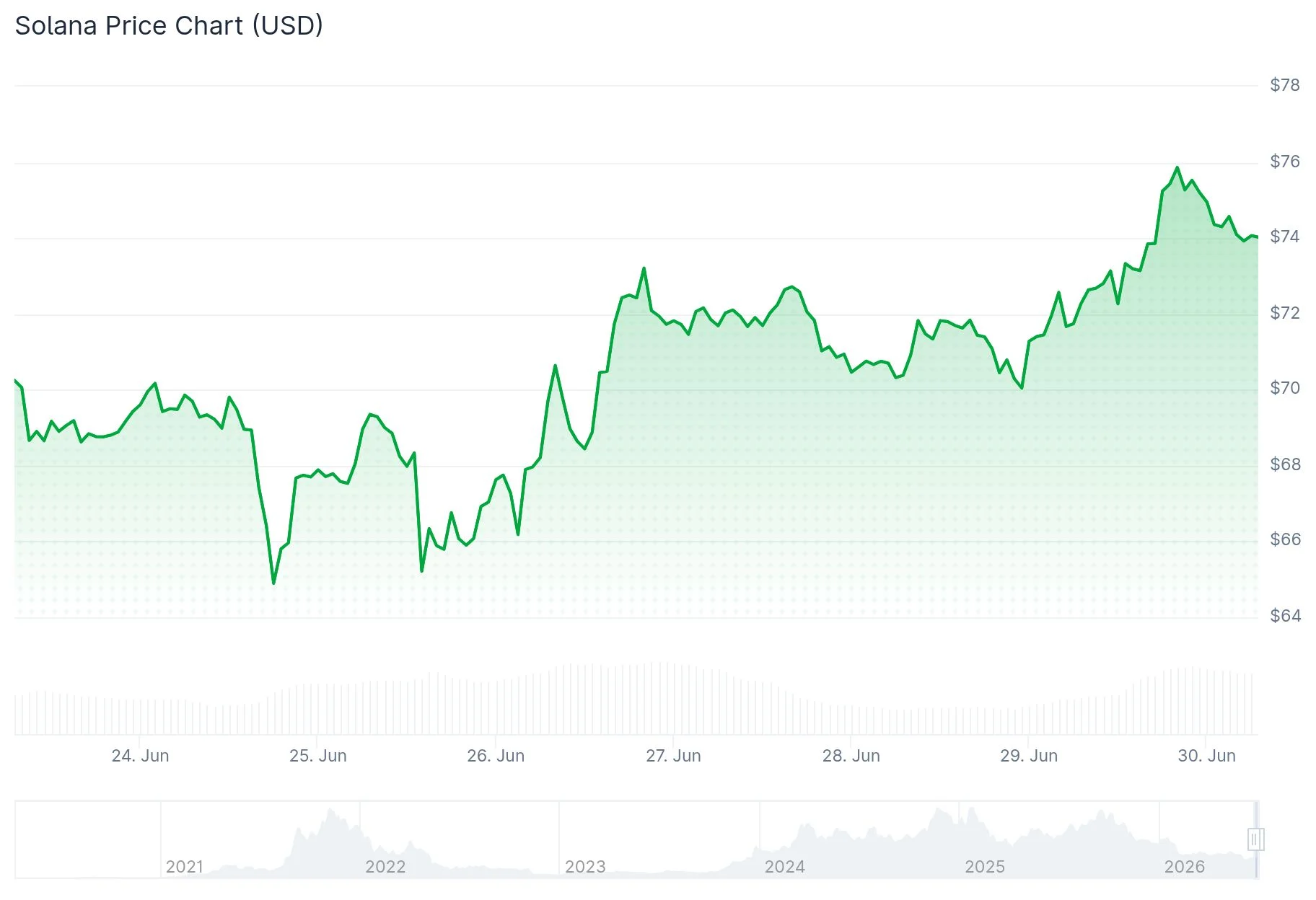
- Solana is currently testing a critical demand zone between $65 and $71 after retreating to $71.37.
- Over 60 million SOL tokens were transacted within the $65–$71 range, establishing it as a significant support area.
- Failure to maintain $70 could trigger declines toward $64, followed by $53.10, based on URPD analysis.
- Technical indicators show RSI at 51.60 with a bullish MACD crossover, hinting at potential momentum shifts.
- World Xyz, a Solana-based project, officially launched, injecting renewed enthusiasm into the community.
Solana’s price has retreated to $71.37 in the last 24 hours. This decline mirrors Bitcoin’s broader market correction that affected most cryptocurrencies.
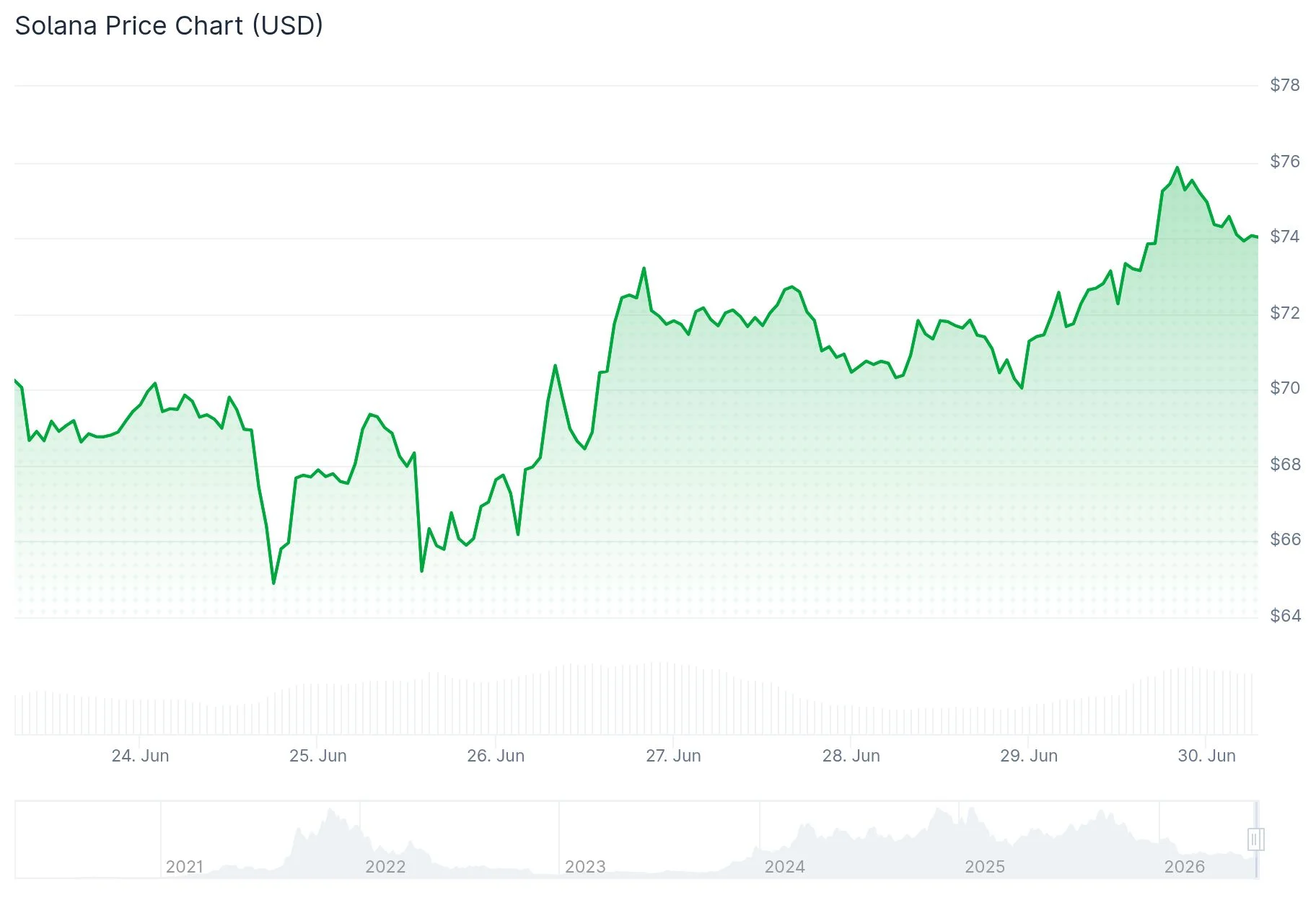
Blockchain data reveals that over 60 million SOL tokens were traded between the $65 and $71 price levels. This concentration of activity establishes this range as a formidable nearby support area.
When significant supply clusters form within a specific price band, they typically function as a buffer during market downturns. Numerous investors established their positions within this zone and may actively defend these levels.
Should SOL maintain support above $70, the asset could enter a consolidation phase. Subsequently, it might challenge the resistance barrier near $73.
A breach below $70 would alter the technical outlook significantly. Market participants would then monitor for potential movement toward the $64 level, according to recent technical assessments.
Critical Support Zones Under Watch
Should the $64 level give way, additional support areas exist at $53.10, $23.60, and $8.85. The $53.10 zone carries particular significance for near-term price action, with approximately 7 million SOL having changed hands at that level.
The present downturn isn’t driven by Solana-specific factors. Bitcoin declined 1.43% during the same timeframe, while overall cryptocurrency market capitalization contracted 1.18%.
This correlation demonstrates that Solana continues exhibiting high-beta characteristics. When Bitcoin experiences selling pressure, alternative cryptocurrencies typically amplify those movements.
The Fear and Greed Index currently registers 16, reflecting prevailing market caution. SOL is positioned beneath its 30-day EMA around $72.48.
The daily RSI indicator hovers near 34.83, indicating subdued momentum. While MACD remains in negative territory, the histogram displays marginal improvement.
Alternative technical analysis presents a more optimistic scenario. RSI has advanced to 51.60, with the signal line at 45.95, while the MACD line exhibits a bullish crossover with a histogram reading of 0.68730.
These technical signals indicate potential easing of downward pressure. Validation would require increased trading activity and decisive closes above resistance thresholds.
Project Developments and Market Commentary
The enigmatic Solana initiative World Xyz has officially unveiled itself following extended speculation. The project previously acquired the world.xyz domain for $80,000.
Vibhu from the Solana Foundation characterized World as an agentic, intent-focused settlement infrastructure constructed on the x402 protocol. The platform functions as a decentralized framework for tokenizing tangible assets.
Following this revelation, SOL’s price appreciated 2.86% over 24 hours. Market analyst 0xNeena indicated that losing the $65–$75 support corridor would leave SOL vulnerable to further declines toward the $50–$55 range.
On X, analyst Sjuul from AltCryptoGems observed that SOL “has been showing some strength on lower time frames” while noting that “on higher time frames it is still in trouble.” Sjuul emphasized that meaningful recovery requires SOL to recapture the $78 threshold.
Solana’s trading volume allegedly surged over 3,200% during Q2, hitting $67 billion. Memecoin trading, staking protocols, and diverse applications contributed to this substantial growth.
Solana ETF flow data indicated $5.8 million in net outflows throughout June. A $15 million short position has sparked discussion regarding whether the current correction might intensify.
CryptoPatel identified an extended support corridor between $40 and $60, projecting ambitious long-term targets at $500 and $1,000 should SOL reclaim higher resistance zones eventually. Analyst Ardi suggested one final capitulation below present levels remains plausible before any substantial recovery materializes.


CFTC has opened a wide ranging investigation into Polymarket’s business activities, including its social media operations, according to new reports.
Summary
- The CFTC has opened a broad investigation into Polymarket covering its business activities and social media operations.
- The inquiry follows reports that Polymarket used fake trading videos and undisclosed influencer promotions to attract users.
- The investigation comes as Polymarket works to restore access to the U.S. market while facing renewed regulatory scrutiny.
According to Bloomberg, the Commodity Futures Trading Commission is conducting an extensive investigation into prediction market platform Polymarket that covers multiple parts of its business, including its social media activities.
The report follows a Wall Street Journal investigation published last week that alleged Polymarket hired dozens of mostly college-aged content creators to post fake trading videos designed to attract new users. Bloomberg reported that the CFTC inquiry extends beyond those marketing practices into other aspects of the company’s operations.
CNBC has separately reported, citing a person familiar with the matter, that the investigation remains active, although the source did not disclose when it began.
Both the CFTC and Polymarket have yet to issue an official statement regarding the matter.
Investigation follows scrutiny over promotional campaign
The Wall Street Journal has also alleged that Polymarket used replica versions of its trading platform to create promotional videos showing fabricated bets and winnings.
According to the newspaper, it reviewed 1,105 videos posted between December 2025 and mid-May and found that about 70% contained simulated trades rather than real market activity. The report said the campaign displayed roughly $1.9 million in fake bets, including nearly $900,000 in fabricated winnings that would instead have resulted in losses if placed on the live platform.
Further, it alleged that creators were paid about $2,000 to $3,000 per month through marketing contractor Virality and were instructed not to disclose the sponsorships. Analytics firm Tubular, separately, estimated the videos generated more than 140 million views across TikTok, YouTube, and Instagram.
Responding to those allegations, Polymarket told CNBC it is conducting a comprehensive audit of its active promotional content to ensure it complies with company standards as well as regulatory and legal disclosure requirements.
Questions over U.S. access continue
Bloomberg reported that the CFTC previously closed, alongside the U.S. Department of Justice, an investigation into whether Polymarket violated restrictions on U.S. users without filing charges last year.
The company has barred Americans from its main platform since reaching a settlement with the regulator in 2022, although the report noted that some users continue accessing the service through virtual private networks.
The company has also been working to restore access to the U.S. market. As crypto.news has previously covered, Polymarket launched a CFTC-regulated U.S. exchange in December.
In the meantime, Senators Adam Schiff and John Curtis asked CFTC Chair Michael Selig last week to confirm whether the agency had opened an investigation into Polymarket’s advertising practices and to explain how it has prevented the platform from attracting U.S. users since the 2022 settlement.
According to their letter, the senators also questioned whether the agency has sufficient oversight tools to supervise prediction markets and requested details on advertising standards, influencer disclosure rules, consumer safeguards and age verification requirements.
The current inquiry would be the first major investigation into an event contract platform under CFTC Chair Michael Selig, whose tenure has generally been viewed as supportive of prediction markets.
Following the US dollar’s notable strength last week, European currencies have entered a period of consolidation. Investors and market participants have temporarily reduced trading activity ahead of a series of key macroeconomic releases from the euro area, the UK and the US, which could determine the next direction for EUR/USD and GBP/USD. At the same time, markets continue to monitor developments in the Middle East, as easing geopolitical tensions have somewhat reduced demand for safe-haven assets, allowing investors to shift their focus back to economic fundamentals.
Investor sentiment has also been supported by reports suggesting that the US and Iran may be close to reaching an agreement to halt mutual strikes and resume negotiations. The restoration of shipping through the Strait of Hormuz has reduced concerns over disruptions to global oil supplies and contributed to greater stability across financial markets. Nevertheless, ongoing disagreements over the situation in the Strait of Hormuz and conflicting statements from Iranian officials indicate that geopolitical risks have not yet fully subsided.
EUR/USD
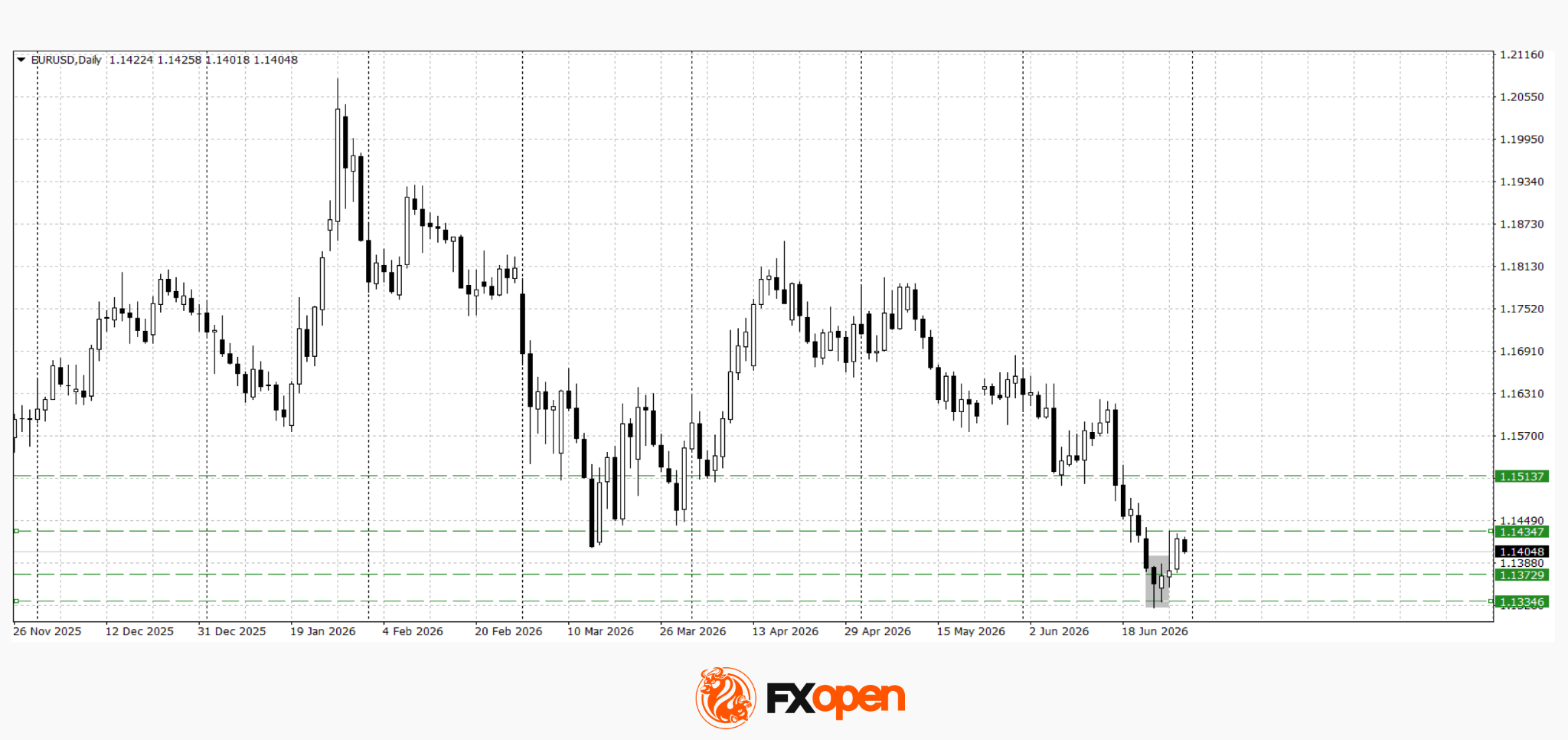
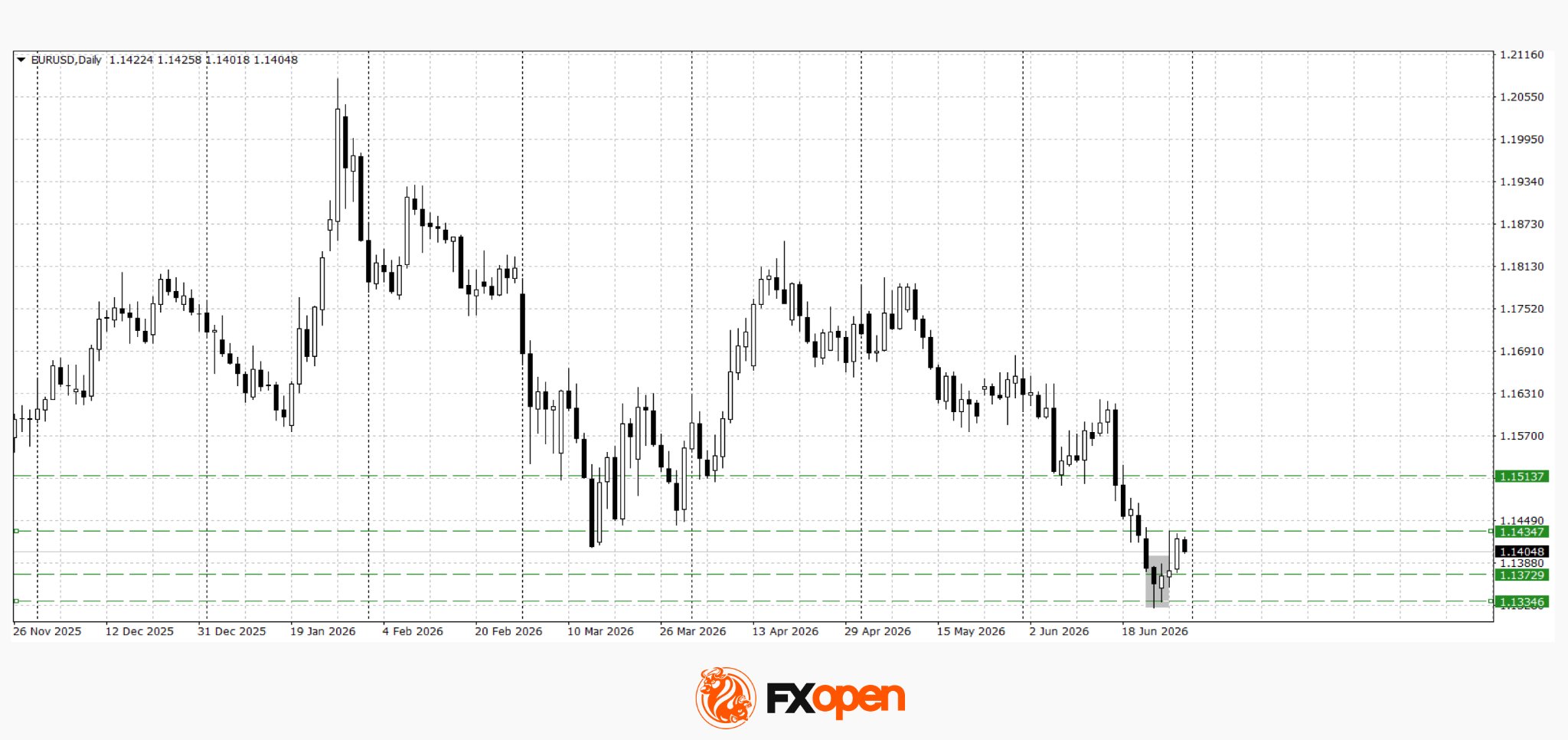
Following a test of the March low, a bullish Piercing Line candlestick pattern formed on the daily timeframe. Technical analysis suggests that EUR/USD is trading within a sideways range between 1.1340 and 1.1430. Price action around these boundaries, together with the incoming macroeconomic data, should provide further clues regarding the pair’s next directional move.
Key events for EUR/USD:
- Today at 09:45 (GMT+3): France CPI.
- Today at 15:00 (GMT+3): Germany CPI.
- Today at 17:00 (GMT+3): US JOLTS Job Openings.
GBP/USD
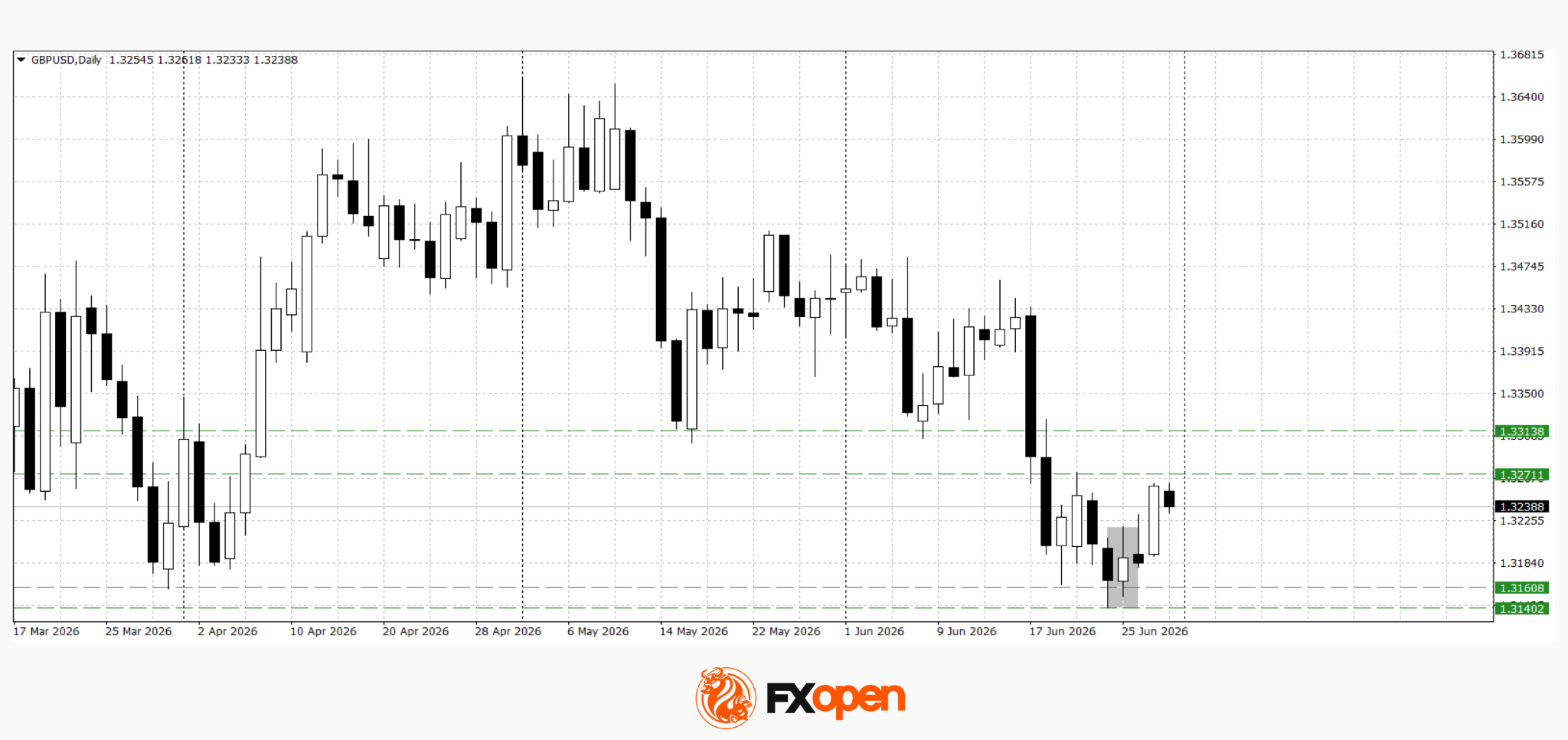
After testing this year’s March low at 1.3160, sterling buyers regained the initiative and formed a bullish Piercing Line candlestick pattern. The pair has since rebounded towards 1.3270, although any further upside is likely to depend on incoming macroeconomic data. Technical analysis suggests the pair may retest the 1.3270 level. A decisive break and close above this resistance could pave the way for further gains towards 1.3300–1.3310, while rejection from current resistance may trigger a decline back towards the 1.3140–1.3160 area.
Key events for GBP/USD:
- Today at 09:00 (GMT+3): UK GDP.
- Today at 13:40 (GMT+3): Speech by Bank of England Financial Policy Committee member Sarah Breeden.
- Today at 17:00 (GMT+3): US CB Consumer Confidence Index.
Following the sharp moves seen in recent sessions, the foreign exchange market has entered a wait-and-see mode. The release of key economic data on both sides of the Atlantic is likely to determine whether the current consolidation becomes the starting point for a recovery in European currencies or gives way to a renewed strengthening of the US dollar.
Trade over 50 forex markets 24 hours a day with FXOpen. Take advantage of low commissions, deep liquidity, and spreads from 0.0 pips (additional fees may apply). Open your FXOpen account now or learn more about trading forex with FXOpen.
This article represents the opinion of the Companies operating under the FXOpen brand only. It is not to be construed as an offer, solicitation, or recommendation with respect to products and services provided by the Companies operating under the FXOpen brand, nor is it to be considered financial advice.
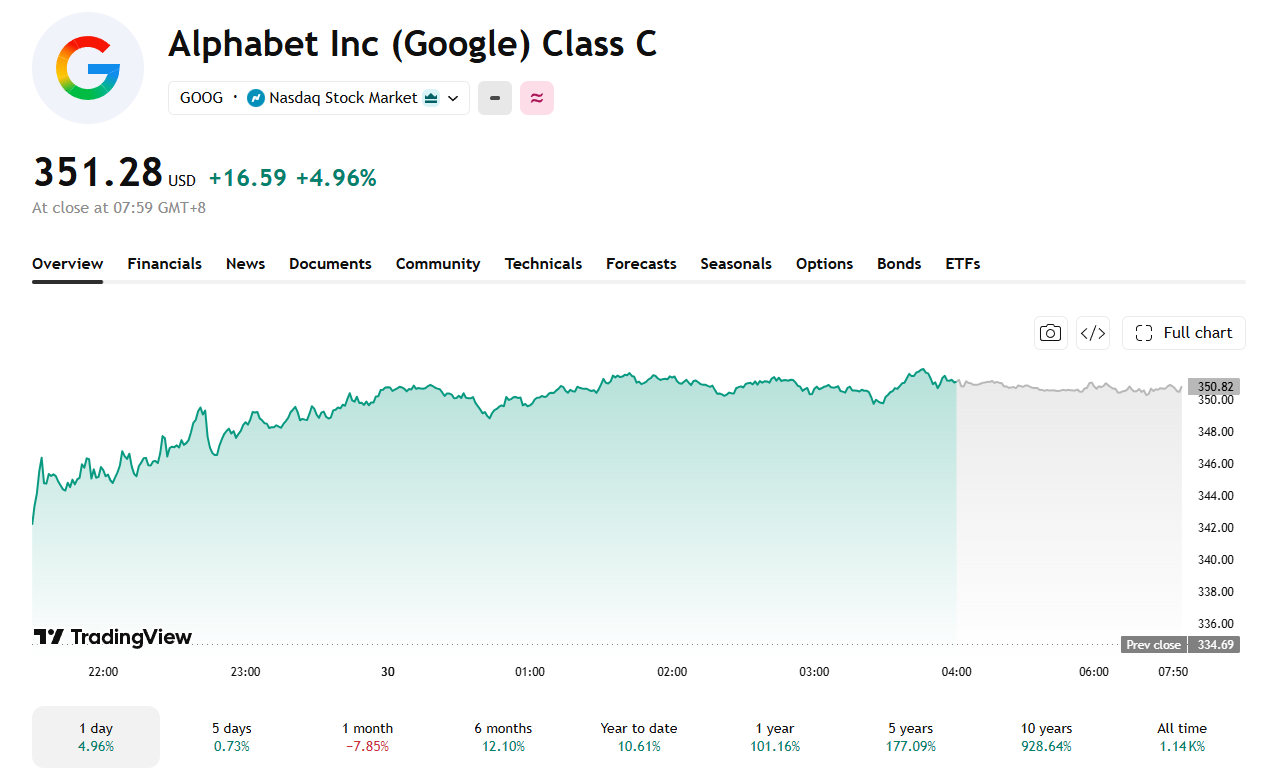
The Dow Jones Industrial Average (DJIA) closed above 52,000 for the first time on Monday, June 29, powered by Alphabet’s blue-chip debut and a broad rally in semiconductor stocks.
The index gained 306.63 points, or 0.59%, to finish at 52,182.74. The S&P 500 rose 1.18% to 7,440.43, and the Nasdaq Composite surged 2.07% to 25,820.14.
Alphabet’s Dow Debut Lifts Sentiment
Alphabet (GOOGL) climbed nearly 5% on its first session as a Dow member after replacing Verizon in the index. The addition carries more symbolic weight than mechanical impact, as the stock already sits in the S&P 500 and Nasdaq 100, limiting forced fund buying from the change.

Despite Monday’s pop, Alphabet is still on pace for its worst month since February of last year, with six of the past seven weeks ending in negative territory. Investor concerns center on AI execution, with Nvidia chip stock flows drawing renewed attention across the sector as compute access tightens.
Semis and Geopolitics Drive the Broader Move
The VanEck Semiconductor ETF gained more than 3%, led by Astera Labs, KLA, and Applied Materials, which rose roughly 16%, 12%, and 11%, respectively.
Macro relief also played a role. The US and Iran agreed to pause hostilities and allow commercial vessels to transit the Strait of Hormuz freely.
Brent and West Texas Intermediate climbed slightly, as traders weighed whether the ceasefire would hold. BeInCrypto previously covered how Iran’s oil ceasefire deals move crude and downstream inflation expectations.
Whether the rally extends into a shortened week ahead of the July 4 holiday will depend on whether the Iran ceasefire holds and if semiconductor momentum carries through.
The post Dow Closes Above 52,000 for First Time as Alphabet Debuts appeared first on BeInCrypto.


U.S. spot bitcoin ETFs lost a net $231 million on Monday, with BlackRock’s IBIT accounting for $300 million of outflows that other funds partly offset, including $50 million into ARKB and $35 million into GBTC, per SoSoValue data.
The outflow lands as risk appetite elsewhere is surging. Wall Street’s technology rally spread into Asia on Tuesday, with the MSCI Asia Pacific index up 1% on the year’s final trading day after a semiconductor rebound helped the S&P 500 snap a five-session losing streak. The Asian benchmark is on track for its biggest quarterly gain in almost 17 years.
South Korea’s Kospi, which crashed 10% in a single session earlier this month, climbed 2.1% to extend its lead as the world’s best-performing major benchmark this year. Samsung is up more than 100% this quarter, and SK Hynix has gained almost 240% since April. The yen slid to its weakest level against the dollar since 1986, a sign investors are funding the AI trade by borrowing in yen.
Bitcoin ETFs are not participating in that capital rotation, however. The same AI infrastructure spending fueling record quarters in Seoul and Tokyo is the trade competing for the dollars that might otherwise flow into bitcoin, a dynamic that has run through the month’s coverage of SpaceX, Anthropic and the chip sector.

Motilal Oswal initiates coverage on Tata Capital, gives target price and re-rating triggers
UK FCA Sets October 2027 Deadline for Crypto Firms in New Regulatory Framework

The Most Embarrassing Celeb Wardrobe Malfunctions Ever


-
 Sports7 days ago
Two goals and an assist by sheer aura: Cristiano Ronaldo just entered the World Cup chat
-

 Fashion4 days ago
Weekend Open Thread: Staud – Corporette.com
-

 Politics4 days ago
The House | Manchesterism won’t survive the painful trade-offs unless it gets citizens on board
-

 Politics4 days ago
Potential 2028er World Cup attendee leaderboard
-

 News Videos2 days ago
MAJOR BITCOIN & MARKET UPDATE!!!! (MUST WATCH ASAP!!!)
-

 Business4 days ago
Asia stock markets slide as tech shares slump
-

 Tech5 days ago
A Look At A Gaggle Of Transputer Boards
-

 Crypto World6 days ago
Securitize Wraps Roubini's SEC-Registered ETF as Dubai VARA Digital Security
-
Crypto World6 days ago
Bitcoin (BTC) Dips Below $62K, Ethereum (ETH) Plunges 6% Daily: Market Watch
-
 Crypto World5 days ago
Dell (DELL) Shares Tumble Over 5% Following Analyst Downgrade to Hold
-

 Crypto World3 days ago
Coinbase, Circle Deepen Crypto Stock Losses Despite Resilient S&P 500
-
Business6 days ago
Entergy settles forward sale agreements, raises $672 million in cash proceeds
-

 Crypto World3 days ago
Kraken's xStocks Opens Bending Spoons IPO Registration to EEA Retail
-

 Sports3 days ago
FIH Pro League: India defeat Pakistan 7-1, register biggest win of campaign | Other Sports News
-

 Crypto World4 days ago
Bitcoin Sparks $600M Hourly Liquidations With $65,000 Set To Become Resistance
-

 Tech2 days ago
Bluekit phishing kit adopts browser-in-the-middle for login theft
-

 Tech3 days ago
Russian hackers now target Signal backup recovery keys
-
Crypto World4 days ago
Hyperliquid Named on Singapore MAS Investor Alert Register
-

 Crypto World4 days ago
RTX holders must register wallets before token distribution begins
-
 Crypto World5 days ago
Ripple and SBI launch RLUSD in Japan after JFSA approval
You must be logged in to post a comment Login