
Crypto World
What Crypto Whales Are Buying and Selling Ahead Of The April US CPI Print

The March Consumer Price Index (CPI) data, a measure of the cost of goods and services, lands today with a hot print expected amid Iran war-driven energy costs. A fragile ceasefire has offered reprieve, but uncertainty lingers. Crypto whales are already positioning.
BeInCrypto analysts tracking on-chain whale activity have identified three tokens showing sharp accumulation or selling ahead of the release.
Ethereum (ETH)
Among the tokens seeing heavy whale accumulation ahead of the April CPI print, Ethereum (ETH) stands out. Its positioning dwarfs all others.
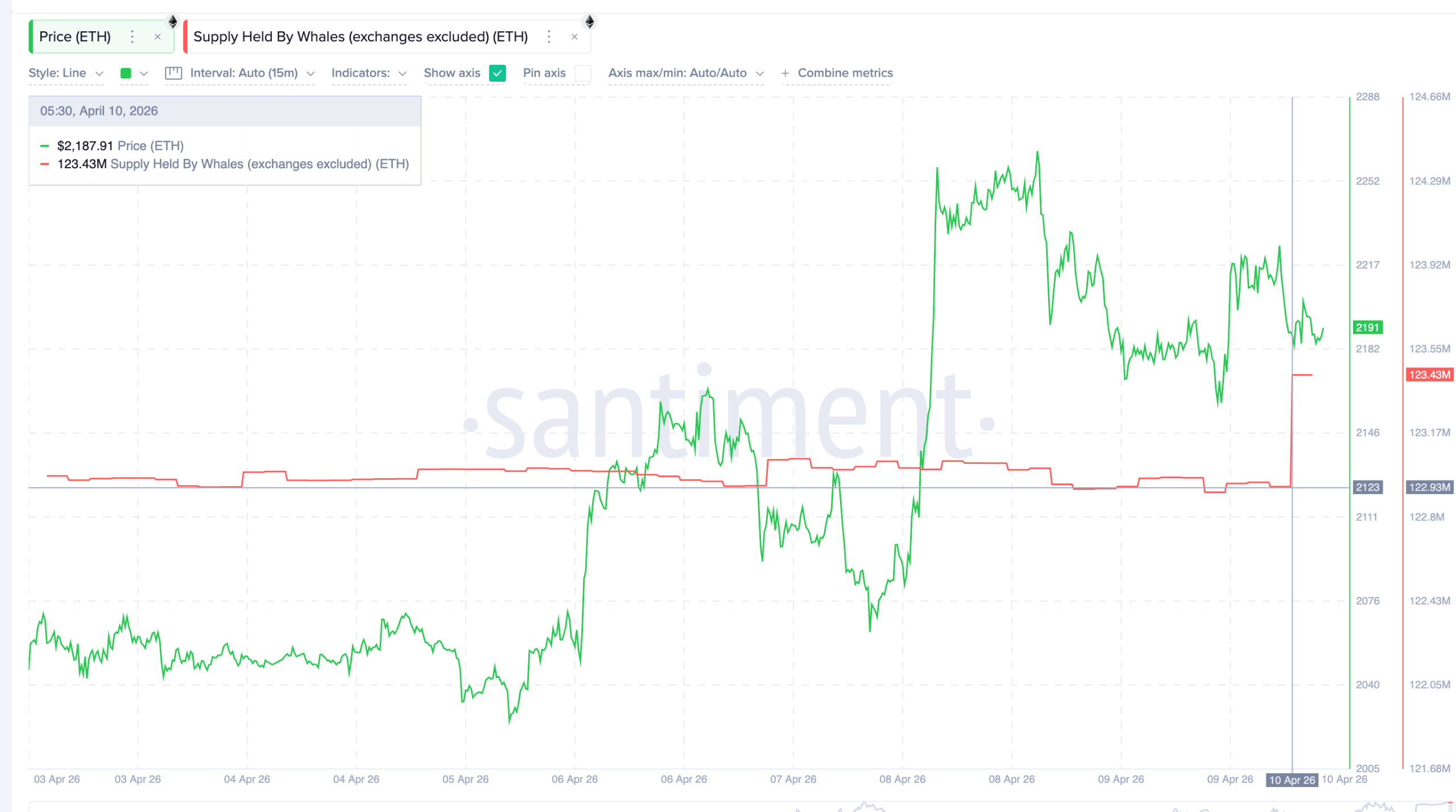
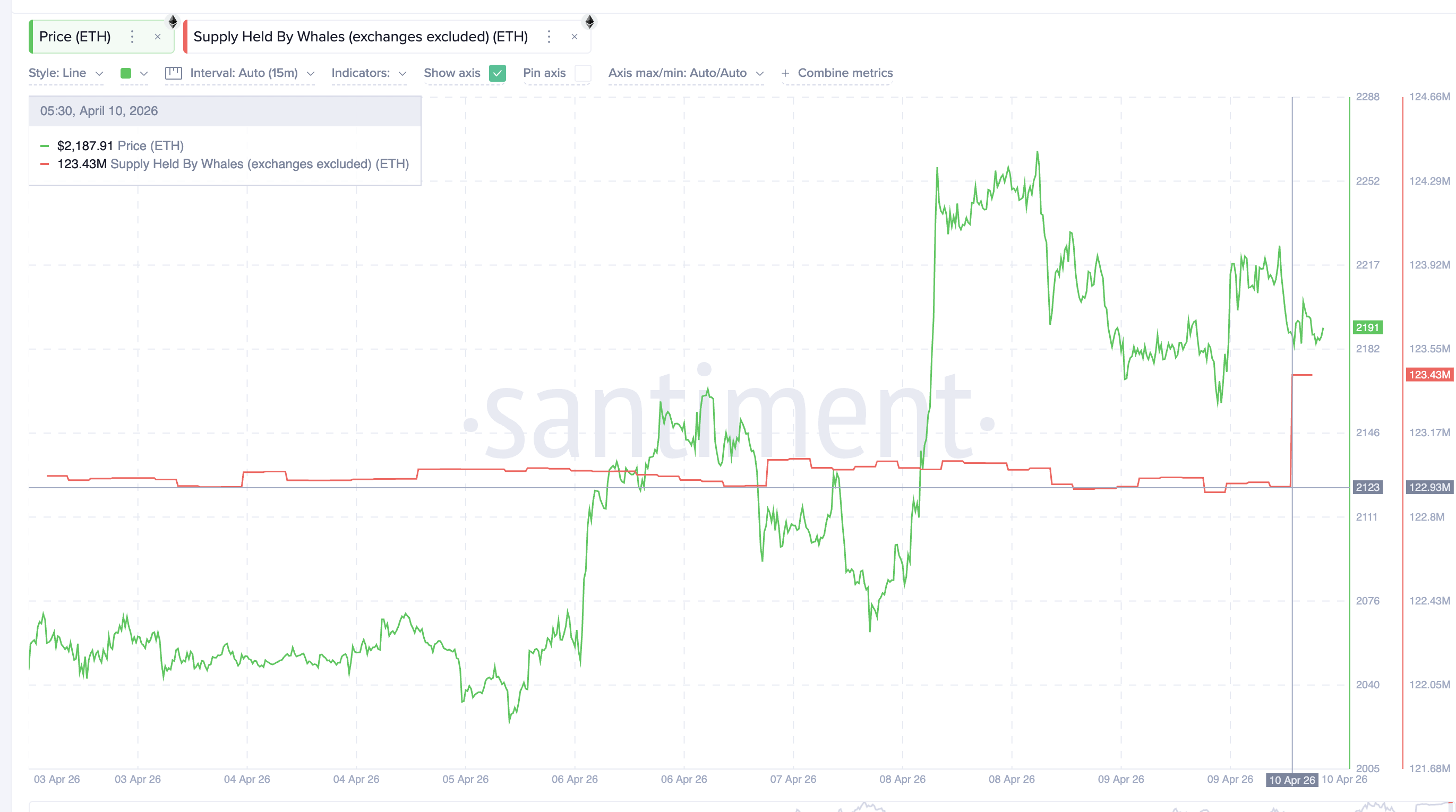
Santiment data shows ETH crypto whale wallets surged from 122.93 million to 123.43 million tokens in hours. That 500,000 ETH increase translates to roughly $1.09 billion in fresh buying.
Want more token insights like this? Sign up for Editor Harsh Notariya’s Daily Crypto Newsletter here.
Headline CPI is expected to spike due to a 10.6% month-over-month jump in energy costs. However, core CPI inflation data is forecast at a softer 0.3% month over month. Large holders appear to be betting on that softer undertone sparking a relief rally.
Meanwhile, the Ethereum Foundation recently staked roughly 45,000 ETH to generate yield rather than sell. That structural shift reduces ongoing sell-side pressure from a major network entity and reinforces the bullish thesis.
On the daily chart, ETH is forming a cup-and-handle pattern inside a descending channel. The cup bottomed near $1,938 before curving higher. The handle’s upper boundary aligns with the channel neckline near $2,270. A single breakout could therefore confirm both structures simultaneously. A daily close above $2,231 would signal early strength.
A move through $2,270 followed by a clean reclaim of $2,300 would validate the pattern. That level aligns with the 0.618 Fibonacci level and would confirm renewed momentum.
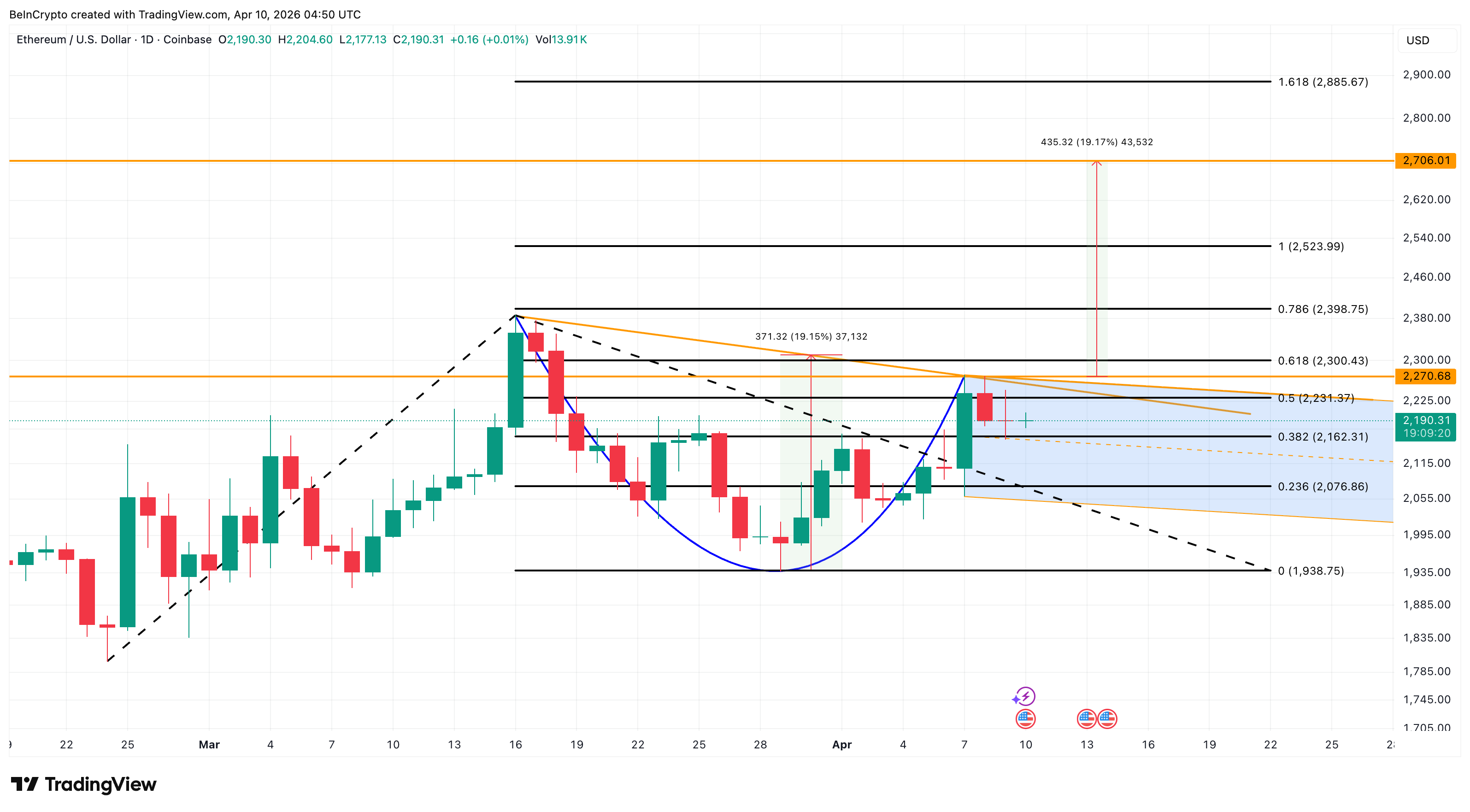
The projected upside sits near 19.15%, which could push ETH toward $2,706. However, a drop below $2,162 would weaken the setup. The pattern gets fully invalidated with a close under $1,938.
Uniswap (UNI)
While some crypto whales are loading up ahead of the CPI print, others are trimming DeFi exposure. In contrast to Ethereum’s $1.09 billion inflow, Uniswap (UNI) has seen consistent whale selling pressure over the past seven days.
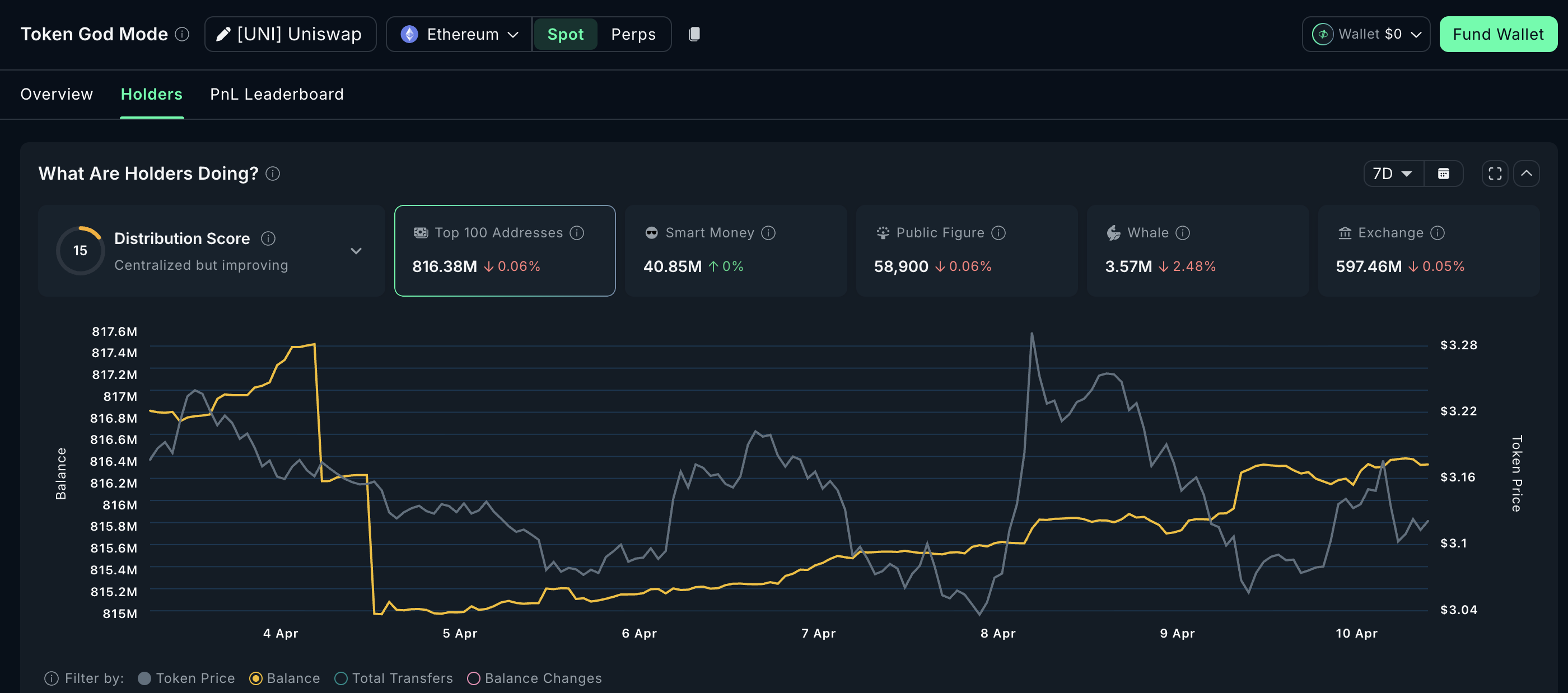
Nansen data shows UNI whale wallets cut holdings by 2.48% over the past week. The stash now sits at 3.57 million tokens. That amounts to roughly 90,000 UNI sold, worth approximately $283,000 at the current price near $3.14. The selling aligns with broader DeFi profit taking as the sector trades mostly flat in the 7-day timeframe. Large holders appear to be de-risking ahead of a volatile CPI print rather than reacting to any UNI-specific catalyst.
The daily chart supports the bearish tone. UNI has been trading inside a bear flag pattern since its March 13 high of $4.21. The flag’s lower boundary was tested near $3.01. UNI has since rebounded without reclaiming meaningful resistance. The 7-day whale distribution aligns with this bearish structure.
If that lower trendline breaks, the projected drop stands at roughly 28%. A daily close below $3.08, the 0.618 Fibonacci level, would start the trigger. Support levels at $2.92 and $2.72 could slow the decline. Yet the measured target sits near $2.20 if buyers fail to step in.
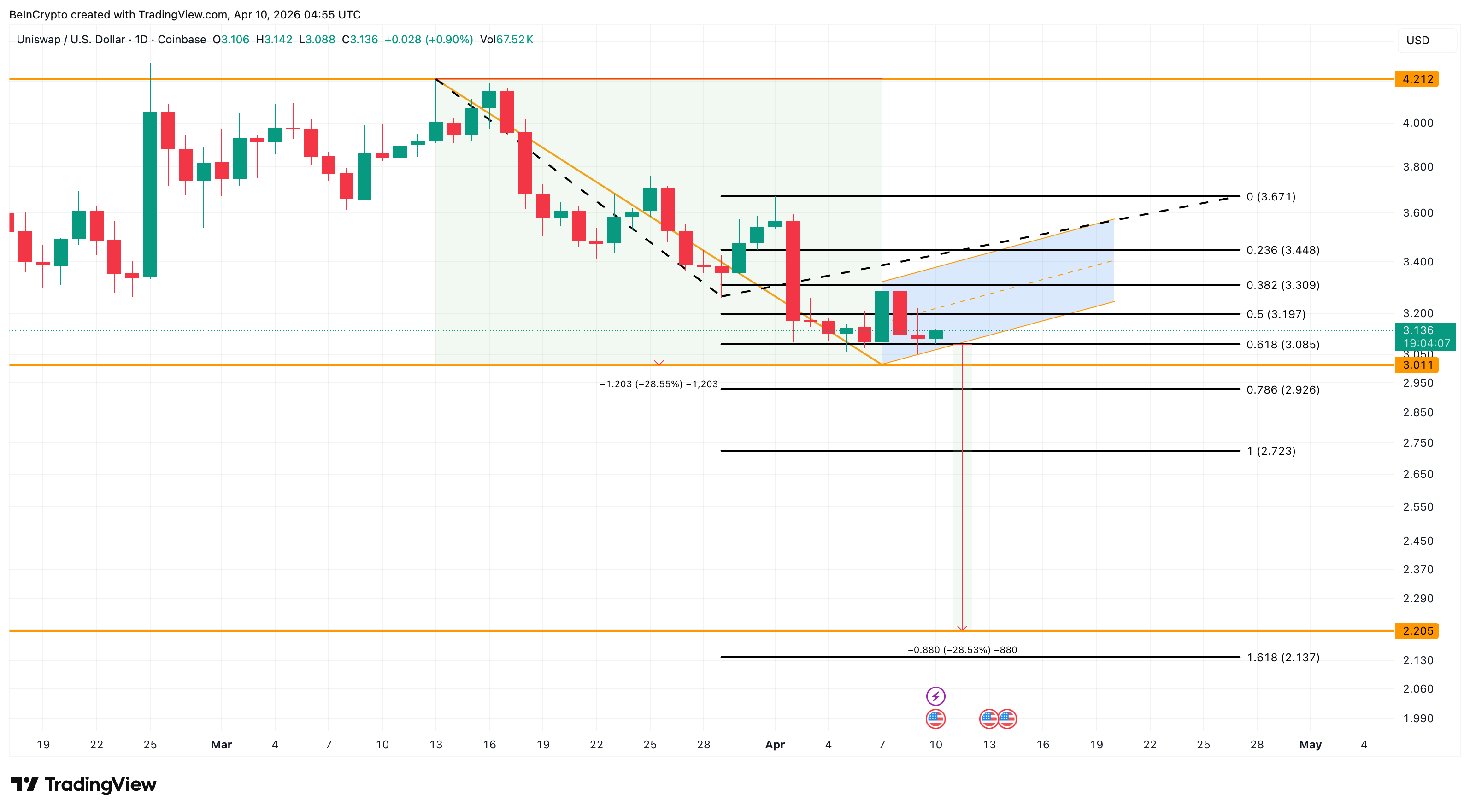
However, a push above $3.44 would challenge the bearish structure. A move beyond $3.67 would likely invalidate the bear flag entirely.
Chainlink (LINK)
Chainlink (LINK) rounds out the altcoin whale buying picture with a sudden surge in accumulation over the past few hours. Its oracle infrastructure feeds price data to DeFi protocols, positioning it to benefit from any activity uptick.
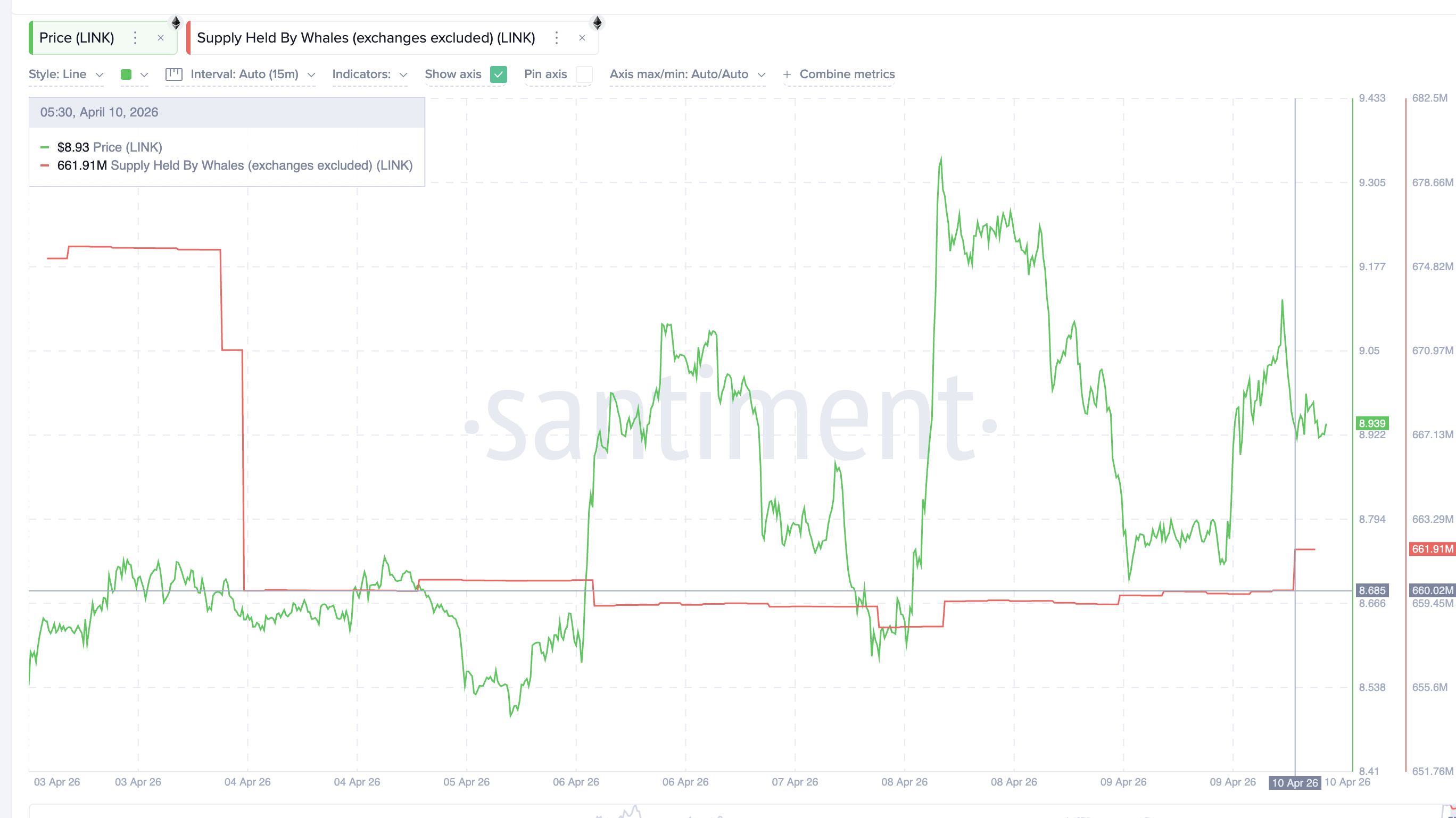
Santiment data shows LINK whale wallets climbed from 660.02 million to 661.91 million tokens. That 1.89 million LINK pickup translates to approximately $16.93 million in fresh buying. The accumulation mirrors the ETH whale pattern. Large holders appear to see the CPI print as a potential macro catalyst, provided a softer core reading surfaces.
On the daily chart, LINK is trading inside an inverse head-and-shoulders pattern. The right shoulder has locked into place, and the neckline sits near $9.43. From the head to the neckline, the measured target implies a 15.40% move higher. That could push LINK toward $10.82, above the psychological $10 mark.
A daily reclaim of $9.43 would confirm the breakout. From there, $9.63 and $9.89 serve as the first set of intermediate targets. However, $8.96 acts as the immediate floor. A slip below $8.68 would put the right shoulder under threat.
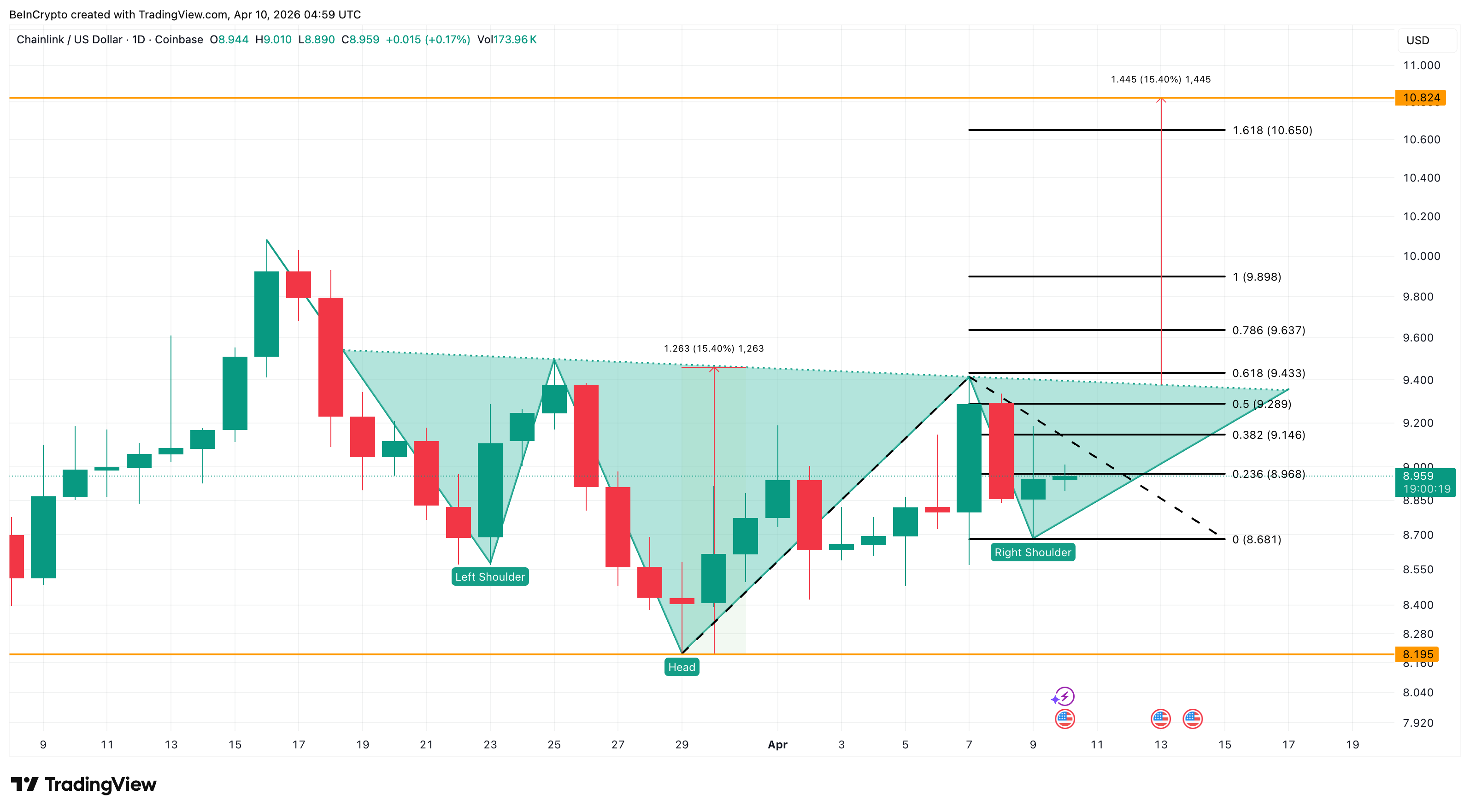
Yet the pattern retains its validity as long as LINK holds above $8.19, the head of the formation. Only a daily close below that level would fully invalidate the setup. Despite the macro uncertainty, that gives bulls a relatively wide margin of safety heading into the CPI release.
The post What Crypto Whales Are Buying and Selling Ahead Of The April US CPI Print appeared first on BeInCrypto.


- Avalanche spot ETFs have extended their zero net inflows streak to 16 days.
- The AVAX token has traded lower amid the laggard ETF market.
- If bulls flip the picture, AVAX could target $16 and then $20 in the next leg up.
Avalanche (AVAX) price faces downward pressure near $9.00 as its spot exchange-traded funds (ETFs) mark yet another milestone in investor apathy.
Despite gains of nearly 4% this past week, zero net inflows persist and could accelerate amid a sluggish altcoin market.
Avalanche spot ETFs’ “bad” net inflows streak
While spot Bitcoin ETFs have shown intermittent days of net inflows and outflows over the past month, the two spot AVAX ETFs have established a long streak of no net inflows.
SoSoValue data indicates that VanEck’s VAVX and Grayscale’s GAVA have recorded zero net inflows for sixteen consecutive trading days, a streak that began on March 18, 2026.
This drought follows a brief surge on March 17, when the funds attracted $246,000 in combined net inflows, building on $532,000 that flowed in earlier that week.
Since then, however, capital has stalled completely, mirroring broader altcoin fatigue in a Bitcoin-dominated market.
As of April 10, 2026, cumulative net inflows for the ETFs total $9.76 million, with daily trading volume remaining anemic at $251,800.
The funds collectively manage $17.14 million in assets under management (AUM), representing just 0.43% of AVAX’s circulating market cap.
This limited exposure highlights the challenges in drawing institutional interest to Avalanche’s ecosystem, despite its strengths in high-throughput blockchain scaling and subnet technology.
Avalanche price outlook
Market observers link the inflows freeze to macroeconomic caution and geopolitical tensions dampening risk appetite.
ETF analysts note that without fresh capital, these products struggle to provide the liquidity boost seen in Bitcoin and Ethereum counterparts, potentially prolonging AVAX’s price consolidation.
AVAX has failed to hit sustained upside momentum since the token tested resistance near $35 in September 2025.
The subsequent plunge below the critical $10 psychological level has left bulls on the defensive, as sellers dominate amid fading on-chain activity and reduced DeFi TVL on Avalanche’s network.
Currently, AVAX trades around the $9.00 support zone, where the Supertrend indicator gives bears the advantage.
However, a fragile uptick over the past week offers slim hope for upward momentum or stabilization as bulls eye $10.00.

Technical indicators signal this possibility, with the Relative Strength Index (RSI) hovering just above 50 on the daily chart.
Analysts have also pointed to the resilience of the broader crypto market as one likely to support a clean break above $10.20.
If bulls invalidate the downtrend, the immediate target will be the $12-$16 region. Highs of $20 could attract bullish traders.
However, failure to hold $9.00 risks acceleration toward $8.50, opening the door to a retest of the year-to-date lows of $7.53 reached on February 6.


Bitcoin’s price may have rallied almost 7% since Sunday, but conviction remains weak, with the recovery stalling near $72,000 ahead of key binary risks, including Friday’s U.S. inflation report and U.S.-Iran truce talks this weekend.
The cautious approach is evident in the options market, where institutions continue to chase upside via calls, the derivative contracts that allow traders to bet on gains of the underlying asset.
According to QCP Capital, options tied to BlackRock’s spot bitcoin ETF (IBIT) show demand for the $45 call expiring in May. That means traders expect IBIT’s price to rise above that level from the present $40. Bitcoin options on Deribit have seen similar flows, with the $80,000 call emerging as the most popular bet. Still, demand for puts, which offer downside protection, persists.
“IBIT options showed sustained open interest in the May 45 call, holding above 80k+ contracts through the week, while downside hedging remained in place via puts and long-dated protection. The combination reflects a market participating in upside, but not abandoning hedges,” the Singapore-based trading firm, which is one of the world’s largest crypto market makers, said in an email.
The sticky demand for protection against declines is also revealed in options skew, which measures the price differential between calls and puts, and remains negative across all time frames. That indicates a lingering bias for put options.
“The skew picture is clear: institutions are buying downside protection and selling upside calls. After the Iran war headlines, some of the tail risk has been priced out, so skew has eased, but the underlying flow remains firmly one-directional. Demand for puts, supply of calls,” Maxime Seiler, CEO of STS Digital, a principal trading firm specializing in digital asset derivatives, told CoinDesk.
The U.S. consumer price index (CPI) for March is expected to show a marked increase in annualized inflation to well over 3%, led primarily by rising energy prices.
That shouldn’t come as a surprise, given that the Iran war led to a sharp surge in oil and gasoline prices worldwide. Still, markets may see volatility if the core figure, which excludes food and energy, blows past the annualized 2.7% estimate. That would further cement the case for Fed rate increases, potentially weighing on risk assets such as BTC.
Beyond CPI, the weekend meeting between Iranian and U.S. delegates in Pakistan holds the key to financial market stability. BTC’s rally will likely accelerate if they find a way to end the war and normalize oil tanker traffic through the Strait of Hormuz. The first cues could come through Hyperliquid-listed oil perpetual futures. Stay alert!
What’s trending
Today’s signal

The chart shows swings in the ICE BofA US Bond Market Option Volatility Estimate Index (MOVE), which reflects volatility in U.S. Treasury futures.
Sharp spikes in the index indicate rising uncertainty around inflation, interest rates or macro shocks. Treasury notes anchor the global finance and collateral and credit creation. Hence, increased turbulence in U.S. bonds often coincides with tighter financial conditions and broader risk-off sentiment spilling into equities, credit, and crypto markets.
The index popped in March, rising to 115% from 73% only to drop back to 74% this month. It showed that the world’s most important bond market is calm again, a green signal for crypto bulls.
Read more: For analysis of today’s activity in altcoins and derivatives, see Crypto Markets Today .
For a more comprehensive list of events this week, see CoinDesk’s “Crypto Week Ahead“.


Key Points
- Brett Redfearn, former director of the SEC’s Division of Trading and Markets, has been named president and board member at Securitize
- Redfearn’s career spans key roles at the SEC, JPMorgan, and Coinbase before founding his own advisory firm
- The strategic appointment arrives as Securitize moves toward going public through a merger with Cantor Equity Partners II
- In March 2026, Securitize reached $3.85 billion in distributed asset value
- Tokenized equities exceeded $1 billion in aggregate onchain value during the same period
Digital asset tokenization platform Securitize has brought Brett Redfearn on board as its president and newest board member. The company made the announcement Thursday amid preparations for its anticipated transition to public markets.
Redfearn’s background includes leading the SEC’s Division of Trading and Markets as director. His professional journey also features more than ten years at JPMorgan, followed by a position as Coinbase’s head of capital markets.
Most recently, Redfearn established Panorama Financial Markets Advisory, providing strategic counsel to exchanges and asset management firms. He had already been contributing to Securitize through his role on the company’s advisory board.
Securitize specializes in converting conventional financial instruments — including investment funds and private credit products — into digital tokens built on blockchain technology. These tokenized assets offer enhanced tradability and accelerated settlement compared to their traditional counterparts.
Carlos Domingo, Securitize’s CEO, praised the new appointment. “Brett has played a pivotal role in shaping how contemporary markets operate and maintain compliance,” Domingo stated.
Redfearn will collaborate with Securitize’s executive team to expand the platform’s capabilities in issuance, trading infrastructure, and fund administration services.
Expanding Market for Tokenized Real-World Assets
The leadership addition coincides with accelerating interest in tokenizing real-world assets. Data from analytics platform RWA.xyz shows that Securitize achieved $3.85 billion in distributed asset value by March 2026.
Tokenized equities simultaneously surpassed the $1 billion threshold in total onchain valuation during this timeframe. Financial institutions and investment firms continue exploring blockchain-based settlement systems to enhance transaction speed and broaden market participation.
Securitize aims to serve as a compliant gateway connecting established financial enterprises with emerging digital asset technology.
Journey Toward Public Markets
The firm intends to enter public markets via a business combination agreement with Cantor Equity Partners II. Redfearn’s addition is viewed as bolstering Securitize’s regulatory standing in advance of this transition.
Redfearn represents just one example of regulators transitioning to the cryptocurrency sector. Caroline Pham, former acting chair of the CFTC, departed in December to take a position at crypto payments provider MoonPay.
Separately, the SEC revealed Wednesday that David Woodcock will assume the director of Enforcement role effective May 4, succeeding interim head Sam Waldon.
Various U.S. legislators have pressed SEC Chair Paul Atkins regarding the departure of former enforcement director Margaret Ryan. Some congressional members suspect her exit may relate to the SEC’s decision to withdraw multiple cryptocurrency enforcement actions, including proceedings against Tron founder Justin Sun.
Redfearn’s selection at Securitize unfolds as the regulatory landscape surrounding tokenized assets evolves through both regulatory agencies and legislative bodies.

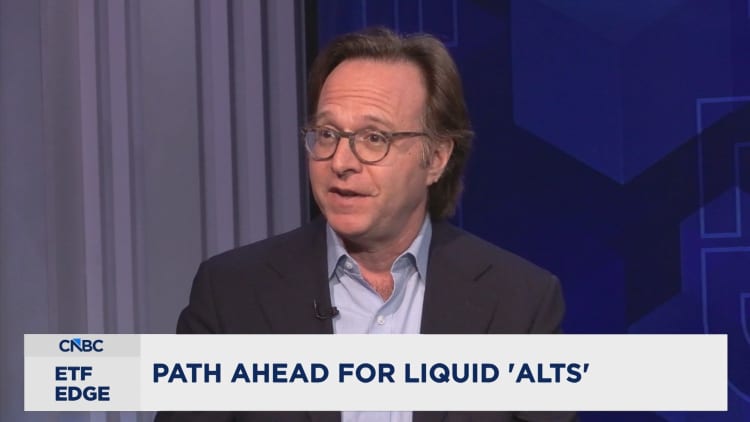

BlackRock is applying hedge fund strategies to its exchange-traded fund business.
Jeffrey Rosenberg, the firm’s senior portfolio manager on the systemic fixed income team, has a leading role in the firm’s liquid alternatives ETFs — which use a long-short strategy in ETF wrappers.
He contends the strategy provides valuable diversification amid the recent breakdown in the relationship between stocks and bonds.
“The great old adage around fixed income is ‘my bonds go up when my stocks go down.’ Now, we just went through a period in March with war risk where we clearly saw again on display… that doesn’t hold. And, really saw it in 2022,” Rosenberg told CNBC’s “ETF Edge” this week. “This entire post-Covid environment has really challenged that bedrock principle of the 60-40 portfolio that bonds are diversifying.”
According to Rosenberg, client demand for liquid alts ETFs is growing because there’s a desire to diversify your diversifiers.
“We’re bringing the techniques that we’ve developed in the hedge fund side of our business, which primarily center around market neutral, long-short investing,” he added. “That’s the key kind of ‘a-ha moment’ for ETF investors to realize most of what they have exposure to in the ETF ecosystem is some kind of beta exposure.”
Rosenberg is a portfolio manager on two BlackRock liquid alts ETFs: the iShares Systematic Alternatives Active ETF (IALT) and the iShares Managed Futures Active ETF (ISMF). As of April 8, the firm’s website shows IALT is up almost 8% so far this year while the ISMF is up nearly 5%.
“What liquid alternatives bring to the table is the ability to look at other sources of return away from just market directionality,” said Rosenberg.
He highlighted a major challenge investors face on the stock market side.
“Our equity portfolios have been more and more dominated by the big, large cap tech winners,” said Rosenberg. “With that concentration is a loss of diversification and a loss of diversification value on the equity side. So, liquid alternatives can address both of these challenges to portfolio construction.”
‘Something that’s going to zag when the market zigs’
VettaFi’s Todd Rosenbluth still regards liquid alts ETFs as an emerging category.
“Overall, this is still relatively small compared to traditional equity [and] traditional fixed income, but we are seeing advisors looking for something that’s going to zag when the market zigs,” the firm’s head of research said in the same interview.


- Cryptocurrencies now fall under Japan’s securities-style financial laws.
- Insider trading rules and stricter disclosures will apply.
- Lower taxes may boost investor and institutional participation.
Japan has taken a major step in reshaping how it treats cryptocurrencies.
A new bill approved by the government moves cryptocurrencies into the category of financial assets, placing them closer to traditional investment products such as stocks and bonds.
Following the approval, Japan now no longer views crypto just as a payment tool, but as part of its wider financial system.
This change is expected to have a wide impact on exchanges, investors, and crypto companies operating in Japan.
A shift from payment tools to financial instruments
For years, cryptocurrencies in Japan were mainly treated as a means of payment under a lighter regulatory framework. That approach is now being replaced with a more structured system based on financial market rules.
Under the new bill, cryptocurrencies will fall under the Financial Instruments and Exchange Act.
This is the same legal framework used to regulate traditional securities. In simple terms, crypto is being pulled into the same category as regulated financial products like equities.
This change is not just about classification. It also changes how the market is expected to behave.
Cryptocurrency exchange platforms and issuers will now be required to follow stricter rules around transparency, reporting, and operational conduct.
The aim is to make the crypto market function with the same level of structure and accountability seen in conventional financial markets.
Stronger investor protection and market discipline
One of the most important parts of the new framework is the introduction of stricter rules around market fairness.
The bill introduces restrictions similar to those seen in stock markets, including clear prohibitions on insider trading in crypto markets.
This means individuals with access to non-public information about tokens or projects will not be allowed to use that information for trading advantage, which will greatly reduce manipulation and unfair practices in the sector.
In addition, crypto companies and exchanges will face tougher disclosure requirements. They are expected to provide regular and detailed information about their operations and token-related activities.
This is designed to give investors a clearer picture of what they are dealing with before making financial decisions.
Penalties are also being strengthened.
Operating without proper registration or violating market rules can now lead to heavier fines and stricter legal consequences, including prison sentences in serious cases.
The intention is to discourage bad actors and improve overall trust in the system.
These changes reflect a broader effort to build a safer trading environment as Japan tries to reduce risk in a market that has often been criticised for volatility and lack of transparency.
Cryptocurrency tax changes
Alongside regulatory reform, there is also discussion around tax adjustments that could make crypto investment more attractive.
One of the key expected changes is a shift toward a flat capital gains tax rate of around 20%.
This would bring crypto taxation closer to the system used for traditional investments and significantly lower the burden compared to previous progressive rates.
A simpler and more predictable tax structure could encourage more individual and institutional participation in the market. It also removes one of the long-standing barriers for investors who were hesitant due to complex tax obligations.
At the same time, the new legal framework opens the door for greater institutional involvement.
With crypto now treated as a financial asset, banks, asset managers, and investment firms may find it easier to enter the market.
This could eventually lead to the development of regulated crypto investment products, including exchange-traded funds.
The broader shift in Japan’s financial strategy
Japan’s decision is part of a larger effort to modernise its financial system.
By aligning crypto with traditional financial instruments, the country is building a framework that supports both innovation and regulation at the same time.
This move also positions Japan as one of the more structured crypto markets globally.
While some regions continue to debate how to regulate digital assets, Japan is moving ahead with a clear legal classification and enforcement structure.
The long-term goal appears to be creating a stable environment where digital assets can grow under established financial rules.
If successful, this approach could attract more global capital and strengthen Japan’s position in the evolving digital economy.

Bitcoin price has been stable since yesterday, but a technical paper published this week may matter more to long-term BTC holders than any candlestick prediction. A StarkWare researcher has unveiled what he claims is the first method to make Bitcoin transactions quantum-resistant right now, on the live network, without touching a single line of the protocol. The catch? There’s always a catch.
Avihu Levy’s scheme, dubbed Quantum Safe Bitcoin (QSB), replaces signature-based security with hash-based proofs. The system requires no soft fork, no miner signaling, and no activation timeline.
Quantum-Safe Bitcoin Transactions Without Softforkshttps://t.co/1lx5waX9VV pic.twitter.com/Ni7pA6dEsC
— Avihu Levy

 (@avihu28) April 9, 2026
It works entirely within Bitcoin’s existing consensus rules for legacy transactions today. That’s the headline. The fine print: every QSB transaction costs up to $200 and demands heavy off-chain GPU computation, making it an emergency fallback rather than a daily-use solution.
It also contrasts sharply with BIP-360, the formal quantum-resistance proposal merged into Bitcoin’s improvement repository in February, which carries no Core implementation and faces years of governance delay.
With quantum risk now surfacing as a tangible near-term narrative, the question is what this means for BTC price momentum and where the real asymmetric opportunity sits heading into mid-2026.
Discover: The best pre-launch token sales
Bitcoin Price Prediction: $77,000 This Week?
Bitcoin is holding the $71,000 line, with the 24-hour range reflecting a tug-of-war between macro headwinds and institutional demand.
Spot ETF inflows have rebounded, delivering a +1.21% bounce on renewed institutional interest, while US CPI data prompted a counter-move of -0.81% as traders trimmed risk exposure. The 50-day EMA near $70,500 remains the pivotal battleground on the daily chart.
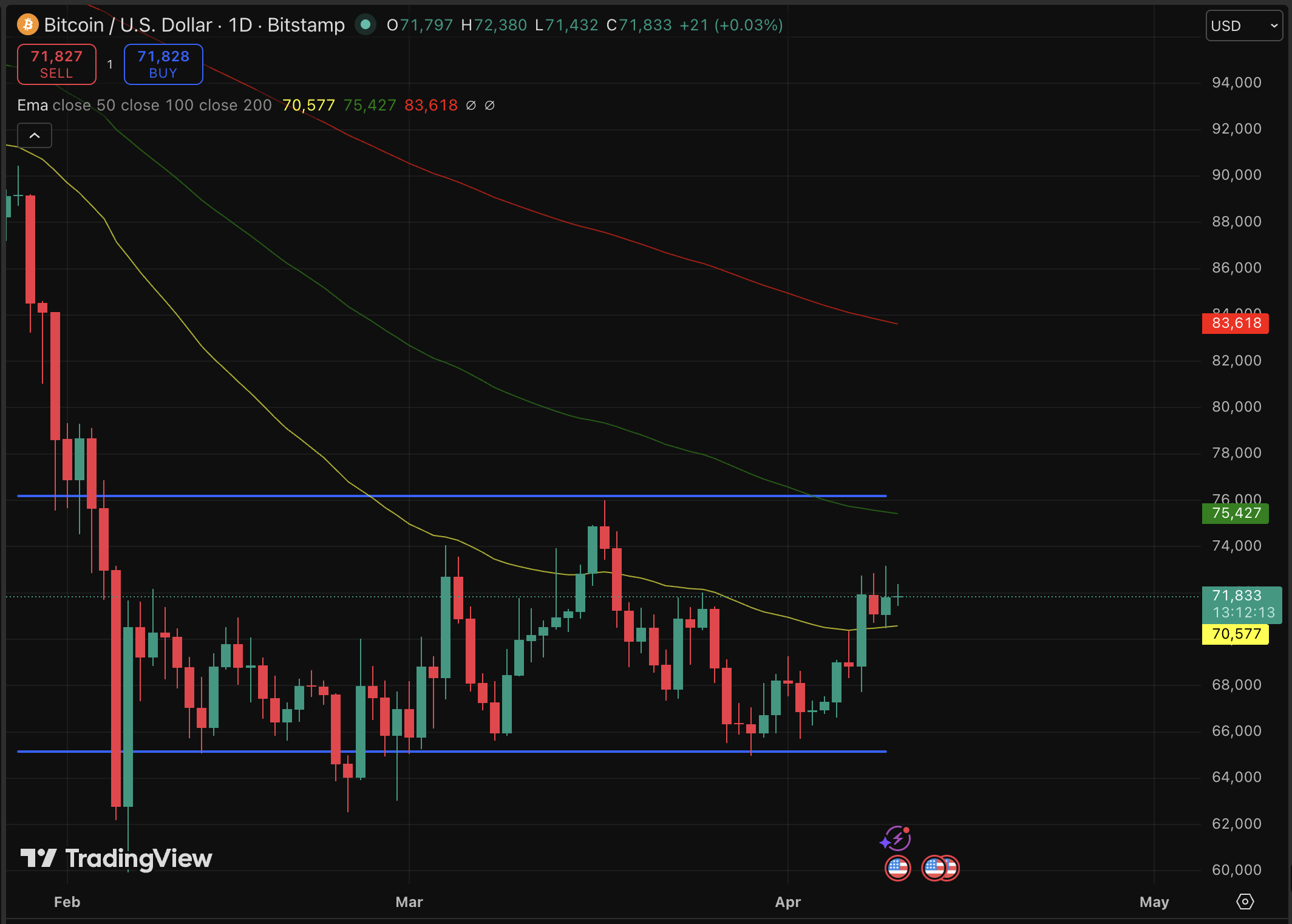
Technically, the picture is mixed. The 4-hour moving average is sloping downward, signaling short-term bearish pressure. But the 200-day MA has been trending up since April 5, 2026, confirming the broader bull structure remains intact.
RSI sits at a neutral, with 50% green days over the measured period, no extreme momentum in either direction.
ETF flow data and any follow-on quantum narrative headlines are the two asymmetric catalysts for next week. For a deeper look at BTC’s technical setup, this price analysis covers complementary levels worth tracking.
Discover: The best crypto to diversify your portfolio with
Early-Mover Upside as Bitcoin Tests Key Resistance
BTC at $71,000 sounds bullish, until you factor in that a move to $77,000 represents just under 10% upside from current levels for an asset already carrying a trillion-dollar market cap. For traders who’ve ridden the Bitcoin cycle and want early-stage exposure to the next infrastructure layer, the math on large-cap appreciation starts to look thin.
LiquidChain ($LIQUID) is a Layer 3 infrastructure project positioning itself as the cross-chain liquidity layer, fusing Bitcoin, Ethereum, and Solana liquidity into a single execution environment.
A new layer emerges. Only a few see it first. — LiquidChain (@getliquidchain) March 24, 2026
The future is LiquidChain  ⟁https://t.co/vqvBcdSj94 pic.twitter.com/R7ZeZ0NPGl
The quantum conversation is relevant here: as BTC’s security model evolves and multi-chain complexity deepens, a unified infrastructure that lets developers deploy once and access all three ecosystems addresses a structural gap the market hasn’t fully priced.
The presale has raised $650K at a current price of $0.01448, and a 1650% APY staking rewards. Core features include a Unified Liquidity Layer, Single-Step Execution, Verifiable Settlement, and Deploy-Once Architecture. LiquidChain is approaching the $1M presale milestone, which historically marks the point where retail attention accelerates.
Research LiquidChain before the next raise tier opens.
The post Bitcoin Price Prediction: BTC is Quantum Safe, But You Need to Know This appeared first on Cryptonews.

Covenant AI, a developer operating on Bittensor’s subnet ecosystem, announced on Friday that it is leaving the decentralized AI network, accusing governance of not being meaningfully distributed and questioning whether the project can sustain its decentralization claims. In a post on X, Covenant AI founder Sam Dare said the team could no longer build on or raise for Bittensor because governance wasn’t truly distributed. “It is decentralization theatre,” Dare wrote, alleging that Jacob Steeves—known as Const—maintains effective control over the governance triad, resists meaningful transfers of authority, and deploys changes unilaterally without process or consensus.
The dispute centers on the core selling point of Bittensor: true decentralization. Covenant AI contends that Steeves wields outsized influence over governance and network operations, an accusation Steeves has denied. Bittensor describes its governance as a transitional framework, featuring a “Triumvirate” of Opentensor Foundation employees alongside a senate, rather than a fully open, fully distributed model. The company’s documentation frames this as a staged approach rather than a completed, decentralized system.
Key takeaways
- Covenant AI is exiting Bittensor, publicly challenging the project’s claim of decentralization and accusing governance of concentrated power under a Triumvirate-led structure.
- The core accusation centers on control over governance and network operations, with Covenant AI alleging unilateral decision-making and resistance to meaningful authority transfers.
- In response, Bittensor founder Jacob Steeves denies suspending subnet operations or granting special privileges, and says dissenting actions are either mischaracterized or misinterpreted—he also contends that certain token-related moves were ordinary market activity visible on-chain.
- The dispute has coincided with a material move in TAO’s price and trading volume, reflecting broader investor attention as the governance rift unfolds.
Governance under the lens: what changed and what stayed the same
The heart of Covenant AI’s claim is that the governance design of Bittensor—ostensibly built to be open and composite—operates in practice as a closed system. Covenant AI argues that the Triumvirate, comprising key Opentensor Foundation figures, plus a senate, retains root permissions and can steer network modifications without broad consensus. Dare framed the arrangement as incompatible with the decentralization narrative that attracted builders and financiers to the project, suggesting that the structure undermines the very premise of distributed governance.
Steeves, for his part, pushes back on the description of centralized control. In his public responses, he argued that he does not wield privileges beyond those of ordinary TAO token holders and that he cannot suspend subnet emissions. He also contends that any large token movements he has executed were disclosed through on-chain activity and thus transparent to the community. In a Friday X post, Steeves responded to Covenant AI’s claims by stating he had liquidated some of his “alpha holdings” on subnets that were not actively running or were on burn-heavy code, asserting that such actions alter emissions in a manner consistent with typical market dynamics on Bittensor.
Nevertheless, Covenant AI asserts that governance friction has tangible effects on project momentum. Emissions controls and moderation rights are among the specific levers cited as evidence of centralized influence, with Covenant AI describing moves as attempts to pressure or stifle the subnet’s development trajectory. Steeves counters by noting that moderation permissions were temporarily restricted and later restored, and he emphasizes that changes in on-chain token economics would be visible to observers. He also argues that his actions fall within the rights of token holders and do not amount to a covert governance coup.
Market signals and on-chain behavior amid the dispute
The governance dispute has spilled into market sentiment around TAO, Bittensor’s native token. TAO’s price had been under pressure, slipping roughly 18% over the preceding 24 hours as of Friday morning in market data cited by Cointelegraph. The selling momentum intensified in the day leading up to Covenant AI’s departure announcement, with on-chain sell volume hitting a level not seen since December 2024. Analysts framed the price and flow dynamics as a potential reflection of investors adjusting exposure to a project undergoing a governance upheaval.
External observers echoed the sense that the departure could be more than a PR dispute. One crypto analyst noted on X that the timing and scale of Covenant AI’s exit appeared deliberate, describing it as a calculated move rather than a coincidence. While market dynamics can be noisy, the episode underscores how governance tensions in decentralized projects can translate into tangible liquidity and price reactions, particularly when a builder with an active subnet exits.
Cointelegraph sought comment from Covenant AI and Bittensor for responses to the evolving narrative but did not receive official remarks by publication time. The broader market context remains relevant: governance design that emphasizes decentralization is increasingly scrutinized as multiple teams seek to attract talent and funding without compromising core distributed principles. The exchange between Covenant AI and Steeves—along with on-chain activity tied to token emissions and governance permissions—provides a live case study in how decentralization ambitions interact with practical governance controls.
Broader implications for decentralization in practice
Industry observers note that the Covenant AI episode highlights a broader, ongoing debate about the practical meaning of decentralization in long-running blockchain and Web3 projects. David and Daniil Liberman, co-founders of the Gonka protocol, described a tension that will resonate with builders across ecosystems: if a project’s infrastructure can be used against it because control rests with a concentrated subset of actors, does the model remain genuinely decentralized? Their assessment emphasizes the need for governance that can withstand complex, real-world pressures without becoming opaque or inert in the face of conflicts between contributors and governance stewards.
The debate also harks back to earlier public moments in Bittensor’s story. For instance, Nvidia CEO Jensen Huang publicly celebrated Covenant AI’s milestone in training a decentralized large language model on Bittensor Subnet 3, calling it a remarkable technical achievement. That historic spotlight contrasted with the current governance friction, illustrating the dual aspects of decentralization narratives: the technical frontier that attracts builders, and the governance framework that must sustain it without central choke points.
As the community digests the tensions, readers should watch for how Bittensor’s governance documents evolve and whether any reforms are pursued to broaden participation or formalize oversight. The resolution, or lack thereof, will influence not only Covenant AI’s future on the network but also how other builders evaluate the feasibility of heavily multi-party, permissioned decentralization models in practice. Observers will be mindful of potential new on-chain disclosures, governance proposals, or changes to subnet permissions that could redefine participation rules for developers and token holders alike.
In this moment, the core question remains: can a decentralized AI network reconcile rapid innovation with a governance framework that remains genuinely open to diverse contributors, or will episodes like Covenant AI’s departure redefine decentralization as a continuous negotiation between ambitious builders and centralized control points?
What to watch next: keep an eye on any updates to Bittensor’s governance structure, changes in subnet emission policies, and new participation rules for subnets. The outcome will influence how other multi-stakeholder networks balance openness with accountability, and it will shape investor sentiment around projects that promise decentralization as a core value proposition.
Crypto World
Volatility compression grips crypto markets ahead of U.S. inflation report: Crypto Markets Today
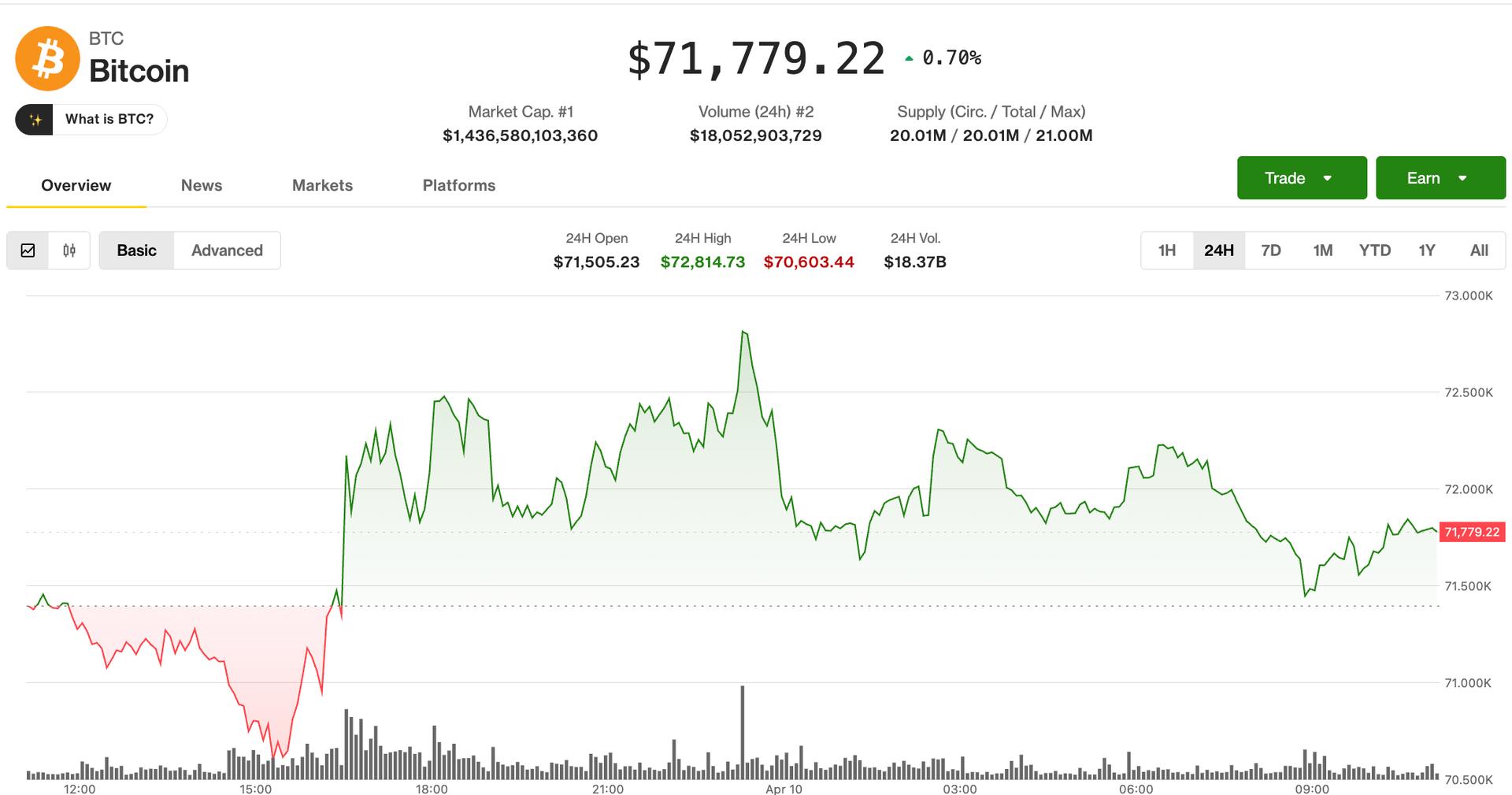
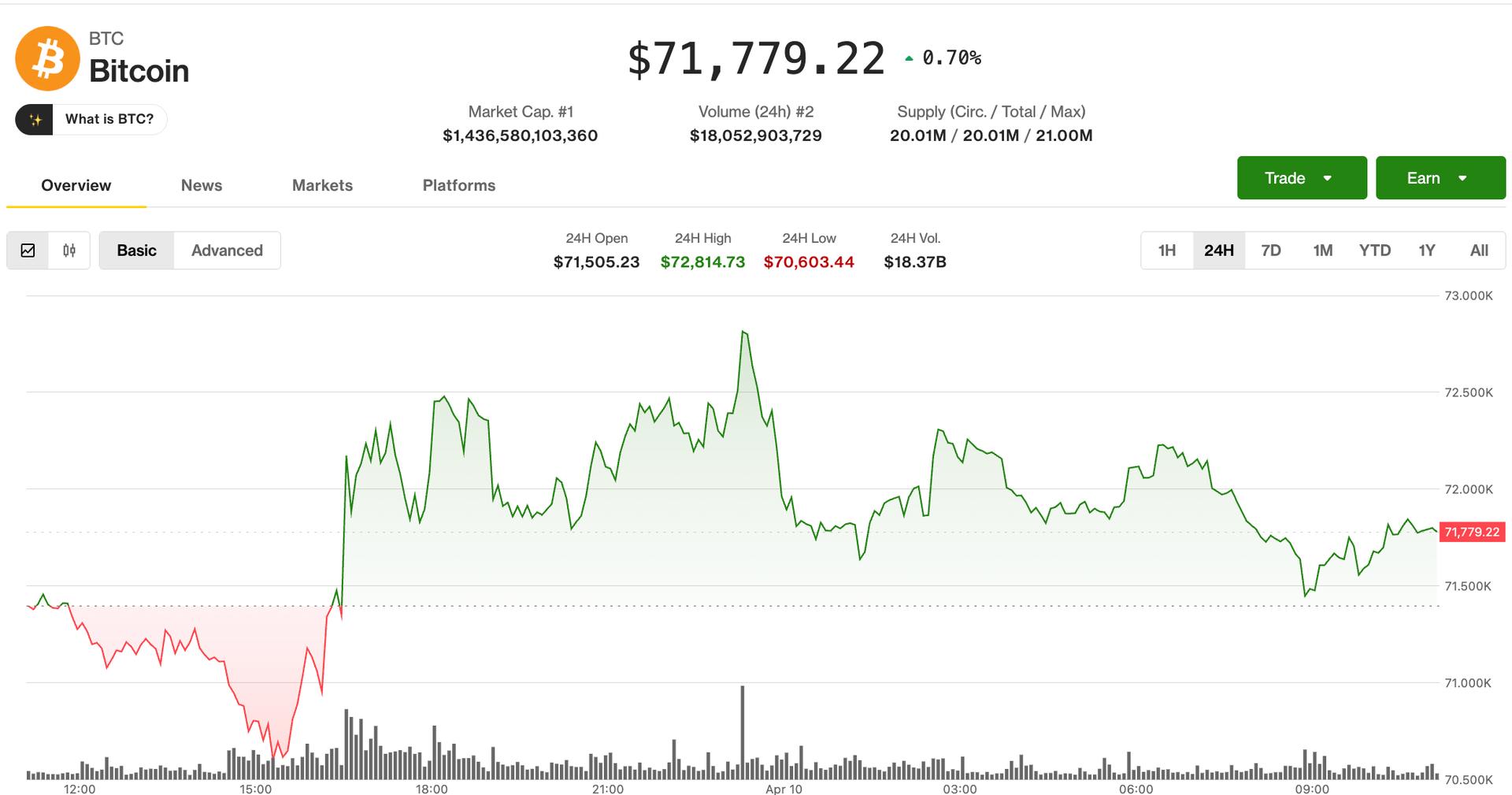
The crypto market held steady on Friday, with bitcoin trading little changed at $71,700 and ether (ETH) at $2,180, extending the low-volatility price action that has characterized the past few months.
Daily Bollinger bands, a technical analysis tool that measures market volatility, are at their narrowest since early 2024. In the past, such a tight range — bitcoin has held between $63,000 and $75,000 since early February — has ended with a 40% move in price, according crypto analyst Eric Crown.
A breakout above $75,000 in bitcoin’s case would trigger upside momentum by trapping traders who are short and need to buy at market prices to cover their positions, while a short-term move below $70,000 will liquidate around $200 million worth of long positions that are betting on the breakout, according to CoinGlass’ liquidation heatmap.
One key catalyst on Friday will be the U.S. consumer price index (CPI) data. March inflation is estimated at 3.3% year-on-year, driven by surging energy prices. High inflation figures tend to spur upside price action in the U.S. dollar, which could weigh on risk assets like bitcoin.
Derivatives positioning
- Open interest (OI) in bitcoin futures increased by 1%, with average perpetual funding rates on major exchanges at their highest since Feb. 4. This shows a strengthening investor appetite for bullish exposure.
- Other major cryptocurrencies were mixed. OI increased slightly in XRP (XRP) while holding flat in ether (ETH) and solana (SOL). HYPE and AVAX are other standouts, displaying a bullish combination of OI growth and positive funding rates.
- The privacy-focused ZEC, meanwhile, shows OI growth and negative rates, a sign that traders are continuing to short futures and hedge downside risks even as the spot price rallies. ZEC’s price rose to nearly $400, the highest since Jan. 28.
- There seems to be no end to the downtrend in BTC’s 30-day implied volatility index, BVIV. The measure has slipped to 45%, indicating market calm. It has dropped in a near-straight line from 58% on March 31. Ether’s volatility index shows a similar pattern.
- The decline in volatility is largely led by ETF-related flows. “The ETF complex has created a feedback loop: institutions sell calls for yield, which suppresses upside vol, which makes selling more calls even more attractive. The impact is still subtle, but the direction of travel is clear. Bitcoin’s options market is maturing into a structurally skewed market, just like equities,” STS Digital’s CEO Maxime Seiler told CoinDesk.
- The implied volatility term structure is flat for the next six months and then rises from September, suggesting the market is prepping for a quiet few months in between.
- On Deribit, BTC and ETH options continue to display put skews, although it’s much weaker than a week ago as traders chase upside bets, particularly the BTC call option at the $80,000 strike.
Token talk
- CoinDesk’s DeFi Select Index (DFX) is the best-performing benchmark on Friday, rising by 0.38% while the bitcoin-dominant CoinDesk 5 (CD5) is down by a quarter of a percent.
- The CoinDesk Computing Select Index (CPUS) is the worst performer, losing 1.4% after it was dragged down by bittensor (TAO), which lost more than 12% since midnight UTC after Covenant AI, one of the network’s largest subnet developers, said it was leaving Bittensor.
- “The entire premise of Bittensor, the promise that drew builders, miners, validators, and investors into this ecosystem, is that no single entity controls it,” Covenant AI founder Sam Dare wrote on X. “That promise is a lie.”
- One token that shrugged off broader crypto market apathy was DASH, which surged more than 19% since midnight UTC, contributing to a 24-hour gain of 34% as traders rotated back into the privacy sector.
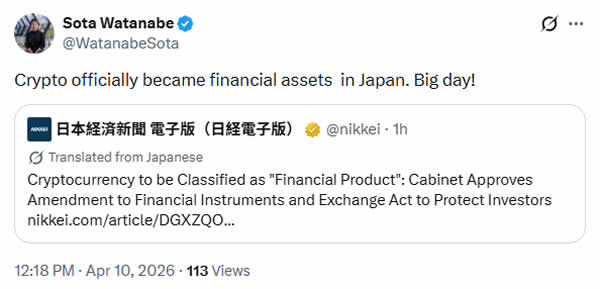
The Japanese government amended the Financial Instruments and Exchange Act on Friday to classify crypto assets as financial instruments.
The amendment also bans insider trading and other activities that involve buying and selling based on undisclosed information, Nikkei reported.
The amended act will also now require cryptocurrency “issuers” to be more transparent and disclose information once a year.
Japan’s Financial Services Agency has previously regulated crypto assets under the Payment and Settlement Act, citing their potential use as a means of payment. However, the regulations and classifications have been updated to reflect increasing institutional investment in the asset class.
By reclassifying crypto as a financial instrument rather than just a payment method, Japan is moving crypto out of the experimental payments category and into the same league as its stock market.

Crypto under the TradFi umbrella
“We will expand the supply of growth capital in response to changes in financial and capital markets, and ensure market fairness, transparency, and investor protection,” said Finance Minister Satsuki Katayama at a press conference after the Cabinet meeting.
Fines and sentences for unregistered crypto exchanges have also increased under the amendment.
Related: Prediction markets are testing legal limits in strict Asian markets
Japan signaled that it was bringing crypto under the same umbrella as traditional finance in January when Katayama said, “To ensure citizens benefit from digital and blockchain-based assets, the role of exchanges and market infrastructure will be essential.”
The government backed plans in December to significantly reduce Japan’s maximum tax rate on crypto profits, with a flat rate of 20% across the board.
Crypto ETFs coming to Japan
Japan is also planning to legalize crypto exchange-traded funds (ETFs) by 2028, marking a major shift toward mainstream crypto adoption, according to a January report.
Major financial groups, including Nomura Holdings and SBI Holdings, are among the first companies expected to develop crypto-linked exchange-traded products.
Asia Express: Phantom Bitcoin checks, China tracks tax on blockchain


A New York judge couldn’t decide yesterday whether or not to acquit Tornado Cash co-founder Roman Storm on conspiracy charges relating to his role in the creation of the non-custodial crypto mixer.
Storm was convicted last year of conspiracy to operate an unlicensed money transmitting business, however, a jury was unable to come to a decision on more serious conspiracy to launder money and conspiracy to evade US sanctions charges.
As such, the question of whether or not to acquit Storm fell to Judge Katherine Polk Failla.
“This is a lot,” she said after hearing arguments from both Storm’s defence and government prosecutors.
As reported by The Block, Storm’s defence argued that Tornado Cash is legal, and that his work to update and maintain his legal business used by ordinary people doesn’t make him guilty of abetting the criminal money launderers who also use it.
General Counsel of Solana Policy Institute, Patrick Wilson, called this expansive claim “alarming,” and noted that, “Once criminals use a noncustodial tool at sufficient (though unspecified) scale, even otherwise lawful activity can be recast as illegitimate.”
Government prosecutors argued, however, that his work means he not only helped but profited from money launderering. One prosecutor caused a brief stir in the courtroom after implying that anyone whose funds were mixed with criminal funds via Tornado Cash may also be liable.
The CEO of the DeFi Education Fund, Amanda Tuminelli, attended the hearing and claimed that the government “still does not understand the tech at issue.”
Read more: Ethereum dev arrested in Turkey ups Roman Storm donation to $500K
“The lack of nuance, the misrepresentations about how a UI functions, and the equivocation between different technologies is really disheartening at this point in the case,” she said.
“It was good to see the judge digging in and asking detailed questions, but there is no way to predict how she will rule on Storm’s motion. Given that she was focused on dates for retrial at end of 2026, I think we can expect to see the case continue,” Tuminelli added.
The Rage reports that the topic of the First Amendment was barely touched upon, as well as the subject of unlicensed money transmission. The choice of New York as the venue was debated, however.
The prosecution claimed that the location of a Tornado Cash hacker, investors, and an attorney acting on behalf of a hacked crypto exchange, are all based in New York. Storm’s defence hit back, claiming that the investor’s funding was irrelevant and that the hacker didn’t use Tornado Cash for illegal purposes.
Prosecutors further claimed that an Ethereum cloud service used by Tornado Cash, which used a Manhattan bank, also constituted a New York venue.
Storm’s defence argued, however, that the payments to this cloud service cannot constitute an act aiding criminal conspiracy.
Roman Storm faces an October retrial
After last year’s trial, Storm filed for a pre-trial motion under Criminal Rule 29 that would acquit him on all counts.
His defence argues that the prosecution’s evidence wasn’t legally sufficient, and claims that, if his acquittal isn’t granted, the government “would criminalize the publication of decentralized software in violation of the first amendment.”
Read more: Roman Storm says he’s been ‘financially cancelled’ after payroll firm axe
Government prosecutors have requested that a retrial be scheduled for October so that the two remaining charges can be decided upon.
Storm currently remains free on a $2 million bail.
Got a tip? Send us an email securely via Protos Leaks. For more informed news and investigations, follow us on X, Bluesky, and Google News, or subscribe to our YouTube channel.

Wales star commits future to Welsh club after getting ‘back to his best’

Zendaya’s Quick Exit Fuels Sydney Sweeney Rift Rumors
Form DEF 14A BUNGE GLOBAL SA For: 10 April


-

 Fashion7 days ago
Weekend Open Thread: Spanx – Corporette.com
-

 Business5 days ago
Three Gulf funds agree to back Paramount’s $81 billion takeover of Warner, WSJ reports
-

 Sports6 days ago
India men’s 4x400m and mixed 4x100m relay teams register big progress | Other Sports News
-

 Business6 days ago
Expert Picks for Every Need
-

 Tech3 days ago
How Long Can You Drive With Expired Registration? What Florida Law Says
-

 Business5 days ago
No Jackpot Winner, Prize to Climb to $231 Million
-

 Fashion4 days ago
Massimo Dutti Offers Inspiration for Your Summer Mood Board
-

 Fashion3 days ago
Let’s Discuss: DEI in 2026
-
Politics7 days ago
Wings Over Scotland | The quality of mercy
-

 Crypto World2 days ago
Bitcoin recovers as US and Iran Agree a Ceasefire Deal
-

 Business6 days ago
Akebia Therapeutics, Inc. (AKBA) Discusses Pipeline Progress and Strategic Focus on Kidney Disease Treatments at R&D Day – Slideshow
-

 Crypto World24 hours ago
Canary Capital Files SEC Registration for PEPE ETF
-

 Politics6 days ago
The UK should not pay a penny in slavery reparations
-

 Fashion7 days ago
Frugal Friday’s Workwear Report: Hammered Metallic Button Sweater Vest
-

 Tech4 days ago
Samsung just gave up on its own Messages app
-

 Tech4 days ago
Haier is betting big that your next TV purchase will be one of these
-

 Fashion7 days ago
Weekly News Update, 4.3.26 – Corporette.com
-
Sports7 days ago
A Kevin O’Connell Theory Can Now Be Retired
-

 NewsBeat7 days ago
Kemi Badenoch talks ‘spring cleaning’ Reform defections
-

 Tech4 days ago
Gamer Restores the Original PlayStation Portal From Two Decades Ago
You must be logged in to post a comment Login