
Crypto World
What Happened to Bitcoin and Ethereum ETFs During the Crucial Macro Week?

In what was expected to be arguably the most important macro week of the entire year for the crypto markets, investors gaining exposure to the two largest digital assets by market cap through ETFs displayed rather controversial behavior.
Nevertheless, the spot Bitcoin ETFs managed to turn the tables on Friday, but the same cannot be said about their Ethereum counterparts, which snapped an impressive green streak.
BTC ETFs With Late Turnaround
The business week actually began on the right foot for the spot BTC ETFs as they gained slightly over $160 million on Monday. However, Tuesday was the first major test, with the CLARITY Act scheduled to be voted on in the US Senate. As the vote didn’t go in the cryptocurrency industry’s favor, investors pulled $450.33 million out of the funds, the highest daily net withdrawal since late June.
All eyes turned to the Fed on Wednesday as the US central bank hiked rates for the first time in over three years. Investors made another sizeable withdrawal, taking $296 million from the ETFs. The landscape improved slightly on Thursday. SoSoData shows that the net inflows were just under $160 million.
Friday is what turned the tables. The actual net inflows for the day reached a two-week peak, with $433.03 million entering the funds. The impact was twofold: on the one hand, the ETF week turned slightly in the green ($6.21 million). On the other hand, BTC’s price soared by several grand, going from $76,000 early that day to over $80,000 by the end of it.

ETH ETFs Break the Streak
The spot Ethereum ETFs enjoyed the past couple of months, as their cumulative total net inflows rocketed from under $10.9 billion to almost $13.4 billion. Within that timeframe, only one out of 10 business weeks was in the red, and it was quite modest – just $2.26 million left the funds during the second full week of August.
However, the ETFs‘ impressive streak came to an end during the past week, with $140 million leaving the funds. Although Monday ($121.02 million) and Friday ($143.80 million) were well in the green, they couldn’t offset the losses registered during the other three days, which were as follows: $141.47 million on Tuesday, $224.11 million on Wednesday, and $39.24 million on Thursday.
Nevertheless, ETH’s price managed to rocket past $2,600 on Friday and Saturday before it was stopped and now sits inches below the latter after the latest developments in the Middle East.

The post What Happened to Bitcoin and Ethereum ETFs During the Crucial Macro Week? appeared first on CryptoPotato.



Strategy shares have gained 47.65% over one month through Sept. 18, putting the Bitcoin treasury company at the top of the latest Nasdaq-100 constituent return ranking.
Summary
- Strategy shares gained 47.65% in one month, leading Nasdaq-100 constituents through September 18 closing prices.
- MSTR closed at $153.92 Friday after surging 16.39% as Bitcoin reclaimed the $80,000 level again.
- Strategy held 845,050 Bitcoin through September 13, with aggregate acquisition costs totaling $63.73 billion total.
- Strategy made no Bitcoin purchases for two consecutive weeks while directing cash toward STRC repurchases.
- Bitcoin rose above $80,000 Friday while crypto-related equities gained amid fresh U.S. regulatory developments emerging.
History of Market data updated Sept. 19 showed MSTR at $153.92 with a trailing one-month return of 47.65% and a one-week gain of 17.52%. The dataset uses exchange closing prices and the Nasdaq-100 constituent list. Its ranking placed Strategy ahead of the other index members over the one-month window.
Strategy stock closes at $153.92 after 16% Friday surge
The final session of the measurement period accounted for a large part of MSTR’s latest gain. Strategy shares climbed 16.39% on Sept. 18, closing at $153.92 after ending the previous session at $132.25, according to market data.
Trading volume reached 54.34 million shares, well above the company’s recent daily levels. The stock traded as high as $154.02 during the session after opening at $132.25.
MSTR had closed at $104.25 one month earlier on Aug. 19. Its rise to $153.92 produced the 47.65% trailing return. The rally has recovered a portion of the stock’s earlier losses, though MSTR remained down more than 55% over the trailing 12 months as of Sept. 18.
Bitcoin’s Friday rally coincided with the sharp move in Strategy. Reuters reported that crypto-linked equities rose as Bitcoin climbed during a volatile U.S. trading session, while the Nasdaq finished higher.
Bitcoin advanced more than 5% and moved through $80,000 during the session. Ascrypto.news reported on Bitcoin’s Sept. 18 breakout, BTC reached an intraday high of $81,258 after recovering from $75,560.
The timing supports a close relationship between the two moves, but it does not establish Bitcoin as the sole cause of MSTR’s entire one-month gain. Strategy’s stock incorporates its Bitcoin exposure alongside its debt, preferred securities, cash balances, common-share structure and investor expectations for future capital activity.
Strategy remains exposed to 845,050 Bitcoin
Strategy’s latest SEC filing shows the company held 845,050 BTC as of Sept. 13. It acquired those coins for $63.73 billion in aggregate, including expenses, at an average cost of approximately $75,412 per Bitcoin.
The position equals just over 4% of Bitcoin’s fixed 21 million supply cap. Strategy remains the largest publicly traded corporate Bitcoin holder based on its disclosed balance.
Its latest addition came during the week ending Aug. 30, when the company purchased 4,603 BTC for $369.7 million at an average price of $80,318. The transaction increased holdings from 840,447 BTC to the current 845,050 BTC.
Strategy’s 4,603 BTC purchase, the acquisition was funded through common-stock sales. Strategy sold 4.53 million MSTR shares that week for $602.8 million in net proceeds, directing $369.7 million toward Bitcoin.
The company then stopped buying Bitcoin for the following two reporting periods. Its Sept. 8 and Sept. 14 SEC filings showed no Bitcoin purchases or sales and no at-the-market share issuance during either week. Strategy’s Bitcoin exposure therefore remained unchanged while MSTR’s market price moved sharply.
Strategy has redirected cash toward STRC buybacks
During the pause in Bitcoin purchases, Strategy directed capital toward its Variable Rate Series A Perpetual Stretch preferred stock, or STRC.
From Aug. 31 through Sept. 7, the company repurchased 1.81 million STRC shares for $176.3 million. Strategy simultaneously increased its Digital Credit Securities Repurchase Program authorization from $1 billion to $2 billion, according to its Sept. 8 filing.
Another 1.42 million STRC shares were repurchased for $139.3 million between Sept. 8 and Sept. 13. Strategy funded that transaction from its separate USD Cash balance, leaving its designated USD Reserve untouched.
As crypto.news reported on Strategy’s two-week Bitcoin pause, the company had neither issued common shares nor traded Bitcoin during the latest reporting period while continuing to reduce its preferred-share obligations.
Strategy had spent roughly $950.8 million on STRC repurchases since the program began in July. The preferred shares had recovered toward Strategy’s targeted $99-to-$100 range.
Strategy CEO Phong Le has described discounted STRC repurchases as an attractive use of capital because buying the preferred shares below their $100 stated amount reduces future dividend requirements at a lower purchase price.
The policy does not commit the company to a fixed amount or timing for future purchases. Strategy says repurchase decisions depend on market prices, liquidity, available capital and its other capital-allocation priorities.
MSTR rally outpaces the latest Bitcoin move
Strategy’s one-month return has been considerably larger than Bitcoin’s price increase over the same general period, reinforcing MSTR’s history of producing amplified moves around changes in the value of its primary treasury asset.
On Sept. 18 alone, MSTR gained 16.39% while Bitcoin rose roughly 5% to 6%, depending on the reference time. Barron’s reported that Strategy was among the strongest crypto-linked equities during the session as BTC climbed beyond $80,000.
Regulatory news coincided with the rally. The SEC had announced a five-year Innovation Exemption on Sept. 17 for qualifying tokenized U.S. stock trading, while the CFTC had sent proposed crypto-market rules for White House review. Bitcoin ETF flows had also returned to positive territory before Friday’s move.
Reuters reported that the wider market remained mixed as Treasury yields and oil prices continued to pressure equities. Against that backdrop, crypto-related stocks strengthened alongside the Bitcoin recovery, making Strategy’s advance part of a sector move rather than an isolated company event.
The History of Market dataset shows MSTR’s 47.65% one-month gain alongside a Nasdaq-100 index containing 101 securities as of Sept. 19. Strategy itself carries an estimated index weight of roughly 0.20%, far below the index’s largest holdings such as Nvidia, Apple and Microsoft.
The company’s shorter-term rebound has not erased its longer-term decline. History of Market recorded a roughly 55.35% trailing one-year loss for MSTR despite the latest monthly rise, while its year-to-date performance remained close to flat.
Strategy’s official capital position last disclosed on Sept. 14 included $5.10 billion in its USD Reserve and $1.30 billion in USD Cash. After the latest STRC purchases, approximately $1.05 billion remained under its preferred-securities repurchase authorization, while the separate $1 billion MSTR common-stock repurchase authorization remained unused.


Mainstream AI models failed 57% of personal finance answers, according to UK fintech firm Saturn. Failure rates climbed to 88% on harder, multi-step queries.
The results came as consumer reliance on chatbots for money questions has grown sharply.
Harder Questions Broke Almost Every Model
The study ran 121 questions through 18 free and paid models from providers including ChatGPT, Gemini, Claude, and Copilot. Each question was repeated up to 5 times, producing more than 10,000 answers.
The test scored an answer as a failure when it contained a factual error, skipped something material, or omitted a required warning.
Free models performed the worst, failing on 63% of answers compared to 49% for paid versions. On the hardest questions, free models failed 93% of the time.
Claude Opus 5 in reasoning mode led the field. However, it still failed 39% of answers. The errors included miscalculations, overlooked tax changes, and nonexistent rules.
One pension tax answer could have exposed a saver to a £17,500 charge from HM Revenue and Customs.
“Millions of people are trusting the AI models for money advice, but they are getting wrong answers that can lose them money,” Amal Jolly, Saturn chief executive, said.
Follow us on X to get the latest news as it happens
Trust in AI Chatbots Keeps Climbing Anyway
Meanwhile, usage has widened across markets and age groups. A global EY survey of 18,000 consumers found that 49% had used AI to support savings and investment decisions.
Britain’s financial regulator reported in August that four in five less experienced investors have used AI for help with investing. Of those surveyed, 56% said they trust the tools, ahead of television and radio at 47%.
Meanwhile, the same research found 44% wrongly believe AI-generated financial information is regulated.
A PensionBee survey of 1,000 US adults found nearly six in ten would act on money guidance without independently checking it. Nearly one in four said a chatbot had already given them wrong information about their finances.
Jolly said AI financial advice is unregulated, leaving consumers without the compensation rights a human adviser would carry. He urged the FCA to act quickly.
Subscribe to our YouTube channel to watch leaders and journalists provide expert insights
The post Should You Trust a Chatbot With Your Money? A 10,000-Answer Test Has a Verdict appeared first on BeInCrypto.

The airline industry is notorious for its cyclicality. Traditionally, airlines like Delta Air Lines (NYSE: DAL) are seen as having strong pricing power when travel demand is high, only to suffer when demand wanes, as ticket prices decline while the airline continues to carry high fixed costs.
That said, Delta might not be as risky as you think, and the market may need to rethink how it values the company. Here’s why.
Missed Nvidia in 2009? This Rare Signal Is Flashing Again. In 2009, a “Double Down” signal flashed for a little-known chipmaker called Nvidia. For the first time in years, that same “Total Conviction” signal is flashing for a company 1/100th the size of Nvidia. Continue »
Delta Air Lines is diversifying its revenue streams
Chief Commercial Officer Joe Esposito outlined on the second-quarter earnings call that “diverse revenue streams represented 61% of total revenue in the quarter, up 2 points over last year, with premium and loyalty revenue both up nearly 20%.”
The 61% figure is impressive enough, and it makes sense to create an apples-to-apples comparison across the industry, as other airlines don’t operate refineries (which is a low-margin business anyway). Still, I would argue that it underplays the issue.
By “diverse revenue streams,” Esposito means Delta’s non-main-cabin revenue. That’s fair enough, but when calculating the 61%, Delta adjusts the revenue figure by stripping out its refinery sales to third parties. Esposito is referring to the bottom figure on the right side of the table, but including refinery sales increases the share of non-main-cabin revenue to 65.3%.
Data source: Delta Air Lines presentations. * Adjusted figure excludes $2.091 billion in third-party refinery sales.
A deliberate strategy
Sticking with my figure of 65.3%, it represents a significant increase over the full-year 2017 equivalent figure of 50%. Back then, main cabin revenue was 1.7 times Delta’s premium cabin revenue, but as you can see above, Delta’s premium cabin revenue exceeded main cabin revenue in the second quarter.
It’s all part of a deliberate strategy to diversify Delta’s revenue away from the extreme cyclicality of main cabin ticket revenue. As Esposito noted on the recent earnings call: “We’re not growing Main Cabin seats. This is a multiyear, several years in a row, that we haven’t grown this cabin. We won’t be growing it next year either.”

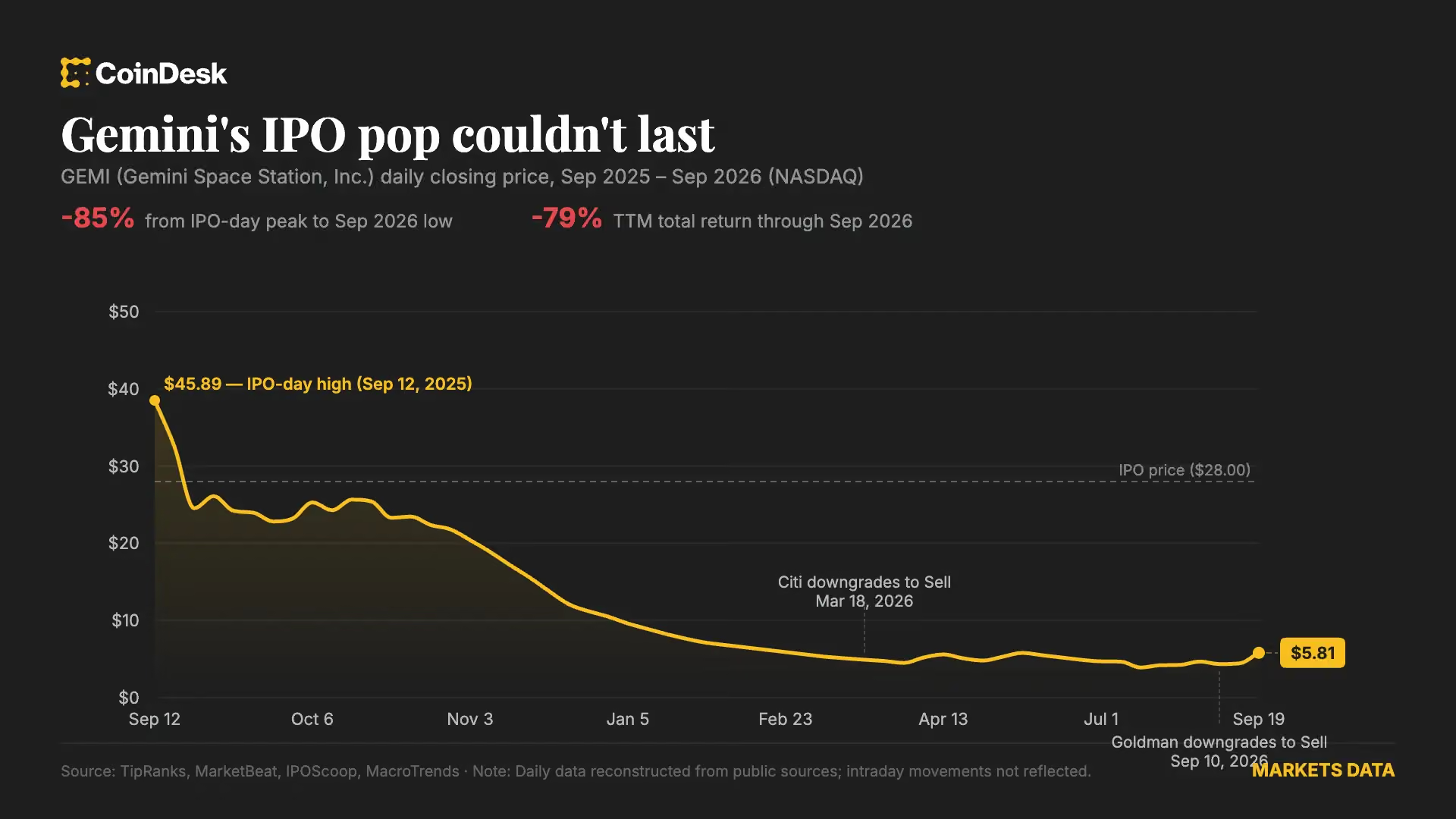
Gemini Space Station (GEMI), a crypto platform, has seen its price roughly 80% since its public debut, reviving questions about whether the platform founded by the billionaire Winklevoss twins could eventually become an acquisition target.
Lorenzo Valente, director of digital assets research at ARK Invest, argued in a post on X last month that Hyperliquid, the offshore perpetual-trading platform, should acquire Gemini and use it as a regulated U.S. gateway for perpetual futures and prediction markets, with the Winklevoss twins’ concentrated voting control potentially simplifying the deal.

Is Gemini a viable target?
While there is no indication that Hyperliquid is actively pursuing a deal to buy Gemini, Valente’s proposal raises a broader question: What is Gemini’s value proposition to a potential buyer if its regulatory infrastructure is worth more than its shrinking spot-exchange business?
Currently, the stock’s market cap is $753 million, down from about $4 billion at its peak. Gemini’s second-quarter exchange revenue fell 38% from a year earlier to $12.5 million, while spot trading volume dropped 66% to $3.8 billion, and assets on the platform declined to $8.4 billion from $18.2 billion.
After a couple of consecutive weeks in which the spot XRP ETFs attracted nearly $19 million, the actual inflows were slashed in half during the previous, highly eventful five-day trading period.
Nevertheless, they have extended their green streak, which can also be said of the spot SOL ETFs. In fact, the Solana funds have been in the green for nearly three months now.
XRP ETFs Hit New ATH
On the day ahead of the crucial Senate vote for the CLARITY Act, the spot Ripple ETFs attracted $11.26 million, which helped them start the week with a bang. Interestingly, the failure of the bill vote on Tuesday didn’t result in any direct net outflows, with SoSoValue showing $0.00 in reportable data on that day, even though the underlying asset slumped by more than 8% in hours.
In fact, investors continued to pour funds into the financial vehicle on the next day, with $3.50 million entering the ETFs despite the Fed’s rate hike on Wednesday. That’s where the tide turned, and the net inflows stopped. SoSoValue shows $5.15 million in net withdrawals completed on Thursday, and a very modest $43,700 taken out on Friday.
As such, the cumulative total net inflows reached a new all-time high on Wednesday at $1.720 billion but dropped toward $1.710 billion a day later. Nevertheless, the week was still a success, with $9.56 million in net inflows. The last time the spot XRP ETFs were in the red was during the first full week of July.

SOL ETFs Are Doing Even Better
Similar to the XRP ETFs, the SOL counterparts began the week on a high note, attracting just over $11 million. They didn’t budge on Tuesday either, gaining another $1.35 million. The net inflows slowed down to under $840,000 on Wednesday and went to $0.00 on Thursday. As of press time, there’s no data on SoSoValue about what happened on Friday, so we will assume it was another non-action day of $0.00.
Given the currently available information, the week ended with $13.19 million in net inflows. Unless investors pulled out over that amount on Friday alone, which is highly unlikely since the last time this happened was on July 28, then the green streak of consecutive weeks with more net inflows grew to 12. In other words, the last time the SOL ETFs were in the red weekly was in late June.
Meanwhile, the underlying asset rocketed to a multi-month peak of around $115 during the Friday/Saturday rally, before it was rejected to below $110 as of Sunday afternoon.

The post Ripple (XRP) ETFs Hit 10-Week Green Streak, but Solana (SOL) Funds Go Even Further appeared first on CryptoPotato.


The SEC has opened a five-year route for qualifying tokenized U.S. stocks to trade through permissioned automated market makers, prompting Goldman Sachs and Citizens analysts to identify Coinbase, Robinhood and Circle as companies that could benefit if regulated onchain equity trading expands.
Summary
- SEC relief lets tokenized U.S. stocks trade through permissioned automated market makers for five years.
- Coinbase offers one-to-one-backed stock tokens on Base, but its U.S. products still need compliance changes.
- Robinhood’s overseas stock tokens provide economic exposure without full underlying shareholder rights required by SEC.
- Circle could gain USDC settlement demand because SEC permits payment stablecoins within qualifying stock-token pairs.
- Tier One tokenized stocks face seventy-five-symbol limits and 0.25% volume caps under the exemption framework.
The Securities and Exchange Commission said on Sept. 17 that its Innovation Exemption grants temporary conditional relief to Tokenized Securities Venues, or TSVs, that use AMM liquidity pools for secondary trading of tokenized National Market System stocks. The framework excludes synthetic stock products and requires eligible tokens to convey the same rights as the equivalent traditional shares.
Under the order, qualifying tokenized stocks must give holders the same company interest, dividends, voting rights and liquidation rights as conventional shares of the same class. Primary offerings cannot use the exemption, while securities offered and sold under the framework must still satisfy Securities Act registration requirements or qualify for another exemption.
Third-party tokenizers face an issuer notice requirement. A TSV must inform the underlying public company before listing an unaffiliated third party’s tokenized version of its shares, then wait at least 30 calendar days. If the issuer objects within that period, the venue cannot begin trading the token.
The SEC placed limits on both the number of stocks and their trading volume. Tier 1 securities, covering stocks in the S&P 500, Russell 1000 and certain highly traded exchange-traded products, are limited to 75 symbols on a TSV and 0.25% of each stock’s prior-month average daily share volume. Tier 2 is capped at 250 symbols and 2.5% of prior-month average daily volume.
A repeat breach of a stock’s volume ceiling requires the venue and affiliated TSVs to stop trading that tokenized stock for three months. The SEC said the caps are designed to limit possible price dislocations between AMM-traded tokens and shares trading through conventional markets.
The framework requires smart contracts used by qualifying venues to be auditable and public while running on public, permissionless distributed ledgers. Access to the actual TSV must remain permissioned. Venues must stop token trading whenever the underlying stock is halted on its primary listing exchange.
Ascrypto.news reported on the five-year SEC exemption, synthetic products offering only price exposure do not qualify. A subsequent review of the shareholder-rights requirement noted that the SEC’s framework separates tokens carrying actual shareholder rights from products structured as derivatives or debt claims.
Coinbase already has several pieces of the required model
Goldman Sachs analysts identified Coinbase as a potential beneficiary because the company already operates tokenization, custody, stablecoin and blockchain infrastructure that could support onchain equity markets. Coinbase’s international tokenized stocks are backed one-for-one by real shares held in regulated, bankruptcy-remote custody.
Coinbase says holders have a senior beneficial claim on the underlying equity, while dividends and stock splits are incorporated through an onchain multiplier. Primary creation and redemption are restricted to KYC-approved institutional partners and authorized participants. Its current products are offered under Regulation S and are unavailable to U.S. persons.
Voting remains one item still being developed. Coinbase President Emilie Choi said during the Goldman Sachs Communacopia conference that the products already carry dividend rights and that voting options are being added. She described implementing those rights as a technology task instead of a change in the fundamental security structure.
Coinbase’s Base stock tokens, the company began with Apple, Nvidia, Meta and Alphabet products before expanding its lineup. The tokens use Coinbase’s B20 standard and can move into supported DeFi applications on Base.
Activity has moved beyond simple spot trading. Token Terminal data cited by crypto.news in its Base tokenized-stock market report showed $730.9 million in DEX volume during the 30 days through Sept. 12, with Aerodrome accounting for $557.1 million.
Morpho then opened lending markets for five Coinbase-issued stock tokens. By Sept. 18, users had posted $104,401 of stock tokens as collateral and borrowed $54,652 in USDC, according to crypto.news coverage of the Morpho integration.
Goldman’s analysis identifies a separate issue if Coinbase wants to operate a U.S. TSV itself. Coinbase’s conventional exchanges use central limit order books, while the new SEC relief specifically covers AMM liquidity pools. Goldman said Coinbase could develop AMM infrastructure or route activity through qualifying decentralized venues, including protocols operating on Base.
Robinhood’s current tokens do not meet the SEC test
Robinhood enters the U.S. discussion with an established overseas stock-token business, but its existing legal structure differs from the securities covered by the exemption.
Robinhood’s second-quarter SEC filing states that its Stock Tokens are tokenized debt securities issued by Robinhood Assets (Jersey) Limited. They provide economic exposure to referenced securities but do not grant holders legal or beneficial rights in the companies whose shares underpin the products.
That distinction conflicts with the Innovation Exemption’s requirement that token holders receive the same interest, dividends, voting rights and liquidation rights as traditional shareholders. Goldman analysts therefore said Robinhood would need further product development before offering a U.S. product under this particular framework.
Robinhood has already indicated that its design is evolving. CEO Vlad Tenev said in September that the company intends to introduce share redemption and voting features, while its newer onchain stock products can move outside the Robinhood app and interact with DeFi smart contracts.
The company’s earlier offshore model became part of a public dispute with AMC Entertainment after Robinhood introduced an AMC-linked token without the company’s approval. Robinhood-AMC dispute, holders received economic exposure but not direct shareholder rights.
Tenev later argued that issuer approval should depend on what legal rights a token creates, not simply whether blockchain technology is involved. The SEC’s final exemption takes a different procedural approach for unaffiliated third-party tokenization by granting the underlying issuer a 30-day window to prevent its shares from trading on a TSV.
Robinhood Chain gives the company existing onchain infrastructure to build around. Robinhood launched the chain’s mainnet in July and opened stock tokens to smart-contract use, including DeFi pools and third-party applications.
Circle exposure comes through settlement and collateral
Circle’s connection to the SEC order is indirect because the company does not need to issue tokenized stocks to participate in the market analysts describe.
The SEC order permits a tokenized NMS stock to trade in a pair with another tokenized stock, a tokenized money market fund or a non-security crypto asset, including a qualifying payment stablecoin. That creates a regulatory route for stablecoins to serve as the other side of qualifying AMM pools.
Goldman Sachs and Citizens analysts identified USDC as a possible settlement and collateral asset if tokenized-equity activity grows. Circle already markets USDC as settlement infrastructure for tokenized assets. On Cronos, for example, Circle says USDC serves as the dollar settlement layer for an application designed to support tokenized stocks, crypto and prediction markets.
Circle’s institutional work extends into tokenization infrastructure through Arc. Its second-quarter update said BlackRock, BNY, DTCC and Standard Chartered were developing or examining integrations involving tokenized-asset settlement, custody, stablecoin access, foreign exchange and repo markets. DTCC plans to enable tokenization of DTC-custodied assets on Arc.
Existing Base activity supplies an early example of stock tokens interacting with USDC. Morpho’s Coinbase tokenized-stock markets use USDC for borrowing, although their current scale remains small beside conventional U.S. securities markets.
Trading caps limit the initial challenge to traditional exchanges
Goldman does not expect the exemption’s first phase to pull substantial trading volume away from Nasdaq or Intercontinental Exchange, the owner of the NYSE. The bank cited the SEC’s volume caps, symbol limits, issuer objections and AMM market structure as constraints on the experiment.
The SEC itself acknowledges AMM pricing can diverge from conventional equity markets because pool prices generally depend on the ratio of assets deposited into a liquidity pool. Its volume limits were designed partly to contain potential price dislocations while regulators collect operating data.
Traditional market infrastructure is pursuing a separate tokenization path. DTCC said in May that DTC’s tokenization service would begin with limited production transactions in July before a planned October 2026 launch, following work with more than 50 financial companies. Participants include Circle, Coinbase, Goldman Sachs, BlackRock, Bank of America and several major trading and custody firms.
The TSV route has its own waiting period before a qualifying venue can operate. The SEC requires a prospective TSV to publish a detailed public notice at least 30 calendar days before starting operations and notify the Commission within one business day of publishing it.
Public feedback remains open. The SEC’s comment page currently lists no closing date for comments on File No. 4-927, while Chairman Paul Atkins has described the exemption as a temporary bridge that is expected to inform later rulemaking.
FAQs
Does the SEC exemption allow synthetic stock tokens?
No. The order excludes crypto assets that represent a third party’s own security while providing synthetic exposure to another stock, including tokenized linked securities and tokenized security-based swaps.
Can Coinbase immediately offer its existing stock tokens to U.S. investors?
No. Coinbase’s current products operate under an offshore Regulation S structure and remain unavailable to U.S. persons. A U.S. offering would need to comply with the conditions applicable to the security and trading venue.
Why would Robinhood need to change its current stock tokens?
Its existing Stock Tokens provide economic exposure through debt securities without granting legal or beneficial rights in the referenced companies. The SEC exemption requires equivalent shareholder rights for qualifying tokenized NMS stocks.
Does the SEC framework specifically require USDC?
No. The order permits qualifying tokenized stocks to pair with non-security crypto assets, including permitted payment stablecoins. It does not require a specific stablecoin. Analysts identified USDC as one possible beneficiary.
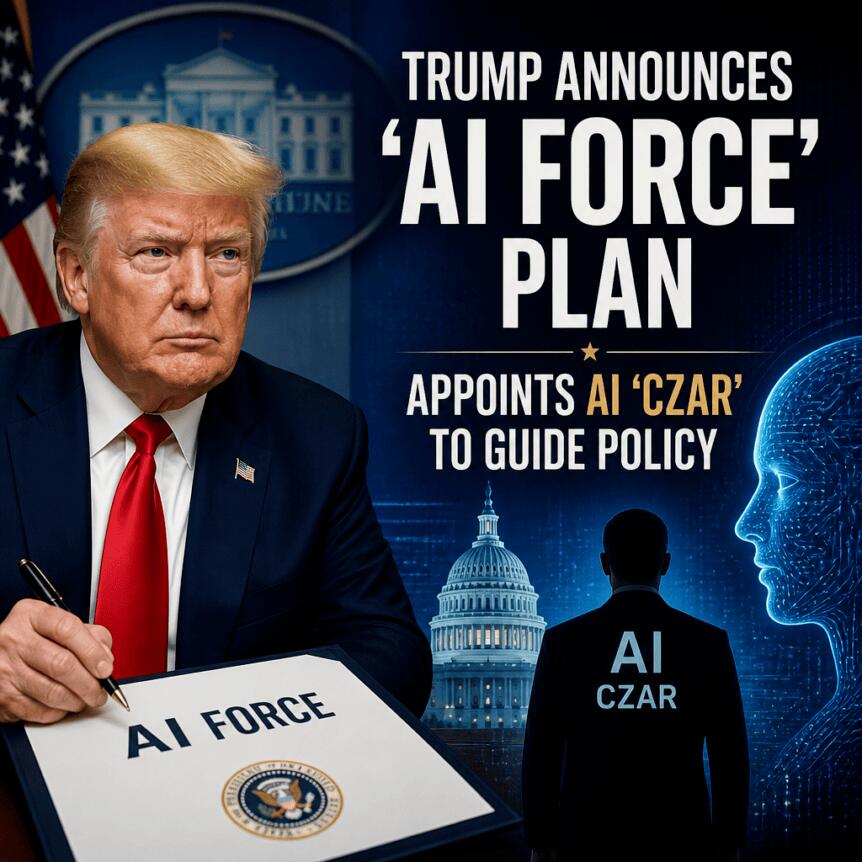
U.S. President Donald Trump says he plans to create an “AI Force” and appoint an “AI czar,” framing the initiative as a way to coordinate the rapidly expanding AI sector without adding regulations that could slow innovation. The announcement, posted by Trump on Truth Social over the weekend, positions the effort as an executive-led counterpart to earlier “Space Force” branding—though it leaves major questions unanswered.
Trump’s message did not spell out whether the AI Force would function as a military command, a civilian agency, or a new department. The New York Times reported that White House officials did not respond to an email seeking clarification.
Key takeaways
- Trump says he will form an “AI Force” and appoint an “AI czar,” but he offered no organizational details in the initial post.
- The president framed the plan as avoiding new regulations that could hinder innovation—without specifying how that would work in practice.
- Trump’s announcement arrives as prominent AI leaders debate whether development should slow down to improve safety and oversight.
- Private-sector and industry approaches to moderating AI progress are already emerging, including Anthropic’s decision to use an “embedded evaluator.”
A political coordination pitch—without a clear structure
In his Truth Social post, Trump said the AI Force would be created “much like” Space Force and that it would be managed in a way he described as successful during his first term. He also indicated that he would announce an AI “czar” “in the near future,” adding that “Only High I.Q. individuals need apply!”
While the rhetoric borrows from the branding of Space Force, Trump did not outline the governance model behind the new initiative. According to the New York Times, the administration did not provide clarification on whether the AI Force would be organized under defense authorities, operate as a civilian regulator, or assume a different form entirely.
That ambiguity matters for investors and builders because the practical effect of any “czar” or task force depends heavily on authority—whether it can set compliance standards, coordinate enforcement, or influence procurement and research priorities. Without that detail, markets are left to interpret the initiative primarily as signaling rather than as a concrete regulatory shift.
The timing: AI safety warnings and calls to slow down
Multiple reports tie Trump’s announcement to a broader debate about whether the pace of AI development should be moderated. The BBC noted that his post came amid warnings about AI’s potential dangers and included no further information about timing or scope.
Earlier this month, Cointelegraph reported on Sept. 12 that Anthropic CEO Dario Amodei shared a three-step proposal aimed at pacing AI progress more deliberately. The underlying concern, as Cointelegraph characterized it, was that if development moves too quickly, systems could “outrun our ability to understand and control these systems.”
That proposal has also drawn reactions from other high-profile technology leaders. Cointelegraph previously reported that OpenAI CEO Sam Altman and SpaceX CEO Elon Musk responded positively to Amodei’s slowdown idea, while Nvidia CEO Jensen Huang did not, arguing that regulation was not necessary. CNBC’s coverage of Huang’s position—referenced by the original reporting—highlighted his view that regulation may not be the right tool for addressing the risks.
Trump’s announcement intersects with this debate, but it does so from a different angle: his stated goal emphasizes managing AI without “adding regulations” that could slow innovation. For stakeholders, the open question is whether that approach means voluntary coordination, procurement and safety guidance, or simply a political framework rather than enforceable rules.
What industry is doing meanwhile: Anthropic and an “embedded evaluator”
Even as policymakers and executives debate the need for slower development, at least one major lab has been moving forward with an internal mechanism intended to influence AI deployment pacing. On Sunday, Anthropic said it had chosen Accenture as its first embedded evaluator, according to Cointelegraph’s report.
Cointelegraph linked this decision to the first step in Amodei’s three-part proposal, describing the move as an effort to help moderate the pace of AI development. The key point for builders and users is that this is not merely an abstract policy discussion—it reflects a concrete, operational attempt to create additional review or evaluation capacity within development pipelines.
This distinction is likely to shape how stakeholders interpret Trump’s plan. If the White House initiative ultimately results in similar embedded oversight—through contractors, audits, or evaluation mechanisms—it could align more closely with lab-level approaches like Anthropic’s. If, however, the AI Force is mainly ceremonial or focused on high-level coordination without technical enforcement, it may provide less tangible safety impact than internal evaluation models.
Why the “AI czar” concept could matter for crypto and digital infrastructure
Although Trump’s announcement is framed around AI governance, the implications can extend into the broader technology ecosystem that underpins modern digital markets—including crypto infrastructure. AI systems increasingly influence everything from software development and automated trading to security tooling and risk modeling. When governments signal intent to shape AI oversight—whether through an “AI czar,” procurement priorities, or coordination structures—they can indirectly affect which tools and workflows enterprises adopt.
At the same time, the public debate highlighted in the reporting underscores a tension: some leaders argue for pacing to improve safety and control, while others contend that regulation is unnecessary and that oversight can be handled without new legal constraints. Trump’s statement suggests he wants coordination without additional regulation, but the absence of details means the policy direction remains unclear.
For readers tracking both AI and blockchain-related infrastructure, the practical question is not only whether new roles or offices are created, but how those roles will translate into standards, audits, or constraints that affect developers building adjacent systems.
With Trump promising more information “in the near future,” the next developments to watch are the AI Force’s formal structure, its legal or administrative authority, and whether the administration’s approach meaningfully engages the kinds of evaluation practices already emerging in the private sector—especially as the industry continues to debate how quickly AI should move and who should be responsible for keeping it under control.


Dogecoin (DOGE) started out as a joke; its creators originally intended for users to tip each other for entertaining social media content.
Despite its playful origins, Dogecoin has since become one of the most popular cryptocurrencies.
Like other cryptocurrencies, Dogecoin (DOGE) can be mined using cloud platforms. Cloud mining is an attractive option if you wish to avoid technical hassles, bypass initial hardware investments, or escape high electricity costs. Essentially, cloud mining involves outsourcing the entire mining process to a third party; as a leading global cloud mining service provider, SHR Miner enables Dogecoin enthusiasts to participate in mining rewards with a zero-barrier entry by leasing computing power from industrial-grade mining rigs.
How to earn profits mining Dogecoin with SHR miner
There are several benefits to mining Dogecoin rather than other cryptocurrencies. First, transaction speeds on the Dogecoin blockchain are fast, which means Dogecoin mining pools typically pay out earnings every 24 hours.
In addition to offering quick withdrawals, Dogecoin can generate a steady income for you. Consequently, Dogecoin mining is efficient, profitable, and holds great promise. Furthermore, there are numerous markets where you can sell your Dogecoin, making it well worth considering as a source of daily income.
Earn Dogecoin rewards with SHR Miner—get started in just three steps:
1. Register an account
Upon creating an account, you will receive a $15 new-user bonus and earn a daily reward of $0.60 through a free hashing power contract. (Click here to register)
2. Select a contract plan
Choose a short-term or long-term cloud mining contract based on your budget and requirements, with contract durations ranging from 1 to 50 days.
3. Start earning rewards
Once the contract is activated, users can view daily rewards via the dashboard and select a supported cryptocurrency for withdrawal.
Examples of popular cloud mining contracts
| Contract Name | Price | Profit | Days | Principal + Total Return |
| New User Experience Agreement | $100 | $4 | 2 | $100+$8 |
| Bitdeer Sealminer A2 Pro | $500 | $6.25 | 5 | $500.00 + $31.25 |
| Litecoin Miner L9 | $1000.00 | $13.00 | 10 | $1000.00 + $130 |
| Bitcoin Miner S21 XP Imm | $5000.00 | $70.50 | 25 | $5000.00 + $1762.5 |
| Bitcoin Miner S21e XP Hyd | $10000.00 | $151.00 | 35 | $10000.00 + $5285 |
| ANTSPACE HK3 | $30000.00 | $513.00 | 40 | $30000.00 + $20520 |
SHR Miner offers a variety of cloud mining contracts to meet the diverse needs of users regarding budgets, durations, and target returns. Whether users prefer short-term flexibility or are focused on long-term returns, they can select the plan that best suits their individual circumstances.
For details on specific contract prices, terms, and estimated rewards, click here to view all contract plans.
Why choose SHR miner?
Compliant UK operations: We hold the necessary operational licenses, prioritize business transparency and regulatory compliance, and charge no hidden fees.
24/7 technical support: Our systems run continuously, backed by a professional team providing round-the-clock customer support.
No complex setup required: The platform handles all aspects of mining rig deployment and hash rate allocation.
Real-time information access: Users can view contract status, mining progress, and daily rewards via the web-based dashboard.
Genuine hash rate: Users receive hash power corresponding to their chosen contract, without the risks associated with third-party equipment maintenance.
One-stop management: Mining, reward tracking, withdrawals, and contract renewals can all be managed on a single platform.
As the market sees a return to favorable price levels, cloud mining offers cryptocurrency holders a new way to participate in the digital asset ecosystem, while eliminating the complexities of deploying and maintaining mining hardware themselves.
In short
Cloud mining is an excellent choice for those seeking ways to generate passive income. If used properly, these opportunities can easily accumulate cryptocurrency wealth in “autopilot” mode, requiring only a minimal investment of time. At the very least, they are far less time-consuming than any form of active trading. Passive income is the ultimate goal for every investor and trader, and with SHRMiner, maximizing your passive income potential is easier than ever.

The main culprit of Strategy’s highly aggressive BTC accumulation game plan, Michael Saylor, took it to X earlier on Sunday to hint that the company might have resumed its cryptocurrency purchases.
In a not-so-cryptic tweet, the former CEO posted a graph of the firm’s countless Bitcoin accumulations completed over the past six years and said, “A little more orange.”
A little more orange. pic.twitter.com/Z3n9jDAEpn
— Michael Saylor (@saylor) September 20, 2026
Recall that Strategy’s last BTC purchase was announced on August 31 and was completed during the week prior. It came at an average price of $80,318 per unit, and the firm spent almost $370 million to reacquire 4,603 BTC. What was particularly interesting about that one is that it came after a two-month pause in which the company made a couple of sales at much lower prices.
Since then, Strategy has been on the sidelines when it comes to Bitcoin accumulations. Instead, it turned its attention to repurchasing its STRC stock, whose price has erased almost all losses from its drop to $75 and closed Friday at $98.51 – just inches below its par price of $100.
If Saylor’s hint has been rightfully understood by the entire crypto community and us on X, this means that Strategy has resumed its purchases during the most intense macro week for BTC and the industry.
On Tuesday, the US Senate voted against advancing the highly anticipated CLARITY Act. A day later, the US Federal Reserve hiked interest rates for the first time in over three years. On Friday, the Bank of Japan mimicked the Fed’s move, raising its own rates to a 31-year high.
The post Strategy’s Saylor Teases New Bitcoin Buy Despite Fed Hike and CLARITY Setback appeared first on CryptoPotato.

I’ll give you a real-world example. I have two sons who both graduated college in the last two years, and they’re entering the workforce. One of my sons studied finance and marketing, and he wanted to get into business development. He went to a startup, and he got a job but [became] frustrated. But he got AI-pilled in January of this year, and he does not have a background in technology in any explicit way, but he just poured himself into learning these agentic systems, and he came to me and he said, “I’m going to quit my job and I want to master these skills. I want to build things. I want to create things.” I’m like, “OK, go do that.” And it is essentially my advice for anyone who is at any stage in their career, but I’ll say for young people who are coming in, the opportunity right now is incredible. If you’re a generally good thinker, you can become a master of literally hundreds of different domains, and you can learn how to create and orchestrate and build things that it was impossible to do before, and so it’s one of the greatest periods ever in human history for individuals and individual agency, and that’s why we’re seeing a huge surge in solo founders. That’s why we’re actually seeing record numbers of new business creation that are happening in the U.S. Agents give agency. So, my recommendation is that people should dive in whatever their domain interest is and master these tools, because it effectively is going to give you superpowers. And that’s the exact message I’ve given every single employee at Circle. I’ve said everyone’s jobs are going to be transformed. We are going to reconstitute this company. We’re going to reorganize this company around the capabilities of agentic [AI], and it’s the greatest career opportunity you’re ever going to have. Take as much time as you want to master this, because you’re going to be more valuable in Circle, or if you choose to go do something else as well.

The 8 Most Fun Westerns of All Time, Ranked

Kim Kardashian, Oprah, Kerry Washington & More A-Listers Attend Lucas Museum of Narrative Art Opening Night Gala

The quiet Norfolk beach 2 hours from Cambridge that’s an ‘unspoilt natural beauty’




-

 Fashion2 days ago
Weekend Open Thread: Talbots – Corporette.com
-
 NewsBeat2 days ago
Trump says US has reached an agreement to take permanent control of Greenland’s security
-

 Crypto World2 days ago
Circle launches Arc Studio AI agent for building onchain apps
-

 Crypto World6 days ago
Revolut Attackers Warn of Ongoing Daily Customer Data Leaks
-

 Crypto World6 days ago
Kraken Lets xStocks Holders Earn Yield Through DeFi
-

 Crypto World5 days ago
What Is the Status of the U.S.-Iran Peace Talks? Here's What Both Sides Are Saying
-

 Crypto World5 days ago
Robinhood engineers charged over $50K crypto scheme
-

 Crypto World4 days ago
US Charges Robinhood Engineers Over Crypto Listing Trades
-

 Crypto World2 days ago
Bitcoin price breaks channel as RSI climbs to 63
-

 Crypto World6 days ago
Elon Musk Drops a Bombshell: Grok 5 Could Be the AGI Breakthrough
-
 Crypto World7 days ago
New Tesla Roadster Uses SpaceX Tech. Will It Impact the Stock Price?
-
 NewsBeat6 days ago
‘Sick conspiracy’: Trump says only guardrails AI needs is ‘a strong and smart (High IQ!) president’ in all-caps rant
-

 Crypto World5 days ago
NVIDIA Analysis: Attempted Rising Wedge Breakout Amid Pressure on the AI Sector
-
Business6 days ago
SK Hynix ADRs Fall More Than 6% as Memory Rally Breaks on Fears of Slower AI Spending
-

 Tech5 days ago
Webb’s IC 348 Mosaic Includes Two-Jupiter Dwarfs, Twin Jets, and a Nursery Still Making Worlds
-
 Crypto World6 days ago
3 Token Unlocks to Watch in the Third Week of September 2026
-
Crypto World6 days ago
Can Circle’s Arc Repeat Robinhood Chain’s Meme Coin Boom?
-

 Crypto World6 days ago
DOJ Seeks to Seize $61M in Iran Oil Funds From Binance Accounts It Vouched For
-

 Crypto World7 days ago
Goldman Sachs backs 25bp Fed hike after CPI
-
 Crypto World7 days ago
AI Safety Burden Falls on Chief Executives as Trump Prioritizes China Race
You must be logged in to post a comment Login