

Crypto World
What is Section 13(3)? Fed emergency lending explained



When the Fed chair was asked whether the central bank would rescue crypto in a crisis, he avoided one topic with lawyerly care: Section 13(3), the emergency lending power behind every modern bailout. Here is what it is, how 2010 rewrote it, and why a stablecoin rescue through it is closer to illegal than unlikely.
Summary
- Section 13(3) of the Federal Reserve Act is the Fed’s emergency lending authority, allowing it to lend beyond banks in unusual and exigent circumstances. It powered the rescues of Bear Stearns and AIG in 2008 and the pandemic facilities of 2020.
- The Dodd-Frank Act rewrote it in 2010: emergency lending must now be broad-based instead of aimed at a single firm, borrowers must be solvent, collateral must protect taxpayers, and the Treasury secretary must approve.
- Those amendments mean the Fed cannot legally rescue one failing stablecoin issuer even if it wanted to. The only lawful path is a market-wide liquidity facility, and a broken issuer would likely fail the solvency test anyway.
- Fed Chair Kevin Warsh told Congress on July 14 the Fed does not want to be in the bailout business, while avoiding specifics on 13(3). The statute explains the silence: the power is narrower than the market assumes.
- The 2023 rescue that restored USDC’s peg did not use 13(3) at all. It ran through a different tool at a different agency, which is a distinction anyone assessing crypto’s safety net needs to hold clearly.
Every modern financial rescue Americans can name ran through the same fourteen words of statute. Bear Stearns, AIG, the alphabet of 2008 facilities, the pandemic programs of 2020: all of them drew their legal authority from the third paragraph of Section 13 of the Federal Reserve Act, which permits the Fed, in unusual and exigent circumstances, to lend beyond the banking system it normally serves. So when Representative Brad Sherman asked the new Fed chair on July 14 whether crypto would get the treatment money market funds got in 2008, and Kevin Warsh answered that the Fed does not want to be in the bailout business while conspicuously declining to discuss his emergency authority, the exchange pointed directly at this provision. For readers tracking the exchange, crypto.news has also covered the testimony this statute sits under. Most of the crypto market has never read it. That is worth fixing, because what the statute actually says, especially after Congress rewrote it in 2010, changes the question from whether the Fed would rescue a stablecoin issuer to whether it lawfully could. The answer is narrower than almost anyone trading on the assumption of a backstop believes.
Where the power came from
Section 13(3) is a Depression artifact, and its origin explains its shape.
The Federal Reserve of 1913 was built to lend to banks against short-term commercial paper, a deliberately narrow design. The Great Depression broke the design’s assumptions: thousands of banks failed, surviving banks hoarded, and creditworthy businesses could not borrow at any price. Congress responded with the Emergency Relief and Construction Act of July 1932, adding a third paragraph to Section 13 that let the Reserve Banks lend to individuals, partnerships, and corporations, anyone, in effect, when circumstances were unusual and exigent, the borrower could post satisfactory collateral, and at least five members of the Federal Reserve Board approved. Historians of the provision note that its framers meant it to reach the real economy, not merely a weakened financial sector: it was a tool for lending to merchants when the banking system had seized.
Then it went to sleep. The authority sat essentially unused for three-quarters of a century, a loaded but forgotten instrument, until 2008.
What 2008 did with it
The financial crisis turned Section 13(3) from a footnote into the operating system of the rescue.
The Fed invoked it in two distinct ways, and the distinction is the entire modern debate. The first was broad-based: facilities open to whole classes of borrowers, created to revive whole markets. Programs for primary dealers, for commercial paper, for asset-backed securities, six facilities designed, five used, all justified as providing liquidity to the financial system rather than saving anyone in particular. The second was tailored: special assistance built for exactly one counterparty at a time. A $13 billion direct loan to Bear Stearns and roughly $30 billion more to grease its sale to JPMorgan. The AIG rescue. Support arrangements for Citigroup and Bank of America. Four firms the Fed judged too big to fail, each receiving a bespoke intervention under the same fourteen words written for Depression-era merchants.
The tailored rescues worked, in the narrow sense that the firms did not collapse, and they poisoned the politics of the authority, in the broad sense that Congress concluded a central bank should never again design a private rescue for a chosen firm. That conclusion became law.
How Dodd-Frank rewired it
The 2010 Dodd-Frank Act did not repeal Section 13(3). It did something more interesting: it kept the power and removed the part crypto is implicitly counting on.
The amendments, implemented in a final Fed rule in 2015, impose five binding constraints. Emergency lending must be through a program or facility with broad-based eligibility, meaning open to a class of borrowers, designed to supply liquidity to the financial system, and explicitly not for the purpose of aiding a single failing financial company. Borrowers must be solvent; the Fed is required to maintain procedures prohibiting credit to insolvent firms. Collateral must be sufficient to protect taxpayers from losses. The Treasury secretary must approve any program before it launches. And the whole exercise runs under mandatory disclosure with a lag plus Government Accountability Office audit.
Read those constraints against the 2008 record and the intent is unmistakable: the broad facilities would have been legal under the new rules, and Bear Stearns, AIG, Citigroup, and Bank of America would not. Congress banned the bespoke bailout while preserving the market-wide fire hose. The 2020 pandemic response proved the surviving architecture works as designed: the Fed reopened its broad facilities and built new ones, corporate credit, municipal liquidity, Main Street lending, all broad-based, all Treasury-approved, several capitalized with Treasury equity that the Fed leveraged, and none of them a rescue of any single named firm.
Now apply it to crypto
Walk a stablecoin crisis through the modern statute and the market’s implicit assumptions start failing the text.
Scenario one: a major issuer breaks. Its coin depegs, redemptions surge, and its reserves, wherever they sit, cannot be liquidated fast enough. Crypto.news has explained what a run on an issuer looks like in stablecoin markets. Could the Fed lend to the issuer to bridge the run? Under post-2010 law, almost certainly not. A loan to one named issuer is precisely the single-firm assistance Dodd-Frank prohibits; a facility gerrymandered to reach only that issuer would be the same thing in costume, which the 2015 rule anticipates. And an issuer whose liabilities exceed the realizable value of its assets in the relevant window has a solvency problem, which triggers the categorical bar. The legal analysis is not close. The tool the market imagines, the Fed catching a falling Tether or Circle the way it caught AIG, was welded shut fifteen years ago.
Scenario two: the sector runs, not one firm. A generalized stablecoin panic forces mass liquidation of reserve assets, Treasury bills and repo, at fire-sale speed, and the stress starts transmitting into the funding markets banks and money funds share, which is exactly the channel the New York Fed’s staff research has flagged. Here a lawful path exists: a broad-based facility lending against high-quality reserve assets to a defined class of participants, justified as protecting the Treasury and money markets rather than any issuer. It would need Treasury sign-off, five board votes, taxpayer-protective collateral, and eventual disclosure, and it would look less like saving crypto than like the Fed defending the government securities market with crypto as an incidental beneficiary.
Which is the precise shape of Warsh’s July 14 testimony. His full stop, no bailouts, maps onto what the statute already forbids: firm-specific rescue. His hedge, mitigating extraordinary risks, maps onto what the statute still permits: broad liquidity defense of the system. The chair avoided discussing 13(3) not because the answer is embarrassing but because the answer is the law, and stating it plainly, we legally cannot save your issuer, and might flood the market it drowns in, is not a sentence any central banker volunteers.
One more concreteness is worth adding before leaving the crypto scenarios, because the abstract phrase broad-based facility hides real design choices that would decide who actually benefits. A lawful stablecoin-crisis facility would have to define its borrower class, and every plausible definition changes the politics. A facility lending to banks against Treasury collateral, the 2023 template, helps issuers only indirectly, by keeping the bill market orderly while they liquidate. A facility lending to registered stablecoin issuers as a class against their reserve assets would be legally defensible under the broad-based test once the GENIUS regime defines who a permitted issuer is, and it would instantly raise the question Congress fought over in 2008: why this industry’s liquidity and not another’s. A facility reaching exchanges or custodians would strain the financial-system purpose language and almost certainly fail the Treasury-approval gate. The unfinished GENIUS rulebook matters here too, in an underappreciated way: a facility for permitted payment stablecoin issuers is only definable once the licensing rules say who they are. The missed July deadline did not just delay compliance paperwork. It delayed the existence of the borrower class any lawful crypto facility would need, which means that today, in a crisis, even the legal path would begin with regulators improvising definitions, the exact condition emergency lending law was rewritten to prevent.
The rescue that confused everyone
One episode makes the market chronically overestimate the crypto safety net, and it deserves to be filed correctly: March 2023, when USDC broke and was made whole.
That was not Section 13(3), and it was not the Fed acting as lender of last resort to crypto. Circle held $3.3 billion of USDC reserves as deposits at Silicon Valley Bank; the bank failed; the coin fell to roughly 87 cents. What restored it was the FDIC’s systemic risk exception, the different tool that actually rescued crypto once, a separate authority at a separate agency under separate law, which allowed regulators to guarantee all SVB depositors, uninsured ones included, to stop a regional banking contagion. Circle was a depositor, so Circle was caught in the net, so the peg recovered. The Fed’s contribution that weekend was a new lending facility for banks, broad-based, exactly as Dodd-Frank prescribes.
The correct lesson is double-edged. Crypto’s one historical rescue was an accident, a spillover from the traditional system saving itself, and the specific channel it flowed through, uninsured issuer deposits at a bank, is precisely the exposure the post-2023 reserve reforms and the GENIUS Act’s rules are designed to shrink. The accidental-bailout pathway is narrowing by design. What remains, on the Fed side, is only the broad facility, with its political gate at Treasury and its solvency screen at the door.
The money market fund precedent, examined
The exchange that produced Warsh’s testimony began with a specific historical reference, Sherman asking whether crypto would get what money market funds got in 2008, and the comparison rewards a closer look, because it is simultaneously the strongest argument for crypto’s eventual rescue and the strongest argument against it.
What money market funds got in 2008 was not, strictly, a Section 13(3) loan to a failing fund. When the Reserve Primary Fund broke the buck after Lehman’s collapse and a run began across the industry, the response came in two parts. Treasury created a temporary guarantee program for money fund shares, backed by its own Exchange Stabilization Fund, effectively insurance conjured overnight for an uninsured product. The Fed, for its part, built broad-based 13(3) facilities that lent against the assets funds were dumping, restoring the markets the funds needed to meet redemptions. Firm-specific rescue never happened; system-wide liquidity and an improvised guarantee did, and together they stopped the run within weeks.
The parallel to a future stablecoin crisis is close enough to be uncomfortable. A stablecoin is functionally a bearer money market share: a claim on a pool of short-dated assets, promising par, redeemable on demand, held by users who treat it as cash. A sector-wide stablecoin run would look like September 2008 in miniature, mass redemption, fire sales of bills and repo, contagion through whatever the coins collateralize. And the toolkit that worked then maps onto what remains legal now: the Fed could lawfully build a broad facility against reserve assets, exactly as it did for the funds’ assets, and Treasury retains its own instruments outside the Fed’s statute entirely. Anyone reasoning from 2008 concludes that the system, pressed hard enough, finds a way, and that conclusion is not naive. It is the historical base rate.
But the aftermath of 2008 is the other half of the precedent, and it points the opposite way. The money fund rescue was followed by fifteen years of regulatory effort to ensure it never recurred: floating net asset values for institutional funds, liquidity fees, gates, reform fights in 2014 and again in 2023, all animated by the conviction that an uninsured product which received an improvised guarantee once must be restructured so it never needs one again. The rescue bought the industry survival and cost it the presumption of independence. Stablecoins are receiving the sequel in advance: the GENIUS Act’s full-reserve and holder-priority rules are the money fund reforms applied before the crisis instead of after, a legislature attempting to pre-position the orderly-failure machinery so the improvised-guarantee moment never arrives.
Which resolves the Sherman question more precisely than either a yes or a no. Would crypto get what money market funds got? The firm rescues, never, those are barred. The broad liquidity, plausibly, that door remains open by design. The improvised guarantee, only at the point where a stablecoin run visibly threatens the Treasury market itself, and the entire current regulatory project is an attempt to make sure the question is never asked, by making failure survivable before it happens. The 2008 precedent is real, and it comes with its own warning label: the products that used it spent the next decade paying it back.
Why the narrowness is the point
It is tempting to read all this as crypto being uniquely disfavored. The truth is closer to the opposite: crypto is being handed, in advance and in writing, the exact deal the rest of finance learned the hard way.
The GENIUS Act is the resolution regime that makes no-bailout credible. Its full-reserve requirement and its rule paying stablecoin holders ahead of other creditors in an insolvency are the components of orderly failure, the thing a system needs so that firms can die without rescues. A resolution regime and a constrained lender of last resort are complements: the first makes the second credible. The unfinished state of the GENIUS rulebook, all six agencies having missed the July 18 rulemaking deadline, is therefore not a side story. Crypto.news has also covered the unfinished rulebook behind the doctrine. Until redemption mechanics and supervisory triggers are final, an issuer failure would be improvised, and improvisation is historically where no-bailout doctrines go to die. The statute bars the tailored rescue; only a working resolution process bars the pressure for one.
For anyone holding or building in the sector, the practical summary is short. There is no lawful mechanism for the Fed to rescue your issuer, your exchange, or your custodian as such. There is a lawful mechanism for the Fed to flood the markets your issuer’s reserves live in, if a failure ever threatens those markets, and using it requires the Treasury secretary’s signature and a solvent counterparty class. Everything else, reserve quality, segregation, attestation, legal priority, is the actual safety net, and it is private. Section 13(3) is the most famous emergency power in finance, and the most important fact about it for crypto is fourteen years old: Congress already decided who it cannot save.
Frequently asked questions
What is Section 13(3) in plain terms?
It is the provision of the Federal Reserve Act that lets the Fed lend beyond banks, to markets and firms it does not normally serve, when circumstances are unusual and exigent. Added in 1932 to fight the Depression, it requires approval by at least five members of the Federal Reserve Board and satisfactory collateral, and since 2010 it carries additional strict conditions on how and to whom the Fed may lend.
What was it used for historically?
Almost nothing for 75 years, then everything. In 2008 it powered both broad facilities, for primary dealers, commercial paper, and asset-backed securities, and tailored rescues of Bear Stearns, AIG, Citigroup, and Bank of America. In 2020 it authorized the pandemic facilities, including corporate credit and municipal liquidity programs, several backed by Treasury equity. The tailored 2008 rescues are the ones later legislation banned.
How did Dodd-Frank change it?
Five ways. Emergency lending must be broad-based, open to a class of borrowers, and not designed to aid a single failing firm. Borrowers must be solvent. Collateral must be sufficient to protect taxpayers. The Treasury secretary must approve any program. And lending is subject to delayed public disclosure and GAO audit. A 2015 Fed rule implemented these requirements, closing the loophole of single-firm facilities dressed as programs.
Could the Fed use it to save a failing stablecoin issuer?
Under current law, effectively no. A rescue of one named issuer is the single-firm assistance Dodd-Frank prohibits, and an issuer unable to meet redemptions would likely fail the solvency requirement outright. The only lawful use in a stablecoin crisis would be a broad-based liquidity facility serving a whole class of participants, aimed at stabilizing the markets where reserves are held, not at saving any particular company.
Is that what the Fed chair meant by no bailouts?
It maps closely. Kevin Warsh told the House on July 14 that the Fed does not want to be in the bailout business, while pledging to mitigate extraordinary risks and avoiding specifics on 13(3). The statute already forbids the firm-specific rescue and preserves the broad systemic tool, so his stated policy and his hedge track the actual legal boundary rather than a personal preference.
Did Section 13(3) rescue USDC in 2023?
No, and the distinction matters. USDC’s peg was restored because the FDIC invoked its systemic risk exception to make all Silicon Valley Bank depositors whole, and Circle was a depositor with $3.3 billion at the bank. That is a different authority, at a different agency, aimed at banking contagion. The Fed’s role that weekend was a broad-based bank lending facility, consistent with its post-2010 constraints.
Who has to approve emergency lending now?
Three layers. At least five members of the Federal Reserve Board must vote to authorize a program. The Treasury secretary must approve it before launch, which inserts a political checkpoint into every use of the power. And afterward, the program faces mandatory disclosure of participants and terms on a lag, plus audit by the Government Accountability Office.
What actually protects stablecoin holders, then?
The private architecture, not the Fed. Under the GENIUS Act, issuers must hold full reserves in liquid assets and holders are paid ahead of other creditors if an issuer fails, though the detailed implementing rules remain unfinished after regulators missed the July 2026 deadline. Reserve quality, segregation, attestations, and that legal priority are the operative safety net. This is educational information, not financial advice.
Disclaimer: This article is for information and educational purposes only and does not constitute financial, investment, or legal advice. It summarizes statutes and regulatory practice that are subject to interpretation and change, and no description here should be relied on as a prediction of official action. Always do your own research. Information is accurate as of July 20, 2026.

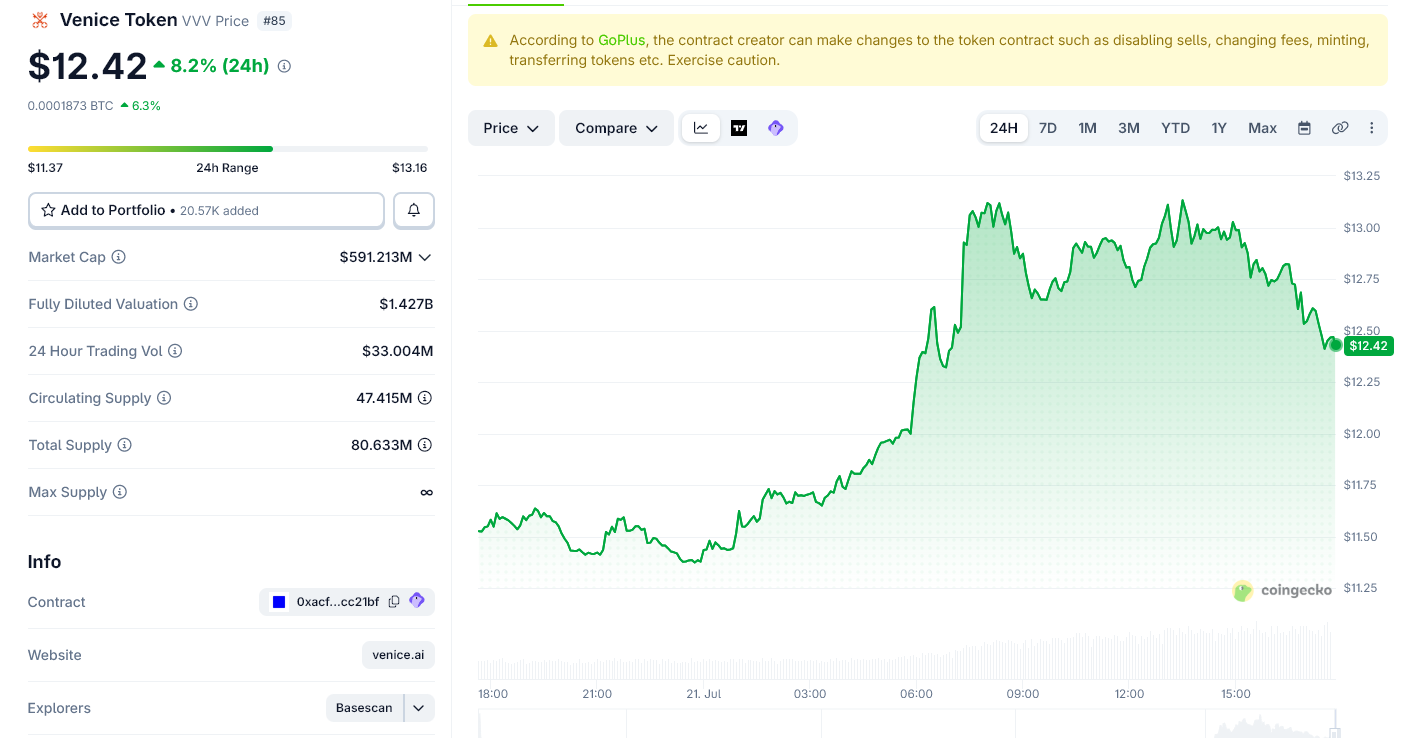
Venice Token (VVV) price rallied 11% on Tuesday to $12.84, breaking above the descending resistance line that had capped every recovery attempt since the June 3 peak at $21.47.
The move ends a six-week correction that bottomed just below $10. Momentum, volume, and Fibonacci structure now make $14 the next battleground.

Daily RSI Broke Its Downtrend Before the Price Did
Momentum turned before price action did. The daily Relative Strength Index (RSI) broke above its descending trendline several sessions ahead of the price chart. Analysts often read such leads as early confirmation of a trend change.
The indicator bottomed near 32 in early July, when the Venice Token price tested the $10 area. It has since reclaimed the 50 midline and its moving average, and it currently sits near 55.

A reading of 55 leaves room before the overbought zone above 70. However, the signal would weaken if RSI slips back below 50 during a pullback.
A previous analysis flagged bearish divergences in VVV just before the June top, and momentum has since completed a full reset.
Hourly Volume Delivers Critical Confirmation
Daily volume tells a more cautious story. It has declined steadily since May, which means the breakout still lacks confirmation on higher timeframes.
The hourly chart fills that gap. VVV traded inside a parallel channel between roughly $11.35 and $12.05 from July 18 until Tuesday morning. The break above the channel’s upper band occurred during the strongest hourly-volume spike of the entire recovery.

Hourly RSI reached 83 during the impulse and has since cooled to 70. Therefore, a retest of the $12.00 to $12.05 area would be a natural next step.
Holding that zone would confirm it as new support and echo the bullish setups that preceded the May rally.
Venice Token Price Prediction Makes $14 the Gate to $16.80
The correction from $21.47 stopped almost exactly where the Fibonacci theory said it should. The low formed just below $10, slightly above the 0.618 retracement at $9.33, and near a prior resistance area.
The current target sits at the 0.382 retracement near $13.97. That level overlaps a horizontal supply zone around $14, where VVV stalled repeatedly in May and June. A move there would add roughly 9% from current prices.
A clean break above $14 would expose the 0.236 level at $16.83, about 31% higher.
Beyond that, the record high of $22.58 from January 2025 remains the final barrier. In contrast, a rejection at $14, combined with a $12 loss, would invalidate the bullish structure and reopen the $10 support.

Fundamentals could accelerate the move. Venice AI announced on July 17 that $5 of every $100 in API credit purchases now automatically buys and burns VVV. The token also led a broader altcoin rally in May, and rising burns tighten supply while most circulating VVV remains staked.
The setup now reduces to a single question. Either buyers convert $14 into a launchpad, or the breakout stalls at the same wall that stopped them twice before.
The post Venice Token Breaks Out with 10% Rally. How Far Will This Altcoin Jump? appeared first on BeInCrypto.
Ondo Finance said it has deployed its tokenized stocks as collateral on OndoPerps, a perpetual futures venue, starting with SPYon and QQQon, in a post published Monday on X. The OndoPerps account said tokenized stock collateral is "live" and "now available for all users," letting Ondo Stocks back… Read the full story at The Defiant


Galaxy Digital (GLXY) said it set up a $5 million fund for Bitcoin developers working to protect the network from the potential future threat posed by quantum computing.
The crypto financial services company said it will begin accepting applications for the Galaxy Bitcoin Quantum Readiness Initiative immediately, with grants focusing on developing quantum-resistant signature schemes, wallet migration tools and security audits. The company said it hopes other firms will contribute funding and research to accelerate the transition to quantum-resistant cryptography.
Bitcoin secures wallets and transactions with cryptographic techniques that current computers cannot break in a meaningful timeframe. While quantum computing is still too immature to attack the blockchain, advances in the technology have accelerated efforts across government and industry to adopt quantum-resistant standards before the threat becomes a reality.
In the event that quantum computers do become capable of breaking Bitcoin’s cryptography, roughly 6.9 million bitcoin could become vulnerable to theft, according to CryptoQuant research. At today’s price of about $66,800, that comes to about $461 billion.
Telegram founder Pavel Durov said the messaging app will embed a native, non-custodial Gram wallet in every version of Telegram this summer, putting a self-custody crypto wallet in front of the platform's more than one billion users. In a post on July 21, Durov said he is "implementing a native… Read the full story at The Defiant
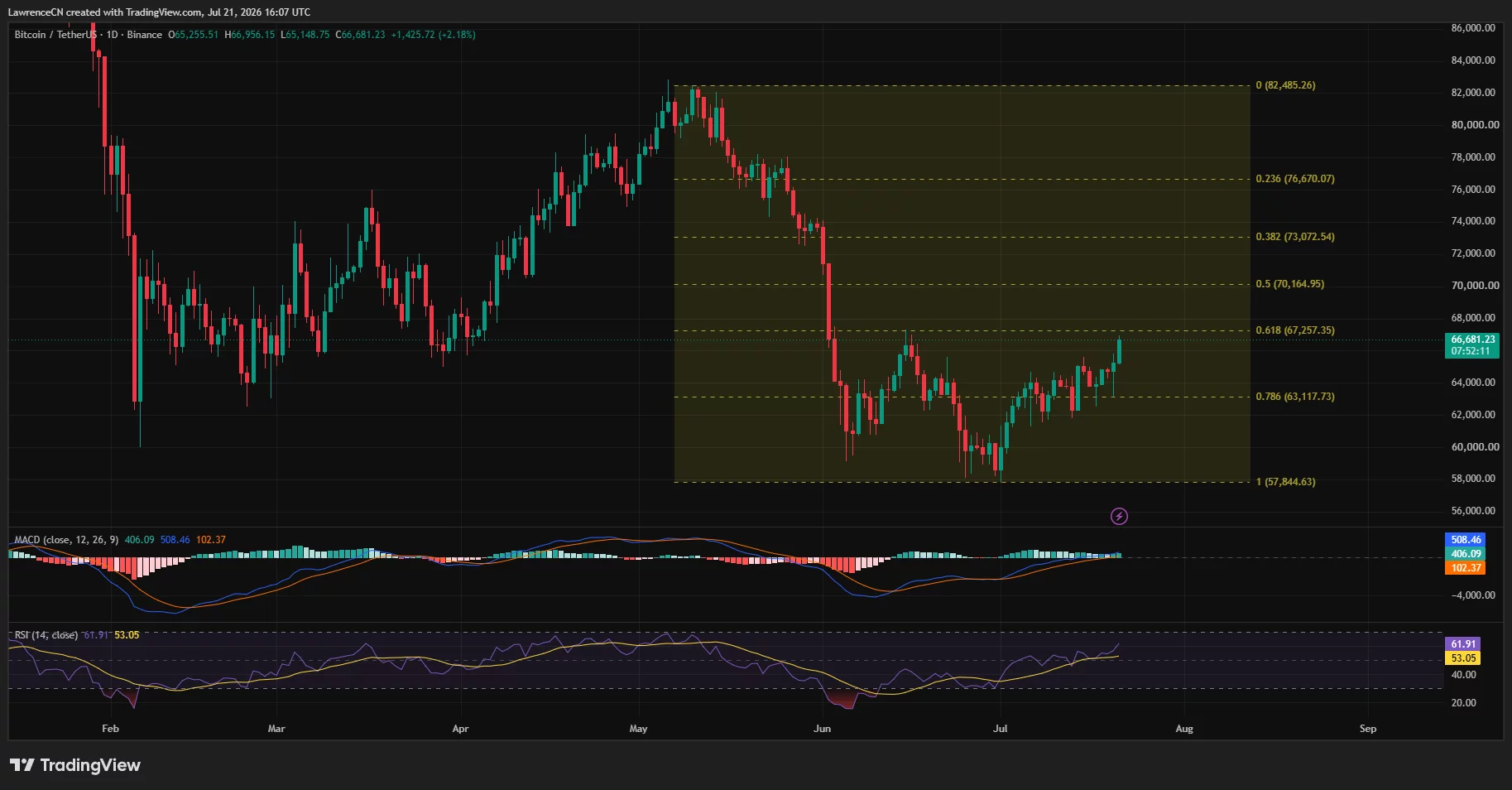
Bitcoin has risen 2.2% to $66,681, and XRP has gained 3.6% to $1.152 as both assets test chart resistance while Iran claims it struck Amazon’s data infrastructure in Bahrain.
Summary
- Bitcoin approached $67,257 Fibonacci resistance as bullish momentum strengthened on its daily chart.
- XRP broke above a symmetrical triangle, opening a possible move toward $1.30.
- Iran’s unverified Amazon strike claim added geopolitical risk to both crypto rallies.
IRNA, Iran’s state news agency, has reported that the Islamic Revolutionary Guard Corps used several cruise missiles to attack what it described as Amazon’s central data infrastructure in Bahrain on July 21. The IRGC claimed the facility was destroyed, although Amazon and Bahraini authorities had not confirmed the reported damage at the time of writing.
According to the IRGC, the operation came in response to a US attack on the construction site of Iran’s Darkhovin nuclear power plant. The Iranian force has also threatened 18 American technology companies, including Microsoft, Intel, Cisco and Google, over their alleged links to US military and intelligence activity.
Amazon Web Services facilities in Bahrain and the United Arab Emirates have already faced attacks during the conflict. In April, an Amazon cloud facility in Bahrain had sustained damage in an Iranian attack, while service interruptions affected AWS infrastructure elsewhere in the region.
Investors reacted cautiously because the latest IRGC account lacked independent confirmation. Amazon shares had closed Monday 1.12% higher at $249.99, but US stock futures later surrendered part of their earlier gains as reports of the alleged attack circulated.
Military action continued while Pakistan pursued another diplomatic effort. The US Central Command had completed a new series of attacks on Iran, extending the American campaign to a tenth consecutive night.
CENTCOM listed Iranian command centers, maritime assets, missile and drone launch sites, and air-defense systems among the targets. The US military stated that the strikes were intended to reduce Iran’s ability to attack commercial vessels passing through the Strait of Hormuz.
At the same time, the Associated Press reported that Pakistan was trying to restart ceasefire negotiations. Those efforts continued as Iran attacked targets in Bahrain, Kuwait and Jordan and fighting disrupted commercial traffic through the Strait of Hormuz.
Bitcoin recovery runs into Fibonacci resistance
Bitcoin (BTC) rose from a daily low of $65,149 to an intraday high of $66,956 on Binance, according to the supplied TradingView chart. The move placed BTC directly below the 61.8% Fibonacci retracement at $67,257, calculated from the decline between $82,485 and $57,845.
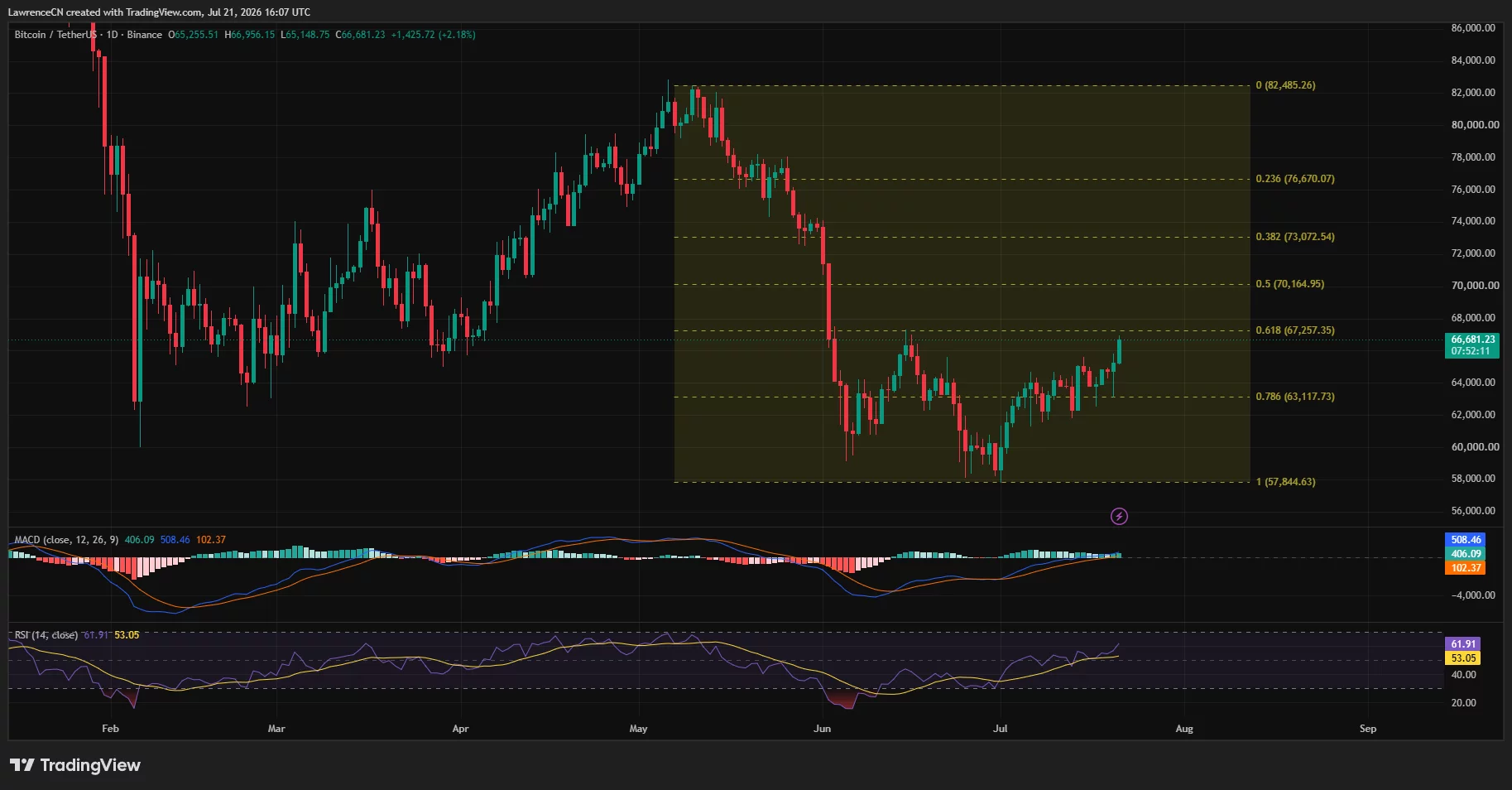
TradingView’s daily setup identifies $67,257 as the immediate technical barrier. A daily close above it would expose the 50% retracement at $70,165, while another advance could bring the 38.2% level at $73,073 into view.
Failure to clear the 61.8% line would leave Bitcoin inside the recovery range formed since its late-June low. The same chart places the closest marked downside level at $63,118, which corresponds with the 78.6% Fibonacci retracement and overlaps with recent consolidation.
Momentum has improved alongside the rebound. Bitcoin’s relative strength index stands at 61.91, above its moving average of 53.05 but still below the overbought threshold of 70, according to TradingView.
The daily MACD also remains positive, with the MACD line at 508.46, the signal line at 406.09 and the histogram at 102.37. TradingView’s readings show bullish momentum, although the small gap between the two lines means BTC still requires follow-through above $67,257 to strengthen the signal.
Bitcoin’s latest candle opened at $65,255 and remained positive when the chart was captured. However, the unfinished daily candle means the attempted break cannot be confirmed until the session closes.
XRP breakout points toward $1.30
XRP (XRP) price has moved above the descending boundary of a symmetrical triangle on its Binance daily chart. TradingView data shows the token advancing from a session low of $1.111 to an intraday high of $1.158 after several weeks of contracting price action.
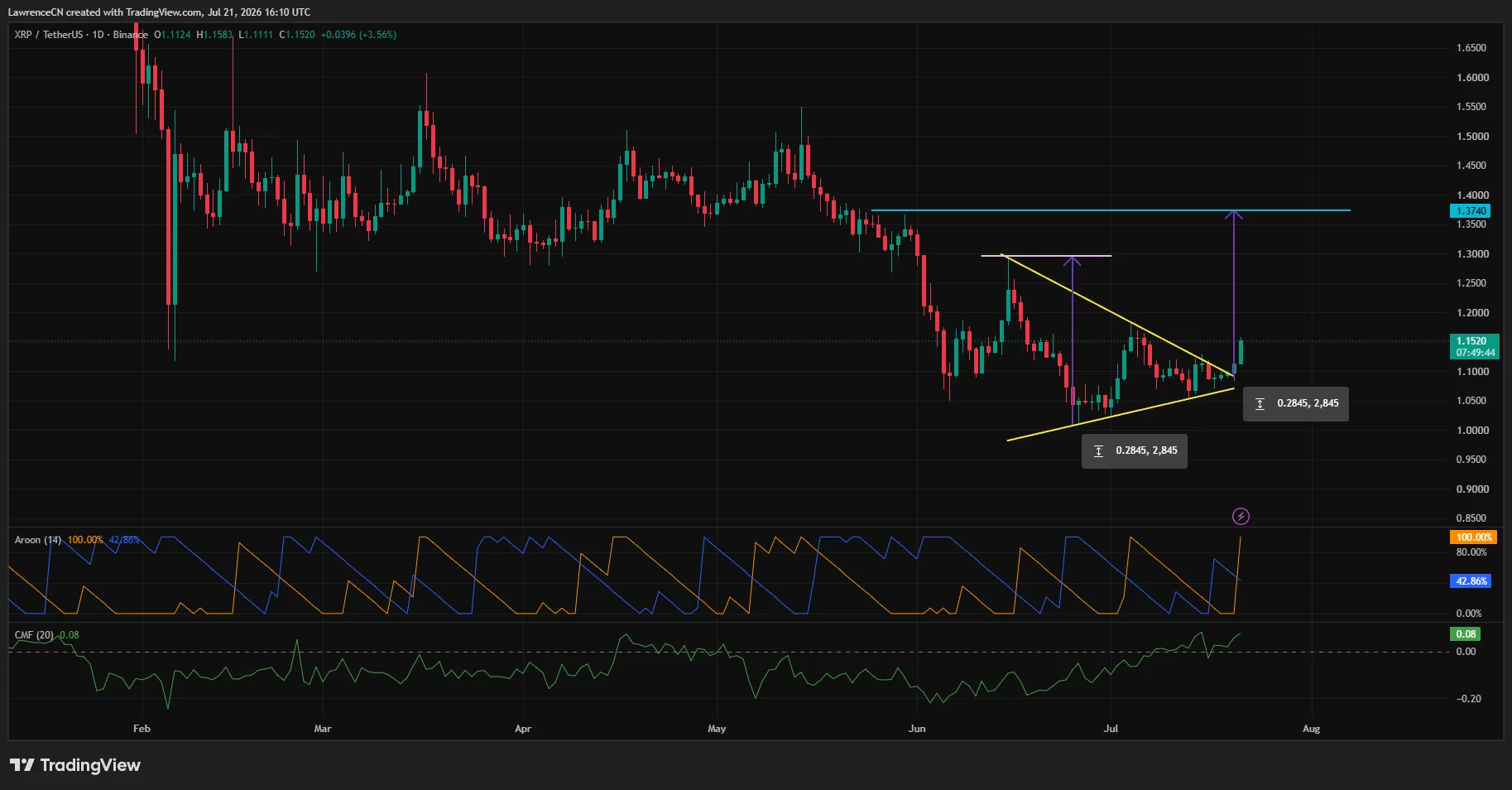
The pattern developed between falling resistance from the mid-June swing high and ascending support extending from the late-June low. XRP’s move above the upper trendline indicates a breakout attempt, although confirmation still depends on a daily close outside the formation.
Based on the measured height displayed on the supplied chart, the triangle carries a projected move of about $0.2845. Applying that distance to the breakout area places the first marked target near $1.30.
A second resistance line appears at $1.374, which acted as a trading area before XRP’s sharp decline in early June. The chart therefore shows $1.30 as the first target and $1.374 as the next barrier if buyers maintain control.
TradingView’s Aroon indicator supports the bullish attempt, with Aroon Up at 100% and Aroon Down at 42.86%. Chaikin Money Flow has also climbed to 0.08, indicating that buying pressure has returned during the breakout.
A move back below the triangle’s upper boundary near $1.10 would weaken the pattern and place its rising support at risk. Sustained trading above the breakout line would preserve the chart’s path toward $1.30, though the unverified Amazon strike claim and continued US-Iran attacks could increase volatility across both XRP and Bitcoin.
Disclosure: This article does not represent investment advice. The content and materials featured on this page are for educational purposes only.
The UK Parliament’s Crypto and Digital Assets All-Party Parliamentary Group has launched a formal inquiry into why banks refuse to open accounts and block payments for crypto businesses. Written evidence will be accepted until August 31, while the group aims to publish recommendations before the FCA’s mandatory crypto regime begins in October 2027. The move tests whether the UK’s ambition to become a global digital asset hub can survive banking restrictions.
The inquiry was announced on Tuesday by co-chairs Lord Vaizey of Didcot and Labor MP Gurinder Singh Josan CBE. It covers difficulties opening and maintaining business accounts, transfer limits, payment blocks, and whether banks apply restrictions proportionately. It will also compare the UK’s approach with the US, Hong Kong, Australia, and the European Union.
The APPG outlined its concern clearly. It said crypto and digital asset firms have consistently reported difficulty accessing UK banking services. The group added that banking access is essential for legitimate businesses, while unnecessary barriers risk slowing investment, innovation, and long-term growth.
The scale of the issue remains significant. Research from the UK Cryptoasset Business Council, published in January 2026, found roughly 40% of payments to crypto exchanges were blocked or delayed by UK banks. One platform reported almost £1 billion in rejected transactions during 2025. Meanwhile, 80% of exchanges saw customer friction increase, while 70% described banking conditions as more hostile than a year earlier.
— Crypto Banter (@crypto_banter) July 21, 2026
 UK LAWMAKERS LAUNCH INQUIRY INTO CRYPTO BANKING ACCESS!
UK parliamentarians have launched an inquiry into the challenges crypto firms face in obtaining traditional banking services.
The probe aims to address barriers that have hindered the sector’s growth and integration with… pic.twitter.com/aSqFNBRRPx
Those findings contrast with the government’s stated position. HM Treasury Economic Secretary Lucy Rigby told Parliament in March 2026 that licensed crypto firms should not face restrictions simply because they operate in the sector. As a result, the inquiry will examine why FCA-registered businesses continue facing banking hurdles despite regulatory progress.
Discover: The Best Crypto to Diversify Your Portfolio
UK Crypto and FCA Framework Sharpen the Debanking Question
The inquiry also follows the UK’s finalized FCA crypto framework. The authorization window opens in September 2026, while full compliance becomes mandatory on October 25, 2027. If licensed firms still struggle to secure banking services, confidence in the new regulatory framework could suffer.
Meanwhile, comparisons with overseas markets continue to grow. In the United States, crypto companies have compared banking restrictions to Operation Chokepoint 2.0. Kraken recently secured a $22 million settlement from an auditor it claimed abandoned the exchange during that period. In Australia, Coinbase has also criticized banks over restrictions on crypto-related services. The APPG will assess how competing jurisdictions have handled similar challenges.
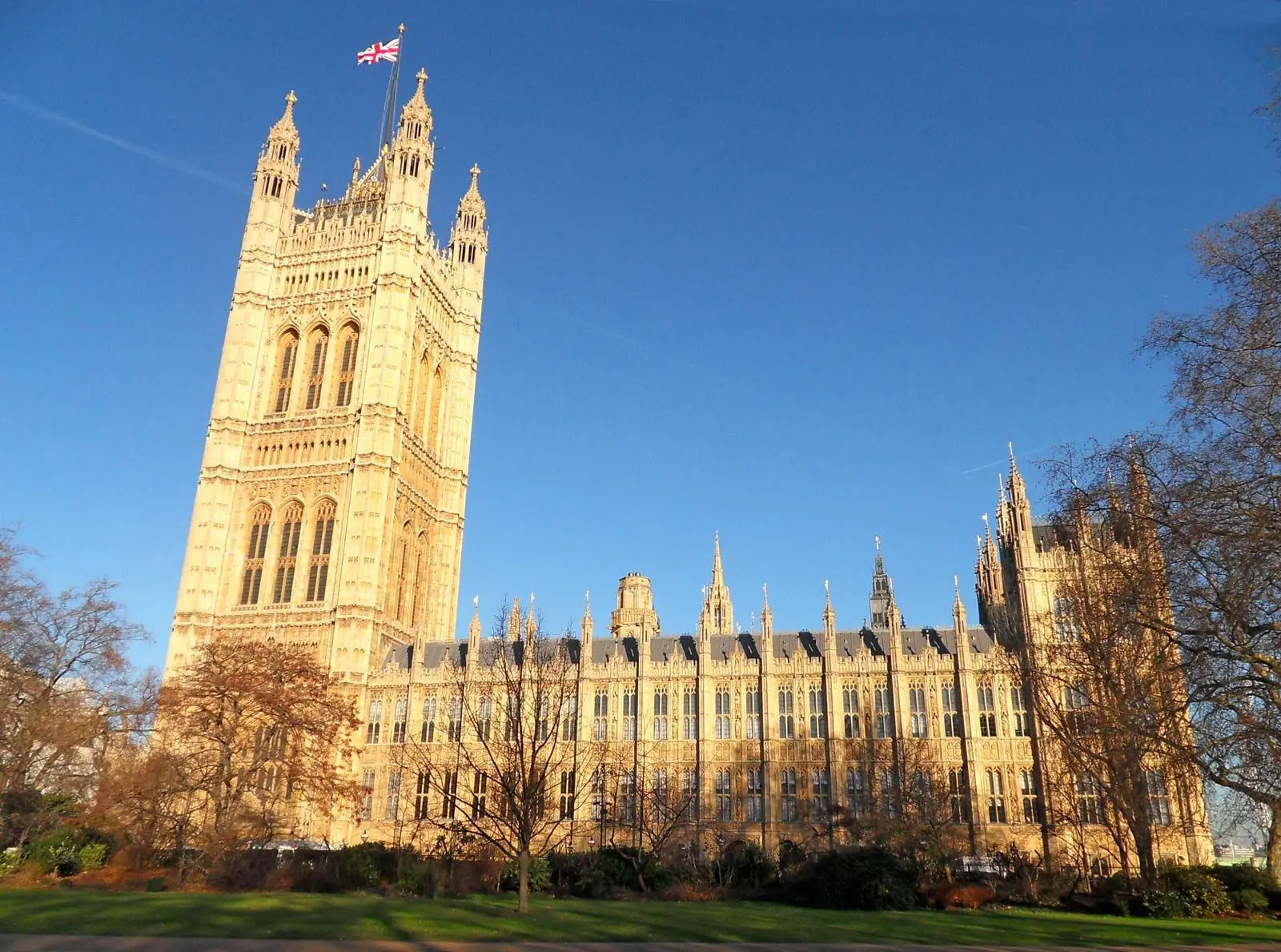
The inquiry arrives during a political transition. Andy Burnham became Prime Minister on Monday, while John Healey was appointed Chancellor of the Exchequer. Legal experts say global financial firms will closely watch whether the new government delivers a stable regulatory environment for digital assets and financial services.
Written submissions will be accepted from July 21 through August 31 across banking, payments, fintech, and crypto sectors. The APPG will then publish recommendations before the October 2027 deadline. Industry participants are expected to advocate for case-by-case risk assessments instead of blanket restrictions on FCA-registered crypto firms.
Trade on Bybit and Get a Chance to Win Our $1,000 USDT Airdrop
The post APPG Targets UK Bank Debanking of Crypto Firms Before 2027 FCA Deadline appeared first on Cryptonews.
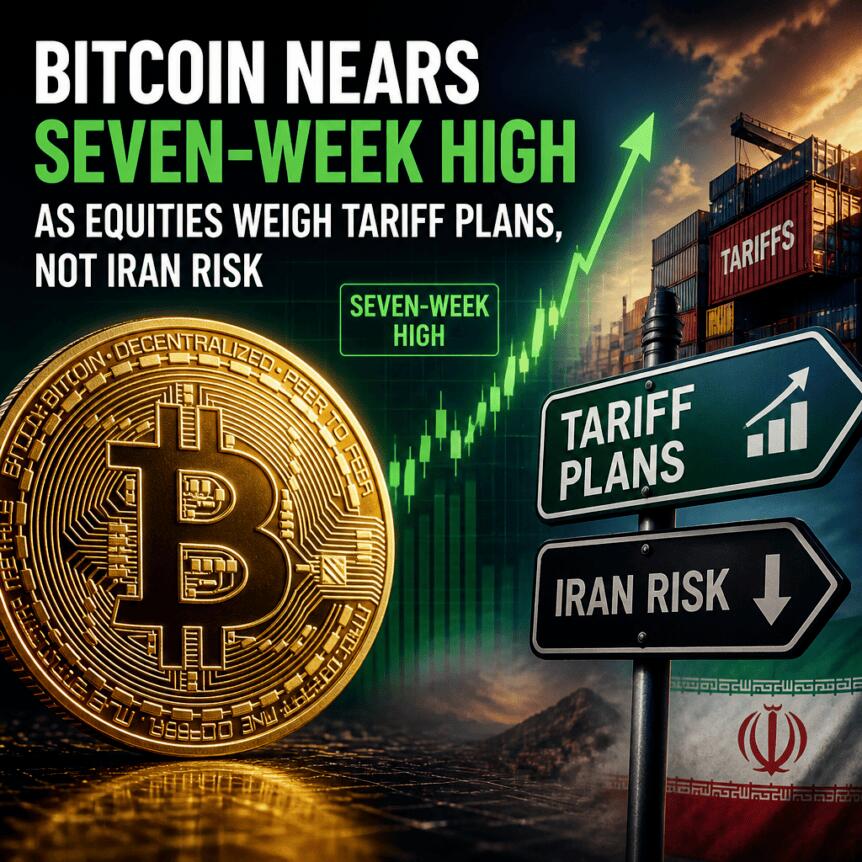
Bitcoin extended its early gains into the Wall Street open, tracking a broader buoyancy in US risk assets despite fresh geopolitical and tariff-related headlines. TradingView data showed BTC/USD pressing toward $67,000 and edging close to its seven-week highs.
What stands out for traders is that neither the latest escalation in the US–Iran situation nor renewed talk of international trade tariffs has meaningfully derailed momentum in crypto markets. Instead, price action suggests participants are leaning toward the view that any disruptions may be temporary—at least for now.
Key takeaways
- BTC moved toward $67,000 and threatened fresh multi-week highs as stocks held up into the US session.
- Escalating tensions involving Iran and the Strait of Hormuz coincided with strength in risk assets rather than a selloff.
- Reported US tariff plans could have been a headwind for speculative markets, but traders appeared to expect a resolution.
- Analysts warn Bitcoin needs to reclaim its 21-week simple moving average to credibly challenge the broader bear-market structure.
Geopolitical escalation and tariff talk fail to cool risk appetite
According to TradingView, BTC/USD approached $67,000 during the session, with momentum that began earlier appearing to persist. The cryptocurrency’s relative resilience came alongside firm trading in US equity futures.
At the same time, the day’s headlines pointed to conditions that often support “risk-off” behavior. The US–Iran conflict saw further escalation after Iran struck targets at Amazon facilities in Bahrain in response to US strikes, and reporting indicated the Strait of Hormuz oil route remained closed.
In commodity markets, the geopolitical pressure showed up in crude prices: WTI oil rose to its highest level in over a month, nearing $85 per barrel, as TradingView’s WTI CFDs chart reflected.
On the policy front, multiple outlets reported that President Donald Trump is planning to introduce new 10% international trade tariffs. The proposal is described as following 50% measures imposed on Canada earlier in the week. Historically, tariff uncertainty can weigh on broader risk sentiment, yet crypto traders did not appear to react with sustained caution.
Instead, commentary from market participants suggested expectations that the situation would ultimately resolve in favor of markets. YouTube host Crypto Rover, for example, summarized the prevailing stance in an X post, writing that “Markets are pricing in peace.”
Stocks in focus as macro risks get tested
While crypto held up, some investors remained confident about near-term equity direction. Caleb Franzen, who runs macro analysis resource Cubic Analytics, posted on X that he had “zero fear” or worry regarding S&P 500 futures, describing the setup as supportive.
Still, the optimism was not universal. Cautionary notes surfaced from senior banking leadership, including JPMorgan CEO Jamie Dimon, who warned that markets were not pricing risks aggressively enough relative to what could come next. The juxtaposition highlights the tension investors face: risk assets can keep rising even when underlying risks are real, as long as participants believe outcomes will be less severe than feared.
Technical pressure point: the 21-week trendline
For Bitcoin-specific direction, attention shifted from short-term resistance levels to a longer moving-average benchmark. Material Indicators cofounder Keith Alan offered a more guarded view of the near-term outlook, arguing that the bear market may still be intact until BTC confirms a stronger trend.
Alan pointed to a “golden cross” involving the 21-day and 50-day simple moving averages on Monday, but emphasized that such signals on lower timeframes don’t necessarily negate a broader downturn. In his X analysis, he warned that bear markets do not always look like bear markets—especially when price action is volatile but not trend-confirmed.
The key condition, according to Alan, is whether Bitcoin can reclaim its 21-week simple moving average. He wrote that the macro trend would be challenged only if BTC pushes above that level, noting that until then, “the Bear Market remains intact.”
At the time of writing, the 21-week SMA was cited at $69,720, a figure that also aligns with Bitcoin’s 2021 all-time high. The larger implication is that reclaiming this long-term trendline would signal more than just a bounce—it would suggest a shift in how the market is pricing longer-duration risk.
Alan also acknowledged that there was “no real resistance” until $67,250, which helps explain why traders were willing to press higher even amid macro uncertainty. However, the absence of immediate resistance near $67,000 does not guarantee follow-through if the move fails at the longer-term moving-average level.
What to watch next for BTC
With BTC approaching the high-$60,000 zone, traders are now likely to monitor whether price can build momentum toward the $69,720 21-week SMA area. If Bitcoin cannot reclaim that threshold, analysts like Keith Alan suggest the market may still be operating under a bear-market structure—even if rallies continue to occur in the shorter term.
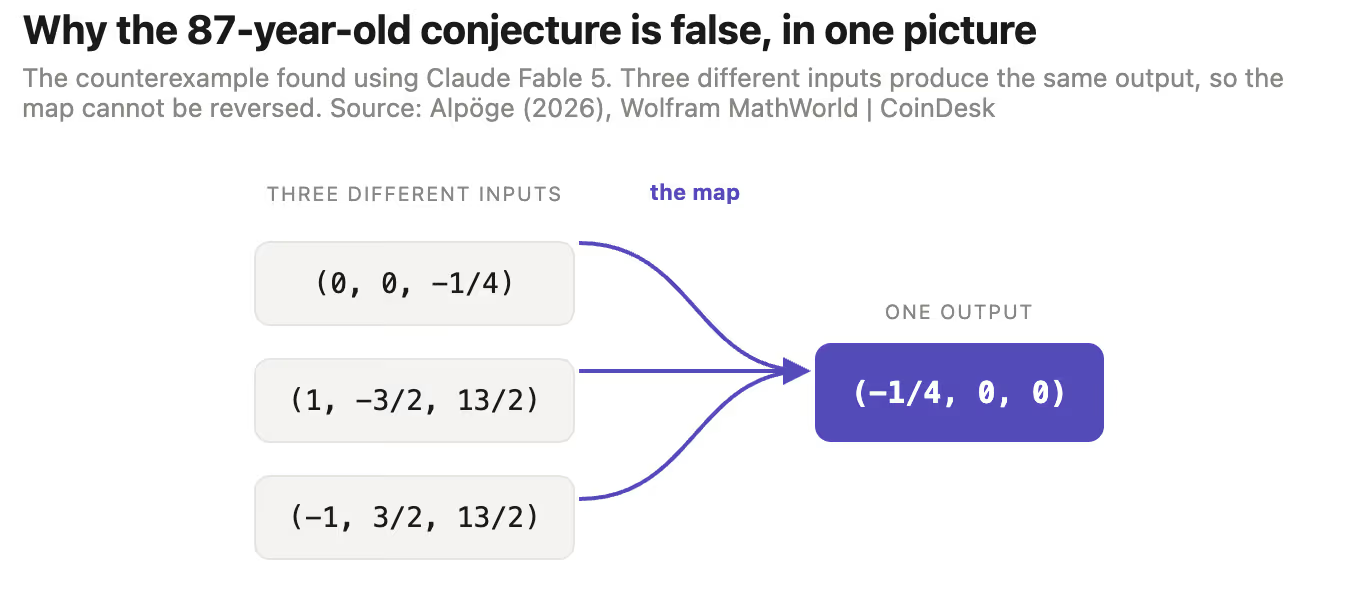
But the larger pull is simpler: AI is where the speculative money and investors’ attention are now going. The capital that once chased crypto is now chasing compute, chips and model builders, and every leap in what these systems can do widens that appeal.
Each result like Fable’s finding of the Jacobian conjecture strengthens the case for pouring capital into AI, and poses a difficult conundrum for crypto investors: Why hold a token that trades as a sidecar to the AI cycle when someone can own the vehicle itself?
AI’s capability curve is steep, and the steeper it gets, the more of the market’s risk appetite it draws away from everything else, crypto included.
What the problem actually was
Think of a machine that takes two numbers and gives back two new numbers, using only adding and multiplying. The question, first asked in 1939, was whether the machine can always be run backward: given only its answer, can the original two numbers be recovered every time?
Mathematicians had a quick way to check whether a machine looked reversible. The Jacobian conjecture said that if a machine passed that check, it should always be reversible.

For 87 years, nobody could prove it was true, and nobody could find a machine that broke the rule.
The White House has agreed to the CLARITY Act ethics package. These are the conflict-of-interest rules that froze the crypto bill for months. Treasury Secretary Scott Bessent says the Senate is now at the 1-yard line.
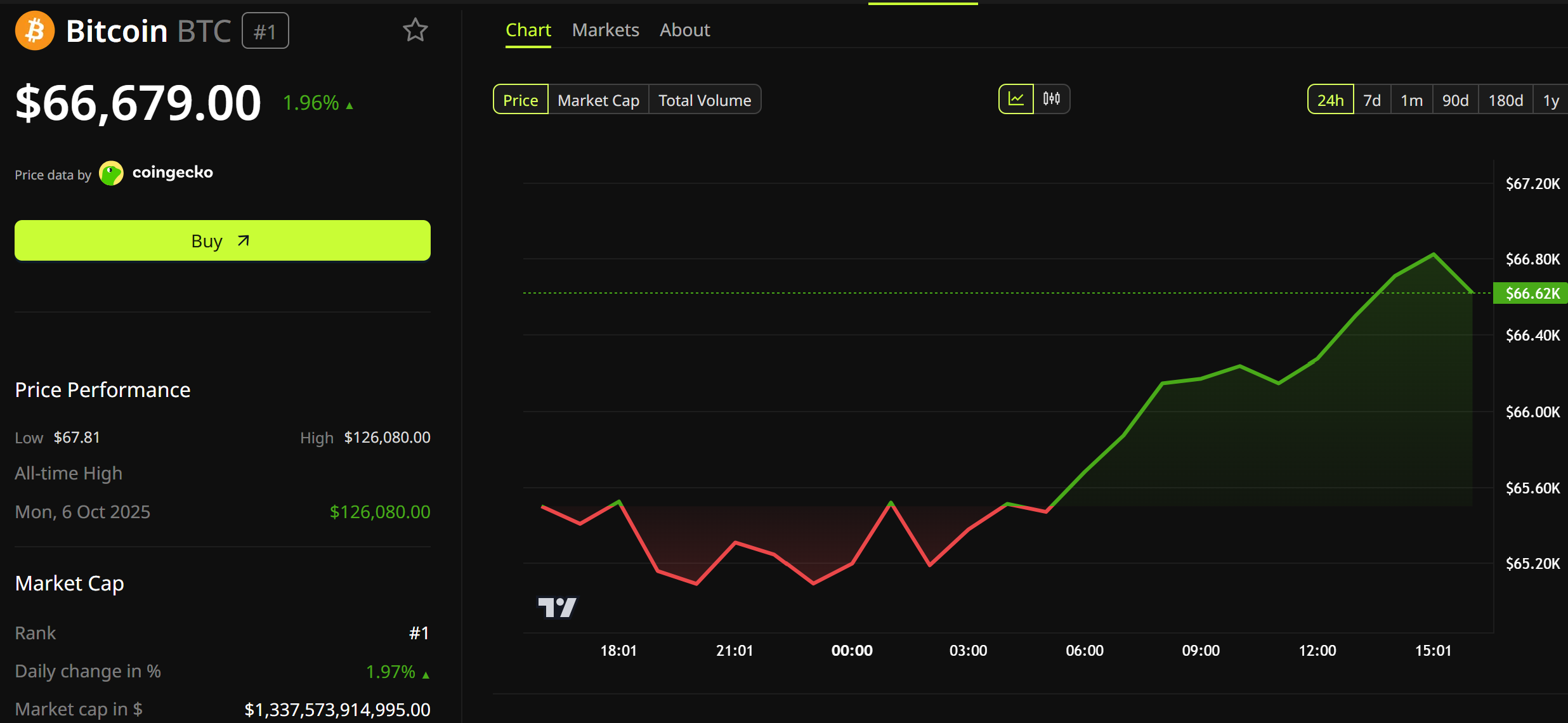
Bitcoin (BTC) climbed toward $67,000 on the news. Here is what the deal says, and why traders like it.

What Is the CLARITY Act Ethics Package?
Start with the bill itself. The Digital Asset Market Clarity (CLARITY) Act would give US crypto its first full federal rulebook.
The split is simple. The Commodity Futures Trading Commission (CFTC) would police digital commodities like Bitcoin. The Securities and Exchange Commission (SEC) would keep tokens that act like securities.
The House passed the bill 294-134 in a bipartisan vote on July 17, 2025. Then it hit a wall. It needs 60 Senate votes, and it stalled before the Senate floor over one clause.
That clause is the ethics package. It would stop the president, the vice president, lawmakers, and senior officials from profiting from crypto while in office.
Follow us on X to get the latest news as it happens
Why did Democrats insist on it? Trump’s money. The president’s annual disclosure listed $635 million in meme coin royalties. It showed another $515 million from World Liberty Financial token sales.
The fight is not new. In May, Senator Chris Van Hollen offered an amendment to ban officials and their families from owning or promoting crypto. Republicans blocked it. The bill cleared committee 15-9, with just two Democrats, Ruben Gallego and Angela Alsobrooks, on board.
Last week, that wall cracked. Trump met Senators Cynthia Lummis and Bernie Moreno in the Oval Office. On Monday, the White House agreed and sent the language to Senate Republicans.
Senator Kevin Cramer, a North Dakota Republican, confirmed one more change. The Department of Justice (DOJ) would enforce the rules, not individual state attorneys general.
Why the CLARITY Act Ethics Package Is Bullish for Bitcoin
The math explains the excitement. Republicans hold 53 Senate seats. At least seven Democrats must cross over. The ethics deal answers their biggest objection. Watch Senators Catherine Cortez Masto and Mark Warner, who want illicit finance safeguards first.
The administration is pushing hard. Bessent said lawmakers are at the “1-yard line,” Bloomberg reported Tuesday. He wants the bill passed before the August recess.
Markets voted fast. The $63 billion market rebound lifted total crypto value 2.8% to $2.32 trillion. Bitcoin trades near $66,604, up 2% in a day. Coinbase stock jumped as much as 12%.

The deeper case is simple. Clear rules end years of regulation by lawsuit. That lowers risk for banks, funds, and custodians. Meanwhile, the Bitcoin ETF inflow streak is back. About $727 million entered US spot funds in five days.
The chart helps too. Glassnode data shows only about 1% of Bitcoin supply last changed hands between here and $70,685. Little stands in the way.

What Could Still Go Wrong
Plenty. Van Hollen and Senator Elizabeth Warren say the draft weakens consumer protections rather than adding them.
“While the CLARITY Act may seek to do that, it not only fails to achieve those goals but also risks deregulating existing markets and opening the door to further corruption and abuse.”
Traders stay cautious too. Last week, Polymarket passage odds fell to 38% for 2026 before the breakthrough. The odds have since sprung up, however, amid recent developments.

History adds a warning. Trump signed the GENIUS Act, the stablecoin law, in July 2025. Crypto’s total value crossed $4 trillion for the first time. Yet regulators missed that law’s one-year rule deadline just last Saturday. Passage is a catalyst, not a finish line.
The clock is the last risk. Majority Leader John Thune must fit a floor vote into a tight Senate floor window before recess starts on August 7.
For now, the bill’s biggest weakness has become its momentum. Bitcoin sits about 5% below $70,000. Watch for the updated text, and for the first Democrat to say yes.
The post What is the CLARITY Act Ethics Package and Why is It Bullish for Bitcoin? appeared first on BeInCrypto.
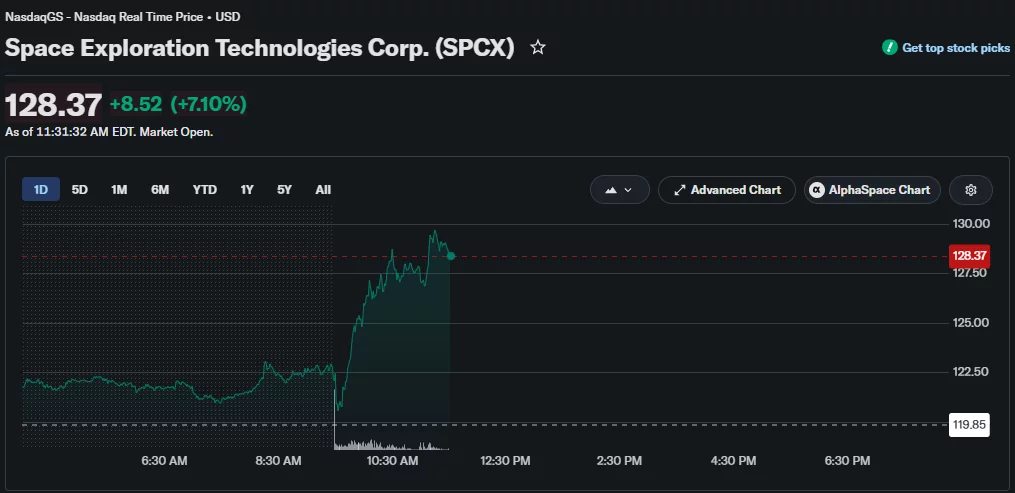
Cathie Wood’s ARK Invest has gained an early paper profit after buying $20.45 million of SpaceX stock one day before the shares jumped 7.10% to $128.37.
Summary
- ARK Invest bought 170,634 SpaceX shares worth about $20.45 million across four ETFs.
- SpaceX stock jumped 7.10% to $128.37, giving ARK an early paper gain.
- ARK’s SpaceX investment has surpassed $475 million despite heavy short selling and IPO losses.
ARK Invest’s July 20 trading disclosure shows that four of the firm’s actively managed exchange-traded funds bought a combined 170,634 SpaceX shares while the stock was trading under its $135 IPO price. Based on Monday’s closing price of $119.85, the purchases were worth about $20.45 million.
During Tuesday’s session, SpaceX shares rose $8.52 to $128.37 as of 11:31 a.m. EDT, according to Nasdaq real-time market data. Applying that increase to ARK’s latest purchase gives the position an unrealized gain of about $1.45 million, although its final value will depend on where the stock trades when the funds sell.
Tuesday’s advance followed a 3.34% decline on Monday, when SpaceX extended a steep retreat from its post-IPO peak. Despite the rebound, the stock remained about 4.9% below its $135 offer price and nearly 43% under its record high of $225.64.
ARK expands its SpaceX exposure
Among the four funds, the ARK Innovation ETF made the largest purchase by adding 97,664 SpaceX shares. ARK’s disclosure valued that position at roughly $11.70 million using Monday’s closing price.
The ARK Autonomous Technology & Robotics ETF purchased another 31,807 shares worth about $3.81 million. At the same time, the ARK Next Generation Internet ETF added 28,153 shares valued at approximately $3.37 million.
Completing the latest round, the ARK Space Exploration & Innovation ETF bought 13,010 shares for close to $1.56 million. ARK spread the purchase across funds with different mandates, although each portfolio gained exposure to the same SpaceX price recovery.
Monday’s transaction followed another large ARK purchase on July 17, when four funds acquired 147,623 SpaceX shares after the stock fell 5.43% to a fresh post-IPO low. According to ARK’s July 17 trading report, those shares were worth about $18.3 million at the closing price of $123.99.
ARKK led that earlier purchase with 95,129 shares valued at approximately $11.8 million. ARKQ bought 30,464 shares worth $3.78 million, while ARKX added 12,611 shares valued at $1.56 million. ARKW completed the transaction with 9,419 shares worth roughly $1.17 million.
Across the July 17 and July 20 disclosures, ARK purchased 318,257 SpaceX shares valued at about $38.75 million at the respective closing prices. The two transactions continued a series of investments that began around SpaceX’s June 12 stock-market debut.
According to Ark Invest Tracker, Wood’s firm had already invested more than $475 million in SpaceX by the week ending July 10. The tracker reported about $52.1 million of purchases during that week, following roughly $444 million of buying around the IPO.
Wall Street’s outlook remains largely positive despite SpaceX’s post-IPO decline. According to an Ark Invest Tracker post citing Reuters data from July 7, analysts had a median price target of $213.50, which implies about 66% upside from Tuesday’s $128.37 price. Raymond James held the highest target at $800, followed by Morgan Stanley at $300, while MoffettNathanson had the lowest estimate at $130.
Short sellers retain large exposure
Although Tuesday’s rally gave ARK’s latest position an early lift, S3 Partners data indicates that bearish traders have benefited from the decline that followed SpaceX’s record high. According to the financial-data firm, short sellers accumulated about $4 billion in paper profits over the previous month.
S3 Partners also estimated that investors betting against SpaceX had shorted about 30% of its freely traded shares, equal to roughly 192 million shares. A large short position can add buying pressure when the price rises because some traders may repurchase shares to close their bets, though S3 Partners had not attributed Tuesday’s gain specifically to short covering.
Operational concerns have also weighed on investor sentiment since the IPO. SpaceX called off Starship’s first planned post-listing flight after an automatic abort triggered by engine problems, according to the original launch update. The cancellation added another setback while the stock was already retreating from its June peak.
Investors are also watching the scheduled expiration of SpaceX’s post-IPO lockup on Aug. 19. According to the lockup details cited in the original report, the expiration could make an additional 900 million shares eligible for trading, potentially increasing the stock’s available supply.
For now, Tuesday’s 7.10% jump has recovered Monday’s entire decline and moved SpaceX closer to its IPO price. Nasdaq data still placed the shares $6.63 below the $135 offer level, leaving ARK’s earlier purchases with different results depending on their entry prices, even as the latest $20.45 million bet moved into profit.

Postal IRCs Are Almost A Thing Of The Past

Consortium in talks to buy stake in Liverpool as FSG release statement

Iberdrola to Take Control of Finnish Utility Caruna for $2.3 Billion


-
 NewsBeat5 days ago
London Mayor Sadiq Khan handed a peerage by Keir Starmer alongside 15 other Labour figures… just days before the PM leaves No10
-

 Fashion4 days ago
Weekend Open Thread – Corporette.com
-

 Politics3 days ago
The House | The City of London can help the new chancellor deliver growth in every postcode
-

 Politics6 days ago
Young campaigners urge incoming PM to act on outdoor junk food ads
-

 Crypto World6 days ago
CFTC blocks Kalshi from unwinding Michigan trades after court order
-
 Crypto World4 days ago
Two July Windows Left: The CLARITY Act’s Senate Fight and What Failure Means
-

 Crypto World3 days ago
Ripple Payments Joins MiCA With 14 Firms, Does It Mean Anything For XRP?
-

 Business6 days ago
Nvidia Stock Slips After Big Tuesday Rally as Huang Confirms Vera Rubin Chip Is Now in Production Today
-

 Politics2 days ago
Democrats look to World Cup watch parties to register thousands of voters
-
 Entertainment6 days ago
Disney’s Most Ambitious Failed Star Wars Attraction Is Coming to SDCC
-

 Crypto World4 days ago
Ripple wins EU-wide access as ESMA adds it to MiCA register
-

 Crypto World9 hours ago
Grayscale Files For Worldcoin ETF, WLD Registers Sharp Rise
-

 Crypto World5 days ago
Injective Submits SEC Transfer-Agent Registration to Onchain Ownership Records
-

 Business6 days ago
Palantir Shares Rise After Expanded Nvidia Partnership and Fresh Analyst Upgrades Ahead of Earnings Day
-

 Tech17 hours ago
Sail Virtually Aboard The “Itanic” With IA-64 Emulator
-
 Tech14 hours ago
Turtle Beach Command Series KB7 review: a nifty screen-equipped gaming keyboard
-

 Tech7 days ago
Dark Secrets Emerge When Jailbreaking LLMs
-

 NewsBeat4 days ago
Registration is now open for March for Men with Kev 2026
-

 News Videos7 days ago
XRP BOMBSHELL… XRP OMBOARDED FOR TRANSACTIONS!!!
-

 NewsBeat1 day ago
Unregistered fitter used Gas Safe logo on business flyers
You must be logged in to post a comment Login